

ISO/FDIS 23974-2
(Main)Leather — Red hair sheep skins — Part 2: Guidelines for grading on the basis of defects
- Abstract
This draft international standard prescribes guidelines for classification of raw or cured, trimmed red hair sheep skins on the basis of visually apparent defects.
- Status
- Not Published
- Technical Committee
- ISO/TC 120/SC 1 - Raw hides and skins, including pickled pelts
- Drafting Committee
- ISO/TC 120/SC 1 - Raw hides and skins, including pickled pelts
- Current Stage
- 5020 - FDIS ballot initiated: 2 months. Proof sent to secretariat
- Start Date
- 06-Oct-2026
- Completion Date
- 06-Oct-2026
Buy Documents
ISO/FDIS 23974-2 - Leather — Red hair sheep skins — Part 2: Guidelines for grading on the basis of defects
REDLINE ISO/FDIS 23974-2 - Leather — Red hair sheep skins — Part 2: Guidelines for grading on the basis of defects
ISO/FDIS 23974-2 is an ISO draft international standard for grading raw or cured, trimmed red hair sheep skins. It specifies classification guidelines based on visually apparent defects, so people handling these skins can sort them consistently in inspection, buying, and quality control.
What does ISO/FDIS 23974-2 specify?
ISO/FDIS 23974-2 specifies how to classify red hair sheep skins by the defects that can be seen on the skin surface. The document covers raw or cured, trimmed skins and organizes the grading rules into defect categories, four grades, and a rejection rule.
Clause 4 groups faults and defects into six locations or causes, and Clause 5 turns those defect groups into grading criteria. Clause 6 gives the cases that lead to rejection.
What are the key requirements of ISO/FDIS 23974-2?
ISO/FDIS 23974-2 grades skins from first grade to fourth grade, then rejects skins that fall outside the accepted limits. In practice, the standard is a visual sorting rule: the grader checks where defects are located, how many there are, and how much of the skin they affect.
How the document groups defects
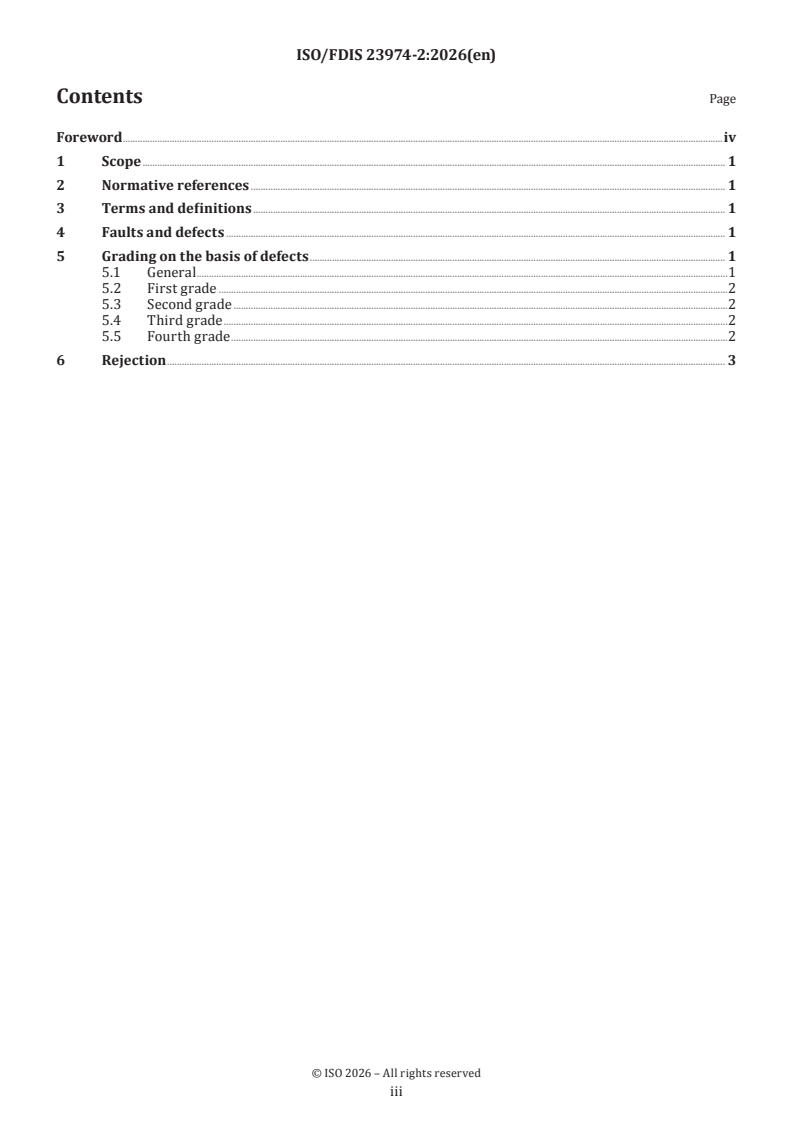
Clause 4 divides faults and defects into six groups:
- defects related to the health of the animal
- defects related to breeding conditions, such as brands
- defects from insects and parasites
- open or cicatrized wounds, whether caused on the living animal or during flaying
- preservation defects such as putrefaction, chemical stains, hair slip and red heat
- dirt such as dung, urine stains, sand and dust
This matters because the grader is not looking at defects as one single category. The location and origin of the defect affect which grade the skin can still receive.
What first grade means
Clause 5.2 sets the strictest grade. A first-grade red hair sheep skin has no visible defects in the central part, no sign of putrefaction, and should be free from dirt. Only one defect is accepted at the periphery, on the legs or tail, such as a few parasite defects, one branding mark, or one wound.
In practice, first grade is for skins with very limited surface damage, mainly outside the best central area.
What second and third grade allow
Clause 5.3 allows more defects on the shoulder or belly, in addition to defects already accepted at the periphery, legs and tail. Clause 5.4 extends acceptance further, allowing low or medium concentrations of defects in the best part of the skin, identified as the butt.
For a buyer or quality manager, these two grades show how far defects may spread before the skin drops into a lower commercial class. The document uses both defect type and body location to set that limit.
What fourth grade means
Clause 5.5 accepts defects in low or medium concentration over the skin, as long as they do not cover more than 40 % of the total skin area.
This is the broadest usable grade before rejection. It gives a clear area limit, so graders can judge whether a damaged skin still belongs in the fourth grade.
When skins are rejected
Clause 6 rejects skins that exceed the fourth-grade allowance or where more than 50 % of the area cannot be processed into leather. It also rejects fallen skins, untrimmed or poorly trimmed skins, ground and ball dried skins, and smoked skins.
For users, this means rejection can result either from excessive defect levels or from a preparation condition that makes the skin unsuitable for normal leather processing.
Who uses ISO/FDIS 23974-2?
ISO/FDIS 23974-2 is used by people who inspect, grade, buy, or receive red hair sheep skins in the leather chain. That includes graders, tannery staff, traders, and quality teams who need a shared visual basis for acceptance and price class decisions.
What does the ISO/FDIS 23974-2 document contain?
ISO/FDIS 23974-2 is a short grading document rather than a test-method standard. It contains a scope, a defect classification in Clause 4, grading rules in Clause 5, and rejection criteria in Clause 6.
The content is practical and inspection-oriented. It focuses on where defects appear on the skin - central part, periphery, legs, tail, shoulder, belly and butt - and how those locations affect grade.
The document also uses descriptive lists for defect types such as disease-related marks, parasite damage, branding, wounds, preservation defects, and dirt. That structure helps users apply the same visual grading logic during receiving, sorting, and commercial evaluation.
Buy Documents
ISO/FDIS 23974-2 - Leather — Red hair sheep skins — Part 2: Guidelines for grading on the basis of defects
REDLINE ISO/FDIS 23974-2 - Leather — Red hair sheep skins — Part 2: Guidelines for grading on the basis of defects
Get Certified
Connect with accredited certification bodies for this standard

Control Union Certifications
Global certification for agriculture and sustainability.

Hohenstein Institut
Textile testing and certification.

Bureau Veritas Bangladesh
Bureau Veritas certification services in Bangladesh.
Sponsored listings
Frequently Asked Questions
ISO/FDIS 23974-2 is a draft published by the International Organization for Standardization (ISO). Its full title is "Leather — Red hair sheep skins — Part 2: Guidelines for grading on the basis of defects". This standard covers: This draft international standard prescribes guidelines for classification of raw or cured, trimmed red hair sheep skins on the basis of visually apparent defects.
This draft international standard prescribes guidelines for classification of raw or cured, trimmed red hair sheep skins on the basis of visually apparent defects.
ISO/FDIS 23974-2 is classified under the following ICS (International Classification for Standards) categories: 59.140.20 - Raw skins, hides and pelts. The ICS classification helps identify the subject area and facilitates finding related standards.
ISO/FDIS 23974-2 is available in PDF format for immediate download after purchase. The document can be added to your cart and obtained through the secure checkout process. Digital delivery ensures instant access to the complete standard document.
Standards Content (Sample)
FINAL DRAFT
International
Standard
ISO/TC 120/SC 1
Leather — Red hair sheep skins —
Secretariat: BIS
Part 2:
Voting begins on:
2026-10-06
Guidelines for grading on the basis
of defects
Voting terminates on:
2026-12-01
RECIPIENTS OF THIS DRAFT ARE INVITED TO SUBMIT,
WITH THEIR COMMENTS, NOTIFICATION OF ANY
RELEVANT PATENT RIGHTS OF WHICH THEY ARE AWARE
AND TO PROVIDE SUPPOR TING DOCUMENTATION.
IN ADDITION TO THEIR EVALUATION AS
BEING ACCEPTABLE FOR INDUSTRIAL, TECHNO-
LOGICAL, COMMERCIAL AND USER PURPOSES, DRAFT
INTERNATIONAL STANDARDS MAY ON OCCASION HAVE
TO BE CONSIDERED IN THE LIGHT OF THEIR POTENTIAL
TO BECOME STAN DARDS TO WHICH REFERENCE MAY BE
MADE IN NATIONAL REGULATIONS.
Reference number
FINAL DRAFT
International
Standard
ISO/TC 120/SC 1
Leather — Red hair sheep skins —
Secretariat: BIS
Part 2:
Voting begins on:
Guidelines for grading on the basis
of defects
Voting terminates on:
RECIPIENTS OF THIS DRAFT ARE INVITED TO SUBMIT,
WITH THEIR COMMENTS, NOTIFICATION OF ANY
RELEVANT PATENT RIGHTS OF WHICH THEY ARE AWARE
AND TO PROVIDE SUPPOR TING DOCUMENTATION.
© ISO 2026
IN ADDITION TO THEIR EVALUATION AS
All rights reserved. Unless otherwise specified, or required in the context of its implementation, no part of this publication may
BEING ACCEPTABLE FOR INDUSTRIAL, TECHNO-
LOGICAL, COMMERCIAL AND USER PURPOSES, DRAFT
be reproduced or utilized otherwise in any form or by any means, electronic or mechanical, including photocopying, or posting on
INTERNATIONAL STANDARDS MAY ON OCCASION HAVE
the internet or an intranet, without prior written permission. Permission can be requested from either ISO at the address below
TO BE CONSIDERED IN THE LIGHT OF THEIR POTENTIAL
or ISO’s member body in the country of the requester.
TO BECOME STAN DARDS TO WHICH REFERENCE MAY BE
MADE IN NATIONAL REGULATIONS.
ISO copyright office
CP 401 • Ch. de Blandonnet 8
CH-1214 Vernier, Geneva
Phone: +41 22 749 01 11
Email: copyright@iso.org
Website: www.iso.org
Published in Switzerland Reference number
ii
Contents Page
Foreword .iv
1 Scope . 1
2 Normative references . 1
3 Terms and definitions . 1
4 Faults and defects . 1
5 Grading on the basis of defects . 1
5.1 General .1
5.2 First grade .2
5.3 Second grade .2
5.4 Third grade .2
5.5 Fourth grade .2
6 Rejection . 3
iii
Foreword
ISO (the International Organization for Standardization) is a worldwide federation of national standards
bodies (ISO member bodies). The work of preparing International Standards is normally carried out through
ISO technical committees. Each member body interested in a subject for which a technical committee
has been established has the right to be represented on that committee. International organizations,
governmental and non-governmental, in liaison with ISO, also take part in the work. ISO collaborates closely
with the International Electrotechnical Commission (IEC) on all matters of electrotechnical standardization.
The procedures used to develop this document and those intended for its further maintenance are described
in
...
Formatted: French (Switzerland)
ISO/DISFDIS 23974-2
Formatted: French (Switzerland)
ISO/TC 120/SC 1
Secretariat: BIS
Date: 2026-05-1109-09
Leather — Red hair sheep skins —
Part 2:
Guidelines for grading on the basis of defects
DISFDIS stage
VVVVototototiiiinnnngggg b b b beeeeggggiiiinnnnssss on on on on:::: 2222000022225555----00009999----11118888
VVVVooootintintintingggg te te te termrmrmrmiiiinnnnaaaatetetetessss o o o onnnn:::: 2 2 2 2000022225555----11112222----11111111
ISO/DISFDIS 23974-2:2026(en)
All rights reserved. Unless otherwise specified, or required in the context of its implementation, no part of this publication
may be reproduced or utilized otherwise in any form or by any means, electronic or mechanical, including photocopying,
or posting on the internet or an intranet, without prior written permission. Permission can be requested from either ISO
at the address below or ISO’s member body in the country of the requester.
ISO copyright office
CP 401 • Ch. de Blandonnet 8
CH-1214 Vernier, Geneva
Phone: + 41 22 749 01 11
Formatted: French (Switzerland)
E-mail: copyright@iso.org
Website: www.iso.org
Published in Switzerland
ii
ISO/DISFDIS 23974-2:2026(en)
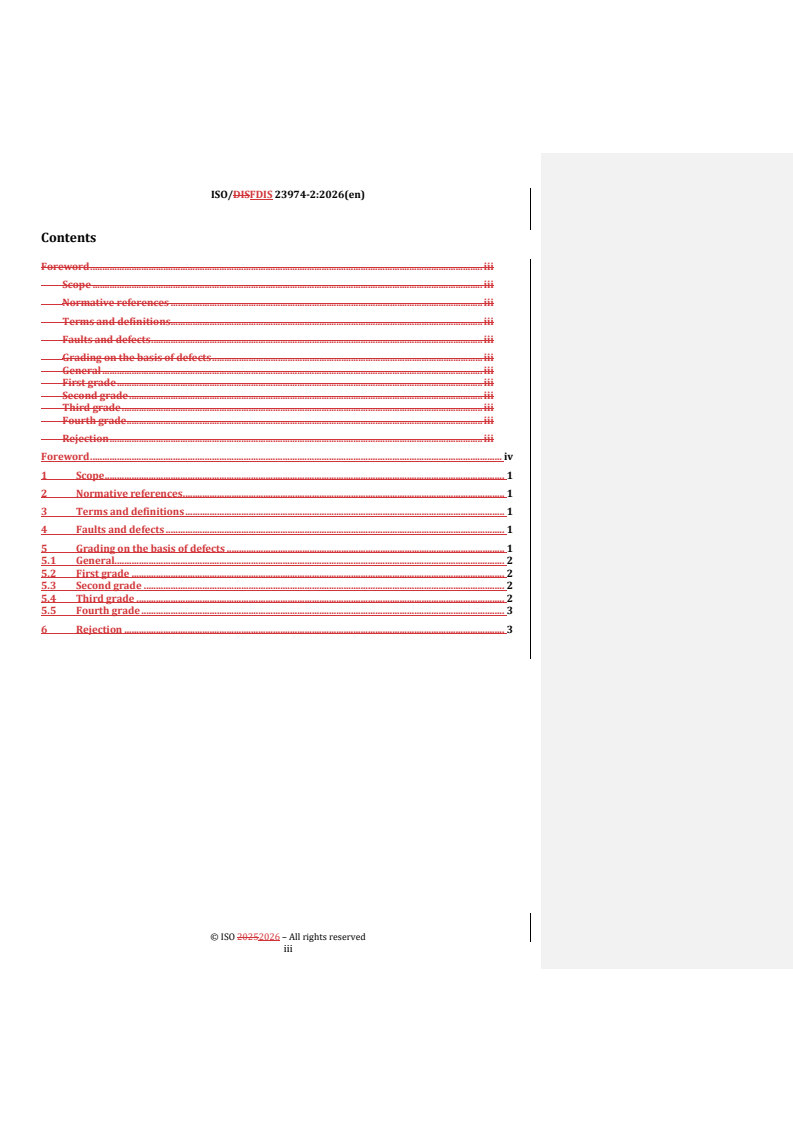
Contents
Foreword . iii
Scope . iii
Normative references . iii
Terms and definitions . iii
Faults and defects . iii
Grading on the basis of defects . iii
General . iii
First grade . iii
Second grade . iii
Third grade . iii
Fourth grade . iii
Rejection . iii
Foreword . iv
1 Scope . 1
2 Normative references . 1
3 Terms and definitions . 1
4 Faults and defects . 1
5 Grading on the basis of defects . 1
5.1 General. 2
5.2 First grade . 2
5.3 Second grade . 2
5.4 Third grade . 2
5.5 Fourth grade . 3
6 Rejection . 3
iii
ISO/DISFDIS 23974-2:2026(en)
Foreword
ISO (the International Organization for Standardization) is a worldwide federation of national standards
bodies (ISO member bodies). The work of preparing International Standards is normally carried out through
ISO technical committees. Each member body interested in a subject for which a technical committee has been
established has the right to be represented on that committee. International organizations, governmental and
non-governmental, in liaison with ISO, also take part in the work. ISO collaborates closely with the
International Electr
...