

ISO 8968-4:2016
(Main)Milk and milk products — Determination of nitrogen content — Part 4: Determination of protein and non-protein nitrogen content and true protein content calculation (Reference method)
General Information
- Abstract
ISO 8968-4|IDF 20-4:2016 specifies a method for the direct and indirect determination of the protein nitrogen content of liquid, whole or skimmed milk.
- Status
- Published
- Publication Date
- 03-Apr-2016
- Technical Committee
- ISO/TC 34/SC 5 - Milk and milk products
- Drafting Committee
- ISO/TC 34/SC 5 - Milk and milk products
- Current Stage
- 9020 - International Standard under periodical review
- Start Date
- 15-Jul-2026
- Completion Date
- 15-Jul-2026
Buy Documents
ISO 8968-4:2016 - Milk and milk products — Determination of nitrogen content — Part 4: Determination of protein and non-protein nitrogen content and true protein content calculation (Reference method) Released:4/4/2016
ISO 8968-4:2016 - Lait et produits laitiers — Détermination de la teneur en azote — Partie 4: Détermination de la teneur en azote protéique et non protéique et calcul de la teneur en protéines vraies (Méthode de référence) Released:4/4/2016
Overview - ISO 8968-4:2016 (Milk protein determination, reference method)
ISO 8968-4:2016 (also published jointly as IDF 20-4) is a reference analytical method for the determination of protein and non‑protein nitrogen in liquid milk (whole or skimmed) and for the calculation of true protein content. The standard specifies both a direct and an indirect analytical approach based on precipitation of milk proteins, followed by nitrogen determination using the Kjeldahl principle (see ISO 8968‑1).
Key topics and technical requirements
- Scope: Direct and indirect determination of protein‑nitrogen in liquid milk; expresses results as mass fraction (percentage).
- Principle: Protein is precipitated from a measured test portion with trichloroacetic acid (TCA).
- Indirect method: measure nitrogen in the TCA filtrate (non‑protein nitrogen, NPN); subtract from previously determined total nitrogen to obtain true protein nitrogen.
- Direct method: determine nitrogen in the protein precipitate (protein nitrogen) directly.
- Reagents: Analytical‑grade reagents only. Key reagents specified include a TCA solution (15.0 g TCA per 100 ml water) and standardized hydrochloric acid solutions (0.10 mol/L for the direct approach and c(HCl) = 0.01 ± 0.0001 mol/L for the indirect approach). Guidance is given on substitution and dilution practices to preserve method precision.
- Apparatus & sample handling: Standard lab glassware plus specific items such as nitrogen‑free filter paper, 75 mm glass funnels, automatic pipette (10 ml), and a 38–40 °C water bath for sample warm‑up and homogenization. Test portion guidance (e.g., pipette 5.0 ml ± 0.1 ml) and detailed filtration/ rinsing steps are provided.
- Procedure outline: Precipitation with ~12% final TCA concentration, filtration, collection of precipitate or filtrate, and digestion/distillation and titration according to ISO 8968‑1 (Kjeldahl).
- Quality: The standard includes sections on precision, sampling recommendations, and test reporting requirements. A safety warning highlights hazardous materials and laboratory practices.
Applications and users
ISO 8968‑4:2016 is intended for:
- Dairy industry analytical and quality control laboratories verifying milk protein content or NPN.
- Regulatory and compliance testing for nutritional labelling and adulteration checks.
- Research and development in dairy science, product formulation, and nutritional analysis.
- Laboratories seeking a reference method to validate or compare rapid/ routine procedures.
Keywords: ISO 8968-4:2016, milk protein determination, true protein content, protein nitrogen, non-protein nitrogen, trichloroacetic acid, Kjeldahl reference method, dairy quality control.
Related standards
- ISO 8968‑1 | IDF 20‑1 - Kjeldahl principle (total nitrogen determination)
- ISO 8968‑3 | IDF 20‑3 - Block digestion (semi‑micro routine method)
Safety note: Users must implement appropriate lab safety measures for handling acids, TCA and digestion reagents.
Relations
- Effective Date
- 12-Feb-2026
- Effective Date
- 03-Sep-2011
- Effective Date
- 03-Sep-2011
Buy Documents
ISO 8968-4:2016 - Milk and milk products — Determination of nitrogen content — Part 4: Determination of protein and non-protein nitrogen content and true protein content calculation (Reference method) Released:4/4/2016
ISO 8968-4:2016 - Lait et produits laitiers — Détermination de la teneur en azote — Partie 4: Détermination de la teneur en azote protéique et non protéique et calcul de la teneur en protéines vraies (Méthode de référence) Released:4/4/2016
Get Certified
Connect with accredited certification bodies for this standard

BSI Group
BSI (British Standards Institution) is the business standards company that helps organizations make excellence a habit.

Bureau Veritas
Bureau Veritas is a world leader in laboratory testing, inspection and certification services.

DNV
DNV is an independent assurance and risk management provider.
Sponsored listings
Frequently Asked Questions
ISO 8968-4:2016 is a standard published by the International Organization for Standardization (ISO). Its full title is "Milk and milk products — Determination of nitrogen content — Part 4: Determination of protein and non-protein nitrogen content and true protein content calculation (Reference method)". This standard covers: ISO 8968-4|IDF 20-4:2016 specifies a method for the direct and indirect determination of the protein nitrogen content of liquid, whole or skimmed milk.
ISO 8968-4|IDF 20-4:2016 specifies a method for the direct and indirect determination of the protein nitrogen content of liquid, whole or skimmed milk.
ISO 8968-4:2016 is classified under the following ICS (International Classification for Standards) categories: 67.100.10 - Milk and processed milk products. The ICS classification helps identify the subject area and facilitates finding related standards.
ISO 8968-4:2016 has the following relationships with other standards: It is inter standard links to EN ISO 8968-4:2016, ISO 8968-5:2001, ISO 8968-4:2001. Understanding these relationships helps ensure you are using the most current and applicable version of the standard.
ISO 8968-4:2016 is available in PDF format for immediate download after purchase. The document can be added to your cart and obtained through the secure checkout process. Digital delivery ensures instant access to the complete standard document.
Standards Content (Sample)
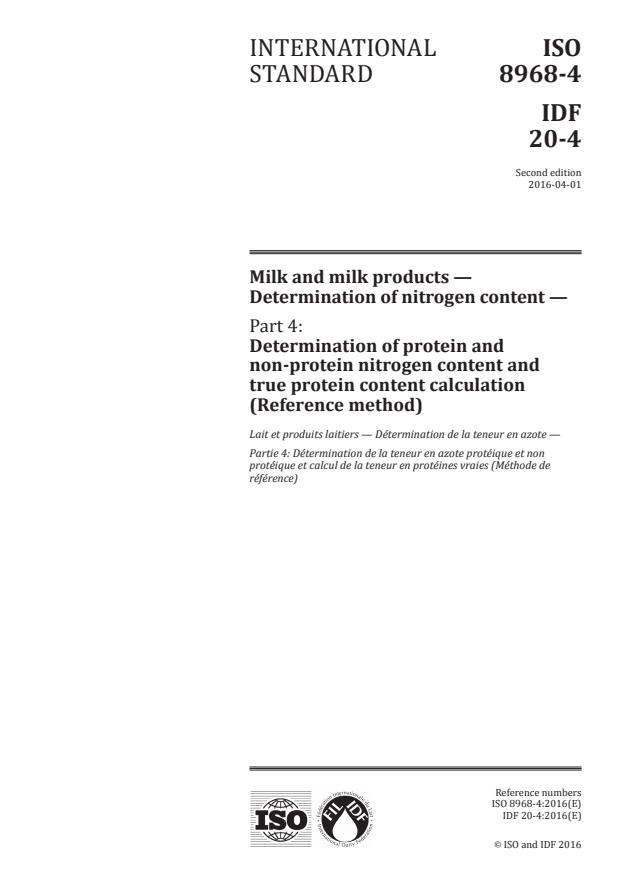
INTERNATIONAL ISO
STANDARD 8968-4
IDF
20-4
Second edition
2016-04-01
Milk and milk products —
Determination of nitrogen content —
Part 4:
Determination of protein and
non-protein nitrogen content and
true protein content calculation
(Reference method)
Lait et produits laitiers — Détermination de la teneur en azote —
Partie 4: Détermination de la teneur en azote protéique et non
protéique et calcul de la teneur en protéines vraies (Méthode de
référence)
Reference numbers
IDF 20-4:2016(E)
©
ISO and IDF 2016
IDF 20-4:2016(E)
© ISO and IDF 2016, Published in Switzerland
All rights reserved. Unless otherwise specified, no part of this publication may be reproduced or utilized otherwise in any form
or by any means, electronic or mechanical, including photocopying, or posting on the internet or an intranet, without prior
written permission. Permission can be requested from either ISO at the address below or ISO’s member body in the country of
the requester.
ISO copyright office International Dairy Federation
Ch. de Blandonnet 8 • CP 401 Silver Building • Bd Auguste Reyers 70/B • B-1030 Brussels
CH-1214 Vernier, Geneva, Switzerland
Tel. +41 22 749 01 11 Tel. + 32 2 325 67 40
Fax +41 22 749 09 47 Fax + 32 2 325 67 41
copyright@iso.org info@fil-idf.org
www.iso.org www.fil-idf.org
ii © ISO and IDF 2016 – All rights reserved
IDF 20-4:2016(E)
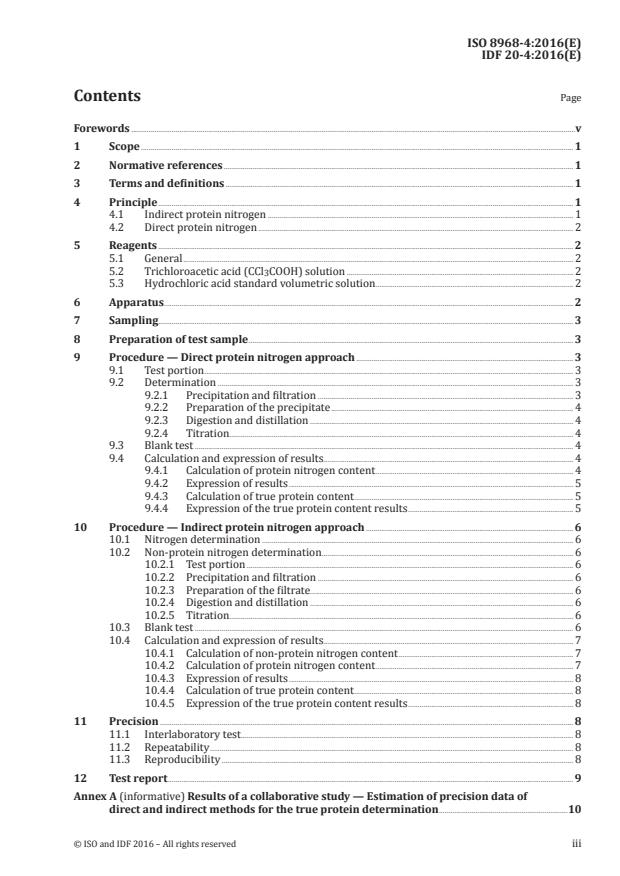
Contents Page
Forewords .v
1 Scope . 1
2 Normative references . 1
3 Terms and definitions . 1
4 Principle . 1
4.1 Indirect protein nitrogen . 1
4.2 Direct protein nitrogen . 2
5 Reagents . 2
5.1 General . 2
5.2 Trichloroacetic acid (CCl COOH) solution . 2
5.3 Hydrochloric acid standard volumetric solution . 2
6 Apparatus . 2
7 Sampling . 3
8 Preparation of test sample . 3
9 Procedure — Direct protein nitrogen approach . 3
9.1 Test portion . 3
9.2 Determination . 3
9.2.1 Precipitation and filtration . 3
9.2.2 Preparation of the precipitate . 4
9.2.3 Digestion and distillation . 4
9.2.4 Titration. 4
9.3 Blank test . 4
9.4 Calculation and expression of results. 4
9.4.1 Calculation of protein nitrogen content . 4
9.4.2 Expression of results . 5
9.4.3 Calculation of true protein content . 5
9.4.4 Expression of the true protein content results . 5
10 Procedure — Indirect protein nitrogen approach . 6
10.1 Nitrogen determination . 6
10.2 Non-protein nitrogen determination . . 6
10.2.1 Test portion . 6
10.2.2 Precipitation and filtration . 6
10.2.3 Preparation of the filtrate. 6
10.2.4 Digestion and distillation . 6
10.2.5 Titration. 6
10.3 Blank test . 6
10.4 Calculation and expression of results. 7
10.4.1 Calculation of non-protein nitrogen content . 7
10.4.2 Calculation of protein nitrogen content . 7
10.4.3 Expression of results . 8
10.4.4 Calculation of true protein content . 8
10.4.5 Expression of the true protein content results . 8
11 Precision . 8
11.1 Interlaboratory test. 8
11.2 Repeatability . 8
11.3 Reproducibility . 8
12 Test report . 9
Annex A (informative) Results of a collaborative study — Estimation of precision data of
direct and indirect methods for the true protein determination .10
IDF 20-4:2016(E)
Bibliography .11
iv © ISO and IDF 2016 – All rights reserved
IDF 20-4:2016(E)
Forewords
ISO (the International Organization for Standardization) is a worldwide federation of national standards
bodies (ISO member bodies). The work of preparing International Standards is normally carried out
through ISO technical committees. Each member body interested in a subject for which a technical
committee has been established has the right to be represented on that committee. International
organizations, governmental and non-governmental, in liaison with ISO, also take part in the work.
ISO collaborates closely with the International Electrotechnical Commission (IEC) on all matters of
electrotechnical standardization.
The procedures used to develop this document and those intended for its further maintenance are
described in the ISO/IEC Directives, Part 1. In particular the different approval criteria needed for the
different types of ISO documents should be noted. This document was drafted in accordance with the
editorial rules of the ISO/IEC Directives, Part 2 (see www.iso.org/directives).
Attention is drawn to the possibility that some of the elements of this document may be the subject of
patent rights. ISO shall not be held responsible for identifying any or all such patent rights. Details of
any patent rights identified during the development of the document will be in the Introduction and/or
on the ISO list of patent declarations received (see www.iso.org/patents).
Any trade name used in this document is information given for the convenience of users and does not
constitute an endorsement.
For an explanation on the meaning of ISO specific terms and expressions related to conformity
assessment, as well as information about ISO’s adherence to the WTO principles in the Technical
Barriers to Trade (TBT) see the following URL: Foreword - Supplementary information
The committee responsible for this document is ISO/TC 34, Food products, Subcommittee SC 5, Milk and
milk products and the International Dairy Federation (IDF). It is being published jointly by ISO and IDF.
This second edition of ISO 8968-4|IDF 20-4 cancels and replaces ISO 8968-4|IDF 20-4:2001 and
ISO 8968-5|IDF 20-5:2001, which have been technically revised.
ISO 8968|IDF 20 consists of the following parts, under the general title Milk and milk products —
Determination of nitrogen content:
— Part 1: Kjeldahl principle and crude protein calculation
1)
— Part 3: Block-digestion method (Semi-micro rapid routine method)
— Part 4: Determination of protein and non-protein nitrogen content and true protein content calculation
(Reference method)
1) It is intended that upon revision, the main element of the title of ISO 8968-3|IDF 20-3 (i.e. “Milk”) will be aligned
with the main element of the titles of ISO 8968-1|IDF 20-1 and ISO 8968-4|IDF 20-4.
IDF 20-4:2016(E)
IDF (the International Dairy Federation) is a non-profit private sector organization representing the
interests of various stakeholders in dairying at the global level. IDF members are organized in National
Committees, which are national associations composed of representatives of dairy-related national
interest groups including dairy farmers, dairy processing industry, dairy suppliers, academics and
governments/food control authorities.
ISO and IDF collaborate closely on all matters of standardization relating to methods of analysis
and sampling for milk and milk products. Since 2001, ISO and IDF jointly publish their International
Standards using the logos and reference numbers of both organizations.
Attention is drawn to the possibility that some of the elements of this document may be the subject of
patent rights. IDF shall not be held responsible for identifying any or all such patent rights. Details of
any patent rights identified during the development of the document will be in the Introduction and/or
on the ISO list of patent declarations received (see www.iso.org/patents).
Any trade name used in this document is information given for the convenience of users and does not
constitute and endorsement
ISO 8968-4|IDF 20-4 was prepared by the IDF Standing Committee on Analytical methods for composition
and ISO Technical Committee ISO/TC 34, Food products, Subcommittee SC 5, Milk and milk products.
The work was carried out by the IDF/ISO Project Group (C13) of the Standing Committee on Analytical
methods for composition under the aegis of its project leaders, D. Barbano (US) and P. Trossat (FR).
This ISO|IDF International Standard cancels and replaces ISO 8968-4|IDF 20-4:2001 and
ISO 8968-5|IDF 20-5:2001, which have been technically revised.
ISO 8968|IDF 20 consists of the following parts, under the general title Milk and milk products —
Determination of nitrogen content:
— Part 1: Kjeldahl principle and crude protein calculation
— Part 3: Block-digestion method (Semi-micro rapid routine method)
— Part 4: Determination of protein and non-protein nitrogen content and true protein content calculation
(Reference method)
vi © ISO and IDF 2016 – All rights reserved
INTERNATIONAL STANDARD
IDF 20-4:2016(E)
Milk and milk products — Determination of nitrogen
content —
Part 4:
Determination of protein and non-protein nitrogen content
and true protein content calculation (Reference method)
WARNING — The use of this part of ISO 8968|IDF 20 can involve the use of hazardous materials,
operations and equipment. This part of ISO 8968|IDF 20 does not purport to address all the
safety risks associated with its use. It is the responsibility of the user of this part of ISO 8968|IDF
20 to establish appropriate safety and healthy practices and determine the applicability of local
regulatory limitations prior to use.
1 Scope
This part of ISO 8968|IDF 20 specifies a method for the direct and indirect determination of the protein
nitrogen content of liquid, whole or skimmed milk.
2 Normative references
The following documents, in whole or in part, are normatively referenced in this document and are
indispensable for its application. For dated references, only the edition cited applies. For undated
references, the latest edition of the referenced document (including any amendments) applies.
ISO 8968-1|IDF 20-1, Milk and milk products — Determination of nitrogen content — Part 1: Kjeldahl
principle and crude protein calculation
3 Terms and definitions
For the purposes of this document, the following terms and definitions apply.
3.1
non-protein nitrogen content
NPN
mass fraction of substances determined by the specified procedure
Note 1 to entry: The non-protein nitrogen content is expressed as a percentage by mass.
3.2
protein nitrogen content
mass fraction of substances determined by the specified procedure, directly or, alternatively, indirectly
Note 1 to entry: The protein nitrogen content is expressed as a percentage by mass.
4 Principle
4.1 Indirect protein nitrogen
Precipitation of protein from a test portion by addition of trichloroacetic acid solution such that the final
concentration of trichloroacetic acid in the mixture is approximately 12 %. Removal of the precipitated
IDF 20-4:2016(E)
milk protein by filtration, with the remaining filtrate containing the non-protein nitrogen components.
Determination of the nitrogen content of the filtrate by the procedure described in ISO 8968-1|IDF 20-1.
Where the total nitrogen content of the milk sample has previously been determined, the true protein
nitrogen content may be calculated as the difference between the total nitrogen content and the non-
protein nitrogen content.
4.2 Direct protein nitrogen
Precipitation of protein from a test portion by addition of trichloroacetic acid solution such that the final
concentration of trichloroacetic acid in the mixture is approximately 12 %. Separation of the protein
precipitate by filtration. (The precipitate contains the protein nitrogen of the sample.) Determination of
the nitrogen content of the precipitate by the procedure described in ISO 8968-1|IDF 20-1.
5 Reagents
5.1 General
Use only reagents of recognized analytical grade, unless otherwise specified, and distilled or
demineralized water or water of equivalent purity.
The reagents specified for the determination of total nitrogen by the method described in
ISO 8968-1 | IDF 20-1, together with the following, are required.
5.2 Trichloroacetic acid (CCl COOH) solution
Dissolve 15,0 g of trichloroacetic acid in water in a 100 ml one-mark volumetric flask. Dilute to the
mark with water. Do not use concentrations of trichloroacetic acid and volumes of solutions other than
those specified.
NOTE The performance of the method with respect to mean value and between-laboratory performance
characteristics will be different, if using other than specified concentrations of trichloroacetic acid and volumes
of solutions.
5.3 Hydrochloric acid standard volumetric solution
For the direct approach, the 0,1 mol/l hydrochloric acid solution is as described in ISO 8968-1| IDF 20-1.
For the indirect protein nitrogen approach, the following hydrochloric acid solution is required
c(HCl) = (0,01 ± 0,000 1) mol/l in addition to the 0,1 mol/l hydrochloric acid solution required as
described in ISO 8968-1|IDF 20-1.
6 Appar
...
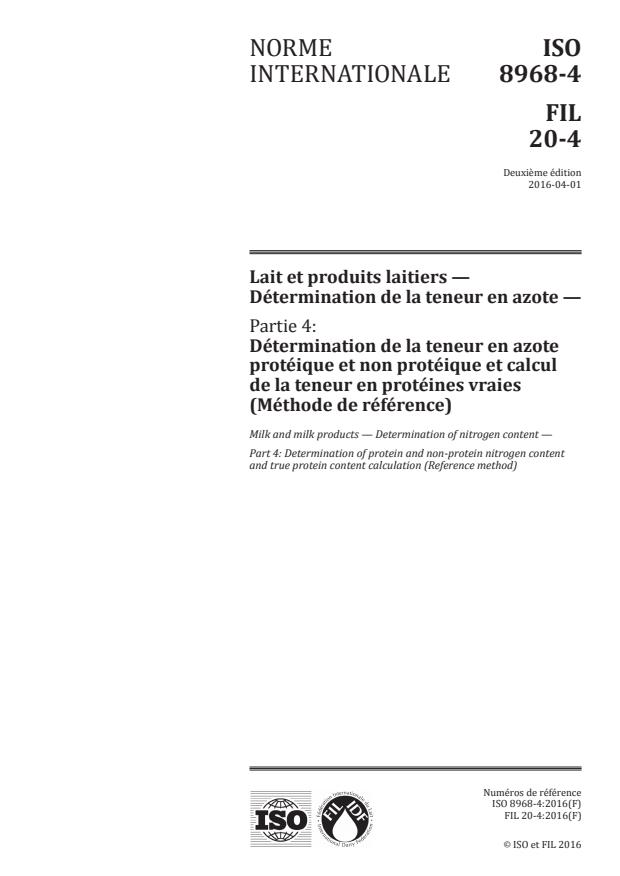
NORME ISO
INTERNATIONALE 8968-4
FIL
20-4
Deuxième édition
2016-04-01
Lait et produits laitiers —
Détermination de la teneur en azote —
Partie 4:
Détermination de la teneur en azote
protéique et non protéique et calcul
de la teneur en protéines vraies
(Méthode de référence)
Milk and milk products — Determination of nitrogen content —
Part 4: Determination of protein and non-protein nitrogen content
and true protein content calculation (Reference method)
Numéros de référence
FIL 20-4:2016(F)
©
ISO et FIL 2016
FIL 20-4:2016(F)
DOCUMENT PROTÉGÉ PAR COPYRIGHT
© ISO et FIL 2016, Publié en Suisse
Droits de reproduction réservés. Sauf indication contraire, aucune partie de cette publication ne peut être reproduite ni utilisée
sous quelque forme que ce soit et par aucun procédé, électronique ou mécanique, y compris la photocopie, l’affichage sur
l’internet ou sur un Intranet, sans autorisation écrite préalable. Les demandes d’autorisation peuvent être adressées à l’ISO à
l’adresse ci-après ou au comité membre de l’ISO dans le pays du demandeur.
ISO copyright office International Dairy Federation
Ch. de Blandonnet 8 • CP 401 Silver Building • Bd Auguste Reyers 70/B • B-1030 Brussels
CH-1214 Vernier, Geneva, Switzerland
Tel. +41 22 749 01 11 Tel. + 32 2 325 67 40
Fax +41 22 749 09 47 Fax + 32 2 325 67 41
copyright@iso.org info@fil-idf.org
www.iso.org www.fil-idf.org
ii © ISO et FIL 2016 – Tous droits réservés
FIL 20-4:2016(F)
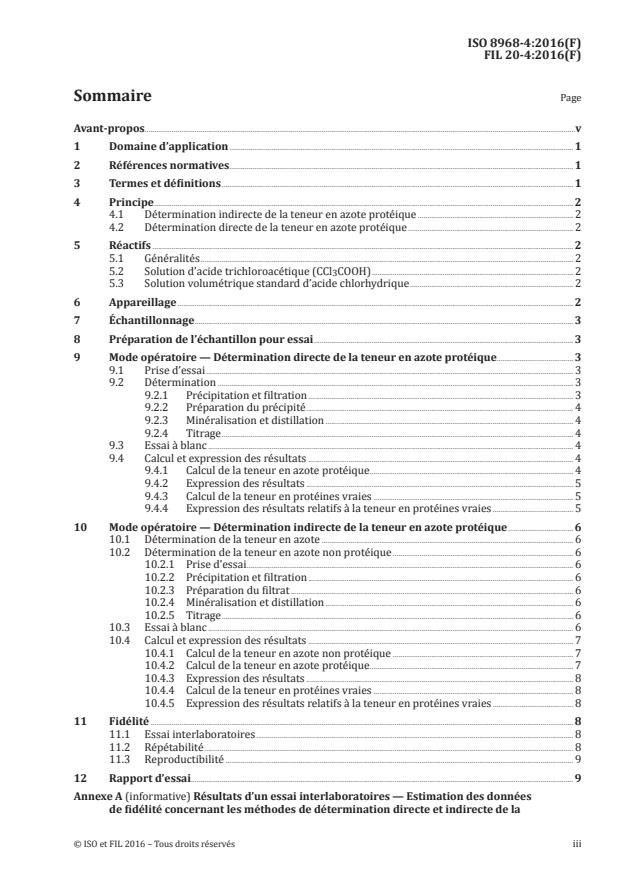
Sommaire Page
Avant-propos .v
1 Domaine d’application . 1
2 Références normatives . 1
3 Termes et définitions . 1
4 Principe . 2
4.1 Détermination indirecte de la teneur en azote protéique . 2
4.2 Détermination directe de la teneur en azote protéique . 2
5 Réactifs . 2
5.1 Généralités . 2
5.2 Solution d’acide trichloroacétique (CCl COOH) . 2
5.3 Solution volumétrique standard d’acide chlorhydrique . 2
6 Appareillage . 2
7 Échantillonnage . 3
8 Préparation de l’échantillon pour essai . 3
9 Mode opératoire — Détermination directe de la teneur en azote protéique.3
9.1 Prise d’essai . 3
9.2 Détermination . 3
9.2.1 Précipitation et filtration . 3
9.2.2 Préparation du précipité . 4
9.2.3 Minéralisation et distillation . 4
9.2.4 Titrage . 4
9.3 Essai à blanc . 4
9.4 Calcul et expression des résultats . 4
9.4.1 Calcul de la teneur en azote protéique . 4
9.4.2 Expression des résultats . 5
9.4.3 Calcul de la teneur en protéines vraies . 5
9.4.4 Expression des résultats relatifs à la teneur en protéines vraies . 5
10 Mode opératoire — Détermination indirecte de la teneur en azote protéique .6
10.1 Détermination de la teneur en azote . 6
10.2 Détermination de la teneur en azote non protéique . 6
10.2.1 Prise d’essai . 6
10.2.2 Précipitation et filtration . 6
10.2.3 Préparation du filtrat . 6
10.2.4 Minéralisation et distillation . 6
10.2.5 Titrage . 6
10.3 Essai à blanc . 6
10.4 Calcul et expression des résultats . 7
10.4.1 Calcul de la teneur en azote non protéique . 7
10.4.2 Calcul de la teneur en azote protéique . 7
10.4.3 Expression des résultats . 8
10.4.4 Calcul de la teneur en protéines vraies . 8
10.4.5 Expression des résultats relatifs à la teneur en protéines vraies . 8
11 Fidélité . 8
11.1 Essai interlaboratoires . 8
11.2 Répétabilité . 8
11.3 Reproductibilité . 9
12 Rapport d’essai . 9
Annexe A (informative) Résultats d’un essai interlaboratoires — Estimation des données
de fidélité concernant les méthodes de détermination directe et indirecte de la
© ISO et FIL 2016 – Tous droits réservés iii
FIL 20-4:2016(F)
teneur en protéines vraies .10
Bibliographie .11
iv © ISO et FIL 2016 – Tous droits réservés
FIL 20-4:2016(F)
Avant-propos
L’ISO (Organisation internationale de normalisation) est une fédération mondiale d’organismes
nationaux de normalisation (comités membres de l’ISO). L’élaboration des Normes internationales est
en général confiée aux comités techniques de l’ISO. Chaque comité membre intéressé par une étude
a le droit de faire partie du comité technique créé à cet effet. Les organisations internationales,
gouvernementales et non gouvernementales, en liaison avec l’ISO participent également aux travaux.
L’ISO collabore étroitement avec la Commission électrotechnique internationale (IEC) en ce qui
concerne la normalisation électrotechnique.
Les procédures utilisées pour élaborer le présent document et celles destinées à sa mise à jour sont
décrites dans les Directives ISO/IEC, Partie 1. Il convient, en particulier de prendre note des différents
critères d’approbation requis pour les différents types de documents ISO. Le présent document a été
rédigé conformément aux règles de rédaction données dans les Directives ISO/IEC, Partie 2 (voir www.
iso.org/directives).
L’attention est appelée sur le fait que certains des éléments du présent document peuvent faire l’objet de
droits de propriété intellectuelle ou de droits analogues. L’ISO ne saurait être tenue pour responsable
de ne pas avoir identifié de tels droits de propriété et averti de leur existence. Les détails concernant
les références aux droits de propriété intellectuelle ou autres droits analogues identifiés lors de
l’élaboration du document sont indiqués dans l’Introduction et/ou dans la liste des déclarations de
brevets reçues par l’ISO (voir www.iso.org/brevets).
Les appellations commerciales éventuellement mentionnées dans le présent document sont données
pour information, par souci de commodité, à l’intention des utilisateurs et ne sauraient constituer un
engagement.
Pour une explication de la signification des termes et expressions spécifiques de l’ISO liés à
l’évaluation de la conformité, ou pour toute information au sujet de l’adhésion de l’ISO aux principes
de l’OMC concernant les obstacles techniques au commerce (OTC), voir le lien suivant: Avant-propos —
Informations supplémentaires.
Le comité chargé de l’élaboration du présent document est l’ISO/TC 34, Produits alimentaires, sous-comité
SC 5, Lait et produits laitiers et la Fédération internationale du lait (FIL). Il est publié conjointement par
l’ISO et la FIL.
Cette deuxième édition de l’ISO 8968-4|FIL 20-4 annule et remplace l’ISO 8968-4|FIL 20-4:2001 et
l’ISO 8968-5|FIL 20-5:2001, qui ont fait l’objet d’une révision technique.
L’ISO 8968|FIL 20 comprend les parties suivantes, présentées sous le titre général Lait et produits
laitiers — Détermination de la teneur en azote:
— Partie 1: Méthode Kjeldahl et calcul de la teneur en protéines brutes
1)
— Partie 3: Méthode de minéralisation en bloc (méthode pratique semi-micro rapide)
— Partie 4: Détermination de la teneur en azote protéique et non protéique et calcul de la teneur en
protéines vraies (Méthode de référence)
1) Il est prévu, lors de la révision, d’aligner l’élément principal du titre de l’ISO 8968-3|FIL 20-3 (c’est-à-dire,
«Lait») avec l’élément principal des titres de l’ISO 8968-1|FIL 20-1 et de l’ISO 8968-4|FIL 20-4.
© ISO et FIL 2016 – Tous droits réservés v
FIL 20-4:2016(F)
La FIL (Fédération internationale du lait) est une organisation privée à but non lucratif qui représente
les intérêts des divers acteurs de la filière laitière au niveau international. Les membres de la FIL sont
organisés en comités nationaux, qui sont des associations nationales composées de représentants de
groupes d’intérêt nationaux dans le secteur des produits laitiers, incluant des producteurs laitiers, des
acteurs de l’industrie de transformation des produits laitiers, des fournisseurs de produits laitiers, des
universitaires et des représentants des gouvernements/autorités chargées du contrôle des aliments.
L’ISO et la FIL collaborent étroitement sur toutes les activités de normalisation concernant les méthodes
d’analyse et d’échantillonnage du lait et des produits laitiers. Depuis 2001, l’ISO et la FIL publient
conjointement leurs Normes internationales en utilisant les logos et les numéros de référence des deux
organisations.
L’attention est appelée sur le fait que certains des éléments du présent document peuvent faire l’objet de
droits de propriété intellectuelle ou de droits analogues. La FIL ne saurait être tenue pour responsable
de ne pas avoir identifié de tels droits de propriété et averti de leur existence. Les détails concernant
les références aux droits de propriété intellectuelle ou autres droits analogues identifiés lors de
l’élaboration du document sont indiqués dans l’Introduction et/ou dans la liste des déclarations de
brevets reçues par l’ISO (voir www.iso.org/brevets).
Les appellations commerciales éventuellement mentionnées dans le présent document sont données
pour information, par souci de commodité à l’intention des utilisateurs et ne sauraient constituer un
engagement.
L’ISO 8968-4|FIL 20-4 a été élaborée par le Comité permanent de la FIL chargé des Méthodes d’analyse
de la composition et par le comité technique de ISO/TC 34, Produits alimentaires, sous-comité SC 5, Lait
et produits laitiers.
L’ensemble des travaux a été confié au groupe de projet mixte ISO/FIL (C13) du Comité permanent
chargé des Méthodes d’analyse de la composition, sous la direction de ses chefs de projet, D. Barbano (US)
et P. Trossat (FR).
La présente Norme internationale ISO|FIL annule et remplace l’ISO 8968-4|FIL 20-4:2001 et
l’ISO 8968-5|FIL 20-5:2001, qui ont fait l’objet d’une révision technique.
L’ISO 8968|FIL 20 comprend les parties suivantes, présentées sous le titre général Lait et produits
laitiers — Détermination de la teneur en azote:
— Partie 1: Méthode Kjeldahl et calcul de la teneur en protéines brutes
— Partie 3: Méthode de minéralisation en bloc (méthode pratique semi-micro rapide)
— Partie 4: Détermination de la teneur en azote protéique et non protéique et calcul de la teneur en
protéines vraies (Méthode de référence)
vi © ISO et FIL 2016 – Tous droits réservés
NORME INTERNATIONALE
FIL 20-4:2016(F)
Lait et produits laitiers — Détermination de la teneur en
azote —
Partie 4:
Détermination de la teneur en azote protéique et non
protéique et calcul de la teneur en protéines vraies
(Méthode de référence)
AVERTISSEMENT — L’utilisation de la présente partie de l’ISO 8968|FIL 20 peut impliquer
l’utilisation de produits et la mise en œuvre de modes opératoires et d’appareillages à caractère
dangereux. La présente partie de l’ISO 8968|FIL 20 ne prétend pas aborder tous les risques liés à
son utilisation. Il incombe à l’utilisateur de la présente partie de l’ISO 8968|FIL 20 d’établir, avant
de l’utiliser, des pratiques d’hygiène et de sécurité appropriées et de déterminer l’applicabilité
des restrictions réglementaires locales.
1 Domaine d’application
La présente partie de l’ISO 8968|FIL 20 spécifie une méthode pour la détermination directe et indirecte
de la teneur en azote protéique du lait liquide, entier ou écrémé.
2 Références normatives
Les documents ci-après, dans leur intégralité ou non, sont des références normatives indispensables à
l’application du présent document. Pour les références datées, seule l’édition citée s’applique. Pour les
références non datées, la dernière édition du document de référence s’applique (y compris les éventuels
amendements).
ISO 8968-1|FIL 20-1, Lait et produits laitiers — Détermination de la teneur en azote — Partie 1: Méthode
Kjeldahl et calcul de la teneur en protéines brutes
3 Termes et définitions
Pour les besoins du présent document, les termes et les définitions suivants s’appliquent.
3.1
teneur en azote non protéique
rapport de masse des substances, déterminé par le mode opératoire spécifié
Note 1 à l’article: La teneur en azote non protéique est exprimée sous forme de pourcentage en masse.
3.2
teneur en azote protéique
rapport de masse des substances, déterminé par le mode opératoire spécifié, directement ou
indirectement
Note 1 à l’article: La teneur en azote protéique est exprimée sous forme de pourcentage en masse.
© ISO et FIL 2016 – Tous droits réservés 1
FIL 20-4:2016(F)
4 Principe
4.1 Détermination indirecte de la teneur en azote protéique
Précipitation des protéines d’une prise d’essai par addition de solution d’acide trichloroacétique, de
façon à ce que la concentration finale de l’acide trichloroacétique dans le mélange soit d’environ 12 %.
Extraction des protéines de lait précipitées par filtration, le filtrat résiduel contenant les composants
d’azote non protéique. Détermination de la teneur en azote du filtrat par le mode opératoire décrit dans
l’ISO 8968-1|FIL 20-1.
Lorsque la teneur totale en azote de l’échantillon de lait a été déterminée préalablement, il est possible
de calculer la teneur en azote protéique vrai comme étant la différence entre la teneur totale en azote et
la teneur en azote non protéique
4.2 Détermination directe de la teneur en azote protéique
Précipitation des protéines d’une prise d’essai par addition de solution d’acide trichloroacétique,
de façon à ce que la concentration finale de l’acide trichloroacétique dans le mélange soit d’environ
12 %. Séparation du précipité protéique par filtration. (Le précipité contient l’azote protéique de
l’échantillon). Détermination de la teneur en azote du précipité par le mode opératoire décrit dans
l’ISO 8968-1|FIL 20-1.
5 Réactifs
5.1 Généralités
Sauf indication contraire, utiliser uniquement des réactifs de qualité analytique reconnue ainsi que de
l’eau distillée ou déminéralisée, ou de l’eau de pureté équivalente.
Les réactifs spécifiés pour la détermination de la teneur en azote total selon la méthode décrite dans
l’ISO 8968-1|FIL 20-1, ainsi que les réactifs suivants, sont requis:
5.2 Solution d’acide trichloroacétique (CCl COOH)
Dans une fiole jaugée de 100 ml, dissoudre 15,0 g d’acide trichloroacétique dans de l’eau. Compléter
avec de l’eau jusqu’au trait. Ne pas utiliser de concentrations d’acide trichloroacétique et de volumes de
solutions différents de ceux spécifiés.
NOTE Les performances de la méthode en ce qui concerne la valeur moyenne et les caractéristiques
de performances interlaboratoires seront différentes en cas d’utilisation d’autres concentrations d’acide
trichloroacétique ou d’autres volumes de solutions.
5.3 Solution volumétrique standard d’acide chlorhydrique
Pour la détermination directe, la solution d’acide chlorhydrique à 0,1 mol/l est telle que décrite dans
l’ISO 8968-1|FIL 20-1.
Pour la détermination indirecte de la teneur en azote protéique, la solution d’acide chlorhydrique
suivante est nécessaire: c(HCl) = (0,01 ± 0,000 1) mol/l, en plus de la solution d’acide chlorhydrique à
0,1 mol/l requise telle que décrite dans l’ISO 8968-1|FIL 20-1.
6 Appareillage
Utiliser un matériel courant de laboratoire ainsi que le matériel spécifié pour la détermination de la
teneur en azote total dans l’ISO 8968-1|FIL 20-1 et, en particulier, le matériel suivant.
6.1 Bain d’eau, pouvant être maintenu à une température comprise entre 38 °C et 40 °C.
2 © ISO et FIL 2016 – Tous droits réservés
FIL 20-4:2016(F)
6.2 Fioles coniques, d’une capacité de 125 ml (déterminat
...