


ISO 12931:2012
(Main)Performance criteria for authentication solutions used to combat counterfeiting of material goods
Performance criteria for authentication solutions used to combat counterfeiting of material goods
ISO 12931:2012 specifies performance criteria and evaluation methodology for authentication solutions used to establish material good authenticity throughout the entire material good life cycle. It does not specify how technical solutions achieve these performance criteria. ISO 12931:2012 is intended for all types and sizes of organizations that require the ability to validate the authenticity of material goods. It is intended to guide such organizations in the determination of the categories of authentication elements they need to combat those risks, and the criteria for selection of authentication elements that provide those categories, having undertaken a counterfeiting risk analysis. Such authentication elements can be part of the material good itself and/or its packaging. The criteria applies to the material good and/or its packaging.
Critères de performance des solutions d'authentification utilisées pour combattre la contrefaçon des biens matériels
L'ISO 12931:2011 spécifie des critères et une méthodologie d'évaluation de la performance des solutions d'authentification utilisées pour établir l'authenticité d'un bien matériel durant l'ensemble de son cycle de vie. Elle ne précise pas comment les solutions techniques remplissent ces critères de performance. Elle est destinée à tous les types et tailles d'organisations qui requièrent la capacité de valider l'authenticité de biens matériels. Elle a vocation à guider ces organisations lors de la détermination, d'une part, des catégories d'éléments authentifiants dont elles ont besoin pour s'opposer à ces risques, et d'autre part, des critères de choix desdits éléments, une analyse des risques de contrefaçon ayant été préalablement menée. Ces éléments authentifiants peuvent faire partie intégrante du bien matériel proprement dit et/ou de son emballage. Les critères s'appliquent au bien matériel et/ou à son emballage.
General Information
- Status
- Withdrawn
- Publication Date
- 30-May-2012
- Withdrawal Date
- 30-May-2012
- Technical Committee
- ISO/TC 292 - Security and resilience
- Drafting Committee
- ISO/TC 292 - Security and resilience
- Current Stage
- 9599 - Withdrawal of International Standard
- Start Date
- 09-Sep-2020
- Completion Date
- 14-Feb-2026
Relations
- Effective Date
- 23-Apr-2020
Buy Documents

ISO 12931:2012 - Performance criteria for authentication solutions used to combat counterfeiting of material goods

ISO 12931:2012 - Criteres de performance des solutions d'authentification utilisées pour combattre la contrefaçon des biens matériels
Get Certified
Connect with accredited certification bodies for this standard

Great Wall Tianjin Quality Assurance Center
Established 1993, first batch to receive national accreditation with IAF recognition.
Hong Kong Quality Assurance Agency (HKQAA)
Hong Kong's leading certification body.

Innovative Quality Certifications Pvt. Ltd. (IQCPL)
Known for integrity, providing ethical & impartial Assessment & Certification. CMMI Institute Partner.
Sponsored listings
Frequently Asked Questions
ISO 12931:2012 is a standard published by the International Organization for Standardization (ISO). Its full title is "Performance criteria for authentication solutions used to combat counterfeiting of material goods". This standard covers: ISO 12931:2012 specifies performance criteria and evaluation methodology for authentication solutions used to establish material good authenticity throughout the entire material good life cycle. It does not specify how technical solutions achieve these performance criteria. ISO 12931:2012 is intended for all types and sizes of organizations that require the ability to validate the authenticity of material goods. It is intended to guide such organizations in the determination of the categories of authentication elements they need to combat those risks, and the criteria for selection of authentication elements that provide those categories, having undertaken a counterfeiting risk analysis. Such authentication elements can be part of the material good itself and/or its packaging. The criteria applies to the material good and/or its packaging.
ISO 12931:2012 specifies performance criteria and evaluation methodology for authentication solutions used to establish material good authenticity throughout the entire material good life cycle. It does not specify how technical solutions achieve these performance criteria. ISO 12931:2012 is intended for all types and sizes of organizations that require the ability to validate the authenticity of material goods. It is intended to guide such organizations in the determination of the categories of authentication elements they need to combat those risks, and the criteria for selection of authentication elements that provide those categories, having undertaken a counterfeiting risk analysis. Such authentication elements can be part of the material good itself and/or its packaging. The criteria applies to the material good and/or its packaging.
ISO 12931:2012 is classified under the following ICS (International Classification for Standards) categories: 03.140 - Patents. Intellectual property. The ICS classification helps identify the subject area and facilitates finding related standards.
ISO 12931:2012 has the following relationships with other standards: It is inter standard links to ISO 22383:2020. Understanding these relationships helps ensure you are using the most current and applicable version of the standard.
ISO 12931:2012 is available in PDF format for immediate download after purchase. The document can be added to your cart and obtained through the secure checkout process. Digital delivery ensures instant access to the complete standard document.
Standards Content (Sample)
INTERNATIONAL ISO
STANDARD 12931
First edition
2012-06-01
Performance criteria for authentication
solutions used to combat counterfeiting
of material goods
Critères de performance des solutions d’authentification utilisées pour
combattre la contrefaçon des biens matériels
Reference number
©
ISO 2012
All rights reserved. Unless otherwise specified, no part of this publication may be reproduced or utilized in any form or by any means,
electronic or mechanical, including photocopying and microfilm, without permission in writing from either ISO at the address below or ISO’s
member body in the country of the requester.
ISO copyright office
Case postale 56 • CH-1211 Geneva 20
Tel. + 41 22 749 01 11
Fax + 41 22 749 09 47
E-mail copyright@iso.org
Web www.iso.org
Published in Switzerland
ii © ISO 2012 – All rights reserved
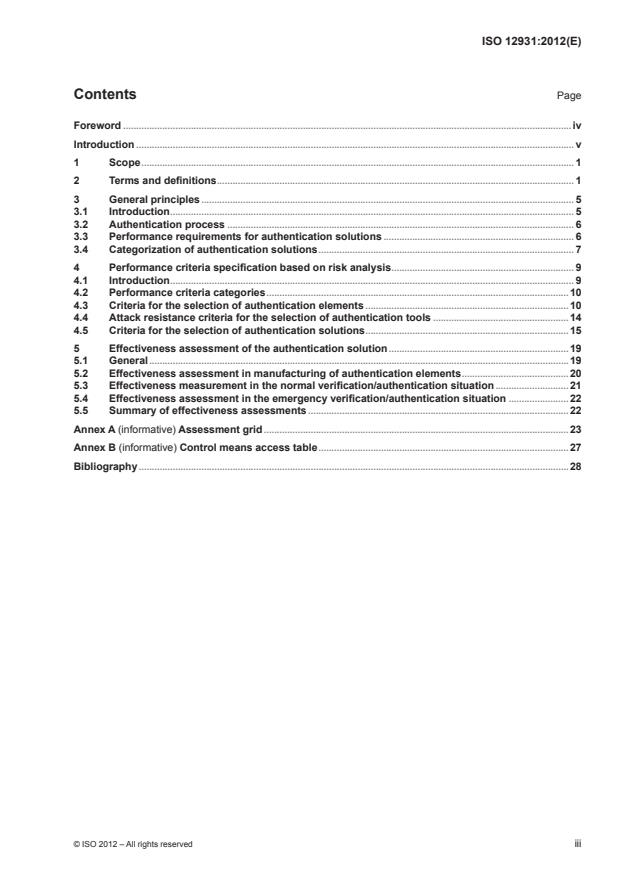
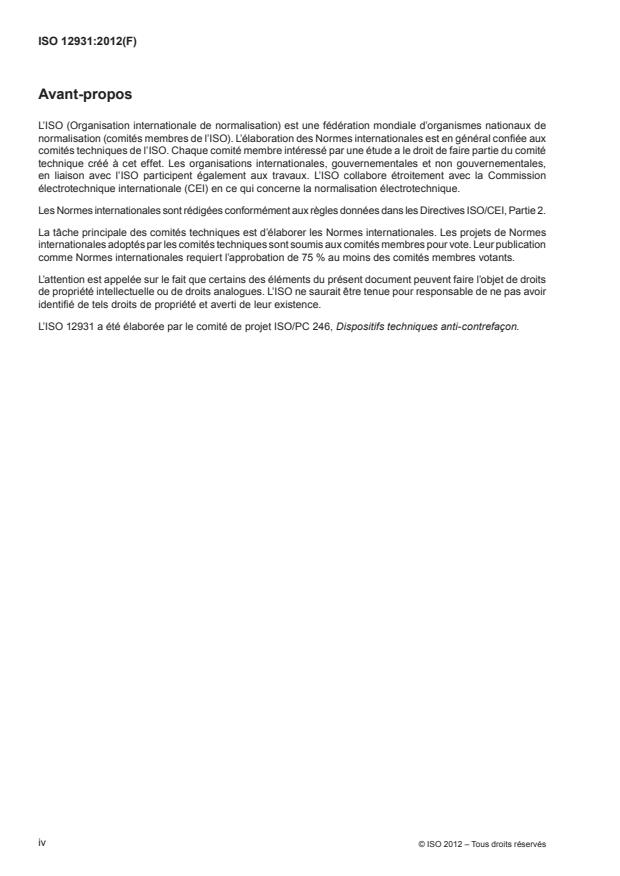
Contents Page
Foreword .iv
Introduction . v
1 Scope . 1
2 Terms and definitions . 1
3 General principles . 5
3.1 Introduction . 5
3.2 Authentication process . 6
3.3 Performance requirements for authentication solutions . 6
3.4 Categorization of authentication solutions . 7
4 Performance criteria specification based on risk analysis . 9
4.1 Introduction . 9
4.2 Performance criteria categories .10
4.3 Criteria for the selection of authentication elements .10
4.4 Attack resistance criteria for the selection of authentication tools .14
4.5 Criteria for the selection of authentication solutions .15
5 Effectiveness assessment of the authentication solution .19
5.1 General .19
5.2 Effectiveness assessment in manufacturing of authentication elements .20
5.3 Effectiveness measurement in the normal verification/authentication situation .21
5.4 Effectiveness assessment in the emergency verification/authentication situation .22
5.5 Summary of effectiveness assessments .22
Annex A (informative) Assessment grid .23
Annex B (informative) Control means access table .27
Bibliography .28
Foreword
ISO (the International Organization for Standardization) is a worldwide federation of national standards bodies
(ISO member bodies). The work of preparing International Standards is normally carried out through ISO
technical committees. Each member body interested in a subject for which a technical committee has been
established has the right to be represented on that committee. International organizations, governmental and
non-governmental, in liaison with ISO, also take part in the work. ISO collaborates closely with the International
Electrotechnical Commission (IEC) on all matters of electrotechnical standardization.
International Standards are drafted in accordance with the rules given in the ISO/IEC Directives, Part 2.
The main task of technical committees is to prepare International Standards. Draft International Standards
adopted by the technical committees are circulated to the member bodies for voting. Publication as an
International Standard requires approval by at least 75 % of the member bodies casting a vote.
Attention is drawn to the possibility that some of the elements of this document may be the subject of patent
rights. ISO shall not be held responsible for identifying any or all such patent rights.
ISO 12931 was prepared by Project committee ISO/TC 246, Anti-counterfeiting tools.
iv © ISO 2012 – All rights reserved
Introduction
The quantity and range of counterfeited material goods has been expanding rapidly over a decade, and is
now no longer limited to luxury goods. The sale of counterfeit goods is prevalent in many developing countries
and is becoming more common in the developed world. Individual manufacturers and rights holders are
experiencing an increase in the number of counterfeiting attacks on their material goods. The internet is
compounding the problem. These counterfeit goods do not necessarily offer the same guarantees in terms
of safety and compliance with environmental measures and regulatory requirements, generating risk for
consumers, patients, users and the distribution chain. They cause loss of earnings, job losses, and brand value
damage for the companies and rights holders targeted as well as tax losses for governments. Counterfeiting
increases the potential for false material good claims and litigation for the companies and distribution supply
chain. Counterfeiting of material goods has become one of the major activities of organized crime, both within
domestic markets and international trade and smuggling.
In order to prevent counterfeiting from plaguing their business, companies are increasingly using authentication
solutions geared to their individual needs. It is important to specify the performance requirements for the
solutions designed to support the fight against counterfeiting at both national and international levels. This will
nurture greater confidence among consumers, support the security of the supply chain, and help the public
authorities devise and implement preventive, deterrent and punitive policies.
Counterfeiting can include but is not limited to
— deceipt of the consumer,
— deceipt of the purchasers of new goods or replacement parts,
— infringement of intellectual property rights, and
— violation of national, regional or international laws.
Counterfeiting can include false claims regarding
— intellectual property rights,
— details of manufacture, and
— trade dress.
Counterfeiting needs to be kept separate from diversion.
The problem of counterfeiting is aggravated by the following factors:
— the market is increasingly global and the material goods are more complex;
— the global movement of material goods is increasing, and may use non-traditional channels.
Therefore it is more difficult for an inspector to recognize the characteristics of any given authentic material good.
Counterfeiting seeks to bypass legal provisions, including guarantees of conformity and quality, designed
to enable professionals to release safe material goods onto the market in fair competition. Buyers do not
necessarily pay all necessary attention to the material goods they are examining, particularly because of trust,
lack of time, the temptation of attractive prices, or simply because they are unfamiliar with the material good
itself. The authentication element provides a specific and more reliable method of determining if the item is
genuine or a counterfeit good.
Establishing the authenticity of material goods, in other words recognizing whether it is genuine or fake, consists
in checking whether the material good reproduces the essential characteristics of the authentic material good to
help establish whether or not there has been infringement. The first step, then, required to provide solid ground
on which to conduct this challenge, is to establish what these essential characteristics are, in particular the
material good’s origin, and then to verify whether the suspect material good being challenged does objectively
and concretely present these characteristics.
If there is any doubt as to the authenticity of a material good, it is the inspectors’ role, once they have observed
the characteristics of the suspect material good and/or authentication element, to examine whether these
characteristics match those of the authentic material good and/or authentication element. The process
involved is an essentially technical analysis using experience, authentication elements, authentication tools or
a combination of these methods.
This International Standard has been drafted to pinpoint the objectives and boundaries required for industry-
wide and services-wide application. This International Standard sets out the performance criteria for purpose-
built authentication solutions. These authentication solutions are designed to provide reliable evidence making
it easier to assess whether material goods are authentic or counterfeit.
This International Standard aims to integrate the performance requirements for authentication solutions into
the material good’s life cycle in any situation when required. Authentication is thus positioned as a feature of
the material good and services life cycle against counterfeiting.
This International Standard is proposed to be part of a wider framework in related standards in the anti-
counterfeiting field wherein the proof that a material good is authentic or counterfeit can be obtained by any
means whatsoever, and it was not drafted or designed to define a sole means of authentication.
vi © ISO 2012 – All rights reserved
INTERNATIONAL STANDARD ISO 12931:2012(E)
Performance criteria for authentication solutions used to
combat counterfeiting of material goods
1 Scope
This International Standard specifies performance criteria and evaluation methodology for authentication
solutions used to establish material good authenticity throughout the entire material good life cycle. It does not
specify how technical solutions achieve these performance criteria.
This International Standard is intended for all types and sizes of organizations that require the ability to
validate the authenticity of material goods. It is intended to guide such organizations in the determination of
the categories of authentication elements they need to combat those risks, and the criteria for selection of
authentication elements that provide those categories, having undertaken a counterfeiting risk analysis. Such
authentication elements can be part of the material good itself and/or its packaging. The criteria applies to the
material good and/or its packaging.
The performance criteria is considered by organizations in relation to their specific situation.
This International Standard is focused upon the authentication of material goods
— covered by intellectual property rights,
— covered by relevant national or regional regulation,
— with safety and public health implications,
— otherwise with a distinctive identity.
This International Standard focuses on material goods and is not intended to apply to, for example, goods used
in the financial sector, official administrative papers, identity documents or to downloadable products.
This International Standard does not apply to technologies or systems designed for the tracking and tracing of
material goods. Track and trace on its own is not an authentication solution and is therefore outside the scope
of this International Standard.
This International Standard does not deal with economical criteria aiming to correlate performance and costs
of the authentication solutions.
Some industries and services may have special regulatory requirements which would require additional
functionality to supersede part(s) of this International Standard.
This International Standard is intended to contribute to an organization’s understanding of its authentication
needs, possible strategies, and challenges. It is intended to give the organization a set of criteria to analyse,
specify and implement its authentication solutions.
The organization will determine the level of security assurance required for the selected authentication solution.
The authentication solution provider is expected to comply with the risk and security requirements of the
organization.
This International Standard is not intended to constrain the organization’s choice of authentication technologies.
2 Terms and definitions
For the purposes of this document, the following terms and definitions apply.
2.1
attack
successful or unsuccessful attempt(s) to circumvent an authentication solution, including attempts to imitate,
produce or reproduce the authentication elements
2.1.1
internal attack
attack perpetrated by persons or entities directly or indirectly linked with the legitimate manufacturer, originator
of the good or rights holder (staff of the rights holder, subcontractor, supplier, etc.)
2.1.2
external attack
attack perpetrated by persons or entities that are not directly or indirectly linked with the legitimate manufacturer,
originator of the good or rights holder
2.2
authentic material good
material good produced under the control of the legitimate manufacturer, originator of the good or holder of
intellectual property rights
2.3
authentication
act of establishing whether a material good is genuine or not
2.3.1
authentication element
tangible object, visual feature or information associated with a material good or its packaging that is used as
part of an authentication solution
2.3.1.1
overt authentication element
authentication element which is detectable and verifiable by one or more of the human senses without resource
to a tool (other than everyday tools which correct imperfect human senses, such as spectacles or hearing aids)
2.3.1.2
covert authentication element
authentication element which is hidden from the human senses until the use of a tool by an informed person
reveals it to their senses or else allows automated interpretation of the element
2.3.2
authentication tool
set of hardware and/or software system(s) that is part of an anticounterfeiting solution and is used to control of
the authentication element
2.3.2.1
stand-alone authentication tool
authentication tool which either is used to reveal a covert authentication element to the human senses for
human verification, or which integrates the functions required to be able to verify the authentication element
independently
2.3.2.2
on-line authentication tool
authentication tool which requires a real-time on-line connection to be able to locally interpret the
authentication element
2.3.2.3
off-the-shelf authentication tool
authentication tool which can be purchased through open sales networks
2 © ISO 2012 – All rights reserved
2.3.2.4
purpose-built authentication tool
authentication tool dedicated to a specific authentication solution
2.3.3
authentication solution
complete set of means and procedures that allows the authentication of a material good to be performed
2.4
automated interpretation
authenticity is evaluated automatically by one or more components of the authentication solution
2.5
counterfeit, verb
to simulate, reproduce or modify a material good or its packaging without authorization
2.6
counterfeit good
material good imitating or copying an authentic material good
2.7
false acceptance rate
proportion of authentications wrongly declared true
2.8
false rejection rate
proportion of authentications wrongly declared false
2.9
forensic analysis
scientific methodology for authenticating material goods by confirming an authentication element or an intrinsic
attribute through the use of specialised equipment by a skilled expert with special knowledge
2.10
human interpretation
authenticity as evaluated by the inspector
2.11
inspector
anyone who uses the authentication solution with the aim of authenticating a material good
2.12
integrated authentication element
authentication element that is added to the material good
2.13
integrity
the property of the unimpaired condition of the authentication element, the associated data, the information or
the elements and the means for processing them
2.14
interoperability
degree to which an authentication solution is able to work together with other different tools
2.15
intrinsic authentication element
authentication element which is inherent to the material good
2.16
likelihood
chance of something happening
NOTE 1 to entry: In risk management terminology, the word “likelihood” is used to refer to the chance of something
happening, whether defined, measured or determined objectively or subjectively, qualitatively or quantitatively, and
described using general terms or mathematically (such as a probability or a frequency over a given time period).
NOTE 2 to entry: The English term “likelihood” does not have a direct equivalent in some languages; instead, the equivalent
of the term “probability” is often used. However, in English, “probability” is often narrowly interpreted as a mathematical
term. Therefore, in risk management terminology, “likelihood” is used with the intent that it should have the same broad
interpretation as the term “probability” has in many languages other than English.
[SOURCE: ISO Guide 73:2009, 3.6.1.1]
2.17
material good
manufactured, grown product or one secured from nature
2.18
material good life cycle
stages in the life of a material good including conception, design, manufacture, storage, service, resell and disposal
2.19
rights holder
physical person or legal entity either holding or authorised to use one or more intellectual property rights
2.20
risk analysis
process to comprehend the nature of risk and to determine the level of risk
NOTE 1 to entry: Risk analysis provides the basis for risk evaluation and decisions about risk treatment.
NOTE 2 to entry: Risk analysis includes risk estimation.
[SOURCE: ISO Guide 73:2009, 3.6.1]
2.21
robustness
ability of a system to resist to virtual or physical, internal or external attacks
NOTE 1 to entry: Particularly, in the context of this International Standard, it is the ability to resist attempted imitation,
copy, intrusion or bypassing.
2.22
security
state of being free from danger or threats where procedures are followed or after taking appropriate measures
2.23
secret
data and/or knowledge that are protected against disclosure to unauthorised entities
2.24
specifier
person or entity who defines the requirements for an authentication solution to be applied to a particular
material good
2.25
tamper evidence
ability of the authentication element to show that the material good has been compromised
4 © ISO 2012 – All rights reserved
2.26
track and trace
means of identifying every individual material good or lot(s) or batch in order to know where it has been (track)
and where it is (trace) in the supply chain
3 General principles
3.1 Introduction
Authentication solutions come in a wide range of formats, from simple solutions to complex ones involving
information technology architectures. A simple solution does not mean a weak solution as the most appropriate
authentication solution for a material good will depend of the context of implementation and usage.
The technical, logistical and financial criteria involved in the selection of an authentication solution will depend
upon numerous factors including
— characteristics of the authentication element(s),
— the verification levels and methods targeted,
— any required information system,
— security requirements,
— counterfeit resistance,
— the value of the material goods intended to be protected,
— counterfeiting risks throughout the material good’s life cycle,
— integration and implementation requirements,
— role of packaging.
Authentication solutions should not affect the functionality and the integrity of the material goods.
A proper application of this International Standard relies on the observation of national, regional and international
laws and regulations especially on privacy and safety.
The verification processes of authentication elements deployed in these solutions require the ability to read,
capture and sometimes perform sampling using human senses or tools. These tools will either offer a local
on-the-spot response or will call, in real-time, into a secure information system, or possibly rechannel the data,
sample, or material good towards a structure offering expert analysis for an off-line diagnosis.
Thus, in relation with the specification of the material good protection, an authentication solution is the result of
a creation process followed by a verification process. The creation process consists of defining, generating and
manufacturing the authentication elements and integrating them with the material good or its packaging. The
verification process consists of checking the authentication elements along the distribution chain by trained
people using human senses, tools or references. Those two processes are linked in a Plan-Do-Check-Act
(PDCA) model and the actors involved form an integral part of the authentication solution.
The level of performance of an authentication solution shall therefore be assessed as a whole, including all the
components and interfaces involved.
As a strategy analysis, the main questions to be addressed by the rights owners are as follows.
— What are the counterfeiting issues, the consequences and likelihood of the counterfeiting threat?
— Which of my material goods are being counterfeited or have the potential to be counterfeited?
— In which locations are we experiencing counterfeiting and how are the counterfeits being distributed?
— What is the manufacturing and supply chain environment?
— How and by whom will the authentication process be performed?
— What is the impact of human error on the solution (process and authentication)?
3.2 Authentication process
The typical authentication solution is shown in Figure 1 and reveals the interrelationship between the material
good to be authenticated and typical components of the authentication solution. They together yield a true or
false verdict or provide information that will enable to detect the authenticity of the material good.
Risk analysis
Consequences of Material good Authentication Material good
counterfeiting details options conterfeiting
history
Authentication
element(s)
selection
Suspect
Integrated /
Intrinsic
No Yes
Associated
Décision:
authentication Act Act
Authentication
Genuine ?
element(s)
element(s)
Inspection:
Overt or Covert, or
Forensic analysis
Authentication
Supporting Data methods /
protocols
Figure 1 — Functional block diagram of a typical authentication solution
3.3 Performance requirements for authentication solutions
The aim of this International Standard is to
— establish common categorization of authentication solutions,
6 © ISO 2012 – All rights reserved
— establish an understanding how an authentication solution may constitute a more robust solution when
layered and therefore individual authentication elements should be used in combination, and
— provide criteria for which type of solution can be used to authenticate in different verification scenarios.
Thus to assist users and potential users of authentication solutions to understand their functionality and
selection criteria against their own risk analysis, which will facilitate the user’s ability to
— run material good verifications anywhere, under all foreseeable circumstances and conditions of use, and
— define specific requirements for every desired level of security for their authentication solution.
3.4 Categorization of authentication solutions
This categorization is intended to provide a guideline for users and suppliers of authentication solutions that
allow solutions to be compared or selected according to their characteristics. It is not intended to rank the
solutions according to performance effectiveness. The environment of the examination helps to determine the
choice of authentication solution(s).
The characteristics used in this categorization are based on the following considerations.
3.4.1 Provision of knowledge
Any authentication solution will require some knowledge to be provided to the inspector. Without the knowledge
that a certain authentication solution has been applied to the material good in question, an inspector cannot
inspect the associated authentication element. Without knowledge of the appropriate inspection procedure,
he cannot adequately perform the authentication. The knowledge required can be subdivided into general
knowledge (e.g., how a class of authentication elements appears to the inspector) and material good-specific
knowledge (e.g., which particular authentication element has been applied to the material good being inspected).
However, the right holder may control the intended audience of this knowledge, in particular of material good-
specific knowledge. The following distinction is used for the categorization.
3.4.1.1 General audience
Knowledge about the authentication solution employed is made public, e.g., via advertisements, websites, or
marketing materials.
3.4.1.2 Restricted audience
Knowledge about the authentication solution employed is made available only to a restricted group of people
that have a need to know; this will usually include all those people who are professionally required to inspect
the material good, and thus exclude those in the general audience. This approach is limited by the potential
risk that the knowledge will leak from the intended audience and may ultimately become public knowledge;
on the other hand, the security of an authentication solution can be substantially increased by restricting the
availability of knowledge.
3.4.2 Inspection method
The process of inspection of an authentication element invariably involves some form of physical observation.
The following distinction in this regard is used for the categorization.
3.4.2.1 Human senses
The inspection method makes use of the human senses.
3.4.2.2 Authentication tool
An authentication tool is employed to perform the required inspection and to display the result in some
appropriate way for presentation to the inspector. The tool employed may either be field available tool or require
the use of a laboratory equipment or similar environment.
Using these characteristics, the following set of basic categories can be established, as shown in Table 1 and
further detailed below.
Table 1 — Characteristics of categories for authentication solutions
Authentication tool
Human senses Forensic analysis
Off the shelf Purpose built
a
General audience OVERT COVERT — —
Restricted audience OVERT COVERT COVERT COVERT
a
See 3.4.4.2.
Track and Trace technology when used alone is not considered to be an authentication solution and as such is
not covered by this International Standard.
Annex B provides the specifier a tool with which to define the audience.
3.4.3 Categorization of authentication tools
When an authentication solution uses an authentication tool to inspect the authentication element, the technical
tool can further be characterized by the following categories.
3.4.3.1 Mode of operation
Depending on how the authentication tool operates, two categories for its mode of operation can be distinguished.
3.4.3.1.1 Stand-alone
The authentication tool can operate and perform the inspection of the authentication element in complete
autonomy (except for a source of electrical power where required).
3.4.3.1.2 Online
The authentication tool requires the use of a network connection to operate. The connection may be required,
for instance, to send or receive data required to perform the inspection, or to request authorization to perform
inspection of the authentication element.
3.4.3.2 Availability
Depending on how an authentication tool can be procured, two categories for its availability can be distinguished.
3.4.3.2.1 Commercial off-the-shelf
The authentication tool can be procured as a standard commercial item, often from more than one source.
3.4.3.2.2 Purpose-built
The authentication tool has been especially designed for authenticating one or several authentication elements;
often, it is available only from a single source.
8 © ISO 2012 – All rights reserved
3.4.4 Categorization of authentication elements
3.4.4.1 Overt category
Overt authentication can be directly performed by an informed inspector and does not require any additional
equipment to allow a feature to be verified as genuine.
Overt authentication elements are apparent to the human senses, most often sight, but touch is also used. Overt
authentication elements are often therefore employed where a visual check is the only one immediately possible
and this can be undertaken by informed inspectors, such as consumers, store clerks and check-out staff.
Ideally the inspector will have a genuine authentication element as a reference comparison.
Overt authentication elements must be difficult to copy accurately so that their absence or their imperfections
will alert examiners to the fact that a material good may not be genuine, because counterfeiters will always try
to reproduce all visible features on the material good and its packaging in their effort to produce a realistic copy.
The absence of an overt authentication element, or the presence of a crude copy, therefore, is an indication
that the material good is probably not genuine.
3.4.4.2 Covert category
Covert authentication elements are not instantly recognizable or interpretable by the human senses. They
require authentication tools and/or specialized knowledge to verify their presence and validity, either revealing
themselves to the human senses (usually vision) or to the authentication tool. These tools can be stand-alone
or require a connection to a network, they can be off-the-shelf or purpose-built. The result presented by an
authentication tool might make a determination of the authentication element’s authenticity, or the decision
might be left to the inspector. Inspectors analysing these authentication elements may need some training.
Covert technologies exploit all kinds of physical, chemical or biological effects, as well as logical relationships.
Electronically supported authentication elements use software or/and hardware based data and/or protocols
securely related to the genuine material good for proof of authenticity.
Covert authentication solutions may be designed so that authentication can be performed in the field.
Particularly, where a covert application uses data that is or can be linked to a person, privacy principles and
regulations shall be obeyed.
With the evolution of technology, a general audience will have the capacity to authenticate a covert authentication
element, subject to specific conditions as determined by the authentication solution specifier.
3.4.5 Forensic analysis
Forensic analysis involves the use of knowledge and dedicated scientific methods to validate the authentication
elements or intrinsic attributes of a material good. While forensic analysis may be used in the field for
authentication, it is more commonly used in a laboratory setting with the use of common and specialized tools
for examination. The validation process may often use original exemplars for a comparative analysis.
To be acceptable by a legal authority, forensic evidence may need to be established by a trusted third party.
4 Performance criteria specification based on risk analysis
4.1 Introduction
This clause establishes the performance criteria for the selection of an authentication solution. Based upon
these criteria the authentication solution specifier may determine what class or combination of categories of
solutions meets the needs and requirements of the user.
The global performance of an authentication solution depends on the performance of each component and on
the performance of the links between them. Tools performance, in particular their attack resistance shall be
taken into consideration with the same importance as authentication element performance.
Risk is a function of consequences and likelihood of events. Risk assessment is an overall process of risk
identification, risk analysis and risk evaluation (see ISO 31000). This clause defines the performance criteria,
specification factors that are used by risk analysis systems.
The performance of any authentication element can be affected by changes in technology. These changes may
make the solution obsolete or make the reproduction of the authentication technology readily available to the
counterfeiter. As part of any criteria evaluation a periodic review shall be conducted to ensure the implemented
technology has not become obsolete or compromised by technological developments.
4.2 Performance criteria categories
This subclause defines the performance criteria of authentication solutions in the following different categories:
— physical characteristics;
— attack resistance;
— integration process;
— field/environmental function;
— implementation process.
A specifier may choose to adopt an authentication solution that combines several authentication elements
working together to build proof. These elements may be of different types (overt, covert and forensic) and
with different levels of accessibility. Regarding all the criteria, the more robust the solution and the greater the
expertise of the inspector, the more reliable the result of the authentication process.
While the categories of criteria may be the same for different solutions, the use of different methodologies to
authenticate is required. In recognition of this difference the criteria is separated into three clauses. Subclause
4.3 will describe the criteria for the authentication element; 4.4 will describe the criteria for the authentication
tool; 4.5 will describe the criteria for authentication solution.
Annex A provides the specifier the grid with which to select the criteria.
4.3 Criteria for the selection of authentication elements
4.3.1 Physical characteristics
This performance criteria is linked to the physical characteristics of the authentication elements.
The readability of the authentication elements (either human or machine readable) is a key issue. Multiple
factors shall be taken into consideration including: the characteristics of the material good, the user/inspector,
the authentication environment and the authentication durability. All of these factors may be affected by the
physical characteristics of the authentication elements. Among the physical characteristics, the following
should be considered.
4.3.1.1 Static characteristics
— Size
— Thickness
— Weight
These characteristics have to be considered according to the material good: available space, compatibility,
potential interference with material good features or process (see integration process characteristics, 4.3.3).
10 © ISO 2012 – All rights reserved
4.3.1.2 Dynamic characteristics
Authentication element’s physical characteristics shall not be detrimentally affected by material good
manufacturing, or during the storage, transport and integration processes.
This includes characteristics such as
— flexibility,
— viscosity,
— tear,
— tensile strength.
Therefore, the authentication element shall be chosen to take into consideration any of the process requirements
involved in the production of the material good.
If process requirements alter or damage the authentication elements, they will become unusable and cause the
material good to be rejected during final production control. Therefore, the authentication element should be
chosen to take into consideration any of the process requirements involved in the production of the material good.
4.3.1.3 Durability characteristics
The following environmental conditions during subsequent processing, storage, or operation shall not affect
the physical characteristics of the authentication element used for authentication in an adverse manner that
might result in a malfunction of the authentication element over life cycle:
— mild environmental conditions (Climatic features such as temperature and humidity);
— harsh environmental conditions (Degradation features such as chemical action and radiation);
— mechanical use typical of the material good under consideration; and
— aging that may result in a malfunction of the authentication element over the life cycle of the material good.
The specifier of the authentication solution shall define the conditions of usage based upon the required risk
analysis. In addition, the life cycle of the material good may have a significant impact in determining the
durability of the authentication capability.
4.3.1.4 Health and Environmental Impact Characteristics
— Electromagnetic radiation
— Radioactivity
— Chemical composition and banning of some substances
— Migration of substances
— Recyclability
The potential environmental and health impact of authentication elements shall be considered, particularly in
light of national, regional, international regulations.
4.3.1.5 Feature-linked physical characteristics
— Visibility
— Machine readable
— Tamper evidence
— Uniqueness (one-to-one, one-to-many)
A feature can be recognized as unique in two manners, one-to-one or one-to-many. A unique feature that
authenticates a single item and is unique only to that item is recognized as one–to-one. A unique feature
applied to several items is recognized as one-to-many.
4.3.2 Attack resistance
This performance criteria is linked to the attack resistance of the authentication elements.
The attack resistance of an authentication element is defined as the degree to which an authentication element
is able to withstand the acts outlined in 4.3.2.1 to 4.3.2.7.
4.3.2.1 Reverse engineering and copy resistance
The element shall be resistant to reverse engineering. It shall be extremely unlikely to acquire enough
information to be able to successfully create/generate/manufacture an authentication element and to use this
element to circumvent the material good protection.
It shall require an extraordinary level of effort to accurately copy authentication elements. If an authentication
element were to be copied, the authentication element should contain copy evident features apparent in the
authentication process.
To avoid simulation and emulation it should not be possible to create some fake authentication element that
could be interpreted as genuine by an inspector or by a tool.
4.3.2.2 Tamper resistance/Tamper evidence
The tamper resistance is the ability of the authentication element to resist the removal, alteration or substitution
of the element from the material good or tis packaging.
A tangible or intangible form of interdependence between the authentication element and the material good it
protects shall be developed. An authentication element displays tangible interdependence if it is destroyed or
displays some form of visible or recognizable alteration when an attempt is made to remove the authentication
element from the material good. Intangible interdependence occurs where the authentication element has a
logical association with a material good or a reference that cannot be erased or duplicated.
To generate tamper evidence the various forms of interdependence shall be affected by any (at least partly)
serious attack, which is why an attack should immediately and irreversibly change one or more characteristics
of the association between the authentication element and the material good. Furthermore, any changes to
these characteristics resulting from an attempted attack should be detectable during the verification protocol.
To reduce the chance of a false positive, the interdependent characteristics should remain stable and resist
changes in environmental conditions during the material good’s life cycle.
4.3.2.3 Alteration resistance
The authentication element should withstand modification of its characteristics or the modification of the
information contained within the element. In the event the element is circumvented, detection of the attempt
should be evident to the inspector.
4.3.2.4 Side channel resistance
It should not be possible to capture any secret information or determine characteristics of the authentication
element through analysis of its physical behaviour in any environmental circumstances,
12 © ISO 2012 – All rights reserved
4.3.2.5 Interception of communication
It shall not be possible to gain attack-sensitive information by intercepting the communication between the
authentication element and any tool required to read or verify the element. Thus, the authentication element either
shall not communicate any attack-sensitive information with the tool or the information exchange shall be secured.
4.3.2.6 Obsolescence
An evaluation shall be conducted to determine the potential longevity of the authentication element, the degree
the element will remain an effective solution, and the availability of the technology and support in the future.
4.3.2.7 Not uncontrolled reuse
It shall not be possible to reuse the authentication element without authorization.
4.3.3 Integration process
The performance criteria are linked to the integration process of the authentication elements with the material
good to be protected.
4.3.3.1 Security
— Security policy
During the integration process recognized security process and controls shall be implemented.
— Supply chain security
An evaluation of supply chain components shall be performed to ensure compliance with all security policies
and procedures.
4.3.3.2 Manufacturing
4.3.3.2.1 Availability
A determination shall be made to ensure that the integrator can meet the production and supply requirements
for the authentication element and its integrati
...
NORME ISO
INTERNATIONALE 12931
Première édition
2012-06-01
Critères de performance des solutions
d’authentification utilisées pour combattre
la contrefaçon des biens matériels
Performance criteria for authentication solutions used to combat
counterfeiting of material goods
Numéro de référence
©
ISO 2012
DOCUMENT PROTÉGÉ PAR COPYRIGHT
Droits de reproduction réservés. Sauf prescription différente, aucune partie de cette publication ne peut être reproduite ni utilisée sous
quelque forme que ce soit et par aucun procédé, électronique ou mécanique, y compris la photocopie et les microfilms, sans l’accord écrit
de l’ISO à l’adresse ci-après ou du comité membre de l’ISO dans le pays du demandeur.
ISO copyright office
Case postale 56 • CH-1211 Geneva 20
Tel. + 41 22 749 01 11
Fax + 41 22 749 09 47
E-mail copyright@iso.org
Web www.iso.org
Publié en Suisse
ii © ISO 2012 – Tous droits réservés
Sommaire Page
Avant-propos .iv
Introduction . v
1 Domaine d’application . 1
2 Termes et définitions . 2
3 Principes généraux . 5
3.1 Introduction . 5
3.2 Processus d’authentification . 6
3.3 Exigences de performance des solutions d’authentification . 6
3.4 Typologie des solutions d’authentification . 6
4 Spécification des critères de performance à partir d’une analyse des risques .10
4.1 Introduction .10
4.2 Catégories des critères de performance .10
4.3 Critères pour le choix des éléments authentifiants . 11
4.4 Critères de résistance aux attaques pour le choix des outils d’authentification .14
4.5 Critères pour le choix des solutions d’authentification .16
5 Appréciation de l’efficacité de la solution d’authentification .20
5.1 Généralités .20
5.2 Appréciation de l’efficacité lors de la fabrication des éléments authentifiants .22
5.3 Mesure de l’efficacité dans une situation normale de vérification/d’authentification .22
5.4 Appréciation de l’efficacité dans une situation d’urgence de vérification/ d’authentification .23
5.5 Synthèse relative aux appréciations de l’efficacité .23
Annexe A (informative) Grille d’appréciation .24
Annexe B (informative) Tableau relatif à l’accès aux moyens de contrôle .29
Bibliographie .30
Avant-propos
L’ISO (Organisation internationale de normalisation) est une fédération mondiale d’organismes nationaux de
normalisation (comités membres de l’ISO). L’élaboration des Normes internationales est en général confiée aux
comités techniques de l’ISO. Chaque comité membre intéressé par une étude a le droit de faire partie du comité
technique créé à cet effet. Les organisations internationales, gouvernementales et non gouvernementales,
en liaison avec l’ISO participent également aux travaux. L’ISO collabore étroitement avec la Commission
électrotechnique internationale (CEI) en ce qui concerne la normalisation électrotechnique.
Les Normes internationales sont rédigées conformément aux règles données dans les Directives ISO/CEI, Partie 2.
La tâche principale des comités techniques est d’élaborer les Normes internationales. Les projets de Normes
internationales adoptés par les comités techniques sont soumis aux comités membres pour vote. Leur publication
comme Normes internationales requiert l’approbation de 75 % au moins des comités membres votants.
L’attention est appelée sur le fait que certains des éléments du présent document peuvent faire l’objet de droits
de propriété intellectuelle ou de droits analogues. L’ISO ne saurait être tenue pour responsable de ne pas avoir
identifié de tels droits de propriété et averti de leur existence.
L’ISO 12931 a été élaborée par le comité de projet ISO/PC 246, Dispositifs techniques anti-contrefaçon.
iv © ISO 2012 – Tous droits réservés
Introduction
Depuis plus d’une décennie, la contrefaçon des biens matériels se développe rapidement, tant au niveau
quantitatif que qualitatif; elle ne se limite plus aux produits de luxe. La vente de biens de contrefaçon est courante
dans de nombreux pays en développement et elle se répand dans les économies développées. Certains
fabricants et détenteurs de droits sont confrontés à une augmentation du nombre d’attaques contrefaisantes
sur leurs biens matériels. L’Internet aggrave le problème. Ces produits de contrefaçon, qui n’offrent pas
nécessairement les mêmes garanties en termes de sécurité et de respect de l’environnement et des exigences
réglementaires, constituent une source de danger pour les consommateurs, les patients, les utilisateurs et la
chaîne de distribution. Ils se traduisent, d’une part, par des pertes de chiffre d’affaires et d’emplois ainsi que
par une atteinte à l’image de marque des entreprises et des détenteurs de droits ciblés, et d’autre part, par des
pertes de recettes fiscales pour les États. La contrefaçon accroît le potentiel de revendications liées aux biens
matériels frauduleux et de litiges pour les entreprises et la chaîne d’approvisionnement et de distribution. Par
ailleurs, la contrefaçon des biens matériels est devenue l’une des principales activités du crime organisé, tant
sur les marchés intérieurs que dans le domaine du commerce international et dans celui de la contrebande.
Pour lutter contre ce fléau, les entreprises utilisent de plus en plus des solutions d’authentification adaptées à
leurs besoins. Il importe de préciser les exigences de performance requises des solutions propres à soutenir
la lutte contre la contrefaçon au plan national comme au plan international. Cela générera une plus grande
confiance parmi les consommateurs, renforcera la sécurité de la chaîne de distribution et aidera les autorités
publiques à concevoir et mettre en œuvre des politiques préventives, dissuasives et répressives.
La contrefaçon peut comprendre, sans toutefois s’y limiter,
— une escroquerie pour le consommateur,
— une tromperie pour les acheteurs de biens matériels neufs ou de pièces de rechange,
— une atteinte aux droits de propriété intellectuelle, et
— une violation des lois nationales, régionales ou internationales.
La contrefaçon peut englober des revendications frauduleuses portant sur
— des droits de propriété intellectuelle,
— des détails de fabrication, et
— l’ornementation.
La contrefaçon doit être maintenue distincte du détournement.
Le problème de la contrefaçon est aggravé par les facteurs suivants:
— le marché se mondialise de plus en plus et les biens matériels deviennent de plus en plus complexes;
— les déplacements de biens matériels à l’échelle mondiale se développent et peuvent emprunter des canaux
non-traditionnels.
Par conséquent, un contrôleur a davantage de difficultés à reconnaître les caractéristiques de n’importe quel
bien matériel authentique donné.
Les dispositions légales, y compris les garanties de conformité et de qualité, conçues pour permettre aux
professionnels de mettre sur le marché des biens matériels sûrs dans des conditions commerciales loyales,
ne sont pas respectées en cas de contrefaçon. Les acheteurs n’accordent pas nécessairement toute l’attention
requise aux biens matériels qu’ils sont en train d’examiner, en particulier pour des raisons de confiance, par
manque de temps, du fait de la tentation imputable à des prix attractifs ou simplement parce que le bien
matériel lui-même ne leur est pas familier. L’élément authentifiant fournit une méthode particulière et plus fiable
pour déterminer si l’article est authentique ou si c’est un produit de contrefaçon.
Établir l’authenticité d’un bien matériel, autrement dit reconnaître son caractère «vrai» ou «faux» consiste à
rechercher si ce bien reproduit les caractéristiques essentielles du bien matériel authentique, qui aident à
établir s’il y a infraction ou non. Il faut donc, pour donner à cette contestation une base solide, commencer par
établir en quoi consistent ces caractéristiques essentielles, notamment l’origine du bien matériel, puis vérifier
si le bien matériel suspect présente ou non, concrètement et objectivement, ces caractéristiques.
En cas de doute sur l’authenticité d’un bien matériel, le contrôleur devra, après avoir observé les caractéristiques
du bien matériel suspect et/ou de l’élément authentifiant, rechercher si celles-ci correspondent aux
caractéristiques du bien matériel authentique et/ou de l’élément authentifiant. Le processus engagé consiste
essentiellement en une analyse technique exploitant l’expérience, des éléments authentifiants, des outils
d’authentification ou une combinaison de ces méthodes.
La présente Norme internationale a été élaborée pour définir plus précisément les objectifs et les limites
requis pour une application dans l’industrie et les services. Elle définit les critères de performance de solutions
d’authentification dédiées. Ces solutions d’authentification sont destinées à fournir des éléments de preuve
fiables facilitant l’appréciation du caractère authentique ou falsifié de biens matériels.
La présente Norme internationale vise à intégrer les critères de performance des solutions d’authentification dans
le cycle de vie du bien matériel dans toutes les situations, lorsque cela est nécessaire. L’authentification occupe
ainsi une position au sein même du cycle de vie du bien matériel et des services, pour lutter contre la contrefaçon.
La présente Norme internationale a pour objet de s’intégrer dans un vaste cadre de normes connexes afférentes
au domaine de la lutte contre la contrefaçon, où la preuve du caractère authentique ou falsifié d’un bien
matériel peut être obtenue par tout moyen; elle n’a ni pour objectif, ni pour effet, de définir un moyen exclusif
d’authentification.
vi © ISO 2012 – Tous droits réservés
NORME INTERNATIONALE ISO 12931:2012(F)
Critères de performance des solutions d’authentification
utilisées pour combattre la contrefaçon des biens matériels
1 Domaine d’application
La présente Norme internationale spécifie des critères et une méthodologie d’évaluation de la performance
des solutions d’authentification utilisées pour établir l’authenticité d’un bien matériel durant l’ensemble de son
cycle de vie. Elle ne précise pas comment les solutions techniques remplissent ces critères de performance.
La présente Norme internationale est destinée à tous les types et tailles d’organisations qui requièrent la
capacité de valider l’authenticité de biens matériels. Elle a vocation à guider ces organisations lors de la
détermination, d’une part, des catégories d’éléments authentifiants dont elles ont besoin pour s’opposer à
ces risques, et d’autre part, des critères de choix desdits éléments, une analyse des risques de contrefaçon
ayant été préalablement menée. Ces éléments authentifiants peuvent faire partie intégrante du bien matériel
proprement dit et/ou de son emballage. Les critères s’appliquent au bien matériel et/ou à son emballage.
Les critères de performance seront pris en considération par ces organisations en relation avec leur
situation spécifique.
La présente Norme internationale se concentre sur l’authentification des biens matériels
— couverts par des droits de propriété intellectuelle,
— couverts par la législation régionale ou nationale applicable,
— avec des implications pour la sécurité et la santé publique,
— avec ou sans une identité caractéristique.
La présente Norme internationale est axée sur les biens matériels. Elle n’est pas destinée à s’appliquer, par
exemple, aux biens du domaine financier, aux documents officiels administratifs, aux papiers d’identité ou aux
produits numériques téléchargeables.
La présente Norme internationale ne s’applique pas non plus aux technologies ou systèmes de suivi logistique
des biens matériels. Le suivi logistique en soi n’étant pas une solution d’authentification, il ne relève pas du
domaine d’application de la présente Norme internationale.
La présente Norme internationale ne traite pas de critères économiques ayant pour but de mettre en regard la
performance et le coût des solutions d’authentification.
Il se peut que certaines industries et services aient des exigences réglementaires particulières qui
nécessiteraient une fonctionnalité supplémentaire afin de remplacer une ou plusieurs parties de la présente
Norme internationale.
La présente Norme internationale a pour but d’aider les organisations à appréhender leurs propres besoins en
matière d’authentification, les stratégies possibles et les défis à relever. Elle vise à leur fournir un ensemble de
critères pour analyser, préciser et mettre en œuvre leurs solutions d’authentification.
L’organisation déterminera le niveau d’assurance sécurité requis pour la solution d’authentification choisie. Le
fournisseur de la solution d’authentification est censé se conformer aux exigences de l’organisation en matière
de risque et de sécurité.
La présente Norme internationale ne vise pas à contraindre l’organisation dans son choix de technologies
d’authentification.
2 Termes et définitions
Pour les besoins du présent document, les termes et définitions suivants s’appliquent.
2.1
attaque
tentative(s) réussie(s) ou non de mettre en échec une solution d’authentification, comprenant des tentatives
d’imitation, de production ou de reproduction à l’identique des éléments authentifiants
2.1.1
attaque interne
attaque perpétrée par des personnes ou entités ayant un lien direct ou indirect avec le fabricant légitime, le
créateur du bien ou le détenteur des droits (personnel du détenteur des droits, sous-traitant, fournisseur, etc.)
2.1.2
attaque externe
attaque perpétrée par des personnes ou entités n’ayant pas de lien direct ou indirect avec le fabricant légitime,
le créateur du bien ou le détenteur des droits
2.2
bien matériel authentique
bien matériel produit sous le contrôle du fabricant légitime, du créateur du bien ou du détenteur des droits de
propriété intellectuelle
2.3
authentification
acte consistant à établir si un bien matériel est authentique ou non
2.3.1
élément authentifiant
objet tangible, caractéristique visuelle ou information associée au bien matériel ou à son emballage, utilisé en
tant que partie intégrante d’une solution d’authentification
2.3.1.1
élément authentifiant contrôlable sans outil
élément authentifiant pouvant être détecté et vérifié à l’aide d’un ou de plusieurs sens de l’être humain sans recourir
à un outil (autre que les outils courants qui corrigent des sens déficients tels que lunettes ou prothèses auditives)
2.3.1.2
élément authentifiant contrôlable avec outil
élément authentifiant non perçu par les sens de l’être humain jusqu’à ce qu’une personne expérimentée recoure
à un outil pour le leur révéler ou pour en permettre l’interprétation automatisée
2.3.2
outil d’authentification
ensemble de logiciels et/ou matériels faisant partie d’une solution anti-contrefaçon et utilisé pour contrôler
l’élément authentifiant
2.3.2.1
outil d’authentification autonome
outil d’authentification qui, soit est utilisé pour révéler un élément authentifiant contrôlable avec outil aux sens
de l’être humain dans le cas d’une vérification humaine, soit comprend les fonctions requises pour être apte à
vérifier l’élément authentifiant de manière indépendante
2.3.2.2
outil d’authentification connecté
outil d’authentification qui nécessite une connexion en temps réel pour pouvoir interpréter localement l’élément
authentifiant
2 © ISO 2012 – Tous droits réservés
2.3.2.3
outil d’authentification en vente libre
outil d’authentification qui peut être acquis dans les réseaux de vente ouverts
2.3.2.4
outil d’authentification dédié
outil d’authentification dédié à une solution d’authentification spécifique
2.3.3
solution d’authentification
ensemble complet de moyens et de procédures qui permet d’effectuer l’authentification d’un bien matériel
2.4
interprétation automatisée
évaluation automatique de l’authenticité par un ou plusieurs composants de la solution d’authentification
2.5
contrefaire
simuler, reproduire à l’identique ou modifier un bien matériel ou son emballage sans autorisation
2.6
produit de contrefaçon
bien matériel imitant ou copiant un bien matériel authentique
2.7
taux de fausses acceptations
proportion d’authentifications déclarées vraies erronément
2.8
taux de faux rejets
proportion d’authentifications déclarées fausses erronément
2.9
analyse scientifique
méthode scientifique permettant d’authentifier des biens matériels en confirmant un élément authentifiant ou
un attribut intrinsèque, via l’emploi d’un appareillage spécialisé par un expert qualifié ayant des connaissances
particulières
2.10
interprétation humaine
évaluation de l’authenticité par le contrôleur
2.11
contrôleur
quiconque exploite la solution d’authentification dans le but d’authentifier un bien matériel
2.12
élément authentifiant intégré
élément authentifiant ajouté au bien matériel
2.13
intégrité
non-altération de l’élément authentifiant, des données associées, des informations ou des éléments et de leurs
moyens de traitement
2.14
interopérabilité
degré de compatibilité d’une solution d’authentification avec des outils différents
2.15
élément authentifiant intrinsèque
élément authentifiant inhérent au bien matériel
2.16
vraisemblance
possibilité que quelque chose se produise
Note 1 à l’article: Dans la terminologie du management du risque, le mot «vraisemblance» est utilisé pour indiquer la
possibilité que quelque chose se produise, que cette possibilité soit définie, mesurée ou déterminée de façon objective ou
subjective, qualitative ou quantitative, et qu’elle soit décrite au moyen de termes généraux ou mathématiques (telles une
probabilité ou une fréquence sur une période donnée).
Note 2 à l’article: Le terme anglais «likelihood» (vraisemblance) n’a pas d’équivalent direct dans certaines langues et
c’est souvent l’équivalent du terme «probability» (probabilité) qui est utilisé à la place. En anglais, cependant, le terme
«probability» (probabilité) est souvent limité à son interprétation mathématique. Par conséquent, dans la terminologie du
management du risque, le terme «vraisemblance» est utilisé avec l’intention qu’il fasse l’objet d’une interprétation aussi
large que celle dont bénéficie le terme «probability» (probabilité) dans de nombreuses langues autres que l’anglais.
[SOURCE:ISO Guide 73:2009, définition 3.6.1.1]
2.17
bien matériel
produit manufacturé, cultivé ou fourni par la nature
2.18
cycle de vie d’un bien matériel
les différentes étapes de la vie d’un bien matériel, comprenant la conception, le dessin, la fabrication, le
stockage, l’entretien, la revente et la mise au rebut
2.19
détenteur de droits
personne physique ou morale détenant un ou plusieurs droits de propriété intellectuelle ou autorisée à les utiliser
2.20
analyse du risque
processus mis en œuvre pour comprendre la nature d’un risque et pour déterminer le niveau de risque
Note 1 à l’article: L’analyse du risque fournit la base de l’évaluation du risque et les décisions relatives au traitement du risque.
Note 2 à l’article: L’analyse du risque inclut l’estimation du risque
[SOURCE: ISO Guide 73:2009, définition 3.6.1]
2.21
robustesse
capacité d’un dispositif à résister à des attaques externes ou internes, de nature physique ou informatique
Note 1 à l’article: Dans le contexte de la présente Norme internationale, il s’agit notamment de la capacité à résister à des
tentatives d’imitation, de reproduction, d’intrusion ou de contournement
2.22
sécurité
situation caractérisée par l’absence de dangers ou de menaces, dans laquelle des procédures sont observées
ou qui découle de mesures appropriées
2.23
secret
donnée et/ou savoir qui est protégé pour ne pas être révélé à des personnes non-autorisées
2.24
spécifieur
personne ou entité qui définit les exigences relatives à la solution d’authentification devant être appliquée à un
bien matériel particulier
4 © ISO 2012 – Tous droits réservés
2.25
preuve d’effraction
aptitude de l’élément authentifiant à montrer qu’il a été porté atteinte au bien matériel
2.26
suivi logistique
moyen d’identification de chaque bien matériel ou de chaque lot ou série, permettant de savoir où il était
(traçabilité) et où il se trouve (suivi) dans la chaîne de distribution
3 Principes généraux
3.1 Introduction
Les solutions d’authentification revêtent une large palette de formes, allant des solutions simples aux solutions
complexes impliquant des architectures TIC (technologies de l’information). Une solution simple ne signifie
pas une solution peu performante car, pour un bien matériel, la solution d’authentification la plus appropriée
dépendra du contexte de mise en application et de l’usage.
Les critères techniques, logistiques et financiers qui entrent en jeu lors du choix de la solution d’authentification
dépendent de nombreux facteurs, à savoir:
— les caractéristiques du ou des éléments authentifiants;
— les niveaux et méthodes de contrôle recherchés;
— tout système d’information requis;
— les exigences en matière de sécurité;
— la résistance à la contrefaçon;
— la valeur des biens matériels à protéger;
— les risques associés à la contrefaçon durant tout le cycle de vie du bien matériel;
— les exigences en matière d’intégration et de mise en œuvre;
— le type d’emballage.
Il convient que les solutions d’authentification n’aient aucune incidence sur la fonctionnalité et l’intégrité des
biens matériels.
Une application correcte de la présente Norme internationale repose sur le respect des lois et réglementations
nationales, régionales et internationales, en particulier en matière de vie privée, de confidentialité et de sécurité.
Les processus de vérification des éléments authentifiants déployés dans ces solutions requièrent une capacité
de lecture, d’observation, d’analyse, de capture, et parfois de prélèvement, en faisant appel aux sens de
l’être humain ou à des outils. Ces outils vont soit apporter une réponse locale immédiate, soit faire appel en
temps réel à un système d’information sécurisé, soit encore acheminer l’information, le prélèvement ou le bien
matériel vers une structure d’expertise qui donnera un diagnostic en temps différé.
Ainsi, eu égard à la spécification de la protection du bien matériel, une solution d’authentification découle
d’un processus de création qui est suivi d’un processus de contrôle. Le processus de création consiste à
définir, générer et fabriquer les éléments authentifiants, puis à les intégrer dans le bien matériel ou dans son
emballage. Le processus de contrôle consiste à faire contrôler les éléments authentifiants tout au long de la
chaîne de distribution par des personnes ayant reçu une formation, utilisant les sens de l’être humain, des
outils ou des références. Ces deux processus sont reliés en un modèle «Planifier-Déployer-Contrôler-Agir»
(PDCA) et les acteurs impliqués font partie intégrante de la solution d’authentification.
Le niveau de performance d’une solution d’authentification doit donc être évalué dans son ensemble, pour
toutes ses composantes et leurs interfaces.
L’analyse de la stratégie impose que les titulaires de droits examinent les questions majeures suivantes.
— Quels sont les problèmes de contrefaçon, les conséquences et la vraisemblance d’une menace de contrefaçon?
— Parmi mes biens matériels, lesquels sont contrefaits ou pourraient l’être?
— À quels endroits sommes-nous confrontés à la contrefaçon et comment les contrefaçons sont-elles distribuées?
— Quel est le contexte de la fabrication et de la chaîne de distribution?
— Comment et par qui le processus d’authentification sera-t-il réalisé?
— Quel est l’impact de l’erreur humaine sur la solution (processus et authentification)?
3.2 Processus d’authentification
La solution d’authentification type est représentée sur la Figure 1. Elle révèle les liens existant entre le bien
matériel à authentifier et les composantes types de la solution d’authentification. Prises conjointement, celles-ci
conduisent à un verdict d’authenticité ou de fausseté, ou fournissent des informations qui permettront de
déceler l’authenticité du bien matériel.
3.3 Exigences de performance des solutions d’authentification
la présente Norme internationale a pour objectif:
— d’établir une typologie commune des solutions d’authentification;
— d’établir un consensus sur la manière dont une solution d’authentification peut constituer une solution
plus robuste lorsqu’elle est hiérarchisée et, donc, sur le fait qu’il convient d’utiliser des combinaisons des
différents éléments authentifiants;
— de fournir des critères sur le type de solution pouvant être utilisé pour procéder à des authentifications
dans différents scénarios de contrôle.
Elle vise ainsi à aider les utilisateurs réels et potentiels de solutions d’authentification à comprendre les
fonctionnalités de celles-ci et les critères de choix adaptés à leur propre analyse du risque, ce qui facilitera la
capacité de l’utilisateur:
— à effectuer des vérifications de biens matériels en tout lieu, dans toutes les circonstances et conditions
d’usage prévisibles;
— à définir des exigences spécifiques pour chaque niveau de sécurité souhaité pour ses solutions
d’authentification.
3.4 Typologie des solutions d’authentification
Cette typologie a pour but de fournir des indications aux utilisateurs et fournisseurs de solutions d’authentification
qui permettent de comparer les solutions ou de les sélectionner en fonction de leurs caractéristiques. Son but
n’est pas de classer les solutions selon leurs performances effectives. Le contexte dans lequel se fait l’examen
facilite la détermination du choix de la ou des solutions d’authentification.
Les caractéristiques sous-jacentes de cette typologie reposent sur les considérations suivantes.
6 © ISO 2012 – Tous droits réservés
Analyse du risque
Conséquences de Détails relatifs au Options Antécédents de
la contrefaçon produit d'authentification contrefaçon
touchant le bien
matériel
Sélection des
éléments
authentifiants
Éléments Éléments
NonOui
Décision:
authentifiants authentifiants Agir Agir
Authentique?
intégrés/associés intrinsèques
Contrôle:
sans outil et/ou
avec outil et/ou
analyse scientifique
Protocoles/
Données à l'appui méthodes
d'authentification
Figure 1 — Bloc-diagramme fonctionnel d’une solution d’authentification type
3.4.1 Apport de connaissances
Toute solution d’authentification nécessite de communiquer des données au contrôleur. Si le contrôleur ne
sait pas qu’une solution d’authentification déterminée a été appliquée au bien matériel en question, il ne peut
pas contrôler l’élément authentifiant correspondant. Sans avoir connaissance de la procédure de contrôle
appropriée, il ne peut pas réaliser l’authentification convenablement. Les connaissances requises peuvent
être subdivisées en connaissances générales (par exemple, comment une catégorie d’éléments authentifiants
apparaît au contrôleur?) et en connaissances spécifiques au bien matériel (par exemple, quel élément
authentifiant particulier a été appliqué au bien matériel contrôlé?). Toutefois, le détenteur des droits peut
contrôler les destinataires prévus de ces connaissances, en particulier les connaissances spécifiques au bien
matériel. La typologie des solutions utilise la distinction suivante.
3.4.1.1 Large public
Les données afférentes à la solution d’authentification employée sont rendues publiques, par exemple, à
travers des publicités, des sites Internet ou des supports de marketing.
3.4.1.2 Public restreint
Les données afférentes à la solution d’authentification employée sont communiquées uniquement à un
groupe limité de personnes qui ont besoin de ce savoir; en général, cela englobe toutes les personnes dont
la profession requiert de contrôler le bien matériel, et exclut ainsi le public. Cette approche se voit limitée par
le risque de fuite des données depuis le public restreint considéré, les données finissant alors par devenir
publiques. D’un autre côté, la sécurité d’une solution d’authentification peut être considérablement accrue en
limitant la diffusion des données.
3.4.2 Méthode de contrôle
Invariablement, le processus de contrôle d’un élément authentifiant implique une forme d’observation physique.
À cet égard, la typologie utilise la distinction suivante.
3.4.2.1 Les sens de l’être humain
La méthode de contrôle recourt aux sens de l’être humain.
3.4.2.2 Un outil d’authentification
Un outil d’authentification est utilisé pour réaliser le contrôle requis et pour présenter le résultat obtenu sous
une forme appropriée à l’intention du contrôleur. Cet outil peut être soit disponible sur le terrain, soit nécessiter
l’usage d’un équipement de laboratoire ou tout environnement similaire.
À partir de ces caractéristiques, il est possible d’établir l’ensemble suivant de typologies, présentées dans le
Tableau 1 et plus amplement détaillées ci-après.
Tableau 1 — Caractéristiques des typologies correspondant aux solutions d’authentification
Outil d’authentification
Sens de l’être
Analyse scientifique
humain
En vente libre Dédié
CONTROLABLE CONTROLABLE
Large public — —
a
SANS OUTIL AVEC OUTIL
CONTROLABLE CONTROLABLE CONTROLABLE CONTROLABLE
Public restreint
SANS OUTIL AVEC OUTIL AVEC OUTIL AVEC OUTIL
a
Voir 3.4.4.2.
La technologie du suivi logistique (track & trace), lorsqu’elle est utilisée seule, n’est pas considérée comme une
solution d’authentification et n’est pas, en soi, couverte par la présente norme.
L’Annexe B fournit au spécifieur un outil pour définir le public.
3.4.3 Typologie des outils d’authentification
Lorsqu’une solution d’authentification utilise un outil d’authentification pour contrôler l’élément authentifiant,
l’outil technique peut faire l’objet d’une caractérisation supplémentaire, par les typologies suivantes.
3.4.3.1 Mode de fonctionnement
On distingue deux modes de fonctionnement de l’outil d’authentification, en fonction de la manière dont il fonctionne.
3.4.3.1.1 Autonome
L’outil d’authentification peut fonctionner et effectuer le contrôle de l’élément authentifiant de manière
complètement autonome (sauf dans le cas où une source d’alimentation électrique est nécessaire).
8 © ISO 2012 – Tous droits réservés
3.4.3.1.2 Connecté
Pour fonctionner, l’outil d’authentification nécessite le recours à une connexion à un réseau. Cette connexion
peut être requise, par exemple, pour envoyer ou recevoir les données nécessaires pour effectuer le contrôle,
ou pour demander l’autorisation de réaliser un contrôle de l’élément authentifiant.
3.4.3.2 Disponibilité
Il est possible de faire la distinction entre deux options de disponibilité, selon la manière dont on se procure
l’outil d’authentification.
3.4.3.2.1 Commercialisation en vente libre
Il est possible de se procurer l’outil d’authentification comme tout article du commerce courant, souvent auprès
de plusieurs sources.
3.4.3.2.2 Conception spécialement dédiée
L’outil d’authentification a été spécialement conçu pour authentifier un ou plusieurs éléments authentifiants et,
le plus souvent, il n’est disponible qu’auprès d’une seule source.
3.4.4 Typologie des éléments authentifiants
3.4.4.1 Catégorie sans outil
L’authentification sans outil peut être réalisée directement par un contrôleur informé. Pour vérifier qu’une
caractéristique est authentique, il n’est pas nécessaire de recourir à des équipements supplémentaires.
Les éléments authentifiants contrôlables sans outil sont accessibles aux sens de l’être humain, le plus souvent
à la vue, mais le toucher est également utilisé. De ce fait, les éléments authentifiants contrôlables sans outil
sont souvent utilisés lorsqu’un contrôle visuel est le seul immédiatement possible; celui-ci peut être effectué
par des contrôleurs informés, tels que consommateurs, vendeurs et caissiers.
Dans l’idéal, le contrôleur disposera d’un élément authentifiant authentique comme référence de comparaison.
Les éléments authentifiants contrôlables sans outil doivent être difficiles à copier avec exactitude de sorte que
leur absence ou leurs défauts éveilleront l’attention des inspecteurs sur le fait qu’il se peut que le bien matériel
ne soit pas authentique; en effet, les contrefacteurs essaient toujours de reproduire toutes les caractéristiques
visibles sur le bien matériel et son emballage dans le but de produire une copie réaliste. L’absence d’un
élément authentifiant contrôlable sans outil ou la présence d’une copie grossière indiquent, par conséquent,
que le bien matériel n’est probablement pas authentique.
3.4.4.2 Catégorie avec outil
Les éléments authentifiants contrôlables avec outil ne sont pas instantanément reconnaissables ou
interprétables par les sens de l’être humain. Leur présence et leur validité nécessitent d’être vérifiées à l’aide
d’outils d’authentification et/ou de connaissances particulières, qui les révèlent soit aux sens de l’être humain
(en général, la vue), soit à l’outil d’authentification. Ces outils peuvent avoir un fonctionnement autonome ou
nécessiter une connexion à un réseau, ils peuvent être en vente libre ou avoir une conception spécialement
dédiée. Le résultat donné par un outil d’authentification peut déterminer l’authenticité d’un élément authentifiant;
à défaut la décision est laissée au contrôleur. Les contrôleurs qui analysent ces éléments authentifiants peuvent
avoir besoin de recevoir une formation.
Les technologies avec outil exploitent toutes sortes d’effets physiques, chimiques ou biologiques, ainsi que
des liens logiques. Les éléments authentifiants assistés par des moyens électroniques utilisent des données
et/ou des protocoles basés sur des logiciels et/ou des matériels, associés en toute sécurité au bien matériel
authentique pour fournir la preuve de son authenticité.
Les solutions d’authentification avec outil peuvent être conçues de façon à pouvoir réaliser l’authentification
sur le terrain.
Lorsqu’une application avec outil utilise des données liées à une personne (ou pouvant l’être), les principes et
règlements afférents à la vie privée et à la confidentialité doivent être respectés.
Avec l’évolution de la technologie, un large public sera en mesure d’authentifier un élément authentifiant
contrôlable avec outil, sous réserve des conditions spécifiques déterminées par le spécifieur de la solution
d’authentification.
3.4.5 Analyse scientifique
Une analyse scientifique implique l’utilisation de connaissances et de méthodes scientifiques spécialisées
pour valider les éléments authentifiants ou les attributs intrinsèques d’un bien matériel. Bien qu’une analyse
scientifique puisse être menée sur le terrain à des fins d’authentification, elle est plus couramment conduite
dans un laboratoire, avec l’utilisation d’outils courants et spécialisés pour effectuer l’examen. Le processus de
validation utilise fréquemment des modèles originaux pour effectuer une analyse comparative.
Pour être acceptable par l’autorité juridique, il se peut qu’une preuve scientifique ait besoin d’être établie par
une tierce partie agréée.
4 Spécification des critères de performance à partir d’une analyse des risques
4.1 Introduction
Le présent article établit les critères de performance pour le choix d’une solution d’authentification. En se fondant
sur ces critères, le spécifieur de la solution d’authentification peut déterminer quelle classe ou combinaison de
typologies de solutions répond aux besoins et aux exigences de l’utilisateur.
La performance globale d’une solution d’authentification est fonction des performances de chacune de ses
composantes et de la performance des liens qui les unissent. La performance des outils, notamment leur
résistance aux attaques, doit être prise en considération avec le même poids que la performance des éléments
authentifiants.
Le risque est fonction de la vraisemblance des événements et de leurs conséquences. L’appréciation du risque
correspond à un processus global d’identification du risque, d’analyse du risque et d’évaluation du risque (voir
l’ISO 31000). Le présent article définit les éléments de spécification des critères de performance utilisés par
les systèmes d’analyse du risque.
La performance de tout élément authentifiant peut être altérée par les évolutions de la technologie. Ces
changements peuvent rendre la solution obsolète ou mettre la reproduction de la technique d’authentification
à portée du contrefacteur. Dans le cadre de l’évaluation des critères, il est nécessaire de réaliser une revue
périodique pour s’assurer que la technologie mise en œuvre n’est pas devenue obsolète ou qu’elle n’est pas
compromise par les développements technologiques.
4.2 Catégories des critères de performance
Le présent paragraphe définit les critères de performance des solutions d’authentification dans les
catégories suivantes:
— caractéristiques physiques;
— résistance aux attaques;
— processus d’intégration;
— fonction dans l’environnement/sur le terrain;
— processus de mise en œuvre.
10 © ISO 2012 – Tous droits réservés
Un spécifieur peut choisir d’adopter une solution d’authentification qui combine plusieurs éléments authentifiants,
contribuant ensemble à élaborer une preuve. Ces éléments peuvent être de divers types (contrôlable sans
outil, contrôlable avec outil et scientifique) et avoir différents niveaux d’accessibilité. Pour tous les critères,
le résultat du processus d’authentification est d’autant plus fiable que la solution est robuste et l’expertise du
contrôleur solide.
Alors que les catégories de critères peuvent être identiques pour différentes solutions, il est requis d’utiliser des
méthodologies différentes pour effectuer l’authentification. Compte tenu de cette différence, les critères sont
séparés et répartis dans trois paragraphes. Le paragraphe 4.3 décrit les critères liés à l’élément authentifiant
et le paragraphe 4.4 les critères liés à l’outil d’authentification ; le paragraphe 4.5 décrit les critères pour la
solution d’authentification.
L’Annexe A fournit au spécifieur une grille de sélection des critères.
4.3 Critères pour le choix des éléments authentifiants
4.3.1 Caractéristiques physiques
Ce critère de performance est lié aux caractéristiques physiques des éléments authentifiants.
La lisibilité des éléments authentifiants (par l’être humain ou par une machine) est une problématique clé.
De nombreux facteurs doivent être pris en considération, à savoir: les caractéristiques du bien matériel,
l’utilisateur/le contrôleur, le contexte de l’authentification et la durabilité de celle-ci. Tous ces facteurs peuvent
être affectés par les caractéristiques physiques des éléments authentifiants. Parmi ces caractéristiques
physiques, il convient de prendre en considération ce qui suit.
4.3.1.1 Caractéristiques statiques
— Taille
— Épaisseur
— Poids
Ces caractéristiques doivent être prises en compte en fonction du bien matériel: espace disponible, compatibilité,
interférences potentielles avec les propriétés du bien matériel ou le processus (voir les caractéristiques du
processus d’intégration, en 4.3.3).
4.3.1.2 Caractéristiques dynamiques
Les caractéristiques physiques de l’élément authentifiant ne doivent pas être défavorablement affectées par la
fabrication du bien matériel ou pendant les processus de stockage, de transport et d’intégration.
Sont incluses des caractéristiques telles que
— flexibilité,
— viscosité,
— déchirabilité, et
— résistance à la traction.
De ce fait, l’élément authentifiant doit être choisi de façon à prendre en compte les exigences propres au
processus impliquées dans la production du bien matériel.
Si des exigences propres au processus altèrent ou endommagent les éléments authentifiants, ceux-ci
deviendront inutilisables et entraîneront le rejet du bien matériel lors du contrôle final de la production. De
ce fait, il convient de choisir l’élément authentifiant de façon à prendre en compte les exigences propres au
processus impliquées dans la production du bien matériel.
4.3.1.3 Caractéristiques de durabilité
Les conditions environnementales suivantes, régnant pendant le traitement ultérieur, le stockage ou
l’exploitation, ne doivent avoir aucune incidence défavorable sur les caractéristiques physiques de l’élément
authentifiant utilisé aux fins de l’authentification, pouvant entraîner un défaut de fonctionnement de l’élément
authentifiant sur l’ensemble du cycle de vie:
— conditions environnementales clémentes (caractéristiques climatiques telles que température et humidité);
— conditions environnementales rudes (caractéristiques de dégradation telles qu’action chimique et
rayonnement);
— usage mécanique type du bien matériel considéré;
— vieillissement pouvant engendrer un dysfonctionnement de l’élément authentifiant durant le cycle de vie du
bien matériel.
Le spécifieur de la solution d’authentification doit définir les conditions d’usage basées sur l’analyse des risques
requise. De plus, le cycle de vie du bien matériel peut avoir un impact significatif lors de la détermination de la
durabilité de l’aptitude à l’authentification.
4.3.1.4 Caractéristiques d’impact sur la santé et l’environnement
— Rayonnement électromagnétique
— Radioactivité
— Composition chimique et interdiction d
...
МЕЖДУНАРОДНЫЙ ISO
СТАНДАРТ 12931
Первое издание
2012-06-01
Критерии эффективности средств
аутентификации материальных
товаров для борьбы с подделками
Performance criteria for authentication solutions used to combat
counterfeiting of material goods
Ответственность за подготовку русской версии несёт GOST R
(Российская Федерация) в соответствии со статьёй 18.1 Устава ISO
Ссылочный номер
©
ISO 2012
Отказ от ответственности при работе в PDF
Настоящий файл PDF может содержать интегрированные шрифты. В соответствии с условиями лицензирования, принятыми
фирмой Adobe, этот файл можно распечатать или смотреть на экране, но его нельзя изменить, пока не будет получена
лицензия на установку интегрированных шрифтов в компьютере, на котором ведется редактирование. В случае загрузки
настоящего файла заинтересованные стороны принимают на себя ответственность за соблюдение лицензионных условий
фирмы Adobe. Центральный секретариат ISO не несет никакой ответственности в этом отношении.
Adobe - торговый знак Adobe Systems Incorporated.
Подробности, относящиеся к программным продуктам, использованным для создания настоящего файла PDF, можно найти в
рубрике General Info файла; параметры создания PDF оптимизированы для печати. Были приняты во внимание все меры
предосторожности с тем, чтобы обеспечить пригодность настоящего файла для использования комитетами – членами ISO. В
редких случаях возникновения проблемы, связанной со сказанным выше, просим информировать Центральный секретариат
по адресу, приведенному ниже.
ДОКУМЕНТ ЗАЩИЩЕН АВТОРСКИМ ПРАВОМ
© ISO 2012
Все права сохраняются. Если не указано иное, никакую часть настоящей публикации нельзя копировать или использовать в
какой-либо форме или каким-либо электронным или механическим способом, включая фотокопии и микрофильмы, без
предварительного письменного согласия ISO по адресу ниже или членов ISO в стране регистрации пребывания.
ISO copyright office
Case postale 56 • CH-1211 Geneva 20
Tel. + 41 22 749 01 11
Fax + 41 22 749 09 47
E-mail copyright@iso.org
Web www.iso.org
Опубликовано в Швейцарии
ii © ISO 2012– Все права сохраняются
Содержание Страница
Предисловие .iv
Введение .v
1 Область применения .1
2 Термины и определения .2
3 Общие принципы.6
3.1 Введение .6
3.2 Процесс аутентификации.7
3.3 Требования к функциям средств аутентификации .8
3.4 Разделение средств аутентификации на категории.9
4 Установление критериев эффективности на основе анализа риска.12
4.1 Введение .12
4.2 Категории критериев эффективности.12
4.3 Критерии для выбора элементов аутентификации.13
4.4 Критерии стойкости к агрессивным воздействиям для выбора инструментов
аутентификации.17
4.5 Критерии выбора средств аутентификации .18
5 Оценка эффективности средства аутентификации .23
5.1 Общие положения .23
5.2 Оценка эффективности производства элементов аутентификации .25
5.3 Измерение эффективности в нормальной ситуации верификации/аутентификации .25
5.4 Оценка эффективности в чрезвычайной ситуации верификации/аутентификации.26
5.5 Итоговая информация об оценках эффективности .26
Приложение А (информативное) Сетка оценки .27
Приложение В (информативное) Таблица средств контроля доступа.33
Библиография.34
iii
Предисловие
Международная организация по стандартизации (ISO) является всемирной федерацией национальных
организаций по стандартизации (комитетов-членов ISO). Разработка международных стандартов
обычно осуществляется техническими комитетами ISO. Каждый комитет-член, заинтересованный в
деятельности, для которой был создан технический комитет, имеет право быть представленным в этом
комитете. Международные правительственные и неправительственные организации, имеющие связи с
ISO, также принимают участие в работах. Что касается стандартизации в области электротехники, то
ISO работает в тесном сотрудничестве с Международной электротехнической комиссией (IEC).
Проекты международных стандартов разрабатываются в соответствии с правилами Директив ISO/IEC,
Часть 2.
Основной задачей технических комитетов является подготовка международных стандартов. Проекты
международных стандартов, принятые техническими комитетами, рассылаются комитетам-членам на
голосование. Их опубликование в качестве международных стандартов требует одобрения не менее
75 % комитетов-членов, принимающих участие в голосовании.
Следует иметь в виду, что некоторые элементы настоящего международного стандарта могут быть
объектом патентных прав. Международная организация по стандартизации не может нести
ответственность за идентификацию какого-либо одного или всех патентных прав.
ISO 12931 был подготовлен Комитетом по проектам ISO/TC 246, Средства борьбы с подделками.
iv
Введение
За последние десять лет быстро выросло количество, а также расширился ассортимент
фальсифицированных материальных товаров, и в настоящее время подделки не ограничиваются
предметами роскоши. Продажа фальсифицированных материальных товаров преобладает в
большинстве развивающихся стран и становится обычной в развитых странах. Отдельные
производители и правообладатели испытывают на себе рост числа подделок своих материальных
товаров. Эту проблему усугубляет интернет. Фальсифицированные товары необязательно предлагают
те же гарантии в отношении безопасности и соответствия требованиям к мерам по охране
окружающей среды и требованиям регламентов, создавая риск для потребителей, пациентов,
пользователей и движению товаров от производства к потреблению. Они приводят к потере прибыли,
потерям работы и наносят вред ценности торговой марки (бренда) компаний и правообладателей,
материальный товар которых фальсифицирован, а также к налоговым потерям для государств.
Фальсификация открывает дорогу рекламациям на подделки и судебным искам к компаниям и ко всей
цепи поставок. Фальсификация материальных товаров стала одним из основных видов деятельности
организованной преступности, как на внутренних рынках, так и в международной торговле и
контрабанде.
Чтобы защитить свой бизнес, компании все шире используют средства аутентификации,
приспособленные к их собственным потребностям. Важно установить требования к эффективности
средств аутентификации, предназначенных для борьбы против фальсификации, как на национальном,
так и на международном уровнях. Это приведет к повышению доверия со стороны потребителей,
поддержит безопасность цепи поставок и поможет государственным органам в разработке и внедрении
превентивной, сдерживающей и карательной политики.
Фальсификация может включать, но не ограничивается этим, следующее:
⎯ обман потребителя,
⎯ обман покупателей новых товаров или запасных частей,
⎯ нарушение прав интеллектуальной собственности, и
⎯ нарушение национальных, региональных или международных законов.
Фальсификация может включать неправомерные притязания в отношении
⎯ прав интеллектуальной собственности,
⎯ деталей производства, и
⎯ внешнего оформления изделия.
Фальсификации не следует путать с разновидностями товаров.
Проблема фальсификации усугубляется следующими факторами:
⎯ рынок становится все более глобальным, а материальные товары - все более сложными;
⎯ мировое движение товаров ширится и может использовать нетрадиционные каналы.
Поэтому инспектору все труднее распознавать характеристики любого данного подлинного
материального товара.
v
Фальсификация стремится обойти законоположения, включая гарантии соответствия и качества,
предназначенные для облегчения профессионалам выпускать безопасные материальные товары на
рынок в честной конкуренции. Покупатели не всегда с должным вниманием изучают предлагаемые
материальные товары, в частности, из-за своей доверчивости, отсутствия времени, соблазнительно
привлекательных цен, или просто потому, что незнакомы с самим товаром. Элемент аутентификации
обеспечивает конкретный и более надежный метод определения, является ли данный предмет
подлинным товаром или подделкой.
Установление подлинности материальных товаров, иными словами признание их подлинными или
поддельными, заключается в проверке того, воспроизводит ли данный материальный товар
существенные характеристики подлинного товара, чтобы установить, были нарушения или нет. Тогда
первым шагом, который требуется для обеспечения реального основания для такой проверки, будет
установление таких характеристик, в частности, происхождения товара, и затем подтверждение того,
обладает ли проверяемый сомнительный товар объективно и конкретно данными характеристиками.
Если есть хоть какое-либо сомнение в отношении подлинности материального товара, задача
инспекторов будет заключаться в том, чтобы изучить, совпадают ли эти характеристики с такими же
характеристиками подлинного материального товара и/или элементом аутентификации, поскольку
инспекторы однажды наблюдали характеристики сомнительного материального товара и/или элемент
аутентификации. Используемый процесс представляет собой технический анализ с использованием
имеющегося опыта, элементов аутентификации, инструментов аутентификации или сочетания этих
средств.
Настоящий международный стандарт был разработан для того, чтобы точно указать цели и границы,
необходимые для широкого применения рассматриваемых средств в промышленности и сфере услуг.
Стандарт устанавливает критерии эффективности специально созданных средств аутентификации
(подтверждения подлинности). Эти средства предназначены для обеспечения надежного
доказательства подлинности или фальсификации материального товара, облегчая процесс
определения этого.
Цель настоящего международного стандарта заключается в интеграции требований к эффективности
средств аутентификации в жизненный цикл материальных товаров в любой ситуации, когда это
требуется. Аутентификация, таким образом, позиционируется как особая характеристика жизненного
цикла материального товара или услуги, не допускающая фальсификации.
Настоящий международный стандарт предложен как часть более широкой концепции, изложенной в
соответствующих стандартах в области борьбы с подделками, где доказательство того, что товар
является подлинным или фальсифицированным, может быть получено любым способом; в то же
время, стандарта не предназначался и не разрабатывался для определения единственного средства
аутентификации.
vi
МЕЖДУНАРОДНЫЙ СТАНДАРТ ISO 12931:2012(R)
Критерии эффективности средств аутентификации
материальных товаров для борьбы с подделками
1 Область применения
Настоящий международный стандарт устанавливает критерии эффективности и методологию
оценивания средств, используемых для установления подлинности материального товара в процессе
его жизненного цикла. При этом способы достижения критериев эффективности этими техническими
средствами не устанавливаются.
Настоящий международный стандарт предназначен для организаций всех типов и размеров, которым
требуется подтверждать подлинность материальных товаров. Он предназначен служить руководством
для этих организаций при определении категорий элементов аутентификации, необходимых им для
борьбы с рисками такого рода, а также определения критериев выбора элементов аутентификации,
определяющих эти категории после анализа рисков фальсификации. Такие элементы аутентификации
могут быть частью самого материального товара и/или его упаковки. Критерии применяются к
материальному товару и/или его упаковке.
Критерии эффективности рассматриваются организациями относительно их конкретной ситуацией.
Данный международный стандарт сфокусирован на установлении подлинности материальных товаров,
⎯ на которые распространяются права интеллектуальной собственности,
⎯ подпадающих под действие национальных или региональных регламентов,
⎯ имеющих значение для безопасности и охраны здоровья,
⎯ обладающих тем или иным четким отличием.
Настоящий международный стандарт касается материальных товаров, но не применим к товарам,
используемым, например, в финансовом секторе, к официальным административным документам,
документам, удостоверяющим личность или скачиваемым продуктам.
Настоящий международный стандарт не применяется к технологиям или системам, предназначенным
для прослеживания и локализации материальных товаров. Прослеживание и локализации сами по
себе не являются средством аутентификации и поэтому не входят в область применения данного
международного стандарта.
Настоящий международный стандарт не связан с экономическими критериями, целью которых
является корреляция эффективности и стоимости средств аутентификации.
Некоторые отрасли промышленности и сферы услуг могут иметь специальные регулятивные
требования, для выполнения которых необходимы дополнительные функциональные возможности,
чтобы заменить часть (или отдельные части) данного международного стандарта.
Предполагается, что данный международный стандарт поможет организациям в понимании своих
потребностей, возможных стратегий и проблем в области аутентификации. Он предназначен дать
организации набор критериев для анализа, установления и реализации средств аутентификации.
Организация должна определить уровень обеспечения безопасности, необходимый для выбранного
средства аутентификации. Ожидается, что провайдер средства аутентификации будет действовать в
соответствии с рисками и требованиями безопасности организации.
Данный международный стандарт не предназначен ограничивать выбор организацией технологий
аутентификации.
2 Термины и определения
В настоящем документе используются следующие термины и определения.
2.1
агрессивное воздействие
attack
успешная или безуспешная попытка(и) обойти средство аутентификации, включая попытки имитации,
создания или воссоздания элементов аутентификации
2.1.1
внутреннее агрессивное воздействие
internal attack
воздействие, совершаемое физическими или юридическими лицами, прямо или косвенно связанными
с законным производителем, создателем продукта или правообладателем (штат правообладателя,
подрядчика, поставщика и т.д.)
2.1.2
внешнее агрессивное воздействие
external attack
воздействие, совершаемое физическими или юридическими лицами, прямо или косвенно не
связанными с законным производителем, создателем продукта или правообладателем
2.2
подлинный материальный товар
authentic material good
материальный товар, произведенный под контролем законного производителя, создателя продукта
или правообладателя интеллектуальной собственности на товар
2.3
установление подлинности
аутентификация
authentication
действие по установлению подлинности или поддельности материального товара
2.3.1
элемент аутентификации
authentication element
осязаемый объект, визуальный признак или информация, связанные с материальным товаром или его
упаковкой, которые используются как часть средства аутентификации
2.3.1.1
открытый элемент аутентификации
overt authentication element
элемент аутентификации, который можно обнаружить и проверить с помощью одного из органов
чувств человека без привлечения вспомогательных средств (кроме обычных средств коррекции
несовершенного восприятия, таких как очки или слуховые аппараты)
2.3.1.2
скрытый элемент аутентификации
covert authentication element
элемент аутентификации, который скрыт от органов чувств человека до тех пор, пока использование
инструмента подготовленным человеком не откроет его этим органам чувств или иным образом не
позволит автоматически интерпретировать этот элемент
2.3.2
инструмент аутентификации
authentication tool
комплект систем(ы) аппаратного и/или программного обеспечения, который является частью средства
борьбы с подделками и используется для управления элементом аутентификации
2.3.2.1
автономный инструмент аутентификации
stand-alone authentication tool
инструмент аутентификации, который либо используется для обнаружения органами чувств человека
скрытого элемента аутентификации с целью его проверки человеком, либо включает функции,
необходимые для проверки элемента аутентификации независимо
2.3.2.2
интерактивный инструмент аутентификации
on-line authentication tool
инструмент аутентификации, который для обеспечения локальной интерпретации элемента
аутентификации требует соединения в режиме реального времени
2.3.2.3
серийный инструмент аутентификации
off-the-shelf authentication tool
инструмент аутентификации, который можно приобрести в открытой продаже
2.3.2.4
специализированный инструмент аутентификации
purpose-built authentication tool
инструмент аутентификации, сделанный специально для конкретного средства аутентификации
2.3.3
средство аутентификации
authentication solution
полный набор способов и процедур, который позволяет установить подлинность материального товара
2.4
автоматическая интерпретация
automated interpretation
подлинность, оцениваемая автоматически с помощью одного или нескольких компонентов средства
аутентификации
2.5
подделывать, гл.
фальсифицировать, гл.
counterfeit, verb
несанкционированно имитировать, воспроизводить или модифицировать материальный товар или его
упаковку
2.6
поддельный товар
фальсифицированный товар
counterfeit good
материальный товар, имитирующий или копирующий подлинный материальный товар
2.7
доля ошибочной приемки
false acceptance rate
доля аутентификаций, при которых поддельный материальный товар ошибочно объявлен подлинным
2.8
доля ошибочной браковки
false rejection rate
доля аутентификаций, при которых подлинный материальный товар ошибочно объявлен поддельным
2.9
криминалистический анализ
forensic analysis
научная методология установления подлинности материальных товаров посредством подтверждения
элемента аутентификации или присущего признака с помощью специализированного оборудования
опытным специалистом, обладающим специальными знаниями
2.10
интерпретация, выполненная человеком
human interpretation
подлинность, оцененная инспектором
2.11
инспектор
inspector
любой специалист, использующий средство аутентификации с целью аутентификации материального
товара
2.12
интегрированный элемент аутентификации
integrated authentication element
элемент аутентификации, добавленный к материальному товару
2.13
целостность
integrity
свойство ненарушенного состояния элемента аутентификации, связанных с ним данных, информации
или элементов и методов их обработки
2.14
взаимодействие
interoperability
степень, в которой средство аутентификации способно работать вместе с другими различными
инструментами
2.15
присущий элемент аутентификации
intrinsic authentication element
элемент аутентификации, свойственный данному материальному товару
2.16
вероятность
likelihood
шанс на то, что какое-либо событие произойдет
ПРИМЕЧАНИЕ 1 к статье: В терминологии менеджмента риска, слово “вероятность” используется для
обозначения шанса на то, что произойдет некое событие, установленное, измеренное или определенное
объективно или субъективно, качественно или количественно, и описанное с использованием общих терминов или
математически (например, как вероятность или частота появления за данный период времени).
ПРИМЕЧАНИЕ 2 к статье: Английский термин “likelihood” не имеет прямого соответствия в некоторых языках;
вместо этого часто используется эквивалент термина “probability”(вероятность). Однако, в английском языке,
“probability” часто переводится только как математический термин. Поэтому в терминологии менеджмента риска,
“likelihood” используется в смысле, имеющем более широкую интерпретацию, как термин “probability” во многих
других языках, кроме английского.
[ИСТОЧНИК: ISO Guide 73:2009, 3.6.1.1]
2.17
материальный товар
material good
произведенный, выращенный продукт или продукт, обеспечиваемый природой
2.18
жизненный цикл материального товара
material good life cycle
этапы существования товара, включая разработку концепции, проектирование, производство,
хранение, обслуживание, продажу и утилизацию
2.19
правообладатель
rights holder
физическое или юридическое лицо, либо обладающее одним или несколькими правами на
интеллектуальную собственность, либо имеющее разрешение на использование одного или
нескольких таких прав
2.20
анализ риска
risk analysis
процесс осмысления природы риска и определения степени риска
ПРИМЕЧАНИЕ 1 к статье: Анализ риска обеспечивает основу для оценивания риска и принятия решений в
отношении риска.
ПРИМЕЧАНИЕ 2 к статье: Анализ риска включает его оценку.
[ИСТОЧНИК: ISO Guide 73:2009, 3.6.1]
2.21
устойчивость
robustness
способность системы противостоять виртуальным или физическим, внутренним или внешним
агрессивным воздействиям
ПРИМЕЧАНИЕ 1 к статье: В частности, в контексте данного международного стандарта, это способность
противостоять попыткам имитации, копирования, вмешательства или обхода.
2.22
безопасность
security
состояние свободы от опасности или угроз там, где соблюдаются процедуры или приняты
соответствующие меры
2.23
секрет
secret
данные и/или знания, которые защищены от несанкционированного раскрытия
2.24
разработчик спецификаций
specifier
физическое или юридическое лицо, определяющее требования к средству аутентификации, которое
должно применяться к конкретному материальному товару
2.25
очевидность подделки
tamper evidence
способность элемента аутентификации показывать, что данный материальный товар вызывает
подозрение в его подделке
2.26
прослеживание и локализация
track and trace
средство идентификации каждого отдельного материального товара или серии(й) или партии такого
товара, используемое с целью выяснения, где он был (прослеживание) и где в данный момент
находится (локализация) в цепочке поставок
3 Общие принципы
3.1 Введение
Средства аутентификации появляются в самых различных формах, от простых до сложных,
включающих в себя архитектуры информационных технологий. Простое средство не означает, что оно
слабое, поскольку самое подходящее средство аутентификации материального товара должно
зависеть от обстоятельств его внедрения и использования.
Технические, логистические и финансовые критерии, применяемые при выборе средства
аутентификации, будут определяться целым рядом факторов, включая:
⎯ характеристики элемента(ов) аутентификации,
⎯ уровни проверок и целевые методы,
⎯ любую требуемую информационную систему,
⎯ требования к безопасности,
⎯ стойкость к фальсификации,
⎯ ценность материальных товаров, подлежащих защите,
⎯ риски фальсификации на протяжении жизненного цикла материального товара,
⎯ требования к интегрированию и реализации,
⎯ роль упаковки.
Средства аутентификации не должны влиять на функциональность и целостность материальных
товаров.
Надлежащее применение данного международного стандарта опирается на соблюдение
национальных, региональных и международных законов и регламентов, особенно касающихся
конфиденциальности и безопасности.
Процессы проверки элементов аутентификации, заложенных в этих средствах, требуют способности к
считыванию, улавливанию и, иногда, опробованию с помощью органов чувств человека или с помощью
инструментов. Такие инструменты либо сразу обеспечат ответ на месте, либо обратятся в реальном
времени в защищенную информационную систему, или, возможно, перенаправят данные, образец или
собственно материальный товар в структуру, предлагающую анализ специалистов, для диагностики в
автономном режиме.
Таким образом, относительно спецификации защиты материальных товаров средство аутентификации
является результатом процесса создания с последующим процессом проверки. Процесс создания
состоит из определения, формирования и производства элементов аутентификации и их интеграции с
материальным товаром или его упаковкой. Процесс проверки заключается в контроле над элементами
аутентификации в цепочке сбыта подготовленными специалистами с помощью органов чувств,
инструментов или справочных материалов. Эти два процесса связаны в модели необходимых мер
«Планирование – Исполнение - Проверка – Действие» [Plan-Do-Check-Act (PDCA)], а привлеченные
исполнители составляют существенную часть средства аутентификации.
Таким образом, уровень пригодности средства аутентификации должен оцениваться в целом, включая
все применимые компоненты и интерфейсы.
В качестве анализа стратегии правообладатели должны рассмотреть основные вопросы,
приведенные ниже:
⎯ Что такое подделки, последствия и вероятность угрозы подделки?
⎯ Какой из моих материальный материальных товаров подделывают или могут подделать?
⎯ В каких местах мы подвергаемся фальсификации, и как распространяются подделки?
⎯ Каково окружение производства и цепи поставок?
⎯ Как и кем должен выполняться процесс аутентификации?
⎯ Каково влияние ошибки человека на средство (процесс и аутентификация)?
3.2 Процесс аутентификации
Типичное средство аутентификации показано на Рисунке 1, который иллюстрирует взаимосвязь между
товаром, подлежащим аутентификации, и типичными компонентами средства аутентификации. Вместе
они составляют правдивое или ложное заключение либо предоставляют информацию, которая
позволит выявить подлинность материального товара.
Рисунок 1 — Функциональная блок-схема типичного средства аутентификации
3.3 Требования к функциям средств аутентификации
Цель данного международного стандарта заключается в том, чтобы
⎯ создать общее деление средств аутентификации по категориям,
⎯ добиться понимания того, как средство аутентификации, если сделать его многоуровневым, может
стать более устойчивым, и, следовательно, отдельные элементы аутентификации следует
использовать в сочетании, и
⎯ обеспечить критерии, по которым какое-либо средство можно использовать для аутентификации в
различных сценариях проверки.
Так можно помочь имеющимся и потенциальным пользователям средств аутентификации в понимании
их функций, а также в выборе критериев для собственного анализа риска, которые облегчат
пользователю возможность
⎯ проводить проверку материальных товаров везде, при всех прогнозируемых обстоятельствах и
условиях использования, и
⎯ определить конкретные требования для каждого желаемого уровня безопасности для своих
средств аутентификации.
3.4 Разделение средств аутентификации на категории
Такое разделение предназначено обеспечить пользователям и поставщикам средств аутентификации
руководящее указание, которое позволит сравнивать или выбирать эти средства в зависимости от их
характеристик. Не предполагается брать за основу разделения средств аутентификации в зависимости
от их эффективности. Окружающие условия при изучении средств(а) аутентификации помогут
определиться при выборе.
Характеристики, используемые для разделения на категории, основаны на приведенных ниже
соображениях.
3.4.1 Обучение
Любое средство аутентификации потребует от инспектора некоторого объема знаний. Не зная того,
что некое средство аутентификации применено к рассматриваемому материальному товару, инспектор
не может контролировать связанный с этим средством элемент аутентификации. Без знания
соответствующей процедуры контроля он не может надлежащим образом установить подлинность
материального товара. Требуемый объем знаний может быть подразделен на общие знания (например,
как класс элементов аутентификации представляется инспектору) и знание, касающееся конкретного
материального товара (например, какой конкретный элемент аутентификации, примененный к данному
материальному товару, подлежит контролю). В то же время, правообладатель может держать под
контролем предполагаемую целевую аудиторию, обладающую такими знаниями, в частности,
знаниями о конкретном материальном товаре. Для разделения на категории используется следующее
ниже различие.
3.4.1.1 Общая аудитория
Знания о применяемом средстве аутентификации распространяются в обществе, например, через
рекламу, сайты или маркетинговые материалы.
3.4.1.2 Ограниченная аудитория
Знания о применяемом средстве аутентификации делают доступными только для некоторой
небольшой группы людей, которым они необходимы; сюда обычно входят все те люди, которые в силу
своей профессии должны осуществлять контроль материального товара, и, таким образом, они
исключаются из общей аудитории. Такой подход ограничен потенциальным риском, что знания через
целевую аудиторию могут, в конечном итоге, стать достоянием широкой публики; с другой стороны,
безопасность средства аутентификации может заметно увеличиться посредством ограничения
доступности знаний о нем.
3.4.2 Метод контроля
Процесс контроля элемента аутентификации неизменно включает некоторую форму физического
наблюдения. В этом отношении для разделения на категории используется следующее ниже различие.
3.4.2.1 Органы чувств человека
Метод контроля использует органы чувств человека.
3.4.2.2 Инструмент аутентификации
Инструмент аутентификации применяется для выполнения требуемого контроля и отображения
результата некоторым надлежащим образом для представления инспектору. Используемый
инструмент может быть либо инструментом, имеющимся на месте, либо требующим применения
лабораторного оборудования или аналогичного окружения.
Пользуясь такими характеристиками можно установить следующий ряд основных категорий, как
показано в Таблице 1 и детально описано ниже.
Таблица 1 — Характеристики категорий средств аутентификации
Инструмент аутентификации
Органы
Криминалистический
чувств
Имеется в открытой Сделанный
анализ
человека
продаже специально
a
Общая аудитория ОТКРЫТЫЙ СКРЫТЫЙ — —
Ограниченная аудитория ОТКРЫТЫЙ СКРЫТЫЙ СКРЫТЫЙ СКРЫТЫЙ
a
См. 3.4.4.2.
Если используется только технология прослеживания и локализации, то она не рассматривается как
средство аутентификации и не подпадает под действие настоящего международного стандарта.
Приложение B обеспечивает разработчика спецификаций инструментом, с помощью которого
определяется аудитория.
3.4.3 Разделение инструментов аутентификации на категории
Когда средство аутентификации использует инструмент аутентификации для контроля элемента
аутентификации, технический инструмент можно далее характеризовать с помощью следующих ниже
категорий.
3.4.3.1 Режим работы
В зависимости от того, как работает инструмент аутентификации, можно различать две категории
режима его работы.
3.4.3.1.1 Автономный
Инструмент аутентификации может работать и выполнять контроль элемента аутентификации
полностью автономно (за исключением источника электропитания, если требуется).
3.4.3.1.2 Он-лайн
Для работы инструмент аутентификации требует подсоединения к сети. Соединение может
потребоваться, например, для отсылки или получения данных, нужных для выполнения контроля, или
для запроса авторизации на выполнение контроля элемента аутентификации.
3.4.3.2 Доступность
В зависимости от того, каким образом можно приобрести инструмент аутентификации, можно
различать две категории его доступности.
3.4.3.2.1 Готовый инструмент, имеющийся в продаже
Инструмент аутентификации можно приобрести как обычный коммерческий продукт, зачастую не
только из одного источника.
3.4.3.2.2 Инструмент, изготовленный специально для данной цели
Инструмент аутентификации, специально спроектированный для аутентификации одного или
нескольких элементов аутентификации; зачастую его можно получить только из одного источника.
3.4.4 Разделение элементов аутентификации на категории
3.4.4.1 Открытая категория
Открытая аутентификация может выполняться напрямую информированным инспектором и не требует
никакого дополнительного оборудования, позволяющего подтвердить подлинность характеристики
элемента аутентификации.
Открытые элементы аутентификации выявляются с помощью органов чувств человека, наиболее
часто используется зрение, но иногда также и осязание. Поэтому открытые элементы аутентификации
часто применяются там, где визуальная проверка является единственным методом, которым всегда
можно воспользоваться незамедлительно и который может быть выполнен информированными
инспекторами, например потребителями, работниками складов и проверяющими сотрудниками.
В идеале у инспектора должен быть подлинный элемент аутентификации для контрольного сравнения.
Открытые элементы аутентификации должны быть сложными для точного копирования, так что их
отсутствие или их недостатки обратят внимание проверяющих на тот факт, что материальный товар
может быть не подлинным, поскольку фальсификаторы всегда стараются воспроизвести все видимые
признаки материального товара и его упаковки, пытаясь создать реалистичную копию. Следовательно,
отсутствие открытого элемента аутентификации, или наличие его грубой копии являются показателем
вероятности того, что рассматриваемый товар не является подлинным.
3.4.4.2 Скрытая категория
Скрытые элементы аутентификации не распознаются и не интерпретируются немедленно с помощью
органов чувств человека. Они требуют инструментов аутентификации и/или специальных знаний для
подтверждения их наличия и действительности либо посредством открытия их для органов чувств
человека (обычно зрения), либо для инструмента аутентификации. Такие инструменты могут быть
автономными или требуют присоединения к сети, они могут быть серийными или созданными
специально для данной цели. Результат, представленный инструментом аутентификации, может
определить подлинность элемента аутентификации, или решение может быть оставлено инспектору.
Инспекторам, анализирующим такие элементы аутентификации, может понадобиться определенная
подготовка.
Скрытые технологии используют все виды физических, химических или биологических воздействий,
также как и логические взаимосвязи. Элементы аутентификации в электронном виде используют
данные, основанные на программном или/и аппаратном обеспечении, и/или протоколы, прочно
связанные с подлинным материальным товаром для доказательства его подлинности.
Скрытые средства аутентификации можно спроектировать таким образом, чтобы аутентификацию
можно было осуществлять в производственных условиях.
В частности, там, где при скрытой аутентификации используются данные, которые связаны или могут
быть связаны с частным лицом, должны соблюдаться принципы и регламенты, относящиеся к частной
собственности.
С развитием техники общая аудитория будет иметь возможность установить подлинность скрытого
элемента аутентификации, при конкретных условиях, определяемых разработчиком спецификаций на
средства аутентификации.
3.4.5 Криминалистический анализ
Криминалистический анализ включает использование знаний и специализированных научных методов
для проверки элементов аутентификации или присущих признаков рассматриваемого материального
товара. Тогда как для аутентификации в производственных условиях можно использовать
криминалистический анализ, он более широко используется в лабораторных условиях с применением
обычных и специализированных инструментов для обследования. В процессе валидации часто
используются оригинальные экземпляры для сравнительного анализа.
Для принятия криминального свидетельства в юридическом порядке, может потребоваться, чтобы оно
было установлено пользующейся доверием третьей стороной.
4 Установление критериев эффективности на основе анализа риска
4.1 Введение
В данном разделе устанавливаются критерии эффективности для выбора средства аутентификации.
На базе этих критериев разработчик спецификаций на средства аутентификации может определить,
какой класс или сочетание категорий средств удовлетворяет потребностям и требованиям
пользователя.
Общая эффективность средств аутентификации зависит от эффективности каждого компонента и от
эффективности связей между ними. Эффективность инструментов, в частности, их стойкость к
агрессивному воздействию, должна приниматься в расчет в той же степени важности, что и
эффективность элементов аутентификации.
Риск является функцией последствий и вероятности событий. Оценивание риска является общим
процессом идентификации риска, анализа риска и оценки риска (см. ISO 31000). Данный раздел
определяет критерии эффективности, технические факторы, которые используются системами
анализа риска.
На эффективность любого элемента аутентификации могут повлиять изменения в технологии. Эти
изменения могут сделать средство неактуальным или сделать легко доступным воспроизведение
технологии аутентификации для фальсификатора. Как часть любой оценки критериев необходимо
регулярно проводить анализ технологии, чтобы обеспечить ее актуальность и непротиворечивость
техническому прогрессу.
4.2 Категории критериев эффективности
Данный подраздел определяет критерии эффективности средств аутентификации в следующих
различных категориях:
⎯ физические характеристики;
⎯ сопротивление воздействиям;
⎯ процесс интеграции;
⎯ функция поле/окружающая среда;
⎯ процесс внедрения.
Разработчик спецификаций может выбрать для принятия средство аутентификации, которое
объединяет несколько элементов аутентификации, работающих вместе для создания защиты. Такие
элементы могут быть различных типов (открытые, скрытые и для криминалистического анализа) с
различными уровнями доступности. Что касается всех критериев, то чем надежнее средство
аутентификации и выше компетентность инспектора, тем надежнее результат процесса
аутентификации.
В то время как категории критериев могут быть одинаковы для разных средств аутентификации, для
самой аутентификации требуется применение различных методологий. С учетом этого различия,
критерии описаны в трех подразделах. В подразделе 4.3 описаны критерии для элемента
аутентификации; в 4.4 - критерии для инструмента аутентификации; в 4.5 - критерии для средства
аутентификации.
В Приложении A для разработчика спецификаций представлена матрица для выбора критериев.
4.3 Критерии для выбора элементов аутентификации
4.3.1 Физические характеристики
Этот критерий эффективности связан с физическими характеристиками элементов аутентификации.
Возможность считывания элементов аутентификации (человеком или машиной) является ключевым
вопросом. Необходимо учесть многочисленные факторы, включая: характеристики материального
товара, пользователя/инспектора, окружающие условия аутентификации и ее продолжительность. Все
эти факторы могут зависеть от физических характеристик элементов аутентификации. Среди
физических характеристик стоит обратить внимание на те, которые приведены ниже.
4.3.1.1 Статические характеристики
⎯ Размер
⎯ Толщина
⎯ Масса
Эти характеристики должны учитываться в соответствии с материальным товаром: доступное
пространство, совместимость, потенциальные помехи со стороны характерных особенностей
материального товара или процесса (см. Характеристики процесса интеграции, 4.3.3).
4.3.1.2 Динамические характеристики
Физическим характеристикам элемента аутентификации не должен наноситься ущерб при
производстве материального товара или во время его хранения, транспортирования и процессов
интеграции.
Эти характеристики включают следующее
⎯ гибкость,
⎯ вязкость,
⎯ износ,
⎯ предел прочности при растяжении.
Следовательно, элемент аутентификации должен выбираться так, чтобы учесть все требования к
процессам, задействованным в производстве товара.
Если требования процесса изменяют или повреждают элементы аутентификации, они становятся
бесполезными и приведут к отбраковке товара при окончательном производственном контроле.
Поэтому элемент аутентификации следует выбирать с учетом всех требований процессов,
производства материального товара.
4.3.1.3 Характеристики стойкости к внешним воздействиям
При обработке, хранении или эксплуатации элемента аутентификации, используемом для
аутентификации, следующие условия окружающей среды не должны влиять на его физические
характеристики таким образом, чтобы это привело к нарушению функционирования элемента
аутентификации в ходе его жизненного цикла:
⎯ умеренные условия окружающей среды (климатические условия, такие как температура и
влажность);
⎯ суровые условия окружающей среды (разрушающие факторы, такие как химическое воздействие и
радиация);
⎯ механические воздействия, типичные для рассматриваемого материального товара; и
⎯ старение, которое может вылиться в нарушение функционирования элемента аутентификации в
процессе жизненного цикла материального товара.
Разработчик спецификаций средства аутентификации должен определить условия использования на
основе необходимого анализа риска. Кроме того, жизненный цикл материального товара может
оказывать значительное влияние на определение сохранения способности к аутентификации.
4.3.1.4 Характеристики, влияющие на здоровье и окружающую среду
⎯ Электромагнитное излучение
⎯ Радиоактивность
⎯ Химический состав и запрет на некоторые вещества
⎯ Миграция веществ
⎯ Способность к рециклингу
Потенциальное влияние элементов аутентификации на здоровье и окружающую среду должно
учитываться, особенно в свете национальных, региональных и международных регламентов.
4.3.1.5 Физические характеристики, связанные с отличительными особенностями
⎯ Возможность визуального контроля
⎯ Распознаваемост
...
Questions, Comments and Discussion
Ask us and Technical Secretary will try to provide an answer. You can facilitate discussion about the standard in here.
Loading comments...