


ISO 24534-3:2010
(Main)Automatic vehicle and equipment identification — Electronic registration identification (ERI) for vehicles — Part 3: Vehicle data
Automatic vehicle and equipment identification — Electronic registration identification (ERI) for vehicles — Part 3: Vehicle data
ISO 24534-3:2010 provides requirements for electronic registration identification (ERI) that are based on an identifier assigned to a vehicle (e.g. for recognition by national authorities) suitable to be used for: electronic identification of local and foreign vehicles by national authorities; vehicle manufacturing, in-life maintenance and end-of-life identification (vehicle life cycle management); adaptation of vehicle data (e.g. for international resales); safety-related purposes; crime reduction; commercial services. It adheres to privacy and data protection regulations. ISO 24534-3:2010 defines the vehicle identification data. This data is called the ERI data and includes the vehicle identifier, and possible additional vehicle-related information (as typically included in a vehicle registration certificate). All additional vehicle data elements are defined as optional. It is left to local legislation and/or the discretion of a registration authority to use or not to use a particular data element. If used, the value is assumed to be the one registered by the registration authority in accordance with local legislation. ISO 24534-3:2010 only provides the syntax for all these data elements.
Identification automatique des véhicules et des équipements — Identification d'enregistrement électronique (ERI) pour les véhicules — Partie 3: Données du véhicule
l'ISO 24534-3:2010 fournit les exigences pour une identification d'enregistrement électronique (ERI) s'appuyant sur un identifiant attribué à un véhicule (par exemple, pour la reconnaissance par les autorités nationales), adapté à l'identification électronique des véhicules locaux et étrangers par les autorités nationales; à l'identification pendant la fabrication, la maintenance et la fin de vie des véhicules (gestion du cycle de vie des véhicules); à l'adaptation des données des véhicules (par exemple, pour les reventes à l'étranger); aux besoins de la sécurité; à la réduction des délits; et aux services commerciaux. Elle respecte les réglementations concernant le respect de la vie privée et la protection des données. Elle définit les données d'identification des véhicules. Celles-ci sont appelées données ERI et comprennent l'identifiant du véhicule, et de potentielles informations supplémentaires relatives au véhicule (telles que celles généralement incluses dans un certificat d'immatriculation de véhicule). Toutes les données de véhicule supplémentaires sont facultatives. Le soin est laissé à la législation locale et/ou à l'autorité d'immatriculation d'utiliser ou non un élément de données particulier. En cas d'utilisation, la valeur est supposée être celle enregistrée par l'autorité d'immatriculation conformément à la législation locale. L'ISO 24534-3:2010 ne fournit que la syntaxe de tous ces éléments de données.
General Information
- Status
- Withdrawn
- Publication Date
- 13-Jul-2010
- Withdrawal Date
- 13-Jul-2010
- Technical Committee
- ISO/TC 204 - Intelligent transport systems
- Drafting Committee
- ISO/TC 204 - Intelligent transport systems
- Current Stage
- 9599 - Withdrawal of International Standard
- Start Date
- 01-Apr-2016
- Completion Date
- 14-Feb-2026
Relations
- Effective Date
- 09-Feb-2026
- Effective Date
- 09-Feb-2026
- Effective Date
- 12-Feb-2026
- Effective Date
- 19-Feb-2011
- Effective Date
- 20-Jun-2008
Buy Documents
ISO 24534-3:2010 - Automatic vehicle and equipment identification -- Electronic registration identification (ERI) for vehicles

ISO 24534-3:2010 - Identification automatique des véhicules et des équipements -- Identification d'enregistrement électronique (ERI) pour les véhicules
Get Certified
Connect with accredited certification bodies for this standard

BSI Group
BSI (British Standards Institution) is the business standards company that helps organizations make excellence a habit.

Great Wall Tianjin Quality Assurance Center
Established 1993, first batch to receive national accreditation with IAF recognition.
Hong Kong Quality Assurance Agency (HKQAA)
Hong Kong's leading certification body.
Sponsored listings
Frequently Asked Questions
ISO 24534-3:2010 is a standard published by the International Organization for Standardization (ISO). Its full title is "Automatic vehicle and equipment identification — Electronic registration identification (ERI) for vehicles — Part 3: Vehicle data". This standard covers: ISO 24534-3:2010 provides requirements for electronic registration identification (ERI) that are based on an identifier assigned to a vehicle (e.g. for recognition by national authorities) suitable to be used for: electronic identification of local and foreign vehicles by national authorities; vehicle manufacturing, in-life maintenance and end-of-life identification (vehicle life cycle management); adaptation of vehicle data (e.g. for international resales); safety-related purposes; crime reduction; commercial services. It adheres to privacy and data protection regulations. ISO 24534-3:2010 defines the vehicle identification data. This data is called the ERI data and includes the vehicle identifier, and possible additional vehicle-related information (as typically included in a vehicle registration certificate). All additional vehicle data elements are defined as optional. It is left to local legislation and/or the discretion of a registration authority to use or not to use a particular data element. If used, the value is assumed to be the one registered by the registration authority in accordance with local legislation. ISO 24534-3:2010 only provides the syntax for all these data elements.
ISO 24534-3:2010 provides requirements for electronic registration identification (ERI) that are based on an identifier assigned to a vehicle (e.g. for recognition by national authorities) suitable to be used for: electronic identification of local and foreign vehicles by national authorities; vehicle manufacturing, in-life maintenance and end-of-life identification (vehicle life cycle management); adaptation of vehicle data (e.g. for international resales); safety-related purposes; crime reduction; commercial services. It adheres to privacy and data protection regulations. ISO 24534-3:2010 defines the vehicle identification data. This data is called the ERI data and includes the vehicle identifier, and possible additional vehicle-related information (as typically included in a vehicle registration certificate). All additional vehicle data elements are defined as optional. It is left to local legislation and/or the discretion of a registration authority to use or not to use a particular data element. If used, the value is assumed to be the one registered by the registration authority in accordance with local legislation. ISO 24534-3:2010 only provides the syntax for all these data elements.
ISO 24534-3:2010 is classified under the following ICS (International Classification for Standards) categories: 03.220.20 - Road transport; 35.240.60 - IT applications in transport. The ICS classification helps identify the subject area and facilitates finding related standards.
ISO 24534-3:2010 has the following relationships with other standards: It is inter standard links to EN ISO 24534-2:2010, EN ISO 17263:2012, EN ISO 24534-3:2010, ISO 24534-3:2016, ISO/TS 24534-3:2008. Understanding these relationships helps ensure you are using the most current and applicable version of the standard.
ISO 24534-3:2010 is available in PDF format for immediate download after purchase. The document can be added to your cart and obtained through the secure checkout process. Digital delivery ensures instant access to the complete standard document.
Standards Content (Sample)
INTERNATIONAL ISO
STANDARD 24534-3
First edition
2010-07-15
Automatic vehicle and equipment
identification — Electronic registration
identification (ERI) for vehicles —
Part 3:
Vehicle data
Identification automatique des véhicules et des équipements —
Identification d'enregistrement électronique (ERI) pour les véhicules —
Partie 3: Données du véhicule
Reference number
©
ISO 2010
PDF disclaimer
This PDF file may contain embedded typefaces. In accordance with Adobe's licensing policy, this file may be printed or viewed but
shall not be edited unless the typefaces which are embedded are licensed to and installed on the computer performing the editing. In
downloading this file, parties accept therein the responsibility of not infringing Adobe's licensing policy. The ISO Central Secretariat
accepts no liability in this area.
Adobe is a trademark of Adobe Systems Incorporated.
Details of the software products used to create this PDF file can be found in the General Info relative to the file; the PDF-creation
parameters were optimized for printing. Every care has been taken to ensure that the file is suitable for use by ISO member bodies. In
the unlikely event that a problem relating to it is found, please inform the Central Secretariat at the address given below.
© ISO 2010
All rights reserved. Unless otherwise specified, no part of this publication may be reproduced or utilized in any form or by any means,
electronic or mechanical, including photocopying and microfilm, without permission in writing from either ISO at the address below or
ISO's member body in the country of the requester.
ISO copyright office
Case postale 56 • CH-1211 Geneva 20
Tel. + 41 22 749 01 11
Fax + 41 22 749 09 47
E-mail copyright@iso.org
Web www.iso.org
Published in Switzerland
ii © ISO 2010 – All rights reserved
Contents Page
Foreword .iv
Introduction.v
1 Scope.1
2 Normative references.2
3 Terms and definitions .2
4 Abbreviations.3
5 Requirements.3
5.1 Vehicle identification data .3
5.2 The vehicle identifier.4
5.3 The ERI data type .5
5.4 The additional ERI data type .5
5.5 Additional ERI registration data.6
5.6 Encoding .20
Annex A (normative) ASN.1 module .21
Annex B (informative) Combined ERI data and local registrations .27
Bibliography.31
Foreword
ISO (the International Organization for Standardization) is a worldwide federation of national standards bodies
(ISO member bodies). The work of preparing International Standards is normally carried out through ISO
technical committees. Each member body interested in a subject for which a technical committee has been
established has the right to be represented on that committee. International organizations, governmental and
non-governmental, in liaison with ISO, also take part in the work. ISO collaborates closely with the
International Electrotechnical Commission (IEC) on all matters of electrotechnical standardization.
International Standards are drafted in accordance with the rules given in the ISO/IEC Directives, Part 2.
The main task of technical committees is to prepare International Standards. Draft International Standards
adopted by the technical committees are circulated to the member bodies for voting. Publication as an
International Standard requires approval by at least 75 % of the member bodies casting a vote.
Attention is drawn to the possibility that some of the elements of this document may be the subject of patent
rights. ISO shall not be held responsible for identifying any or all such patent rights.
ISO 24534-3 was prepared by the European Committee for Standardization (CEN) Technical Committee
CEN/TC 278, Road transport and traffic telematics, in collaboration with Technical Committee ISO/TC 204,
Intelligent transport systems, in accordance with the Agreement on technical cooperation between ISO and
CEN (Vienna Agreement).
This first edition of ISO 24534-3 cancels and replaces ISO/TS 24534-3:2008, which has been technically
revised.
ISO 24534 consists of the following parts, under the general title Automatic vehicle and equipment
identification — Electronic registration identification (ERI) for vehicles:
⎯ Part 1: Architecture
⎯ Part 2: Operational requirements
⎯ Part 3: Vehicle data
⎯ Part 4: Secure communications using asymmetrical techniques
⎯ Part 5: Secure communications using symmetrical techniques
iv © ISO 2010 – All rights reserved
Introduction
A quickly emerging need has been identified with administrations to improve the unique identification of
vehicles for a variety of services. Situations are already occurring where manufacturers intend to fit lifetime
tags to vehicles. Various governments are considering the needs and benefits of electronic registration
identification (ERI) as a legal proof of vehicle identity with potential mandatory uses. There is commercial and
economic justification in respect of both tags and infrastructure that a standard enables an interoperable
solution.
ERI is a means of uniquely identifying road vehicles. The application of ERI will offer significant benefits over
existing techniques for vehicle identification. It will be a suitable tool for the future management and
administration of traffic and transport, including applications in free-flow, multi-lane traffic conditions with the
capability to support mobile transactions. ERI addresses the need of authorities and other road users for a
trusted electronic identification, including roaming vehicles.
This part of ISO 24534 specifies the vehicle-related data that can be exchanged between an onboard
electronic registration tag (ERT) and an ERI reader/writer inside or outside the vehicle. The vehicle-related
data consists of the vehicle identifier and might also include additional vehicle data as typically included in a
vehicle registration certificate.
This part of ISO 24534 does not provide any accurate definitions for additional vehicle data items; this is left to
the local registration authorities and/or local legislation. This part of ISO 24534 only provides the means for an
unambiguous exchange of vehicle parameters registered by local registration authorities.
This part of ISO 24534 makes use of the basic automatic vehicle identification (AVI) definitions in ISO 14816.
INTERNATIONAL STANDARD ISO 24534-3:2010(E)
Automatic vehicle and equipment identification — Electronic
registration identification (ERI) for vehicles —
Part 3:
Vehicle data
1 Scope
This part of ISO 24534 provides requirements for electronic registration identification (ERI) that are based on
an identifier assigned to a vehicle (e.g. for recognition by national authorities) suitable to be used for:
⎯ electronic identification of local and foreign vehicles by national authorities;
⎯ vehicle manufacturing, in-life maintenance and end-of-life identification (vehicle life cycle management);
⎯ adaptation of vehicle data (e.g. for international resales);
⎯ safety-related purposes;
⎯ crime reduction;
⎯ commercial services.
It adheres to privacy and data protection regulations.
This part of ISO 24534 defines the vehicle identification data. This data is called the ERI data and includes
⎯ the vehicle identifier, and
⎯ possible additional vehicle-related information (as typically included in a vehicle registration certificate).
All additional vehicle data elements are defined as optional. It is left to local legislation and/or the discretion of
a registration authority to use or not to use a particular data element. If used, the value is assumed to be the
one registered by the registration authority in accordance with local legislation. This part of ISO 24534 only
provides the syntax for all these data elements.
NOTE The secure application layer interfaces for the exchange of ERI data with an ERI reader or writer are specified
in ISO 24534-4 and ISO 24534-5.
2 Normative references
The following referenced documents are indispensable for the application of this document. For dated
references, only the edition cited applies. For undated references, the latest edition of the referenced
document (including any amendments) applies.
ISO 612:1978, Road vehicles — Dimensions of motor vehicles and towed vehicles — Terms and definitions
ISO 1176:1990, Road vehicles — Masses — Vocabulary and codes
ISO 3779, Road vehicles — Vehicle identification number (VIN) — Content and structure
ISO 3780, Road vehicles — World manufacturer identifier (WMI) code
ISO 3833, Road vehicles — Types — Terms and definitions
ISO/IEC 8824 (all parts), Information technology — Abstract Syntax Notation One (ASN.1)
ISO/IEC 8825-2, Information technology — ASN.1 encoding rules: Specification of Packed Encoding Rules
(PER)
3 Terms and definitions
For the purposes of this document, the following terms and definitions apply.
3.1
additional vehicle data
ERI data in addition to the vehicle identifier
3.2
distinguishing identifier
information which unambiguously distinguishes an entity
[ISO/IEC 9798-1:1997, definition 3.3.9]
3.3
electronic registration identification
ERI
action or act of identifying a vehicle with electronic means for purposes as mentioned in the scope of this part
of ISO 24534
3.4
ERI data
vehicle identifying data which can be obtained from an ERT
NOTE ERI data consists of the vehicle identifier and possible additional vehicle data.
3.5
electronic registration tag
ERT
onboard ERI device that contains the ERI data including relevant security provisions and one or more
interfaces to access that data
NOTE 1 In case of high security, the ERT is a SAM (secure application module).
NOTE 2 The ERT may be a separate device or may be integrated into an onboard device that also provides other
capabilities (e.g. DSRC communications).
2 © ISO 2010 – All rights reserved
3.6
periodic motor vehicle test
compulsory periodic (e.g. annual) test of the roadworthiness of a motor vehicle of above a specified age, or a
certificate of passing such a test
EXAMPLE The MOT test in the United Kingdom.
3.7
privacy
right of individuals to control or influence what information related to them may be collected and stored and by
whom and to whom that information may be disclosed
[ISO 7498-2:1989, definition 3.3.43]
NOTE Because this term relates to the right of individuals, it cannot be very precise and its use is best avoided
except as a motivation for requiring security.
3.8
registration authority
〈for vehicles〉 authority responsible for the registration and maintenance of vehicle records
NOTE The authority can provide vehicle records to accredited organizations.
3.9
registration authority
〈for ERI data〉 organization responsible for the ERI data and security data according to local legislation
NOTE The registration authority for ERI data can be the same as the registration authority for vehicles. This
International Standard, however, does not require this.
3.10
registration certificate
vehicle registration document (paper or smart card) issued by the registration authority for vehicles in which
the vehicle and its owner or lessee are registered
4 Abbreviations
AEI automatic equipment identification
ASN.1 Abstract Syntax Notation One [as defined in ISO/IEC 8824 (all parts)]
AVI automatic vehicle identification
EEA European Economic Area
EN Europäische Norm (German), English: European Standard
ENV Europäische Norm Vorausgabe (German), English: European Pre-Standard
ERI electronic registration identification
ERT electronic registration tag
EU European Union
VIN vehicle identification number
5 Requirements
5.1 Vehicle identification data
5.1 is informative only.
The secure onboard environment in which the vehicle identification data is stored is called the electronic
registration tag (ERT).
This Clause 5 provides an abstract definition of the ERI data to be exchanged between the ERT and an ERI
reader or writer. The abstract definitions are defined using Abstract Syntax Notation One (ASN.1) as defined
in ISO/IEC 8824 (all parts).
The identifier used to identify a vehicle is called the vehicle identifier or vehicleId. The preferred vehicle
identifier is the VIN that is assigned to the vehicle by its manufacturer in accordance with ISO 3779.
However, in order to make this part of ISO 24534 also applicable in countries where the VIN is not used, an
alternative is also supported (see 5.2). The fundamental requirement is that the combination of a registration
authority and a vehicle identifier should be globally distinguishing.
NOTE 1 As two vehicles built 30 years apart may have the same VIN, the VIN is not 100 % unique.
NOTE 2 Empirical data has shown that a database of a registration authority may contain duplicate VIN numbers.
NOTE 3 In this part of ISO 24534, the combination of the almost unique vehicleId and a unique ERT number may be
used as the unambiguous distinguishing identifier. The ERT number is a unique read-only identifier that is written into the
ERT during ERT manufacturing time. See ISO 24534-4 and ISO 24534-5 for details.
Apart from the vehicle identifier, this part of ISO 24534 also supports the use of additional vehicle data as
typically included in a vehicle registration certificate. This additional vehicle data may, e.g., be used as
⎯ additional identification information to improve the trust in a vehicle identifier, and
⎯ certified vehicle information for other applications (e.g. for tolling to determine a tariff).
5.2 The vehicle identifier
The VehicleId type shall be used for the vehicle identifier according to local legislation and is defined as
follows:
VehicleId ::= CHOICE {
vin VIN, -- preferred choice
raSpecificVehicleId RaSpecificVehicleId,
…
}
VIN ::= CS5
NOTE 1 The “…” at the end of the definition designates that the type VehicleId may be extended with additional
components at that location in new versions of this part of ISO 24534, e.g. to cope with a new VIN standard.
The VehicleId should be a globally distinguishing identifier.
NOTE 2 When identifying a vehicle, the ERT always delivers the vehicleId in combination with the identifier of the
registration authority and the ERT number. The identifier of the registration authority may be used to obtain additional
information about the vehicle. The ERT number is an extra unique identifier from another source that may be used to
resolve potential disputes about the VIN of a vehicle.
NOTE 3 The choice of which alternative is used is outside the scope of this part of ISO 24534. It may e.g. depend on
local legislation.
The vin alternative, if used, shall be of type VIN and is the preferred vehicle identifier. The type VIN is identical
to the type CS5 as defined in ISO 14816. The value of the vin alternative shall be the value of the VIN as
assigned conforming to ISO 3779 by a manufacturer or a registration authority.
4 © ISO 2010 – All rights reserved
The raSpecificVehicleId alternative, if used, shall contain a globally distinguishing identifier for the vehicle and
shall be of type RaSpecificVehicleId as defined below:
RaSpecificVehicleId ::= SEQUENCE {
wmi PrintableString (SIZE(3)),
nonIsoStandardId PrintableString (SIZE (1.20))
}
The wmi component shall contain the world manufacturer identifier (WMI) code of the organization that
assigned the nonIsoStandardId value, and the WMI code shall be assigned to this organization according to
ISO 3780.
The nonIsoStandardId component shall be of type PrintableString with a maximum length of 20 characters.
NOTE 4 Any additional meaning conveyed in the value of a nonIsoStandardId component is outside the scope of this
part of ISO 24534.
5.3 The ERI data type
The EriData type shall be used for the ERI data and is defined as follows:
EriData ::= SEQUENCE {
vehicleId VehicleId,
additionalEriData AdditionalEriData OPTIONAL
}
The vehicleId component shall contain the vehicle's identifier as defined in 5.2.
The AdditionalEriData component, if present, shall contain the additional ERI data.
5.4 The additional ERI data type
The type AdditionalEriData is used for the additional ERI data and is defined as follows:
AdditionalEriData ::= CHOICE {
additionalEriRegistrationData AdditionalEriRegistrationData, -- preferred choice
…,
raSpecificAdditionalEriData OCTET STRING (SIZE (0.1024))
-- only to be used if AdditionalEriRegistrationData is not supported
}
The additionalEriRegistrationData alternative is the preferred alternative and shall be chosen whenever a
value of the type AdditionalEriRegistrationData can be used.
The raSpecificAdditionalEriData alternative is of type OCTET STRING with a maximum length of 1 024 octets
and shall only be used if a value of the type additionalEriRegistrationData cannot be used.
NOTE The “…” in the definition designates that the type AdditionalEriData can be extended with additional
alternatives at that location in new versions of this part of ISO 24534, e.g. to cope with a new version of the alternative
eriRegistrationData.
5.5 Additional ERI registration data
5.5.1 The additional ERI registration data type
5.5.1.1 The definition of the additional ERI registration data type
The AdditionalEriRegistrationData type contains the vehicle-related data typically found in a vehicle
registration certificate and is defined as follows:
AdditionalEriRegistrationData ::= SEQUENCE {
-- Administrative data
registrationAuthority RegistrationAuthority OPTIONAL,
vehicleIdStatus VehicleIdStatus OPTIONAL,
dateOfFirstRegistration DateOfFirstRegistration OPTIONAL,
dateOfRegistration DateOfRegistration OPTIONAL,
validThru ValidThru OPTIONAL,
chassisNumber ChassisNumber (SIZE (1.23)) OPTIONAL,
registrationNumber RegistrationNumber OPTIONAL,
-- Vehicle type
vehicleMake VehicleMake OPTIONAL,
vehicleType VehicleType OPTIONAL,
vehicleTypeStatus VehicleTypeStatus OPTIONAL,
commercialDescription CommercialDescription OPTIONAL,
typeApprovalNumber TypeApprovalNumber OPTIONAL,
vehicleCategory VehicleCategory OPTIONAL,
vehicleTaxCategory VehicleTaxCategory OPTIONAL,
euVehicleCategoryCode EuVehicleCategoryCode OPTIONAL,
raSpecificVehicleClass1 RaSpecificVehicleClass1 OPTIONAL,
raSpecificVehicleClass2 RaSpecificVehicleClass2 OPTIONAL,
raSpecificVehicleClass3 RaSpecificVehicleClass3 OPTIONAL,
vehicleUse VehicleUse OPTIONAL,
privateUse PrivateUse OPTIONAL,
colour VehicleColour OPTIONAL,
-- Vehicle shape
length VehicleLength OPTIONAL,
width VehicleWidth OPTIONAL,
height VehicleHeight OPTIONAL,
wheelbase Wheelbase OPTIONAL,
bodyShape VehicleBodyShape OPTIONAL,
euBodyWorkType EuBodyWorkType OPTIONAL,
iso3833VehicleType Iso3833VehicleType OPTIONAL,
-- Vehicle number of passengers, axles, and mass
numberOfSeats NumberOfSeats OPTIONAL, -- including the driver seat
numberOfStandingPlaces NumberOfStandingPlaces OPTIONAL,
maxNumberOfPassengers MaxNumberOfPassengers OPTIONAL, -- including the
driver
unladenWeight UnladenWeight OPTIONAL,
maxDesignLadenMass MaxDesignLadenMass OPTIONAL,
maxAuthorizedLadenMass MaxAuthorizedLadenMass OPTIONAL,
maxAuthorizedTrainMass MaxAuthorizedTrainMass OPTIONAL,
maxAuthorizedPayload MaxAuthorizedPayload OPTIONAL,
numberOfAxles NumberOfAxles OPTIONAL,
authorizedAxleLadenMass AuthorizedAxleLadenMass OPTIONAL, -- from front to rear axle
axleGroupConfiguration NumberOfAxlesForEachAxleGroup OPTIONAL, -- from front to
rear axle group
authorizedAxleGroupLadenMass AuthorizedAxleGroupLadenMass OPTIONAL, -- from front to
rear axle group
maxTowableMassBrakedTrailer MaxTowableMassBrakedTrailer OPTIONAL,
6 © ISO 2010 – All rights reserved
maxTowableMassUnbrakedTrailer MaxTowableMassUnbrakedTrailer OPTIONAL,
-- Vehicle engine and power source
engineId EngineId (SIZE (1.60)) OPTIONAL,
primeEngineType PrimeEngineType OPTIONAL,
enginePowerSources EnginePowerSources OPTIONAL,
primePowerSource PrimePowerSource OPTIONAL,
engineMaxNetPower EngineMaxNetPower OPTIONAL,
engineDisplacement EngineDisplacement OPTIONAL,
ratedEngineSpeed RatedEngineSpeed OPTIONAL,
powerWeightRatio PowerWeightRatio OPTIONAL,
maxSpeed MaxSpeed OPTIONAL,
fuelTanksCapacity FuelTanksCapacity OPTIONAL,
-- Environmental characteristics
stationarySoundLevel StationarySoundLevel OPTIONAL,
engineSpeed EngineSpeed OPTIONAL,
driveBySoundLevel DriveBySoundLevel OPTIONAL,
emissionCO EmissionCO OPTIONAL,
emissionHC EmissionHC OPTIONAL,
emissionNOx EmissionNOx OPTIONAL,
emissionHCandNOx EmissionHCandNOx OPTIONAL,
particulatesForDiesel ParticulatesForDiesel OPTIONAL,
correctedAbsorptionCoefficient CorrectedAbsorptionCoefficient OPTIONAL,
emissionCO2 EmissionCO2 OPTIONAL,
combinedFuelConsumption CombinedFuelConsumption OPTIONAL,
environmentalCategory EnvironmentalCategory OPTIONAL,
euroType EuroType OPTIONAL,
-- Others
lastOfficialTestData OfficialVehicleTestData OPTIONAL,
…,
raSpecificData RaSpecificData OPTIONAL
}
The type of the components of the AdditionalEriRegistrationData type is defined in 5.5.1.2 to 5.5.1.8.
NOTE 1 The “…” at the end of the AdditionalEriRegistrationData definition designates that the
AdditionalEriRegistrationData type may be still extended with additional components at that location in new versions of this
part of ISO 24534.
All components are optional. Whether or not an optional component is present or absent depends on local
legislation and the discretion of the vehicle's registration authority.
The precise meaning of a value of a component, if present, shall be determined by local legislation and/or the
vehicle's registration authority and shall always take precedence over a definition in this International
Standard.
NOTE 2 This part of ISO 24534 only facilitates the exchange of ERI registration data values for the purpose of vehicle
identification. Both the precise definition of terms and the assignment of values in a particular state or country are outside
the scope of this part of ISO 24534.
NOTE 3 In order to maintain consistency with the vehicle's registration certificate, the value of a component, if present
and applicable, should be equal to or at least as precise as the value of the corresponding data item on the vehicle's
registration certificate.
5.5.1.2 Administrative data components
The registrationAuthority component, if present, shall identify the registration authority that registered the
vehicle.
The VehicleIdStatus component, if present, shall specify the status of the vehicle identifier.
The VehicleIdStatus component shall not be present for a VIN-based vehicle identifier.
The dateOfFirstRegistration component, if present, shall specify the date of the first registration of the vehicle
with its current registration authority.
The dateOfRegistration component, if present, shall specify the date of the registration to which this ERI data
refers.
The validThru component, if present, shall specify the last day the ERI data is valid. If not present, the validity
period may be assumed to be unlimited.
The chassisNumber component, if present, shall specify the chassis number of the vehicle.
The registrationNumber component, if present, shall specify the vehicle's registration number as assigned by
the registration authority.
5.5.1.3 Vehicle type components
The vehicleMake component, if present, shall specify the make of the vehicle as assigned by the vehicle
manufacturer.
The vehicleType component, if present, shall specify the variant, if applicable, and/or the version, if applicable,
of the vehicle as assigned by the vehicle manufacturer.
The vehicleTypeStatus component, if present, shall specify the status of the vehicle type.
The commercialDescription component, if present, shall contain the commercial description(s) of the vehicle.
The typeApprovalNumber component, if present, shall specify the type-approval number.
The vehicleCategory component, if present, shall specify the vehicle category according to local legislation.
The vehicleTaxCategory component, if present, shall specify the vehicle tax category according to local
legislation.
The euVehicleCategoryCode component, if present, shall specify the vehicle category according to the EU
directives EU 2001/116, EU 2002/24 and UNECE 1999.
The raSpecificVehicleClass1 component, if present, shall contain a registration authority-specific vehicle class,
category or code.
The raSpecificVehicleClass2 component, if present, shall contain a registration authority-specific vehicle class,
category or code.
The raSpecificVehicleClass3 component, if present, shall contain a registration authority-specific vehicle class,
category or code.
The vehicleUse component, if present, shall specify the use of the vehicle.
The privateUse component, if present, shall specify whether the vehicle is for private or for commercial use.
The colour component, if present, shall specify the colour of the vehicle.
5.5.1.4 Vehicle shape components
The length component, if present, shall specify the length of the vehicle.
The width component, if present, shall specify the width of the vehicle.
8 © ISO 2010 – All rights reserved
The height component, if present, shall specify the height of the vehicle.
The wheelbase component, if present, shall specify the wheelbase of the vehicle.
The bodyShape component, if present, shall specify the shape of the body of the vehicle.
The euBodyWorkType component, if present, shall specify the type of body work of the vehicle according to
EU 2001/116.
The iso3833VehicleType component, if present, shall specify the type of the vehicle according to ISO 3833.
5.5.1.5 Vehicle number of passengers, axles, and mass components
The numberOfSeats component, if present, shall specify the number of seats, including the driver seat.
The numberOfStandingPlaces component, if present, shall specify the number of standing places.
The maxNumberOfPassenger component, if present, shall specify the maximum permissible number of
passengers (including the driver) that may use the vehicle.
The unladenWeight component, if present, shall specify the nominal unladen mass of the vehicle with
bodywork.
The maxDesignLadenMass component, if present, shall specify the maximum technically permissible total
mass of the vehicle including payload (but excluding the mass of trailers).
The maxAuthorizedLadenMass component, if present, shall specify the maximum permissible total mass of
the vehicle including payload (but excluding the mass of trailers) when in service in the jurisdiction of the
registration authority.
The maxAuthorizedTrainMass component, if present, shall specify the maximum permissible total mass in
kilograms of the whole vehicle, including payload (and including trailers and the payload of trailers) when in
service in the jurisdiction of the registration authority.
The maxAuthorizedPayload component, if present, shall specify the maximum permissible payload of the
vehicle (but excluding the payload of trailers).
The numberOfAxles component, if present, shall specify the number of axles of the vehicle (including lifted
axles).
The authorizedAxleLadenMass component, if present, shall specify the maximum laden mass on each axle in
kilograms.
The axleGroupConfiguration component, if present, shall specify the number of axles of each axle group of
the vehicle (including lifted axles).
The authorizedAxleGroupLadenMass component, if present, shall specify the maximum laden mass on each
axle group in kilograms.
The maxTowableMassBrakedTrailer component, if present, shall specify the technically permissible maximum
braked towable mass of the trailer.
The maxTowableMassUnbrakedTrailer component, if present, shall specify the technically permissible
maximum unbraked towable mass of the trailer.
5.5.1.6 Vehicle engine and power source components
The engineId component, if present, shall specify the engine identification number.
The primeEngineType component, if present, shall specify the type of the prime engine of the vehicle as
assigned by the manufacturer.
The enginePowerSource component, if present, shall specify the power source(s) of the vehicle.
The primePowerSource component, if present, shall specify the power source of the prime engine.
The engineMaxNetPower component, if present, shall specify the nominal (maximum net) power of the engine.
The engineDisplacement component, if present, shall specify the displacement of the engine.
The ratedEngineSpeed component, if present, shall specify the rated speed.
The powerWeightRatio component, if present, shall specify the power/weight ratio of the vehicle.
The maxSpeed component, if present, shall specify the maximum speed of the vehicle.
The fuelTankCapacity component, if present, shall specify the capacity of the fuel tank(s).
5.5.1.7 Environmental characteristic components
The stationarySoundLevel component, if present, shall specify the stationary sound level of the vehicle.
The engineSpeed component, if present, shall specify the engine speed.
The driveBySoundLevel component, if present, shall specify the drive-by sound level of the vehicle.
The emissionCO component, if present, shall specify the CO exhaust emission.
The emissionHC component, if present, shall specify the HC exhaust emission.
The emissionNOx component, if present, shall specify the NO exhaust emission.
x
The emissionHCandNOx component, if present, shall specify the HC plus NO exhaust emission.
x
The particulatesForDiesel component, if present, shall specify the exhaust emission of particulates for diesel.
The correctedAbsorptionCoefficient component, if present, shall specify the corrected absorption coefficient
for diesel.
The emissionCO2 component, if present, shall specify the CO exhaust emission.
The combinedFuelConsumption component, if present, shall specify the combined fuel consumption of the
vehicle.
The environmentalCategory component, if present, shall be of type EnvironmentalCategory and shall specify
the environmental category of the vehicle.
The euroType component, if present, shall specify the environmental category of the vehicle conforming to
directive EU 1988/77 as amended by EU 2003/522.
5.5.1.8 Other components
The lastOfficialTestData component, if present, shall specify the data observed during the last official vehicle
test, e.g. a periodic motor vehicle test or an intermediate motor vehicle test.
The lastOfficialTestData component shall only be present if at least one of its components is present.
10 © ISO 2010 – All rights reserved
NOTE The value of the EriRegistrationData has to be signed and therefore needs a canonical representation.
The raSpecificVehicleData component, if present, may contain any additional registration authority-specific
data.
5.5.2 Administrative types
RegistrationAuthority ::= EntityId
VehicleIdStatus ::= Text60
DateOfFirstRegistration ::= DATE
DateOfRegistration ::= DATE
ValidThru ::= DATE
ChassisNumber ::= PrintableString (SIZE (1.23)) -- incl. 3 WMI characters
RegistrationNumber ::= CS4
Unless specified otherwise, the definition and assignment of the values for the types defined in this subclause
are at the discretion of the registration authority and/or local legislation (see 5.5.1).
The RegistrationAuthority type shall be used to identify a registration authority and shall be of type EntityId.
The VehicleIdStatus type shall be used to specify the status of a vehicle identifier.
The VehicleIdStatus type shall not be used for a VIN-based vehicle identifier.
EXAMPLE Possible values are ordinary, authority assigned, the identifier of the authority that assigned the vehicleId,
etc.
The DateOfFirstRegistration type shall be used to specify the date of the first registration of a vehicle with its
current registration authority.
The value of a DateOfFirstRegistration component shall contain at least the year and optionally the month
and/or day.
The DateOfRegistration type shall be used to specify the date of the registration to which this ERI data refers.
The ValidThru type shall be used to specify the last day the ERI data is valid. If not present, the validity period
may be assumed to be unlimited.
The ChassisNumber type shall be used to specify the chassis number of a vehicle.
The RegistrationNumber type shall be used to specify the vehicle's registration number as assigned by the
registration authority.
5.5.3 The EU vehicle category code type
The EuVehicleCategoryCode type is defined as follows:
EuVehicleCategoryCode ::= CHOICE {
euVehicleCategoryL EuVehicleCategoryL, -- conforms to EU 2002/24 and UNECE 1999
euVehicleCategoryM EuVehicleCategoryM, -- conforms to EU 2001/116 and UNECE 1999
euVehicleCategoryN EuVehicleCategoryN, -- conforms to EU 2001/116 and UNECE 1999
euVehicleCategoryO EuVehicleCategoryO, -- conforms to EU 2001/116 and UNECE 1999
euVehicleCategoryT NULL, -- conforms to UNECE 1999
euVehicleCategoryG NULL -- conforms to EU 2001/116 and UNECE 1999
}
EuVehicleCategoryL ::= ENUMERATED {l1, l2, l3, l4, l5, l6, l7}
EuVehicleCategoryM ::= ENUMERATED {m1, m2, m3}
EuVehicleCategoryN ::= ENUMERATED {n1, n2, n3}
EuVehicleCategoryO ::= ENUMERATED {o1, o2, o3, o4}
An EuVehicleCategoryCode value may be a vehicleCategoryL value, a vehicleCategoryM value, a
vehicleCategoryN value, a vehicleCategoryO value, a vehicleCategoryT value or a vehicleCategoryG value.
The euVehicleCategoryL alternative shall be chosen for a vehicle in the L category according to directive
EU 2002/24 or UNECE 1999.
The euVehicleCategoryL alternative, if chosen, shall have one of the values l1, l2, l3, l4, l5, l6, or l7 for,
respectively, the vehicle categories L1, L2, L3, L4, L5, L6, or L7 defined in directive EU 2002/24 or
UNECE 1999.
NOTE 1 EU vehicle category L is used for vehicles with fewer than three wheels.
The euVehicleCategoryM alternative shall be chosen for a vehicle in the M category according to directive
EU 2001/116 or UNECE 1999.
The euVehicleCategoryM alternative, if chosen, shall have one of the values m1, m2, or m3 for, respectively,
the vehicle categories M1, M2 or M3 defined in directive EU 2001/116 or UNECE 1999.
NOTE 2 EU vehicle category M is used for passenger vehicles with M1 for vehicles with no more than eight seats in
addition to the driver seat, M2 for vehicles with more than eight seats but less than five tons and M3 for vehicles with more
than eight seats and more than five tons.
NOTE 3 The category M1 special purpose vehicles from UNECE 1999 can be described as EU 2001/116 body types
(see the euBodyWorkType).
The euVehicleCategoryN alternative shall be chosen for a vehicle in the N category according to directive
EU 2001/116 or UNECE 1999.
The euVehicleCategoryN alternative, if chosen, shall have one of the values n1, n2, or n3 for, respectively, the
vehicle categories N1, N2 or N3 defined in directive EU 2001/116 or UNECE 1999.
NOTE 4 EU vehicle category N is used for vehicles carrying goods with N1 for vehicles not exceeding 3,5 tons
maximum mass; N2 for vehicles exceeding 3,5 tons maximum mass but not exceeding 12 tons; and N3 for vehicles
exceeding 12 tons maximum mass.
The euVehicleCategoryO alternative shall be chosen for a vehicle in the O category according to directive
EU 2001/116 or UNECE 1999.
The euVehicleCategoryO alternative, if chosen, shall have one of the values o1, o2, o3, or o4 for, respectively,
the vehicle categories O1, O2, O3 or O4 defined in directive EU 2001/116 or UNECE 1999.
12 © ISO 2010 – All rights reserved
NOTE 5 EU vehicle category O is used for (semi-) trailers with O1 for trailers not exceeding 0,75 tons maximum mass,
O2 for trailers exceeding 0,75 tons maximum mass but not exceeding 3,5 tons, O3 for trailers exceeding 3,5 tons
maximum mass but not exceeding 10 tons, and O4 for trailers exceeding 10 tons maximum mass.
The euVehicleCategoryT alternative shall be chosen for a vehicle in the T category according to UNECE 1999.
NOTE 6 EU vehicle category T is used for agricultural and forestry tractors.
The euVehicleCategoryG alternative shall be chosen for a vehicle in the G category according to directive
EU 2001/116 or UNECE 1999.
NOTE 7 EU vehicle category G is used for off-road vehicles.
5.5.4 Other vehicle type types
VehicleMake ::= Text60
VehicleType ::= Text60
VehicleTypeStatus ::= Text60
CommercialDescription ::= Text60
TypeApprovalNumber ::= PrintableString (SIZE (1.60))
VehicleCategory ::= Text60
VehicleTaxCategory ::= Text60
RaSpecificVehicleClass1 ::= Text60
RaSpecificVehicleClass2 ::= Text60
RaSpecificVehicleClass3 ::= Text60
VehicleUse ::= Text60
PrivateUse ::= BOOLEAN -- False = commercial use
VehicleColour ::= Text60
Unless specified otherwise, the definition and assignment of the values for the types defined in this subclause
are at the discretion of the registration authority and/or local legislation (see 5.5.1).
The VehicleMake type shall be used to specify the make of a vehicle as assigned by the vehicle manufacturer.
The VehicleType type shall be used to specify the variant, if applicable, and/or the version, if applicable, of a
vehicle as assigned by the vehicle manufacturer.
The VehicleTypeStatus type shall be used to specify the status of the vehicle type.
EXAMPLE 1 Possible values are prototype, prefabricated type, modified type, etc.
The CommercialDescription type shall be used for the commercial description(s) of a vehicle.
The TypeApprovalNumber type shall be used to specify the type-approval number, if available.
The VehicleCategory type shall be used to specify the vehicle category according to local legislation.
The VehicleTaxCategory type shall be used to specify the vehicle tax category according to local legislation.
The RaSpecificVehicleClass1 type shall be used for a registration authority-specific vehicle class, category or
code.
The RaSpecificVehicleClass2 type shall be used for a registration authority-specific vehicle class, category or
code.
The RaSpecificVehicleClass3 type shall be used for a registration authority-specific vehicle class, category or
code.
The VehicleUse type shall be used to specify the use of a vehicle.
EXAMPLE 2 A registration authority may want to use the vehicleUse component to specify the usage of a particular
category of a vehicle with values such as e.g. private or commercial, or “school bus” for a vehicle in the bus category, or
“rental car” for a private car.
The PrivateUse type shall be used to specify whether a vehicle is for private or for commercial use. If for
private use the value shall be TRUE, if for commercial use the value shall be FALSE.
The VehicleColour type shall be used to specify the colour of a vehicle.
5.5.5 The ISO 3833 vehicle type
The Iso3833VehicleType type is defined as follows:
Iso3833VehicleType ::= ENUMERATED {
passengerCar, -- term No 3.1.1
saloon, -- term No 3.1.1.1 (sedan)
convertibleSaloon, -- term No 3.1.1.2
pullmanSaloon, -- term No 3.1.1.3
stationWagon, -- term No 3.1.1.4
truckStationWagon, -- term No 3.1.1.4.1
coupe, -- term No 3.1.1.5 (coupé)
convertible, -- term No 3.1.1.6 (open tourer, roadster, spider)
multipurposePassengerCar, -- term No 3.1.1.7
forwardControlPassengerCar, -- term No 3.1.1.8
specialPassengerCar, -- term No 3.1.1.9
bus, -- term No 3.1.2
minibus, -- term No 3.1.2.1
urbanBus, -- term No 3.1.2.2
interurbanCoach, -- term No 3.1.2.3
longDistanceCoach, -- term No 3.1.2.4
articulatedBus, -- term No 3.1.2.5
trolleyBus, -- term No 3.1.2.6
specialBus, -- term No 3.1.2.7
commercialVehicle, -- term No 3.1.3
specialCommercialVehicle, -- term No 3.1.3.1
specialVehicle, -- term No 3.1.4
trailingTowingVehicle, -- term No 3.1.5 (draw-bar tractor)
semiTrailerTowingVehicle, -- term No 3.1.6 (fifth wheel tractor)
trailer, -- term No 3.2.1
busTrailer, -- term No 3.2.1.1
generalPurposeTrailer, -- term No 3.2.1.2
caravan, -- term No 3.2.1.3
specialTrailer, -- term No 3.2.1.4
semiTrailer, -- term No 3.2.2
busSemiTrailer, -- term No 3.2.2.1
generalPurposeSemiTrailer, -- term No 3.2.2.2
specialSemiTrailer, -- term No 3.2.2.3
roadTrain, -- term No 3.3.1
passengerRoadTrain, -- term No 3.3.2
articulatedRoadTrain, -- term No 3.3.3
doubleRoadTrain, -- term No 3.3.4
compositeRoadTrain, -- term No 3.3.5
specialRoadTrain, -- term No 3.3.6
moped, -- term No 3.4
motorCycle -- term No 3.5
}
A “term No” in a comments part refers to the number of the corresponding term and its definition in ISO 3833.
A value of Iso3833VehicleType type shall conform to the corresponding definition in ISO 3833.
14 © ISO 2010 – All rights reserved
5.5.6 Other vehicle shape types
VehicleLength ::= Millimetre
VehicleWidth ::= Millimetre
VehicleHeight ::= Millimetre
Wheelbase
...
NORME ISO
INTERNATIONALE 24534-3
Première édition
2010-07-15
Identification automatique des véhicules
et des équipements — Identification
d'enregistrement électronique (ERI) pour
les véhicules —
Partie 3:
Données du véhicule
Automatic vehicle and equipment identification — Electronic registration
identification (ERI) for vehicles —
Part 3: Vehicle data
Numéro de référence
©
ISO 2010
DOCUMENT PROTÉGÉ PAR COPYRIGHT
© ISO 2010
Droits de reproduction réservés. Sauf prescription différente, aucune partie de cette publication ne peut être reproduite ni utilisée sous
quelque forme que ce soit et par aucun procédé, électronique ou mécanique, y compris la photocopie et les microfilms, sans l'accord écrit
de l'ISO à l'adresse ci-après ou du comité membre de l'ISO dans le pays du demandeur.
ISO copyright office
Case postale 56 CH-1211 Geneva 20
Tel. + 41 22 749 01 11
Fax + 41 22 749 09 47
E-mail copyright@iso.org
Web www.iso.org
Version française parue en 2012
Publié en Suisse
ii © ISO 2010 – Tous droits réservés
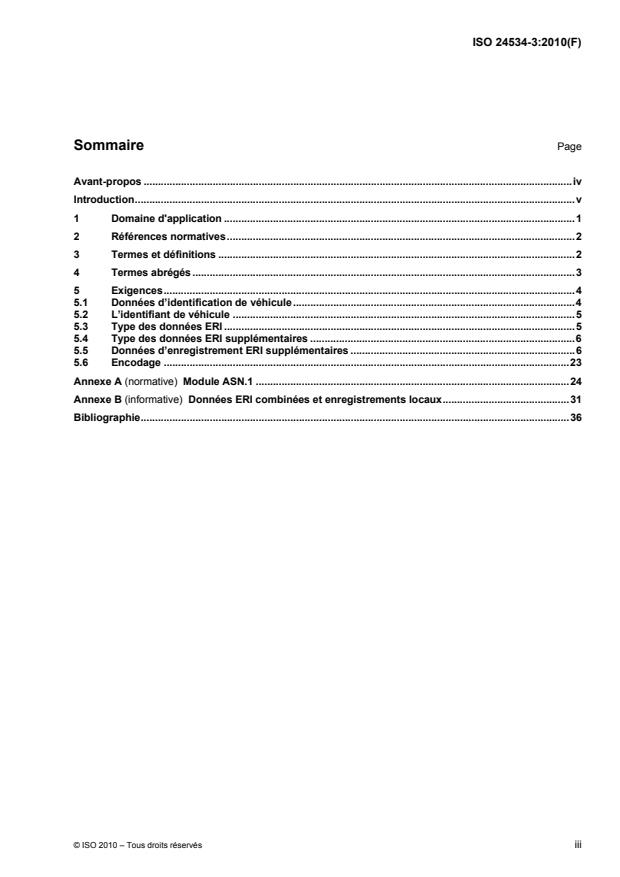
Sommaire Page
Avant-propos . iv
Introduction . v
1 Domaine d'application . 1
2 Références normatives . 2
3 Termes et définitions . 2
4 Termes abrégés . 3
5 Exigences . 4
5.1 Données d’identification de véhicule . 4
5.2 L’identifiant de véhicule . 5
5.3 Type des données ERI . 5
5.4 Type des données ERI supplémentaires . 6
5.5 Données d’enregistrement ERI supplémentaires . 6
5.6 Encodage . 23
Annexe A (normative) Module ASN.1 . 24
Annexe B (informative) Données ERI combinées et enregistrements locaux . 31
Bibliographie . 36
Avant-propos
L'ISO (Organisation internationale de normalisation) est une fédération mondiale d'organismes nationaux de
normalisation (comités membres de l'ISO). L'élaboration des Normes internationales est en général confiée
aux comités techniques de l'ISO. Chaque comité membre intéressé par une étude a le droit de faire partie du
comité technique créé à cet effet. Les organisations internationales, gouvernementales et non
gouvernementales, en liaison avec l'ISO participent également aux travaux. L'ISO collabore étroitement avec
la Commission électrotechnique internationale (CEI) en ce qui concerne la normalisation électrotechnique.
Les Normes internationales sont rédigées conformément aux règles données dans les Directives ISO/CEI,
Partie 2.
La tâche principale des comités techniques est d'élaborer les Normes internationales. Les projets de Normes
internationales adoptés par les comités techniques sont soumis aux comités membres pour vote. Leur
publication comme Normes internationales requiert l'approbation de 75 % au moins des comités membres
votants.
L'attention est appelée sur le fait que certains des éléments du présent document peuvent faire l'objet de
droits de propriété intellectuelle ou de droits analogues. L'ISO ne saurait être tenue pour responsable de ne
pas avoir identifié de tels droits de propriété et averti de leur existence.
L'ISO 24534-3 a été élaborée par le comité technique CEN/TC 278, Télématique de la circulation et du
transport routier, du Comité européen de normalisation (CEN), en collaboration avec le comité technique
ISO/TC 204,Systèmes intelligents de transport, conformément à l'Accord de coopération technique entre l'ISO
et le CEN (Accord de Vienne).
Cette première édition de l’ISO 24534-3 annule et remplace l’ISO/TS 24534-3:2008, qui a fait l'objet d'une
révision technique.
L'ISO 24534 comprend les parties suivantes, présentées sous le titre général Identification automatique des
véhicules et des équipements — Identification d'enregistrement électronique (ERI) pour les véhicules:
Partie 1: Architecture
Partie 2: Exigences de fonctionnement
Partie 3: Données du véhicule
Partie 4: Communications sécurisées à l’aide de techniques asymétriques
Partie 5: Communications sécurisées à l’aide de techniques symétriques
iv © ISO 2010 – Tous droits réservés
Introduction
Au sein des administrations, un besoin émergeant rapidement d’amélioration de l’identification unique des
véhicules pour divers usages a été identifié. Certains constructeurs prévoient déjà d’attribuer un marqueur à
leurs véhicules pour toute leur durée de vie. Plusieurs gouvernements évaluent les besoins et les avantages
d’une identification d’enregistrement électronique (ERI) en tant que preuve juridique de l’identité d’un véhicule
avec des applications obligatoires potentielles. Une norme permettant une solution interopérable de
marqueurs et d’infrastructure se justifie commercialement et économiquement.
L’ERI est un moyen d’identification unique des véhicules routiers. L’application de l’ERI offrira des avantages
substantiels par rapport aux techniques existantes d’identification des véhicules. Il s’agira d’un outil adapté à
la gestion et à l’administration futures de la circulation et du transport, y compris pour des applications à des
conditions de circulation sur plusieurs voies, dans un écoulement libre, avec la capacité de supporter des
transactions mobiles. L’ERI répond aux besoins des autorités et des autres usagers de la route, y compris les
véhicules itinérants, pour une identification électronique fiable.
La présente partie de l’ISO 24534 spécifie les données relatives au véhicule pouvant être échangées entre un
marqueur d’enregistrement électronique (ERT) embarqué et un lecteur/scripteur ERI à l’intérieur ou à
l’extérieur du véhicule. Les données relatives au véhicule sont composées de l’identifiant du véhicule et
éventuellement des données de véhicule supplémentaires telles que celles généralement incluses dans un
certificat d’immatriculation de véhicule.
La présente partie de l’ISO 24534 ne fournit aucune définition précise quant aux données supplémentaires de
véhicule; cette tâche incombe aux autorités d’immatriculation locales et/ou à la législation locale. La présente
partie de l’ISO 24534 ne fournit que les moyens pour un échange sans ambiguïté des paramètres enregistrés
du véhicule par les autorités d’immatriculation locales.
La présente partie de l’ISO 24534 utilise les définitions de base de l’identification automatique d’un véhicule
(AVI) de l’ISO 14816.
NORME INTERNATIONALE ISO 24534-3:2010(F)
Identification automatique des véhicules et des équipements —
Identification d'enregistrement électronique (ERI) pour les
véhicules —
Partie 3:
Données du véhicule
1 Domaine d'application
La présente partie de l’ISO 24534 fournit les exigences pour une identification d’enregistrement électronique
(ERI) s’appuyant sur un identifiant attribué à un véhicule (par exemple, pour la reconnaissance par les
autorités nationales), adapté:
à l’identification électronique des véhicules locaux et étrangers par les autorités nationales;
à l’identification pendant la fabrication, la maintenance et la fin de vie des véhicules (gestion du cycle de
vie des véhicules);
à l’adaptation des données des véhicules (par exemple, pour les reventes à l’étranger);
aux besoins de la sécurité;
à la réduction des délits;
aux services commerciaux.
Elle respecte les réglementations concernant le respect de la vie privée et la protection des données.
La présente partie de l’ISO 24534 définit les données d’identification des véhicules. Celles-ci sont appelées
données ERI et comprennent
l’identifiant du véhicule, et
de potentielles informations supplémentaires relatives au véhicule (telles que celles généralement
incluses dans un certificat d’immatriculation de véhicule).
Toutes les données de véhicule supplémentaires sont facultatives. Le soin est laissé à la législation locale
et/ou à l’autorité d’immatriculation d’utiliser ou non un élément de données particulier. En cas d’utilisation, la
valeur est supposée être celle enregistrée par l’autorité d’immatriculation conformément à la législation locale.
La présente partie de l’ISO 24534 ne fournit que la syntaxe de tous ces éléments de données.
NOTE Les interfaces de la couche application sécurisée pour l’échange de données ERI avec un lecteur ou un
scripteur ERI sont spécifiées dans l’ISO 24534-4 et dans l’ISO 24534-5.
2 Références normatives
Les documents de référence suivants sont indispensables pour l'application du présent document. Pour les
références datées, seule l'édition citée s'applique. Pour les références non datées, la dernière édition du
document de référence s'applique (y compris les éventuels amendements).
ISO 612:1978, Véhicules routiers — Dimensions des automobiles et véhicules tractés — Dénominations et
définitions
ISO 1176:1990, Véhicules routiers — Masses — Vocabulaire et codes
ISO 3779, Véhicules routiers — Numéro d'identification des véhicules (VIN) — Contenu et structure
ISO 3780, Véhicules routiers — Code d'identification mondiale des constructeurs (WMI)
ISO 3833, Véhicules routiers — Types — Dénominations et définitions
ISO/CEI 8824 (toutes les parties), Technologies de l'information — Notation de syntaxe abstraite numéro un
(ASN.1): Spécification de la notation de base
ISO/CEI 8825-2, Technologies de l'information — Règles de codage ASN.1: Spécification des règles de
codage compact (PER)
3 Termes et définitions
Pour les besoins du présent document, les termes et définitions suivants s’appliquent.
3.1
données de véhicule supplémentaires
données ERI outre l’identifiant de véhicule
3.2
identificateur distinctif
information qui distingue une entité sans ambiguïté
[ISO/CEI 9798-1:1997, définition 3.3.9]
3.3
identification d’enregistrement électronique
ERI
action ou acte d’identification d’un véhicule par des moyens électroniques pour les besoins décrits dans le
domaine d’application de la présente partie de l’ISO 24534
NOTE Le terme abrégé ERI est dérivé de l'anglais electronic registration identification.
3.4
données ERI
données d’identification de véhicule pouvant être obtenues d’un ERT
NOTE Les données ERI consistent en l’identifiant de véhicule et les autres données possibles concernant le
véhicule.
2 © ISO 2010 – Tous droits réservés
3.5
marqueur d’enregistrement électronique
ERT
dispositif ERI embarqué contenant les données ERI, y compris les dispositions de sécurité appropriées, et
une ou plusieurs interfaces pour accéder aux données
NOTE 1 Dans les cas où le niveau de sécurité est élevé, il s’agit d’un type de SAM (module d’application sécurisée).
NOTE 2 L'ERT peut être un dispositif séparé ou être incorporé dans un dispositif embarqué qui fournit également
d'autres capacités (par exemple communications DSRC).
NOTE 3 Le terme abrégé ERT est dérivé de l'anglais electronic registration tag.
3.6
contrôle technique périodique
contrôle périodique (par exemple annuel) obligatoire du bon état d’un véhicule à moteur ayant dépassé un
certain âge, ou un certificat de passage d’un tel contrôle
EXEMPLE Le MOT, au Royaume-Uni.
3.7
respect de la vie privée
droit des individus d’exercer leur contrôle ou d’agir sur les informations collectées et stockées les concernant,
et sur les personnes par lesquelles et auxquelles ces informations peuvent être divulguées
[ISO 7498-2:1989, définition 3.3.43]
NOTE Comme ce terme est relatif au droit des personnes, il ne peut pas être très précis et il conseillé d’éviter de
l’employer, sauf pour motiver une exigence de sécurité.
3.8
autorité d’immatriculation
pour les véhicules autorité responsable de l’immatriculation et de la conservation des enregistrements de
véhicule
NOTE L’autorité peut fournir des enregistrements de véhicule aux organisations accréditées.
3.9
autorité d’immatriculation
pour les données ERI organisation responsable des données ERI et de sécurité, conformément à la
législation locale
NOTE L’autorité d’immatriculation pour les données ERI peut être la même que l’autorité d'immatriculation pour les
véhicules. La présente Norme internationale ne l’exige cependant pas.
3.10
certificat d’immatriculation
document d’immatriculation du véhicule (papier ou carte à puce) délivré par l’autorité d'immatriculation pour
les véhicules dans lequel le véhicule et son propriétaire ou son locataire sont enregistrés
4 Termes abrégés
AEI Identification automatique d’un équipement (automatic equipment identification)
ASN.1 Notation de syntaxe abstraite numéro un [Abstract Syntax Notation One, telle que définie dans
l’ISO/CEI 8824 (toutes les parties)]
AVI Identification automatique d’un véhicule (automatic vehicle identification)
EEA Espace économique européen (European Economic Area)
EN Norme européenne (Europäische Norm)
ENV Projet de Norme européenne (Europäische Norm Vorausgabe)
ERI Identification d’enregistrement électronique (electronic registration identification)
ERT Marqueur d’enregistrement électronique (electronic registration tag)
UE Union européenne
VIN Numéro d’identification d'un véhicule (vehicle identification number)
5 Exigences
5.1 Données d’identification de véhicule
Le paragraphe 5.1 est uniquement informatif.
L’environnement embarqué sécurisé dans lequel les données d’identification du véhicule sont stockées est
appelé le marqueur d’enregistrement électronique (ERT).
Le présent Article 5 donne une définition abstraite des données ERI qui seront échangées entre l’ERT et un
lecteur ou un scripteur ERI. Les définitions abstraites sont établies à l’aide de la Notation de syntaxe abstraite
numéro un (ASN.1) telle que définie dans l’ISO/CEI 8824 (toutes les parties).
L’identifiant utilisé pour identifier un véhicule est appelé identifiant de véhicule ou vehicleId. L’identifiant de
véhicule préférentiel est le VIN, attribué au véhicule par son constructeur conformément à l’ISO 3779.
Toutefois, pour rendre la présente partie de l’ISO 24534 applicable également dans les pays où le VIN n’est
pas utilisé, une solution de remplacement est également soutenue (voir 5.2). L’exigence fondamentale est le
caractère distinctif au niveau mondial de la combinaison d’une autorité d’immatriculation et d’un identifiant de
véhicule.
NOTE 1 Comme deux véhicules construits à 30 ans d’écart peuvent avoir le même VIN, le VIN n’est pas unique à
100 %.
NOTE 2 Des données empiriques ont prouvé que la base de données d’une autorité d’immatriculation pouvait
comporter des numéros VIN en double.
NOTE 3 Dans la présente partie de l’ISO 24534, la combinaison du vehicleId quasiment unique et d’un numéro ERT
unique peut être utilisée comme identifiant distinctif sans ambiguïté. Le numéro ERT est un identifiant unique en lecture
seule inscrit dans l’ERT pendant la fabrication de celui-ci. Consulter l’ISO 24534-4 et l’ISO 24534-5 pour de plus amples
détails.
Outre l’identifiant de véhicule, la présente partie de l’ISO 24534 supporte également l’utilisation de données
de véhicule supplémentaires telles que celles généralement incluses dans un certificat d’immatriculation de
véhicule. Ces données de véhicule supplémentaires peuvent par exemple être utilisées comme:
informations d’identification supplémentaires pour améliorer la confiance en un identifiant de véhicule; et
informations de véhicule certifiées pour d’autres applications (par exemple, pour la détermination d’un
tarif de péage).
4 © ISO 2010 – Tous droits réservés
5.2 L’identifiant de véhicule
Le type VehicleId doit être utilisé pour l’identifiant de véhicule conformément à la législation locale et est défini
de la manière suivante:
VehicleId ::= CHOICE {
vin VIN, -- choix préférentiel
raSpecificVehicleId RaSpecificVehicleId,
…
}
VIN ::= CS5
NOTE 1 Le ‘…’, à la fin de la définition, indique que des composants supplémentaires peuvent s’ajouter au type
VehicleId à cet emplacement dans les nouvelles versions de la présente partie de l’ISO 24534, par exemple, pour faire
face à une nouvelle norme VIN.
Il convient que le VehicleId soit un identifiant distinctif au niveau mondial.
NOTE 2 Lors de l’identification d’un véhicule, l’ERT fournit toujours le VehicleId associé à l’identifiant de l’autorité
d’immatriculation et au numéro ERT. L’identifiant de l’autorité d’immatriculation peut être utilisé pour obtenir des
informations supplémentaires au sujet du véhicule. Le numéro ERT est un identifiant unique supplémentaire provenant
d’une autre source et pouvant être utilisé pour résoudre une éventuelle ambiguïté au sujet du VIN d’un véhicule.
NOTE 3 Le choix de l’autre solution utilisée sort du domaine d’application de la présente partie de l’ISO 24534. Celle-ci
peut dépendre de la législation locale, par exemple.
La solution de remplacement du vin, si elle est utilisée, doit être de type VIN et est l’identifiant de véhicule
préférentiel. Le type VIN est identique au type CS5 tel que défini dans l’ISO 14816. La valeur de la solution de
remplacement du VIN doit être la valeur du VIN telle qu’attribuée conformément à l’ISO 3779 par un
constructeur ou une autorité d’immatriculation.
La solution de remplacement raSpecificVehicleId, si elle est utilisée, doit comporter un identifiant distinctif au
niveau mondial pour le véhicule et doit être du type RaSpecificVehicleId tel que défini ci-dessous:
RaSpecificVehicleId ::= SEQUENCE {
wmi PrintableString (SIZE(3)),
nonIsoStandardId PrintableString (SIZE (1.20))
}
Le composant wmi doit comporter le code d’identification mondiale des constructeurs (WMI) de l’organisation
qui a attribué la valeur nonIsoStandardId, et le code WMI doit être attribué à cette organisation conformément
à l’ISO 3780.
Le composant nonIsoStandardId doit être du type PrintableString avec une longueur maximale de
20 caractères.
NOTE 4 Toute signification supplémentaire portée par la valeur d’un composant nonIsoStandardId sort du domaine
d’application de la présente partie de l’ISO 24534.
5.3 Type des données ERI
Le type EriData doit être utilisé pour les données ERI et est défini de la manière suivante:
EriData ::= SEQUENCE {
vehicleId VehicleId,
additionalEriData AdditionalEriData OPTIONAL
}
Le composant vehicleId doit comporter l’identifiant du véhicule tel que défini en 5.2.
Le composant AdditionalEriData, s’il est présent, doit comporter les données ERI supplémentaires.
5.4 Type des données ERI supplémentaires
Le type AdditionalEriData est utilisé pour les données ERI supplémentaires et est défini de la manière
suivante:
AdditionalEriData ::= CHOICE {
additionalEriRegistrationData AdditionalEriRegistrationData, -- choix préférentiel
…,
raSpecificAdditionalEriData OCTET STRING (SIZE (0.1024))
-- à n’utiliser que si AdditionalEriRegistrationData n’est pas supporté
}
Le choix préférentiel est le composant additionalEriRegistrationData, qui doit être choisi dès qu’une valeur du
type AdditionalEriRegistrationData peut être utilisée.
Le composant raSpecificAdditionalEriData est du type OCTET STRING d’une longueur maximale de
1 024 octets et ne doit être utilisé que si une valeur du type additionalEriRegistrationData ne peut l’être.
NOTE Le ‘…’, dans la définition, indique que des composants supplémentaires peuvent s’ajouter au type
AdditionalEriData à cet emplacement dans les nouvelles versions de la présente partie de l’ISO 24534, par exemple, pour
faire face à une nouvelle version du composant eriRegistrationData.
5.5 Données d’enregistrement ERI supplémentaires
5.5.1 Type des données d’enregistrement ERI supplémentaires
5.5.1.1 Définition du type des données d’enregistrement ERI supplémentaires
Le type AdditionalEriRegistrationData comporte les données relatives au véhicule se trouvant généralement
dans le certificat d’immatriculation du véhicule et est défini de la manière suivante:
6 © ISO 2010 – Tous droits réservés
AdditionalEriRegistrationData ::= SEQUENCE {
-- Données administratives
registrationAuthority RegistrationAuthority OPTIONAL,
vehicleIdStatus VehicleIdStatus OPTIONAL,
dateOfFirstRegistration DateOfFirstRegistration OPTIONAL,
dateOfRegistration DateOfRegistration OPTIONAL,
validThru ValidThru OPTIONAL,
chassisNumber ChassisNumber (SIZE (1.23)) OPTIONAL,
registrationNumber RegistrationNumber OPTIONAL,
-- Type de véhicule
vehicleMake VehicleMake OPTIONAL,
vehicleType VehicleType OPTIONAL,
vehicleTypeStatus VehicleTypeStatus OPTIONAL,
commercialDescription CommercialDescription OPTIONAL,
typeApprovalNumber TypeApprovalNumber OPTIONAL,
vehicleCategory VehicleCategory OPTIONAL,
vehicleTaxCategory VehicleTaxCategory OPTIONAL,
euVehicleCategoryCode EuVehicleCategoryCode OPTIONAL,
raSpecificVehicleClass1 RaSpecificVehicleClass1 OPTIONAL,
raSpecificVehicleClass2 RaSpecificVehicleClass2 OPTIONAL,
raSpecificVehicleClass3 RaSpecificVehicleClass3 OPTIONAL,
vehicleUse VehicleUse OPTIONAL,
privateUse PrivateUse OPTIONAL,
colour VehicleColour OPTIONAL,
-- Forme du véhicule
length VehicleLength OPTIONAL,
width VehicleWidth OPTIONAL,
height VehicleHeight OPTIONAL,
wheelbase Wheelbase OPTIONAL,
bodyShape VehicleBodyShape OPTIONAL,
euBodyWorkType EuBodyWorkType OPTIONAL,
iso3833VehicleType Iso3833VehicleType OPTIONAL,
-- Nombre de passagers, nombre d’essieux et masse du véhicule
numberOfSeats NumberOfSeats OPTIONAL, -- siège conducteur
compris
numberOfStandingPlaces NumberOfStandingPlaces OPTIONAL,
maxNumberOfPassengers MaxNumberOfPassengers OPTIONAL, --
conducteur compris
unladenWeight UnladenWeight OPTIONAL,
maxDesignLadenMass MaxDesignLadenMass OPTIONAL,
maxAuthorizedLadenMass MaxAuthorizedLadenMass OPTIONAL,
maxAuthorizedTrainMass MaxAuthorizedTrainMass OPTIONAL,
maxAuthorizedPayload MaxAuthorizedPayload OPTIONAL,
numberOfAxles NumberOfAxles OPTIONAL,
authorizedAxleLadenMass AuthorizedAxleLadenMass OPTIONAL, -- de
l’essieu avant à l’essieu arrière
axleGroupConfiguration NumberOfAxlesForEachAxleGroup OPTIONAL, --
groupe de l’essieu avant à l’essieu arrière
authorizedAxleGroupLadenMass AuthorizedAxleGroupLadenMass OPTIONAL, --
groupe de l’essieu avant à l’essieu arrière
maxTowableMassBrakedTrailer MaxTowableMassBrakedTrailer OPTIONAL,
maxTowableMassUnbrakedTrailer MaxTowableMassUnbrakedTrailer OPTIONAL,
-- Moteur et source d’énergie du véhicule
engineId EngineId (SIZE (1.60)) OPTIONAL,
primeEngineType PrimeEngineType OPTIONAL,
enginePowerSources EnginePowerSources OPTIONAL,
primePowerSource PrimePowerSource OPTIONAL,
engineMaxNetPower EngineMaxNetPower OPTIONAL,
engineDisplacement EngineDisplacement OPTIONAL,
ratedEngineSpeed RatedEngineSpeed OPTIONAL,
powerWeightRatio PowerWeightRatio OPTIONAL,
maxSpeed MaxSpeed OPTIONAL,
fuelTanksCapacity FuelTanksCapacity OPTIONAL,
-- Caractéristiques environnementales
stationarySoundLevel StationarySoundLevel OPTIONAL,
engineSpeed EngineSpeed OPTIONAL,
driveBySoundLevel DriveBySoundLevel OPTIONAL,
emissionCO EmissionCO OPTIONAL,
emissionHC EmissionHC OPTIONAL,
emissionNOx EmissionNOx OPTIONAL,
emissionHCandNOx EmissionHCandNOx OPTIONAL,
particulatesForDiesel ParticulatesForDiesel OPTIONAL,
correctedAbsorptionCoefficient CorrectedAbsorptionCoefficient OPTIONAL,
emissionCO2 EmissionCO2 OPTIONAL,
combinedFuelConsumption CombinedFuelConsumption OPTIONAL,
environmentalCategory EnvironmentalCategory OPTIONAL,
euroType EuroType OPTIONAL,
-- Autres
lastOfficialTestData OfficialVehicleTestData OPTIONAL,
…,
raSpecificData RaSpecificData OPTIONAL
}
Le type des composants du type AdditionalEriRegistrationData est défini dans les paragraphes 5.5.1.2 à
5.5.1.8.
NOTE 1 Le ‘…’, à la fin de la définition de AdditionalEriRegistrationData, indique que des composants supplémentaires
peuvent encore s’ajouter au type AdditionalEriRegistrationData à cet emplacement dans les nouvelles versions de la
présente partie de l’ISO 24534.
Tous les composants sont facultatifs. La présence ou l’absence d’un composant facultatif dépend de la
législation locale et de l’autorité d’immatriculation du véhicule.
La signification précise de la valeur d’un composant, s’il existe, doit être déterminée par la législation locale
et/ou par l’autorité d’immatriculation du véhicule et doit toujours avoir la priorité sur une définition de la
présente Norme internationale.
NOTE 2 La présente partie de l’ISO 24534 ne fait que faciliter l’échange des valeurs des données d’enregistrement
ERI pour les besoins d’identification des véhicules. La définition précise des termes et l’attribution des valeurs dans un
état ou un pays particulier sortent toutes deux du domaine d’application de la présente partie de l’ISO 24534.
NOTE 3 Pour maintenir la cohérence avec le certificat d’immatriculation du véhicule, il convient que la valeur d’un
composant, s’il est présent et le cas échéant, soit égale ou au moins aussi précise que la valeur de l’élément de données
correspondant du certificat d’immatriculation du véhicule.
8 © ISO 2010 – Tous droits réservés
5.5.1.2 Composants de données administratives
Le composant registrationAuthority, s’il est présent, doit identifier l’autorité d’immatriculation ayant enregistré
le véhicule.
Le composant vehicleIdStatus, s’il est présent, doit spécifier le statut de l’identifiant de véhicule.
Le composant vehicleIdStatus ne doit pas être présent pour un identifiant de véhicule dérivé du VIN.
Le composant dateOfFirstRegistration, s’il est présent, doit spécifier la date de première immatriculation du
véhicule par son autorité d’immatriculation actuelle.
Le composant dateOfRegistration, s’il est présent, doit spécifier la date d’immatriculation à laquelle les
données ERI font référence.
Le composant validThru, s’il est présent, doit spécifier le dernier jour de validité des données ERI. S’il est
absent, la période de validité peut être supposée illimitée.
Le composant chassisNumber, s’il est présent, doit spécifier le numéro de châssis du véhicule.
Le composant registrationNumber, s’il est présent, doit spécifier le numéro d’immatriculation du véhicule tel
qu’attribué par son autorité d’immatriculation.
5.5.1.3 Composants de type de véhicule
Le composant vehicleMake, s’il est présent, doit spécifier la marque du véhicule telle qu’attribuée par le
constructeur du véhicule.
Le composant vehicleType, s’il est présent, doit spécifier la variante, le cas échéant, et/ou la version, le cas
échéant, du véhicule telles qu’attribuées par le constructeur du véhicule.
Le composant vehicleTypeStatus, s’il est présent, doit spécifier le statut du type de véhicule.
Le composant commercialDescription, s’il est présent, doit comporter la ou les descriptions commerciales du
véhicule.
Le composant typeApprovalNumber, s’il est présent, doit spécifier le numéro de réception.
Le composant vehicleCategory, s’il est présent, doit spécifier la catégorie du véhicule conformément à la
législation locale.
Le composant vehicleTaxCategory, s’il est présent, doit spécifier la catégorie fiscale du véhicule
conformément à la législation locale.
Le composant euVehicleCategoryCode, s’il est présent, doit spécifier la catégorie du véhicule conformément
aux directives européennes UE 2001/116, UE 2002/24 et UNECE 1999.
Le composant raSpecificVehicleClass1, s’il est présent, doit comporter une classe, une catégorie ou un code
de véhicule spécifique à l’autorité d’immatriculation.
Le composant raSpecificVehicleClass2, s’il est présent, doit comporter une classe, une catégorie ou un code
de véhicule spécifique à l’autorité d’immatriculation.
Le composant raSpecificVehicleClass3, s’il est présent, doit comporter une classe, une catégorie ou un code
de véhicule spécifique à l’autorité d’immatriculation.
Le composant vehicleUse, s’il est présent, doit spécifier l’usage du véhicule.
Le composant privateUse, s’il est présent, doit spécifier si le véhicule est destiné à un usage personnel ou
commercial.
Le composant colour, s’il est présent, doit spécifier la couleur du véhicule.
5.5.1.4 Composants de forme du véhicule
Le composant length, s’il est présent, doit spécifier la longueur du véhicule.
Le composant width, s’il est présent, doit spécifier la largeur du véhicule.
Le composant height, s’il est présent, doit spécifier la hauteur du véhicule.
Le composant wheelbase, s’il est présent, doit spécifier l’empattement du véhicule.
Le composant bodyShape, s’il est présent, doit spécifier la forme de la carrosserie du véhicule.
Le composant euBodyWorkType, s’il est présent, doit spécifier le type de la carrosserie du véhicule,
conformément à l’UE 2001/116.
Le composant iso3833VehicleType, s’il est présent, doit spécifier le type du véhicule, conformément à
l’ISO 3833.
5.5.1.5 Composants de nombre de passagers, de nombre d’essieux et de masse du véhicule
Le composant numberOfSeats, s’il est présent, doit spécifier le nombre de sièges, y compris celui du
conducteur.
Le composant numberOfStandingPlaces, s’il est présent, doit spécifier le nombre de places debout.
Le composant maxNumberOfPassenger, s’il est présent, doit spécifier le nombre maximal admissible de
passagers (conducteur compris) pouvant utiliser le véhicule.
Le composant unladenWeight, s’il est présent, doit spécifier le poids à vide nominal du véhicule avec sa
carrosserie.
Le composant maxDesignLadenMass, s’il est présent, doit spécifier le poids total maximal techniquement
admissible du véhicule, charge utile comprise (mais sans le poids des remorques).
Le composant maxAuthorizedLadenMass, s’il est présent, doit spécifier le poids total maximal admissible du
véhicule, charge utile comprise (mais sans le poids des remorques), lorsqu’il est en service dans la juridiction
de l’autorité d’immatriculation.
Le composant maxAuthorizedTrainMass, s’il est présent, doit spécifier le poids total maximal admissible du
véhicule complet en kilogrammes, charge utile comprise (et remorques et poids des remorques compris),
lorsqu’il est en service dans la juridiction de l’autorité d’immatriculation.
Le composant maxAuthorizedPayload, s’il est présent, doit spécifier la charge utile maximale admissible du
véhicule (mais sans la charge utile des remorques).
Le composant numberOfAxles, s’il est présent, doit spécifier le nombre d’essieux du véhicule (y compris les
essieux relevés).
Le composant authorizedLadenMass, s’il est présent, doit spécifier le poids en charge maximal sur chaque
essieu, en kilogrammes.
10 © ISO 2010 – Tous droits réservés
Le composant axleGroupConfiguration, s’il est présent, doit spécifier le nombre d’essieux de chaque groupe
d'essieu du véhicule (y compris les essieux relevés).
Le composant authorizedAxleGroupLadenMass, s’il est présent, doit spécifier le poids en charge maximal sur
chaque groupe d'essieu, en kilogrammes.
Le composant maxTowableMassBrakedTrailer, s’il est présent, doit spécifier le poids tractable freiné maximal
techniquement admissible de la remorque.
Le composant maxTowableMassUnbrakedTrailer, s’il est présent, doit spécifier le poids tractable non freiné
maximal techniquement admissible de la remorque.
5.5.1.6 Composants de moteur et de source d’énergie du véhicule
Le composant engineId, s’il est présent, doit spécifier le numéro d’identification du moteur.
Le composant primeEngineType, s’il est présent, doit spécifier le type du moteur principal du véhicule tel
qu’attribué par le constructeur.
Le composant enginePowerSource, s’il est présent, doit spécifier la ou les sources d’énergie du véhicule.
Le composant primePowerSource, s’il est présent, doit spécifier la source d’énergie du moteur principal.
Le composant engineMaxNetPower, s’il est présent, doit spécifier la puissance (nette maximale) nominale du
moteur.
Le composant engineDisplacement, s’il est présent, doit spécifier la cylindrée du moteur.
Le composant ratedEngineSpeed, s’il est présent, doit spécifier la vitesse nominale.
Le composant powerWeightRatio, s’il est présent, doit spécifier le rapport puissance/poids du véhicule.
Le composant maxSpeed, s’il est présent, doit spécifier la vitesse maximale du véhicule.
Le composant fuelTankCapacity, s’il est présent, doit spécifier la capacité du ou des réservoirs de carburant.
5.5.1.7 Composants de caractéristiques environnementales
Le composant stationarySoundLevel, s’il est présent, doit spécifier le niveau sonore à l’arrêt du véhicule.
Le composant engineSpeed, s’il est présent, doit spécifier la vitesse du moteur.
Le composant driveBySoundLevel, s’il est présent, doit spécifier le niveau sonore en marche (passage) du
véhicule.
Le composant emissionCO, s’il est présent, doit spécifier les émissions d’échappement de CO.
Le composant emissionHC, s’il est présent, doit spécifier les émissions d’échappement de HC.
Le composant emissionNOx, s’il est présent, doit spécifier les émissions d’échappement de NO .
x
Le composant emissionHCandNOx, s’il est présent, doit spécifier les émissions d’échappement de HC plus de
NO .
x
Le composant particulatesForDiesel, s’il est présent, doit spécifier les émissions d’échappement de particules
pour le diesel.
Le composant correctedAbsorptionCoefficient, s’il est présent, doit spécifier le coefficient d’absorption corrigé
pour le diesel.
Le composant emissionCO2, s’il est présent, doit spécifier les émissions d’échappement de CO .
Le composant combinedFuelConsumption, s’il est présent, doit spécifier la consommation combinée de
carburant du véhicule.
Le composant environmentalCategory, s’il est présent, doit être du type EnvironmentalCategory et doit
spécifier la catégorie environnementale du véhicule.
Le composant euroType, s’il est présent, doit spécifier la catégorie environnementale du véhicule
conformément à la directive UE 1988/77, telle que modifiée par l’UE 2003/522.
5.5.1.8 Autres composants
Le composant lastOfficialTestData, s’il est présent, doit spécifier les données observées lors du dernier
contrôle officiel du véhicule, tel qu’un contrôle technique périodique du véhicule ou un contrôle technique
intermédiaire.
Le composant lastOfficialTestData ne doit être présent que si l’un de ses composants est présent, au
minimum.
NOTE La valeur du composant EriRegistrationData doit être signée et nécessite donc une représentation canonique.
Le composant raSpecificVehicleData, s’il est présent, peut comporter toutes données supplémentaires
spécifiques à une autorité.
5.5.2 Types administratifs
RegistrationAuthority ::= EntityId
VehicleIdStatus ::= Text60
DateOfFirstRegistration ::= DATE
DateOfRegistration ::= DATE
ValidThru ::= DATE
ChassisNumber ::= PrintableString (SIZE (1.23)) -- 3 caractères WMI compris
RegistrationNumber ::= CS4
Sauf spécification contraire, la définition et l’attribution des valeurs pour les types définis dans le présent
paragraphe sont à la discrétion de l’autorité d’immatriculation et/ou de la législation locale (voir 5.5.1).
Le type RegistrationAuthority doit être utilisé pour identifier une autorité d’immatriculation et doit être du type
EntityId.
Le type VehicleIdStatus doit être utilisé pour spécifier le statut d’un identifiant de véhicule.
Le type vehicleIdStatus ne doit pas être utilisé pour un identifiant de véhicule dérivé du VIN.
EXEMPLE Des valeurs ordinaires, attribuées par l’autorité (identifiant de l’autorité ayant attribué le vehicleId), etc.
sont des exemples de valeurs possibles.
Le type dateOfFirstRegistration doit être utilisé pour spécifier la date de première immatriculation du véhicule
par son autorité d’immatriculation actuelle.
La valeur d’un composant DateOfFirstRegistration doit au moins comprendre l’année et, de manière
facultative, le mois et/ou le jour.
12 © ISO 2010 – Tous droits réservés
Le type DateOfRegistration doit être utilisé pour spécifier la date d’immatriculation à laquelle les données ERI
font référence.
Le type ValidThru doit être utilisé pour spécifier le dernier jour de validité des données ERI. S’il est absent, la
période de validité peut être supposée illimitée.
Le type ChassisNumber doit être utilisé pour spécifier le numéro de châssis du véhicule.
Le type RegistrationNumber doit être utilisé pour spécifier le numéro d’immatriculation du véhicule tel
qu’attribué par son autorité d’immatriculation.
5.5.3 Type de code de catégorie de véhicule UE
Le type EuVehicleCategoryCode est défini comme suit:
EuVehicleCategoryCode ::= CHOICE {
euVehicleCategoryL EuVehicleCategoryL, -- conforme à l’UE 2002/24 et à l’UNECE 19999
euVehicleCategoryM EuVehicleCategoryM, -- conforme à l’UE 2001/116 et à l’UNECE 1999
euVehicleCategoryN EuVehicleCategoryN, -- conforme à l’UE 2001/116 et à l’UNECE 1999
euVehicleCategoryO EuVehicleCategoryO, -- conforme à l’UE 2001/116 et à l’UNECE 1999
euVehicleCategoryT NULL, -- conforme à l’UNECE 1999
euVehicleCategoryG NULL -- conforme à l’UE 2001/116 et à l’UNECE 1999
}
EuVehicleCategoryL ::= ENUMERATED {l1, l2, l3, l4, l5, l6, l7}
EuVehicleCategoryM ::= ENUMERATED {m1, m2, m3}
EuVehicleCategoryN ::= ENUMERATED {n1, n2, n3}
EuVehicleCategoryO ::= ENUMERATED {o1, o2, o3, o4}
Une valeur EuVehicleCategoryCode peut être une valeur vehicleCategoryL, une valeur vehicleCategoryM,
une valeur vehicleCategoryN, une valeur vehicleCategoryO, une valeur vehicleCategoryT ou une valeur
vehicleCategoryG.
La valeur euVehicleCategoryL doit être choisie pour un véhicule de catégorie L conformément aux directives
UE 2002/24 ou UNECE 1999.
La valeur euVehicleCategoryL, si elle est choisie, doit prendre l’une des valeurs l1, l2, l3, l4, l5, l6 ou l7 pour
les catégories de véhicule respectives L1, L2, L3, L4, L5, L6 et L7 définies dans les directives UE 2002/24 ou
UNECE 1999.
NOTE 1 La catégorie de véhicule L est utilisée pour les véhicules équipés de moins de trois roues.
La valeur euVehicleCategoryM doit être choisie pour un véhicule de catégorie M conformément aux directives
UE 2001/116 ou UNECE 1999.
La valeur euVehicleCategoryM, si elle est choisie, doit prendre l’une des valeurs m1, m2 ou m3 pour les
catégories de véhicule respectives M1, M2 et M3 définies dans les directives UE 2001/116 ou UNECE 1999.
NOTE 2 La catégorie de véhicule M est utilisée pour les véhicules de transport de personnes; M1 s’appliquant aux
véhicules équipés d’au plus huit sièges en plus du siège du conducteur; M2 s’appliquant aux véhicules équipés de plus de
huit sièges mais de moins de cinq tonnes; et M3 s’appliquant aux véhicules équipés de plus de huit sièges et de plus de
cinq tonnes.
NOTE 3 Les véhicules à usage spécial de catégorie M1 de l’UNECE 1999 peuvent être décrits comme des types de
carrosserie de l’UE 2001/116 (voir euBodyWorkType).
La valeur euVehicleCategoryN doit être choisie pour un véhicule de catégorie N conformément aux directives
UE 2001/116 ou UNECE 1999.
La valeur euVehicleCategoryM, si elle est choisie, doit prendre l’une des valeurs n1, n2 ou n3 pour les
catégories de véhicule respectives N1, N2 et N3 définies dans les directives UE 2001/116 ou UNECE 1999.
NOTE 4 La catégorie de véhicule N est utilisée pour les véhicules de transport de marchandises; N1 s’appliquant aux
véhicules dont le poids maximal ne dépasse pas 3,5 tonnes; N2 s’appliquant aux véhicules dont le poids maximal
dépasse 3,5 tonnes mais ne dépasse pas 12 tonnes; et N3 s’appliquant aux véhicules dont le poids maximal dépasse 12
tonnes.
La valeur euVehicleCategoryO doit être choisie pour un véhicule de catégorie O conformément aux directives
UE 2001/116 ou UNECE 1999.
La valeur euVehicleCategoryO, si elle est choisie, doit prendre l’une des valeurs o1, o2, o3 ou o4 pour les
catégories de véhicule respectives O1, O2, O3 et O4 définies dans les directives UE 2001/116 ou
UNECE 1999.
NOTE 5 La catégorie de véhicule O est utilisée pour les (semi-)remorques; O1 s’appliquant aux remorques dont le
poids maximal ne dépasse pas 0,75 tonne; O2 s’appliquant aux remorques dont le poids maximal dépasse 0,75 tonne
mais ne dépasse pas 3,5 tonnes; O3 s’appliquant aux remorques dont le poids maximal dépasse 3,5 tonnes mais ne
dépasse pas 10 tonnes; et O4 s’appliquant aux remorques dont le poids maximal dépasse 10 tonnes.
La valeur euVehicleCategoryT doit être choisie pour un véhicule de catégorie T conformément à
l’UNECE 1999.
NOTE 6 La catégorie de véhicule T est utilisée pour les tracteurs d’agriculture et de foresterie.
La valeur euVehicleCategoryG doit être choisie pour un véhicule de catégorie G conformément aux directives
UE 2001/116 ou UNECE 1999.
NOTE 7 La catégorie de véhicule G est utilisée pour les véhicules tout terrain.
5.5.4 Autres types de véhicule
VehicleMake ::= Text60
VehicleType ::= Text60
VehicleTypeStatus ::= Text60
CommercialDescription ::= Text60
TypeApprovalNumber ::= PrintableString (SIZE (1.60))
VehicleCategory ::= Text60
VehicleTaxCategory ::= Text60
RaSpecificVehicleClass1 ::= Text60
RaSpecificVehicleClass2 ::= Text60
RaSpecificVehicleClass3 ::= Text60
VehicleUse ::= Text60
PrivateUse ::= BOOLEAN -- False = utilisation commerciale
VehicleColour ::= Text60
Sauf spécification contraire, la définition et l’attribution des valeurs pour les types définis dans le présent
paragraphe sont à la discrétion de l’autorité d’immatriculation et/ou de la législation locale (voir 5.5.1).
Le type VehicleMake doit être utilisé pour spécifier la marque du véhicule tel
...
Questions, Comments and Discussion
Ask us and Technical Secretary will try to provide an answer. You can facilitate discussion about the standard in here.
Loading comments...