


ISO/IEC 15408-2:2008
(Main)Information technology — Security techniques — Evaluation criteria for IT security — Part 2: Security functional components
Information technology — Security techniques — Evaluation criteria for IT security — Part 2: Security functional components
ISO/IEC 15408-2:2008 defines the content and presentation of the security functional requirements to be assessed in a security evaluation using ISO/IEC 15408. It contains a comprehensive catalogue of predefined security functional components that will meet most common security needs of the marketplace. These are organized using a hierarchical structure of classes, families and components, and supported by comprehensive user notes. ISO/IEC 15408-2:2008 also provides guidance on the specification of customized security requirements where no suitable predefined security functional components exist.
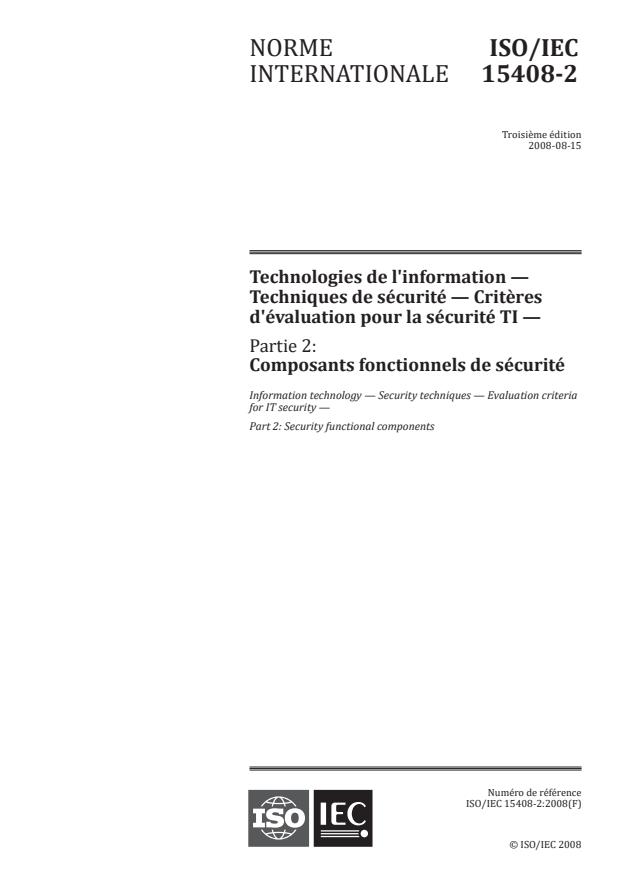
Technologies de l'information — Techniques de sécurité — Critères d'évaluation pour la sécurité TI — Partie 2: Composants fonctionnels de sécurité
Cette partie de l'ISO/IEC 15408 définit la structure requise et le contenu des composants fonctionnels de sécurité dans l'intérêt d'une évaluation de sécurité. Elle comporte un catalogue des composants fonctionnels qui répondront aux exigences fonctionnelles de sécurité communes à de nombreux produits TI.
General Information
- Status
- Withdrawn
- Publication Date
- 18-Aug-2008
- Current Stage
- 9599 - Withdrawal of International Standard
- Start Date
- 09-Aug-2022
- Completion Date
- 14-Feb-2026
Relations
- Effective Date
- 09-Feb-2026
- Effective Date
- 09-Feb-2026
- Effective Date
- 09-Feb-2026
- Effective Date
- 09-Feb-2026
- Effective Date
- 09-Feb-2026
- Effective Date
- 09-Feb-2026
- Effective Date
- 09-Feb-2026
- Effective Date
- 09-Feb-2026
- Effective Date
- 09-Feb-2026
- Effective Date
- 09-Feb-2026
- Referred By
CEN/TS 419241:2014 - Security Requirements for Trustworthy Systems Supporting Server Signing - Effective Date
- 09-Feb-2026
- Referred By
CEN/TS 419221-1:2016 - Protection Profiles for TSP cryptographic modules - Part 1: Overview - Effective Date
- 09-Feb-2026
- Effective Date
- 09-Feb-2026
- Effective Date
- 09-Feb-2026
- Effective Date
- 17-Dec-2016
Buy Documents
ISO/IEC 15408-2:2008 - Information technology -- Security techniques -- Evaluation criteria for IT security
ISO/IEC 15408-2:2008 - Technologies de l'information -- Techniques de sécurité -- Critères d'évaluation pour la sécurité TI
Get Certified
Connect with accredited certification bodies for this standard

BSI Group
BSI (British Standards Institution) is the business standards company that helps organizations make excellence a habit.

Bureau Veritas
Bureau Veritas is a world leader in laboratory testing, inspection and certification services.

DNV
DNV is an independent assurance and risk management provider.
Sponsored listings
Frequently Asked Questions
ISO/IEC 15408-2:2008 is a standard published by the International Organization for Standardization (ISO). Its full title is "Information technology — Security techniques — Evaluation criteria for IT security — Part 2: Security functional components". This standard covers: ISO/IEC 15408-2:2008 defines the content and presentation of the security functional requirements to be assessed in a security evaluation using ISO/IEC 15408. It contains a comprehensive catalogue of predefined security functional components that will meet most common security needs of the marketplace. These are organized using a hierarchical structure of classes, families and components, and supported by comprehensive user notes. ISO/IEC 15408-2:2008 also provides guidance on the specification of customized security requirements where no suitable predefined security functional components exist.
ISO/IEC 15408-2:2008 defines the content and presentation of the security functional requirements to be assessed in a security evaluation using ISO/IEC 15408. It contains a comprehensive catalogue of predefined security functional components that will meet most common security needs of the marketplace. These are organized using a hierarchical structure of classes, families and components, and supported by comprehensive user notes. ISO/IEC 15408-2:2008 also provides guidance on the specification of customized security requirements where no suitable predefined security functional components exist.
ISO/IEC 15408-2:2008 is classified under the following ICS (International Classification for Standards) categories: 35.030 - IT Security; 35.040 - Information coding. The ICS classification helps identify the subject area and facilitates finding related standards.
ISO/IEC 15408-2:2008 has the following relationships with other standards: It is inter standard links to EN ISO/IEC 15408-1:2020, CEN ISO/TS 17574:2009, EN ISO/IEC 18045:2020, EN 419251-2:2013, EN 419241-1:2018, EN 419231:2019, EN 13757-1:2014, EN 419251-1:2013, EN 419251-3:2013, EN 419211-6:2014, CEN/TS 419241:2014, CEN/TS 419221-1:2016, EN 419211-2:2013, EN ISO/IEC 15408-3:2020, ISO/IEC 15408-2:2022. Understanding these relationships helps ensure you are using the most current and applicable version of the standard.
ISO/IEC 15408-2:2008 is available in PDF format for immediate download after purchase. The document can be added to your cart and obtained through the secure checkout process. Digital delivery ensures instant access to the complete standard document.
Standards Content (Sample)
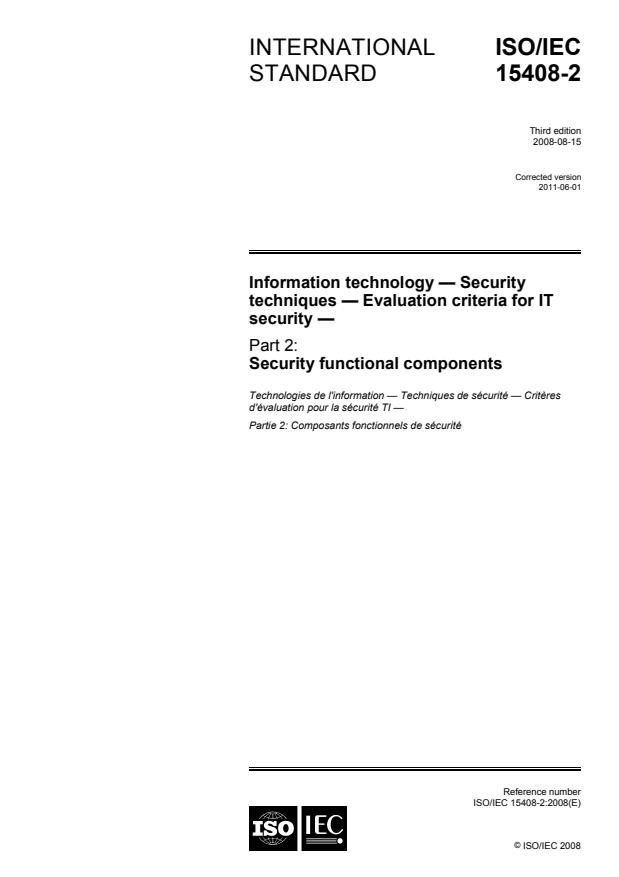
INTERNATIONAL ISO/IEC
STANDARD 15408-2
Third edition
2008-08-15
Corrected version
2011-06-01
Information technology — Security
techniques — Evaluation criteria for IT
security —
Part 2:
Security functional components
Technologies de l'information — Techniques de sécurité — Critères
d'évaluation pour la sécurité TI —
Partie 2: Composants fonctionnels de sécurité
Reference number
©
ISO/IEC 2008
© ISO/IEC 2008
All rights reserved. Unless otherwise specified, no part of this publication may be reproduced or utilized in any form or by any means,
electronic or mechanical, including photocopying and microfilm, without permission in writing from either ISO at the address below or
ISO's member body in the country of the requester.
ISO copyright office
Case postale 56 • CH-1211 Geneva 20
Tel. + 41 22 749 01 11
Fax + 41 22 749 09 47
E-mail copyright@iso.org
Web www.iso.org
Published in Switzerland
ii © ISO/IEC 2008 – All rights reserved
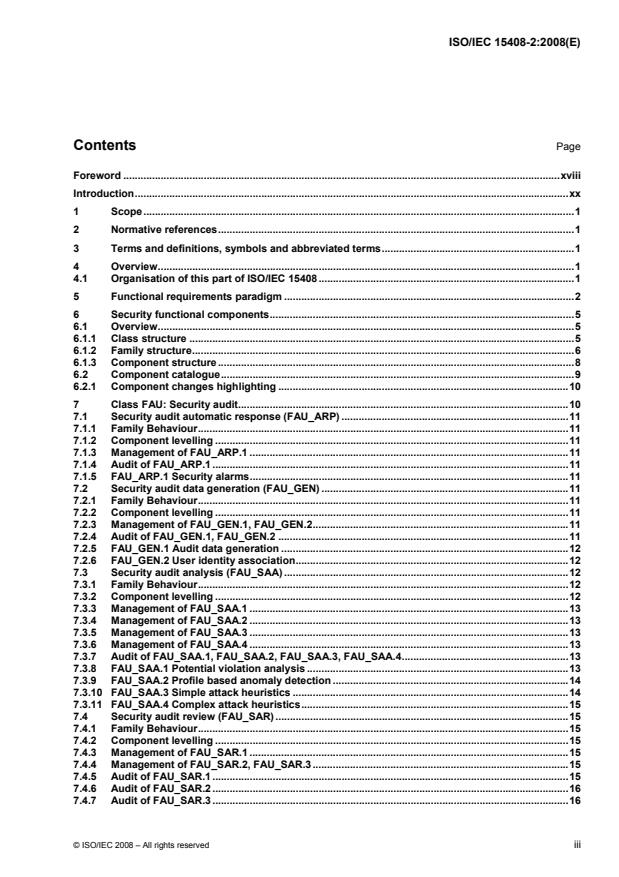
Contents Page
Foreword .xviii
Introduction.xx
1 Scope.1
2 Normative references.1
3 Terms and definitions, symbols and abbreviated terms.1
4 Overview.1
4.1 Organisation of this part of ISO/IEC 15408.1
5 Functional requirements paradigm .2
6 Security functional components.5
6.1 Overview.5
6.1.1 Class structure.5
6.1.2 Family structure.6
6.1.3 Component structure .8
6.2 Component catalogue.9
6.2.1 Component changes highlighting .10
7 Class FAU: Security audit.10
7.1 Security audit automatic response (FAU_ARP) .11
7.1.1 Family Behaviour.11
7.1.2 Component levelling .11
7.1.3 Management of FAU_ARP.1 .11
7.1.4 Audit of FAU_ARP.1 .11
7.1.5 FAU_ARP.1 Security alarms.11
7.2 Security audit data generation (FAU_GEN) .11
7.2.1 Family Behaviour.11
7.2.2 Component levelling .11
7.2.3 Management of FAU_GEN.1, FAU_GEN.2.11
7.2.4 Audit of FAU_GEN.1, FAU_GEN.2 .11
7.2.5 FAU_GEN.1 Audit data generation .12
7.2.6 FAU_GEN.2 User identity association.12
7.3 Security audit analysis (FAU_SAA) .12
7.3.1 Family Behaviour.12
7.3.2 Component levelling .12
7.3.3 Management of FAU_SAA.1 .13
7.3.4 Management of FAU_SAA.2 .13
7.3.5 Management of FAU_SAA.3 .13
7.3.6 Management of FAU_SAA.4 .13
7.3.7 Audit of FAU_SAA.1, FAU_SAA.2, FAU_SAA.3, FAU_SAA.4.13
7.3.8 FAU_SAA.1 Potential violation analysis .13
7.3.9 FAU_SAA.2 Profile based anomaly detection .14
7.3.10 FAU_SAA.3 Simple attack heuristics .14
7.3.11 FAU_SAA.4 Complex attack heuristics.15
7.4 Security audit review (FAU_SAR) .15
7.4.1 Family Behaviour.15
7.4.2 Component levelling .15
7.4.3 Management of FAU_SAR.1 .15
7.4.4 Management of FAU_SAR.2, FAU_SAR.3.15
7.4.5 Audit of FAU_SAR.1 .15
7.4.6 Audit of FAU_SAR.2 .16
7.4.7 Audit of FAU_SAR.3 .16
© ISO/IEC 2008 – All rights reserved iii
7.4.8 FAU_SAR.1 Audit review.16
7.4.9 FAU_SAR.2 Restricted audit review .16
7.4.10 FAU_SAR.3 Selectable audit review .16
7.5 Security audit event selection (FAU_SEL) .16
7.5.1 Family Behaviour.16
7.5.2 Component levelling .17
7.5.3 Management of FAU_SEL.1 .17
7.5.4 Audit of FAU_SEL.1.17
7.5.5 FAU_SEL.1 Selective audit.17
7.6 Security audit event storage (FAU_STG) .17
7.6.1 Family Behaviour.17
7.6.2 Component levelling .17
7.6.3 Management of FAU_STG.1.18
7.6.4 Management of FAU_STG.2.18
7.6.5 Management of FAU_STG.3.18
7.6.6 Management of FAU_STG.4.18
7.6.7 Audit of FAU_STG.1, FAU_STG.2.18
7.6.8 Audit of FAU_STG.3.18
7.6.9 Audit of FAU_STG.4.18
7.6.10 FAU_STG.1 Protected audit trail storage .18
7.6.11 FAU_STG.2 Guarantees of audit data availability .19
7.6.12 FAU_STG.3 Action in case of possible audit data loss .19
7.6.13 FAU_STG.4 Prevention of audit data loss.19
8 Class FCO: Communication .20
8.1 Non-repudiation of origin (FCO_NRO).20
8.1.1 Family Behaviour.20
8.1.2 Component levelling .20
8.1.3 Management of FCO_NRO.1, FCO_NRO.2 .20
8.1.4 Audit of FCO_NRO.1.20
8.1.5 Audit of FCO_NRO.2.21
8.1.6 FCO_NRO.1 Selective proof of origin.21
8.1.7 FCO_NRO.2 Enforced proof of origin.21
8.2 Non-repudiation of receipt (FCO_NRR).22
8.2.1 Family Behaviour.22
8.2.2 Component levelling .22
8.2.3 Management of FCO_NRR.1, FCO_NRR.2 .22
8.2.4 Audit of FCO_NRR.1.22
8.2.5 Audit of FCO_NRR.2.22
8.2.6 FCO_NRR.1 Selective proof of receipt .22
8.2.7 FCO_NRR.2 Enforced proof of receipt .23
9 Class FCS: Cryptographic support.24
9.1 Cryptographic key management (FCS_CKM).24
9.1.1 Family Behaviour.24
9.1.2 Component levelling .24
9.1.3 Management of FCS_CKM.1, FCS_CKM.2, FCS_CKM.3, FCS_CKM.4 .25
9.1.4 Audit of FCS_CKM.1, FCS_CKM.2, FCS_CKM.3, FCS_CKM.4 .25
9.1.5 FCS_CKM.1 Cryptographic key generation .25
9.1.6 FCS_CKM.2 Cryptographic key distribution.25
9.1.7 FCS_CKM.3 Cryptographic key access.25
9.1.8 FCS_CKM.4 Cryptographic key destruction .26
9.2 Cryptographic operation (FCS_COP) .26
9.2.1 Family Behaviour.26
9.2.2 Component levelling .26
9.2.3 Management of FCS_COP.1 .26
9.2.4 Audit of FCS_COP.1 .26
9.2.5 FCS_COP.1 Cryptographic operation.27
10 Class FDP: User data protection.27
10.1 Access control policy (FDP_ACC) .29
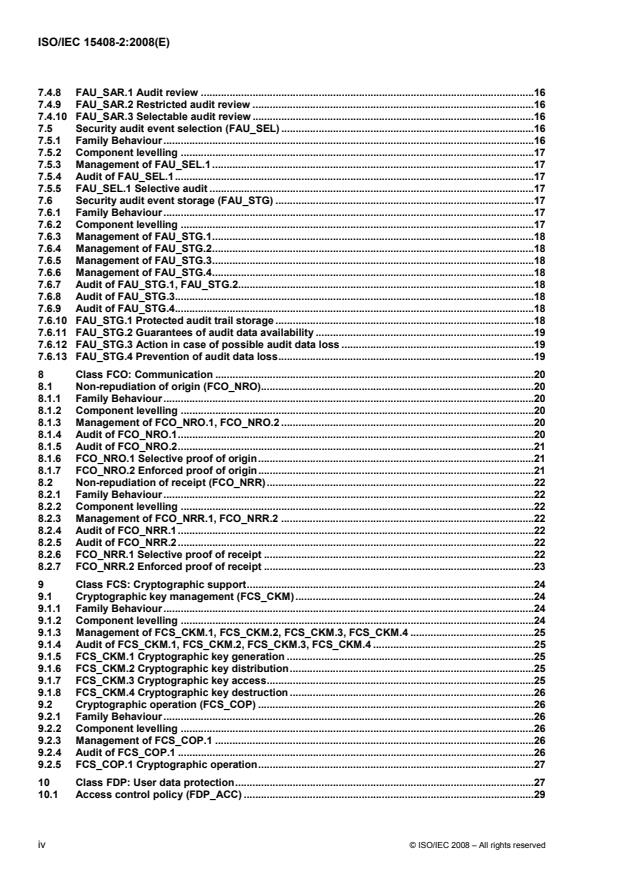
iv © ISO/IEC 2008 – All rights reserved
10.1.1 Family Behaviour.29
10.1.2 Component levelling .30
10.1.3 Management of FDP_ACC.1, FDP_ACC.2.30
10.1.4 Audit of FDP_ACC.1, FDP_ACC.2.30
10.1.5 FDP_ACC.1 Subset access control .30
10.1.6 FDP_ACC.2 Complete access control.30
10.2 Access control functions (FDP_ACF) .30
10.2.1 Family Behaviour.30
10.2.2 Component levelling .30
10.2.3 Management of FDP_ACF.1 .31
10.2.4 Audit of FDP_ACF.1 .31
10.2.5 FDP_ACF.1 Security attribute based access control .31
10.3 Data authentication (FDP_DAU).32
10.3.1 Family Behaviour.32
10.3.2 Component levelling .32
10.3.3 Management of FDP_DAU.1, FDP_DAU.2.32
10.3.4 Audit of FDP_DAU.1 .32
10.3.5 Audit of FDP_DAU.2 .32
10.3.6 FDP_DAU.1 Basic Data Authentication.32
10.3.7 FDP_DAU.2 Data Authentication with Identity of Guarantor .33
10.4 Export from the TOE (FDP_ETC) .33
10.4.1 Family Behaviour.33
10.4.2 Component levelling .33
10.4.3 Management of FDP_ETC.1.33
10.4.4 Management of FDP_ETC.2.33
10.4.5 Audit of FDP_ETC.1, FDP_ETC.2 .33
10.4.6 FDP_ETC.1 Export of user data without security attributes.34
10.4.7 FDP_ETC.2 Export of user data with security attributes.34
10.5 Information flow control policy (FDP_IFC) .34
10.5.1 Family Behaviour.34
10.5.2 Component levelling .35
10.5.3 Management of FDP_IFC.1, FDP_IFC.2 .35
10.5.4 Audit of FDP_IFC.1, FDP_IFC.2.35
10.5.5 FDP_IFC.1 Subset information flow control .35
10.5.6 FDP_IFC.2 Complete information flow control.35
10.6 Information flow control functions (FDP_IFF).35
10.6.1 Family Behaviour.35
10.6.2 Component levelling .36
10.6.3 Management of FDP_IFF.1, FDP_IFF.2.36
10.6.4 Management of FDP_IFF.3, FDP_IFF.4, FDP_IFF.5 .36
10.6.5 Management of FDP_IFF.6.36
10.6.6 Audit of FDP_IFF.1, FDP_IFF.2, FDP_IFF.5.36
10.6.7 Audit of FDP_IFF.3, FDP_IFF.4, FDP_IFF.6.37
10.6.8 FDP_IFF.1 Simple security attributes.37
10.6.9 FDP_IFF.2 Hierarchical security attributes.37
10.6.10 FDP_IFF.3 Limited illicit information flows.38
10.6.11 FDP_IFF.4 Partial elimination of illicit information flows.39
10.6.12 FDP_IFF.5 No illicit information flows.39
10.6.13 FDP_IFF.6 Illicit information flow monitoring.39
10.7 Import from outside of the TOE (FDP_ITC).39
10.7.1 Family Behaviour.39
10.7.2 Component levelling .39
10.7.3 Management of FDP_ITC.1, FDP_ITC.2.40
10.7.4 Audit of FDP_ITC.1, FDP_ITC.2.40
10.7.5 FDP_ITC.1 Import of user data without security attributes.40
10.7.6 FDP_ITC.2 Import of user data with security attributes .40
10.8 Internal TOE transfer (FDP_ITT).41
10.8.1 Family Behaviour.41
10.8.2 Component levelling .41
10.8.3 Management of FDP_ITT.1, FDP_ITT.2.41
© ISO/IEC 2008 – All rights reserved v
10.8.4 Management of FDP_ITT.3, FDP_ITT.4 .42
10.8.5 Audit of FDP_ITT.1, FDP_ITT.2.42
10.8.6 Audit of FDP_ITT.3, FDP_ITT.4.42
10.8.7 FDP_ITT.1 Basic internal transfer protection .42
10.8.8 FDP_ITT.2 Transmission separation by attribute.42
10.8.9 FDP_ITT.3 Integrity monitoring .43
10.8.10 FDP_ITT.4 Attribute-based integrity monitoring .43
10.9 Residual information protection (FDP_RIP).43
10.9.1 Family Behaviour.43
10.9.2 Component levelling .44
10.9.3 Management of FDP_RIP.1, FDP_RIP.2.44
10.9.4 Audit of FDP_RIP.1, FDP_RIP.2.44
10.9.5 FDP_RIP.1 Subset residual information protection .44
10.9.6 FDP_RIP.2 Full residual information protection.44
10.10 Rollback (FDP_ROL).44
10.10.1 Family Behaviour.44
10.10.2 Component levelling .44
10.10.3 Management of FDP_ROL.1, FDP_ROL.2.45
10.10.4 Audit of FDP_ROL.1, FDP_ROL.2.45
10.10.5 FDP_ROL.1 Basic rollback.45
10.10.6 FDP_ROL.2 Advanced rollback.45
10.11 Stored data integrity (FDP_SDI) .46
10.11.1 Family Behaviour.46
10.11.2 Component levelling .46
10.11.3 Management of FDP_SDI.1 .46
10.11.4 Management of FDP_SDI.2 .46
10.11.5 Audit of FDP_SDI.1 .46
10.11.6 Audit of FDP_SDI.2 .46
10.11.7 FDP_SDI.1 Stored data integrity monitoring.46
10.11.8 FDP_SDI.2 Stored data integrity monitoring and action.47
10.12 Inter-TSF user data confidentiality transfer protection (FDP_UCT) .47
10.12.1 Family Behaviour.47
10.12.2 Component levelling .47
10.12.3 Management of FDP_UCT.1.47
10.12.4 Audit of FDP_UCT.1.47
10.12.5 FDP_UCT.1 Basic data exchange confidentiality.47
10.13 Inter-TSF user data integrity transfer protection (FDP_UIT) .48
10.13.1 Family Behaviour.48
10.13.2 Component levelling .48
10.13.3 Management of FDP_UIT.1, FDP_UIT.2, FDP_UIT.3 .48
10.13.4 Audit of FDP_UIT.1 .48
10.13.5 Audit of FDP_UIT.2, FDP_UIT.3 .48
10.13.6 FDP_UIT.1 Data exchange integrity .49
10.13.7 FDP_UIT.2 Source data exchange recovery .49
10.13.8 FDP_UIT.3 Destination data exchange recovery.49
11 Class FIA: Identification and authentication.50
11.1 Authentication failures (FIA_AFL).51
11.1.1 Family Behaviour.51
11.1.2 Component levelling .51
11.1.3 Management of FIA_AFL.1.52
11.1.4 Audit of FIA_AFL.1.52
11.1.5 FIA_AFL.1 Authentication failure handling.52
11.2 User attribute definition (FIA_ATD).52
11.2.1 Family Behaviour.52
11.2.2 Component levelling .52
11.2.3 Management of FIA_ATD.1 .52
11.2.4 Audit of FIA_ATD.1 .52
11.2.5 FIA_ATD.1 User attribute definition.53
11.3 Specification of secrets (FIA_SOS).53
vi © ISO/IEC 2008 – All rights reserved
11.3.1 Family Behaviour.53
11.3.2 Component levelling .53
11.3.3 Management of FIA_SOS.1.53
11.3.4 Management of FIA_SOS.2.53
11.3.5 Audit of FIA_SOS.1, FIA_SOS.2 .53
11.3.6 FIA_SOS.1 Verification of secrets .53
11.3.7 FIA_SOS.2 TSF Generation of secrets .54
11.4 User authentication (FIA_UAU).54
11.4.1 Family Behaviour.54
11.4.2 Component levelling .54
11.4.3 Management of FIA_UAU.1.54
11.4.4 Management of FIA_UAU.2.55
11.4.5 Management of FIA_UAU.3, FIA_UAU.4, FIA_UAU.7 .55
11.4.6 Management of FIA_UAU.5.55
11.4.7 Management of FIA_UAU.6.55
11.4.8 Audit of FIA_UAU.1 .55
11.4.9 Audit of FIA_UAU.2 .55
11.4.10 Audit of FIA_UAU.3 .55
11.4.11 Audit of FIA_UAU.4 .56
11.4.12 Audit of FIA_UAU.5 .56
11.4.13 Audit of FIA_UAU.6 .56
11.4.14 Audit of FIA_UAU.7 .56
11.4.15 FIA_UAU.1 Timing of authentication .56
11.4.16 FIA_UAU.2 User authentication before any action .56
11.4.17 FIA_UAU.3 Unforgeable authentication .57
11.4.18 FIA_UAU.4 Single-use authentication mechanisms .57
11.4.19 FIA_UAU.5 Multiple authentication mechanisms.57
11.4.20 FIA_UAU.6 Re-authenticating .57
11.4.21 FIA_UAU.7 Protected authentication feedback.57
11.5 User identification (FIA_UID).58
11.5.1 Family Behaviour.58
11.5.2 Component levelling .58
11.5.3 Management of FIA_UID.1 .58
11.5.4 Management of FIA_UID.2 .58
11.5.5 Audit of FIA_UID.1, FIA_UID.2.58
11.5.6 FIA_UID.1 Timing of identification.58
11.5.7 FIA_UID.2 User identification before any action .59
11.6 User-subject binding (FIA_USB).59
11.6.1 Family Behaviour.59
11.6.2 Component levelling .59
11.6.3 Management of FIA_USB.1.59
11.6.4 Audit of FIA_USB.1.59
11.6.5 FIA_USB.1 User-subject binding .59
12 Class FMT: Security management.60
12.1 Management of functions in TSF (FMT_MOF).61
12.1.1 Family Behaviour.61
12.1.2 Component levelling .61
12.1.3 Management of FMT_MOF.1.61
12.1.4 Audit of FMT_MOF.1.62
12.1.5 FMT_MOF.1 Management of security functions behaviour .62
12.2 Management of security attributes (FMT_MSA).62
12.2.1 Family Behaviour.62
12.2.2 Component levelling .62
12.2.3 Management of FMT_MSA.1.62
12.2.4 Management of FMT_MSA.2.62
12.2.5 Management of FMT_MSA.3.63
12.2.6 Management of FMT_MSA.4.63
12.2.7 Audit of FMT_MSA.1.63
12.2.8 Audit of FMT_MSA.2.63
© ISO/IEC 2008 – All rights reserved vii
12.2.9 Audit of FMT_MSA.3.63
12.2.10 Audit of FMT_MSA.4.63
12.2.11 FMT_MSA.1 Management of security attributes.63
12.2.12 FMT_MSA.2 Secure security attributes .64
12.2.13 FMT_MSA.3 Static attribute initialisation .64
12.2.14 FMT_MSA.4 Security attribute value inheritance .64
12.3 Management of TSF data (FMT_MTD).65
12.3.1 Family Behaviour.65
12.3.2 Component levelling .65
12.3.3 Management of FMT_MTD.1 .65
12.3.4 Management of FMT_MTD.2 .65
12.3.5 Management of FMT_MTD.3 .
...
NORME ISO/IEC
INTERNATIONALE 15408-2
Troisième édition
2008-08-15
Technologies de l'information —
Techniques de sécurité — Critères
d'évaluation pour la sécurité TI —
Partie 2:
Composants fonctionnels de sécurité
Information technology — Security techniques — Evaluation criteria
for IT security —
Part 2: Security functional components
Numéro de référence
© ISO/IEC 2008
DOCUMENT PROTÉGÉ PAR COPYRIGHT
© ISO/IEC 2008
Tous droits réservés. Sauf prescription différente ou nécessité dans le contexte de sa mise en œuvre, aucune partie de cette
publication ne peut être reproduite ni utilisée sous quelque forme que ce soit et par aucun procédé, électronique ou mécanique,
y compris la photocopie, ou la diffusion sur l’internet ou sur un intranet, sans autorisation écrite préalable. Une autorisation peut
être demandée à l’ISO à l’adresse ci-après ou au comité membre de l’ISO dans le pays du demandeur.
ISO copyright office
Case postale 401 • Ch. de Blandonnet 8
CH-1214 Vernier, Genève
Tél.: +41 22 749 01 11
Fax: +41 22 749 09 47
E-mail: copyright@iso.org
Web: www.iso.org
Publié en Suisse
ii
© ISO/IEC 2008 – Tous droits réservés
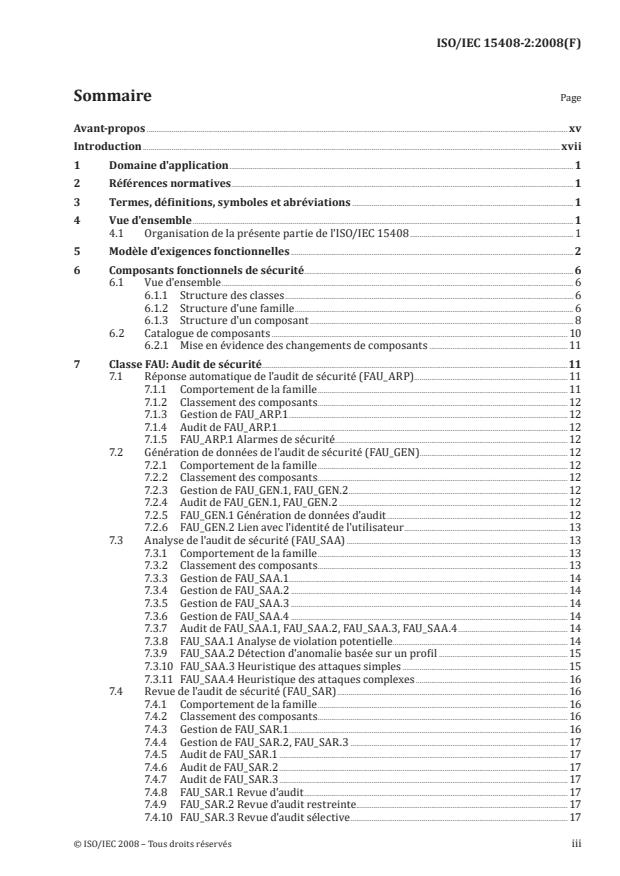
Sommaire Page
Avant-propos . xv
Introduction . xvii
1 Domaine d'application .1
2 Références normatives .1
3 Termes, définitions, symboles et abréviations . 1
4 Vue d'ensemble . 1
4.1 Organisation de la présente partie de l'ISO/IEC 15408 . 1
5 Modèle d'exigences fonctionnelles . 2
6 Composants fonctionnels de sécurité . 6
6.1 Vue d'ensemble . 6
6.1.1 Structure des classes . 6
6.1.2 Structure d'une famille . 6
6.1.3 Structure d'un composant . 8
6.2 Catalogue de composants . 10
6.2.1 Mise en évidence des changements de composants . 11
7 Classe FAU: Audit de sécurité . .11
7.1 Réponse automatique de l'audit de sécurité (FAU_ARP). 11
7.1.1 Comportement de la famille . 11
7.1.2 Classement des composants .12
7.1.3 Gestion de FAU_ARP.1 .12
7.1.4 Audit de FAU_ARP.1.12
7.1.5 FAU_ARP.1 Alarmes de sécurité .12
7.2 Génération de données de l'audit de sécurité (FAU_GEN).12
7.2.1 Comportement de la famille .12
7.2.2 Classement des composants .12
7.2.3 Gestion de FAU_GEN.1, FAU_GEN.2 .12
7.2.4 Audit de FAU_GEN.1, FAU_GEN.2 .12
7.2.5 FAU_GEN.1 Génération de données d'audit .12
7.2.6 FAU_GEN.2 Lien avec l'identité de l'utilisateur .13
7.3 Analyse de l'audit de sécurité (FAU_SAA) . 13
7.3.1 Comportement de la famille . 13
7.3.2 Classement des composants . 13
7.3.3 Gestion de FAU_SAA.1 . . 14
7.3.4 Gestion de FAU_SAA.2 . 14
7.3.5 Gestion de FAU_SAA.3 . 14
7.3.6 Gestion de FAU_SAA.4 . 14
7.3.7 Audit de FAU_SAA.1, FAU_SAA.2, FAU_SAA.3, FAU_SAA.4 . 14
7.3.8 FAU_SAA.1 Analyse de violation potentielle . 14
7.3.9 FAU_SAA.2 Détection d'anomalie basée sur un profil . 15
7.3.10 FAU_SAA.3 Heuristique des attaques simples . 15
7.3.11 FAU_SAA.4 Heuristique des attaques complexes . 16
7.4 Revue de l'audit de sécurité (FAU_SAR) . 16
7.4.1 Comportement de la famille . 16
7.4.2 Classement des composants . 16
7.4.3 Gestion de FAU_SAR.1 . 16
7.4.4 Gestion de FAU_SAR.2, FAU_SAR.3 . 17
7.4.5 Audit de FAU_SAR.1 . 17
7.4.6 Audit de FAU_SAR.2 . 17
7.4.7 Audit de FAU_SAR.3 . 17
7.4.8 FAU_SAR.1 Revue d'audit . 17
7.4.9 FAU_SAR.2 Revue d'audit restreinte . . 17
7.4.10 FAU_SAR.3 Revue d'audit sélective . 17
iii
© ISO/IEC 2008 – Tous droits réservés
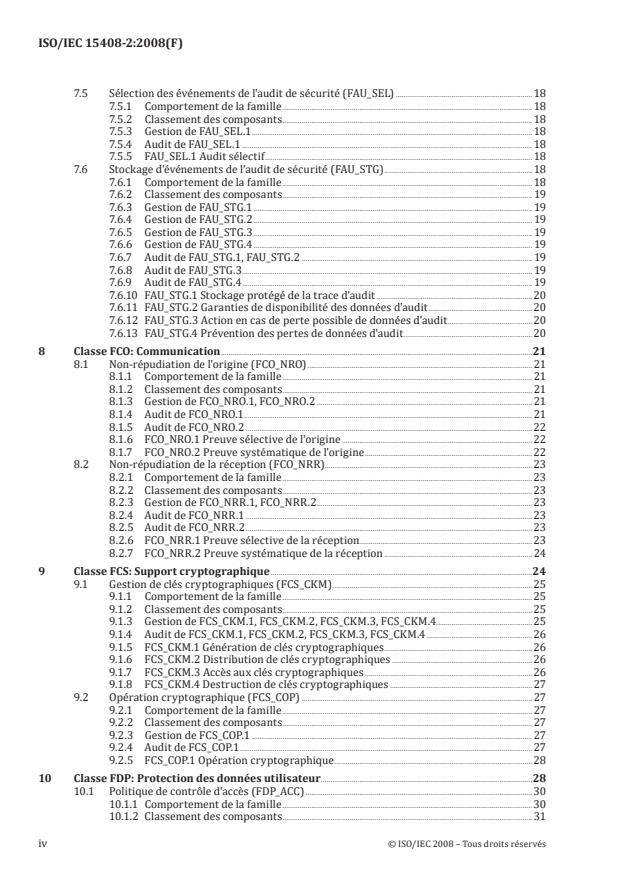
7.5 Sélection des événements de l'audit de sécurité (FAU_SEL) . 18
7.5.1 Comportement de la famille . 18
7.5.2 Classement des composants . 18
7.5.3 Gestion de FAU_SEL.1 . 18
7.5.4 Audit de FAU_SEL.1 . 18
7.5.5 FAU_SEL.1 Audit sélectif . 18
7.6 Stockage d'événements de l'audit de sécurité (FAU_STG) . 18
7.6.1 Comportement de la famille . 18
7.6.2 Classement des composants . 19
7.6.3 Gestion de FAU_STG.1 . 19
7.6.4 Gestion de FAU_STG.2 . 19
7.6.5 Gestion de FAU_STG.3 . 19
7.6.6 Gestion de FAU_STG.4 . 19
7.6.7 Audit de FAU_STG.1, FAU_STG.2 . 19
7.6.8 Audit de FAU_STG.3. 19
7.6.9 Audit de FAU_STG.4 . 19
7.6.10 FAU_STG.1 Stockage protégé de la trace d'audit . 20
7.6.11 FAU_STG.2 Garanties de disponibilité des données d'audit .20
7.6.12 FAU_STG.3 Action en cas de perte possible de données d'audit .20
7.6.13 FAU_STG.4 Prévention des pertes de données d'audit . 20
8 Classe FCO: Communication .21
8.1 Non-répudiation de l'origine (FCO_NRO) . 21
8.1.1 Comportement de la famille . 21
8.1.2 Classement des composants . 21
8.1.3 Gestion de FCO_NRO.1, FCO_NRO.2 . 21
8.1.4 Audit de FCO_NRO.1 . . 21
8.1.5 Audit de FCO_NRO.2 .22
8.1.6 FCO_NRO.1 Preuve sélective de l'origine . 22
8.1.7 FCO_NRO.2 Preuve systématique de l'origine .22
8.2 Non-répudiation de la réception (FCO_NRR) . 23
8.2.1 Comportement de la famille . 23
8.2.2 Classement des composants . 23
8.2.3 Gestion de FCO_NRR.1, FCO_NRR.2 . 23
8.2.4 Audit de FCO_NRR.1 . 23
8.2.5 Audit de FCO_NRR.2 . 23
8.2.6 FCO_NRR.1 Preuve sélective de la réception. 23
8.2.7 FCO_NRR.2 Preuve systématique de la réception . 24
9 Classe FCS: Support cryptographique .24
9.1 Gestion de clés cryptographiques (FCS_CKM) . 25
9.1.1 Comportement de la famille . 25
9.1.2 Classement des composants . 25
9.1.3 Gestion de FCS_CKM.1, FCS_CKM.2, FCS_CKM.3, FCS_CKM.4.25
9.1.4 Audit de FCS_CKM.1, FCS_CKM.2, FCS_CKM.3, FCS_CKM.4 .26
9.1.5 FCS_CKM.1 Génération de clés cryptographiques . 26
9.1.6 FCS_CKM.2 Distribution de clés cryptographiques . 26
9.1.7 FCS_CKM.3 Accès aux clés cryptographiques . 26
9.1.8 FCS_CKM.4 Destruction de clés cryptographiques . 27
9.2 Opération cryptographique (FCS_COP) . 27
9.2.1 Comportement de la famille . 27
9.2.2 Classement des composants . 27
9.2.3 Gestion de FCS_COP.1 . 27
9.2.4 Audit de FCS_COP.1 . 27
9.2.5 FCS_COP.1 Opération cryptographique .28
10 Classe FDP: Protection des données utilisateur .28
10.1 Politique de contrôle d'accès (FDP_ACC) .30
10.1.1 Comportement de la famille .30
10.1.2 Classement des composants . 31
iv
© ISO/IEC 2008 – Tous droits réservés
10.1.3 Gestion de FDP_ACC.1, FDP_ACC.2 . 31
10.1.4 Audit de FDP_ACC.1, FDP_ACC.2 . 31
10.1.5 FDP_ACC.1 Contrôle d'accès partiel . 31
10.1.6 FDP_ACC.2 Contrôle d'accès complet . 31
10.2 Fonctions de contrôle d'accès (FDP_ACF) . 31
10.2.1 Comportement de la famille . 31
10.2.2 Classement des composants . 32
10.2.3 Gestion de FDP_ACF.1 . 32
10.2.4 Audit de FDP_ACF.1 . 32
10.2.5 FDP_ACF.1 Contrôle d'accès basé sur les attributs de sécurité . 32
10.3 Authentification de données (FDP_DAU) . 33
10.3.1 Comportement de la famille . 33
10.3.2 Classement des composants . 33
10.3.3 Gestion de FDP_DAU.1, FDP_DAU.2 . 33
10.3.4 Audit de FDP_DAU.1 . 33
10.3.5 Audit de FDP_DAU.2 .33
10.3.6 FDP_DAU.1 Authentification de données élémentaire . 33
10.3.7 FDP_DAU.2 Authentification de données avec identité du garant .34
10.4 Exportation depuis la TOE (FDP_ETC) .34
10.4.1 Comportement de la famille .34
10.4.2 Classement des composants .34
10.4.3 Gestion de FDP_ETC.1 .34
10.4.4 Gestion de FDP_ETC.2 .34
10.4.5 Audit de FDP_ETC.1, FDP_ETC.2 . 35
10.4.6 FDP_ETC.1 Exportation de données de l'utilisateur sans attributs de
sécurité . 35
10.4.7 FDP_ETC.2 Exportation de données de l'utilisateur avec attributs de
sécurité . 35
10.5 Politique de contrôle de flux d'information (FDP_IFC) .36
10.5.1 Comportement de la famille . 36
10.5.2 Classement des composants . 36
10.5.3 Gestion de FDP_IFC.1, FDP_IFC.2 .36
10.5.4 Audit de FDP_IFC.1, FDP_IFC.2 . .36
10.5.5 FDP_IFC.1 Contrôle de flux d'information partiel .36
10.5.6 FDP_IFC.2 Contrôle de flux d'information complet. 37
10.6 Fonctions de contrôle de flux d'information (FDP_IFF). 37
10.6.1 Comportement de la famille . 37
10.6.2 Classement des composants . 37
10.6.3 Gestion de FDP_IFF.1, FDP_IFF.2 .38
10.6.4 Gestion de FDP_IFF.3, FDP_IFF.4, FDP_IFF.5 .38
10.6.5 Gestion de FDP_IFF.6 .38
10.6.6 Audit de FDP_IFF.1, FDP_IFF.2, FDP_IFF.5 .38
10.6.7 Audit de FDP_IFF.3, FDP_IFF.4, FDP_IFF.6 .38
10.6.8 FDP_IFF.1 Attributs de sécurité simples .38
10.6.9 FDP_IFF.2 Attributs de sécurité hiérarchiques .39
10.6.10 .
FDP_IFF.3 Flux d'information illicites limités .40
10.6.11 .
FDP_IFF.4 Élimination partielle des flux d'information illicites .40
10.6.12 .
FDP_IFF.5 Aucun flux d'information illicite . 41
10.6.13 .
FDP_IFF.6 Contrôle des flux d'information illicites . 41
10.7 Importation depuis une zone hors du contrôle de la TSF (FDP_ITC) . 41
10.7.1 Comportement de la famille . 41
10.7.2 Classement des composants . 41
10.7.3 Gestion de FDP_ITC.1, FDP_ITC.2 . 41
10.7.4 Audit de FDP_ITC.1, FDP_ITC.2 . 41
v
© ISO/IEC 2008 – Tous droits réservés
10.7.5 FDP_ITC.1 Importation de données de l'utilisateur sans attributs de sécurité . 42
10.7.6 FDP_ITC.2 Importation de données de l'utilisateur avec attributs de sécurité . 42
10.8 Transfert interne à la TOE (FDP_ITT) . 43
10.8.1 Comportement de la famille . 43
10.8.2 Classement des composants . 43
10.8.3 Gestion de FDP_ITT.1, FDP_ITT.2. 43
10.8.4 Gestion de FDP_ITT.3, FDP_ITT.4 . 43
10.8.5 Audit de FDP_ITT.1, FDP_ITT.2 .44
10.8.6 Audit de FDP_ITT.3, FDP_ITT.4 .44
10.8.7 FDP_ITT.1 Protection élémentaire d'un transfert interne .44
10.8.8 FDP_ITT.2 Séparation de données au cours d'une transmission en fonction
d'attributs .44
10.8.9 FDP_ITT.3 Contrôle de l'intégrité . 45
10.8.10 .
FDP_ITT.4 Contrôle de l'intégrité basé sur des attributs . 45
10.9 Protection des informations résiduelles (FDP_RIP) . 45
10.9.1 Comportement de la famille . 45
10.9.2 Classement des composants .46
10.9.3 Gestion de FDP_RIP.1, FDP_RIP.2 .46
10.9.4 Audit de FDP_RIP.1, FDP_RIP.2 .46
10.9.5 FDP_RIP.1 Protection partielle des informations résiduelles .46
10.9.6 FDP_RIP.2 Protection totale des informations résiduelles .46
10.10 Annulation (FDP_ROL) .46
10.10.1 Comportement de la famille .46
10.10.2 .
Classement des composants . 47
10.10.3 .
Gestion de FDP_ROL.1, FDP_ROL.2 . . . 47
10.10.4 Audit de FDP_ROL.1, FDP_ROL.2 . 47
10.10.5 .
FDP_ROL.1 Annulation élémentaire . 47
10.10.6 FDP_ROL.2 Annulation avancée . 47
10.11 Intégrité des données stockées (FDP_SDI) .48
10.11.1 Comportement de la famille .48
10.11.2 .
Classement des composants .48
10.11.3 .
Gestion de FDP_SDI.1 .48
10.11.4 Gestion de FDP_SDI.2 .48
10.11.5 .
Audit de FDP_SDI.1 .48
10.11.6 Audit de FDP_SDI.2 .49
10.11.7 FDP_SDI.1 Contrôle de l'intégrité des données stockées .49
10.11.8 .
FDP_SDI.2 Contrôle de l'intégrité des données stockées et action à
entreprendre .49
10.12 Protection de la confidentialité des données utilisateur lors d'un transfert inter-
TSF (FDP_UCT).49
10.12.1 .
Comportement de la famille .49
10.12.2 .
Classement des composants .49
10.12.3 .
Gestion de FDP_UCT.1 .50
10.12.4 .
Audit de FDP_UCT.1 .50
10.12.5 .
FDP_UCT.1 Confidentialité élémentaire lors d'un échange de données .50
vi
© ISO/IEC 2008 – Tous droits réservés
10.13 Protection de l'intégrité des données de l'utilisateur lors d'un transfert inter-TSF
(FDP_UIT) .50
10.13.1 Comportement de la famille .50
10.13.2 .
Classement des composants .50
10.13.3 .
Gestion de FDP_UIT.1, FDP_UIT.2, FDP_UIT.3. 51
10.13.4 .
Audit de FDP_UIT.1 . . . 51
10.13.5 .
Audit de FDP_UIT.2, FDP_UIT.3. 51
10.13.6 .
FDP_UIT.1 Intégrité lors d'un échange de données . 51
10.13.7 FDP_UIT.2 Reconstitution grâce à l'émetteur lors d'un échange de données . 52
10.13.8 .
FDP_UIT.3 Reconstitution par le destinataire lors d'un échange de données . 52
11 Classe FIA: Identification et authentification .52
11.1 Échecs de l'authentification (FIA_AFL) . 53
11.1.1 Comportement de la famille . 53
11.1.2 Classement des composants . 53
11.1.3 Gestion de FIA_AFL.1 .54
11.1.4 Audit de FIA_AFL.1 .54
11.1.5 FIA_AFL.1 Traitement des échecs d'authentification .54
11.2 Définition des attributs de l'utilisateur (FIA_ATD) .54
11.2.1 Comportement de la famille .54
11.2.2 Classement des composants .54
11.2.3 Gestion de FIA_ATD.1 . 55
11.2.4 Audit de FIA_ATD.1 . 55
11.2.5 FIA_ATD.1 Définition des attributs de l'utilisateur . 55
11.3 Spécification des secrets (FIA_SOS). 55
11.3.1 Comportement de la famille . 55
11.3.2 Classement des composants . 55
11.3.3 Gestion de FIA_SOS.1 . . .55
11.3.4 Gestion de FIA_SOS.2 .55
11.3.5 Audit de FIA_SOS.1, FIA_SOS.2 . 55
11.3.6 FIA_SOS.1 Vérification des secrets . .56
11.3.7 FIA_SOS.2 Génération de secrets par la TSF .56
11.4 Authentification de l'utilisateur (FIA_UAU) .56
11.4.1 Comportement de la famille .56
11.4.2 Classement des composants .56
11.4.3 Gestion de FIA_UAU.1 . . 57
11.4.4 Gestion de FIA_UAU.2 . 57
11.4.5 Gestion de FIA_UAU.3, FIA_UAU.4, FIA_UAU.7 . 57
11.4.6 Gestion de FIA_UAU.5 . 57
11.4.7 Gestion de FIA_UAU.6 . 57
11.4.8 Audit de FIA_UAU.1 .
...
Questions, Comments and Discussion
Ask us and Technical Secretary will try to provide an answer. You can facilitate discussion about the standard in here.
Loading comments...