

ISO/IEC 15408-2:2022
(Main)Information security, cybersecurity and privacy protection — Evaluation criteria for IT security — Part 2: Security functional components
General Information
- Abstract
This document defines the required structure and content of security functional components for the purpose of security evaluation. It includes a catalogue of functional components that meets the common security functionality requirements of many IT products.
- Status
- Withdrawn
- Publication Date
- 08-Aug-2022
- Current Stage
- 9599 - Withdrawal of International Standard
- Start Date
- 19-May-2026
- Completion Date
- 29-Aug-2026

Overview
ISO/IEC 15408-2:2022 defines the required structure and content of security functional components used for IT security evaluation. Part 2 of the ISO/IEC 15408 evaluation criteria series provides a standardized catalogue of functional components that address common security functionality across a wide range of IT products. The fourth edition (2022) organizes components into classes, families and component levels to support consistent evaluation and specification of security capabilities.
Key topics and technical requirements
- Functional requirements paradigm - defines how functional components are structured, specified and combined for evaluation.
- Class, family and component structure - hierarchical organization allowing precise selection of security functional components for a product or security target.
- Component catalogue - a comprehensive list of predefined functional components (e.g., audit, communication, cryptographic support) that evaluators and vendors can reference.
- Representative classes and families (examples referenced in the document):
- FAU (Security audit) - audit generation, storage, analysis, review and selection (FAU_GEN, FAU_STG, FAU_SAA, FAU_SAR, FAU_SEL, FAU_ARP).
- FCO (Communication) - non-repudiation of origin and receipt (FCO_NRO, FCO_NRR).
- FCS (Cryptographic support) - cryptographic key management and related cryptographic functions (FCS_CKM and related components).
- Management and audit expectations - component-level descriptions include management requirements and what must be auditable during evaluation.
- Leveling of components - components may be defined at multiple assurance/functional levels to match risk and product capability.
Practical applications - who uses this standard
- Security evaluators and certification bodies - to map product behaviour to standardized functional components during formal evaluation.
- Product developers and architects - to define, design and document security features that meet recognized evaluation criteria.
- Procurement and risk managers - to specify required security functionality in contracts and vendor assessments.
- Security testers and auditors - to verify that implemented features comply with the functional requirements and to plan test coverage.
Using ISO/IEC 15408-2 helps align product security claims with a recognized catalogue of functional requirements, simplifying certification, procurement and interoperability assessments.
Related standards
- Other parts of the ISO/IEC 15408 series (e.g., Part 1 - general model/introduction; Part 3 - security assurance components) and complementary IT security standards are commonly used alongside ISO/IEC 15408-2 for comprehensive security evaluation and compliance.
Keywords: ISO/IEC 15408-2:2022, security functional components, evaluation criteria for IT security, security audit, cryptographic key management, IT security evaluation.
Relations
- Effective Date
- 25-Aug-2026
- Effective Date
- 03-Jun-2026
- Effective Date
- 03-Jun-2026
- Effective Date
- 27-May-2026
- Effective Date
- 27-May-2026
- Effective Date
- 28-Oct-2023
- Effective Date
- 17-Dec-2016
Get Certified
Connect with accredited certification bodies for this standard

BSI Group
BSI (British Standards Institution) is the business standards company that helps organizations make excellence a habit.

Bureau Veritas
Bureau Veritas is a world leader in laboratory testing, inspection and certification services.

DNV
DNV is an independent assurance and risk management provider.
Sponsored listings
Frequently Asked Questions
ISO/IEC 15408-2:2022 is a standard published by the International Organization for Standardization (ISO). Its full title is "Information security, cybersecurity and privacy protection — Evaluation criteria for IT security — Part 2: Security functional components". This standard covers: This document defines the required structure and content of security functional components for the purpose of security evaluation. It includes a catalogue of functional components that meets the common security functionality requirements of many IT products.
This document defines the required structure and content of security functional components for the purpose of security evaluation. It includes a catalogue of functional components that meets the common security functionality requirements of many IT products.
ISO/IEC 15408-2:2022 is classified under the following ICS (International Classification for Standards) categories: 35.030 - IT Security. The ICS classification helps identify the subject area and facilitates finding related standards.
ISO/IEC 15408-2:2022 has the following relationships with other standards: It is inter standard links to EN ISO/IEC 19896-3:2023, EN ISO/IEC 18045:2023, EN ISO/IEC 15408-1:2023, EN ISO/IEC 15408-4:2023, EN ISO/IEC 15408-3:2023, ISO/IEC 15408-2:2026, ISO/IEC 15408-2:2008. Understanding these relationships helps ensure you are using the most current and applicable version of the standard.
ISO/IEC 15408-2:2022 is available in PDF format for immediate download after purchase. The document can be added to your cart and obtained through the secure checkout process. Digital delivery ensures instant access to the complete standard document.
Standards Content (Sample)
INTERNATIONAL ISO/IEC
STANDARD 15408-2
Fourth edition
2022-08
Information security, cybersecurity
and privacy protection — Evaluation
criteria for IT security —
Part 2:
Security functional components
Sécurité de l'information, cybersécurité et protection de la vie
privée — Critères d'évaluation pour la sécurité des technologies de
l'information —
Partie 2: Composants fonctionnels de sécurité
Reference number
© ISO/IEC 2022
© ISO/IEC 2022
All rights reserved. Unless otherwise specified, or required in the context of its implementation, no part of this publication may
be reproduced or utilized otherwise in any form or by any means, electronic or mechanical, including photocopying, or posting on
the internet or an intranet, without prior written permission. Permission can be requested from either ISO at the address below
or ISO’s member body in the country of the requester.
ISO copyright office
CP 401 • Ch. de Blandonnet 8
CH-1214 Vernier, Geneva
Phone: +41 22 749 01 11
Email: copyright@iso.org
Website: www.iso.org
Published in Switzerland
ii
© ISO/IEC 2022 – All rights reserved
Contents Page
Foreword . xv
Introduction . xvii
1 Scope . 1
2 Normative references . 1
3 Terms and definitions . 1
4 Abbreviated terms . 3
5 Overview . 4
5.1 General . 4
5.2 Organization of this document . . 4
6 Functional requirements paradigm . .5
7 Security functional components .9
7.1 Overview . 9
7.1.1 General . 9
7.1.2 Class structure . 9
7.1.3 Family structure . 10
7.1.4 Component structure . 11
7.2 Component catalogue .13
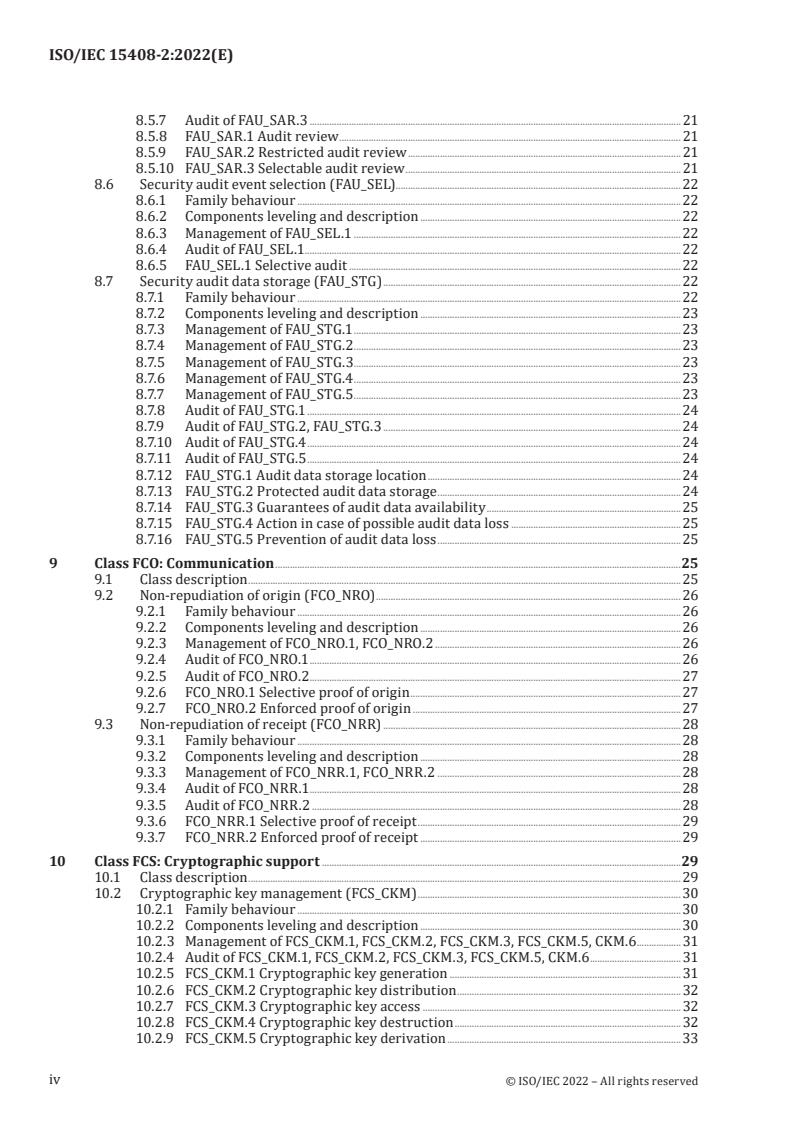
8 Class FAU: Security audit .14
8.1 Class description . 14
8.2 Security audit automatic response (FAU_ARP) . 15
8.2.1 Family behaviour .15
8.2.2 Components leveling and description . 15
8.2.3 Management of FAU_ARP.1 . 15
8.2.4 Audit of FAU_ARP.1 . 15
8.2.5 FAU_ARP.1 Security alarms . 15
8.3 Security audit data generation (FAU_GEN) . 15
8.3.1 Family behaviour . 15
8.3.2 Components leveling and description . 15
8.3.3 Management of FAU_GEN.1, FAU_GEN.2 . 16
8.3.4 Audit of FAU_GEN.1, FAU_GEN.2. 16
8.3.5 FAU_GEN.1 Audit data generation . 16
8.3.6 FAU_GEN.2 User identity association . 16
8.4 Security audit analysis (FAU_SAA) . 17
8.4.1 Family behaviour . 17
8.4.2 Components leveling and description . 17
8.4.3 Management of FAU_SAA.1 . 17
8.4.4 Management of FAU_SAA.2 . 18
8.4.5 Management of FAU_SAA.3 . 18
8.4.6 Management of FAU_SAA.4 . 18
8.4.7 Audit of FAU_SAA.1, FAU_SAA.2, FAU_SAA.3, FAU_SAA.4 . 18
8.4.8 FAU_SAA.1 Potential violation analysis . 18
8.4.9 FAU_SAA.2 Profile based anomaly detection . 18
8.4.10 FAU_SAA.3 Simple attack heuristics . 19
8.4.11 FAU_SAA.4 Complex attack heuristics . 19
8.5 Security audit review (FAU_SAR) . 20
8.5.1 Family behaviour .20
8.5.2 Components leveling and description . 20
8.5.3 Management of FAU_SAR.1 . 20
8.5.4 Management of FAU_SAR.2, FAU_SAR.3 . 20
8.5.5 Audit of FAU_SAR.1 . .20
8.5.6 Audit of FAU_SAR.2 . 21
iii
© ISO/IEC 2022 – All rights reserved
8.5.7 Audit of FAU_SAR.3 . 21
8.5.8 FAU_SAR.1 Audit review . 21
8.5.9 FAU_SAR.2 Restricted audit review . 21
8.5.10 FAU_SAR.3 Selectable audit review . 21
8.6 Security audit event selection (FAU_SEL) . 22
8.6.1 Family behaviour .22
8.6.2 Components leveling and description . 22
8.6.3 Management of FAU_SEL.1 . 22
8.6.4 Audit of FAU_SEL.1.22
8.6.5 FAU_SEL.1 Selective audit . 22
8.7 Security audit data storage (FAU_STG) . 22
8.7.1 Family behaviour .22
8.7.2 Components leveling and description . 23
8.7.3 Management of FAU_STG.1 . 23
8.7.4 Management of FAU_STG.2 . 23
8.7.5 Management of FAU_STG.3 . 23
8.7.6 Management of FAU_STG.4 . 23
8.7.7 Management of FAU_STG.5 . 23
8.7.8 Audit of FAU_STG.1 . 24
8.7.9 Audit of FAU_STG.2, FAU_STG.3 . 24
8.7.10 Audit of FAU_STG.4 . 24
8.7.11 Audit of FAU_STG.5 . 24
8.7.12 FAU_STG.1 Audit data storage location . 24
8.7.13 FAU_STG.2 Protected audit data storage . 24
8.7.14 FAU_STG.3 Guarantees of audit data availability . 25
8.7.15 FAU_STG.4 Action in case of possible audit data loss . 25
8.7.16 FAU_STG.5 Prevention of audit data loss . 25
9 Class FCO: Communication .25
9.1 Class description .25
9.2 Non-repudiation of origin (FCO_NRO) . 26
9.2.1 Family behaviour .26
9.2.2 Components leveling and description . 26
9.2.3 Management of FCO_NRO.1, FCO_NRO.2 . 26
9.2.4 Audit of FCO_NRO.1 .26
9.2.5 Audit of FCO_NRO.2 . 27
9.2.6 FCO_NRO.1 Selective proof of origin . 27
9.2.7 FCO_NRO.2 Enforced proof of origin . 27
9.3 Non-repudiation of receipt (FCO_NRR) .28
9.3.1 Family behaviour .28
9.3.2 Components leveling and description .28
9.3.3 Management of FCO_NRR.1, FCO_NRR.2 .28
9.3.4 Audit of FCO_NRR.1.28
9.3.5 Audit of FCO_NRR.2 .28
9.3.6 FCO_NRR.1 Selective proof of receipt .29
9.3.7 FCO_NRR.2 Enforced proof of receipt .29
10 Class FCS: Cryptographic support .29
10.1 Class description .29
10.2 Cryptographic key management (FCS_CKM) .30
10.2.1 Family behaviour .30
10.2.2 Components leveling and description .30
10.2.3 Management of FCS_CKM.1, FCS_CKM.2, FCS_CKM.3, FCS_CKM.5, CKM.6 . 31
10.2.4 Audit of FCS_CKM.1, FCS_CKM.2, FCS_CKM.3, FCS_CKM.5, CKM.6 . 31
10.2.5 FCS_CKM.1 Cryptographic key generation . 31
10.2.6 FCS_CKM.2 Cryptographic key distribution . 32
10.2.7 FCS_CKM.3 Cryptographic key access . 32
10.2.8 FCS_CKM.4 Cryptographic key destruction . 32
10.2.9 FCS_CKM.5 Cryptographic key derivation . 33
iv
© ISO/IEC 2022 – All rights reserved
10.2.10 FCS_CKM.6 Timing and event of cryptographic key destruction .33
10.3 Cryptographic operation (FCS_COP) . 33
10.3.1 Family behaviour .33
10.3.2 Components leveling and description . 33
10.3.3 Management of FCS_COP.1 .34
10.3.4 Audit of FCS_COP.1 .34
10.3.5 FCS_COP.1 Cryptographic operation .34
10.4 Random bit generation (FCS_RBG) .34
10.4.1 Family behaviour .34
10.4.2 Components leveling and description .34
10.4.3 Management of FCS_RBG.1, FCS_RBG.2, FCS_RBG.3, FCS_RBG.4, FCS_
RBG.5, FCS_RBG.6 . 35
10.4.4 Audit of FCS_RBG.1, FCS_RBG.2 . 35
10.4.5 Audit of FCS_RBG.3, FCS_RBG.4, FCS_RBG.5, FCS_RBG.6 . 35
10.4.6 FCS_RBG.1 Random bit generation (RBG) . 35
10.4.7 FCS_RBG.2 Random bit generation (external seeding) .36
10.4.8 FCS_RBG.3 Random bit generation (internal seeding – single source) .36
10.4.9 FCS_RBG.4 Random bit generation (internal seeding – multiple sources) . 37
10.4.10 FCS_RBG.5 Random bit generation (combining noise sources) . 37
10.4.11 FCS_RBG.6 Random bit generation service . 37
10.5 Generation of random numbers (FCS_RNG) . 37
10.5.1 Family behaviour . 37
10.5.2 Components leveling and description .38
10.5.3 Management of FCS_RNG.1 .38
10.5.4 Audit of FCS_RNG.1 .38
10.5.5 FCS_RNG.1 Random number generation .38
11 Class FDP: User data protection.38
11.1 Class description .38
11.2 Access control policy (FDP_ACC) .40
11.2.1 Family behaviour .40
11.2.2 Components leveling and description . 41
11.2.3 Management of FDP_ACC.1, FDP_ACC.2 . 41
11.2.4 Audit of FDP_ACC.1, FDP_ACC.2 . 41
11.2.5 FDP_ACC.1 Subset access control . 41
11.2.6 FDP_ACC.2 Complete access control . 41
11.3 Access control functions (FDP_ACF) . 42
11.3.1 Family behaviour . 42
11.3.2 Components leveling and description . 42
11.3.3 Management of FDP_ACF.1 . 42
11.3.4 Audit of FDP_ACF.1 . 42
11.3.5 FDP_ACF.1 Security attribute-based access control . 42
11.4 Data authentication (FDP_DAU) . 43
11.4.1 Family behaviour . 43
11.4.2 Components leveling and description . 43
11.4.3 Management of FDP_DAU.1, FDP_DAU.2 . 43
11.4.4 Audit of FDP_DAU.1 . 43
11.4.5 Audit of FDP_DAU.2 .44
11.4.6 FDP_DAU.1 Basic Data Authentication .44
11.4.7 FDP_DAU.2 Data Authentication with Identity of Guarantor .44
11.5 Export from the TOE (FDP_ETC) .44
11.5.1 Family behaviour .44
11.5.2 Components leveling and description . 45
11.5.3 Management of FDP_ETC.1 . 45
11.5.4 Management of FDP_ETC.2 . 45
11.5.5 Audit of FDP_ETC.1, FDP_ETC.2 . 45
11.5.6 FDP_ETC.1 Export of user data without security attributes . 45
11.5.7 FDP_ETC.2 Export of user data with security attributes . 45
11.6 Information flow control policy (FDP_IFC) .46
v
© ISO/IEC 2022 – All rights reserved
11.6.1 Family behaviour .46
11.6.2 Components leveling and description .46
11.6.3 Management of FDP_IFC.1, FDP_IFC.2 . 47
11.6.4 Audit of FDP_IFC.1, FDP_IFC.2 . 47
11.6.5 FDP_IFC.1 Subset information flow control. 47
11.6.6 FDP_IFC.2 Complete information flow control . 47
11.7 Information flow control functions (FDP_IFF) . 47
11.7.1 Family behaviour . 47
11.7.2 Components leveling and description .48
11.7.3 Management of FDP_IFF.1, FDP_IFF.2 .48
11.7.4 Management of FDP_IFF.3, FDP_IFF.4, FDP_IFF.5 .48
11.7.5 Management of FDP_IFF.6 .49
11.7.6 Audit of FDP_IFF.1, FDP_IFF.2, FDP_IFF.5 .49
11.7.7 Audit of FDP_IFF.3, FDP_IFF.4, FDP_IFF.6 .49
11.7.8 FDP_IFF.1 Simple security attributes .49
11.7.9 FDP_IFF.2 Hierarchical security attributes .50
11.7.10 FDP_IFF.3 Limited illicit information flows. 51
11.7.11 FDP_IFF.4 Partial elimination of illicit information flows . 51
11.7.12 FDP_IFF.5 No illicit information flows . 51
11.7.13 FDP_IFF.6 Illicit information flow monitoring . 51
11.8 Information Retention Control (FDP_IRC) . 52
11.8.1 Family behaviour . 52
11.8.2 Components leveling and description . 52
11.8.3 Management of FDP_IRC.1 . . 53
11.8.4 Audit of FDP_IRC.1 .53
11.8.5 FDP_IRC.1 Information retention control . 53
11.9 Import from outside of the TOE (FDP_ITC) . 53
11.9.1 Family behaviour . 53
11.9.2 Components leveling and description . 53
11.9.3 Management of FDP_ITC.1, FDP_ITC.2 .54
11.9.4 Audit of FDP_ITC.1, FDP_ITC.2 .54
11.9.5 FDP_ITC.1 Import of user data without security attributes .54
11.9.6 FDP_ITC.2 Import of user data with security attributes .54
11.10 Internal TOE transfer (FDP_ITT) . 55
11.10.1 Family behaviour .55
11.10.2 Components leveling and description . 55
11.10.3 Management of FDP_ITT.1, FDP_ITT.2 . 55
11.10.4 Management of FDP_ITT.3, FDP_ITT.4 .56
11.10.5 Audit of FDP_ITT.1, FDP_ITT.2 .56
11.10.6 Audit of FDP_ITT.3, FDP_ITT.4 .56
11.10.7 FDP_ITT.1 Basic internal transfer protection .56
11.10.8 FDP_ITT.2 Transmission separation by attribute .56
11.10.9 FDP_ITT.3 Integrity monitoring . 57
11.10.10 .
FDP_ITT.4 Attribute-based integrity monitoring . 57
11.11 Residual information protection (FDP_RIP) . 57
11.11.1 Family behaviour . 57
11.11.2 Components leveling and description .58
11.11.3 Management of FDP_RIP.1, FDP_RIP.2 .58
11.11.4 Audit of FDP_RIP.1, FDP_RIP.2 .58
11.11.5 FDP_RIP.1 Subset residual information protection .58
11.11.6 FDP_RIP.2 Full residual information protection .58
11.12 Rollback (FDP_ROL) . 59
11.12.1 Family behaviour . 59
11.12.2 Components leveling and description . 59
11.12.3 Management of FDP_ROL.1, FDP_ROL.2 . 59
11.12.4 Audit of FDP_ROL.1, FDP_ROL.2 . 59
11.12.5 FDP_ROL.1 Basic rollback . 59
vi
© ISO/IEC 2022 – All rights reserved
11.12.6 FDP_ROL.2 Advanced rollback .60
11.13 Stored data confidentiality (FDP_SDC) .60
11.13.1 Family behaviour .60
11.13.2 Components leveling and description .60
11.13.3 Management of FDP_SDC.1, FDP_SDC.2 .60
11.13.4 Audit of FDP_SDC.1, FDP_SDC.2 . 61
11.13.5 FDP_SDC.1 Stored data confidentiality . 61
11.13.6 FDP_SDC.2 Stored data confidentiality with dedicated method . 61
11.14 Stored data integrity (FDP_SDI) . 61
11.14.1 Family behaviour . 61
11.14.2 Components leveling and description . 61
11.14.3 Management of FDP_SDI.1 . 62
11.14.4 Management of FDP_SDI.2 . 62
11.14.5 Audit of FDP_SDI.1 . 62
11.14.6 Audit of FDP_SDI.2 . 62
11.14.7 FDP_SDI.1 Stored data integrity monitoring . 62
11.14.8 FDP_SDI.2 Stored data integrity monitoring and action . 62
11.15 Inter-TSF user data confidentiality transfer protection (FDP_UCT) .63
11.15.1 Family behaviour .63
11.15.2 Components leveling and description .63
11.15.3 Management of FDP_UCT.1 .63
11.15.4 Audit of FDP_UCT.1 .63
11.15.5 FDP_UCT.1 Basic data exchange confidentiality .63
11.16 Inter-TSF user data integrity transfer protection (FDP_UIT) .64
11.16.1 Family behaviour .64
11.16.2 Components leveling and description .64
11.16.3 Management of FDP_UIT.1, FDP_UIT.2, FDP_UIT.3 .64
11.16.4 Audit of FDP_UIT.1 .64
11.16.5 Audit of FDP_UIT.2, FDP_UIT.3 .65
11.16.6 FDP_UIT.1 Data exchange integrity .65
11.16.7 FDP_UIT.2 Source data exchange recovery .65
11.16.8 FDP_UIT.3 Destination data exchange recovery.66
12 Class FIA: Identification and authentication .66
12.1 Class description .66
12.2 Authentication failures (FIA_AFL) . 67
12.2.1 Family behaviour . 67
12.2.2 Components leveling and description . 67
12.2.3 Management of FIA_AFL.1 .68
12.2.4 Audit of FIA_AFL.1 .68
12.2.5 FIA_AFL.1 Authentication failure handling .68
12.3 Authentication proof of identity (FIA_API) .
...