

ISO/IEC 29192-1:2012/Amd 1:2025
(Amendment)Information technology — Security techniques — Lightweight cryptography — Part 1: General — Amendment 1
General Information
- Abstract
- Status
- Published
- Publication Date
- 11-Dec-2025
- Current Stage
- 6060 - International Standard published
- Start Date
- 12-Dec-2025
- Due Date
- 04-May-2026
- Completion Date
- 12-Dec-2025



Overview
ISO/IEC 29192-1:2012/Amd 1:2025 is an amendment to the international standard for lightweight cryptography, focusing on general principles and updated guidance. Developed by ISO and IEC’s Joint Technical Committee JTC 1/SC 27 on information security, this amendment enhances the framework for lightweight cryptographic techniques suitable for resource-constrained environments. Lightweight cryptography offers essential security with reduced computational load, making it ideal for IoT devices, embedded systems, and other constrained hardware.
This amendment provides clarifications and additions concerning key cryptographic primitives-such as hash-functions, message authentication codes (MACs), broadcast authentication protocols, and authenticated encryption-tailored for lightweight implementations. It integrates with other relevant standards and supports a variety of secure information technology applications.
Key Topics
Lightweight Hash-Functions
A hash-function compresses variable-length inputs into fixed-length outputs, critical for digital signatures, data commitment, message authentication codes, and checksums. ISO/IEC 29192-5 defines lightweight hash-functions suitable for constrained environments, reaffirmed in this amendment through detailed subclauses.Message Authentication Codes (MACs)
Lightweight MAC algorithms help verify data integrity and authenticate message origin using secret keys. This amendment outlines routes to implement lightweight MACs using:- MAC algorithms from ISO/IEC 9797-1 and ISO/IEC 9797-2 combined with block ciphers from ISO/IEC 29192-2 or hash-functions from ISO/IEC 29192-5.
- Dedicated lightweight MAC functions exemplified in ISO/IEC 29192-6.
Broadcast Authentication Protocols
These protocols secure communications from a single sender to multiple receivers. The amendment acknowledges use cases where traditional digital signatures are too costly, introducing lightweight broadcast authentication defined in ISO/IEC 29192-7 to enable efficient verification of message authenticity and sender identity.Authenticated Encryption
Combining confidentiality, integrity, and authenticity in one operation, authenticated encryption is fundamental for secure data processing. Aligned with ISO/IEC 19772 and referencing lightweight cryptographic methods in ISO/IEC 29192-8, this amendment supports balanced security and performance in constrained devices.
Applications
ISO/IEC 29192-1:2012/Amd 1:2025 is vital for industries requiring secure computing on devices with limited resources, including:
- Internet of Things (IoT) devices needing efficient yet robust security mechanisms.
- Embedded systems in automotive, medical, or industrial automation applications where performance and power consumption are critical.
- Wireless sensor networks requiring lightweight authentication and encryption protocols to secure data broadcasts.
- Smart cards and mobile devices benefiting from optimized cryptographic functions that extend battery life and reduce latency.
By adopting this amendment, organizations can implement cryptographic solutions that ensure strong security without overwhelming system resources, enabling widespread, secure deployment of connected technologies.
Related Standards
This amendment links and refers to several other international standards, providing a comprehensive cryptographic ecosystem:
- ISO/IEC 10118 (Hash-functions) – Standard for general-purpose cryptographic hash algorithms.
- ISO/IEC 9797 (Message Authentication Codes) – Defines MAC algorithms essential for data integrity and authentication.
- ISO/IEC 29192-2 (Lightweight block ciphers) – Specifies block cipher algorithms optimized for constrained environments.
- ISO/IEC 29192-5 (Lightweight hash-functions) – Focuses on hash-functions tailored for lightweight cryptographic applications.
- ISO/IEC 29192-6 (Lightweight MACs) – Details dedicated lightweight MAC functions for resource-limited platforms.
- ISO/IEC 29192-7 (Lightweight broadcast authentication) – Provides efficient protocols to authenticate broadcast messages.
- ISO/IEC 29192-8 (Lightweight authenticated encryption) – Specifies authenticated encryption methods suited for low-resource environments.
- ISO/IEC 19772 (Authenticated encryption) – Covers methods combining data confidentiality and integrity.
Together, these linked standards enable implementers to build modular, interoperable lightweight cryptographic schemes tailored to application-specific constraints.
Keywords: ISO/IEC 29192-1 amendment, lightweight cryptography, hash-functions, message authentication codes, broadcast authentication protocols, authenticated encryption, constrained environments, IoT security, embedded systems, lightweight security standards.
Relations
- Effective Date
- 06-May-2023
Get Certified
Connect with accredited certification bodies for this standard

BSI Group
BSI (British Standards Institution) is the business standards company that helps organizations make excellence a habit.

Bureau Veritas
Bureau Veritas is a world leader in laboratory testing, inspection and certification services.

DNV
DNV is an independent assurance and risk management provider.
Sponsored listings
Frequently Asked Questions
ISO/IEC 29192-1:2012/Amd 1:2025 is a standard published by the International Organization for Standardization (ISO). Its full title is "Information technology — Security techniques — Lightweight cryptography — Part 1: General — Amendment 1". This standard covers: Information technology — Security techniques — Lightweight cryptography — Part 1: General — Amendment 1
Information technology — Security techniques — Lightweight cryptography — Part 1: General — Amendment 1
ISO/IEC 29192-1:2012/Amd 1:2025 is classified under the following ICS (International Classification for Standards) categories: 35.030 - IT Security. The ICS classification helps identify the subject area and facilitates finding related standards.
ISO/IEC 29192-1:2012/Amd 1:2025 has the following relationships with other standards: It is inter standard links to ISO/IEC 29192-1:2012. Understanding these relationships helps ensure you are using the most current and applicable version of the standard.
ISO/IEC 29192-1:2012/Amd 1:2025 is available in PDF format for immediate download after purchase. The document can be added to your cart and obtained through the secure checkout process. Digital delivery ensures instant access to the complete standard document.
Standards Content (Sample)
International
Standard
ISO/IEC 29192-1
First edition
Information technology —
2012-06-01
Security techniques — Lightweight
cryptography —
AMENDMENT 1
2025-12
Part 1:
General
AMENDMENT 1
Technologies de l'information — Techniques de sécurité —
Cryptographie pour environnements contraints —
Partie 1: Généralités
AMENDEMENT 1
Reference number
ISO/IEC 29192-1:2012/Amd. 1:2025(en) © ISO/IEC 2025
ISO/IEC 29192-1:2012/Amd. 1:2025(en)
© ISO/IEC 2025
All rights reserved. Unless otherwise specified, or required in the context of its implementation, no part of this publication may
be reproduced or utilized otherwise in any form or by any means, electronic or mechanical, including photocopying, or posting on
the internet or an intranet, without prior written permission. Permission can be requested from either ISO at the address below
or ISO’s member body in the country of the requester.
ISO copyright office
CP 401 • Ch. de Blandonnet 8
CH-1214 Vernier, Geneva
Phone: +41 22 749 01 11
Email: copyright@iso.org
Website: www.iso.org
Published in Switzerland
© ISO/IEC 2025 – All rights reserved
ii
ISO/IEC 29192-1:2012/Amd. 1:2025(en)
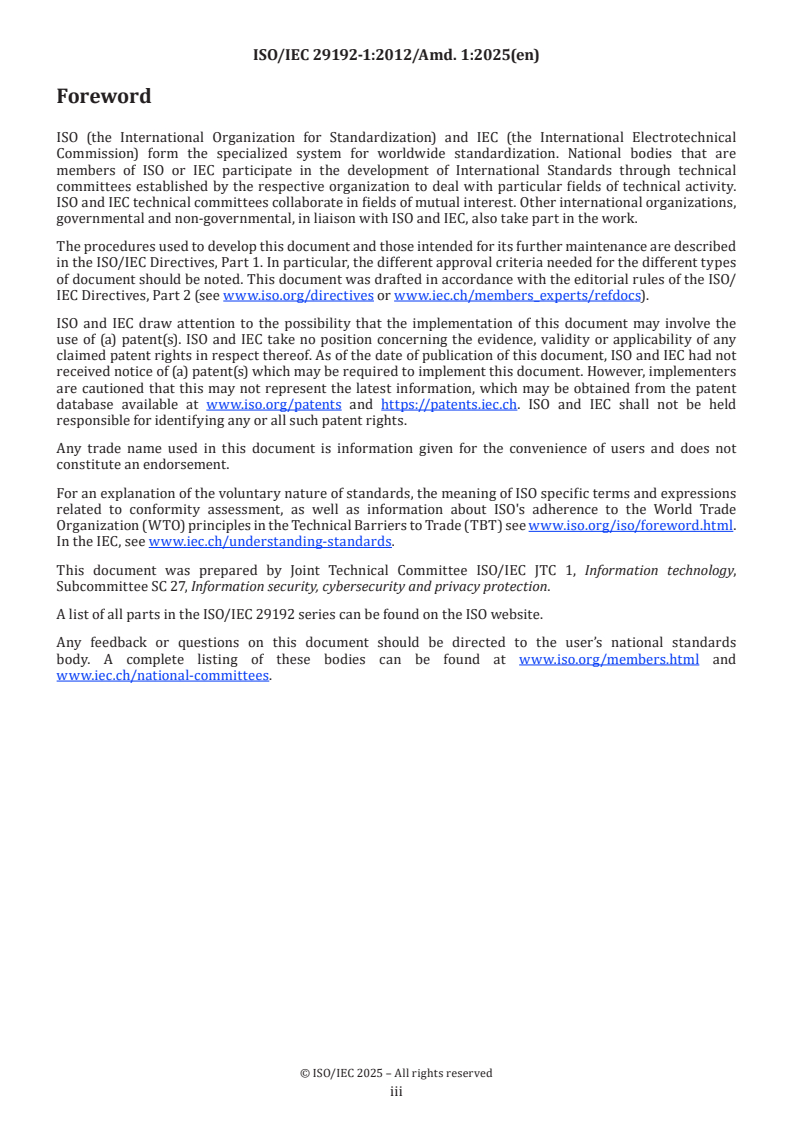
Foreword
ISO (the International Organization for Standardization) and IEC (the International Electrotechnical
Commission) form the specialized system for worldwide standardization. National bodies that are
members of ISO or IEC participate in the development of International Standards through technical
committees established by the respective organization to deal with particular fields of technical activity.
ISO and IEC technical committees collaborate in fields of mutual interest. Other international organizations,
governmental and non-governmental, in liaison with ISO and IEC, also take part in the work.
The procedures used to develop this document and those intended for its further maintenance are described
in the ISO/IEC Directives, Part 1. In particular, the different approval criteria needed for the different types
of document should be noted. This document was drafted in accordance with the editorial rules of the ISO/
IEC Directives, Part 2 (see www.iso.org/directives or www.iec.ch/members_experts/refdocs).
ISO and IEC draw attention to the possibility that the implementation of this document may involve the
use of (a) patent(s). ISO and IEC take no position concerning the evidence, validity or applicability of any
claimed patent rights in respect thereof. As of the date of publication of this document, ISO and IEC had not
received notice of (a) patent(s) which may be required to implement this document. However, implementers
are cautioned that this may not represent the latest information, which may be obtained from the patent
database available at www.iso.org/patents and https://patents.iec.ch. ISO and IEC shall not be held
responsible for identifying any or all such patent rights.
Any trade name used in this document is information given for the convenience of users and does not
constitute an endorsement.
For an explanation of the voluntary nature of standards, the meaning of ISO specific terms and expressions
related to conformity assessment, as well as information about ISO's adherence to the World Trade
Organization (WTO) principles in the Technical Barriers to Trade (TBT) see www.iso.org/iso/foreword.html.
In the IEC, see www.iec.ch/understanding-standards.
This document was prepared by Joint Technical Committee ISO/IEC JTC 1, Information technology,
Subcommittee SC 27, Information security, cybersecurity and privacy protection.
A list of all parts in the ISO/IEC 29192 series can be found on the ISO website.
Any feedback or questions on this document should be directed to the user’s national standards
body. A complete listing of these bodies can be found at www.iso.org/members.html and
www.iec.ch/national-committees.
© ISO/IEC 2025 – All rights reserved
iii
ISO/IEC 29192-1:2012/Amd. 1:2025(en)
Information technology — Security techniques — Lightweight
cryptography —
Part 1:
General
AMENDMENT 1
Clause 5
Add the following subclauses.
5.4 Hash-functions
A hash-function maps strings of bits of variable (but usually upper bounded) length to fixed-length strings
of bits, using a specified algorithm. They can be used for:
— reducing
...