

ISO/IEC 29192-1:2012
(Main)Information technology — Security techniques — Lightweight cryptography — Part 1: General
General Information
- Abstract
ISO/IEC 29192-1:2012 provides terms and definitions that apply in subsequent parts of ISO/IEC 29192. ISO/IEC 29192-1:2012 sets the security requirements, classification requirements and implementation requirements for mechanisms that are proposed for inclusion in subsequent parts of ISO/IEC 29192.
- Status
- Published
- Publication Date
- 28-May-2012
- Drafting Committee
- ISO/IEC JTC 1/SC 27/WG 2 - Cryptography and security mechanisms
- Current Stage
- 9093 - International Standard confirmed
- Start Date
- 27-Mar-2025
- Completion Date
- 29-Aug-2026
Overview
ISO/IEC 29192-1:2012 - Information technology - Security techniques - Lightweight cryptography - Part 1: General - defines the foundational terms, requirements and classification rules for lightweight cryptographic mechanisms targeted at constrained environments. This first part of ISO/IEC 29192 sets the security, classification and implementation requirements that subsequent parts (block ciphers, stream ciphers, asymmetric mechanisms) must follow. It is intended to help standardize cryptography for devices with limitations in chip area, energy, memory, bandwidth and execution time.
Key topics and technical requirements
- Terms and definitions: Clear definitions for core concepts such as chip area, energy consumption, program code size, RAM size, latency, security strength, and side-channel attack.
- Categories of constraints: Identifies five constraint categories relevant to lightweight cryptography: chip area, energy consumption, program code size & RAM, communication bandwidth, and execution time.
- Security requirements: Defines security strength in bits and establishes 80-bit security as the minimum for lightweight cryptography within this standard. It emphasizes correct usage limits (e.g., safe data volumes per key) and notes that side-channel countermeasures are important but are outside the standard’s normative scope.
- Classification requirements: Mechanisms must be tailored and evidenced for the specific constraint categories they claim to address. Claims require theoretical justification and, where given, verifiable implementation evidence.
- Implementation requirements: Hardware measurements use gate equivalents (GE) for chip area and provide metrics such as cycles, bits per cycle, power, energy, energy per bit, and target technology. Software constraints focus on program code size and RAM needs.
- Supporting material: Annexes include selection criteria (Annex A), practical metrics and measurement guidance for hardware (Annex B, C) and gate equivalent information (Annex D).
Applications and users
ISO/IEC 29192-1:2012 is intended for practitioners and organizations designing or selecting cryptography for constrained devices, including:
- RFID tags and contactless smart cards
- Embedded/sensor networks and Body Area Networks (healthcare)
- Secure batteries and low-power IoT devices
- Security architects, device manufacturers, cryptographic implementers, and standards bodies comparing lightweight mechanisms
Related standards
ISO/IEC 29192 intersects with and complements existing standards such as ISO/IEC 18033, ISO/IEC 9798, and ISO/IEC 11770. Subsequent parts of ISO/IEC 29192 specify specific lightweight block ciphers, stream ciphers, and asymmetric mechanisms.
Keywords: ISO/IEC 29192-1:2012, lightweight cryptography, constrained environments, chip area, gate equivalents, energy consumption, program code size, RAM, communication bandwidth, security strength, side-channel attacks.
Relations
- Effective Date
- 06-May-2023
Get Certified
Connect with accredited certification bodies for this standard

BSI Group
BSI (British Standards Institution) is the business standards company that helps organizations make excellence a habit.

Bureau Veritas
Bureau Veritas is a world leader in laboratory testing, inspection and certification services.

DNV
DNV is an independent assurance and risk management provider.
Sponsored listings
Frequently Asked Questions
ISO/IEC 29192-1:2012 is a standard published by the International Organization for Standardization (ISO). Its full title is "Information technology — Security techniques — Lightweight cryptography — Part 1: General". This standard covers: ISO/IEC 29192-1:2012 provides terms and definitions that apply in subsequent parts of ISO/IEC 29192. ISO/IEC 29192-1:2012 sets the security requirements, classification requirements and implementation requirements for mechanisms that are proposed for inclusion in subsequent parts of ISO/IEC 29192.
ISO/IEC 29192-1:2012 provides terms and definitions that apply in subsequent parts of ISO/IEC 29192. ISO/IEC 29192-1:2012 sets the security requirements, classification requirements and implementation requirements for mechanisms that are proposed for inclusion in subsequent parts of ISO/IEC 29192.
ISO/IEC 29192-1:2012 is classified under the following ICS (International Classification for Standards) categories: 35.030 - IT Security; 35.040 - Information coding. The ICS classification helps identify the subject area and facilitates finding related standards.
ISO/IEC 29192-1:2012 has the following relationships with other standards: It is inter standard links to ISO/IEC 29192-1:2012/Amd 1:2025. Understanding these relationships helps ensure you are using the most current and applicable version of the standard.
ISO/IEC 29192-1:2012 is available in PDF format for immediate download after purchase. The document can be added to your cart and obtained through the secure checkout process. Digital delivery ensures instant access to the complete standard document.
Standards Content (Sample)
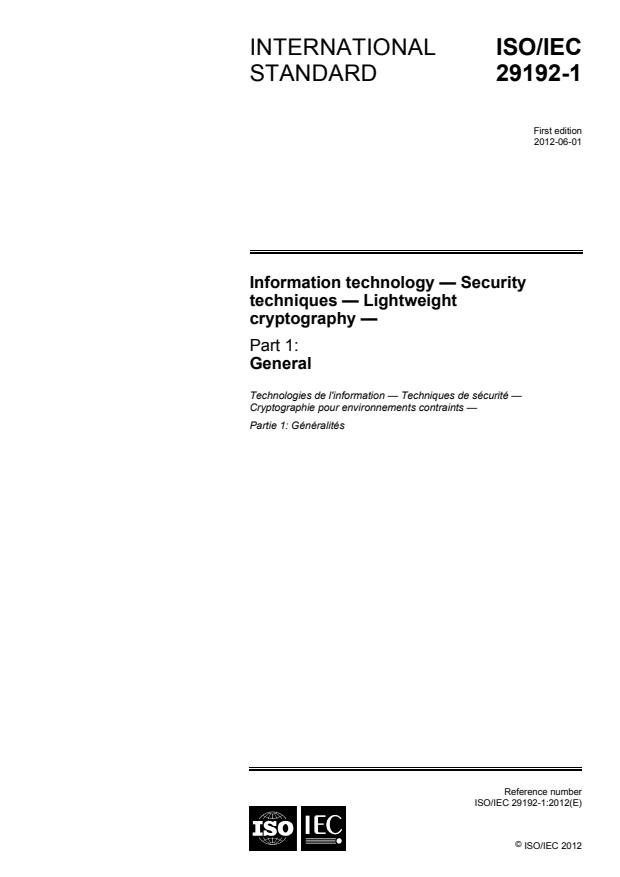
INTERNATIONAL ISO/IEC
STANDARD 29192-1
First edition
2012-06-01
Information technology — Security
techniques — Lightweight
cryptography —
Part 1:
General
Technologies de l'information — Techniques de sécurité —
Cryptographie pour environnements contraints —
Partie 1: Généralités
Reference number
©
ISO/IEC 2012
© ISO/IEC 2012
All rights reserved. Unless otherwise specified, no part of this publication may be reproduced or utilized in any form or by any means,
electronic or mechanical, including photocopying and microfilm, without permission in writing from either ISO at the address below or
ISO's member body in the country of the requester.
ISO copyright office
Case postale 56 CH-1211 Geneva 20
Tel. + 41 22 749 01 11
Fax + 41 22 749 09 47
E-mail copyright@iso.org
Web www.iso.org
Published in Switzerland
ii © ISO/IEC 2012 – All rights reserved
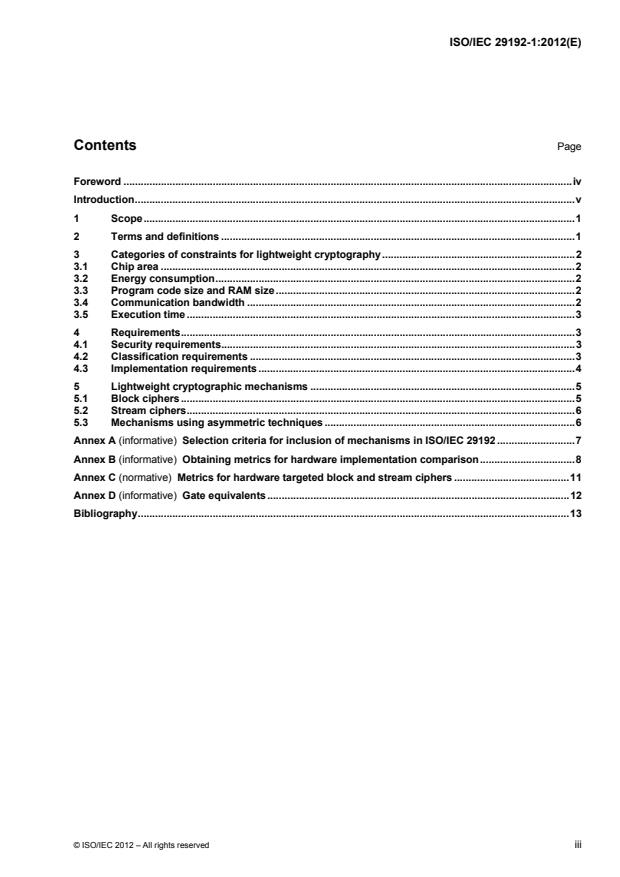
Contents Page
Foreword . iv
Introduction . v
1 Scope . 1
2 Terms and definitions . 1
3 Categories of constraints for lightweight cryptography . 2
3.1 Chip area . 2
3.2 Energy consumption . 2
3.3 Program code size and RAM size . 2
3.4 Communication bandwidth . 2
3.5 Execution time . 3
4 Requirements . 3
4.1 Security requirements . 3
4.2 Classification requirements . 3
4.3 Implementation requirements . 4
5 Lightweight cryptographic mechanisms . 5
5.1 Block ciphers . 5
5.2 Stream ciphers . 6
5.3 Mechanisms using asymmetric techniques . 6
Annex A (informative) Selection criteria for inclusion of mechanisms in ISO/IEC 29192 . 7
Annex B (informative) Obtaining metrics for hardware implementation comparison . 8
Annex C (normative) Metrics for hardware targeted block and stream ciphers . 11
Annex D (informative) Gate equivalents . 12
Bibliography . 13
© ISO/IEC 2012 – All rights reserved iii
Foreword
ISO (the International Organization for Standardization) and IEC (the International Electrotechnical
Commission) form the specialized system for worldwide standardization. National bodies that are members of
ISO or IEC participate in the development of International Standards through technical committees
established by the respective organization to deal with particular fields of technical activity. ISO and IEC
technical committees collaborate in fields of mutual interest. Other international organizations, governmental
and non-governmental, in liaison with ISO and IEC, also take part in the work. In the field of information
technology, ISO and IEC have established a joint technical committee, ISO/IEC JTC 1.
International Standards are drafted in accordance with the rules given in the ISO/IEC Directives, Part 2.
The main task of the joint technical committee is to prepare International Standards. Draft International
Standards adopted by the joint technical committee are circulated to national bodies for voting. Publication as
an International Standard requires approval by at least 75 % of the national bodies casting a vote.
Attention is drawn to the possibility that some of the elements of this document may be the subject of patent
rights. ISO and IEC shall not be held responsible for identifying any or all such patent rights.
ISO/IEC 29192-1 was prepared by Joint Technical Committee ISO/IEC JTC 1, Information technology,
Subcommittee SC 27, IT Security techniques.
ISO/IEC 29192 consists of the following parts, under the general title Information technology — Security
techniques — Lightweight cryptography:
Part 1: General
Part 2: Block ciphers
Part 3: Stream ciphers
Part 4: Mechanisms using asymmetric techniques
Further parts may follow.
iv © ISO/IEC 2012 – All rights reserved
Introduction
ISO/IEC 29192 is a multi-part International Standard that specifies lightweight cryptography for the purposes
of data confidentiality, authentication, identification, non-repudiation, and key exchange. Lightweight
cryptography is suitable in particular for constrained environments. The constraints normally encountered can
be any of the following:
chip area;
energy consumption;
program code size and RAM size;
communication bandwidth;
execution time.
The purpose of ISO/IEC 29192 is to specify standardized mechanisms which are suitable for lightweight
cryptographic applications, including radiofrequency identification (RFID) tags, smart cards (e.g. contactless
applications), secure batteries, health-care systems (e.g. Body Area Networks), sensor networks, etc.
This part of ISO/IEC 29192 sets the security requirements, classification requirements and implementation
requirements of mechanisms that are proposed for inclusion in subsequent parts of ISO/IEC 29192.
Lightweight cryptography delivers adequate security in the context for which it is intended. The cryptographic
mechanisms standardized in ISO/IEC 29192 provide their full security strength if they are used within the
limitations of the mechanisms as specified.
EXAMPLE For a block cipher with a block size of n bits and a key size of k bits, when limiting the use of the block
cipher to encrypting no more than 2n/2 blocks of plaintext under a single key in say counter mode, it will provide k-bit
security. The security degrades with more than 2n/2 blocks.
There are overlaps in some security techniques between ISO/IEC 29192 and existing standards such as
ISO/IEC 18033, ISO/IEC 9798, and ISO/IEC 11770. The exclusion of particular mechanisms does not imply
that these mechanisms are not suitable for lightweight cryptography. The criteria used to select the
cryptographic mechanisms specified in subsequent parts of ISO/IEC 29192 are described in Annex A.
© ISO/IEC 2012 – All rights reserved v
INTERNATIONAL STANDARD ISO/IEC 29192-1:2012(E)
Information technology — Security techniques — Lightweight
cryptography —
Part 1:
General
1 Scope
This part of ISO/IEC 29192 provides terms and definitions that apply in subsequent parts of ISO/IEC 29192.
This part of ISO/IEC 29192 sets the security requirements, classification requirements and implementation
requirements for mechanisms that are proposed for inclusion in subsequent parts of ISO/IEC 29192.
2 Terms and definitions
For the purposes of this document, the following terms and definitions apply.
2.1
chip area
area occupied by a semiconductor circuit
2.2
communication bandwidth
number of bits per second that can be transmitted over a specified communication channel
2.3
energy consumption
power consumption over a certain time period
NOTE In ISO/IEC 29192, energy consumption during the cryptographic process is evaluated. In some constrained
devices the total energy required to perform the cryptographic operation is important, for instance, in RFID and sensors.
2.4
gate equivalent
unit of measure which allows for the specification of the complexity of digital electronic circuits, commonly the
silicon area of a two-input drive-strength-one NAND gate
2.5
latency
delay introduced by the cryptographic mechanism in real-time communication systems
2.6
lightweight cryptography
cryptography tailored for implementation in constrained environments
NOTE The constraints can be aspects such as chip area, energy consumption, memory size, or communication
bandwidth.
© ISO/IEC 2012 – All rights reserved 1
2.7
program code size
size of a cryptographic mechanism code in bytes
2.8
RAM size
size of temporary storage space a cryptographic mechanism requires in random access memory including the
registers in the processor
2.9
security strength
number associated with the amount of work (i.e. the number of operations) that is required to break a
cryptographic algorithm or system
NOTE 1 A security strength of n implies that the required workload of breaking the cryptosystem is equivalent to 2n
executions of the cryptosystem.
NOTE 2 In ISO/IEC 29192, security strength is specified in bits, e.g. 80, 112, 128, 192, and 256.
2.10
short input performance
performance of the cryptographic primitive when processing short messages
2.11
side-channel attack
attack based on information gained from the physical implementation of a cryptosystem, rather than on brute
force or theoretical weaknesses in the underlying algorithms
EXAMPLE Timing information, power consumption, or electromagnetic emissions can provide extra sources of
information and can be exploited to attack the system.
3 Categories of constraints for lightweight cryptography
3.1 Chip area
Where cryptographic mechanisms are implemented in hardware, the actual chip area that the cryptographic
mechanism requires may be constrained in some applications (e.g. RFID tags). For the purposes of this
international standard, the chip area will be measured in gate equivalents.
3.2 Energy consumption
Energy consumption can be constrained in lightweight cryptography applications. Energy consumption is
related to several factors including the processing time, the chip area (when implemented in hardware), the
operating frequency and the number of bits transmitted between entities (in wireless transmissions, in
particular). To minimize energy consumption, all of the related factors should be considered.
3.3 Program code size and RAM size
Program code size (loosely referred to as ROM) and RAM size can be constrained on what are loosely
referred to as low end processors. These processors have simple instruction sets and limited space available
for the program code, as well as limited available space in RAM for computations (e.g. embedded processors)
when compared to general purpose computer processors.
3.4 Communication bandwidth
Communication bandwidth is limited in certain cases with respect to the maximum number of bits that can be
transmitted during a session (e.g. RFID tags). Mechanisms that fall into this category are therefore tailored to
2 © ISO/IEC 2012 – All rights reserved
be more economical with regard to the number of bits that need to be transmitted over the communications
channel when compared to other more generally used cryptographic mechanisms.
3.5 Execution time
For some applications such as contactless cards and RFID, for correct operation the execution time is
constrained by the implementation (e.g. how long the card/token is present in the field). Note that this
constraint typically occurs in applications where the constraints treated in previous subsections also apply.
4 Requirements
4.1 Security requirements
In ISO/IEC 29192, the security strength of a cryptographic mechanism is measured as defined in 2.9. This
notion can be used for different cryptographic mechanisms. Two mechanisms are considered to be of
comparable strength if the amount of work needed to break the mechanisms or determine the keys is
approximately the same using a given resource.
In ISO/IEC 29192, 80-bit security is considered to be the minimum security strength for lightweight
cryptography.
Resistance against side-channel attacks may be important in some applications of lightweight cryptography.
Countermeasures against side-channel analysis often require additional chip area (for hardware targeted
algorithms) or additional program code (for software targeted algorithms). The countermeasures vary
depending on the technology, and the specific side-channel method applicable to a specific implementation.
Side-channel resistance is therefore outside the scope of this international standard.
NOTE Many organisations recommend using cryptographic mechanisms with more than 80-bit security after 2010.
However, there are some lightweight cryptographic applications that may allow lower security requirements, i.e. do not
have to assume all powerful adversaries. In cases where 80-bit keys are used, this implies that less data can be encrypted
safely with a single key before rekeying is required. It is therefore important that designers of cryptographic security
systems make sure that the safe operation limitations of lightweight cryptographic mechanisms are not exceeded for a
single key. The ECRYPT2 yearly report 2009-2010 [6] recommends 80-bit security for very short-term protection against
intelligence agencies with a budget of $300M or for long-term protection against small organizations with budget of $10k.
For more references and information regarding key length selection, see Standing Document 12 of ISO/IEC JTC 1/SC 27
at http://www.jtc1sc27.din.de/sbe/SD12.
4.2 Classification requirements
For a cryptographic mechanism to be classified as lightweight, it shall (by definition of ISO/IEC 29192) be
tailored for a combination of the categories defined in Clause 3. For each category a lightweight cryptographic
mechanism is tailored to, indication of the category of tailoring shall be made and evidence shall be provided
that the lightweight cryptographic mechanism is suitable for the claimed category (e.g. the chip area, the
energy consumption etc.). Note that a cryptographic mechanism tailored only for execution time is not always
considered to be lightweight.
All evidence of suitability for a particular category shall be based on theoretical evidence, which may be
further substantiated by actual implementation evidence. All claims of actual implementation evidence shall be
fully documented so as to be verifiable.
EXAMPLE Mechanism A claims to be tailored to be suitable for low energy for communication systems. This claim
can be substantiated theoretically by comparing the number of bits transmitted resulting from the use of mechanism A,
compared to other mechanisms commonly in use that are not considered to be lightweight mechanisms. The claim can be
further substantiated by referencing practical implementations in which the energy consumption is experimentally
measured, and comparing it to other practical implementations in which similar measurements are made.
© ISO/IEC 2012 – All rights reserved 3
4.3 Implementation requirements
4.3.1 Hardware implementation requirements
Both of the following are important physical characteristics of lightweight cryptography in hardware
implementations:
Chip area
Energy consumption
For the purpose of ISO/IEC 29192 the chip area is measured in gate equivalents (GE). This enables a
standardized comparison between cryptographic mechanisms intended for hardware implementation. There
are no concrete figures for a suitable target size for an implementation because this depends on the economic
realities of the application, the cryptographic mechanism under consideration and its deployment. In some
lightweight cryptographic applications, countermeasures against side-channel attacks are necessary which
require additional overheads. All cryptographic algorithms intended for hardware implementation published in
ISO/IEC 29192 include its expected size in GEs.
Comparing energy consumption between cryptographic mechanisms is difficult because it depends on the
particular technology in which the cryptographic mechanism is implemented. Some cryptographic
mechanisms can be implemented in hardware with low energy consumption but large chip area, however in
ISO/IEC 29192 energy consumption is evaluated by using a hardware implementation with reasonably small
chip area.
Real energy consumption measured experimentally, though technology and implementation dependent, is still
a useful practical figure for readers of ISO/IEC 29192, and is provided where available. When experimental
measurements are provided, the experimental measurement methodology used is properly documented, as
well as details regarding the technology on which the cryptographic mechanism was implemented.
In particular, all block ciphers and stream ciphers targeted for implementation in hardware provides the
following summary of information to assist users of ISO/IEC 29192 to choose the most appropriate
mechanism for their application (the details of which can be obtained in Annex B for background information
and Annex C for the detailed requirements):
a) Chip area
b) Cycles
c) Bits per cycle
d) Power
e) Energy
f) Energy per bit
g) Technology: the specific library and version number that was used to obtain these figures
4.3.2 Software implementation requirements
In some lightweight cryptography applications software implementations are preferred over hardware
implementations. The following aspects can be critical in software implementations in constrained
environments:
Program code size
RAM size
4 © ISO/IEC 2012 – All rights reserved
ISO/IEC 29192 does not set an absolute target size for software implementation requirements, because it
depends on many aspects e.g. processor architecture, processor instruction set, available memory,
optimisation techniques, speed/memory trade-offs, etc. Software targeted lightweight cryptographic
mechanisms are compared by code size and required RAM size on the same technology to algorithms
included in ISO/IEC 18033 (e.g. AES), ISO/IEC 9798 and ISO/IEC 11770. If the required code size and RAM
size is considerably less, such mechanisms is considered for inclusion in ISO/IEC 29192. Preference will be
given to lightweight cryptography mechanisms that is lightweight on a larger number of different processors,
i.e. can be considered lightweight because the required instruction set to classify it as lightweight is less
dependent on specific instruction sets found only on specific technologies.
In particular, all block and stream ciphers targeted for implementation in software provides the following
summary of information to assist users of ISO/IEC 29192 to choose the most appropriate mechanism for their
application:
a) Program code size
b) RAM size
c) Speed
4.3.3 Other preferable properties
4.3.3.1 Short input performance
In some lightweight cryptographic applications short messages / plaintexts / ciphertexts are processed by the
cryptographic mechanism. When lots of short messages / plaintexts / ciphertexts are processed independently,
the short input performance becomes an important factor to consider, and is applicable to all categories of
lightweight cryptography. It is even possible that a lightweight cryptographic primitive is tailored to have a
good short input performance and if it is the case, this fact is indicated by the mechanism.
Factors that affect short-input-performance are the ratio of the processing size (number of key bits, block size
of the cipher, or block size of a hash compression function input) compared to the message size, as well as
initial setup time per processing of each singl
...