

ISO/IEC 27050-2:2018
(Main)Information technology — Electronic discovery — Part 2: Guidance for governance and management of electronic discovery
General Information
- Abstract
This document provides guidance for technical and non-technical personnel at senior management levels within an organization, including those with responsibility for compliance with statuary and regulatory requirements, and industry standards. It describes how such personnel can identify and take ownership of risks related to electronic discovery, set policy and achieve compliance with corresponding external and internal requirements. It also suggests how to produce such policies in a form which can inform process control. Furthermore, it provides guidance on how to implement and control electronic discovery in accordance with the policies.
- Status
- Published
- Publication Date
- 01-Oct-2018
- Drafting Committee
- ISO/IEC JTC 1/SC 27/WG 4 - Security controls and services
- Current Stage
- 9060 - Close of review
- Completion Date
- 04-Jun-2029
Buy Documents



ISO/IEC 27050-2:2018 - Information technology -- Electronic discovery
ISO/IEC 27050-2:2018 - Information technology — Electronic discovery — Part 2: Guidance for governance and management of electronic discovery/2/2018
Overview
ISO/IEC 27050-2:2018 - "Information technology - Electronic discovery - Part 2: Guidance for governance and management of electronic discovery" provides guidance for senior technical and non‑technical personnel on governing, managing and controlling electronic discovery (e‑discovery) processes. The standard helps organizations identify and assign ownership of e‑discovery risks, set policies that support process control, achieve compliance with external and internal requirements, and implement controls for handling Electronically Stored Information (ESI).
Key topics and technical requirements
The document covers governance and management topics that support robust e‑discovery and information security practices. Key topics include:
- Governance principles and mandate: roles, responsibilities and strategic direction for e‑discovery risk owners.
- Risk identification and ownership: identify systemic and unpredictable failure points and assign accountability.
- Policy design for process control: how to create archival, discovery, disclosure, capability, risk‑compliance and monitoring policies that map to operational controls.
- E‑discovery process elements: guidance aligned with ESI identification, preservation, collection, processing, review, analysis, production, provenance and chain of custody.
- Technical challenges: managing metadata, large ESI volumes, OCR/indexing, encryption/password protection and risks of data corruption that affect evidential value.
- Monitoring, reporting and effectiveness review: metrics, process control, communication and vendor management to ensure conformance.
- Risks and environmental factors: privacy, reputational impact, staff morale, detection of other legal issues and organizational disruption.
- Compliance and review: structural requirements for process delivery, conformance checks and continuous improvement.
Practical applications and users
ISO/IEC 27050-2 is practical for organizations that need to govern e‑discovery as part of legal, regulatory or internal compliance programs. Typical users include:
- Senior management and board members setting strategy and risk appetite for e‑discovery governance
- Legal and compliance teams overseeing litigation, regulatory requests and disclosure policies
- IT governance, security and records management teams implementing ESI preservation, collection and chain‑of‑custody controls
- E‑discovery practitioners and service providers defining workflows, tool capabilities and vendor contracts
- Audit and risk teams monitoring effectiveness and reporting on compliance
Use cases include developing organization‑level e‑discovery policies, defining roles for risk ownership, establishing technical controls for collection and preservation of ESI, and designing monitoring/reporting frameworks.
Related standards
- ISO/IEC 27050-1 (Overview and concepts)
- ISO/IEC 27050-3 (Processes and procedures)
- ISO/IEC 27000 (Information security management vocabulary)
- ISO/IEC 38500 (IT governance)
Keywords: ISO/IEC 27050-2, electronic discovery, e-discovery governance, ESI, chain of custody, information security, compliance, risk management.
Relations
- Effective Date
- 09-Feb-2026
Buy Documents
ISO/IEC 27050-2:2018 - Information technology -- Electronic discovery
ISO/IEC 27050-2:2018 - Information technology — Electronic discovery — Part 2: Guidance for governance and management of electronic discovery/2/2018
Get Certified
Connect with accredited certification bodies for this standard

BSI Group
BSI (British Standards Institution) is the business standards company that helps organizations make excellence a habit.

Bureau Veritas
Bureau Veritas is a world leader in laboratory testing, inspection and certification services.

DNV
DNV is an independent assurance and risk management provider.
Sponsored listings
Frequently Asked Questions
ISO/IEC 27050-2:2018 is a standard published by the International Organization for Standardization (ISO). Its full title is "Information technology — Electronic discovery — Part 2: Guidance for governance and management of electronic discovery". This standard covers: This document provides guidance for technical and non-technical personnel at senior management levels within an organization, including those with responsibility for compliance with statuary and regulatory requirements, and industry standards. It describes how such personnel can identify and take ownership of risks related to electronic discovery, set policy and achieve compliance with corresponding external and internal requirements. It also suggests how to produce such policies in a form which can inform process control. Furthermore, it provides guidance on how to implement and control electronic discovery in accordance with the policies.
This document provides guidance for technical and non-technical personnel at senior management levels within an organization, including those with responsibility for compliance with statuary and regulatory requirements, and industry standards. It describes how such personnel can identify and take ownership of risks related to electronic discovery, set policy and achieve compliance with corresponding external and internal requirements. It also suggests how to produce such policies in a form which can inform process control. Furthermore, it provides guidance on how to implement and control electronic discovery in accordance with the policies.
ISO/IEC 27050-2:2018 is classified under the following ICS (International Classification for Standards) categories: 35.030 - IT Security; 35.040 - Information coding. The ICS classification helps identify the subject area and facilitates finding related standards.
ISO/IEC 27050-2:2018 has the following relationships with other standards: It is inter standard links to CWA 17865:2022. Understanding these relationships helps ensure you are using the most current and applicable version of the standard.
ISO/IEC 27050-2:2018 is available in PDF format for immediate download after purchase. The document can be added to your cart and obtained through the secure checkout process. Digital delivery ensures instant access to the complete standard document.
Standards Content (Sample)
INTERNATIONAL ISO/IEC
STANDARD 27050-2
First edition
2018-09
Information technology — Electronic
discovery —
Part 2:
Guidance for governance and
management of electronic discovery
Technologies de l'information — Découverte électronique —
Partie 2: Lignes directrices pour la gouvernance et le management de
l'investigation informatique
Reference number
©
ISO/IEC 2018
© ISO/IEC 2018
All rights reserved. Unless otherwise specified, or required in the context of its implementation, no part of this publication may
be reproduced or utilized otherwise in any form or by any means, electronic or mechanical, including photocopying, or posting
on the internet or an intranet, without prior written permission. Permission can be requested from either ISO at the address
below or ISO’s member body in the country of the requester.
ISO copyright office
CP 401 • Ch. de Blandonnet 8
CH-1214 Vernier, Geneva
Phone: +41 22 749 01 11
Fax: +41 22 749 09 47
Email: copyright@iso.org
Website: www.iso.org
Published in Switzerland
ii © ISO/IEC 2018 – All rights reserved
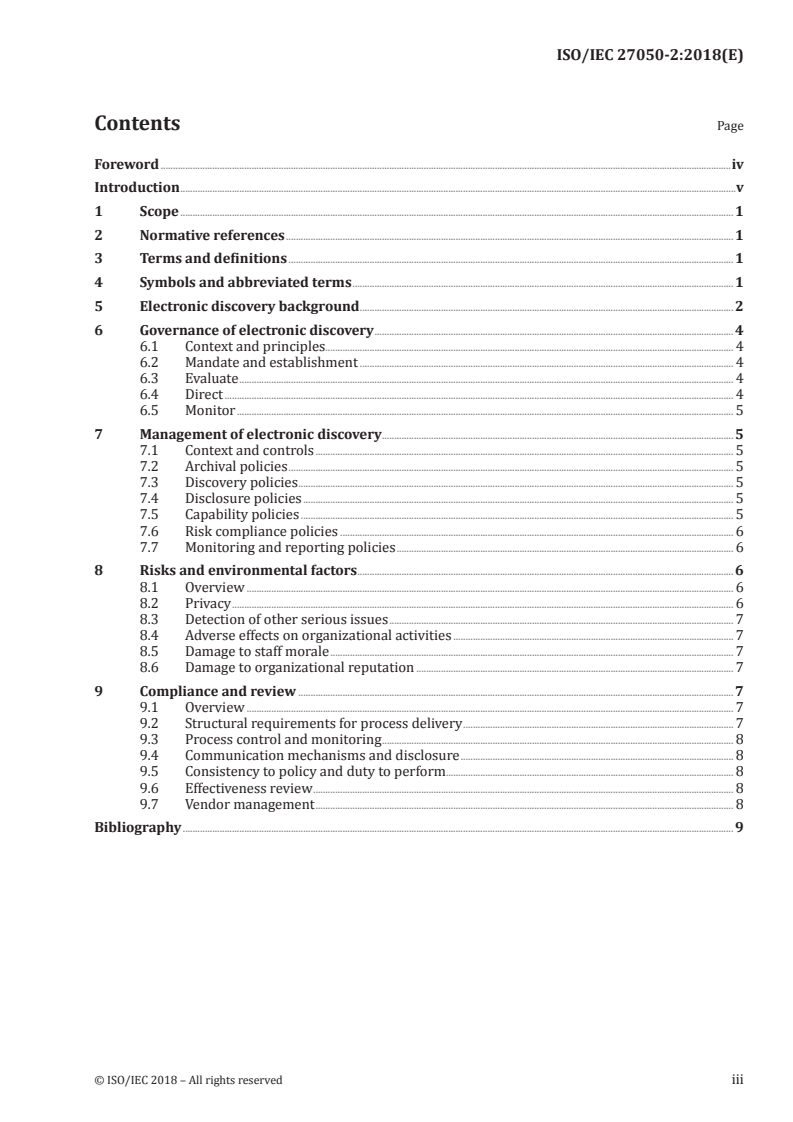
Contents Page
Foreword .iv
Introduction .v
1 Scope . 1
2 Normative references . 1
3 Terms and definitions . 1
4 Symbols and abbreviated terms . 1
5 Electronic discovery background . 2
6 Governance of electronic discovery . 4
6.1 Context and principles. 4
6.2 Mandate and establishment . 4
6.3 Evaluate . 4
6.4 Direct . 4
6.5 Monitor . 5
7 Management of electronic discovery . 5
7.1 Context and controls . 5
7.2 Archival policies . 5
7.3 Discovery policies . 5
7.4 Disclosure policies . 5
7.5 Capability policies . 5
7.6 Risk compliance policies . 6
7.7 Monitoring and reporting policies . 6
8 Risks and environmental factors . 6
8.1 Overview . 6
8.2 Privacy . 6
8.3 Detection of other serious issues . 7
8.4 Adverse effects on organizational activities . 7
8.5 Damage to staff morale . 7
8.6 Damage to organizational reputation . 7
9 Compliance and review . 7
9.1 Overview . 7
9.2 Structural requirements for process delivery . 7
9.3 Process control and monitoring . 8
9.4 Communication mechanisms and disclosure . 8
9.5 Consistency to policy and duty to perform . 8
9.6 Effectiveness review . 8
9.7 Vendor management . 8
Bibliography . 9
© ISO/IEC 2018 – All rights reserved iii
Foreword
ISO (the International Organization for Standardization) and IEC (the International Electrotechnical
Commission) form the specialized system for worldwide standardization. National bodies that are
members of ISO or IEC participate in the development of International Standards through technical
committees established by the respective organization to deal with particular fields of technical
activity. ISO and IEC technical committees collaborate in fields of mutual interest. Other international
organizations, governmental and non-governmental, in liaison with ISO and IEC, also take part in the
work. In the field of information technology, ISO and IEC have established a joint technical committee,
ISO/IEC JTC 1.
The procedures used to develop this document and those intended for its further maintenance are
described in the ISO/IEC Directives, Part 1. In particular, the different approval criteria needed for
the different types of document should be noted. This document was drafted in accordance with the
editorial rules of the ISO/IEC Directives, Part 2 (see www .iso .org/directives).
Attention is drawn to the possibility that some of the elements of this document may be the subject
of patent rights. ISO and IEC shall not be held responsible for identifying any or all such patent
rights. Details of any patent rights identified during the development of the document will be in the
Introduction and/or on the ISO list of patent declarations received (see www .iso .org/patents).
Any trade name used in this document is information given for the convenience of users and does not
constitute an endorsement.
For an explanation of the voluntary nature of standards, the meaning of ISO specific terms and
expressions related to conformity assessment, as well as information about ISO's adherence to the
World Trade Organization (WTO) principles in the Technical Barriers to Trade (TBT) see www .iso
.org/iso/foreword .html.
This document was prepared by Technical Committee ISO/IEC JTC 1, Information technology,
Subcommittee SC 27, IT Security techniques.
A list of all parts in the ISO/IEC 27050 series can be found on the ISO website.
Any feedback or questions on this document should be directed to the user’s national standards body. A
complete listing of these bodies can be found at www .iso .org/members .html.
iv © ISO/IEC 2018 – All rights reserved
Introduction
Engagement in electronic discovery and processes can expose organizations and the stakeholders
within and outside those organizations to collective and individual risks, including legal, financial and
ethical. This document aims to provide guidance for decision makers and those holding responsible
roles to ensure that causes of failure are properly managed and, where possible, minimized while still
complying with policy and conformance requirements to enable effective and appropriate electronic
discovery and processes.
This document is to be read in relation to ISO/IEC 27050-1 and ISO/IEC 27050-3. Common responsibilities
of a governing body is to provide strategic direction in all matters of relevance to electronic discovery
and to take ownership of the risks related to electronic discovery. The responsibility of management
is to develop and implement the policies, plans and strategies for electronic discovery set by the
governing body. The inherent causes of failure and environmental issues associated with electronic
discovery governance and management impact the viability of a coherent system that delivers optimal
business value. Consequently, the structures, processes and communication requirements of electronic
discovery needs to be compliant and open to review.
The measure of success for the investment in the use of electronic discovery services is the benefit that
it brings to the organization making the investment. Proper foresight, oversight and direction allow
the full scope of the effort required to derive the expected benefits and an appropriate framework
for governance, risk and value to be determined. This document addresses the concerns of electronic
discovery governance by identifying the risk and the risk owners of potential points of failure in
electronic discovery processes.
This document is to provide guidance for the governance and management of electronic discovery.
© ISO/IEC 2018 – All rights reserved v
INTERNATIONAL STANDARD ISO/IEC 27050-2:2018(E)
Information technology — Electronic discovery —
Part 2:
Guidance for governance and management of electronic
discovery
1 Scope
This document provides guidance for technical and non-technical personnel at senior management
levels within an organization, including those with responsibility for compliance with statuary and
regulatory requirements, and industry standards.
It describes how such personnel can identify and take ownership of risks related to electronic
discovery, set policy and achieve compliance with corresponding external and internal requirements.
It also suggests how to produce such policies in a form which can inform process control. Furthermore,
it provides guidance on how to implement and control electronic discovery in accordance with the
policies.
2 Normative references
The following documents are referred to in the text in such a way that some or all of their content
constitutes requirements of this document. For dated references, only the edition cited applies. For
undated references, the latest edition of the referenced document (including any amendments) applies.
ISO/IEC 27000, Information technology — Security techniques — Information security management
systems — Overview and vocabulary
ISO/IEC 27050-1, Information technology — Security techniques — Electronic discovery — Part 1:
Overview and concepts
ISO/IEC 38500, Information technology — Governance of IT for the organization
3 Terms and definitions
For the purposes of this document, the terms and definitions given in ISO/IEC 27000, ISO/IEC 27050-1,
ISO/IEC 38500 apply.
ISO and IEC maintain terminological databases for use in standardization at the following addresses:
— ISO Online browsing platform: available at https: //www .iso .org/obp
— IEC Electropedia: available at http: //www .electropedia .org/
4 Symbols and abbreviated terms
ICT Information and Communication Technology
OCR Optical Character Recognition
ESI Electronically Stored Information
© ISO/IEC 2018 – All rights reserved 1
5 Electronic discovery background
Electronic discovery is an element of traditional discovery and it is a process that typically involves
identifying, preserving, collecting, processing, reviewing, analysing, producing, establishing
provenience, and maintaining the chain of custody, of ESI that can be potentially relevant to a particular
matter. The guidance provided in this document are in accordance with the electronic discovery
concepts described in ISO/IEC 27050-1:2016 Clause 3, 6.4 and 6.5.
ISO/IEC 27050-1 differentiates between generic actions such as "identifying" from the specific electronic
discovery process elements by preceding the names with "ESI" (e.g., ESI identification). Likewise, this
document follows this approach. Figure 1, repeated from ISO/IEC 27050-1, shows all of the electronic
discovery process elements and the interrelationships between them (see ISO/IEC 27050-1:2016, 8.1
for a full description).
Figure 1 — Electronic discovery process elements
Risks associated with electronic discovery processes require attention from those responsible for
governance and management to minimize systemic failures, unpredictable failures, and to maximize
the process effects. The goal of electronic discovery is the same as with hardcopy document discovery
that is to find and to produce information potentially relevant in a matter. The nature of electronic
information adds differing layers of complexity and opportunity, since ESI carries with it such elements
as metadata and requisite data processing and management functions that do not exist with paper. In
addition, the collection and processing of ESI for discovery presents challenges that can have import
either:
— to the viability or accuracy of the ESI produced to the opposing side (e.g., data corruption, password
protection, encryption, indexing issues, inadequate keyword search, poor OCR); or
— to the ability to maintain chain of custody.
The escalating volumes of ESI typically created, maintained and collected present challenges for
consistency and accuracy in review. The role of those responsible for governance and management is to
assure electronic processes are controlled according to the risk criteria and conform to the distributed
appetite for risk. Figure 2 describes the responsibilities in relation to electronic discovery roles and the
harmonisation of related risks for optimal benefit delivery.
2 © ISO/IEC 2018 – All rights reserved
This document addresses the challenges of control by:
— promoting common understanding of various concepts and terminology for governance and
management;
— articulating objectives and structures for electronic discovery governance;
— encouraging practical and cost-effective establishment of electronic discovery processes;
— providing guidance and best practices to those responsible for governance and management of
electronic discovery strategies and policy;
— identifying tasks and strategy contexts for those responsible for electronic discovery governance
and management, that they may set policy and design controls;
— promoting the proactive use of metrics and risk evaluation practices for minimizing failure in
electronic discovery processes;
— suggesting ways to avoid adverse effects on reputational factors, organizational activities and
staff morale;
— providing guidance for compliance, conformance and effectiveness review.
The overriding goal is to help organizations establish good governance for their electronic discovery
processes by setting targeted policies and measured controls that are responsive to scale and size of
an electronic discovery project. While this document has been written with larger electronic discovery
projects in mind, and therefore covers aspects encountered in the majority of matters, it is not
necessarily the case that all steps will be required or proportionate to every matter. For examp
...
INTERNATIONAL ISO/IEC
STANDARD 27050-2
First edition
2018-09
Information technology — Electronic
discovery —
Part 2:
Guidance for governance and
management of electronic discovery
Technologies de l'information — Découverte électronique —
Partie 2: Lignes directrices pour la gouvernance et le management de
l'investigation informatique
Reference number
©
ISO/IEC 2018
© ISO/IEC 2018
All rights reserved. Unless otherwise specified, or required in the context of its implementation, no part of this publication may
be reproduced or utilized otherwise in any form or by any means, electronic or mechanical, including photocopying, or posting
on the internet or an intranet, without prior written permission. Permission can be requested from either ISO at the address
below or ISO’s member body in the country of the requester.
ISO copyright office
CP 401 • Ch. de Blandonnet 8
CH-1214 Vernier, Geneva
Phone: +41 22 749 01 11
Fax: +41 22 749 09 47
Email: copyright@iso.org
Website: www.iso.org
Published in Switzerland
ii © ISO/IEC 2018 – All rights reserved
Contents Page
Foreword .iv
Introduction .v
1 Scope . 1
2 Normative references . 1
3 Terms and definitions . 1
4 Symbols and abbreviated terms . 1
5 Electronic discovery background . 2
6 Governance of electronic discovery . 4
6.1 Context and principles. 4
6.2 Mandate and establishment . 4
6.3 Evaluate . 4
6.4 Direct . 4
6.5 Monitor . 5
7 Management of electronic discovery . 5
7.1 Context and controls . 5
7.2 Archival policies . 5
7.3 Discovery policies . 5
7.4 Disclosure policies . 5
7.5 Capability policies . 5
7.6 Risk compliance policies . 6
7.7 Monitoring and reporting policies . 6
8 Risks and environmental factors . 6
8.1 Overview . 6
8.2 Privacy . 6
8.3 Detection of other serious issues . 7
8.4 Adverse effects on organizational activities . 7
8.5 Damage to staff morale . 7
8.6 Damage to organizational reputation . 7
9 Compliance and review . 7
9.1 Overview . 7
9.2 Structural requirements for process delivery . 7
9.3 Process control and monitoring . 8
9.4 Communication mechanisms and disclosure . 8
9.5 Consistency to policy and duty to perform . 8
9.6 Effectiveness review . 8
9.7 Vendor management . 8
Bibliography . 9
© ISO/IEC 2018 – All rights reserved iii
Foreword
ISO (the International Organization for Standardization) and IEC (the International Electrotechnical
Commission) form the specialized system for worldwide standardization. National bodies that are
members of ISO or IEC participate in the development of International Standards through technical
committees established by the respective organization to deal with particular fields of technical
activity. ISO and IEC technical committees collaborate in fields of mutual interest. Other international
organizations, governmental and non-governmental, in liaison with ISO and IEC, also take part in the
work. In the field of information technology, ISO and IEC have established a joint technical committee,
ISO/IEC JTC 1.
The procedures used to develop this document and those intended for its further maintenance are
described in the ISO/IEC Directives, Part 1. In particular, the different approval criteria needed for
the different types of document should be noted. This document was drafted in accordance with the
editorial rules of the ISO/IEC Directives, Part 2 (see www .iso .org/directives).
Attention is drawn to the possibility that some of the elements of this document may be the subject
of patent rights. ISO and IEC shall not be held responsible for identifying any or all such patent
rights. Details of any patent rights identified during the development of the document will be in the
Introduction and/or on the ISO list of patent declarations received (see www .iso .org/patents).
Any trade name used in this document is information given for the convenience of users and does not
constitute an endorsement.
For an explanation of the voluntary nature of standards, the meaning of ISO specific terms and
expressions related to conformity assessment, as well as information about ISO's adherence to the
World Trade Organization (WTO) principles in the Technical Barriers to Trade (TBT) see www .iso
.org/iso/foreword .html.
This document was prepared by Technical Committee ISO/IEC JTC 1, Information technology,
Subcommittee SC 27, IT Security techniques.
A list of all parts in the ISO/IEC 27050 series can be found on the ISO website.
Any feedback or questions on this document should be directed to the user’s national standards body. A
complete listing of these bodies can be found at www .iso .org/members .html.
iv © ISO/IEC 2018 – All rights reserved
Introduction
Engagement in electronic discovery and processes can expose organizations and the stakeholders
within and outside those organizations to collective and individual risks, including legal, financial and
ethical. This document aims to provide guidance for decision makers and those holding responsible
roles to ensure that causes of failure are properly managed and, where possible, minimized while still
complying with policy and conformance requirements to enable effective and appropriate electronic
discovery and processes.
This document is to be read in relation to ISO/IEC 27050-1 and ISO/IEC 27050-3. Common responsibilities
of a governing body is to provide strategic direction in all matters of relevance to electronic discovery
and to take ownership of the risks related to electronic discovery. The responsibility of management
is to develop and implement the policies, plans and strategies for electronic discovery set by the
governing body. The inherent causes of failure and environmental issues associated with electronic
discovery governance and management impact the viability of a coherent system that delivers optimal
business value. Consequently, the structures, processes and communication requirements of electronic
discovery needs to be compliant and open to review.
The measure of success for the investment in the use of electronic discovery services is the benefit that
it brings to the organization making the investment. Proper foresight, oversight and direction allow
the full scope of the effort required to derive the expected benefits and an appropriate framework
for governance, risk and value to be determined. This document addresses the concerns of electronic
discovery governance by identifying the risk and the risk owners of potential points of failure in
electronic discovery processes.
This document is to provide guidance for the governance and management of electronic discovery.
© ISO/IEC 2018 – All rights reserved v
INTERNATIONAL STANDARD ISO/IEC 27050-2:2018(E)
Information technology — Electronic discovery —
Part 2:
Guidance for governance and management of electronic
discovery
1 Scope
This document provides guidance for technical and non-technical personnel at senior management
levels within an organization, including those with responsibility for compliance with statuary and
regulatory requirements, and industry standards.
It describes how such personnel can identify and take ownership of risks related to electronic
discovery, set policy and achieve compliance with corresponding external and internal requirements.
It also suggests how to produce such policies in a form which can inform process control. Furthermore,
it provides guidance on how to implement and control electronic discovery in accordance with the
policies.
2 Normative references
The following documents are referred to in the text in such a way that some or all of their content
constitutes requirements of this document. For dated references, only the edition cited applies. For
undated references, the latest edition of the referenced document (including any amendments) applies.
ISO/IEC 27000, Information technology — Security techniques — Information security management
systems — Overview and vocabulary
ISO/IEC 27050-1, Information technology — Security techniques — Electronic discovery — Part 1:
Overview and concepts
ISO/IEC 38500, Information technology — Governance of IT for the organization
3 Terms and definitions
For the purposes of this document, the terms and definitions given in ISO/IEC 27000, ISO/IEC 27050-1,
ISO/IEC 38500 apply.
ISO and IEC maintain terminological databases for use in standardization at the following addresses:
— ISO Online browsing platform: available at https: //www .iso .org/obp
— IEC Electropedia: available at http: //www .electropedia .org/
4 Symbols and abbreviated terms
ICT Information and Communication Technology
OCR Optical Character Recognition
ESI Electronically Stored Information
© ISO/IEC 2018 – All rights reserved 1
5 Electronic discovery background
Electronic discovery is an element of traditional discovery and it is a process that typically involves
identifying, preserving, collecting, processing, reviewing, analysing, producing, establishing
provenience, and maintaining the chain of custody, of ESI that can be potentially relevant to a particular
matter. The guidance provided in this document are in accordance with the electronic discovery
concepts described in ISO/IEC 27050-1:2016 Clause 3, 6.4 and 6.5.
ISO/IEC 27050-1 differentiates between generic actions such as "identifying" from the specific electronic
discovery process elements by preceding the names with "ESI" (e.g., ESI identification). Likewise, this
document follows this approach. Figure 1, repeated from ISO/IEC 27050-1, shows all of the electronic
discovery process elements and the interrelationships between them (see ISO/IEC 27050-1:2016, 8.1
for a full description).
Figure 1 — Electronic discovery process elements
Risks associated with electronic discovery processes require attention from those responsible for
governance and management to minimize systemic failures, unpredictable failures, and to maximize
the process effects. The goal of electronic discovery is the same as with hardcopy document discovery
that is to find and to produce information potentially relevant in a matter. The nature of electronic
information adds differing layers of complexity and opportunity, since ESI carries with it such elements
as metadata and requisite data processing and management functions that do not exist with paper. In
addition, the collection and processing of ESI for discovery presents challenges that can have import
either:
— to the viability or accuracy of the ESI produced to the opposing side (e.g., data corruption, password
protection, encryption, indexing issues, inadequate keyword search, poor OCR); or
— to the ability to maintain chain of custody.
The escalating volumes of ESI typically created, maintained and collected present challenges for
consistency and accuracy in review. The role of those responsible for governance and management is to
assure electronic processes are controlled according to the risk criteria and conform to the distributed
appetite for risk. Figure 2 describes the responsibilities in relation to electronic discovery roles and the
harmonisation of related risks for optimal benefit delivery.
2 © ISO/IEC 2018 – All rights reserved
This document addresses the challenges of control by:
— promoting common understanding of various concepts and terminology for governance and
management;
— articulating objectives and structures for electronic discovery governance;
— encouraging practical and cost-effective establishment of electronic discovery processes;
— providing guidance and best practices to those responsible for governance and management of
electronic discovery strategies and policy;
— identifying tasks and strategy contexts for those responsible for electronic discovery governance
and management, that they may set policy and design controls;
— promoting the proactive use of metrics and risk evaluation practices for minimizing failure in
electronic discovery processes;
— suggesting ways to avoid adverse effects on reputational factors, organizational activities and
staff morale;
— providing guidance for compliance, conformance and effectiveness review.
The overriding goal is to help organizations establish good governance for their electronic discovery
processes by setting targeted policies and measured controls that are responsive to scale and size of
an electronic discovery project. While this document has been written with larger electronic discovery
projects in mind, and therefore covers aspects encountered in the majority of matters, it is not
necessarily the case that all steps will be required or proportionate to every matter. For examp
...