

ISO/IEC 10118-3:2018
(Main)IT Security techniques — Hash-functions — Part 3: Dedicated hash-functions
General Information
- Abstract
This document specifies dedicated hash-functions, i.e. specially designed hash-functions. The hash-functions in this document are based on the iterative use of a round-function. Distinct round-functions are specified, giving rise to distinct dedicated hash-functions. The use of Dedicated Hash-Functions 1, 2 and 3 in new digital signature implementations is deprecated. NOTE As a result of their short hash-code length and/or cryptanalytic results, Dedicated Hash-Functions 1, 2 and 3 do not provide a sufficient level of collision resistance for future digital signature applications and they are therefore, only usable for legacy applications. However, for applications where collision resistance is not required, such as in hash-functions as specified in ISO/IEC 9797‑2, or in key derivation functions specified in ISO/IEC 11770‑6, their use is not deprecated. Numerical examples for dedicated hash-functions specified in this document are given in Annex B as additional information. For information purposes, SHA-3 extendable-output functions are specified in Annex C.
- Status
- Published
- Publication Date
- 30-Oct-2018
- Drafting Committee
- ISO/IEC JTC 1/SC 27/WG 2 - Cryptography and security mechanisms
- Current Stage
- 9093 - International Standard confirmed
- Start Date
- 03-May-2024
- Completion Date
- 29-Aug-2026
Buy Documents



ISO/IEC 10118-3:2018 - IT Security techniques -- Hash-functions

ISO/IEC 10118-3:2018 - IT Security techniques — Hash-functions — Part 3: Dedicated hash-functions/31/2018
Overview
ISO/IEC 10118-3:2018 - IT Security techniques - Hash-functions - Part 3: Dedicated hash‑functions specifies a set of specially designed (dedicated) cryptographic hash‑functions. The standard defines these algorithms in detail: their models, parameters, byte ordering, padding methods, constants, initialization values and the iterative round‑function descriptions used to compute hash codes. Annex B provides numerical examples and Annex C includes SHA‑3 extendable‑output functions for information.
Key technical topics and requirements
- Models and design: Defines both a round‑function model (iterative construction) and a sponge model for dedicated hash‑function design and use.
- Algorithm specifications: Exact descriptions for multiple dedicated hash‑functions (e.g., RIPEMD‑160, RIPEMD‑128, SHA‑1, SHA‑224, SHA‑256, SHA‑384, SHA‑512, WHIRLPOOL, SHA‑512/224, etc.) including:
- Parameters, functions and constants
- Byte ordering conventions
- Padding methods
- Initializing values
- Detailed round‑function operation and sequence
- Security guidance: Notes deprecation of Dedicated Hash‑Functions 1, 2 and 3 (RIPEMD‑160, RIPEMD‑128, SHA‑1 as listed) for new digital signature implementations due to short hash lengths and known cryptanalytic weaknesses. Their use remains allowed for legacy systems and for applications where collision resistance is not required (for example, certain MACs or KDFs per ISO/IEC 9797‑2 and ISO/IEC 11770‑6).
- Annexes: Numerical examples (Annex B) to aid implementers and SHA‑3 XOF information (Annex C).
Practical applications and who uses this standard
ISO/IEC 10118-3 is intended for:
- Cryptographic library implementers and software developers who need authoritative, interoperable definitions of hash algorithms.
- Security architects and protocol designers specifying hash functions for messaging, file integrity, key derivation or MAC constructions.
- Product vendors and embedded systems developers implementing legacy support or compliance with existing deployments.
- Evaluators, auditors and standards compliance officers verifying correct algorithm implementation and conformance.
- Educators and researchers referencing formal algorithm definitions and example vectors.
Use cases:
- Legacy system maintenance where older hash algorithms remain deployed.
- KDFs and MACs where collision resistance is not a primary requirement (per ISO/IEC 9797‑2, ISO/IEC 11770‑6).
- Implementations requiring exact algorithmic parameters, padding and byte‑order rules for interoperability.
Related standards
- ISO/IEC 10118‑1 (symbols and general provisions referenced)
- ISO/IEC 9797‑2 (message authentication codes)
- ISO/IEC 11770‑6 (key derivation)
- SHA‑3 specifications (referenced in Annex C for extendable‑output functions)
Keywords: ISO/IEC 10118-3, dedicated hash-functions, hash function standard, SHA-1 deprecation, RIPEMD, WHIRLPOOL, cryptographic hash, IT security techniques, collision resistance.
Relations
- Effective Date
- 25-Aug-2026
- Effective Date
- 25-Aug-2026
- Effective Date
- 08-Apr-2026
- Effective Date
- 16-Sep-2017
- Effective Date
- 02-Aug-2014
Buy Documents
ISO/IEC 10118-3:2018 - IT Security techniques -- Hash-functions
ISO/IEC 10118-3:2018 - IT Security techniques — Hash-functions — Part 3: Dedicated hash-functions/31/2018
Get Certified
Connect with accredited certification bodies for this standard

BSI Group
BSI (British Standards Institution) is the business standards company that helps organizations make excellence a habit.

Bureau Veritas
Bureau Veritas is a world leader in laboratory testing, inspection and certification services.

DNV
DNV is an independent assurance and risk management provider.
Sponsored listings
Frequently Asked Questions
ISO/IEC 10118-3:2018 is a standard published by the International Organization for Standardization (ISO). Its full title is "IT Security techniques — Hash-functions — Part 3: Dedicated hash-functions". This standard covers: This document specifies dedicated hash-functions, i.e. specially designed hash-functions. The hash-functions in this document are based on the iterative use of a round-function. Distinct round-functions are specified, giving rise to distinct dedicated hash-functions. The use of Dedicated Hash-Functions 1, 2 and 3 in new digital signature implementations is deprecated. NOTE As a result of their short hash-code length and/or cryptanalytic results, Dedicated Hash-Functions 1, 2 and 3 do not provide a sufficient level of collision resistance for future digital signature applications and they are therefore, only usable for legacy applications. However, for applications where collision resistance is not required, such as in hash-functions as specified in ISO/IEC 9797‑2, or in key derivation functions specified in ISO/IEC 11770‑6, their use is not deprecated. Numerical examples for dedicated hash-functions specified in this document are given in Annex B as additional information. For information purposes, SHA-3 extendable-output functions are specified in Annex C.
This document specifies dedicated hash-functions, i.e. specially designed hash-functions. The hash-functions in this document are based on the iterative use of a round-function. Distinct round-functions are specified, giving rise to distinct dedicated hash-functions. The use of Dedicated Hash-Functions 1, 2 and 3 in new digital signature implementations is deprecated. NOTE As a result of their short hash-code length and/or cryptanalytic results, Dedicated Hash-Functions 1, 2 and 3 do not provide a sufficient level of collision resistance for future digital signature applications and they are therefore, only usable for legacy applications. However, for applications where collision resistance is not required, such as in hash-functions as specified in ISO/IEC 9797‑2, or in key derivation functions specified in ISO/IEC 11770‑6, their use is not deprecated. Numerical examples for dedicated hash-functions specified in this document are given in Annex B as additional information. For information purposes, SHA-3 extendable-output functions are specified in Annex C.
ISO/IEC 10118-3:2018 is classified under the following ICS (International Classification for Standards) categories: 35.030 - IT Security; 35.040 - Information coding. The ICS classification helps identify the subject area and facilitates finding related standards.
ISO/IEC 10118-3:2018 has the following relationships with other standards: It is inter standard links to EN ISO 12855:2022, EN ISO 12855:2025, CEN/TS 16702-2:2020, ISO/IEC 10118-3:2004/Amd 1:2006, ISO/IEC 10118-3:2004. Understanding these relationships helps ensure you are using the most current and applicable version of the standard.
ISO/IEC 10118-3:2018 is available in PDF format for immediate download after purchase. The document can be added to your cart and obtained through the secure checkout process. Digital delivery ensures instant access to the complete standard document.
Standards Content (Sample)
INTERNATIONAL ISO/IEC
STANDARD 10118-3
Fourth edition
2018-10
IT Security techniques — Hash-
functions —
Part 3:
Dedicated hash-functions
Techniques de sécurité IT — Fonctions de brouillage —
Partie 3: Fonctions de brouillage dédiées
Reference number
©
ISO/IEC 2018
© ISO/IEC 2018
All rights reserved. Unless otherwise specified, or required in the context of its implementation, no part of this publication may
be reproduced or utilized otherwise in any form or by any means, electronic or mechanical, including photocopying, or posting
on the internet or an intranet, without prior written permission. Permission can be requested from either ISO at the address
below or ISO’s member body in the country of the requester.
ISO copyright office
CP 401 • Ch. de Blandonnet 8
CH-1214 Vernier, Geneva
Phone: +41 22 749 01 11
Fax: +41 22 749 09 47
Email: copyright@iso.org
Website: www.iso.org
Published in Switzerland
ii © ISO/IEC 2018 – All rights reserved
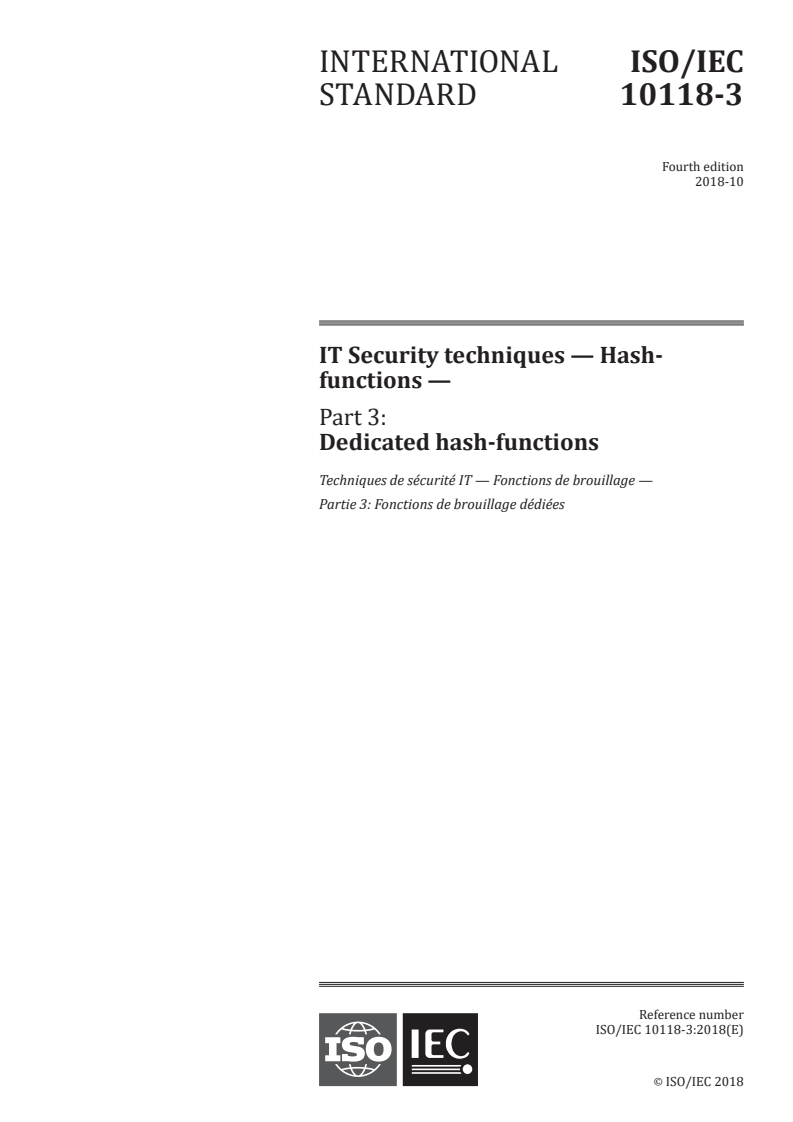
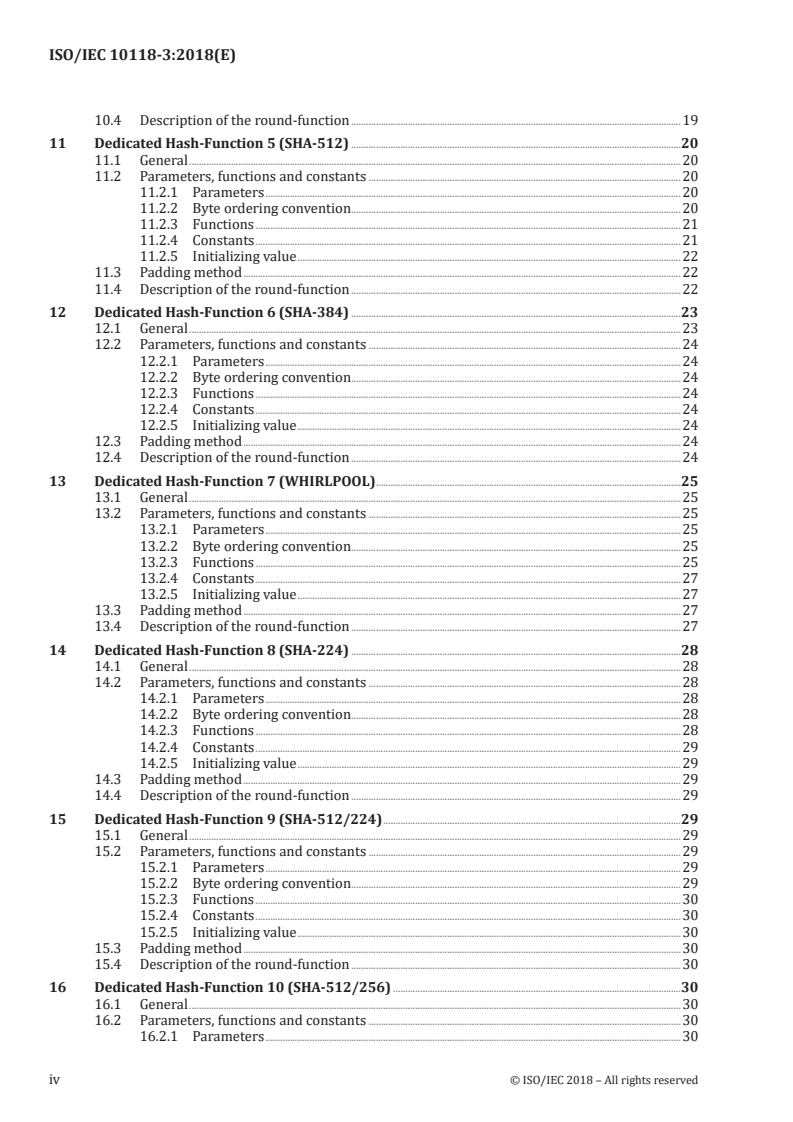
Contents Page
Foreword .vii
1 Scope . 1
2 Normative references . 1
3 Terms and definitions . 1
4 Symbols . 2
4.1 Symbols specified in ISO/IEC 10118-1 . 2
4.2 Symbols specific to this document . 2
5 Requirements . 4
6 Models for dedicated hash-functions . 4
6.1 Use of models . 4
6.2 Round-function model . . 4
6.3 Sponge model . 5
7 Dedicated Hash-Function 1 (RIPEMD-160) . 6
7.1 General . 6
7.2 Parameters, functions and constants . 7
7.2.1 Parameters . 7
7.2.2 Byte ordering convention . 7
7.2.3 Functions . 7
7.2.4 Constants . 8
7.2.5 Initializing value .10
7.3 Padding method .10
7.4 Description of the round-function .11
8 Dedicated Hash-Function 2 (RIPEMD-128) .12
8.1 General .12
8.2 Parameters, functions and constants .12
8.2.1 Parameters .12
8.2.2 Byte ordering convention .12
8.2.3 Functions .13
8.2.4 Constants .13
8.2.5 Initializing value .13
8.3 Padding method .13
8.4 Description of the round-function .13
9 Dedicated Hash-Function 3 (SHA-1).15
9.1 General .15
9.2 Parameters, functions and constants .15
9.2.1 Parameters .15
9.2.2 Byte ordering convention .15
9.2.3 Functions .15
9.2.4 Constants .15
9.2.5 Initializing value .16
9.3 Padding method .16
9.4 Description of the round-function .16
10 Dedicated Hash-Function 4 (SHA-256) .17
10.1 General .17
10.2 Parameters, functions and constants .18
10.2.1 Parameters .18
10.2.2 Byte ordering convention .18
10.2.3 Functions .18
10.2.4 Constants .18
10.2.5 Initializing value .18
10.3 Padding method .19
© ISO/IEC 2018 – All rights reserved iii
10.4 Description of the round-function .19
11 Dedicated Hash-Function 5 (SHA-512) .20
11.1 General .20
11.2 Parameters, functions and constants .20
11.2.1 Parameters .20
11.2.2 Byte ordering convention .20
11.2.3 Functions .21
11.2.4 Constants .21
11.2.5 Initializing value .22
11.3 Padding method .22
11.4 Description of the round-function .22
12 Dedicated Hash-Function 6 (SHA-384) .23
12.1 General .23
12.2 Parameters, functions and constants .24
12.2.1 Parameters .24
12.2.2 Byte ordering convention .24
12.2.3 Functions .24
12.2.4 Constants .24
12.2.5 Initializing value .24
12.3 Padding method .24
12.4 Description of the round-function .24
13 Dedicated Hash-Function 7 (WHIRLPOOL) .25
13.1 General .25
13.2 Parameters, functions and constants .25
13.2.1 Parameters .25
13.2.2 Byte ordering convention .25
13.2.3 Functions .25
13.2.4 Constants .27
13.2.5 Initializing value .27
13.3 Padding method .27
13.4 Description of the round-function .27
14 Dedicated Hash-Function 8 (SHA-224) .28
14.1 General .28
14.2 Parameters, functions and constants .28
14.2.1 Parameters .28
14.2.2 Byte ordering convention .28
14.2.3 Functions .28
14.2.4 Constants .29
14.2.5 Initializing value .29
14.3 Padding method .29
14.4 Description of the round-function .29
15 Dedicated Hash-Function 9 (SHA-512/224) .29
15.1 General .29
15.2 Parameters, functions and constants .29
15.2.1 Parameters .29
15.2.2 Byte ordering convention .29
15.2.3 Functions .30
15.2.4 Constants .30
15.2.5 Initializing value .30
15.3 Padding method .30
15.4 Description of the round-function .30
16 Dedicated Hash-Function 10 (SHA-512/256) .30
16.1 General .30
16.2 Parameters, functions and constants .30
16.2.1 Parameters .30
iv © ISO/IEC 2018 – All rights reserved
16.2.2 Byte ordering convention .31
16.2.3 Functions .31
16.2.4 Constants .31
16.2.5 Initializing value .31
16.3 Padding method .31
16.4 Description of the round-function .31
17 Dedicated Hash-Function 11 (STREEBOG-512) .31
17.1 General .31
17.2 Parameters, functions and constants .32
17.2.1 Parameters .32
17.2.2 Byte ordering convention .32
17.2.3 Functions .32
17.2.4 Constants .34
17.2.5 Initializing value .34
17.3 Padding method .34
17.4 Description of the round-function .35
18 Dedicated Hash-Function 12 (STREEBOG-256) .36
18.1 General .36
18.2 Parameters, functions and constants .36
18.2.1 Parameters .36
18.2.2 Byte ordering convention .36
18.2.3 Functions .36
18.2.4 Constants .36
18.2.5 Initializing value .36
18.3 Padding method .37
18.4 Description of the round-function .37
19 Dedicated Hash-Function 13 (SHA3-224) .37
19.1 General .37
19.2 Parameters, functions and constants .37
19.2.1 Parameters .37
19.2.2 Byte ordering convention .37
19.2.3 Functions .37
19.3 Padding method .43
19.4 Description of a round-function .43
19.5 Output transformation .44
20 Dedicated Hash-Function 14 (SHA3-256) .44
20.1 General .44
20.2 Parameters, functions and constants .44
20.2.1 Parameters .44
20.2.2 Byte ordering convention .44
20.2.3 Functions .44
20.2.4 Constants .44
20.2.5 Initializing value .44
20.3 Padding method .45
20.4 Description of round-function .45
20.5 Output transformation .45
21 Dedicated Hash-Function 15 (SHA3-384) .45
21.1 General .45
21.2 Parameters, functions and constants .45
21.2.1 Parameters .45
21.2.2 Byte ordering convention .45
21.2.3 Functions .46
21.2.4 Constants .46
21.2.5 Initializing value .46
21.3 Padding method .46
21.4 Description of round-function .46
© ISO/IEC 2018 – All rights reserved v
21.5 Output transformation .46
22 Dedicated Hash-Function 16 (SHA3-512) .46
22.1 General .46
22.2 Parameters, functions and constants .46
22.2.1 Parameters .46
22.2.2 Byte ordering convention .46
22.2.3 Functions .47
22.2.4 Constants .47
22.2.5 Initializing value .47
22.3 Padding method .47
22.4 Description of round-function .47
22.5 Output transformation .47
23 Dedicated Hash-Function 17 (SM3) .47
23.1 General .47
23.2 Parameters, functions and constants .48
23.2.1 Parameters .48
23.2.2 Byte ordering convention .48
23.2.3 Functions .48
23.2.4 Constants .48
23.2.5 Initializing value .48
23.3 Padding method .49
23.4 Description of the round-function .49
Annex A (normative) Object identifiers .51
Annex B (informative) Numerical examples .55
Annex C (informative) SHA-3 Extendable-Output Functions .245
Bibliography .399
vi © ISO/IEC 2018 – All rights reserved
Foreword
ISO (the International Organization for Standardization) and IEC (the International Electrotechnical
Commission) form the specialized system for worldwide standardization. National bodies that
are members of ISO or IEC participate in the development of International Standards through
technical committees established by the respective organization to deal with particular fields of
technical activity. ISO and IEC technical committees collaborate in fields of mutual interest. Other
international organizations, governmental and non-governmental, in liaison with ISO and IEC, also
take part in the work.
The procedures used to develop this document and those intended for its further maintenance are
described in the ISO/IEC Directives, Part 1. In particular, the different approval criteria needed for
the different types of document should be noted. This document was drafted in accordance with the
editorial rules of the ISO/IEC Directives, Part 2 (see www .iso .org/directives).
Attention is drawn to the possibility that some of the elements of this document may be the subject
of patent rights. ISO and IEC shall not be held responsible for identifying any or all such patent
rights. Details of any patent rights identified during the development of the document will be in the
Introduction and/or on the ISO list of patent declarations received (see www .iso .org/patents) or the IEC
list of patent declarations received (see http: //patents .iec .ch).
Any trade name used in this document is information given for the convenience of users and does not
constitute an endorsement.
For an explanation of the voluntary nature of standards, the meaning of ISO specific terms and
expressions related to conformity assessment, as well as information about ISO's adherence to the
World Trade Organization (WTO) principles in the Technical Barriers to Trade (TBT) see www .iso
.org/iso/foreword .html.
This document was prepared by Joint Technical Committee ISO/IEC JTC 1, Information technology,
Subcommittee SC 27, IT Security techniques.
This fourth edition cancels and replaces the third edition (ISO/IEC 10118-3:2004), which has been
technically revised. It also incorporates the Amendment ISO/IEC 10118-3:2004/Amd1: 2006 and
Technical Corrigendum ISO/IEC 10118-3:2004/Cor1: 2011.
The main changes compared to the previous edition are as follows:
— SHA-3, STREEBOG and SM3 hash-functions have been included;
— SHA-3 extendable-output functions have been included;
— cautionary notes for hash-functions with short hash-codes have been added.
A list of all parts in the ISO/IEC 10118 series can be found on the ISO website.
Any feedback or questions on this document should be directed to the user’s national standards body. A
complete listing of these bodies can be found at www .iso .org/members .html.
© ISO/IEC 2018 – All rights reserved vii
INTERNATIONAL STANDARD ISO/IEC 10118-3:2018(E)
IT Security techniques — Hash-functions —
Part 3:
Dedicated hash-functions
1 Scope
This document specifies dedicated hash-functions, i.e. specially designed hash-functions. The hash-
functions in this document are based on the iterative use of a round-function. Distinct round-functions
are specified, giving rise to distinct dedicated hash-functions.
The use of Dedicated Hash-Functions 1, 2 and 3 in new digital signature implementations is deprecated.
NOTE As a result of their short hash-code length and/or cryptanalytic results, Dedicated Hash-Functions
1, 2 and 3 do not provide a sufficient level of collision resistance for future digital signature applications and
they are therefore, only usable for legacy applications. However, for applications where collision resistance is
not required, such as in hash-functions as specified in ISO/IEC 9797-2, or in key derivation functions specified in
ISO/IEC 11770-6, their use is not deprecated.
Numerical examples for dedicated hash-functions specified in this document are given in Annex B as
additional information. For information purposes, SHA-3 extendable-output functions are specified in
Annex C.
2 Normative references
The following documents are referred to in the text in such a way that some or all of their content
constitutes requirements of this document. For dated references, only the edition cited applies. For
undated references, the latest edition of the referenced document (including any amendments) applies.
ISO/IEC 10118-1, Information technology — Security techniques — Hash-functions — Part 1: General
3 Terms and definitions
For the purposes of this document, the terms and definitions given in ISO/IEC 10118-1 and the
following apply.
ISO and IEC maintain terminological databases for use in standardization at the following addresses:
— ISO Online browsing platform: available at https: //www .iso .org/obp
— IEC Electropedia: available at http: //www .electropedia .org/
3.1
block
bit string of length L , i.e., the length of the first input to the round-function
3.2
word
string of bits
3.3
circulant matrix
matrix with the property that each row, apart from the first, consists of the right cyclic shift by one
position of the row immediately above it
© ISO/IEC 2018 – All rights reserved 1
3.4
abelian group
group (G, *) such that a*b = b*a for every a and b in G
3.5
field
set of elements S and a pair of operations (+,*) defined on S such that: (i) a*(b + c) = a*b + a*c for every a,
b and c in S, (ii) S together with + forms an abelian group (with identity element 0) and (iii) S excluding
0 together with * forms an abelian group
4 Symbols
4.1 Symbols specified in ISO/IEC 10118‑1
B byte
i
D data
H hash-code
IV initializing value
L length (in bits) of the first of the two input strings to the round-function Φ
L length (in bits) of the second of the two input strings to the round-function Φ, of the out-
put string from the round-function Φ and of the IV
L length (in bits) of a bit string X
X
X ⊕ Y bitwise exclusive-or of bit strings X and Y (where L = L )
X Y
X || Y concatenation of strings of bits X and Y in the indicated order
Φ a round-function, i.e. if X, Y are bit strings of lengths L and L respectively, then Φ(X, Y) is
1 2
the string obtained by applying Φ to X and Y
4.2 Symbols specific to this document
i
A sequence of constant matrices used in the specification of the round-function defined
in Clause 16
n
A concatenation of n instances of the word А
a , a′ sequences of indices used in specifications of a round-function
i i
C , C′ constant words used in the round-functions
i i
C” 8 × 8 circulant matrix with entries chosen from GF(2 ) used in the specification
of the round-function in Clause 16
c function taking a string of 64 elements of GF(2 ) as input and giving an 8 × 8 matrix with
entries from GF(2 ) as output, used in specifying the round-function defined in Clause 16
c , c , c functions taking an 8 × 8 matrix of elements of GF(2 ) as input and giving an 8 × 8 matrix
1 2 3
with entries from GF(2 ) as output, used in the specification of the round-function defined
in Clause 16
2 © ISO/IEC 2018 – All rights reserved
c function taking two 8 × 8 matrices of elements of GF(2 ) as input and giving an 8 × 8
matrix with entries from GF(2 ) as output, used in the specification of the round-function
defined in Clause 16
D a block derived from the data string after the padding process
i
d , e , f , g functions taking either one or three words as input and producing a single word as output,
i i i i
used in specifying round-functions
H a string of L bits which is used in the hashing operation to store an intermediate result
i 2
Int −1
n
an inverse mapping to the mapping Vec , i.e.IntV= ec
n
nn
8 8 4
...
INTERNATIONAL ISO/IEC
STANDARD 10118-3
Fourth edition
2018-10
IT Security techniques — Hash-
functions —
Part 3:
Dedicated hash-functions
Techniques de sécurité IT — Fonctions de brouillage —
Partie 3: Fonctions de brouillage dédiées
Reference number
©
ISO/IEC 2018
© ISO/IEC 2018
All rights reserved. Unless otherwise specified, or required in the context of its implementation, no part of this publication may
be reproduced or utilized otherwise in any form or by any means, electronic or mechanical, including photocopying, or posting
on the internet or an intranet, without prior written permission. Permission can be requested from either ISO at the address
below or ISO’s member body in the country of the requester.
ISO copyright office
CP 401 • Ch. de Blandonnet 8
CH-1214 Vernier, Geneva
Phone: +41 22 749 01 11
Fax: +41 22 749 09 47
Email: copyright@iso.org
Website: www.iso.org
Published in Switzerland
ii © ISO/IEC 2018 – All rights reserved
Contents Page
Foreword .vii
1 Scope . 1
2 Normative references . 1
3 Terms and definitions . 1
4 Symbols . 2
4.1 Symbols specified in ISO/IEC 10118-1 . 2
4.2 Symbols specific to this document . 2
5 Requirements . 4
6 Models for dedicated hash-functions . 4
6.1 Use of models . 4
6.2 Round-function model . . 4
6.3 Sponge model . 5
7 Dedicated Hash-Function 1 (RIPEMD-160) . 6
7.1 General . 6
7.2 Parameters, functions and constants . 7
7.2.1 Parameters . 7
7.2.2 Byte ordering convention . 7
7.2.3 Functions . 7
7.2.4 Constants . 8
7.2.5 Initializing value .10
7.3 Padding method .10
7.4 Description of the round-function .11
8 Dedicated Hash-Function 2 (RIPEMD-128) .12
8.1 General .12
8.2 Parameters, functions and constants .12
8.2.1 Parameters .12
8.2.2 Byte ordering convention .12
8.2.3 Functions .13
8.2.4 Constants .13
8.2.5 Initializing value .13
8.3 Padding method .13
8.4 Description of the round-function .13
9 Dedicated Hash-Function 3 (SHA-1).15
9.1 General .15
9.2 Parameters, functions and constants .15
9.2.1 Parameters .15
9.2.2 Byte ordering convention .15
9.2.3 Functions .15
9.2.4 Constants .15
9.2.5 Initializing value .16
9.3 Padding method .16
9.4 Description of the round-function .16
10 Dedicated Hash-Function 4 (SHA-256) .17
10.1 General .17
10.2 Parameters, functions and constants .18
10.2.1 Parameters .18
10.2.2 Byte ordering convention .18
10.2.3 Functions .18
10.2.4 Constants .18
10.2.5 Initializing value .18
10.3 Padding method .19
© ISO/IEC 2018 – All rights reserved iii
10.4 Description of the round-function .19
11 Dedicated Hash-Function 5 (SHA-512) .20
11.1 General .20
11.2 Parameters, functions and constants .20
11.2.1 Parameters .20
11.2.2 Byte ordering convention .20
11.2.3 Functions .21
11.2.4 Constants .21
11.2.5 Initializing value .22
11.3 Padding method .22
11.4 Description of the round-function .22
12 Dedicated Hash-Function 6 (SHA-384) .23
12.1 General .23
12.2 Parameters, functions and constants .24
12.2.1 Parameters .24
12.2.2 Byte ordering convention .24
12.2.3 Functions .24
12.2.4 Constants .24
12.2.5 Initializing value .24
12.3 Padding method .24
12.4 Description of the round-function .24
13 Dedicated Hash-Function 7 (WHIRLPOOL) .25
13.1 General .25
13.2 Parameters, functions and constants .25
13.2.1 Parameters .25
13.2.2 Byte ordering convention .25
13.2.3 Functions .25
13.2.4 Constants .27
13.2.5 Initializing value .27
13.3 Padding method .27
13.4 Description of the round-function .27
14 Dedicated Hash-Function 8 (SHA-224) .28
14.1 General .28
14.2 Parameters, functions and constants .28
14.2.1 Parameters .28
14.2.2 Byte ordering convention .28
14.2.3 Functions .28
14.2.4 Constants .29
14.2.5 Initializing value .29
14.3 Padding method .29
14.4 Description of the round-function .29
15 Dedicated Hash-Function 9 (SHA-512/224) .29
15.1 General .29
15.2 Parameters, functions and constants .29
15.2.1 Parameters .29
15.2.2 Byte ordering convention .29
15.2.3 Functions .30
15.2.4 Constants .30
15.2.5 Initializing value .30
15.3 Padding method .30
15.4 Description of the round-function .30
16 Dedicated Hash-Function 10 (SHA-512/256) .30
16.1 General .30
16.2 Parameters, functions and constants .30
16.2.1 Parameters .30
iv © ISO/IEC 2018 – All rights reserved
16.2.2 Byte ordering convention .31
16.2.3 Functions .31
16.2.4 Constants .31
16.2.5 Initializing value .31
16.3 Padding method .31
16.4 Description of the round-function .31
17 Dedicated Hash-Function 11 (STREEBOG-512) .31
17.1 General .31
17.2 Parameters, functions and constants .32
17.2.1 Parameters .32
17.2.2 Byte ordering convention .32
17.2.3 Functions .32
17.2.4 Constants .34
17.2.5 Initializing value .34
17.3 Padding method .34
17.4 Description of the round-function .35
18 Dedicated Hash-Function 12 (STREEBOG-256) .36
18.1 General .36
18.2 Parameters, functions and constants .36
18.2.1 Parameters .36
18.2.2 Byte ordering convention .36
18.2.3 Functions .36
18.2.4 Constants .36
18.2.5 Initializing value .36
18.3 Padding method .37
18.4 Description of the round-function .37
19 Dedicated Hash-Function 13 (SHA3-224) .37
19.1 General .37
19.2 Parameters, functions and constants .37
19.2.1 Parameters .37
19.2.2 Byte ordering convention .37
19.2.3 Functions .37
19.3 Padding method .43
19.4 Description of a round-function .43
19.5 Output transformation .44
20 Dedicated Hash-Function 14 (SHA3-256) .44
20.1 General .44
20.2 Parameters, functions and constants .44
20.2.1 Parameters .44
20.2.2 Byte ordering convention .44
20.2.3 Functions .44
20.2.4 Constants .44
20.2.5 Initializing value .44
20.3 Padding method .45
20.4 Description of round-function .45
20.5 Output transformation .45
21 Dedicated Hash-Function 15 (SHA3-384) .45
21.1 General .45
21.2 Parameters, functions and constants .45
21.2.1 Parameters .45
21.2.2 Byte ordering convention .45
21.2.3 Functions .46
21.2.4 Constants .46
21.2.5 Initializing value .46
21.3 Padding method .46
21.4 Description of round-function .46
© ISO/IEC 2018 – All rights reserved v
21.5 Output transformation .46
22 Dedicated Hash-Function 16 (SHA3-512) .46
22.1 General .46
22.2 Parameters, functions and constants .46
22.2.1 Parameters .46
22.2.2 Byte ordering convention .46
22.2.3 Functions .47
22.2.4 Constants .47
22.2.5 Initializing value .47
22.3 Padding method .47
22.4 Description of round-function .47
22.5 Output transformation .47
23 Dedicated Hash-Function 17 (SM3) .47
23.1 General .47
23.2 Parameters, functions and constants .48
23.2.1 Parameters .48
23.2.2 Byte ordering convention .48
23.2.3 Functions .48
23.2.4 Constants .48
23.2.5 Initializing value .48
23.3 Padding method .49
23.4 Description of the round-function .49
Annex A (normative) Object identifiers .51
Annex B (informative) Numerical examples .55
Annex C (informative) SHA-3 Extendable-Output Functions .245
Bibliography .399
vi © ISO/IEC 2018 – All rights reserved
Foreword
ISO (the International Organization for Standardization) and IEC (the International Electrotechnical
Commission) form the specialized system for worldwide standardization. National bodies that
are members of ISO or IEC participate in the development of International Standards through
technical committees established by the respective organization to deal with particular fields of
technical activity. ISO and IEC technical committees collaborate in fields of mutual interest. Other
international organizations, governmental and non-governmental, in liaison with ISO and IEC, also
take part in the work.
The procedures used to develop this document and those intended for its further maintenance are
described in the ISO/IEC Directives, Part 1. In particular, the different approval criteria needed for
the different types of document should be noted. This document was drafted in accordance with the
editorial rules of the ISO/IEC Directives, Part 2 (see www .iso .org/directives).
Attention is drawn to the possibility that some of the elements of this document may be the subject
of patent rights. ISO and IEC shall not be held responsible for identifying any or all such patent
rights. Details of any patent rights identified during the development of the document will be in the
Introduction and/or on the ISO list of patent declarations received (see www .iso .org/patents) or the IEC
list of patent declarations received (see http: //patents .iec .ch).
Any trade name used in this document is information given for the convenience of users and does not
constitute an endorsement.
For an explanation of the voluntary nature of standards, the meaning of ISO specific terms and
expressions related to conformity assessment, as well as information about ISO's adherence to the
World Trade Organization (WTO) principles in the Technical Barriers to Trade (TBT) see www .iso
.org/iso/foreword .html.
This document was prepared by Joint Technical Committee ISO/IEC JTC 1, Information technology,
Subcommittee SC 27, IT Security techniques.
This fourth edition cancels and replaces the third edition (ISO/IEC 10118-3:2004), which has been
technically revised. It also incorporates the Amendment ISO/IEC 10118-3:2004/Amd1: 2006 and
Technical Corrigendum ISO/IEC 10118-3:2004/Cor1: 2011.
The main changes compared to the previous edition are as follows:
— SHA-3, STREEBOG and SM3 hash-functions have been included;
— SHA-3 extendable-output functions have been included;
— cautionary notes for hash-functions with short hash-codes have been added.
A list of all parts in the ISO/IEC 10118 series can be found on the ISO website.
Any feedback or questions on this document should be directed to the user’s national standards body. A
complete listing of these bodies can be found at www .iso .org/members .html.
© ISO/IEC 2018 – All rights reserved vii
INTERNATIONAL STANDARD ISO/IEC 10118-3:2018(E)
IT Security techniques — Hash-functions —
Part 3:
Dedicated hash-functions
1 Scope
This document specifies dedicated hash-functions, i.e. specially designed hash-functions. The hash-
functions in this document are based on the iterative use of a round-function. Distinct round-functions
are specified, giving rise to distinct dedicated hash-functions.
The use of Dedicated Hash-Functions 1, 2 and 3 in new digital signature implementations is deprecated.
NOTE As a result of their short hash-code length and/or cryptanalytic results, Dedicated Hash-Functions
1, 2 and 3 do not provide a sufficient level of collision resistance for future digital signature applications and
they are therefore, only usable for legacy applications. However, for applications where collision resistance is
not required, such as in hash-functions as specified in ISO/IEC 9797-2, or in key derivation functions specified in
ISO/IEC 11770-6, their use is not deprecated.
Numerical examples for dedicated hash-functions specified in this document are given in Annex B as
additional information. For information purposes, SHA-3 extendable-output functions are specified in
Annex C.
2 Normative references
The following documents are referred to in the text in such a way that some or all of their content
constitutes requirements of this document. For dated references, only the edition cited applies. For
undated references, the latest edition of the referenced document (including any amendments) applies.
ISO/IEC 10118-1, Information technology — Security techniques — Hash-functions — Part 1: General
3 Terms and definitions
For the purposes of this document, the terms and definitions given in ISO/IEC 10118-1 and the
following apply.
ISO and IEC maintain terminological databases for use in standardization at the following addresses:
— ISO Online browsing platform: available at https: //www .iso .org/obp
— IEC Electropedia: available at http: //www .electropedia .org/
3.1
block
bit string of length L , i.e., the length of the first input to the round-function
3.2
word
string of bits
3.3
circulant matrix
matrix with the property that each row, apart from the first, consists of the right cyclic shift by one
position of the row immediately above it
© ISO/IEC 2018 – All rights reserved 1
3.4
abelian group
group (G, *) such that a*b = b*a for every a and b in G
3.5
field
set of elements S and a pair of operations (+,*) defined on S such that: (i) a*(b + c) = a*b + a*c for every a,
b and c in S, (ii) S together with + forms an abelian group (with identity element 0) and (iii) S excluding
0 together with * forms an abelian group
4 Symbols
4.1 Symbols specified in ISO/IEC 10118‑1
B byte
i
D data
H hash-code
IV initializing value
L length (in bits) of the first of the two input strings to the round-function Φ
L length (in bits) of the second of the two input strings to the round-function Φ, of the out-
put string from the round-function Φ and of the IV
L length (in bits) of a bit string X
X
X ⊕ Y bitwise exclusive-or of bit strings X and Y (where L = L )
X Y
X || Y concatenation of strings of bits X and Y in the indicated order
Φ a round-function, i.e. if X, Y are bit strings of lengths L and L respectively, then Φ(X, Y) is
1 2
the string obtained by applying Φ to X and Y
4.2 Symbols specific to this document
i
A sequence of constant matrices used in the specification of the round-function defined
in Clause 16
n
A concatenation of n instances of the word А
a , a′ sequences of indices used in specifications of a round-function
i i
C , C′ constant words used in the round-functions
i i
C” 8 × 8 circulant matrix with entries chosen from GF(2 ) used in the specification
of the round-function in Clause 16
c function taking a string of 64 elements of GF(2 ) as input and giving an 8 × 8 matrix with
entries from GF(2 ) as output, used in specifying the round-function defined in Clause 16
c , c , c functions taking an 8 × 8 matrix of elements of GF(2 ) as input and giving an 8 × 8 matrix
1 2 3
with entries from GF(2 ) as output, used in the specification of the round-function defined
in Clause 16
2 © ISO/IEC 2018 – All rights reserved
c function taking two 8 × 8 matrices of elements of GF(2 ) as input and giving an 8 × 8
matrix with entries from GF(2 ) as output, used in the specification of the round-function
defined in Clause 16
D a block derived from the data string after the padding process
i
d , e , f , g functions taking either one or three words as input and producing a single word as output,
i i i i
used in specifying round-functions
H a string of L bits which is used in the hashing operation to store an intermediate result
i 2
Int −1
n
an inverse mapping to the mapping Vec , i.e.IntV= ec
n
nn
8 8 4
...