


ISO 22900-3:2009
(Main)Road vehicles — Modular vehicle communication interface (MVCI) — Part 3: Diagnostic server application programming interface (D-Server API)
Road vehicles — Modular vehicle communication interface (MVCI) — Part 3: Diagnostic server application programming interface (D-Server API)
ISO 22900-3:2009 defines an object-oriented programming interface, the objective of which is to be able to implement server applications used during the design, production and maintenance phase of a vehicle communication system which are compatible with each other and therefore exchangeable. A server compliant with ISO 22900-3:2009 has three function blocks: M: measurement, C: calibration, and D: diagnostics. A more detailed description of the server API is given in the Programmers Reference Guide.
Véhicules routiers — Interface de communication modulaire du véhicule (MVCI) — Partie 3: Interface pour la programmation des applications du serveur de diagnostic (D-Server API)
General Information
- Status
- Withdrawn
- Publication Date
- 10-Jun-2009
- Withdrawal Date
- 10-Jun-2009
- Technical Committee
- ISO/TC 22 - Road vehicles
- Drafting Committee
- ISO/TC 22 - Road vehicles
- Current Stage
- 9599 - Withdrawal of International Standard
- Start Date
- 26-Apr-2010
- Completion Date
- 14-Feb-2026
Relations
- Effective Date
- 08-May-2010
Buy Documents


ISO 22900-3:2009 - Road vehicles -- Modular vehicle communication interface (MVCI)
ISO 22900-3:2009 - Road vehicles -- Modular vehicle communication interface (MVCI)
Get Certified
Connect with accredited certification bodies for this standard

TÜV Rheinland
TÜV Rheinland is a leading international provider of technical services.

TÜV SÜD
TÜV SÜD is a trusted partner of choice for safety, security and sustainability solutions.

AIAG (Automotive Industry Action Group)
American automotive industry standards and training.
Sponsored listings
Frequently Asked Questions
ISO 22900-3:2009 is a standard published by the International Organization for Standardization (ISO). Its full title is "Road vehicles — Modular vehicle communication interface (MVCI) — Part 3: Diagnostic server application programming interface (D-Server API)". This standard covers: ISO 22900-3:2009 defines an object-oriented programming interface, the objective of which is to be able to implement server applications used during the design, production and maintenance phase of a vehicle communication system which are compatible with each other and therefore exchangeable. A server compliant with ISO 22900-3:2009 has three function blocks: M: measurement, C: calibration, and D: diagnostics. A more detailed description of the server API is given in the Programmers Reference Guide.
ISO 22900-3:2009 defines an object-oriented programming interface, the objective of which is to be able to implement server applications used during the design, production and maintenance phase of a vehicle communication system which are compatible with each other and therefore exchangeable. A server compliant with ISO 22900-3:2009 has three function blocks: M: measurement, C: calibration, and D: diagnostics. A more detailed description of the server API is given in the Programmers Reference Guide.
ISO 22900-3:2009 is classified under the following ICS (International Classification for Standards) categories: 43.040.15 - Car informatics. On board computer systems. The ICS classification helps identify the subject area and facilitates finding related standards.
ISO 22900-3:2009 has the following relationships with other standards: It is inter standard links to ISO 22900-3:2012. Understanding these relationships helps ensure you are using the most current and applicable version of the standard.
ISO 22900-3:2009 is available in PDF format for immediate download after purchase. The document can be added to your cart and obtained through the secure checkout process. Digital delivery ensures instant access to the complete standard document.
Standards Content (Sample)
INTERNATIONAL ISO
STANDARD 22900-3
First edition
2009-06-15
Road vehicles — Modular vehicle
communication interface (MVCI) —
Part 3:
Diagnostic server application
programming interface (D-Server API)
Véhicules routiers — Interface de communication modulaire du véhicule
(MVCI) —
Partie 3: Interface pour la programmation des applications du serveur
de diagnostic (D-Server API)
Reference number
©
ISO 2009
PDF disclaimer
PDF files may contain embedded typefaces. In accordance with Adobe's licensing policy, such files may be printed or viewed but shall
not be edited unless the typefaces which are embedded are licensed to and installed on the computer performing the editing. In
downloading a PDF file, parties accept therein the responsibility of not infringing Adobe's licensing policy. The ISO Central Secretariat
accepts no liability in this area.
Adobe is a trademark of Adobe Systems Incorporated.
Details of the software products used to create the PDF file(s) constituting this document can be found in the General Info relative to
the file(s); the PDF-creation parameters were optimized for printing. Every care has been taken to ensure that the files are suitable for
use by ISO member bodies. In the unlikely event that a problem relating to them is found, please inform the Central Secretariat at the
address given below.
This CD-ROM contains the publication ISO 22900-3:2009 in portable document format (PDF), which can be
viewed using Adobe® Acrobat® Reader.
Adobe and Acrobat are trademarks of Adobe Systems Incorporated.
© ISO 2009
All rights reserved. Unless required for installation or otherwise specified, no part of this CD-ROM may be reproduced, stored in a retrieval
system or transmitted in any form or by any means without prior permission from ISO. Requests for permission to reproduce this product
should be addressed to
ISO copyright office • C
...
INTERNATIONAL ISO
STANDARD 22900-3
First edition
2009-06-15
Road vehicles — Modular vehicle
communication interface (MVCI) —
Part 3:
Diagnostic server application
programming interface (D-Server API)
Véhicules routiers — Interface de communication modulaire du véhicule
(MVCI) —
Partie 3: Interface pour la programmation des applications du serveur
de diagnostic (D-Server API)
Reference number
©
ISO 2009
PDF disclaimer
This PDF file may contain embedded typefaces. In accordance with Adobe's licensing policy, this file may be printed or viewed but
shall not be edited unless the typefaces which are embedded are licensed to and installed on the computer performing the editing. In
downloading this file, parties accept therein the responsibility of not infringing Adobe's licensing policy. The ISO Central Secretariat
accepts no liability in this area.
Adobe is a trademark of Adobe Systems Incorporated.
Details of the software products used to create this PDF file can be found in the General Info relative to the file; the PDF-creation
parameters were optimized for printing. Every care has been taken to ensure that the file is suitable for use by ISO member bodies. In
the unlikely event that a problem relating to it is found, please inform the Central Secretariat at the address given below.
© ISO 2009
All rights reserved. Unless otherwise specified, no part of this publication may be reproduced or utilized in any form or by any means,
electronic or mechanical, including photocopying and microfilm, without permission in writing from either ISO at the address below or
ISO's member body in the country of the requester.
ISO copyright office
Case postale 56 • CH-1211 Geneva 20
Tel. + 41 22 749 01 11
Fax + 41 22 749 09 47
E-mail copyright@iso.org
Web www.iso.org
Published in Switzerland
ii © ISO 2009 – All rights reserved
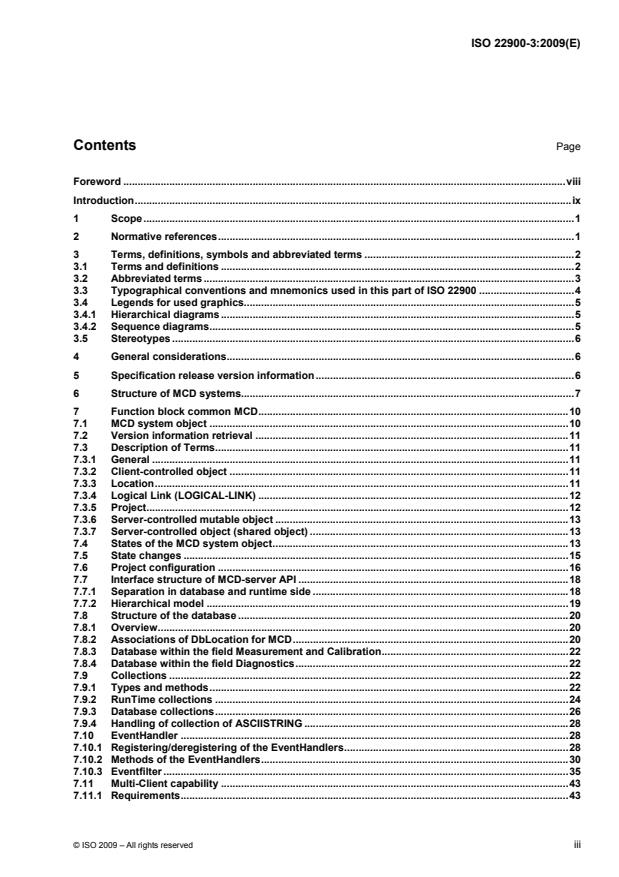
Contents Page
Foreword .viii
Introduction.ix
1 Scope.1
2 Normative references.1
3 Terms, definitions, symbols and abbreviated terms .2
3.1 Terms and definitions .2
3.2 Abbreviated terms .3
3.3 Typographical conventions and mnemonics used in this part of ISO 22900 .4
3.4 Legends for used graphics.5
3.4.1 Hierarchical diagrams.5
3.4.2 Sequence diagrams.5
3.5 Stereotypes .6
4 General considerations.6
5 Specification release version information.6
6 Structure of MCD systems.7
7 Function block common MCD.10
7.1 MCD system object .10
7.2 Version information retrieval .11
7.3 Description of Terms.11
7.3.1 General .11
7.3.2 Client-controlled object .11
7.3.3 Location.11
7.3.4 Logical Link (LOGICAL-LINK) .12
7.3.5 Project.12
7.3.6 Server-controlled mutable object .13
7.3.7 Server-controlled object (shared object) .13
7.4 States of the MCD system object.13
7.5 State changes .15
7.6 Project configuration .16
7.7 Interface structure of MCD-server API .18
7.7.1 Separation in database and runtime side .18
7.7.2 Hierarchical model .19
7.8 Structure of the database .20
7.8.1 Overview.20
7.8.2 Associations of DbLocation for MCD.20
7.8.3 Database within the field Measurement and Calibration.22
7.8.4 Database within the field Diagnostics.22
7.9 Collections .22
7.9.1 Types and methods.22
7.9.2 RunTime collections .24
7.9.3 Database collections.26
7.9.4 Handling of collection of ASCIISTRING .28
7.10 EventHandler .28
7.10.1 Registering/deregistering of the EventHandlers.28
7.10.2 Methods of the EventHandlers.30
7.10.3 Eventfilter .35
7.11 Multi-Client capability .43
7.11.1 Requirements.43
7.11.2 Design .46
7.11.3 Proxy in Multi Client Architecture.47
7.11.4 Cooperation Level.50
7.11.5 Symbolic Names of Clients.52
7.11.6 Selection and de-selection of Project and VehicleInfo in a multi-client setting .52
7.11.7 Notification .53
7.11.8 Remove shared objects .54
7.11.9 Locking .55
7.12 Client Controlled Objects.57
7.13 Resource Release.58
7.13.1 Use cases .58
7.13.2 Requirements.59
7.13.3 Solution.59
7.14 Critical Section, Critical Groups of Methods .59
7.15 Result access.61
7.16 MCD value.62
7.16.1 Value types .62
7.16.2 Method getValue .63
7.16.3 Method setValue .63
7.16.4 Method createValue.64
7.17 Use cases .68
7.17.1 View.68
7.17.2 Instantiation of projects .68
7.17.3 Database access.71
7.17.4 Destruction .73
8 Function block Common MD.74
8.1 Collector .74
8.1.1 ERD .74
8.1.2 Concept.75
8.1.3 Result access.79
8.1.4 Collector usage in diagnostics.84
8.2 Use cases .85
8.2.1 Measurement with a collector - activation .85
8.2.2 Measurement with a collector - result access .87
8.2.3 Measurement with a collector - polling for results.90
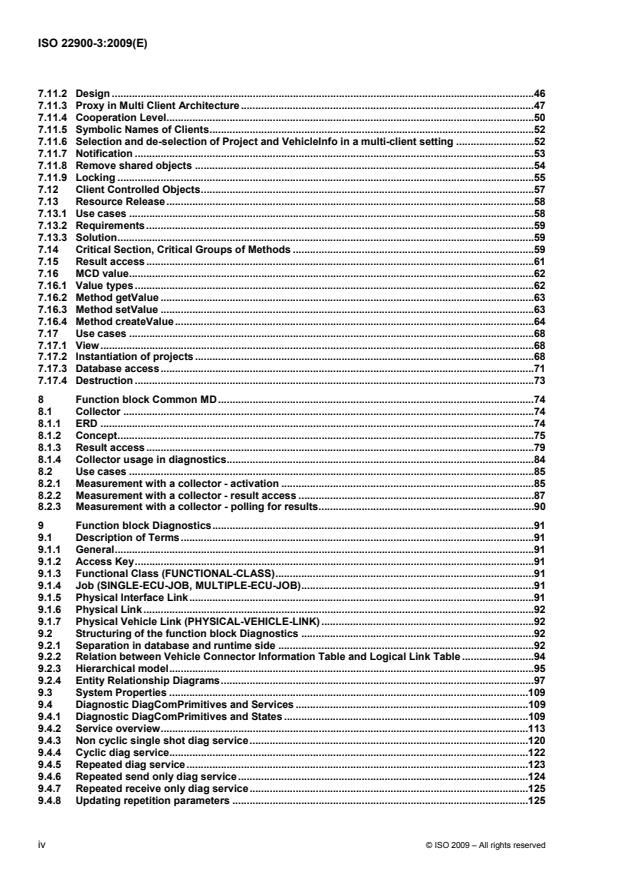
9 Function block Diagnostics.91
9.1 Description of Terms.91
9.1.1 General.91
9.1.2 Access Key.91
9.1.3 Functional Class (FUNCTIONAL-CLASS).91
9.1.4 Job (SINGLE-ECU-JOB, MULTIPLE-ECU-JOB).91
9.1.5 Physical Interface Link.91
9.1.6 Physical Link.92
9.1.7 Physical Vehicle Link (PHYSICAL-VEHICLE-LINK).92
9.2 Structuring of the function block Diagnostics .92
9.2.1 Separation in database and runtime side .92
9.2.2 Relation between Vehicle Connector Information Table and Logical Link Table .94
9.2.3 Hierarchical model.95
9.2.4 Entity Relationship Diagrams.97
9.3 System Properties .109
9.4 Diagnostic DiagComPrimitives and Services .109
9.4.1 Diagnostic DiagComPrimitives and States .109
9.4.2 Service overview.113
9.4.3 Non cyclic single shot diag service.120
9.4.4 Cyclic diag service.122
9.4.5 Repeated diag service.123
9.4.6 Repeated send only diag service.124
9.4.7 Repeated receive only diag service.125
9.4.8 Updating repetition parameters .125
iv © ISO 2009 – All rights reserved
9.4.9 Summary .126
9.4.10 Protocol parameters.127
9.4.11 Suppress Positive Response .140
9.5 Diagnostic variables.143
9.6 eEND_OF_PDU as RequestParameter .145
9.6.1 Database side .145
9.6.2 Runtime side .147
9.6.3 COMPUCODE.148
9.7 Variable length parameters .149
9.8 Layer inheritance of services.151
9.8.1 Goal.151
9.8.2 Layer inheritance of services.151
9.8.3 Service handling on functional and physical locations .156
9.9 Variant Identification and Selection (VI / VIS).158
9.9.1 Goal.158
9.9.2 Variant Identification Algorithm.158
9.9.3 General VI/VIS handling considerations .166
9.9.4 Deselecting of selected variants.168
9.9.5 Request and Response parameters of VI and VIS .168
9.9.6 Example Scenarios for VI and VIS .173
9.10 Base Variant Identification and Selection.183
9.11 Use Cases .190
9.11.1 Creation of LogicalLink and usage of DiagComPrimitives.190
9.11.2 Removal of communication objects.192
9.11.3 Service Handling .194
9.11.4 Result access.196
9.12 Filtering of results .225
9.12.1 Principle.225
9.12.2 Handling rules.229
9.13 Read DTC.230
9.14 Logical Link.234
9.14.1 General .234
9.14.2 Connection overview .234
9.14.3 State diagram of Logical Link .235
9.14.4 Logical Link examples .243
9.14.5 Gateway handling.248
9.14.6 Examples and Relations between Logical Links, Locations and relevant AccessKeys.250
9.15 Functional Addressing.256
9.16 Tables .258
9.16.1 General .258
9.16.2 Usage of tables within DiagComPrimitives .260
9.17 Dynamically Defined Local Id / Table Parameters (DDLID).263
9.17.1 General .263
9.17.2 DDLID principle and requirements .263
9.17.3 Lifecycle .264
9.18 Internationalisation .272
9.18.1 Multi language support.272
9.18.2 Units.272
9.19 Special Data Groups .272
9.20 ECU Flash programming .273
9.20.1 Goal.273
9.20.2 Description of Terms for ECU-Reprogramming.274
9.20.3 Structure of the function block flash programming .275
9.20.4 Management of ECU-MEMs.288
9.20.5 Physical Memories .289
9.20.6 Executing flash sessions.291
9.21 Library.299
9.22 Java Jobs .300
9.22.1 General .300
9.22.2 General information Java Jobs.300
9.22.3 Types of Java Jobs.301
9.22.4 Handling of Java Jobs.304
9.22.5 Job execution.314
9.22.6 Job example .322
9.23 ECU configuration .332
9.23.1 General.332
9.23.2 ECU Configuration Database Part.332
9.23.3 ECU Configuration Runtime Part .336
9.23.4 Error Handling.339
9.23.5 Initialising an MCDConfigurationRecord .339
9.23.6 Offline versus Online Configuration.340
9.23.7 Uploading and Downloading Configuration Strings.341
9.24 Audiences and Additional Audiences .346
9.24.1 General.346
9.24.2 Audiences.348
9.24.3 Additional Audiences .348
9.25 Function Dictionary and Sub-Components .349
9.25.1 Terms and requirements.349
9.25.2 Functions and function group in ODX.349
9.25.3 Function dictionary data model description.351
9.25.4 Function dictionary usage scenario .353
9.25.5 Sub-Component data model description .355
9.25.6 Sub-Component usage scenario.356
9.26 ECU States.357
9.27 Monitoring vehicle bus traffic.360
9.28 Support of VCI module selection and other VCI module features in accordance with D-
PDU API Standard.362
9.28.1 General.362
9.28.2 Definitions .362
9.28.3 General behaviour of D-PDU API related D-server methods.362
9.28.4 Overview of VCI module related classes.363
9.28.5 VCI module selection .364
9.28.6 MCDInterface.364
9.28.7 VCI module selection sequence.365
9.28.8 Interface status events.366
9.28.9 MCDInterfaceResource .367
9.28.10 Selection of an interface resource.367
9.28.11 Send Break Signal .368
9.28.12 MCDDbInterfaceCable .369
9.28.13 Accessing VCI module features.369
9.28.14 Adding Logical Links which are not found in the Vehicle Information.370
9.28.15 Behaviour of a MCD-server not supporting VCI Modules in accordance with D-PDU API
Standard .371
9.29 Mapping of D-PDU API methods .372
9.29.1 General.372
9.29.2 Initialization and Selection of VCI Modules .372
9.29.3 Communication on a Logical Link .372
9.29.4 Handling of Communication Parameters .374
9.29.5 MCDStartCommunication and MCDStopCommunication .376
10 Error Codes .377
10.1 Principle.377
10.2 Description of the errors.379
10.2.1 Error free behaviour .379
10.2.2 Parameterisation errors .379
10.2.3 Runtime / ProgramViolation errors.379
10.2.4 Database errors.379
10.2.5 System errors.379
10.2.6 Communication errors .379
10.2.7 Job error .379
vi © ISO 2009 – All rights reserved
Annex A (informative) Code examples .380
Annex B (normative) COMPUCODE template .387
Annex C (normative) Job Templates .388
Annex D (informative) Gateway Handling.392
Annex E (normative) Value reading and setting by string.393
Annex F (normative) Bus types.396
Annex G (normative) System parameter .398
Annex H (normative) Cooperation level .401
Annex I (normative) System properties.428
Annex J (informative) VCI Module selection sequence .431
Annex K (informative) Service example illustrations .432
Annex L (informative) Examplary monitoring message format .437
Annex M (normative) Overview of the methods for isModifiedByOtherClient flag.439
Bibliography.447
Foreword
ISO (the International Organization for Standardization) is a worldwide federation of national standards bodies
(ISO member bodies). The work of preparing International Standards is normally carried out through ISO
technical committees. Each member body interested in a subject for which a technical committee has been
established has the right to be represented on that committee. International organizations, governmental and
non-governmental, in liaison with ISO, also take part in the work. ISO collaborates closely with the
International Electrotechnical Commission (IEC) on all matters of electrotechnical standardization.
International Standards are drafted in accordance with the rules given in the ISO/IEC Directives, Part 2.
The main task of technical committees is to prepare International Standards. Draft International Standards
adopted by the technical committees are circulated to the member bodies for voting. Publication as an
International Standard requires approval by at least 75 % of the member bodies casting a vote.
Attention is drawn to the possibility that some of the elements of this document may be the subject of patent
rights. ISO shall not be held responsible for identifying any or all such patent rights.
ISO 22900-3 was prepared by Technical Committee ISO/TC 22, Road vehicles, Subcommittee SC 3,
Electrical and electronic equipment.
ISO 22900 consists of the following parts, under the general title Road vehicles — Modular vehicle
communication interface (MVCI):
⎯ Part 1: Hardware design requirements
⎯ Part 2: Diagnostic protocol data unit application programming interface (D-PDU API)
⎯ Part 3: Diagnostic server application programming interface (D-Server API)
viii © ISO 2009 – All rights reserved
Introduction
The purpose of this part of ISO 22900 is to define a universal application programmer interface of a vehicle
communication server application. At present, the automotive market requires different vehicle communication
interfaces for different vehicle original equipment manufacturers (OEMs) supporting multiple communication
protocols. However, up until now, many vehicle communication interfaces have been incompatible with regard
to interoperability with multiple communication applications and vehicle communication protocols.
Implementation of the measurement calibration diagnostic (MCD) server concept supports overall cost
reduction to the end user, e.g. because a single diagnostic or programming application will support many
vehicle communication interfaces supporting different communication protocols and different vehicle
communication modules of different vendors at one time.
A vehicle communication application compliant with this part of ISO 22900 supports a protocol-independent
protocol data unit application programming interface (D-PDU API) as specified in ISO 22900-2. The server
application needs to be configured with vehicle and electronic control unit (ECU) specific information. This is
1)
accomplished by supporting the open diagnostic exchange (ODX) data format, as specified in ISO 22901-1 .
[11]
1) Equivalent to ASAM MCD 2 D ODX .
INTERNATIONAL STANDARD ISO 22900-3:2009(E)
Road vehicles — Modular vehicle communication interface
(MVCI) —
Part 3:
Diagnostic server application programming interface
(D-Server API)
1 Scope
This part of ISO 22900 defines an object-oriented programming interface, the objective of which is to be able
to implement server applications used during the design, production and maintenance phase of a vehicle
communication system which are compatible with each other and therefore exchangeable.
A server compliant with this part of ISO 22900 has three function blocks:
⎯ M: measurement,
⎯ C: calibration, and
⎯ D: diagnostics.
[14]
A more detailed description of the server API is given in the Programmers Reference Guide .
2 Normative references
The following referenced documents are indispensable for the application of this document. For dated
references, only the edition cited applies. For undated references, the latest edition of the referenced
document (including any amendments) applies.
ISO 9141-2, Road vehicles — Diagnostic systems — Part 2: CARB requirements for interchange of digital
information
ISO 11898-2, Road vehicles — Controller area network (CAN) — Part 2: High-speed medium access unit
ISO 11898-3, Road vehicles — Controller area network (CAN) — Part 3: Low-speed, fault-tolerant, medium-
dependent interface
ISO 11992-1, Road vehicles — Interchange of digital information on electrical connections between towing
and towed vehicles — Part 1: Physical and data-link layers
ISO 14229-1, Road vehicles — Unified diagnostic services (UDS) — Part 1: Specification and requirements
ISO 14230-1, Road vehicles — Diagnostic systems — Keyword Protocol 2000 — Part 1: Physical layer
ISO 15765 (all parts), Road vehicles — Diagnostics on Controller Area Networks (CAN)
ISO 22900-2:2009, Road vehicles — Modular vehicle communication interface (MVCI) — Part 2: Diagnostic
protocol data unit application programming interface (D-PDU API)
3 Terms, definitions, symbols and abbreviated terms
3.1 Terms and definitions
For the purposes of this document, the following terms and definitions apply.
3.1.1
AccessKey
path identifier through the inheritance hierarchy as defined in open diagnostic data exchange (ODX) to a
diagnostic data element
3.1.2
ancestor object
parent object
object located above in the object hierarchy with respect to a given object
3.1.3
descendant object
child object
object located below in the object hierarchy with respect to a given object
3.1.4
functional class
set of diagnostic services
3.1.5
interface connector
connector at the vehicle end of the interface cable between the vehicle and the communication device
3.1.6
job
sequence of diagnostic services and other jobs with a control flow
3.1.7
location
representation of a set of diagnostic data valid on a given hierarchical level of inheritance as defined in open
diagnostic data exchange (ODX)
EXAMPLE Multiple ECU Job; Protocol; Functional Group; ECU Base Variant; ECU Variant; Module.
3.1.8
logical link
set of data, identifying the physical line, the interface and protocol used for an electronic control unit (ECU)
3.1.9
physical int
...
Questions, Comments and Discussion
Ask us and Technical Secretary will try to provide an answer. You can facilitate discussion about the standard in here.
Loading comments...