


ISO/IEC 17799:2000
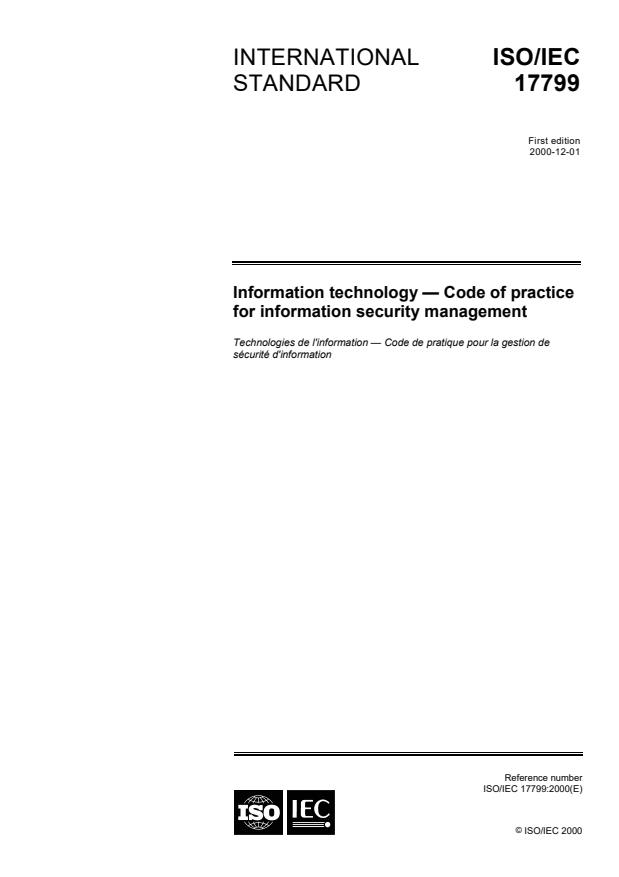
(Main)Information technology — Code of practice for information security management
Information technology — Code of practice for information security management
Technologies de l'information — Code de pratique pour la gestion de sécurité d'information
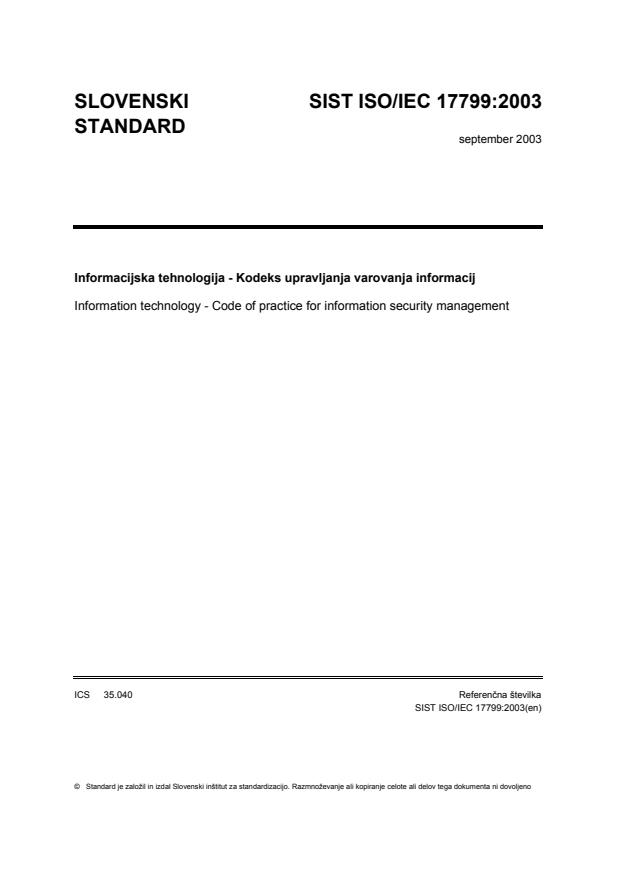
Informacijska tehnologija - Kodeks upravljanja varovanja informacij
General Information
- Status
- Withdrawn
- Publication Date
- 29-Nov-2000
- Withdrawal Date
- 29-Nov-2000
- Current Stage
- 9599 - Withdrawal of International Standard
- Start Date
- 10-Jun-2005
- Completion Date
- 12-Feb-2026
Relations
- Effective Date
- 15-Apr-2008

Get Certified
Connect with accredited certification bodies for this standard

BSI Group
BSI (British Standards Institution) is the business standards company that helps organizations make excellence a habit.

Bureau Veritas
Bureau Veritas is a world leader in laboratory testing, inspection and certification services.

DNV
DNV is an independent assurance and risk management provider.
Sponsored listings
Frequently Asked Questions
ISO/IEC 17799:2000 is a standard published by the International Organization for Standardization (ISO). Its full title is "Information technology — Code of practice for information security management". This standard covers: Information technology — Code of practice for information security management
Information technology — Code of practice for information security management
ISO/IEC 17799:2000 is classified under the following ICS (International Classification for Standards) categories: 35.030 - IT Security; 35.040 - Information coding. The ICS classification helps identify the subject area and facilitates finding related standards.
ISO/IEC 17799:2000 has the following relationships with other standards: It is inter standard links to ISO/IEC 17799:2005. Understanding these relationships helps ensure you are using the most current and applicable version of the standard.
ISO/IEC 17799:2000 is available in PDF format for immediate download after purchase. The document can be added to your cart and obtained through the secure checkout process. Digital delivery ensures instant access to the complete standard document.
Standards Content (Sample)
INTERNATIONAL ISO/IEC
STANDARD 17799
First edition
2000-12-01
Information technology — Code of practice
for information security management
Technologies de l'information — Code de pratique pour la gestion de
sécurité d'information
Reference number
©
ISO/IEC 2000
PDF disclaimer
This PDF file may contain embedded typefaces. In accordance with Adobe's licensing policy, this file may be printed or viewed but shall not
be edited unless the typefaces which are embedded are licensed to and installed on the computer performing the editing. In downloading this
file, parties accept therein the responsibility of not infringing Adobe's licensing policy. The ISO Central Secretariat accepts no liability in this
area.
Adobe is a trademark of Adobe Systems Incorporated.
Details of the software products used to create this PDF file can be found in the General Info relative to the file; the PDF-creation parameters
were optimized for printing. Every care has been taken to ensure that the file is suitable for use by ISO member bodies. In the unlikely event
that a problem relating to it is found, please inform the Central Secretariat at the address given below.
© ISO/IEC 2000
All rights reserved. Unless otherwise specified, no part of this publication may be reproduced or utilized in any form or by any means, electronic
or mechanical, including photocopying and microfilm, without permission in writing from either ISO at the address below or ISO's member body
in the country of the requester.
ISO copyright office
Case postale 56 � CH-1211 Geneva 20
Tel. + 41 22 749 01 11
Fax + 41 22 749 09 47
E-mail copyright@iso.ch
Web www.iso.ch
Printed in Switzerland
ii © ISO/IEC 2000 – All rights reserved
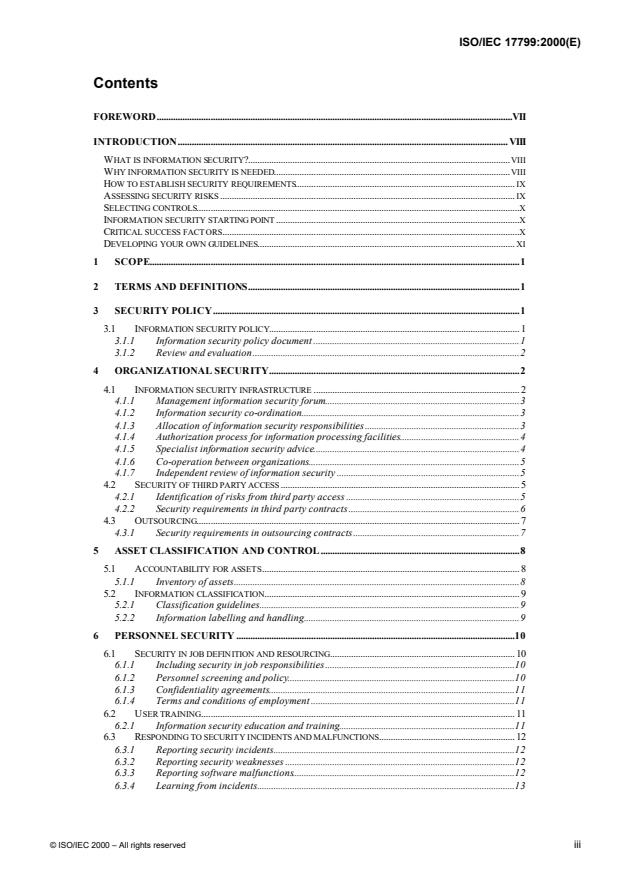
Contents
FOREWORD.VII
INTRODUCTION. VIII
WHAT IS INFORMATION SECURITY?.VIII
WHY INFORMATION SECURITY IS NEEDED.VIII
HOW TO ESTABLISH SECURITY REQUIREMENTS. IX
ASSESSING SECURITY RISKS . IX
SELECTING CONTROLS.X
INFORMATION SECURITY STARTING POINT .X
CRITICAL SUCCESS FACT ORS.X
DEVELOPING YOUR OWN GUIDELINES. XI
1 SCOPE.1
2 TERMS AND DEFINITIONS.1
3 SECURITY POLICY.1
3.1 INFORMATION SECURITY POLICY.1
3.1.1 Information security policy document .1
3.1.2 Review and evaluation.2
4 ORGANIZATIONAL SECURITY.2
4.1 INFORMATION SECURITY INFRASTRUCTURE .2
4.1.1 Management information security forum.3
4.1.2 Information security co-ordination.3
4.1.3 Allocation of information security responsibilities.3
4.1.4 Authorization process for information processing facilities.4
4.1.5 Specialist information security advice.4
4.1.6 Co-operation between organizations.5
4.1.7 Independent review of information security .5
4.2 SECURITY OF THIRD PARTY ACCESS .5
4.2.1 Identification of risks from third party access .5
4.2.2 Security requirements in third party contracts.6
4.3 OUTSOURCING.7
4.3.1 Security requirements in outsourcing contracts.7
5 ASSET CLASSIFICATION AND CONTROL.8
5.1 ACCOUNTABILITY FOR ASSETS.8
5.1.1 Inventory of assets.8
5.2 INFORMATION CLASSIFICATION.9
5.2.1 Classification guidelines.9
5.2.2 Information labelling and handling.9
6 PERSONNEL SECURITY .10
6.1 SECURITY IN JOB DEFINITION AND RESOURCING. 10
6.1.1 Including security in job responsibilities.10
6.1.2 Personnel screening and policy.10
6.1.3 Confidentiality agreements.11
6.1.4 Terms and conditions of employment .11
6.2 USER TRAINING. 11
6.2.1 Information security education and training.11
6.3 RESPONDING TO SECURITY INCIDENTS AND MALFUNCTIONS. 12
6.3.1 Reporting security incidents.12
6.3.2 Reporting security weaknesses .12
6.3.3 Reporting software malfunctions.12
6.3.4 Learning from incidents.13
© ISO/IEC 2000 – All rights reserved iii
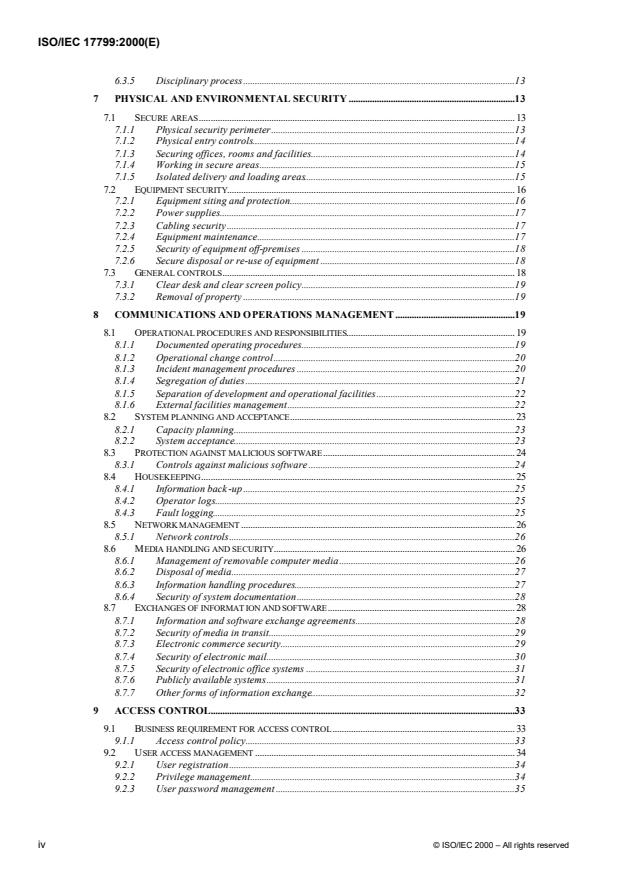
6.3.5 Disciplinary process.13
7 PHYSICAL AND ENVIRONMENTAL SECURITY .13
7.1 SECURE AREAS. 13
7.1.1 Physical security perimeter.13
7.1.2 Physical entry controls.14
7.1.3 Securing offices, rooms and facilities.14
7.1.4 Working in secure areas.15
7.1.5 Isolated delivery and loading areas.15
7.2 EQUIPMENT SECURITY. 16
7.2.1 Equipment siting and protection.16
7.2.2 Power supplies.17
7.2.3 Cabling security.17
7.2.4 Equipment maintenance.17
7.2.5 Security of equipment off-premises .18
7.2.6 Secure disposal or re-use of equipment .18
7.3 GENERAL CONTROLS. 18
7.3.1 Clear desk and clear screen policy.19
7.3.2 Removal of property .19
8 COMMUNICATIONS AND OPERATIONS MANAGEMENT .19
8.1 OPERATIONAL PROCEDURES AND RESPONSIBILITIES. 19
8.1.1 Documented operating procedures.19
8.1.2 Operational change control.20
8.1.3 Incident management procedures .20
8.1.4 Segregation of duties.21
8.1.5 Separation of development and operational facilities.22
8.1.6 External facilities management.22
8.2 SYSTEM PLANNING AND ACCEPTANCE. 23
8.2.1 Capacity planning.23
8.2.2 System acceptance.23
8.3 PROTECTION AGAINST MALICIOUS SOFTWARE. 24
8.3.1 Controls against malicious software .24
8.4 HOUSEKEEPING. 25
8.4.1 Information back -up.25
8.4.2 Operator logs.25
8.4.3 Fault logging.25
8.5 NETWORK MANAGEMENT . 26
8.5.1 Network controls.26
8.6 MEDIA HANDLING AND SECURITY. 26
8.6.1 Management of removable computer media.26
8.6.2 Disposal of media.27
8.6.3 Information handling procedures.27
8.6.4 Security of system documentation.28
8.7 EXCHANGES OF INFORMAT ION AND SOFTWARE. 28
8.7.1 Information and software exchange agreements.28
8.7.2 Security of media in transit.29
8.7.3 Electronic commerce security.29
8.7.4 Security of electronic mail.30
8.7.5 Security of electronic office systems .31
8.7.6 Publicly available systems.31
8.7.7 Other forms of information exchange.32
9 ACCESS CONTROL.33
9.1 BUSINESS REQUIREMENT FOR ACCESS CONTROL. 33
9.1.1 Access control policy.33
9.2 USER ACCESS MANAGEMENT . 34
9.2.1 User registration.34
9.2.2 Privilege management.34
9.2.3 User password management .35
iv © ISO/IEC 2000 – All rights reserved
9.2.4 Review of user access rights.35
9.3 USER RESPONSIBILITIES. 36
9.3.1 Password use .36
9.3.2 Unattended user equipment.36
9.4 NETWORK ACCESS CONTROL. 37
9.4.1 Policy on use of network services.37
9.4.2 Enforced path.37
9.4.3 User authentication for external connections.38
9.4.4 Node authentication.38
9.4.5 Remote diagnostic port protection.38
9.4.6 Segregation in networks.39
9.4.7 Network connection control.39
9.4.8 Network routing control.39
9.4.9 Security of network services.40
9.5 OPERATING SYSTEM ACCE SS CONTROL . 40
9.5.1 Automatic terminal identification.40
9.5.2 Terminal log-on procedures.40
9.5.3 User identification and authentication.41
9.5.4 Password management system.41
9.5.5 Use of system utilities.42
9.5.6 Duress alarm to safeguard users.42
9.5.7 Terminal time-out.42
9.5.8 Limitation of connection time.42
9.6 APPLICATION ACCESS CONTROL. 43
9.6.1 Information access restriction.43
9.6.2 Sensitive system isolation.43
9.7 MONITORING SYSTEM ACCESS AND USE. 44
9.7.1 Event logging .44
9.7.2 Monitoring system use.44
9.7.3 Clock synchronization.45
9.8 MOBILE COMPUTING AND TELEWORKING. 46
9.8.1 Mobile computing.46
9.8.2 Teleworking.46
10 SYSTEMS DEVELOPMENT AND MAINTENANCE.47
10.1 SECURITY REQUIREMENTS OF SYSTEMS. 47
10.1.1 Security requirements analysis and specification.48
10.2 SECURITY IN APPLICATION SYSTEMS. 48
10.2.1 Input data validation.48
10.2.2 Control of internal processing.49
10.2.3 Message authentication.49
10.2.4 Output data validation.50
10.3 CRYPTOGRAPHIC CONTROLS. 50
10.3.1 Policy on the use of cryptographic controls.50
10.3.2 Encryption .50
10.3.3 Digital signatures.51
10.3.4 Non-repudiation services.51
10.3.5 Key management.52
10.4 SECURITY OF SYSTEM FILES. 53
10.4.1 Control of operational software.53
10.4.2 Protection of system test data .53
10.4.3 Access control to program source library.54
10.5 SECURITY IN DEVELOPMENT AND SUPPORT PROCE SSES. 54
10.5.1 Change control procedures.54
10.5.2 Technical review of operating system changes.55
10.5.3 Restrictions on changes to software packages.55
10.5.4 Covert channels and Trojan code .56
10.5.5 Outsourced software development.56
11 BUSINESS CONTINUITY MANAGEMENT .56
© ISO/IEC 2000 – All rights reserved v
11.1 ASPECTS OF BUSINESS CONTINUITY MANAGEMENT. 56
11.1.1 Business continuity management process.57
11.1.2 Business continuity and impact analysis.57
11.1.3 Writing and implementing continuity plans.57
11.1.4 Business continuity planning framework .58
11.1.5 Testing, maintaining and re-assessing business continuity plans.59
12 COMPLIANCE .60
12.1 COMPLIANCE WITH LEGAL REQUIREMENTS. 60
12.1.1 Identification of applicable legislation.60
12.1.2 Intellectual property rights (IPR).60
12.1.3 Safeguarding of organizational records.61
12.1.4 Data protection and privacy of personal information.62
12.1.5 Prevention of misuse of information processing facilities.62
12.1.6 Regulation of cryptographic controls.62
12.1.7 Collection of evidence.63
12.2 REVIEWS OF SECURITY P OLICY AND TECHNICAL COMPLIANCE . 63
12.2.1 Compliance with security policy.63
12.2.2 Technical compliance checking.64
12.3 SYSTEM AUDIT CONSIDERATIONS. 64
12.3.1 System audit controls.64
12.3.2 Protection of system audit tools.65
vi © ISO/IEC 2000 – All rights reserved
Foreword
ISO (the International Organization for Standardization) and IEC (the International Electrotechnical Commission)
form the specialized system for worldwide standardization. National bodies that are members of ISO or IEC
participate in the development of International Standards through technical committees established by the
respective organization to deal with particular fields of technical activity. ISO and IEC technical committees
collaborate in fields of mutual interest. Other international organizations, governmental and non-governmental, in
liaison with ISO and IEC, also take part in the work.
International Standards are drafted in accordance with the rules given in the ISO/IEC Directives, Part 3.
In the field of information technology, ISO and IEC have established a joint technical committee, ISO/IEC JTC 1.
Draft International Standards adopted by the joint technical committee are circulated to national bodies for voting.
Publication as an International Standard requires approval by at least 75 % of the national bodies casting a vote.
Attention is drawn to the possibility that some of the elements of this International Standard may be the subject of
patent rights. ISO and IEC shall not be held responsible for identifying any or all such patent rights.
International Standard ISO/IEC 17799 was prepared by the British Standards Institution (as BS 7799) and was
adopted, under a special “fast-track procedure”, by Joint Technical Committee ISO/IEC JTC 1, Information
technology, in parallel with its approval by national bodies of ISO and IEC.
© ISO/IEC 2000 – All rights reserved vii
Introduction
What is information security?
Information is an asset which, like other important business assets, has value to an
organization and consequently needs to be suitably protected. Information security protects
information from a wide range of threats in order to ensure business continuity, minimize
business damage and maximize return on investments and business opportunities.
Information can exist in many forms. It can be printed or written on paper, stored
electronically, transmitted by post or using electronic means, shown on films, or spoken in
conversation. Whatever form the information takes, or means by which it is shared or stored,
it should always be appropriately protected.
Information security is characterized here as the preservation of:
a) confidentiality: ensuring that information is accessible only to those authorized to
have access;
b) integrity: safeguarding the accuracy and completeness of information and processing
methods;
c) availability: ensuring that authorized users have access to information and associated
assets when required.
Information security is achieved by implementing a suitable set of controls, which could be
policies, practices, procedures, organizational structures and software functions. These
controls need to be established to ensure that the specific security objectives of the
organization are met.
Why information security is needed
Information and the supporting processes, systems and networks are important bus iness
assets. Confidentiality, integrity and availability of information may be essential to maintain
competitive edge, cash-flow, profitability, legal compliance and commercial image.
Increasingly, organizations and their information systems and networks are faced with
security threats from a wide range of sources, including computer-assisted fraud, espionage,
sabotage, vandalism, fire or flood. Sources of damage such as computer viruses, computer
hacking and denial of service attacks have become more common, more ambitious and
increasingly sophisticated.
Dependence on information systems and services means organizations are more vulnerable to
security threats. The interconnecting of public and private networks and sharing of
information resources increases the difficulty of achieving access control. The trend to
distributed computing has weakened the effectiveness of central, specialist control.
Many information systems have not been designed to be secure. The security that can be
achieved through technical means is limited, and should be supported by appropriate
management and procedures. Identifying which controls should be in place requires careful
planning and attention to detail. Information security management needs, as a minimum,
participation by all employees in the organization. It may also require participation from
suppliers, customers or shareholders. Specialist advice from outside organizations may also
be needed.
viii © ISO/IEC 2000 – All rights reserved
Information security controls are considerably cheaper and more effective if incorporated at
the requirements specification and design stage.
How to establish security requirements
It is essential that an organization identifies its security requirements. There are three main
sources.
The first source is derived from assessing risks to the organization. Through risk assessment
threats to assets are identified, vulnerability to and likelihood of occurrence is evaluated and
potential impact is estimated.
The second source is the legal, statutory, regulatory and contractual requirements that an
organization, its trading partners, contractors and service providers have to satisfy.
The third source is the particular set of principles, objectives and requirements for information
processing that an organization has developed to support its operations.
Assessing security risks
Security requirements are identified by a methodical assessment of security risks. Expenditure
on controls needs to be balanced against the business harm likely to result from security
failures. Risk assessment techniques can be applied to the whole organization, or only parts of
it, as well as to individual information systems, specific system components or services where
this is practicable, realistic and helpful.
Risk assessment is systematic consideration of:
a) the business harm likely to result from a security failure, taking into account the
potential consequences of a loss of confidentiality, integrity or availability of the
information and other assets;
b) the realistic likelihood of such a failure occurring in the light of prevailing threats
and vulnerabilities, and the controls currently implemented.
The results of this assessment will help guide and determine the appropriate management
action and priorities for managing information security risks, and for implementing controls
selected to protect against these risks. The process of assessing risks and selecting controls
may need to be performed a number of times to cover different parts of the organization or
individual information systems.
It is important to carry out periodic reviews of security risks and implemented controls to:
a) take account of changes to business requirements and priorities;
b) consider new threats and vulnerabilities;
c) confirm that controls remain effective and appropriate.
Reviews should be performed at different levels of depth depending on the results of previous
assessments and the changing levels of risk that management is prepared to accept. Risk
assessments are often carried out first at a high level, as a means of prioritizing resources in
areas of high risk, and then at a more detailed level, to address specific risks.
© ISO/IEC 2000 – All rights reserved ix
Selecting controls
Once security requirements have been identified, controls should be selected and
implemented to ensure risks are reduced to an acceptable level. Controls can be selected from
this document or from other control sets, or new controls can be designed to meet specific
needs as appropriate. There are many different ways of managing risks and this document
provides examples of common approaches. However, it is necessary to recognize that some of
the controls are not applicable to every information system or environment, and might not be
practicable for all organizations. As an example, 8.1.4 describes how duties may be
segregated to prevent fraud and error. It may not be possible for smaller organizations to
segregate all duties and other ways of achieving the same control objective may be necessary.
As another example, 9.7 and 12.1 describe how system use can be monitored and evidence
collected. The described controls e.g. event logging might conflict with applicable
legislation, such as privacy protection for customers or in the workplace.
Controls should be selected based on the cost of implementation in relation to the risks being
reduced and the potential losses if a security breach occurs. Non-monetary factors such as loss
of reputation should also be taken into account.
Some of the controls in this document can be considered as guiding principles for information
security management and applicable for most organizations. They are explained in more
detail below under the heading “Information security starting point”.
Information security starting point
A number of controls can be considered as guiding principles providing a good starting point
for implementing information security. They are either based on essential legislative
requirements or considered to be common best practice for information security.
Controls considered to be essential to an organization from a legislative point of view include:
a) data protection and privacy of personal information (see 12.1.4).
b) safeguarding of organizational records (see 12.1.3);
c) intellectual property rights (see 12.1.2);
Controls considered to be common best practice for information security include:
a) information security policy document (see 3.1);
b) allocation of information security responsibilities (see 4.1.3);
c) information security education and training (see 6.2.1);
d) reporting security incidents (see 6.3.1);
e) business continuity management (see 11.1).
These controls apply to most organizations and in most environments. It should be noted that
although all controls in this document are important, the relevance of any control should be
determined in the light of the specific risks an organization is facing. Hence, although the
above approach is considered a good starting point, it does not replace selection of controls
based on a risk assessment.
Critical success factors
Experience has shown that the following factors are often critical to the successful
implementation of information security within an organization:
x © ISO/IEC 2000 – All rights reserved
a) security policy, objectives and activities that reflect business objectives;
b) an approach to implementing security that is consistent with the organizational
culture;
c) visible support and commitment from management;
d) a good understanding of the security requirements, risk assessment and risk
management;
e) effective marketing of security to all managers and employees;
f) distribution of guidance on information security policy and standards to all
employees and contractors;
g) providing appropriate training and education;
h) a comprehensive and balanced system of measurement which is used to evaluate
performance in information security management and feedback suggestions for
improvement.
Developing your own guidelines
This code of practice may be regarded as a starting point for developing organization specific
guidance. Not all of the guidance and controls in this code of practice may be applicable.
Furthermore, additional controls not included in this document may be required. When this
happens it may be useful to retain cross-references which will facilitate compliance checking
by auditors and business partners.
© ISO/IEC 2000 – All rights reserved xi
INTERNATIONAL STANDARD ISO/IEC 17799:2000(E)
Information technology — Code of practice for information
security management
1 Scope
This standard gives recommendations for information security management for use by those
who are responsible for initiating, implementing or maintaining security in their organization.
It is intended to provide a common basis for developing organizational security standards and
effective security management practice and to provide confidence in inter-organizational
dealings. Recommendations from this standard should be selected and used in accordance
with applicable laws and regulations.
2 Terms and definitions
For the purposes of this document, the following definitions apply.
2.1 Information security
Preservation of confidentiality, integrity and availability of information.
- Confidentiality
Ensuring that information is accessible only to those authorized to have access.
- Integrity
Safeguarding the accuracy and completeness of information and processing
methods.
- Availability
Ensuring that authorized users have access to information and associated assets
when required.
2.2 Risk assessment
Assessment of threats to, impacts on and vulnerabilities of information and information
processing facilities and the likelihood of their occurrence.
2.3 Risk management
Process of identifying, controlling and minimizing or eliminating security risks that may affect
information systems, for an acceptable cost.
3 Security policy
3.1 Information security policy
Objective: To provide management direction and support for information security.
Management should set a clear policy direction and demonstrate support for, and commitment
to, information security through the issue and maintenance of an information security policy
across the organization.
3.1.1 Information security policy document
A policy document should be approved by management, published and communicated, as
appropriate, to all employees. It should state management commitment and set out the
organization’s approach to managing information security. As a minimum, the following
guidance should be included:
© ISO/IEC 2000 — All rights reserved 1
a) a definition of information security, its overall objectives and scope and the
importance of security as an enabling mechanism for information sharing (see
introduction);
b) a statement of management intent, supporting the goals and principles of information
security;
c) a brief explanation of the security policies, principles, standards and compliance
requirements of particular importance to the organization, for example:
1) compliance with legislative and contractual requirements;
2) security education requirements;
3) prevention and detection of viruses and other malicious software;
4) business continuity management;
5) consequences of security policy violations;
d) a definition of general and specific responsibilities for information security
management, including reporting security incidents;
e) references to documentation which may support the policy, e.g. more detailed
security policies and procedures for specific information systems or security rules
users should comply with.
This policy should be communicated throughout the organization to users in a form that is
relevant, accessible and understandable to the intended reader.
3.1.2 Review and evaluation
The policy should have an owner who is responsible for its maintenance and review according
to a defined review process. That process should ensure that a review takes place in response
to any changes affecting the basis of the original risk assessment, e.g. significant security
incidents, new vulnerabilities or changes to the organizational or technical infrastructure.
There should also be scheduled, periodic reviews of the following:
a) the policy’s effectiveness, demonstrated by the nature, number and impact of
recorded security incidents;
b) cost and impact of controls on business efficiency;
c) effects of changes to technology.
4 Organizational security
4.1 Information security infrastructure
Objective: To manage information security within the organization.
A management framework should be established to initiate and control the implementation of
information security within the organization.
Suitable management fora with management leadership should be established to approve the
information security policy, assign security roles and co-ordinate the implementation of
security across the organization. If necessary, a source of specialist information security
advice should be established and made available within the
...
SLOVENSKI SIST ISO/IEC 17799:2003
STANDARD
september 2003
Informacijska tehnologija - Kodeks upravljanja varovanja informacij
Information technology - Code of practice for information security management
ICS 35.040 Referenčna številka
© Standard je založil in izdal Slovenski inštitut za standardizacijo. Razmnoževanje ali kopiranje celote ali delov tega dokumenta ni dovoljeno
INTERNATIONAL ISO/IEC
STANDARD 17799
First edition
2000-12-01
Information technology — Code of practice
for information security management
Technologies de l'information — Code de pratique pour la gestion de
sécurité d'information
Reference number
©
ISO/IEC 2000
PDF disclaimer
This PDF file may contain embedded typefaces. In accordance with Adobe's licensing policy, this file may be printed or viewed but shall not
be edited unless the typefaces which are embedded are licensed to and installed on the computer performing the editing. In downloading this
file, parties accept therein the responsibility of not infringing Adobe's licensing policy. The ISO Central Secretariat accepts no liability in this
area.
Adobe is a trademark of Adobe Systems Incorporated.
Details of the software products used to create this PDF file can be found in the General Info relative to the file; the PDF-creation parameters
were optimized for printing. Every care has been taken to ensure that the file is suitable for use by ISO member bodies. In the unlikely event
that a problem relating to it is found, please inform the Central Secretariat at the address given below.
© ISO/IEC 2000
All rights reserved. Unless otherwise specified, no part of this publication may be reproduced or utilized in any form or by any means, electronic
or mechanical, including photocopying and microfilm, without permission in writing from either ISO at the address below or ISO's member body
in the country of the requester.
ISO copyright office
Case postale 56 � CH-1211 Geneva 20
Tel. + 41 22 749 01 11
Fax + 41 22 749 09 47
E-mail copyright@iso.ch
Web www.iso.ch
Printed in Switzerland
ii © ISO/IEC 2000 – All rights reserved
Contents
FOREWORD.VII
INTRODUCTION. VIII
WHAT IS INFORMATION SECURITY?.VIII
WHY INFORMATION SECURITY IS NEEDED.VIII
HOW TO ESTABLISH SECURITY REQUIREMENTS. IX
ASSESSING SECURITY RISKS . IX
SELECTING CONTROLS.X
INFORMATION SECURITY STARTING POINT .X
CRITICAL SUCCESS FACT ORS.X
DEVELOPING YOUR OWN GUIDELINES. XI
1 SCOPE.1
2 TERMS AND DEFINITIONS.1
3 SECURITY POLICY.1
3.1 INFORMATION SECURITY POLICY.1
3.1.1 Information security policy document .1
3.1.2 Review and evaluation.2
4 ORGANIZATIONAL SECURITY.2
4.1 INFORMATION SECURITY INFRASTRUCTURE .2
4.1.1 Management information security forum.3
4.1.2 Information security co-ordination.3
4.1.3 Allocation of information security responsibilities.3
4.1.4 Authorization process for information processing facilities.4
4.1.5 Specialist information security advice.4
4.1.6 Co-operation between organizations.5
4.1.7 Independent review of information security .5
4.2 SECURITY OF THIRD PARTY ACCESS .5
4.2.1 Identification of risks from third party access .5
4.2.2 Security requirements in third party contracts.6
4.3 OUTSOURCING.7
4.3.1 Security requirements in outsourcing contracts.7
5 ASSET CLASSIFICATION AND CONTROL.8
5.1 ACCOUNTABILITY FOR ASSETS.8
5.1.1 Inventory of assets.8
5.2 INFORMATION CLASSIFICATION.9
5.2.1 Classification guidelines.9
5.2.2 Information labelling and handling.9
6 PERSONNEL SECURITY .10
6.1 SECURITY IN JOB DEFINITION AND RESOURCING. 10
6.1.1 Including security in job responsibilities.10
6.1.2 Personnel screening and policy.10
6.1.3 Confidentiality agreements.11
6.1.4 Terms and conditions of employment .11
6.2 USER TRAINING. 11
6.2.1 Information security education and training.11
6.3 RESPONDING TO SECURITY INCIDENTS AND MALFUNCTIONS. 12
6.3.1 Reporting security incidents.12
6.3.2 Reporting security weaknesses .12
6.3.3 Reporting software malfunctions.12
6.3.4 Learning from incidents.13
© ISO/IEC 2000 – All rights reserved iii
6.3.5 Disciplinary process.13
7 PHYSICAL AND ENVIRONMENTAL SECURITY .13
7.1 SECURE AREAS. 13
7.1.1 Physical security perimeter.13
7.1.2 Physical entry controls.14
7.1.3 Securing offices, rooms and facilities.14
7.1.4 Working in secure areas.15
7.1.5 Isolated delivery and loading areas.15
7.2 EQUIPMENT SECURITY. 16
7.2.1 Equipment siting and protection.16
7.2.2 Power supplies.17
7.2.3 Cabling security.17
7.2.4 Equipment maintenance.17
7.2.5 Security of equipment off-premises .18
7.2.6 Secure disposal or re-use of equipment .18
7.3 GENERAL CONTROLS. 18
7.3.1 Clear desk and clear screen policy.19
7.3.2 Removal of property .19
8 COMMUNICATIONS AND OPERATIONS MANAGEMENT .19
8.1 OPERATIONAL PROCEDURES AND RESPONSIBILITIES. 19
8.1.1 Documented operating procedures.19
8.1.2 Operational change control.20
8.1.3 Incident management procedures .20
8.1.4 Segregation of duties.21
8.1.5 Separation of development and operational facilities.22
8.1.6 External facilities management.22
8.2 SYSTEM PLANNING AND ACCEPTANCE. 23
8.2.1 Capacity planning.23
8.2.2 System acceptance.23
8.3 PROTECTION AGAINST MALICIOUS SOFTWARE. 24
8.3.1 Controls against malicious software .24
8.4 HOUSEKEEPING. 25
8.4.1 Information back -up.25
8.4.2 Operator logs.25
8.4.3 Fault logging.25
8.5 NETWORK MANAGEMENT . 26
8.5.1 Network controls.26
8.6 MEDIA HANDLING AND SECURITY. 26
8.6.1 Management of removable computer media.26
8.6.2 Disposal of media.27
8.6.3 Information handling procedures.27
8.6.4 Security of system documentation.28
8.7 EXCHANGES OF INFORMAT ION AND SOFTWARE. 28
8.7.1 Information and software exchange agreements.28
8.7.2 Security of media in transit.29
8.7.3 Electronic commerce security.29
8.7.4 Security of electronic mail.30
8.7.5 Security of electronic office systems .31
8.7.6 Publicly available systems.31
8.7.7 Other forms of information exchange.32
9 ACCESS CONTROL.33
9.1 BUSINESS REQUIREMENT FOR ACCESS CONTROL. 33
9.1.1 Access control policy.33
9.2 USER ACCESS MANAGEMENT . 34
9.2.1 User registration.34
9.2.2 Privilege management.34
9.2.3 User password management .35
iv © ISO/IEC 2000 – All rights reserved
9.2.4 Review of user access rights.35
9.3 USER RESPONSIBILITIES. 36
9.3.1 Password use .36
9.3.2 Unattended user equipment.36
9.4 NETWORK ACCESS CONTROL. 37
9.4.1 Policy on use of network services.37
9.4.2 Enforced path.37
9.4.3 User authentication for external connections.38
9.4.4 Node authentication.38
9.4.5 Remote diagnostic port protection.38
9.4.6 Segregation in networks.39
9.4.7 Network connection control.39
9.4.8 Network routing control.39
9.4.9 Security of network services.40
9.5 OPERATING SYSTEM ACCE SS CONTROL . 40
9.5.1 Automatic terminal identification.40
9.5.2 Terminal log-on procedures.40
9.5.3 User identification and authentication.41
9.5.4 Password management system.41
9.5.5 Use of system utilities.42
9.5.6 Duress alarm to safeguard users.42
9.5.7 Terminal time-out.42
9.5.8 Limitation of connection time.42
9.6 APPLICATION ACCESS CONTROL. 43
9.6.1 Information access restriction.43
9.6.2 Sensitive system isolation.43
9.7 MONITORING SYSTEM ACCESS AND USE. 44
9.7.1 Event logging .44
9.7.2 Monitoring system use.44
9.7.3 Clock synchronization.45
9.8 MOBILE COMPUTING AND TELEWORKING. 46
9.8.1 Mobile computing.46
9.8.2 Teleworking.46
10 SYSTEMS DEVELOPMENT AND MAINTENANCE.47
10.1 SECURITY REQUIREMENTS OF SYSTEMS. 47
10.1.1 Security requirements analysis and specification.48
10.2 SECURITY IN APPLICATION SYSTEMS. 48
10.2.1 Input data validation.48
10.2.2 Control of internal processing.49
10.2.3 Message authentication.49
10.2.4 Output data validation.50
10.3 CRYPTOGRAPHIC CONTROLS. 50
10.3.1 Policy on the use of cryptographic controls.50
10.3.2 Encryption .50
10.3.3 Digital signatures.51
10.3.4 Non-repudiation services.51
10.3.5 Key management.52
10.4 SECURITY OF SYSTEM FILES. 53
10.4.1 Control of operational software.53
10.4.2 Protection of system test data .53
10.4.3 Access control to program source library.54
10.5 SECURITY IN DEVELOPMENT AND SUPPORT PROCE SSES. 54
10.5.1 Change control procedures.54
10.5.2 Technical review of operating system changes.55
10.5.3 Restrictions on changes to software packages.55
10.5.4 Covert channels and Trojan code .56
10.5.5 Outsourced software development.56
11 BUSINESS CONTINUITY MANAGEMENT .56
© ISO/IEC 2000 – All rights reserved v
11.1 ASPECTS OF BUSINESS CONTINUITY MANAGEMENT. 56
11.1.1 Business continuity management process.57
11.1.2 Business continuity and impact analysis.57
11.1.3 Writing and implementing continuity plans.57
11.1.4 Business continuity planning framework .58
11.1.5 Testing, maintaining and re-assessing business continuity plans.59
12 COMPLIANCE .60
12.1 COMPLIANCE WITH LEGAL REQUIREMENTS. 60
12.1.1 Identification of applicable legislation.60
12.1.2 Intellectual property rights (IPR).60
12.1.3 Safeguarding of organizational records.61
12.1.4 Data protection and privacy of personal information.62
12.1.5 Prevention of misuse of information processing facilities.62
12.1.6 Regulation of cryptographic controls.62
12.1.7 Collection of evidence.63
12.2 REVIEWS OF SECURITY P OLICY AND TECHNICAL COMPLIANCE . 63
12.2.1 Compliance with security policy.63
12.2.2 Technical compliance checking.64
12.3 SYSTEM AUDIT CONSIDERATIONS. 64
12.3.1 System audit controls.64
12.3.2 Protection of system audit tools.65
vi © ISO/IEC 2000 – All rights reserved
Foreword
ISO (the International Organization for Standardization) and IEC (the International Electrotechnical Commission)
form the specialized system for worldwide standardization. National bodies that are members of ISO or IEC
participate in the development of International Standards through technical committees established by the
respective organization to deal with particular fields of technical activity. ISO and IEC technical committees
collaborate in fields of mutual interest. Other international organizations, governmental and non-governmental, in
liaison with ISO and IEC, also take part in the work.
International Standards are drafted in accordance with the rules given in the ISO/IEC Directives, Part 3.
In the field of information technology, ISO and IEC have established a joint technical committee, ISO/IEC JTC 1.
Draft International Standards adopted by the joint technical committee are circulated to national bodies for voting.
Publication as an International Standard requires approval by at least 75 % of the national bodies casting a vote.
Attention is drawn to the possibility that some of the elements of this International Standard may be the subject of
patent rights. ISO and IEC shall not be held responsible for identifying any or all such patent rights.
International Standard ISO/IEC 17799 was prepared by the British Standards Institution (as BS 7799) and was
adopted, under a special “fast-track procedure”, by Joint Technical Committee ISO/IEC JTC 1, Information
technology, in parallel with its approval by national bodies of ISO and IEC.
© ISO/IEC 2000 – All rights reserved vii
Introduction
What is information security?
Information is an asset which, like other important business assets, has value to an
organization and consequently needs to be suitably protected. Information security protects
information from a wide range of threats in order to ensure business continuity, minimize
business damage and maximize return on investments and business opportunities.
Information can exist in many forms. It can be printed or written on paper, stored
electronically, transmitted by post or using electronic means, shown on films, or spoken in
conversation. Whatever form the information takes, or means by which it is shared or stored,
it should always be appropriately protected.
Information security is characterized here as the preservation of:
a) confidentiality: ensuring that information is accessible only to those authorized to
have access;
b) integrity: safeguarding the accuracy and completeness of information and processing
methods;
c) availability: ensuring that authorized users have access to information and associated
assets when required.
Information security is achieved by implementing a suitable set of controls, which could be
policies, practices, procedures, organizational structures and software functions. These
controls need to be established to ensure that the specific security objectives of the
organization are met.
Why information security is needed
Information and the supporting processes, systems and networks are important bus iness
assets. Confidentiality, integrity and availability of information may be essential to maintain
competitive edge, cash-flow, profitability, legal compliance and commercial image.
Increasingly, organizations and their information systems and networks are faced with
security threats from a wide range of sources, including computer-assisted fraud, espionage,
sabotage, vandalism, fire or flood. Sources of damage such as computer viruses, computer
hacking and denial of service attacks have become more common, more ambitious and
increasingly sophisticated.
Dependence on information systems and services means organizations are more vulnerable to
security threats. The interconnecting of public and private networks and sharing of
information resources increases the difficulty of achieving access control. The trend to
distributed computing has weakened the effectiveness of central, specialist control.
Many information systems have not been designed to be secure. The security that can be
achieved through technical means is limited, and should be supported by appropriate
management and procedures. Identifying which controls should be in place requires careful
planning and attention to detail. Information security management needs, as a minimum,
participation by all employees in the organization. It may also require participation from
suppliers, customers or shareholders. Specialist advice from outside organizations may also
be needed.
viii © ISO/IEC 2000 – All rights reserved
Information security controls are considerably cheaper and more effective if incorporated at
the requirements specification and design stage.
How to establish security requirements
It is essential that an organization identifies its security requirements. There are three main
sources.
The first source is derived from assessing risks to the organization. Through risk assessment
threats to assets are identified, vulnerability to and likelihood of occurrence is evaluated and
potential impact is estimated.
The second source is the legal, statutory, regulatory and contractual requirements that an
organization, its trading partners, contractors and service providers have to satisfy.
The third source is the particular set of principles, objectives and requirements for information
processing that an organization has developed to support its operations.
Assessing security risks
Security requirements are identified by a methodical assessment of security risks. Expenditure
on controls needs to be balanced against the business harm likely to result from security
failures. Risk assessment techniques can be applied to the whole organization, or only parts of
it, as well as to individual information systems, specific system components or services where
this is practicable, realistic and helpful.
Risk assessment is systematic consideration of:
a) the business harm likely to result from a security failure, taking into account the
potential consequences of a loss of confidentiality, integrity or availability of the
information and other assets;
b) the realistic likelihood of such a failure occurring in the light of prevailing threats
and vulnerabilities, and the controls currently implemented.
The results of this assessment will help guide and determine the appropriate management
action and priorities for managing information security risks, and for implementing controls
selected to protect against these risks. The process of assessing risks and selecting controls
may need to be performed a number of times to cover different parts of the organization or
individual information systems.
It is important to carry out periodic reviews of security risks and implemented controls to:
a) take account of changes to business requirements and priorities;
b) consider new threats and vulnerabilities;
c) confirm that controls remain effective and appropriate.
Reviews should be performed at different levels of depth depending on the results of previous
assessments and the changing levels of risk that management is prepared to accept. Risk
assessments are often carried out first at a high level, as a means of prioritizing resources in
areas of high risk, and then at a more detailed level, to address specific risks.
© ISO/IEC 2000 – All rights reserved ix
Selecting controls
Once security requirements have been identified, controls should be selected and
implemented to ensure risks are reduced to an acceptable level. Controls can be selected from
this document or from other control sets, or new controls can be designed to meet specific
needs as appropriate. There are many different ways of managing risks and this document
provides examples of common approaches. However, it is necessary to recognize that some of
the controls are not applicable to every information system or environment, and might not be
practicable for all organizations. As an example, 8.1.4 describes how duties may be
segregated to prevent fraud and error. It may not be possible for smaller organizations to
segregate all duties and other ways of achieving the same control objective may be necessary.
As another example, 9.7 and 12.1 describe how system use can be monitored and evidence
collected. The described controls e.g. event logging might conflict with applicable
legislation, such as privacy protection for customers or in the workplace.
Controls should be selected based on the cost of implementation in relation to the risks being
reduced and the potential losses if a security breach occurs. Non-monetary factors such as loss
of reputation should also be taken into account.
Some of the controls in this document can be considered as guiding principles for information
security management and applicable for most organizations. They are explained in more
detail below under the heading “Information security starting point”.
Information security starting point
A number of controls can be considered as guiding principles providing a good starting point
for implementing information security. They are either based on essential legislative
requirements or considered to be common best practice for information security.
Controls considered to be essential to an organization from a legislative point of view include:
a) data protection and privacy of personal information (see 12.1.4).
b) safeguarding of organizational records (see 12.1.3);
c) intellectual property rights (see 12.1.2);
Controls considered to be common best practice for information security include:
a) information security policy document (see 3.1);
b) allocation of information security responsibilities (see 4.1.3);
c) information security education and training (see 6.2.1);
d) reporting security incidents (see 6.3.1);
e) business continuity management (see 11.1).
These controls apply to most organizations and in most environments. It should be noted that
although all controls in this document are important, the relevance of any control should be
determined in the light of the specific risks an organization is facing. Hence, although the
above approach is considered a good starting point, it does not replace selection of controls
based on a risk assessment.
Critical success factors
Experience has shown that the following factors are often critical to the successful
implementation of information security within an organization:
x © ISO/IEC 2000 – All rights reserved
a) security policy, objectives and activities that reflect business objectives;
b) an approach to implementing security that is consistent with the organizational
culture;
c) visible support and commitment from management;
d) a good understanding of the security requirements, risk assessment and risk
management;
e) effective marketing of security to all managers and employees;
f) distribution of guidance on information security policy and standards to all
employees and contractors;
g) providing appropriate training and education;
h) a comprehensive and balanced system of measurement which is used to evaluate
performance in information security management and feedback suggestions for
improvement.
Developing your own guidelines
This code of practice may be regarded as a starting point for developing organization specific
guidance. Not all of the guidance and controls in this code of practice may be applicable.
Furthermore, additional controls not included in this document may be required. When this
happens it may be useful to retain cross-references which will facilitate compliance checking
by auditors and business partners.
© ISO/IEC 2000 – All rights reserved xi
INTERNATIONAL STANDARD ISO/IEC 17799:2000(E)
Information technology — Code of practice for information
security management
1 Scope
This standard gives recommendations for information security management for use by those
who are responsible for initiating, implementing or maintaining security in their organization.
It is intended to provide a common basis for developing organizational security standards and
effective security management practice and to provide confidence in inter-organizational
dealings. Recommendations from this standard should be selected and used in accordance
with applicable laws and regulations.
2 Terms and definitions
For the purposes of this document, the following definitions apply.
2.1 Information security
Preservation of confidentiality, integrity and availability of information.
- Confidentiality
Ensuring that information is accessible only to those authorized to have access.
- Integrity
Safeguarding the accuracy and completeness of information and processing
methods.
- Availability
Ensuring that authorized users have access to information and associated assets
when required.
2.2 Risk assessment
Assessment of threats to, impacts on and vulnerabilities of information and information
processing facilities and the likelihood of their occurrence.
2.3 Risk management
Process of identifying, controlling and minimizing or eliminating security risks that may affect
information systems, for an acceptable cost.
3 Security policy
3.1 Information security policy
Objective: To provide management direction and support for information security.
Management should set a clear policy direction and demonstrate support for, and commitment
to, information security through the issue and maintenance of an information security policy
across the organization.
3.1.1 Information security policy document
A policy document should be approved by management, published and communicated, as
appropriate, to all employees. It should state management commitment and set out the
organization’s approach to managing information security. As a minimum, the following
guidance should be included:
© ISO/IEC 2000 — All rights reserved 1
a) a definition of information security, its overall objectives and scope and the
importance of security as an enabling mechanism for information sharing (see
introduction);
b) a statement of management intent, supporting the goals and principles of information
security;
c) a brief explanation of the security policies, principles, standards and compliance
requirements of particular importance to the organization, for example:
1) compliance with legislative and contractual requirements;
2) security education requirements;
3) prevention and detection of viruses and other malicious software;
4) business continuity management;
5) consequences of security policy violations;
d) a definition of general and specific responsibilities for information security
management, including reporting security incidents;
e) references to documentation which may support the policy, e.g. more detailed
security policies and procedures for specific information systems or security rules
users should comply with.
This policy should be communicated throughout the organization to users in a form that is
relevant, accessible and understandable to the intended reader.
3.1.2 Review and evaluation
The policy should have an owner who is responsible for its maintenance and review according
to a defined review process. That process should ensure that a review takes place in response
to any changes affecting the basis of the original risk assessment, e.g. significant security
incidents, new vulnerabilities or changes to the organizational or technical infrastructure.
There should also be scheduled, periodic reviews of the following:
a) the policy’s effectiveness, demonstrated by the nature, number and impact of
recorded security incidents;
b) cost and impact of controls on business efficiency;
c) effects of changes to technology.
4 Organizational security
4.1 Information security infrastructure
Objective: To manage information security
...
Questions, Comments and Discussion
Ask us and Technical Secretary will try to provide an answer. You can facilitate discussion about the standard in here.
Loading comments...