

ISO 12289:2016
(Main)Aerospace — Rivets, solid, in corrosion-resisting steel — Procurement specification
General Information
- Abstract
ISO 12289:2016 specifies the characteristics and quality assurance requirements for solid rivets made in corrosion-resisting steel for aerospace construction. It is applicable whenever it is referenced in a definition document.
- Status
- Published
- Publication Date
- 16-Feb-2016
- Technical Committee
- ISO/TC 20/SC 4 - Aerospace fastener systems
- Drafting Committee
- ISO/TC 20/SC 4 - Aerospace fastener systems
- Current Stage
- 9093 - International Standard confirmed
- Start Date
- 19-Oct-2021
- Completion Date
- 29-Aug-2026
Buy Documents
ISO 12289:2016 - Aerospace -- Rivets, solid, in corrosion-resisting steel -- Procurement specification
ISO 12289:2016 - Aerospace — Rivets, solid, in corrosion-resisting steel — Procurement specification/17/2016
Overview
ISO 12289:2016 - "Aerospace - Rivets, solid, in corrosion-resisting steel - Procurement specification" defines the procurement, inspection and quality assurance requirements for solid rivets made from corrosion-resisting steel used in aerospace construction. It applies whenever referenced in a definition document and is intended for manufacturers, suppliers and buyers of aerospace fasteners.
Key topics and requirements
- Material and identification
- Rivets must conform to the product material standard or a specific definition document.
- Product identification and marking requirements are specified.
- Quality assurance and acceptance
- Manufacturer responsibility for acceptance inspections and tests on each batch; testing may be destructive or non‑destructive.
- Use of sampling plans (based on ISO 2859-1) for visual, dimensional, mechanical and metallurgical inspections.
- Option to use Statistical Process Control (SPC) in place of final systematic sampling, subject to formal justification and validation (see ISO/TR 13425 and ISO 7870 series for control charts).
- Mechanical and metallurgical properties
- Double shear strength requirements are provided (table format by rivet diameter and steel grade).
- Grain size requirement: equal to or finer than four according to ASTM E112 (one test per heat per diameter).
- Manufacturing and workmanship
- Heat treatment and surface treatment as specified in the material or definition document; rivet wire samples must undergo the same heat treatments as the batch.
- Visual and magnified inspections for cracks, blisters, seams, laps, cold shuts and pits with defined acceptance limits.
- Delivery, packaging and labelling
- Packaging must prevent damage/corrosion and contain only rivets from the same batch; maximum package mass 25 kg.
- Labels must include designation, quantity, manufacturer and batch number.
- Records
- Manufacturers must retain batch documentation and test reports for at least five years and provide certificates of compliance on request.
Practical applications and users
Who uses ISO 12289:2016:
- Aerospace fastener manufacturers and sub‑suppliers for product specification and production control
- Procurement and supply‑chain teams drafting purchase orders and contracts
- Quality assurance and inspection engineers establishing acceptance testing and sampling plans
- OEMs, MROs and primes for supplier qualification, traceability and certification
How it’s used:
- As a procurement specification referenced in drawings or contract documents
- To define inspection routines, sampling plans and test methods (including double shear strength tests per ISO 17057)
- To support supplier audits, SPC implementation and compliance records
Related standards
- ISO 2859‑1 (sampling procedures by AQL)
- ISO 7870‑1/2/3 (control charts / SPC)
- ISO 17057 (rivet test method)
- ASTM E112 (grain size determination)
Keywords: ISO 12289:2016, solid rivets, corrosion-resisting steel, aerospace fasteners, procurement specification, quality assurance, sampling plans, double shear strength, SPC.
Relations
- Revises
ISO 12289:2003 - Aerospace — Rivets, solid, in corrosion-resisting steel — Procurement specification - Effective Date
- 29-Mar-2014
Buy Documents
ISO 12289:2016 - Aerospace -- Rivets, solid, in corrosion-resisting steel -- Procurement specification
ISO 12289:2016 - Aerospace — Rivets, solid, in corrosion-resisting steel — Procurement specification/17/2016
Get Certified
Connect with accredited certification bodies for this standard

BUREAU VERITAS Certification Germany
Bureau Veritas certification in Germany.

Element Materials Technology
Materials testing and product certification.

AQMS Ltd.
AQMS provides ISO certification to SMEs across the UK.
Sponsored listings
Frequently Asked Questions
ISO 12289:2016 is a standard published by the International Organization for Standardization (ISO). Its full title is "Aerospace — Rivets, solid, in corrosion-resisting steel — Procurement specification". This standard covers: ISO 12289:2016 specifies the characteristics and quality assurance requirements for solid rivets made in corrosion-resisting steel for aerospace construction. It is applicable whenever it is referenced in a definition document.
ISO 12289:2016 specifies the characteristics and quality assurance requirements for solid rivets made in corrosion-resisting steel for aerospace construction. It is applicable whenever it is referenced in a definition document.
ISO 12289:2016 is classified under the following ICS (International Classification for Standards) categories: 49.030.60 - Rivets. The ICS classification helps identify the subject area and facilitates finding related standards.
ISO 12289:2016 has the following relationships with other standards: It is inter standard links to ISO 12289:2003. Understanding these relationships helps ensure you are using the most current and applicable version of the standard.
ISO 12289:2016 is available in PDF format for immediate download after purchase. The document can be added to your cart and obtained through the secure checkout process. Digital delivery ensures instant access to the complete standard document.
Standards Content (Sample)
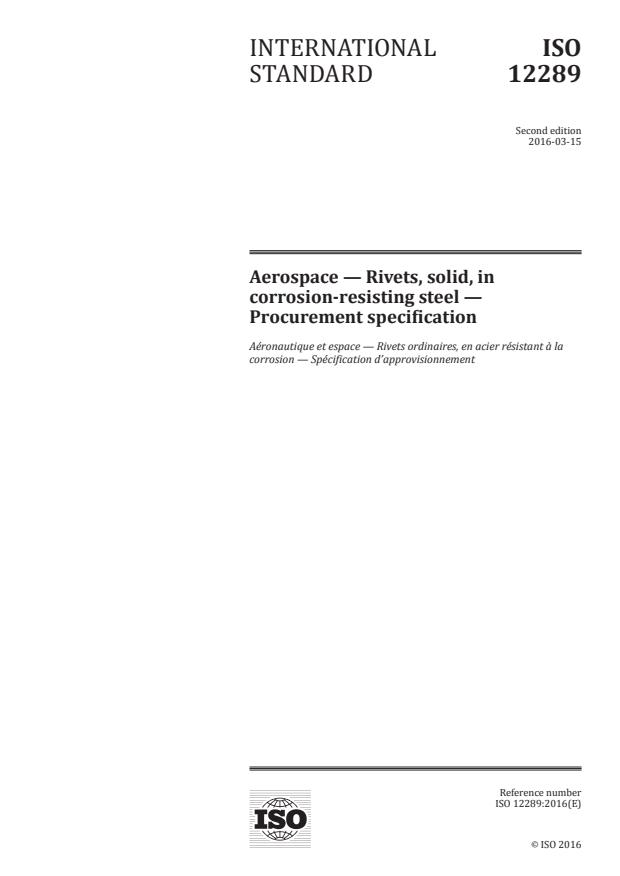
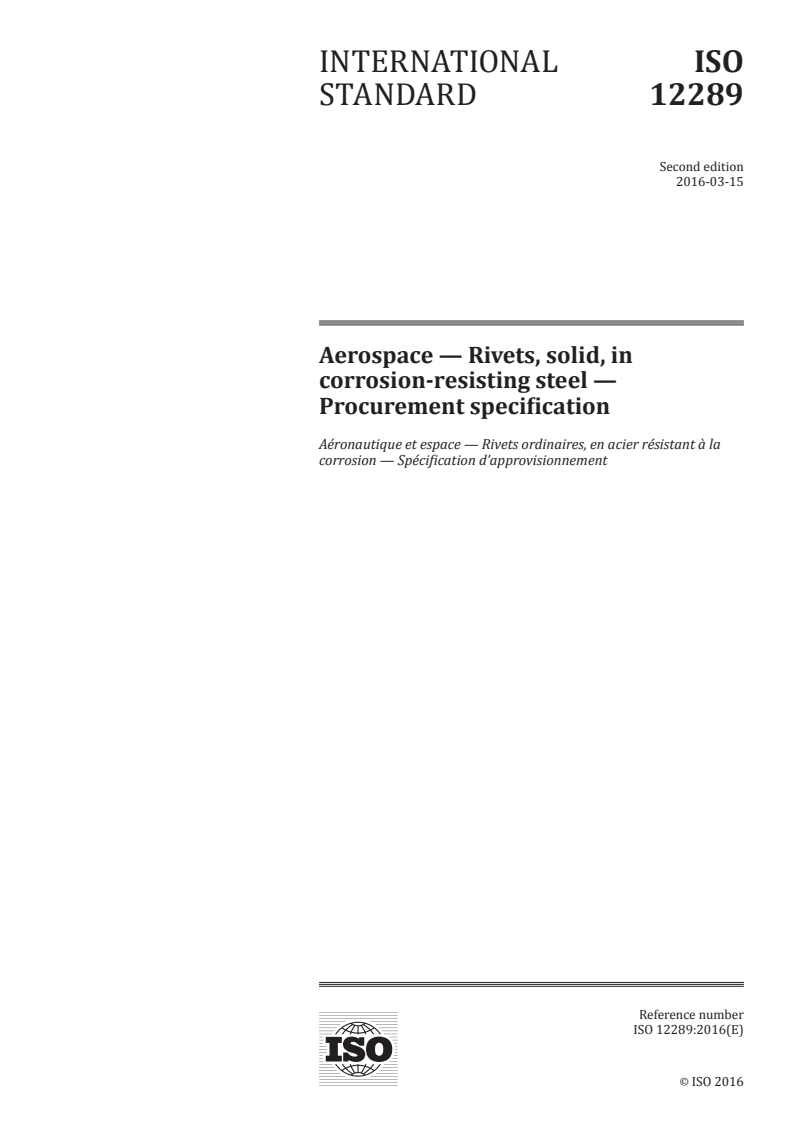
INTERNATIONAL ISO
STANDARD 12289
Second edition
2016-03-15
Aerospace — Rivets, solid, in
corrosion-resisting steel —
Procurement specification
Aéronautique et espace — Rivets ordinaires, en acier résistant à la
corrosion — Spécification d’approvisionnement
Reference number
©
ISO 2016
© ISO 2016, Published in Switzerland
All rights reserved. Unless otherwise specified, no part of this publication may be reproduced or utilized otherwise in any form
or by any means, electronic or mechanical, including photocopying, or posting on the internet or an intranet, without prior
written permission. Permission can be requested from either ISO at the address below or ISO’s member body in the country of
the requester.
ISO copyright office
Ch. de Blandonnet 8 • CP 401
CH-1214 Vernier, Geneva, Switzerland
Tel. +41 22 749 01 11
Fax +41 22 749 09 47
copyright@iso.org
www.iso.org
ii © ISO 2016 – All rights reserved
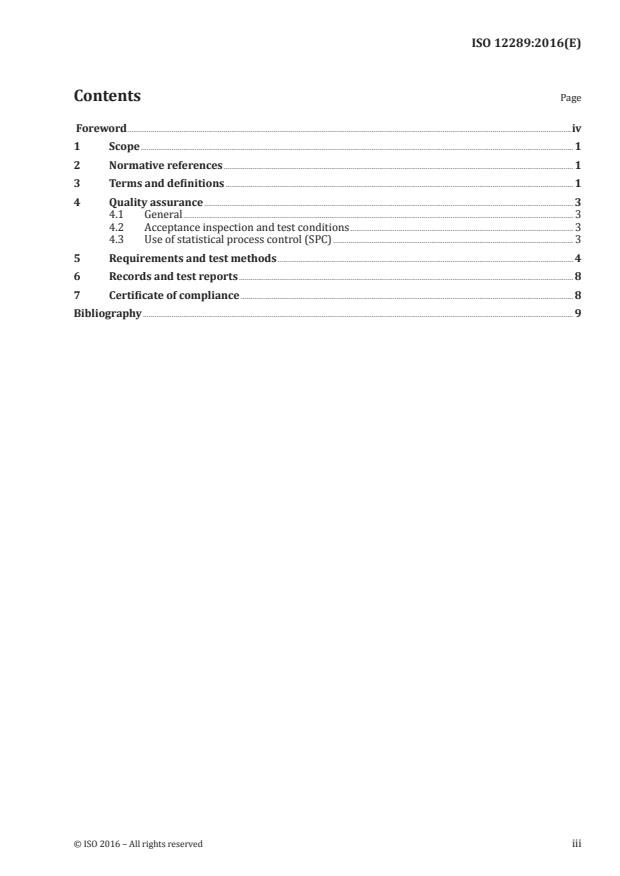
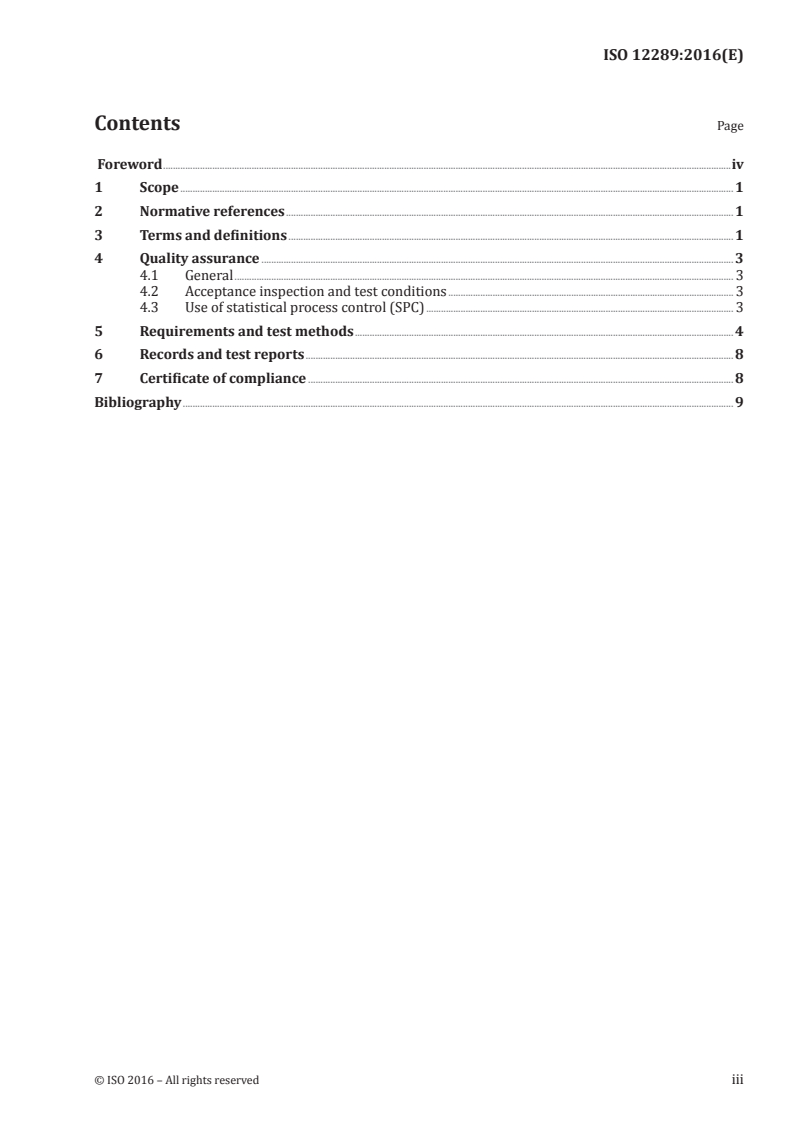
Contents Page
Foreword .iv
1 Scope . 1
2 Normative references . 1
3 Terms and definitions . 1
4 Quality assurance . 3
4.1 General . 3
4.2 Acceptance inspection and test conditions . 3
4.3 Use of statistical process control (SPC) . 3
5 Requirements and test methods . 4
6 Records and test reports . 8
7 Certificate of compliance . 8
Bibliography . 9
Foreword
ISO (the International Organization for Standardization) is a worldwide federation of national standards
bodies (ISO member bodies). The work of preparing International Standards is normally carried out
through ISO technical committees. Each member body interested in a subject for which a technical
committee has been established has the right to be represented on that committee. International
organizations, governmental and non-governmental, in liaison with ISO, also take part in the work.
ISO collaborates closely with the International Electrotechnical Commission (IEC) on all matters of
electrotechnical standardization.
The procedures used to develop this document and those intended for its further maintenance are
described in the ISO/IEC Directives, Part 1. In particular the different approval criteria needed for the
different types of ISO documents should be noted. This document was drafted in accordance with the
editorial rules of the ISO/IEC Directives, Part 2 (see www.iso.org/directives).
Attention is drawn to the possibility that some of the elements of this document may be the subject of
patent rights. ISO shall not be held responsible for identifying any or all such patent rights. Details of
any patent rights identified during the development of the document will be in the Introduction and/or
on the ISO list of patent declarations received (see www.iso.org/patents).
Any trade name used in this document is information given for the convenience of users and does not
constitute an endorsement.
For an explanation on the meaning of ISO specific terms and expressions related to conformity
assessment, as well as information about ISO’s adherence to the WTO principles in the Technical
Barriers to Trade (TBT) see the following URL: Foreword - Supplementary information.
The committee responsible for this document is ISO/TC 20, Aircraft and space vehicles, Subcommittee
SC 4, Aerospace fastener systems.
This second edition cancels and replaces the first edition (ISO 12289:2003), of which it constitutes a
minor revision.
iv © ISO 2016 – All rights reserved
INTERNATIONAL STANDARD ISO 12289:2016(E)
Aerospace — Rivets, solid, in corrosion-resisting steel —
Procurement specification
1 Scope
This International Standard specifies the characteristics and quality assurance requirements for solid
rivets made in corrosion-resisting steel for aerospace construction.
It is applicable whenever it is referenced in a definition document.
2 Normative references
The following documents, in whole or in part, are normatively referenced in this document and are
indispensable for its application. For dated references, only the edition cited applies. For undated
references, the latest edition of the referenced document (including any amendments) applies.
ISO 2859–1, Sampling procedures for inspection by attributes — Part 1: Sampling schemes indexed by
acceptance quality limit (AQL) for lot-by-lot inspection
ISO 7870–1, Control charts — Part 1: General guidelines
ISO 7870–2, Control charts — Part 2: Shewhart control charts
ISO 7870–3, Control charts — Part 3: Acceptance control charts
ISO 17057, Aerospace — Rivets, solid — Test method
1)
ASTM E112 , Standard test methods for determining average grain size
3 Terms and definitions
For the purposes of this document, the following terms and definitions apply.
3.1
batch
quantity of finished products, manufactured using the same processes, from a single material cast
(single heat of alloy) having the same definition document (3.4) number, diameter and length code, heat
treated together to the same specified condition and produced as one continuous run
3.2
rivet wire sample
length of wire, sampled at one end of the coil used for the manufacture of rivets of the batch (3.1)
Note 1 to entry: The rivet wire samples should undergo the same heat treatments as the rivets of the batch, at the
same time.
3.3
rivet sample
rivet sampled at random from the batch (3.1)
1) Published by the American Society for Testing and Materials (ASTM), 1916, Race street, Philadelphia, PA 19103,
USA.
3.4
definition document
document specifying directly or indirectly all the requirements for products
Note 1 to entry: The definition document may be an International Standard, an in-house standard or a drawing.
3.5
crack
rupture in the material, which can extend in any direction and which can be intercrystalline or
transcrystalline in character
3.6
seam
longitudinal open surface defect
3.7
lap
surface defect caused by folding over metal fins or sharp corners and then forming them into the surface
3.8
cold shut
doubling over of metal which can occur during the cold heading operation
3.9
blistering
defect in the metal on or near the surface, resulting from expansion of gas in a sub-surface zone
3.10
pit
small, sharp cavity in a metal surface caused by non-uniform electrodeposition or by corrosion
3.11
critical defect
defect that, according to judgement and experience, is likely to result in hazardous or unsafe conditions
for individuals using, maintaining, or depending upon the considered product, or that is likely to
prevent performance of the function of a major end item
3.12
major defect
defect, other than critical, that is likely to result in a failure or to reduce materially the usability of the
considered product for its intended purpose
3.13
minor defect
defect that is not likely to reduce materially the usability of the considered product for its intended
purpose, or that is a departure from established specifications having little bearing on the effective use
or operation of this product
3.14
sampling plan
plan according to which one or more samples are taken in order to obtain information and to reach a
decision, if possible
3.15
acceptable quality limit
AQL
maximum percent defective (or the maximum number of defects per hundred units) that, for purposes
of sampling inspection, can be considered satisfactory as a process average
Note 1 to entry: Variant: quality level, which in a sampling plan (3.14), corresponds to a specified but relatively
high probability of aссeptance.
2 © ISO 2016 – All rights reserved
4 Quality assurance
4.1 General
The manufacturer shall be capable of continuous production of solid rivets complying with the quality
requirements specified in this International Standard. It is recommended that the manufacturer be
certifie
...
INTERNATIONAL ISO
STANDARD 12289
Second edition
2016-03-15
Aerospace — Rivets, solid, in
corrosion-resisting steel —
Procurement specification
Aéronautique et espace — Rivets ordinaires, en acier résistant à la
corrosion — Spécification d’approvisionnement
Reference number
©
ISO 2016
© ISO 2016, Published in Switzerland
All rights reserved. Unless otherwise specified, no part of this publication may be reproduced or utilized otherwise in any form
or by any means, electronic or mechanical, including photocopying, or posting on the internet or an intranet, without prior
written permission. Permission can be requested from either ISO at the address below or ISO’s member body in the country of
the requester.
ISO copyright office
Ch. de Blandonnet 8 • CP 401
CH-1214 Vernier, Geneva, Switzerland
Tel. +41 22 749 01 11
Fax +41 22 749 09 47
copyright@iso.org
www.iso.org
ii © ISO 2016 – All rights reserved
Contents Page
Foreword .iv
1 Scope . 1
2 Normative references . 1
3 Terms and definitions . 1
4 Quality assurance . 3
4.1 General . 3
4.2 Acceptance inspection and test conditions . 3
4.3 Use of statistical process control (SPC) . 3
5 Requirements and test methods . 4
6 Records and test reports . 8
7 Certificate of compliance . 8
Bibliography . 9
Foreword
ISO (the International Organization for Standardization) is a worldwide federation of national standards
bodies (ISO member bodies). The work of preparing International Standards is normally carried out
through ISO technical committees. Each member body interested in a subject for which a technical
committee has been established has the right to be represented on that committee. International
organizations, governmental and non-governmental, in liaison with ISO, also take part in the work.
ISO collaborates closely with the International Electrotechnical Commission (IEC) on all matters of
electrotechnical standardization.
The procedures used to develop this document and those intended for its further maintenance are
described in the ISO/IEC Directives, Part 1. In particular the different approval criteria needed for the
different types of ISO documents should be noted. This document was drafted in accordance with the
editorial rules of the ISO/IEC Directives, Part 2 (see www.iso.org/directives).
Attention is drawn to the possibility that some of the elements of this document may be the subject of
patent rights. ISO shall not be held responsible for identifying any or all such patent rights. Details of
any patent rights identified during the development of the document will be in the Introduction and/or
on the ISO list of patent declarations received (see www.iso.org/patents).
Any trade name used in this document is information given for the convenience of users and does not
constitute an endorsement.
For an explanation on the meaning of ISO specific terms and expressions related to conformity
assessment, as well as information about ISO’s adherence to the WTO principles in the Technical
Barriers to Trade (TBT) see the following URL: Foreword - Supplementary information.
The committee responsible for this document is ISO/TC 20, Aircraft and space vehicles, Subcommittee
SC 4, Aerospace fastener systems.
This second edition cancels and replaces the first edition (ISO 12289:2003), of which it constitutes a
minor revision.
iv © ISO 2016 – All rights reserved
INTERNATIONAL STANDARD ISO 12289:2016(E)
Aerospace — Rivets, solid, in corrosion-resisting steel —
Procurement specification
1 Scope
This International Standard specifies the characteristics and quality assurance requirements for solid
rivets made in corrosion-resisting steel for aerospace construction.
It is applicable whenever it is referenced in a definition document.
2 Normative references
The following documents, in whole or in part, are normatively referenced in this document and are
indispensable for its application. For dated references, only the edition cited applies. For undated
references, the latest edition of the referenced document (including any amendments) applies.
ISO 2859–1, Sampling procedures for inspection by attributes — Part 1: Sampling schemes indexed by
acceptance quality limit (AQL) for lot-by-lot inspection
ISO 7870–1, Control charts — Part 1: General guidelines
ISO 7870–2, Control charts — Part 2: Shewhart control charts
ISO 7870–3, Control charts — Part 3: Acceptance control charts
ISO 17057, Aerospace — Rivets, solid — Test method
1)
ASTM E112 , Standard test methods for determining average grain size
3 Terms and definitions
For the purposes of this document, the following terms and definitions apply.
3.1
batch
quantity of finished products, manufactured using the same processes, from a single material cast
(single heat of alloy) having the same definition document (3.4) number, diameter and length code, heat
treated together to the same specified condition and produced as one continuous run
3.2
rivet wire sample
length of wire, sampled at one end of the coil used for the manufacture of rivets of the batch (3.1)
Note 1 to entry: The rivet wire samples should undergo the same heat treatments as the rivets of the batch, at the
same time.
3.3
rivet sample
rivet sampled at random from the batch (3.1)
1) Published by the American Society for Testing and Materials (ASTM), 1916, Race street, Philadelphia, PA 19103,
USA.
3.4
definition document
document specifying directly or indirectly all the requirements for products
Note 1 to entry: The definition document may be an International Standard, an in-house standard or a drawing.
3.5
crack
rupture in the material, which can extend in any direction and which can be intercrystalline or
transcrystalline in character
3.6
seam
longitudinal open surface defect
3.7
lap
surface defect caused by folding over metal fins or sharp corners and then forming them into the surface
3.8
cold shut
doubling over of metal which can occur during the cold heading operation
3.9
blistering
defect in the metal on or near the surface, resulting from expansion of gas in a sub-surface zone
3.10
pit
small, sharp cavity in a metal surface caused by non-uniform electrodeposition or by corrosion
3.11
critical defect
defect that, according to judgement and experience, is likely to result in hazardous or unsafe conditions
for individuals using, maintaining, or depending upon the considered product, or that is likely to
prevent performance of the function of a major end item
3.12
major defect
defect, other than critical, that is likely to result in a failure or to reduce materially the usability of the
considered product for its intended purpose
3.13
minor defect
defect that is not likely to reduce materially the usability of the considered product for its intended
purpose, or that is a departure from established specifications having little bearing on the effective use
or operation of this product
3.14
sampling plan
plan according to which one or more samples are taken in order to obtain information and to reach a
decision, if possible
3.15
acceptable quality limit
AQL
maximum percent defective (or the maximum number of defects per hundred units) that, for purposes
of sampling inspection, can be considered satisfactory as a process average
Note 1 to entry: Variant: quality level, which in a sampling plan (3.14), corresponds to a specified but relatively
high probability of aссeptance.
2 © ISO 2016 – All rights reserved
4 Quality assurance
4.1 General
The manufacturer shall be capable of continuous production of solid rivets complying with the quality
requirements specified in this International Standard. It is recommended that the manufacturer be
certifie
...