

ISO 3230:1998
(Main)Aerospace — Rivets, solid, 100 degrees normal countersunk head with dome, metallic material, with or without surface treatment — Dimensions
General Information
- Abstract
- Status
- Published
- Publication Date
- 11-Mar-1998
- Technical Committee
- ISO/TC 20/SC 4 - Aerospace fastener systems
- Drafting Committee
- ISO/TC 20/SC 4 - Aerospace fastener systems
- Current Stage
- 9060 - Close of review
- Completion Date
- 04-Mar-2030
Buy Documents
ISO 3230:1998 - Aerospace -- Rivets, solid, 100 degrees normal countersunk head with dome, metallic material, with or without surface treatment -- Dimensions
ISO 3230:1998 - Aerospace — Rivets, solid, 100 degrees normal countersunk head with dome, metallic material, with or without surface treatment — Dimensions/12/1998
ISO 3230:1998 - Aéronautique et espace -- Rivets ordinaires, a tete fraisée 100 degrés normale avec dôme, en matériau métallique, avec ou sans traitement de surface -- Dimensions
ISO 3230:1998 - Aéronautique et espace — Rivets ordinaires, à tête fraisée 100 degrés normale avec dôme, en matériau métallique, avec ou sans traitement de surface — Dimensions/12/1998
Overview
ISO 3230:1998 is an international standard specifying the dimensions of solid rivets used in aerospace applications. These rivets feature a 100-degree normal countersunk head with a dome, made from metallic materials and available with or without surface treatment. The standard provides detailed measurements and tolerances essential for ensuring uniformity, reliability, and compatibility in aerospace fastener components.
Developed by ISO Technical Committee ISO/TC 20, Subcommittee SC 4 (Aerospace fastener systems), ISO 3230 supports the aerospace industry's needs for consistent and high-quality rivet specifications. It applies to a range of metallic rivets used in aircraft manufacturing, offering precise data to engineers and manufacturers for design, production, and quality assurance.
Key Topics
- Rivet Type and Head Style: Solid rivets with a 100° normal countersunk head featuring a dome shape.
- Materials: Metallic materials suitable for aerospace, available with or without surface treatment.
- Dimensional Specifications: Detailed dimensions including diameter, length, head dimensions, and tail end shape.
- Tolerances: Defined limits and fits according to ISO 286-2, ensuring dimensional accuracy post-manufacture and after surface treatment.
- Tail End Configurations: Includes options for non-radiused (Form A) and radiused (Form B) tail ends, tailored to different aerospace fastening requirements.
- Length Ranges: Specific length tables for rivets in aluminium and aluminium alloys, as well as nickel alloys, corrosion-resistant steels, titanium, and titanium alloys.
- Surface Treatment Considerations: Dimensions apply after any approved surface treatment process, supporting corrosion resistance and durability.
Applications
ISO 3230:1998 rivets are critical components in the aerospace industry, used predominantly in:
- Aircraft Manufacturing: Securing aircraft skin panels, frames, and structural assemblies where countersunk rivets are necessary to maintain aerodynamic surfaces.
- Space Vehicles: Fastening components of spacecraft and satellites requiring reliable joints with minimal profile protrusions.
- Aerospace Maintenance and Repair: Providing standardized replacement rivets compatible with existing aerospace designs.
- Quality Control and Procurement: Supplying manufacturers and suppliers with exact dimensional criteria to ensure interchangeability and compliance with aerospace product standards.
By adhering to ISO 3230, aerospace engineers and manufacturers can achieve:
- Enhanced structural integrity of aerospace assemblies.
- Consistent rivet fit and finish for aerodynamic performance.
- Compliance with international aerospace fastener requirements.
Related Standards
To complement ISO 3230:1998, the following standards are integral for aerospace fasteners and dimensional control:
- ISO 286-2 - System of limits and fits; provides tables of standard tolerance grades and limit deviations essential for holes and shafts related to rivet applications.
- Other aerospace fastener standards developed by ISO/TC 20/SC 4, covering various rivet types, bolts, nuts, and locking mechanisms.
- Material standards governing aluminium alloys, titanium alloys, nickel alloys, and corrosion-resistant steels used in aerospace fasteners.
Adherence to this suite of standards ensures that aerospace components meet strict international requirements for safety, performance, and interchangeability.
Keywords: aerospace rivets, solid rivets, countersunk head rivets, rivet dimensions, aerospace fasteners, metallic rivets, surface treatment, dimensional tolerances, ISO 3230, aircraft industry fasteners, aerospace manufacturing standards
Buy Documents
ISO 3230:1998 - Aerospace -- Rivets, solid, 100 degrees normal countersunk head with dome, metallic material, with or without surface treatment -- Dimensions
ISO 3230:1998 - Aerospace — Rivets, solid, 100 degrees normal countersunk head with dome, metallic material, with or without surface treatment — Dimensions/12/1998
ISO 3230:1998 - Aéronautique et espace -- Rivets ordinaires, a tete fraisée 100 degrés normale avec dôme, en matériau métallique, avec ou sans traitement de surface -- Dimensions
ISO 3230:1998 - Aéronautique et espace — Rivets ordinaires, à tête fraisée 100 degrés normale avec dôme, en matériau métallique, avec ou sans traitement de surface — Dimensions/12/1998
Get Certified
Connect with accredited certification bodies for this standard

BUREAU VERITAS Certification Germany
Bureau Veritas certification in Germany.

Element Materials Technology
Materials testing and product certification.

AQMS Ltd.
AQMS provides ISO certification to SMEs across the UK.
Sponsored listings
Frequently Asked Questions
ISO 3230:1998 is a standard published by the International Organization for Standardization (ISO). Its full title is "Aerospace — Rivets, solid, 100 degrees normal countersunk head with dome, metallic material, with or without surface treatment — Dimensions". This standard covers: Aerospace — Rivets, solid, 100 degrees normal countersunk head with dome, metallic material, with or without surface treatment — Dimensions
Aerospace — Rivets, solid, 100 degrees normal countersunk head with dome, metallic material, with or without surface treatment — Dimensions
ISO 3230:1998 is classified under the following ICS (International Classification for Standards) categories: 49.030.60 - Rivets. The ICS classification helps identify the subject area and facilitates finding related standards.
ISO 3230:1998 is available in PDF format for immediate download after purchase. The document can be added to your cart and obtained through the secure checkout process. Digital delivery ensures instant access to the complete standard document.
Standards Content (Sample)
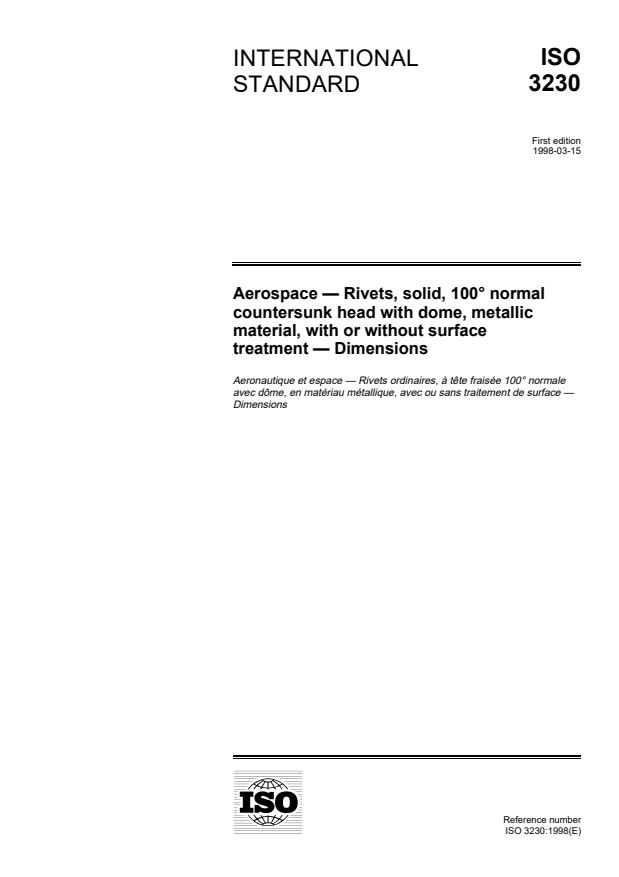
INTERNATIONAL ISO
STANDARD 3230
First edition
1998-03-15
Aerospace — Rivets, solid, 100° normal
countersunk head with dome, metallic
material, with or without surface
treatment — Dimensions
Aeronautique et espace — Rivets ordinaires, à tête fraisée 100° normale
avec dôme, en matériau métallique, avec ou sans traitement de surface —
Dimensions
A
Reference number
Foreword
ISO (the International Organization for Standardization) is a worldwide
federation of national standards bodies (ISO member bodies). The work of
preparing International Standards is normally carried out through ISO
technical committees. Each member body interested in a subject for which
a technical committee has been established has the right to be represented
on that committee. International organizations, governmental and non-
governmental, in liaison with ISO, also take part in the work. ISO
collaborates closely with the International Electrotechnical Commission
(IEC) on all matters of electrotechnical standardization.
Draft International Standards adopted by the technical committees are
circulated to the member bodies for voting. Publication as an International
Standard requires approval by at least 75 % of the member bodies casting
a vote.
International Standard ISO 3230 was prepared by Technical Committee
ISO/TC 20, Aircraft and space vehicles, Subcommittee SC 4, Aerospace
fastener systems.
© ISO 1998
All rights reserved. Unless otherwise specified, no part of this publication may be reproduced
or utilized in any form or by any means, electronic or mechanical, including photocopying and
microfilm, without permission in writing from the publisher.
International Organization for Standardization
Case postale 56 • CH-1211 Genève 20 • Switzerland
Internet central@iso.ch
X.400 c=ch; a=400net; p=iso; o=isocs; s=central
Printed in Switzerland
ii
©
INTERNATIONAL STANDARD ISO ISO 3230:1998(E)
Aerospace — Rivets, solid, 100°normal countersunk with dome,
metallic material, with or without surface treatment — Dimensions
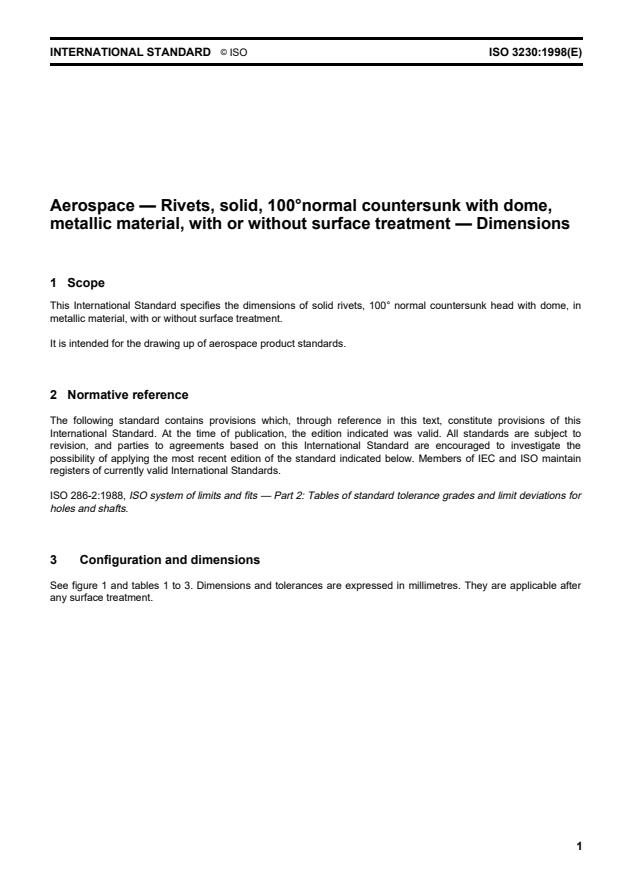
1 Scope
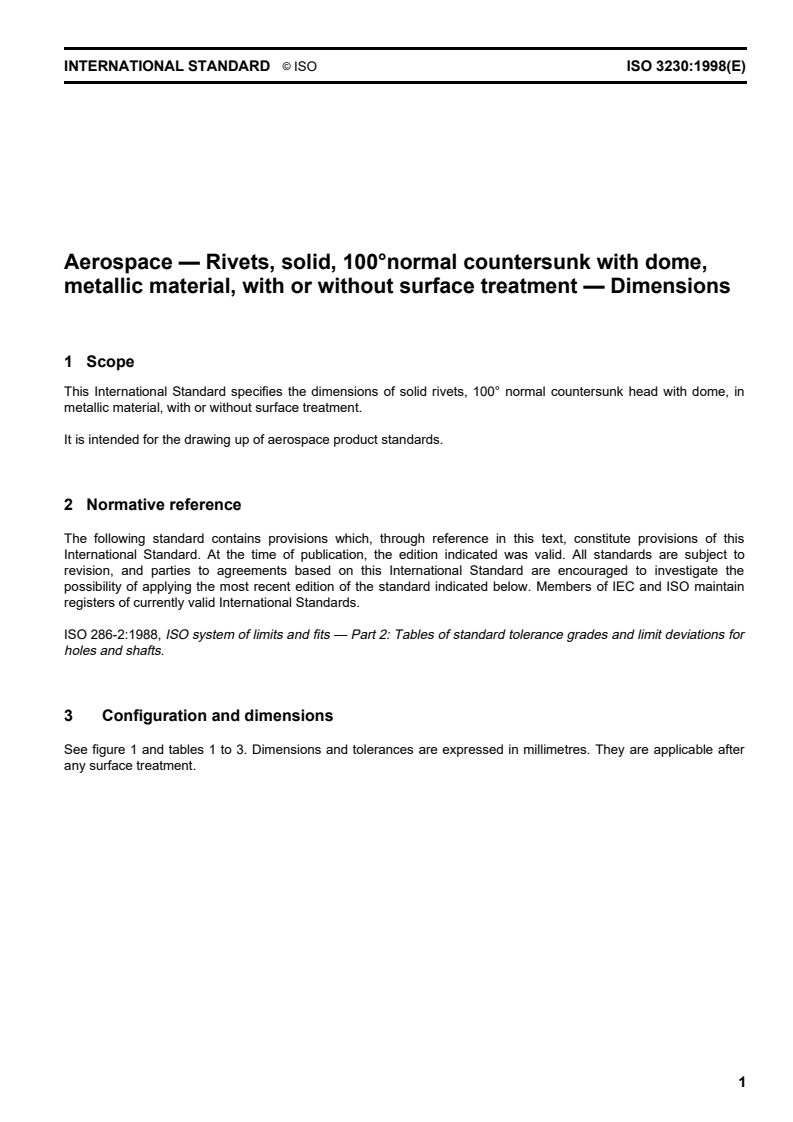
This International Standard specifies the dimensions of solid rivets, 100° normal countersunk head with dome, in
metallic material, with or without surface treatment.
It is intended for the drawing up of aerospace product standards.
2 Normative reference
The following standard contains provisions which, through reference in this text, constitute provisions of this
International Standard. At the time of publication, the edition indicated was valid. All standards are subject to
revision, and parties to agreements based on this International Standard are encouraged to investigate the
possibility of applying the most recent edition of the standard indicated below. Members of IEC and ISO maintain
registers of currently valid International Standards.
ISO 286-2:1988, ISO system of limits and fits — Part 2: Tables of standard tolerance grades and limit deviations for
holes and shafts.
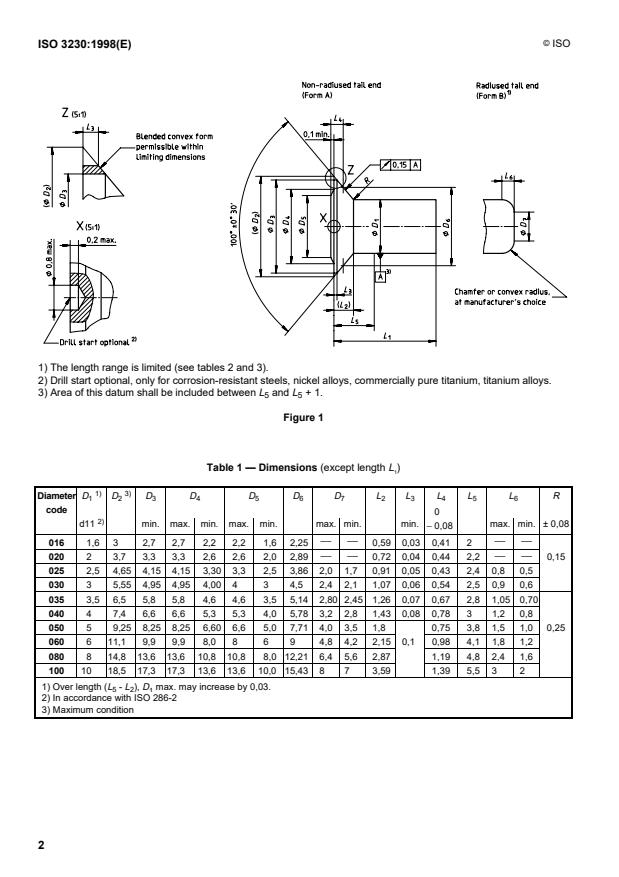
3 Configuration and dimensions
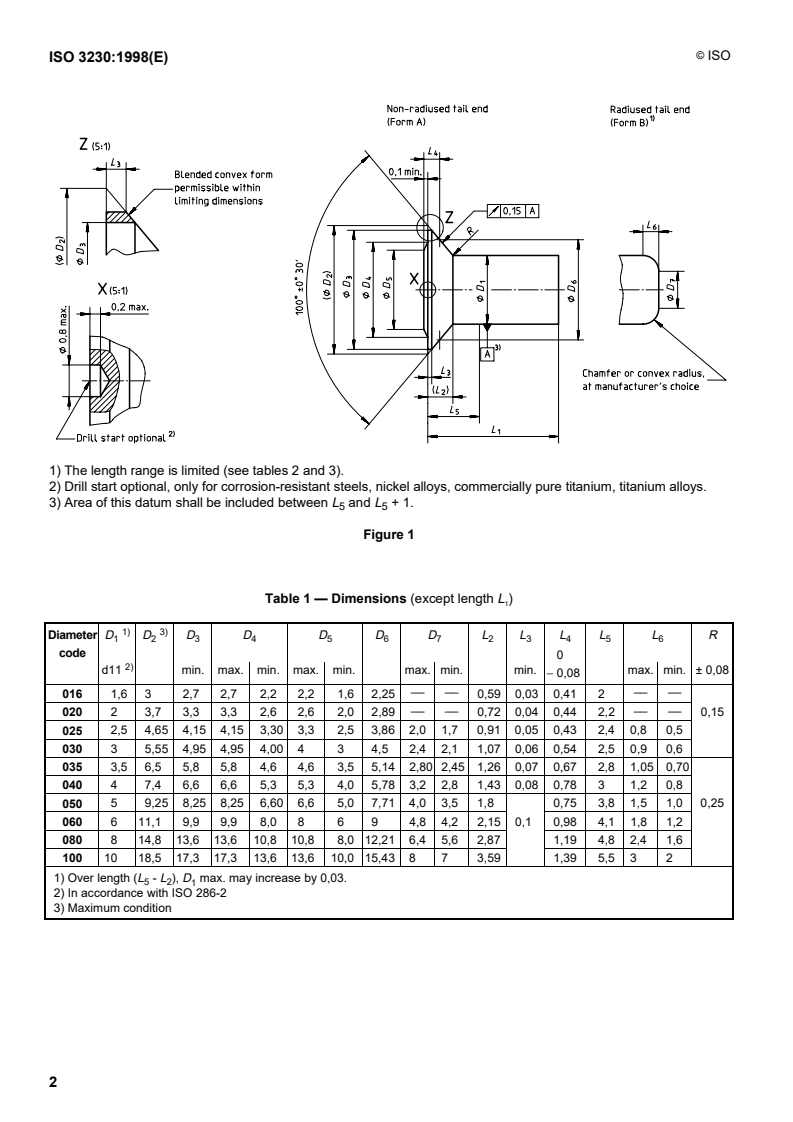
See figure 1 and tables 1 to 3. Dimensions and tolerances are expressed in millimetres. They are applicable after
any surface treatment.
©
ISO
1) The length range is limited (see tables 2 and 3).
2) Drill start optional, only for corrosion-resistant steels, nickel alloys, co
...
INTERNATIONAL ISO
STANDARD 3230
First edition
1998-03-15
Aerospace — Rivets, solid, 100° normal
countersunk head with dome, metallic
material, with or without surface
treatment — Dimensions
Aeronautique et espace — Rivets ordinaires, à tête fraisée 100° normale
avec dôme, en matériau métallique, avec ou sans traitement de surface —
Dimensions
A
Reference number
Foreword
ISO (the International Organization for Standardization) is a worldwide
federation of national standards bodies (ISO member bodies). The work of
preparing International Standards is normally carried out through ISO
technical committees. Each member body interested in a subject for which
a technical committee has been established has the right to be represented
on that committee. International organizations, governmental and non-
governmental, in liaison with ISO, also take part in the work. ISO
collaborates closely with the International Electrotechnical Commission
(IEC) on all matters of electrotechnical standardization.
Draft International Standards adopted by the technical committees are
circulated to the member bodies for voting. Publication as an International
Standard requires approval by at least 75 % of the member bodies casting
a vote.
International Standard ISO 3230 was prepared by Technical Committee
ISO/TC 20, Aircraft and space vehicles, Subcommittee SC 4, Aerospace
fastener systems.
© ISO 1998
All rights reserved. Unless otherwise specified, no part of this publication may be reproduced
or utilized in any form or by any means, electronic or mechanical, including photocopying and
microfilm, without permission in writing from the publisher.
International Organization for Standardization
Case postale 56 • CH-1211 Genève 20 • Switzerland
Internet central@iso.ch
X.400 c=ch; a=400net; p=iso; o=isocs; s=central
Printed in Switzerland
ii
©
INTERNATIONAL STANDARD ISO ISO 3230:1998(E)
Aerospace — Rivets, solid, 100°normal countersunk with dome,
metallic material, with or without surface treatment — Dimensions
1 Scope
This International Standard specifies the dimensions of solid rivets, 100° normal countersunk head with dome, in
metallic material, with or without surface treatment.
It is intended for the drawing up of aerospace product standards.
2 Normative reference
The following standard contains provisions which, through reference in this text, constitute provisions of this
International Standard. At the time of publication, the edition indicated was valid. All standards are subject to
revision, and parties to agreements based on this International Standard are encouraged to investigate the
possibility of applying the most recent edition of the standard indicated below. Members of IEC and ISO maintain
registers of currently valid International Standards.
ISO 286-2:1988, ISO system of limits and fits — Part 2: Tables of standard tolerance grades and limit deviations for
holes and shafts.
3 Configuration and dimensions
See figure 1 and tables 1 to 3. Dimensions and tolerances are expressed in millimetres. They are applicable after
any surface treatment.
©
ISO
1) The length range is limited (see tables 2 and 3).
2) Drill start optional, only for corrosion-resistant steels, nickel alloys, co
...
NORME ISO
INTERNATIONALE 3230
Première édition
1998-03-15
Aéronautique et espace — Rivets ordinaires,
à tête fraisée 100° normale avec dôme, en
matériau métallique, avec ou sans
traitement de surface — Dimensions
Aerospace — Rivets, solid, 100° normal countersunk head with dome,
metallic material, with or without surface treatment — Dimensions
A
Numéro de référence
Avant-propos
L'ISO (Organisation internationale de normalisation) est une fédération
mondiale d'organismes nationaux de normalisation (comités membres de
l'ISO). L'élaboration des Normes internationales est en général confiée aux
comités techniques de l'ISO. Chaque comité membre intéressé par une
étude a le droit de faire partie du comité technique créé à cet effet. Les
organisations internationales, gouvernementales et non gouvernementales,
en liaison avec l'ISO participent également aux travaux. L'ISO collabore
étroitement avec la Commission électrotechnique internationale (CEI) en
ce qui concerne la normalisation électrotechnique.
Les projets de Normes internationales adoptés par les comités techniques
sont soumis aux comités membres pour vote. Leur publication comme
Normes internationales requiert l'approbation de 75 % au moins des
comités membres votants.
La Norme internationale ISO 3230 a été élaborée par le comité technique
ISO/TC 20, Aéronautique et espace, sous-comité SC 4, Éléments de
fixation pour constructions aérospatiales.
© ISO 1998
Droits de reproduction réservés. Sauf prescription différente, aucune partie de cette publi-
cation ne peut être reproduite ni utilisée sous quelque forme que ce soit et par aucun pro-
cédé, électronique ou mécanique, y compris la photocopie et les microfilms, sans l'accord
écrit de l'éditeur.
Organisation internationale de normalisation
Case postale 56 • CH-1211 Genève 20 • Suisse
Internet central@iso.ch
X.400 c=ch; a=400net; p=iso; o=isocs; s=central
Imprimé en Suisse
ii
©
NORME INTERNATIONALE ISO ISO 3230:1998(F)
Aéronautique et espace — Rivets ordinaires, à tête fraisée 100°
normale avec dôme, en matériau métallique, avec ou sans
traitement de surface — Dimensions
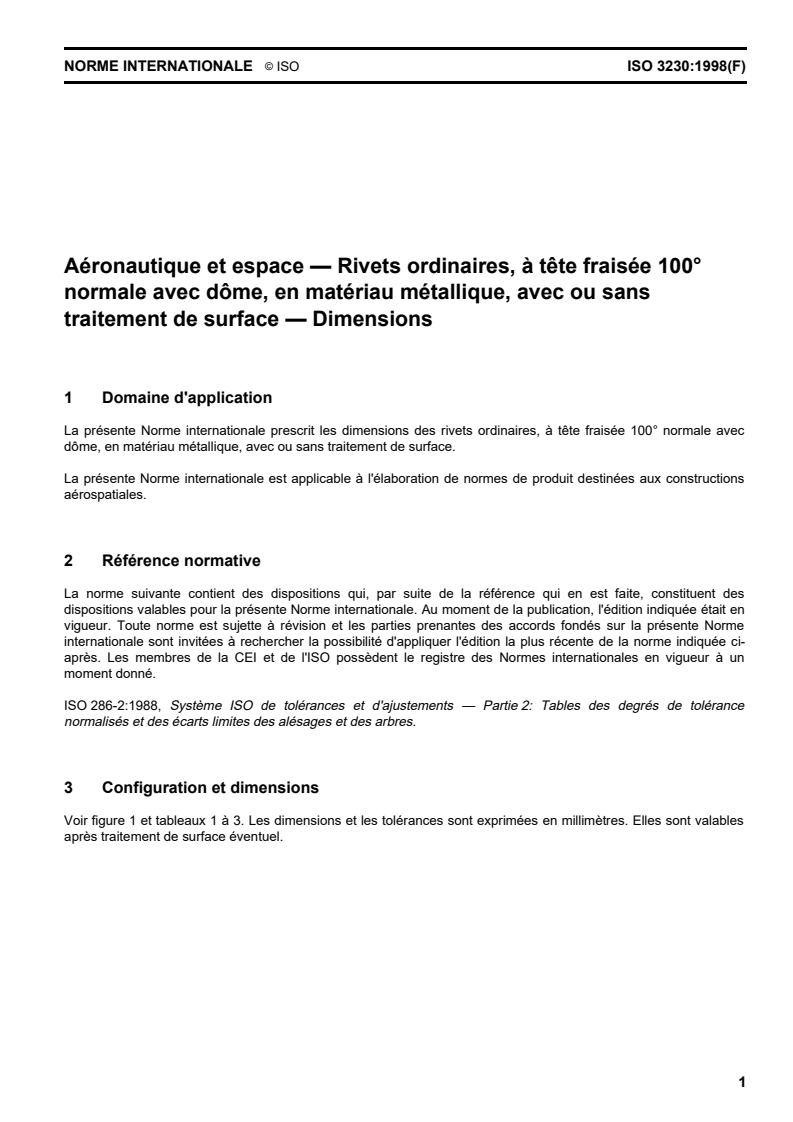
1 Domaine d'application
La présente Norme internationale prescrit les dimensions des rivets ordinaires, à tête fraisée 100° normale avec
dôme, en matériau métallique, avec ou sans traitement de surface.
La présente Norme internationale est applicable à l'élaboration de normes de produit destinées aux constructions
aérospatiales.
2 Référence normative
La norme suivante contient des dispositions qui, par suite de la référence qui en est faite, constituent des
dispositions valables pour la présente Norme internationale. Au moment de la publication, l'édition indiquée était en
vigueur. Toute norme est sujette à révision et les parties prenantes des accords fondés sur la présente Norme
internationale sont invitées à rechercher la possibilité d'appliquer l'édition la plus récente de la norme indiquée ci-
après. Les membres de la CEI et de l'ISO possèdent le registre des Normes internationales en vigueur à un
moment donné.
ISO 286-2:1988,
Système ISO de tolérances et d'ajustements — Partie 2: Tables des degrés de tolérance
normalisés et des écarts limites des alésages et des arbres.
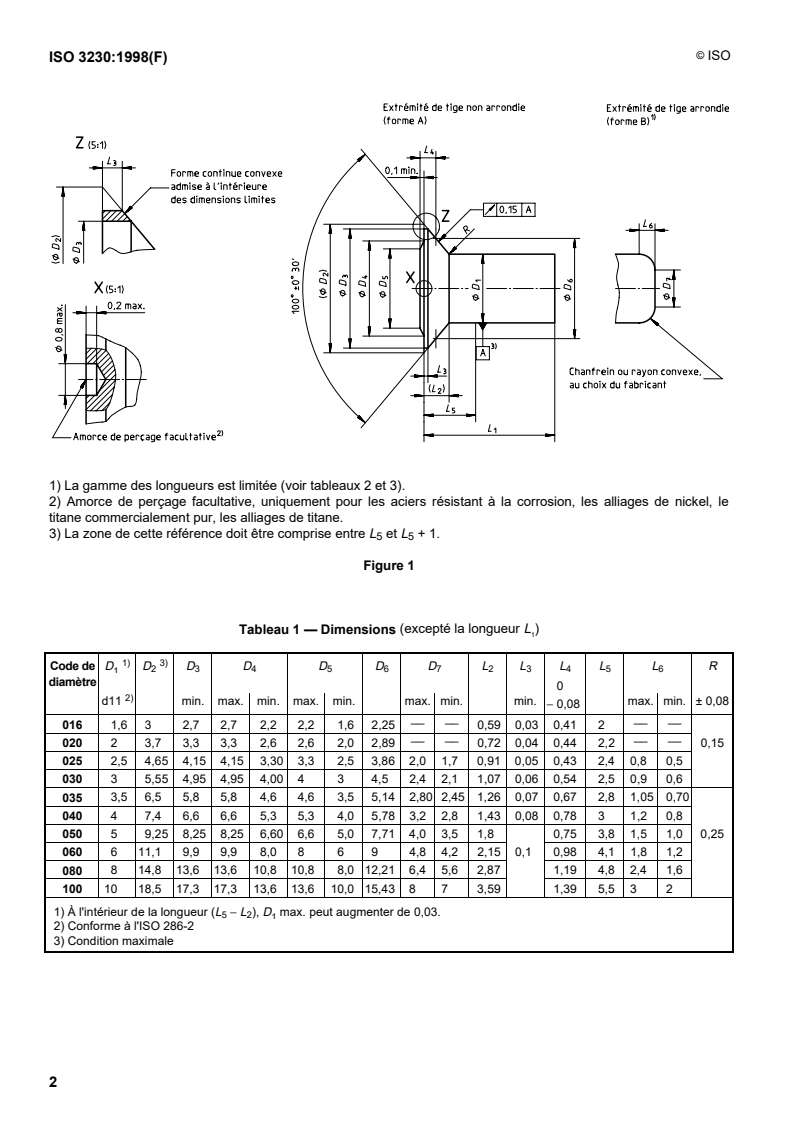
3 Configuration et dimensions
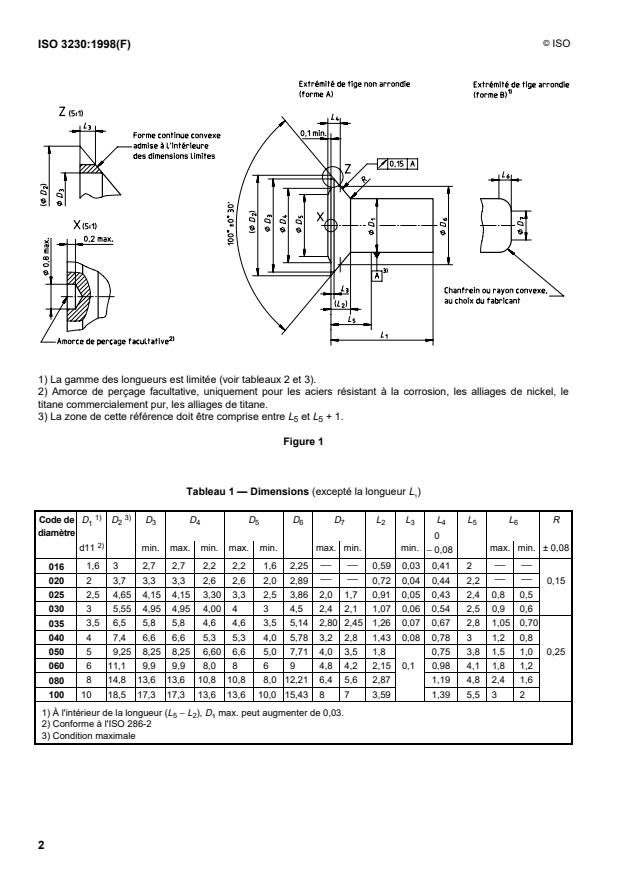
Voir figure 1 et tableaux 1 à 3. Les dimensions et les tolérances sont exprimées en millimètres. Elles sont valables
après traitement de surface éventuel.
©
ISO
1) La gamme des longueurs est limitée (voir tableaux 2 et 3).
2) Amorce de perça
...
NORME ISO
INTERNATIONALE 3230
Première édition
1998-03-15
Aéronautique et espace — Rivets ordinaires,
à tête fraisée 100° normale avec dôme, en
matériau métallique, avec ou sans
traitement de surface — Dimensions
Aerospace — Rivets, solid, 100° normal countersunk head with dome,
metallic material, with or without surface treatment — Dimensions
A
Numéro de référence
Avant-propos
L'ISO (Organisation internationale de normalisation) est une fédération
mondiale d'organismes nationaux de normalisation (comités membres de
l'ISO). L'élaboration des Normes internationales est en général confiée aux
comités techniques de l'ISO. Chaque comité membre intéressé par une
étude a le droit de faire partie du comité technique créé à cet effet. Les
organisations internationales, gouvernementales et non gouvernementales,
en liaison avec l'ISO participent également aux travaux. L'ISO collabore
étroitement avec la Commission électrotechnique internationale (CEI) en
ce qui concerne la normalisation électrotechnique.
Les projets de Normes internationales adoptés par les comités techniques
sont soumis aux comités membres pour vote. Leur publication comme
Normes internationales requiert l'approbation de 75 % au moins des
comités membres votants.
La Norme internationale ISO 3230 a été élaborée par le comité technique
ISO/TC 20, Aéronautique et espace, sous-comité SC 4, Éléments de
fixation pour constructions aérospatiales.
© ISO 1998
Droits de reproduction réservés. Sauf prescription différente, aucune partie de cette publi-
cation ne peut être reproduite ni utilisée sous quelque forme que ce soit et par aucun pro-
cédé, électronique ou mécanique, y compris la photocopie et les microfilms, sans l'accord
écrit de l'éditeur.
Organisation internationale de normalisation
Case postale 56 • CH-1211 Genève 20 • Suisse
Internet central@iso.ch
X.400 c=ch; a=400net; p=iso; o=isocs; s=central
Imprimé en Suisse
ii
©
NORME INTERNATIONALE ISO ISO 3230:1998(F)
Aéronautique et espace — Rivets ordinaires, à tête fraisée 100°
normale avec dôme, en matériau métallique, avec ou sans
traitement de surface — Dimensions
1 Domaine d'application
La présente Norme internationale prescrit les dimensions des rivets ordinaires, à tête fraisée 100° normale avec
dôme, en matériau métallique, avec ou sans traitement de surface.
La présente Norme internationale est applicable à l'élaboration de normes de produit destinées aux constructions
aérospatiales.
2 Référence normative
La norme suivante contient des dispositions qui, par suite de la référence qui en est faite, constituent des
dispositions valables pour la présente Norme internationale. Au moment de la publication, l'édition indiquée était en
vigueur. Toute norme est sujette à révision et les parties prenantes des accords fondés sur la présente Norme
internationale sont invitées à rechercher la possibilité d'appliquer l'édition la plus récente de la norme indiquée ci-
après. Les membres de la CEI et de l'ISO possèdent le registre des Normes internationales en vigueur à un
moment donné.
ISO 286-2:1988,
Système ISO de tolérances et d'ajustements — Partie 2: Tables des degrés de tolérance
normalisés et des écarts limites des alésages et des arbres.
3 Configuration et dimensions
Voir figure 1 et tableaux 1 à 3. Les dimensions et les tolérances sont exprimées en millimètres. Elles sont valables
après traitement de surface éventuel.
©
ISO
1) La gamme des longueurs est limitée (voir tableaux 2 et 3).
2) Amorce de perça
...