

ISO/TR 12198:1998
(Main)Aerospace — Rivets, solid — Materials
General Information
- Abstract
This Technical Report gives, for each material family and for each minimum shear stress, the material(s) to be used for the manufacture of solid rivets. These materials ensure interchangeability of the products concerned. This Technical Report applies when referenced in the relevant standard.
- Status
- Published
- Publication Date
- 04-Nov-1998
- Technical Committee
- ISO/TC 20/SC 4 - Aerospace fastener systems
- Drafting Committee
- ISO/TC 20/SC 4 - Aerospace fastener systems
- Current Stage
- 9093 - International Standard confirmed
- Start Date
- 07-Dec-2016
- Completion Date
- 29-Aug-2026

Overview
ISO/TR 12198:1998 is a Technical Report from ISO/TC 20 (Aircraft and space vehicles) that specifies materials for solid (full) rivets used in aerospace applications. As a type‑3 Technical Report, it compiles “state of the art” data rather than establishing a new normative standard. ISO/TR 12198:1998 lists, for each material family and for each minimum shear stress, the acceptable material designations to be used in manufacturing solid rivets to ensure product interchangeability when this Technical Report is referenced by the relevant standard.
Key topics and requirements
- Material families covered: aluminium alloys, corrosion‑resisting steels, nickel‑base alloys and titanium alloys.
- Minimum shear stress: tables associate each material (by designation) with a minimum shear stress (in MPa) required for rivet manufacture.
- Material designation cross‑references: the Report gives multiple designations and control documents (for example EN, AMS, QQ‑A, national designations) so manufacturers and procurers can match equivalent materials across regions.
- Interchangeability focus: the selected materials are intended to produce rivets that are interchangeable between suppliers and airframe designs when referenced by the applicable standard.
- Examples included: common aerospace materials such as 2017A and 7050 aluminium alloys, AISI 304L‑type stainless (Fe18Cr12Ni), Monel (Ni‑Cu), Inconel/Nimonic family items, and titanium alloys (designations shown in the Report).
- Application condition: ISO/TR 12198 applies only when it is explicitly referenced in the relevant standard or specification.
Practical applications
Who uses ISO/TR 12198 and why:
- Fastener manufacturers use the material lists to select approved alloy grades for solid rivets and to meet minimum shear performance.
- Aerospace OEMs and suppliers reference these material options in procurement specifications to ensure interchangeability and compliance across suppliers.
- Structural and materials engineers consult the tables to confirm acceptable rivet materials for design shear loads.
- Quality assurance and inspection teams use the Report to verify material traceability and conformity to accepted designations and control documents.
- Maintenance and repair organizations rely on the cross‑referenced designations for correct replacement rivets.
Practical benefits include streamlined procurement, consistent mechanical performance (shear strength), and reduced risk from mismatched or non‑equivalent rivet materials.
Related standards
- ISO/TR 12198 cross‑references national and industry control documents (EN, AMS, QQ‑A, national standards).
- It is produced by ISO/TC 20/SC 4 (Aerospace fastener systems) and is intended for use where cited by relevant normative standards or specifications for aerospace rivets.
Keywords: ISO/TR 12198:1998, aerospace rivets, solid rivet materials, rivet material specifications, rivet shear stress, aerospace fasteners, interchangeability.
Get Certified
Connect with accredited certification bodies for this standard

BUREAU VERITAS Certification Germany
Bureau Veritas certification in Germany.

Element Materials Technology
Materials testing and product certification.

AQMS Ltd.
AQMS provides ISO certification to SMEs across the UK.
Sponsored listings
Frequently Asked Questions
ISO/TR 12198:1998 is a technical report published by the International Organization for Standardization (ISO). Its full title is "Aerospace — Rivets, solid — Materials". This standard covers: This Technical Report gives, for each material family and for each minimum shear stress, the material(s) to be used for the manufacture of solid rivets. These materials ensure interchangeability of the products concerned. This Technical Report applies when referenced in the relevant standard.
This Technical Report gives, for each material family and for each minimum shear stress, the material(s) to be used for the manufacture of solid rivets. These materials ensure interchangeability of the products concerned. This Technical Report applies when referenced in the relevant standard.
ISO/TR 12198:1998 is classified under the following ICS (International Classification for Standards) categories: 49.030.60 - Rivets. The ICS classification helps identify the subject area and facilitates finding related standards.
ISO/TR 12198:1998 is available in PDF format for immediate download after purchase. The document can be added to your cart and obtained through the secure checkout process. Digital delivery ensures instant access to the complete standard document.
Standards Content (Sample)
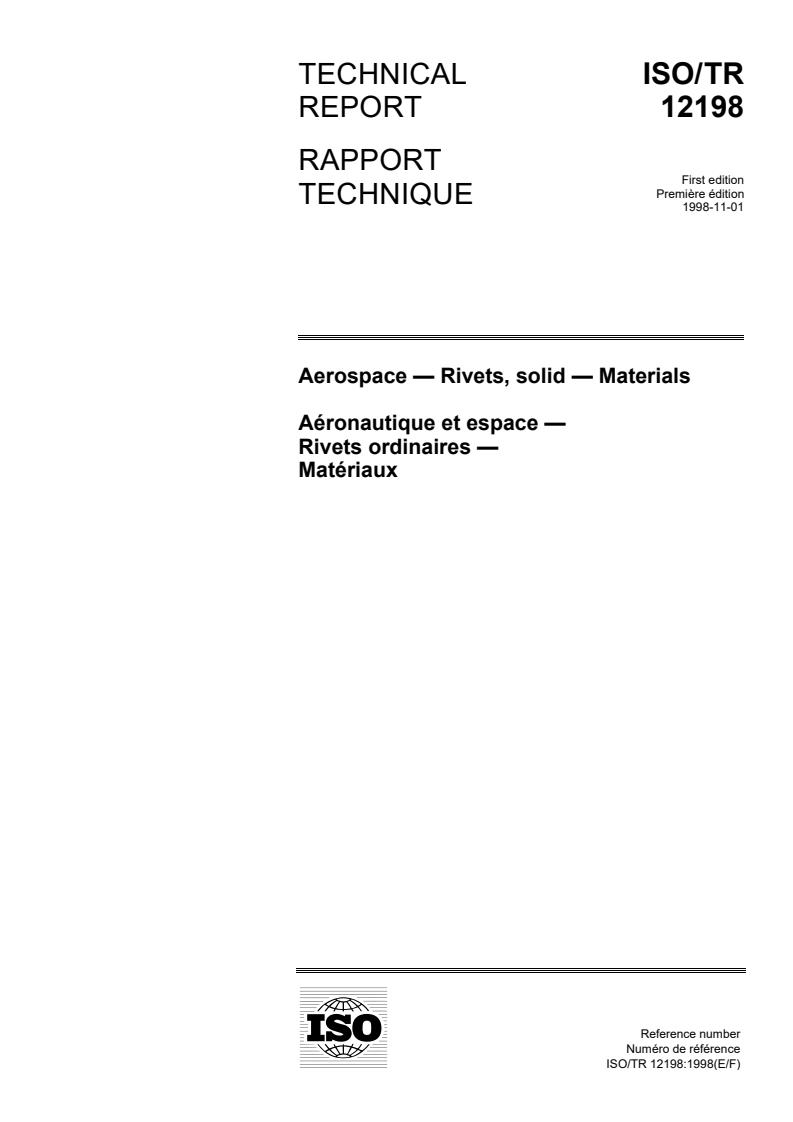
TECHNICAL ISO/TR
REPORT 12198
RAPPORT
First edition
Première édition
TECHNIQUE
1998-11-01
Aerospace — Rivets, solid — Materials
Aéronautique et espace —
Rivets ordinaires —
Matériaux
Reference number
A
Numéro de référence
Foreword
ISO (the International Organization for Standardization) is a worldwide
federation of national standards bodies (ISO member bodies). The work of
preparing International Standards is normally carried out through ISO
technical committees. Each member body interested in a subject for which
a technical committee has been established has the right to be represented
on that committee. International organizations, governmental and non-
governmental, in liaison with ISO, also take part in the work. ISO
collaborates closely with the International Electrotechnical Commission
(IEC) on all matters of electrotechnical standardization.
The main task of technical committees is to prepare International
Standards, but in exceptional circumstances a technical committee may
propose the publication of a Technical Report of one of the following types:
— type 1, when the required support cannot be obtained for the
publication of an International Standard, despite repeated efforts;
— type 2, when the subject is still under technical development or where
for any other reason there is the future but not immediate possibility of
an agreement on an International Standard;
— type 3, when a technical committee has collected data of a different
kind from that which is normally published as an International Standard
(“state of the art”, for example).
Technical Reports of types 1 and 2 are subject to review within three years
of publication, to decide whether they can be transformed into International
Standards. Technical Reports of type 3 do not necessarily have to be
reviewed until data they provide are considered to be no longer valid or
useful.
ISO/TR 12198, which is a Technical Report of type 3, was prepared by
Technical Committee ISO/TC 20, Aircraft and space vehicles,
Subcommittee SC 4, Aerospace fastener systems.
© ISO 1998
All rights reserved. Unless otherwise specified, no part of this publication may be reproduced
or utilized in any form or by any means, electronic or mechanical, including photocopying and
microfilm, without permission in writing from the publisher. / Droits de reproduction réservés.
Sauf prescription différente, aucune partie de cette publication ne peut être reproduite ni
utilisée sous quelque forme que ce soit et par aucun procédé, électronique ou mécanique, y
compris la photocopie et les microfilms, sans l'accord écrit de l'éditeur.
International Organization for Standardization
Case postale 56 • CH-1211 Genève 20 • Switzerland
Internet iso@iso.ch
Printed in Switzerland/Imprimé en Suisse
ii
©
ISO ISO/TR 12198:1998(E/F)
Avant-propos
L'ISO (Organisation internationale de normalisation) est une fédération
mondiale d'organismes nationaux de normalisation (comités membres de
l'ISO). L'élaboration des Normes internationales est en général confiée aux
comités techniques de l'ISO. Chaque comité membre intéressé par une
étude a le droit de faire partie du comité technique créé à cet effet. Les
organisations internationales, gouvernementales et non gouvernementales,
en liaison avec l'ISO, participent également aux travaux. L'ISO collabore
étroitement avec la Commission électrotechnique internationale (CEI) en
ce qui concerne la normalisation électrotechnique.
La tâche principale des comités techniques est d'élaborer les Normes
internationales. Exceptionnellement, un comité technique peut proposer la
publication d'un rapport technique de l'un des types suivants:
— type 1, lorsque, en dépit de maints efforts, l'accord requis ne peut être
réalisé en faveur de la publication d'une Norme internationale;
— type 2, lorsque le sujet en question est encore en cours de
développement technique ou lorsque, pour toute autre raison, la
possibilité d'un accord pour la publication d'une Norme internationale
peut être envisagée pour l'avenir mais pas dans l'immédiat;
— type 3, lorsqu'un comité technique a réuni des données de nature
différente de celles qui sont normalement publiées comme Normes
internationales (ceci pouvant comprendre des informations sur l'état
de la technique, par exemple).
Les rapports techniques des types 1 et 2 font l'objet d'un nouvel examen
trois ans au plus tard après leur publication afin de décider éventuellement
de leur transformation en Normes internationales. Les rapports techniques
de type 3 ne doivent pas nécessairement être révisés avant que les
données fournies ne soient plus jugées valables ou utiles.
L'ISO/TR 12198, rapport technique du type 3, a été élaboré par le comité
sous-comité SC 4,
technique ISO/TC 20, Aéronautique et espace,
Éléments de fixation pour constructions aérospatiales.
iii
TECHNICAL REPORT
©
ISO ISO/TR 12198:1998(E/F)
RAPPORT TECHNIQUE
Aerospace — Rivets, solid — Aéronautique et espace —
Materials Rivets ordinaires —
Matériaux
1 Scope 1
...