

ISO 17057:1999
(Main)Aerospace — Rivets, solid — Test method
General Information
- Abstract
This International Standard specifies the test method for solid rivets. It describes the test device and the method. It applies to rivets intended for use in aerospace construction in conjunction with the relevant procurement specification, provided that the specification refers to this International Standard.
- Status
- Published
- Publication Date
- 15-Dec-1999
- Technical Committee
- ISO/TC 20/SC 4 - Aerospace fastener systems
- Drafting Committee
- ISO/TC 20/SC 4 - Aerospace fastener systems
- Current Stage
- 9093 - International Standard confirmed
- Start Date
- 19-Oct-2021
- Completion Date
- 29-Aug-2026
Buy Documents
ISO 17057:1999 - Aerospace — Rivets, solid — Test method Released:12/16/1999
ISO 17057:1999 - Aéronautique et espace — Rivets ordinaires — Méthode de contôle et d'essai Released:12/16/1999
Overview
ISO 17057:1999 - Aerospace - Rivets, solid - Test method specifies a standardized test method for solid rivets used in aerospace construction. The International Standard defines the required test device, fixture characteristics, and test procedure for determining rivet shear performance when used in conjunction with the relevant procurement specification that references this standard.
Keywords: ISO 17057, solid rivets, aerospace rivets, test method, rivet shear test, rivet inspection
Key topics and technical requirements
- Scope: Applies to solid rivets intended for aerospace construction where the procurement specification refers to ISO 17057.
- Test type: Double shear inspection and test using a purpose-designed fixture.
- Testing machine: Machine accuracy must be verified to ISO 7500-1:1999 (class of testing machine range 1,0). The machine shall be calibrated as specified in Annex A.
- Test fixture: Made of steel with a minimum hardness of 530 HV30; dimensions conform to the figure provided in the standard. Machined steel bolts and polished interfaces are required to minimize distortion and wear.
- Procedure:
- Place rivet or riveting wire so full bearing surface contacts the fixture.
- Record the maximum load F at fracture (or stop once required minimum ultimate test load is reached).
- Calculate shear strength from the measured peak load and the actual rivet diameter at the shear zone (the standard provides the formula and defines d as the actual diameter).
- Test speed: ≤ 20 mm/min (0.75 in/min).
- Calibration and traceability: Annex A requires periodic calibration of test apparatus at intervals not exceeding 12 months, performed by a national official body, an organization controlled by such a body, or using standards traceable to a national standards body.
Practical applications
- Quality assurance and acceptance testing of solid rivets used in aircraft and spacecraft structures.
- Verifying rivet shear strength for procurement, incoming inspection, and production control.
- Supporting aerospace fastener qualification and compliance with contract or regulatory requirements.
Who should use this standard
- Aerospace manufacturers and structural assembly shops
- Fastener suppliers and inspectors
- Materials and test laboratories performing mechanical testing on rivets
- Procurement and quality assurance engineers specifying rivet acceptance criteria
Related standards
- ISO 7500-1:1999 - Metallic materials: verification of static uniaxial testing machines (tension/compression) - verification and calibration of force-measuring systems
- Procurement specifications for aerospace rivets that reference ISO 17057
Using ISO 17057 ensures consistent, reproducible rivet shear testing and helps organizations demonstrate compliance with aerospace fastener performance requirements.
Relations
- Consolidated By
ISO 1854:2008 - Whey cheese — Determination of fat content — Gravimetric method (Reference method) - Effective Date
- 06-Jun-2022
Buy Documents
ISO 17057:1999 - Aerospace — Rivets, solid — Test method Released:12/16/1999
ISO 17057:1999 - Aéronautique et espace — Rivets ordinaires — Méthode de contôle et d'essai Released:12/16/1999
Get Certified
Connect with accredited certification bodies for this standard

BUREAU VERITAS Certification Germany
Bureau Veritas certification in Germany.

Element Materials Technology
Materials testing and product certification.

AQMS Ltd.
AQMS provides ISO certification to SMEs across the UK.
Sponsored listings
Frequently Asked Questions
ISO 17057:1999 is a standard published by the International Organization for Standardization (ISO). Its full title is "Aerospace — Rivets, solid — Test method". This standard covers: This International Standard specifies the test method for solid rivets. It describes the test device and the method. It applies to rivets intended for use in aerospace construction in conjunction with the relevant procurement specification, provided that the specification refers to this International Standard.
This International Standard specifies the test method for solid rivets. It describes the test device and the method. It applies to rivets intended for use in aerospace construction in conjunction with the relevant procurement specification, provided that the specification refers to this International Standard.
ISO 17057:1999 is classified under the following ICS (International Classification for Standards) categories: 49.030.60 - Rivets. The ICS classification helps identify the subject area and facilitates finding related standards.
ISO 17057:1999 has the following relationships with other standards: It is inter standard links to ISO 1854:2008. Understanding these relationships helps ensure you are using the most current and applicable version of the standard.
ISO 17057:1999 is available in PDF format for immediate download after purchase. The document can be added to your cart and obtained through the secure checkout process. Digital delivery ensures instant access to the complete standard document.
Standards Content (Sample)
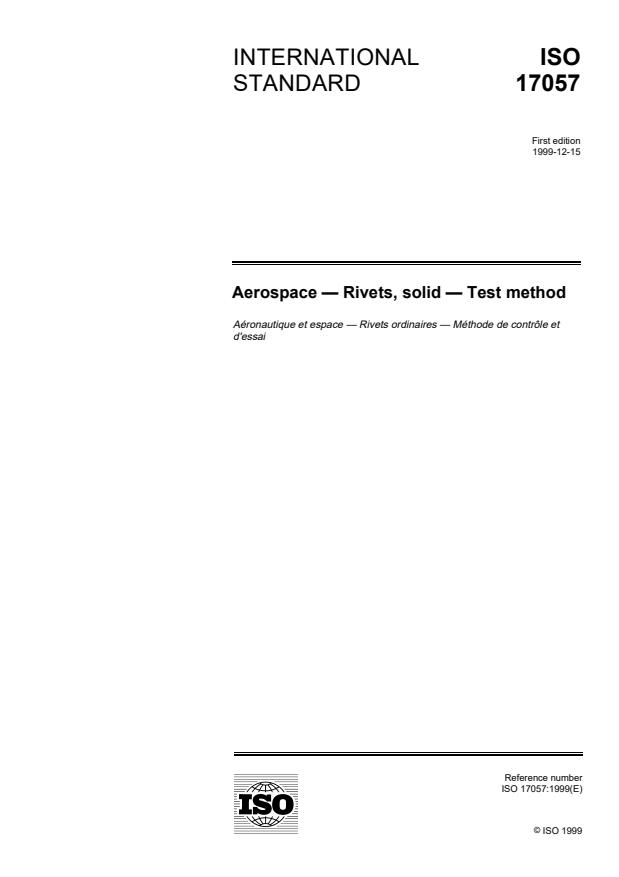
INTERNATIONAL ISO
STANDARD 17057
First edition
1999-12-15
Aerospace — Rivets, solid — Test method
Aéronautique et espace — Rivets ordinaires — Méthode de contrôle et
d'essai
Reference number
©
ISO 1999
PDF disclaimer
This PDF file may contain embedded typefaces. In accordance with Adobe's licensing policy, this file may be printed or viewed but shall not
be edited unless the typefaces which are embedded are licensed to and installed on the computer performing the editing. In downloading this
file, parties accept therein the responsibility of not infringing Adobe's licensing policy. The ISO Central Secretariat accepts no liability in this
area.
Adobe is a trademark of Adobe Systems Incorporated.
Details of the software products used to create this PDF file can be found in the General Info relative to the file; the PDF-creation parameters
were optimized for printing. Every care has been taken to ensure that the file is suitable for use by ISO member bodies. In the unlikely event
that a problem relating to it is found, please inform the Central Secretariat at the address given below.
© ISO 1999
All rights reserved. Unless otherwise specified, no part of this publication may be reproduced or utilized in any form or by any means, electronic
or mechanical, including photocopying and microfilm, without permission in writing from either ISO at the address below or ISO's member body
in the country of the requester.
ISO copyright office
Case postale 56 � CH-1211 Geneva 20
Tel. + 41 22 749 01 11
Fax + 41 22 734 10 79
E-mail copyright@iso.ch
Web www.iso.ch
Printed in Switzerland
ii © ISO 1999 – All rights reserved
Foreword
ISO (the International Organization for Standardization) is a worldwide federation of national standards bodies (ISO
member bodies). The work of preparing International Standards is normally carried out through ISO technical
committees. Each member body interested in a subject for which a technical committee has been established has
the right to be represented on that committee. International organizations, governmental and non-governmental, in
liaison with ISO, also take part in the work. ISO collaborates closely with the International Electrotechnical
Commission (IEC) on all matters of electrotechnical standardization.
International Standards are drafted in accordance with the rules given in the ISO/IEC Directives, Part 3.
Draft International Standards adopted by the technical committees are circulated to the member bodies for voting.
Publication as an International Standard requires approval by at least 75 % of the member bodies casting a vote.
Attention is drawn to the possibility that some of the elements of this International Standard may be the subject of
patent rights. ISO shall not be held responsible for identifying any or all such patent rights.
International Standard ISO 17057 was prepared by Technical Committee ISO/TC 20, Aircraft and space vehicles,
Subcommittee SC 4, Aerospace fastener systems.
Annex A forms a normative part of this International Standard.
© ISO 1999 – All rights reserved iii
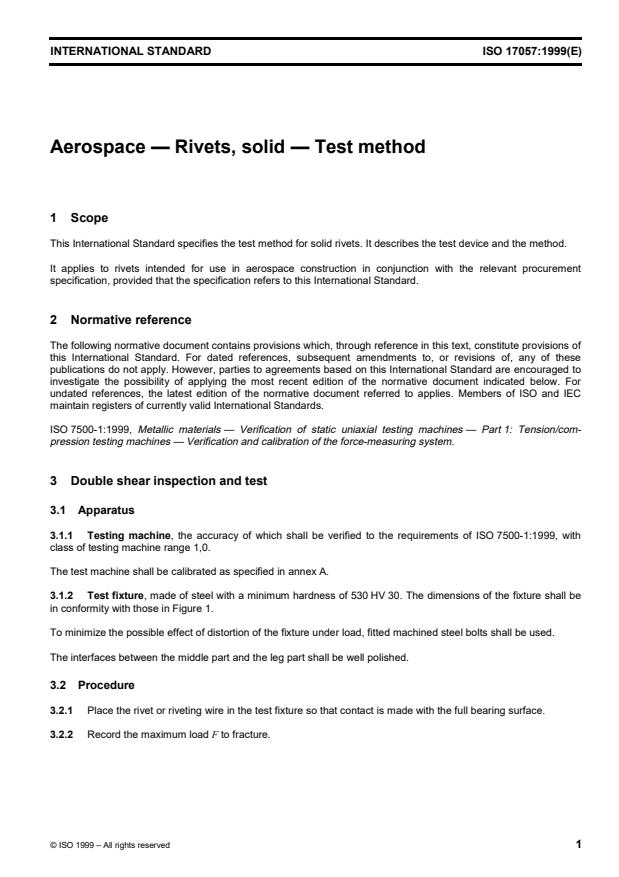
INTERNATIONAL STANDARD ISO 17057:1999(E)
Aerospace — Rivets, solid — Test method
1 Scope
This International Standard specifies the test method for solid rivets. It describes the test device and the method.
It applies to rivets intended for use in aerospace construction in conjunction with the relevant
...
NORME ISO
INTERNATIONALE 17057
Première édition
1999-12-15
Aéronautique et espace — Rivets
ordinaires — Méthode de contrôle
et d'essai
Aerospace — Rivets, solid — Test method
Numéro de référence
©
ISO 1999
PDF – Exonération de responsabilité
Le présent fichier PDF peut contenir des polices de caractères intégrées. Conformément aux conditions de licence d'Adobe, ce fichier peut
être imprimé ou visualisé, mais ne doit pas être modifié à moins que l'ordinateur employé à cet effet ne bénéficie d'une licence autorisant
l'utilisation de ces polices et que celles-ci y soient installées. Lors du téléchargement de ce fichier, les parties concernées acceptent de fait la
responsabilité de ne pas enfreindre les conditions de licence d'Adobe. Le Secrétariat central de l'ISO décline toute responsabilité en la
matière.
Adobe est une marque déposée d'Adobe Systems Incorporated.
Les détails relatifs aux produits logiciels utilisés pour la création du présent fichier PDF sont disponibles dans la rubrique General Info du
fichier; les paramètres de création PDF ont été optimisés pour l'impression. Toutes les mesures ont été prises pour garantir l'exploitation de
ce fichier par les comités membres de l'ISO. Dans le cas peu probable où surviendrait un problème d'utilisation, veuillez en informer le
Secrétariat central à l'adresse donnée ci-dessous.
© ISO 1999
Droits de reproduction réservés. Sauf prescription différente, aucune partie de cette publication ne peut être reproduite ni utilisée sous quelque
forme que ce soit et par aucun procédé, électronique ou mécanique, y compris la photocopie et les microfilms, sans l'accord écrit de l’ISO à
l’adresse ci-après ou du comité membre de l’ISO dans le pays du demandeur.
ISO copyright office
Case postale 56 � CH-1211 Geneva 20
Tel. + 41 22 749 01 11
Fax. + 41 22 734 10 79
E-mail copyright@iso.ch
Web www.iso.ch
ImpriméenSuisse
ii © ISO 1999 – Tous droits réservés
Avant-propos
L'ISO (Organisation internationale de normalisation) est une fédération mondiale d'organismes nationaux de
normalisation (comités membres de l'ISO). L'élaboration des Normes internationales est en général confiée aux
comités techniques de l'ISO. Chaque comité membre intéressé par une étude a le droit de faire partie du comité
technique créé à cet effet. Les organisations internationales, gouvernementales et non gouvernementales, en
liaison avec l'ISO, participent également aux travaux. L'ISO collabore étroitement avec la Commission
électrotechnique internationale (CEI) en ce qui concerne la normalisation électrotechnique.
Les Normes internationales sont rédigées conformément aux règles données dans les Directives ISO/CEI, Partie 3.
Les projets de Normes internationales adoptés par les comités techniques sont soumis aux comités membres pour
vote. Leur publication comme Normes internationales requiert l'approbation de 75 % au moins des comités
membres votants.
L’attention est appelée sur le fait que certains des éléments de la présente Norme internationale peuvent faire
l’objet de droits de propriété intellectuelle ou de droits analogues. L’ISO ne saurait être tenue pour responsable de
ne pas avoir identifié de tels droits de propriété et averti de leur existence.
La Norme internationale ISO 17057 a été élaborée par le comité technique ISO/TC 20, Aéronautique et espace,
sous-comité SC 4, Éléments de fixation pour constructions aérospatiales.
L’annexe A constitue un élément normatif de la présente Norme internationale.
© ISO 1999 – Tous droits réservés iii
NORME INTERNATIONALE ISO 17057:1999(F)
Aéronautique et espace — Rivets ordinaires —
Méthode de contrôle et d'essai
1 Domaine d'application
La présente Norme internationale spécifie la méthode de contrôle et d'essai des rivets ordinaires. El
...