

ISO 4981:2023
(Main)Plastics piping systems for non-pressure underground conveyance and storage of non-potable water — Boxes used for retention, detention, storage and transportation systems — Specifications for storm water boxes made of PE, PP and PVC-U
General Information
- Abstract
This document gives the definitions and specifies the minimum requirements for injection moulded, extruded, compression moulded and thermoformed thermoplastics cuboid shaped boxes, including integral components, used in underground systems for retention, detention, storage and transportation of non-potable water (e.g. storm water) and manufactured from polyethylene (PE), polypropylene (PP) or unplasticized polyvinylchloride (PVC-U). The boxes are intended for buried underground use, e.g. in landscape, pedestrian or vehicular traffic areas. In the case of retention and detention systems, the main purpose of the boxes is to retain water, for later infiltration in the ground or for later use in non-potable applications (irrigation, cleaning, sanitary facilities, etc.) or to retain water during a storm, transferring it in a controlled way to the public storm water network. Applications include commercial, residential, agricultural and highway drainage, including installation under parking lots and roadways. Product performance is determined by a combination of material specification, product design and manufacturing process. A box can either be factory-assembled or site-assembled from different components. The boxes are intended to be used as elements in a modular system where the manufacturer has provided a clearly documented method specifying how the components are assembled to create a complete retention, detention, storage and transportation system. The boxes are installed as one or more horizontal layers on a firm foundation and embedded with fill around and above the complete system. NOTE Non-load bearing component(s) can be manufactured by various methods (e.g. extrusion, injection moulding, rotational moulding, compression moulded, thermoforming and low-pressure injection moulding) and are not within the scope of this document.
- Status
- Published
- Publication Date
- 26-Jun-2023
- Current Stage
- 6060 - International Standard published
- Start Date
- 27-Jun-2023
- Due Date
- 29-Apr-2023
- Completion Date
- 27-Jun-2023
Buy Documents
ISO 4981:2023 - Plastics piping systems for non-pressure underground conveyance and storage of non-potable water — Boxes used for retention, detention, storage and transportation systems — Specifications for storm water boxes made of PE, PP and PVC-U Released:27. 06. 2023
Overview
ISO 4981:2023 specifies requirements for thermoplastic storm water boxes used in non-pressure underground conveyance and storage of non-potable water. The standard covers cuboid-shaped boxes and their integral load-bearing components manufactured from polyethylene (PE), polypropylene (PP) and unplasticized polyvinyl chloride (PVC‑U). It applies to injection‑moulded, extruded, compression‑moulded and thermoformed boxes intended for buried installation in landscape, pedestrian and vehicular areas. ISO 4981:2023 targets systems for retention, detention and storage of storm water-supporting infiltration, attenuation and reuse (irrigation, cleaning, sanitary uses).
Key topics and technical requirements
- Materials: Acceptable thermoplastics (PE, PP, PVC‑U) with guidance on virgin, modified and non‑virgin materials and material characteristics.
- Manufacturing methods: Injection moulding, extrusion, compression moulding and thermoforming for cuboid boxes; non‑load bearing components manufactured by other methods are out of scope.
- Design & performance: Performance is determined by material specification, product design and manufacturing process. The standard defines geometrical, physical and mechanical characteristics (shape, dimensions, volume, porosity, weight, compression strength).
- Assembly & modularity: Boxes can be factory‑assembled or site‑assembled into modular systems. Manufacturers must provide documented assembly methods for complete retention/detention/storage systems.
- Installation principles: Boxes are installed in horizontal layers on a firm foundation and embedded with fill. The standard includes marking and identification requirements for traceability.
- Referenced test methods: The document references established test standards for plastics (tensile, impact, creep, DSC, thermogravimetry) and specific box compression tests (e.g., EN 17150, EN 17151).
Applications
- Underground storm water management for commercial, residential, agricultural and highway drainage
- Installation under parking lots, roadways, green areas and pedestrian zones
- Systems for attenuation (detention), infiltration (retention) and temporary storage of storm water prior to controlled discharge or reuse
- Sustainable urban drainage systems (SUDS), stormwater harvesting for irrigation and on‑site non‑potable reuse
Who should use this standard
- Manufacturers and designers of thermoplastic storm water boxes (PE/PP/PVC‑U)
- Civil and drainage engineers specifying underground retention/detention systems
- Installers, contractors and infrastructure procurement teams
- Regulators, asset owners and water resource planners assessing compliance and performance
Related standards
- EN 17150 / EN 17151 (box compression test methods)
- CEN/TR 17179 (installation guidance)
- ISO plastics test standards cited (e.g., ISO 179‑1, ISO 527 series, ISO 1133)
Keywords: ISO 4981:2023, storm water boxes, PE PP PVC-U, underground retention systems, detention, modular stormwater storage, non‑potable water, thermoplastic boxes.
Buy Documents
ISO 4981:2023 - Plastics piping systems for non-pressure underground conveyance and storage of non-potable water — Boxes used for retention, detention, storage and transportation systems — Specifications for storm water boxes made of PE, PP and PVC-U Released:27. 06. 2023
Get Certified
Connect with accredited certification bodies for this standard

Institut za varilstvo d.o.o. (Welding Institute)
Slovenia's leading welding institute since 1952. ISO 3834, EN 1090, pressure equipment certification, NDT personnel, welder qualification. Only IIW Au
Zavod za gradbeništvo Slovenije (ZAG) - Inšpekcija
ZAG inspection body for construction products, structures, and materials.
Sponsored listings
Frequently Asked Questions
ISO 4981:2023 is a standard published by the International Organization for Standardization (ISO). Its full title is "Plastics piping systems for non-pressure underground conveyance and storage of non-potable water — Boxes used for retention, detention, storage and transportation systems — Specifications for storm water boxes made of PE, PP and PVC-U". This standard covers: This document gives the definitions and specifies the minimum requirements for injection moulded, extruded, compression moulded and thermoformed thermoplastics cuboid shaped boxes, including integral components, used in underground systems for retention, detention, storage and transportation of non-potable water (e.g. storm water) and manufactured from polyethylene (PE), polypropylene (PP) or unplasticized polyvinylchloride (PVC-U). The boxes are intended for buried underground use, e.g. in landscape, pedestrian or vehicular traffic areas. In the case of retention and detention systems, the main purpose of the boxes is to retain water, for later infiltration in the ground or for later use in non-potable applications (irrigation, cleaning, sanitary facilities, etc.) or to retain water during a storm, transferring it in a controlled way to the public storm water network. Applications include commercial, residential, agricultural and highway drainage, including installation under parking lots and roadways. Product performance is determined by a combination of material specification, product design and manufacturing process. A box can either be factory-assembled or site-assembled from different components. The boxes are intended to be used as elements in a modular system where the manufacturer has provided a clearly documented method specifying how the components are assembled to create a complete retention, detention, storage and transportation system. The boxes are installed as one or more horizontal layers on a firm foundation and embedded with fill around and above the complete system. NOTE Non-load bearing component(s) can be manufactured by various methods (e.g. extrusion, injection moulding, rotational moulding, compression moulded, thermoforming and low-pressure injection moulding) and are not within the scope of this document.
This document gives the definitions and specifies the minimum requirements for injection moulded, extruded, compression moulded and thermoformed thermoplastics cuboid shaped boxes, including integral components, used in underground systems for retention, detention, storage and transportation of non-potable water (e.g. storm water) and manufactured from polyethylene (PE), polypropylene (PP) or unplasticized polyvinylchloride (PVC-U). The boxes are intended for buried underground use, e.g. in landscape, pedestrian or vehicular traffic areas. In the case of retention and detention systems, the main purpose of the boxes is to retain water, for later infiltration in the ground or for later use in non-potable applications (irrigation, cleaning, sanitary facilities, etc.) or to retain water during a storm, transferring it in a controlled way to the public storm water network. Applications include commercial, residential, agricultural and highway drainage, including installation under parking lots and roadways. Product performance is determined by a combination of material specification, product design and manufacturing process. A box can either be factory-assembled or site-assembled from different components. The boxes are intended to be used as elements in a modular system where the manufacturer has provided a clearly documented method specifying how the components are assembled to create a complete retention, detention, storage and transportation system. The boxes are installed as one or more horizontal layers on a firm foundation and embedded with fill around and above the complete system. NOTE Non-load bearing component(s) can be manufactured by various methods (e.g. extrusion, injection moulding, rotational moulding, compression moulded, thermoforming and low-pressure injection moulding) and are not within the scope of this document.
ISO 4981:2023 is classified under the following ICS (International Classification for Standards) categories: 23.040.01 - Pipeline components and pipelines in general; 93.025 - External water conveyance systems. The ICS classification helps identify the subject area and facilitates finding related standards.
ISO 4981:2023 is available in PDF format for immediate download after purchase. The document can be added to your cart and obtained through the secure checkout process. Digital delivery ensures instant access to the complete standard document.
Standards Content (Sample)
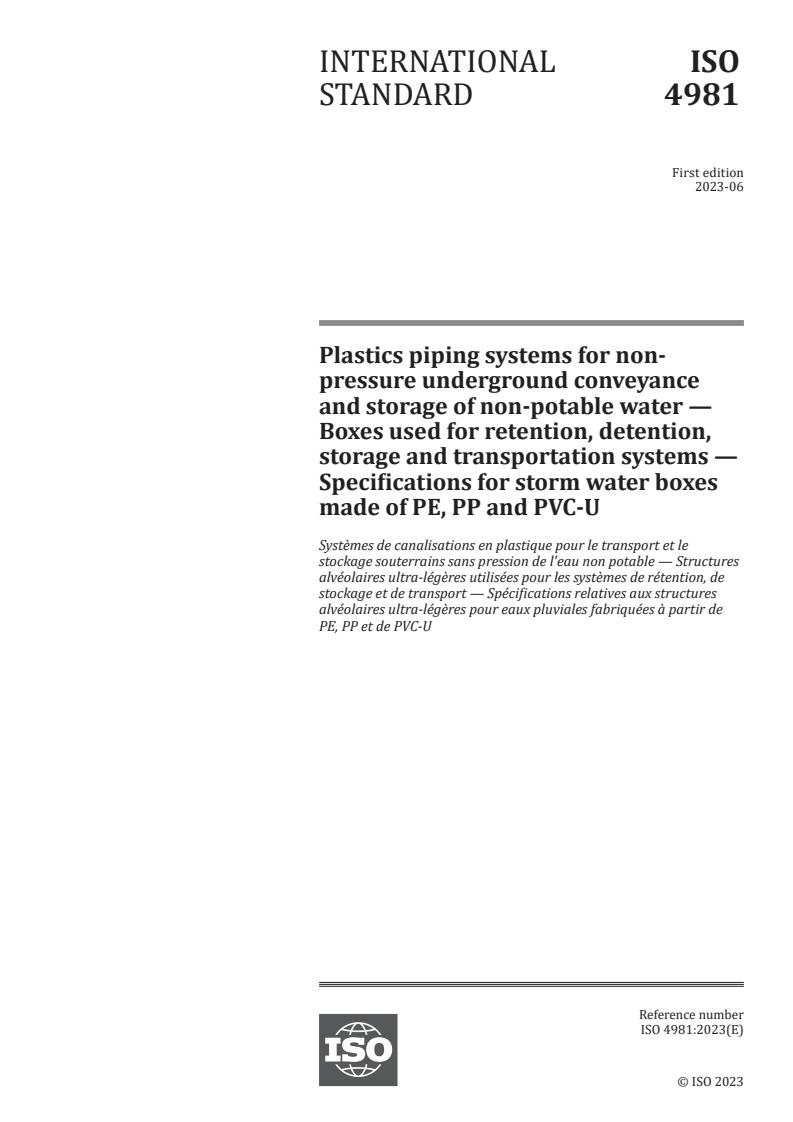
INTERNATIONAL ISO
STANDARD 4981
First edition
2023-06
Plastics piping systems for non-
pressure underground conveyance
and storage of non-potable water —
Boxes used for retention, detention,
storage and transportation systems —
Specifications for storm water boxes
made of PE, PP and PVC-U
Systèmes de canalisations en plastique pour le transport et le
stockage souterrains sans pression de l'eau non potable — Structures
alvéolaires ultra-légères utilisées pour les systèmes de rétention, de
stockage et de transport — Spécifications relatives aux structures
alvéolaires ultra-légères pour eaux pluviales fabriquées à partir de
PE, PP et de PVC-U
Reference number
© ISO 2023
All rights reserved. Unless otherwise specified, or required in the context of its implementation, no part of this publication may
be reproduced or utilized otherwise in any form or by any means, electronic or mechanical, including photocopying, or posting on
the internet or an intranet, without prior written permission. Permission can be requested from either ISO at the address below
or ISO’s member body in the country of the requester.
ISO copyright office
CP 401 • Ch. de Blandonnet 8
CH-1214 Vernier, Geneva
Phone: +41 22 749 01 11
Email: copyright@iso.org
Website: www.iso.org
Published in Switzerland
ii
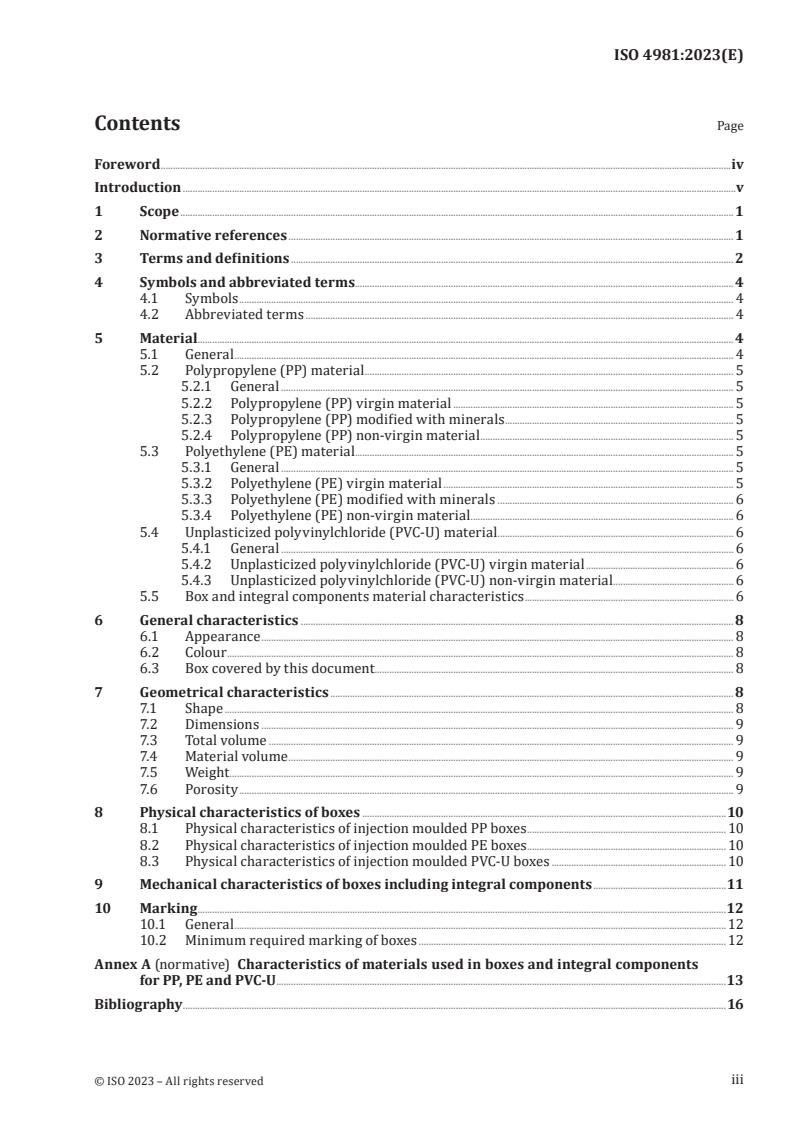
Contents Page
Foreword .iv
Introduction .v
1 Scope . 1
2 Normative references . 1
3 Terms and definitions . 2
4 Symbols and abbreviated terms.4
4.1 Symbols . 4
4.2 Abbreviated terms . 4
5 Material. 4
5.1 General . 4
5.2 Polypropylene (PP) material . 5
5.2.1 General . 5
5.2.2 Polypropylene (PP) virgin material . 5
5.2.3 Polypropylene (PP) modified with minerals . 5
5.2.4 Polypropylene (PP) non-virgin material . 5
5.3 Polyethylene (PE) material. 5
5.3.1 General . 5
5.3.2 Polyethylene (PE) virgin material . 5
5.3.3 Polyethylene (PE) modified with minerals . 6
5.3.4 Polyethylene (PE) non-virgin material . . 6
5.4 Unplasticized polyvinylchloride (PVC-U) material . 6
5.4.1 General . 6
5.4.2 Unplasticized polyvinylchloride (PVC-U) virgin material . 6
5.4.3 Unplasticized polyvinylchloride (PVC-U) non-virgin material . 6
5.5 Box and integral components material characteristics . 6
6 General characteristics . 8
6.1 Appearance . 8
6.2 Colour . 8
6.3 Box covered by this document . 8
7 Geometrical characteristics . 8
7.1 Shape . 8
7.2 Dimensions . 9
7.3 Total volume . 9
7.4 Material volume . 9
7.5 Weight . . 9
7.6 Porosity . 9
8 Physical characteristics of boxes .10
8.1 Physical characteristics of injection moulded PP boxes . 10
8.2 Physical characteristics of injection moulded PE boxes . 10
8.3 Physical characteristics of injection moulded PVC-U boxes . 10
9 Mechanical characteristics of boxes including integral components .11
10 Marking . .12
10.1 General .12
10.2 Minimum required marking of boxes .12
Annex A (normative) Characteristics of materials used in boxes and integral components
for PP, PE and PVC-U . .13
Bibliography .16
iii
Foreword
ISO (the International Organization for Standardization) is a worldwide federation of national standards
bodies (ISO member bodies). The work of preparing International Standards is normally carried out
through ISO technical committees. Each member body interested in a subject for which a technical
committee has been established has the right to be represented on that committee. International
organizations, governmental and non-governmental, in liaison with ISO, also take part in the work.
ISO collaborates closely with the International Electrotechnical Commission (IEC) on all matters of
electrotechnical standardization.
The procedures used to develop this document and those intended for its further maintenance are
described in the ISO/IEC Directives, Part 1. In particular, the different approval criteria needed for the
different types of ISO documents should be noted. This document was drafted in accordance with the
editorial rules of the ISO/IEC Directives, Part 2 (see www.iso.org/directives).
Attention is drawn to the possibility that some of the elements of this document may be the subject of
patent rights. ISO shall not be held responsible for identifying any or all such patent rights. Details of
any patent rights identified during the development of the document will be in the Introduction and/or
on the ISO list of patent declarations received (see www.iso.org/patents).
Any trade name used in this document is information given for the convenience of users and does not
constitute an endorsement.
For an explanation of the voluntary nature of standards, the meaning of ISO specific terms and
expressions related to conformity assessment, as well as information about ISO's adherence to
the World Trade Organization (WTO) principles in the Technical Barriers to Trade (TBT), see
www.iso.org/iso/foreword.html.
This document was prepared by Technical Committee ISO/TC 138, Plastics pipes, fittings and valves for
the transport of fluids, Subcommittee SC 1, Plastics pipes and fittings for soil, waste and drainage (including
land drainage).
Any feedback or questions on this document should be directed to the user’s national standards body. A
complete listing of these bodies can be found at www.iso.org/members.html.
iv
Introduction
This document specifies systems comprised of boxes made of PE, PP or PVC-U and used for retention,
detention, storage and transportation of storm water.
This document is based on EN 17152-1, additionally including PE materials.
[1]
Guidance for installation can be found in CEN/TR 17179.
v
INTERNATIONAL STANDARD ISO 4981:2023(E)
Plastics piping systems for non-pressure underground
conveyance and storage of non-potable water — Boxes
used for retention, detention, storage and transportation
systems — Specifications for storm water boxes made of
PE, PP and PVC-U
1 Scope
This document gives the definitions and specifies the minimum requirements for injection moulded,
extruded, compression moulded and thermoformed thermoplastics cuboid shaped boxes, including
integral components, used in underground systems for retention, detention, storage and transportation
of non-potable water (e.g. storm water) and manufactured from polyethylene (PE), polypropylene (PP)
or unplasticized polyvinylchloride (PVC-U).
The boxes are intended for buried underground use, e.g. in landscape, pedestrian or vehicular traffic
areas.
In the case of retention and detention systems, the main purpose of the boxes is to retain water, for
later infiltration in the ground or for later use in non-potable applications (irrigation, cleaning, sanitary
facilities, etc.) or to retain water during a storm, transferring it in a controlled way to the public storm
water network.
Applications include commercial, residential, agricultural and highway drainage, including installation
under parking lots and roadways.
Product performance is determined by a combination of material specification, product design and
manufacturing process.
A box can either be factory-assembled or site-assembled from different components.
The boxes are intended to be used as elements in a modular system where the manufacturer has
provided a clearly documented method specifying how the components are assembled to create a
complete retention, detention, storage and transportation system. The boxes are installed as one or
more horizontal layers on a firm foundation and embedded with fill around and above the complete
system.
NOTE Non-load bearing component(s) can be manufactured by various methods (e.g. extrusion, injection
moulding, rotational moulding, compression moulded, thermoforming and low-pressure injection moulding) and
are not within the scope of this document.
2 Normative references
The following documents are referred to in the text in such a way that some or all of their content
constitutes requirements of this document. For dated references, only the edition cited applies. For
undated references, the latest edition of the referenced document (including any amendments) applies.
ISO 179-1, Plastics — Determination of Charpy impact properties — Part 1: Non-instrumented impact test
ISO 306, Plastics — Thermoplastic materials — Determination of Vicat softening temperature (VST)
ISO 472, Plastics — Vocabulary
ISO 527-1, Plastics — Determination of tensile properties — Part 1: General principles
ISO 527-2, Plastics — Determination of tensile properties — Part 2: Test conditions for moulding and
extrusion plastics
ISO 527-3, Plastics — Determination of tensile properties — Part 3: Test conditions for films and sheets
ISO 580:2005, Plastics piping and ducting systems — Injection-moulded thermoplastics fittings — Methods
for visually assessing the effects of heating
ISO 899-1, Plastics — Determination of creep behaviour — Part 1: Tensile creep
ISO 899-2, Plastics — Determination of creep behaviour — Part 2: Flexural creep by three-point loading
ISO 1043-1:2011, Plastics — Symbols and abbreviated terms — Part 1: Basic polymers and their special
characteristics
ISO 1133-1, Plastics — Determination of the melt mass-flow rate (MFR) and melt volume-flow rate (MVR)
of thermoplastics — Part 1: Standard method
ISO 1167-1:2006, Thermoplastics pipes, fittings and assemblies for the conveyance of fluids — Determination
of the resistance to internal pressure — Part 1: General method
ISO 1167-2, Thermoplastics pipes, fittings and assemblies for the conveyance of fluids — Determination of
the resistance to internal pressure — Part 2: Preparation of pipe test pieces
ISO 1183-1, Plastics — Methods for determining the density of non-cellular plastics — Part 1: Immersion
method, liquid pycnometer method and titration method
ISO 3126, Plastics piping systems — Plastics components — Determination of dimensions
ISO 3451-1, Plastics — Determination of ash — Part 1: General methods
ISO 3451-5, Plastics — Determination of ash — Part 5: Poly(vinyl chloride)
ISO 11357-6, Plastics — Differential scanning calorimetry (DSC) — Part 6: Determination of oxidation
induction time (isothermal OIT) and oxidation induction temperature (dynamic OIT)
ISO 11358-1, Plastics — Thermogravimetry (TG) of polymers — Part 1: General principles
ISO 13229, Thermoplastics piping systems for non-pressure applications — Unplasticized poly(vinyl
chloride) (PVC-U) pipes and fittings — Determination of the viscosity number and K-value
EN 17150, Plastics piping systems for non-pressure underground conveyance and storage of non-potable
water - Test method for determination of short-term compression strength of boxes
EN 17151:2019, Plastics piping systems for non-pressure underground conveyance and storage of non-
potable water - Test method for determination of long-term compression strength of boxes
3 Terms and definitions
For the purposes of this document, the terms and definitions given in ISO 472, ISO 1043-1 and the
following apply.
ISO and IEC maintain terminology databases for use in standardization at the following addresses:
— ISO Online browsing platform: available at https:// www .iso .org/ obp
— IEC Electropedia: available at https:// www .electropedia .org/
3.1
box
thermoplastic cuboid shaped element, with or without sidewalls, used to create a modular system
3.2
integral component
load bearing component contributing to the overall strength of the box
3.3
modular system
system made of repeating boxes
3.4
detention system
modular system designed to attenuate the peak flow from a given site by providing a temporary
underground storm water storage facility
Note 1 to entry: Also known as ‘Attenuation”.
3.5
retention system
modular system designed to provide a temporary underground storage facility from which storm water
infiltrates into the surrounding ground.
Note 1 to entry: Also known as ‘Infiltration”.
3.6
storage system
modular system designed to provide an underground storage facility for storm water
3.7
porosity
total available volume for water storage divided by the total envelope cuboid volume for a box
3.8
long-term compression strength
maximum applied compression stress for which the box will survive without creep rupture for
50 years determined as the lower 95 % confidence limit (LCL) for the stress leading to a failure at the
extrapolated lifetime, in kN/m
3.9
virgin material
material in the form such as granules or powder that have not been subjected to use or processing other
than that required for their manufacture and to which no reprocessed or recycled material has been
added
3.10
non-virgin material
material from used or unused retention, detention, storage and transportation boxes which have been
cleaned and crushed or ground, or material from used or unused PE, PP or PVC-U products other than
retention, detention, storage and transportation boxes, regardless of where they are manufactured
3.11
agreed specification
relevant material characteristics agreed between the supplier of the material and the box manufacturer
3.12
type testing
initial testing performed according to the testing requirements in this document, the results of which
are the specified requirements of the specific product being tested
Note 1 to entry: See ISO/IEC 17000:2020, 5.1, for a definition of "specified requirements".
4 Symbols and abbreviated terms
4.1 Symbols
For the purposes of this document, the following symbols apply.
e maximum thickness of the component tested
h height, i.e. the vertical distance (in the “z” direction) between the outer surfaces of the
unit
w width, i.e. the smallest horizontal distance (in the “y” direction) between the outer
surfaces of the unit
l length, i.e. the biggest horizontal distance (in the “x” direction) between the outer
surfaces of the unit
P porosity
W weight
V total volume of the unit measured
total
V volume taken by the material
material
V volume not accessible to water or from which water cannot be retrieved
closed
ρ material density (as specified by the material supplier in Table A.2)
4.2 Abbreviated terms
For the purposes of this document, the following abbreviated terms apply.
OIT oxidation induction time
PE polyethylene
PP polypropylene
PVC-U unplasticized polyvinylchloride
IR infrared
P porosity
5 Material
5.1 General
The material shall be either PE, PP or PVC-U, to which may be added:
— mineral modifier(s) of known specification;
— additives needed to facilitate the manufacture of components conforming to this document.
The material used to manufacture the boxes and integral components shall consist of a material or
mixtures of different materials each of which shall have an agreed specification between the supplier
and manufacturer (see Clause A.2).
5.2 Polypropylene (PP) material
5.2.1 General
The material shall be either PP virgin, PP modified or PP non-virgin material, conforming to 5.2.2 –
5.2.4 as appropriate.
5.2.2 Polypropylene (PP) virgin material
The material for boxes and integral components shall be a compound of PP virgin material and those
additives that are needed to facilitate the manufacture of box or integral components conforming to the
requirements of this document.
When reworked material is added to a level of less than 10 %, the material for boxes can still be
considered as virgin.
5.2.3 Polypropylene (PP) modified with minerals
The material for boxes and integral components shall be a compound of PP virgin material modified
with minerals and those additives that are needed to facilitate the manufacture of box or integral
components conforming to the requirements of this document.
If calcium carbonate is used, only coated calcium carbonate shall be used. The content of minerals in
the final compound shall be less than 50 % by mass.
When reworked material is added to a level of less than 10 %, the material for boxes can still be
considered as modified.
5.2.4 Polypropylene (PP) non-virgin material
The material for boxes and integral components
...