

ISO 24102-4:2018
(Main)Intelligent transport systems — ITS station management — Part 4: Station-internal management communications
General Information
- Abstract
This document provides specifications for secure ITS station-internal management communications.
- Status
- Published
- Publication Date
- 30-Oct-2018
- Technical Committee
- ISO/TC 204 - Intelligent transport systems
- Drafting Committee
- ISO/TC 204/WG 16 - Communications
- Current Stage
- 9060 - Close of review
- Completion Date
- 04-Jun-2029
Buy Documents
ISO 24102-4:2018 - Intelligent transport systems -- ITS station management
ISO 24102-4:2018 - Intelligent transport systems — ITS station management — Part 4: Station-internal management communications/31/2018
Overview
ISO 24102-4:2018 - "Intelligent transport systems - ITS station management - Part 4: Station‑internal management communications" defines secure, station‑internal management communications for ITS stations. It specifies the reference architecture, protocol data units (PDUs), communication and management procedures, security considerations, conformance and test methods for ITS‑S internal management communications (IIC). Part 4 is one element of the ISO 24102 series and is architecturally aligned with ISO 21217 (ITS station/CALM architecture).
Keywords: ISO 24102-4, ITS station management, station-internal management communications, IIC, IICM, IICA, ITS-SCU-ID, ASN.1, PDUs, ITS security.
Key technical topics and requirements
- Reference architecture (Clause 6): Defines IIC roles - IIC Manager (IICM) and IIC Agent (IICA) - and how they interact via ITS station internal networks and management SAPs (MI‑SAP, MN‑SAP, MF‑SAP, MA‑SAP, MS‑SAP).
- Protocol Data Units (Clause 7): Two ASN.1 PDUs are specified: IIC‑Request and IIC‑Response. PDUs carry fields such as source/destination ITS‑SCU‑ID, PduCounter, IIC‑PDU‑ID, data identifiers and error status.
- Communication procedures (Clause 8): Procedures for initialization, transmission and reception of IIC PDUs, including request/response behavior and processing at IICA/IICM endpoints.
- Management procedures (Clause 9): Includes ITS‑SCU‑ID assignment, maintenance and shut‑down procedures for ITS‑SCUs within the ITS station.
- Security (Clause 10): Requires secure IIC following trusted distributed systems principles; security mechanisms and parameters are defined for protected station‑internal management.
- Conformance & testing (Clauses 11–12): Specifies conformance declaration requirements and test methods; annexes include an ASN.1 module (Annex A), PDU definitions (Annex B) and an ICS proforma (Annex C).
Practical applications and who uses this standard
ISO 24102-4 is intended for:
- ITS equipment vendors implementing ITS‑station management stacks and internal management protocols.
- System integrators ensuring interoperable, secure management across ITS‑SCUs in roadside units (RSUs), onboard units (OBUs) and central ITS stations.
- Software developers encoding/decoding IIC PDUs (ASN.1/PER) and implementing IICM/IICA roles.
- Test houses and certification labs validating conformance and security of station‑internal management communications.
- Standards and regulatory bodies harmonizing ITS deployment and secure management practices.
Related standards
- ISO 21217 (CALM architecture)
- ISO 24102-1, -3, -6 (other ITS station management parts)
- ISO 17419 (globally unique ITS‑SCUID)
- ISO/IEC 8825-2 (ASN.1 PER encoding)
- ETSI TS 102 797 series (test specifications)
Adopting ISO 24102-4 helps ensure interoperable, secure management within ITS stations - a foundation for reliable cooperative ITS operations.
Relations
- Effective Date
- 09-Feb-2026
- Effective Date
- 04-Feb-2017
- Effective Date
- 04-Feb-2017
Buy Documents
ISO 24102-4:2018 - Intelligent transport systems -- ITS station management
ISO 24102-4:2018 - Intelligent transport systems — ITS station management — Part 4: Station-internal management communications/31/2018
Get Certified
Connect with accredited certification bodies for this standard

BSI Group
BSI (British Standards Institution) is the business standards company that helps organizations make excellence a habit.

Great Wall Tianjin Quality Assurance Center
Established 1993, first batch to receive national accreditation with IAF recognition.
Hong Kong Quality Assurance Agency (HKQAA)
Hong Kong's leading certification body.
Sponsored listings
Frequently Asked Questions
ISO 24102-4:2018 is a standard published by the International Organization for Standardization (ISO). Its full title is "Intelligent transport systems — ITS station management — Part 4: Station-internal management communications". This standard covers: This document provides specifications for secure ITS station-internal management communications.
This document provides specifications for secure ITS station-internal management communications.
ISO 24102-4:2018 is classified under the following ICS (International Classification for Standards) categories: 03.220.01 - Transport in general; 35.240.60 - IT applications in transport. The ICS classification helps identify the subject area and facilitates finding related standards.
ISO 24102-4:2018 has the following relationships with other standards: It is inter standard links to EN ISO 22418:2020, ISO 24102-4:2013/Amd 1:2017, ISO 24102-4:2013. Understanding these relationships helps ensure you are using the most current and applicable version of the standard.
ISO 24102-4:2018 is available in PDF format for immediate download after purchase. The document can be added to your cart and obtained through the secure checkout process. Digital delivery ensures instant access to the complete standard document.
Standards Content (Sample)
INTERNATIONAL ISO
STANDARD 24102-4
Second edition
2018-11
Intelligent transport systems — ITS
station management —
Part 4:
Station-internal management
communications
Systèmes intelligents de transport — Gestion des stations ITS —
Partie 4: Communications de gestion interne à la station
Reference number
©
ISO 2018
© ISO 2018
All rights reserved. Unless otherwise specified, or required in the context of its implementation, no part of this publication may
be reproduced or utilized otherwise in any form or by any means, electronic or mechanical, including photocopying, or posting
on the internet or an intranet, without prior written permission. Permission can be requested from either ISO at the address
below or ISO’s member body in the country of the requester.
ISO copyright office
CP 401 • Ch. de Blandonnet 8
CH-1214 Vernier, Geneva
Phone: +41 22 749 01 11
Fax: +41 22 749 09 47
Email: copyright@iso.org
Website: www.iso.org
Published in Switzerland
ii © ISO 2018 – All rights reserved
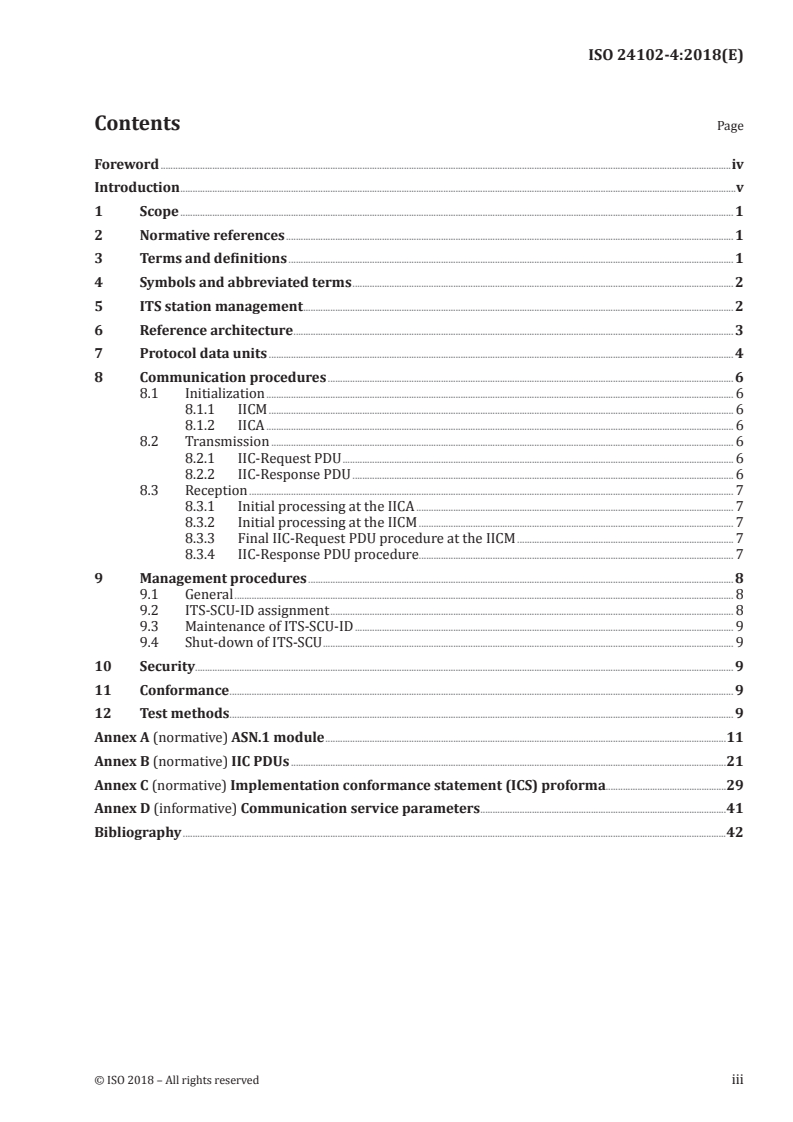
Contents Page
Foreword .iv
Introduction .v
1 Scope . 1
2 Normative references . 1
3 Terms and definitions . 1
4 Symbols and abbreviated terms . 2
5 ITS station management . 2
6 Reference architecture . 3
7 Protocol data units . 4
8 Communication procedures . 6
8.1 Initialization . 6
8.1.1 IICM . 6
8.1.2 IICA . 6
8.2 Transmission . 6
8.2.1 IIC-Request PDU . 6
8.2.2 IIC-Response PDU . 6
8.3 Reception . 7
8.3.1 Initial processing at the IICA . 7
8.3.2 Initial processing at the IICM . 7
8.3.3 Final IIC-Request PDU procedure at the IICM . 7
8.3.4 IIC-Response PDU procedure . 7
9 Management procedures . 8
9.1 General . 8
9.2 ITS-SCU-ID assignment . 8
9.3 Maintenance of ITS-SCU-ID . 9
9.4 Shut-down of ITS-SCU . 9
10 Security. 9
11 Conformance . 9
12 Test methods . 9
Annex A (normative) ASN.1 module .11
Annex B (normative) IIC PDUs .21
Annex C (normative) Implementation conformance statement (ICS) proforma.29
Annex D (informative) Communication service parameters .41
Bibliography .42
Foreword
ISO (the International Organization for Standardization) is a worldwide federation of national standards
bodies (ISO member bodies). The work of preparing International Standards is normally carried out
through ISO technical committees. Each member body interested in a subject for which a technical
committee has been established has the right to be represented on that committee. International
organizations, governmental and non-governmental, in liaison with ISO, also take part in the work.
ISO collaborates closely with the International Electrotechnical Commission (IEC) on all matters of
electrotechnical standardization.
The procedures used to develop this document and those intended for its further maintenance are
described in the ISO/IEC Directives, Part 1. In particular, the different approval criteria needed for the
different types of ISO documents should be noted. This document was drafted in accordance with the
editorial rules of the ISO/IEC Directives, Part 2 (see www .iso .org/directives).
Attention is drawn to the possibility that some of the elements of this document may be the subject of
patent rights. ISO shall not be held responsible for identifying any or all such patent rights. Details of
any patent rights identified during the development of the document will be in the Introduction and/or
on the ISO list of patent declarations received (see www .iso .org/patents).
Any trade name used in this document is information given for the convenience of users and does not
constitute an endorsement.
For an explanation of the voluntary nature of standards, the meaning of ISO specific terms and
expressions related to conformity assessment, as well as information about ISO's adherence to the
World Trade Organization (WTO) principles in the Technical Barriers to Trade (TBT), see www .iso
.org/iso/foreword .html.
This document was prepared by Technical Committee ISO/TC 204, Intelligent transport systems.
This second edition cancels and replaces the first edition (ISO 24102-4:2013) which has been technically
revised. It also incorporates the Amendment ISO 24102-4:2013/Amd1: 2017.
A list of all parts in the ISO 24102 series can be found on the ISO website.
Any feedback or questions on this document should be directed to the user’s national standards body. A
complete listing of these bodies can be found at www .iso .org/members .html.
[1]
NOTE The former ISO 24102-5 has been converted into a separate standard ISO 22418 , as it is not a station
management standard.
iv © ISO 2018 – All rights reserved
Introduction
This document is part of a series of International Standards for communications in intelligent transport
systems (ITS) based on the ITS station and communications architecture specified in ISO 21217 and
illustrated in Figure 1.
Figure 1 — ITS station reference architecture with named interfaces
This document is Part 4 of a multi-part standard which determines the intelligent transport systems
(ITS) station-internal management communications that is architecturally located in the ITS station
Management entity.
The ITS station management entity provides functionality related to the management of communication
protocol layers (Access, Networking & Transport, Facilities), the Security entity, and the ITS Applications
entity introduced in ISO 21217:2014 and presented in Figure 1.
ITS station management is specified as a distributed process, where no supervisory entity is employed.
INTERNATIONAL STANDARD ISO 24102-4:2018(E)
Intelligent transport systems — ITS station management —
Part 4:
Station-internal management communications
1 Scope
This document provides specifications for secure ITS station-internal management communications.
2 Normative references
The following documents are referred to in the text in such a way that some or all of their content
constitutes requirements of this document. For dated references, only the edition cited applies. For
undated references, the latest edition of the referenced document (including any amendments) applies.
ISO/IEC 8825-2, Information technology — ASN.1 encoding rules: Specification of Packed Encoding
Rules (PER)
ISO 17419:2018, Intelligent transport systems — Cooperative ITS — Globally unique identification
ISO 21217:2014, Intelligent transport systems — Communications access for land mobiles (CALM) —
Architecture
ISO 21218, Intelligent transport systems — Hybrid communications — Access technology support
ISO 24102-1, Intelligent transport systems — ITS station management — Part 1: Local management
ISO 24102-3, Intelligent transport systems — ITS station management — Part 3: Service access points
ISO 24102-6, Intelligent transport systems — ITS station management — Part 6: Path and flow management
ETSI TS 102 797-2, Intelligent Transport Systems (ITS); Road Transport and Traffic Telematics (RTTT);
Test specifications for Intelligent Transport Systems, Communications access for land mobiles (CALM), ITS
station management (ISO 24102); Part 2: Test Suite Structure and Test Purposes (TSS & TP)
ETSI TS 102 797-3, Intelligent Transport Systems (ITS); Road Transport and Traffic Telematics (RTTT);
Test specifications for Intelligent Transport Systems, Communications access for land mobiles (CALM), ITS
station management (ISO 24102); Part 3: Abstract Test Suite (ATS) and partial PIXIT information
3 Terms and definitions
For the purposes of this document, the terms and definitions given in ISO 21217, ISO 21218, ISO 24102-1,
and ISO 24102-3 and the following apply.
ISO and IEC maintain terminological databases for use in standardization at the following addresses:
— ISO Online browsing platform: available at https: //www .iso .org/obp
— IEC Electropedia: available at http: //www .electropedia .org/
3.1
ITS-S communication unit
physical unit in an ITS-SU containing a part or all of the functionality of an ITS-S
[SOURCE: ISO 21217:2014, 3.21, modified — Note 1 to entry was deleted.]
4 Symbols and abbreviated terms
For the purposes of this document, the abbreviated terms given in ISO 21217:2014, ISO 21218,
ISO 24102-1, and ISO 24102-3 and the following apply.
ITS-SCU ITS station Communication Unit
ITS-SCU-ID ITS-SCU Identifier
ITS-SCUID Globally unique identifier of an ITS-SCU
NOTE ITS-SCUID is specified in ISO 17419 as a globally unique identifier, whilst ITS-SCU-ID is specified
in this document as an addressing element for IIC.
IIC ITS station-internal management communications
IICM IIC manager
IICA IIC agent
IICP IIC protocol
n/a not applicable
5 ITS station management
The ITS station management includes functionality specified in the various parts of this multi-part
International Standard:
1) The functionality of local ITS station management specified in ISO 24102-1.
[2]
2) The functionality of remote ITS station management specified in ISO 24102-2 .
3) The functionality of service access points specified in ISO 24102-3.
4) The functionality of ITS station-internal management communications specified in this
document (Part 4).
5) Void.
6) The functionality of path and flow management specified in ISO 24102-6.
ITS station-internal management communications interconnects ITS station communication units
(ITS-SCUs) of the same ITS station (ITS-S) via the ITS station-internal network illustrated in ISO 21217.
This communication is also referred to as "ITS-S Internal management Communications" (IIC) in this
document. IIC allows remote access to management SAPs specified in ISO 21217 with details specified
in ISO 24102-3.
IIC may be secured following the principles of trusted distributed systems.
Detailed mandatory requirements are specified in the following clauses of this document.
— Clause 6 specifies the IIC reference architecture.
— Clause 7 specifies IIC protocol data units (PDUs).
— Clause 8 specifies communication procedures.
— Clause 9 specifies management procedures.
— Clause 10 specifies security elements and procedures.
2 © ISO 2018 – All rights reserved
— Clause 11 specifies conformance declaration.
— Clause 12 specifies test methods.
— Annex A specifies an ASN.1 module.
— Annex B specifies IIC PDUs.
— Annex C specifies the implementation conformance statement (ICS) proforma.
— Annex D exemplifies communication service parameters for IIC for usage in implementations
[5]
compliant with ISO 17423 .
6 Reference architecture
"ITS-S Internal management Communications" (IIC) is communications between ITS-S Management
Entities of different ITS-SCUs of the same ITS-SU via the ITS station-internal network. A specific
purpose of IIC is remote access to management service access points MI-SAP, MN-SAP, MF-SAP, MA-SAP
and MS-SAP. The concept of ITS-SCUs is specified in ISO 21217. An ITS-SCU can support IICP disregard
of the ITS-S roles it supports.
NOTE The MA-SAP is part of the API presented in Figure 2.
The reference architecture for IIC is illustrated in Figure 2.
Figure 2 — Reference architecture for ITS station-internal management communications
Source and destination of IIC protocol data units are instances of the "ITS-S Internal management
Communications Manager" (IICM). Transmission requests from the IICM are forwarded to the "ITS-S
Internal management Communications Agent" (IICA) via the MF-SAP. Notifications of received IIC PDUs
are sent by the IICA via the MF-SAP to the IICM.
Communications on the ITS station-internal network is performed between peer instances of the
IICA via NF-SAP, a suitable networking & transport layer protocol, the IN-SAP, and a suitable access
technology. Source- and destination endpoints of the ITS-S networking & transport layer protocol are
identified by an ITS-S port (ITS-SP) with the number PORT_IIC of the IICA identified in [3].
7 Protocol data units
"ITS-S Internal management Communications" (IIC) uses the following protocol data units (PDU)
illustrated in Figure 3:
— IIC-Request;
— IIC-Response.
Figure 3 — IIC PDU structure
The IIC-Request PDU is of ASN.1 type IIC-Request specified in A.2.
The IIC-Response PDU is of ASN.1 type IIC-Response specified in A.2.
Details on parameters of these PDUs are specified in Table 1.
4 © ISO 2018 – All rights reserved
Table 1 — IIC PDUs
PDU element/ASN.1 type IIC-Request IIC-Response
Source ITS-SCU-ID/ ITS-SCU-ID of source ITS-SCU, which ITS-SCU-ID of ITS-SCU, which pro-
produces the request. duces the response.
ITS-scuId
Destination ITS-SCU-ID/ ITS-SCU-ID of destination ITS-SCU. Same as SourceITS-SCU-ID of
related request if not requested
ITS-scuId
otherwise in this document.
PDU-Counter/ Even number generated from a PDU-Counter of related request
cyclic counter at the ITS-SCU, which incremented by one.
PduCounter
produces the request.
IIC-PDU-ID / One octet INTEGER value 0. One octet INTEGER value 1.
INTEGER ASN.1 type RequestID. ASN.1 type ResponseID.
Value dependent on PDU type
Data/ Data type identifier RqDataID fol- Data type identifier RsDataID fol-
lowed by length of RqData in Integer lowed by length of RsData in Inte-
SEQUENCE based on ASN.1
multiples of an octet and RqData. ger multiples of an octet and RsData
CLASS IICPREQ
ASN.1 type PduRequest. ASN.1 type PduResponse.
ErrorStatus/ Not existent. Existent.
0: No error happened
PduErrStatus
>0: Number indicating type of error.
Seq/ Security type identifier SecRqID Security type identifier SecRsID fol-
followed by the lenth of SecRequest lowed by the lenth of SecResponse
SEQUENCE based on ASN.1
in Integer multiples of an octet and in Integer multiples of an octet and
CLASS SECIICP
SecRequest. SecResponse.
ASN.1 type SecRq. ASN.1 type SecRs.
The ASN.1 specification of the PDUs as provided in Annex A of this document shall apply.
ITS-SCU-ID values used in parameters "SourceITS-SCU-ID" and "DestinationITS-SCU-ID" shall be as
specified in Table 2.
Table 2 — ITS-SCU-ID value assignment
SourceITS- DestinationITS- Description
SCU-ID SCU-ID
0 Reserved. Used to indicate "own/local ITS-SCU". Must not be used in com-
munications with other ITS-SCUs.
n/a 1 ITS-SCU-ID identifying ITS-SCUs with ITS-S host role.
n/a 2 ITS-SCU-ID identifying ITS-SCUs with ITS-S router role.
3 ITS test system Dispatcher (using IICP for upper tester access), see ISO/
[4]
TS 20026 .
[4]
4 ITS Test CI unit, see ISO/TS 20026 .
5 to 15 Reserved.
ITS-SCU-ID identifying ITS-SCUs with an implementation specific role
16 to 65534 ITS-SCU-ID identifying uniquely a specific ITS-SCU in an ITS station.
n/a 65535 ITS-SCU-ID identifying all ITS-SCUs.
"Data" values shall be set as specified in Annex B of this document.
"ErrorStatus" values shall be set as specified in Table 3.
Table 3 — ErrorStatus value assignment; ASN.1 type PduErrStatus
ErrorStatus Description
0 No error
1 IIC-PDU-ID unknown or not implemented
2 Duplicate ITS-SCU-ID
3 Invalid or unknown AliveMessage
4 Invalid or unknown ITS-SCU type
5 to 127 Reserved for future use
128 to 254 For implementation-specific, non-standardized usage
255 Unspecified error
The ITS port number PORT_IICP is specified in ISO 17419: to identify the IICA. Port numbers for TCP-IP
or UDP-IP are not allocated so far.
8 Communication procedures
8.1 Initialization
8.1.1 IICM
ITS station-internal management communications between addressable ITS-SCUs shall be initialized as
specified in Clause 9 on management procedures.
8.1.2 IICA
Prior to the initialization specified in Clause 9, the IICA shall initialize communications as requested for
the selected ITS-S networking & transport layer protocol.
8.2 Transmission
8.2.1 IIC-Request PDU
Upon request from a protocol in the ITS-S management entity, the IICM shall construct the IIC-Request
PDU specified in Clause 7. In case secure transmission is needed, the "Security Support" illustrated in
Figure 2 shall be involved via the MS-SAP. Details on security shall be as specified in Clause 10.
The "PDU-Counter" value shall be set to an even value uniquely in an ITS-SCU under the control of the
IICM issuing the request. The initial value shall be zero. For every next IIC-Request PDU, the counter
value shall be incremented by two. It shall wrap from 65534 to zero. The IICM shall note the value of the
PDU-Counter in case a response is expected.
The IICM shall forward the IIC-Request PDU to the IICA using MF-COMMAND IICrequestTX specified
in Annex A.
The IICA shall request transmission of the IIC-Request PDU using the appropriate service of the NF-SAP.
8.2.2 IIC-Response PDU
Upon reception of an IIC-Request PDU which requires transmission of an IIC-Response PDU, the IICM
shall construct the IIC-Response PDU specified in Clause 7. In case secure transmission is needed, the
"Security support" illustrated in Figure 2 shall be involved via the MS-SAP. Details on security shall be
as specified in Clause 10.
The "PDU-Counter" value shall be set equal to the value of the "PDU-Counter" contained in the related
IIC-Request PDU incremented by one.
6 © ISO 2018 – All rights reserved
The IICM shall forward the IIC-Response PDU to the IICA using MF-COMMAND IICresponseTX
specified in Annex A.
The IICA shall request transmission of the IIC-Response PDU using the appropriate service of the NF-SAP.
8.3 Reception
8.3.1 Initial processing at the IICA
The IICA shall perform the following steps:
1) Check DestinationITS-SCU-ID:
i) If the DestinationITS-SCU-ID value is a valid address value (3, 4, 16 to 65534) and matches the
own address, step 2) shall be performed.
ii) If the DestinationITS-SCU-ID value is either 1 or 2, and the value matches with the own ITS-S
role, step 2) shall be performed.
iii) If the DestinationITS-SCU-ID value is 65535, step 2) shall be performed.
iv) Otherwise the PDU is ignored.
2) Check the PDU type value and PDU-Counter value.
i) In case the PDU type is inconsistent with the PDU-Counter value, the PDU is ignored.
ii) The IICA shall forward an IIC-Request PDU received via NF-SAP to the IICM using MF-REQUEST
IICrequestRX specified in Annex A.
iii) The IICA shall forward an IIC-Response PDU received via NF-SAP to the IICM using MF-
REQUEST IICresponseRX specified in Annex A.
8.3.2 Initial processing at the IICM
The IICM shall perform the following steps:
1) In case the element SecRq is not empty, involve the "Security Support" illustrated in Figure 2 via
the MS-SAP as specified in Clause 10.
2) In case of unsuccessful security checking, the IICM ignores the received PDU.
3) In case of successful security checking, the IICM shall perform the respective procedure for IIC-
Request or IIC-Response.
8.3.3 Final IIC-Request PDU procedure at the IICM
The IICM shall perform the following steps:
1) The IICM performs the required action as indicated by Data contained in the IIC-Request PDU.
2) In case a response is required, the IICM prepares the IIC-Response PDU as specified above.
8.3.4 IIC-Response PDU procedure
The IICM shall perform the following steps:
1) Check whether the PDU-Counter value matches a previously transmitted IIC-Request that was
not acknowledged so far with an IIC-Response PDU. In case of no match the IICM ignores the
received PDU.
2) The IICM performs the required action as indicated by Data contained in the IIC-Response PDU.
9 Management procedures
9.1 General
The management procedures specified in Clause 9 include procedures
— for initial assignment of unique ITS-SCU-IDs,
— for ITS-SCU-ID maintenance, and
— for release of ITS-SCU-IDs.
Uniqueness of ITS-SCU-IDs in the range 15 to 65534 may be achieved by implementation-dependent
means.
9.2 ITS-SCU-ID assignment
In case an ITS-SCU does not have a pre-defined unique ITS-SCU-ID, the procedure specified in this sub-
clause shall be followed.
The IICM shall generate an ITS-SCU-ID as specified in Table 2 as its own ITS-SCU-ID and shall put the
selected ITS-SCU-ID to its local ITS-SCU-list. ITS-SCU-ID values already being in the local ITS-SCU-list
indicate usage by another ITS-SCU in the same station and shall not be selected. Then the IIC-Request
PDU ITS-SCUalive (new) shall be sent to all ITS-SCUs, indicating a first choice of ITS-SCU-ID in
the "SourceITS-SCU-ID element, or a new choice of ITS-SCU-ID, and the type of ITS-SCU in the "Data"
element. In case of a negative acknowledgement, i.e. indication of usage of this ITS-SCU-ID value by
another ITS-SCU, see below, the IICM shall repeat the procedure with a new ITS-SCU-ID value.
Upon activation, the IICM may listen to receive IIC-Request PDUs, or IIC-Response PDUs in order to
identify already allocated ITS-SCU-IDs.
Upon reception of an IIC-Request PDU ITS-SCUalive (new), the IICM shall check the SourceITS-SCU-ID.
— If the SourceITS-SCU-ID is equal to the own ITS-SCU-ID, the receiving IICM shall send an IIC-Response
PDU ITS-SCUalive to all ITS-SCUs, reporting the own ITS-SCU-ID and type of ITS-SCU to all ITS-
SCUs, indicating ErrorStatus=2.
— If the SourceITS-SCU-ID is different to the own ITS-SCU-ID, the IICM shall take this information to
its local ITS-SCU-list, if not already present there. An existing entry shall not be updated with this
new information. The IICM shall acknowledge the IIC-Request PDU with the IIC-Response PDU ITS-
SCUalive, reporting the own ITS-SCU-ID and type of ITS-SCU, indicating ErrorStatus=0.
Upon reception of an IIC-Request PDU ITS-SCUalive (alive), the IICM shall check the SourceITS-SCU-ID.
— If the SourceITS-SCU-ID is equal to the own ITS-SCU-ID, the receiving IICM shall send an IIC-Response
PDU ITS-SCUalive to all ITS-SCUs, reporting the own ITS-SCU-ID and type of ITS-SCU to all ITS-
SCUs, indicating ErrorStatus=2. All IICMs with this ITS-SCU-ID shall invalidate this ITS-SCU-ID and
shall start the procedure to select a new ITS-SCU-ID.
— If the SourceITS-SCU-ID is different to the own ITS-SCU-ID, the IICM shall take this information to
its local ITS-SCU-list, if not already present there. The IIC-Request PDU shall not be acknowledged
with an IIC-Response.
Upon reception of an IIC-Response PDU ITS-SCUalive, the IICM shall check the ErrorStatus.
— In case of ErrorStatus=0, the IICM shall take this information about another ITS-SCU to its local ITS-
SCU-list, if not already present there.
8 © ISO 2018 – All rights reserved
— In case of ErrorStatus=2, an address conflict was detected. The procedure to be selected upon this
event depends on the value of "Message" and SourceITS-SCU-ID contained in the IIC-Response as
presented in Table 4.
Table 4 — Error handling procedure for IIC-Response PDU (ITS-SCUalive)
ErrorStatus = 2 SourceITS-SCU-ID = SourceITS-SCU-ID ≠
(Duplicate ITS-SCU-ID) own ITS-SCU-ID own ITS-SCU-ID
AliveMessage = new Map ITS-SCU-ID to ITS-SCUtype Nothing to do.
reported in the response.
Restart ITS-SCU-ID assignment
process.
AliveMessage = alive IMPORTANT — This should IMPORTANT — This should
never happen. never happen.
Reset ITS-SCU and restart ITS-SCU- Delete SourceITS-SCU-ID from local
ID assignment process. ITS-SCU-list.
AliveMessage = delete IMPORTANT — This should never happen.
Nothing to do.
9.3 Maintenance of ITS-SCU-ID
The IICM shall periodically transmit the "alive-signal" IIC-Request PDU ITS-SCUalive (alive) in
order to indicate its presence in the ITS station. The period of transmission shall be as set in parameter
"Talive" specified in ISO 24102-1. The value of "Talive" shall be defined by implementation and shall be
unique in an ITS station.
The IICM periodically shall check the local ITS-SCU-list. If for a period of at least three times "Talive" no
"alive-signal" IIC-Request PDU ITS-SCUalive (alive) was received, the IICM assumes that this ITS-
SCU is no longer alive, and the respective ITS-SCU-ID shall be deleted from the local ITS-SCU-list.
9.4 Shut-down of ITS-SCU
In case an ITS-SCU has the capability to perform a power shut-down, prior to performing such a shut-
down of an ITS-SCU, the IIC-Request PDU ITS-SCUalive (delete) shall be sent to all ITS-SCUs at least
once. This message shall not be acknowledged.
10 Security
Details of security data elements presented in Figure 3, and related security procedures are out of
scope of this document.
11 Conformance
The "Protocol Implementation Conformance Statements" (PICS) proforma specified in Annex C
[7]
supersedes the one specified in ETSI TS 102 797-1 for the predecessor of this document.
12 Test methods
The "Test Suite Structure & Test Purposes" (TSS&TP) for conformance testing can be based on
ETSI TS 102 797-2, which is to be cross-checked for identifying potential but not expected inconsistencies
introduced by the revision of the predecessor of this document.
The "Abstract Test Suite" (ATS) for conformance testing can be based on ETSI TS 102 797-3, which
needs to be revised due to changes of ASN.1 type names and ASN.1 value names.
10 © ISO 2018 – All rights reserved
Annex A
(normative)
ASN.1 module
A.1 Overview
The following ASN.1 module is specified in this Annex:
— ITSiitsscu { iso (1) standard (0) calm-management (24102) iitsscu (4) asnm-1 (1) version2 (2)}
In case the ASN.1 specifications given in this Annex are not compliant with illustrations or specifications
provided elsewhere in this document, the specifications given in this Annex shall prevail.
A.2 Module ITSiitsscu
This module specifies ASN.1 type definitions together with useful ASN.1 value definitions.
Unaligned packed encoding rules (PER) as specified in ISO/IEC 8825-2 shall be applied for this
ASN.1 module.
In order to achieve octet alignment enabling cheap implementations, "fill" bits were defined. All fill bits
shall be set to the value '0'b.
ITSiitsscu { iso (1) standard (0) calm-management (24102) iitsscu (4)
asnm-1 (1) version2 (2)}
DEFINITIONS AUTOMATIC TAGS::=BEGIN
IMPORTS
-- From EN ISO 17419-1
ITS-scuId, ITSatt FROM CITSapplMgmtApplReg2 {iso(1) standard(0)
cits-applMgmt (17419) applRegistry (2) version2 (2)}
-- From EN ISO 17419-1 Data Dictionary
NullType FROM CITSdataDictionary1 {iso(1) standard(0) cits-applMgmt
(17419) dataDictionary (1) version1 (1)}
-- From ISO 21218:2017
CIaClass, CIclass, CIstatus, Directivity, Link-ID, MACaddress FROM
ITSllsap {iso(1) standard(0) calm-ll-sap(21218) asnm-1 (1) version2
(2)}
RefMPARAM, Param24102 FROM ITSmanagement { iso (1) standard (0)
calm-management (24102) local (1) asnm-1 (1) version2 (2)}
-- From ISO 24102-3 ITSsapCmdMf
SimFUTcmd, SimFLTcmd, MF-Command-request, MF-Command-confirm FROM
ITSsapCmdMf { iso (1) standard (0) calm-management (24102) msap (3)
commands (3) mf (2) version0 (0)}
-- From ISO 24102-3 ITSsapCmdMn
SimNUTcmd, SimNLTcmd, MN-Command-request, MN-Command-confirm FROM
ITSsapCmdMn { iso (1) standard (0) calm-management (24102) msap (3)
commands (3) mn (3) version0 (0)}
-- From ISO 24102-3 ITSsapCmdMi
SimIUTcmd, MI-Command-request, MI-Command-confirm, MI-Get-request,
MI-Set-request, MI-Get-confirm, MI-Set-confirm FROM ITSsapCmdMi
{ iso (1) standard (0) calm-management (24102) msap (3) commands
(3) mi (4) version0 (0)}
-- From ISO 24102-3 ITSsapReqMf
SimFLTreq, SimFUTreq, MF-Request-request, MF-Request-confirm FROM
ITSsapReqMf { iso (1) standard (0) calm-management (24102) msap
(3) requests (4) mf (2) version0 (0)}
-- From ISO 24102-3 ITSsapReqMn
SimNUTreq, SimNLTreq, MN-Request-request, MN-Request-confirm FROM
ITSsapReqMn { iso (1) standard (0) calm-management (24102) msap (3)
requests (4) mn (3) version0 (0)}
-- From ISO 24102-3 ITSsapReqMi
SimIUTreq, MI-Request-request, MI-Request-confirm FROM ITSsapReqMi
{ iso (1) standard (0) calm-management (24102) msap (3) requests
(4) mi (4) version0 (0)}
-- From ISO 24102-3 ITSsapBasics
ErrStatus FROM ITSsapBasics { iso (1) standard (0) calm-management
(24102) msap (3) basics (2) version0 (0)}
-- From ISO 24102-3 ITSsapCmdMa
MA-Command-request, MA-Command-confirm FROM ITSsapCmdMa { iso (1)
standard (0) calm-management (24102) msap (3) commands (3) ma (1)
version0 (0)}
-- From ISO 24102-3 ITSsapReqMa
MA-Request-request, MA-Request-confirm FROM ITSsapReqMa { iso (1)
standard (0) calm-management (24102) msap (3) requests (4) ma (1)
version0 (0)}
-- From ISO 24102-3 ITSsapCmdMs
MS-Command-request, MS-Command-confirm FROM ITSsapCmdMs { iso (1)
standard (0) calm-management (24102) msap (3) commands (3) ms (0)
version0 (0)}
-- From ISO 24102-3 ITSsapReqMs
MS-Request-request, MS-Request-confirm FROM ITSsapReqMs { iso (1)
standard (0) calm-management (24102) msap (3) requests (4) ms (0)
version0 (0)}
-- Details on SecRq and SecRs to be provided by a standard on security
;
-- End of IMPORTS
-- Types
-- PDUs --
-- Data type identifier for IIC-Request and IIC-Response
RefIICP ::= INTEGER { -- Define IICPREQ.ref values range
c-iic-alive (0),
c-iic-mfRcmd (1),
c-iic-mfRreq (2),
c-iic-mnRcmd (3),
c-iic-mnRreq (4),
c-iic-miRcmd (5),
c-iic-miRreq (6),
c-iic-miRget (7),
c-iic-miRset (8),
c-iic-mCmd (9),
c-iic-maRcmd (10),
c-iic-maRreq (11),
c-iic-msRcmd (12),
c-iic-msRreq (13),
-- c-iic-simSutCmd (236),
-- c-iic-simSutReq (237),
-- c-iic-simSltCmd (238),
-- c-iic-simSltReq (239),
c-iic-simUtIn (240), -- see ETSI abstract test suite
c-iic-simUtOut (241), -- see ETSI abstract test suite
-- c-iic-simAutCmd (242),
-- c-iic-simAutReq (243),
c-iic-simFutCmd (244),
12 © ISO 2018 – All rights reserved
c-iic-simFutReq (245),
c-iic-simNutCmd (246),
c-iic-simNutReq (247),
c-iic-simIutCmd (248),
c-iic-simIutReq (249),
-- c-iic-simAltCmd (250),
-- c-iic-simAltReq (251),
c-iic-simFltCmd (252),
c-iic-simFltReq (253),
c-iic-simNltCmd (254),
c-iic-simNltReq (255)
} (0.255)
-- IIC-Request PDU
IIC-Request::=SEQUENCE{
sourceITS-scuId ITS-scuId,
destinationITS-scuId ITS-scuId,
pduCounter PduCounter,
requestID RequestID, -- value zero
pduRequest PduRequest,
secRq SecRq
}
RequestID::=INTEGER{
request (0)
} (0.255)
IICPREQ::=CLASS{
&ref RefIICP UNIQUE, -- data type identifier
&IICPrequest
}
IICPrequests IICPREQ::={aliveRq | mfRcmdRq | mfRreqRq | mnRcmdRq |
mnRreqRq | miRcmdRq | miRreqRq | miRgetRq | miRsetRq | mCmdRq |
maRcmdRq | maRreqRq | msRcmdRq | msRreqRq | simFutCmdRq | simFutReqRq |
simNutCmdRq | simNutReqRq | simIutCmdRq | simIutReqRq | simFltCmdRq |
simFltReqRq | simNltCmdRq | simNltReqRq | simUtInRq | simUtOutRq, .}
PduRequest::=SEQUENCE{
reqRef IICPREQ.&ref({IICPrequests}), -- data type identifier
iicpReq IICPREQ.&IICPrequest({IICPrequests}{@reqRef})
}
-- Used in operational mode
aliveRq IICPREQ::={&ref c-iic-alive, &IICPrequest ITS-SCUalive}
mfRcmdRq IICPREQ::={&ref c-iic-mfRcmd, &IICPrequest MF-Command-
request}
mfRreqRq IICPREQ::={&ref c-iic-mfRreq, &IICPrequest MF-Request-
request}
mnRcmdRq IICPREQ::={&ref c-iic-mnRcmd, &IICPrequest MN-Command-
request}
mnRreqRq IICPREQ::={&ref c-iic-mnRreq, &IICPrequest MN-Request-
request}
miRcmdRq IICPREQ::={&ref c-iic-miRcmd, &IICPrequest MI-Command-
request}
miRreqRq IICPREQ::={&ref c-iic-miRreq, &IICPrequest MI-Request-
request}
miRgetRq IICPREQ::={&ref c-iic-miRget, &IICPrequest MI-Get-request}
miRsetRq IICPREQ::={&ref c-iic-miRset, &IICPrequest MI-Set-request}
mCmdRq IICPREQ::={&ref c-iic-mCmd, &IICPrequest McmdRq}
maRcmdRq IICPREQ::={&ref c-iic-maRcmd, &IICPrequest MA-Command-
request}
maRreqRq IICPREQ::={&ref c-iic-maRreq, &IICPrequest MA-Request-
request}
msRcmdRq IICPREQ::={&ref c-iic-msRcmd, &IICPrequest MS-Command-
request}
msRreqRq IICPREQ::={&ref c-iic-msRreq, &IICPrequest MS-Request-
request}
-- Used in test mode only
-- simAutCmdRq IICPREQ::={&ref c-iic-simAutCmd, &IICPrequest
SimAUTcmd}
-- simAutReqRq IICPREQ::={&ref c-iic-simAutReq, &IICPrequest
SimAUTreq}
simFutCmdRq IICPREQ::={&ref c-iic-simFutCmd, &IICPrequest
SimFUTcmd}
simFutReqRq IICPREQ::={&ref c-iic-simFutReq, &IICPrequest
SimFUTreq}
simNutCmdRq IICPREQ::={&ref c-iic-simNutCmd, &IICPrequest
SimNUTcmd}
simNutReqRq IICPREQ::={&ref c-iic-simNutReq, &IICPrequest
SimNUTreq}
simIutCmdRq IICPREQ::={&ref c-iic-simIutCmd, &IICPrequest
SimIUTcmd}
simIutReqRq IICPREQ::={&ref c-iic-simIutReq, &IICPrequest
SimIUTreq}
-- simAltCmdRq IICPREQ::={&ref c-iic-simAltCmd, &IICPrequest
SimALTcmd}
-- simAltReqRq IICPREQ::={&ref c-iic-simAltReq, &IICPrequest
SimALTreq}
simFltCmdRq IICPREQ::={&ref c-iic-simFltCmd, &IICPrequest
SimFLTcmd}
simFltReqRq IICPREQ::={&ref c-iic-simFltReq, &IICPrequest
SimFLTreq}
simNltCmdRq IICPREQ::={&ref c-iic-simNltCmd, &IICPrequest
SimNLTcmd}
simNltReqRq IICPREQ::={&ref c-iic-simNltReq, &IICPrequest
SimNLTreq}
simUtInRq IICPREQ::={&ref c-iic-simUtIn, &IICPrequest SimUt}
simUtOutRq IICPREQ::={&ref c-iic-simUtOut, &IICPrequest SimUt}
ITS-SCUalive::=SEQUENCE{
message AliveMessage,
its-scuType ITS-SCUtype
}
AliveMessage::= INTEGER{
alive (0),
delete (1),
new (255)
} (0.255)
ITS-SCUtype::= INTEGER{
unknown (0),
host (1),
router (2),
itsTestSystem (3),
testCIunit (4),
hostAndRouter (5),
any (255)
} (0.255)
-- SimUt CLASS
RefSimUt ::= INTEGER { -- allows for 256 commands
c-simUt-mfCmdReq (0),
c-simUt-mfCmdConf (1),
c-simUt-mnCmdReq (2),
c-simUt-mnCmdConf (3),
c-simUt-miCmdReq (4),
c-simUt-miCmdConf (5),
c-simUt-maCmdReq (6),
c-simUt-maCmdConf (7),
c-simUt-mfReqReq (8),
c-simUt-mfReqConf (9),
c-simUt-mnReqReq (10),
c-simUt-mnReqConf (11),
c-simUt-miReqReq (12),
c-simUt-miReqConf (13),
c-simUt-maReqReq (14),
c-simUt-maReqConf (15),
c-simUt-miGetReq (16),
c-simUt-miGetConf (17),
14 © ISO 2018 – All rights reserved
c-simUt-miSetReq (18),
c-simUt-miSetConf (19),
c-simUt-mcmdReq (20),
c-simUt-mcmdConf (21),
c-simUt-msCmdReq (22),
c-simUt-msCmdConf (23),
c-simUt-msReqReq (24),
c-simUt-msReqConf (25)
} (0.255)
SIMUTC::=CLASS{
&refSimUt RefSimUt UNIQUE, -- allows for 256 commands
&SimUtCmd
}
SimUt::=SEQUENCE{
simUtRef SIMUTC.&refSimUt({SimUts}),
simUt SIMUTC.&SimUtCmd ({SimUts}{@simUtRef})
}
SimUts SIMUTC::={simUt-maCmdConf | simUt-maCmdReq | simUt-maReqConf |
simUt-maReqReq | simUt-mcmdConf | simUt-mcmdReq | simUt-mfCmdConf |
simUt-mfCmdReq | simUt-mfReqConf | simUt-mfReqReq | simUt-miCmdConf |
simUt-miCmdReq | simUt-miGetConf | simUt-miGetReq | simUt-miReqConf |
simUt-miReqReq | simUt-miSetConf | simUt-miSetReq | simUt-mnCmdConf |
simUt-mnCmdReq | simUt-mnReqConf | simUt-mnReqReq | simUt-msCmdConf |
simUt-msCmdReq | simUt-msReqConf | simUt-msReqReq, .}
simUt-mfCmdReq SIMUTC::={&refSimUt c-simUt-mfCmdReq, &SimUtCmd
MF-Command-request}
simUt-mfCmdConf SIMUTC::={&refSimUt c-simUt-mfCmdConf, &SimUtCmd
MF-Command-confirm}
simUt-mnCmdReq SIMUTC::={&refSimUt c-simUt-mnCmdReq, &SimUtCmd
MN-Command-request}
simUt-mnCmdConf SIMUTC::={&refSimUt c-simUt-mnCmdConf, &SimUtCmd
MN-Command-confirm}
simUt-miCmdReq SIMUTC::={&refSimUt c-simUt-miCmdReq, &SimUtCmd
MI-Command-request}
simUt-miCmdConf SIMUTC::={&refSimUt c-simUt-miCmdConf, &SimUtCmd
MI-Command-confirm}
simUt-maCmdReq SIMUTC::={&refSimUt c-simUt-maCmdReq, &SimUtCmd
MA-Command-request}
simUt-maCmdConf SIMUTC::={&refSimUt c-simUt-maCmdConf, &SimUtCmd
MA-Command-confirm}
simUt-mfReqReq SIMUTC::={&refSimUt c-simUt-mfReqReq, &SimUtCmd
MF-Request-request}
simUt-mfReqConf SIMUTC::={&refSimUt c-simUt-mfReqConf, &SimUtCmd
MF-Request-confirm}
simUt-mnReqReq SIMUTC::={&refSimUt c-simUt-mnReqReq, &SimUtCmd
MN-Request-request}
simUt-mnReqConf SIMUTC::={&refSimUt c-simUt-mnReqConf, &SimUtCmd
MN-Request-confirm}
simUt-miReqReq SIMUTC::={&refSimUt c-simUt-miReqReq, &SimUtCmd
MI-Request-request}
simUt-miReqConf SIMUTC::={&refSimUt c-simUt-miReqConf, &SimUtCmd
MI-Request-confirm}
simUt-maReqReq SIMUTC::={&refSimUt c-simUt-maReqReq, &SimUtCmd
MA-Request-request}
simUt-maReqConf SIMUTC::={&refSimUt c-simUt-maReqConf, &SimUtCmd
MA-Request-confirm}
simUt-miGetReq SIMUTC::={&refSimUt c-simUt-miGetReq, &SimUtCmd
MI-Get-request}
simUt-miGetConf SIMUTC::={&ref
...
INTERNATIONAL ISO
STANDARD 24102-4
Second edition
2018-11
Intelligent transport systems — ITS
station management —
Part 4:
Station-internal management
communications
Systèmes intelligents de transport — Gestion des stations ITS —
Partie 4: Communications de gestion interne à la station
Reference number
©
ISO 2018
© ISO 2018
All rights reserved. Unless otherwise specified, or required in the context of its implementation, no part of this publication may
be reproduced or utilized otherwise in any form or by any means, electronic or mechanical, including photocopying, or posting
on the internet or an intranet, without prior written permission. Permission can be requested from either ISO at the address
below or ISO’s member body in the country of the requester.
ISO copyright office
CP 401 • Ch. de Blandonnet 8
CH-1214 Vernier, Geneva
Phone: +41 22 749 01 11
Fax: +41 22 749 09 47
Email: copyright@iso.org
Website: www.iso.org
Published in Switzerland
ii © ISO 2018 – All rights reserved
Contents Page
Foreword .iv
Introduction .v
1 Scope . 1
2 Normative references . 1
3 Terms and definitions . 1
4 Symbols and abbreviated terms . 2
5 ITS station management . 2
6 Reference architecture . 3
7 Protocol data units . 4
8 Communication procedures . 6
8.1 Initialization . 6
8.1.1 IICM . 6
8.1.2 IICA . 6
8.2 Transmission . 6
8.2.1 IIC-Request PDU . 6
8.2.2 IIC-Response PDU . 6
8.3 Reception . 7
8.3.1 Initial processing at the IICA . 7
8.3.2 Initial processing at the IICM . 7
8.3.3 Final IIC-Request PDU procedure at the IICM . 7
8.3.4 IIC-Response PDU procedure . 7
9 Management procedures . 8
9.1 General . 8
9.2 ITS-SCU-ID assignment . 8
9.3 Maintenance of ITS-SCU-ID . 9
9.4 Shut-down of ITS-SCU . 9
10 Security. 9
11 Conformance . 9
12 Test methods . 9
Annex A (normative) ASN.1 module .11
Annex B (normative) IIC PDUs .21
Annex C (normative) Implementation conformance statement (ICS) proforma.29
Annex D (informative) Communication service parameters .41
Bibliography .42
Foreword
ISO (the International Organization for Standardization) is a worldwide federation of national standards
bodies (ISO member bodies). The work of preparing International Standards is normally carried out
through ISO technical committees. Each member body interested in a subject for which a technical
committee has been established has the right to be represented on that committee. International
organizations, governmental and non-governmental, in liaison with ISO, also take part in the work.
ISO collaborates closely with the International Electrotechnical Commission (IEC) on all matters of
electrotechnical standardization.
The procedures used to develop this document and those intended for its further maintenance are
described in the ISO/IEC Directives, Part 1. In particular, the different approval criteria needed for the
different types of ISO documents should be noted. This document was drafted in accordance with the
editorial rules of the ISO/IEC Directives, Part 2 (see www .iso .org/directives).
Attention is drawn to the possibility that some of the elements of this document may be the subject of
patent rights. ISO shall not be held responsible for identifying any or all such patent rights. Details of
any patent rights identified during the development of the document will be in the Introduction and/or
on the ISO list of patent declarations received (see www .iso .org/patents).
Any trade name used in this document is information given for the convenience of users and does not
constitute an endorsement.
For an explanation of the voluntary nature of standards, the meaning of ISO specific terms and
expressions related to conformity assessment, as well as information about ISO's adherence to the
World Trade Organization (WTO) principles in the Technical Barriers to Trade (TBT), see www .iso
.org/iso/foreword .html.
This document was prepared by Technical Committee ISO/TC 204, Intelligent transport systems.
This second edition cancels and replaces the first edition (ISO 24102-4:2013) which has been technically
revised. It also incorporates the Amendment ISO 24102-4:2013/Amd1: 2017.
A list of all parts in the ISO 24102 series can be found on the ISO website.
Any feedback or questions on this document should be directed to the user’s national standards body. A
complete listing of these bodies can be found at www .iso .org/members .html.
[1]
NOTE The former ISO 24102-5 has been converted into a separate standard ISO 22418 , as it is not a station
management standard.
iv © ISO 2018 – All rights reserved
Introduction
This document is part of a series of International Standards for communications in intelligent transport
systems (ITS) based on the ITS station and communications architecture specified in ISO 21217 and
illustrated in Figure 1.
Figure 1 — ITS station reference architecture with named interfaces
This document is Part 4 of a multi-part standard which determines the intelligent transport systems
(ITS) station-internal management communications that is architecturally located in the ITS station
Management entity.
The ITS station management entity provides functionality related to the management of communication
protocol layers (Access, Networking & Transport, Facilities), the Security entity, and the ITS Applications
entity introduced in ISO 21217:2014 and presented in Figure 1.
ITS station management is specified as a distributed process, where no supervisory entity is employed.
INTERNATIONAL STANDARD ISO 24102-4:2018(E)
Intelligent transport systems — ITS station management —
Part 4:
Station-internal management communications
1 Scope
This document provides specifications for secure ITS station-internal management communications.
2 Normative references
The following documents are referred to in the text in such a way that some or all of their content
constitutes requirements of this document. For dated references, only the edition cited applies. For
undated references, the latest edition of the referenced document (including any amendments) applies.
ISO/IEC 8825-2, Information technology — ASN.1 encoding rules: Specification of Packed Encoding
Rules (PER)
ISO 17419:2018, Intelligent transport systems — Cooperative ITS — Globally unique identification
ISO 21217:2014, Intelligent transport systems — Communications access for land mobiles (CALM) —
Architecture
ISO 21218, Intelligent transport systems — Hybrid communications — Access technology support
ISO 24102-1, Intelligent transport systems — ITS station management — Part 1: Local management
ISO 24102-3, Intelligent transport systems — ITS station management — Part 3: Service access points
ISO 24102-6, Intelligent transport systems — ITS station management — Part 6: Path and flow management
ETSI TS 102 797-2, Intelligent Transport Systems (ITS); Road Transport and Traffic Telematics (RTTT);
Test specifications for Intelligent Transport Systems, Communications access for land mobiles (CALM), ITS
station management (ISO 24102); Part 2: Test Suite Structure and Test Purposes (TSS & TP)
ETSI TS 102 797-3, Intelligent Transport Systems (ITS); Road Transport and Traffic Telematics (RTTT);
Test specifications for Intelligent Transport Systems, Communications access for land mobiles (CALM), ITS
station management (ISO 24102); Part 3: Abstract Test Suite (ATS) and partial PIXIT information
3 Terms and definitions
For the purposes of this document, the terms and definitions given in ISO 21217, ISO 21218, ISO 24102-1,
and ISO 24102-3 and the following apply.
ISO and IEC maintain terminological databases for use in standardization at the following addresses:
— ISO Online browsing platform: available at https: //www .iso .org/obp
— IEC Electropedia: available at http: //www .electropedia .org/
3.1
ITS-S communication unit
physical unit in an ITS-SU containing a part or all of the functionality of an ITS-S
[SOURCE: ISO 21217:2014, 3.21, modified — Note 1 to entry was deleted.]
4 Symbols and abbreviated terms
For the purposes of this document, the abbreviated terms given in ISO 21217:2014, ISO 21218,
ISO 24102-1, and ISO 24102-3 and the following apply.
ITS-SCU ITS station Communication Unit
ITS-SCU-ID ITS-SCU Identifier
ITS-SCUID Globally unique identifier of an ITS-SCU
NOTE ITS-SCUID is specified in ISO 17419 as a globally unique identifier, whilst ITS-SCU-ID is specified
in this document as an addressing element for IIC.
IIC ITS station-internal management communications
IICM IIC manager
IICA IIC agent
IICP IIC protocol
n/a not applicable
5 ITS station management
The ITS station management includes functionality specified in the various parts of this multi-part
International Standard:
1) The functionality of local ITS station management specified in ISO 24102-1.
[2]
2) The functionality of remote ITS station management specified in ISO 24102-2 .
3) The functionality of service access points specified in ISO 24102-3.
4) The functionality of ITS station-internal management communications specified in this
document (Part 4).
5) Void.
6) The functionality of path and flow management specified in ISO 24102-6.
ITS station-internal management communications interconnects ITS station communication units
(ITS-SCUs) of the same ITS station (ITS-S) via the ITS station-internal network illustrated in ISO 21217.
This communication is also referred to as "ITS-S Internal management Communications" (IIC) in this
document. IIC allows remote access to management SAPs specified in ISO 21217 with details specified
in ISO 24102-3.
IIC may be secured following the principles of trusted distributed systems.
Detailed mandatory requirements are specified in the following clauses of this document.
— Clause 6 specifies the IIC reference architecture.
— Clause 7 specifies IIC protocol data units (PDUs).
— Clause 8 specifies communication procedures.
— Clause 9 specifies management procedures.
— Clause 10 specifies security elements and procedures.
2 © ISO 2018 – All rights reserved
— Clause 11 specifies conformance declaration.
— Clause 12 specifies test methods.
— Annex A specifies an ASN.1 module.
— Annex B specifies IIC PDUs.
— Annex C specifies the implementation conformance statement (ICS) proforma.
— Annex D exemplifies communication service parameters for IIC for usage in implementations
[5]
compliant with ISO 17423 .
6 Reference architecture
"ITS-S Internal management Communications" (IIC) is communications between ITS-S Management
Entities of different ITS-SCUs of the same ITS-SU via the ITS station-internal network. A specific
purpose of IIC is remote access to management service access points MI-SAP, MN-SAP, MF-SAP, MA-SAP
and MS-SAP. The concept of ITS-SCUs is specified in ISO 21217. An ITS-SCU can support IICP disregard
of the ITS-S roles it supports.
NOTE The MA-SAP is part of the API presented in Figure 2.
The reference architecture for IIC is illustrated in Figure 2.
Figure 2 — Reference architecture for ITS station-internal management communications
Source and destination of IIC protocol data units are instances of the "ITS-S Internal management
Communications Manager" (IICM). Transmission requests from the IICM are forwarded to the "ITS-S
Internal management Communications Agent" (IICA) via the MF-SAP. Notifications of received IIC PDUs
are sent by the IICA via the MF-SAP to the IICM.
Communications on the ITS station-internal network is performed between peer instances of the
IICA via NF-SAP, a suitable networking & transport layer protocol, the IN-SAP, and a suitable access
technology. Source- and destination endpoints of the ITS-S networking & transport layer protocol are
identified by an ITS-S port (ITS-SP) with the number PORT_IIC of the IICA identified in [3].
7 Protocol data units
"ITS-S Internal management Communications" (IIC) uses the following protocol data units (PDU)
illustrated in Figure 3:
— IIC-Request;
— IIC-Response.
Figure 3 — IIC PDU structure
The IIC-Request PDU is of ASN.1 type IIC-Request specified in A.2.
The IIC-Response PDU is of ASN.1 type IIC-Response specified in A.2.
Details on parameters of these PDUs are specified in Table 1.
4 © ISO 2018 – All rights reserved
Table 1 — IIC PDUs
PDU element/ASN.1 type IIC-Request IIC-Response
Source ITS-SCU-ID/ ITS-SCU-ID of source ITS-SCU, which ITS-SCU-ID of ITS-SCU, which pro-
produces the request. duces the response.
ITS-scuId
Destination ITS-SCU-ID/ ITS-SCU-ID of destination ITS-SCU. Same as SourceITS-SCU-ID of
related request if not requested
ITS-scuId
otherwise in this document.
PDU-Counter/ Even number generated from a PDU-Counter of related request
cyclic counter at the ITS-SCU, which incremented by one.
PduCounter
produces the request.
IIC-PDU-ID / One octet INTEGER value 0. One octet INTEGER value 1.
INTEGER ASN.1 type RequestID. ASN.1 type ResponseID.
Value dependent on PDU type
Data/ Data type identifier RqDataID fol- Data type identifier RsDataID fol-
lowed by length of RqData in Integer lowed by length of RsData in Inte-
SEQUENCE based on ASN.1
multiples of an octet and RqData. ger multiples of an octet and RsData
CLASS IICPREQ
ASN.1 type PduRequest. ASN.1 type PduResponse.
ErrorStatus/ Not existent. Existent.
0: No error happened
PduErrStatus
>0: Number indicating type of error.
Seq/ Security type identifier SecRqID Security type identifier SecRsID fol-
followed by the lenth of SecRequest lowed by the lenth of SecResponse
SEQUENCE based on ASN.1
in Integer multiples of an octet and in Integer multiples of an octet and
CLASS SECIICP
SecRequest. SecResponse.
ASN.1 type SecRq. ASN.1 type SecRs.
The ASN.1 specification of the PDUs as provided in Annex A of this document shall apply.
ITS-SCU-ID values used in parameters "SourceITS-SCU-ID" and "DestinationITS-SCU-ID" shall be as
specified in Table 2.
Table 2 — ITS-SCU-ID value assignment
SourceITS- DestinationITS- Description
SCU-ID SCU-ID
0 Reserved. Used to indicate "own/local ITS-SCU". Must not be used in com-
munications with other ITS-SCUs.
n/a 1 ITS-SCU-ID identifying ITS-SCUs with ITS-S host role.
n/a 2 ITS-SCU-ID identifying ITS-SCUs with ITS-S router role.
3 ITS test system Dispatcher (using IICP for upper tester access), see ISO/
[4]
TS 20026 .
[4]
4 ITS Test CI unit, see ISO/TS 20026 .
5 to 15 Reserved.
ITS-SCU-ID identifying ITS-SCUs with an implementation specific role
16 to 65534 ITS-SCU-ID identifying uniquely a specific ITS-SCU in an ITS station.
n/a 65535 ITS-SCU-ID identifying all ITS-SCUs.
"Data" values shall be set as specified in Annex B of this document.
"ErrorStatus" values shall be set as specified in Table 3.
Table 3 — ErrorStatus value assignment; ASN.1 type PduErrStatus
ErrorStatus Description
0 No error
1 IIC-PDU-ID unknown or not implemented
2 Duplicate ITS-SCU-ID
3 Invalid or unknown AliveMessage
4 Invalid or unknown ITS-SCU type
5 to 127 Reserved for future use
128 to 254 For implementation-specific, non-standardized usage
255 Unspecified error
The ITS port number PORT_IICP is specified in ISO 17419: to identify the IICA. Port numbers for TCP-IP
or UDP-IP are not allocated so far.
8 Communication procedures
8.1 Initialization
8.1.1 IICM
ITS station-internal management communications between addressable ITS-SCUs shall be initialized as
specified in Clause 9 on management procedures.
8.1.2 IICA
Prior to the initialization specified in Clause 9, the IICA shall initialize communications as requested for
the selected ITS-S networking & transport layer protocol.
8.2 Transmission
8.2.1 IIC-Request PDU
Upon request from a protocol in the ITS-S management entity, the IICM shall construct the IIC-Request
PDU specified in Clause 7. In case secure transmission is needed, the "Security Support" illustrated in
Figure 2 shall be involved via the MS-SAP. Details on security shall be as specified in Clause 10.
The "PDU-Counter" value shall be set to an even value uniquely in an ITS-SCU under the control of the
IICM issuing the request. The initial value shall be zero. For every next IIC-Request PDU, the counter
value shall be incremented by two. It shall wrap from 65534 to zero. The IICM shall note the value of the
PDU-Counter in case a response is expected.
The IICM shall forward the IIC-Request PDU to the IICA using MF-COMMAND IICrequestTX specified
in Annex A.
The IICA shall request transmission of the IIC-Request PDU using the appropriate service of the NF-SAP.
8.2.2 IIC-Response PDU
Upon reception of an IIC-Request PDU which requires transmission of an IIC-Response PDU, the IICM
shall construct the IIC-Response PDU specified in Clause 7. In case secure transmission is needed, the
"Security support" illustrated in Figure 2 shall be involved via the MS-SAP. Details on security shall be
as specified in Clause 10.
The "PDU-Counter" value shall be set equal to the value of the "PDU-Counter" contained in the related
IIC-Request PDU incremented by one.
6 © ISO 2018 – All rights reserved
The IICM shall forward the IIC-Response PDU to the IICA using MF-COMMAND IICresponseTX
specified in Annex A.
The IICA shall request transmission of the IIC-Response PDU using the appropriate service of the NF-SAP.
8.3 Reception
8.3.1 Initial processing at the IICA
The IICA shall perform the following steps:
1) Check DestinationITS-SCU-ID:
i) If the DestinationITS-SCU-ID value is a valid address value (3, 4, 16 to 65534) and matches the
own address, step 2) shall be performed.
ii) If the DestinationITS-SCU-ID value is either 1 or 2, and the value matches with the own ITS-S
role, step 2) shall be performed.
iii) If the DestinationITS-SCU-ID value is 65535, step 2) shall be performed.
iv) Otherwise the PDU is ignored.
2) Check the PDU type value and PDU-Counter value.
i) In case the PDU type is inconsistent with the PDU-Counter value, the PDU is ignored.
ii) The IICA shall forward an IIC-Request PDU received via NF-SAP to the IICM using MF-REQUEST
IICrequestRX specified in Annex A.
iii) The IICA shall forward an IIC-Response PDU received via NF-SAP to the IICM using MF-
REQUEST IICresponseRX specified in Annex A.
8.3.2 Initial processing at the IICM
The IICM shall perform the following steps:
1) In case the element SecRq is not empty, involve the "Security Support" illustrated in Figure 2 via
the MS-SAP as specified in Clause 10.
2) In case of unsuccessful security checking, the IICM ignores the received PDU.
3) In case of successful security checking, the IICM shall perform the respective procedure for IIC-
Request or IIC-Response.
8.3.3 Final IIC-Request PDU procedure at the IICM
The IICM shall perform the following steps:
1) The IICM performs the required action as indicated by Data contained in the IIC-Request PDU.
2) In case a response is required, the IICM prepares the IIC-Response PDU as specified above.
8.3.4 IIC-Response PDU procedure
The IICM shall perform the following steps:
1) Check whether the PDU-Counter value matches a previously transmitted IIC-Request that was
not acknowledged so far with an IIC-Response PDU. In case of no match the IICM ignores the
received PDU.
2) The IICM performs the required action as indicated by Data contained in the IIC-Response PDU.
9 Management procedures
9.1 General
The management procedures specified in Clause 9 include procedures
— for initial assignment of unique ITS-SCU-IDs,
— for ITS-SCU-ID maintenance, and
— for release of ITS-SCU-IDs.
Uniqueness of ITS-SCU-IDs in the range 15 to 65534 may be achieved by implementation-dependent
means.
9.2 ITS-SCU-ID assignment
In case an ITS-SCU does not have a pre-defined unique ITS-SCU-ID, the procedure specified in this sub-
clause shall be followed.
The IICM shall generate an ITS-SCU-ID as specified in Table 2 as its own ITS-SCU-ID and shall put the
selected ITS-SCU-ID to its local ITS-SCU-list. ITS-SCU-ID values already being in the local ITS-SCU-list
indicate usage by another ITS-SCU in the same station and shall not be selected. Then the IIC-Request
PDU ITS-SCUalive (new) shall be sent to all ITS-SCUs, indicating a first choice of ITS-SCU-ID in
the "SourceITS-SCU-ID element, or a new choice of ITS-SCU-ID, and the type of ITS-SCU in the "Data"
element. In case of a negative acknowledgement, i.e. indication of usage of this ITS-SCU-ID value by
another ITS-SCU, see below, the IICM shall repeat the procedure with a new ITS-SCU-ID value.
Upon activation, the IICM may listen to receive IIC-Request PDUs, or IIC-Response PDUs in order to
identify already allocated ITS-SCU-IDs.
Upon reception of an IIC-Request PDU ITS-SCUalive (new), the IICM shall check the SourceITS-SCU-ID.
— If the SourceITS-SCU-ID is equal to the own ITS-SCU-ID, the receiving IICM shall send an IIC-Response
PDU ITS-SCUalive to all ITS-SCUs, reporting the own ITS-SCU-ID and type of ITS-SCU to all ITS-
SCUs, indicating ErrorStatus=2.
— If the SourceITS-SCU-ID is different to the own ITS-SCU-ID, the IICM shall take this information to
its local ITS-SCU-list, if not already present there. An existing entry shall not be updated with this
new information. The IICM shall acknowledge the IIC-Request PDU with the IIC-Response PDU ITS-
SCUalive, reporting the own ITS-SCU-ID and type of ITS-SCU, indicating ErrorStatus=0.
Upon reception of an IIC-Request PDU ITS-SCUalive (alive), the IICM shall check the SourceITS-SCU-ID.
— If the SourceITS-SCU-ID is equal to the own ITS-SCU-ID, the receiving IICM shall send an IIC-Response
PDU ITS-SCUalive to all ITS-SCUs, reporting the own ITS-SCU-ID and type of ITS-SCU to all ITS-
SCUs, indicating ErrorStatus=2. All IICMs with this ITS-SCU-ID shall invalidate this ITS-SCU-ID and
shall start the procedure to select a new ITS-SCU-ID.
— If the SourceITS-SCU-ID is different to the own ITS-SCU-ID, the IICM shall take this information to
its local ITS-SCU-list, if not already present there. The IIC-Request PDU shall not be acknowledged
with an IIC-Response.
Upon reception of an IIC-Response PDU ITS-SCUalive, the IICM shall check the ErrorStatus.
— In case of ErrorStatus=0, the IICM shall take this information about another ITS-SCU to its local ITS-
SCU-list, if not already present there.
8 © ISO 2018 – All rights reserved
— In case of ErrorStatus=2, an address conflict was detected. The procedure to be selected upon this
event depends on the value of "Message" and SourceITS-SCU-ID contained in the IIC-Response as
presented in Table 4.
Table 4 — Error handling procedure for IIC-Response PDU (ITS-SCUalive)
ErrorStatus = 2 SourceITS-SCU-ID = SourceITS-SCU-ID ≠
(Duplicate ITS-SCU-ID) own ITS-SCU-ID own ITS-SCU-ID
AliveMessage = new Map ITS-SCU-ID to ITS-SCUtype Nothing to do.
reported in the response.
Restart ITS-SCU-ID assignment
process.
AliveMessage = alive IMPORTANT — This should IMPORTANT — This should
never happen. never happen.
Reset ITS-SCU and restart ITS-SCU- Delete SourceITS-SCU-ID from local
ID assignment process. ITS-SCU-list.
AliveMessage = delete IMPORTANT — This should never happen.
Nothing to do.
9.3 Maintenance of ITS-SCU-ID
The IICM shall periodically transmit the "alive-signal" IIC-Request PDU ITS-SCUalive (alive) in
order to indicate its presence in the ITS station. The period of transmission shall be as set in parameter
"Talive" specified in ISO 24102-1. The value of "Talive" shall be defined by implementation and shall be
unique in an ITS station.
The IICM periodically shall check the local ITS-SCU-list. If for a period of at least three times "Talive" no
"alive-signal" IIC-Request PDU ITS-SCUalive (alive) was received, the IICM assumes that this ITS-
SCU is no longer alive, and the respective ITS-SCU-ID shall be deleted from the local ITS-SCU-list.
9.4 Shut-down of ITS-SCU
In case an ITS-SCU has the capability to perform a power shut-down, prior to performing such a shut-
down of an ITS-SCU, the IIC-Request PDU ITS-SCUalive (delete) shall be sent to all ITS-SCUs at least
once. This message shall not be acknowledged.
10 Security
Details of security data elements presented in Figure 3, and related security procedures are out of
scope of this document.
11 Conformance
The "Protocol Implementation Conformance Statements" (PICS) proforma specified in Annex C
[7]
supersedes the one specified in ETSI TS 102 797-1 for the predecessor of this document.
12 Test methods
The "Test Suite Structure & Test Purposes" (TSS&TP) for conformance testing can be based on
ETSI TS 102 797-2, which is to be cross-checked for identifying potential but not expected inconsistencies
introduced by the revision of the predecessor of this document.
The "Abstract Test Suite" (ATS) for conformance testing can be based on ETSI TS 102 797-3, which
needs to be revised due to changes of ASN.1 type names and ASN.1 value names.
10 © ISO 2018 – All rights reserved
Annex A
(normative)
ASN.1 module
A.1 Overview
The following ASN.1 module is specified in this Annex:
— ITSiitsscu { iso (1) standard (0) calm-management (24102) iitsscu (4) asnm-1 (1) version2 (2)}
In case the ASN.1 specifications given in this Annex are not compliant with illustrations or specifications
provided elsewhere in this document, the specifications given in this Annex shall prevail.
A.2 Module ITSiitsscu
This module specifies ASN.1 type definitions together with useful ASN.1 value definitions.
Unaligned packed encoding rules (PER) as specified in ISO/IEC 8825-2 shall be applied for this
ASN.1 module.
In order to achieve octet alignment enabling cheap implementations, "fill" bits were defined. All fill bits
shall be set to the value '0'b.
ITSiitsscu { iso (1) standard (0) calm-management (24102) iitsscu (4)
asnm-1 (1) version2 (2)}
DEFINITIONS AUTOMATIC TAGS::=BEGIN
IMPORTS
-- From EN ISO 17419-1
ITS-scuId, ITSatt FROM CITSapplMgmtApplReg2 {iso(1) standard(0)
cits-applMgmt (17419) applRegistry (2) version2 (2)}
-- From EN ISO 17419-1 Data Dictionary
NullType FROM CITSdataDictionary1 {iso(1) standard(0) cits-applMgmt
(17419) dataDictionary (1) version1 (1)}
-- From ISO 21218:2017
CIaClass, CIclass, CIstatus, Directivity, Link-ID, MACaddress FROM
ITSllsap {iso(1) standard(0) calm-ll-sap(21218) asnm-1 (1) version2
(2)}
RefMPARAM, Param24102 FROM ITSmanagement { iso (1) standard (0)
calm-management (24102) local (1) asnm-1 (1) version2 (2)}
-- From ISO 24102-3 ITSsapCmdMf
SimFUTcmd, SimFLTcmd, MF-Command-request, MF-Command-confirm FROM
ITSsapCmdMf { iso (1) standard (0) calm-management (24102) msap (3)
commands (3) mf (2) version0 (0)}
-- From ISO 24102-3 ITSsapCmdMn
SimNUTcmd, SimNLTcmd, MN-Command-request, MN-Command-confirm FROM
ITSsapCmdMn { iso (1) standard (0) calm-management (24102) msap (3)
commands (3) mn (3) version0 (0)}
-- From ISO 24102-3 ITSsapCmdMi
SimIUTcmd, MI-Command-request, MI-Command-confirm, MI-Get-request,
MI-Set-request, MI-Get-confirm, MI-Set-confirm FROM ITSsapCmdMi
{ iso (1) standard (0) calm-management (24102) msap (3) commands
(3) mi (4) version0 (0)}
-- From ISO 24102-3 ITSsapReqMf
SimFLTreq, SimFUTreq, MF-Request-request, MF-Request-confirm FROM
ITSsapReqMf { iso (1) standard (0) calm-management (24102) msap
(3) requests (4) mf (2) version0 (0)}
-- From ISO 24102-3 ITSsapReqMn
SimNUTreq, SimNLTreq, MN-Request-request, MN-Request-confirm FROM
ITSsapReqMn { iso (1) standard (0) calm-management (24102) msap (3)
requests (4) mn (3) version0 (0)}
-- From ISO 24102-3 ITSsapReqMi
SimIUTreq, MI-Request-request, MI-Request-confirm FROM ITSsapReqMi
{ iso (1) standard (0) calm-management (24102) msap (3) requests
(4) mi (4) version0 (0)}
-- From ISO 24102-3 ITSsapBasics
ErrStatus FROM ITSsapBasics { iso (1) standard (0) calm-management
(24102) msap (3) basics (2) version0 (0)}
-- From ISO 24102-3 ITSsapCmdMa
MA-Command-request, MA-Command-confirm FROM ITSsapCmdMa { iso (1)
standard (0) calm-management (24102) msap (3) commands (3) ma (1)
version0 (0)}
-- From ISO 24102-3 ITSsapReqMa
MA-Request-request, MA-Request-confirm FROM ITSsapReqMa { iso (1)
standard (0) calm-management (24102) msap (3) requests (4) ma (1)
version0 (0)}
-- From ISO 24102-3 ITSsapCmdMs
MS-Command-request, MS-Command-confirm FROM ITSsapCmdMs { iso (1)
standard (0) calm-management (24102) msap (3) commands (3) ms (0)
version0 (0)}
-- From ISO 24102-3 ITSsapReqMs
MS-Request-request, MS-Request-confirm FROM ITSsapReqMs { iso (1)
standard (0) calm-management (24102) msap (3) requests (4) ms (0)
version0 (0)}
-- Details on SecRq and SecRs to be provided by a standard on security
;
-- End of IMPORTS
-- Types
-- PDUs --
-- Data type identifier for IIC-Request and IIC-Response
RefIICP ::= INTEGER { -- Define IICPREQ.ref values range
c-iic-alive (0),
c-iic-mfRcmd (1),
c-iic-mfRreq (2),
c-iic-mnRcmd (3),
c-iic-mnRreq (4),
c-iic-miRcmd (5),
c-iic-miRreq (6),
c-iic-miRget (7),
c-iic-miRset (8),
c-iic-mCmd (9),
c-iic-maRcmd (10),
c-iic-maRreq (11),
c-iic-msRcmd (12),
c-iic-msRreq (13),
-- c-iic-simSutCmd (236),
-- c-iic-simSutReq (237),
-- c-iic-simSltCmd (238),
-- c-iic-simSltReq (239),
c-iic-simUtIn (240), -- see ETSI abstract test suite
c-iic-simUtOut (241), -- see ETSI abstract test suite
-- c-iic-simAutCmd (242),
-- c-iic-simAutReq (243),
c-iic-simFutCmd (244),
12 © ISO 2018 – All rights reserved
c-iic-simFutReq (245),
c-iic-simNutCmd (246),
c-iic-simNutReq (247),
c-iic-simIutCmd (248),
c-iic-simIutReq (249),
-- c-iic-simAltCmd (250),
-- c-iic-simAltReq (251),
c-iic-simFltCmd (252),
c-iic-simFltReq (253),
c-iic-simNltCmd (254),
c-iic-simNltReq (255)
} (0.255)
-- IIC-Request PDU
IIC-Request::=SEQUENCE{
sourceITS-scuId ITS-scuId,
destinationITS-scuId ITS-scuId,
pduCounter PduCounter,
requestID RequestID, -- value zero
pduRequest PduRequest,
secRq SecRq
}
RequestID::=INTEGER{
request (0)
} (0.255)
IICPREQ::=CLASS{
&ref RefIICP UNIQUE, -- data type identifier
&IICPrequest
}
IICPrequests IICPREQ::={aliveRq | mfRcmdRq | mfRreqRq | mnRcmdRq |
mnRreqRq | miRcmdRq | miRreqRq | miRgetRq | miRsetRq | mCmdRq |
maRcmdRq | maRreqRq | msRcmdRq | msRreqRq | simFutCmdRq | simFutReqRq |
simNutCmdRq | simNutReqRq | simIutCmdRq | simIutReqRq | simFltCmdRq |
simFltReqRq | simNltCmdRq | simNltReqRq | simUtInRq | simUtOutRq, .}
PduRequest::=SEQUENCE{
reqRef IICPREQ.&ref({IICPrequests}), -- data type identifier
iicpReq IICPREQ.&IICPrequest({IICPrequests}{@reqRef})
}
-- Used in operational mode
aliveRq IICPREQ::={&ref c-iic-alive, &IICPrequest ITS-SCUalive}
mfRcmdRq IICPREQ::={&ref c-iic-mfRcmd, &IICPrequest MF-Command-
request}
mfRreqRq IICPREQ::={&ref c-iic-mfRreq, &IICPrequest MF-Request-
request}
mnRcmdRq IICPREQ::={&ref c-iic-mnRcmd, &IICPrequest MN-Command-
request}
mnRreqRq IICPREQ::={&ref c-iic-mnRreq, &IICPrequest MN-Request-
request}
miRcmdRq IICPREQ::={&ref c-iic-miRcmd, &IICPrequest MI-Command-
request}
miRreqRq IICPREQ::={&ref c-iic-miRreq, &IICPrequest MI-Request-
request}
miRgetRq IICPREQ::={&ref c-iic-miRget, &IICPrequest MI-Get-request}
miRsetRq IICPREQ::={&ref c-iic-miRset, &IICPrequest MI-Set-request}
mCmdRq IICPREQ::={&ref c-iic-mCmd, &IICPrequest McmdRq}
maRcmdRq IICPREQ::={&ref c-iic-maRcmd, &IICPrequest MA-Command-
request}
maRreqRq IICPREQ::={&ref c-iic-maRreq, &IICPrequest MA-Request-
request}
msRcmdRq IICPREQ::={&ref c-iic-msRcmd, &IICPrequest MS-Command-
request}
msRreqRq IICPREQ::={&ref c-iic-msRreq, &IICPrequest MS-Request-
request}
-- Used in test mode only
-- simAutCmdRq IICPREQ::={&ref c-iic-simAutCmd, &IICPrequest
SimAUTcmd}
-- simAutReqRq IICPREQ::={&ref c-iic-simAutReq, &IICPrequest
SimAUTreq}
simFutCmdRq IICPREQ::={&ref c-iic-simFutCmd, &IICPrequest
SimFUTcmd}
simFutReqRq IICPREQ::={&ref c-iic-simFutReq, &IICPrequest
SimFUTreq}
simNutCmdRq IICPREQ::={&ref c-iic-simNutCmd, &IICPrequest
SimNUTcmd}
simNutReqRq IICPREQ::={&ref c-iic-simNutReq, &IICPrequest
SimNUTreq}
simIutCmdRq IICPREQ::={&ref c-iic-simIutCmd, &IICPrequest
SimIUTcmd}
simIutReqRq IICPREQ::={&ref c-iic-simIutReq, &IICPrequest
SimIUTreq}
-- simAltCmdRq IICPREQ::={&ref c-iic-simAltCmd, &IICPrequest
SimALTcmd}
-- simAltReqRq IICPREQ::={&ref c-iic-simAltReq, &IICPrequest
SimALTreq}
simFltCmdRq IICPREQ::={&ref c-iic-simFltCmd, &IICPrequest
SimFLTcmd}
simFltReqRq IICPREQ::={&ref c-iic-simFltReq, &IICPrequest
SimFLTreq}
simNltCmdRq IICPREQ::={&ref c-iic-simNltCmd, &IICPrequest
SimNLTcmd}
simNltReqRq IICPREQ::={&ref c-iic-simNltReq, &IICPrequest
SimNLTreq}
simUtInRq IICPREQ::={&ref c-iic-simUtIn, &IICPrequest SimUt}
simUtOutRq IICPREQ::={&ref c-iic-simUtOut, &IICPrequest SimUt}
ITS-SCUalive::=SEQUENCE{
message AliveMessage,
its-scuType ITS-SCUtype
}
AliveMessage::= INTEGER{
alive (0),
delete (1),
new (255)
} (0.255)
ITS-SCUtype::= INTEGER{
unknown (0),
host (1),
router (2),
itsTestSystem (3),
testCIunit (4),
hostAndRouter (5),
any (255)
} (0.255)
-- SimUt CLASS
RefSimUt ::= INTEGER { -- allows for 256 commands
c-simUt-mfCmdReq (0),
c-simUt-mfCmdConf (1),
c-simUt-mnCmdReq (2),
c-simUt-mnCmdConf (3),
c-simUt-miCmdReq (4),
c-simUt-miCmdConf (5),
c-simUt-maCmdReq (6),
c-simUt-maCmdConf (7),
c-simUt-mfReqReq (8),
c-simUt-mfReqConf (9),
c-simUt-mnReqReq (10),
c-simUt-mnReqConf (11),
c-simUt-miReqReq (12),
c-simUt-miReqConf (13),
c-simUt-maReqReq (14),
c-simUt-maReqConf (15),
c-simUt-miGetReq (16),
c-simUt-miGetConf (17),
14 © ISO 2018 – All rights reserved
c-simUt-miSetReq (18),
c-simUt-miSetConf (19),
c-simUt-mcmdReq (20),
c-simUt-mcmdConf (21),
c-simUt-msCmdReq (22),
c-simUt-msCmdConf (23),
c-simUt-msReqReq (24),
c-simUt-msReqConf (25)
} (0.255)
SIMUTC::=CLASS{
&refSimUt RefSimUt UNIQUE, -- allows for 256 commands
&SimUtCmd
}
SimUt::=SEQUENCE{
simUtRef SIMUTC.&refSimUt({SimUts}),
simUt SIMUTC.&SimUtCmd ({SimUts}{@simUtRef})
}
SimUts SIMUTC::={simUt-maCmdConf | simUt-maCmdReq | simUt-maReqConf |
simUt-maReqReq | simUt-mcmdConf | simUt-mcmdReq | simUt-mfCmdConf |
simUt-mfCmdReq | simUt-mfReqConf | simUt-mfReqReq | simUt-miCmdConf |
simUt-miCmdReq | simUt-miGetConf | simUt-miGetReq | simUt-miReqConf |
simUt-miReqReq | simUt-miSetConf | simUt-miSetReq | simUt-mnCmdConf |
simUt-mnCmdReq | simUt-mnReqConf | simUt-mnReqReq | simUt-msCmdConf |
simUt-msCmdReq | simUt-msReqConf | simUt-msReqReq, .}
simUt-mfCmdReq SIMUTC::={&refSimUt c-simUt-mfCmdReq, &SimUtCmd
MF-Command-request}
simUt-mfCmdConf SIMUTC::={&refSimUt c-simUt-mfCmdConf, &SimUtCmd
MF-Command-confirm}
simUt-mnCmdReq SIMUTC::={&refSimUt c-simUt-mnCmdReq, &SimUtCmd
MN-Command-request}
simUt-mnCmdConf SIMUTC::={&refSimUt c-simUt-mnCmdConf, &SimUtCmd
MN-Command-confirm}
simUt-miCmdReq SIMUTC::={&refSimUt c-simUt-miCmdReq, &SimUtCmd
MI-Command-request}
simUt-miCmdConf SIMUTC::={&refSimUt c-simUt-miCmdConf, &SimUtCmd
MI-Command-confirm}
simUt-maCmdReq SIMUTC::={&refSimUt c-simUt-maCmdReq, &SimUtCmd
MA-Command-request}
simUt-maCmdConf SIMUTC::={&refSimUt c-simUt-maCmdConf, &SimUtCmd
MA-Command-confirm}
simUt-mfReqReq SIMUTC::={&refSimUt c-simUt-mfReqReq, &SimUtCmd
MF-Request-request}
simUt-mfReqConf SIMUTC::={&refSimUt c-simUt-mfReqConf, &SimUtCmd
MF-Request-confirm}
simUt-mnReqReq SIMUTC::={&refSimUt c-simUt-mnReqReq, &SimUtCmd
MN-Request-request}
simUt-mnReqConf SIMUTC::={&refSimUt c-simUt-mnReqConf, &SimUtCmd
MN-Request-confirm}
simUt-miReqReq SIMUTC::={&refSimUt c-simUt-miReqReq, &SimUtCmd
MI-Request-request}
simUt-miReqConf SIMUTC::={&refSimUt c-simUt-miReqConf, &SimUtCmd
MI-Request-confirm}
simUt-maReqReq SIMUTC::={&refSimUt c-simUt-maReqReq, &SimUtCmd
MA-Request-request}
simUt-maReqConf SIMUTC::={&refSimUt c-simUt-maReqConf, &SimUtCmd
MA-Request-confirm}
simUt-miGetReq SIMUTC::={&refSimUt c-simUt-miGetReq, &SimUtCmd
MI-Get-request}
simUt-miGetConf SIMUTC::={&ref
...