

ISO/TR 20118:2019
(Main)Plastics — Guidance on fire characteristics and fire performance of PVC materials used in building applications
General Information
- Abstract
This document provides information on the fire characteristics and performance in fire tests of PVC materials and products for use in building applications. It illustrates a number of suitable applications incorporating primarily PVC materials, including unplasticized PVC (PVC-U), plasticized (or flexible) PVC (PVC-P) and chlorinated PVC (PVC-C) based products. Except where otherwise stated, there is no restriction with reference to the content of PVC (in terms of quantity and composition) in the products mentioned in this document. This document draws attention to the limits of applicability or the unsuitability of some standard fire test methods for certain applications of PVC based products in buildings. This document applies to products during their use phase in the building and does not apply to the manufacturing phase of plastic products. It neither applies to general safety measures applicable to the installation phase nor to the dismantling or the demolition phase of the building.
- Status
- Published
- Publication Date
- 31-Mar-2019
- Technical Committee
- ISO/TC 61/SC 4 - Burning behaviour
- Drafting Committee
- ISO/TC 61/SC 4 - Burning behaviour
- Current Stage
- 9092 - International Standard to be revised
- Start Date
- 23-Sep-2025
- Completion Date
- 29-Aug-2026
Buy Documents


ISO/TR 20118:2019 - Plastics -- Guidance on fire characteristics and fire performance of PVC materials used in building applications

ISO/TR 20118:2019 - Plastics — Guidance on fire characteristics and fire performance of PVC materials used in building applications/1/2019
Overview
ISO/TR 20118:2019 - Plastics: Guidance on fire characteristics and fire performance of PVC materials used in building applications - is a Technical Report that summarizes fire-related behaviour of PVC-based construction products. It covers unplasticized PVC (PVC‑U), plasticized/flexible PVC (PVC‑P) and chlorinated PVC (PVC‑C), explains relevant fire test approaches and limits, and focuses on product performance during the use phase in buildings (not manufacturing, installation, dismantling or demolition).
Keywords: ISO/TR 20118:2019, PVC fire characteristics, fire performance of PVC, PVC building materials.
Key topics
- Material classes: Guidance differentiates PVC‑U, PVC‑P and PVC‑C and addresses flame-retardant strategies.
- Fire safety strategy: Objectives such as life safety, property conservation, business continuity and environmental protection are explained in a building context.
- Reaction-to-fire tests: Overview of relevance and limitations of small-, intermediate- and large‑scale tests for plastics (including cone calorimeter metrics).
- Material fire characteristics: Combustibility, ignitability (ignition temperature, cone calorimeter), oxygen index, heat release and heat release rate, flame spread mechanisms, flaming droplets, char and intumescence.
- Smoke and combustion products: Smoke generation, obscuration, toxicity (including HCl concerns for PVC), corrosivity and decay behavior.
- Relevance and interpretation: How test results relate to real-world fire scenarios and the limits of standard tests when applied to certain PVC products.
Note: ISO/TR 20118:2019 is a guidance document - it explains technical topics and test relevance rather than imposing prescriptive requirements.
Applications
- Use the guidance when assessing the fire performance of PVC components integrated into buildings, such as rigid and flexible PVC products (e.g., pipes, profiles, membranes and other in‑service building components).
- Helps inform material selection, specification writing and fire risk assessment during design and maintenance phases.
- Useful for interpreting test data for compliance with building codes or performance-based fire safety designs.
Keywords: fire test methods, cone calorimeter, heat release rate, smoke toxicity, flame spread.
Who should use it
- PVC and plastics manufacturers
- Building designers, architects and specifiers
- Building owners and facility managers
- Fire safety engineers, testing laboratories, firefighters and investigators
- Regulators and public health authorities
Related standards
- Normative references in the report include ISO 472 (Plastics - Vocabulary), ISO 13943 (Fire safety - Vocabulary) and IEC 60695‑4 (fire test terminology). The report also situates PVC fire performance within regulatory frameworks such as the EU Construction Products Regulation and harmonized reaction‑to‑fire classification systems.
Use ISO/TR 20118:2019 as a technical reference to understand PVC behaviour in fires, interpret test results, and inform safe, code‑aware specification of PVC products in buildings.
Buy Documents
ISO/TR 20118:2019 - Plastics -- Guidance on fire characteristics and fire performance of PVC materials used in building applications
ISO/TR 20118:2019 - Plastics — Guidance on fire characteristics and fire performance of PVC materials used in building applications/1/2019
Get Certified
Connect with accredited certification bodies for this standard

DIN CERTCO
DIN Group product certification.
CIS Institut d.o.o.
Personal Protective Equipment (PPE) certification body. Notified Body NB-2890 for EU Regulation 2016/425 PPE.

Kiwa BDA Testing
Building and construction product certification.
Sponsored listings
Frequently Asked Questions
ISO/TR 20118:2019 is a technical report published by the International Organization for Standardization (ISO). Its full title is "Plastics — Guidance on fire characteristics and fire performance of PVC materials used in building applications". This standard covers: This document provides information on the fire characteristics and performance in fire tests of PVC materials and products for use in building applications. It illustrates a number of suitable applications incorporating primarily PVC materials, including unplasticized PVC (PVC-U), plasticized (or flexible) PVC (PVC-P) and chlorinated PVC (PVC-C) based products. Except where otherwise stated, there is no restriction with reference to the content of PVC (in terms of quantity and composition) in the products mentioned in this document. This document draws attention to the limits of applicability or the unsuitability of some standard fire test methods for certain applications of PVC based products in buildings. This document applies to products during their use phase in the building and does not apply to the manufacturing phase of plastic products. It neither applies to general safety measures applicable to the installation phase nor to the dismantling or the demolition phase of the building.
This document provides information on the fire characteristics and performance in fire tests of PVC materials and products for use in building applications. It illustrates a number of suitable applications incorporating primarily PVC materials, including unplasticized PVC (PVC-U), plasticized (or flexible) PVC (PVC-P) and chlorinated PVC (PVC-C) based products. Except where otherwise stated, there is no restriction with reference to the content of PVC (in terms of quantity and composition) in the products mentioned in this document. This document draws attention to the limits of applicability or the unsuitability of some standard fire test methods for certain applications of PVC based products in buildings. This document applies to products during their use phase in the building and does not apply to the manufacturing phase of plastic products. It neither applies to general safety measures applicable to the installation phase nor to the dismantling or the demolition phase of the building.
ISO/TR 20118:2019 is classified under the following ICS (International Classification for Standards) categories: 13.220.50 - Fire-resistance of building materials and elements; 83.080.01 - Plastics in general. The ICS classification helps identify the subject area and facilitates finding related standards.
ISO/TR 20118:2019 is available in PDF format for immediate download after purchase. The document can be added to your cart and obtained through the secure checkout process. Digital delivery ensures instant access to the complete standard document.
Standards Content (Sample)
TECHNICAL ISO/TR
REPORT 20118
First edition
2019-04
Plastics — Guidance on fire
characteristics and fire performance
of PVC materials used in building
applications
Plastiques — Lignes directrices relatives aux caractéristiques et
aux performances au feu des matériaux en PVC utilisés dans les
applications de construction
Reference number
©
ISO 2019
COPYRIGHT PROTECTED DOCUMENT
© ISO 2019
All rights reserved. Unless otherwise specified, or required in the context of its implementation, no part of this publication may
be reproduced or utilized otherwise in any form or by any means, electronic or mechanical, including photocopying, or posting
on the internet or an intranet, without prior written permission. Permission can be requested from either ISO at the address
below or ISO’s member body in the country of the requester.
ISO copyright office
CP 401 • Ch. de Blandonnet 8
CH-1214 Vernier, Geneva
Phone: +41 22 749 01 11
Fax: +41 22 749 09 47
Email: copyright@iso.org
Website: www.iso.org
Published in Switzerland
ii © ISO 2019 – All rights reserved
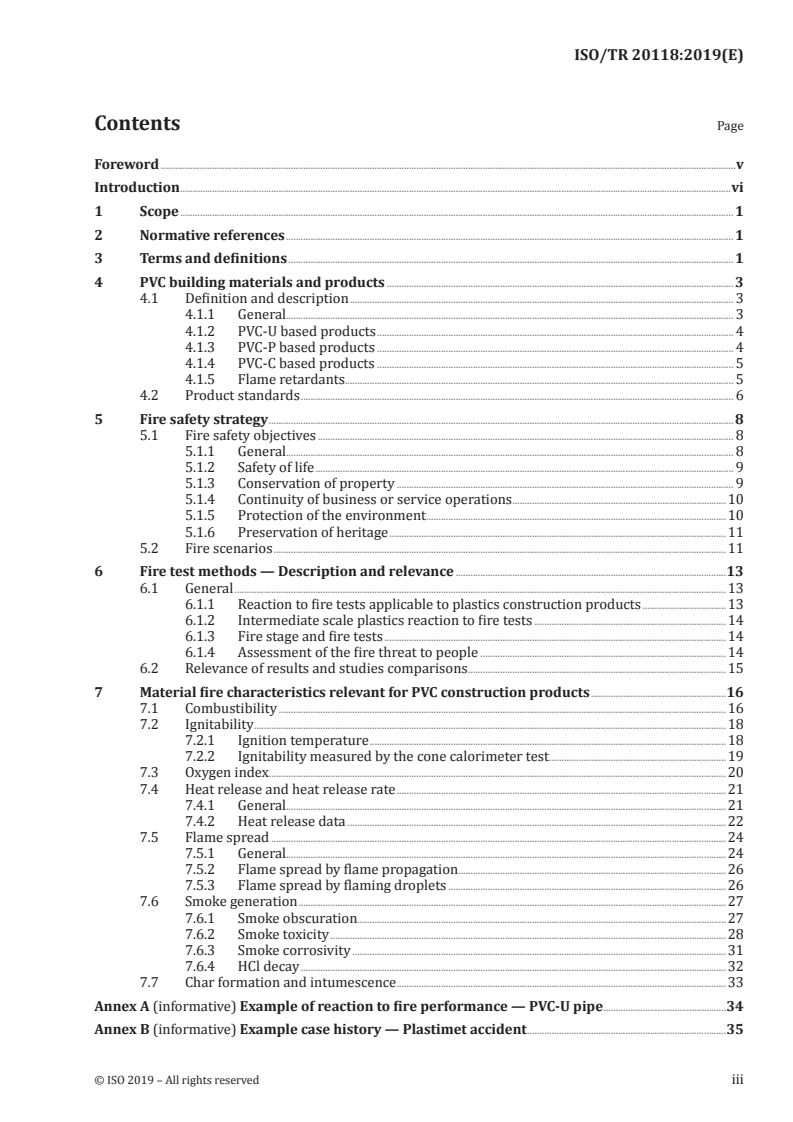
Contents Page
Foreword .v
Introduction .vi
1 Scope . 1
2 Normative references . 1
3 Terms and definitions . 1
4 PVC building materials and products . 3
4.1 Definition and description . 3
4.1.1 General. 3
4.1.2 PVC-U based products . 4
4.1.3 PVC-P based products . 4
4.1.4 PVC-C based products . 5
4.1.5 Flame retardants . . 5
4.2 Product standards . 6
5 Fire safety strategy . 8
5.1 Fire safety objectives . 8
5.1.1 General. 8
5.1.2 Safety of life . 9
5.1.3 Conservation of property . 9
5.1.4 Continuity of business or service operations .10
5.1.5 Protection of the environment .10
5.1.6 Preservation of heritage .11
5.2 Fire scenarios .11
6 Fire test methods — Description and relevance .13
6.1 General .13
6.1.1 Reaction to fire tests applicable to plastics construction products .13
6.1.2 Intermediate scale plastics reaction to fire tests .14
6.1.3 Fire stage and fire tests .14
6.1.4 Assessment of the fire threat to people .14
6.2 Relevance of results and studies comparisons .15
7 Material fire characteristics relevant for PVC construction products .16
7.1 Combustibility .16
7.2 Ignitability .18
7.2.1 Ignition temperature .18
7.2.2 Ignitability measured by the cone calorimeter test .19
7.3 Oxygen index.20
7.4 Heat release and heat release rate .21
7.4.1 General.21
7.4.2 Heat release data .22
7.5 Flame spread .24
7.5.1 General.24
7.5.2 Flame spread by flame propagation.26
7.5.3 Flame spread by flaming droplets .26
7.6 Smoke generation .27
7.6.1 Smoke obscuration.27
7.6.2 Smoke toxicity .28
7.6.3 Smoke corrosivity .31
7.6.4 HCl decay .32
7.7 Char formation and intumescence .33
Annex A (informative) Example of reaction to fire performance — PVC-U pipe .34
Annex B (informative) Example case history — Plastimet accident .35
Bibliography .36
iv © ISO 2019 – All rights reserved
Foreword
ISO (the International Organization for Standardization) is a worldwide federation of national standards
bodies (ISO member bodies). The work of preparing International Standards is normally carried out
through ISO technical committees. Each member body interested in a subject for which a technical
committee has been established has the right to be represented on that committee. International
organizations, governmental and non-governmental, in liaison with ISO, also take part in the work.
ISO collaborates closely with the International Electrotechnical Commission (IEC) on all matters of
electrotechnical standardization.
The procedures used to develop this document and those intended for its further maintenance are
described in the ISO/IEC Directives, Part 1. In particular, the different approval criteria needed for the
different types of ISO documents should be noted. This document was drafted in accordance with the
editorial rules of the ISO/IEC Directives, Part 2 (see www .iso .org/directives).
Attention is drawn to the possibility that some of the elements of this document may be the subject of
patent rights. ISO shall not be held responsible for identifying any or all such patent rights. Details of
any patent rights identified during the development of the document will be in the Introduction and/or
on the ISO list of patent declarations received (see www .iso .org/patents).
Any trade name used in this document is information given for the convenience of users and does not
constitute an endorsement.
For an explanation of the voluntary nature of standards, the meaning of ISO specific terms and
expressions related to conformity assessment, as well as information about ISO's adherence to the
World Trade Organization (WTO) principles in the Technical Barriers to Trade (TBT) see www .iso
.org/iso/foreword .html.
This document was prepared by Technical Committee ISO/TC 61, Plastics, Subcommittee SC 4, Burning
behaviour.
Any feedback or questions on this document should be directed to the user’s national standards body. A
complete listing of these bodies can be found at www .iso .org/members .html.
Introduction
Fire safety is an essential consideration in building design regardless of the type and nature of products
used. Effective measures should be taken to prevent or reduce the likelihood of fires that may result in
casualties, injuries or property damage.
National codes and regulations are the basis of such fire safety measures. Technical details are given
in standards and related documents, referred to as specific documents or incorporated in the said
codes or regulations. Such details are particularly important when performance-based behaviour
[77]
is concerned. A specific case is the European Construction Products Regulation , which specifies
that products need to be tested and classified regarding their fire performance according to the EU
harmonized classification systems for reaction to fire and for resistance to fire.
The construction industry makes significant efforts to protect society from the dramatic consequences
of fires. As a result, 1 % to 8 % of total construction costs are spent on fire safety measures. These costs
are directly dependent on the type of building and can increase considerably for sensitive buildings like
schools and theatres. In the case of shopping centres, fire safety measures can amount to 10 % of total
building costs.
Plastic products are increasingly specified by architects and used by builders. They contribute to
greater energy efficiency, cost savings and to a more comfortable and safer environment. The role
of plastics in fire safety should be addressed despite the fact that they are considered as a major
combustible contributor only in less than 15 % of fires.
Plastic materials or products can be tailored to meet specific needs and to reduce their contribution
to the propagation of a fire. Some families of plastics, such as halogen containing polymers like PVC,
inherently have superior fire performance. The same performance can be achieved or even improved
with other plastics by:
— adding flame retardants;
— covering them with less combustible layers.
Each type of building has its own specific potential fire hazards and fire risks linked to the permanent
elements of the building (i.e. construction products and overall design) as well as its content including
furniture, papers, clothes, domestic and leisure articles. Fire hazard and fire risk are also linked to the
proper use and installation of construction products in the building structure. This is also valid for PVC
and for plastic materials in general, which, like all other construction materials, should be used in the
correct applications and under appropriate conditions.
NOTE Data from various market surveys show that only 10 % to 15 % of all plastics contained in a private
house are in construction products. 85 % to 90 % of plastics are brought into the building by the occupants in, for
example, furniture (including, for example, wooden furniture containing minor plastics elements), decorations,
household and media appliances, clothes, toys and packaging. This means that although PVC is a significant
component of many construction products, other combustible materials often comprise a more important
potential source of fuel, in particular in private houses.
A fire usually involves a combination of different combustible and non-combustible materials. Organic
materials (including all plastics, wood and other carbon containing materials) produce a mixture of
gaseous substances (making fire smoke always hazardous) in addition to a certain degree of heat
release.
As fire is a complex phenomenon, the type and quantity of materials involved are only two of the various
parameters influencing the development and consequences of a fire. The other factors that come into
play include building design, location, potential ignition sources and other fire scenario parameters.
Fire tests results relate only to the behaviour of test specimens under the particular conditions of the test.
They are not intended to be the sole criterion of assessing the potential fire hazard of the product in use.
This document provides information on the fire characteristics and fire performance of PVC based
materials and products used in building applications. It is to be considered as a documentary and
vi © ISO 2019 – All rights reserved
technical reference document for any entity interested in fire safety in building and construction, when
products containing PVC are concerned, including at the design or pre-building phase.
The intended audience for this document includes but is not necessarily limited to:
— materials and products manufacturers;
— building designers, specifiers and architects;
— building owners and managers;
— fire fighters and investigators;
— public health authorities;
— fire testing laboratories.
TECHNICAL REPORT ISO/TR 20118:2019(E)
Plastics — Guidance on fire characteristics and
fire performance of PVC materials used in building
applications
1 Scope
This document provides information on the fire characteristics and performance in fire tests of PVC
materials and products for use in building applications.
It illustrates a number of suitable applications incorporating primarily PVC materials, including
unplasticized PVC (PVC-U), plasticized (or flexible) PVC (PVC-P) and chlorinated PVC (PVC-C) based
products. Except where otherwise stated, there is no restriction with reference to the content of PVC
(in terms of quantity and composition) in the products mentioned in this document.
This document draws attention to the limits of applicability or the unsuitability of some standard fire
test methods for certain applications of PVC based products in buildings.
This document applies to products during their use phase in the building and does not apply to the
manufacturing phase of plastic products. It neither applies to general safety measures applicable to the
installation phase nor to the dismantling or the demolition phase of the building.
2 Normative references
The following documents are referred to in the text in such a way that some or all of their content
constitutes requirements of this document. For dated references, only the edition cited applies. For
undated references, the latest edition of the referenced document (including any amendments) applies.
ISO 472, Plastics — Vocabulary
ISO 13943, Fire safety — Vocabulary
IEC 60695-4, Fire hazard testing — Part 4: Terminology concerning fire tests for electrotechnical products
3 Terms and definitions
For the purposes of this document, the terms and definitions given in ISO 472, ISO 13943, IEC 60695-4
and the following apply.
ISO and IEC maintain terminological databases for use in standardization at the following addresses:
— ISO Online browsing platform: available at https: //www .iso .org/obp
— IEC Electropedia: available at http: //www .electropedia .org/
3.1
composite
solid product consisting of two or more distinct phases, including a binding material (matrix) and a
particulate or fibrous material
Note 1 to entry: Solid product consisting of two or more layers (often in a symmetrical assembly) of, for instance,
plastic film or sheet, normal or syntactic cellular plastic, metal, wood or a composite, with or without adhesive
interlayers.
[SOURCE: ISO 472:2013, 2.182.1 and 2.182.2, modified —2.182.1 and 2.182.2 have been merged into
one entry.]
3.2
compound
intimate mixture of a polymer or polymers with other ingredients such as fillers, plasticizers catalysts
and colorants
Note 1 to entry: The terms “formulation” and “composition” are sometimes used as synonyms.
[SOURCE: ISO 472:2013, 2.184, modified — Note 1 to entry has been added.]
3.3
fire effluent
totality of gases and aerosols, including suspended particles, created by combustion or pyrolysis in a fire
Note 1 to entry: For the purpose of this document, fire effluent also includes run-off water generated during fire-
fighting activities.
3.4
fire safety engineering
application of engineering methods to the development or assessment of designs in the built
environment through the analysis of specific fire scenarios or through the quantification of risk for a
group of fire scenarios
[SOURCE: ISO 13943:2017, 3.149]
3.5
flash ignition temperature
minimum temperature at which, under specified test conditions, sufficient flammable gases are emitted
to ignite momentarily on application of a pilot flame
Note 1 to entry: Compare with the terms ignitability (3.7), minimum ignition temperature and spontaneous
ignition temperature (see ISO 13943].
Note 2 to entry: Flash ignition temperature refers to the ignition temperature determined for solid specimens
on application of a flame to the specimen, for example in a test method such as ISO 871. Flash point refers to the
temperature to which a flammable liquid must be heated for its vapours to ignite.
Note 3 to entry: The typical units are °C.
[SOURCE: ISO 871:2006, 3.1, modified — Notes to entry have been added.]
3.6
heat release
thermal energy produced by combustion
Note 1 to entry: The typical unit is J.
[SOURCE: ISO 13943:2017, 3.205]
3.7
ignitability
measure of the ease with which a test specimen can be ignited, under specified conditions
Note 1 to entry: Also known as ease of ignition.
[SOURCE: ISO 13943:2017, 3.212, modified — Notes to entry have been replaced.]
3.8
plastics products
articles or stock shapes of plastic materials for any type of application
[SOURCE: ISO 11469:2016, 3.2]
2 © ISO 2019 – All rights reserved
3.9
plenum
compartment or chamber to which one or more air ducts are connected and that forms part of the air
distribution system
Note 1 to entry: Plenums are typically located above ceilings or below raised floors and they are the areas
that contain heating, ventilating or air conditioning ducts. Products such as data and communications cables,
associated cable management systems and sprinkler piping are also often contained in plenums.
[SOURCE: NFPA Glossary of terms (2013)]
3.10
profile
extruded plastic product, excluding film and sheet, having a characteristic constant cross-section along
the axis of the product
[SOURCE: ISO 472:2013, 2.839, modified — Note to entry has been omitted.]
3.11
chlorinated PVC
PVC-C
polyvinylchloride, which is a thermoplastic obtained by polymerization of vinyl chloride and to which
additional chloride is chemically bonded by substitution of hydrogen atoms
Note 1 to entry: It is also commonly referred to as CPVC.
3.12
plasticized PVC
PVC-P
polyvinylchloride, which is a thermoplastic obtained by polymerization of vinyl chloride and plasticized
by the addition of specific additives
Note 1 to entry: It is also commonly referred to as flexible PVC and soft PVC.
3.13
unplasticized PVC
PVC-U
polyvinylchloride, which is a thermoplastic obtained by polymerization of vinyl chloride
Note 1 to entry: It is also commonly referred to as rigid PVC.
3.14
spontaneous-ignition temperature
minimum temperature at which ignition is obtained by heating, under specified test conditions, in the
absence of any flame ignition source
Note 1 to entry: Spontaneous ignition temperature is typically used in fire tests while auto-ignition temperature
is often used as a material or product property.
4 PVC building materials and products
4.1 Definition and description
4.1.1 General
PVC is the most widely used polymer in building and construction applications and, for instance, up to
70 % of the World’s annual PVC production is used in this sector.
PVC is a thermoplastic composed of 56,8 mass % of chlorine (typically derived from industrial grade
salt) and 43,2 mass % of carbon and hydrogen (derived predominantly from oil or gas via ethylene). The
chlorine content gives excellent intrinsic fire performance to PVC.
PVC resin is often supplied in powder form and long-term storage is possible since the material is
resistant to oxidation and degradation. Various additives such as processing agents, stabilizers, fillers,
plasticizers, flame retardants, and pigments are added to the PVC resin during the compounding stage,
depending on the desired properties of the final product. The compound is then converted into PVC
products.
According to ISO 1043-1, PVC belongs to Group A, homopolymers. PVC compounds are classified in
different categories:
— PVC-U: unplasticized PVC, commonly named rigid PVC
— PVC-P: plasticized PVC, also named soft or flexible PVC
— PVC-C: chlorinated PVC, also identified as CPVC
ISO 11469 specifies a system of uniform marking of products that have been fabricated from plastics
materials. It refers to ISO 1043-1 (basic polymers), ISO 1043-2 (fillers and reinforcing materials),
ISO 1043-3 (plasticizers) and ISO 1043-4 (flame retardants).
NOTE 1 ISO 11469 is not intended to supplant, replace or in any way interfere with the requirements for
labelling specified in products standards or legislation.
The same rules apply in the cases of PVC containing, for example, a plasticizer and/or a flame retardant
(see 4.1.2 to 4.1.5).
NOTE 2 When possible and appropriate, compounds containing plasticizers can be marked with the
abbreviated term for the polymer followed by a hyphen, then the symbol “P” followed by the abbreviated term
of the plasticizer in parentheses, as given in ISO 1043-3. The exact marking is generally specified in the product
standard. It can be compulsory in case it is specified, for example, in an applicable regulation.
While the marking system is intended to help identify plastics products for subsequent decisions
concerning handling, waste recovery or disposal, it is also very useful to identify a material to be
subjected to fire testing.
NOTE 3 For characteristics other than the chemical composition of the material or product, such as reaction
to fire properties, a complementary and specific marking can be used.
4.1.2 PVC-U based products
Unplasticized PVC products are intended for applications where rigidity is needed. Some common
applications for PVC-U products include pipes, window profiles, conduit, siding, fences, decks and
railings. The use of plasticizers differentiates flexible vinyl products from rigid ones. The rigidity of
PVC is maintained by not introducing plasticizers.
In reaction to fire tests, PVC-U displays a high resistance to ignition, a low rate of heat release, and
self-extinguishes when the external ignition source is removed. This is because of its high content of
chlorine.
4.1.3 PVC-P based products
PVC is plasticized for applications where the flexibility of the final product is essential such as wire
sheathing and insulation, floor and wall coverings and flexible sheets.
4 © ISO 2019 – All rights reserved
The fire properties of PVC generally deteriorate to a certain extent when PVC is plasticized depending
on the amount and kind of plasticizer and other additives used. However, many of the plasticized PVC
products in use will not continue to burn once the flame source is removed, even if not additionally
fire-retarded. Moreover, technologies were developed in the 1980s and 1990s, using combinations of
plasticizers and other additives, which resulted in plasticized PVC materials with fire properties similar
or better than those of the corresponding native unplasticized PVC.
4.1.4 PVC-C based products
PVC-C is obtained from normal PVC resin to which additional chlorine is introduced in the polymer
chain, to reach a chlorine content in the range of 62 % to 68 % by mass, leading to a different family of
vinyl polymers. This addition leads to improved fire properties: further decrease in the flammability
(including heat release) of the polymer and significant decrease in intrinsic smoke generation. The reason
for this effect on smoke generation is likely to be a change in the mechanism of dehydrochlorination.
4.1.5 Flame retardants
The term “flame retardant” refers to a range of additives of various chemical compositions that can
be added to materials to improve their fire behaviour and reduce fire hazard. Various species of flame
retardants, including smoke suppressants, alone or in combination, can lead to consistent lowering of
heat release, flame spread, ignitability, (by increasing the time to ignition or the minimum heat flux for
ignition), or smoke release.
NOTE The presence of flame retardants is indicated according to ISO 1043-4.
Altogether, there are over 200 different types of substances that can be used as flame retardants and
they are often applied in synergistic combinations with each other. Not all flame retardants provide
their functionality for all materials and some are often specific to or incompatible with certain
materials. Properties depend on their physical form and use conditions.
A wide range of flame retardants are used with PVC construction products. Flame retardants can act in
the condensed phase or in the vapor phase and they may even act in a combination of both. Typical flame
retardants for PVC include those based on metal hydroxides (e.g. aluminium hydroxide or magnesium
hydroxide), antimony oxide, zinc derivatives (e.g. zinc borate, zinc stannate or zinc hydroxystannate),
bromine derivatives (e.g. brominated phthalates), molybdenum compounds, or phosphates (particularly
aryl phosphates, aryl alkyl phosphates or halogenated phosphates), and a variety of other additives,
often in various combinations.
Smoke suppressants are additives used in PVC compounds to lower the resulting smoke production.
Just like other flame retardants, smoke suppressants can act in the solid phase (i.e. the PVC matrix) or
in the vapor phase, in each case in a physical or chemical manner.
The following discusses the mechanism of action of some flame retardants and/or smoke suppressants.
— Halogen-containing materials (in which the halogen is mainly either bromine or chorine) tend to act
primarily in the vapor phase as free radical scavengers. Some of the additives used are chlorinated
paraffins, or polycyclic chlorinated or brominated materials.
— Aluminium trihydrate (or aluminium hydroxide, ATH) (Al(OH) ) and magnesium hydroxide
(Mg(OH) ) act primarily by releasing water into the vapor phase and thus both cooling the vapor
phase and diluting it to decrease the likelihood of reaching the flammability limit. They typically
need to be used in high loadings.
— Antimony oxide (Sb O ) typically needs the presence of halogen-containing materials for action,
2 3
primarily in the vapor phase, by forming antimony-halogen compounds, so that it is a very effective
flame retardant for PVC.
— Zinc borate (Zn B O .nH O) is a potential partial replacement for antimony oxide, and it is a char
x y z 2
promoter which typically needs the presence of halogen atoms. In some cases, it can be synergistic
with ATH.
— Aryl phosphates (especially aryl alkyl phosphates) are flame retardants and plasticizers and work
to decrease both heat release and smoke release and they are often used in high performance PVC
cable materials.
— Molybdenum compounds (molybdenum trioxide (MoO ) and ammonium molybdate ((NH ) MoO ),
3 4 2 4
also often used as a hydrate) act primarily as smoke suppressants by reducing the formation of
aromatic compounds, which are soot precursors.
— Compounds of tin and zinc, especially zinc stannate (ZnSnO ) and zinc hydroxystannate (ZnSn(OH) )
3 6
are, just like molybdenum compounds, primarily used to decrease smoke, as synergists, in high
performance cable compounds.
— Some iron-based components generate a char layer after reacting with hydrogen chloride to produce
iron (III) chloride (FeCl ).
— Calcium carbonate (CaCO ) and magnesium carbonate (MgCO ) both act primarily as absorbers of
3 3
hydrogen chloride and tend to reduce hydrogen chloride release and also smoke production.
The type and levels of flame retardant (or smoke suppressant) additives used are dependent on the
specific fire classification (such as a fire test) the material will need to meet.
PVC products, particularly unplasticized ones, have inherently good resistance to burning and the
incorporation of flame retardants into PVC based rigid construction products is generally limited to
particular applications in public buildings and certain indoor locations, to which specific regulations
apply. However, the use of flame retardants and/or smoke suppressants is very frequent for electrical
and/or optical fibre cables, construction products which, when they use PVC materials, involve
plasticized PVC.
4.2 Product standards
A number of PVC products are covered by various standardization committees. The ISO and IEC
technical committees (as well as ones from CEN and CENELEC and technical committees in individual
countries) that exist have the properties of most PVC materials and products used in construction
within their scope. The list below presents information on some committees that address the PVC
products to which this document applies:
— PVC materials (including recycled and composite PVC materials):
— ISO TC 61 SC9: Plastics — Thermoplastic materials — Poly(vinyl chloride)
— CEN TC 249 WG11: Plastics — Plastics recycling
— CEN TC 249 WG13: Plastics — Wood Plastics Composites (WPC)
— ASTM D20 (Section D20.15.07), Plastics — Thermoplastic Materials — Vinyl chloride polymers
— Plastics pipes and fittings:
— ISO TC 138: Plastics pipes, fittings and valves for the transport of fluids
— CEN TC 155: Plastics piping systems and ducting systems
— ASTM F17 (F17.25), Plastic Piping Systems (Vinyl Based Pipe)
— Profiles for doors and windows:
— ISO TC 162: Doors and windows
— CEN TC 33: Doors, windows, shutters, building hardware and curtain walling
— CEN TC 249 WG21: Plastics — Profiles for windows and doors
6 © ISO 2019 – All rights reserved
— ASTM D20 (D20.24), Plastics (Plastic Building Products)
— Covering sheets:
— ISO TC 219 WG 2: Floor coverings - Resilient floor coverings
— CEN TC 99: Wall coverings
— CEN TC 134 WG7: Resilient, textile and laminate floor coverings — Resilient floor coverings
— CEN TC 249 WG22: Plastics — Wall covering panels for building applications
— ASTM F15 (F15.15), Consumer Products (Wallcoverings)
— Flexible sheets (including stretched sheets):
— ISO TC 61 SC11 WG3: Plastics — Products — Plastics films and sheeting
— CEN TC 254 SC2: Flexible sheets for waterproofing — Synthetic sheets
— CEN TC 357: Stretched ceilings
— ASTM D20 (D20.19), Plastics (Film, sheeting and moulding products)
— Rigid sheets and profiles:
— ISO TC 61 SC11: Plastics — Products
— CEN TC 128 SC9: Roof covering products for discontinuous laying and products for wall cladding —
Prefabricated accessories for roofing
— CEN TC 128 SC10: Roof covering products for discontinuous laying and products for wall cladding
— Gutters
— CEN TC 249 WG5: Plastics — Thermoplastic profiles for building applications
— CEN TC 249 WG12: Plastics — Plastics jacketing
— Technical and composites products:
— ISO TC 61 SC11 WG 11: Plastics — Products — Wood-plastic composites
— CEN TC 88: Thermal insulating materials and products
— CEN TC 217: Surfaces for sport areas
— ASTM D20 (D20.20), Plastics (Plastic lumber)
— ASTM D7 (D7.02.07), Wood (Wood/plastic composites)
— Electro-technical products:
— IEC TC 15: Solid electrical insulating materials
— IEC TC 20: Electric cables
— IEC TC 23: Electrical accessories
— CLC TC 20: Electric cables
— CLC TC 213: Cable management systems
— ASTM D9, (Electrical and electronic insulating materials)
The standards and other documents issued by these committees generally address a panel of
characteristics, properties or performance applicable to the concerned products to be used, both
generally and in specific conditions, such as chemical, mechanical, dimensional and durability
properties. However, safety related performance, including those related to fire safety, is addressed in a
limited number of cases. Such performance is typically addressed in codes and regulations, which often
use specific fire test methods.
The products related standards, technical specifications or technical reports often refer to ISO (and
other) test method standards in order to complete the technical content applicable to the concerned
products by linking characterization or specification with test methods normative references.
Many of the recommended fire test methods applicable to PVC products are produced by ISO/TC 61
and ISO/TC 92. Other fire test methods are produced by IEC/TC 89 and IEC/TC 15. In the US, ASTM and
NFPA also generate fire test methods. Geometry, mounting and fixing of specimens submitted to testing
are often detailed in the corresponding product standards developed by the responsible product
technical committees.
NOTE Pre-selection testing for electrotechnical products is discussed in IEC 60695-1-30.
5 Fire safety strategy
5.1 Fire safety objectives
5.1.1 General
Fire safety objectives are best achieved by the application of fire safety engineering principles.
This chapter on fire safety objectives is based on information provided by scientific studies and other
standards, as shown below. ISO 23932-1 introduces general principles regarding fire safety engineering.
It provides an operational, performance-based methodology for users to assess the level of fire safety
for new or existing built environments. Fire safety is evaluated through an engineering approach based
on the quantification of the behaviour of fire and people and based on knowledge of the consequences
of such behaviour on life safety, property and the environment.
This document is intended to be useful for developers, manufacturers and users of construction
products because it lists the basic principles of fire safety design that should be applied to all generic
phenomena associated with fire (e.g. fire growth, extent of smoke movement, structural behaviour) and
the fire safety objectives addressing these phenomena, such as:
— the safety of life, including safe escape and safety of rescue teams;
— the conservation of property, including avoiding propagation to adjacent buildings;
— continuity of business operations;
— protection of the environment;
— preservation of heritage.
The fire performance of a construction product should always be considered as an essential element
in the context of the fire safety objective(s) defined for the situation envisaged. This document
presents all the key parameters that should be considered to assess fire safety in any fire scenario,
including: ignitability, ease of extinction, heat release, flame propagation, smoke obscuration, smoke
toxicity, emergency measures and active fire protection measures. The optimization of a partial set of
parameters would not be appropriate for defining a responsible fire safety strategy.
In terms of fire safety objectives related to user needs or social expectations, ISO 19208 lists the
following commonly encountered subject matter of objectives:
— hazards of outbreak of fire and of spread of fire;
8 © ISO 2019 – All rights reserved
— physiological effects of smoke and heat;
— alarm time (detection and alarm systems);
— evacuation time (escape routes);
— survival time (fire compartmentation).
ISO 15928-4 sets out a method for describing the fire safety performance within houses. It covers user
needs, provides performance descriptions, and outlines evaluation processes. It includes the description
of relevant parameters for early warning, fire suppression, fire containment, means of escape, control
of structural behaviour and emission and spread of fire effluent. It is intended for use in the evaluation
of the design and construction of houses, in the international trading of house sub-systems, and in
developing tools to manage fire hazard and fire risk for the protection of buildings. It does not specify a
level of performance and it is not intended to provide either some design method and/or criteria.
NOTE Useful guidance and an overview of fire safety engineering as applicable to electrotechnical products
are given in IEC 60695-1-12.
5.1.2 Safety of life
The objectives for a goal of minimizing loss of life or damage to health will typically be stated in terms
of goals to ensure safe evacuation or rescue for occupants in all compartments in the built environment.
For safety from injuries that can occur before an occupant can reasonably react to fire and begin
evacuation, the objectives will typically be stated in terms of goals on equipment or other products to
reduce the likelihood of fire occurrence. (See ISO 23932-1.)
Incapacitation is reached when a threshold is attained with reference to any of the following parameters:
— heat (in case of radiation on the body and breathing hot air): discomfort occurs at 54 °C, effects
become dangerous at 65 °C and are deadly above that temperature; humid air being more dangerous
than dry air;
— obstruction of the respiratory tract: accumulation of soot of all sizes, from nanoparticles to
aggregates;
— toxicity of the fire effluent, as a result of either asphyxiation or irritation;
— smoke opacity, causing impairment of visibility and potential disorientation.
Synergistic or antagonistic effects could occur depending on the composition of the smoke and the
nature of the local environment.
NOTE The ocular irritation produced by high levels of acidic or basic substances can be a cause of loss of
visibility in addition to the physical one generated by the smoke itself. This phenomenon depends on the overall
composition of the fire effluent and not only on any one specific substance.
5.1.3 Conservation of property
Property conservation objectives will typically seek to reduce or avoid both damage to the built
environment and damage to contents, such as equipment. (See ISO 23932-1.)
These objectives could be considered as relating to three types of situations. The first one relates to the
place where the fire occurred, while the second one relates to adjacent locations, meaning compartments
or rooms away from the compartment of fire origin, to which the products of the fire (such as flames,
heat, smoke and combustion products) can penetrate. The third area relates to locations so far away
from the compartment of fire origin that heat effects can be ignored.
In the compartment of fire origin, the effects are primarily caused by heat released during the first
phases of the fire, because the time scale is often too short for other chemical reactions to develop.
Later in the fire, if the fire becomes big enough and reaches flashover, there will be complete property
destruction. Once that stage has been reached, the chemical impact of any substance, including acidic
chemicals released by halogenated plastics, is irrelevant.
In locations outside the compartment of f
...
TECHNICAL ISO/TR
REPORT 20118
First edition
2019-04
Plastics — Guidance on fire
characteristics and fire performance
of PVC materials used in building
applications
Plastiques — Lignes directrices relatives aux caractéristiques et
aux performances au feu des matériaux en PVC utilisés dans les
applications de construction
Reference number
©
ISO 2019
COPYRIGHT PROTECTED DOCUMENT
© ISO 2019
All rights reserved. Unless otherwise specified, or required in the context of its implementation, no part of this publication may
be reproduced or utilized otherwise in any form or by any means, electronic or mechanical, including photocopying, or posting
on the internet or an intranet, without prior written permission. Permission can be requested from either ISO at the address
below or ISO’s member body in the country of the requester.
ISO copyright office
CP 401 • Ch. de Blandonnet 8
CH-1214 Vernier, Geneva
Phone: +41 22 749 01 11
Fax: +41 22 749 09 47
Email: copyright@iso.org
Website: www.iso.org
Published in Switzerland
ii © ISO 2019 – All rights reserved
Contents Page
Foreword .v
Introduction .vi
1 Scope . 1
2 Normative references . 1
3 Terms and definitions . 1
4 PVC building materials and products . 3
4.1 Definition and description . 3
4.1.1 General. 3
4.1.2 PVC-U based products . 4
4.1.3 PVC-P based products . 4
4.1.4 PVC-C based products . 5
4.1.5 Flame retardants . . 5
4.2 Product standards . 6
5 Fire safety strategy . 8
5.1 Fire safety objectives . 8
5.1.1 General. 8
5.1.2 Safety of life . 9
5.1.3 Conservation of property . 9
5.1.4 Continuity of business or service operations .10
5.1.5 Protection of the environment .10
5.1.6 Preservation of heritage .11
5.2 Fire scenarios .11
6 Fire test methods — Description and relevance .13
6.1 General .13
6.1.1 Reaction to fire tests applicable to plastics construction products .13
6.1.2 Intermediate scale plastics reaction to fire tests .14
6.1.3 Fire stage and fire tests .14
6.1.4 Assessment of the fire threat to people .14
6.2 Relevance of results and studies comparisons .15
7 Material fire characteristics relevant for PVC construction products .16
7.1 Combustibility .16
7.2 Ignitability .18
7.2.1 Ignition temperature .18
7.2.2 Ignitability measured by the cone calorimeter test .19
7.3 Oxygen index.20
7.4 Heat release and heat release rate .21
7.4.1 General.21
7.4.2 Heat release data .22
7.5 Flame spread .24
7.5.1 General.24
7.5.2 Flame spread by flame propagation.26
7.5.3 Flame spread by flaming droplets .26
7.6 Smoke generation .27
7.6.1 Smoke obscuration.27
7.6.2 Smoke toxicity .28
7.6.3 Smoke corrosivity .31
7.6.4 HCl decay .32
7.7 Char formation and intumescence .33
Annex A (informative) Example of reaction to fire performance — PVC-U pipe .34
Annex B (informative) Example case history — Plastimet accident .35
Bibliography .36
iv © ISO 2019 – All rights reserved
Foreword
ISO (the International Organization for Standardization) is a worldwide federation of national standards
bodies (ISO member bodies). The work of preparing International Standards is normally carried out
through ISO technical committees. Each member body interested in a subject for which a technical
committee has been established has the right to be represented on that committee. International
organizations, governmental and non-governmental, in liaison with ISO, also take part in the work.
ISO collaborates closely with the International Electrotechnical Commission (IEC) on all matters of
electrotechnical standardization.
The procedures used to develop this document and those intended for its further maintenance are
described in the ISO/IEC Directives, Part 1. In particular, the different approval criteria needed for the
different types of ISO documents should be noted. This document was drafted in accordance with the
editorial rules of the ISO/IEC Directives, Part 2 (see www .iso .org/directives).
Attention is drawn to the possibility that some of the elements of this document may be the subject of
patent rights. ISO shall not be held responsible for identifying any or all such patent rights. Details of
any patent rights identified during the development of the document will be in the Introduction and/or
on the ISO list of patent declarations received (see www .iso .org/patents).
Any trade name used in this document is information given for the convenience of users and does not
constitute an endorsement.
For an explanation of the voluntary nature of standards, the meaning of ISO specific terms and
expressions related to conformity assessment, as well as information about ISO's adherence to the
World Trade Organization (WTO) principles in the Technical Barriers to Trade (TBT) see www .iso
.org/iso/foreword .html.
This document was prepared by Technical Committee ISO/TC 61, Plastics, Subcommittee SC 4, Burning
behaviour.
Any feedback or questions on this document should be directed to the user’s national standards body. A
complete listing of these bodies can be found at www .iso .org/members .html.
Introduction
Fire safety is an essential consideration in building design regardless of the type and nature of products
used. Effective measures should be taken to prevent or reduce the likelihood of fires that may result in
casualties, injuries or property damage.
National codes and regulations are the basis of such fire safety measures. Technical details are given
in standards and related documents, referred to as specific documents or incorporated in the said
codes or regulations. Such details are particularly important when performance-based behaviour
[77]
is concerned. A specific case is the European Construction Products Regulation , which specifies
that products need to be tested and classified regarding their fire performance according to the EU
harmonized classification systems for reaction to fire and for resistance to fire.
The construction industry makes significant efforts to protect society from the dramatic consequences
of fires. As a result, 1 % to 8 % of total construction costs are spent on fire safety measures. These costs
are directly dependent on the type of building and can increase considerably for sensitive buildings like
schools and theatres. In the case of shopping centres, fire safety measures can amount to 10 % of total
building costs.
Plastic products are increasingly specified by architects and used by builders. They contribute to
greater energy efficiency, cost savings and to a more comfortable and safer environment. The role
of plastics in fire safety should be addressed despite the fact that they are considered as a major
combustible contributor only in less than 15 % of fires.
Plastic materials or products can be tailored to meet specific needs and to reduce their contribution
to the propagation of a fire. Some families of plastics, such as halogen containing polymers like PVC,
inherently have superior fire performance. The same performance can be achieved or even improved
with other plastics by:
— adding flame retardants;
— covering them with less combustible layers.
Each type of building has its own specific potential fire hazards and fire risks linked to the permanent
elements of the building (i.e. construction products and overall design) as well as its content including
furniture, papers, clothes, domestic and leisure articles. Fire hazard and fire risk are also linked to the
proper use and installation of construction products in the building structure. This is also valid for PVC
and for plastic materials in general, which, like all other construction materials, should be used in the
correct applications and under appropriate conditions.
NOTE Data from various market surveys show that only 10 % to 15 % of all plastics contained in a private
house are in construction products. 85 % to 90 % of plastics are brought into the building by the occupants in, for
example, furniture (including, for example, wooden furniture containing minor plastics elements), decorations,
household and media appliances, clothes, toys and packaging. This means that although PVC is a significant
component of many construction products, other combustible materials often comprise a more important
potential source of fuel, in particular in private houses.
A fire usually involves a combination of different combustible and non-combustible materials. Organic
materials (including all plastics, wood and other carbon containing materials) produce a mixture of
gaseous substances (making fire smoke always hazardous) in addition to a certain degree of heat
release.
As fire is a complex phenomenon, the type and quantity of materials involved are only two of the various
parameters influencing the development and consequences of a fire. The other factors that come into
play include building design, location, potential ignition sources and other fire scenario parameters.
Fire tests results relate only to the behaviour of test specimens under the particular conditions of the test.
They are not intended to be the sole criterion of assessing the potential fire hazard of the product in use.
This document provides information on the fire characteristics and fire performance of PVC based
materials and products used in building applications. It is to be considered as a documentary and
vi © ISO 2019 – All rights reserved
technical reference document for any entity interested in fire safety in building and construction, when
products containing PVC are concerned, including at the design or pre-building phase.
The intended audience for this document includes but is not necessarily limited to:
— materials and products manufacturers;
— building designers, specifiers and architects;
— building owners and managers;
— fire fighters and investigators;
— public health authorities;
— fire testing laboratories.
TECHNICAL REPORT ISO/TR 20118:2019(E)
Plastics — Guidance on fire characteristics and
fire performance of PVC materials used in building
applications
1 Scope
This document provides information on the fire characteristics and performance in fire tests of PVC
materials and products for use in building applications.
It illustrates a number of suitable applications incorporating primarily PVC materials, including
unplasticized PVC (PVC-U), plasticized (or flexible) PVC (PVC-P) and chlorinated PVC (PVC-C) based
products. Except where otherwise stated, there is no restriction with reference to the content of PVC
(in terms of quantity and composition) in the products mentioned in this document.
This document draws attention to the limits of applicability or the unsuitability of some standard fire
test methods for certain applications of PVC based products in buildings.
This document applies to products during their use phase in the building and does not apply to the
manufacturing phase of plastic products. It neither applies to general safety measures applicable to the
installation phase nor to the dismantling or the demolition phase of the building.
2 Normative references
The following documents are referred to in the text in such a way that some or all of their content
constitutes requirements of this document. For dated references, only the edition cited applies. For
undated references, the latest edition of the referenced document (including any amendments) applies.
ISO 472, Plastics — Vocabulary
ISO 13943, Fire safety — Vocabulary
IEC 60695-4, Fire hazard testing — Part 4: Terminology concerning fire tests for electrotechnical products
3 Terms and definitions
For the purposes of this document, the terms and definitions given in ISO 472, ISO 13943, IEC 60695-4
and the following apply.
ISO and IEC maintain terminological databases for use in standardization at the following addresses:
— ISO Online browsing platform: available at https: //www .iso .org/obp
— IEC Electropedia: available at http: //www .electropedia .org/
3.1
composite
solid product consisting of two or more distinct phases, including a binding material (matrix) and a
particulate or fibrous material
Note 1 to entry: Solid product consisting of two or more layers (often in a symmetrical assembly) of, for instance,
plastic film or sheet, normal or syntactic cellular plastic, metal, wood or a composite, with or without adhesive
interlayers.
[SOURCE: ISO 472:2013, 2.182.1 and 2.182.2, modified —2.182.1 and 2.182.2 have been merged into
one entry.]
3.2
compound
intimate mixture of a polymer or polymers with other ingredients such as fillers, plasticizers catalysts
and colorants
Note 1 to entry: The terms “formulation” and “composition” are sometimes used as synonyms.
[SOURCE: ISO 472:2013, 2.184, modified — Note 1 to entry has been added.]
3.3
fire effluent
totality of gases and aerosols, including suspended particles, created by combustion or pyrolysis in a fire
Note 1 to entry: For the purpose of this document, fire effluent also includes run-off water generated during fire-
fighting activities.
3.4
fire safety engineering
application of engineering methods to the development or assessment of designs in the built
environment through the analysis of specific fire scenarios or through the quantification of risk for a
group of fire scenarios
[SOURCE: ISO 13943:2017, 3.149]
3.5
flash ignition temperature
minimum temperature at which, under specified test conditions, sufficient flammable gases are emitted
to ignite momentarily on application of a pilot flame
Note 1 to entry: Compare with the terms ignitability (3.7), minimum ignition temperature and spontaneous
ignition temperature (see ISO 13943].
Note 2 to entry: Flash ignition temperature refers to the ignition temperature determined for solid specimens
on application of a flame to the specimen, for example in a test method such as ISO 871. Flash point refers to the
temperature to which a flammable liquid must be heated for its vapours to ignite.
Note 3 to entry: The typical units are °C.
[SOURCE: ISO 871:2006, 3.1, modified — Notes to entry have been added.]
3.6
heat release
thermal energy produced by combustion
Note 1 to entry: The typical unit is J.
[SOURCE: ISO 13943:2017, 3.205]
3.7
ignitability
measure of the ease with which a test specimen can be ignited, under specified conditions
Note 1 to entry: Also known as ease of ignition.
[SOURCE: ISO 13943:2017, 3.212, modified — Notes to entry have been replaced.]
3.8
plastics products
articles or stock shapes of plastic materials for any type of application
[SOURCE: ISO 11469:2016, 3.2]
2 © ISO 2019 – All rights reserved
3.9
plenum
compartment or chamber to which one or more air ducts are connected and that forms part of the air
distribution system
Note 1 to entry: Plenums are typically located above ceilings or below raised floors and they are the areas
that contain heating, ventilating or air conditioning ducts. Products such as data and communications cables,
associated cable management systems and sprinkler piping are also often contained in plenums.
[SOURCE: NFPA Glossary of terms (2013)]
3.10
profile
extruded plastic product, excluding film and sheet, having a characteristic constant cross-section along
the axis of the product
[SOURCE: ISO 472:2013, 2.839, modified — Note to entry has been omitted.]
3.11
chlorinated PVC
PVC-C
polyvinylchloride, which is a thermoplastic obtained by polymerization of vinyl chloride and to which
additional chloride is chemically bonded by substitution of hydrogen atoms
Note 1 to entry: It is also commonly referred to as CPVC.
3.12
plasticized PVC
PVC-P
polyvinylchloride, which is a thermoplastic obtained by polymerization of vinyl chloride and plasticized
by the addition of specific additives
Note 1 to entry: It is also commonly referred to as flexible PVC and soft PVC.
3.13
unplasticized PVC
PVC-U
polyvinylchloride, which is a thermoplastic obtained by polymerization of vinyl chloride
Note 1 to entry: It is also commonly referred to as rigid PVC.
3.14
spontaneous-ignition temperature
minimum temperature at which ignition is obtained by heating, under specified test conditions, in the
absence of any flame ignition source
Note 1 to entry: Spontaneous ignition temperature is typically used in fire tests while auto-ignition temperature
is often used as a material or product property.
4 PVC building materials and products
4.1 Definition and description
4.1.1 General
PVC is the most widely used polymer in building and construction applications and, for instance, up to
70 % of the World’s annual PVC production is used in this sector.
PVC is a thermoplastic composed of 56,8 mass % of chlorine (typically derived from industrial grade
salt) and 43,2 mass % of carbon and hydrogen (derived predominantly from oil or gas via ethylene). The
chlorine content gives excellent intrinsic fire performance to PVC.
PVC resin is often supplied in powder form and long-term storage is possible since the material is
resistant to oxidation and degradation. Various additives such as processing agents, stabilizers, fillers,
plasticizers, flame retardants, and pigments are added to the PVC resin during the compounding stage,
depending on the desired properties of the final product. The compound is then converted into PVC
products.
According to ISO 1043-1, PVC belongs to Group A, homopolymers. PVC compounds are classified in
different categories:
— PVC-U: unplasticized PVC, commonly named rigid PVC
— PVC-P: plasticized PVC, also named soft or flexible PVC
— PVC-C: chlorinated PVC, also identified as CPVC
ISO 11469 specifies a system of uniform marking of products that have been fabricated from plastics
materials. It refers to ISO 1043-1 (basic polymers), ISO 1043-2 (fillers and reinforcing materials),
ISO 1043-3 (plasticizers) and ISO 1043-4 (flame retardants).
NOTE 1 ISO 11469 is not intended to supplant, replace or in any way interfere with the requirements for
labelling specified in products standards or legislation.
The same rules apply in the cases of PVC containing, for example, a plasticizer and/or a flame retardant
(see 4.1.2 to 4.1.5).
NOTE 2 When possible and appropriate, compounds containing plasticizers can be marked with the
abbreviated term for the polymer followed by a hyphen, then the symbol “P” followed by the abbreviated term
of the plasticizer in parentheses, as given in ISO 1043-3. The exact marking is generally specified in the product
standard. It can be compulsory in case it is specified, for example, in an applicable regulation.
While the marking system is intended to help identify plastics products for subsequent decisions
concerning handling, waste recovery or disposal, it is also very useful to identify a material to be
subjected to fire testing.
NOTE 3 For characteristics other than the chemical composition of the material or product, such as reaction
to fire properties, a complementary and specific marking can be used.
4.1.2 PVC-U based products
Unplasticized PVC products are intended for applications where rigidity is needed. Some common
applications for PVC-U products include pipes, window profiles, conduit, siding, fences, decks and
railings. The use of plasticizers differentiates flexible vinyl products from rigid ones. The rigidity of
PVC is maintained by not introducing plasticizers.
In reaction to fire tests, PVC-U displays a high resistance to ignition, a low rate of heat release, and
self-extinguishes when the external ignition source is removed. This is because of its high content of
chlorine.
4.1.3 PVC-P based products
PVC is plasticized for applications where the flexibility of the final product is essential such as wire
sheathing and insulation, floor and wall coverings and flexible sheets.
4 © ISO 2019 – All rights reserved
The fire properties of PVC generally deteriorate to a certain extent when PVC is plasticized depending
on the amount and kind of plasticizer and other additives used. However, many of the plasticized PVC
products in use will not continue to burn once the flame source is removed, even if not additionally
fire-retarded. Moreover, technologies were developed in the 1980s and 1990s, using combinations of
plasticizers and other additives, which resulted in plasticized PVC materials with fire properties similar
or better than those of the corresponding native unplasticized PVC.
4.1.4 PVC-C based products
PVC-C is obtained from normal PVC resin to which additional chlorine is introduced in the polymer
chain, to reach a chlorine content in the range of 62 % to 68 % by mass, leading to a different family of
vinyl polymers. This addition leads to improved fire properties: further decrease in the flammability
(including heat release) of the polymer and significant decrease in intrinsic smoke generation. The reason
for this effect on smoke generation is likely to be a change in the mechanism of dehydrochlorination.
4.1.5 Flame retardants
The term “flame retardant” refers to a range of additives of various chemical compositions that can
be added to materials to improve their fire behaviour and reduce fire hazard. Various species of flame
retardants, including smoke suppressants, alone or in combination, can lead to consistent lowering of
heat release, flame spread, ignitability, (by increasing the time to ignition or the minimum heat flux for
ignition), or smoke release.
NOTE The presence of flame retardants is indicated according to ISO 1043-4.
Altogether, there are over 200 different types of substances that can be used as flame retardants and
they are often applied in synergistic combinations with each other. Not all flame retardants provide
their functionality for all materials and some are often specific to or incompatible with certain
materials. Properties depend on their physical form and use conditions.
A wide range of flame retardants are used with PVC construction products. Flame retardants can act in
the condensed phase or in the vapor phase and they may even act in a combination of both. Typical flame
retardants for PVC include those based on metal hydroxides (e.g. aluminium hydroxide or magnesium
hydroxide), antimony oxide, zinc derivatives (e.g. zinc borate, zinc stannate or zinc hydroxystannate),
bromine derivatives (e.g. brominated phthalates), molybdenum compounds, or phosphates (particularly
aryl phosphates, aryl alkyl phosphates or halogenated phosphates), and a variety of other additives,
often in various combinations.
Smoke suppressants are additives used in PVC compounds to lower the resulting smoke production.
Just like other flame retardants, smoke suppressants can act in the solid phase (i.e. the PVC matrix) or
in the vapor phase, in each case in a physical or chemical manner.
The following discusses the mechanism of action of some flame retardants and/or smoke suppressants.
— Halogen-containing materials (in which the halogen is mainly either bromine or chorine) tend to act
primarily in the vapor phase as free radical scavengers. Some of the additives used are chlorinated
paraffins, or polycyclic chlorinated or brominated materials.
— Aluminium trihydrate (or aluminium hydroxide, ATH) (Al(OH) ) and magnesium hydroxide
(Mg(OH) ) act primarily by releasing water into the vapor phase and thus both cooling the vapor
phase and diluting it to decrease the likelihood of reaching the flammability limit. They typically
need to be used in high loadings.
— Antimony oxide (Sb O ) typically needs the presence of halogen-containing materials for action,
2 3
primarily in the vapor phase, by forming antimony-halogen compounds, so that it is a very effective
flame retardant for PVC.
— Zinc borate (Zn B O .nH O) is a potential partial replacement for antimony oxide, and it is a char
x y z 2
promoter which typically needs the presence of halogen atoms. In some cases, it can be synergistic
with ATH.
— Aryl phosphates (especially aryl alkyl phosphates) are flame retardants and plasticizers and work
to decrease both heat release and smoke release and they are often used in high performance PVC
cable materials.
— Molybdenum compounds (molybdenum trioxide (MoO ) and ammonium molybdate ((NH ) MoO ),
3 4 2 4
also often used as a hydrate) act primarily as smoke suppressants by reducing the formation of
aromatic compounds, which are soot precursors.
— Compounds of tin and zinc, especially zinc stannate (ZnSnO ) and zinc hydroxystannate (ZnSn(OH) )
3 6
are, just like molybdenum compounds, primarily used to decrease smoke, as synergists, in high
performance cable compounds.
— Some iron-based components generate a char layer after reacting with hydrogen chloride to produce
iron (III) chloride (FeCl ).
— Calcium carbonate (CaCO ) and magnesium carbonate (MgCO ) both act primarily as absorbers of
3 3
hydrogen chloride and tend to reduce hydrogen chloride release and also smoke production.
The type and levels of flame retardant (or smoke suppressant) additives used are dependent on the
specific fire classification (such as a fire test) the material will need to meet.
PVC products, particularly unplasticized ones, have inherently good resistance to burning and the
incorporation of flame retardants into PVC based rigid construction products is generally limited to
particular applications in public buildings and certain indoor locations, to which specific regulations
apply. However, the use of flame retardants and/or smoke suppressants is very frequent for electrical
and/or optical fibre cables, construction products which, when they use PVC materials, involve
plasticized PVC.
4.2 Product standards
A number of PVC products are covered by various standardization committees. The ISO and IEC
technical committees (as well as ones from CEN and CENELEC and technical committees in individual
countries) that exist have the properties of most PVC materials and products used in construction
within their scope. The list below presents information on some committees that address the PVC
products to which this document applies:
— PVC materials (including recycled and composite PVC materials):
— ISO TC 61 SC9: Plastics — Thermoplastic materials — Poly(vinyl chloride)
— CEN TC 249 WG11: Plastics — Plastics recycling
— CEN TC 249 WG13: Plastics — Wood Plastics Composites (WPC)
— ASTM D20 (Section D20.15.07), Plastics — Thermoplastic Materials — Vinyl chloride polymers
— Plastics pipes and fittings:
— ISO TC 138: Plastics pipes, fittings and valves for the transport of fluids
— CEN TC 155: Plastics piping systems and ducting systems
— ASTM F17 (F17.25), Plastic Piping Systems (Vinyl Based Pipe)
— Profiles for doors and windows:
— ISO TC 162: Doors and windows
— CEN TC 33: Doors, windows, shutters, building hardware and curtain walling
— CEN TC 249 WG21: Plastics — Profiles for windows and doors
6 © ISO 2019 – All rights reserved
— ASTM D20 (D20.24), Plastics (Plastic Building Products)
— Covering sheets:
— ISO TC 219 WG 2: Floor coverings - Resilient floor coverings
— CEN TC 99: Wall coverings
— CEN TC 134 WG7: Resilient, textile and laminate floor coverings — Resilient floor coverings
— CEN TC 249 WG22: Plastics — Wall covering panels for building applications
— ASTM F15 (F15.15), Consumer Products (Wallcoverings)
— Flexible sheets (including stretched sheets):
— ISO TC 61 SC11 WG3: Plastics — Products — Plastics films and sheeting
— CEN TC 254 SC2: Flexible sheets for waterproofing — Synthetic sheets
— CEN TC 357: Stretched ceilings
— ASTM D20 (D20.19), Plastics (Film, sheeting and moulding products)
— Rigid sheets and profiles:
— ISO TC 61 SC11: Plastics — Products
— CEN TC 128 SC9: Roof covering products for discontinuous laying and products for wall cladding —
Prefabricated accessories for roofing
— CEN TC 128 SC10: Roof covering products for discontinuous laying and products for wall cladding
— Gutters
— CEN TC 249 WG5: Plastics — Thermoplastic profiles for building applications
— CEN TC 249 WG12: Plastics — Plastics jacketing
— Technical and composites products:
— ISO TC 61 SC11 WG 11: Plastics — Products — Wood-plastic composites
— CEN TC 88: Thermal insulating materials and products
— CEN TC 217: Surfaces for sport areas
— ASTM D20 (D20.20), Plastics (Plastic lumber)
— ASTM D7 (D7.02.07), Wood (Wood/plastic composites)
— Electro-technical products:
— IEC TC 15: Solid electrical insulating materials
— IEC TC 20: Electric cables
— IEC TC 23: Electrical accessories
— CLC TC 20: Electric cables
— CLC TC 213: Cable management systems
— ASTM D9, (Electrical and electronic insulating materials)
The standards and other documents issued by these committees generally address a panel of
characteristics, properties or performance applicable to the concerned products to be used, both
generally and in specific conditions, such as chemical, mechanical, dimensional and durability
properties. However, safety related performance, including those related to fire safety, is addressed in a
limited number of cases. Such performance is typically addressed in codes and regulations, which often
use specific fire test methods.
The products related standards, technical specifications or technical reports often refer to ISO (and
other) test method standards in order to complete the technical content applicable to the concerned
products by linking characterization or specification with test methods normative references.
Many of the recommended fire test methods applicable to PVC products are produced by ISO/TC 61
and ISO/TC 92. Other fire test methods are produced by IEC/TC 89 and IEC/TC 15. In the US, ASTM and
NFPA also generate fire test methods. Geometry, mounting and fixing of specimens submitted to testing
are often detailed in the corresponding product standards developed by the responsible product
technical committees.
NOTE Pre-selection testing for electrotechnical products is discussed in IEC 60695-1-30.
5 Fire safety strategy
5.1 Fire safety objectives
5.1.1 General
Fire safety objectives are best achieved by the application of fire safety engineering principles.
This chapter on fire safety objectives is based on information provided by scientific studies and other
standards, as shown below. ISO 23932-1 introduces general principles regarding fire safety engineering.
It provides an operational, performance-based methodology for users to assess the level of fire safety
for new or existing built environments. Fire safety is evaluated through an engineering approach based
on the quantification of the behaviour of fire and people and based on knowledge of the consequences
of such behaviour on life safety, property and the environment.
This document is intended to be useful for developers, manufacturers and users of construction
products because it lists the basic principles of fire safety design that should be applied to all generic
phenomena associated with fire (e.g. fire growth, extent of smoke movement, structural behaviour) and
the fire safety objectives addressing these phenomena, such as:
— the safety of life, including safe escape and safety of rescue teams;
— the conservation of property, including avoiding propagation to adjacent buildings;
— continuity of business operations;
— protection of the environment;
— preservation of heritage.
The fire performance of a construction product should always be considered as an essential element
in the context of the fire safety objective(s) defined for the situation envisaged. This document
presents all the key parameters that should be considered to assess fire safety in any fire scenario,
including: ignitability, ease of extinction, heat release, flame propagation, smoke obscuration, smoke
toxicity, emergency measures and active fire protection measures. The optimization of a partial set of
parameters would not be appropriate for defining a responsible fire safety strategy.
In terms of fire safety objectives related to user needs or social expectations, ISO 19208 lists the
following commonly encountered subject matter of objectives:
— hazards of outbreak of fire and of spread of fire;
8 © ISO 2019 – All rights reserved
— physiological effects of smoke and heat;
— alarm time (detection and alarm systems);
— evacuation time (escape routes);
— survival time (fire compartmentation).
ISO 15928-4 sets out a method for describing the fire safety performance within houses. It covers user
needs, provides performance descriptions, and outlines evaluation processes. It includes the description
of relevant parameters for early warning, fire suppression, fire containment, means of escape, control
of structural behaviour and emission and spread of fire effluent. It is intended for use in the evaluation
of the design and construction of houses, in the international trading of house sub-systems, and in
developing tools to manage fire hazard and fire risk for the protection of buildings. It does not specify a
level of performance and it is not intended to provide either some design method and/or criteria.
NOTE Useful guidance and an overview of fire safety engineering as applicable to electrotechnical products
are given in IEC 60695-1-12.
5.1.2 Safety of life
The objectives for a goal of minimizing loss of life or damage to health will typically be stated in terms
of goals to ensure safe evacuation or rescue for occupants in all compartments in the built environment.
For safety from injuries that can occur before an occupant can reasonably react to fire and begin
evacuation, the objectives will typically be stated in terms of goals on equipment or other products to
reduce the likelihood of fire occurrence. (See ISO 23932-1.)
Incapacitation is reached when a threshold is attained with reference to any of the following parameters:
— heat (in case of radiation on the body and breathing hot air): discomfort occurs at 54 °C, effects
become dangerous at 65 °C and are deadly above that temperature; humid air being more dangerous
than dry air;
— obstruction of the respiratory tract: accumulation of soot of all sizes, from nanoparticles to
aggregates;
— toxicity of the fire effluent, as a result of either asphyxiation or irritation;
— smoke opacity, causing impairment of visibility and potential disorientation.
Synergistic or antagonistic effects could occur depending on the composition of the smoke and the
nature of the local environment.
NOTE The ocular irritation produced by high levels of acidic or basic substances can be a cause of loss of
visibility in addition to the physical one generated by the smoke itself. This phenomenon depends on the overall
composition of the fire effluent and not only on any one specific substance.
5.1.3 Conservation of property
Property conservation objectives will typically seek to reduce or avoid both damage to the built
environment and damage to contents, such as equipment. (See ISO 23932-1.)
These objectives could be considered as relating to three types of situations. The first one relates to the
place where the fire occurred, while the second one relates to adjacent locations, meaning compartments
or rooms away from the compartment of fire origin, to which the products of the fire (such as flames,
heat, smoke and combustion products) can penetrate. The third area relates to locations so far away
from the compartment of fire origin that heat effects can be ignored.
In the compartment of fire origin, the effects are primarily caused by heat released during the first
phases of the fire, because the time scale is often too short for other chemical reactions to develop.
Later in the fire, if the fire becomes big enough and reaches flashover, there will be complete property
destruction. Once that stage has been reached, the chemical impact of any substance, including acidic
chemicals released by halogenated plastics, is irrelevant.
In locations outside the compartment of f
...