


ISO 11973:2023
(Main)Heat-resistant cast steels and alloys for general applications
Heat-resistant cast steels and alloys for general applications
This document specifies chemical composition and mechanical properties of cast steels and alloys for heat-resistant service.
Aciers et alliages moulés réfractaires destinés à des applications générales
General Information
- Status
- Published
- Publication Date
- 08-Nov-2023
- Technical Committee
- ISO/TC 17/SC 11 - Steel castings
- Drafting Committee
- ISO/TC 17/SC 11 - Steel castings
- Current Stage
- 6060 - International Standard published
- Start Date
- 09-Nov-2023
- Due Date
- 17-Nov-2023
- Completion Date
- 09-Nov-2023
Relations
- Effective Date
- 06-Jun-2022
Overview
ISO 11973:2023 specifies the chemical composition and mechanical properties of heat-resistant cast steels and alloys intended for general applications. This third edition updates clause structure and supplementary requirements and provides standardized grade designations, delivery conditions and guidance to support material selection for heat-resistant service.
Key Topics
- Scope: Defines requirements for cast steels and alloys used in heat-resistant service, focusing on composition and mechanical performance at room temperature and guidance on maximum use temperature.
- General conditions of delivery: Materials shall conform to ISO 4990 (General technical delivery requirements) and any purchaser-specified supplementary requirements.
- Heat treatment: A limited set of grades (for example GX40CrSi13, GX40CrSi17, GX30CrSi7, GX40CrSi24, GX40CrSi28, GX130CrSi29) may be annealed at 800 °C to 850 °C; some grades can be supplied as-cast. Any additional heat treatment must be agreed between manufacturer and purchaser.
- Chemical composition: Table 1 in the standard lists mass fraction limits for C, Si, Mn, P, S, Cr, Mo, Ni and other elements for each grade. These compositional limits are mandatory for conformity.
- Mechanical properties and testing: Table 2 provides required mechanical properties (yield/offset, tensile, elongation, hardness limits where applicable) and indicates tests to be performed at room temperature if agreed between manufacturer and purchaser.
- Maximum use temperature: The standard includes indicative maximum use temperatures for oxidising environments to aid grade comparison; actual selection must consider service environment and mechanical loading.
- Supplementary requirements: A standardized list is referenced from ISO 4990 for optional purchaser requirements.
- UNS equivalents: Annex A provides comparable UNS cast-grade numbers for many ISO grades to help cross-reference specifications.
Applications
ISO 11973:2023 is intended to guide engineers, material specifiers, foundry producers and procurement professionals when selecting heat-resistant cast steels and alloys for general high-temperature service. Typical, illustrative applications include:
- High-temperature components in furnaces and boilers
- Heat-resistant cast parts in metallurgical and chemical process equipment
- Components exposed to oxidising high-temperature environments where predictable mechanical performance is required
Use the standard to compare grades, confirm composition and hardness limits, and define contractual requirements for delivery and testing.
Related Standards
- ISO 4990 - Steel castings: General technical delivery requirements (normative reference in ISO 11973)
- EN 10027-1 / EN 10027-2 - Designation systems referenced for grade naming and numbering
For procurement and conformity, follow the clauses in ISO 11973:2023 and coordinate supplementary requirements and any special heat treatments with manufacturers.
Frequently Asked Questions
ISO 11973:2023 is a standard published by the International Organization for Standardization (ISO). Its full title is "Heat-resistant cast steels and alloys for general applications". This standard covers: This document specifies chemical composition and mechanical properties of cast steels and alloys for heat-resistant service.
This document specifies chemical composition and mechanical properties of cast steels and alloys for heat-resistant service.
ISO 11973:2023 is classified under the following ICS (International Classification for Standards) categories: 77.140.20 - Stainless steels; 77.140.80 - Iron and steel castings. The ICS classification helps identify the subject area and facilitates finding related standards.
ISO 11973:2023 has the following relationships with other standards: It is inter standard links to ISO 11973:2015. Understanding these relationships helps ensure you are using the most current and applicable version of the standard.
ISO 11973:2023 is available in PDF format for immediate download after purchase. The document can be added to your cart and obtained through the secure checkout process. Digital delivery ensures instant access to the complete standard document.
Standards Content (Sample)
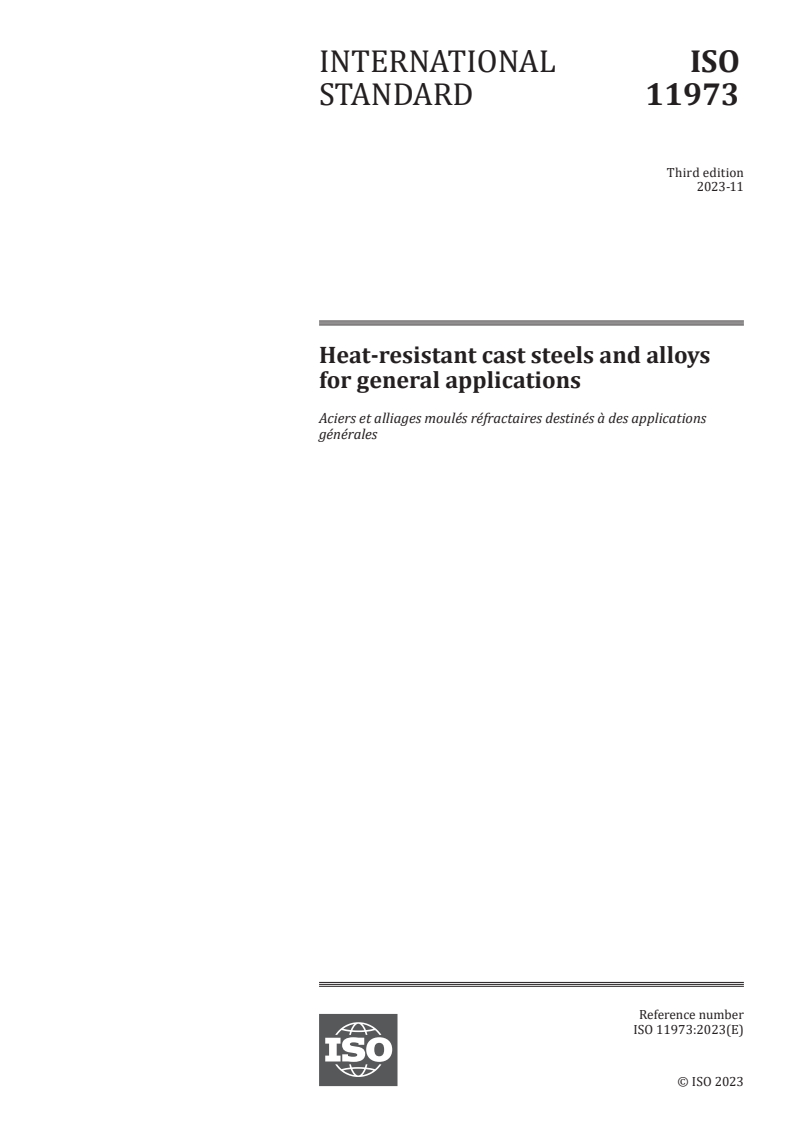
INTERNATIONAL ISO
STANDARD 11973
Third edition
2023-11
Heat-resistant cast steels and alloys
for general applications
Aciers et alliages moulés réfractaires destinés à des applications
générales
Reference number
© ISO 2023
All rights reserved. Unless otherwise specified, or required in the context of its implementation, no part of this publication may
be reproduced or utilized otherwise in any form or by any means, electronic or mechanical, including photocopying, or posting on
the internet or an intranet, without prior written permission. Permission can be requested from either ISO at the address below
or ISO’s member body in the country of the requester.
ISO copyright office
CP 401 • Ch. de Blandonnet 8
CH-1214 Vernier, Geneva
Phone: +41 22 749 01 11
Email: copyright@iso.org
Website: www.iso.org
Published in Switzerland
ii
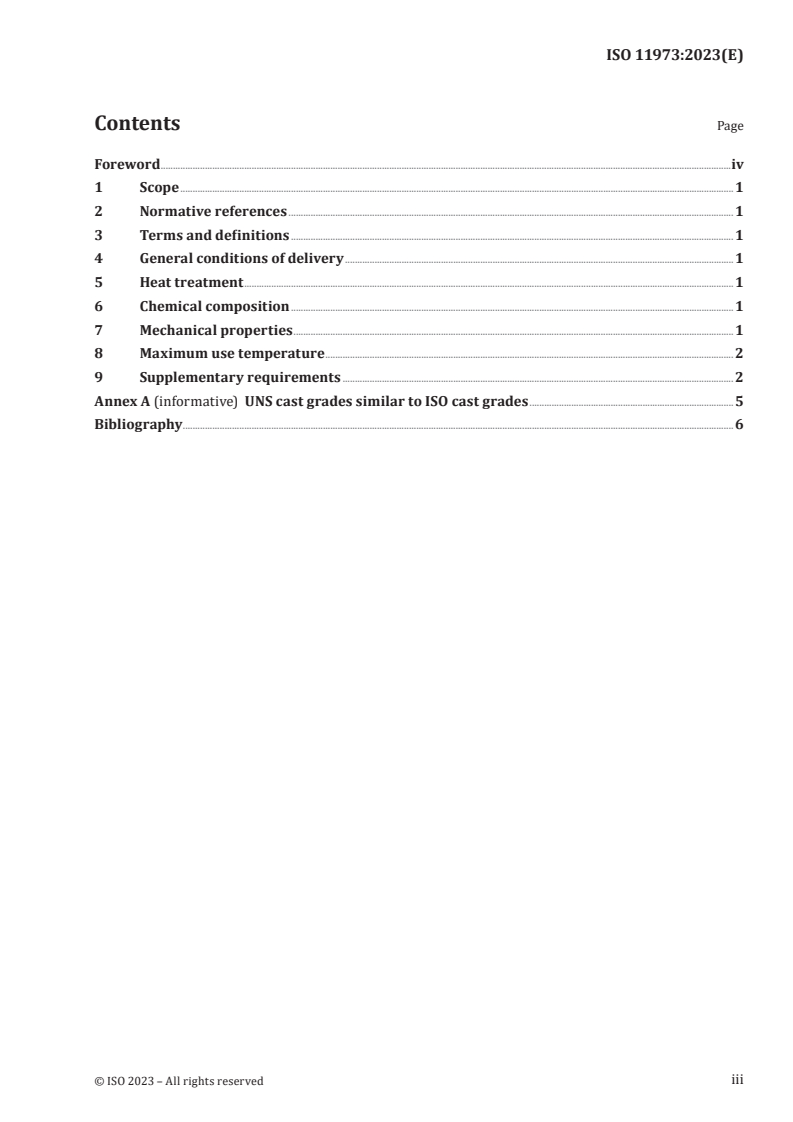
Contents Page
Foreword .iv
1 Scope . 1
2 Normative references . 1
3 Terms and definitions . 1
4 General conditions of delivery .1
5 Heat treatment .1
6 Chemical composition .1
7 Mechanical properties .1
8 Maximum use temperature . 2
9 Supplementary requirements . 2
Annex A (informative) UNS cast grades similar to ISO cast grades . 5
Bibliography . 6
iii
Foreword
ISO (the International Organization for Standardization) is a worldwide federation of national standards
bodies (ISO member bodies). The work of preparing International Standards is normally carried out
through ISO technical committees. Each member body interested in a subject for which a technical
committee has been established has the right to be represented on that committee. International
organizations, governmental and non-governmental, in liaison with ISO, also take part in the work.
ISO collaborates closely with the International Electrotechnical Commission (IEC) on all matters of
electrotechnical standardization.
The procedures used to develop this document and those intended for its further maintenance are
described in the ISO/IEC Directives, Part 1. In particular, the different approval criteria needed for the
different types of ISO document should be noted. This document was drafted in accordance with the
editorial rules of the ISO/IEC Directives, Part 2 (see www.iso.org/directives).
ISO draws attention to the possibility that the implementation of this document may involve the use
of (a) patent(s). ISO takes no position concerning the evidence, validity or applicability of any claimed
patent rights in respect thereof. As of the date of publication of this document, ISO had not received
notice of (a) patent(s) which may be required to implement this document. However, implementers are
cautioned that this may not represent the latest information, which may be obtained from the patent
database available at www.iso.org/patents. ISO shall not be held responsible for identifying any or all
such patent rights.
Any trade name used in this document is information given for the convenience of users and does not
constitute an endorsement.
For an explanation of the voluntary nature of standards, the meaning of ISO specific terms and
expressions related to conformity assessment, as well as information about ISO's adherence to
the World Trade Organization (WTO) principles in the Technical Barriers to Trade (TBT), see
www.iso.org/iso/foreword.html.
This document was prepared by Technical Committee ISO/TC 17, Steel, Subcommittee SC 11, Steel
castings.
This third edition cancels and replaces the second edition (ISO 11973:2015), which has been technically
revised.
The main changes are as follows:
— the mandatory Terms and definitions clause (see Clause 3) has been added and subsequent clauses
have been renumbered;
— Clause 4 has been updated to add a reference to Annex A;
— the title for Table 1 has been changed;
— supplementary requirements (see Clause 9) has been updated.
Any feedback or questions on this document should be directed to the user’s national standards body. A
complete listing of these bodies can be found at www.iso.org/members.html.
iv
INTERNATIONAL STANDARD ISO 11973:2023(E)
Heat-resistant cast steels and alloys for general
applications
1 Scope
This document specifies chemical composition and mechanical properties of cast steels and alloys for
heat-resistant service.
2 Normative references
The following documents are referred to in the text in such a way that some or all of their content
constitutes requirements of this document. For dated references, only the edition cited applies. For
undated references, the latest edition of the referenced document (including any amendments) applies.
ISO 4990, Steel castings — General technical delivery requirements
3 Terms and definitions
No terms and definitions are listed in this document.
ISO and IEC maintain terminology databases for use in standardization at the following addresses:
— ISO Online browsing platform: available at https:// www .iso .org/ obp
— IEC Electropedia: available at https:// www .electropedia .org/
4 General conditions of delivery
Materials furnished in conformity with this document shall conform to the applicable requirements of
ISO 4990 including the supplementary requirements that are indicated on the enquiry and purchase
order. Similar UNS numbers to the grades in this document are included in Ann
...
Questions, Comments and Discussion
Ask us and Technical Secretary will try to provide an answer. You can facilitate discussion about the standard in here.
Loading comments...