

ISO/TS 15666:2021
(Main)Acoustics — Assessment of noise annoyance by means of social and socio-acoustic surveys
General Information
- Abstract
This document provides specifications for socio-acoustic surveys and social surveys which include questions on noise effects (referred to hereafter as “social surveys”). It includes questions to be asked, response scales, key aspects of conducting the survey, and reporting the results. It is recognized that specific requirements and protocols of some social studies may not permit the use of some or all of the present specifications. This document in no way lessens the merit, value or validity of such research studies. The scope of this document is restricted to surveys conducted to obtain information about noise annoyance “at home”. Surveys conducted to obtain information about noise annoyance in other situations, such as recreational areas, work environments and inside vehicles, are not included. This document concerns only the questions on noise annoyance used in a social survey and the most important additional specifications needed to accomplish a high level of comparability with other studies. Other elements which are required to provide high-quality social surveys, but which are not specific for social surveys on noise (such as sampling methods), can be found in textbooks (see References [1] and [2]). Conformity with the recommendations of this document does not guarantee the collection of accurate, precise or reliable information about the prevalence of noise-induced annoyance and/or its relationship to noise exposure. Other aspects of study design, as well as uncertainties of estimation and measurement of noise exposure, can influence the interpretability of survey findings to a great extent.
- Status
- Published
- Publication Date
- 17-May-2021
- Technical Committee
- ISO/TC 43/SC 1 - Noise
- Current Stage
- 9093 - International Standard confirmed
- Start Date
- 10-Sep-2024
- Completion Date
- 29-Aug-2026
Buy Documents
ISO/TS 15666:2021 - Acoustics — Assessment of noise annoyance by means of social and socio-acoustic surveys Released:5/18/2021
ISO/TS 15666:2021 - Acoustics — Assessment of noise annoyance by means of social and socio-acoustic surveys/18/2021
Overview
ISO/TS 15666:2021 - Acoustics - Assessment of noise annoyance by means of social and socio-acoustic surveys - is a technical specification that standardizes how to ask about and report noise annoyance “at home”. The 2021 (second) edition specifies recommended question wording, response scales, survey conduct guidance, and reporting formats to improve comparability and pooling of socio‑acoustic and social survey data.
Key topics and requirements
- Scope restriction: Applies only to annoyance experienced at home (indoors or outdoors at the residence). It excludes recreational areas, work environments and vehicles.
- Standardized questions: Two recommended questions:
- A 5‑point verbal rating scale: Not at all / Slightly / Moderately / Very / Extremely.
- An 11‑point numerical rating scale: 0 (not at all) to 10 (extremely), with instructions for respondents.
- Presentation and formatting: Visual card formats and clear marking of a single box are specified to reduce bias.
- Survey conduct: Guidance on placement of annoyance questions early in the questionnaire, interviewer instructions (ask verbatim, handle “I don’t understand”, avoid prompting), and handling of audibility questions separately.
- Assessment and reporting:
- Report frequency or cumulative distributions of individual annoyance scores by noise exposure category.
- Define “highly annoyed” using conventional cut-offs: numerical values 8–10 on the 11‑point scale (top 28%), or the top two categories on the verbal scale (very + extremely). A weighting scheme (extremely = 1.0; very = 0.4) is provided to improve comparability between scales.
- Suppress small cell counts to preserve anonymity; include mean/median or percentiles as appropriate.
- Limitations noted: Conformity with ISO/TS 15666:2021 increases comparability but does not guarantee accuracy - other design choices and exposure measurement uncertainties also affect interpretability.
Applications and users
ISO/TS 15666:2021 is intended for:
- Acoustics consultants and researchers conducting socio‑acoustic surveys
- Environmental health and public‑policy analysts assessing community noise impacts
- Local authorities and planners designing noise monitoring and public consultation
- Academics and international teams seeking comparable annoyance metrics for meta‑analyses
Typical uses include community noise impact assessments, policy evaluations, regulatory support, and cross‑study comparisons of annoyance prevalence.
Related standards
- ISO 1996 (all parts) - Description, measurement and assessment of environmental noise (referenced normative guidance for noise metrics and measurement).
- ICBEN analyses and referenced literature (Annex A and B provide rationale and multi‑language wording).
Keywords: ISO/TS 15666:2021, noise annoyance, socio-acoustic surveys, social surveys, acoustics standard, environmental noise, highly annoyed, 5‑point verbal scale, 11‑point numerical scale, survey methodology.
Relations
- Effective Date
- 24-Jun-2017
Buy Documents
ISO/TS 15666:2021 - Acoustics — Assessment of noise annoyance by means of social and socio-acoustic surveys Released:5/18/2021
ISO/TS 15666:2021 - Acoustics — Assessment of noise annoyance by means of social and socio-acoustic surveys/18/2021
Get Certified
Connect with accredited certification bodies for this standard

CIS Institut d.o.o.
Personal Protective Equipment (PPE) certification body. Notified Body NB-2890 for EU Regulation 2016/425 PPE.

Kiwa BDA Testing
Building and construction product certification.
Kmetijski inštitut Slovenije
Agricultural Institute of Slovenia. Soil testing, plant health, agricultural product analysis.
Sponsored listings
Frequently Asked Questions
ISO/TS 15666:2021 is a technical specification published by the International Organization for Standardization (ISO). Its full title is "Acoustics — Assessment of noise annoyance by means of social and socio-acoustic surveys". This standard covers: This document provides specifications for socio-acoustic surveys and social surveys which include questions on noise effects (referred to hereafter as “social surveys”). It includes questions to be asked, response scales, key aspects of conducting the survey, and reporting the results. It is recognized that specific requirements and protocols of some social studies may not permit the use of some or all of the present specifications. This document in no way lessens the merit, value or validity of such research studies. The scope of this document is restricted to surveys conducted to obtain information about noise annoyance “at home”. Surveys conducted to obtain information about noise annoyance in other situations, such as recreational areas, work environments and inside vehicles, are not included. This document concerns only the questions on noise annoyance used in a social survey and the most important additional specifications needed to accomplish a high level of comparability with other studies. Other elements which are required to provide high-quality social surveys, but which are not specific for social surveys on noise (such as sampling methods), can be found in textbooks (see References [1] and [2]). Conformity with the recommendations of this document does not guarantee the collection of accurate, precise or reliable information about the prevalence of noise-induced annoyance and/or its relationship to noise exposure. Other aspects of study design, as well as uncertainties of estimation and measurement of noise exposure, can influence the interpretability of survey findings to a great extent.
This document provides specifications for socio-acoustic surveys and social surveys which include questions on noise effects (referred to hereafter as “social surveys”). It includes questions to be asked, response scales, key aspects of conducting the survey, and reporting the results. It is recognized that specific requirements and protocols of some social studies may not permit the use of some or all of the present specifications. This document in no way lessens the merit, value or validity of such research studies. The scope of this document is restricted to surveys conducted to obtain information about noise annoyance “at home”. Surveys conducted to obtain information about noise annoyance in other situations, such as recreational areas, work environments and inside vehicles, are not included. This document concerns only the questions on noise annoyance used in a social survey and the most important additional specifications needed to accomplish a high level of comparability with other studies. Other elements which are required to provide high-quality social surveys, but which are not specific for social surveys on noise (such as sampling methods), can be found in textbooks (see References [1] and [2]). Conformity with the recommendations of this document does not guarantee the collection of accurate, precise or reliable information about the prevalence of noise-induced annoyance and/or its relationship to noise exposure. Other aspects of study design, as well as uncertainties of estimation and measurement of noise exposure, can influence the interpretability of survey findings to a great extent.
ISO/TS 15666:2021 is classified under the following ICS (International Classification for Standards) categories: 13.140 - Noise with respect to human beings. The ICS classification helps identify the subject area and facilitates finding related standards.
ISO/TS 15666:2021 has the following relationships with other standards: It is inter standard links to ISO/TS 15666:2003. Understanding these relationships helps ensure you are using the most current and applicable version of the standard.
ISO/TS 15666:2021 is available in PDF format for immediate download after purchase. The document can be added to your cart and obtained through the secure checkout process. Digital delivery ensures instant access to the complete standard document.
Standards Content (Sample)
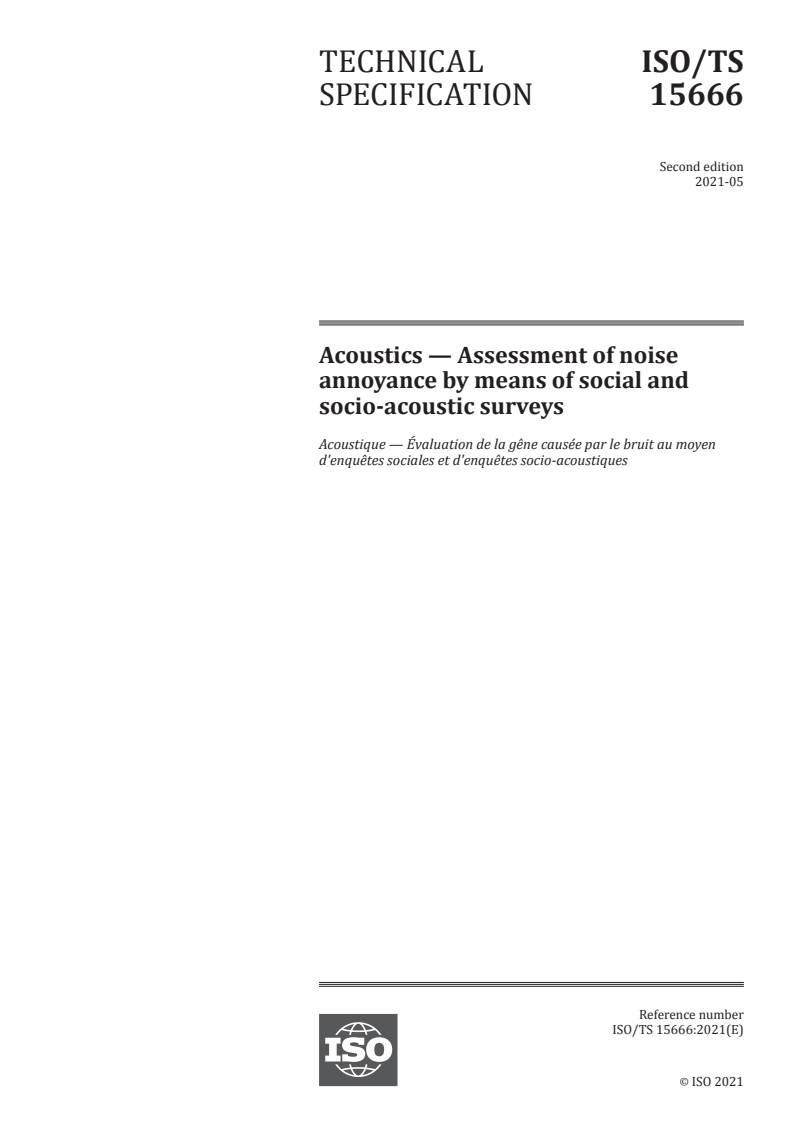
TECHNICAL ISO/TS
SPECIFICATION 15666
Second edition
2021-05
Acoustics — Assessment of noise
annoyance by means of social and
socio-acoustic surveys
Acoustique — Évaluation de la gêne causée par le bruit au moyen
d'enquêtes sociales et d'enquêtes socio-acoustiques
Reference number
©
ISO 2021
© ISO 2021
All rights reserved. Unless otherwise specified, or required in the context of its implementation, no part of this publication may
be reproduced or utilized otherwise in any form or by any means, electronic or mechanical, including photocopying, or posting
on the internet or an intranet, without prior written permission. Permission can be requested from either ISO at the address
below or ISO’s member body in the country of the requester.
ISO copyright office
CP 401 • Ch. de Blandonnet 8
CH-1214 Vernier, Geneva
Phone: +41 22 749 01 11
Email: copyright@iso.org
Website: www.iso.org
Published in Switzerland
ii © ISO 2021 – All rights reserved
Contents Page
Foreword .iv
Introduction .v
1 Scope . 1
2 Normative references . 1
3 Terms and definitions . 1
4 Specifications for wording and scaling of questions on annoyance . 2
5 Additional specifications for conducting social and socio-acoustic surveys when
assessing noise annoyance . 3
6 Specifications for assessing the degree of annoyance . 4
7 Specifications for reporting core information from social and socio-acoustic surveys .5
Annex A (informative) Rationale for wording and scaling of questions on annoyance .7
Annex B (informative) Wording in seventeen languages of questions on annoyance .13
Bibliography .18
Foreword
ISO (the International Organization for Standardization) is a worldwide federation of national standards
bodies (ISO member bodies). The work of preparing International Standards is normally carried out
through ISO technical committees. Each member body interested in a subject for which a technical
committee has been established has the right to be represented on that committee. International
organizations, governmental and non-governmental, in liaison with ISO, also take part in the work.
ISO collaborates closely with the International Electrotechnical Commission (IEC) on all matters of
electrotechnical standardization.
The procedures used to develop this document and those intended for its further maintenance are
described in the ISO/IEC Directives, Part 1. In particular, the different approval criteria needed for the
different types of ISO documents should be noted. This document was drafted in accordance with the
editorial rules of the ISO/IEC Directives, Part 2 (see www .iso .org/ directives).
Attention is drawn to the possibility that some of the elements of this document may be the subject of
patent rights. ISO shall not be held responsible for identifying any or all such patent rights. Details of
any patent rights identified during the development of the document will be in the Introduction and/or
on the ISO list of patent declarations received (see www .iso .org/ patents).
Any trade name used in this document is information given for the convenience of users and does not
constitute an endorsement.
For an explanation of the voluntary nature of standards, the meaning of ISO specific terms and
expressions related to conformity assessment, as well as information about ISO's adherence to the
World Trade Organization (WTO) principles in the Technical Barriers to Trade (TBT), see www .iso .org/
iso/ foreword .html.
This document was prepared by Technical Committee ISO/TC 43, Acoustics, Subcommittee SC 1, Noise.
This second edition cancels and replaces the first edition (ISO/TS 15666:2003), which has been
technically revised.
The main changes compared to the previous edition are as follows:
— A relaxation of the requirement to ask both the 5-point verbal scale and the 11-point numerical
scale. Both questions can still be asked but guidance has been provided about the advantages and
disadvantages of each scale to aid question choice in situations where only one question will be
asked.
— Clarification regarding assumptions that the question covers a 24 h period (day, evening and night)
and the indoor and outdoor home environment.
— Additional guidance has been added in Clause 6 describing the conventional cut-offs to define “highly”
annoyed” for the 5-point verbal scale and the 11-point numerical scale, to enable comparisons
between different surveys and contexts.
— Updated references.
Any feedback or questions on this document should be directed to the user’s national standards body. A
complete listing of these bodies can be found at www .iso .org/ members .html.
iv © ISO 2021 – All rights reserved
Introduction
Many countries have already developed regulations concerning the acceptability of environmental
noise exposure, while others are likely to do so in the future. Such regulations often take into account
relationships between noise exposure and noise-induced annoyance.
Measurement of environmental noise has been standardized. For example, ISO 1996 (all parts) contains
detailed specifications about basic quantities and procedures, about acquisition of (noise) data, and
about the application of these data to set noise limits.
The intent of this document is to provide specifications for the assessment of noise annoyance by social
and socio-acoustic surveys. When these specifications are met, the statistically relevant possibilities
of comparing and pooling survey results will be increased, thus offering more and better quality
information for use by environmental policy makers.
TECHNICAL SPECIFICATION ISO/TS 15666:2021(E)
Acoustics — Assessment of noise annoyance by means of
social and socio-acoustic surveys
1 Scope
This document provides specifications for socio-acoustic surveys and social surveys which include
questions on noise effects (referred to hereafter as “social surveys”). It includes questions to be asked,
response scales, key aspects of conducting the survey, and reporting the results.
It is recognized that specific requirements and protocols of some social studies may not permit the use
of some or all of the present specifications. This document in no way lessens the merit, value or validity
of such research studies.
The scope of this document is restricted to surveys conducted to obtain information about noise
annoyance “at home”. Surveys conducted to obtain information about noise annoyance in other
situations, such as recreational areas, work environments and inside vehicles, are not included.
This document concerns only the questions on noise annoyance used in a social survey and the most
important additional specifications needed to accomplish a high level of comparability with other
studies. Other elements which are required to provide high-quality social surveys, but which are
not specific for social surveys on noise (such as sampling methods), can be found in textbooks (see
References [1] and [2]).
Conformity with the recommendations of this document does not guarantee the collection of
accurate, precise or reliable information about the prevalence of noise-induced annoyance and/or its
relationship to noise exposure. Other aspects of study design, as well as uncertainties of estimation and
measurement of noise exposure, can influence the interpretability of survey findings to a great extent.
2 Normative references
The following documents are referred to in the text in such a way that some or all of their content
constitutes requirements of this document. For dated references, only the edition cited applies. For
undated references, the latest edition of the referenced document (including any amendments) applies.
ISO 1996-1, Acoustics — Description, measurement and assessment of environmental noise — Part 1: Basic
quantities and assessment procedures
ISO 1996-2, Acoustics — Description, measurement and assessment of environmental noise — Part 2:
Determination of sound pressure levels
3 Terms and definitions
For the purposes of this document, the following terms and definitions apply.
ISO and IEC maintain terminological databases for use in standardization at the following addresses:
— ISO Online browsing platform: available at https:// www .iso .org/ obp
— IEC Electropedia: available at http:// www .electropedia .org/
3.1
noise-induced annoyance
one person’s individual adverse reaction to noise
Note 1 to entry: The reaction may be referred to in various ways including, for example, dissatisfaction, bother,
annoyance and disturbance due to noise (see References [3] and [4]).
Note 2 to entry: Community noise annoyance is the prevalence rate of this individual reaction in a community,
as measured by the responses to questions specified in Clause 4 and expressed in appropriate statistical terms.
3.2
socio-acoustic survey
social survey in which noise-induced annoyance is assessed and values of measured or calculated noise
metrics are attributed to the respondents’ home environment
Note 1 to entry: Many general social surveys of environmental factors including noise are not considered to be
“socio-acoustic” surveys because they do not have associated (measured or modelled) noise data.
4 Specifications for wording and scaling of questions on annoyance
Two questions have been formulated: one question with a verbal rating scale; one with a numerical
rating scale.
a) Question with verbal rating scale
Thinking about the last (12 months or so), when you are here at home, how much does noise from (noise
source) bother, disturb or annoy you?
— Not at all
— Slightly
— Moderately
— Very
— Extremely
b) Question with numerical rating scale, with introduction
Introduction:
This uses a 0-to-10 opinion scale for how much (source) noise bothers, disturbs or annoys you when
you are here at home. If you are not at all annoyed choose 0; if you are extremely annoyed choose
10; if you are somewhere in between, choose a number between 0 and 10.
Question:
Thinking about the last (12 months or so), when you are here at home, what number from 0 to 10 best
shows how much you are bothered, disturbed or annoyed by (source) noise?
NOTE 1 There is an implicit assumption that the verbal and numeric scales address annoyance over the whole
24 h period during the last (12 months or so), i.e. annoyance integrated over the day-time, evening and night-time
periods.
NOTE 2 The terminology ‘at home’ covers inside the home or outdoors at home, for example in the garden or
on the balcony (see References [5] and [6]). See also A.7 and A.8 d).
The rationale for the specification and wording is presented in Annex A. The most accurate translations
into several other languages are presented in Annex B.
2 © ISO 2021 – All rights reserved
5 Additional specifications for conducting social and socio-acoustic surveys
when assessing noise annoyance
General specifications for conducting social surveys of any kind are found in numerous articles, papers
and textbooks (see References [1] and [2]). This clause does not give a comprehensive overview of these
general specifications. The focus in this clause is on additional specifications with respect to the design
of the questionnaire when asking about noise annoyance. More information is given in Annex A.
a) Each respondent may be asked both questions specified in Clause 4. More information is given in
Annex A about the advantages and disadvantages of the verbal and numerical scales to aid choice of
question, if only one question is to be used.
b) The questions shall be placed early in the questionnaire, unless this conflicts with other survey
objectives, and before other, more detailed, questions about noise have been asked. Respondents
shall not be eliminated on the basis of some previous question about whether they “hear” the noise,
nor on the basis of length of residence. There is too great an uncertainty that respondents may
conflate low levels of annoyance with not hearing the sound of the evaluated source (Reference [8]).
If it is necessary to determine whether some respondents do not hear the noise source, a question
about the audibility of the noise should be asked separately later in the survey. If other questions on
noise annoyance are more important for the survey’s purposes, the specified annoyance questions
may be asked later (see References [7] and [8]).
c) When asking a question about annoyance, do not imply that the noise should be present in the
respondent’s situation at home. Ask, for instance, about “noise from aircraft” instead of “noise from
the aircraft”.
d) When both questions are used, if pre-tests indicate that the questions are perceived as repetitious,
include appropriate instructions. An example is presented in Annex A.
e) As discussed in Reference [8], the answer categories of the five-point verbal scale may be presented
without numbers, in a vertical orientation that can visually depict their equal separation as follows:
CARD QV1
NOT AT ALL
SLIGHTLY
MODERATELY
VERY
EXTREMELY
As discussed in Reference [8] the presentation for the numerical scale shall be as follows:
CARD QN
0 1 2 3 4 5 6 7 8 9 10
NOT AT ALL
EXTREMELY
The chosen answer shall be marked clearly within one box.
f) Prepare written instructions for interviewers. For telephone or personal interviews, the
interviewers shall be provided with written instructions that
— instruct interviewers to ask questions exactly as written,
— train interviewers to respond to “I don't understand” with methods that do not require
paraphrasing the question,
— urge respondents to choose between the offered answers, including those who respond “I don’t
know”,
— request all respondents to answer these questions (new residents can be instructed to answer
about only their recent period of residence and later excluded from some analyses) – for more
details see Reference [8], and
— if repetition is expected to be a problem, for some respondents provide interviewers with
instructions as described in Reference [8].
6 Specifications for assessing the degree of annoyance
Results of the questions shall be given as the frequency or cumulative distributions of the individual
annoyance scores, if available for each category of noise exposure, bearing in mind that it may
be necessary to supress values with low numbers (small samples) to preserve anonymity. Other
(summarizing) statistics such as the mean or median annoyance score, or percentages of respondents
who are annoyed to a certain degree, may be given.
“Defining highly annoyed”
The cut-offs used in individual countries or preferred by individual researchers to define the percentage
of respondents who should be regarded to have at least a certain degree of annoyance, such as for
example “highly annoyed” can vary, although such variations can impede cross-study comparisons.
Over the past decades a science-based rationale has emerged to define “highly annoyed’ as one of the
following: (see NOTE 1, NOTE 2 and NOTE 3).
Consistent with what was originally proposed in Reference [9] “highly annoyed” is defined as the top
28 % for the 11-point numerical scale:
— Numerical values 8, 9, and 10 for the 11-point numerical scale (to be referred to as HA ).
N
As specified in the extensive ICBEN Team 6 analysis (see Reference [8]) and consistent with Reference [9]
“highly annoyed” can be defined on the 5-point verbal scale as:
— The top two verbal response categories for the 5-point verbal scale (i.e., very and extremely) (to be
referred to as HA ).
V
It should therefore be noted, that as defined above, the two scales do not use the same cut-offs to define
“highly annoyed’.
New research from large-scale investigations (see References [7] and [10]) have found that comparisons
between the two scales can be improved with the following weighting scheme, whereby:
— Defining “highly annoyed” as the top two verbal response categories on the 5-point verbal scale
(i.e., very and extremely) with ‘extremely’ counted in full, and ‘very’ weighted by a factor 0,4 (to be
referred to as HA ). This creates a greater mathematical similarity between this scale and studies
vw
that have reported high annoyance as the top 28 % on the 11-point numerical scale. A detailed
analysis of the perceived annoyance intensity encompassed by the top two categories “very” and
“extremely” on a scale from 0 % to 100 % is provided in Reference [8].
4 © ISO 2021 – All rights reserved
NOTE 1 The term “highly annoyed” in this context refers to the percentage of the survey respondents
reporting to be highly bothered, disturbed or annoyed, following the wording of the question but the convention
is to refer to this group as “highly annoyed” and not the literary “bothered, disturbed or annoyed”.
NOTE 2 The verbal scale is an ordinal scale so if converted to a numerical scale for statistical purposes there
needs to be clear evidence that the step-difference between each category is perceived by the respondent to
be equal. The analysis in Reference [8] supports the assumption of equidistance between the verbal categories
in general, but this can be sensitive to study demographics. The procedure for constructing the verbal scale
(see Reference [8]) attempts to space the verbal modifiers at equal intervals of annoyance intensity along the
annoyance axis.
NOTE 3 When reporting percentage highly annoyed, it is important to clearly state which scoring has been
used to support comparison and harmonisation of data. It is however recognised that users and countries can
conventionally adopt other forms of scoring due to preference or historical need, which cannot be based on a
need to report the prevalence of high annoyance.
7 Specifications for reporting core information from social and socio-acoustic
surveys
In Table 1, minimum specifications are presented for reporting core information from social and socio-
acoustic surveys in scientific reports. This information is essential to judge whether comparisons with
other surveys can be made. Further information can be found in Reference [11].
Table 1 — Minimum specifications for reporting core information from social and socio-
acoustical surveys in scientific reports
Topic area Item Topic Required information
Overall 1 Survey date Year and months of social survey
design
2 Site location Country and area/region of study sites
3 Site selection Any important, unusual characteristic of the study period or sites
Map or description of study site locations relative to the noise source
Rationale for site selection
Site selection and exclusion criteria
4 Site size Number of study sites
Number of dwellings by site
5 Study purpose State original study objective(s)
State if respondents were aware of study objective(s)
Social sur- 6 Sample selection Population definition (i.e., is the sample drawn from a targeted area,
vey sample local community, larger provincial/state, or representative of a na-
tional sample)
Respondent sample selection method (probability, judgmental, etc.)
Respondent exclusion criteria (age, gender, length of residence, etc.)
7 Achieved sample Number of respondents (sample size)
Response rate
Reasons for non-response
Social sur- 8 Survey methods Method (face-to-face, telephone, online, mail.)
vey data
9 Questionnaire Exact wording of primary questionnaire items (including answer
collection
wording alternatives) and where appropriate, any valid skips
10 Precision of sample Number of responses for main analyses, range of the average time
estimate taken to complete the survey per respondent.
Table 1 (continued)
Topic area Item Topic Required information
Acoustical 11 Noise source Type of primary noise source (aircraft, road traffic, etc.)
conditions
Types of noise source operations that are included or excluded
(if applica-
ble)
Protocols to define the noise source (e.g. minimum level, operations,
days of week)
12 Noise metrics Give the complete description of any appropriate noise metric report-
ed for the source, in accordance with e.g. ISO 1996-1, ISO 1996-2 (if
applicable):
— Provide L , L and L (or L by time-period) for all
Aeq,24h dn den Aeq
locations
or
— provide conversion rule(s) to estimate L , L and L under
Aeq,24h dn den
the specific study conditions from the study's preferred metric
— Discuss the adequacy of the conversion rule(s)
— Provide impulse and/or tone corrections
13 Time period Hours of day represented by noise metric
Period (months, years) represented by noise metric
Time period should coincide with the historical time reference period
in the annoyance questions
14 Estimation/ Estimation approach (modelling, measurement during sampled
measurement pro- periods, etc.). Identify the standard followed and software used to
cedure quantify exposures.
15 Reference position Nominal position relative to noise source and reflecting surfaces
Present exposure (or give conversion rule) for noisiest façade, specify-
ing whether reflections from the façade are taken into account or not
16 Precision of noise Best information available on precision of noise exposure estimates
estimate
Basic 17 Dose/response Tabulation of frequency of annoyance ratings for each category of
dose/ relationships noise exposure.
response
Include discussion on the variance found within the relationship –
analysis
either a qualitative discussion or quantitative assessment of how well
any derived curve fits the spread of data.
18 Participants count- Clarification that participants who may have indicated a source was
ed as “not highly inaudible or “do not know” their annoyance magnitude, are treated as
annoyed” “not highly annoyed” in modelling where logistic regression analysis
is used.
6 © ISO 2021 – All rights reserved
Annex A
(informative)
Rationale for wording and scaling of questions on annoyance
A.1 General
In this annex the rationale for the specifications for wording and scaling of the specified questions
about annoyance is presented, largely based on the ICBEN Team 6 analysis (Reference [8]).
A.2 Types of question
Direct rating questions:
— name the noise source;
— ask for respondents’ attitude towards the noise;
— present respondents with choices between a limited number of answers.
Such direct rating questions have been almost universally accepted as the primary measure of the
relationship between noise and residents' reactions. Answers to such direct questions are more explicit
and more readily interpreted than indirect questions or comparison questions (the two other types of
questions that are sometimes used for special purposes in noise surveys).
Indirect questions attempt to ascertain the underlying impact of noise on people with
— open questions in which the noise source is not identified,
— questions in which respondents report complaint actions rather than an attitude, or
— questions in which respondents report behavioural reactions rather than an attitude.
Although useful for specific purposes, these have not supplanted the direct questions as the primary
indicator of noise impact because they can only be used to infer indirectly how people may feel about
noise exposure. In addition, such indirect questions may highlight non-acoustic factors which may or
may not be directly related to noise exposure (see Reference [12]). Indirect, open questions that allow
respondents to volunteer their own answers are expensive to analyse and require survey designs and
procedures which are different from those presented in this document and therefore are outside of the
scope of this TS. For this reason, answers from indirect, open questions cannot be directly compared
with those obtained from the methods used with this document. Similarly, willingness-to-pay type
questions (e.g. higher taxes for lower noise from a particular noise source) are not directly comparable
with the methods used in this document.
The other type of question, a comparison question, provides an anchor for a rating by asking respondents
to compare their attitude towards the specified noise to their attitude towards some other object. The
overwhelming problem with comparison questions is the absence of a common, shared anchor that
could provide a uniform point of comparison across surveys or even across neighbourhoods in the
same survey. The most obvious anchors, other neighbourhood nuisances, vary so greatly from site to
site that they cannot be used for comparing noise responses at different sites. Magnitude estimation
techniques could, in theory, use other shared reference points to resolve this problem, but previous
research has found that such techniques are not sufficiently refined for a question to be recommended
for wide usage in noise-reaction surveys (see Reference [13]).
A.3 "Noise", is unwanted sound
As per the scope of this document, the term “noise” is used rather than “sound” because this document
is designed to measure and assess the existence of annoyance towards a sound source. Therefore,
participants who are not “bothered”, “disturbed” or “annoyed” by the sound source under consideration
(i.e. do not consider the sound “noise”) should select the survey answer “not at all”. This document
acknowledges that the audibility of the sound source(s) identified in a survey may not be unwanted in
either some or all cases by participants. It is recognized that the human response to sound, regardless of
the source, can vary widely depending on multiple non-acoustic factors including context, expectations
and preferences. However, it is outside of the scope of this document to measure and/or assess factors
comprising the category “not at all”.
A.4 Unipolar scales (neutral-negative)
From many previous surveys, it has been found that reactions to noise are overwhelmingly either
negative or neutral (see Reference [8]). Therefore, the questions should use unipolar scales that extend
from a negative pole (extremely annoyed) to a neutral position (not at all annoyed), but not to a positive
pole (extremely enjoyable).
A.5 Two questions
This document provides a choice between two annoyance scales, although it is recommended that
both questions are used. Using more than one scale is consistent with the most basic principles in
psychometrics to increase the reliability of a measurement. It also enhances comparability between
studies and advances the body of evidence pertaining to the interchangeability between the two
questions and by extension the optimal derivation of “highly annoyed”.
A.6 Verbal and numerical scale
It is appreciated that it may not always be possible to include both questions in a survey due to space
and cost constraints. Each of the scales has different strengths and weaknesses (see Reference [8]). If
having to choose between the scales it may be useful to consider the following points.
The 5-point verbal scale is recommended where there is a need for the clearest, most transparent
communication. The simple task of choosing a word is most likely to be easily performed by all
respondents. The resulting selected word is, when presented in a report, simply passed on to readers
as the respondent’s choice. The protocol used to choose the answer scale words attempts to ensure
that the commonly understood meaning of the word is consistent with its position on the scale. If
developed in line with the methodology proposed (see Reference [8]) the descriptive verbal categories
can generally be considered to be equidistance from each other, making the verbal scale interval. As
specified in Reference [8] equal distance between variables is subject to study demographics and
therefore not necessarily guaranteed, such that the resulting data would be ordinal in nature. Another
disadvantage is that within cultures the meaning of language can change over time, which could
influence the respondents’ perception of the verbal scale (see Reference [14]). Although efforts have
been made to stabilize the response categories across cultures (see Reference [8]), the terminology
used in the response categories can be culturally bound and this can add uncertainty to cross-study
comparisons.
The simplicity of the 11-point numerical scale circumvents some of the issues related to the verbal
scale. The most obvious difference being that the spacing along the 11-point scale is equal, which
provides a pragmatic rationale for treating the data as “continuous” in statistical testing, even though
the scale is ordinal by definition. Further advantages are that it may offer a more sensitive assessment
of annoyance, as the respondent has a greater number of possible response options. While this may
prove to be true, it is acknowledged that more options may also contribute to fluctuations in annoyance
ratings, without meaningful changes in noise. Disadvantages of the scale are seen to be the lack of
verbal descriptions across the scale as only the two poles of the scale are given semantic descriptors
and that defining “highly annoyed’ at 28 % means that respondents who score 7 or 8 are treated very
8 © ISO 2021 – All rights reserved
differently. Further, there may be ambiguity arising from providing so many response categories and
the values between the extreme anchor points do not have clearly defined differences.
Each scale
...
TECHNICAL ISO/TS
SPECIFICATION 15666
Second edition
2021-05
Acoustics — Assessment of noise
annoyance by means of social and
socio-acoustic surveys
Acoustique — Évaluation de la gêne causée par le bruit au moyen
d'enquêtes sociales et d'enquêtes socio-acoustiques
Reference number
©
ISO 2021
© ISO 2021
All rights reserved. Unless otherwise specified, or required in the context of its implementation, no part of this publication may
be reproduced or utilized otherwise in any form or by any means, electronic or mechanical, including photocopying, or posting
on the internet or an intranet, without prior written permission. Permission can be requested from either ISO at the address
below or ISO’s member body in the country of the requester.
ISO copyright office
CP 401 • Ch. de Blandonnet 8
CH-1214 Vernier, Geneva
Phone: +41 22 749 01 11
Email: copyright@iso.org
Website: www.iso.org
Published in Switzerland
ii © ISO 2021 – All rights reserved
Contents Page
Foreword .iv
Introduction .v
1 Scope . 1
2 Normative references . 1
3 Terms and definitions . 1
4 Specifications for wording and scaling of questions on annoyance . 2
5 Additional specifications for conducting social and socio-acoustic surveys when
assessing noise annoyance . 3
6 Specifications for assessing the degree of annoyance . 4
7 Specifications for reporting core information from social and socio-acoustic surveys .5
Annex A (informative) Rationale for wording and scaling of questions on annoyance .7
Annex B (informative) Wording in seventeen languages of questions on annoyance .13
Bibliography .18
Foreword
ISO (the International Organization for Standardization) is a worldwide federation of national standards
bodies (ISO member bodies). The work of preparing International Standards is normally carried out
through ISO technical committees. Each member body interested in a subject for which a technical
committee has been established has the right to be represented on that committee. International
organizations, governmental and non-governmental, in liaison with ISO, also take part in the work.
ISO collaborates closely with the International Electrotechnical Commission (IEC) on all matters of
electrotechnical standardization.
The procedures used to develop this document and those intended for its further maintenance are
described in the ISO/IEC Directives, Part 1. In particular, the different approval criteria needed for the
different types of ISO documents should be noted. This document was drafted in accordance with the
editorial rules of the ISO/IEC Directives, Part 2 (see www .iso .org/ directives).
Attention is drawn to the possibility that some of the elements of this document may be the subject of
patent rights. ISO shall not be held responsible for identifying any or all such patent rights. Details of
any patent rights identified during the development of the document will be in the Introduction and/or
on the ISO list of patent declarations received (see www .iso .org/ patents).
Any trade name used in this document is information given for the convenience of users and does not
constitute an endorsement.
For an explanation of the voluntary nature of standards, the meaning of ISO specific terms and
expressions related to conformity assessment, as well as information about ISO's adherence to the
World Trade Organization (WTO) principles in the Technical Barriers to Trade (TBT), see www .iso .org/
iso/ foreword .html.
This document was prepared by Technical Committee ISO/TC 43, Acoustics, Subcommittee SC 1, Noise.
This second edition cancels and replaces the first edition (ISO/TS 15666:2003), which has been
technically revised.
The main changes compared to the previous edition are as follows:
— A relaxation of the requirement to ask both the 5-point verbal scale and the 11-point numerical
scale. Both questions can still be asked but guidance has been provided about the advantages and
disadvantages of each scale to aid question choice in situations where only one question will be
asked.
— Clarification regarding assumptions that the question covers a 24 h period (day, evening and night)
and the indoor and outdoor home environment.
— Additional guidance has been added in Clause 6 describing the conventional cut-offs to define “highly”
annoyed” for the 5-point verbal scale and the 11-point numerical scale, to enable comparisons
between different surveys and contexts.
— Updated references.
Any feedback or questions on this document should be directed to the user’s national standards body. A
complete listing of these bodies can be found at www .iso .org/ members .html.
iv © ISO 2021 – All rights reserved
Introduction
Many countries have already developed regulations concerning the acceptability of environmental
noise exposure, while others are likely to do so in the future. Such regulations often take into account
relationships between noise exposure and noise-induced annoyance.
Measurement of environmental noise has been standardized. For example, ISO 1996 (all parts) contains
detailed specifications about basic quantities and procedures, about acquisition of (noise) data, and
about the application of these data to set noise limits.
The intent of this document is to provide specifications for the assessment of noise annoyance by social
and socio-acoustic surveys. When these specifications are met, the statistically relevant possibilities
of comparing and pooling survey results will be increased, thus offering more and better quality
information for use by environmental policy makers.
TECHNICAL SPECIFICATION ISO/TS 15666:2021(E)
Acoustics — Assessment of noise annoyance by means of
social and socio-acoustic surveys
1 Scope
This document provides specifications for socio-acoustic surveys and social surveys which include
questions on noise effects (referred to hereafter as “social surveys”). It includes questions to be asked,
response scales, key aspects of conducting the survey, and reporting the results.
It is recognized that specific requirements and protocols of some social studies may not permit the use
of some or all of the present specifications. This document in no way lessens the merit, value or validity
of such research studies.
The scope of this document is restricted to surveys conducted to obtain information about noise
annoyance “at home”. Surveys conducted to obtain information about noise annoyance in other
situations, such as recreational areas, work environments and inside vehicles, are not included.
This document concerns only the questions on noise annoyance used in a social survey and the most
important additional specifications needed to accomplish a high level of comparability with other
studies. Other elements which are required to provide high-quality social surveys, but which are
not specific for social surveys on noise (such as sampling methods), can be found in textbooks (see
References [1] and [2]).
Conformity with the recommendations of this document does not guarantee the collection of
accurate, precise or reliable information about the prevalence of noise-induced annoyance and/or its
relationship to noise exposure. Other aspects of study design, as well as uncertainties of estimation and
measurement of noise exposure, can influence the interpretability of survey findings to a great extent.
2 Normative references
The following documents are referred to in the text in such a way that some or all of their content
constitutes requirements of this document. For dated references, only the edition cited applies. For
undated references, the latest edition of the referenced document (including any amendments) applies.
ISO 1996-1, Acoustics — Description, measurement and assessment of environmental noise — Part 1: Basic
quantities and assessment procedures
ISO 1996-2, Acoustics — Description, measurement and assessment of environmental noise — Part 2:
Determination of sound pressure levels
3 Terms and definitions
For the purposes of this document, the following terms and definitions apply.
ISO and IEC maintain terminological databases for use in standardization at the following addresses:
— ISO Online browsing platform: available at https:// www .iso .org/ obp
— IEC Electropedia: available at http:// www .electropedia .org/
3.1
noise-induced annoyance
one person’s individual adverse reaction to noise
Note 1 to entry: The reaction may be referred to in various ways including, for example, dissatisfaction, bother,
annoyance and disturbance due to noise (see References [3] and [4]).
Note 2 to entry: Community noise annoyance is the prevalence rate of this individual reaction in a community,
as measured by the responses to questions specified in Clause 4 and expressed in appropriate statistical terms.
3.2
socio-acoustic survey
social survey in which noise-induced annoyance is assessed and values of measured or calculated noise
metrics are attributed to the respondents’ home environment
Note 1 to entry: Many general social surveys of environmental factors including noise are not considered to be
“socio-acoustic” surveys because they do not have associated (measured or modelled) noise data.
4 Specifications for wording and scaling of questions on annoyance
Two questions have been formulated: one question with a verbal rating scale; one with a numerical
rating scale.
a) Question with verbal rating scale
Thinking about the last (12 months or so), when you are here at home, how much does noise from (noise
source) bother, disturb or annoy you?
— Not at all
— Slightly
— Moderately
— Very
— Extremely
b) Question with numerical rating scale, with introduction
Introduction:
This uses a 0-to-10 opinion scale for how much (source) noise bothers, disturbs or annoys you when
you are here at home. If you are not at all annoyed choose 0; if you are extremely annoyed choose
10; if you are somewhere in between, choose a number between 0 and 10.
Question:
Thinking about the last (12 months or so), when you are here at home, what number from 0 to 10 best
shows how much you are bothered, disturbed or annoyed by (source) noise?
NOTE 1 There is an implicit assumption that the verbal and numeric scales address annoyance over the whole
24 h period during the last (12 months or so), i.e. annoyance integrated over the day-time, evening and night-time
periods.
NOTE 2 The terminology ‘at home’ covers inside the home or outdoors at home, for example in the garden or
on the balcony (see References [5] and [6]). See also A.7 and A.8 d).
The rationale for the specification and wording is presented in Annex A. The most accurate translations
into several other languages are presented in Annex B.
2 © ISO 2021 – All rights reserved
5 Additional specifications for conducting social and socio-acoustic surveys
when assessing noise annoyance
General specifications for conducting social surveys of any kind are found in numerous articles, papers
and textbooks (see References [1] and [2]). This clause does not give a comprehensive overview of these
general specifications. The focus in this clause is on additional specifications with respect to the design
of the questionnaire when asking about noise annoyance. More information is given in Annex A.
a) Each respondent may be asked both questions specified in Clause 4. More information is given in
Annex A about the advantages and disadvantages of the verbal and numerical scales to aid choice of
question, if only one question is to be used.
b) The questions shall be placed early in the questionnaire, unless this conflicts with other survey
objectives, and before other, more detailed, questions about noise have been asked. Respondents
shall not be eliminated on the basis of some previous question about whether they “hear” the noise,
nor on the basis of length of residence. There is too great an uncertainty that respondents may
conflate low levels of annoyance with not hearing the sound of the evaluated source (Reference [8]).
If it is necessary to determine whether some respondents do not hear the noise source, a question
about the audibility of the noise should be asked separately later in the survey. If other questions on
noise annoyance are more important for the survey’s purposes, the specified annoyance questions
may be asked later (see References [7] and [8]).
c) When asking a question about annoyance, do not imply that the noise should be present in the
respondent’s situation at home. Ask, for instance, about “noise from aircraft” instead of “noise from
the aircraft”.
d) When both questions are used, if pre-tests indicate that the questions are perceived as repetitious,
include appropriate instructions. An example is presented in Annex A.
e) As discussed in Reference [8], the answer categories of the five-point verbal scale may be presented
without numbers, in a vertical orientation that can visually depict their equal separation as follows:
CARD QV1
NOT AT ALL
SLIGHTLY
MODERATELY
VERY
EXTREMELY
As discussed in Reference [8] the presentation for the numerical scale shall be as follows:
CARD QN
0 1 2 3 4 5 6 7 8 9 10
NOT AT ALL
EXTREMELY
The chosen answer shall be marked clearly within one box.
f) Prepare written instructions for interviewers. For telephone or personal interviews, the
interviewers shall be provided with written instructions that
— instruct interviewers to ask questions exactly as written,
— train interviewers to respond to “I don't understand” with methods that do not require
paraphrasing the question,
— urge respondents to choose between the offered answers, including those who respond “I don’t
know”,
— request all respondents to answer these questions (new residents can be instructed to answer
about only their recent period of residence and later excluded from some analyses) – for more
details see Reference [8], and
— if repetition is expected to be a problem, for some respondents provide interviewers with
instructions as described in Reference [8].
6 Specifications for assessing the degree of annoyance
Results of the questions shall be given as the frequency or cumulative distributions of the individual
annoyance scores, if available for each category of noise exposure, bearing in mind that it may
be necessary to supress values with low numbers (small samples) to preserve anonymity. Other
(summarizing) statistics such as the mean or median annoyance score, or percentages of respondents
who are annoyed to a certain degree, may be given.
“Defining highly annoyed”
The cut-offs used in individual countries or preferred by individual researchers to define the percentage
of respondents who should be regarded to have at least a certain degree of annoyance, such as for
example “highly annoyed” can vary, although such variations can impede cross-study comparisons.
Over the past decades a science-based rationale has emerged to define “highly annoyed’ as one of the
following: (see NOTE 1, NOTE 2 and NOTE 3).
Consistent with what was originally proposed in Reference [9] “highly annoyed” is defined as the top
28 % for the 11-point numerical scale:
— Numerical values 8, 9, and 10 for the 11-point numerical scale (to be referred to as HA ).
N
As specified in the extensive ICBEN Team 6 analysis (see Reference [8]) and consistent with Reference [9]
“highly annoyed” can be defined on the 5-point verbal scale as:
— The top two verbal response categories for the 5-point verbal scale (i.e., very and extremely) (to be
referred to as HA ).
V
It should therefore be noted, that as defined above, the two scales do not use the same cut-offs to define
“highly annoyed’.
New research from large-scale investigations (see References [7] and [10]) have found that comparisons
between the two scales can be improved with the following weighting scheme, whereby:
— Defining “highly annoyed” as the top two verbal response categories on the 5-point verbal scale
(i.e., very and extremely) with ‘extremely’ counted in full, and ‘very’ weighted by a factor 0,4 (to be
referred to as HA ). This creates a greater mathematical similarity between this scale and studies
vw
that have reported high annoyance as the top 28 % on the 11-point numerical scale. A detailed
analysis of the perceived annoyance intensity encompassed by the top two categories “very” and
“extremely” on a scale from 0 % to 100 % is provided in Reference [8].
4 © ISO 2021 – All rights reserved
NOTE 1 The term “highly annoyed” in this context refers to the percentage of the survey respondents
reporting to be highly bothered, disturbed or annoyed, following the wording of the question but the convention
is to refer to this group as “highly annoyed” and not the literary “bothered, disturbed or annoyed”.
NOTE 2 The verbal scale is an ordinal scale so if converted to a numerical scale for statistical purposes there
needs to be clear evidence that the step-difference between each category is perceived by the respondent to
be equal. The analysis in Reference [8] supports the assumption of equidistance between the verbal categories
in general, but this can be sensitive to study demographics. The procedure for constructing the verbal scale
(see Reference [8]) attempts to space the verbal modifiers at equal intervals of annoyance intensity along the
annoyance axis.
NOTE 3 When reporting percentage highly annoyed, it is important to clearly state which scoring has been
used to support comparison and harmonisation of data. It is however recognised that users and countries can
conventionally adopt other forms of scoring due to preference or historical need, which cannot be based on a
need to report the prevalence of high annoyance.
7 Specifications for reporting core information from social and socio-acoustic
surveys
In Table 1, minimum specifications are presented for reporting core information from social and socio-
acoustic surveys in scientific reports. This information is essential to judge whether comparisons with
other surveys can be made. Further information can be found in Reference [11].
Table 1 — Minimum specifications for reporting core information from social and socio-
acoustical surveys in scientific reports
Topic area Item Topic Required information
Overall 1 Survey date Year and months of social survey
design
2 Site location Country and area/region of study sites
3 Site selection Any important, unusual characteristic of the study period or sites
Map or description of study site locations relative to the noise source
Rationale for site selection
Site selection and exclusion criteria
4 Site size Number of study sites
Number of dwellings by site
5 Study purpose State original study objective(s)
State if respondents were aware of study objective(s)
Social sur- 6 Sample selection Population definition (i.e., is the sample drawn from a targeted area,
vey sample local community, larger provincial/state, or representative of a na-
tional sample)
Respondent sample selection method (probability, judgmental, etc.)
Respondent exclusion criteria (age, gender, length of residence, etc.)
7 Achieved sample Number of respondents (sample size)
Response rate
Reasons for non-response
Social sur- 8 Survey methods Method (face-to-face, telephone, online, mail.)
vey data
9 Questionnaire Exact wording of primary questionnaire items (including answer
collection
wording alternatives) and where appropriate, any valid skips
10 Precision of sample Number of responses for main analyses, range of the average time
estimate taken to complete the survey per respondent.
Table 1 (continued)
Topic area Item Topic Required information
Acoustical 11 Noise source Type of primary noise source (aircraft, road traffic, etc.)
conditions
Types of noise source operations that are included or excluded
(if applica-
ble)
Protocols to define the noise source (e.g. minimum level, operations,
days of week)
12 Noise metrics Give the complete description of any appropriate noise metric report-
ed for the source, in accordance with e.g. ISO 1996-1, ISO 1996-2 (if
applicable):
— Provide L , L and L (or L by time-period) for all
Aeq,24h dn den Aeq
locations
or
— provide conversion rule(s) to estimate L , L and L under
Aeq,24h dn den
the specific study conditions from the study's preferred metric
— Discuss the adequacy of the conversion rule(s)
— Provide impulse and/or tone corrections
13 Time period Hours of day represented by noise metric
Period (months, years) represented by noise metric
Time period should coincide with the historical time reference period
in the annoyance questions
14 Estimation/ Estimation approach (modelling, measurement during sampled
measurement pro- periods, etc.). Identify the standard followed and software used to
cedure quantify exposures.
15 Reference position Nominal position relative to noise source and reflecting surfaces
Present exposure (or give conversion rule) for noisiest façade, specify-
ing whether reflections from the façade are taken into account or not
16 Precision of noise Best information available on precision of noise exposure estimates
estimate
Basic 17 Dose/response Tabulation of frequency of annoyance ratings for each category of
dose/ relationships noise exposure.
response
Include discussion on the variance found within the relationship –
analysis
either a qualitative discussion or quantitative assessment of how well
any derived curve fits the spread of data.
18 Participants count- Clarification that participants who may have indicated a source was
ed as “not highly inaudible or “do not know” their annoyance magnitude, are treated as
annoyed” “not highly annoyed” in modelling where logistic regression analysis
is used.
6 © ISO 2021 – All rights reserved
Annex A
(informative)
Rationale for wording and scaling of questions on annoyance
A.1 General
In this annex the rationale for the specifications for wording and scaling of the specified questions
about annoyance is presented, largely based on the ICBEN Team 6 analysis (Reference [8]).
A.2 Types of question
Direct rating questions:
— name the noise source;
— ask for respondents’ attitude towards the noise;
— present respondents with choices between a limited number of answers.
Such direct rating questions have been almost universally accepted as the primary measure of the
relationship between noise and residents' reactions. Answers to such direct questions are more explicit
and more readily interpreted than indirect questions or comparison questions (the two other types of
questions that are sometimes used for special purposes in noise surveys).
Indirect questions attempt to ascertain the underlying impact of noise on people with
— open questions in which the noise source is not identified,
— questions in which respondents report complaint actions rather than an attitude, or
— questions in which respondents report behavioural reactions rather than an attitude.
Although useful for specific purposes, these have not supplanted the direct questions as the primary
indicator of noise impact because they can only be used to infer indirectly how people may feel about
noise exposure. In addition, such indirect questions may highlight non-acoustic factors which may or
may not be directly related to noise exposure (see Reference [12]). Indirect, open questions that allow
respondents to volunteer their own answers are expensive to analyse and require survey designs and
procedures which are different from those presented in this document and therefore are outside of the
scope of this TS. For this reason, answers from indirect, open questions cannot be directly compared
with those obtained from the methods used with this document. Similarly, willingness-to-pay type
questions (e.g. higher taxes for lower noise from a particular noise source) are not directly comparable
with the methods used in this document.
The other type of question, a comparison question, provides an anchor for a rating by asking respondents
to compare their attitude towards the specified noise to their attitude towards some other object. The
overwhelming problem with comparison questions is the absence of a common, shared anchor that
could provide a uniform point of comparison across surveys or even across neighbourhoods in the
same survey. The most obvious anchors, other neighbourhood nuisances, vary so greatly from site to
site that they cannot be used for comparing noise responses at different sites. Magnitude estimation
techniques could, in theory, use other shared reference points to resolve this problem, but previous
research has found that such techniques are not sufficiently refined for a question to be recommended
for wide usage in noise-reaction surveys (see Reference [13]).
A.3 "Noise", is unwanted sound
As per the scope of this document, the term “noise” is used rather than “sound” because this document
is designed to measure and assess the existence of annoyance towards a sound source. Therefore,
participants who are not “bothered”, “disturbed” or “annoyed” by the sound source under consideration
(i.e. do not consider the sound “noise”) should select the survey answer “not at all”. This document
acknowledges that the audibility of the sound source(s) identified in a survey may not be unwanted in
either some or all cases by participants. It is recognized that the human response to sound, regardless of
the source, can vary widely depending on multiple non-acoustic factors including context, expectations
and preferences. However, it is outside of the scope of this document to measure and/or assess factors
comprising the category “not at all”.
A.4 Unipolar scales (neutral-negative)
From many previous surveys, it has been found that reactions to noise are overwhelmingly either
negative or neutral (see Reference [8]). Therefore, the questions should use unipolar scales that extend
from a negative pole (extremely annoyed) to a neutral position (not at all annoyed), but not to a positive
pole (extremely enjoyable).
A.5 Two questions
This document provides a choice between two annoyance scales, although it is recommended that
both questions are used. Using more than one scale is consistent with the most basic principles in
psychometrics to increase the reliability of a measurement. It also enhances comparability between
studies and advances the body of evidence pertaining to the interchangeability between the two
questions and by extension the optimal derivation of “highly annoyed”.
A.6 Verbal and numerical scale
It is appreciated that it may not always be possible to include both questions in a survey due to space
and cost constraints. Each of the scales has different strengths and weaknesses (see Reference [8]). If
having to choose between the scales it may be useful to consider the following points.
The 5-point verbal scale is recommended where there is a need for the clearest, most transparent
communication. The simple task of choosing a word is most likely to be easily performed by all
respondents. The resulting selected word is, when presented in a report, simply passed on to readers
as the respondent’s choice. The protocol used to choose the answer scale words attempts to ensure
that the commonly understood meaning of the word is consistent with its position on the scale. If
developed in line with the methodology proposed (see Reference [8]) the descriptive verbal categories
can generally be considered to be equidistance from each other, making the verbal scale interval. As
specified in Reference [8] equal distance between variables is subject to study demographics and
therefore not necessarily guaranteed, such that the resulting data would be ordinal in nature. Another
disadvantage is that within cultures the meaning of language can change over time, which could
influence the respondents’ perception of the verbal scale (see Reference [14]). Although efforts have
been made to stabilize the response categories across cultures (see Reference [8]), the terminology
used in the response categories can be culturally bound and this can add uncertainty to cross-study
comparisons.
The simplicity of the 11-point numerical scale circumvents some of the issues related to the verbal
scale. The most obvious difference being that the spacing along the 11-point scale is equal, which
provides a pragmatic rationale for treating the data as “continuous” in statistical testing, even though
the scale is ordinal by definition. Further advantages are that it may offer a more sensitive assessment
of annoyance, as the respondent has a greater number of possible response options. While this may
prove to be true, it is acknowledged that more options may also contribute to fluctuations in annoyance
ratings, without meaningful changes in noise. Disadvantages of the scale are seen to be the lack of
verbal descriptions across the scale as only the two poles of the scale are given semantic descriptors
and that defining “highly annoyed’ at 28 % means that respondents who score 7 or 8 are treated very
8 © ISO 2021 – All rights reserved
differently. Further, there may be ambiguity arising from providing so many response categories and
the values between the extreme anchor points do not have clearly defined differences.
Each scale
...