

ISO/TR 23087:2018
(Main)Automation systems and integration — The Big Picture of standards
General Information
- Abstract
ISO/TR 23087:2018 is the reference framework for the Big Picture project. The Big Picture aims at monitoring the consistency of published standards and current or future standardization projects. The Big Picture enables the standardization stakeholders to identify, for each concerned standard or standardization project, the relevant characteristics related to the positioning and impact of the standard or standardization project in the industry. Although the Big Picture was designed initially for the universe of discourse of ISO/TC 184 and then IEC/TC 65, it applies to manufacturing in general.
- Status
- Published
- Publication Date
- 26-Mar-2018
- Technical Committee
- ISO/TC 184 - Automation systems and integration
- Drafting Committee
- ISO/TC 184 - Automation systems and integration
- Current Stage
- 6060 - International Standard published
- Start Date
- 27-Mar-2018
- Due Date
- 11-Sep-2020
- Completion Date
- 11-Sep-2020
Buy Documents

ISO/TR 23087:2018 - Automation systems and integration — The Big Picture of standards Released:3/27/2018

ISO/TR 23087:2018 - Automation systems and integration — The Big Picture of standards/27/2018
ISO/TR 23087:2018 - The Big Picture of standards (Overview)
ISO/TR 23087:2018 is a Technical Report from ISO (Automation systems and integration) that provides a reference framework for the “Big Picture” project. The Big Picture is a methodology and visualization toolkit designed to monitor the consistency and positioning of published standards and active standardization projects, particularly in the manufacturing and smart manufacturing domains. Although developed initially for ISO/TC 184 and IEC/TC 65, the framework is applicable across manufacturing sectors and helps stakeholders understand the impact and relationships of standards.
Key Topics
The report focuses on structured analysis and visual mapping of standards through a set of defined criteria and tools:
- Big Picture diagram - a graphical representation that places standards and projects within a common landscape (role level, value chain, life cycle).
- Matrix and facets - structured attributes to describe each standard/project, including:
- Object of standardization
- Type of standard
- Sector
- Life cycle and value chain
- Role level (e.g., enterprise, device, system)
- Interoperability approach, barriers, and concerns
- Conformity, point of view, and genericity
- Explicit relationships and relation with other committees
- Conceptual background and objectives - clarifies goals such as outreach, monitoring redundancy, and promoting standardization visibility.
- Annexes - practical examples for visualizing Big Picture data and a sample matrix to guide implementation.
Note: ISO/TR 23087 is a technical report (informative), intended as guidance rather than a prescriptive normative standard.
Applications and Who Uses It
ISO/TR 23087 is practical for anyone involved in standards strategy, alignment, or adoption in manufacturing and automation:
- Standards developers and technical committees (ISO/TC 184, IEC/TC 65 and related bodies) - to map scope overlaps and gaps and coordinate projects.
- Industry managers and system architects - to assess which standards affect processes, products, or interoperability.
- Standards program planners and policy makers - for strategic monitoring and outreach across value chains.
- Systems integrators, compliance officers, and product managers - to identify applicable standards and interoperability risks.
- Researchers and consultants - to analyze standardization landscapes and recommend harmonization actions.
Related Standards and Guidance
- ISO/TC 184 deliverables and scope documents
- IEC/TC 65 guidance and sector activities
- ISO/IEC Guide 75 (mentioned historically in the report) and ISO/IEC Directives (procedural context)
Keywords: ISO/TR 23087:2018, Big Picture of standards, automation systems and integration, standards mapping, smart manufacturing standards, interoperability, ISO/TC 184, IEC/TC 65.
Relations
- Consolidated By
ISO 13736:2021/Amd 1:2022 - Determination of flash point — Abel closed-cup method — Amendment 1: Bias statement update - Effective Date
- 06-Jun-2022
Buy Documents
ISO/TR 23087:2018 - Automation systems and integration — The Big Picture of standards Released:3/27/2018
ISO/TR 23087:2018 - Automation systems and integration — The Big Picture of standards/27/2018
Get Certified
Connect with accredited certification bodies for this standard

DVS-ZERT GmbH
German welding certification society.
CARES (UK Certification Authority for Reinforcing Steels)
UK certification for reinforcing steels and construction.
EWF/IIW (European/International Welding Federation)
International welding personnel certification.
Sponsored listings
Frequently Asked Questions
ISO/TR 23087:2018 is a technical report published by the International Organization for Standardization (ISO). Its full title is "Automation systems and integration — The Big Picture of standards". This standard covers: ISO/TR 23087:2018 is the reference framework for the Big Picture project. The Big Picture aims at monitoring the consistency of published standards and current or future standardization projects. The Big Picture enables the standardization stakeholders to identify, for each concerned standard or standardization project, the relevant characteristics related to the positioning and impact of the standard or standardization project in the industry. Although the Big Picture was designed initially for the universe of discourse of ISO/TC 184 and then IEC/TC 65, it applies to manufacturing in general.
ISO/TR 23087:2018 is the reference framework for the Big Picture project. The Big Picture aims at monitoring the consistency of published standards and current or future standardization projects. The Big Picture enables the standardization stakeholders to identify, for each concerned standard or standardization project, the relevant characteristics related to the positioning and impact of the standard or standardization project in the industry. Although the Big Picture was designed initially for the universe of discourse of ISO/TC 184 and then IEC/TC 65, it applies to manufacturing in general.
ISO/TR 23087:2018 is classified under the following ICS (International Classification for Standards) categories: 25.040.01 - Industrial automation systems in general. The ICS classification helps identify the subject area and facilitates finding related standards.
ISO/TR 23087:2018 has the following relationships with other standards: It is inter standard links to ISO 13736:2021/Amd 1:2022. Understanding these relationships helps ensure you are using the most current and applicable version of the standard.
ISO/TR 23087:2018 is available in PDF format for immediate download after purchase. The document can be added to your cart and obtained through the secure checkout process. Digital delivery ensures instant access to the complete standard document.
Standards Content (Sample)
TECHNICAL ISO/TR
REPORT 23087
First edition
2018-03
Automation systems and
integration — The Big Picture of
standards
Systèmes d'automatisation et intégration — Panorama des
documents normatifs
Reference number
©
ISO 2018
© ISO 2018
All rights reserved. Unless otherwise specified, or required in the context of its implementation, no part of this publication may
be reproduced or utilized otherwise in any form or by any means, electronic or mechanical, including photocopying, or posting
on the internet or an intranet, without prior written permission. Permission can be requested from either ISO at the address
below or ISO’s member body in the country of the requester.
ISO copyright office
CP 401 • Ch. de Blandonnet 8
CH-1214 Vernier, Geneva
Phone: +41 22 749 01 11
Fax: +41 22 749 09 47
Email: copyright@iso.org
Website: www.iso.org
Published in Switzerland
ii © ISO 2018 – All rights reserved
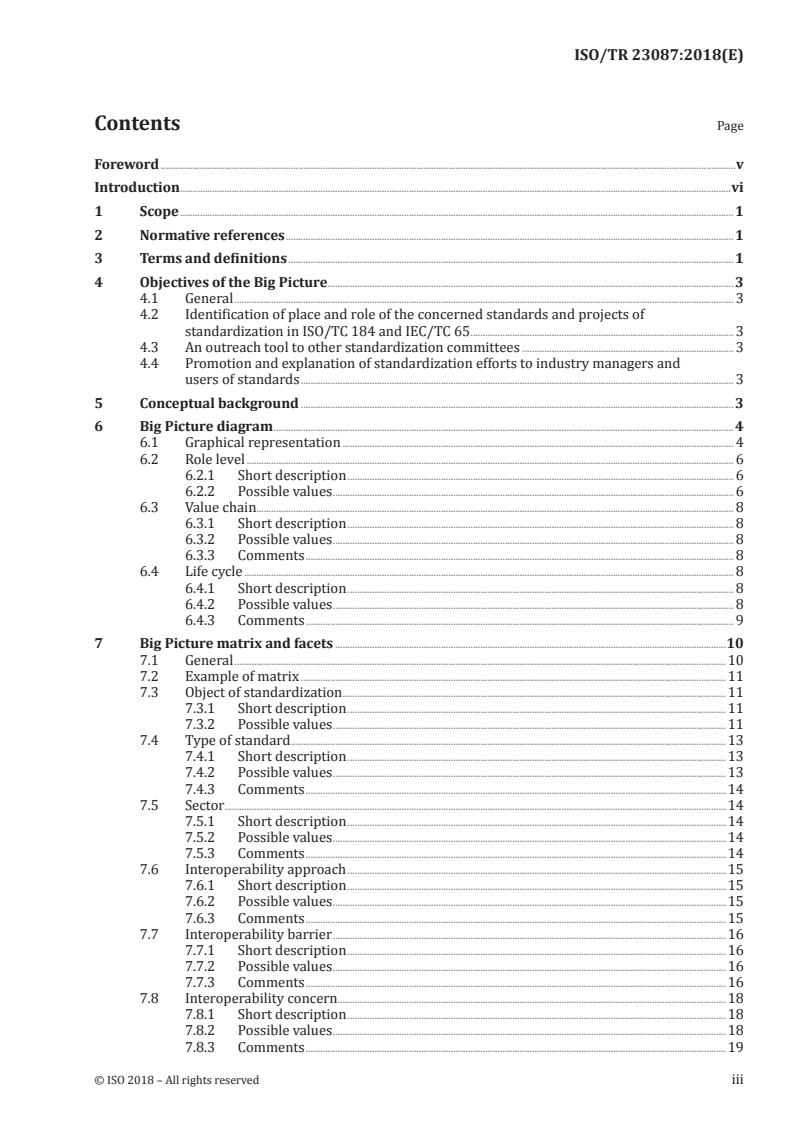
Contents Page
Foreword .v
Introduction .vi
1 Scope . 1
2 Normative references . 1
3 Terms and definitions . 1
4 Objectives of the Big Picture . 3
4.1 General . 3
4.2 Identification of place and role of the concerned standards and projects of
standardization in ISO/TC 184 and IEC/TC 65 . 3
4.3 An outreach tool to other standardization committees . 3
4.4 Promotion and explanation of standardization efforts to industry managers and
users of standards . 3
5 Conceptual background . 3
6 Big Picture diagram . 4
6.1 Graphical representation . 4
6.2 Role level . 6
6.2.1 Short description . 6
6.2.2 Possible values . 6
6.3 Value chain . 8
6.3.1 Short description . 8
6.3.2 Possible values . 8
6.3.3 Comments . 8
6.4 Life cycle . 8
6.4.1 Short description . 8
6.4.2 Possible values . 8
6.4.3 Comments . 9
7 Big Picture matrix and facets .10
7.1 General .10
7.2 Example of matrix .11
7.3 Object of standardization .11
7.3.1 Short description .11
7.3.2 Possible values .11
7.4 Type of standard .13
7.4.1 Short description .13
7.4.2 Possible values .13
7.4.3 Comments .14
7.5 Sector .14
7.5.1 Short description .14
7.5.2 Possible values .14
7.5.3 Comments .14
7.6 Interoperability approach .15
7.6.1 Short description .15
7.6.2 Possible values .15
7.6.3 Comments .15
7.7 Interoperability barrier .16
7.7.1 Short description .16
7.7.2 Possible values .16
7.7.3 Comments .16
7.8 Interoperability concern . .18
7.8.1 Short description .18
7.8.2 Possible values .18
7.8.3 Comments .19
7.9 Conformity .19
7.10 Point of view .19
7.11 Genericity .19
7.11.1 Short description .19
7.11.2 Possible values .19
7.11.3 Comments .20
7.12 Explicit relationship .20
7.12.1 Short description .20
7.12.2 Possible values .20
7.12.3 Comments .21
7.13 Relation with other committees .21
7.13.1 Short description .21
7.13.2 Possible values .21
7.13.3 Comments .21
Annex A (informative) Visualizing the exploration of Big Picture data .22
Annex B (informative) Big Picture matrix .25
Bibliography .32
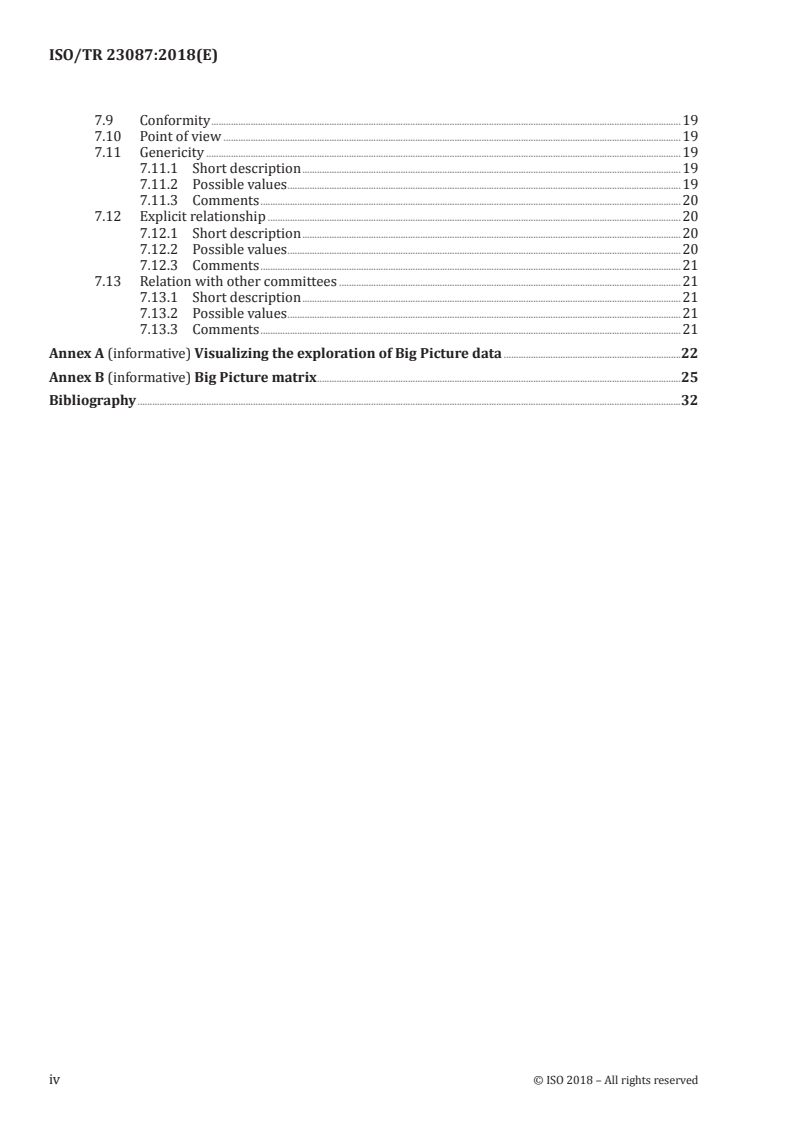
iv © ISO 2018 – All rights reserved
Foreword
ISO (the International Organization for Standardization) is a worldwide federation of national standards
bodies (ISO member bodies). The work of preparing International Standards is normally carried out
through ISO technical committees. Each member body interested in a subject for which a technical
committee has been established has the right to be represented on that committee. International
organizations, governmental and non-governmental, in liaison with ISO, also take part in the work.
ISO collaborates closely with the International Electrotechnical Commission (IEC) on all matters of
electrotechnical standardization.
The procedures used to develop this document and those intended for its further maintenance are
described in the ISO/IEC Directives, Part 1. In particular the different approval criteria needed for the
different types of ISO documents should be noted. This document was drafted in accordance with the
editorial rules of the ISO/IEC Directives, Part 2 (see www .iso .org/ directives).
Attention is drawn to the possibility that some of the elements of this document may be the subject of
patent rights. ISO shall not be held responsible for identifying any or all such patent rights. Details of
any patent rights identified during the development of the document will be in the Introduction and/or
on the ISO list of patent declarations received (see www .iso .org/ patents).
Any trade name used in this document is information given for the convenience of users and does not
constitute an endorsement.
For an explanation on the voluntary nature of standards, the meaning of ISO specific terms and
expressions related to conformity assessment, as well as information about ISO's adherence to the
World Trade Organization (WTO) principles in the Technical Barriers to Trade (TBT) see the following
URL: www .iso .org/ iso/ foreword .html.
This document was prepared by Technical Committee ISO/TC 184, Automation systems and integration.
Introduction
The main objective of the Big Picture is to clarify the landscape of standards and standardization
projects in smart manufacturing (covering all sectors of activity, all value chains, and all types of control:
discrete, batch and continuous) by using clearly defined criteria of analysis (object of standardization,
type of standard, industrial sector, life cycle, value chain, role level, etc.).
The IEC Sector Board 3 (SB3) activity began around 1997 and had members consisting of executives and
technical managers from selected industrial sectors. The SB3 was assisted by a technical steering group
of representatives from ISO/TC 184, IEC/TC 65 and other technical committees developing international
standards for these industrial sectors. The SB3 efforts and deliverables (e.g. ISO/IEC Guide 75) focused
on establishing the rationale, direction and strategic actions to assist both industry and the standards
development organizations in assessing the market relevance of proposed standardization projects.
The “Big Picture” project delivered necessary tools in realizing the SB3 objectives.
The first utilization of the term “Big Picture” by ISO/TC 184 was made by ISO/TC 184/SC 4/IMTF
(Integrated Manufacturing Task Force) in its report to ISO/TC 184/SC 4 in 2001. This report was limited
to the identification of the place and role of the various standards developed within TC 184/SC 4 and to
their relationship. The main interests of this report were the first attempt for an overall representation
of the ISO/TC 184/SC 4 area of work using a graphical representation on which each concerned standard
or project of standardization can be placed as well as the methodology to obtain this representation.
This work was preceded by other work done in 1999 and 2000 by TC 184/SC 4/JWG 8, on the request
of the Chairman of ISO/TC 184/SC 4, on “manufacturing related standards”. Nevertheless, this work
includes preliminary considerations on redundancy, on the impact of the point of view used in each
standard. It also includes a preliminary list of ISO/TC 184 and non ISO/TC 184 standards related to
manufacturing as well as a first analysis of the relationships between features that can have the same
naming in different standards but address concepts that are in fact different.
Later on, ISO/TC 184 set up a task force led by its Advisory Group and named “BSAD”, which was appointed
to list the various areas of interest (universe of discourse) for ISO/TC 184 and its subcommittees. The
objectives of this work was again to try to identify the place of existing standards and possible areas
of work in the ISO/TC 184 “universe of discourse”, using a distinction between developments that are
in the core of the scope of ISO/TC 184, areas that are impacted by ISO/TC 184 work and/or are likely
to impact ISO/TC 184 developments, and areas that are just to be monitored according to the fact that
they are in the “universe of discourse” of ISO/TC 184 without any other relationship with its work.
These activities were followed by the first attempts to carry the “Big Picture” effort to ISO/TC 184/SC 5
and finally at the ISO/TC 184 level (Louisville meeting between SC 4 and SC 5).
A common activity between ISO/TC 184 and IEC/TC 65 started in July 2008 by a meeting between
Chairmen and continued with Joint Advisory Group meetings in 2009, in Frankfurt and Paris.
In 2010, a draft technical report was prepared.
In 2011, a renewed matrix and its user manual were circulated in ISO/TC 184 and IEC/TC 65. These
documents were reviewed in the Joint Advisory Group meeting in 2011 (Berlin).
The ISO/TC 184 and IEC/TC 65 reference framework for the Big Picture was circulated at the end of
2011. Both ISO/TC 184 and IEC/TC 65 and their subcommittees populated the Big Picture Matrix on
this reference framework.
This document is an update of the Big Picture reference framework circulated internally in ISO/TC 184
and IEC/TC 65 in 2011.
In 2012 and 2013, the French National Committee (AFNOR) continued refining the concepts.
In 2014 and 2015, EDF (Électricité de France) conducted a project for the exploiting of the Big
Picture data in a smarter way. The project involved two academic institutions: Centre Universitaire
d'Informatique (Geneva) and Centrale Lille\IG2I. The aim was to provide a “smart” access to
vi © ISO 2018 – All rights reserved
information on standardization and standards in order to facilitate their development and promote
their interoperability, and to develop and present the methodology for access to normative information
(see Annex A).
At the ISO/TC 184 plenary meeting in Nara, the results of the EDF project were demonstrated and
Resolution 563 was endorsed: “TC 184 welcomes the EDF initiative to exploit and present the Big
Picture, invites projects such as OGI to provide additional use cases and invites its Secretariat to pursue
the creation of an ISO project under the TMB to further develop the tool. It is suggested that if the
tool enters general use, consideration should be given to extending the ISO NP form to include the
identification of categories of use.”
Figure 1 shows a summary of the Big Picture project history.
Figure 1 — History of the Big Picture project
This Technical Report may be used in the context of the common ISO-IEC project of international
reference model for smart manufacturing.
TECHNICAL REPORT ISO/TR 23087:2018(E)
Automation systems and integration — The Big Picture of
standards
1 Scope
This document is the reference framework for the Big Picture project.
The Big Picture aims at monitoring the consistency of published standards and current or future
standardization projects.
The Big Picture enables the standardization stakeholders to identify, for each concerned standard
or standardization project, the relevant characteristics related to the positioning and impact of the
standard or standardization project in the industry.
Although the Big Picture was designed initially for the universe of discourse of ISO/TC 184 and then
IEC/TC 65, it applies to manufacturing in general.
2 Normative references
There are no normative references in this document.
3 Terms and definitions
For the purposes of this document, the following terms and definitions apply.
ISO and IEC maintain terminological databases for use in standardization at the following addresses:
— IEC Electropedia: available at http:// www .electropedia .org/
— ISO Online browsing platform: available at https:// www .iso .org/ obp
3.1
generalization
act of removing or modifying detail from a specific concept to produce a more general extent, use or
purpose of this concept or the concept resulting from this operation
Note 1 to entry: Generalization is the inverse of specialization (3.9).
[SOURCE: ISO 19439:2006, 3.34, modified — the order has been changed]
3.2
generic
property of being a generalization (3.1) from a number of distinguishable entities based on their shared
characteristics
[SOURCE: ISO 19439:2006, 3.35]
3.3
genericity
extent to which a concept or an object is generic (3.2)
[SOURCE: ISO 19439:2006, 3.37, modified— “or an object” has been added]
3.4
life cycle
set of distinguishable phases and steps within phases which an entity goes through from its creation
until it ceases to exist
[SOURCE: ISO 19439:2006, 3.42]
3.5
model
abstract description of reality in any form (including mathematical, physical, symbolic, graphical or
descriptive) that presents a certain aspect of that reality
[SOURCE: ISO 19439:2006, 3.47, modified — Note 1 to entry has been deleted]
3.6
point of view
aspect
specific set of properties addressed by a standard or project of standardization according to specific
stakeholder concerns
EXAMPLE The point of view of a manufacturer, a user or a supplier.
Note 1 to entry: This concept is the application to standards of the concept of modeller views developed in
ISO 15704, ISO 14258 and ISO 19439.
3.7
product
thing or substance produced by a natural or artificial process
[SOURCE: ISO 10303-1:1994, 3.2.26]
3.8
resource
enterprise entity that provides some or all of the capabilities required by the execution of an enterprise
activity and/or business process
[SOURCE: ISO 15704:2000, 3.18]
3.9
specialization
general concept modified for a more limited extent, specific use or purpose, or the act of adding or
modifying details to a general concept to produce a specialization thereof
Note 1 to entry: Specialization is the inverse of generalization(3.1).
[SOURCE: ISO 19439:2006, 3.62]
3.10
system
collection of real-world items organized for a given purpose
[SOURCE: ISO 15704:2000, 3.20, modified — Note 1 to entry has been deleted]
3.11
universe of discourse
collection of concrete or abstract things that belong to an area of the real world, selected according to
its interest for the scope of the concerned standardization committees
[SOURCE: ISO 15531-1:2004, 3.6.50, modified — “the system to be modelled and for its corresponding
environment” has been replaced with “scope of the concerned standardization committees” and Note 1
to entry has been deleted]
2 © ISO 2018 – All rights reserved
4 Objectives of the Big Picture
4.1 General
The objectives of the Big Picture are the improvement and the facilitation of systems, components,
products and applications integration along the different life cycles. They can be split into three areas:
— identifying the place and role of the relevant standards and projects of standardization of ISO/TC 184
and IEC/TC 65;
— providing an outreach tool to other standardization committees; and
— promoting and explaining standardization efforts to industry managers and users of standards.
4.2 Identification of place and role of the concerned standards and projects of
standardization in ISO/TC 184 and IEC/TC 65
Identifying the place and role of existing standards and projects of standardization in the universe
of discourse of both ISO/TC 184 and IEC/TC 65 is necessary in order to enable standardization
stakeholders to identify any need for new standards, to monitor possible overlaps and to clarify their
roles and relationships in the field of automation systems and integration concerning:
— collaborative manufacturing throughout the life cycles of products, enterprises, supply chains;
— the application of multiple technologies, techniques and tools to manage and control the flow of
information, materials and other resources within an extended enterprise or supply chain.
4.3 An outreach tool to other standardization committees
The Big Picture is designed to help and facilitate:
— cooperation and collaboration to reduce conflicts in work items;
— promoting the use of related deliverables and their benefits.
4.4 Promotion and explanation of standardization efforts to industry managers and
users of standards
The promotion and explanation of standardization efforts specially address:
— the industry managers and standards users;
— the explanation of the place and role of each standard in the automation and integration process in
manufacturing;
— highlighting the benefits of the use of concerned standards.
5 Conceptual background
Systems theories support explicitly or implicitly most of the standards developed in the universe of
discourse of ISO/TC 184 (especially those developed by ISO/TC 184/SC 5 and ISO/TC 184/SC 4) as well
as some of the standards developed by IEC/TC 65. Accordingly, any process or automation application
may be described systematically as depicted in Figure 2 adapted from ISO 15531-31:2004, Annex D.
Figure 2 — Production or manufacturing system
Any system, including the control system and the physical system, may be divided in subsystems that
will be described in the same way. Systems address applications and processes including software and
hardware components (subsystems).
Products may include raw material, intermediate components and final products.
The physical system has resources (humans, machines, facilities.) that contribute to the transformation
of inputs (product such as raw materials, components.) into others products (final products,
transformed components). Some resources may be considered as products in other systems.
EXAMPLE A drill is a resource in a system which drills a hole such as a drilling machine. The same one is a
product in a system which sharps it such as a sharpening tool.
The control system is the part of the system that treats information coming from the physical system
and from the environment (e.g. other systems), such as sustained constraints to monitor the physical
system and submit needed information to the environment (e.g. others systems) such as provided
constraints. It manages the interfaces with the environment and especially with the other concerned
systems.
6 Big Picture diagram
6.1 Graphical representation
This graphical representation is a three-axis diagram, where the three axes are:
— the role level axis;
— the value chain axis;
— the life cycle axis.
4 © ISO 2018 – All rights reserved
Figure 3 — Big Picture diagram
The target of this graphical representation (See Figure 3) is to identify in a clear, simple and educational
way the place of the standard or standardization project in the universe of discourse of manufacturing
automation and integration.
For example, Figure 4 shows “control and make” standards.
Figure 4 — Example: control and make
For example, Figure 5 shows “business, operate and ship” standards.
Figure 5 — Example: business, operate and ship
6.2 Role level
6.2.1 Short description
The axis “Role level” refers to the role-based hierarchy of an enterprise to which the standard is
applicable. Some standards may serve more than one role.
6.2.2 Possible values
Table 1 describes the possible values of “Role level”.
6 © ISO 2018 – All rights reserved
Table 1 — Role level
Possible values Explanation Source documents
Business Business planning, operation and logistics IEC 62264-1:2013, 3.1.16
Level 4 IEC 62264-1:2013, 5.2.1
functions involved in the business-related
activities needed to manage a manufacturing
organization
Establishing the basic plant schedule for
production, material use, delivery, shipping,
determining inventory levels, operational man-
agement, etc.
Operations Operations management IEC 62264-1:2013, 3.1.22
manufacturing operations management IEC 62264-1:2013, 3.1.17
MOM IEC 62264-1:2013, 5.2.1
activities within Level 3 of a manufacturing fa-
cility that coordinate the personnel, equipment
and material in manufacturing
Level 3
Functions involved in the business-related
activities needed to manage a manufacturing
organization
Work flow/recipe control to produce the de-
sired end products. Maintaining records and
optimizing the production process, dispatching
production, detailed production scheduling,
reliability assurance, etc.
Control Level 2 IEC 62264-1:2013, 5.2.1
functions involved in monitoring and con-
trolling of the physical process
Monitoring, supervisory control and automated
control of the production process
Sensors and actu- Level 1 IEC 62264-1:2013, 3.1.18
ators
functions involved in sensing and manipulating
the physical process
Production process Level 0 IEC 62264-1:2013, 3.1.19
actual physical process
Enterprise Whole enterprise IEC 62264-1:2013, 3.1.10
Enterprise
one or more organizations sharing a definite
mission, goals and objectives which provides an
output such as a product or service
Other All out of making.
For example when the object of standardization
is a product.
6.3 Value chain
6.3.1 Short description
The axis “Value chain” positions the standard on the chain of manufacturing from the supply operation
to the sales and customer support operations.
1)
[SOURCE: SCOR® ]
6.3.2 Possible values
Table 2 describes the possible values of “Value chain”.
Table 2 — Possible values of “Value chain”
Possible values Explanation
Source Buy side, supply chain management.
Make Asset management.
Includes resources, facility and asset management.
Ship Sell side.
For example, customer support management.
Whole Source, make and ship.
6.3.3 Comments
From SCC website:
“SCOR® is typically used to identify, measure, reorganize and improve supply chain processes. This is
accomplished by a cyclic process of:
Capturing the configuration of a supply chain. A supply chain configuration is driven by:
— plan levels of aggregation and information sources;
— source locations and products;
— make production sites and methods;
— deliver channels, inventory deployment and products;
— return locations and methods.
...”
6.4 Life cycle
6.4.1 Short description
The axis “Life cycle” defines the phase(s) of the life cycle covered by the standard.
6.4.2 Possible values
Table 3 describes the possible values of “Life cycle”.
1) SCOR® (Supply Chain Operation Reference) is the trademark of a model from SCC (Supply Chain Council). This
information is given for the convenience of users of this document and does not constitute an endorsement by ISO
of the product named.
8 © ISO 2018 – All rights reserved
Table 3 — Possible values of “Life cycle”
Possible values Explanation
Requirements “Requirements” also covers identification and concept according to ISO 15704.
Design “Design” is synonymous with development and includes preliminary design
and detailed design.
Implementation “Implementation” includes construction and commissioning.
Operation “Operation” includes production and maintenance.
Recycling/reuse
Decommission “Decommission” includes final disposal and waste treatment.
Whole If the standard covers the whole life cycle.
6.4.3 Comments
The phases listed typically cover the life cycle production system but can be also used for other types
of objects.
Three different life cycles are typically considered with the corresponding phases listed in Table 4:
— product instance life cycle: consecutive and interlinked stages of a product system, from raw material
acquisition or generation from natural resources to final disposal (see ISO 14040:2006, 3.1);
— product type life cycle: set of stages of a product type from the start of the development phase to the
end of the product abandonment;
— production system life cycle: finite set of generic phases and steps a system may go through over its
entire life history (see ISO 15704:2000, 3.11).
Table 4 — Alternative values of “Life cycle”
Possible values Explanation
Applicable for all:
Whole life cycle If the standard covers the whole life cycle.
Applicable for systems:
Requirements “Requirements” also covers identification and concept according to ISO 15704.
Design “Design” is synonymous with development and includes preliminary design
and detailed design.
Implementation “Implementation” includes construction and commissioning.
Operation “Operation” includes production and maintenance.
Recycling/reuse
Decommission “Decommission” includes final disposal and waste treatment.
Applicable for product types:
Requirements
Design “Design” is synonymous with development and includes preliminary design
and detailed design.
Implementation
Sales
After sales support
Applicable for product instances:
Raw material acquisition
Production
Use
Recycling/reuse
Decommission “Decommission” includes final disposal and waste treatment.
7 Big Picture matrix and facets
7.1 General
The Big Picture matrix is a spreadsheet where relevant standards and standardization projects can be
described according to the Big Picture axis and additional attributes called facets.
The identification attributes of the standards and standardization projects are:
— standard body;
— standard series number;
— standard part number;
— standard title.
The facets are:
— object of standardization;
— type of standard;
— sector;
— interoperability approach;
— interoperability barrier;
10 © ISO 2018 – All rights reserved
— interoperability concern;
— conformity;
— point of view;
— genericity;
— explicit relationship;
— committee interest.
These facets are described in the following subclauses.
7.2 Example of matrix
Figure 6 and Annex B show examples of populated Big Picture matrices.
Figure 6 — Example of Big Picture matrix
7.3 Object of standardization
7.3.1 Short description
The facet “Object of standardisation” defines the focus in the system approach.
The standard specifies requirements/provisions that need to be provided/addressed/satisfied by
“Object of standardisation”.
7.3.2 Possible values
Table 5 describes the possible values of “Object of standardization”.
Table 5 — Possible values of “Object of standardization”
Possible values Explanation Source documents
System — Definitions ISO/IEC 10746-2:2009, 6.5
something of interest as a whole or as comprised ISO 15745-1:2003, 3.32
of parts
ISO 15704:2000, 3.20
Therefore a system may be referred to as an en-
tity. A component of a system may itself be a sys-
tem, in which case it may be called a subsystem.
collection of real-world items organized for a
given purpose
NOTE A system is characterized by its structure
and its behaviour.
— Examples of item
Enterprise, factory, machine.
Device — Definition ISO 15745-1:2003, 3.11
entity that performs control, actuating and/or
sensing functions and interfaces to other such
entities within an automation system
— Comment
The device is a resource for the manufacturing
system.
— Example of standard
IEC 61915-2
Product — Definition IEC 62264-1:2013, 3.1.27
desired output or by-product of the processes of
an enterprise
Note 1 to entry: A product can be an intermedi-
ate product, end product, or finished goods from
a business perspective.
— Comment
In this notion of product, service is not included.
The product is the result of a process and object
of trade.
— Examples of standard
IEC 62683-1
IEC 61987-1
Tool — Examples of item
Milling tool
Application
Process — Examples of item
Batch
Service distinct part of the functionality that is provided ISO/TS 19103:2015, 4.32
by an entity through interfaces
12 © ISO 2018 – All rights reserved
Table 5 (continued)
Possible values Explanation Source documents
Interface — Definition ISO/IEC 2382:2015, 2124351
feature (hardware or software) that enables ISO/IEC 10859:1997, 1.4.1.2
objects to cooperate
shared boundary between two functional units,
defined by various characteristics pertaining
to the functions, physical interconnections,
signal exchanges, and other characteristics, as
appropriate
shared boundary between two or more systems,
or between two or more elements within a sys-
tem, through which information is conveyed
— Examples of item
Networks, gateways
— Examples of standard
IEC/TR 62541-1
IEC 62453-1
Data — Examples of standard
ISO/TS 8000-1
Information — Examples of standard
ISO 10303 series
Ontology — Examples of standard
IEC 61360-1
ISO 13584 series
ISO 22745 series
7.4 Type of standard
7.4.1 Short description
The facet “Type of standard” defines the focus of the standard or of the part of standard.
7.4.2 Possible values
Table 6 describes the possible values of “Type of standard”.
Table 6 — Possible values of “Type of standard”
Possible values Explanation
Terminology “Terminology” covers:
— terminology
— glossary
Overview
Model
Framework Elements, rules and flows.
Architecture
Table 6 (continued)
Possible values Explanation
Language — Examples of item
UML, XML, EXPRESS
— Examples of standard
IEC 61131-3
IEC 61499-2
Design requirements
Test requirements
Design and test requirements
7.4.3 Comments
The components of enterprise-reference architectures are engineering methodologies, modelling
languages, generic elements, (partial and particular) models, (computer-based) tools, modules, and
enterprise-operational systems (see ISO 15704).
7.5 Sector
7.5.1 Short description
The facet “Sector” describes a grouping based on similar production processes, similar products,
similar activities or similar behaviour in financial markets.
7.5.2 Possible values
Table 7 describes the possible values of “Sector”.
Table 7 — Possible values of “Sector”
Possible values Explanation
Any
Text Sector from a recognized taxonomy.
7.5.3 Comments
The classification or taxonomy used can vary according to the standard.
It can be the type of production process: discrete manufacturing process; batch process; continuous
process.
The segmentation can rely on the end markets: residential; industry; energy and infrastructure;
buildings; data centres & networks.
It can be the classification of sectors from the European Commission\Enterprise and Industry:
aeronautic industries; automotive; biotechnology; chemicals; construction; defence industries;
electrical engineering; food industry; footwear; furniture; healthcare industries; information and
communication technologies; leather; legal metrology and pre-packaging; maritime industries;
mechanical engineering; mining; metals and minerals; pressure equipment and gas appliances; radio
and telecommunications terminal equipment (R&TTE); security research and development; space;
textiles and clothing; tourism; toys; wood, paper, printing.
The segmentation can be more detailed such as: robots; industrial automation; airport; automotive;
hospital; marine; retail; hotels; packaging; material handling; hoisting; textile; hvac; it; lift; machines;
rail; panel builders; electrical energy; wind farm; thermal power; nuclear; hydro; mining; minerals &
14 © ISO 2018 – All rights reserved
metals; cement; mining; food & beverages; milk; drinks; beer; biscuit; pet food; water; drinking water;
wastewater; desalination; oil and gas; off-shore; on-shore; pipeline; refinery; tank farm; services; green
buildings; fire safety.
It can be from the ISO ICS list: services, company organization, management and quality; administration,
transport, sociology; mathematics, natural sciences; health care technology; environment, health
protection, safety; metrology and measurement, physical phenomena; testing; mechanical systems and
components for general use; fluid systems and components for general use; manufacturing engineering;
energy and heat transfer engineering; electrical engineering; electronics; telecommunications, audio
and video engineering; information technology, office machines; image technology; precision mechanics,
jewellery; road vehicles engineering; railway engineering; shipbuilding and marine structures; aircraft
and space vehicle engineering; materials handling equipment; packaging and distribution of goods;
textile and leather technology; clothing industry; agriculture; food technology; chemical technology;
mining and minerals; petroleum and related technologies; metallurgy; wood technology; glass and
ceramics industries; rubber and plastic industries; paper technology; paint and colour industr
...
TECHNICAL ISO/TR
REPORT 23087
First edition
2018-03
Automation systems and
integration — The Big Picture of
standards
Systèmes d'automatisation et intégration — Panorama des
documents normatifs
Reference number
©
ISO 2018
© ISO 2018
All rights reserved. Unless otherwise specified, or required in the context of its implementation, no part of this publication may
be reproduced or utilized otherwise in any form or by any means, electronic or mechanical, including photocopying, or posting
on the internet or an intranet, without prior written permission. Permission can be requested from either ISO at the address
below or ISO’s member body in the country of the requester.
ISO copyright office
CP 401 • Ch. de Blandonnet 8
CH-1214 Vernier, Geneva
Phone: +41 22 749 01 11
Fax: +41 22 749 09 47
Email: copyright@iso.org
Website: www.iso.org
Published in Switzerland
ii © ISO 2018 – All rights reserved
Contents Page
Foreword .v
Introduction .vi
1 Scope . 1
2 Normative references . 1
3 Terms and definitions . 1
4 Objectives of the Big Picture . 3
4.1 General . 3
4.2 Identification of place and role of the concerned standards and projects of
standardization in ISO/TC 184 and IEC/TC 65 . 3
4.3 An outreach tool to other standardization committees . 3
4.4 Promotion and explanation of standardization efforts to industry managers and
users of standards . 3
5 Conceptual background . 3
6 Big Picture diagram . 4
6.1 Graphical representation . 4
6.2 Role level . 6
6.2.1 Short description . 6
6.2.2 Possible values . 6
6.3 Value chain . 8
6.3.1 Short description . 8
6.3.2 Possible values . 8
6.3.3 Comments . 8
6.4 Life cycle . 8
6.4.1 Short description . 8
6.4.2 Possible values . 8
6.4.3 Comments . 9
7 Big Picture matrix and facets .10
7.1 General .10
7.2 Example of matrix .11
7.3 Object of standardization .11
7.3.1 Short description .11
7.3.2 Possible values .11
7.4 Type of standard .13
7.4.1 Short description .13
7.4.2 Possible values .13
7.4.3 Comments .14
7.5 Sector .14
7.5.1 Short description .14
7.5.2 Possible values .14
7.5.3 Comments .14
7.6 Interoperability approach .15
7.6.1 Short description .15
7.6.2 Possible values .15
7.6.3 Comments .15
7.7 Interoperability barrier .16
7.7.1 Short description .16
7.7.2 Possible values .16
7.7.3 Comments .16
7.8 Interoperability concern . .18
7.8.1 Short description .18
7.8.2 Possible values .18
7.8.3 Comments .19
7.9 Conformity .19
7.10 Point of view .19
7.11 Genericity .19
7.11.1 Short description .19
7.11.2 Possible values .19
7.11.3 Comments .20
7.12 Explicit relationship .20
7.12.1 Short description .20
7.12.2 Possible values .20
7.12.3 Comments .21
7.13 Relation with other committees .21
7.13.1 Short description .21
7.13.2 Possible values .21
7.13.3 Comments .21
Annex A (informative) Visualizing the exploration of Big Picture data .22
Annex B (informative) Big Picture matrix .25
Bibliography .32
iv © ISO 2018 – All rights reserved
Foreword
ISO (the International Organization for Standardization) is a worldwide federation of national standards
bodies (ISO member bodies). The work of preparing International Standards is normally carried out
through ISO technical committees. Each member body interested in a subject for which a technical
committee has been established has the right to be represented on that committee. International
organizations, governmental and non-governmental, in liaison with ISO, also take part in the work.
ISO collaborates closely with the International Electrotechnical Commission (IEC) on all matters of
electrotechnical standardization.
The procedures used to develop this document and those intended for its further maintenance are
described in the ISO/IEC Directives, Part 1. In particular the different approval criteria needed for the
different types of ISO documents should be noted. This document was drafted in accordance with the
editorial rules of the ISO/IEC Directives, Part 2 (see www .iso .org/ directives).
Attention is drawn to the possibility that some of the elements of this document may be the subject of
patent rights. ISO shall not be held responsible for identifying any or all such patent rights. Details of
any patent rights identified during the development of the document will be in the Introduction and/or
on the ISO list of patent declarations received (see www .iso .org/ patents).
Any trade name used in this document is information given for the convenience of users and does not
constitute an endorsement.
For an explanation on the voluntary nature of standards, the meaning of ISO specific terms and
expressions related to conformity assessment, as well as information about ISO's adherence to the
World Trade Organization (WTO) principles in the Technical Barriers to Trade (TBT) see the following
URL: www .iso .org/ iso/ foreword .html.
This document was prepared by Technical Committee ISO/TC 184, Automation systems and integration.
Introduction
The main objective of the Big Picture is to clarify the landscape of standards and standardization
projects in smart manufacturing (covering all sectors of activity, all value chains, and all types of control:
discrete, batch and continuous) by using clearly defined criteria of analysis (object of standardization,
type of standard, industrial sector, life cycle, value chain, role level, etc.).
The IEC Sector Board 3 (SB3) activity began around 1997 and had members consisting of executives and
technical managers from selected industrial sectors. The SB3 was assisted by a technical steering group
of representatives from ISO/TC 184, IEC/TC 65 and other technical committees developing international
standards for these industrial sectors. The SB3 efforts and deliverables (e.g. ISO/IEC Guide 75) focused
on establishing the rationale, direction and strategic actions to assist both industry and the standards
development organizations in assessing the market relevance of proposed standardization projects.
The “Big Picture” project delivered necessary tools in realizing the SB3 objectives.
The first utilization of the term “Big Picture” by ISO/TC 184 was made by ISO/TC 184/SC 4/IMTF
(Integrated Manufacturing Task Force) in its report to ISO/TC 184/SC 4 in 2001. This report was limited
to the identification of the place and role of the various standards developed within TC 184/SC 4 and to
their relationship. The main interests of this report were the first attempt for an overall representation
of the ISO/TC 184/SC 4 area of work using a graphical representation on which each concerned standard
or project of standardization can be placed as well as the methodology to obtain this representation.
This work was preceded by other work done in 1999 and 2000 by TC 184/SC 4/JWG 8, on the request
of the Chairman of ISO/TC 184/SC 4, on “manufacturing related standards”. Nevertheless, this work
includes preliminary considerations on redundancy, on the impact of the point of view used in each
standard. It also includes a preliminary list of ISO/TC 184 and non ISO/TC 184 standards related to
manufacturing as well as a first analysis of the relationships between features that can have the same
naming in different standards but address concepts that are in fact different.
Later on, ISO/TC 184 set up a task force led by its Advisory Group and named “BSAD”, which was appointed
to list the various areas of interest (universe of discourse) for ISO/TC 184 and its subcommittees. The
objectives of this work was again to try to identify the place of existing standards and possible areas
of work in the ISO/TC 184 “universe of discourse”, using a distinction between developments that are
in the core of the scope of ISO/TC 184, areas that are impacted by ISO/TC 184 work and/or are likely
to impact ISO/TC 184 developments, and areas that are just to be monitored according to the fact that
they are in the “universe of discourse” of ISO/TC 184 without any other relationship with its work.
These activities were followed by the first attempts to carry the “Big Picture” effort to ISO/TC 184/SC 5
and finally at the ISO/TC 184 level (Louisville meeting between SC 4 and SC 5).
A common activity between ISO/TC 184 and IEC/TC 65 started in July 2008 by a meeting between
Chairmen and continued with Joint Advisory Group meetings in 2009, in Frankfurt and Paris.
In 2010, a draft technical report was prepared.
In 2011, a renewed matrix and its user manual were circulated in ISO/TC 184 and IEC/TC 65. These
documents were reviewed in the Joint Advisory Group meeting in 2011 (Berlin).
The ISO/TC 184 and IEC/TC 65 reference framework for the Big Picture was circulated at the end of
2011. Both ISO/TC 184 and IEC/TC 65 and their subcommittees populated the Big Picture Matrix on
this reference framework.
This document is an update of the Big Picture reference framework circulated internally in ISO/TC 184
and IEC/TC 65 in 2011.
In 2012 and 2013, the French National Committee (AFNOR) continued refining the concepts.
In 2014 and 2015, EDF (Électricité de France) conducted a project for the exploiting of the Big
Picture data in a smarter way. The project involved two academic institutions: Centre Universitaire
d'Informatique (Geneva) and Centrale Lille\IG2I. The aim was to provide a “smart” access to
vi © ISO 2018 – All rights reserved
information on standardization and standards in order to facilitate their development and promote
their interoperability, and to develop and present the methodology for access to normative information
(see Annex A).
At the ISO/TC 184 plenary meeting in Nara, the results of the EDF project were demonstrated and
Resolution 563 was endorsed: “TC 184 welcomes the EDF initiative to exploit and present the Big
Picture, invites projects such as OGI to provide additional use cases and invites its Secretariat to pursue
the creation of an ISO project under the TMB to further develop the tool. It is suggested that if the
tool enters general use, consideration should be given to extending the ISO NP form to include the
identification of categories of use.”
Figure 1 shows a summary of the Big Picture project history.
Figure 1 — History of the Big Picture project
This Technical Report may be used in the context of the common ISO-IEC project of international
reference model for smart manufacturing.
TECHNICAL REPORT ISO/TR 23087:2018(E)
Automation systems and integration — The Big Picture of
standards
1 Scope
This document is the reference framework for the Big Picture project.
The Big Picture aims at monitoring the consistency of published standards and current or future
standardization projects.
The Big Picture enables the standardization stakeholders to identify, for each concerned standard
or standardization project, the relevant characteristics related to the positioning and impact of the
standard or standardization project in the industry.
Although the Big Picture was designed initially for the universe of discourse of ISO/TC 184 and then
IEC/TC 65, it applies to manufacturing in general.
2 Normative references
There are no normative references in this document.
3 Terms and definitions
For the purposes of this document, the following terms and definitions apply.
ISO and IEC maintain terminological databases for use in standardization at the following addresses:
— IEC Electropedia: available at http:// www .electropedia .org/
— ISO Online browsing platform: available at https:// www .iso .org/ obp
3.1
generalization
act of removing or modifying detail from a specific concept to produce a more general extent, use or
purpose of this concept or the concept resulting from this operation
Note 1 to entry: Generalization is the inverse of specialization (3.9).
[SOURCE: ISO 19439:2006, 3.34, modified — the order has been changed]
3.2
generic
property of being a generalization (3.1) from a number of distinguishable entities based on their shared
characteristics
[SOURCE: ISO 19439:2006, 3.35]
3.3
genericity
extent to which a concept or an object is generic (3.2)
[SOURCE: ISO 19439:2006, 3.37, modified— “or an object” has been added]
3.4
life cycle
set of distinguishable phases and steps within phases which an entity goes through from its creation
until it ceases to exist
[SOURCE: ISO 19439:2006, 3.42]
3.5
model
abstract description of reality in any form (including mathematical, physical, symbolic, graphical or
descriptive) that presents a certain aspect of that reality
[SOURCE: ISO 19439:2006, 3.47, modified — Note 1 to entry has been deleted]
3.6
point of view
aspect
specific set of properties addressed by a standard or project of standardization according to specific
stakeholder concerns
EXAMPLE The point of view of a manufacturer, a user or a supplier.
Note 1 to entry: This concept is the application to standards of the concept of modeller views developed in
ISO 15704, ISO 14258 and ISO 19439.
3.7
product
thing or substance produced by a natural or artificial process
[SOURCE: ISO 10303-1:1994, 3.2.26]
3.8
resource
enterprise entity that provides some or all of the capabilities required by the execution of an enterprise
activity and/or business process
[SOURCE: ISO 15704:2000, 3.18]
3.9
specialization
general concept modified for a more limited extent, specific use or purpose, or the act of adding or
modifying details to a general concept to produce a specialization thereof
Note 1 to entry: Specialization is the inverse of generalization(3.1).
[SOURCE: ISO 19439:2006, 3.62]
3.10
system
collection of real-world items organized for a given purpose
[SOURCE: ISO 15704:2000, 3.20, modified — Note 1 to entry has been deleted]
3.11
universe of discourse
collection of concrete or abstract things that belong to an area of the real world, selected according to
its interest for the scope of the concerned standardization committees
[SOURCE: ISO 15531-1:2004, 3.6.50, modified — “the system to be modelled and for its corresponding
environment” has been replaced with “scope of the concerned standardization committees” and Note 1
to entry has been deleted]
2 © ISO 2018 – All rights reserved
4 Objectives of the Big Picture
4.1 General
The objectives of the Big Picture are the improvement and the facilitation of systems, components,
products and applications integration along the different life cycles. They can be split into three areas:
— identifying the place and role of the relevant standards and projects of standardization of ISO/TC 184
and IEC/TC 65;
— providing an outreach tool to other standardization committees; and
— promoting and explaining standardization efforts to industry managers and users of standards.
4.2 Identification of place and role of the concerned standards and projects of
standardization in ISO/TC 184 and IEC/TC 65
Identifying the place and role of existing standards and projects of standardization in the universe
of discourse of both ISO/TC 184 and IEC/TC 65 is necessary in order to enable standardization
stakeholders to identify any need for new standards, to monitor possible overlaps and to clarify their
roles and relationships in the field of automation systems and integration concerning:
— collaborative manufacturing throughout the life cycles of products, enterprises, supply chains;
— the application of multiple technologies, techniques and tools to manage and control the flow of
information, materials and other resources within an extended enterprise or supply chain.
4.3 An outreach tool to other standardization committees
The Big Picture is designed to help and facilitate:
— cooperation and collaboration to reduce conflicts in work items;
— promoting the use of related deliverables and their benefits.
4.4 Promotion and explanation of standardization efforts to industry managers and
users of standards
The promotion and explanation of standardization efforts specially address:
— the industry managers and standards users;
— the explanation of the place and role of each standard in the automation and integration process in
manufacturing;
— highlighting the benefits of the use of concerned standards.
5 Conceptual background
Systems theories support explicitly or implicitly most of the standards developed in the universe of
discourse of ISO/TC 184 (especially those developed by ISO/TC 184/SC 5 and ISO/TC 184/SC 4) as well
as some of the standards developed by IEC/TC 65. Accordingly, any process or automation application
may be described systematically as depicted in Figure 2 adapted from ISO 15531-31:2004, Annex D.
Figure 2 — Production or manufacturing system
Any system, including the control system and the physical system, may be divided in subsystems that
will be described in the same way. Systems address applications and processes including software and
hardware components (subsystems).
Products may include raw material, intermediate components and final products.
The physical system has resources (humans, machines, facilities.) that contribute to the transformation
of inputs (product such as raw materials, components.) into others products (final products,
transformed components). Some resources may be considered as products in other systems.
EXAMPLE A drill is a resource in a system which drills a hole such as a drilling machine. The same one is a
product in a system which sharps it such as a sharpening tool.
The control system is the part of the system that treats information coming from the physical system
and from the environment (e.g. other systems), such as sustained constraints to monitor the physical
system and submit needed information to the environment (e.g. others systems) such as provided
constraints. It manages the interfaces with the environment and especially with the other concerned
systems.
6 Big Picture diagram
6.1 Graphical representation
This graphical representation is a three-axis diagram, where the three axes are:
— the role level axis;
— the value chain axis;
— the life cycle axis.
4 © ISO 2018 – All rights reserved
Figure 3 — Big Picture diagram
The target of this graphical representation (See Figure 3) is to identify in a clear, simple and educational
way the place of the standard or standardization project in the universe of discourse of manufacturing
automation and integration.
For example, Figure 4 shows “control and make” standards.
Figure 4 — Example: control and make
For example, Figure 5 shows “business, operate and ship” standards.
Figure 5 — Example: business, operate and ship
6.2 Role level
6.2.1 Short description
The axis “Role level” refers to the role-based hierarchy of an enterprise to which the standard is
applicable. Some standards may serve more than one role.
6.2.2 Possible values
Table 1 describes the possible values of “Role level”.
6 © ISO 2018 – All rights reserved
Table 1 — Role level
Possible values Explanation Source documents
Business Business planning, operation and logistics IEC 62264-1:2013, 3.1.16
Level 4 IEC 62264-1:2013, 5.2.1
functions involved in the business-related
activities needed to manage a manufacturing
organization
Establishing the basic plant schedule for
production, material use, delivery, shipping,
determining inventory levels, operational man-
agement, etc.
Operations Operations management IEC 62264-1:2013, 3.1.22
manufacturing operations management IEC 62264-1:2013, 3.1.17
MOM IEC 62264-1:2013, 5.2.1
activities within Level 3 of a manufacturing fa-
cility that coordinate the personnel, equipment
and material in manufacturing
Level 3
Functions involved in the business-related
activities needed to manage a manufacturing
organization
Work flow/recipe control to produce the de-
sired end products. Maintaining records and
optimizing the production process, dispatching
production, detailed production scheduling,
reliability assurance, etc.
Control Level 2 IEC 62264-1:2013, 5.2.1
functions involved in monitoring and con-
trolling of the physical process
Monitoring, supervisory control and automated
control of the production process
Sensors and actu- Level 1 IEC 62264-1:2013, 3.1.18
ators
functions involved in sensing and manipulating
the physical process
Production process Level 0 IEC 62264-1:2013, 3.1.19
actual physical process
Enterprise Whole enterprise IEC 62264-1:2013, 3.1.10
Enterprise
one or more organizations sharing a definite
mission, goals and objectives which provides an
output such as a product or service
Other All out of making.
For example when the object of standardization
is a product.
6.3 Value chain
6.3.1 Short description
The axis “Value chain” positions the standard on the chain of manufacturing from the supply operation
to the sales and customer support operations.
1)
[SOURCE: SCOR® ]
6.3.2 Possible values
Table 2 describes the possible values of “Value chain”.
Table 2 — Possible values of “Value chain”
Possible values Explanation
Source Buy side, supply chain management.
Make Asset management.
Includes resources, facility and asset management.
Ship Sell side.
For example, customer support management.
Whole Source, make and ship.
6.3.3 Comments
From SCC website:
“SCOR® is typically used to identify, measure, reorganize and improve supply chain processes. This is
accomplished by a cyclic process of:
Capturing the configuration of a supply chain. A supply chain configuration is driven by:
— plan levels of aggregation and information sources;
— source locations and products;
— make production sites and methods;
— deliver channels, inventory deployment and products;
— return locations and methods.
...”
6.4 Life cycle
6.4.1 Short description
The axis “Life cycle” defines the phase(s) of the life cycle covered by the standard.
6.4.2 Possible values
Table 3 describes the possible values of “Life cycle”.
1) SCOR® (Supply Chain Operation Reference) is the trademark of a model from SCC (Supply Chain Council). This
information is given for the convenience of users of this document and does not constitute an endorsement by ISO
of the product named.
8 © ISO 2018 – All rights reserved
Table 3 — Possible values of “Life cycle”
Possible values Explanation
Requirements “Requirements” also covers identification and concept according to ISO 15704.
Design “Design” is synonymous with development and includes preliminary design
and detailed design.
Implementation “Implementation” includes construction and commissioning.
Operation “Operation” includes production and maintenance.
Recycling/reuse
Decommission “Decommission” includes final disposal and waste treatment.
Whole If the standard covers the whole life cycle.
6.4.3 Comments
The phases listed typically cover the life cycle production system but can be also used for other types
of objects.
Three different life cycles are typically considered with the corresponding phases listed in Table 4:
— product instance life cycle: consecutive and interlinked stages of a product system, from raw material
acquisition or generation from natural resources to final disposal (see ISO 14040:2006, 3.1);
— product type life cycle: set of stages of a product type from the start of the development phase to the
end of the product abandonment;
— production system life cycle: finite set of generic phases and steps a system may go through over its
entire life history (see ISO 15704:2000, 3.11).
Table 4 — Alternative values of “Life cycle”
Possible values Explanation
Applicable for all:
Whole life cycle If the standard covers the whole life cycle.
Applicable for systems:
Requirements “Requirements” also covers identification and concept according to ISO 15704.
Design “Design” is synonymous with development and includes preliminary design
and detailed design.
Implementation “Implementation” includes construction and commissioning.
Operation “Operation” includes production and maintenance.
Recycling/reuse
Decommission “Decommission” includes final disposal and waste treatment.
Applicable for product types:
Requirements
Design “Design” is synonymous with development and includes preliminary design
and detailed design.
Implementation
Sales
After sales support
Applicable for product instances:
Raw material acquisition
Production
Use
Recycling/reuse
Decommission “Decommission” includes final disposal and waste treatment.
7 Big Picture matrix and facets
7.1 General
The Big Picture matrix is a spreadsheet where relevant standards and standardization projects can be
described according to the Big Picture axis and additional attributes called facets.
The identification attributes of the standards and standardization projects are:
— standard body;
— standard series number;
— standard part number;
— standard title.
The facets are:
— object of standardization;
— type of standard;
— sector;
— interoperability approach;
— interoperability barrier;
10 © ISO 2018 – All rights reserved
— interoperability concern;
— conformity;
— point of view;
— genericity;
— explicit relationship;
— committee interest.
These facets are described in the following subclauses.
7.2 Example of matrix
Figure 6 and Annex B show examples of populated Big Picture matrices.
Figure 6 — Example of Big Picture matrix
7.3 Object of standardization
7.3.1 Short description
The facet “Object of standardisation” defines the focus in the system approach.
The standard specifies requirements/provisions that need to be provided/addressed/satisfied by
“Object of standardisation”.
7.3.2 Possible values
Table 5 describes the possible values of “Object of standardization”.
Table 5 — Possible values of “Object of standardization”
Possible values Explanation Source documents
System — Definitions ISO/IEC 10746-2:2009, 6.5
something of interest as a whole or as comprised ISO 15745-1:2003, 3.32
of parts
ISO 15704:2000, 3.20
Therefore a system may be referred to as an en-
tity. A component of a system may itself be a sys-
tem, in which case it may be called a subsystem.
collection of real-world items organized for a
given purpose
NOTE A system is characterized by its structure
and its behaviour.
— Examples of item
Enterprise, factory, machine.
Device — Definition ISO 15745-1:2003, 3.11
entity that performs control, actuating and/or
sensing functions and interfaces to other such
entities within an automation system
— Comment
The device is a resource for the manufacturing
system.
— Example of standard
IEC 61915-2
Product — Definition IEC 62264-1:2013, 3.1.27
desired output or by-product of the processes of
an enterprise
Note 1 to entry: A product can be an intermedi-
ate product, end product, or finished goods from
a business perspective.
— Comment
In this notion of product, service is not included.
The product is the result of a process and object
of trade.
— Examples of standard
IEC 62683-1
IEC 61987-1
Tool — Examples of item
Milling tool
Application
Process — Examples of item
Batch
Service distinct part of the functionality that is provided ISO/TS 19103:2015, 4.32
by an entity through interfaces
12 © ISO 2018 – All rights reserved
Table 5 (continued)
Possible values Explanation Source documents
Interface — Definition ISO/IEC 2382:2015, 2124351
feature (hardware or software) that enables ISO/IEC 10859:1997, 1.4.1.2
objects to cooperate
shared boundary between two functional units,
defined by various characteristics pertaining
to the functions, physical interconnections,
signal exchanges, and other characteristics, as
appropriate
shared boundary between two or more systems,
or between two or more elements within a sys-
tem, through which information is conveyed
— Examples of item
Networks, gateways
— Examples of standard
IEC/TR 62541-1
IEC 62453-1
Data — Examples of standard
ISO/TS 8000-1
Information — Examples of standard
ISO 10303 series
Ontology — Examples of standard
IEC 61360-1
ISO 13584 series
ISO 22745 series
7.4 Type of standard
7.4.1 Short description
The facet “Type of standard” defines the focus of the standard or of the part of standard.
7.4.2 Possible values
Table 6 describes the possible values of “Type of standard”.
Table 6 — Possible values of “Type of standard”
Possible values Explanation
Terminology “Terminology” covers:
— terminology
— glossary
Overview
Model
Framework Elements, rules and flows.
Architecture
Table 6 (continued)
Possible values Explanation
Language — Examples of item
UML, XML, EXPRESS
— Examples of standard
IEC 61131-3
IEC 61499-2
Design requirements
Test requirements
Design and test requirements
7.4.3 Comments
The components of enterprise-reference architectures are engineering methodologies, modelling
languages, generic elements, (partial and particular) models, (computer-based) tools, modules, and
enterprise-operational systems (see ISO 15704).
7.5 Sector
7.5.1 Short description
The facet “Sector” describes a grouping based on similar production processes, similar products,
similar activities or similar behaviour in financial markets.
7.5.2 Possible values
Table 7 describes the possible values of “Sector”.
Table 7 — Possible values of “Sector”
Possible values Explanation
Any
Text Sector from a recognized taxonomy.
7.5.3 Comments
The classification or taxonomy used can vary according to the standard.
It can be the type of production process: discrete manufacturing process; batch process; continuous
process.
The segmentation can rely on the end markets: residential; industry; energy and infrastructure;
buildings; data centres & networks.
It can be the classification of sectors from the European Commission\Enterprise and Industry:
aeronautic industries; automotive; biotechnology; chemicals; construction; defence industries;
electrical engineering; food industry; footwear; furniture; healthcare industries; information and
communication technologies; leather; legal metrology and pre-packaging; maritime industries;
mechanical engineering; mining; metals and minerals; pressure equipment and gas appliances; radio
and telecommunications terminal equipment (R&TTE); security research and development; space;
textiles and clothing; tourism; toys; wood, paper, printing.
The segmentation can be more detailed such as: robots; industrial automation; airport; automotive;
hospital; marine; retail; hotels; packaging; material handling; hoisting; textile; hvac; it; lift; machines;
rail; panel builders; electrical energy; wind farm; thermal power; nuclear; hydro; mining; minerals &
14 © ISO 2018 – All rights reserved
metals; cement; mining; food & beverages; milk; drinks; beer; biscuit; pet food; water; drinking water;
wastewater; desalination; oil and gas; off-shore; on-shore; pipeline; refinery; tank farm; services; green
buildings; fire safety.
It can be from the ISO ICS list: services, company organization, management and quality; administration,
transport, sociology; mathematics, natural sciences; health care technology; environment, health
protection, safety; metrology and measurement, physical phenomena; testing; mechanical systems and
components for general use; fluid systems and components for general use; manufacturing engineering;
energy and heat transfer engineering; electrical engineering; electronics; telecommunications, audio
and video engineering; information technology, office machines; image technology; precision mechanics,
jewellery; road vehicles engineering; railway engineering; shipbuilding and marine structures; aircraft
and space vehicle engineering; materials handling equipment; packaging and distribution of goods;
textile and leather technology; clothing industry; agriculture; food technology; chemical technology;
mining and minerals; petroleum and related technologies; metallurgy; wood technology; glass and
ceramics industries; rubber and plastic industries; paper technology; paint and colour industr
...