


ISO 16400-3:2024
(Main)Automation systems and integration — Equipment behaviour catalogues for virtual production system — Part 3: Requirements and recommendations for construction of an equipment instance model
Automation systems and integration — Equipment behaviour catalogues for virtual production system — Part 3: Requirements and recommendations for construction of an equipment instance model
This document provides requirements and recommendations on how to construct an equipment instance model using an equipment behaviour catalogue (EBC) item.
Titre manque — Partie 3: Titre manque
General Information
- Status
- Published
- Publication Date
- 18-Mar-2024
- Technical Committee
- ISO/TC 184/SC 5 - Interoperability, integration, and architectures for enterprise systems and automation applications
- Drafting Committee
- ISO/TC 184/SC 5/WG 13 - Equipment behaviour catalogue
- Current Stage
- 6060 - International Standard published
- Start Date
- 19-Mar-2024
- Due Date
- 07-Jan-2024
- Completion Date
- 19-Mar-2024
Overview
ISO 16400-3:2024 is an international standard developed by ISO focused on automation systems and integration, specifically addressing the construction of equipment behaviour catalogues (EBC) for virtual production systems. Part 3 of this standard provides comprehensive requirements and recommendations for constructing an equipment instance model based on an EBC item. This standard is part of the ISO 16400 series, which promotes interoperability and consistent modeling of equipment behavior, supporting the development of smart manufacturing and Industry 4.0 technologies.
An equipment instance model is an executable representation of equipment, constructed from catalogued behavioral data. The model enables simulation, verification, and monitoring of both nominal and physical instances of equipment within virtual production environments.
Key Topics
- Equipment Behaviour Catalogue (EBC): The EBC enables standardized communication of dynamic equipment behaviors. It forms the foundation for constructing executable equipment models.
- Equipment Instance Model: An executable model built from an EBC, used for simulating, verifying, and monitoring equipment behavior in virtual production systems.
- Construction Requirements: The standard outlines construction rules and procedures to ensure the resulting equipment instance models are consistent and processable.
- Construction Processor: Software that processes EBC items per the construction requirements to generate equipment instance models.
Core functionalities required for equipment instance models include:
- Processable descriptions of the equipment’s behaviour flow.
- Mathematical or formula-based descriptions.
- Capturing of external interactions.
Construction Rules:
- Document general information using the EBC header.
- Specify properties using EBC property sets.
- Define equipment states through EBC behaviors.
- State transitions that describe the equipment’s dynamic responses.
- Procedures for handling external interactions.
Applications
ISO 16400-3:2024 provides practical value for a range of automation and digital manufacturing contexts:
- Virtual Production System Configuration: Facilitates the construction of accurate digital twins and simulation models for manufacturing equipment.
- Smart Manufacturing & Industry 4.0: Enables integration of diverse equipment types into unified production systems using standardized behavior descriptions.
- Process Simulation & Optimization: Allows manufacturers to simulate and analyze production scenarios, supporting decision-making and process optimization.
- Equipment Design & Lifecycle Management: Supports the entire equipment lifecycle, from design and commissioning to maintenance and decommissioning, by enabling traceable and repeatable equipment modeling.
- Interoperability: Enhances interoperability across different systems and vendors by applying consistent modeling standards.
Related Standards
ISO 16400-3:2024 is part of a comprehensive suite of standards that support equipment modeling and integration for virtual production systems. Related standards include:
ISO 16400-1:2020 - Automation systems and integration - Equipment behaviour catalogues for virtual production system - Part 1: Overview.
Provides foundational concepts and an overview of the EBC framework.ISO 16400-2:2024 - Automation systems and integration - Equipment behaviour catalogues for virtual production systems - Part 2: Formal description of a catalogue template.
Details the structure and formal description language of EBC templates, which underpin the construction process.
These related standards support consistent use, integration, and implementation of equipment behavioral modeling across manufacturing domains.
Summary
ISO 16400-3:2024 offers vital requirements and recommendations for constructing executable equipment instance models, a cornerstone for digital manufacturing and smart production systems. By standardizing how equipment behavior is catalogued and modeled, this standard enables better simulation, system configuration, and real-time process monitoring, supporting innovation and efficiency in the global manufacturing sector.
Keywords: ISO 16400-3, equipment behaviour catalogue, virtual production system, equipment instance model, automation systems, smart manufacturing, digital twin, Industry 4.0, interoperability, construction processor, equipment modeling.
Buy Documents


ISO 16400-3:2024 - Automation systems and integration — Equipment behaviour catalogues for virtual production system — Part 3: Requirements and recommendations for construction of an equipment instance model Released:19. 03. 2024
Get Certified
Connect with accredited certification bodies for this standard

DVS-ZERT GmbH
German welding certification society.
CARES (UK Certification Authority for Reinforcing Steels)
UK certification for reinforcing steels and construction.
EWF/IIW (European/International Welding Federation)
International welding personnel certification.
Sponsored listings
Frequently Asked Questions
ISO 16400-3:2024 is a standard published by the International Organization for Standardization (ISO). Its full title is "Automation systems and integration — Equipment behaviour catalogues for virtual production system — Part 3: Requirements and recommendations for construction of an equipment instance model". This standard covers: This document provides requirements and recommendations on how to construct an equipment instance model using an equipment behaviour catalogue (EBC) item.
This document provides requirements and recommendations on how to construct an equipment instance model using an equipment behaviour catalogue (EBC) item.
ISO 16400-3:2024 is classified under the following ICS (International Classification for Standards) categories: 25.040.01 - Industrial automation systems in general. The ICS classification helps identify the subject area and facilitates finding related standards.
ISO 16400-3:2024 is available in PDF format for immediate download after purchase. The document can be added to your cart and obtained through the secure checkout process. Digital delivery ensures instant access to the complete standard document.
Standards Content (Sample)
International
Standard
ISO 16400-3
First edition
Automation systems and
2024-03
integration — Equipment behaviour
catalogues for virtual production
system —
Part 3:
Requirements and
recommendations for construction
of an equipment instance model
Reference number
© ISO 2024
All rights reserved. Unless otherwise specified, or required in the context of its implementation, no part of this publication may
be reproduced or utilized otherwise in any form or by any means, electronic or mechanical, including photocopying, or posting on
the internet or an intranet, without prior written permission. Permission can be requested from either ISO at the address below
or ISO’s member body in the country of the requester.
ISO copyright office
CP 401 • Ch. de Blandonnet 8
CH-1214 Vernier, Geneva
Phone: +41 22 749 01 11
Email: copyright@iso.org
Website: www.iso.org
Published in Switzerland
ii
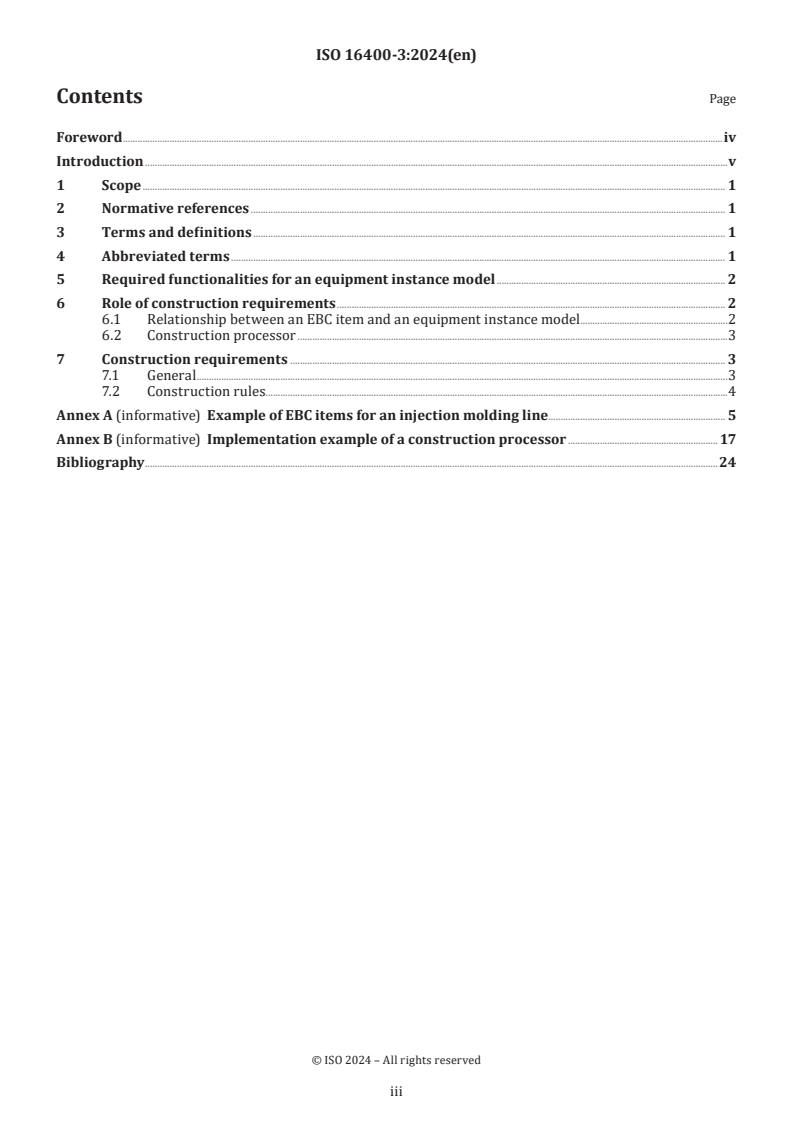
Contents Page
Foreword .iv
Introduction .v
1 Scope . 1
2 Normative references . 1
3 Terms and definitions . 1
4 Abbreviated terms . 1
5 Required functionalities for an equipment instance model . 2
6 Role of construction requirements . 2
6.1 Relationship between an EBC item and an equipment instance model .2
6.2 Construction processor .3
7 Construction requirements . 3
7.1 General .3
7.2 Construction rules.4
Annex A (informative) Example of EBC items for an injection molding line . 5
Annex B (informative) Implementation example of a construction processor . 17
Bibliography .24
iii
Foreword
ISO (the International Organization for Standardization) is a worldwide federation of national standards
bodies (ISO member bodies). The work of preparing International Standards is normally carried out through
ISO technical committees. Each member body interested in a subject for which a technical committee
has been established has the right to be represented on that committee. International organizations,
governmental and non-governmental, in liaison with ISO, also take part in the work. ISO collaborates closely
with the International Electrotechnical Commission (IEC) on all matters of electrotechnical standardization.
The procedures used to develop this document and those intended for its further maintenance are described
in the ISO/IEC Directives, Part 1. In particular, the different approval criteria needed for the different types
of ISO document should be noted. This document was drafted in accordance with the editorial rules of the
ISO/IEC Directives, Part 2 (see www.iso.org/directives).
ISO draws attention to the possibility that the implementation of this document may involve the use of (a)
patent(s). ISO takes no position concerning the evidence, validity or applicability of any claimed patent
rights in respect thereof. As of the date of publication of this document, ISO had not received notice of (a)
patent(s) which may be required to implement this document. However, implementers are cautioned that
this may not represent the latest information, which may be obtained from the patent database available at
www.iso.org/patents. ISO shall not be held responsible for identifying any or all such patent rights.
Any trade name used in this document is information given for the convenience of users and does not
constitute an endorsement.
For an explanation of the voluntary nature of standards, the meaning of ISO specific terms and expressions
related to conformity assessment, as well as information about ISO's adherence to the World Trade
Organization (WTO) principles in the Technical Barriers to Trade (TBT), see www.iso.org/iso/foreword.html.
This document was prepared by Technical Committee ISO/TC 184, Automation systems and integration,
Subcommittee SC 5, Interoperability, integration, and architectures for enterprise systems and automation
applications.
A list of all parts in the ISO 16400 series can be found on the ISO website.
Any feedback or questions on this document should be directed to the user’s national standards body. A
complete listing of these bodies can be found at www.iso.org/members.html.
iv
Introduction
The ISO 16400 series introduces a concept of an equipment behaviour catalogue (EBC), addresses the
requirements of an EBC and provides requirements and recommendations to generate an executable model
representing the dynamic behaviour of a nominal or a physical instance of an equipment. An equipment
instance model is implemented, such as a software agent. Such an executable model plays a vital role when
configuring virtual production systems used for simulation and verification of a future process as well as
monitoring of a current process. Therefore, EBCs will constitute an important part in the development of
smart manufacturing.
An EBC enables an efficient and standardized way for a provider of equipment to communicate its dynamic
behaviour.
The ISO 16400 series consists of the following parts, under the general title “Automation systems and
integration — Equipment behaviour catalogues for virtual production system”:
Part 1: Overview
Part 2: Formal description of a catalogue template
Part 3 (this document): Requirements and recommendations for construction of an equipment instance model
v
International Standard ISO 16400-3:2024(en)
Automation systems and integration — Equipment behaviour
catalogues for virtual production system —
Part 3:
Requirements and recommendations for construction of an
equipment instance model
1 Scope
This document provides requirements and recommendations on how to construct an equipment instance
model using an equipment behaviour catalogue (EBC) item.
2 Normative references
The following documents are referred to in the text in such a way that some or all of their content constitutes
requirements of this document. For dated references, only the edition cited applies. For undated references,
the latest edition of the referenced document (including any amendments) applies.
ISO 16400-1:2020, Automation systems and integration — Equipment behaviour catalogues for virtual
production system — Part 1: Overview
ISO 16400-2:2024, Automation systems and integration — Equipment behaviour catalogues for virtual
production systems — Part 2: Formal description of a catalogue template
3 Terms and definitions
For the purposes of this document, the terms and definitions given in ISO 16400-1 and the following apply.
ISO and IEC maintain terminology databases for use in standardization at the following addresses:
— ISO Online browsing platform: available at https:// www .iso .org/ obp
— IEC Electropedia: available at https:// www .electropedia .org/
3.1
construction processor
software tool to construct an equipment instance model from an equipment behaviour catalogue (EBC) item
refering to construction requirements
3.2
equipment instance model
executable model corresponding to a specification of an equipment behaviour catalogue (EBC) item
4 Abbreviated terms
XML eXtensible Markup Language
XSL eXtensible Stylesheet Language
XSLT eXtensible Stylesheet Language Transformations
5 Required functionalities for an equipment instance model
When the virtual production system of interest is constructed, an equipment instance model shall be
constructed from an appropriate EBC item.
An equipment instance model shall have the following functionalities:
— processable description of behaviour flow specified in the EBC item;
NOTE Behaviour flow means a sequence of behaviours performed during the execution of an equipment
instance model.
— processable description of formula(s) or mathematical model(s);
— processable description of external interactions.
To fulfil these functionalities, an equipment instance model can be modelled in various ways, e.g. agent-
based modelling, discrete event modelling, dynamic system modelling. In this document, an equipment
instance model is implemented as a software agent.
6 Role of construction requirements
6.1 Relationship between an EBC item and an equipment instance model
A production system model is constructed using equipment instance models. An equipment instance model
is constructed from the selected EBC item. The EBC items and the EBC templates are registered in a shared
repository (see ISO 16400-1:2020, Figure 4).
Figure 1 shows three cases for construction of an equipment instance model. All cases shall be treated by
the construction requirements.
Figure 1 — Three cases for the construction of equipment instance models
— Case 1: If the EBC item contains the physical data of a specific equipment that actually exists, a physical
equipment instance model is constructed;
— Case 2: If the EBC item contains only nominal data as designed for a specific equipment, but the specific
physical data exists, applying the physical data to the corresponding EBC item, a physical equipment
instance model is constructed;
— Case 3: If the EBC item contains only nominal data as designed for a specific equipment, a nominal
equipment instance model is constructed.
6.2 Construction processor
An equipment instance model shall be constructed using the construction requirements. These construction
requirements shall be applicable to the above three cases.
The construction processor of the target environment where the equipment instance model will be executed
takes an EBC item as an input and constructs an equipment instance model.
Depending on whether the EBC item contains nominal data or physical data, there can be three cases in
which the equipment instance model is constructed by a construction processor using the construction
requirements as shown in Figure 2.
Key
process flow
reference
Figure 2 — Construction of an equipment instance model
7 Construction requirements
7.1 General
The construction requirements are represented by the construction rules. Details of construction rules
are described in 7.2. The construction procedures shall be implemented in the construction processor by
following the construction requirements. The construction procedures are executed by the construction
processor which accepts an EBC item to construct an equipment instance model. Figure 3 shows a
construction processor based on the construction requirements.
Key
process flow
reference
Figure 3 — Construction processor
7.2 Construction rules
An EBC item is an instance of an EBC template which includes descriptions for a header, a property set,
behaviours and external interactions. The structure of an EBC item uses the correspondent EBC template.
An equipment instance model is constructed from an EBC item and related data of an equipment design
(nominal data) or related data of an equipment individual (physical data).
Rules to construct an equipment instance model shall consist of the following:
— Rule 1: describes general information in an equipment instance model using a header of an EBC item;
— Rule 2: describes properties to be processable in an equipment instance model using a property set of an
EBC item;
— Rule 3: describes a state of an equipment instance model using each state of the behaviour of an EBC item;
— Rule 4: describes a state transition of an equipment instance model using each state transition of the
behaviour of an EBC item;
— Rule 5: describes a procedure in either a state or a state transition, or both, of an equipment instance
model using each external interaction of an EBC item.
The required functionalities for an equipment instance model described in Clause 5 shall be implemented
according to the construction rules as follows:
— the description of general information for an equipment instance model is made by Rule 1;
— the processable description of behaviour flow is made by Rule 2, Rule 3 and Rule 4;
— the processable description of formula(s) or mathematical model(s) is made by Rule 2 and Rule 3;
— the processable description of external interactions is made by Rule 5.
Annex A shows three examples of EBC items. Annex B shows an implementation example of a construction
processor for EBC items in Annex A.
Annex A
(informative)
Example of EBC items for an injection molding line
A.1 Equipment on an injection molding line
The structure of an injection molding line is shown in Figure A.1. This injection molding line consists of an
injection molding machine including mold, a molding extraction robot, and a mold temperature controller.
The examples of building the EBC templates for the injection molding line are presented in ISO 16400-2:
2024, Annex C. The example of the EBC items using these EBC templates is described in A.2 to A.4. These EBC
items are used to construct equipment instance models by the construction processor in Annex B.
Figure A.1 — Structure of an injection molding line
A.2 EBC item for an injection molding machine
In ISO 16400-2:2024, C.2, the example of the EBC template of an injection molding machine is represented.
The example of the EBC item using this EBC template can be described using XML as follows:
Questions, Comments and Discussion
Ask us and Technical Secretary will try to provide an answer. You can facilitate discussion about the standard in here.
Loading comments...