

ISO 20140-5:2024
(Main)Automation systems and integration — Evaluating energy efficiency and other factors of manufacturing systems that influence the environment — Part 5: Environmental performance evaluation data
General Information
- Abstract
This document defines a set of environmental performance evaluation (EPE) data classes, including their properties. It is applicable to entire manufacturing facilities or to parts of a manufacturing facility. This document applies to manufacturing systems including discrete, batch and continuous control, which are defined in IEC 62264-1. The following are outside the scope of this document: — syntax of EPE data and data models; — protocols to exchange EPE data; — functions that can be enabled by the use of EPE data; — product life cycle assessment; — EPE data that are specific to a particular industry sector, manufacturer or machinery; — acquisition of EPE data.
- Status
- Published
- Publication Date
- 16-Sep-2024
- Current Stage
- 6060 - International Standard published
- Start Date
- 17-Sep-2024
- Due Date
- 03-May-2024
- Completion Date
- 17-Sep-2024
Buy Documents

ISO 20140-5:2024 - Automation systems and integration — Evaluating energy efficiency and other factors of manufacturing systems that influence the environment — Part 5: Environmental performance evaluation data Released:17. 09. 2024
Overview
ISO 20140-5:2024 - part of the ISO 20140 series on automation systems and integration - defines a structured set of Environmental Performance Evaluation (EPE) data classes and their properties for assessing how manufacturing systems influence the environment. It applies to whole manufacturing facilities or portions thereof and covers discrete, batch and continuous control systems as defined in IEC 62264-1. The standard focuses on the data model for environmental performance (what data to capture and how to classify it), while explicitly excluding data syntax, communication protocols, acquisition methods, product life‑cycle assessment and sector‑specific or vendor‑specific EPE data.
Key Topics and Requirements
- EPE data class definitions: Formal definitions for Elementary and Grouped EPE data, including Defined, Measured and Calculated data classes.
- Process modeling: Structured representations for EPE_process, Elementary_process, Compound_process, process transitions, inputs and outputs.
- Mechanisms and control: Classes for EPE_mechanism (equipment, space) and EPE_control describing how physical assets and control systems relate to environmental data.
- Properties and metadata: A comprehensive set of property definitions (examples found in the standard include Air_conditioning, Dimension, Mass_of_part, Measuring_equipment_used, EPE_data_granularity and EPE_data_resolution) to ensure consistent meaning and use of EPE values.
- Data conventions: Guidance on value types, UML notation and conventions for defining class definitions and properties to support unambiguous implementation.
- Scope constraints: Clarifies excluded topics such as data syntax, protocols, enabled functions, product LCA and acquisition methods so implementers know the standard’s boundary.
Practical Applications and Users
ISO 20140-5 is intended for organizations that need consistent, interoperable environmental performance data within manufacturing contexts:
- Factory and facility managers seeking standardized environmental metrics for energy efficiency benchmarking and reporting.
- Sustainability and EHS engineers integrating environmental performance into operational analytics and continuous improvement.
- Automation and IT system integrators designing data models and software that represent environmental data alongside production data.
- Software vendors and MES/SCADA providers who need a neutral set of EPE data classes to support analytics, dashboards and compliance reporting.
- Consultants, researchers and standards bodies developing harmonized approaches to manufacturing environmental assessment.
Practical uses include internal performance evaluation, cross-facility benchmarking, feeding higher-level sustainability reports, and enabling consistent data mapping between factory equipment and enterprise systems.
Related Standards
- IEC 62264-1 (referenced for definitions of discrete, batch and continuous control)
- Other parts of the ISO 20140 series (context for evaluating energy efficiency and environmental factors in manufacturing)
Keywords: ISO 20140-5, environmental performance evaluation data, EPE data classes, manufacturing systems, energy efficiency, automation systems, IEC 62264-1, sustainability in manufacturing.
Relations
- Effective Date
- 06-Jun-2022
Buy Documents
ISO 20140-5:2024 - Automation systems and integration — Evaluating energy efficiency and other factors of manufacturing systems that influence the environment — Part 5: Environmental performance evaluation data Released:17. 09. 2024
Get Certified
Connect with accredited certification bodies for this standard

DVS-ZERT GmbH
German welding certification society.
CARES (UK Certification Authority for Reinforcing Steels)
UK certification for reinforcing steels and construction.
EWF/IIW (European/International Welding Federation)
International welding personnel certification.
Sponsored listings
Frequently Asked Questions
ISO 20140-5:2024 is a standard published by the International Organization for Standardization (ISO). Its full title is "Automation systems and integration — Evaluating energy efficiency and other factors of manufacturing systems that influence the environment — Part 5: Environmental performance evaluation data". This standard covers: This document defines a set of environmental performance evaluation (EPE) data classes, including their properties. It is applicable to entire manufacturing facilities or to parts of a manufacturing facility. This document applies to manufacturing systems including discrete, batch and continuous control, which are defined in IEC 62264-1. The following are outside the scope of this document: — syntax of EPE data and data models; — protocols to exchange EPE data; — functions that can be enabled by the use of EPE data; — product life cycle assessment; — EPE data that are specific to a particular industry sector, manufacturer or machinery; — acquisition of EPE data.
This document defines a set of environmental performance evaluation (EPE) data classes, including their properties. It is applicable to entire manufacturing facilities or to parts of a manufacturing facility. This document applies to manufacturing systems including discrete, batch and continuous control, which are defined in IEC 62264-1. The following are outside the scope of this document: — syntax of EPE data and data models; — protocols to exchange EPE data; — functions that can be enabled by the use of EPE data; — product life cycle assessment; — EPE data that are specific to a particular industry sector, manufacturer or machinery; — acquisition of EPE data.
ISO 20140-5:2024 is classified under the following ICS (International Classification for Standards) categories: 25.040.01 - Industrial automation systems in general. The ICS classification helps identify the subject area and facilitates finding related standards.
ISO 20140-5:2024 has the following relationships with other standards: It is inter standard links to ISO 20140-5:2017. Understanding these relationships helps ensure you are using the most current and applicable version of the standard.
ISO 20140-5:2024 is available in PDF format for immediate download after purchase. The document can be added to your cart and obtained through the secure checkout process. Digital delivery ensures instant access to the complete standard document.
Standards Content (Sample)
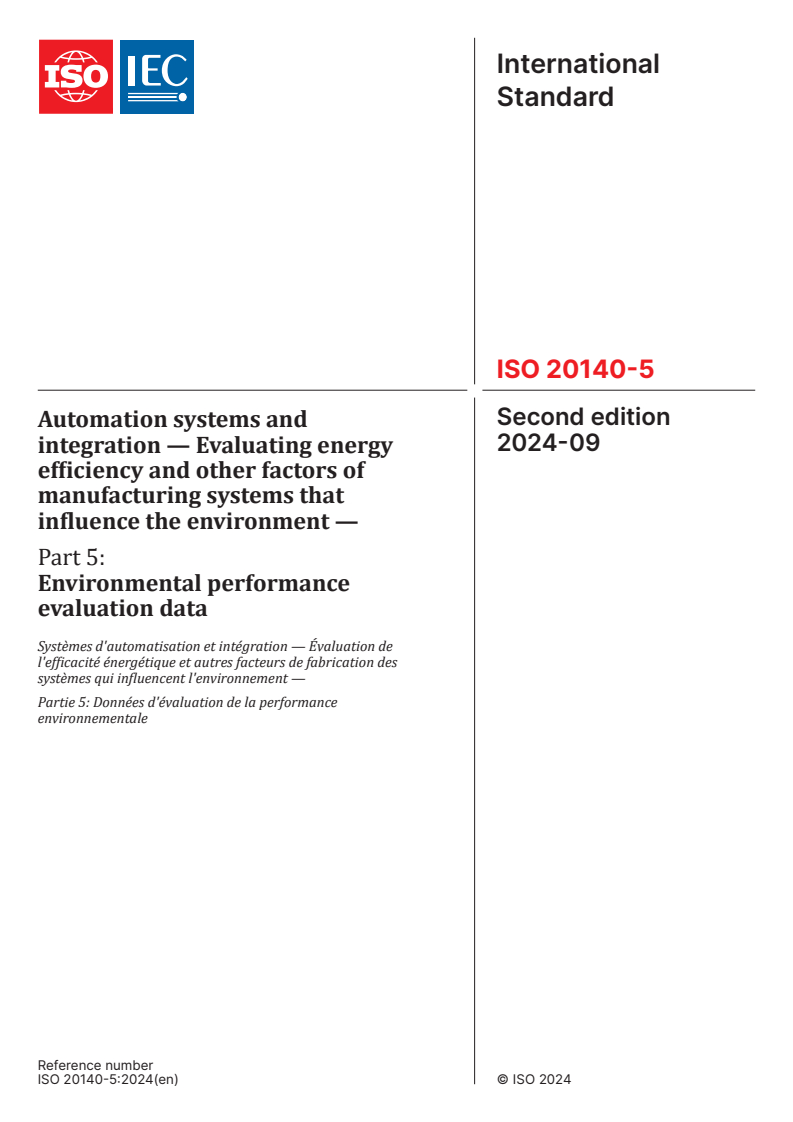
International
Standard
ISO 20140-5
Second edition
Automation systems and
2024-09
integration — Evaluating energy
efficiency and other factors of
manufacturing systems that
influence the environment —
Part 5:
Environmental performance
evaluation data
Systèmes d'automatisation et intégration — Évaluation de
l'efficacité énergétique et autres facteurs de fabrication des
systèmes qui influencent l'environnement —
Partie 5: Données d'évaluation de la performance
environnementale
Reference number
© ISO 2024
All rights reserved. Unless otherwise specified, or required in the context of its implementation, no part of this publication may
be reproduced or utilized otherwise in any form or by any means, electronic or mechanical, including photocopying, or posting on
the internet or an intranet, without prior written permission. Permission can be requested from either ISO at the address below
or ISO’s member body in the country of the requester.
ISO copyright office
CP 401 • Ch. de Blandonnet 8
CH-1214 Vernier, Geneva
Phone: +41 22 749 01 11
Email: copyright@iso.org
Website: www.iso.org
Published in Switzerland
ii
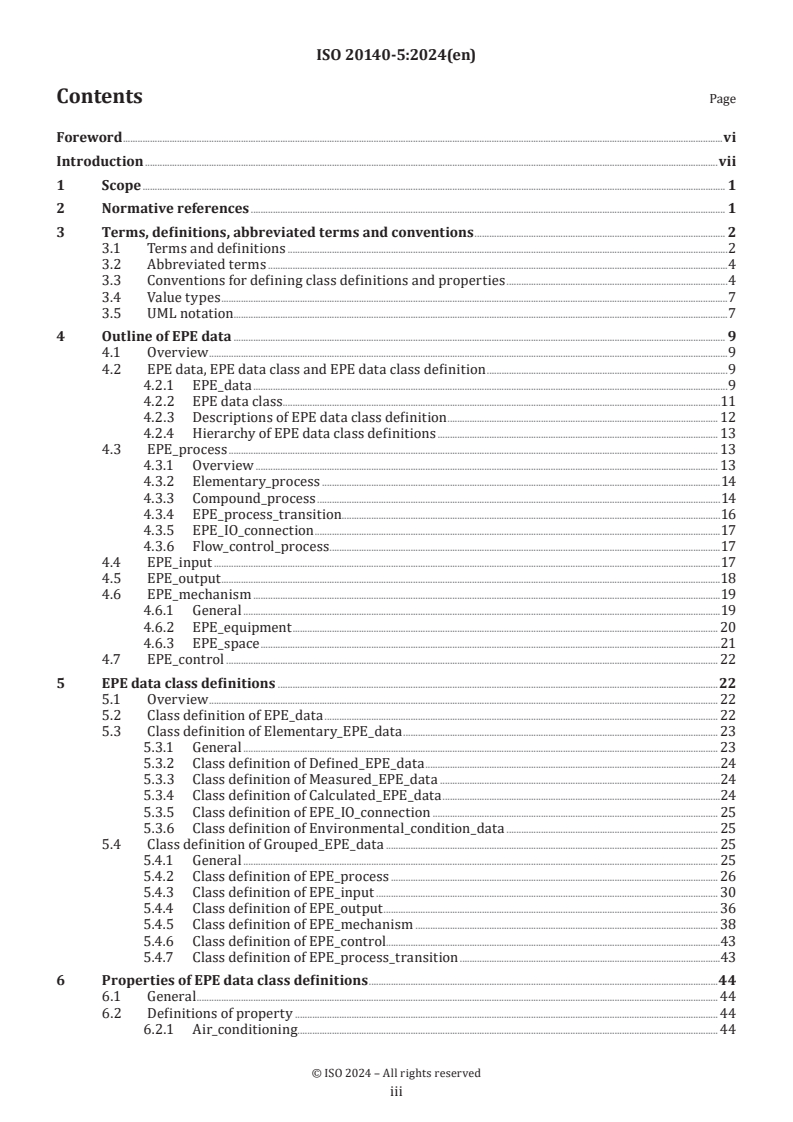
Contents Page
Foreword .vi
Introduction .vii
1 Scope . 1
2 Normative references . 1
3 Terms, definitions, abbreviated terms and conventions . 2
3.1 Terms and definitions .2
3.2 Abbreviated terms .4
3.3 Conventions for defining class definitions and properties .4
3.4 Value types .7
3.5 UML notation.7
4 Outline of EPE data . 9
4.1 Overview .9
4.2 EPE data, EPE data class and EPE data class definition .9
4.2.1 EPE_data .9
4.2.2 EPE data class.11
4.2.3 Descriptions of EPE data class definition . 12
4.2.4 Hierarchy of EPE data class definitions . 13
4.3 EPE_process . 13
4.3.1 Overview . 13
4.3.2 Elementary_process .14
4.3.3 Compound_process .14
4.3.4 EPE_process_transition.16
4.3.5 EPE_IO_connection .17
4.3.6 Flow_control_process . .17
4.4 EPE_input .17
4.5 EPE_output .18
4.6 EPE_mechanism .19
4.6.1 General .19
4.6.2 EPE_equipment . 20
4.6.3 EPE_space .21
4.7 EPE_control . 22
5 EPE data class definitions .22
5.1 Overview . 22
5.2 Class definition of EPE_data . 22
5.3 Class definition of Elementary_EPE_data . 23
5.3.1 General . 23
5.3.2 Class definition of Defined_EPE_data .24
5.3.3 Class definition of Measured_EPE_data .24
5.3.4 Class definition of Calculated_EPE_data .24
5.3.5 Class definition of EPE_IO_connection . 25
5.3.6 Class definition of Environmental_condition_data . 25
5.4 Class definition of Grouped_EPE_data . 25
5.4.1 General . 25
5.4.2 Class definition of EPE_process . 26
5.4.3 Class definition of EPE_input . 30
5.4.4 Class definition of EPE_output . 36
5.4.5 Class definition of EPE_mechanism . 38
5.4.6 Class definition of EPE_control.43
5.4.7 Class definition of EPE_process_transition .43
6 Properties of EPE data class definitions .44
6.1 General . 44
6.2 Definitions of property . 44
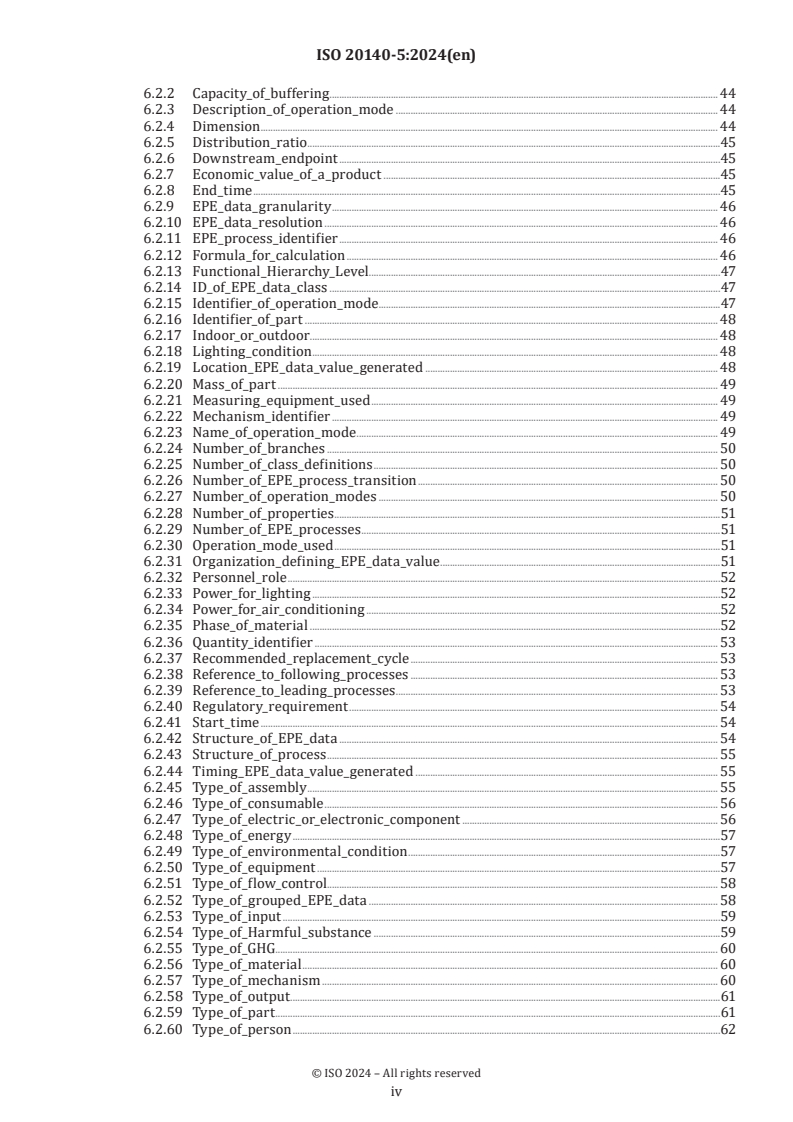
6.2.1 Air_conditioning . . . 44
iii
6.2.2 Capacity_of_buffering . 44
6.2.3 Description_of_operation_mode . 44
6.2.4 Dimension . 44
6.2.5 Distribution_ratio .45
6.2.6 Downstream_endpoint .45
6.2.7 Economic_value_of_a_product .45
6.2.8 End_time .45
6.2.9 EPE_data_granularity . 46
6.2.10 EPE_data_resolution . 46
6.2.11 EPE_process_identifier . 46
6.2.12 Formula_for_calculation . 46
6.2.13 Functional_Hierarchy_Level . . .47
6.2.14 ID_of_EPE_data_class .47
6.2.15 Identifier_of_operation_mode .47
6.2.16 Identifier_of_part . 48
6.2.17 Indoor_or_outdoor . . 48
6.2.18 Lighting_condition . 48
6.2.19 Location_EPE_data_value_generated . 48
6.2.20 Mass_of_part . 49
6.2.21 Measuring_equipment_used . 49
6.2.22 Mechanism_identifier . 49
6.2.23 Name_of_operation_mode . 49
6.2.24 Number_of_branches . 50
6.2.25 Number_of_class_definitions . 50
6.2.26 Number_of_EPE_process_transition . 50
6.2.27 Number_of_operation_modes . 50
6.2.28 Number_of_properties .51
6.2.29 Number_of_EPE_processes .51
6.2.30 Operation_mode_used .51
6.2.31 Organization_defining_EPE_data_value .51
6.2.32 Personnel_role .52
6.2.33 Power_for_lighting .52
6.2.34 Power_for_air_conditioning .52
6.2.35 Phase_of_material .52
6.2.36 Quantity_identifier . 53
6.2.37 Recommended_replacement_cycle . 53
6.2.38 Reference_to_following_processes . 53
6.2.39 Reference_to_leading_processes . 53
6.2.40 Regulatory_requirement . 54
6.2.41 Start_time . 54
6.2.42 Structure_of_EPE_data . 54
6.2.43 Structure_of_process . 55
6.2.44 Timing_EPE_data_value_generated . 55
6.2.45 Type_of_assembly . 55
6.2.46 Type_of_consumable . 56
6.2.47 Type_of_electric_or_electronic_component . 56
6.2.48 Type_of_energy .57
6.2.49 Type_of_environmental_condition .57
6.2.50 Type_of_equipment .57
6.2.51 Type_of_flow_control . . . 58
6.2.52 Type_of_grouped_EPE_data . 58
6.2.53 Type_of_input .59
6.2.54 Type_of_Harmful_substance .59
6.2.55 Type_of_GHG . 60
6.2.56 Type_of_material . 60
6.2.57 Type_of_mechanism . 60
6.2.58 Type_of_output .61
6.2.59 Type_of_part .61
6.2.60 Type_of_person .62
iv
6.2.61 Type_of_process .62
6.2.62 Type_of_product .62
6.2.63 Type_of_space . 63
6.2.64 Type_of_transition . 63
6.2.65 Type_of_unit_activity . 64
6.2.66 Type_of_upstream_data . 64
6.2.67 Upstream_endpoint . 65
6.2.68 Way_for_generating. 65
6.2.69 Way_of_measurement . 65
Annex A (informative) Relationship with the other related International Standards .66
Annex B (informative) Use case for EPE data .68
Annex C (informative) Observation of EPE data in manufacturing systems . 76
Bibliography .89
v
Foreword
ISO (the International Organization for Standardization) is a worldwide federation of national standards
bodies (ISO member bodies). The work of preparing International Standards is normally carried out through
ISO technical committees. Each member body interested in a subject for which a technical committee
has been established has the right to be represented on that committee. International organizations,
governmental and non-governmental, in liaison with ISO, also take part in the work. ISO collaborates closely
with the International Electrotechnical Commission (IEC) on all matters of electrotechnical standardization.
The procedures used to develop this document and those intended for its further maintenance are described
in the ISO/IEC Directives, Part 1. In particular, the different approval criteria needed for the different types
of ISO documents should be noted. This document was drafted in accordance with the editorial rules of the
ISO/IEC Directives, Part 2 (see www.iso.org/directives).
ISO draws attention to the possibility that the implementation of this document may involve the use of (a)
patent(s). ISO takes no position concerning the evidence, validity or applicability of any claimed patent
rights in respect thereof. As of the date of publication of this document, ISO had not received notice of (a)
patent(s) which may be required to implement this document. However, implementers are cautioned that
this may not represent the latest information, which may be obtained from the patent database available at
www.iso.org/patents. ISO shall not be held responsible for identifying any or all such patent rights.
Any trade name used in this document is information given for the convenience of users and does not
constitute an endorsement.
For an explanation of the voluntary nature of standards, the meaning of ISO specific terms and expressions
related to conformity assessment, as well as information about ISO's adherence to the World Trade
Organization (WTO) principles in the Technical Barriers to Trade (TBT), see www.iso.org/iso/foreword.html.
This document was prepared by Technical Committee ISO/TC 184, Automation systems and integration,
Subcommittee SC 5, Interoperability, integration, and architectures for enterprise systems and automation
applications, in collaboration with the International Electrotechnial Commission (IEC), Technical Committee
IEC/TC 65, Industrial-process measurement, control and automation.
This second edition cancels and replaces the first edition (ISO 20140-5:2017), which has been technically
revised.
The main changes are as follows:
a) renewal of Clause 4 according to EPE data class definition;
b) restructuring and updates of Clauses 5 to 8 into new Clause 5 and Clause 6 in terms of EPE data class
definitions and their properties;
c) replacement of Annexes with new Annex A, Annex B and Annex C.
A list of all parts in the ISO 20140 series can be found on the ISO website.
Any feedback or questions on this document should be directed to the user’s national standards body. A
complete listing of these bodies can be found at www.iso.org/members.html.
vi
Introduction
The ISO 20140 series specifies a method for evaluating the energy efficiency and other factors of a
manufacturing system that influence the environment, such as energy consumption, waste, and release.
The ISO 20140 series can be used for:
— benchmarking the environmental performance against a generic reference manufacturing system or
comparing between different manufacturing systems;
— alternative studies for improving environmental performance;
— setting targets for improving environmental performance;
— visualizing the environmental performance of a manufacturing system under operation;
— managing carbon footprints of products (CFP) in a supply chain;
— evaluating the environmental performance of manufacturing systems.
Expected users of the ISO 20140 series are:
a) managers who are responsible for the environmental conditions of a manufacturing system;
b) engineers who design manufacturing processes for products;
c) engineers who design a manufacturing system;
d) engineers and supervisors who are responsible for manufacturing products.
This document classifies environmental performance evaluation (EPE) data. The classification intends to
support the association of EPE data with context information and transferring them across various locations
and disciplines in the manufacturing system.
This document provides EPE data classes which are used in the aggregation process specified in ISO 20140-3
to evaluate environmental performance of a manufacturing system. This document intends to allow mapping
EPE data to various implementations based on different technologies by providing formal and technology-
independent definitions of EPE data classes. The EPE data classes are intended to be stored in concept data
dictionaries (e.g. IEC CDD).
This document is the second edition of ISO 20140-5, which replaces the first edition ISO 20140-5: 2017. The
objective and the scope of both documents are the same. Both documents define the same set of EPE data
classes. In order to improve the applicability of EPE data for evaluating various manufacturing processes,
this document defines EPE data classes by a classification scheme differently from the first edition. The
classification of the first edition is based on properties of manufacturing operations, i.e., source and time of
EPE data generation. The classification of this document is based on a general concept of a manufacturing
process, and detailed EPE data classes are defined systematically. The definitions of EPE data classes and
types of properties are given respectively in Clause 5 and Clause 6 of this document. In order to retain the
general use of the definitions, individual EPE data derived from EPE data classes and its properties are not
described in this document. Detailed individual EPE data and properties specified in the first edition of
ISO 20140-5 can be represented by using the class definitions given in this document.
vii
International Standard ISO 20140-5:2024(en)
Automation systems and integration — Evaluating energy
efficiency and other factors of manufacturing systems that
influence the environment —
Part 5:
Environmental performance evaluation data
1 Scope
This document defines a set of environmental performance evaluation (EPE) data classes, including their
properties.
It is applicable to entire manufacturing facilities or to parts of a manufacturing facility.
This document applies to manufacturing systems including discrete, batch and continuous control, which
are defined in IEC 62264-1.
The following are outside the scope of this document:
— syntax of EPE data and data models;
— protocols to exchange EPE data;
— functions that can be enabled by the use of EPE data;
— product life cycle assessment;
— EPE data that are specific to a particular industry sector, manufacturer or machinery;
— acquisition of EPE data.
2 Normative references
The following documents are referred to in the text in such a way that some or all of their content constitutes
requirements of this document. For dated references, only the edition cited applies. For undated references,
the latest edition of the referenced document (including any amendments) applies.
ISO 10303 (all parts), Industrial automation systems and integration — Product data representation and
exchange
ISO 11014, Safety data sheet for chemical products — Content and order of sections
ISO 13584-42, Industrial automation systems and integration — Parts library — Part 42: Description
methodology: Methodology for structuring parts families
ISO 14224, Petroleum, petrochemical and natural gas industries — Collection and exchange of reliability and
maintenance data for equipment
ISO/TS 15926-4, Industrial automation systems and integration — Integration of life-cycle data for process
plants including oil and gas production facilities — Part 4: Initial reference data
ISO 20140-1, Automation systems and integration — Evaluating energy efficiency and other factors of
manufacturing systems that influence the environment — Part 1: Overview and general principles
IEC TS 62720, Identification of units of measurement for computer-based processing
IEC 60721 (all parts), Classification of environmental conditions
IEC 61360-4, IEC/SC 3D — Common Data Dictionary (CDD — V2.0015.0004)
IEC 61987 (all parts), Industrial-process measurement and control — Data structures and elements in process
equipment catalogues
IEC 62683-1, Low-voltage switchgear and controlgear — Product data and properties for information exchange
— Part 1: Catalogue data
IEC/TR 63213, Power measurement applications within electrical distribution networks and electrical
installations
3 Terms, definitions, abbreviated terms and conventions
3.1 Terms and definitions
For the purposes of this document, the terms and definitions given in ISO 20140-1 and the following apply.
ISO and IEC maintain terminology databases for use in standardization at the following addresses:
— ISO Online browsing platform: available at https:// www .iso .org/ obp
— IEC Electropedia: available at https:// www .electropedia .org/
3.1.1
assembly
number of parts, subassemblies or combinations thereof joined together
[SOURCE: IEC 60194:2021, 3.1.72, modified — removed Note 1 to entry.]
3.1.2
attribute
data element for the computer-sensible description of a class definition or a property
[SOURCE: IEC 61360-1:2017, 3.1.2, modified — “a property, a relation or a class” was replaced with “a class
definition or a property".]
3.1.3
classifying property
property applicable for a particular class, having a value list whose values define the subclasses of the class
[SOURCE: IEC 61360-1:2017, 3.1.7]
3.1.4
consumable
any part or material that is necessary for continued use or maintenance of the product
[SOURCE: IEC/IEEE 82079-1:2019, 3.7]
3.1.5
environmental performance evaluation data
EPE data
data that are used to evaluate the environmental performance
[SOURCE: ISO 20140-3:2019, 3.7]
3.1.6
environmental performance evaluation data class
EPE data class
description of a set of EPE data that share common characteristics
Note 1 to entry: Adapted from IEC 62832-2:2020.
3.1.7
environmental performance evaluation data class definition
EPE data class definition
grouping of references to property or to another EPE data class definition, that defines the shared structure
of a group of EPE data classes
3.1.8
environmental performance evaluation data value
EPE data value
number, text, or artefact encoding that expresses a quantity or quality held by EPE data
3.1.9
material
substance or mixture within a product or a part of a product
[SOURCE: IEC 62474:2012, 3.15]
3.1.10
part
material or functional element that is or can be a constituent of different products
[SOURCE: ISO 13584-1:2001, 3.1.16, modified – The phrase “intended to constitute a component” is replaced
by “is or can be a constituent”.]
3.1.11
product
intended or accomplished result of labour, or of a natural or artificial process
[SOURCE: IEC 81346-1:2022, 3.6]
3.1.12
property
defined parameter suitable for the description and differentiation of objects
Note 1 to entry: A property describes one characteristic of a given object.
Note 2 to entry: A property can have attributes such as code, version, and revision.
Note 3 to entry: The specification of a property can include predefined choices of values.
[SOURCE: IEC 61360-1:2017, 3.1.24]
3.1.13
subclass definition
environmental performance evaluation (EPE) data class definition that is included in another EPE data class
definition
3.1.14
tool
device for imparting a desired shape, form, or finish to a material
Note 1 to entry: The desired shape can be achieved by different means, e.g. by material removal, forming, shaping.
[SOURCE: ISO 14955-3:2020, 3.5]
3.1.15
value type
stereotype of properties that is used to define types of values that are allowed to express information
3.2 Abbreviated terms
CAS Chemical Abstracts Service
CFP Carbon Footprint of Products
ECD Environmental Characteristics Data
EPE Environmental Performance Evaluation
GHG Greenhouse Gas
ID Identifier
IO Input and Output
LCA Life Cycle Assessment
NC Numerical Control
UML Unified Modelling Language
3.3 Conventions for defining class definitions and properties
Words connected with underscore (e.g. EPE_data) are used for representing class definitions and properties
in Clause 4, Clause 5 and Clause 6.
Table 1 is the template used in this document for specifying an EPE data class definition.
Table 1 — Template for specifying EPE data class definitions
Attributes of the class Value of the attribute
definition
ID of the class definition
Preferred name
Description of the class
definition
Source of the description
Preferred name of parent Subclause number defining the parent class definition
class definition
class definition>
Property included in the Cardinality Subclause defining the property
class definition
erty #1>
…. …
ty #N>
Class definitions included Cardinality Subclause defining the class definition
in this class definition
TTaabblle 1 e 1 ((ccoonnttiinnueuedd))
definition #1>
… …
definition #N>
The shaded cells indicate the meaning of associated unshaded cell.
The text in the angle bracket (i.e. “<” and “>”) in each unshaded cell describes what the cell is used for.
The "Attributes of the class definition" part of the template provides identifying information for this EPE
data class definition formatted as fields (unshaded cells) with respective values. The fields are designated ID
of the class definition, Preferred name, and Description of the class definition.
The "Preferred name of parent class definition" part of the template provides references to another EPE data
class definition (parent class definition). The EPE data class definition being specified inherits the properties
of the parent class definition, which is referenced by preferred name.
The "Property included in the class definition" part of the template provides a list of properties for inclusion
into this EPE data class definition by indicating the preferred names and the number of possible occurrences
(cardinality). The first row for the "Property included in the class definition" part of the template is used for
the classifying property of the class definition, if applicable. The preferred names of classifying properties
are represented in bold text.
The "Class definitions included in the class" part of the template provides a list of other EPE class definitions
for inclusion into this EPE data class. The EPE data class definition being defined inherits the properties of
the included EPE data class definition that is referenced by indicating the preferred name and number of
possible occurrences (cardinality).
NOTE For ease of understanding, reference subclause numbers in this document are added to the tables.
The field “Cardinality” contains a range which defines the number of constituent elements, which are
properties or EPE class definitions. The range is expressed using the following convention:
[a.b]
where:
a is the minimum number of constituent elements;
b is the maximum number of constituent elements.
EXAMPLE The number of constituent elements can be expressed as follows:
[0.1] indicates the EPE class definition has none or one constituent element;
[0.n] indicates the EPE class definition has none or as many as n constituent elements;
[1.1] indicates the EPE class definition has one constituent element;
[1.n] indicates the EPE class definition has one or as many as n constituent elements.
Table 2 specifies the template used to list subclass definitions which are EPE class definitions derived from
the class definition that is defined by the template of Table 1. It also indicates the value of the classifying
property which characterizes each subclass definition.
Table 2 — Template for listing subclass definitions
Classifying property Preferred name of subclass definition that is derived from Subclause number in this doc-
the class definition ument specifying the subclass
definition
property #1> from the class definition to be defined> nition #1>
…. …. ….
property #N> from the class definition to be defined> nition #N>
Table 3 specifies the template to be used for defining a specific property.
Table 3 — Template for defining properties
Attribute of the property Value of the attribute
ID of the property
Preferred name
Description of the property
Source of the description
Value type < type of the property value which is defined in 3.4 >
Code of quantity < Identifier of quantity defined by IEC TS 62720. This attribute applies
properties whose value type is MeasureType.>
Coding system
whose value type is CodeType.>
The template provides the definition of a specific property of EPE data (identity and meaning) and the
attributes for defining it. In some cases, additional rows are added.
Each shaded cell indicates the name of an attribute; the value is shown in the unshaded cell.
A specific property is defined by providing data in the relevant unshaded cells (i.e. the table is filled). An
“N/A” in an unshaded cell indicates that the field is not applicable to the definition of the specific property.
The attribute of Code of quantity is used for specifying the quantity of the value specified by the property in
the case where its value type is MeasureType.
NOTE Since multiple units of measure can be used for a property, identifiers of quantities defined by IEC TS 62720
is
...