


ISO/FDIS 50100
(Main)Energy management systems and energy savings — Decarbonization — Requirements with guidance for use
Energy management systems and energy savings — Decarbonization — Requirements with guidance for use
This document specifies requirements and guidance to enable an organization to reduce its energy related greenhouse gas (GHG) emissions. This document: a) is applicable to any organization regardless of its type, size, complexity, geographical location, organizational culture or the products and services it provides; b) is applicable to Scope 1 emissions related to energy and Scope 2 emissions; c) is applicable irrespective of the quantity, use, or types of energy consumed; d) requires demonstration of absolute reduction of energy related GHG emissions aligned with emission reduction target(s); e) ISO 50001 is required as a part of this document. Note: Organizations can include some or all categories of Scope 3 emissions within the scope of their EnMS based on the organization’s management decisions. Annex A provides guidance for the use of this document. Annex B provides guidance on managing Scope 3 emissions. Annex C provides guidance on the relationship between this document and ISO 50001.
Management de l'énergie et économies d'énergie — Décarbonation — Exigences et recommandations d'utilisation
General Information
- Status
- Not Published
- Technical Committee
- ISO/TC 301 - Energy management and energy savings
- Drafting Committee
- ISO/TC 301/WG 1 - Energy management
- Current Stage
- 5020 - FDIS ballot initiated: 2 months. Proof sent to secretariat
- Start Date
- 05-Jan-2026
- Completion Date
- 05-Jan-2026
Overview
ISO/FDIS 50100 establishes requirements and practical guidance to enable organizations to reduce their energy-related greenhouse gas (GHG) emissions (ERGE). The document applies to any organization regardless of size, sector or location and focuses on Scope 1 (energy-related) and Scope 2 emissions. It requires organizations to demonstrate absolute ERGE reduction aligned with defined targets and integrates with an energy management system (EnMS), notably ISO 50001.
Key components include a structured decarbonization plan, ERGE quantification methods, base-year determination, target setting, action planning, monitoring and reporting. Annexes provide guidance on the relationship to ISO 50001 (Annex A), GHG emission factors and emissions guidance (Annex B), and decarbonization planning (Annex C). The standard supports valid planning, verification and claims related to ERGE targets.
Key Topics
- Decarbonization boundary and commitment: Define physical and organizational boundaries and secure top management commitment for ERGE reduction.
- Decarbonization plan: Develop a documented plan that sets the pathway to meet ERGE targets and timelines.
- ERGE quantification: Use energy consumption data, emission factors or direct measurement approaches to quantify energy-related emissions, and document the chosen methods.
- Base year and targets: Establish a base year ERGE, set absolute reduction targets, and estimate future ERGE trajectories.
- ERGE reduction actions: Create and maintain action plans covering energy efficiency, fuel switching, renewable energy procurement and design/procurement considerations.
- Monitoring and reporting: Implement monitoring systems for ERGE performance, maintain records and prepare a decarbonization report to support validation or verification.
- Claims and conformity: Guidance on making claims about plans or achievements against ERGE targets in line with related ISO guidance.
Applications
This standard is practical for organizations aiming to integrate decarbonization into operational management and energy programs. Typical applications include:
- Integrating ERGE targets into an existing EnMS (ISO 50001) or other management systems.
- Developing corporate decarbonization strategies that require demonstrable, absolute emissions reductions.
- Establishing robust measurement and reporting processes for internal stakeholders, regulators, investors and customers.
- Informing procurement, design and capital investment decisions to prioritize low-carbon energy and technologies.
Benefits include improved data quality, clearer engagement of top management, aligned action plans, and credible reporting that supports external validation or verification.
Related Standards
- ISO 50001 - Energy management systems (used as a foundation for implementing the processes referenced in ISO/FDIS 50100).
- ISO 14064-1 and recognized GHG protocols - for GHG quantification and reporting alignment.
- ISO 14068-1 / ISO 14060 - related guidance on carbon neutrality and pathways to net zero (context for claims related to decarbonization).
Keywords: decarbonization, energy management, ERGE, Scope 1, Scope 2, ISO 50001, GHG emission factors, decarbonization plan, EnMS, monitoring, reporting.


ISO/FDIS 50100 - Energy management systems and energy savings — Decarbonization — Requirements with guidance for use Released:22. 12. 2025


REDLINE ISO/FDIS 50100 - Energy management systems and energy savings — Decarbonization — Requirements with guidance for use Released:22. 12. 2025
Get Certified
Connect with accredited certification bodies for this standard

DNV
DNV is an independent assurance and risk management provider.

Lloyd's Register
Lloyd's Register is a global professional services organisation specialising in engineering and technology.

BSI Group
BSI (British Standards Institution) is the business standards company that helps organizations make excellence a habit.
Sponsored listings
Frequently Asked Questions
ISO/FDIS 50100 is a draft published by the International Organization for Standardization (ISO). Its full title is "Energy management systems and energy savings — Decarbonization — Requirements with guidance for use". This standard covers: This document specifies requirements and guidance to enable an organization to reduce its energy related greenhouse gas (GHG) emissions. This document: a) is applicable to any organization regardless of its type, size, complexity, geographical location, organizational culture or the products and services it provides; b) is applicable to Scope 1 emissions related to energy and Scope 2 emissions; c) is applicable irrespective of the quantity, use, or types of energy consumed; d) requires demonstration of absolute reduction of energy related GHG emissions aligned with emission reduction target(s); e) ISO 50001 is required as a part of this document. Note: Organizations can include some or all categories of Scope 3 emissions within the scope of their EnMS based on the organization’s management decisions. Annex A provides guidance for the use of this document. Annex B provides guidance on managing Scope 3 emissions. Annex C provides guidance on the relationship between this document and ISO 50001.
This document specifies requirements and guidance to enable an organization to reduce its energy related greenhouse gas (GHG) emissions. This document: a) is applicable to any organization regardless of its type, size, complexity, geographical location, organizational culture or the products and services it provides; b) is applicable to Scope 1 emissions related to energy and Scope 2 emissions; c) is applicable irrespective of the quantity, use, or types of energy consumed; d) requires demonstration of absolute reduction of energy related GHG emissions aligned with emission reduction target(s); e) ISO 50001 is required as a part of this document. Note: Organizations can include some or all categories of Scope 3 emissions within the scope of their EnMS based on the organization’s management decisions. Annex A provides guidance for the use of this document. Annex B provides guidance on managing Scope 3 emissions. Annex C provides guidance on the relationship between this document and ISO 50001.
ISO/FDIS 50100 is classified under the following ICS (International Classification for Standards) categories: 13.020.40 - Pollution, pollution control and conservation; 27.015 - Energy efficiency. Energy conservation in general. The ICS classification helps identify the subject area and facilitates finding related standards.
ISO/FDIS 50100 is available in PDF format for immediate download after purchase. The document can be added to your cart and obtained through the secure checkout process. Digital delivery ensures instant access to the complete standard document.
Standards Content (Sample)
FINAL DRAFT
International
Standard
ISO/TC 301
Energy management systems and
Secretariat: ANSI
energy savings — Decarbonization
Voting begins on:
— Requirements with guidance for
2026-01-05
use
Voting terminates on:
2026-03-02
RECIPIENTS OF THIS DRAFT ARE INVITED TO SUBMIT,
WITH THEIR COMMENTS, NOTIFICATION OF ANY
RELEVANT PATENT RIGHTS OF WHICH THEY ARE AWARE
AND TO PROVIDE SUPPOR TING DOCUMENTATION.
IN ADDITION TO THEIR EVALUATION AS
BEING ACCEPTABLE FOR INDUSTRIAL, TECHNO
LOGICAL, COMMERCIAL AND USER PURPOSES, DRAFT
INTERNATIONAL STANDARDS MAY ON OCCASION HAVE
TO BE CONSIDERED IN THE LIGHT OF THEIR POTENTIAL
TO BECOME STAN DARDS TO WHICH REFERENCE MAY BE
MADE IN NATIONAL REGULATIONS.
Reference number
FINAL DRAFT
International
Standard
ISO/TC 301
Energy management systems and
Secretariat: ANSI
energy savings — Decarbonization
Voting begins on:
— Requirements with guidance for
2026-01-09
use
Voting terminates on:
RECIPIENTS OF THIS DRAFT ARE INVITED TO SUBMIT,
WITH THEIR COMMENTS, NOTIFICATION OF ANY
RELEVANT PATENT RIGHTS OF WHICH THEY ARE AWARE
AND TO PROVIDE SUPPOR TING DOCUMENTATION.
© ISO 2026
IN ADDITION TO THEIR EVALUATION AS
All rights reserved. Unless otherwise specified, or required in the context of its implementation, no part of this publication may
BEING ACCEPTABLE FOR INDUSTRIAL, TECHNO
LOGICAL, COMMERCIAL AND USER PURPOSES, DRAFT
be reproduced or utilized otherwise in any form or by any means, electronic or mechanical, including photocopying, or posting on
INTERNATIONAL STANDARDS MAY ON OCCASION HAVE
the internet or an intranet, without prior written permission. Permission can be requested from either ISO at the address below
TO BE CONSIDERED IN THE LIGHT OF THEIR POTENTIAL
or ISO’s member body in the country of the requester.
TO BECOME STAN DARDS TO WHICH REFERENCE MAY BE
MADE IN NATIONAL REGULATIONS.
ISO copyright office
CP 401 • Ch. de Blandonnet 8
CH-1214 Vernier, Geneva
Phone: +41 22 749 01 11
Email: copyright@iso.org
Website: www.iso.org
Published in Switzerland Reference number
ii
Contents Page
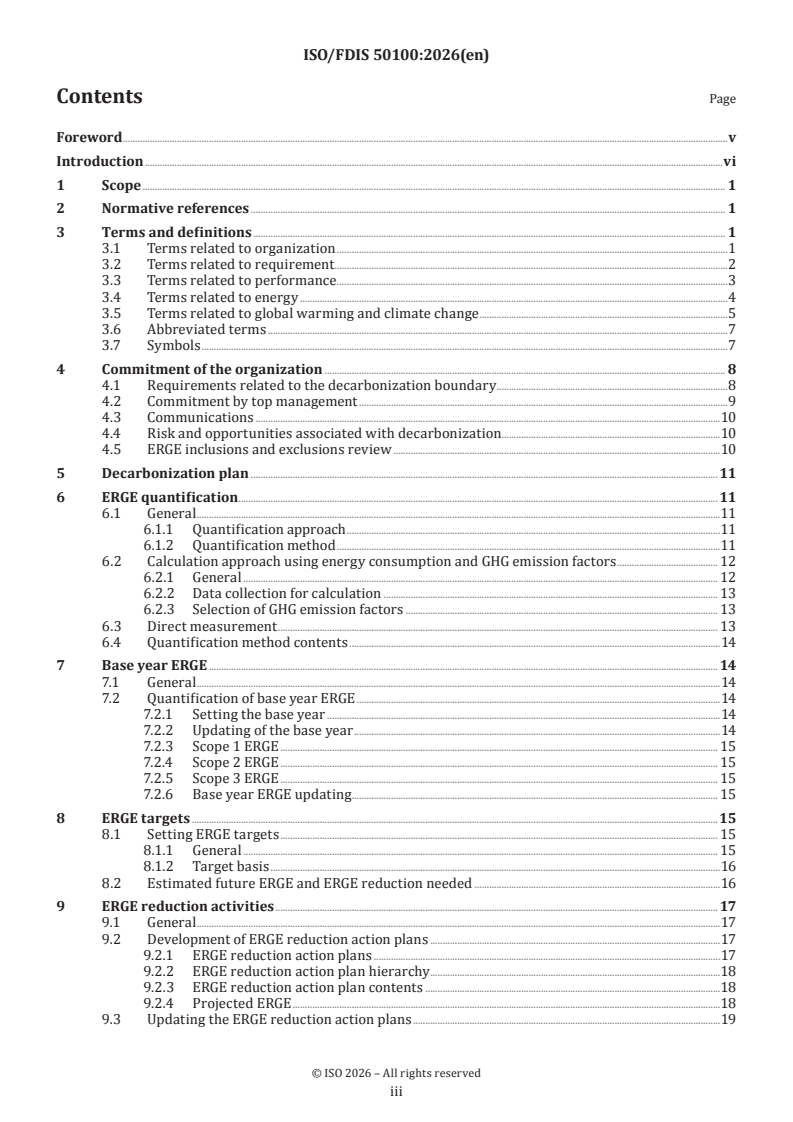
Foreword .v
Introduction .vi
1 Scope . 1
2 Normative references . 1
3 Terms and definitions . 1
3.1 Terms related to organization .1
3.2 Terms related to requirement .2
3.3 Terms related to performance .3
3.4 Terms related to energy .4
3.5 Terms related to global warming and climate change .5
3.6 Abbreviated terms .7
3.7 Symbols .7
4 Commitment of the organization . 8
4.1 Requirements related to the decarbonization boundary .8
4.2 Commitment by top management .9
4.3 Communications .10
4.4 Risk and opportunities associated with decarbonization .10
4.5 ERGE inclusions and exclusions review .10
5 Decarbonization plan .11
6 ERGE quantification .11
6.1 General .11
6.1.1 Quantification approach .11
6.1.2 Quantification method .11
6.2 Calculation approach using energy consumption and GHG emission factors . 12
6.2.1 General . 12
6.2.2 Data collection for calculation . 13
6.2.3 Selection of GHG emission factors . 13
6.3 Direct measurement . 13
6.4 Quantification method contents .14
7 Base year ERGE . 14
7.1 General .14
7.2 Quantification of base year ERGE .14
7.2.1 Setting the base year .14
7.2.2 Updating of the base year .14
7.2.3 Scope 1 ERGE . 15
7.2.4 Scope 2 ERGE . 15
7.2.5 Scope 3 ERGE . 15
7.2.6 Base year ERGE updating. 15
8 ERGE targets .15
8.1 Setting ERGE targets . 15
8.1.1 General . 15
8.1.2 Target basis .16
8.2 Estimated future ERGE and ERGE reduction needed .16
9 ERGE reduction activities . 17
9.1 General .17
9.2 Development of ERGE reduction action plans .17
9.2.1 ERGE reduction action plans .17
9.2.2 ERGE reduction action plan hierarchy .18
9.2.3 ERGE reduction action plan contents .18
9.2.4 Projected ERGE .18
9.3 Updating the ERGE reduction action plans .19
iii
9.4 Design and procurement .19
10 Monitoring ERGE . 19
11 Decarbonization report . .20
11.1 General . 20
11.2 Decarbonization report content . 20
12 Decarbonization claim .21
Annex A (informative) Relationship to ISO 50001 and example of energy performance
improvement .23
Annex B (informative) GHG emissions and GHG emission factors .28
Annex C (informative) Guidance on decarbonization planning .33
Bibliography .39
iv
Foreword
ISO (the International Organization for Standardization) is a worldwide federation of national standards
bodies (ISO member bodies). The work of preparing International Standards is normally carried out through
ISO technical committees. Each member body interested in a subject for which a technical committee
has been established has the right to be represented on that committee. International organizations,
governmental and non-governmental, in liaison with ISO, also take part in the work. ISO collaborates closely
with the International Electrotechnical Commission (IEC) on all matters of electrotechnical standardization.
The procedures used to develop this document and those intended for its further maintenance are described
in the ISO/IEC Directives, Part 1. In particular, the different approval criteria needed for the different types
of ISO document should be noted. This document was drafted in accordance with the editorial rules of the
ISO/IEC Directives, Part 2 (see www.iso.org/directives).
ISO draws attention to the possibility that the implementation of this document may involve the use of (a)
patent(s). ISO takes no position concerning the evidence, validity or applicability of any claimed patent
rights in respect thereof. As of the date of publication of this document, ISO had not received notice of (a)
patent(s) which may be required to implement this document. However, implementers are cautioned that
this may not represent the latest information, which may be obtained from the patent database available at
www.iso.org/patents. ISO shall not be held responsible for identifying any or all such patent rights.
Any trade name used in this document is information given for the convenience of users and does not
constitute an endorsement.
For an explanation of the voluntary nature of standards, the meaning of ISO specific terms and expressions
related to conformity assessment, as well as information about ISO’s adherence to the World Trade
Organization (WTO) principles in the Technical Barriers to Trade (TBT), see www.iso.org/iso/foreword.html.
This document was prepared by Technical Committee ISO/TC 301, Energy management and energy savings.
Any feedback or questions on this document should be directed to the user’s national standards body. A
complete listing of these bodies can be found at www.iso.org/members.html.
v
Introduction
0.1 Importance of decarbonization
Nearly 75 % of global anthropogenic greenhouse gas (GHG) emissions are from the generation and
[1]
consumption of energy. This document is designed to help organizations of all types and sizes to reduce
their energy-related GHG emissions (noted as ERGE in this document) in line with the organization’s related
targets. Figure 1 illustrates the relationship between greenhouse gas and ERGE.
This document outlines the requirements and provides guidance for organizations to develop a pathway
that transitions their energy consumption to meet their ERGE targets.
Key
Boxes of solid lines with black font are ERGE
Boxes in dash single dot line with red italics are outside the scope of this document
Boxes in dash double dot line with blue underlined text can be optionally included in ERGE
Boxes in dotted lines provide context
Figure 1 — Illustration of energy-related greenhouse gas emissions (ERGE)
0.2 Achieving decarbonization
[2]
To achieve decarbonization, as established by the Paris Agreement and Nationally Determined
[3]
Contributions (NDCs) , organizations across all sectors must take action and implement actions to reduce
vi
the energy consumption of their energy uses and switch to the consumption of low or zero-carbon emission
energy types (e.g. energy with a lower GHG emission factor).
This document provides organizations with a comprehensive decarbonization process for ERGE that can
be integrated into the organization’s operations. This process is based on a decarbonization plan leading to
specific ERGE reduction actions producing demonstrable results.
[4]
Processes to manage energy have been shown to effectively reduce energy consumption . ISO 50001:2018
is an example of an energy management system (EnMS) that can serve as the foundation for reducing
GHG emissions from energy consumption. While this document is not a management system standard,
the processes it outlines can be effectively integrated with an EnMS or any other management system
that includes requirements to quantifiably improve energy performance. Annex A shows the relationship
between this document and ISO 50001:2018, which complement each other to enable an organization to
achieve a performance-based decarbonization strategy.
[6]
This document is designed to work with the existing GHG quantification documents (e.g. ISO 14064-1, GHG
[7]
Protocol, etc.).
This document enables an organization to make claims regarding:
— its plan to meet ERGE targets (validation);
— its achievement of ERGE targets based on historical data (verification);
— both its plan and achievement of ERGE targets.
[8]
NOTE ISO 14068-1:2023 sets out the requirements for claims around the achievement of carbon neutrality, and
[9]
ISO 14060 for being on a pathway to net zero.
0.3 Benefits
This document provides a systematic approach to developing a pathway for transitioning an organization’s
energy consumption to reduce ERGE in order to help organizations:
a) align internal systems, processes and input from interested parties to more effectively reduce ERGE;
b) improve the availability and quality of data and information shared internally and with interested
parties;
c) create a culture for reducing ERGE, involving leveraging synergies across different means such as EnMS,
energy efficiency, renewable energy and technology improvements;
d) provide internal and external interested parties assurance that the organization has established one or
more clear and transparent Scope 1 ERGE and Scope 2 ERGE targets;
e) develop ERGE reduction action plans implemented over time, resulting in achievement of the
organizational decarbonization strategy;
f) demonstrate achievement of past ERGE targets and the ability to achieve future ERGE targets.
0.4 Compatibility
This document contains requirements and can be used to assess conformity for repeatable and reproducible
results related to ERGE.
vii
FINAL DRAFT International Standard ISO/FDIS 50100:2026(en)
Energy management systems and energy savings —
Decarbonization — Requirements with guidance for use
1 Scope
This document specifies requirements and provides guidance that enable an organization to reduce its
energy-related greenhouse gas (GHG) emissions (ERGE).
This document is applicable:
a) to any organization regardless of its type, size, complexity, geographical location, organizational culture
or the products and services it provides;
b) to energy-related Scope 1 emissions and Scope 2 emissions;
c) irrespective of the quantity, use or types of energy consumed;
This document requires demonstration of absolute ERGE reduction aligned with ERGE target(s).
Annex A provides information on the relationship between ISO 50001:2018 and this document.
Annex B provides information on GHG emissions and GHG emission factors.
Annex C provides guidance related to the decarbonization planning.
2 Normative references
There are no normative references in this document.
3 Terms and definitions
For the purposes of this document, the following terms and definitions apply.
ISO and IEC maintain terminology databases for use in standardization at the following addresses:
— ISO Online browsing platform: available at https:// www .iso .org/ obp
— IEC Electropedia: available at https:// www .electropedia .org/
3.1 Terms related to organization
3.1.1
organization
person or group of people that has its own functions with responsibilities, authorities and relationships to
achieve its targets
Note 1 to entry: The concept of organization includes, but is not limited to, sole-trader, company, corporation, firm,
enterprise, authority, partnership, charity or institution, or part or combination thereof, whether incorporated or not,
public or private.
[SOURCE: ISO 50001:2018, 3.1.1, modified — “targets” replaced “objectives” in the definition.]
3.1.2
top management
person or group of people who directs and controls an organization (3.1.1) at the highest level
Note 1 to entry: Top management is empowered to delegate authority and provide resources within the organization.
[SOURCE: ISO 50001:2018, 3.1.2, modified — Note 2 to entry and Note 3 to entry deleted.]
3.1.3
boundary
physical, virtual and/or organizational limits as defined by the entity for a stated purpose
EXAMPLE A process, a group of processes, a site, multiple sites under the control of an organization (3.1.1), an
entire organization.
Note 1 to entry: The entity can be an organization, group of organizations, region(s), subset of an organization or other
depending on the application.
Note 2 to entry: Physical can be equipment, systems, a building, a process, a group of processes, a site or multiple sites,
under the control of an organization.
[SOURCE: ISO 50006:2023, 3.1.2, modified — Example added.]
3.1.4
interested party
stakeholder
person or organization (3.1.1) that can affect, be affected by, or perceive itself to be affected by a decision or
activity
EXAMPLE Regulators, customers, suppliers, investors, shareholders, corporate, employees.
[SOURCE: ISO 50001:2018, 3.1.5, modified — Example added.]
3.1.5
energy management system
EnMS
management system to establish an energy policy, objectives, energy targets action plans and process(es) to
achieve the objectives and energy targets
[SOURCE: ISO 50001:2018, 3.2.2]
3.2 Terms related to requirement
3.2.1
requirement
need or expectation that is stated, generally implied or obligatory
Note 1 to entry: “Generally implied” means that it is custom or common practice for the organization (3.1.1) and
interested parties (3.1.4) that the need or expectation under consideration is implied.
Note 2 to entry: A specified requirement is one that is stated, for example in documented information.
Note 3 to entry: A relevant requirement is one that the organization has determined applies to the decarbonization
(3.5.1) boundary (3.1.3) and/or decarbonization activities.
[SOURCE: ISO 50001:2018, 3.3.1, modified — Note 3 to entry added.]
3.3 Terms related to performance
3.3.1
monitoring
determining the status of a system, a process or an activity
Note 1 to entry: To determine the status, there can be a need to check, supervise or critically observe.
Note 2 to entry: In an energy management system (3.1.5), monitoring (3.3.1) can be a review of energy (3.4.1) data or
greenhouse gas emissions (3.5.3) related data.
[SOURCE: ISO 50001:2018, 3.3.7, modified — “or greenhouse gas emissions related data” added to Note 2 to
entry.]
3.3.2
base year
historical 12-month period identified for the purpose of comparing energy-related greenhouse gas emissions
(ERGE) reduction (3.5.8)
Note 1 to entry: The base year can be quantified based on a specific year or averaged from several periods (e.g. several
years).
Note 2 to entry: This document uses the unit of tCO e/year throughout, thus the period is a year. The 12-month period
does not need to be a calendar year but is a contiguous 12-months.
3.3.3
reporting year
12-month period of time selected for quantification and reporting of energy-related greenhouse gas emissions
(ERGE) (3.5.7)
Note 1 to entry: The reporting year can be quantified based on a specific year or averaged from several years.
Note 2 to entry: This document uses the unit of tCO e/year throughout, thus the period is a year. The 12-month period
does not need to be a calendar year but is a contiguous 12-months.
3.3.4
validation
confirmation of a claim (3.3.6), through the provision of objective evidence, that the requirements (3.2.1) for
a specific intended future use or application have been fulfilled
Note 1 to entry: Objective evidence can come from real or simulated sources.
Note 2 to entry: Validation is considered to be a process to evaluate the reasonableness of the assumptions, limitations,
and methods that support a claim about the outcome of future activities.
Note 3 to entry: Validation is applied to claims regarding an intended future use based on projected information
(confirmation of plausibility).
[SOURCE: ISO/IEC 17029:2019, 3.2, modified — Note 4 to entry deleted.]
3.3.5
verification
confirmation of a claim (3.3.6), through the provision of objective evidence, that specified requirements
(3.2.1) have been fulfilled
Note 1 to entry: Verification is considered to be a process for evaluating a claim based on historical data and
information to determine whether the claim is materially correct and conforms with specified requirements.
Note 2 to entry: Verification is applied to claims regarding events that have already occurred or results that have
already been obtained (confirmation of truthfulness).
[SOURCE: ISO/IEC 17029:2019, 3.3, modified — Note 3 to entry deleted.]
3.3.6
claim
information declared by the organization (3.1.1)
Note 1 to entry: The claim is the object of conformity assessment by validation (3.3.4) and/or verification (3.3.5).
Note 2 to entry: The claim can represent a situation at a point in time or can cover a period of time.
Note 3 to entry: The claim should be clearly identifiable and capable of consistent evaluation or measurement against
specified requirements (3.2.1) by a validation or verification body.
Note 4 to entry: The claim can be provided in the form of a report, a statement, a declaration, a decarbonization (3.5.1)
plan or consolidated data.
[SOURCE: ISO/IEC 17029:2019, 3.1, modified — “organization” replaced “client” in the definition.
“decarbonization plan” replaced “project plan” in Note 4 to entry.]
3.3.7
energy performance
measurable result(s) related to energy efficiency (3.4.3), energy use (3.4.4), and energy consumption (3.4.2)
Note 1 to entry: Energy performance can be measured against the organization’s (3.1.1) objectives, energy targets and
other energy performance requirements (3.2.1).
Note 2 to entry: Energy performance is one component of the performance of the energy management system (3.1.5).
[SOURCE: ISO 50001:2018, 3.4.3]
3.3.8
energy performance improvement
improvement in measurable results of energy efficiency (3.4.3) or energy consumption (3.4.2) related to
energy use (3.4.4), compared to the energy baseline
[SOURCE: ISO 50006:2023, 3.1.11]
3.4 Terms related to energy
3.4.1
energy
electricity, fuels, steam, heat, compressed air and other similar media
Note 1 to entry: For the purposes of this document, energy refers to the various types of energy, including renewable,
which can be purchased, stored, treated, used in an equipment or in a process, or recovered.
[SOURCE: ISO 50001:2018, 3.5.1]
3.4.2
energy consumption
quantity of energy (3.4.1) applied
Note 1 to entry: Energy consumption can be represented in volume (e.g. litres of fuel), mass, weight units or energy
units (e.g. GJ, kWh).
[SOURCE: ISO 50006:2023, 3.1.5]
3.4.3
energy efficiency
ratio or other quantitative relationship between an output of process and an input of energy (3.4.1)
EXAMPLE Conversion efficiency, energy required/energy used, output/input, theoretical energy used to operate/
energy used to operate.
Note 1 to entry: The output of a process can be products, services or energy.
Note 2 to entry: Both input and output should be clearly specified in terms of quantity and quality and should be
measurable.
[SOURCE: ISO 50006:2023, 3.1.6]
3.4.4
energy use
energy end-use
application of energy (3.4.1)
EXAMPLE Ventilation, lighting, heating, cooling, transportation, process, data storage.
Note 1 to entry: Energy use is based on “what the energy is used for” as compared to energy consumption (3.4.2) which
is based on “how much energy is used”.
Note 2 to entry: This application can be from any energy type including renewables.
[SOURCE: ISO 50006:2023, 3.1.7]
3.5 Terms related to global warming and climate change
3.5.1
decarbonization
reduction of emissions of carbon dioxide(CO ) and other greenhouse gas (3.5.2) into the atmosphere
3.5.2
greenhouse gas
GHG
gaseous constituent of the atmosphere, both natural or anthropogenic, that absorbs and emits radiation
at specific wavelengths within the spectrum of infrared radiation emitted by the Earth’s surface, the
atmosphere and clouds
[5]
Note 1 to entry: The GHG emissions (3.5.3) included are those identified by the Kyoto Protocol as amended by the
[21]
latest Intergovernmental Panel on Climate Change (IPCC) Assessment Report . The three GHGs most commonly
associated with ERGE (3.5.7), are carbon dioxide (CO ), methane (CH ), and nitrous oxide (N O). The remaining GHGs
2 4 2
are perfluorocarbons (PFCs), hydrofluorocarbons (HFCs), sulfur hexafluoride (SF ), nitrogen trifluoride (NF ).
6 3
[SOURCE: ISO 14064-1:2018, 3.1.1, modified — Note 1 to entry revised. Note 2 to entry deleted.]
3.5.3
greenhouse gas emission
GHG emission
release of greenhouse gas (3.5.2) into the atmosphere
[SOURCE: ISO 14050:2020, 3.9.8]
3.5.4
Scope 1 emission
direct GHG emission
greenhouse gas (GHG) emission (3.5.3) from sources owned or directly controlled by the organization (3.1.1)
EXAMPLE
— process emissions, (such as CO that arises from the breakdown of calcium carbonate (CaCO ) during
2 3
cement manufacture);
— emissions from stationary combustion;
— emissions from mobile combustion;
— fugitive emissions (such as methane emissions from coal mines and refrigerant leaks).
Note 1 to entry: This document uses the concepts of equity share or control (financial or operational) to establish
energy-related Scope 1 emission responsibility.
Note 2 to entry: Scope 1 emissions do not include those occurring from natural ecosystems owned or controlled by the
organization that are not under management or remain in a natural state and have not been modified.
Note 3 to entry: Scope 1 emissions for governance organizations operating at a regional level refer to GHG emissions
from sources located inside the boundary (3.1.3) of that region. More information on Scope 1 emissions is provided in
[6]
the GHG Global Protocol for Community-Scale Greenhouse Gas Inventories, An Accounting and Reporting Standard
for Cities Version 1.1.
Note 4 to entry: A source is a human-based activity or process that releases a GHG into the atmosphere.
[SOURCE: IWA 42:2022, 3.2.3, modified — Example and Notes 4 to entry added. Notes 1 and 3 to entry
modified.]
3.5.5
Scope 2 emission
indirect GHG emission from purchased energy
greenhouse gas emission (GHG) (3.5.3) from the generation of purchased electricity, heat, cooling or steam
consumed by the organization (3.1.1)
Note 1 to entry: Purchased electricity is brought into the organizational boundary (3.1.3).
Note 2 to entry: Scope 2 emissions can include other purchased energy sources brought into the organizational
boundary (e.g. compressed air).
[SOURCE: IWA 42:2022, 3.2.4, modified — Note 1 to entry deleted. New Notes 1 and 2 to entry added.]
3.5.6
Scope 3 emission
indirect GHG emission
greenhouse gas (GHG) emission (3.5.3) that is a consequence of the organization’s (3.1.1) activities but arises
from sources that are not owned or directly controlled by the organization
EXAMPLE Extraction and production of purchased materials, transportation of purchased fuels, use of sold
products and services.
Note 1 to entry: Scope 3 emissions include all attributable value chain GHG emissions not included in Scope 1 emissions
(3.5.4) or Scope 2 emissions (3.5.5).
[SOURCE: IWA 42:2022, 3.2.5, modified — Example added. Note 2 to entry deleted.]
3.5.7
energy-related greenhouse gas emission
ERGE
Scope 1 emissions (3.5.4) from energy consumption (3.4.3) and Scope 2 emissions (3.5.5)
Note 1 to entry: The organization (3.1.1) may include Scope 3 emissions (3.5.6) associated with the organization’s
energy consumption.
Note 2 to entry: ERGE units are in absolute tCO e/year.
3.5.8
energy-related greenhouse gas emission reduction
ERGE reduction
E
R
quantified decrease in ERGE (3.5.7)
[SOURCE: ISO 14064-2:2019, 3.1.7, modified — “energy-related” added to term. Symbol added. “ERGE”
replaced “GHG emissions between a baseline scenario and the GHG project” in the definition.
3.5.9
greenhouse gas emission factor
GHG emission factor
coefficient relating greenhouse gas emission (3.5.2) activity data with greenhouse gas emissions (3.5.3)
Note 1 to entry: In this document, “GHG activity data” relate to energy consumption (3.4.2).
Note 2 to entry: An organization (3.1.1) can use multiple GHG emission factors depending on energy type.
[SOURCE: ISO 14050:2020, 3.9.20, modified — Notes 1 and 2 to entry added.]
3.6 Abbreviated terms
CCUS carbon capture, utilization and storage
CEMS continuous emissions monitoring system
EnMS energy management system
ERGE energy-related greenhouse gas emission
GHG greenhouse gas
IEA International Energy Agency
IPCC Intergovernmental Panel on Climate Change
NDCs Nationally Determined Contributions
tCO e tonne CO equivalent
2 2
UNFCCC United Nations Framework Convention on Climate Change
3.7 Symbols
E interim ERGE target for ERGE
A
E interim ERGE target for Scope 1 ERGE
AS1
E interim ERGE target for Scope 2 ERGE
AS2
E interim ERGE target for total ERGE
AT
E base-year ERGE
B
E base-year ERGE for Scope 1 ERGE
BS1
E base-year ERGE for Scope 2 ERGE
BS2
E base-year ERGE for Scope 3 ERGE
BS3
E base-year ERGE for total ERGE
BT
E quantified ERGE at a point in time used to compare to ERGE targets, monitored ERGE
M
E quantified Scope 1 ERGE at a point in time used to compare to Scope 1 ERGE targets, monitored
MS1
Scope 1 ERGE
E quantified Scope 2 ERGE at a point in time used to compare to Scope 2 ERGE targets, monitored
MS2
Scope 2 ERGE
E quantified total ERGE at a point in time used to compare to total ERGE targets, monitored total ERGE
MT
E ERGE reduction needed in the interim period
R
E ERGE reduction needed for Scope 1 ERGE in the interim period
RS1
E ERGE reduction needed for Scope 2 ERGE in the interim period
RS2
E ERGE reduction needed for total ERGE the interim period
RT
E estimated future ERGE with no actions taken by the organization
F
E estimated future Scope 1 ERGE
FS1
E estimated future Scope 2 ERGE
FS2
E estimated future total ERGE
FT
E ERGE for each energy type (i)
i
F GHG emission factor for each energy type (i)
i
E ERGE for Scope 1
S1
E ERGE for Scope 2
S2
E total ERGE
T
E long-term ERGE target
LA
E long-term ERGE target for Scope 1 ERGE
LAS1
E long-term ERGE target for Scope 2 ERGE
LAS2
E long-term ERGE target for total ERGE
LAT
E projected ERGE with successful actions taken by the organization
P
E projected ERGE value for Scope 1 ERGE
PS1
E projected ERGE value for Scope 2 ERGE
PS2
E projected ERGE value for total ERGE
PT
Q quantity of energy consumption of the energy type (i)
i
4 Commitment of the organization
4.1 Requirements related to the decarbonization boundary
The organization shall establish the boundary for its decarbonization activities. The organization shall
include all its ERGE within the decarbonization boundary. The organization shall establish, implement,
and maintain processes to manage its energy consumption, energy performance, energy performance
improvement and ERGE.
The decarbonization boundary and any changes to the decarbonization boundary, with the justification for
the changes, shall be available as documented information.
The organization shall review the activities related to ERGE within the decarbonization boundary at planned
intervals.
4.2 Commitment by top management
4.2.1 Top management shall demonstrate commitment to decarbonization by:
a) supporting the processes for establishing:
1) the base year (see 7.2.1) and base year ERGE;
2) interim and long-term ERGE targets (see 8.1.2);
3) ERGE reduction action plans (see Clause 9) to achieve interim and long-term ERGE targets;
b) supporting the long-term ERGE targets (see 8.1) and approving the interim ERGE targets (see 8.1) in
alignment with the organization’s business strategy, risks and opportunities;
1) ensuring risks and opportunities related to ERGE targets are identified and appropriately addressed
(see 4.4);
2) providing resources needed for decarbonization;
3) ensuring action is taken if the monitoring (see 10.2) of ERGE indicates that the ERGE targets are not
being achieved or are likely not to be achieved;
4) ensuring there is a process for decisions related to making a claim (see Clause 12).
NOTE The organization’s top management can receive input from external and internal interested parties. Top
management can consider appropriate communication with the external and internal interested parties.
4.2.2 Top management shall review at planned intervals:
a) the status of the ERGE reduction action plans (see Clause 9);
b) the monitoring of ERGE related to ERGE targets (see Clause 10);
c) recommendations related to any changes to the GHG emission factors (see 6.2.3);
d) recommendations related to any opportunities (see 9.1) identified to help achieve the interim or long-
term ERGE targets.
4.2.3 The results of the review shall be available as documented information. The result shall include:
a) decisions related to ERGE reduction action plans and targets;
b) any need for changes to the interim ERGE targets;
c) any need for changes to the long-term ERGE targets;
d) any need for changes related to GHG emission factors;
e) recommendations of actions or opportunities to help achieve the interim or long-term ERGE targets and
their disposition.
4.2.4 Top management shall assign the responsibilities for:
a) ensuring the effective development and implementation of a decarbonization plan (see Clause 5) to
achieve the interim and long-term ERGE targets (see 8.1);
b) implementing the organization’s communication strategy related to decarbonization;
c) reporting on the progress and the results of the decarbonization plan.
4.3 Communications
The organization shall determine and implement the internal communications relevant to the ERGE
reduction activities and the decarbonization plan.
The organization shall consider the need for public disclosure of information related to its decarbonization
(see Clause 12).
When communicating reports or claims about decarbonization, the organization shall ensure it is consistent
with its financial reporting.
4.4 Risk and opportunities associated with decarbonization
4.4.1 The organization shall consider the following when determining the risks and opportunities related
to decarbonization:
a) the achievement of long-term ERGE targets;
b) the achievement of interim ERGE targets;
c) changes to GHG emission factors;
d) current and potential regulatory requirements;
e) energy costs, reliability and security of energy supply;
f) transparency, accuracy and availability of data and information;
g) technological advancements;
h) availability of decarbonization options.
The risks and opportunities shall be reviewed at planned intervals.
4.4.2 The organization may consider the following when determining the risks and opportunities related
to decarbonization:
a) adverse impacts affecting interested parties;
b) adaption to climate change;
c) other issues associated with climate change (e.g. operational, financial, strategic);
d) current and future carbon abatement costs.
4.5 ERGE inclusions and exclusions review
The organization shall review the activities related to ERGE within the decarbonization boundary and
determine if any energy-related Scope 3 emissions are to be included.
NOTE 1 Scope 3 emissions can be ERGE that are not included in Scope 1 emissions or in Scope 2 emissions. These
are optional Scope 3 ERGE and are not required to be considered in this document. These Scope 3 GHG emissions
include transmission and distribution losses in electricity grids and upstream GHG emissions related to fossil fuels
(sometimes known as well-to-tank (WTT)). These Scope 3 ERGE will typically reduce in parallel as Scope 1 emissions
and Scope 2 emissions ERGE are reduced. An organization can decide to include them in its decarbonization boundary
(see 4.4.1). The additional Scope 3 ERGE are calculated in the same way as other ERGE, by using Formula (1) (see 6.2.1).
The justification for the exclusion and inclusion of ERGE shall be available as documented information.
The organization shall justify the de-minimis threshold for ERGE. A typical de-minimis threshold is 1 % of
ERGE. De-minimis ERGE can be excluded.
---------------------- Pa
...
ISO/DIS FDIS 50100:2025(en)
First edition
ISO/TC 301
Secretariat: ANSI
Date: 2025-11-12-19
Energy management systems and energy savings — Decarbonization
— Requirements with guidance for use
FDIS stage
Voting begins on: 2026-01-09
Voting terminates on:
All rights reserved. Unless otherwise specified, or required in the context of its implementation, no part of this publication
may be reproduced or utilized otherwise in any form or by any means, electronic or mechanical, including photocopying,
or posting on the internet or an intranet, without prior written permission. Permission can be requested from either ISO
at the address below or ISO’s member body in the country of the requester.
ISO copyright office
CP 401 • Ch. de Blandonnet 8
CH-1214 Vernier, Geneva
Phone: + 41 22 749 01 11
E-mail: copyright@iso.org
Website: www.iso.org
Published in Switzerland
ii
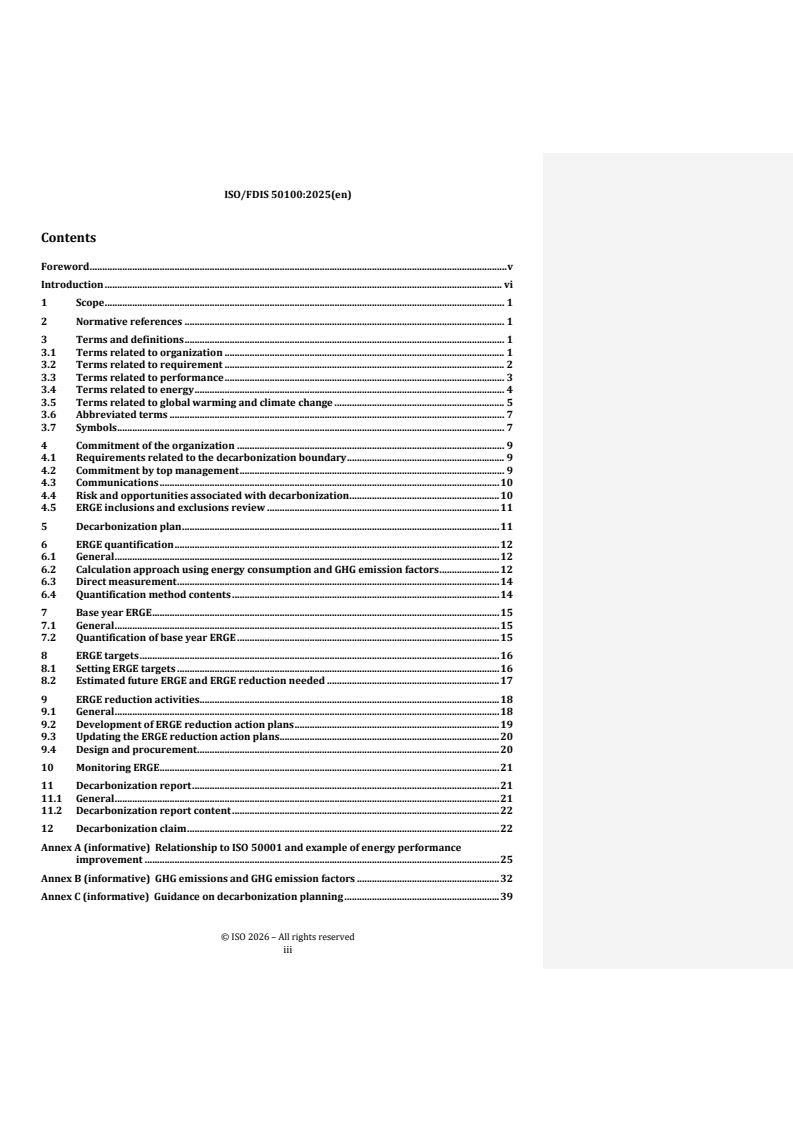
Contents
Foreword . v
Introduction . vi
1 Scope . 1
2 Normative references . 1
3 Terms and definitions . 1
3.1 Terms related to organization . 1
3.2 Terms related to requirement . 2
3.3 Terms related to performance . 3
3.4 Terms related to energy . 4
3.5 Terms related to global warming and climate change . 5
3.6 Abbreviated terms . 7
3.7 Symbols . 7
4 Commitment of the organization . 9
4.1 Requirements related to the decarbonization boundary . 9
4.2 Commitment by top management . 9
4.3 Communications . 10
4.4 Risk and opportunities associated with decarbonization . 10
4.5 ERGE inclusions and exclusions review . 11
5 Decarbonization plan . 11
6 ERGE quantification . 12
6.1 General . 12
6.2 Calculation approach using energy consumption and GHG emission factors . 12
6.3 Direct measurement . 14
6.4 Quantification method contents . 14
7 Base year ERGE . 15
7.1 General . 15
7.2 Quantification of base year ERGE . 15
8 ERGE targets . 16
8.1 Setting ERGE targets . 16
8.2 Estimated future ERGE and ERGE reduction needed . 17
9 ERGE reduction activities . 18
9.1 General . 18
9.2 Development of ERGE reduction action plans . 19
9.3 Updating the ERGE reduction action plans. 20
9.4 Design and procurement . 20
10 Monitoring ERGE . 21
11 Decarbonization report . 21
11.1 General . 21
11.2 Decarbonization report content . 22
12 Decarbonization claim . 22
Annex A (informative) Relationship to ISO 50001 and example of energy performance
improvement . 25
Annex B (informative) GHG emissions and GHG emission factors . 32
Annex C (informative) Guidance on decarbonization planning . 39
iii
Bibliography . 47
iv
Foreword
ISO (the International Organization for Standardization) is a worldwide federation of national standards
bodies (ISO member bodies). The work of preparing International Standards is normally carried out through
ISO technical committees. Each member body interested in a subject for which a technical committee has been
established has the right to be represented on that committee. International organizations, governmental and
non-governmental, in liaison with ISO, also take part in the work. ISO collaborates closely with the
International Electrotechnical Commission (IEC) on all matters of electrotechnical standardization.
The procedures used to develop this document and those intended for its further maintenance are described
in the ISO/IEC Directives, Part 1. In particular, the different approval criteria needed for the different types of
ISO document should be noted. This document was drafted in accordance with the editorial rules of the
ISO/IEC Directives, Part 2 (see www.iso.org/directives).
ISO draws attention to the possibility that the implementation of this document may involve the use of (a)
patent(s). ISO takes no position concerning the evidence, validity or applicability of any claimed patent rights
in respect thereof. As of the date of publication of this document, ISO had not received notice of (a) patent(s)
which may be required to implement this document. However, implementers are cautioned that this may not
represent the latest information, which may be obtained from the patent database available at
www.iso.org/patents. ISO shall not be held responsible for identifying any or all such patent rights.
Any trade name used in this document is information given for the convenience of users and does not
constitute an endorsement.
For an explanation of the voluntary nature of standards, the meaning of ISO specific terms and expressions
related to conformity assessment, as well as information about ISO’s adherence to the World Trade
Organization (WTO) principles in the Technical Barriers to Trade (TBT), see www.iso.org/iso/foreword.html.
This document was prepared by Technical Committee ISO/TC 301, Energy management and energy savings.
Any feedback or questions on this document should be directed to the user’s national standards body. A
complete listing of these bodies can be found at www.iso.org/members.html.
v
Introduction
0.1 Importance of decarbonization
Nearly 75 % of global anthropogenic greenhouse gas (GHG) emissions are from the generation and
[1]
consumption of energy. This document is designed to help organizations of all types and sizes to reduce their
energy-related GHG emissions (noted as ERGE in this document) in line with the organization’s related targets.
Figure 1 illustrates the relationship between greenhouse gas and energy-related greenhouse gas emissions.
ERGE.
This document outlines the requirements and provides guidance for organizations to develop a pathway that
transitions their energy consumption to meet their ERGE targets.
vi
Greenhouse gas (3.5.2)
GHG emission (3.5.3)
Scope 1 Scope 3
Scope 2
emission (3.5.4) emission (3.5.6)
emission (3.5.5)
Fuel and energy
Scope 3
Scope 1 emission
Other Scope 1
related ac�vi�es
emissions not
from energy
emission:
not in Scope 1
related to energy
consump�on
Fugitive emission
emissions or
consumption,
Process emission
Scope 2 emissions
energy use, or
(see Table B.3)
energy
performance
ERGE (3.5.7)
vii
Key
Boxes of solid lines with black font are ERGE
Boxes in dash single dot line with red italics are outside the scope of this document
Boxes in dash double dot line with blue underlined text can be optionally included in ERGE
Boxes in dotted lines provide context
Figure 1 — Illustration of energy-related greenhouse gas emissions (ERGE)
0.2
Key
viii
Boxes of solid lines with black font are ERGE
Boxes in dash single dot line with red italics are outside the scope of this document
Boxes in dash double dot line with blue underlined text can be optionally included in ERGE
Boxes in dotted lines provide context
Figure 1 — Illustration of energy-related greenhouse gas emissions (ERGE)
This document outlines the requirements and provides guidance for organizations to develop a pathway that
transitions their energy consumption to meet their ERGE targets.
0.2 Achieving decarbonization
[2[2]]
To achieve decarbonization, as established by the Paris Agreement and Nationally Determined
[3]
Contributions (NDCs) , organizations across all sectors must take action and implement actions to reduce the
energy consumption of their energy uses and switch to the consumption of low or zero-carbon emission
energy types (e.g. energy with a lower GHG emission factor).
This document provides organizations with a comprehensive decarbonization process for energy-related GHG
emissionsERGE that can be integrated into the organization’s operations. This process is based on a
decarbonization plan leading to specific ERGE reduction actions producing demonstrable results.
[4]
Processes to manage energy have been shown to effectively reduce energy consumption . ISO 50001:2018 is
an example of an energy management system (EnMS) that can serve as the foundation for reducing GHG
emissions from energy consumption. While this document is not a management system standard, the
processes it outlines can be effectively integrated with an EnMS or any other management system that
includes requirements to quantifiably improve energy performance. Annex A shows the relationship between
this document and ISO 50001:2018, which complement each other to enable an organization to achieve a
performance-based decarbonization strategy.
[6]
This document is designed to work with the existing GHG quantification documents (e.g. ISO 14064-1, GHG
[7]
Protocol, etc.).
This document enables an organization to make claims regarding:
— its plan to meet ERGE targets (validation);
— its achievement of ERGE targets based on historical data (verification);
— both its plan and achievement of ERGE targets.
[8]
NOTE ISO 14068-1:2023 sets out the requirements for claims around the achievement of carbon neutrality, and
[9]
ISO 14060 for being on a pathway to net zero.
0.3 Benefits
This document provides a systematic approach to developing a pathway for transitioning an organization’s
energy consumption to reduce ERGE in order to help organizations:
a) align internal systems, processes and input from interested parties to more effectively reduce ERGE;
ix
b) improve the availability and quality of data and information shared internally and with interested parties;
c) create a culture for reducing ERGE, involving leveraging synergies across different means such as EnMS,
energy efficiency, renewable energy and technology improvements;
d) provide internal and external interested parties assurance that the organization has established one or
more clear and transparent Scope 1 ERGE and Scope 2 ERGE targets;
e) develop ERGE reduction action plans implemented over time, resulting in achievement of the
organizational decarbonization strategy;
f) demonstrate achievement of past ERGE targets and the ability to achieve future ERGE targets.
0.4 Compatibility
This document contains requirements and can be used to assess conformity for repeatable and reproducible
results related to ERGE.
x
Energy management systems and energy savings — Decarbonization
— Requirements with guidance for use
1 Scope
This document specifies requirements and provides guidance that enable an organization to reduce its energy-
related greenhouse gas (GHG) emissions (ERGE).
This document is applicable:
a) to any organization regardless of its type, size, complexity, geographical location, organizational culture
or the products and services it provides;
b) to energy-related Scope 1 emissions and Scope 2 emissions;
c) irrespective of the quantity, use or types of energy consumed;
This document requires demonstration of absolute ERGE reduction aligned with ERGE target(s).
Annex A provides information on the relationship between ISO 50001:2018 and this document.
Annex B provides information on GHG emissions and GHG emission factors.
Annex C provides guidance related to the decarbonization planning.
2 Normative references
There are no normative references in this document.
3 Terms and definitions
For the purposes of this document, the following terms and definitions apply.
ISO and IEC maintain terminology databases for use in standardization at the following addresses:
— ISO Online browsing platform: available at https://www.iso.org/obp
— IEC Electropedia: available at https://www.electropedia.org/
3.1 Terms related to organization
3.1.1
organization
person or group of people that has its own functions with responsibilities, authorities and relationships to
achieve its targets
Note 1 to entry: The concept of organization includes, but is not limited to, sole-trader, company, corporation, firm,
enterprise, authority, partnership, charity or institution, or part or combination thereof, whether incorporated or not,
public or private.
[SOURCE: ISO 50001:2018, 3.1.1, modified — “targets” replaced “objectives” in the definition.]
3.1.2
top management
person or group of people who directs and controls an organization (3.1.1) at the highest level
Note 1 to entry: Top management is empowered to delegate authority and provide resources within the organization.
[SOURCE: ISO 50001:2018, 3.1.2, modified — Note 2 to entry and Note 3 to entry deleted.]
3.1.3
boundary
physical, virtual and/or organizational limits as defined by the entity for a stated purpose
EXAMPLE A process, a group of processes, a site, multiple sites under the control of an organization (3.1.1), an entire
organization.
Note 1 to entry: The entity can be an organization, group of organizations, region(s), subset of an organization or other
depending on the application.
Note 2 to entry: Physical can be equipment, systems, a building, a process, a group of processes, a site or multiple sites,
under the control of an organization.
[SOURCE: ISO 50006:2023, 3.1.2, modified — Example added.]
3.1.4
interested party
stakeholder
person or organization (3.1.1) that can affect, be affected by, or perceive itself to be affected by a decision or
activity
EXAMPLE Regulators, customers, suppliers, investors, shareholders, corporate, employees.
[SOURCE: ISO 50001:2018, 3.1.5, modified — Example added.]
3.1.5
energy management system
EnMS
management system to establish an energy policy, objectives, energy targets action plans and process(es) to
achieve the objectives and energy targets
[SOURCE: ISO 50001:2018, 3.2.2]
3.2 Terms related to requirement
3.2.1
requirement
need or expectation that is stated, generally implied or obligatory
Note 1 to entry: “Generally implied” means that it is custom or common practice for the organization (3.1.1) and
interested parties (3.1.4) that the need or expectation under consideration is implied.
Note 2 to entry: A specified requirement is one that is stated, for example in documented information.
Note 3 to entry: A relevant requirement is one that the organization has determined applies to the decarbonization
(3.5.1)boundary (3.1.3) and/or decarbonization activities.
[SOURCE: ISO 50001:2018, 3.3.1, modified — Note 3 to entry added.]
3.3 Terms related to performance
3.3.1
monitoring
determining the status of a system, a process or an activity
Note 1 to entry: To determine the status, there can be a need to check, supervise or critically observe.
Note 2 to entry: In an energy management system (3.1.5), monitoring (3.3.1) can be a review of energy (3.4.1) data or
greenhouse gas emissions (3.5.3) related data.
[SOURCE: ISO 50001:2018, 3.3.7, modified — “or greenhouse gas emissions related data” added to Note 2 to
entry.]
3.3.2
base year
historical 12-month period identified for the purpose of comparing energy-related greenhouse gas emissions
(ERGE) reduction (3.5.8)
Note 1 to entry: The base year can be quantified based on a specific year or averaged from several periods (e.g. several
years).
Note 2 to entry: This document uses the unit of tCO2e/year throughout, thus the period is a year. The 12-month period
does not need to be a calendar year but is a contiguous 12-months.
3.3.3
reporting year
12-month period of time selected for quantification and reporting of energy-related greenhouse gas emissions
(ERGE) (3.5.7)
Note 1 to entry: The reporting year can be quantified based on a specific year or averaged from several years.
Note 2 to entry: This document uses the unit of tCO2e/year throughout, thus the period is a year. The 12-month period
does not need to be a calendar year but is a contiguous 12-months.
3.3.4
validation
confirmation of a claim (3.3.6), through the provision of objective evidence, that the requirements (3.2.1) for a
specific intended future use or application have been fulfilled
Note 1 to entry: Objective evidence can come from real or simulated sources.
Note 2 to entry: Validation is considered to be a process to evaluate the reasonableness of the assumptions, limitations,
and methods that support a claim about the outcome of future activities.
Note 3 to entry: Validation is applied to claims regarding an intended future use based on projected information
(confirmation of plausibility).
[SOURCE: ISO/IEC 17029:2019, 3.2, modified — Note 4 to entry deleted.]
3.3.5
verification
confirmation of a claim (3.3.6), through the provision of objective evidence, that specified requirements (3.2.1)
have been fulfilled
Note 1 to entry: Verification is considered to be a process for evaluating a claim based on historical data and information
to determine whether the claim is materially correct and conforms with specified requirements.
Note 2 to entry: Verification is applied to claims regarding events that have already occurred or results that have already
been obtained (confirmation of truthfulness).
[SOURCE: ISO/IEC 17029:2019, 3.3, modified — Note 3 to entry deleted.]
3.3.6
claim
information declared by the organization (3.1.1)
Note 1 to entry: The claim is the object of conformity assessment by validation (3.3.4) and/or verification (3.3.5).
Note 2 to entry: The claim can represent a situation at a point in time or can cover a period of time.
Note 3 to entry: The claim should be clearly identifiable and capable of consistent evaluation or measurement against
specified requirements (3.2.1) by a validation or verification body.
Note 4 to entry: The claim can be provided in the form of a report, a statement, a declaration, a decarbonization (3.5.1)
plan or consolidated data.
[SOURCE: ISO/IEC 17029:2019, 3.1, modified — “organization” replaced “client” in the definition.
“decarbonization plan” replaced “project plan” in Note 4 to entry.]
3.3.7
energy performance
measurable result(s) related to energy efficiency (3.4.3), energy use (3.4.4), and energy consumption (3.4.2)
Note 1 to entry: Energy performance can be measured against the organization’s (3.1.1) objectives, energy targets and
other energy performance requirements (3.2.1).
Note 2 to entry: Energy performance is one component of the performance of the energy management system (3.1.5).
[SOURCE: ISO 50001:2018, 3.4.3]
3.3.8
energy performance improvement
improvement in measurable results of energy efficiency (3.4.3) or energy consumption (3.4.2) related to energy
use (3.4.4), compared to the energy baseline
[SOURCE: ISO 50006:2023, 3.1.11]
3.4 Terms related to energy
3.4.1
energy
electricity, fuels, steam, heat, compressed air and other similar media
Note 1 to entry: For the purposes of this document, energy refers to the various types of energy, including renewable,
which can be purchased, stored, treated, used in an equipment or in a process, or recovered.
[SOURCE: ISO 50001:2018, 3.5.1]
3.4.2
energy consumption
quantity of energy (3.4.1) applied
Note 1 to entry: Energy consumption can be represented in volume (e.g. litres of fuel), mass, weight units or energy units
(e.g. GJ, kWh).
[SOURCE: ISO 50006:2023, 3.1.5]
3.4.3
energy efficiency
ratio or other quantitative relationship between an output of process and an input of energy (3.4.1)
EXAMPLE Conversion efficiency, energy required/energy used, output/input, theoretical energy used to
operate/energy used to operate.
Note 1 to entry: The output of a process can be products, services or energy.
Note 2 to entry: Both input and output should be clearly specified in terms of quantity and quality and should be
measurable.
[SOURCE: ISO 50006:2023, 3.1.6]
3.4.4
energy use
energy end-use
application of energy (3.4.1)
EXAMPLE Ventilation, lighting, heating, cooling, transportation, process, data storage.
Note 1 to entry: Energy use is based on “what the energy is used for” as compared to energy consumption (3.4.2) which is
based on “how much energy is used”.
Note 2 to entry: This application can be from any energy type including renewables.
[SOURCE: ISO 50006:2023, 3.1.7]
3.5 Terms related to global warming and climate change
3.5.1
decarbonization
reduction of emissions of carbon dioxide(CO ) and other greenhouse gas (3.5.2) into the atmosphere
3.5.2
greenhouse gas
GHG
gaseous constituent of the atmosphere, both natural or anthropogenic, that absorbs and emits radiation at
specific wavelengths within the spectrum of infrared radiation emitted by the Earth’s surface, the atmosphere
and clouds
[5]
Note 1 to entry: The GHG emissions (3.5.3) included are those identified by the Kyoto Protocol as amended by the latest
[21]
Intergovernmental Panel on Climate Change (IPCC) Assessment Report . The three GHGs most commonly associated
with ERGE (3.5.7), are carbon dioxide (CO2), methane (CH4), and nitrous oxide (N2O). The remaining GHGs are
perfluorocarbons (PFCs), hydrofluorocarbons (HFCs), sulphursulfur hexafluoride (SF ), nitrogen trifluoride (NF ).
6 3
[SOURCE: ISO 14064-1:2018, 3.1.1, modified — Note 1 to entry modified revised. Note 2 to entry deleted.]
3.5.3
greenhouse gas emission
GHG emission
release of greenhouse gas (3.5.2) into the atmosphere
[SOURCE: ISO 14050:2020, 3.9.8]
3.5.4
Scope 1 emission
direct GHG emission
greenhouse gas (GHG) emission (3.5.3) from sources owned or directly controlled by the organization (3.1.1)
EXAMPLE
— process emissions, (such as CO that arises from the breakdown of calcium carbonate (CaCO ) during cement
2 3
manufacture);
— emissions from stationary combustion;
— emissions from mobile combustion;
— fugitive emissions (such as methane emissions from coal mines and refrigerant leaks).
Note 1 to entry: This document uses the concepts of equity share or control (financial or operational) to establish energy-
related Scope 1 emission responsibility.
Note 2 to entry: Scope 1 emissions do not include those occurring from natural ecosystems owned or controlled by the
organization that are not under management or remain in a natural state and have not been modified.
Note 3 to entry: Scope 1 emissions for governance organizations operating at a regional level refer to GHG emissions from
sources located inside the boundary (3.1.3) of that region. More information on Scope 1 emissions is provided in the
[6]
GHG Global Protocol for Community-Scale Greenhouse Gas Inventories, An Accounting and Reporting Standard for
Cities Version 1.1.
Note 4 to entry: A source is a human-based activity or process that releases a GHG into the atmosphere.
[SOURCE: IWA 42:2022, 3.2.3, modified — Example and Notes 4 to entry added. Notes 1 and 3 to entry
modified.]
3.5.5
Scope 2 emission
indirect GHG emission from purchased energy
greenhouse gas emission (GHG) (3.5.3) from the generation of purchased electricity, heat, cooling or steam
consumed by the organization (3.1.1)
Note 1 to entry: Purchased electricity is brought into the organizational boundary (3.1.3).
Note 2 to entry: Scope 2 emissions can include other purchased energy sources brought into the organizational boundary
(e.g. compressed air).
[SOURCE: IWA 42:2022, 3.2.4, modified — Note 1 to entry deleted. New Notes 1 and 2 to entry added.]
3.5.6
Scope 3 emission
indirect GHG emission
greenhouse gas (GHG) emission (3.5.3) that is a consequence of the organization’s (3.1.1) activities but arises
from sources that are not owned or directly controlled by the organization
EXAMPLE Extraction and production of purchased materials, transportation of purchased fuels, use of sold products
and services.
Note 1 to entry: Scope 3 emissions include all attributable value chain GHG emissions not included in Scope 1 emissions
(3.5.4) or Scope 2 emissions (3.5.5).
[SOURCE: IWA 42:2022, 3.2.5, modified — Example added. Note 2 to entry deleted.]
3.5.7
energy-related greenhouse gas emission
ERGE
Scope 1 emissions (3.5.4) from energy consumption (3.4.3) and Scope 2 emissions (3.5.5)
Note 1 to entry: The organization (3.1.1) may include Scope 3 emissions (3.5.6) associated with the organization’s energy
consumption.
Note 2 to entry: ERGE units are in absolute tCO2e/year.
3.5.8
energy-related greenhouse gas emission reduction
ERGE reduction
E
R
quantified decrease in ERGE (3.5.7)
[SOURCE: ISO 14064-2:2019, 3.1.7, modified — “energy-related” added to term. Symbol added. “ERGE”
replaced “GHG emissions between a baseline scenario and the GHG project” in the definition.
3.5.9
greenhouse gas emission factor
GHG emission factor
coefficient relating greenhouse gas emission (3.5.2) activity data with greenhouse gas emissions (3.5.3)
Note 1 to entry: In this document, “GHG activity data” relate to energy consumption (3.4.2).
Note 2 to entry: An organization (3.1.1) can use multiple GHG emission factors depending on energy type.
[SOURCE: ISO 14050:2020, 3.9.20, modified — Notes 1 and 2 to entry added.]
3.6 Abbreviated terms
CCUS carbon capture, utilization and storage
CEMS continuous emissions monitoring system
EnMS energy management system
ERGE energy-related greenhouse gas emission
GHG greenhouse gas
IEA International Energy Agency
IPCC Intergovernmental Panel on Climate Change
NDCs Nationally Determined Contributions
tCO e tonne CO equivalent
2 2
UNFCCC United Nations Framework Convention on Climate Change
3.7 Symbols
E interim ERGE target for ERGE
A
Formatted Table
E interim ERGE target for Scope 1 ERGE
AS1
E interim ERGE target for Scope 2 ERGE
AS2
EAT interim ERGE target for total ERGE
E base-year ERGE
B
E base-year ERGE for Scope 1 ERGE
BS1
E base-year ERGE for Scope 2 ERGE
BS2
E base-year ERGE for Scope 3 ERGE
BS3
EBT base-year ERGE for total ERGE
E quantified ERGE at a point in time used to compare to ERGE targets, monitored ERGE
M
E quantified Scope 1 ERGE at a point in time used to compare to Scope 1 ERGE targets, monitored
MS1
Scope 1 ERGE
E quantified Scope 2 ERGE at a point in time used to compare to Scope 2 ERGE targets, monitored
MS2
Scope 2 ERGE
E quantified total ERGE at a point in time used to compare to total ERGE targets, monitored total
MT
ERGE
E ERGE reduction needed in the interim period
R
E ERGE reduction needed for Scope 1 ERGE in the interim period
RS1
E ERGE reduction needed for Scope 2 ERGE in the interim period
RS2
ERT ERGE reduction needed for total ERGE the interim period
E estimated future ERGE with no actions taken by the organization
F
E estimated future Scope 1 ERGE
FS1
E estimated future Scope 2 ERGE
FS2
EFT estimated future total ERGE
E ERGE for each energy type (i)
i
F GHG emission factor for each energy type (i)
i
ES1 ERGE for Scope 1
E ERGE for Scope 2
S2
E Totaltotal ERGE
T
E long-term ERGE target
LA
ELAS1 long-term ERGE target for Scope 1 ERGE
E long-term ERGE target for Scope 2 ERGE
LAS2
E long-term ERGE target for total ERGE
LAT
E projected ERGE with successful actions taken by the organization
P
EPS1 projected ERGE value for Scope 1 ERGE
E projected ERGE value for Scope 2 ERGE
PS2
E projected ERGE value for total ERGE
PT
Q quantity of energy consumption of the energy type (i)
i
4 Commitment of the organization
4.1 Requirements related to the decarbonization boundary
The organization shall establish the boundary for its decarbonization activities. The organization shall include
all its ERGE within the decarbonization boundary. The organization shall establish, implement, and maintain
processes to manage its energy consumption, energy performance, energy performance improvement and
ERGE.
The decarbonization boundary and any changes to the decarbonization boundary, with the justification for
the changes, shall be available as documented information.
The organization shall review the activities related to ERGE within the decarbonization boundary at planned
intervals.
4.2 Commitment by top management
4.2.1 Top management shall demonstrate commitment to decarbonization by:
a) supporting the processes for establishing:
1) the base year (see 7.2.1) and base year ERGE;
2) interim and long-term ERGE targets (see 8.1.2);
3) ERGE reduction action plans (see Clause 9) to achieve interim and long-term ERGE targets;
b) supporting the long-term ERGE targets (see 8.1) and approving the interim ERGE targets (see 8.1) in
alignment with the organization’s business strategy, risks and opportunities;
1) ensuring risks and opportunities related to ERGE targets are identified and appropriately addressed
(see 4.4);
2) providing resources needed for decarbonization;
3) ensuring action is taken if the monitoring (see 10.2) of ERGE indicates that the ERGE targets are not
being achieved or are likely not to be achieved;
4) ensuring there is a process for decisions related to making a claim (see Clause 12).
NOTE The organization’s top management can receive input from external and internal interested parties. Top
management can consider appropriate communication with the external and internal interested parties.
4.2.2 Top management shall review at planned intervals:
a) the status of the ERGE reduction action plans (see Clause 9);
b) the monitoring of ERGE related to ERGE targets (see Clause 10);
c) recommendations related to any changes to the GHG emission factors (see 6.2.3);
d) recommendations related to any opportunities (see 9.1) identified to help achieve the interim or long-
term ERGE targets.
4.2.3 The results of the review shall be available as documented information. The result shall include:
a) decisions related to ERGE reduction action plans and targets;
b) any need for changes to the interim ERGE targets;
c) any need for changes to the long-term ERGE targets;
d) any need for changes related to GHG emission factors;
e) recommendations of actions or opportunities to help achieve the interim or long-term ERGE targets and
their disposition.
4.2.4 Top management shall assign the responsibilities for:
a) ensuring the effective development and implementation of a decarbonization plan (see Clause 5) to
achieve the interim and long-term ERGE targets (see 8.1);
b) implementing the organization’s communication strategy related to decarbonization;
c) reporting on the progress and the results of the decarbonization plan.
4.3 Communications
The organization shall determine and implement the internal communications relevant to the ERGE reduction
activities and the decarbonization plan.
The organization shall consider the need for public disclosure of information related to its decarbonization
(see Clause 12).
When communicating reports or claims about decarbonization, the organization shall ensure it is consistent
with its financial reporting.
4.4 Risk and opportunities associated with decarbonization
4.4.1 The organization shall consider the following when determining the risks and opportunities related to
decarbonization:
a) the achievement of long-term ERGE targets;
b) the achievement of interim ERGE targets;
c) changes to GHG emission factors;
d) current and potential regulatory requirements;
e) energy costs, reliability and security of energy supply;
f) transparency, accuracy and availability of data and information;
g) technological advancements;
h) availability of decarbonization options.
The risks and opportunities shall be reviewed at planned intervals.
4.4.2 The organization may consider the following when determining the risks and opportunities related to
decarbonization:
a) adverse impacts affecting interested parties;
b) adaption to climate change;
c) other issues associated with climate change (e.g. operational, financial, strategic);
d) current and future carbon abatement costs.
4.5 ERGE inclusions and exclusions review
The organization shall review the activities related to ERGE within the decarbonization boundary and
determine if any energy-related Scope 3 emissions are to be included.
NOTE 1 Scope 3 emissions can be ERGE that are not included in Scope 1 emissions or in Scope 2 emissions. These are
optional Scope 3 ERGE and are not required to be considered in this document. These Scope 3 GHG emissions include
transmission and distribution losses in electricity grids and upstream GHG emissions related to fossil fuels (sometimes
known as well-to-tank (WTT)). These Scope 3 ERGE will typically reduce in parallel as Scope 1 emissions and Scope 2
emissions ERGE are reduced. An organization can decide to include them in its decarbonization boundary (see 4.4.1). The
additional Scope 3 ERGE are calculated in the same way as other ERGE, by using Formula (1) (see 6.2.1).
The justification for the exclusion and inclusion of ERGE shall be available as documented information.
The organization shall justify the de-minimis threshold for ERGE. A typical de-minimis threshold is 1 % of
ERGE. De-minimis ERGE can be excluded.
If leased assets are under the control of the organization, their emissions shall be included in ERGE.
[12] [7]
NOTE 2 IPCC and the Greenhouse Gas Protocol: A Corporate Accounting and Reporting Standard provides
additional information on leased assets.
The included emissions determined from this review are included as ERGE and those excluded are not
considered as ERGE.
5 Decarbonization plan
The organization shall establish, implement and maintain a decarbonization plan for reducing its ERGE within
its decarbonization boundary.
The decarbonization plan shall contain at a minimum:
— quantification of the base year ERGE (E ) for both energy-related Scope 1 emissions (E ), Scope 2
B BS1
emissions (E ), Scope 3 emissions (E ) (if included in ERGE) (see 6.2.3), and the total summation of
BS2 BS3
ERGE (E ) (see Clause 7);
BT
— ERGE targets (see 8.1);
— ERGE reduction action plans for Scope 1 ERGE target(s) and Scope 2 ERGE target(s) (see 9.2.3);
— ERGE monitoring (see Clause 10).
The decarbonization plan shall be available as documented information.
The decarbonization plan shall be reviewed on a planned basis and updated when necessary (e.g. when there
are changes to the ERGE targets).
6 ERGE quantification
6.1 General
6.1.1 Quantification approach
The organization shall quantify ERGE using one or both of the following quantification approaches:
a) calculation using energy consumption and GHG emission factors for Scope 1 and Scope 2 emissions (see
6.2);
b) direct measurement for Scope 1 emissions (see 6.3).
6.1.2 Quantification method
The organization shall determine and implement a quantification method (see 6.4) for each energy type or
source. These methods shall:
a) produce accurate, consistent and reproducible results;
b) ensure transparency in how the ERGE were quantified;
c) be documented.
6.2 Calculation approach using energy consumption and GHG emission factors
6.2.1 General
6.2.1.1 When using calculation (see 6.1.1) to quantify ERGE, the organization shall use Formula (1) for each
energy type and source:
( )
𝐸𝐸 = 𝑄𝑄 x 𝐹𝐹 𝐸𝐸 = (𝑄𝑄 ×𝐹𝐹 )
i 𝑖𝑖 i 𝑖𝑖 𝑖𝑖 𝑖𝑖
(1)
where
Qi is the quantity of energy consumption of the energy type (e.g. kWh/year);
Fi is the GHG emission factor for each energy type (e.g. tCO2e/kWh);
Ei is the ERGE (tCO2e/year) for each energy type.
Q is the quantity of energy consumption of the energy type (e.g. kWh/year);
i
F is the GHG emission factor for each energy type (e.g. tCO e/kWh);
i 2
E is the ERGE (tCO e/year) for each energy type.
i 2
NOTE 1 The F typically takes into account the various GHG emissions and global warming potential (GWP) that can
i
be present. For example, the value for natural gas would include CO2, N2O and CH4.
NOTE 2 In some instances, an organization purchases an energy type (e.g. electricity) from two different suppliers
providing energy from two different grids (e.g. a national grid and a mini grid). Each supplier has a different GHG
emissions factor. In this case formula (1), Formula (1) is used for each source of energy of the same energy type and the
results for that type of energy summed to get Ei.
EXAMPLE
Supplier 1: Electricity consumption = 5 000kWh 000 kWh; emission factor is 0,3kgCO e3 kgCO e/kWh.
2 2
Supplier 2: Electricity consumption = 3 000kWh 000 kWh; emission factor is 0,5kgCO2e5 kgCO2e/kWh.
Ei = ((5 000 x × 0,3) + (3 000 x × 0,5)) = 3 000kg 000 kg CO2e = 3 tCO2e.
The organization shall calculate E for all energy types and sources within its established decarbonization
i
boundary (see 4.1).
6.2.1.2 The organization shall use Formula (2) to calculate Scope 1 ERGE (Es1), Scope 2 ERGE (ES2). ):
𝐸𝐸 =∑𝐸𝐸 (2)
𝑆𝑆 𝑖𝑖
where
E is the ERGE (tCO e/year) for each energy type;
i 2
E is the ERGE for Scope 1 ERGE;
s1
E is the ERGE for Scope 2 ERGE.
s2
E is the ERGE (tCO e/year) for each energy type;
i 2
E is the ERGE for Scope 1 ERGE;
s1
E is the ERGE for Scope 2 ERGE.
s2
6.2.1.3 The organization shall use Formula (3) to sum ERGE to determine total ERGE.:
∑
𝐸𝐸 = (𝐸𝐸 + 𝐸𝐸 ) 𝐸𝐸 =∑(𝐸𝐸 +𝐸𝐸 ) (3)
𝑇𝑇 𝑆𝑆2 T s1 s2
𝑠𝑠1
where
E is the ERGE for Scope 1;
S1
E is the ERGE for Scope 2;
S2
E is the total ERGE.
T
ES1 is the ERGE for Scope 1;
ES2 Is the ERGE for Scope 2;
ET is the total ERGE.
Formula (1), Formula (2) and Formula (3) shall be used to quantify ERGE for the base year and each reporting
year.
If the organization determined in 4.5 energy-related Scope 3 emissions that are not included in Scope 1
emissions or in Scope 2 emissions are to be included separately, then Formula (1), Formula (2) and
Formula (3) shall be used to quantify Scope 3 ERGE
...
Questions, Comments and Discussion
Ask us and Technical Secretary will try to provide an answer. You can facilitate discussion about the standard in here.
Loading comments...