


ISO 14180:2017
(Main)Solid mineral fuels — Guidance on the sampling of coal seams
Solid mineral fuels — Guidance on the sampling of coal seams
ISO 14180:2017 provides guidance on methods for taking samples from coal seams in the ground, whether from exploration areas or tenements, or from operating underground or open-cut mines. The following methods are described: a) sampling of small or large diameter holes; b) drill cuttings sampling; c) open-cut slot sampling; d) adit, drift or shaft sampling; e) pillar sampling; f) channel sampling; g) strip sampling. ISO 14180:2017 does not apply to sampling from moving streams in production or any other source of coal that is not in situ. Recommendations are made for selection and preparation of the sampling site, and methods are described for taking both small and bulk samples, and for preparing the samples for transport. NOTE Annex A gives an example of a channel sample record form that can be used to record sampling and other relevant data, and ISO 13909 or ISO 18283 describes how to determine the mass of a representative sample at various nominal top sizes.
Combustibles minéraux solides — Principes directeurs pour l'échantillonnage des veines de charbon
General Information
- Status
- Withdrawn
- Publication Date
- 09-Apr-2017
- Technical Committee
- ISO/TC 27/SC 4 - Sampling
- Drafting Committee
- ISO/TC 27/SC 4 - Sampling
- Current Stage
- 9599 - Withdrawal of International Standard
- Start Date
- 07-Nov-2023
- Completion Date
- 12-Feb-2026
Relations
- Effective Date
- 03-Dec-2022
- Effective Date
- 10-May-2014


Get Certified
Connect with accredited certification bodies for this standard

Bureau Veritas Chile
Bureau Veritas certification services in Chile.
Bureau Veritas Peru
Bureau Veritas certification services in Peru.
BVQI Peru
Bureau Veritas certification in Peru.
Sponsored listings
Frequently Asked Questions
ISO 14180:2017 is a standard published by the International Organization for Standardization (ISO). Its full title is "Solid mineral fuels — Guidance on the sampling of coal seams". This standard covers: ISO 14180:2017 provides guidance on methods for taking samples from coal seams in the ground, whether from exploration areas or tenements, or from operating underground or open-cut mines. The following methods are described: a) sampling of small or large diameter holes; b) drill cuttings sampling; c) open-cut slot sampling; d) adit, drift or shaft sampling; e) pillar sampling; f) channel sampling; g) strip sampling. ISO 14180:2017 does not apply to sampling from moving streams in production or any other source of coal that is not in situ. Recommendations are made for selection and preparation of the sampling site, and methods are described for taking both small and bulk samples, and for preparing the samples for transport. NOTE Annex A gives an example of a channel sample record form that can be used to record sampling and other relevant data, and ISO 13909 or ISO 18283 describes how to determine the mass of a representative sample at various nominal top sizes.
ISO 14180:2017 provides guidance on methods for taking samples from coal seams in the ground, whether from exploration areas or tenements, or from operating underground or open-cut mines. The following methods are described: a) sampling of small or large diameter holes; b) drill cuttings sampling; c) open-cut slot sampling; d) adit, drift or shaft sampling; e) pillar sampling; f) channel sampling; g) strip sampling. ISO 14180:2017 does not apply to sampling from moving streams in production or any other source of coal that is not in situ. Recommendations are made for selection and preparation of the sampling site, and methods are described for taking both small and bulk samples, and for preparing the samples for transport. NOTE Annex A gives an example of a channel sample record form that can be used to record sampling and other relevant data, and ISO 13909 or ISO 18283 describes how to determine the mass of a representative sample at various nominal top sizes.
ISO 14180:2017 is classified under the following ICS (International Classification for Standards) categories: 73.040 - Coals. The ICS classification helps identify the subject area and facilitates finding related standards.
ISO 14180:2017 has the following relationships with other standards: It is inter standard links to ISO 14180:2023, ISO 14180:1998. Understanding these relationships helps ensure you are using the most current and applicable version of the standard.
ISO 14180:2017 is available in PDF format for immediate download after purchase. The document can be added to your cart and obtained through the secure checkout process. Digital delivery ensures instant access to the complete standard document.
Standards Content (Sample)
INTERNATIONAL ISO
STANDARD 14180
Second edition
2017-04
Solid mineral fuels — Guidance on the
sampling of coal seams
Combustibles minéraux solides — Principes directeurs pour
l’échantillonnage des veines de charbon
Reference number
©
ISO 2017
© ISO 2017, Published in Switzerland
All rights reserved. Unless otherwise specified, no part of this publication may be reproduced or utilized otherwise in any form
or by any means, electronic or mechanical, including photocopying, or posting on the internet or an intranet, without prior
written permission. Permission can be requested from either ISO at the address below or ISO’s member body in the country of
the requester.
ISO copyright office
Ch. de Blandonnet 8 • CP 401
CH-1214 Vernier, Geneva, Switzerland
Tel. +41 22 749 01 11
Fax +41 22 749 09 47
copyright@iso.org
www.iso.org
ii © ISO 2017 – All rights reserved
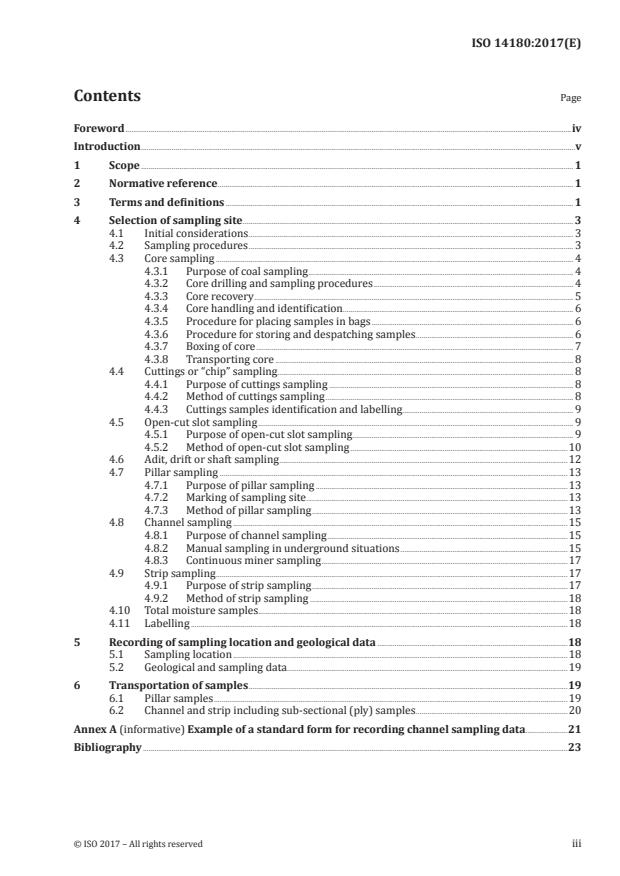
Contents Page
Foreword .iv
Introduction .v
1 Scope . 1
2 Normative reference . 1
3 Terms and definitions . 1
4 Selection of sampling site . 3
4.1 Initial considerations . 3
4.2 Sampling procedures . 3
4.3 Core sampling . 4
4.3.1 Purpose of coal sampling . 4
4.3.2 Core drilling and sampling procedures . 4
4.3.3 Core recovery . 5
4.3.4 Core handling and identification. 6
4.3.5 Procedure for placing samples in bags . 6
4.3.6 Procedure for storing and despatching samples . 6
4.3.7 Boxing of core . 7
4.3.8 Transporting core . 8
4.4 Cuttings or “chip” sampling. 8
4.4.1 Purpose of cuttings sampling . 8
4.4.2 Method of cuttings sampling . 8
4.4.3 Cuttings samples identification and labelling . . 9
4.5 Open-cut slot sampling . 9
4.5.1 Purpose of open-cut slot sampling . 9
4.5.2 Method of open-cut slot sampling .10
4.6 Adit, drift or shaft sampling .12
4.7 Pillar sampling .13
4.7.1 Purpose of pillar sampling .13
4.7.2 Marking of sampling site .13
4.7.3 Method of pillar sampling .13
4.8 Channel sampling .15
4.8.1 Purpose of channel sampling .15
4.8.2 Manual sampling in underground situations .15
4.8.3 Continuous miner sampling .17
4.9 Strip sampling .17
4.9.1 Purpose of strip sampling .17
4.9.2 Method of strip sampling .18
4.10 Total moisture samples.18
4.11 Labelling .18
5 Recording of sampling location and geological data .18
5.1 Sampling location .18
5.2 Geological and sampling data.19
6 Transportation of samples .19
6.1 Pillar samples .19
6.2 Channel and strip including sub-sectional (ply) samples .20
Annex A (informative) Example of a standard form for recording channel sampling data.21
Bibliography .23
Foreword
ISO (the International Organization for Standardization) is a worldwide federation of national standards
bodies (ISO member bodies). The work of preparing International Standards is normally carried out
through ISO technical committees. Each member body interested in a subject for which a technical
committee has been established has the right to be represented on that committee. International
organizations, governmental and non-governmental, in liaison with ISO, also take part in the work.
ISO collaborates closely with the International Electrotechnical Commission (IEC) on all matters of
electrotechnical standardization.
The procedures used to develop this document and those intended for its further maintenance are
described in the ISO/IEC Directives, Part 1. In particular the different approval criteria needed for the
different types of ISO documents should be noted. This document was drafted in accordance with the
editorial rules of the ISO/IEC Directives, Part 2. www .iso .org/ directives
Attention is drawn to the possibility that some of the elements of this document may be the subject of
patent rights. ISO shall not be held responsible for identifying any or all such patent rights. Details of
any patent rights identified during the development of the document will be in the Introduction and/or
on the ISO list of patent declarations received. www .iso .org/ patents
Any trade name used in this document is information given for the convenience of users and does not
constitute an endorsement.
For an explanation on the voluntary nature of standards, the meaning of ISO specific terms and
expressions related to conformity assessment, as well as information about ISO’s adherence to the
World Trade Organization (WTO) principles in the Technical Barriers to Trade (TBT), see the following
URL: http:// www .iso .org/ iso/ foreword .html
This document was prepared by Technical Committee ISO/TC 27, Solid mineral fuels, Subcommittee
SC 4, Sampling.
This second edition cancels and replaces the first edition (ISO 14180:1998), which has been
technically revised
iv © ISO 2017 – All rights reserved
Introduction
Coal is one of the most challenging materials to sample due to its characteristic heterogeneity. A coal
seam can consist of a single stratum of one lithotype of relatively uniform maceral constitution, or
more commonly, consist of a number of layers of different coal lithotypes varying in thickness and
lateral extent. The seam can also contain discrete layers of inorganic sediments or carbonaceous shales
of varying thickness. Veins of concordant or discordant secondary mineral rock could also be present.
The lithotype layers can vary considerably in hardness, texture and structure according to the nature
of the coal and inorganic sediments. The inorganic layers can also thicken laterally, splitting the seam
into two or more separate units which could require multiple samples.
It is strongly recommended that a collaborative team including geologists, mining engineers, safety,
land and laboratory professionals review each proposed sampling program to help ensure optimal
effectiveness and efficiency are obtained.
The purpose of sampling coal for any resource evaluation is to predict the expected quality of the
produced coal from a given locale. Therefore, the fundamental goal of each sampling effort is the
collection of representative samples of the seam(s) at each sampling location. A properly executed
sampling program needs to accurately define both the lateral variation in coal quality and the average
quality for a specified area.
After inspection of any seam, the sampler designes a sampling program with sufficient representative
samples to define the range of expected coal quality. In variable seams it is necessary to take a number
of samples to improve the representativity of sampling.
In operating mines, the manager needs to be consulted and approval needs to be obtained before
sampling sites are selected and sampling proceeds. Where there is no operating mine the area or
tenement owner and or operator is consulted.
In all sampling situations, experienced and qualified personnel will be required for supervision and
to ensure that accurate records are made of location, thickness and lithotype descriptions and that all
safety precautions have been addressed.
Methods of sampling for physical, chemical, petrographic or utilization properties are described for the
following:
a) sampling from small and large diameter drill cores;
b) sampling from exposed seam faces;
c) sampling from trial open-cut excavations;
d) sampling from underground workings.
INTERNATIONAL STANDARD ISO 14180:2017(E)
Solid mineral fuels — Guidance on the sampling of coal
seams
SAFETY PRECAUTIONS — It is strongly recommended that a risk analysis of the sampling
exercise be undertaken by an experienced safety officer before work begins.
1 Scope
This document provides guidance on methods for taking samples from coal seams in the ground,
whether from exploration areas or tenements, or from operating underground or open-cut mines. The
following methods are described:
a) sampling of small or large diameter holes;
b) drill cuttings sampling;
c) open-cut slot sampling;
d) adit, drift or shaft sampling;
e) pillar sampling;
f) channel sampling;
g) strip sampling.
This document does not apply to sampling from moving streams in production or any other source of
coal that is not in situ.
Recommendations are made for selection and preparation of the sampling site, and methods are
described for taking both small and bulk samples, and for preparing the samples for transport.
NOTE Annex A gives an example of a channel sample record form that can be used to record sampling and
other relevant data, and ISO 13909 or ISO 18283 describes how to determine the mass of a representative sample
at various nominal top sizes.
2 Normative reference
The following documents are referred to in the text in such a way that some or all of their content
constitutes requirements of this document. For dated references, only the edition cited applies. For
undated references, the latest edition of the referenced document (including any amendments) applies.
ISO 1213-2, Solid mineral fuels — Vocabulary — Part 2: Terms relating to sampling, testing and analysis
3 Terms and definitions
For the purposes of this document, the terms and definitions given in ISO 1213-2 and the following apply.
ISO and IEC maintain terminological databases for use in standardization at the following addresses:
— ISO Online browsing platform: available at http:// www .iso .org/ obp
— IEC Electropedia: available at http:// www .electropedia .org/
3.1
bulk sample
sample of large mass, taken in a particular operation for a specific reason, such as for pilot washing,
coal preparation or combustion tests
Note 1 to entry: It is not possible to define the minimum size of a bulk sample.
3.2
channel sample
sample of the coal and associated inorganic material taken by removing a vertical channel of even
cross-section from the seam
Note 1 to entry: Where the full section of the seam is not accessible or not required, this term can refer to a
sample taken either from a specifically defined portion of the seam, or from the floor to roof as mined or exposed.
3.3
coal seam
stratum or sequence of strata composed of coal as a significant component and significantly different in
lithology to the strata above and below it
Note 1 to entry: It is laterally persistent over a significant area and it will be of sufficient thickness and persistence
to warrant mapping or description as an individual unit.
3.4
core sample
cylindrical sample of the whole or part of a coal seam obtained by drilling using a coring barrel
Note 1 to entry: The diameter of the core can vary from 50 mm to 2 000 mm depending on the reason for which
the sample is required. However, 50 mm to 200 mm is the most common core diameter range.
3.5
cuttings sample
sample of coal chips produced from the rotary drilling of a coal seam using a non-coring bit such as a
blade bit or roller bit
3.6
pillar sample
section of a seam taken in the form of a block, or series of blocks, of coal with associated inorganic rock
which, when arranged in correct vertical sequence, represent a true section of the seam
Note 1 to entry: Where the full section of the seam is not accessible or not required, this term can refer to a
sample taken either from a specifically defined portion of the seam, or from the floor to roof as mined or exposed.
3.7
ply
layer of coal seam normally differing in properties from adjacent layers. Any distinctive layer maybe
regarded as a ply
3.8
ply sample
sample taken from an individual ply or leaf or from a series of plies or leaves of a coal seam
3.9
strip sample
sample similar to a channel sample but smaller in cross-section
Note 1 to entry: A single strip sample can often be regarded as being too small to guarantee that all horizons
of the seam are adequately represented. However, a number of such samples can be taken to achieve better
representativity in a variable seam.
2 © ISO 2017 – All rights reserved
4 Selection of sampling site
4.1 Initial considerations
Sampling sites where possible are chosen at random when no other information regarding the tenement
or exploration site is available. The site for sampling apart from drill holes should be chosen, as far as
possible, to avoid cracks and breaks, random lenses of rock or mineral matter, or other abnormalities
or irregularities in the face to be sampled. However, on occasion, the purpose may be to sample
a particular mode of development of the seam section, in which case the sample should be taken at
the best available site exhibiting this feature. The location of the sampling point should be recorded
accurately (see Clause 6).
Core sampling is usually employed for sampling coal seams that are not exposed in outcrop or by
mining. It is especially useful in areas which are not readily accessible as drill rigs are small enough
to be located by helicopter. Sometimes, however, this method is used even though exposed faces are
available. This is because it is often faster, less labour-intensive, safer and more representative than
pillar or strip sampling, especially if a suitable drilling rig is readily available. For example, many open-
cut mines take cores of the seam to be uncovered in the next mining strip to obtain coal quality data for
mine planning purposes. Coring of the uncovered coal seam by a drilling rig sitting directly on top of
the coal is also common practice where detailed coal quality parameters need to be known for blending
purposes or for specific cargoes where the customer may be particularly sensitive to certain coal
properties or inorganic impurities.
Cores can be obtained routinely in diameters ranging from 50 mm to 200 mm depending on the amount
of material required for testing. It is generally advisable that, for routine sampling operations, 100 mm
cores be taken as this size provides a good compromise between representativity and cost.
NOTE There are risks in comparing data from different core sizes of the same coal. The determined yield
values and analysis for washing coals can vary significantly. When this occurs it is recommended that the results
be confirmed by very large cores as described above or by practices outlined in 5.4.
4.2 Sampling procedures
No two projects are exactly the same and may have different requirements regarding sampling, such
as when and what should be sampled, how the sampling should be done, and the details of how the
samples should be numbered or identified, wrapped, recorded, stored and treated.
There are a number of rules related to sampling that should be noted:
a) Prepare well. Even if there is little expectation of finding anything of commercial significance, the
sampler should always be prepared and in a position to take samples if the opportunity presents.
Always have a selection of sample bags, bottles or other containers on hand, in case they are needed.
b) Ask questions. Before embarking on a new project, the sampler should discuss the sampling
requirements with the Exploration Geologist and or Manager, so it is clear exactly what is required.
c) If in doubt, take samples rather than not. Samples that are excess or surplus to requirement can
always be disposed of later, but if samples are not taken when the opportunity is available, then
the chance to do so may be lost completely. Take more samples than you may think are needed, and
divide if uncertain about coal ply boundaries. These can always be recombined in the laboratory
following geophysical reconciliation.
d) Do not put off until tomorrow what you can do today. For example, if it is late in the day but
the project requires that 1m increment soil samples should be collected from the first 10m of the
cuttings of an exploration chip borehole, do not leave the cuttings overnight with the intention
of collecting the samples the next morning. Do not take the risk that samples could be lost,
contaminated or have their integrity compromised.
e) Care should also be taken to prevent contamination by out-of-seam materials, or other sources
such as drilling fluid. In all cases, but particularly for lower rank coals, it is imperative that the
sample be promptly packed in its container to minimize loss of moisture and be transported to the
laboratory as soon as practicable.
f) Before sampling an exposed face, the section to be sampled should, as far as practicable, be
uniformly dressed and squared up, and any loose, overhanging or protruding pieces of coal or rock
should be removed. Where a face is weathered, the immediate surface material should be removed
to a depth sufficient to eliminate weathering effects. In the case of underground face sampling,
contamination by stone dust is to be avoided, as this will influence the analysis.
g) The coal sample after logging and identification should be kept in a sealed bag or container.
h) If the laboratory cannot begin analysis immediately, arrangements should be made to keep the
sample in cold or cool storage to prevent oxidation of the coal. Any coal not being analysed should
be returned to cold or cool storage until it is required.
i) It is critical that sample information is recorded carefully, thoroughly and accurately. There is no
value in having a sample that cannot be identified or being able to determine where it came from,
or why it was sampled.
j) It is essential that all samples are analysed using rigid quality assurance and quality control
procedures. Examples such as duplicate samples, round robins between laboratories, standard
samples, laboratory certification to ISO 17025 are recommended in this document.
4.3 Core sampling
4.3.1 Purpose of coal sampling
Core drilling is used to obtain representative samples for geotechnical, coal quality and gas content
and other testing to provide as much information from a borehole as possible. A well drilled and
recovered core enables precise detail to be recorded on the thickness and brightness of coal bands and
the presence of any inter-bedded rock types such as mudstone, siltstone, or tuffaceous material within
a coal seam. It also enables the weathered state of the coal to be identified. The combination of detailed
lithology logs with coal quality determinations and other test results, supports the determination of
working sections and mining methods, coal handing procedures and products.
4.3.2 Core drilling and sampling procedures
The drilling and sampling of core is an expensive and time consuming process. The information available
from logging and testing of core contributes significantly to critical decisions about the quantity and
quality of the resource and the potential mining conditions. Cores should be highly valued and treated
with appropriate care. Tasks when coring include:
a) communicate with the driller about the length of the core run, the depth of the borehole, and the
condition of the core;
b) carefully transfer core from driller’s splits to PVC splits for logging;
c) clean drilling mud and cuttings from core surface with as little water and disturbance as possible;
d) photograph and log all cores as soon as possible after extraction to minimize disturbance to core;
e) sample coal and partings separately before transferring any material to core boxes, unless
significantly different to expected interval or core required for other purpose. In some countries the
term used when handling partings and high ash zones is “When in doubt break it out” meaning these
zones can be separately sub-sampled, analysed and combined mathematically later. Alternatively
the core may be boxed first, logged, and sampled later with the aid of the geophysical logs;
f) any coal core retained should be stored in core sock (plastic tubing) or similar protective covering
to minimize moisture loss and further disturbance;
4 © ISO 2017 – All rights reserved
g) minimize evaporation of moisture from coal samples by not leaving exposed for an extended
period, sealing samples into plastic bags, and keeping sample bags out of direct sunlight.
4.3.3 Core recovery
There are a number of aspects for good core recovery that should be considered as follows:
a) The mechanical state of the rock, the driller and the drilling methods utilized, and the condition
and operation of the coring equipment. It is possible to obtain 100 % core recovery if these factors
are all favourable but this is not usual in many situations.
b) The difference between what is cored and what is recovered needs to be reconciled. The first
step in the core logging process is to measure the length of core recovered.
c) The rig geologist should accurately determine the borehole depth before the core is pumped
out of the barrel, and be responsible for the measurement of the drilled core run intervals. The rig
geologist should ask the driller for the length of the drilled run before the core run is extracted
from the core barrel. Once the core is pumped out of the barrel, the length drilled can then be
compared with the recovered length; Significant differences between the drilled length and the
recovered length may be due to measurement or calculation error of the amount drilled, or due
to core loss. Therefore all measurements should be rechecked and frequent checks of the driller’s
depth should be made.
d) Once the core is on the logging table, the rig geologist should make the best attempt possible to
close up any gaps, crushed zones and irregularities (e.g. rotate the defect/break for a best fit), or
zones of apparent core expansion due to swelling clays or bulking due to discing or mechanical
disturbance. The rig geologist should also try to identify the top of the run. The core should not be
manipulated to fit the drilling interval.
e) The core should then be measured by both the driller and the rig geologist to obtain the measured
recovered length of core which should then be recorded on the Drilling Sheet with the driller to
depth and the geologist to depth. The difference between the length drilled and the recovered
length is the ‘core loss’ or ‘core gain’.
f) The apparent expansion of core can of course occur in combination with real core loss. It then
becomes difficult to know how much real core loss to assign to versus reducing core length for the
cumulative effects of core expansion. Also, although core lost from one core run may be recovered
later, each subsequent core run can also be subject to discrete core loss and this should be allocated
accordingly.
g) The core run information is best recorded as a comment on the Lithology Sheet or separate
recovery sheet and should contain the run number, the start of run depth (SOR), end of run depth
(EOR), drilled core length and recovered core length. For example: “Run 1: 18.00m to 22.50m,
drilled 4.50m, rec 4.32m”. A record could also be calculated and recorded of the loss or gain for
each core run and the cumulative loss or gain (from values collected on the Drilling Sheet).
h) Where it is difficult to identify where the loss or gain has occurred, a continuous record of the core
depths or thicknesses could be made. Any indications of where core loss has occurred should be
recorded and depths adjusted later.
i) Some countries for their geotechnical use also calculate rock quality determinations (RQD) at the
same time as core recovery.
j) Some countries also carry out full scale geophysical logging of cores to provide an accurate seam
thickness to confirm core recovery and provide information regarding variation in ash in the seam.
The data obtained can also assist in the final sampling of the core.
4.3.4 Core handling and identification
Before samples are sent to the laboratory, the following procedures should be followed to ensure the
highest possible standard and reliability of sample collection and analysis:
a) Ensure all samples are taken as soon as possible to minimize moisture loss, otherwise store coal in
core sock or with plastic cover.
b) Minimize inclusion of excess free moisture minimize damage to core when separating samples.
c) Recover all possible core with minimal contamination.
d) Use a brush to ensure all possible fines are retained.
e) It is recommended that each sample should also be given a unique number within a sequential
numbering system, preferably commencing with the first sample of the uppermost seam in the hole.
Record project name, borehole name, and sample number with a water proof pen on the outside of
each bag – sample depths may also be included.
f) Record bag number (as bag x of xx) if multiple bags used for sample interval.
4.3.5 Procedure for placing samples in bags
This procedure should include:
a) double bag all samples (in tough {i.e. >60um} plastic bags);
b) include a sample tag with sample number in outer bag;
c) seal bag as air tight as possible with tape or cable ties;
d) weigh and record all bagged samples;
e) keep samples in shady or cool area if possible;
f) transfer all samples to cold or cool storage at end of day if possible;
g) consider using a bar code system for identifying all samples.
4.3.6 Procedure for storing and despatching samples
This procedure should include:
a) pack sample bags into larger poly sacks (<25kg) or 200 l drums (see Figure 1);
b) seal securely (cable ties, staples, tape or secured lid);
c) label outside with project name, borehole name, sample numbers and bag/drum number with a
water proof pen or paint;
d) keep physical or digital record of all sample bags/drums with contents;
e) transfer all samples to cold or cool storage awaiting despatch if possible;
f) samples should be dispatched to the laboratory as soon as reasonably possible (recommend at least
once per week);
g) prior to despatch, the laboratory should be informed in writing of the number, identification and
dispatch weight of all samples and numbers of drums and or bags that is to be delivered; a copy of
the sample record sheets shall be provided to the laboratory;
h) record date of despatch; and
6 © ISO 2017 – All rights reserved
i) when the laboratory staff receives the samples in the laboratory they shall ensure they reconcile
them against the sample record sheets and weigh each sample received; this ensures that all
samples are received and if any bag is ripped the sample loss can be determined.
Figure 1 — Typical polypropylene sacks
4.3.7 Boxing of core
If core is to be stored for later inspection and sampling it should be placed in appropriate core boxes or
trays. All core boxes should be labelled on the front and one end from left-to-right so they can be read in
racks, with the following:
a) project name;
b) borehole number;
c) box number;
d) and from and to depths (of the core in the box);
Suitable markers (e.g. wood or polystyrene block) should be placed inside the box as follows:
— at the top left with the borehole number, box number, and core start depth;
— at the end of each run with letters ‘EOR’ (end of run), run number, and depth;
— at the start of a new run where not continuous from previous run with letters ‘SOR’ (start of run),
run number, and depth;
— where a sample has been taken with sample number and to and from depths (marker does not need
to match size of sample);
— where core loss has been recorded;
— and at the bottom right with the end of core (EOC) or total depth (TD)of the borehole.
Position the core in a box in a way that minimises manual handling and core damage. It is recommended
that additional blocks are placed into gaps in the core trays to stop the core moving during transport.
Broken or fragmented core may be rolled into an appropriate length of PVC split tubing to ensure
integrity in transfer to the core box, and during transport and storage. If the core has been sampled the
residual core should be stored and clearly identified as being sampled. Figure 2 shows an example of
the correct layout of core in a core box. This shows that details such as project name (removed from this
figure), borehole name (removed from this figure), box number and depths can also be written on the
edges of the box. Note that breaks have occurred in the core during boxing or transportation as they
are not marked.
4.3.8 Transporting core
While on site, core boxes should be located so they are easily accessed and securely stored where they
will not be affected by weather or other disturbance. Position the box in a manner that prevents any
chance of the core box falling or the core being uncovered.
Core boxes should be secured and transported to a core shed and stored appropriately as soon as
possible. Strap core boxes into a vehicle to avoid movement and reduce the safety hazard during transit.
Figure 2 — Typical core box
4.4 Cuttings or “chip” sampling
4.4.1 Purpose of cuttings sampling
Cuttings or chip sampling is used where core sampling is not possible or not justified in terms of
cost. Cuttings samples shall not be considered as representative compared to core samples although
technological advances have made both core and cuttings samples more reliable. They require a great
deal of experience on the part of the driller and sampler to obtain reasonable samples but should never
be accepted as being truly representative of the coal seam. An instance in which cuttings samples
might be adequate would be in the early stages of an exploration area or tenement evaluation where an
indication of coal quality is required as a precursor to more detailed core sampling.
4.4.2 Method of cuttings sampling
Open hole drilling can be accomplished utilizing two non-coring techniques, Rotary Air Blast Drilling
(RAB) and Reverse Circulation Drilling (RC). RAB drilling utilizes a single wall drill pipe, with a variety
of cutting bits at the downhole end, and acts by injecting either air or drilling fluid down through the
drill pipe, and recovering drill cuttings as they are flushed out at the top of the hole, having travelled up
hole in the annulus between the drill pipe and the wall of the hole. RC drilling utilizes double walled drill
pipe, creating a “pipe within a pipe”, and acts by injecting either air or drilling fluid down the outside
pipe, and returning the drill cuttings to the surface through the inner pipe. RC drilling is preferable to
RAB drilling as the drill cuttings are not mixed and contaminated by the wall rock as they travel up the
hole as is the case with RAB, with RC samples therefore being more representative of the strata the drill
bit has penetrated.
The size of the cuttings can be very variable but generally ranges from a few millimetres to a few
centimetres. As the drill bit advances through the seam, the circulating medium (air, water or drilling
mud) transports the cuttings from the bit to the surface and they are collected in a purpose-made
container or cyclone or on a shovel held near the hole. Generally, the driller alerts the sampler when a
coal seam is intersected, and stops drilling while still circulating the drilling fluid to clear the hole as
much as practical of out-of-seam contamination. When satisfied that the hole is clear, the driller then
8 © ISO 2017 – All rights reserved
drills a previously agreed distance, usually one metre, while the sample is collected, and then cleans
out the hole again. This procedure is continued through the seam until the seam floor is encountered.
A qualified and well trained sampler or geologist should log all chip samples after washing by sieving
in a bucket of water to remove dust or drilling fluid, except for some intervals of weathered or clayey
material, as they may not remain in the sieve after being immersed in water. Washing will help to reveal
colour variations, grain size, the presence of minerals, and possibly defects such as joint surfaces. This
also assists with determining percentages of multiple rock types. Log all chips in the same state to
provide consistency of colour descriptions which will appear different if wet or dry. This is likely to be
a wet condition if they are logged immediately after washing them, however if some dry out then they
should be made wet again. This should also be recorded.
NOTE Be observant and record any contaminant present within the chip samples. Rubber for instance is an
indication that the interior of the high pressure bull hose has started to disintegrate. Drilling is to be terminated
immediately and the bull hose replaced before drilling can recommence.
NOTE Small cutting samples are less representative compared to full core samples.
The sampler is responsible for labelling each bag of material collected with a drill hole number and
depth at which the material was extracted. A variation on conventional cuttings retrieval is the
technique of reverse-circulation drilling. In this drilling method, the normal circulation of the drilling
medium (down the centre of the drilling rods and back up the annulus between the rods and wall of the
hole) is reversed and the drilling fluid is pumped down the annulus, entrains the cuttings, and returns
up the centre of the rods, from which the cuttings are recovered and sampled.
Foundation drilling rigs can be used to collect very large cuttings samples, generally on a whole-seam
basis, where a large quantity of coal is required for utilization testing or any other purpose. Again, the
sample is placed directly in a truck, or on a prepared surface for loading later onto a truck with a front-
end loader or similar machine. Sizing of coal obtained in this way can be finer than the anticipated run-
of-mine coal sizing, but techniques such as reaming may be used to increase the average size if this is
important.
Another type of cuttings sampling is known as “keyhole sampling”. This method involves the fracturing
of the coal by blasting in the hole, or reaming followed by the recovery of the broken coal by circulating
the drilling medium using hydraulic mobilization and lifting. This method is best suited to sampling
deep coal seams that are targeted for underground mining, as an alternative to taking a number of
conventional large-diameter cores.
4.4.3 Cuttings samples identification and labelling
Identification and labelling for cuttings samples is similar to the method described for core samples in
5.2.3 If the samples are of small mass then a number of cuttings samples held in small plastic bags and
suitably tagged can be placed in larger plastic bags or drums for ease of transport.
4.5 Open-cut slot sampling
4.5.1 Purpose of open-cut slot sampling
Slot sampling is a form of bulk sampling used to acquire a large quantity of coal that would be
representative of run-of-mine coal from undeveloped deposits amenable to open-cut mining, or
undeveloped areas or seams of an existing open-cut mine. Normally before this form of sampling is
undertaken core or cores would be taken to determine coal quality and the depth of coal oxidation
Often the purpose is to confirm coal quality, sizing, washability and utilization behaviour, on a pilot or
full scale coal preparation plant, or in a commercial trial to predict quality for investment purposes.
Results from these tests are more reliable than those obtained from core or channel samples and
contribute substantially to a development decision and planning.
It is imperative to realize that this type of sampling is subject to relevant legislated acts and regulations
and normally can be carried out only with all appropriate authorizations in place and under the
direction of suitably qualified mining personnel.
It is necessary that all safety issues and environmental concerns shall have been adequately considered
and resolved before sampling is commenced.
4.5.2 Method of open-cut slot sampling
Slot sampling requires a full mine design produced by qualified and experienced civil or mining
engineers and geologists. Detailed slot design is outside the scope of this document and only general
concepts will be discussed.
Factors to be considered in the overall design of the slot include shape, seam dip and depth, ramp grade
and width, side-wall and end-wall angles, water management, and topsoil and spoil pile management.
The size of the slot and therefore the complexity of design will depend on the depth to fresh coal, the
thickness of the coal seam to be sampled and the size of the sample required. Thus, the first decision to
be made is the quantity of coal required for the purposes for which the sample is being taken. This is
influenced by mining and preparation factors such as mining loss, dilution from mining, expected yield
of clean coal after washing and whether subsequent samples are required. The quantity of finished coal
product is the basis upon which the whole mine plan is based. The depth to coal and the strength of the
overburden are particularly important factors in design because they dictate the type of slot that can
be used and hence the cost involved.
Where the coal is relatively shallow and the overburden can be removed by scrapers, the preferred slot
design is a double-ramp design as shown
...
Questions, Comments and Discussion
Ask us and Technical Secretary will try to provide an answer. You can facilitate discussion about the standard in here.
Loading comments...