


ISO 13909-7:2025
(Main)Coal and coke — Mechanical sampling — Part 7: Methods for determining the precision of sampling, sample preparation and testing
Coal and coke — Mechanical sampling — Part 7: Methods for determining the precision of sampling, sample preparation and testing
This document defines methods for estimating overall precision and for deriving values for primary increment variance which can be used to modify the sampling scheme to change the precision. Methods for checking the variance of sample preparation and testing are also described. In this document, formulae are developed which link the variables that contribute to overall sampling precision.
Charbon et coke — Échantillonnage mécanique — Partie 7: Méthodes pour la détermination de la fidélité de l'échantillonnage, de la préparation de l'échantillon et de l'essai
General Information
- Status
- Published
- Publication Date
- 21-Jul-2025
- Technical Committee
- ISO/TC 27/SC 4 - Sampling
- Drafting Committee
- ISO/TC 27/SC 4 - Sampling
- Current Stage
- 6060 - International Standard published
- Start Date
- 22-Jul-2025
- Due Date
- 25-May-2026
- Completion Date
- 22-Jul-2025
Relations
- Effective Date
- 27-May-2023
Overview
ISO 13909-7:2025 - Coal and coke - Mechanical sampling - Part 7 specifies methods to determine and estimate the precision of mechanical sampling, sample preparation and testing for coal and coke. The third edition updates methods for estimating overall sampling precision, deriving primary increment variance, and checking the variance of sample preparation and analysis. The Standard develops formulae linking factors that contribute to precision (product variability, number of increments, sub-lots and preparation/testing variance).
Key topics and technical requirements
- Precision estimation methods: procedures for estimating overall precision using experimental designs such as replicate and duplicate sampling (Clauses 6–8).
- Primary increment variance (VI): methods to estimate variance of individual primary increments, including direct determination and methods based on precision estimates (Clause 6).
- Formulae for precision: relationships between variables affecting precision - number and mass of increments, sub-lots, and preparation/testing variance - and how to use these formulae to design or adjust a sampling scheme (Clause 5).
- Practical sampling checks: duplicate sampling with twice the number of increments, duplicate sampling during routine operation, alternatives to duplicates, and a precision adjustment procedure (Clause 7).
- Calculation procedures: guidance for calculating precision for both replicate sampling and normal sampling schemes (Clause 8).
- Sample preparation and testing checks: methods to check and partition the variance contributed by on-line and off-line preparation, target variances, procedures for stage-by-stage checks, and interpretation of results (Clause 9).
- Informative methods: annexes include the variogram method and Grubbs’ estimators for determining variance.
Practical applications
- Design and validate mechanical sampling systems to achieve a required coal sampling precision.
- Diagnose and reduce variability sources in sample preparation and testing (on-line and off-line).
- Adjust sampling schemes (number of increments, sample mass) based on measured primary increment variance to meet quality control targets.
- Provide documented, repeatable procedures for auditing sampling performance and demonstrating compliance in procurement, quality assurance, and regulatory reporting.
Who should use this standard
- Sampling engineers and system designers for coal and coke handling facilities.
- Laboratory managers and quality assurance personnel responsible for sample preparation and analysis.
- Technical auditors, consultants and regulatory bodies evaluating sampling system performance.
- Researchers and statisticians working on sampling precision and variance estimation.
Related standards
Normative references in ISO 13909-7:2025 include other parts of the ISO 13909 series (Parts 1–6, 8), which cover general principles, sampling from streams and lots, and test-sample preparation. Keywords: ISO 13909-7:2025, coal sampling precision, mechanical sampling, primary increment variance, sample preparation and testing.



Get Certified
Connect with accredited certification bodies for this standard

ABS Quality Evaluations Inc.
American Bureau of Shipping quality certification.

Element Materials Technology
Materials testing and product certification.

ABS Group Brazil
ABS Group certification services in Brazil.
Sponsored listings
Frequently Asked Questions
ISO 13909-7:2025 is a standard published by the International Organization for Standardization (ISO). Its full title is "Coal and coke — Mechanical sampling — Part 7: Methods for determining the precision of sampling, sample preparation and testing". This standard covers: This document defines methods for estimating overall precision and for deriving values for primary increment variance which can be used to modify the sampling scheme to change the precision. Methods for checking the variance of sample preparation and testing are also described. In this document, formulae are developed which link the variables that contribute to overall sampling precision.
This document defines methods for estimating overall precision and for deriving values for primary increment variance which can be used to modify the sampling scheme to change the precision. Methods for checking the variance of sample preparation and testing are also described. In this document, formulae are developed which link the variables that contribute to overall sampling precision.
ISO 13909-7:2025 is classified under the following ICS (International Classification for Standards) categories: 73.040 - Coals; 75.160.10 - Solid fuels. The ICS classification helps identify the subject area and facilitates finding related standards.
ISO 13909-7:2025 has the following relationships with other standards: It is inter standard links to ISO 13909-7:2016. Understanding these relationships helps ensure you are using the most current and applicable version of the standard.
ISO 13909-7:2025 is available in PDF format for immediate download after purchase. The document can be added to your cart and obtained through the secure checkout process. Digital delivery ensures instant access to the complete standard document.
Standards Content (Sample)
International
Standard
ISO 13909-7
Third edition
Coal and coke — Mechanical
2025-07
sampling —
Part 7:
Methods for determining the
precision of sampling, sample
preparation and testing
Charbon et coke — Échantillonnage mécanique —
Partie 7: Méthodes pour la détermination de la fidélité de
l'échantillonnage, de la préparation de l'échantillon et de l'essai
Reference number
© ISO 2025
All rights reserved. Unless otherwise specified, or required in the context of its implementation, no part of this publication may
be reproduced or utilized otherwise in any form or by any means, electronic or mechanical, including photocopying, or posting on
the internet or an intranet, without prior written permission. Permission can be requested from either ISO at the address below
or ISO’s member body in the country of the requester.
ISO copyright office
CP 401 • Ch. de Blandonnet 8
CH-1214 Vernier, Geneva
Phone: +41 22 749 01 11
Email: copyright@iso.org
Website: www.iso.org
Published in Switzerland
ii
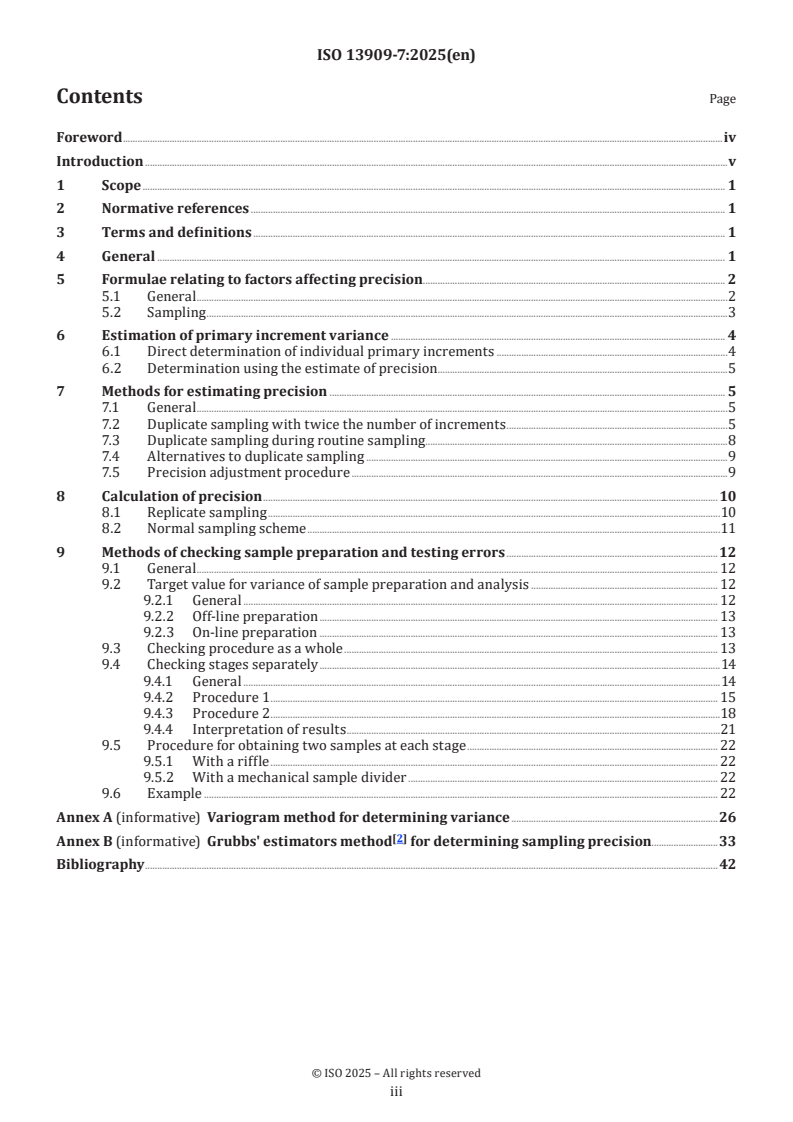
Contents Page
Foreword .iv
Introduction .v
1 Scope . 1
2 Normative references . 1
3 Terms and definitions . 1
4 General . 1
5 Formulae relating to factors affecting precision. 2
5.1 General .2
5.2 Sampling .3
6 Estimation of primary increment variance . 4
6.1 Direct determination of individual primary increments .4
6.2 Determination using the estimate of precision .5
7 Methods for estimating precision . 5
7.1 General .5
7.2 Duplicate sampling with twice the number of increments .5
7.3 Duplicate sampling during routine sampling.8
7.4 Alternatives to duplicate sampling .9
7.5 Precision adjustment procedure .9
8 Calculation of precision . 10
8.1 Replicate sampling .10
8.2 Normal sampling scheme .11
9 Methods of checking sample preparation and testing errors .12
9.1 General . 12
9.2 Target value for variance of sample preparation and analysis . 12
9.2.1 General . 12
9.2.2 Off-line preparation . 13
9.2.3 On-line preparation . 13
9.3 Checking procedure as a whole . 13
9.4 Checking stages separately .14
9.4.1 General .14
9.4.2 Procedure 1 . 15
9.4.3 Procedure 2 .18
9.4.4 Interpretation of results .21
9.5 Procedure for obtaining two samples at each stage . 22
9.5.1 With a riffle . 22
9.5.2 With a mechanical sample divider . 22
9.6 Example . 22
Annex A (informative) Variogram method for determining variance .26
[2]
Annex B (informative) Grubbs' estimators method for determining sampling precision.33
Bibliography .42
iii
Foreword
ISO (the International Organization for Standardization) is a worldwide federation of national standards
bodies (ISO member bodies). The work of preparing International Standards is normally carried out through
ISO technical committees. Each member body interested in a subject for which a technical committee
has been established has the right to be represented on that committee. International organizations,
governmental and non-governmental, in liaison with ISO, also take part in the work. ISO collaborates closely
with the International Electrotechnical Commission (IEC) on all matters of electrotechnical standardization.
The procedures used to develop this document and those intended for its further maintenance are described
in the ISO/IEC Directives, Part 1. In particular, the different approval criteria needed for the different types
of ISO document should be noted. This document was drafted in accordance with the editorial rules of the
ISO/IEC Directives, Part 2 (see www.iso.org/directives).
ISO draws attention to the possibility that the implementation of this document may involve the use of (a)
patent(s). ISO takes no position concerning the evidence, validity or applicability of any claimed patent
rights in respect thereof. As of the date of publication of this document, ISO had not received notice of (a)
patent(s) which may be required to implement this document. However, implementers are cautioned that
this may not represent the latest information, which may be obtained from the patent database available at
www.iso.org/patents. ISO shall not be held responsible for identifying any or all such patent rights.
Any trade name used in this document is information given for the convenience of users and does not
constitute an endorsement.
For an explanation of the voluntary nature of standards, the meaning of ISO specific terms and expressions
related to conformity assessment, as well as information about ISO's adherence to the World Trade
Organization (WTO) principles in the Technical Barriers to Trade (TBT), see www.iso.org/iso/foreword.html.
This document was prepared by Technical Committee ISO/TC 27, Coal and coke, Subcommittee SC 4, Sampling.
This third edition cancels and replaces the second edition (ISO 13909-7:2016), which has been technically
revised.
The main changes are as follows:
— references have been updated;
— the results discussed in Clause B.4 have been clarified.
A list of all parts in the ISO 13909 series can be found on the ISO website.
Any feedback or questions on this document should be directed to the user’s national standards body. A
complete listing of these bodies can be found at www.iso.org/members.html.
iv
Introduction
Two different situations are considered when a measure of precision is required. In the first, an estimate is
made of the precision that can be expected from an existing sampling scheme and, if this is different from that
desired, adjustments are made to correct it. In the second, the precision that is achieved on a particular lot
is estimated from the experimental results actually obtained using a specifically designed sampling scheme.
The formulae developed in this document are based on the assumption that the quality of the fuel varies
in a random manner throughout the mass being sampled and that the observations will follow a normal
distribution. Neither of these assumptions are strictly correct. Although the assumption that observations
will follow a normal distribution is not strictly correct for some fuel parameters, this deviation from assumed
conditions will not materially affect the validity of the formulae developed for precision checking since the
statistics used are not very sensitive to non-normality. Strictly speaking, however, confidence limits will
not always be symmetrically distributed about the mean. For most practical uses of precision, however, the
errors are not significant.
In this document, the term “fuel” is used where the method is applicable to both coal and coke and either
“coal” or “coke” where the method is exclusively applicable to that commodity.
v
International Standard ISO 13909-7:2025(en)
Coal and coke — Mechanical sampling —
Part 7:
Methods for determining the precision of sampling, sample
preparation and testing
1 Scope
This document defines methods for estimating overall precision and for deriving values for primary
increment variance which can be used to modify the sampling scheme to change the precision. Methods for
checking the variance of sample preparation and testing are also described.
In this document, formulae are developed which link the variables that contribute to overall sampling
precision.
2 Normative references
The following documents are referred to in the text in such a way that some or all of their content constitutes
requirements of this document. For dated references, only the edition cited applies. For undated references,
the latest edition of the referenced document (including any amendments) applies.
ISO 13909-1, Coal and coke — Mechanical sampling — Part 1: General introduction
ISO 13909-2:2025, Coal and coke — Mechanical sampling — Part 2: Sampling of coal from moving streams
ISO 13909-3, Coal and coke — Mechanical sampling — Part 3: Sampling of coal from stationary lots
ISO 13909-4, Coal and coke — Mechanical sampling — Part 4: Preparation of test samples of coal
ISO 13909-5, Coal and coke — Mechanical sampling — Part 5: Sampling of coke from moving streams
ISO 13909-6, Coal and coke — Mechanical sampling — Part 6: Preparation of test samples of coke
ISO 13909-8, Coal and coke — Mechanical sampling — Part 8: Methods of testing for bias
3 Terms and definitions
For the purposes of this document, the terms and definitions given in ISO 13909-1 apply.
ISO and IEC maintain terminology databases for use in standardization at the following addresses:
— ISO Online browsing platform: available at https:// www .iso .org/ obp
— IEC Electropedia: available at https:// www .electropedia .org/
4 General
When designing a sampling scheme in order to meet a required precision of results, formulae that link
certain fuel and sampling characteristics to that precision are necessary. The main factors to be considered
are the variability of primary increments, preparation and testing errors, the number of increments and
samples taken to represent the lot, and the mass of the samples. These formulae are derived in Clause 5.
Methods for estimating the parameters used in those formulae are given in Clause 6.
Once a sampling system has been designed and installed, the precision which is being achieved on a routine
basis should be checked. An estimate of the precision can be obtained from the primary increment variance,
V , the numbers of increments, n, and sub-lots, m, (see Clause 5) and the preparation and testing variance, V .
I PT
The preparation component of V is made up of on-line sample processing and off-line sample preparation.
PT
Sampling variance is a function of product variability, so the same number of increments, sub-lots, and
preparation and testing errors yield different precision with fuels that exhibit different product variability.
Depending on the extent to which serial correlation exists and which method of estimating primary
increment variance is used, such an estimate can represent a considerable overestimate of the numerical
value of the precision (i.e. indicate that it is worse than is really the case). In addition, in order for the results
to be meaningful, large numbers of increments (in duplicate) need to be prepared and analysed for the
estimation of V and V .
I PT
Quality variations obtained in the form of primary increment variances on existing systems are not absolute
and, therefore, designers should exercise caution when using such results in a different situation. The
estimated value of the primary increment variance, V , should be derived experimentally for each fuel and at
I
each sampling location.
Whenever a sampling scheme is used for determining increment variance, the operating conditions should
be as similar as possible to the conditions known, or anticipated, to prevail during the sampling for which
the increment variance is needed, whether it be carried out by the same or by a different sampling system.
An estimate of the precision actually achieved can be obtained by taking the sample in a number of parts and
comparing the results obtained from these parts. There are several methods of doing this, depending on:
a) the purpose of the test; and
b) the practical limitations imposed by the available sampling procedures and equipment.
Where a sampling system is in existence, the purpose of the test is to check that the scheme is in fact
achieving the desired precision (see Clause 7). If it is not, it may need to be modified and rechecked until it
meets the precision required. In order to do this, a special check scheme should be devised which may be
different from the regular scheme but which measures the precision of the regular scheme.
For regular sampling schemes, the most rigorous approach is that of duplicate sampling of sub-lots. In many
existing mechanical sampling systems, however, the capacity of individual components and the interval
between increments in the regular scheme is insufficient to allow the taking of extra increments. In such
cases, duplicate samples can be constituted from the normal number of increments and the result adjusted
for the smaller number of increments in each sample (see 7.3).
The need to sample a particular lot and to know the precision of the result obtained (see Clause 8) can arise.
Once again, a special check scheme needs to be devised, but in this case, it is the precision achieved by that
scheme on that lot which is required. For the measurement of the precision achieved for a particular lot,
replicate sampling is the best method.
Methods for detailed checking of preparation and testing errors are given in Clause 9. The results may also
be used to provide data for the formulae used in Clause 5.
5 Formulae relating to factors affecting precision
5.1 General
Precision is a measure of the closeness of agreement between the results obtained by repeating a
measurement procedure several times under specified conditions and is a characteristic of the method used.
The smaller the random errors of a method, the more precise the method is. A commonly accepted index of
precision is two times the sample estimate of the population standard deviation and this index of precision
is used throughout this document.
If a large number of replicate samples, j, are taken from a sub-lot of fuel and are prepared and analysed
separately, the estimated precision, P, of a single observation is given by Formula (1):
Ps==22 V (1)
SPT
where
2 is a conversion factor from sample estimate of the population standard deviation to an index of
precision;
s is the sample estimate of the population standard deviation;
V is the total variance.
SPT
The total variance, V , in Formula (1) is a function of the primary increment variance, the number of
SPT
increments, and the errors associated with sample preparation and testing.
NOTE The components of primary increment variance are the variance of sample extraction and the variance
contributed by product variability. The variance contributed by product variability is generally, but not always, the
largest source of variance in sampling.
For a single sample, this relationship is expressed by Formula (2):
V
I
V =+V (2)
SPT PT
n
where
V is the primary increment variance;
l
V is the preparation and testing variance;
PT
n is the number of primary increments in the sample.
5.2 Sampling
Where the test result is the arithmetic mean of a number of samples, resulting from dividing the lot into a
series of sub-lots and taking a sample from each, Formula (2) becomes:
V V
IPT
V =+ (3)
SPT
mn m
where m is the number of sample results used to obtain the mean.
Since a sample is equivalent to one member of a set of replicate samples, by combining Formulae (1) and (3),
it can be shown that:
V V
IPT
P=+2 (4)
mn m
Formula (4) gives an estimate of the precision that can be expected to be achieved when a given sampling
scheme is used for testing a given fuel, the variability of which is known or can somehow be estimated. In
addition, Formula (4) enables the designer of the sampling scheme to determine, for the desired precision
and with fuel of known or estimated variability, the combination of numbers of increments and samples,
respectively, which will be most favourable considering the relative merits of the sampling equipment and
the laboratory facilities in question. For the latter purpose, however, it is more convenient to use either or
both Formulae (5) and (6), both of which have been derived by rearranging Formula (4).
V
I
n= (5)
mP −4V
PT
4()Vn+ V
IPT
m= (6)
nP
NOTE Results obtained from solid mineral fuels flowing in a stream frequently display serial correlation,
i.e. immediately adjoining fuel tends to be of similar composition, while fuel further apart tends to be of dissimilar
composition. When this is so, the estimates of precision of the result of a single sample based on primary increment
variance and the variance of preparation and testing indicate precision that is worse, i.e. numerically higher, than the
precision actually achieved. The effect of serial correlation can be taken into account using the variographic method of
determining variance given in Annex A.
6 Estimation of primary increment variance
6.1 Direct determination of individual primary increments
The direct estimation of primary increment variance can be accomplished with a duplicate sampling
scheme comprised of several hierarchical levels which allows both the overall variance and the variance of
preparation and testing to be estimated. The estimated variance of primary increments can then be obtained
by subtraction of the variance of preparation and testing from the estimated overall variance. A number of
primary increments is taken systematically and either divided into two parts or prepared so that duplicate
samples are taken at the first division stage. Each part is prepared and tested for the quality characteristic
of interest, using the same methods that are expected to be used in routine operations. The mean of the two
results and the difference between the two results are calculated for each pair.
See Formulae (7), (8) and (9).
It is recommended that at least 30 increments be taken, spread if possible, over an entire lot or even over
several lots of the same type of fuel.
The procedure is as follows.
a) Calculate the preparation and testing variance, V .
PT
d
∑
V = (7)
PT
2n
p
where
d is the difference between pair members;
n is the number of pairs.
p
b) Calculate the primary increment variance, V .
l
x − x
()
∑ ∑
n
V
p
PT
V = − (8)
I
n −1
()
p
where X is the mean of the two measurements for each increment.
An alternative method for estimating primary increment variance, V is as follows:
l,
D
V
∑
PT
V =− (9)
I
22h
where
D is the difference between the means of successive pairs;
H is the number of successive pairs.
This method avoids the overestimation of sampling variance when there is serial correlation (see Note in
5.2) but can only be used if the primary-increment sampling interval at which the increments are taken is
more than or approximately equal to the primary-increment sampling interval used when the scheme is
implemented in routine sampling operations.
The most rigorous treatment of serial correlation is to use the variographic method given in Annex A. This
takes into account both serial correlation and sampling interval effects, thereby avoiding overestimation of
sampling variance and number of primary increments due to these factors.
6.2 Determination using the estimate of precision
The primary increment variance can be calculated from the estimate of precision obtained either using the
method of duplicate sampling given in 7.2 or replicate sampling given in Clause 8 according to Formula (10)
which is derived by rearranging the terms of Formula (4).
mnP
V =−nV (10)
IPT
This value can then be used to adjust the sampling scheme if necessary.
7 Methods for estimating precision
7.1 General
For all the methods given in this clause, the following symbols and definitions apply:
— n is the number of increments in a sub-lot for the regular scheme;
— m is the number of sub-lots in a lot for the regular scheme;
— P is the desired precision for the regular scheme;
— P is the worst (highest absolute value) precision to be permitted.
W
In all cases, the same methods of sample preparation shall be used as for the regular scheme.
7.2 Duplicate sampling with twice the number of increments
Twice the normal number of increments (2n ) are taken from each sub-lot and combined as duplicate
samples (see Figure 1), each containing n increments. This process is repeated, if necessary, over several
lots of the same fuel, until at least 10 pairs of duplicate samples have been taken.
A parameter of the fuel is chosen to be analysed, e.g. ash (dry basis) for coal, or Micum 40 index for coke. The
standard deviation within duplicate samples for the test parameter is then calculated using Formula (11):
d
∑
s= (11)
2n
p
where
d is the difference between duplicates;
n is the number of pairs of duplicates being examined.
p
An example of results for coal ash is given in Table 1.
Table 1 — Results of duplicate sampling, % ash, dry basis
Duplicate values
Difference between duplicates
(%)
Sample pair no.
|A − B| = d
A B d
(%)
1 11,1 10,5 0,6 0,36
2 12,4 11,9 0,5 0,25
3 12,2 12,5 0,3 0,09
4 10,6 10,3 0,3 0,09
5 11,6 12,5 0,9 0,81
6 11,8 12,0 0,2 0,04
7 11,8 12,2 0,4 0,16
8 10,8 10,0 0,8 0,64
9 7,9 8,2 0,3 0,09
10 10,8 10,3 0,5 0,25
Total 2,78
The number of pairs, n is 10. The variance of the ash is therefore
p
d
∑
s =
2n
p
27, 8
==0,139
and the standard deviation is:
s==0,,13900 373%
Key
increment from regular scheme
extra increment for precision check scheme
Figure 1 — Example of a plan of duplicate sampling
The precision of the result for a single sub-lot is therefore:
Ps= 2
= 20(),,373 = 075 % ash
The precision achieved for the mean ash of a normal lot sampled as m sub-lots is given by 2sm . For
example, if m = 10, then:
20,373
()
P = = 0, 2359 %
These values of P have been calculated using point estimates for the standard deviation and represent the
best estimate for precision.
If an interval estimate for the standard deviation is used, then on a 95 % confidence level, the precision
is within an interval with upper and lower limits. These limits are calculated from the point estimate of
precision and factors which depend on the degrees of freedom ( f ) used in calculating the standard deviation
(see Table 2).
Table 2 — Factors used for calculation of precision intervals
ƒ(number of observations) 5 6 7 8 9 10 15 20 25 50
Lower limit 0,62 0,64 0,66 0,68 0,69 0,70 0,74 0,77 0,78 0,84
Upper limit 2,45 2,20 2,04 1,92 1,83 1,75 1,55 1,44 1,38 1,24
NOTE The factors in Table 2 are derived from the estimate of s obtained from the squared differences of n pairs
of observations. Since there is no constraint in this case, the estimate as well as d will have n degrees of freedom. The
values in Table 2 are derived from the relationship:
2 2
ns ns
<
2 2
χχ
nn,,0 025 ,,0 0975
The body of Table 2 gives the values for n/χ , which are multiplied by s to obtain the confidence limits.
For example, for the lot with 10 sub-lots used in the example above:
Upper limit = 1,75 (0,235 9) = 0,41 %
Lower limit = 0,70 (0,235 9) = 0,17 %
where the factors are obtained from Table 2 using ƒ = n , i.e. 10. The true precision lies between 0,17 % and
P
0,41 % ash at the 95 % confidence level.
7.3 Duplicate sampling during routine sampling
If operational conditions do not allow the taking of 2n increments from each normal sub-lot or precision is
to be determined during normal sampling, then, provided that all increments can be kept separate, adopt
the following procedure for estimating precision.
Take the normal number of increments, n , from each sub-lot and combine them as duplicate samples each
comprising n /2 increments (see Figure 2). Repeat this process, if necessary, over several lots of the same
fuel until at least 10 pairs of duplicate samples have been obtained. In this case, the precision obtained using
the procedure in 7.2 will be for n /2 increments. This estimate of precision is divided by the square root of 2
to obtain the estimate of precision for sub-lot samples comprising n increments.
Figure 2 — Example of a plan of duplicate sampling where no additional increments are taken
7.4 Alternatives to duplicate sampling
At some locations, operational conditions of a sampling system do not allow duplicate samples to be collected
with the assurance that no cross-contamination of sample material from adjacent primary increments
occurs. In such cases, other methods have been found useful. An example of such a method, using Grubbs'
estimators, is given for information in Annex B.
This method involves collecting three samples from each of a minimum of 30 sub-lots of fuel. One sample is
collected using the normal sampling scheme and two mutually independent systematic samples are collected
by stopping a main fuel handling belt for collection of stopped-belt increments at preselected intervals.
7.5 Precision adjustment procedure
If the desired level of precision, P , for the lot lies within the confidence limits, then there is no evidence that
this precision is not being achieved. However, if the confidence interval is wide enough to include both P
and P , the test is inconclusive and further data shall be obtained. The results shall be combined with the
W
original data and the calculation done on the total number of duplicate samples.
NOTE 1 The expected effect is reduction of the width of the confidence limits since the value of f in Table 2 will be
greater.
This process can be continued until either P is above the upper confidence limit or the value of P falls
W 0
outside the confidence limits. In the latter case, adjustment may be necessary.
NOTE 2 If the precision obtained differs from the desired precision, a cost/benefit analysis can indicate whether it
is worthwhile to proceed with any modifications to the sampling system and sampling programme because the costs
incurred in making the changes and retesting can be not worthwhile.
Before making changes to the sampling scheme, the errors of preparation and testing shall be examined
using the procedures given in Clause 9. It should then be possible to decide whether to make the changes to
the sampling or the sample preparation using the formulae in 5.2.
If it is decided to design a new sampling scheme, the first step is the calculation of the primary increment
variance. This can be done using Formula (12) which is derived by rearranging Formula (4) and substituting
n for n.
mn P
V =−nV (12)
IP0 T
where
P is the measured precision obtained from the test and is not P , %;
V is either the original value or one estimated using the methods in Clause 9.
PT
Using the new value for the primary increment variance, design a new scheme following the procedures
specified in ISO 13909-2, ISO 13909-3 or ISO 13909-5, as relevant, depending on whether the sampling is of
coal or coke and from moving or stationary fuels.
When the new scheme is in operation, carry out a new precision check, discarding the previous results and
continue in this fashion until the precision is satisfactory.
Thereafter, it is not necessary to check the precision for every lot, but periodic checks should be carried out.
For example, one sub-lot in five may be examined or, alternatively, 10 consecutive sub-lots if using method
7.2, or the equivalent if using method 7.3.
When 10 pairs of results have been accumulated, they shall be examined as described in 7.2, ignoring any
intervening samples not taken in duplicate.
8 Calculation of precision
8.1 Replicate sampling
Establish the parameter to be analysed, e.g. ash (dry basis), and establish the sampling scheme for the
required precision in accordance with ISO 13909-2, ISO 13909-3 or ISO 13909-5 as appropriate, depending
on whether the sampling is of coal or coke and from moving streams or stationary lots.
Instead of forming a sample from each sub-lot, combine the total number of increments, n⋅m, as replicate
samples. The number of replicate samples, j, shall be not less than the number of sub-lots, m, used in the
calculation (see the relevant part of the ISO 13909 series), and not less than 10.
If there are 10 such samples and the sample containers are labelled A, B, C, D, . J, then successive increments
will go into the containers as follows: A, B, C, D, E, F, G, H, I, J, A, B, C, D, . .
A typical calculation for coal is given below using the results in Table 3.
The number of replicate samples, j, is 10.
The mean result is 165/10 = 16,5 % ash
Table 3 — Results of single lot sampling, % ash, dry basis
Sample value (Sample value)
Sample no.
%
A 15,3 234,09
B 17,1 292,41
C 16,5 272,25
D 17,2 295,84
E 15,8 249,64
F 16,4 268,96
G 15,7 246,49
H 16,3 265,69
I 18,0 324,00
J 16,7 278,89
Totals 165,0 2 728,26
The sample estimate of the population standard deviation, s, is given by Formula (13):
x
()
i
∑
x −
∑ i
n
s = (13)
n−1
()
2728,26−
= =0,%800
The best estimate for the precision, P, achieved for the lot is given by Formula (14):
2s
P= (14)
j
i.e.
20,800
()
P = = 0, 506 % ash
Hence, using Table 2, the true precision lies between 0,35 % and 0,89 % at the 95 % confidence level. It
should be noted, however, that the procedure given in this subclause tends to overstate the variance to the
extent that it includes variance components of sample preparation and analysis.
8.2 Normal sampling scheme
If it is desired to design a regular sampling scheme based on the results of the procedure specified in 8.1, the
estimate of precision obtained, the number of increments per sample and the number of replicate samples
can be substituted into Formula (12) and the value for increment variance estimated. The procedures
specified in ISO 13909-2, ISO 13909-3 or ISO 13909-5, as appropriate, can then be followed to design the
regular sampling scheme.
9 Methods of checking sample preparation and testing errors
9.1 General
The methods described in this clause, for checking the precision of sample preparation and testing, are
designed to estimate the variance of random errors arising in the various stages of the process. The errors
are expressed in terms of variance. Separate tests, in accordance with ISO 13909-8, shall be performed
to ensure that bias is not introduced either by contamination or by losses during the sample preparation
process.
As described in ISO 13909-4, sample preparation for general analysis of coal is normally carried out in at
least two stages, each stage consisting of a reduction in particle size, possible mixing, and division of the
sample into two parts, one of which is retained and one rejected. All the errors occur in the course of the
division, in the selection of the final 1 g of 212 µm size and in the analysis. The most important factors are
the size distribution of the samples before division and the masses retained after division.
The preparation of coke samples is generally carried out with fewer stages but the same basic principle of
checking for errors applies.
For convenience, the remainder of this clause refers to coal ash only. If the variance is satisfactory for ash,
it will normally be so for the other characteristics of the proximate and ultimate analyses, except possibly
for errors in moisture and calorific value, which should be checked. If desired, all characteristics may be
checked.
Methods are described for checking the overall errors of preparation and testing and also the errors incurred
at individual stages.
The methods were originally developed for manual and non-integrated mechanical preparation. If some
sample preparation is carried out within an integrated primary sampling/sample preparation system, it
may not be practicable to determine the errors for the individual components, except by artificial means
such as re-feeding reject streams through the system, which would be totally unrepresentative of normal
operations. The variances of the integrated preparation stages may therefore have to be compounded with
the primary increment variance and measured as such.
9.2 Target value for variance of sample preparation and analysis
9.2.1 General
The overall preparation and testing variance, V , estimated by the procedure described in 9.3, is evaluated
PT
in relation to a previously determined target, V . This target is normally laid down by the body responsible
PT
for sample preparation.
The individual division errors are estimated directly. These may be evaluated either in relation to a target
or as a proportion of the overall variance.
NOTE As a rough guide, a division-stage variance is generally twice the analytical variance so that, for example,
for a three-stage preparation and testing process, the overall value of V is divided in the ratio 2:2:1 to obtain the
PT
two-division stage variance targets and the analytical variance.
The final-stage analysis variance target can be determined from the relevant analytical standard from
Formula (15):
r
V = (15)
T
where
V is the final sample extraction and analytical variance target;
T
r is the repeatability limit of the analytical method.
The division errors for moisture content can be unavoidably greater than those for ash content because
of the need to avoid excessive handling which could in turn result in bias. Such errors may, however, be
acceptable if the overall precision can be achieved because of the lower primary increment variances
normally encountered for moisture content.
9.2.2 Off-line preparation
The methods of sample preparation recommended for coal in ISO 13909-4, using the masses specified,
should achieve, for coal ash, a sample preparation and testing variance of 0,2 or less. For many coals, much
lower variances are achievable, particularly, if mechanical dividers are used that take a great many more
than the minimum number of cuts. Similar considerations will apply to the methods of preparation for coke
in ISO 13909-6. If possible, therefore, a more stringent overall target should be set in the light of experience
with similar coals prepared on similar equipment.
Smaller preparation errors will reduce the number of samples required to be taken and tested.
The worst-case individual division-stage variance (for coal 0,08) should be treated as a maximum which
may be improved by using mechanical division.
9.2.3 On-line preparation
Where some elements of sample preparation are carried out in a system integral with the primary sampler,
the errors involved may be compounded with the primary increment variance, V . In such cases, it should
l
be expected that the residue of V will be less than it would have been had all the sample preparation been
PT
done off-line.
It is recommended that realistic overall targets be obtained from relevant experience. As a worst-case target,
however, use the worst-case individual division-stage variance for each division stage plus the appropriate
analytical variance (see 9.2.1).
9.3 Checking procedure as a whole
The first step is to check that the overall variance of preparation and testing does not exceed the target set,
V (see 9.2). The method provides a test of whether the difference between the estimated value and the
PT
target value is statistically significant.
This is done by taking duplicate samples at the first division of the sample; these are thereafter treated
entirely separately to give the two test samples (see Figure 3). The two samples provide an unbiased estimate
of the variance of sample preparation and analysis. Ten pairs of test samples are obtained in this way.
If the mean observed absolute difference between the 10 pairs of results is y, then 0,886 2 y should lie
0 0
between 07, V and 17, 5 V (see Table 2).
PT PT
NOTE The factor 0,886 2 is derived from the relationship for converting the mean differences between pairs to
the standard deviation.
Provided that the standard deviations of two successive sets of 10 duplicate samples fall between these
upper and lower limits, it can be assumed that the procedure is satisfactory.
If the standard deviation is below 07, V , the variance is low but no adjustment is necessary since it is
PT
always desirable to have the variance as low as possible.
If the standard deviation is greater than 17, 5 V , the variance is too high and the masses retained at
PT
various stages of the sample-preparation process are probably insufficient. Therefore, the variance of the
errors arising at each stage should be estimated as described in 9.4 so that steps may be taken to improve
the procedures shown to be necessary.
Key
reduce to particle size specified (L is the nominal top size after first-stage reduction)
divide to mass specified (Y is the value give in Table 3)
Figure 3 — Overall test of sample preparation
9.4 Checking stages separately
9.4.1 General
The following two procedures are commonly used.
a) Procedure 1 (see 9.4.2), where analysis is inexpensive relative to the cost of sampling.
b) Procedure 2 (see 9.4.3), which is slightly less accurate but involves fewer analyses.
Using the principles of 9.4.2.2 or 9.4.3.2 as appropriate, schemes with more than two division stages can
normally be examined.
For example, the e
...
Questions, Comments and Discussion
Ask us and Technical Secretary will try to provide an answer. You can facilitate discussion about the standard in here.
Loading comments...