

ISO 13909-2:2025
(Main)Coal and coke — Mechanical sampling — Part 2: Sampling of coal from moving streams
General Information
- Abstract
This document specifies procedures and requirements for the design and establishment of mechanical samplers for the sampling of coal from moving streams and describes the methods of sampling used. It does not cover mechanical sampling from stationary lots, which is dealt with in ISO 13909-3.
- Status
- Published
- Publication Date
- 21-Jul-2025
- Technical Committee
- ISO/TC 27/SC 4 - Sampling
- Drafting Committee
- ISO/TC 27/SC 4 - Sampling
- Current Stage
- 6060 - International Standard published
- Start Date
- 22-Jul-2025
- Due Date
- 25-May-2026
- Completion Date
- 22-Jul-2025


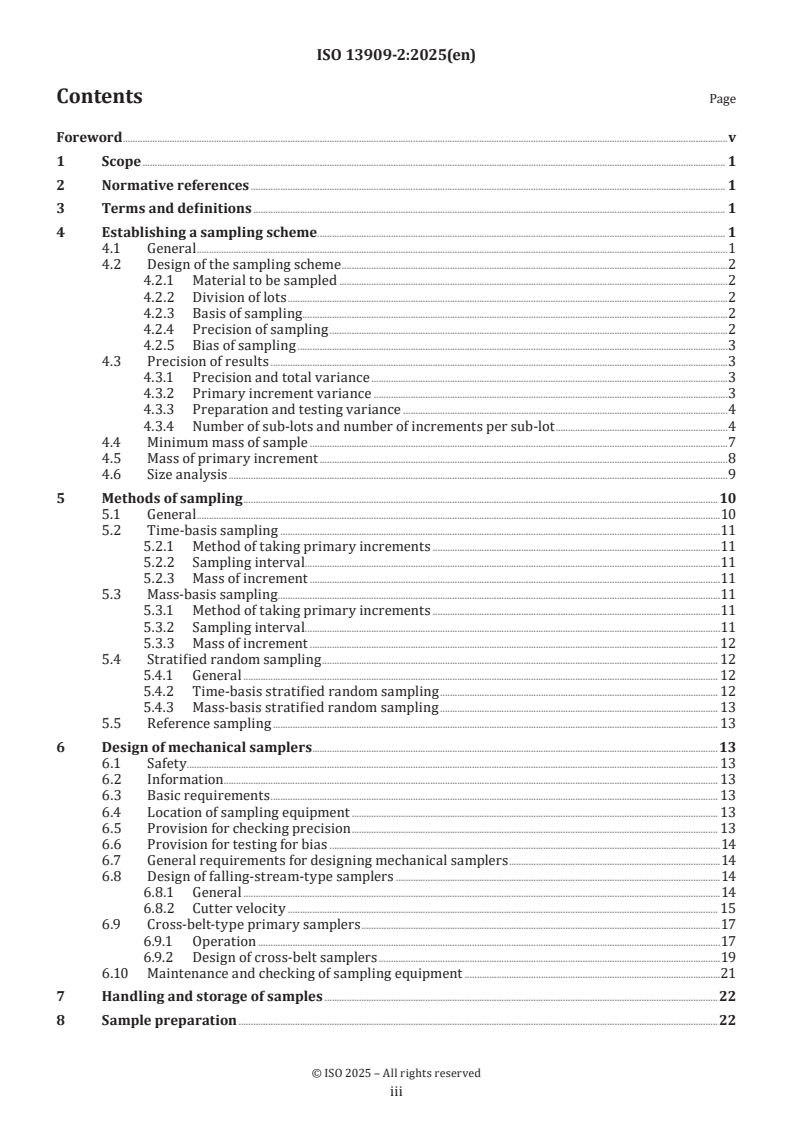

Overview
ISO 13909-2:2025 - "Coal and coke - Mechanical sampling - Part 2: Sampling of coal from moving streams" provides standardized procedures and requirements for the design, establishment and operation of mechanical samplers used to collect representative samples of coal conveyed in continuous (moving) streams. This third edition updates the scope to focus on coal, revises calculations for sub-lots and increments, and aligns terminology with the ISO 13909 series. It does not cover sampling from stationary lots (see ISO 13909-3).
Key topics and technical requirements
The standard organizes requirements that ensure representative, reproducible sampling and covers:
Establishing a sampling scheme
- Defining quality parameters, lots and sub-lots
- Choosing time-basis or mass-basis sampling
- Determining sampling intervals and increment masses
- Assessing variability, precision and bias
Precision and variance
- Guidance on required precision, total variance, primary increment variance, and preparation/testing variance
- Procedures for calculating number of sub-lots and increments to meet precision targets
Methods of sampling
- Time-basis sampling and mass-basis sampling
- Stratified random sampling (time- and mass-basis variants)
- Reference sampling techniques
Design of mechanical samplers
- General design principles, safety, location and information requirements
- Specific sampler types: falling-stream and cross-belt samplers (operation and design considerations)
- Cutter velocity, increment mass, maintenance and provisions for checking precision and bias
Sample handling, storage and preparation
- Requirements for sample storage, preparation of test samples (see ISO 13909-4), and minimizing bias
Verification and testing
- Procedures for checking precision and bias; Annex A addresses evaluation of equipment for mass-basis sampling
Practical applications
ISO 13909-2:2025 is practical for:
- Designing and commissioning mechanical sampling systems for conveyors, chutes or other continuous coal streams
- Developing sampling plans to meet contract or regulatory quality requirements
- Supporting quality control, process monitoring and commercial trade (e.g., calorific value, moisture, ash)
- Establishing maintenance, verification and bias-checking routines to ensure representative sampling over time
Who should use this standard
- Coal producers and mine operators
- Sampling system designers and equipment manufacturers
- Quality assurance and laboratory managers
- Inspectors, auditors and trading partners involved in coal contracts
- Regulatory bodies and consultants overseeing sampling compliance
Related standards
- ISO 13909-1 (General introduction)
- ISO 13909-3 (Stationary lots)
- ISO 13909-4 (Preparation of test samples)
- ISO 13909-7 (Methods for determining precision)
- ISO 13909-8 (Methods for testing bias)
- ISO 21398 (Guidance to inspection of mechanical sampling systems)
For implementation, obtain the full ISO 13909-2:2025 text from ISO or your national standards body to ensure compliance with all technical details.
Relations
- Effective Date
- 27-May-2023
Get Certified
Connect with accredited certification bodies for this standard

Element Materials Technology
Materials testing and product certification.

ABS Group Brazil
ABS Group certification services in Brazil.

ABS Quality Evaluations Inc.
American Bureau of Shipping quality certification.
Sponsored listings
Frequently Asked Questions
ISO 13909-2:2025 is a standard published by the International Organization for Standardization (ISO). Its full title is "Coal and coke — Mechanical sampling — Part 2: Sampling of coal from moving streams". This standard covers: This document specifies procedures and requirements for the design and establishment of mechanical samplers for the sampling of coal from moving streams and describes the methods of sampling used. It does not cover mechanical sampling from stationary lots, which is dealt with in ISO 13909-3.
This document specifies procedures and requirements for the design and establishment of mechanical samplers for the sampling of coal from moving streams and describes the methods of sampling used. It does not cover mechanical sampling from stationary lots, which is dealt with in ISO 13909-3.
ISO 13909-2:2025 is classified under the following ICS (International Classification for Standards) categories: 73.040 - Coals; 75.160.10 - Solid fuels. The ICS classification helps identify the subject area and facilitates finding related standards.
ISO 13909-2:2025 has the following relationships with other standards: It is inter standard links to ISO 13909-2:2016. Understanding these relationships helps ensure you are using the most current and applicable version of the standard.
ISO 13909-2:2025 is available in PDF format for immediate download after purchase. The document can be added to your cart and obtained through the secure checkout process. Digital delivery ensures instant access to the complete standard document.
Standards Content (Sample)
International
Standard
ISO 13909-2
Third edition
Coal and coke — Mechanical
2025-07
sampling —
Part 2:
Sampling of coal from moving streams
Charbon et coke — Échantillonnage mécanique —
Partie 2: Échantillonnage du charbon en continu
Reference number
© ISO 2025
All rights reserved. Unless otherwise specified, or required in the context of its implementation, no part of this publication may
be reproduced or utilized otherwise in any form or by any means, electronic or mechanical, including photocopying, or posting on
the internet or an intranet, without prior written permission. Permission can be requested from either ISO at the address below
or ISO’s member body in the country of the requester.
ISO copyright office
CP 401 • Ch. de Blandonnet 8
CH-1214 Vernier, Geneva
Phone: +41 22 749 01 11
Email: copyright@iso.org
Website: www.iso.org
Published in Switzerland
ii
Contents Page
Foreword .v
1 Scope . 1
2 Normative references . 1
3 Terms and definitions . 1
4 Establishing a sampling scheme. 1
4.1 General .1
4.2 Design of the sampling scheme .2
4.2.1 Material to be sampled .2
4.2.2 Division of lots .2
4.2.3 Basis of sampling . .2
4.2.4 Precision of sampling .2
4.2.5 Bias of sampling .3
4.3 Precision of results .3
4.3.1 Precision and total variance .3
4.3.2 Primary increment variance .3
4.3.3 Preparation and testing variance .4
4.3.4 Number of sub-lots and number of increments per sub-lot .4
4.4 Minimum mass of sample .7
4.5 Mass of primary increment .8
4.6 Size analysis .9
5 Methods of sampling .10
5.1 General .10
5.2 Time-basis sampling .11
5.2.1 Method of taking primary increments .11
5.2.2 Sampling interval.11
5.2.3 Mass of increment .11
5.3 Mass-basis sampling .11
5.3.1 Method of taking primary increments .11
5.3.2 Sampling interval.11
5.3.3 Mass of increment . 12
5.4 Stratified random sampling . 12
5.4.1 General . 12
5.4.2 Time-basis stratified random sampling . 12
5.4.3 Mass-basis stratified random sampling . 13
5.5 Reference sampling . 13
6 Design of mechanical samplers .13
6.1 Safety. 13
6.2 Information . . 13
6.3 Basic requirements . 13
6.4 Location of sampling equipment . 13
6.5 Provision for checking precision . 13
6.6 Provision for testing for bias .14
6.7 General requirements for designing mechanical samplers .14
6.8 Design of falling-stream-type samplers .14
6.8.1 General .14
6.8.2 Cutter velocity . 15
6.9 Cross-belt-type primary samplers .17
6.9.1 Operation .17
6.9.2 Design of cross-belt samplers .19
6.10 Maintenance and checking of sampling equipment .21
7 Handling and storage of samples .22
8 Sample preparation .22
iii
9 Bias .23
9.1 Minimization of bias . 23
9.2 Checking for precision and bias .24
10 Verification .24
Annex A (normative) Evaluation of sampling equipment for mass-basis sampling .25
Bibliography .30
iv
Foreword
ISO (the International Organization for Standardization) is a worldwide federation of national standards
bodies (ISO member bodies). The work of preparing International Standards is normally carried out through
ISO technical committees. Each member body interested in a subject for which a technical committee
has been established has the right to be represented on that committee. International organizations,
governmental and non-governmental, in liaison with ISO, also take part in the work. ISO collaborates closely
with the International Electrotechnical Commission (IEC) on all matters of electrotechnical standardization.
The procedures used to develop this document and those intended for its further maintenance are described
in the ISO/IEC Directives, Part 1. In particular, the different approval criteria needed for the different types
of ISO document should be noted. This document was drafted in accordance with the editorial rules of the
ISO/IEC Directives, Part 2 (see www.iso.org/directives).
ISO draws attention to the possibility that the implementation of this document may involve the use of (a)
patent(s). ISO takes no position concerning the evidence, validity or applicability of any claimed patent
rights in respect thereof. As of the date of publication of this document, ISO had not received notice of (a)
patent(s) which may be required to implement this document. However, implementers are cautioned that
this may not represent the latest information, which may be obtained from the patent database available at
www.iso.org/patents. ISO shall not be held responsible for identifying any or all such patent rights.
Any trade name used in this document is information given for the convenience of users and does not
constitute an endorsement.
For an explanation of the voluntary nature of standards, the meaning of ISO specific terms and expressions
related to conformity assessment, as well as information about ISO's adherence to the World Trade
Organization (WTO) principles in the Technical Barriers to Trade (TBT), see www.iso.org/iso/foreword.html.
This document was prepared by Technical Committee ISO/TC 27, Coal and coke, Subcommittee SC 4, Sampling.
This third edition cancels and replaces the second edition (ISO 13909-2:2016), which has been technically
revised.
The main changes are as follows:
— the title has been changed to “Coal and coke” and aligned with the rest of the ISO 13909 series;
— the scope has been revised to specifically refer to coal;
— the calculation of number of sub-lots and increments has been updated;
— the references have been updated.
A list of all parts in the ISO 13909 series can be found on the ISO website.
Any feedback or questions on this document should be directed to the user’s national standards body. A
complete listing of these bodies can be found at www.iso.org/members.html.
v
International Standard ISO 13909-2:2025(en)
Coal and coke — Mechanical sampling —
Part 2:
Sampling of coal from moving streams
1 Scope
This document specifies procedures and requirements for the design and establishment of mechanical
samplers for the sampling of coal from moving streams and describes the methods of sampling used.
It does not cover mechanical sampling from stationary lots, which is dealt with in ISO 13909-3.
2 Normative references
The following documents are referred to in the text in such a way that some or all of their content constitutes
requirements of this document. For dated references, only the edition cited applies. For undated references,
the latest edition of the referenced document (including any amendments) applies.
ISO 13909-1, Coal and coke — Mechanical sampling — Part 1: General introduction
ISO 13909-4, Coal and coke — Mechanical sampling — Part 4: Preparation of test samples of coal
ISO 13909-7, Coal and coke — Mechanical sampling — Part 7: Methods for determining the precision of sampling,
sample preparation and testing
ISO 13909-8, Coal and coke — Mechanical sampling — Part 8: Methods of testing for bias
ISO 21398, Hard coal and coke — Guidance to the inspection of mechanical sampling systems
3 Terms and definitions
For the purposes of this document, the terms and definitions given in ISO 13909-1 apply.
ISO and IEC maintain terminology databases for use in standardization at the following addresses:
— ISO Online browsing platform: available at https:// www .iso .org/ obp
— IEC Electropedia: available at https:// www .electropedia .org/
4 Establishing a sampling scheme
4.1 General
The general procedure for establishing a sampling scheme is as follows.
a) Define the quality parameters to be determined and the types of samples required.
b) Define the lot.
c) Define or assume the precision required (see 4.3.1).
d) Determine the method of combining the increments into samples and the method of sample preparation
(see ISO 13909-4).
e) Determine or assume the variability of the coal (see 4.3.2) and the variance of preparation and testing
(see 4.3.3). Methods for determining variability and the variance of preparation and testing are given in
ISO 13909-7.
f) Establish the number of sub-lots and the number of increments per sub-lot required to attain the desired
precision (see 4.3.4).
g) Decide whether to use time-basis or mass-basis sampling (see Clause 5) and define the sampling
intervals in minutes for time-basis sampling or in tonnes for mass-basis sampling.
h) Ascertain the nominal top size of coal for the purpose of determining the minimum mass of sample (see
4.4 and Table 1).
NOTE The nominal top size can initially be ascertained by consulting the consignment details, or by visual
estimation, and can be verified, if necessary, by preliminary test work.
i) Determine the minimum average increment mass (see 4.5).
4.2 Design of the sampling scheme
4.2.1 Material to be sampled
The first stage in the design of the scheme is to identify the coal to be sampled. Samples can be required for
technical evaluation, process control, quality control and for commercial reasons by both the producer and
the customer. It is essential to ascertain exactly at what stage in the coal-handling process the sample is
required and, as far as practicable, to design the scheme accordingly. In some instances, however, it can prove
impracticable to obtain samples at the preferred points and, in such cases, a more practicable alternative is
required.
4.2.2 Division of lots
A lot may be sampled as a whole or as a series of sub-lots, e.g. coal dispatched or delivered over a period of
time, a ship load, a train load, a wagon load or coal produced in a certain period, e.g. a shift.
It can be necessary to divide a lot into a number of sub-lots in order to improve the precision of the results.
For lots sampled over long periods, it can be expedient to divide the lot into a series of sub-lots, obtaining a
sample for each.
4.2.3 Basis of sampling
Sampling may be carried out on either a time-basis or a mass-basis. In time-basis sampling, the sampling
interval is defined in minutes and seconds and the increment mass is proportional to the flow rate at the
time of taking the increment. In mass-basis sampling, the sampling interval is defined in tonnes and the mass
of increments constituting the sample is uniform. Of these two alternatives, time-basis sampling is easier to
implement and verify, because only a fixed speed cutter and a timing device are required. On the other hand,
for mass-basis sampling, a conveyor belt weightometer is required as well as a device that is controlled
sufficiently to adjust the primary cutter speed increment by increment to achieve uniform increment mass.
4.2.4 Precision of sampling
After the desired sampling precision has been selected, the number of sub-lots and the minimum number
of increments per sub-lot collected shall be determined as described in 4.3.4, and the average mass of the
primary increments shall be determined as described in 4.5.
For single lots, the quality variation shall be assumed as the worst case (see 4.3.2). The precision of sampling
achieved may be measured using the procedure of replicate sampling (see ISO 13909-7).
At the start of regular sampling of unknown coals, the worst-case quality variation shall be assumed, in
accordance with 4.3.2. When sampling is in operation, a check may be carried out to confirm that the desired
precision has been achieved, using the procedures described in ISO 13909-7.
If any subsequent change in precision is required, the number of sub-lots and of increments shall be changed
as determined in 4.3.4 and the precision attained shall be rechecked. The precision shall also be checked
if there is any reason to suppose that the variability of the coal being sampled has increased. The number
of increments determined in 4.3.4 applies to the precision of the result when the sampling errors are large
relative to the testing errors, e.g. for moisture content.
4.2.5 Bias of sampling
It is of particular importance in sampling to ensure, as far as possible, that the parameter to be measured is
not altered by the sampling and sample preparation process or by subsequent storage prior to testing. This
may require, in some circumstances, a limit on the minimum mass of primary increment (see 4.5).
When collecting samples for moisture determination from lots over an extended period, it may be necessary
to limit the standing time of samples by dividing the lot into a number of sub-lots (see 4.3.4).
Sampling systems shall be tested for bias in accordance with the methods given in ISO 13909-8.
4.3 Precision of results
4.3.1 Precision and total variance
In all methods of sampling, sample preparation and analysis, errors are incurred and the experimental
results obtained from such methods for any given parameter can deviate from the true value of that
parameter. While the absolute deviation of a single result from the "true" value cannot be determined, it
is possible to make an estimate of the precision of the experimental results. The precision is the closeness
with which the results of a series of measurements made on the same coal agree among themselves, and
the deviation of the mean of the results from an accepted reference value, i.e. the bias of the results (see
ISO 13909-8).
It is possible to design a sampling scheme by which, in principle, an arbitrary level of precision can be
achieved.
The desired overall precision for a lot is normally agreed between the parties concerned. In the absence of
such agreement, a value of one tenth of the ash shall be assumed up to 10 % ash, subject to a maximum of
1 % absolute for ash above 10 %.
The theory of the estimation of precision is discussed in ISO 13909-7. The following formula is derived:
V
I
+V
PT
n
P =2 (1)
L
m
where
P is the estimated index of overall precision of sampling, sample preparation and testing for the
L
lot at a 95 % confidence level, expressed as a percentage absolute;
V is the primary increment variance;
I
n is the number of increments taken per sub-lot;
m is the number of sub-lots in the lot;
V is the preparation and testing variance.
PT
If the quality of a coal of a type not previously sampled is required, then in order to devise a sampling scheme,
assumptions shall be made about the variability (see 4.3.2). The precision actually achieved for a particular
lot by the scheme devised can be measured by the procedures given in ISO 13909-7.
4.3.2 Primary increment variance
The primary increment variance, V , depends upon the type and nominal top size of coal, the degree of pre-
I
treatment and mixing, the absolute value of the parameter to be determined and the mass of increment taken.
The number of increments required for the general-analysis sample and the moisture sample shall be
calculated separately using the relevant values of increment variance and the desired precision. If a common
sample is required, the number of increments required for that sample shall be the greater of the numbers
calculated for the general-analysis sample and the moisture sample, respectively.
NOTE For many coals, the increment variance for ash is higher than that for moisture and hence, for the same
precision, the number of increments required for the general-analysis sample is adequate for the moisture sample and
for the common sample.
The value of the primary increment variance, V , required for the calculation of the precision using
I
Formula (1) can be obtained by either:
a) direct determination on the coal to be sampled using one of the methods described in ISO 13909-7, or;
b) assuming a value determined for a similar coal from a similar coal handling and sampling system.
If neither of these values is available, a value of V = 5 for the ash of unwashed and blended coals and V = 3
I I
for the ash of washed coals can be assumed initially and checked, after the sampling has been carried out,
using one of the methods described in ISO 13909-7.
4.3.3 Preparation and testing variance
The value of the preparation and testing variance, V , required for the calculation of the precision using
PT
Formula (1) can be obtained by either:
a) direct determination on the coal to be sampled using one of the methods described in ISO 13909-7, or;
b) assuming a value determined for a similar coal from a similar sample preparation scheme.
If neither of these values is available, a value of V = 0,20 with regard to ash can be assumed initially and
PT
checked, after the preparation and testing has been carried out, using one of the methods described in
ISO 13909-7.
4.3.4 Number of sub-lots and number of increments per sub-lot
4.3.4.1 General
The number of increments taken from a lot in order to achieve a particular precision is a function of the
variability of the quality of the coal in the lot, irrespective of the mass of the lot. The lot may be sampled as
a whole, resulting in one sample, or divided into a number of sub-lots resulting in a sample from each. Such
division may be necessary in order to achieve the required precision, and the necessary number of sub-lots
shall be calculated using the procedure given in 4.3.4.2.
Another important reason for dividing the lot is to maintain the integrity of the sample, i.e. to avoid bias
after taking the increment, particularly, in order to minimize loss of moisture due to standing. The need to
do this division is dependent on factors such as the time taken to collect samples, ambient temperature and
humidity conditions, the ease of keeping the sample in sealed containers during collection and the particle
size of the coal. It is recommended that, if moisture loss is suspected, a bias test be carried out to compare
the quality of a reference sample immediately after extraction with the sample after standing for the normal
time. If bias is found, the sample standing time shall be reduced by collecting samples more frequently, i.e.
increasing the number of sub-lots.
There may be other practical reasons for dividing the lot such as the following:
a) for convenience when sampling over a long period;
b) to keep sample masses manageable.
The designer of a sampling scheme shall cater for the worst case anticipated and will then tend to use
a higher value for V than may occur when the system is in operation. On implementing a new sampling
I
scheme, a check on the actual precision being achieved should be carried out using the methods described
in ISO 13909-7. This can indicate that some changes are required to achieve the required precision, in which
case, the number of sub-lots and increments shall be recalculated using the procedures given in 4.3.4.2.
4.3.4.2 Calculation of number of sub-lots and increments
The number of sub-lots and number of increments required per sub-lot are established using the following
procedure.
Determine the minimum number of sub-lots required for practical reasons (see 4.3.4.1).
Estimate the number of increments, n, in each sub-lot for a desired precision using Formula (2) [obtained by
transposing Formula (1)]:
4V
I
n= (2)
mP −4V
LPT
A value of infinity or a negative number indicates that the errors of preparation and testing are such that the
required precision cannot be achieved with this number of sub-lots. In such cases, or if n is impracticably
large, increase the number of sub-lots by one of the following means.
a) Choose a number for m corresponding to a convenient sub-lot mass, recalculate n from Formula (2) and
repeat this process until n is a practicable number.
b) Decide on the maximum practicable number of increments per sub-lot, n , and calculate m from
Formula (3).
44Vn+ V
IP1 T
m= (3)
nP
1 L
Adjust m upwards, if necessary, to a convenient number and recalculate n.
Take n as 10 if the final calculated value is less than 10.
NOTE This method of calculating the number of increments required per sub-lot for a certain precision from the
primary increment variance and the preparation and testing variance generally gives a higher value for the required
number than needed. The higher number occurs because the method is based on the assumption that the quality of
coal varies in a random manner and has no serial correlation; however, serial correlation is always present to some
degree. In addition, because a certain amount of preparation and testing is required when measuring the increment
variance, the preparation and testing errors are included more than once.
Example 1
The lot is 20 000 t delivered in 5 000 t train loads and the required precision, P , is 0,25 % with regard to
L
ash. The quality variation is known and the following values have been determined:
primary increment variance, V = 0,5;
I
preparation and testing variance, V = 0,05.
PT
a) Initial number of sub-lots
It has been decided that the minimum number of sub-lots shall be four. Therefore, take sub-lots of
5 000 t each (i.e. one sub-lot per train load in this case).
b) Number of increments per sub-lot
40× ,5
n= =40 using Formula (2)
40× ,,25 −×()40 05
()
Therefore, take four sub-lots of 40 increments each, (i.e. 40 increments from each sub-lot, which is a
reasonable number).
Example 2
The lot is 100 000 t delivered as 5 000 t/day over two shifts.
Required precision, P = 0,25 % with regard to ash
L
Primary increment variance, V = 5
I
Preparation and testing variance, V , unknown; initially assumed = 0,20
PT
a) Initial number of sub-lots
Take a daily sample (i.e. m = 20 in order to avoid risk of bias by overnight storage of samples).
b) Number of increments per sub-lot
45×
n= =45 using Formula (2)
20×02,,54−×020
()
()
If this number of increments is considered to be too large, increase the number of sub-lots to 40, i.e. one
per shift.
45×
n= =12
40×02,,54−×()020
()
It would then be sensible to take 12 increments per shift, i.e. one every 40 min.
Example 3
The lot is 8 000 t in a single load and the required precision, P , is 0,5 % with regard to ash. The quality
L
variation is known and the following values have been determined:
primary increment variance, V = 5;
I
preparation and testing variance, V = 0,20.
PT
a) Number of sub-lots
The customer requires a result based on at least two samples.
b) Number of increments per sub-lot
45× 20
n= = =−66,7 using Formula (2)
−03,
20× ,,54−×020
()
()
This negative number indicates that the errors of preparation and testing are such that the required
precision cannot be achieved with this number of sub-lots.
It can be decided that 50 increments is the maximum practicable number in a sub-lot and from Formula (3).
45× +×4500× ,2
() ()
m= =48,
50×05,
This gives a practical sampling method of dividing the lot into five sub-lots and taking 50 increments from each.
Example 4
The lot is 100 000 t of washed coal delivered at 10 000 t/h via a ship loading conveyor.
Required precision, P = 0,2 % with regard to ash
L
Primary increment variance, V = 3 (washed coal)
I
Preparation and testing variance, V = 0,05
PT
a) Initial number of sub-lots
Take an hourly sample, i.e. m = 10.
b) Number of increments per sub-lot
43×
n= =60 using Formula (2)
10×02,,−×40 05
()
()
Therefore, divide the lot into 10 sub-lots and take increments at 1 min intervals.
4.4 Minimum mass of sample
For most parameters, particularly size analysis and those that are particle-size related, the precision of
the result is limited by the ability of the sample to represent all the particle sizes in the mass of coal being
sampled.
The minimum mass of a sample is dependent on the nominal top size of the coal, the precision required for the
parameter concerned and the relationship of that parameter to particle size. Some such relationship applies
at all stages of preparation. The attainment of this mass will not, in itself, guarantee the required precision,
because precision is also dependent on the number of increments in the sample and their variability (see 4.3.4).
Values for the minimum mass of samples derived from Formula (4) for general analysis to reduce the
variance due to the particulate nature of the coal to 0,01, corresponding to a precision of 0,2 % with regard
to ash, are given in column 2 of Table 1 (see Reference [2]). Column 3 of Table 1 gives the corresponding
minimum masses of divided samples for total moisture analysis, which are approximately 20 % of the
minimum masses for general analysis, subject to an absolute minimum of 0,65 kg.
The minimum mass of sample, m , for other desired levels of precision for determination of ash may be
S
calculated from Formula (4).
02,
mm= (4)
SS,0
P
R
where
0,2 is the precision with regard to ash for the masses specified in Table 1;
m is the minimum mass of sample specified in Table 1 for a given nominal top size;
S,0
P is the required precision, with regard to ash, due to the particulate nature of the coal,
R
expressed as %.
When a coal is regularly sampled under the same circumstances, the precision obtained for all the required
quality parameters shall be checked in accordance with ISO 13909-7 and the masses may be adjusted
accordingly. However, the masses shall not be reduced below the minimum requirements laid down in the
relevant analysis standards.
When preparing coal to produce samples for multiple use, account shall also be taken of the individual
masses and size distribution of the test samples required for each test.
Table 1 — Minimum mass of sample for general analysis and determination of total moisture
General-analysis samples and Samples for determination of
Nominal top size of coal
common samples total moisture content
mm kg kg
300 15 000 3 000
200 5 400 1 100
150 2 600 500
125 1 700 350
90 750 125
75 470 95
63 300 60
50 170 35
45 125 25
38 85 17
31,5 55 10
22,4 32 7
16,0 20 4
11,2 13 2,50
10 10 2
8,0 6 1,50
5,6 3 1,20
4,0 1,50 1,00
2,8 0,65 0,65
2,0 0,25 0,65
1,0 0,10 0,65
NOTE 1 The masses for the general analysis and common samples have been determined to reduce the variance due to the
particulate nature of coal to 0,01, corresponding to a precision of 0,2 % with regard to ash.
NOTE 2 Extraction of the total-moisture sample from the common sample is described in ISO 13909-4.
4.5 Mass of primary increment
The mass, m , in kilograms, of an increment taken by a mechanical cutter with cutting edges normal to the
I
stream at the discharge of a moving stream can be calculated from Formula (5).
−3
Cb×10
m = (5)
36, v
c
where
C is the flow rate, in tonnes per hour;
b is the cutter aperture width, in millimetres;
v is the cutter speed, in metres per second (see 6.8.2).
C
NOTE The cutter aperture value used for calculating the mass of an increment is the distance between the leading
edges of the cutter lips first striking the stream of the material.
For a cross-belt sampler, the mass, m , in kilograms, of increment can be calculated from Formula (6).
I
−3
Cb×10
m = (6)
36, v
B
where
C is the flow rate, in tonnes per hour;
b is the cutter aperture width, in millimetres;
v is the belt speed, in metres per second.
B
'
The minimum average mass of primary increment to be collected, m , is calculated from Formula (7).
I
m
′ s
m = (7)
I
n
where
m is the minimum mass of sample (see Table 1);
S
n is the minimum number of increments taken from the sub-lot (see 4.3.4).
In most mechanical systems, the total mass of the primary increments collected [see Formulae (5) and (6)]
greatly exceeds that necessary to make up a sample of the required mass (see Table 1). In some systems, the
primary increments are therefore divided, either as taken or after reduction, in order to avoid the mass of
the sample becoming excessive.
Providing the design of the cutter conforms with the requirements given in 6.8 or 6.9, the extraction of
an increment from the coal stream is unbiased whatever the flow rate at the time. Even if flow rates are
variable, increments taken at low flow rates, and hence of mass less than the average, are not subject to
extraction bias. Therefore, this document does not specify an absolute minimum increment mass.
Under some conditions, e.g. high ambient temperature, increments which are smaller than those
corresponding to the design capacity of the system may suffer from disproportionate changes in quality, e.g.
loss in moisture, and precautions need to be taken to prevent this. If such losses cannot be prevented and are
found to cause bias, such means as buffer hoppers shall be used. Alternatively, increments can themselves be
retained temporarily in a buffer hopper until there is sufficient mass to ensure passage, without introducing
bias into the system, through an on-line preparation system. On no account shall a primary sampler be
switched off at low flow rates to avoid low mass increments.
When measuring primary increment variance (see ISO 13909-7) at preliminary stages in the design of
the sampling scheme, use increment masses that are close to those expected to be taken by the system.
After implementation of the sampling scheme, the precision of the result can be estimated and adjusted
(see ISO 13909-7), by increasing or decreasing the number of increments in the sample, keeping the same
increment mass.
4.6 Size analysis
Within the scope of this document, the coals to be sampled exhibit large differences in size, size range and
size distribution. In addition, the parameters to be determined (percentage retained on a particular sieve,
mean size, etc.) can differ from case to case. Furthermore, when sample division is applied, division errors
shall be taken into account, whereas, they are non-existent if sizing is performed without any preceding
division.
Take these factors into account when applying the techniques for calculating numbers of increments for
a particular precision (see 4.3.1 to 4.3.4). In the absence of any information on increment variance etc.,
initially take 25 increments per sample.
The precision for the particular parameter required shall then be checked, and the number of increments
adjusted according to the procedure described in ISO 13909-7.
Minimization of degradation of samples used for determination of size distribution is vital to reduce bias
in the measured size distribution. To prevent particle degradation, it is essential to keep free-fall drops to
a minimum. Trial tests shall be made in accordance with the method given in ISO 13909-8 to determine the
degree of degradation.
The minimum masses of sample for size analysis are given in Table 2. The masses have been calculated on
the basis of the precision of the determination of oversize, i.e. the coal above the nominal top size. Precision
for other size fractions will normally be better than this.
Table 2 — Minimum mass of sample for size analysis
Nominal top Minimum mass for a Minimum mass for a
size of coal precision of 1 % precision of 2 %
mm kg kg
300 54 000 13 500
200 16 000 4 000
150 6 750 1 700
125 4 000 1 000
90 1 500 400
75 950 250
63 500 125
50 280 70
45 200 50
38 130 30
31,5 65 15
22,4 25 6
16,0 8 2
11,2 3 0,70
10,0 2 0,50
8,0 1 0,25
5,6 0,50 0,25
4,0 0,25 0,25
2,8 0,25 0,25
5 Methods of sampling
5.1 General
Sampling shall be carried out by systematic sampling, either on a time-basis or on a mass-basis, or by
stratified random sampling. The procedures of sample preparation vary in accordance with the type of
sampling employed (see ISO 13909-4).
It is essential that each increment taken from a stream represents the full width and depth of the stream.
The consistency of loading of the belt shall be controlled, as far as possible, so that sampling is as efficient as
possible. The flow shall be made reasonably uniform over the whole cross-section of the stream at all times
by means of controlled loading or suitable devices such as feed hoppers, ploughs, etc.
Whichever method of primary increment collection is used, it is essential that the increment does not
completely fill or overflow the sampling device. With mechanized sampling devices, the primary increment
mass may be considerably larger than that necessary to produce the calculated minimum sample mass. Hence,
a system of primary increment division may be necessary to divide the increment to a manageable mass.
All processes and operations upstream of the sampling location shall be examined for characteristics which
could produce periodic variations in belt loading or quality and which can coincide with the operation of the
primary samplers. Such periodicity may arise from the cycle of operations or feeder systems in use. If it is
not possible to eliminate coincidence between the plant operation cycle and the sampling cycle, stratified
random sampling within fixed mass or time intervals shall be adopted.
5.2 Time-basis sampling
5.2.1 Method of taking primary increments
In order for the increment mass to be proportional to the coal flow rate in mechanical sampling, the speed of
the cutter shall be constant throughout the sampling of the entire sub-lot (see 6.8.1).
Primary increments shall be taken at preset equal time intervals throughout the lot or sub-lot. If the
calculated number of increments has been taken before the handling has been completed, additional
increments shall be taken at the same interval until the handling operation is completed.
5.2.2 Sampling interval
The time interval, ∆t, in minutes, between taking primary increments by time-basis sampling is determined
by Formula (8).
60m
SL
Δt≤ (8)
Gn
where
m is the mass of the sub-lot, in tonnes;
SL
G is the maximum flow rate on the conveyor belt, in tonnes per hour;
n is the number of primary increments in the sample (see 4.3.4).
In order to minimize the possibility of any bias being introduced, a random start within the first sampling
interval is recommended.
5.2.3 Mass of increment
The mass
...