

ISO 13909-1:2025
(Main)Coal and coke — Mechanical sampling — Part 1: General introduction
General Information
- Abstract
This document defines the basic terms used in the sampling of coal and coke, describes the general principles of sampling and details the information to be provided in the documentation and the sampling report. It also lists the other parts of the ISO 13909 series and gives guidance on the selection of the appropriate part. The ISO 13909 series also includes sampling of brown coals and lignites.
- Status
- Published
- Publication Date
- 21-Jul-2025
- Technical Committee
- ISO/TC 27/SC 4 - Sampling
- Drafting Committee
- ISO/TC 27/SC 4 - Sampling
- Current Stage
- 6060 - International Standard published
- Start Date
- 22-Jul-2025
- Due Date
- 25-May-2026
- Completion Date
- 22-Jul-2025
Overview
ISO 13909-1:2025 - "Coal and coke - Mechanical sampling - Part 1: General introduction" is the third edition of the foundational ISO document that defines terminology, principles and reporting requirements for the mechanical sampling of coal, coke, brown coals and lignites. It establishes the basic terms, general sampling principles, documentation and sampling-report content and guides users on choosing the appropriate part of the ISO 13909 series for specific sampling scenarios.
Key topics and technical requirements
- Terminology and definitions: Standardized definitions for key sampling terms (e.g., increment, primary increment, sampler, sample preparation, sample division, air‑drying, bias, precision).
- General principles of sampling: Purpose of sampling is to obtain a representative test sample; primary sampling requires distributed primary increments that are combined and prepared to yield test samples.
- Minimizing bias and ensuring precision: Guidance on factors affecting sampling precision and bias (fuel variability, number of sub-lots, number and mass of increments, nominal top size) and note that methods to quantify precision and bias are in ISO 13909-7 and ISO 13909-8.
- Preferred methods: Mechanical sampling from moving streams (falling‑stream and cross‑belt samplers) is preferred; full‑depth mechanical auger sampling for stationary lots is acceptable when unbiased. The stopped-belt method is the reference for bias testing.
- Sample handling and reporting: Requirements for packing, marking and content of the sampling report and documentation so that results are traceable and auditable.
- Structure of the series: Lists Parts 1–8 and indicates which parts address coal only, coke only, and statistical methods.
Applications and who uses this standard
ISO 13909-1:2025 is intended for organizations involved in the production, handling, testing and commercial trading of coal, coke, brown coal and lignite:
- Coal and coke producers and mine operators
- Material‑handling and sampling equipment manufacturers
- Quality control and analytical laboratories
- Power plants, steelworks and industrial consumers
- Commodity traders and contract managers
- Regulatory and conformity assessment bodies
Practical uses include designing mechanical sampling systems, developing sampling procedures, preparing sampling reports, and ensuring representative samples for chemical and physical testing (e.g., moisture, size distribution, general analysis).
Related standards
- ISO 13909 series (Parts 2–8) - specific methods for moving streams, stationary lots, sample preparation, precision and bias testing.
- ISO 18283 - manual sampling (when mechanical sampling is not feasible).
- ISO 3310-1 and ISO 565 - sieving/nominal top size references cited for test-sample preparation.
- ISO 5725-1:2023 - terminology for measurement error and accuracy.
Keywords: ISO 13909-1:2025, coal sampling, coke sampling, mechanical sampling, sampling report, sample preparation, primary increment, bias, precision, moving-stream sampling.
Relations
- Effective Date
- 27-May-2023
Get Certified
Connect with accredited certification bodies for this standard

Element Materials Technology
Materials testing and product certification.

ABS Group Brazil
ABS Group certification services in Brazil.

ABS Quality Evaluations Inc.
American Bureau of Shipping quality certification.
Sponsored listings
Frequently Asked Questions
ISO 13909-1:2025 is a standard published by the International Organization for Standardization (ISO). Its full title is "Coal and coke — Mechanical sampling — Part 1: General introduction". This standard covers: This document defines the basic terms used in the sampling of coal and coke, describes the general principles of sampling and details the information to be provided in the documentation and the sampling report. It also lists the other parts of the ISO 13909 series and gives guidance on the selection of the appropriate part. The ISO 13909 series also includes sampling of brown coals and lignites.
This document defines the basic terms used in the sampling of coal and coke, describes the general principles of sampling and details the information to be provided in the documentation and the sampling report. It also lists the other parts of the ISO 13909 series and gives guidance on the selection of the appropriate part. The ISO 13909 series also includes sampling of brown coals and lignites.
ISO 13909-1:2025 is classified under the following ICS (International Classification for Standards) categories: 73.040 - Coals; 75.160.10 - Solid fuels. The ICS classification helps identify the subject area and facilitates finding related standards.
ISO 13909-1:2025 has the following relationships with other standards: It is inter standard links to ISO 13909-1:2016. Understanding these relationships helps ensure you are using the most current and applicable version of the standard.
ISO 13909-1:2025 is available in PDF format for immediate download after purchase. The document can be added to your cart and obtained through the secure checkout process. Digital delivery ensures instant access to the complete standard document.
Standards Content (Sample)
International
Standard
ISO 13909-1
Third edition
Coal and coke — Mechanical
2025-07
sampling —
Part 1:
General introduction
Charbon et coke — Échantillonnage mécanique —
Partie 1: Introduction générale
Reference number
© ISO 2025
All rights reserved. Unless otherwise specified, or required in the context of its implementation, no part of this publication may
be reproduced or utilized otherwise in any form or by any means, electronic or mechanical, including photocopying, or posting on
the internet or an intranet, without prior written permission. Permission can be requested from either ISO at the address below
or ISO’s member body in the country of the requester.
ISO copyright office
CP 401 • Ch. de Blandonnet 8
CH-1214 Vernier, Geneva
Phone: +41 22 749 01 11
Email: copyright@iso.org
Website: www.iso.org
Published in Switzerland
ii
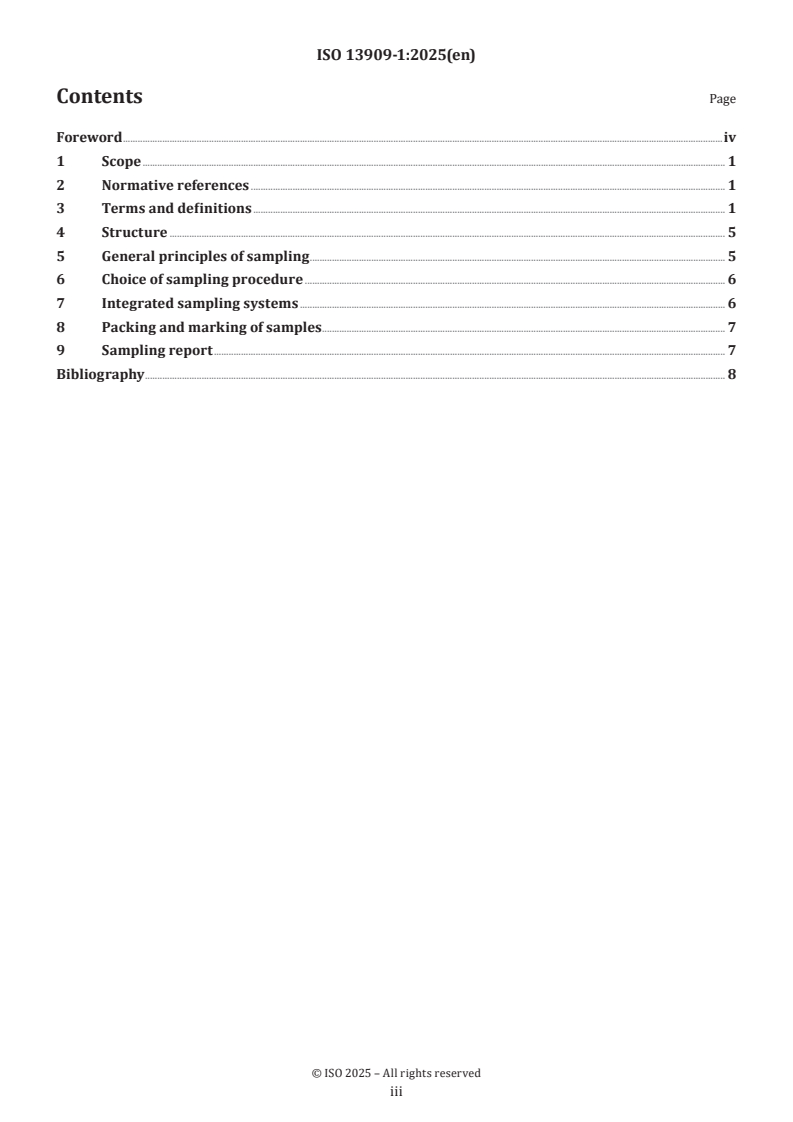
Contents Page
Foreword .iv
1 Scope . 1
2 Normative references . 1
3 Terms and definitions . 1
4 Structure . 5
5 General principles of sampling . 5
6 Choice of sampling procedure . 6
7 Integrated sampling systems . 6
8 Packing and marking of samples . 7
9 Sampling report . 7
Bibliography . 8
iii
Foreword
ISO (the International Organization for Standardization) is a worldwide federation of national standards
bodies (ISO member bodies). The work of preparing International Standards is normally carried out through
ISO technical committees. Each member body interested in a subject for which a technical committee
has been established has the right to be represented on that committee. International organizations,
governmental and non-governmental, in liaison with ISO, also take part in the work. ISO collaborates closely
with the International Electrotechnical Commission (IEC) on all matters of electrotechnical standardization.
The procedures used to develop this document and those intended for its further maintenance are described
in the ISO/IEC Directives, Part 1. In particular, the different approval criteria needed for the different types
of ISO document should be noted. This document was drafted in accordance with the editorial rules of the
ISO/IEC Directives, Part 2 (see www.iso.org/directives).
ISO draws attention to the possibility that the implementation of this document may involve the use of (a)
patent(s). ISO takes no position concerning the evidence, validity or applicability of any claimed patent
rights in respect thereof. As of the date of publication of this document, ISO had not received notice of (a)
patent(s) which may be required to implement this document. However, implementers are cautioned that
this may not represent the latest information, which may be obtained from the patent database available at
www.iso.org/patents. ISO shall not be held responsible for identifying any or all such patent rights.
Any trade name used in this document is information given for the convenience of users and does not
constitute an endorsement.
For an explanation of the voluntary nature of standards, the meaning of ISO specific terms and expressions
related to conformity assessment, as well as information about ISO's adherence to the World Trade
Organization (WTO) principles in the Technical Barriers to Trade (TBT), see www.iso.org/iso/foreword.html.
This document was prepared by Technical Committee ISO/TC 27, Coal and coke, Subcommittee SC 4, Sampling.
This third edition cancels and replaces the second edition (ISO 13909-1:2016), which has been technically
revised.
The main changes are as follows:
— the title has been changed to coal and coke and aligned with the rest of the ISO 13909 series;
— the scope has been modified to specifically include sampling of brown coals and lignites.
A list of all parts in the ISO 13909 series can be found on the ISO website.
Any feedback or questions on this document should be directed to the user’s national standards body. A
complete listing of these bodies can be found at www.iso.org/members.html.
iv
International Standard ISO 13909-1:2025(en)
Coal and coke — Mechanical sampling —
Part 1:
General introduction
1 Scope
This document defines the basic terms used in the sampling of coal and coke, describes the general principles
of sampling and details the information to be provided in the documentation and the sampling report. It also
lists the other parts of the ISO 13909 series and gives guidance on the selection of the appropriate part.
The ISO 13909 series also includes sampling of brown coals and lignites.
2 Normative references
There are no normative references in this document.
3 Terms and definitions
For the purposes of this document, the following terms and definitions apply.
ISO and IEC maintain terminology databases for use in standardization at the following addresses:
— ISO Online browsing platform: available at https:// www .iso .org/ obp
— IEC Electropedia: available at https:// www .electropedia .org/
3.1
air-drying
process of bringing the moisture content of the sample (3.31) near to equilibrium with the atmosphere in the
area in which further reduction and division of the sample are to take place
Note 1 to entry: Air-drying to equilibrium with the atmosphere applies to coal. Drying of coke is generally to facilitate
sample preparation (3.34).
3.2
bias
systematic error (3.10) which leads to the average value of a series of results being persistently higher or
persistently lower than those which are obtained using a reference sampling method
3.3
coefficient of variation
standard deviation (3.37) expressed as a percentage of the absolute value of the arithmetic mean
3.4
common sample
sample (3.31) collected for more than one intended use
3.5
continuous sampling
taking of a sample (3.31) from each consecutive sub-lot (3.39) so that increments are taken at uniform
intervals whenever the fuel is handled at the point of sampling
3.6
cut
increment (3.15) taken by a primary sampler or sample divider
3.7
cutter
mechanical sampling device which extracts increment(s) (3.15)
3.8
divided increment
part obtained from the division of the increment (3.15) in order to decrease its mass
Note 1 to entry: Such division may be done with or without prior size reduction.
3.9
duplicate sampling
particular case of replicate sampling (3.30) with only two replicate samples (3.31)
3.10
error
difference between the observation and the accepted reference value as defined in ISO 5725-1:2023 3.2
Note 1 to entry: This can be designated as systematic error [bias (3.2)] or random error (3.29).
3.11
fixed mass division
method of sample division (3.33) in which the mass retained is predetermined and independent of the mass
of the feed
3.12
fixed ratio division
method of sample division (3.33) in which the division ratio is predetermined
Note 1 to entry: In fixed ratio division, the mass of sample (3.31) retained is a fixed proportion of the mass of the feed.
3.13
fuel
coal or coke
3.14
test sample for general analysis
sample (3.31), prepared to pass a sieve of nominal size of openings 212 µm conforming with ISO 3310-1, used
for the determination of most chemical and some physical characteristics
3.15
increment
portion of fuel (3.13) extracted in a single operation of the sampling device
3.16
lot
defined quantity of fuel (3.13) for which the quality is to be determined
Note 1 to entry: A lot may be divided into sub-lots (3.39).
3.17
manual sampling
collection of increments (3.15) by human effort
3.18
mass-basis sampling
taking of increments (3.15) whereby the position of each increment to be collected from the stream of fuel
(3.13) is measured by a mass interval of stream flow and the increment mass is fixed
3.19
mechanical sampling
collection of increments (3.15) by mechanical means
3.20
mechanical sampling system
combination of sampling and sample preparation (3.34) performed mechanically
3.21
moisture sample
sample (3.31) taken specifically for the purpose of determining total moisture
Note 1 to entry: For coke, this sample may also be used for general analysis.
3.22
nominal top size
aperture size of the smallest sieve in the range included in the R 20 Series (as defined in ISO 565, square
hole) on which not more than 5 % of the sample (3.31) is retained
3.23
off-line sample preparation
sample preparation (3.34) performed manually or mechanically on the samples (3.31) produced by the
mechanical sampling system (3.20), using equipment not integral to the mechanical sampling system itself
3.24
on-line processing
processing of the primary sample (3.31) material using equipment integral with the sampling system
3.25
outlier
result which meets statistical criteria identifying an outlier, especially exceeding Cochran’s maximum
variance test, and for which there is direct physical evidence of causation by gross deviation from the
prescribed experimental procedure
3.26
physical sample
sample (3.31) taken specifically for the determination of physical characteristics, such as physical strength
indices or size distribution
3.27
precision
closeness of agreement between independent test results obtained under stipulated conditions
Note 1 to entry: This is often defined using an index of precisi
...