


ISO 13909-4:2025
(Main)Coal and coke — Mechanical sampling — Part 4: Preparation of test samples of coal
Coal and coke — Mechanical sampling — Part 4: Preparation of test samples of coal
This document describes the preparation of samples of coal from the combination of primary increments to the preparation of samples for specific tests.
Charbon et coke — Échantillonnage mécanique — Partie 4: Préparation des échantillons de charbon pour essai
General Information
- Status
- Published
- Publication Date
- 21-Jul-2025
- Technical Committee
- ISO/TC 27/SC 4 - Sampling
- Drafting Committee
- ISO/TC 27/SC 4 - Sampling
- Current Stage
- 6060 - International Standard published
- Start Date
- 22-Jul-2025
- Due Date
- 25-May-2026
- Completion Date
- 22-Jul-2025
Relations
- Effective Date
- 27-May-2023
Overview
ISO 13909-4:2025 - "Coal and coke - Mechanical sampling - Part 4: Preparation of test samples of coal" (Third edition) specifies how to prepare coal test samples from primary increments through to samples for specific laboratory tests. It addresses constitution, reduction, division, mixing and air-drying, and covers design aspects of preparation equipment and provisions for checking precision and bias. The standard is part of the ISO 13909 series on mechanical sampling of coal and coke.
Key technical topics and requirements
- Scope and purpose: Defines procedures from combining primary increments to producing test-ready samples for analyses such as moisture, size distribution and general chemical testing.
- Constitution of a sample: Combines increments by time-basis or mass-basis sampling and describes how to combine samples (Clause 5).
- Division and reduction: Details mechanical and manual division methods, including falling-stream dividers, riffle, flattened-heap, strip-mixing/splitting methods, and use of reduction mills (Clause 6–7).
- Mixing and air-drying: Requirements for homogenizing and air-drying samples prior to testing (Clauses 8–9).
- Preparation for specific tests: Instructions for preparing samples for total moisture determination, general analysis, size-analysis and other tests; includes handling of common samples and extraction of moisture samples (Clause 10).
- Reserve samples and equipment design: Guidance on maintaining reserve samples and design criteria for dividers, cutters and preparation systems (Clauses 11–12).
- Precision and bias control: Describes how preparation precision contributes to overall uncertainty, and references methods to assess precision and test for bias (Clause 4 and normative references).
- Normative references: Incorporates related standards such as ISO 589 (total moisture), ISO 3310-1 (test sieves), and other parts of ISO 13909 (Parts 1–3, 7, 8).
Practical applications and users
ISO 13909-4:2025 is intended for organizations involved in coal sampling and analysis:
- Coal producers and suppliers preparing representative test samples for contract verification and quality control.
- Power plants, utilities and coke producers verifying feedstock quality (moisture, size, calorific value).
- Testing laboratories performing standard chemical and physical analyses that require well-prepared samples.
- Sampling equipment designers and manufacturers ensuring dividers and reduction systems meet design criteria.
- Quality assurance, inspection bodies and auditors assessing conformity and estimating uncertainty of results.
Benefits include improved representativity of test samples, reduced sampling bias, clearer traceability between increments and test results, and standardized procedures that support reliable coal analysis and contractual compliance.
Related standards
- ISO 13909-1: General introduction to mechanical sampling
- ISO 13909-2: Sampling from moving streams (2025)
- ISO 13909-3: Sampling from stationary lots
- ISO 13909-7: Methods for determining precision of sampling, preparation and testing
- ISO 13909-8: Methods of testing for bias
- ISO 589: Hard coal - Determination of total moisture
- ISO 3310-1: Test sieves - Technical requirements
Keywords: ISO 13909-4:2025, coal sampling, sample preparation, mechanical sampling, test samples of coal, sample division, sample reduction, coal analysis, preparation systems, precision.

Get Certified
Connect with accredited certification bodies for this standard

ABS Quality Evaluations Inc.
American Bureau of Shipping quality certification.

Element Materials Technology
Materials testing and product certification.

ABS Group Brazil
ABS Group certification services in Brazil.
Sponsored listings
Frequently Asked Questions
ISO 13909-4:2025 is a standard published by the International Organization for Standardization (ISO). Its full title is "Coal and coke — Mechanical sampling — Part 4: Preparation of test samples of coal". This standard covers: This document describes the preparation of samples of coal from the combination of primary increments to the preparation of samples for specific tests.
This document describes the preparation of samples of coal from the combination of primary increments to the preparation of samples for specific tests.
ISO 13909-4:2025 is classified under the following ICS (International Classification for Standards) categories: 73.040 - Coals; 75.160.10 - Solid fuels. The ICS classification helps identify the subject area and facilitates finding related standards.
ISO 13909-4:2025 has the following relationships with other standards: It is inter standard links to ISO 13909-4:2016. Understanding these relationships helps ensure you are using the most current and applicable version of the standard.
ISO 13909-4:2025 is available in PDF format for immediate download after purchase. The document can be added to your cart and obtained through the secure checkout process. Digital delivery ensures instant access to the complete standard document.
Standards Content (Sample)
International
Standard
ISO 13909-4
Third edition
Coal and coke — Mechanical
2025-07
sampling —
Part 4:
Preparation of test samples of coal
Charbon et coke — Échantillonnage mécanique —
Partie 4: Préparation des échantillons de charbon pour essai
Reference number
© ISO 2025
All rights reserved. Unless otherwise specified, or required in the context of its implementation, no part of this publication may
be reproduced or utilized otherwise in any form or by any means, electronic or mechanical, including photocopying, or posting on
the internet or an intranet, without prior written permission. Permission can be requested from either ISO at the address below
or ISO’s member body in the country of the requester.
ISO copyright office
CP 401 • Ch. de Blandonnet 8
CH-1214 Vernier, Geneva
Phone: +41 22 749 01 11
Email: copyright@iso.org
Website: www.iso.org
Published in Switzerland
ii
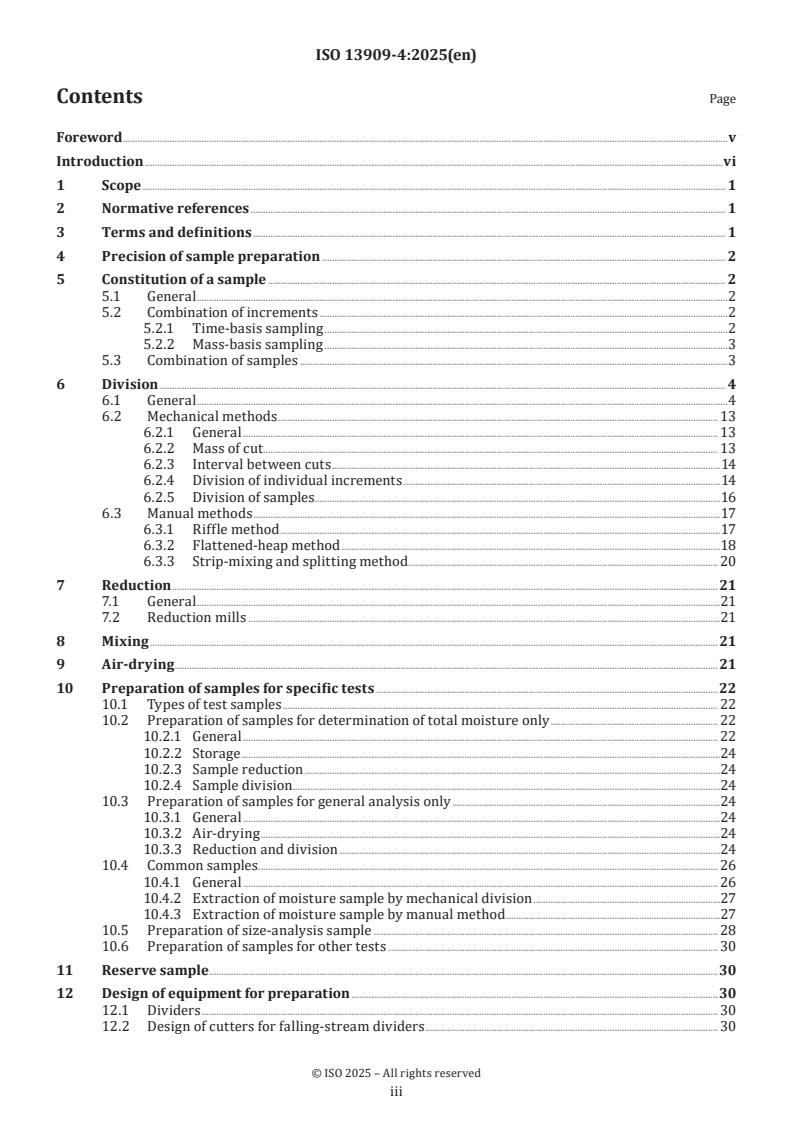
Contents Page
Foreword .v
Introduction .vi
1 Scope . 1
2 Normative references . 1
3 Terms and definitions . 1
4 Precision of sample preparation . 2
5 Constitution of a sample . 2
5.1 General .2
5.2 Combination of increments .2
5.2.1 Time-basis sampling .2
5.2.2 Mass-basis sampling .3
5.3 Combination of samples .3
6 Division . 4
6.1 General .4
6.2 Mechanical methods . 13
6.2.1 General . 13
6.2.2 Mass of cut . 13
6.2.3 Interval between cuts .14
6.2.4 Division of individual increments .14
6.2.5 Division of samples.16
6.3 Manual methods .17
6.3.1 Riffle method .17
6.3.2 Flattened-heap method .18
6.3.3 Strip-mixing and splitting method . 20
7 Reduction .21
7.1 General .21
7.2 Reduction mills .21
8 Mixing .21
9 Air-drying .21
10 Preparation of samples for specific tests .22
10.1 Types of test samples . 22
10.2 Preparation of samples for determination of total moisture only . 22
10.2.1 General . 22
10.2.2 Storage .24
10.2.3 Sample reduction .24
10.2.4 Sample division . . .24
10.3 Preparation of samples for general analysis only .24
10.3.1 General .24
10.3.2 Air-drying .24
10.3.3 Reduction and division .24
10.4 Common samples . 26
10.4.1 General . 26
10.4.2 Extraction of moisture sample by mechanical division .27
10.4.3 Extraction of moisture sample by manual method .27
10.5 Preparation of size-analysis sample . 28
10.6 Preparation of samples for other tests . 30
11 Reserve sample . .30
12 Design of equipment for preparation .30
12.1 Dividers . 30
12.2 Design of cutters for falling-stream dividers . 30
iii
12.2.1 General . 30
12.2.2 Cutter velocity .31
12.3 Preparation systems .31
12.3.1 General .31
12.3.2 Design criteria .31
12.3.3 Abnormal operation .32
12.4 Provision for checking for precision .32
12.5 Provision for testing for bias .32
Bibliography .33
iv
Foreword
ISO (the International Organization for Standardization) is a worldwide federation of national standards
bodies (ISO member bodies). The work of preparing International Standards is normally carried out through
ISO technical committees. Each member body interested in a subject for which a technical committee
has been established has the right to be represented on that committee. International organizations,
governmental and non-governmental, in liaison with ISO, also take part in the work. ISO collaborates closely
with the International Electrotechnical Commission (IEC) on all matters of electrotechnical standardization.
The procedures used to develop this document and those intended for its further maintenance are described
in the ISO/IEC Directives, Part 1. In particular, the different approval criteria needed for the different types
of ISO documents should be noted. This document was drafted in accordance with the editorial rules of the
ISO/IEC Directives, Part 2 (see www.iso.org/directives).
ISO draws attention to the possibility that the implementation of this document may involve the use of (a)
patent(s). ISO takes no position concerning the evidence, validity or applicability of any claimed patent
rights in respect thereof. As of the date of publication of this document, ISO had not received notice of (a)
patent(s) which may be required to implement this document. However, implementers are cautioned that
this may not represent the latest information, which may be obtained from the patent database available at
www.iso.org/patents. ISO shall not be held responsible for identifying any or all such patent rights.
Any trade name used in this document is information given for the convenience of users and does not
constitute an endorsement.
For an explanation of the voluntary nature of standards, the meaning of ISO specific terms and expressions
related to conformity assessment, as well as information about ISO's adherence to the World Trade
Organization (WTO) principles in the Technical Barriers to Trade (TBT), see www.iso.org/iso/foreword.html.
This document was prepared by Technical Committee ISO/TC 27, Coal and coke, Subcommittee SC 4, Sampling.
This third edition cancels and replaces the second edition (ISO 13909-4:2016), which has been technically
revised.
The main changes are as follows:
— the title has been modified and aligned with the rest of the ISO 13909 series;
— the scope has been revised to specifically refer to coal;
— the references have been updated;
— the legend for Formula (3) has been updated.
A list of all parts in the ISO 13909 series can be found on the ISO website.
Any feedback or questions on this document should be directed to the user’s national standards body. A
complete listing of these bodies can be found at www.iso.org/members.html.
v
Introduction
The objective of sample preparation is to prepare one or more test samples from the primary increments for
subsequent analysis. The requisite mass and particle size of the test sample depend on the test to be carried out.
The process of sample preparation may involve constitution of samples, reduction, division, mixing and
drying, or all or a combination of these.
Primary increments may be prepared individually as test samples or combined to constitute samples either
as taken or after having been prepared by reduction or division, or both. Samples can either be prepared
individually as test samples or combined on a weighted basis to constitute a further sample.
When difficulty in handling the coal or coals being sampled is expected at a particular stage in sample
preparation, or if there is a likelihood of losing moisture by evaporation, it is necessary to withdraw the
sample or increment from the on-line system at the stage immediately prior to the point of difficulty and
proceed off-line.
vi
International Standard ISO 13909-4:2025(en)
Coal and coke — Mechanical sampling —
Part 4:
Preparation of test samples of coal
1 Scope
This document describes the preparation of samples of coal from the combination of primary increments to
the preparation of samples for specific tests.
2 Normative references
The following documents, in whole or in part, are normatively referenced in this document and are
indispensable for its application. For dated references, only the edition cited applies. For undated references,
the latest edition of the referenced document (including any amendments) applies.
ISO 589, Hard coal — Determination of total moisture
ISO 3310-1, Test sieves — Technical requirements and testing — Part 1: Test sieves of metal wire cloth
ISO 13909-1, Coal and coke — Mechanical sampling — Part 1: General introduction
ISO 13909-2:2025, Coal and coke — Mechanical sampling — Part 2: Sampling of coal from moving streams
ISO 13909-3, Coal and coke — Mechanical sampling — Part 3: Sampling of coal from stationary lots
ISO 13909-7, Coal and coke — Mechanical sampling — Part 7: Methods for determining the precision of sampling,
sample preparation and testing
ISO 13909-8, Coal and coke — Mechanical sampling — Part 8: Methods of testing for bias
3 Terms and definitions
For the purposes of this document, the terms and definitions given in ISO 13909-1 apply.
ISO and IEC maintain terminology databases for use in standardization at the following addresses:
— ISO Online browsing platform: available at https:// www .iso .org/ obp
— IEC Electropedia: available at https:// www .electropedia .org/
4 Precision of sample preparation
From the formulae given in ISO 13909-7, the estimated absolute value of the precision of the result obtained
for the lot at the 95 % confidence level, P , for sampling is given by Formula (1):
L
V
I
+V
PT
n
P =2 (1)
L
m
where
P is the estimated overall precision of sampling, sample preparation and testing for the lot at a
L
95 % confidence level, expressed as a percentage absolute;
V is the primary increment variance;
I
V is the preparation and testing variance for both off-line and on-line systems;
PT
n is the number of increments to be taken from a sub-lot;
m is the number of sub-lots in the lot.
The procedures given in this document are designed to achieve levels of V of 0,2 or less for both ash and
PT
moisture tests. Better levels are expected when using mechanical dividers.
For some preparation schemes, however, practical restrictions can prevent the preparation and testing
variance being as low as this. Under these circumstances, the user should decide whether to achieve the
desired overall precision by improving the preparation scheme or by dividing the lot into a greater number
of sub-lots.
The errors occurring in the various stages of preparation and analysis, expressed in terms of variance, may
be checked by the method given in ISO 13909-7.
5 Constitution of a sample
5.1 General
Primary increments shall be taken in accordance with the procedures specified in ISO 13909-2 and
ISO 13909-3.
Individual increments are usually combined to form a sample. A single sample may be constituted by
combination of increments taken from a complete sub-lot or by combining increments taken from individual
parts of a sub-lot. Under some circumstances, e.g. size analysis or bias testing, the sample consists of a single
increment which is prepared and tested. Examples of the constitution of samples are shown in Figure 1.
The procedures for increment combination (see 5.2) may vary according to whether the primary increments
were taken using a time-basis (see 5.2.1) or a mass-basis (see 5.2.2) sampling scheme.
Samples may also be prepared by the combination of other samples (see 5.3).
5.2 Combination of increments
5.2.1 Time-basis sampling
The mass of the primary increments shall be proportional to the flow rate at the time of sampling. The
primary increments may be combined into a sample either directly as taken or after having been prepared
individually to an appropriate stage by fixed-ratio division (see Clause 6).
5.2.2 Mass-basis sampling
If the primary increments are of almost uniform mass (see note), they may be combined into a sample, either
directly as taken or after having been prepared individually to an appropriate stage by fixed-ratio division
(see Clause 6).
NOTE Almost uniform mass has been achieved if the coefficient of variation of the increment masses is less than
20 % and there is no significant correlation between the flow rate at the time of taking the increment and the mass of
the increment (see ISO 13909-2:2025, Annex A).
If the primary increments are not of almost uniform mass, they may only be combined into samples after
having been divided individually by fixed-mass division (see Clause 6).
a) Example 1
b) Example 2
Figure 1 — Examples of the constitution of samples
5.3 Combination of samples
When combining samples, the mass of the individual samples shall be directly proportional to the mass of
the coal from which they were taken in order to obtain a weighted mean of the quality characteristic for the
sub-lot. Prior to combination, division shall be by fixed-ratio division (see Clause 6).
6 Division
6.1 General
Division can be:
— on-line mechanically; or
— off-line mechanically or manually.
Whenever possible, mechanical methods are preferred to manual methods to minimize human error.
Examples of dividers are in Figures 2 to 10.
Mechanical dividers are designed to extract one or more parts of the coal in a number of cuts of relatively
small mass. When the smallest mass of the divided sample that can be obtained in one pass through the
divider is greater than that required further passes through the same divider or subsequent passes through
further dividers may be necessary.
If coal does not run freely through a sample divider it may be necessary to air-dry the sample as described in
Clause 10 before sample division is undertaken.
Manual division is normally applied when mechanical methods would result in loss of integrity, e.g. loss of
moisture or size degradation. Manual methods may themselves result in bias, particularly if the mass of coal
to be divided is large.
In the rotating disc type of mechanical divider in Figure 2, the material from a mixing container is fed by
scrapers to the centre of the dividing disc. From there it is discharged over the range of the disc through
special clearing arms. The sample falls through adjustable slots into chutes; the reject is carried away
through a cleaning conduit. The whole interior space is cleaned by scrapers.
For the rotating cone type of divider in Figure 3, a stream of coal is allowed to fall onto a rotating cone, the
adjustable slot with lips in the cone allows the stream to fall directly onto the sample receiver for part of
each revolution.
In the container type dividers in Figure 4, the coal stream flows to the hopper and this flow is intercepted by
the top edge of a number of sector-shaped containers dividing the flow into equal parts. Either the hopper or
the containers may rotate. The machine can be controlled for the following operations:
1) for dividing;
2) for collecting duplicates:
3) for collecting replicates.
For the chain bucket type divider in Figure 5, a chain mechanism as shown is equipped with buckets spread
at equal pitch. The buckets travel in a single direction or change direction at preset time periods. The bucket
intercepts the free-falling coal stream to extract cuts which discharge to sample as the bucket inverts.
The slotted-belt type divider in Figure 6 comprises an endless belt as shown having slots spaced at equal
pitch with lips that act as cutting edges passing below a feed chute. The coal stream is fed to the chute and,
as each slot passes through the stream, a cut is taken. The stream which falls onto the plain part of the belt
is carried to rejects.
The rotating plate divider in Figure 7 consists of a flat plate with lipped slots spaced at equal pitch rotating
beneath a feed chute. Coal is fed into the feed chute, then, falls onto the rotating plate to form a ribbon bed
which is carried to the plough and discharged to rejects. As a slot passes through the stream, a cut is taken.
The rotating chute type divider in Figure 8 incorporates a hollow shaft with a rotating conical hopper and
chute which distributes the coal to one or more stationary cutters within a housing as shown. Each cutter is
designed to take cuts from the coal stream and the rejects are discharged through the hollow shaft.
The rotating cutter divider in Figure 9 comprises one or more rotating cutters taking cuts from the coal
stream as it is fed into the housing through a feed chute as shown. Coal not collected by the rotating cutters
is directed to reject at the bottom of the housing.
Finally, the cutter-chute type divider in Figure 10 incorporates a cutter-chute that traverses the full coal
stream and diverts a portion from the stream. When the coal stream is not being cut by the chute, it is
deflected by the angle plate to reject.
Key
1 feed
2 reject
3 divided sample
Figure 2 — Examples of dividers — Rotating disc type
Key
1 feed
2 rotating cone
3 adjustable slot
4 divided sample
5 reject
Figure 3 — Examples of dividers — Rotating cone type
Key
1 feed
2 divided sample in rotating receivers
Figure 4 — Examples of dividers — Container type
Key
1 feed
2 reject
3 divided sample
Figure 5 — Examples of dividers — Chain bucket type
Key
1 slotted belt
2 feed
3 inclined chute
4 divided sample
5 reject
Figure 6 — Examples of dividers — Slotted-belt type
Key
1 feed
2 reject
3 divided sample
Figure 7 — Examples of dividers — Rotating plate type
Key
1 feed
2 reject
3 divided sample
Figure 8 — Examples of dividers — Rotating chute type
Key
1 feed
2 divided sample
3 reject
Figure 9 — Examples of dividers — Rotating cutter type
Key
1 feed
2 divided sample
3 reject
Figure 10 — Examples of dividers — Cutter-chute type
6.2 Mechanical methods
6.2.1 General
Mechanical sample division may be carried out on an individual increment or a sample which has been
crushed, if necessary, to an appropriate nominal top size. Division shall be either by fixed-mass division or
by fixed-ratio division subject to the conditions set out in 6.2.3.
NOTE The procedures described for fixed-ratio division are the simplest to implement. However, other procedures
can be used, provided that the mass of the divided sample is proportional to the mass of the feed, e.g. the number of
cuts could be kept constant by making the feed rate of each division proportional to the mass of coal to be divided.
6.2.2 Mass of cut
The cuts shall be of uniform mass throughout the division of an increment. In order to achieve this, the flow
of coal to the divider shall be uniform and the cutting aperture shall be constant. The method of feeding the
divider shall be designed to minimize any segregation caused by the divider.
The cutting aperture shall be at least three times the nominal top size of the coal to be divided.
6.2.3 Interval between cuts
In order to minimize bias, the first cut for each mass to be divided shall be made at random within the first
cutting interval. For secondary and tertiary dividers, the cycle time shall not be evenly divisible into the
cycle time of the cutter which precedes it.
For fixed-mass division, the interval between taking cuts shall be varied proportionally to the mass of coal
to be divided so that divided samples having almost uniform mass are obtained.
For fixed-ratio division, the interval between taking cuts shall be constant, irrespective of the variations of
masses of coal to be divided, so that the divided-sample masses are proportional to the mass of the feed.
6.2.4 Division of individual increments
6.2.4.1 Number of cuts
The number of cuts for dividing an increment shall be determined as follows.
a) For fixed-mass division, the minimum number of cuts for dividing primary increments shall be four. An
equal number of cuts shall be taken from each primary increment in the sub-lot.
b) For fixed-ratio division, the minimum number of cuts for dividing a primary increment of mean mass
shall be four.
c) For subsequent division of individual divided primary increments, a minimum of one cut shall be taken
from each cut from the preceding division.
An example of a procedure for division of individual increments and subsequent sample division is shown in
Figure 11 a).
a) Example of division of individual increments (minimum number of cuts)
b) Example of two-stage division of individual increments
Figure 11 — Examples of procedures for division of increments and samples
6.2.4.2 Minimum mass of divided increment
The minimum mass of a divided increment shall be such that the combined masses of all the divided
increments in the sub-lot shall, at each stage, be greater than the mass given in Table 1 corresponding to the
purpose for which the sample has been taken and the nominal top size. If the increment masses are too low
to satisfy this requirement, the divided increment shall be crushed prior to further division (e.g. as shown in
Figure 11 b).
6.2.5 Division of samples
6.2.5.1 Number of cuts
The sample constituted from all increments, or divided increments, shall be divided by taking a minimum of
60 cuts.
NOTE If, during preparation, the sample is thoroughly mixed and it can be established that the required precision
can be achieved, the number can be reduced to 20.
If the mass is too low, an alternative manual method of division should be used.
6.2.5.2 Minimum mass of divided samples
For most parameters, particularly size analysis and those that are particle-size related, the precision of
the result is limited by the ability of the sample to represent all the particle sizes in the mass of coal being
sampled.
The minimum mass of divided samples is dependent on the nominal top size of the coal, the precision
required for the parameter concerned and the relationship of that parameter to particle size. The attainment
of the required minimum mass after division will not, in itself, guarantee the required precision, because
division precision is also dependent on the number of cuts taken during division (see 6.2.4.1 and 6.2.5.1).
Values for the minimum mass of divided samples for general analysis to reduce the variance due to the
particulate nature of the coal to 0,01, corresponding to a precision of 0,2 % with regard to ash, are given in
Table 1 (see Reference [1]). Table 1 gives the corresponding minimum masses of divided samples for total
moisture analysis, which are approximately 20 % of the minimum masses for general analysis, subject to an
absolute minimum of 0,65 kg. Values for the minimum mass of divided samples for size analysis are given in
Table 1 for division precisions of 1 % and 2 %, respectively. These masses have been calculated on the basis
of the precision of the determination of oversize, i.e. the coal above the normal top size. The precision for
other size fractions will normally be better than this. Note that, in each case, the overall division precision is
determined by the sum of the division variances for each sample-division stage.
The minimum mass of divided samples, m , for other desired levels of precision may be calculated from
S
Formula (2):
P
mm= (2)
SS,0
P
R
where
m is the minimum mass of sample after division specified in Table 1 for a given nominal top size;
S,0
P is the precision for a given division stage specified in Table 1;
P is the required precision for a given division stage.
R
When a coal is regularly sampled under the same circumstances, the precision obtained for all the required
quality parameters shall be checked (see ISO 13909-7) and the masses may be adjusted accordingly.
However, the masses shall not be reduced below the minimum requirements laid down in the relevant
analysis standards.
When preparing coal to produce samples for multiple use, account shall also be taken of the masses and size
distribution of the test samples required for each test.
Table 1 — Minimum mass of sample after division
General-analysis
Nominal top size Total-moisture
and common Size-analysis
of coal analysis samples
samples
mm kg kg 1 % precision 2 % precision
kg kg
300 15 000 3 000 54 000 13 500
200 5 400 1 100 16 000 4 000
150 2 600 500 6 750 1 700
125 1 700 350 4 000 1 000
90 750 125 1 500 400
75 470 95 850 210
63 300 60 500 125
50 170 35 250 65
45 125 25 200 50
38 85 17 110 30
31,5 55 10 65 15
22,4 32 7 25 6
16 20 4 8 2
11,2 13 2,5 3 0,7
10 10 2,0 2 0,5
8 6 1,5 1 0,25
5,6 3 1,2 0,5 0,25
4 1,5 1,0 0,25 0,25
2,8 0,65 0,65 0,25 0,25
2,0 0,25 0,65 0,25 0,25
1 0,1 0,65 0,25 0,25
< 0,5 0,06 0,65 0,25 0,25
NOTE 1 The masses for the general-analysis samples and common samples have been determined to reduce the variance due to
the particulate nature of coal to 0,01, corresponding to a precision of 0,2 % ash.
NOTE 2 These values are generally suitable for off-line division but, for nominal top sizes of 16 mm and below, the masses can
possibly not be sufficient to maintain the integrity of the sample when performing on-line division.
6.3 Manual methods
6.3.1 Riffle method
A riffle (see Figure 12) is a sample divider that will, in a single pass of a sample, divide it into halves, one of
which is retained and the other normally rejected. The device is normally portable and, for sample division,
is usually fed manually, the coal being evenly distributed along its length. Adjacent slots feed opposite
receivers.
The slot width shall be at least three times the nominal top size of the coal. Each half of the riffle shall have
the same number of slots, which shall be at least eight and preferably more. All the surfaces on which the
coal might rest shall have a slope of at least 60° to the horizontal.
The coal shall be allowed to fall steadily into the riffle, ensuring that it is evenly distributed over all the
slots. The coal shall be allowed to fall freely, i.e. not towards one side of the riffle, and the rate of feed shall be
controlled such that the slots are never choked. Closed riffles are preferred.
Care shall be taken to minimize loss of dust and moisture. To this end, the receiver shall fit closely against
the body of the riffle, and, for dry coals and moisture samples, closed-type riffles shall be used.
When a stage of sample division requires two or more steps or passes, the sample retained at each step shall
be taken alternately from each side of the riffle.
a) Open type b) Close type
Key
1 even number of slots
Figure 12 — Examples of riffles
6.3.2 Flattened-heap method
The procedure, which is illustrated in Figure 13, is as follows.
The sample is mixed thoroughly and spread to form a rectangle of uniform thickness on a mixing plate which
is a smooth, non-absorbent and non-contaminating surface. The maximum thickness shall be three times
the nominal top size of the coal. Avoid moisture loss from wet coals, which can result from over-mixing.
If the mass of the coal is greater than can be formed into a heap of 2 m × 2,5 m, two or more heaps of equal
mass shall be formed and separate samples shall be taken from each heap.
A matrix is marked on the spread sample to give a minimum of 4 × 5 equal parts. An increment is taken, at
random, from each of the parts by inserting a scoop with a bump plate (see the last paragraph of 6.3.2) to
the bottom of the matrix layer. The increments are combined into a divided sample. It is essential that these
operations be performed quickly to prevent moisture loss.
The increments shall be of uniform mass. The minimum mass required for each nominal top size is the
mass of the divided sample (see Table 1) divided by the number of parts of the flattened heap. This mass is
determined by using a scoop of appropriate dimensions.
The scoop shall be flat-bottomed and the width of the entry shall be at least three times the nominal top
size of the coal. The side walls shall be higher than the height of the heap and the depth shall be sufficient to
allow the required mass of increment to be taken.
In summary, the procedure is as follows:
a) Spread the crushed sample into a rectangle with a maximum thickness of three times the nominal top size.
b) Arrange into 20 equal parts, e.g. into five equal parts lengthwise and four equal parts breadthwise.
c) Take a scoopful of sample at random from each of the 20 parts by inserting the scoop to the bottom of
the sample layer [see Figure 13 d) below]. Combine the 20 scoopfuls to form the divided sample.
Detail of taking an increment by using the bump plate (1) shown in Figure 13 c) is shown in Figure 13 d).
a)
b)
c)
d)
Key
1 bump plate
Figure 13 — Flattened-heap method
Take the scoop sample with the aid of a bump plate, which is inserted vertically through the flattened heap
until it is in contact with the bottom of the sample layer. The scoop is then inserted to the bottom of the
spread coal and moved horizontally until its open end comes into contact with the vertical bump plate. The
scoop and bump plate are lifted together to ensure that all particles are collected off the top of the mixing
plate and that none fall off during lifting.
6.3.3 Strip-mixing and splitting method
The procedure, which is illustrated in Figure 14, is as follows.
The coal sample is formed on a mixing plate, which is a smooth, non-absorbent, non-contaminating surface,
into a strip at least 10 times as long as it is wide by distributing the coal along the length of the strip as
evenly as possible, working randomly from end to end and from both sides of the strip. End plates are used
to ensure that size segregation only occurs laterally.
Increments shall be taken as a complete section across the strip. The width of each cross-section shall be not
less than three times the nominal top size of the coal.
NOTE 1 Special apparatus for the cutting out of increments can be constructed if desired.
Normally 20 increments are required. Fewer increments may be taken, subject to a minimum of 10, where
the same quality coal is regularly prepared under the same conditions and it has first been established that
the required precision can be obtained (see ISO 13909-7).
NOTE 2 Because of the efficient longitudinal mixing achieved in the formation of a strip, the same precision as that
obtainable with the flattened-heap method can be achieved with fewer increments.
Key
1 increment
2 sampling frame
3 end plates ("book ends")
Figure 14 — Strip-mixing and splitting method
7 Reduction
7.1 General
Mechanical equipment shall be used to reduce the particle size, but manual crushing is permitted for the
breakage of large material to meet the maximum feed size acceptable to the first-stage mill.
The test sample shall be reduced to the particle size specified in the relevant test method.
The mill settings should be checked regularly by sieving and determining the nominal top size produced by
each mill.
7.2 Reduction mills
The particle size produced depends on the speed of the mill and its design. Mills shall be designed such
that the required particle size of the reduced sample can be achieved without using extreme settings. Loss
of sample or retention of material from previous samples, which might contaminate succeeding samples,
shall be minimized. Heating of the sample and airstream effects shall be minimized, particularly where the
sample is to be used for total moisture determination, calorific value determination, and coking tests.
There shall be no contact between the metal surfaces in order to avoid localized heating of the sample.
Totally closed, high-speed (>20 Hz) ball mills shall not be used. The particle size of the output is influenced
by the hardness of the coal, but the effect will depend on the speed range.
For certain tests, specified size gradings are required and the type of mill shall be chosen to ensure that the
required size is obtained.
8 Mixing
Mixing is not possible where samples or increments are flowing through any form of preparation system
and is therefore restricted to off-line preparation.
In theory, thorough mixing of a sample prior to its division reduces errors due to sample preparation. In
practice, this is not easy to achieve and some methods of hand mixing, e.g. forming and reforming into a
conical pile, can have the opposite effect leading to increased segregation. Mixing can also result in loss of
moisture.
One method that can be used is to pour the sample through a riffle (6.3.1) or a container-type sample divider
[see Figure 4] three times, reuniting the parts after each pass. If mechanical sample dividers are used in the
course of preparation, an additional mixing step is not normally necessary to meet the required precision.
NOTE Mechanical mixing can be useful at the final stage of preparation of test samples.
9 Air-drying
The sample is spread in a thin layer and allowed to attain equilibrium with the atm
...
Questions, Comments and Discussion
Ask us and Technical Secretary will try to provide an answer. You can facilitate discussion about the standard in here.
Loading comments...