

ISO/FDIS 14918
(Main)Thermal spraying — Qualification testing of thermal sprayers
General Information
- Abstract
ISO 14918:2018 specifies procedural instructions for qualification testing of thermal sprayers. It defines requirements, ranges of qualification, test conditions, acceptance requirements and certification for qualification testing of thermal spray performance. ISO 14918:2018 is applicable when the thermal sprayer's qualification is required by this document, the purchaser, by inspection authorities or by other organizations. The thermal spraying processes referred to in this document include those spraying processes which are designated as manual or mechanized. The test for mechanised application includes the use of automatically controlled thermal spraying, e.g. robotics, scan units.
- Status
- Not Published
- Technical Committee
- ISO/TC 107 - Metallic and other inorganic coatings
- Drafting Committee
- ISO/TC 107/WG 1 - Thermal spraying
- Current Stage
- 5000 - FDIS registered for formal approval
- Start Date
- 23-Jun-2026
- Completion Date
- 01-Jul-2026
Buy Documents
ISO/FDIS 14918 - Thermal spraying — Qualification testing of thermal sprayers

REDLINE ISO/FDIS 14918 - Thermal spraying — Qualification testing of thermal sprayers
Overview
ISO/FDIS 14918 focuses on the qualification testing of thermal sprayers and provides procedural instructions for verifying thermal spray competence. This ISO standard is designed to support consistent thermal spraying quality, competency assessment, and certification across manual and mechanized spraying activities.
The standard is relevant when qualification is required by the document itself, by the purchaser, by inspection authorities, or by other organizations. It addresses both manual thermal spraying and mechanized thermal spraying, including automatically controlled applications such as robotics and scan units. For organizations involved in thermal spray production, ISO/FDIS 14918 helps establish a structured approach to qualification testing, job knowledge assessment, and practical performance evaluation.
This document is particularly valuable for companies that need a clear framework for thermal sprayer certification, quality assurance, and conformity assessment in thermal spray operations.
Key Topics
ISO/FDIS 14918 covers the main elements needed to assess thermal sprayer competence:
- Qualification requirements for thermal sprayers
- Range of qualification by process and application method
- Test conditions and examination responsibilities
- Acceptance requirements for qualification testing
- Certification and validity of qualification status
- Re-tests and prolongation of qualification
- Job knowledge and practical testing
The standard recognizes that thermal spray quality depends on the sprayer’s skill, process knowledge, and ability to follow instructions. It therefore includes both a theoretical examination and a practical examination.
It also supports qualification across several thermal spraying processes, including:
- Arc spraying
- Plasma spraying
- High velocity oxy fuel flame spraying
- Cold spraying
- Detonation spraying
- Powder flame spraying
- Plastic flame spraying
- Wire, rod, and cord flame spraying
- Plasma transferred arc spraying (PTA)
- Laser spraying
- Flame spraying with fusing
A notable feature of the standard is its emphasis on independent examining bodies, impartial assessment, and documented qualification results.
Applications
ISO/FDIS 14918 is useful in sectors where thermal spray performance affects product reliability and service life, such as:
- Corrosion protection
- Wear resistance coatings
- Surface engineering
- Industrial repair and maintenance
- Manufacturing with qualified thermal spray operators
It supports employers, contractors, inspection bodies, and certification organizations that need a defensible method for assessing thermal sprayer competence. The standard is also valuable for training and certification programs that require repeatable, auditable qualification procedures.
For operations using mechanized systems, including automated thermal spraying, the standard helps align operator qualification with the specific process and application method used in production.
Related Standards
ISO/FDIS 14918 is connected to several standards that support thermal spraying and conformity assessment, including:
- ISO 14917 - Thermal spraying - Terminology, classification
- ISO 14916 - Thermal spraying - Determination of tensile adhesive strength
- ISO 2063-1 - Thermal spraying - Zinc, aluminium and their alloys - Design considerations and quality requirements
- ISO 2063-2 - Thermal spraying - Zinc, aluminium and their alloys - Execution of corrosion protection systems
- ISO 4624 - Paints and varnishes - Pull-off test for adhesion
- ISO 6508-1 - Metallic materials - Rockwell hardness test
- EN 15340 - Determination of shear load resistance of thermally sprayed coatings
Together, these standards support a robust framework for thermal spraying qualification, process control, and coating quality assurance.
Relations
- Consolidates
prEN ISO 14918 - Thermal spraying - Qualification testing of thermal sprayers (ISO/DIS 14918:2025) - Effective Date
- 12-Feb-2026
- Consolidates
ISO 24569:2023 - Ships and marine technology — External firefighting system test methods - Effective Date
- 11-Nov-2023
- Effective Date
- 11-Nov-2023
Buy Documents
ISO/FDIS 14918 - Thermal spraying — Qualification testing of thermal sprayers
REDLINE ISO/FDIS 14918 - Thermal spraying — Qualification testing of thermal sprayers
Get Certified
Connect with accredited certification bodies for this standard

DVS-ZERT GmbH
German welding certification society.
CARES (UK Certification Authority for Reinforcing Steels)
UK certification for reinforcing steels and construction.
EWF/IIW (European/International Welding Federation)
International welding personnel certification.
Sponsored listings
Frequently Asked Questions
ISO/FDIS 14918 is a draft published by the International Organization for Standardization (ISO). Its full title is "Thermal spraying — Qualification testing of thermal sprayers". This standard covers: ISO 14918:2018 specifies procedural instructions for qualification testing of thermal sprayers. It defines requirements, ranges of qualification, test conditions, acceptance requirements and certification for qualification testing of thermal spray performance. ISO 14918:2018 is applicable when the thermal sprayer's qualification is required by this document, the purchaser, by inspection authorities or by other organizations. The thermal spraying processes referred to in this document include those spraying processes which are designated as manual or mechanized. The test for mechanised application includes the use of automatically controlled thermal spraying, e.g. robotics, scan units.
ISO 14918:2018 specifies procedural instructions for qualification testing of thermal sprayers. It defines requirements, ranges of qualification, test conditions, acceptance requirements and certification for qualification testing of thermal spray performance. ISO 14918:2018 is applicable when the thermal sprayer's qualification is required by this document, the purchaser, by inspection authorities or by other organizations. The thermal spraying processes referred to in this document include those spraying processes which are designated as manual or mechanized. The test for mechanised application includes the use of automatically controlled thermal spraying, e.g. robotics, scan units.
ISO/FDIS 14918 is classified under the following ICS (International Classification for Standards) categories: 25.220.20 - Surface treatment. The ICS classification helps identify the subject area and facilitates finding related standards.
ISO/FDIS 14918 has the following relationships with other standards: It is inter standard links to prEN ISO 14918, ISO 24569:2023, ISO 14918:2018. Understanding these relationships helps ensure you are using the most current and applicable version of the standard.
ISO/FDIS 14918 is available in PDF format for immediate download after purchase. The document can be added to your cart and obtained through the secure checkout process. Digital delivery ensures instant access to the complete standard document.
Standards Content (Sample)
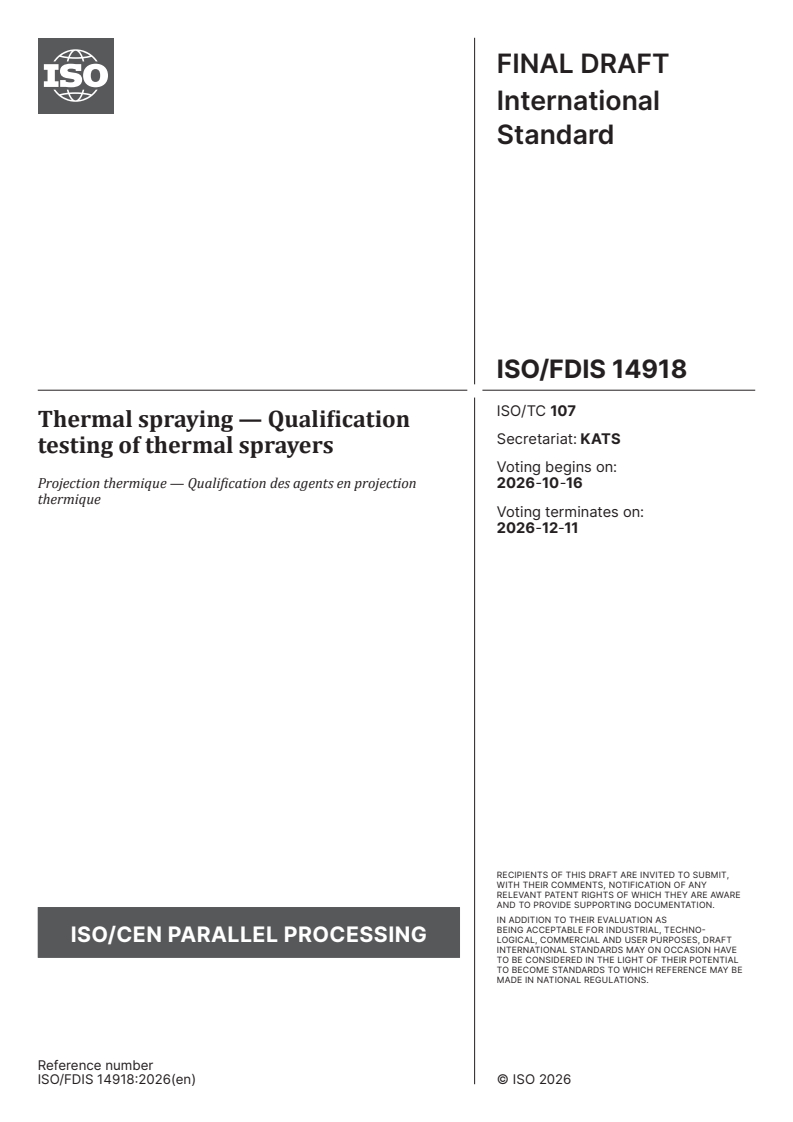
FINAL DRAFT
International
Standard
ISO/TC 107
Thermal spraying — Qualification
Secretariat: KATS
testing of thermal sprayers
Voting begins on:
Projection thermique — Qualification des agents en projection 2026-10-16
thermique
Voting terminates on:
2026-12-11
RECIPIENTS OF THIS DRAFT ARE INVITED TO SUBMIT,
WITH THEIR COMMENTS, NOTIFICATION OF ANY
RELEVANT PATENT RIGHTS OF WHICH THEY ARE AWARE
AND TO PROVIDE SUPPOR TING DOCUMENTATION.
IN ADDITION TO THEIR EVALUATION AS
BEING ACCEPTABLE FOR INDUSTRIAL, TECHNO
ISO/CEN PARALLEL PROCESSING LOGICAL, COMMERCIAL AND USER PURPOSES, DRAFT
INTERNATIONAL STANDARDS MAY ON OCCASION HAVE
TO BE CONSIDERED IN THE LIGHT OF THEIR POTENTIAL
TO BECOME STAN DARDS TO WHICH REFERENCE MAY BE
MADE IN NATIONAL REGULATIONS.
Reference number
FINAL DRAFT
International
Standard
ISO/TC 107
Thermal spraying — Qualification
Secretariat: KATS
testing of thermal sprayers
Voting begins on:
Projection thermique — Qualification des agents en projection
thermique
Voting terminates on:
© ISO 2026
All rights reserved.
RECIPIENTS OF THIS DRAFT ARE INVITED TO SUBMIT,
WITH THEIR COMMENTS, NOTIFICATION OF ANY
This ISO publication is protected by copyright and is owned by ISO and/or its licensors.
RELEVANT PATENT RIGHTS OF WHICH THEY ARE AWARE
The content of this ISO publication is provided under licence, not sold. Use is subject to the applicable licence terms issued by ISO,
AND TO PROVIDE SUPPOR TING DOCUMENTATION.
an ISO member body, or an authorized third-party distributor.
IN ADDITION TO THEIR EVALUATION AS
BEING ACCEPTABLE FOR INDUSTRIAL, TECHNO
Except as required for implementation or expressly permitted by a separate licence, no part of this ISO publication may be
ISO/CEN PARALLEL PROCESSING
LOGICAL, COMMERCIAL AND USER PURPOSES, DRAFT
reproduced, distributed, modified, used, or made available in any form or by any means – electronic or mechanical, including
INTERNATIONAL STANDARDS MAY ON OCCASION HAVE
photocopying, scanning, recording, or posting on internal or external digital platforms. TO BE CONSIDERED IN THE LIGHT OF THEIR POTENTIAL
TO BECOME STAN DARDS TO WHICH REFERENCE MAY BE
Any use beyond the scope of the granted rights is prohibited and may result in legal action.
MADE IN NATIONAL REGULATIONS.
ISO copyright office
CP 401 • CH-1214 Vernier, Geneva
Phone: +41 22 749 01 11
Email: copyright@iso.org
Website: www.iso.org
Published in Switzerland
Reference number
ii
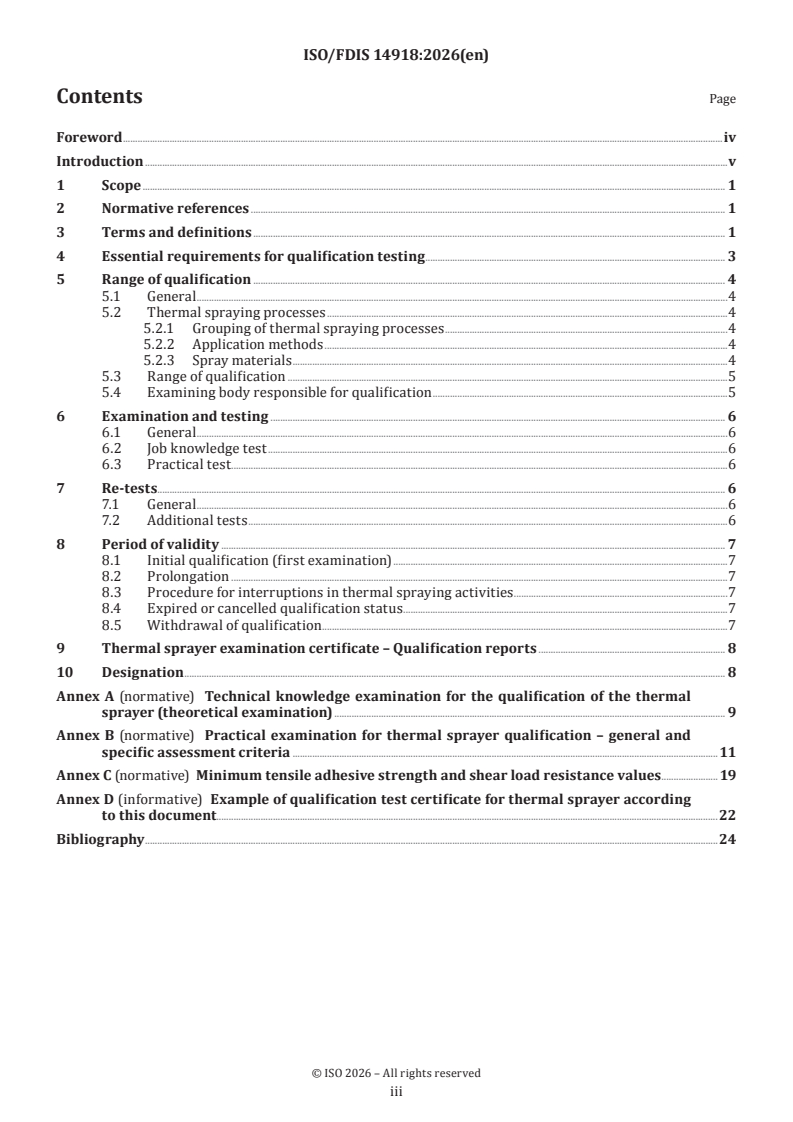
Contents Page
Foreword .iv
Introduction .v
1 Scope . 1
2 Normative references . 1
3 Terms and definitions . 1
4 Essential requirements for qualification testing . 3
5 Range of qualification . 4
5.1 General .4
5.2 Thermal spraying processes .4
5.2.1 Grouping of thermal spraying processes .4
5.2.2 Application methods .4
5.2.3 Spray materials .4
5.3 Range of qualification .5
5.4 Examining body responsible for qualification .5
6 Examination and testing . 6
6.1 General .6
6.2 Job knowledge test .6
6.3 Practical test .6
7 Re-tests. 6
7.1 General .6
7.2 Additional tests .6
8 Period of validity . 7
8.1 Initial qualification (first examination) .7
8.2 Prolongation .7
8.3 Procedure for interruptions in thermal spraying activities .7
8.4 Expired or cancelled qualification status .7
8.5 Withdrawal of qualification .7
9 Thermal sprayer examination certificate – Qualification reports . 8
10 Designation . 8
Annex A (normative) Technical knowledge examination for the qualification of the thermal
sprayer (theoretical examination) . 9
Annex B (normative) Practical examination for thermal sprayer qualification – general and
specific assessment criteria .11
Annex C (normative) Minimum tensile adhesive strength and shear load resistance values . 19
Annex D (informative) Example of qualification test certificate for thermal sprayer according
to this document.22
Bibliography .24
iii
Foreword
ISO (the International Organization for Standardization) is a worldwide federation of national standards
bodies (ISO member bodies). The work of preparing International Standards is normally carried out through
ISO technical committees. Each member body interested in a subject for which a technical committee
has been established has the right to be represented on that committee. International organizations,
governmental and non-governmental, in liaison with ISO, also take part in the work. ISO collaborates closely
with the International Electrotechnical Commission (IEC) on all matters of electrotechnical standardization.
The procedures used to develop this document and those intended for its further maintenance are described
in the ISO/IEC Directives, Part 1. In particular, the different approval criteria needed for the different types
of ISO document should be noted. This document was drafted in accordance with the editorial rules of the
ISO/IEC Directives, Part 2 (see www.iso.org/directives).
ISO draws attention to the possibility that the implementation of this document may involve the use of (a)
patent(s). ISO takes no position concerning the evidence, validity or applicability of any claimed patent
rights in respect thereof. As of the date of publication of this document, ISO had not received notice of (a)
patent(s) which may be required to implement this document. However, implementers are cautioned that
this may not represent the latest information, which may be obtained from the patent database available at
www.iso.org/patents. ISO shall not be held responsible for identifying any or all such patent rights.
Any trade name used in this document is information given for the convenience of users and does not
constitute an endorsement.
For an explanation of the voluntary nature of standards, the meaning of ISO specific terms and expressions
related to conformity assessment, as well as information about ISO's adherence to the World Trade
Organization (WTO) principles in the Technical Barriers to Trade (TBT), see www.iso.org/iso/foreword.html.
This document was prepared by Technical Committee ISO/TC 107, Metallic and other inorganic coatings, in
collaboration with the European Committee for Standardization (CEN) Technical Committee CEN/TC 240,
Thermal spraying and thermally sprayed coatings, in accordance with the Agreement on technical cooperation
between ISO and CEN (Vienna Agreement).
This third edition cancels and replaces the second edition (ISO 14918:2018), which has been technically
revised.
The main changes are as follows:
— normative reverences have been updated;
— further terms and definitions have been added;
— the document has been restructured (inconsistencies were fixed, in particular regarding the theoretical
and practical examinations, handling of the extension of the qualification, stipulations for the repeat
examination etc.);
— Annex A has been restructured and revised regarding the technical knowledge examination, additional
explanations added;
— Annex B has been restructured and revised regarding specific assessment conditions, new assessment
criteria added;
— Annex C has been changed into informative and formally adapted;
— Annex D has been formally adapted;
— a Bibliography has been added.
Any feedback or questions on this document should be directed to the user’s national standards body. A
complete listing of these bodies can be found at www.iso.org/members.html.
iv
Introduction
This document examines the principles of qualification testing of sprayer performance for thermal spraying.
The quality of work involved in thermal spraying depends on the skill, operation of the spray equipment and
job knowledge of the thermal sprayer.
The ability of the thermal sprayer to follow verbal and written instructions and the testing of their skill and
operation of the spray equipment are therefore important factors in ensuring the quality of the thermally
sprayed product.
This document is intended to provide the basis for mutual recognition by examining bodies for qualification
relating to a thermal sprayer’s competence in the various fields of application. Tests can be carried out
according to this document, unless more severe tests are specified by the relevant application standards, in
which case these can be applied.
The thermal sprayer’s skill and job knowledge continues to be classified as qualified as long as the thermal
sprayer works with reasonable continuity on thermal spraying work within the extent of qualification.
v
FINAL DRAFT International Standard ISO/FDIS 14918:2026(en)
Thermal spraying — Qualification testing of thermal sprayers
1 Scope
This document specifies procedural instructions for qualification testing of thermal sprayers. It defines
requirements, ranges of qualification, test conditions, acceptance requirements and certification for
qualification testing of thermal spray performance.
This document is applicable when the thermal sprayer’s qualification is required in accordance with Clause
7 and Clause 8, by the purchaser, by inspection authorities or by other organizations.
This document describes thermal spraying processes that are designated as manual or mechanized.
The test for mechanised application includes the use of automatically controlled thermal spraying, e.g.
robotics, scan units.
2 Normative references
The following documents are referred to in the text in such a way that some or all of their content constitutes
requirements of this document. For dated references, only the edition cited applies. For undated references,
the latest edition of the referenced document (including any amendments) applies.
ISO 2063-1, Thermal spraying — Zinc, aluminium and their alloys — Part 1: Design considerations and quality
requirements for corrosion protection systems
ISO 2063-2:2017, Thermal spraying — Zinc, aluminium and their alloys — Part 2: Execution of corrosion
protection systems
ISO 4624, Paints and varnishes — Pull-off test for adhesion
ISO 6508-1, Metallic materials — Rockwell hardness test — Part 1: Test method
ISO 14916, Thermal spraying — Determination of tensile adhesive strength
ISO 14917, Thermal spraying — Terminology, classification
EN 15340, Thermal spraying — Determination of shear load resistance of thermally sprayed coatings
3 Terms and definitions
For the purposes of this document, the terms and definitions given in ISO 14917 and the following apply.
ISO and IEC maintain terminology databases for use in standardization at the following addresses:
— ISO Online browsing platform: available at https:// www .iso .org/ obp
— IEC Electropedia: available at https:// www .electropedia .org/
3.1
thermal sprayer
person who performs thermal spraying with a manual or mechanized system
3.2
manual thermal spraying
process in which the spraying gun or torch is manipulated by hand
3.3
mechanized thermal spraying
process in which some aspects are mechanized, i.e. with the gun or torch not manipulated by hand
3.4
automatic thermal spraying
process in which all operations typical of the spraying process are fully mechanized including all handling,
e.g. workpiece loading and unloading, and which are integrated in a programmed system
Note 1 to entry: For examination, it is equal to mechanized thermal spraying (3.3).
3.5
examiner
person competent to conduct and score an examination, where the examination requires judgement on the
competence of persons
[SOURCE: ISO/IEC 17024:2026, 3.14]
3.6
examining body
organization who verifies compliance with the application standard
Note 1 to entry: In certain cases, an external independent examining body can be required.
3.7
specific acceptance criteria
document providing in detail the criteria by which a thermal sprayer (3.1) can be tested to be qualified for a
particular spraying technique or application area
3.8
test piece
thermal spray workpiece used for the qualification test (3.10)
3.9
test specimen
portion cut from the test piece (3.8) in order to perform a specified analytical test (3.10)
3.10
test
series of operations which include the making of a thermally sprayed test piece (3.8), subsequent non-
destructive and/or destructive testing and reporting of results
3.11
competence
ability to apply knowledge and skills to achieve intended results
[SOURCE: ISO/IEC 17024:2026, 3.9]
3.12
qualification
demonstrated education, training and work experience
[SOURCE: ISO/IEC 17024:2026, 3.11]
3.13
validity
evidence that an assessment (3.15) measures what it is intended to measure, as defined by the certification
scheme
Note 1 to entry: In this document, validity is also used in its adjective form "valid".
[SOURCE: ISO/IEC 17024:2026, 3.24, modified — Note 1 to entry has been removed.]
3.14
independence
freedom of a person or organization from the control or authority of another person or organization
[SOURCE: ISO/IEC 17000:2020, 5.4, modified — EXAMPLE has been removed.]
3.15
assessment
evaluation of a person's fulfilment of the certification requirements specified in the certification scheme
[SOURCE: ISO/IEC 17024:2026, 3.12]
4 Essential requirements for qualification testing
The examination of thermal sprayers is based on key influencing factors (e.g. the spraying process, execution
method). A scope is defined for each key influencing factor. The competence of the thermal sprayer in the
respective areas is determined using the criteria prescribed in this clause.
The qualification examination mainly takes place after the thermal sprayer training and includes a
theoretical part and a practical part.
NOTE Candidates (thermal sprayers) who already have proven practical experience can proceed directly (without
taking part in additional training) with the qualification testing.
The thermal sprayer candidate shall be examined for basic technical knowledge and specific process-related
knowledge of all thermal spray processes and activities to be qualified.
The following specialist topics are examined as part of the specialist theoretical examination (technical
knowledge examination):
— facilities and environmental conditions for thermal spraying;
— thermal spray processes to be qualified;
— substrate materials and consumables;
— surface preparation;
— safety and accident prevention;
— examination procedures and examination of prepared and thermally sprayed surfaces;
— other specialist topics, e.g. operating the facilities, masking processes, using the equipment.
For additional explanations, see Annex A.
The test pieces for the practical part of the examination shall be selected in accordance with Clause B.5,
according to the application technique manual or mechanized spraying and the spray process chosen by the
candidate.
The candidate shall thermally coat the test item in accordance with a thermal spray procedure specification
(TSPS). The thermal sprayer should be able to demonstrate (during the practical examination) that they are
able to handle the spray gun/facility and set the spray parameters (according to TSPS).
For additional explanations, see Annex B.
5 Range of qualification
5.1 General
Thermal sprayers shall be qualified for thermal spraying to a specific coating process and method of
application technique (execution method). The qualification shall only be valid for that specific coating
process and method of application. The thermal spraying processes and methods of application covered by
this document are identified in 5.2.
NOTE It is possible to qualify a thermal sprayer for several spray processes. This can be done by coating several
test pieces (different spray processes and execution methods) and several technical knowledge examinations.
5.2 Thermal spraying processes
5.2.1 Grouping of thermal spraying processes
This document covers the following thermal spraying processes according to ISO 14917:
— arc spraying;
— plasma spraying;
— high velocity oxy fuel flame spraying, cold spraying, detonation spraying;
— powder flame spraying, plastic flame spraying;
— wire/rods/cords flame spraying;
— powder flame spraying with fusing, laser spraying, plasma transferred arc spraying (PTA).
5.2.2 Application methods
This document covers the following application methods:
— manual;
— mechanized.
The range of qualification listed in Table 1 depends on the application technique used in the examination.
Table 1 — Range of qualification – Application methods
Test piece/application technique Range of qualification
manual manual and mechanized
mechanized mechanized
5.2.3 Spray materials
5.2.3.1 General
The spray materials used in the qualification test are split into material groups.
The materials listed in 5.2.3.2 to 5.2.3.5 are given for information to show which material is generally
appropriate for each process.
5.2.3.2 Flame spraying (powder, wire, cords or rods)/arc spraying
The following materials are appropriate for flame (powder, wire, cords or rods) or arc spraying:
— metals and alloys (for engineering purposes);
— zinc, aluminium and their alloys and plastic (for corrosion protection).
5.2.3.3 Flame spraying (powder, wire, cords or rods, PTA, laser spraying and flame sprayed and
fused)
The following materials are appropriate for flame spraying (powder, wire, cords or rods, PTA, laser spraying
and flame sprayed and fused):
— self-fluxing alloys, cobalt based alloys, hard-facing.
5.2.3.4 Plasma spraying, plasma spraying in controlled atmospheres
The following materials are appropriate for plasma spraying, plasma spraying in a chamber under vacuum:
— metals and alloys;
— metal-based hard material;
— ceramics, hydroxyl-apatite.
5.2.3.5 High velocity flame spraying
The following materials are appropriate for high velocity flame spraying:
— metals and alloys;
— metal-based hard material.
5.3 Range of qualification
The requirements for the initial approval (initial qualification) of a thermal sprayer are different for each of
the processes referred to in 5.2. The qualification in one group (process, see 5.2.1) does not mean that skills
and experience in the use of this specific thermal spray technique are also available in any other group.
NOTE 1 This means that, if a candidate has taken and passed a qualification examination for a specific spray
process, they are only qualified to carry out this spray process as a qualified sprayer (see Annex B).
NOTE 2 The qualification range of the thermal sprayer is defined in the sprayer examination certificate (according
to this document) by the examiner responsible for the qualification, based on the information on the thermal coating
process and the application technique. For example, “arc spraying - manual” can stand for the manual operation of
an arc spraying facility. On request, information on the spray material (material group) used in the qualification
examination on request is provided by the examiner (see Annex A, Annex B and Annex D).
5.4 Examining body responsible for qualification
The qualification examination of the sprayer as well as the testing of the test pieces shall be carried out by
an independent examiner.
The examining body shall ensure its impartiality and independence. The personnel of the examiner shall
have sufficient expertise in the field of thermal spraying to be able to carry out thermal spray testing
properly and professionally. The examiner shall have the necessary resources to adequately carry out the
technical and administrative tasks associated with thermal sprayer examination, including access to all
necessary equipment and examination facilities.
6 Examination and testing
6.1 General
The thermal sprayer candidate shall take two examinations on the respective spray process:
— They shall complete a technical job knowledge test to determine their knowledge of the process.
— They shall undergo a practical test to demonstrate their skill and ability to operate the equipment in the
appropriate area.
At the end of the qualification examination, the independent examining body creates an evaluation
documentation of all results (technical knowledge, practical examination including laboratory results) for
each candidate and each spray process to be qualified.
NOTE A possible documentation process of activities is shown in Table D.1.
6.2 Job knowledge test
The candidate or the thermal sprayer shall satisfactorily answer all questions about the coating processes,
the application technology, the coating tests to be carried out and the material.
The independent examining body shall take the theoretical examination and prepare and assess it.
The individual points that shall be covered are described in Annex A of this document.
6.3 Practical test
The practical test serves to assess whether the candidate has the necessary practical skills. Details of the
practical examination and the specific assessment criteria can be found in Annex B.
The examining body is responsible for taking the examination and evaluating the practical examination. The
results of the laboratory tests on the sprayed samples (see specifications in Annex B) shall be documented.
NOTE If several candidates complete a similar thermal spray examination (i.e. with identical process parameters
or spray equipment and material) in the mechanized spray process, the assessment of the examination can be
reduced to a random test of 20 %, provided that no unacceptable coatings were produced. However, in the event of
irregularities, testing of the samples of all candidates is appropriate.
7 Re-tests
7.1 General
If the candidate does not meet the requirements of this document or does not pass the examinations taken,
the examining body may, at its discretion, schedule a repeat examination, but only after additional training
(if necessary, practical and/or theoretical training).
7.2 Additional tests
If the thermal sprayer candidate can show during spraying (practical examination) that an externally caused
error prevents them from producing a good test piece, a new attempt may be made if this error has been
eliminated.
8 Period of validity
8.1 Initial qualification (first examination)
The validity of the thermal sprayer examination certificate (certificate) begins on the date of the qualification
examination taken. The qualification of a thermal sprayer is valid for three years (see 8.2).
A thermal sprayer’s qualification shall remain valid for a period of three years provided that:
— The sprayer has provably sprayed in their relevant production field.
— This activity has not been interrupted for more than six months.
— A re-qualification has been carried out showing a satisfactory test piece.
The relevant certificate shall be signed at six months intervals by the employer or coordinator and shall
show that the conditions outlined in 8.2, 8.3, 8.4 and 8.5 are fulfilled.
8.2 Prolongation
The qualification of the thermal sprayer for a spray process shall be confirmed every six months by the spray
supervisor (manufacturer) or the examiner or examining body. It shall be confirmed that the sprayer has
sprayed within the original scope during this period, thereby extending the validity of the thermal sprayer
examination certificate for a further period of six months (see Annex D).
The qualification (repeat qualification) of the thermal sprayer shall be extended every three years. The
extension of the qualification shall be carried out by an independent examining body.
The condition for extending the qualification is that acceptable thermally sprayed samples are sprayed (see
6.3).
A technical knowledge examination (see 6.2) is not required, provided that the evidence mentioned in
this subclause (i.e. the sprayer can confirm their spraying activities or no interruption for longer than six
months) is presented (see Annex D). See also 8.4.
NOTE The practical examination of the thermally sprayed test pieces is carried out according to Annex B
(analogous to the initial qualification).
8.3 Procedure for interruptions in thermal spraying activities
A thermal sprayer who has not carried out any spray work in production for a period of six months within the
original scope of application shall go through the procedural steps for re-qualification in order to regain the
qualification. The requalification examinations are carried out in the same way as the initial qualification.
NOTE The thermal sprayer's examinations (technical knowledge, practical) are carried out according to An
...
Style Definition
...
Style Definition
...
Style Definition
...
Style Definition
...
Style Definition
...
Style Definition
...
ISO/TC 107/SC /WG 1
Style Definition
...
Style Definition
...
Secretariat: KATS
Style Definition
...
Date: 2026-10-02-26
Style Definition
...
Style Definition
...
Style Definition
...
Style Definition
...
Style Definition
...
Style Definition
...
Thermal spraying — Qualification testing of thermal sprayers
Style Definition
...
Projection thermique — Qualification des agents en projection thermique
Style Definition
...
Style Definition
...
Style Definition
...
Style Definition
...
Style Definition
...
Style Definition
...
Style Definition
...
Style Definition
...
Style Definition
...
Style Definition
...
Style Definition
...
Style Definition
...
Style Definition
...
Style Definition
...
Style Definition
...
Style Definition
...
Style Definition
...
Style Definition
...
Style Definition
...
Style Definition
...
Style Definition
...
Style Definition
...
TThhiiss d drraftaft i iss s suubbmmiitttteded t too a pa pararallel vallel vootte e iinn I ISSOO,, C CEENN.
Style Definition
...
Style Definition
...
Style Definition
...
Style Definition
...
Style Definition
...
Style Definition
...
Style Definition
...
Style Definition
...
Style Definition
...
Style Definition
...
Style Definition
...
Style Definition
...
Style Definition
...
Style Definition
...
Style Definition
...
Style Definition
...
Style Definition
...
Style Definition
...
Style Definition
...
Style Definition
© FDIS stage
Formatted: Font: Bold, English (United Kingdom)
Formatted: Font: Bold
Formatted: HeaderCentered, Left
© ISO 2026
Formatted: Default Paragraph Font
All rights reserved. Unless otherwise specified, Formatted: Default Paragraph Font
This ISO publication is protected by copyright and is owned by ISO and/or its licensors.
Formatted: Adjust space between Latin and Asian text,
The content of this ISO publication is provided under licence, not sold. Use is subject to the applicable licence terms issued
Adjust space between Asian text and numbers
by ISO, an ISO member body, or an authorized third-party distributor.
Formatted: Left: 1.5 cm, Right: 1.5 cm, Gutter: 0 cm,
Except as required in the context of its for implementation or expressly permitted by a separate licence, no part of this
ISO publication may be reproduced or utilized otherwise, distributed, modified, used, or made available in any form or Header distance from edge: 1.27 cm
by any means, – electronic or mechanical, including photocopying, scanning, recording, or posting on internal or external
digital platforms.
Any use beyond the internet or an intranet, without prior written permission. Permission can be requested from either
Formatted: Adjust space between Latin and Asian text,
ISO at the address below or ISO's member body in the countryscope of the requestergranted rights is prohibited and may
Adjust space between Asian text and numbers
result in legal action.
ISO Copyright Officecopyright office
CP 401 • CH-1214 Vernier, Geneva
Phone: + 41 22 749 01 11
Email: copyright@iso.org
Email: copyright@iso.org
Website: www.iso.orgwww.iso.org
Published in Switzerland.
Formatted: Font: 10 pt
Formatted: Font: 10 pt
Formatted: Font: 10 pt
Formatted: FooterCentered, Left, Space Before: 0 pt,
Tab stops: Not at 17.2 cm
Formatted: Font: 11 pt, Not Bold
© ISO 2026 – All rights reserved
iii
ISO/DISFDIS 14918 (E:2026(en)
Formatted: English (United Kingdom)
Formatted: HeaderCentered, Space After: 0 pt
Contents
Foreword . v
Introduction . vii
1 Scope . 1
2 Normative references . 1
3 Terms and definitions . 1
4 Essential requirements for qualification testing . 4
5 Range of qualification. 5
5.1 General. 5
5.2 Thermal spraying processes . 5
5.3 Range of qualification. 6
5.4 Examining body responsible for qualification . 7
6 Examination and testing . 7
6.1 General. 7
6.2 Job knowledge test . 7
6.3 Practical test . 7
7 Re-tests . 8
7.1 General. 8
7.2 Additional tests . 8
8 Period of validity . 8
8.1 Initial qualification (first examination). 8
8.2 Prolongation . 8
8.3 Procedure for interruptions in thermal spraying activities . 9
8.4 Expired or cancelled qualification status . 9
8.5 Withdrawal of qualification . 9
9 Thermal sprayer examination certificate – Qualification reports . 9
10 Designation . 9
Annex A (normative) Technical knowledge examination for the qualification of the thermal
sprayer (theoretical examination) . 11
Annex B (normative) Practical examination for thermal sprayer qualification – general and
specific assessment criteria . 13
Annex C (normative) Minimum tensile adhesive strength and shear load resistance values . 24
Annex D (informative) Example of qualification test certificate for thermal sprayer according to
this document . 28
Bibliography . 30
iv
iv
Formatted: Font: Bold, English (United Kingdom)
Formatted: Font: Bold
Formatted: HeaderCentered, Left
Foreword
Formatted: Adjust space between Latin and Asian text,
Adjust space between Asian text and numbers
ISO (the International Organization for Standardization) is a worldwide federation of national standards
bodies (ISO member bodies). The work of preparing International Standards is normally carried out through
ISO technical committees. Each member body interested in a subject for which a technical committee has been
established has the right to be represented on that committee. International organizations, governmental and
non-governmental, in liaison with ISO, also take part in the work. ISO collaborates closely with the
International Electrotechnical Commission (IEC) on all matters of electrotechnical standardization.
The procedures used to develop this document and those intended for its further maintenance are described
in the ISO/IEC Directives, Part 1. In particular, the different approval criteria needed for the different types of
ISO document should be noted. This document was drafted in accordance with the editorial rules of the
ISO/IEC Directives, Part 2 (see www.iso.org/directives).
Formatted: English (United Kingdom)
Formatted: Default Paragraph Font, English (United
ISO draws attention to the possibility that the implementation of this document may involve the use of (a)
Kingdom)
patent(s). ISO takes no position concerning the evidence, validity or applicability of any claimed patent rights
in respect thereof. As of the date of publication of this document, ISO had not received notice of (a) patent(s)
which may be required to implement this document. However, implementers are cautioned that this may not
represent the latest information, which may be obtained from the patent database available at
www.iso.org/patents.www.iso.org/patents. ISO shall not be held responsible for identifying any or all such
patent rights.
Any trade name used in this document is information given for the convenience of users and does not
constitute an endorsement.
For an explanation of the voluntary nature of standards, the meaning of ISO specific terms and expressions
related to conformity assessment, as well as information about ISO's adherence to the World Trade
Organization (WTO) principles in the Technical Barriers to Trade (TBT), see
www.iso.org/iso/foreword.htmlwww.iso.org/iso/foreword.html.
Formatted: English (United Kingdom)
This document was prepared by Technical Committee ISO/TC 107, Metallic and other inorganic coatings, in
Formatted: Font: Not Italic
collaboration with the European Committee for Standardization (CEN) Technical Committee CEN/TC 240,
Formatted: Font: Not Italic
Thermal spraying and thermally sprayed coatings, in accordance with the Agreement on technical cooperation
Formatted: Font: Not Italic
between ISO and CEN (Vienna Agreement).
This third edition cancels and replaces the second edition (ISO 14918:2018), which has been technically
Formatted: Default Paragraph Font
revised.
Formatted: Default Paragraph Font
Formatted: Default Paragraph Font
The main changes are as follows:
Formatted: Adjust space between Latin and Asian text,
— — normative reverences have been updated;
Adjust space between Asian text and numbers
— — further terms and definitions have been added;
— — the document has been restructured (inconsistencies were fixed, in particular regarding the
theoretical and practical examinations, handling of the extension of the qualification, stipulations for the
repeat examination etc.);
— — Annex AAnnex A has been restructured and revised regarding the technical knowledge examination,
Formatted: Font: 10 pt
additional explanations added;
Formatted: Font: 10 pt
Formatted: Font: 10 pt
— — Annex BAnnex B has been restructured and revised regarding specific assessment conditions, new
assessment criteria added;
Formatted: FooterCentered, Left, Space Before: 0 pt,
Tab stops: Not at 17.2 cm
— — Annex CAnnex C has been changed into informative and formally adapted;
Formatted: Font: 11 pt, Not Bold
© ISO 2026 – All rights reserved
v
ISO/DISFDIS 14918 (E:2026(en)
Formatted: English (United Kingdom)
Formatted: HeaderCentered, Space After: 0 pt
— — Annex DAnnex D has been formally adapted;
— — a Bibliography has been added.
Any feedback or questions on this document should be directed to the user’s national standards body. A
Formatted: English (United Kingdom)
complete listing of these bodies can be found at www.iso.org/members.html.
Formatted: English (United Kingdom)
Formatted: Default Paragraph Font, English (United
Kingdom)
Formatted: English (United Kingdom)
Field Code Changed
vi
vi
Formatted: Font: Bold, English (United Kingdom)
Formatted: Font: Bold
Formatted: HeaderCentered, Left
Introduction
Formatted: Adjust space between Latin and Asian text,
Adjust space between Asian text and numbers
This document examines the principles of qualification testing of sprayer performance for thermal spraying.
The quality of work involved in thermal spraying depends on the skill, operation of the spray equipment and
job knowledge of the thermal sprayer.
The ability of the thermal sprayer to follow verbal and written instructions and the testing of their skill and
operation of the spray equipment are therefore important factors in ensuring the quality of the thermally
sprayed product.
This document is intended to provide the basis for mutual recognition by examining bodies for qualification
relating to a thermal sprayer’s competence in the various fields of application. Tests can be carried out in
accordance withaccording to this document, unless more severe tests are specified by the relevant application
standards, in which case these can be applied.
The thermal sprayer’s skill and job knowledge continues to be classified as qualified as long as the thermal
sprayer works with reasonable continuity on thermal spraying work within the extent of qualification.
Formatted: Font: 10 pt
Formatted: Font: 10 pt
Formatted: Font: 10 pt
Formatted: FooterCentered, Left, Space Before: 0 pt,
Tab stops: Not at 17.2 cm
Formatted: Font: 11 pt, Not Bold
© ISO 2026 – All rights reserved
vii
DRAFT International Standard ISO/FDIS 14918:2026(en)
Thermal spraying — Qualification testing of thermal sprayers
Formatted: Left: 1.5 cm, Right: 1.5 cm, Gutter: 0 cm,
Section start: New page, Header distance from edge:
1 Scope 1.27 cm
Formatted: Default Paragraph Font
This document specifies procedural instructions for qualification testing of thermal sprayers. It defines
Formatted: Default Paragraph Font
requirements, ranges of qualification, test conditions, acceptance requirements and certification for
qualification testing of thermal spray performance.
Formatted: Default Paragraph Font
Formatted: Default Paragraph Font
This document is applicable when the thermal sprayer’s qualification is required by this documentin
Formatted: Adjust space between Latin and Asian text,
accordance with Clause 7 and Clause 8, by the purchaser, by inspection authorities or by other organizations.
Adjust space between Asian text and numbers, Tab
stops: Not at 0.7 cm + 1.4 cm + 2.1 cm + 2.8 cm +
The thermal spraying processes referred to in thisThis document includedescribes thermal spraying
3.5 cm + 4.2 cm + 4.9 cm + 5.6 cm + 6.3 cm + 7 cm
processes that are designated as manual or mechanized.
Formatted: Default Paragraph Font
The test for mechanised application includes the use of automatically controlled thermal spraying, e.g.
Formatted: Default Paragraph Font
robotics, scan units.
Formatted: Default Paragraph Font
2 Normative references Formatted: Default Paragraph Font
Formatted: Default Paragraph Font
The following documents are referred to in the text in such a way that some or all of their content constitutes
Formatted: Default Paragraph Font
requirements of this document. For dated references, only the edition cited applies. For undated references,
the latest edition of the referenced document (including any amendments) applies.
Formatted: Default Paragraph Font
Formatted: Default Paragraph Font
ISO 2063--1, Thermal spraying — Zinc, aluminium and their alloys — Part 1: Design considerations and
quality requirements for corrosion protection systems Formatted: Default Paragraph Font
Formatted: Default Paragraph Font
ISO 2063--2:2017, Thermal spraying — Zinc, aluminium and their alloys — Part 2: Execution of corrosion
Formatted: Default Paragraph Font
protection systems
Formatted: Default Paragraph Font
ISO 4624, Paints and varnishes — Pull-off test for adhesion
Formatted: Default Paragraph Font
Formatted: Default Paragraph Font
ISO 6508--1, Metallic materials — Rockwell hardness test — Part 1: Test method
Formatted: Default Paragraph Font
ISO 14916, Thermal spraying — Determination of tensile adhesive strength
Formatted: Default Paragraph Font
ISO 14917, Thermal spraying — Terminology, classification
Formatted: Default Paragraph Font
Formatted: Default Paragraph Font
EN 15340, Thermal spraying — Determination of shear load resistance of thermally sprayed coatings
Formatted: Default Paragraph Font
3 Terms and definitions
Formatted: Default Paragraph Font
Formatted: Default Paragraph Font
For the purposes of this document, the terms and definitions given in ISO 14917 and the following apply.
Formatted: Default Paragraph Font
ISO and IEC maintain terminology databases for use in standardization at the following addresses:
Formatted: English (United Kingdom)
Formatted: Font: Cambria, 11 pt, English (United
— — ISO Online browsing platform: available at https://www.iso.org/obphttps://www.iso.org/obp
Kingdom)
— — IEC Electropedia: available at https://www.electropedia.org/https://www.electropedia.org/ Formatted: English (United Kingdom)
Formatted: English (United Kingdom)
Formatted: Font: Cambria, English (United Kingdom)
ISO/DISFDIS 14918 (E:2026(en)
Formatted: English (United Kingdom)
Formatted: HeaderCentered, Space After: 0 pt
3.1 3.1
thermal sprayer
person who performs thermal spraying with a manual or mechanized system
3.2 3.2
manual thermal spraying
process in which the spraying gun or torch is manipulated by hand
3.3 3.3
mechanized thermal spraying
process in which some aspects are mechanized, i.e. with the gun or torch not manipulated by hand
3.4 3.4
automatic thermal spraying
process in which all operations typical of the spraying process are fully mechanized including all handling, e.g.
workpiece loading and unloading, and which are integrated in a programmed system
NOTE Note 1 to entry: For examination, it is equal to mechanized thermal spraying (3.3).(3.3).
3.5 3.5
examiner
person competent to conduct and score an examination, where the examination requires professional
judgement on the competence of persons
[SOURCE: ISO/IEC 17024:20122026, 3.1014]
Formatted: Default Paragraph Font
Formatted: Default Paragraph Font
3.6 3.6
examining body Formatted: Default Paragraph Font
organization who verifies compliance with the application standard
NOTE Note 1 to entry: In certain cases, an external independent examining body can be required.
Formatted: Line spacing: At least 11 pt, Adjust space
between Latin and Asian text, Adjust space between
3.7 3.7
Asian text and numbers, Tab stops: Not at 0.7 cm +
specific acceptance criteria
1.4 cm + 2.1 cm + 2.8 cm + 3.5 cm + 4.2 cm + 4.9
document providing in detail the criteria by which a thermal sprayer (3.1)(3.1) can be tested to be qualified
cm + 5.6 cm + 6.3 cm + 7 cm
for a particular spraying technique or application area
3.8 3.8
test piece
thermal spray workpiece used for the qualification test (3.10)(3.10)
3.9 3.9
test specimen
portion cut from the test piece (3.8)(3.8) in order to perform a specified analytical test (3.10)(3.10)
3.10 3.10
test
series of operations which include the making of a thermally sprayed test piece (3.8),(3.8), subsequent non-
destructive and/or destructive testing and reporting of results
Formatted: Font: Bold, English (United Kingdom)
Formatted: Font: Bold
Formatted: HeaderCentered, Left
3.11
certification process
activities by which a certification body determines that a person fulfils certification requirements (3.13),
including application, assessment, decision on certification, recertification and use of certificates (3.12) and
logos/marks
[SOURCE: ISO/IEC 17024:2012, 3.1]
3.12
certificate
document issued by a certification body under the provisions of this document, indicating that the named
person has fulfilled the certification requirements (3.13)
[SOURCE: ISO/IEC 17024:2012, 3.5]
3.13
certification requirements
set of specified requirements, including requirements of the scheme to be fulfilled in order to establish or
maintain certification
Formatted: Default Paragraph Font
Formatted: Default Paragraph Font
[SOURCE: ISO/IEC 17024:2012, 3.3]
Formatted: Default Paragraph Font
3.11 3.14
Formatted: Default Paragraph Font
competence
ability to apply knowledge and skills to achieve intended results
Formatted: Default Paragraph Font
Formatted: Default Paragraph Font
[SOURCE: ISO/IEC 17024:20122026, 3.69]
Formatted: Font: Not Italic
3.12 3.15
Formatted: Default Paragraph Font
qualification
Formatted: Default Paragraph Font
demonstrated education, training and work experience, where applicable
Formatted: Default Paragraph Font
[SOURCE: ISO/IEC 17024:20122026, 3.711]
Formatted: Default Paragraph Font
Formatted: Default Paragraph Font
3.13 3.16
validity
Formatted: Adjust space between Latin and Asian text,
evidence that thean assessment (3.18)(3.15) measures what it is intended to measure, as defined by the
Adjust space between Asian text and numbers
certification scheme (3.19)
Formatted: Default Paragraph Font
Formatted: Default Paragraph Font
Note 1 to entry: In this document, validity is also used in its adjective form "valid".
Formatted: Default Paragraph Font
[SOURCE: ISO/IEC 17024:20122026, 3.1724, modified — NOTENote 1 to entry has been removed.]
Formatted: Default Paragraph Font
3.14 3.17
Formatted: Font: Not Italic
independence
Formatted: Default Paragraph Font
freedom of a person or organization from the control or authority of another person or organization
Formatted: Default Paragraph Font
[SOURCE: ISO/IEC 17000:2020, 5.4, modified — EXAMPLE has been removed.]
Formatted: Default Paragraph Font
Formatted: Font: 10 pt
3.15 3.18
assessment Formatted: Font: 10 pt
process that evaluates evaluation of a person's fulfilment of the certification requirements ofspecified in the
Formatted: Font: 10 pt
certification scheme (3.19)
Formatted: FooterCentered, Left, Space Before: 0 pt,
Line spacing: single, Tab stops: Not at 17.2 cm
[SOURCE: ISO/IEC 17024:20122026, 3.812]
Formatted: Font: 11 pt
© ISO 2026 – All rights reserved
ISO/DISFDIS 14918 (E:2026(en)
Formatted: English (United Kingdom)
Formatted: HeaderCentered, Space After: 0 pt
3.19
certification scheme
competence (3.14) and other requirements related to specific occupational or skilled categories of persons
[SOURCE: ISO/IEC 17024:2012, 3.2, modified — NOTE 1 to entry has been removed.]
4 Essential requirements for qualification testing
The examination of thermal sprayers is based on key influencing factors (e.g. the spraying process, execution
method). A scope is defined for each key influencing factor. The competence of the thermal sprayer in the
respective areas is determined using the criteria prescribed in this clause.
The qualification examination mainly takes place after the thermal sprayer training and includes a theoretical
part and a practical part.
NOTE Candidates (thermal sprayers) who already have proven practical experience can proceed directly (without
Formatted: Adjust space between Latin and Asian text,
taking part in additional training) with the qualification testing.
Adjust space between Asian text and numbers, Tab
stops: Not at 0.7 cm + 1.4 cm + 2.1 cm + 2.8 cm +
The thermal sprayer candidate shall be examined for basic technical knowledge and specific process-related
3.5 cm + 4.2 cm + 4.9 cm + 5.6 cm + 6.3 cm + 7 cm
knowledge of all thermal spray processes and activities to be qualified.
Formatted: Adjust space between Latin and Asian text,
Adjust space between Asian text and numbers
The following specialist topics are examined as part of the specialist theoretical examination (technical
knowledge examination):
— — facilities and environmental conditions for thermal spraying;
— — thermal spray processes to be qualified;
— — substrate materials and consumables;
— — surface preparation;
— — safety and accident prevention;
— — examination procedures and examination of prepared and thermally sprayed surfaces;
— — other specialist topics, e.g. operating the facilities, masking processes, using the equipment.
For additional explanations, see Annex A.Annex A.
The test pieces for the practical part of the examination shall be selected in accordance with
Clause B.5,Clause B.5, according to the application technique manual or mechanized spraying and the spray
process chosen by the candidate.
The candidate shall thermally coat the test item in accordance with a thermal spray procedure specification
(TSPS). The thermal sprayer should be able to demonstrate (during the practical examination) that they are
able to handle the spray gun/facility and set the spray parameters (according to TSPS).
For additional explanations, see Annex B.Annex B.
Formatted: Font: Bold, English (United Kingdom)
Formatted: Font: Bold
Formatted: HeaderCentered, Left
5 Range of qualification
5.1 General
Thermal sprayers shall be qualified for thermal spraying to a specific coating process and method of
application technique (execution method). The qualification shall only be valid for that specific coating process
and method of application. The thermal spraying processes and methods of application covered by this
document are identified in 5.2.5.2.
NOTE It is possible to qualify a thermal sprayer for several spray processes. This can be done by coating several test
pieces (different spray processes and execution methods) and several technical knowledge examinations.
5.2 Thermal spraying processes
5.2.1 Grouping of thermal spraying processes
This document covers the following thermal spraying processes according to ISO 14917:
Formatted: Default Paragraph Font
Formatted: Default Paragraph Font
— — arc spraying;
Formatted: Adjust space between Latin and Asian text,
Adjust space between Asian text and numbers
— — plasma spraying;
— — high velocity oxy fuel flame spraying, cold spraying, detonation spraying;
— — powder flame spraying, plastic flame spraying;
Formatted: Adjust space between Latin and Asian text,
— — wire/rods/cords flame spraying;
Adjust space between Asian text and numbers
— — powder flame spraying with fusing, laser spraying, plasma transferred arc spraying (PTA).
Formatted: None, Adjust space between Latin and
Asian text, Adjust space between Asian text and
5.2.2 Application methods
numbers
Formatted: Font: 11 pt, Not Bold
This document covers the following application methods:
Formatted: Font: 11 pt, Not Bold
— — manual;
Formatted: Table header (+), Adjust space between
Latin and Asian text, Adjust space between Asian text
— — mechanized.
and numbers
Formatted Table
The range of qualification listed in Table 1Table 1 depends on the application technique used in the
examination.
Formatted: Indent: Left: 0 cm, Right: 0 cm, Adjust
space between Latin and Asian text, Adjust space
Table 1 — Range of qualification – Application methods between Asian text and numbers
Formatted: Indent: Left: 0 cm, Right: 0 cm, Adjust
Test piece/application technique Range of qualification
space between Latin and Asian text, Adjust space
between Asian text and numbers
manual manual and mechanized
Formatted: Adjust space between Latin and Asian text,
mechanized mechanized
Adjust space between Asian text and numbers
Formatted: Default Paragraph Font
5.2.3 Spray materials
Formatted: Font: 10 pt
5.2.3.1 General
Formatted: Font: 10 pt
The spray materials, used in the qualification test are split into material groups.
Formatted: Font: 10 pt
Formatted: FooterCentered, Left, Space Before: 0 pt,
The materials listed in 5.2.3.25.2.3.2 to 5.2.3.55.2.3.5 are given for information only to show which material is
Line spacing: single, Tab stops: Not at 17.2 cm
generally appropriate for each process.
Formatted: Font: 11 pt
© ISO 2026 – All rights reserved
ISO/DISFDIS 14918 (E:2026(en)
Formatted: English (United Kingdom)
Formatted: HeaderCentered, Space After: 0 pt
5.2.3.2 Flame spraying (powder, wire, cords or rods)/arc spraying
The following materials are appropriate for flame (powder, wire, cords or rods) or arc spraying:
Formatted: Body Text
— — Metalsmetals and alloys (for engineering purposes);
— — Zinczinc, aluminium and their alloys and plastic (for corrosion protection).
5.2.3.3 Flame spraying (powder, wire, cords or rods, PTA, laser spraying and flame sprayed and
fused)
The following materials are appropriate for flame spraying (powder, wire, cords or rods, PTA, laser spraying
Formatted: Body Text
and flame sprayed and fused)):
— — Selfself-fluxing alloys, cobalt based alloys, hard-facing.
5.2.3.4 Plasma spraying, plasma spraying in controlled atmospheres
The following materials are appropriate for Plasmaplasma spraying, plasma spraying in a chamber under
Formatted: Body Text
vacuum:
— — Metalsmetals and alloys;
— — Metal metal-based hard material;
— — Ceramicsceramics, hydroxyl-apatite.
5.2.3.5 High velocity flame spraying
The following materials are appropriate for Highhigh velocity flame spraying:
Formatted: Body Text
— — Metalsmetals and alloys.;
— — Metal metal-based hard material.
5.3 Range of qualification
The requirements for the initial approval (initial qualification) of a thermal sprayer are different for each of
the processes referred to in 5.2.5.2. The qualification in one group (process, see 5.2.1)5.2.1) does not mean
that skills and experience in the use of this specific thermal spray technique are also available in any other
group.
NOTE 1 This means that, if a candidate has taken and passed a qualification examination for a specific spray process,
they mayare only qualified to carry out this spray process as a qualified sprayer (see Annex B).Annex B).
NOTE 2 The qualification range of the thermal sprayer is defined in the sprayer examination certificate (according to
this document) by the examiner responsible for the qualification, based on the information on the thermal coating
process and the application technique. For example, “arc spraying - manual” can stand for the manual operation of an arc
spraying facility. In addition, the examiner shall provideOn request, information on the spray material (material group)
Formatted: Font: Bold, English (United Kingdom)
Formatted: Font: Bold
Formatted: HeaderCentered, Left
used in the qualification examination on request (see Annex A, Annex B and Annex D).is provided by the examiner (see
Annex A, Annex B and Annex D).
5.4 Examining body responsible for qualification
The qualification examination of the sprayer as well as the testing of the test pieces shall be carried out by an
Formatted: Adjust space between Latin and Asian text,
independent examiner.
Adjust space between Asian text and numbers
The examining body shall ensure its impartiality and independence. The personnel of the examiner shall have
Formatted: Body Text, Adjust space between Latin and
sufficient expertise in the field of thermal spraying to be able to carry out thermal spray testing properly and
Asian text, Adjust space between Asian text and
professionally. The examiner shall have the necessary resources to adequately carry out the technical and numbers, Tab stops: Not at 0.7 cm + 1.4 cm + 2.1 cm
+ 2.8 cm + 3.5 cm + 4.2 cm + 4.9 cm + 5.6 cm + 6.3
administrative tasks associated with thermal sprayer examination, including access to all necessary
cm + 7 cm
equipment and examination facilities.
6 Examination and testing
6.1 General
The thermal sprayer candidate shall take two examinations on the respective spray process:
Formatted: Adjust space between Latin and Asian text,
Adjust space between Asian text and numbers
— — They shall complete a technical job knowledge test to determine their knowledge of the process.
— — They shall undergo a practical test to demonstrate their skill and ability to operate the equipment in
the appropriate area.
At the end of the qualification examination, the independent examining body creates an evaluation
Formatted: Adjust space between Latin and Asian text,
documentation of all results (technical knowledge, practical examination including laboratory results) for Adjust space between Asian text and numbers
each candidate and each spray process to be qualified.
NOTE A possible documentation process of activities is shown in Table D.1.Table D.1.
6.2 Job knowledge test
The candidate or the thermal sprayer shall satisfactorily answer all questions about the coating processes, the
Formatted: Adjust space between Latin and Asian text,
application technology, the coating tests to be carried out and the material.
Adjust space between Asian text and numbers
The independent examining body shall take the theoretical examination and prepare/ and assess it.
The individual points that shall be covered are described in Annex AAnnex A of this document.
6.3 Practical test
The practical test serves to assess whether the candidate has the necessary practical skills. Details of the
practical examination and the specific assessment criteria can be found in Annex B.Annex B.
Formatted: Adjust space between Latin and Asian text,
The examining body is responsible for taking the examination and evaluating the practical examination. The
Adjust space between Asian text and numbers, Tab
results of the laboratory tests on the sprayed samples (see specifications in Annex B)Annex B) shall be
stops: Not at 0.7 cm + 1.4 cm + 2.1 cm + 2.8 cm +
documented.
3.5 cm + 4.2 cm + 4.9 cm + 5.6 cm + 6.3 cm + 7 cm
NOTE If several candidates complete a similar thermal spray examination (i.e. with identical process parameters or Formatted: Font: 10 pt
spray equipment and material) in the mechanized spray process, the assessment of the examination can be reduced to a
Formatted: Font: 10 pt
random test of 20 %, provided that no unacceptable coatings were produced. However, in the event of irregularities,
testing of the samples of all candidates may be testedis appropriate. Formatted: Font: 10 pt
Formatted: FooterCentered, Left, Space Before: 0 pt,
Line spacing: single, Tab stops: Not at 17.2 cm
Formatted: Font: 11 pt
© ISO 2026 – All rights reserved
ISO/DISFDIS 14918 (E:2026(en)
Formatted: English (United Kingdom)
Formatted: HeaderCentered, Space After: 0 pt
7 Re-tests
7.1 General
If the candidate does not meet the requirements of this document or does not pass the examinations taken,
Formatted: Adjust space between Latin and Asian text,
the examining body may, at its discretion, schedule a repeat examination, but only after additional training (if
Adjust space between Asian text and numbers
necessary, practical and/or theoretical training).
7.2 Additional tests
If the thermal sprayer candidate can show during spraying (practical examination) that an externally caused
Formatted: Adjust space between Latin and Asian text,
error prevents them from producing a good test piece, a new attempt may be made if this error has been Adjust space between Asian text and numbers
eliminated.
8 Period of validity
8.1 Initial qualification (first examination)
The validity of the thermal sprayer examination certificate (certificate) begins on the date of the qualification
examination taken. The qualification of a thermal sprayer is valid for three years (see 8.2).8.2).
A thermal sprayer’s qualification shall remain valid for a period of three years provided that:
— - The sprayer has provably sprayed in their relevant production field.
— - This activity has not been interrupted for more than six months.
— - A re-qualification has been carried out showing a satisfactory test piece.
The relevant certificate shall be signed at six months intervals by the employer/ or coordinator and shall show
that the following conditions outlined in 8.2, 8.3, 8.4 and 8.5 are fulfilled.
8.2 Prolongation
The qualification of the thermal sprayer for a spray process shall be confirmed every 6six months by the spray
supervisor (manufacturer) or the examiner or examining body. It shall be confirmed that the sprayer has
sprayed within the original scope during this period, thereby extending the validity of the thermal sprayer
examination certificate for a further period of 6six months (see Annex D).Annex D).
The qualification (repeat qualification) of the thermal sprayer shall be extended every three years. The
Formatted: English (United Kingdom)
extension of the qualification shall be carried out by an independent examining body.
Formatted: English (United Kingdom)
The condition for extending the qualification is that acceptable thermally sprayed samples are sprayed (see
6.3).6.3).
A technical knowledge examination (see 6.2)6.2) is not required, provided that the evidence mentioned in
8.2this subclause (i.e. the sprayer can confirm their spraying activities or no interruption for longer than six
months) is presented (see Annex D). See also 8.4.Annex D). See also 8.4.
NOTE The practical examination of the thermally sprayed test pieces is carried out in accordance with
Annex Baccording to Annex B (analogous to the initial qualification).
Formatted: Font: Bold, English (United Kingdom)
Formatted: Font: Bold
Formatted: HeaderCentered, Left
8.3 Procedure for interruptions in thermal spraying activities
A thermal sprayer who has not carried out any spray work in production for a period of six months within the
Formatted: Adjust space between Latin and Asian text,
original scope of application shall go through the procedural steps for re-qualification in order to regain the Adjust space between Asian text and numbers
qualification. The requalification examinations are carried out in the same way as the initial qualification.
NOTE The thermal sprayer's examinations (technical knowledge, practical) are carried out in accordance with
Annex Aaccording to Annex A and Annex BAnnex B (analogous to the initial qualification). A possible documentation
Formatted: Default Paragraph Font
process of activities is shown in Table D.2.Table D.2.
8.4 Expired or cancelled qualification status
Thermal sprayers with an expired or cancelled qualification shall not be permitted to perform thermal spray
Formatted: Adjust space between Latin and Asian text,
operations on parts covered by this document. Adjust space between Asian text and numbers
8.5 Withdrawal of qualification
If there are reasonable doubts about the ability of a sprayer to produce thermally sprayed coatings according
Formatted: Adjust space between Latin and Asian text,
to the quality requirements of the product standards, the qualifications concerned shall be withdrawn. All Adjust space between Asian text and numbers
other qualifications that are not in doubt remain valid.
The qualification can be withdrawn by the spraying supervisor if it is determined that the thermal sprayer has
Formatted: Body Text, Adjust space between Latin and
not mastered or does not have the required basic knowledge of thermal spraying and safety and accident Asian text, Adjust space between Asian text and
prevention principles during the spraying process. The examining body shall be informed of this by the numbers, Tab stops: Not at 0.7 cm + 1.4 cm + 2.1 cm
spraying supervisor. + 2.8 cm + 3.5 cm + 4.2 cm + 4.9 cm + 5.6 cm + 6.3
cm + 7 cm
9 Thermal sprayer examination certificate – Qualification reports
Annex A It shall be confirmed that the thermal sprayer has passed the examination (technical
knowledge and practical examination). All essential influencing factors shall be included in the examination
certificate (qualification report). If one of the laboratory tests prescribed for the test piece has not been passed
(see specifications regarding laboratory tests on sprayed test pieces in Annex B, B.3.1.3),Annex B, B.3.1.3),
no spray qualification certificate may be issued.
The thermal spray examination certificate is issued under the sole responsibility of the examining body and
shall contain all the information listed in Clause 10.Clause 10.
The examining body shall keep copies of examination certificates, the examination evidence of the thermal
sprayer (technical knowledge examination, practical examination, including examination report of the
sprayed test piece) and copies of extension certificates (repeat qualification) for at least one year beyond the
qualification validity.
Formatted: Default Paragraph Font
Formatted: Default Paragraph Font
10 Designation
Formatted: Default Paragraph Font
The thermal sprayer’s qualification test shall be designated by the following information:
Formatted: Default Paragraph Font
Formatted: Default Paragraph Font
— — number of this document, i.e. ISO 14918;
Formatted: Default Paragraph Font
— — thermal spray process (see 5.2.15.2.1 or thermal spray processes in accordance with ISO 14917);
Formatted: Font: 10 pt
Formatted: Font: 10 pt
— — application method (i.e. execution method: manual, mechanized);
Formatted: Font: 10 pt
— — spray material (see 5.2.3).5.2.3).
Formatted: FooterCentered, Left, Space Before: 0 pt,
Line spacing: single, Tab stops: Not at 17.2 cm
EXAMPLE Thermal sprayer qualification test ISO 14918 Wire flame spraying – manual – zinc, aluminium and their
alloys.
Formatted: Font: 11 pt
© ISO 2026 – All rights reserved
ISO/DISFDIS 14918 (E:2026(en)
Formatted: English (United Kingdom)
Formatted: HeaderCentered, Space After: 0 pt
An example of a qualification test certificate for a thermal sprayer is provided in Annex D.Annex D.
Formatted: Font: Bold, English (United Kingdom)
Formatted: Font: Bold
Formatted: HeaderCentered, Left
Annex BAnnex A
(
...