ISO 8995-1:2002/Cor 1:2005
(Corrigendum)Lighting of work places — Part 1: Indoor — Technical Corrigendum 1
- BACK
- 11-Sep-2005
- 13.180
- 91.160.10
- ISO/TC 274
Lighting of work places — Part 1: Indoor — Technical Corrigendum 1
Éclairage des lieux de travail — Partie 1: Intérieur — Rectificatif technique 1
General Information
Relations
Standards Content (Sample)
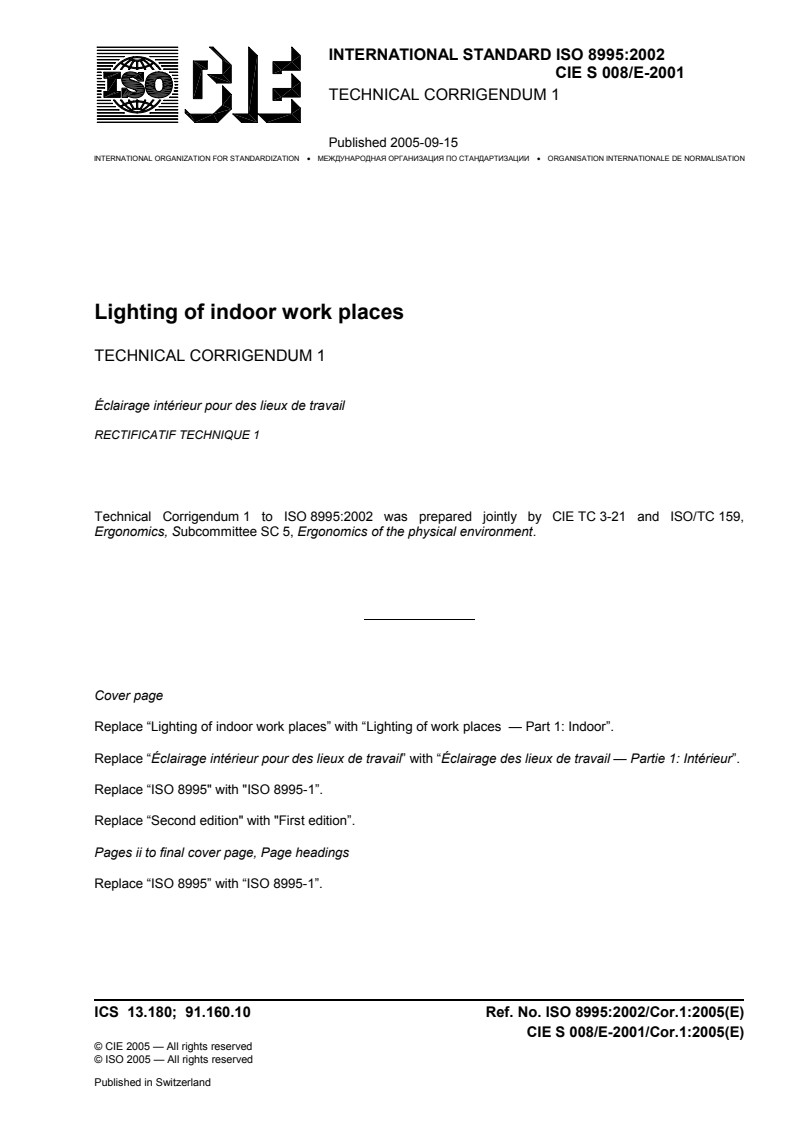
INTERNATIONAL STANDARD ISO 8995:2002
CIE S 008/E-2001
TECHNICAL CORRIGENDUM 1
Published 2005-09-15
INTERNATIONAL ORGANIZATION FOR STANDARDIZATION • МЕЖДУНАРОДНАЯ ОРГАНИЗАЦИЯ ПО СТАНДАРТИЗАЦИИ • ORGANISATION INTERNATIONALE DE NORMALISATION
Lighting of indoor work places
TECHNICAL CORRIGENDUM 1
Éclairage intérieur pour des lieux de travail
RECTIFICATIF TECHNIQUE 1
Technical Corrigendum 1 to ISO 8995:2002 was prepared jointly by CIE TC 3-21 and ISO/TC 159,
Ergonomics, Subcommittee SC 5, Ergonomics of the physical environment.
Cover page
Replace “Lighting of indoor work places” with “Lighting of work places — Part 1: Indoor”.
Replace “Éclairage intérieur pour des lieux de travail” with “Éclairage des lieux de travail — Partie 1: Intérieur”.
Replace “ISO 8995" wit
...
This May Also Interest You
This document specifies lighting requirements for humans in indoor work places, which meet the needs for visual comfort, performance and safety of people having normal, or corrected to normal visual capacity and response to light. This document specifies requirements for lighting solutions for typical indoor work places and their associated areas in terms of quantity and quality of illumination. The illumination can be provided by daylight, electric light sources, or a combination of both. This document gives recommendations for good lighting to fulfil the needs of integrative lighting. This document neither provides specific solutions nor recommendations for atmosphere or aesthetics created by lighting. It does not restrict the designers' freedom from exploring new techniques nor restrict the use of innovative equipment. This document is not applicable for emergency lighting. For emergency lighting, see ISO 30061.
- Standard109 pagesEnglish languagesale 15% off
- 30-Jan-2025
- 13.180
- 91.160.10
- ISO/TC 274
ISO/CIE 8995-3:2018 specifies the lighting requirements which will contribute to the visual needs for safety and security within outdoor work places.
- Standard12 pagesEnglish languagesale 10% offe-Library read for×1 day
- Standard7 pagesEnglish languagesale 15% off
- 08-Mar-2018
- 13.180
- 91.160.10
- ISO/TC 274
This standard specifies lighting requirements for indoor work places and for people to perform the visual tasks efficiently, in comfort and safety throughout the whole work period. This standard does not explain how lighting systems or techniques should be designed to optimise solutions for specific work places. These may be found in the relevant CIE guides and reports.
- Standard18 pagesEnglish languagesale 15% off
- 12-Jun-2002
- 13.180
- 91.160.10
- ISO/TC 274
This document provides users of interactive systems with a summary of the existing knowledge about ergonomics considerations for the influence of artificial (electric) and natural lighting of environments on humans other than on vision, with a focus on non-image-forming effects. The document can furthermore be used as guidance on the specification of use environments in consideration of non-visual effects of lighting, also called non-image-forming (NIF) functions. Therapeutic use of light and optical radiation is not part of this document.
- Technical report35 pagesEnglish languagesale 15% off
- 04-Oct-2022
- 13.100
- 13.180
- 91.160.10
- ISO/TC 159/SC 4
This document specifies a procedure for the evaluation of centreline segregation of continuously cast slabs, including sampling, sample preparation and evaluation method. This document is applicable for low carbon steel slabs for pipe production manufactured by continuous casting. These steels have a typical chemical composition as follows (mass percentages): — C ≤ 0,12 % — Mn ≤ 2,0 % — Si ≤ 0,5 % — Ti + Nb + V ≤ 0,2 % The common dimensions of these slabs are in the following ranges: — Slab width: 800 mm to 2 600 mm — Slab thickness: 150 mm to 450 mm The evaluation methods covered by this document are based on macroscopic etching of slab samples followed by visual inspection by means of human eye or camera systems. The procedures for sampling described in 5.1 to 5.3 of this document are applicable to steels slabs in general (e. g. other steel grades or dimensions). However, the etching procedure (see 5.4) in combination with the evaluation methods described in Clause 6 have been developed especially for the application on pipeline steels as given above. Thus, they are not applicable to other steel grades, product types or dimensions without a prior validation. Any extension or modification beyond the scope of this document necessitates a separate agreement between producer and customer.
- Standard19 pagesEnglish languagesale 15% off
- 11-Dec-2025
- 23.040.10
- 77.140.80
- ISO/TC 17/SC 7
This document specifies test methods to determine loss of pretension in high-strength bolts due to the presence of coatings on the faying surface(s) of a bolted joint to be used in structural steelwork, when any of the coatings are thick enough to affect the pretension in a bolt in the short term, or can show significant deformation over time under sustained loads (creep-prone materials). The presence within the grip of the bolt of other materials having considerably smaller stiffness than steel, such as insulation, is not included in this test method.
- Standard11 pagesEnglish languagesale 15% off
- 11-Dec-2025
- 91.080.13
- ISO/TC 167
This document specifies the test procedures for lithium-ion battery packs and systems used in electrically propelled mopeds and motorcycles. The specified test procedures enable the user of this document to determine the essential characteristics on performance and safety of lithium-ion battery packs and systems. It is also possible to compare the test results achieved for different battery packs or systems. This document enables setting up a dedicated test plan for an individual battery pack or system subject to an agreement between customer and supplier. If required, the relevant test procedures and/or test conditions of lithium-ion battery packs and systems are selected from the standard tests provided in this document to configure a dedicated test plan. NOTE 1 Electrically power-assisted cycles (EPAC) cannot be considered as mopeds. The definition of electrically power-assisted cycles can differ from country to country. An example of definition can be found in Reference [ REF Reference_ref_12 \r \h 7 08D0C9EA79F9BACE118C8200AA004BA90B0200000008000000110000005200650066006500720065006E00630065005F007200650066005F00310032000000 ]. NOTE 2 Testing on cell level is specified in the IEC 62660 series.
- Standard46 pagesEnglish languagesale 15% off
- 11-Dec-2025
- 43.140
- ISO/TC 22/SC 38
This document specifies a method for the qualification and quantification of certain quinoline derivatives in textile products by means of extraction with methanol and gas chromatography with mass selective detector or liquid chromatography with mass selective detector. The method is applicable to all kinds of textile products consisting of natural or artificially dyed textile fibres and fabrics. It is further applicable to dyestuff powder used as textile auxiliary for dyeing and printing.
- Standard16 pagesEnglish languagesale 15% off
- Standard18 pagesFrench languagesale 15% off
The ISO 11929 series specifies a procedure, in the field of ionizing radiation metrology, for the calculation of the “decision threshold”, the “detection limit” and the “limits of the coverage interval” for a non-negative ionizing radiation measurand when counting measurements with preselection of time or counts are carried out. The measurand results from a gross count rate and a background count rate as well as from further quantities on the basis of a model of the evaluation. In particular, the measurand can be the net count rate as the difference of the gross count rate and the background count rate, or the net activity of a sample. It can also be influenced by calibration of the measuring system, by sample treatment and by other factors. ISO 11929 has been divided into four parts covering elementary applications in ISO 11929-1, advanced applications on the basis of the GUM Supplement 1 in this document, applications to unfolding methods in ISO 11929-3, and guidance to the application in ISO 11929-4. ISO 11929-1 covers basic applications of counting measurements frequently used in the field of ionizing radiation metrology. It is restricted to applications for which the uncertainties can be evaluated on the basis of the ISO/IEC Guide 98-3 (JCGM 2008). In ISO 11929-1:2025, Annex A, the special case of repeated counting measurements with random influences is covered, while measurements with linear analogous ratemeters are covered in ISO 11929-1:2025, Annex B. ISO 11929-3 deals with the evaluation of measurements using unfolding methods and counting spectrometric multi-channel measurements if evaluated by unfolding methods, in particular, for alpha- and gamma‑spectrometric measurements. Further, it provides some advice on how to deal with correlations and covariances. ISO 11929-4 gives guidance to the application of ISO 11929, summarizes shortly the general procedure and then presents a wide range of numerical examples. Information on the statistical roots of ISO 11929 and on its current development may be found elsewhere[ REF Reference_ref_37 \r \h 30 08D0C9EA79F9BACE118C8200AA004BA90B0200000008000000110000005200650066006500720065006E00630065005F007200650066005F00330037000000 ][ REF Reference_ref_38 \r \h 31 08D0C9EA79F9BACE118C8200AA004BA90B0200000008000000110000005200650066006500720065006E00630065005F007200650066005F00330038000000 ]. ISO 11929 also applies analogously to other measurements of any kind especially if a similar model of the evaluation is involved. Further practical examples can be found, for example, in ISO 18589[ REF Reference_ref_8 \r \h 1 08D0C9EA79F9BACE118C8200AA004BA90B0200000008000000100000005200650066006500720065006E00630065005F007200650066005F0038000000 ], ISO 9696[ REF Reference_ref_9 \r \h 2 08D0C9EA79F9BACE118C8200AA004BA90B0200000008000000100000005200650066006500720065006E00630065005F007200650066005F0039000000 ], ISO 9697[ REF Reference_ref_10 \r \h 3 08D0C9EA79F9BACE118C8200AA004BA90B0200000008000000110000005200650066006500720065006E00630065005F007200650066005F00310030000000 ], ISO 9698[ REF Reference_ref_11 \r \h 4 08D0C9EA79F9BACE118C8200AA004BA90B0200000008000000110000005200650066006500720065006E00630065005F007200650066005F00310031000000 ], ISO 10703[ REF Reference_ref_12 \r \h 5 08D0C9EA79F9BACE118C8200AA004BA90B0200000008000000110000005200650066006500720065006E00630065005F007200650066005F00310032000000 ], ISO 7503[ REF Reference_ref_13 \r \h 6 08D0C9EA79F9BACE118C8200AA004BA90B0200000008000000110000005200650066006500720065006E00630065005F007200650066005F00310033000000 ], ISO 28218[ REF Reference_ref_14 \r \h 7 08D0C9EA79F9BACE118C8200AA004BA90B0200000008000000110000005200650066006500720065006E00630065005F007200650066005F00310034000000 ] and ISO 11665[ REF Reference_ref_15 \r \h 8 08D0C9EA79F9BACE118C8200AA004BA90B0200000008000000110000005200650066006500720065006E00630065005F007200650066005F00310035000000 ]. NOTE A code system, named UncertRadio, is available for calculations according t
- Standard40 pagesEnglish languagesale 15% off
- Standard41 pagesFrench languagesale 15% off
- 11-Dec-2025
- 17.240
- ISO/TC 85/SC 2
This document specifies approaches for the determination of plutonium isotopes (238Pu, 239Pu and 240Pu) in urine using alpha spectrometry or inductively coupled plasma mass spectrometry (ICP-MS). It is applicable to the measurement of plutonium isotopes at levels which are appropriate for — workers handling plutonium in planned exposure situations, where detection limits are sufficiently low to be in accordance with dose limits, and — workers, members of the public and emergency responders in emergency exposure situations, where required detection limits can be much higher, and results need to be reported in a short timescale. This document does not provide information on when monitoring is carried out or the interpretation of the results in terms of dose or biological effects.
- Standard37 pagesEnglish languagesale 15% off
- Standard39 pagesFrench languagesale 15% off
- 11-Dec-2025
- 17.240
- ISO/TC 85/SC 2


Questions, Comments and Discussion
Ask us and Technical Secretary will try to provide an answer. You can facilitate discussion about the standard in here.
Loading comments...