

ISO/IEC 24769-61:2015
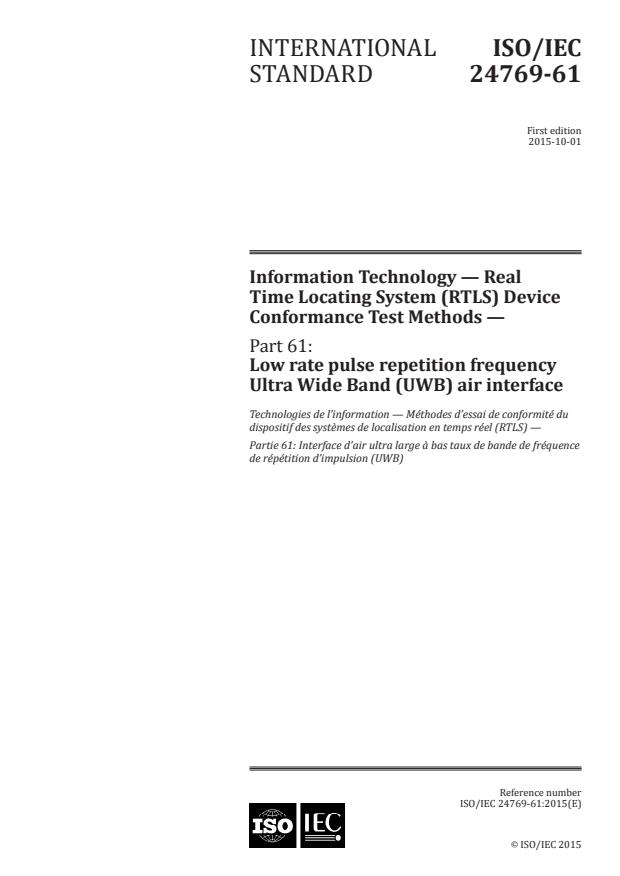
(Main)Information Technology — Real Time Locating System (RTLS) Device Conformance Test Methods — Part 61: Low rate pulse repetition frequency Ultra Wide Band (UWB) air interface
General Information
- Abstract
ISO/IEC 24769-61:2015 defines the test methods for determining the conformance of Ultra Wide Band real-time locating system (RTLS) tags with the specifications given in the corresponding parts of ISO/IEC 24730-61, but does not apply to the testing of conformity with regulatory or similar requirements. The test methods require only that the mandatory functions, and any optional functions which are implemented, be verified. This may in appropriate circumstances, be supplemented by further, application specific functionality criteria that are not available to the general case. Unless otherwise specified, the tests in ISO/IEC 24769-61:2015 apply exclusively to RTLS tags defined in ISO/IEC 24730-61.
- Status
- Published
- Publication Date
- 27-Sep-2015
- Technical Committee
- ISO/IEC JTC 1/SC 31 - Automatic identification and data capture techniques
- Drafting Committee
- ISO/IEC JTC 1/SC 31/WG 4 - Radio communications
- Current Stage
- 9093 - International Standard confirmed
- Start Date
- 26-Jun-2026
- Completion Date
- 29-Aug-2026
Buy Documents
ISO/IEC 24769-61:2015 - Information Technology -- Real Time Locating System (RTLS) Device Conformance Test Methods
ISO/IEC 24769-61:2015 - Information Technology — Real Time Locating System (RTLS) Device Conformance Test Methods — Part 61: Low rate pulse repetition frequency Ultra Wide Band (UWB) air interface/28/2015
Overview
ISO/IEC 24769-61:2015 specifies conformance test methods for Real Time Locating System (RTLS) tags that use the low rate pulse repetition frequency Ultra Wide Band (UWB) air interface defined in ISO/IEC 24730-61. The standard defines how to verify mandatory (and implemented optional) tag functions and RF behaviour - it is focused on conformance testing of RTLS tags and receivers, not regulatory compliance.
Key phrases: ISO/IEC 24769-61:2015, RTLS conformance test methods, UWB air interface, low rate pulse repetition frequency.
Key Topics
- Scope and applicability
- Conformance tests apply exclusively to RTLS tags and RF receivers described in ISO/IEC 24730-61.
- Does not replace regulatory testing (e.g., spectrum allocation or EMC compliance).
- Test environment and tolerances
- Default ambient conditions: 23 °C ± 3 °C and 25–75% relative humidity.
- Default equipment tolerance: ±5% unless otherwise specified.
- Noise-floor requirement: measured spectrum noise must be ≥60 dB below expected tag amplitude for a 0 dBm transmission at 1 m.
- Tag UWB RF transmission tests
- Equipment: anechoic chamber, calibrated antenna, spectrum analyzer (example: Agilent E4407B), RF amplifier/demodulator with ~1 ns resolution.
- Measurements: spectral mask conformity, transmit power (calculated from received power; must be within ±2.0 dB of DUT specified power), chip rate accuracy (drift requirement: <11 ns over 128 symbols), and message/PHY/LEIP structure validation.
- Test reporting: include distance to measurement antenna, measured data, post‑processing software description, and measurement uncertainties.
- Receiver UWB RF tests
- Use a tag generator capable of producing all channels and modes (Basic, Extended, Long range), short and long preambles, payload types, and LEIP.
- Tests verify detection, carrier frequency, receiver input power handling and decoding across modes and message types.
Applications
- Ensures interoperability and reliable performance of UWB RTLS tags used for indoor positioning and asset tracking.
- Relevant in sectors such as logistics, manufacturing, healthcare (asset and personnel tracking), warehousing, and smart buildings.
- Helps vendors validate product conformance before deployment and supports system integrators in selecting interoperable devices.
Who would use this standard
- RTLS device manufacturers and firmware/hardware developers
- Conformance and test laboratories performing RF characterization
- Certification bodies and procurement teams requiring documented interoperability
- System integrators and solution architects validating tag/reader compatibility
Related standards
- ISO/IEC 24730-61:2013 (UWB air interface definitions)
- ISO/IEC 24769 (other parts: Part 2 - 2.4 GHz; Part 5 - CSS 2.4 GHz; Part 62 - high rate PRF UWB)
- ISO/IEC 24770-61 (performance measurement methods)
- ISO/IEC 19762-1 and ISO/IEC 19762-3 (AIDC vocabularies)
Keywords: RTLS, UWB, ISO/IEC 24769-61:2015, conformance test methods, low rate pulse repetition frequency, spectral mask, transmit power, chip rate, tag testing.
Relations
- Effective Date
- 26-Aug-2017
Buy Documents
ISO/IEC 24769-61:2015 - Information Technology -- Real Time Locating System (RTLS) Device Conformance Test Methods
ISO/IEC 24769-61:2015 - Information Technology — Real Time Locating System (RTLS) Device Conformance Test Methods — Part 61: Low rate pulse repetition frequency Ultra Wide Band (UWB) air interface/28/2015
Get Certified
Connect with accredited certification bodies for this standard

BSI Group
BSI (British Standards Institution) is the business standards company that helps organizations make excellence a habit.

NYCE
Mexican standards and certification body.
Sponsored listings
Frequently Asked Questions
ISO/IEC 24769-61:2015 is a standard published by the International Organization for Standardization (ISO). Its full title is "Information Technology — Real Time Locating System (RTLS) Device Conformance Test Methods — Part 61: Low rate pulse repetition frequency Ultra Wide Band (UWB) air interface". This standard covers: ISO/IEC 24769-61:2015 defines the test methods for determining the conformance of Ultra Wide Band real-time locating system (RTLS) tags with the specifications given in the corresponding parts of ISO/IEC 24730-61, but does not apply to the testing of conformity with regulatory or similar requirements. The test methods require only that the mandatory functions, and any optional functions which are implemented, be verified. This may in appropriate circumstances, be supplemented by further, application specific functionality criteria that are not available to the general case. Unless otherwise specified, the tests in ISO/IEC 24769-61:2015 apply exclusively to RTLS tags defined in ISO/IEC 24730-61.
ISO/IEC 24769-61:2015 defines the test methods for determining the conformance of Ultra Wide Band real-time locating system (RTLS) tags with the specifications given in the corresponding parts of ISO/IEC 24730-61, but does not apply to the testing of conformity with regulatory or similar requirements. The test methods require only that the mandatory functions, and any optional functions which are implemented, be verified. This may in appropriate circumstances, be supplemented by further, application specific functionality criteria that are not available to the general case. Unless otherwise specified, the tests in ISO/IEC 24769-61:2015 apply exclusively to RTLS tags defined in ISO/IEC 24730-61.
ISO/IEC 24769-61:2015 is classified under the following ICS (International Classification for Standards) categories: 35.040 - Information coding; 35.040.50 - Automatic identification and data capture techniques. The ICS classification helps identify the subject area and facilitates finding related standards.
ISO/IEC 24769-61:2015 has the following relationships with other standards: It is inter standard links to ISO/IEC TR 24769:2008. Understanding these relationships helps ensure you are using the most current and applicable version of the standard.
ISO/IEC 24769-61:2015 is available in PDF format for immediate download after purchase. The document can be added to your cart and obtained through the secure checkout process. Digital delivery ensures instant access to the complete standard document.
Standards Content (Sample)
INTERNATIONAL ISO/IEC
STANDARD 24769-61
First edition
2015-10-01
Information Technology — Real
Time Locating System (RTLS) Device
Conformance Test Methods —
Part 61:
Low rate pulse repetition frequency
Ultra Wide Band (UWB) air interface
Technologies de l’information — Méthodes d’essai de conformité du
dispositif des systèmes de localisation en temps réel (RTLS) —
Partie 61: Interface d’air ultra large à bas taux de bande de fréquence
de répétition d’impulsion (UWB)
Reference number
©
ISO/IEC 2015
© ISO/IEC 2015, Published in Switzerland
All rights reserved. Unless otherwise specified, no part of this publication may be reproduced or utilized otherwise in any form
or by any means, electronic or mechanical, including photocopying, or posting on the internet or an intranet, without prior
written permission. Permission can be requested from either ISO at the address below or ISO’s member body in the country of
the requester.
ISO copyright office
Ch. de Blandonnet 8 • CP 401
CH-1214 Vernier, Geneva, Switzerland
Tel. +41 22 749 01 11
Fax +41 22 749 09 47
copyright@iso.org
www.iso.org
ii © ISO/IEC 2015 – All rights reserved
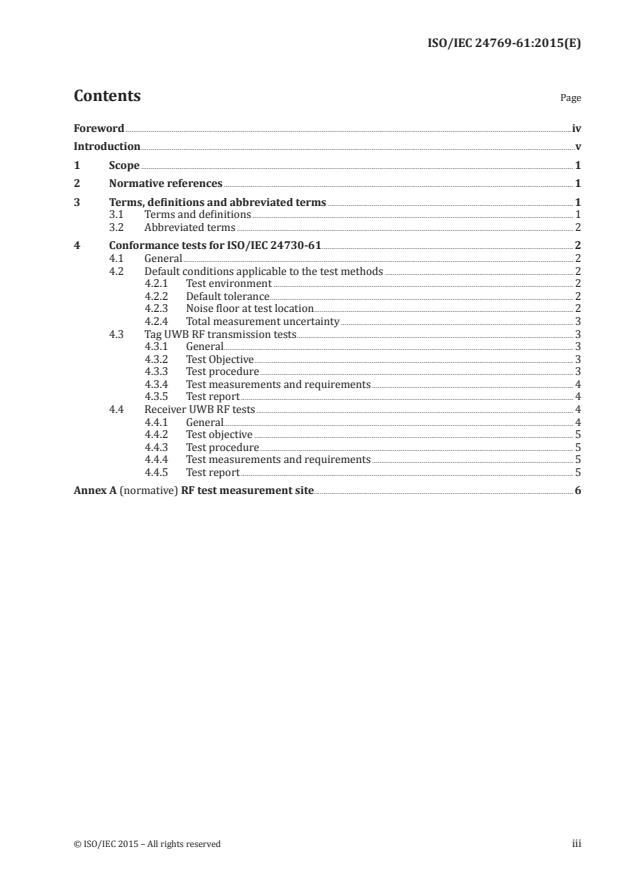
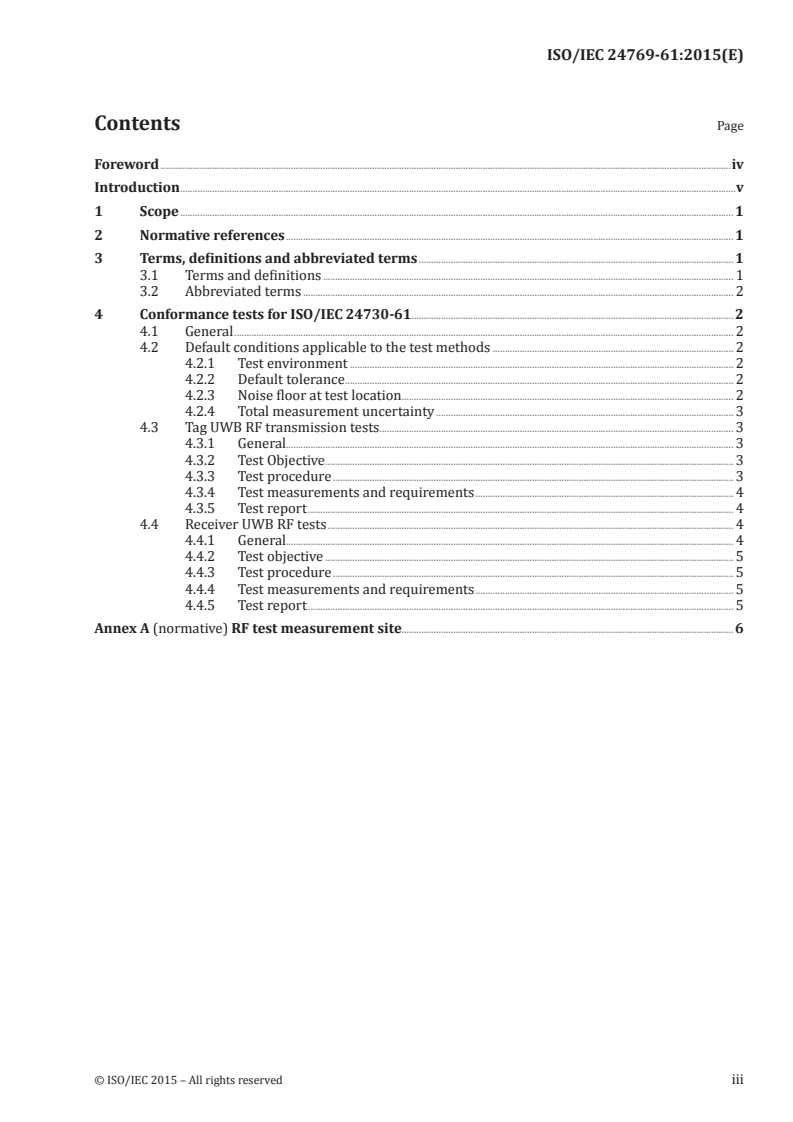
Contents Page
Foreword .iv
Introduction .v
1 Scope . 1
2 Normative references . 1
3 Terms, definitions and abbreviated terms . 1
3.1 Terms and definitions . 1
3.2 Abbreviated terms . 2
4 Conformance tests for ISO/IEC 24730-61. 2
4.1 General . 2
4.2 Default conditions applicable to the test methods . 2
4.2.1 Test environment . 2
4.2.2 Default tolerance . 2
4.2.3 Noise floor at test location. 2
4.2.4 Total measurement uncertainty . 3
4.3 Tag UWB RF transmission tests . . 3
4.3.1 General. 3
4.3.2 Test Objective . 3
4.3.3 Test procedure . 3
4.3.4 Test measurements and requirements . 4
4.3.5 Test report . 4
4.4 Receiver UWB RF tests . 4
4.4.1 General. 4
4.4.2 Test objective . 5
4.4.3 Test procedure . 5
4.4.4 Test measurements and requirements . 5
4.4.5 Test report . 5
Annex A (normative) RF test measurement site. 6
© ISO/IEC 2015 – All rights reserved iii
Foreword
ISO (the International Organization for Standardization) and IEC (the International Electrotechnical
Commission) form the specialized system for worldwide standardization. National bodies that are
members of ISO or IEC participate in the development of International Standards through technical
committees established by the respective organization to deal with particular fields of technical
activity. ISO and IEC technical committees collaborate in fields of mutual interest. Other international
organizations, governmental and non-governmental, in liaison with ISO and IEC, also take part in the
work. In the field of information technology, ISO and IEC have established a joint technical committee,
ISO/IEC JTC 1.
The procedures used to develop this document and those intended for its further maintenance are
described in the ISO/IEC Directives, Part 1. In particular the different approval criteria needed for
the different types of document should be noted. This document was drafted in accordance with the
editorial rules of the ISO/IEC Directives, Part 2 (see www.iso.org/directives).
Attention is drawn to the possibility that some of the elements of this document may be the subject
of patent rights. ISO and IEC shall not be held responsible for identifying any or all such patent
rights. Details of any patent rights identified during the development of the document will be in the
Introduction and/or on the ISO list of patent declarations received (see www.iso.org/patents).
Any trade name used in this document is information given for the convenience of users and does not
constitute an endorsement.
For an explanation on the meaning of ISO specific terms and expressions related to conformity
assessment, as well as information about ISO’s adherence to the WTO principles in the Technical
Barriers to Trade (TBT), see the following URL: Foreword — Supplementary information.
The committee responsible for this document is ISO/IEC JTC 1, Information technology, Subcommittee
SC 31, Automatic identification and data capture techniques.
ISO/IEC 24769 consists of the following parts, under the general title Information technology — Real-
time locating systems (RTLS) device conformance test methods:
— Part 2: Test methods for air interface communication at 2,4 GHz
— Part 5: Test methods for chirp spread spectrum (CSS) at 2,4 GHz air interface
— Part 61: Low rate pulse repetition frequency Ultra Wide Band (UWB) air interface
— Part 62: High rate pulse repetition frequency Ultra Wide Band (UWB) air interface
iv © ISO/IEC 2015 – All rights reserved
Introduction
ISO/IEC 24730-61 defines the air interfaces and an application programming interface for Real Time
Locating Systems (RTLS) devices used in asset management applications.
This International Standard contains all measurements required to be made on a product in order to
establish whether it conforms to ISO/IEC 24730-61.
Test methods for measuring performance of equipment compliant with ISO/IEC 24730-61 are given in
ISO/IEC 24770-61
© ISO/IEC 2015 – All rights reserved v
INTERNATIONAL STANDARD ISO/IEC 24769-61:2015(E)
Information Technology — Real Time Locating System
(RTLS) Device Conformance Test Methods —
Part 61:
Low rate pulse repetition frequency Ultra Wide Band
(UWB) air interface
1 Scope
This International Standard defines the test methods for determining the conformance of Ultra
Wide Band real-time locating system (RTLS) tags with the specifications given in the corresponding
parts of ISO/IEC 24730-61, but does not apply to the testing of conformity with regulatory or similar
requirements.
The test methods require only that the mandatory functions, and any optional functions which
are implemented, be verified. This may in appropriate circumstances, be supplemented by further,
application specific functionality criteria that are not available to the general case.
Unless otherwise specified, the tests in this International Standar
...
INTERNATIONAL ISO/IEC
STANDARD 24769-61
First edition
2015-10-01
Information Technology — Real
Time Locating System (RTLS) Device
Conformance Test Methods —
Part 61:
Low rate pulse repetition frequency
Ultra Wide Band (UWB) air interface
Technologies de l’information — Méthodes d’essai de conformité du
dispositif des systèmes de localisation en temps réel (RTLS) —
Partie 61: Interface d’air ultra large à bas taux de bande de fréquence
de répétition d’impulsion (UWB)
Reference number
©
ISO/IEC 2015
© ISO/IEC 2015, Published in Switzerland
All rights reserved. Unless otherwise specified, no part of this publication may be reproduced or utilized otherwise in any form
or by any means, electronic or mechanical, including photocopying, or posting on the internet or an intranet, without prior
written permission. Permission can be requested from either ISO at the address below or ISO’s member body in the country of
the requester.
ISO copyright office
Ch. de Blandonnet 8 • CP 401
CH-1214 Vernier, Geneva, Switzerland
Tel. +41 22 749 01 11
Fax +41 22 749 09 47
copyright@iso.org
www.iso.org
ii © ISO/IEC 2015 – All rights reserved
Contents Page
Foreword .iv
Introduction .v
1 Scope . 1
2 Normative references . 1
3 Terms, definitions and abbreviated terms . 1
3.1 Terms and definitions . 1
3.2 Abbreviated terms . 2
4 Conformance tests for ISO/IEC 24730-61. 2
4.1 General . 2
4.2 Default conditions applicable to the test methods . 2
4.2.1 Test environment . 2
4.2.2 Default tolerance . 2
4.2.3 Noise floor at test location. 2
4.2.4 Total measurement uncertainty . 3
4.3 Tag UWB RF transmission tests . . 3
4.3.1 General. 3
4.3.2 Test Objective . 3
4.3.3 Test procedure . 3
4.3.4 Test measurements and requirements . 4
4.3.5 Test report . 4
4.4 Receiver UWB RF tests . 4
4.4.1 General. 4
4.4.2 Test objective . 5
4.4.3 Test procedure . 5
4.4.4 Test measurements and requirements . 5
4.4.5 Test report . 5
Annex A (normative) RF test measurement site. 6
© ISO/IEC 2015 – All rights reserved iii
Foreword
ISO (the International Organization for Standardization) and IEC (the International Electrotechnical
Commission) form the specialized system for worldwide standardization. National bodies that are
members of ISO or IEC participate in the development of International Standards through technical
committees established by the respective organization to deal with particular fields of technical
activity. ISO and IEC technical committees collaborate in fields of mutual interest. Other international
organizations, governmental and non-governmental, in liaison with ISO and IEC, also take part in the
work. In the field of information technology, ISO and IEC have established a joint technical committee,
ISO/IEC JTC 1.
The procedures used to develop this document and those intended for its further maintenance are
described in the ISO/IEC Directives, Part 1. In particular the different approval criteria needed for
the different types of document should be noted. This document was drafted in accordance with the
editorial rules of the ISO/IEC Directives, Part 2 (see www.iso.org/directives).
Attention is drawn to the possibility that some of the elements of this document may be the subject
of patent rights. ISO and IEC shall not be held responsible for identifying any or all such patent
rights. Details of any patent rights identified during the development of the document will be in the
Introduction and/or on the ISO list of patent declarations received (see www.iso.org/patents).
Any trade name used in this document is information given for the convenience of users and does not
constitute an endorsement.
For an explanation on the meaning of ISO specific terms and expressions related to conformity
assessment, as well as information about ISO’s adherence to the WTO principles in the Technical
Barriers to Trade (TBT), see the following URL: Foreword — Supplementary information.
The committee responsible for this document is ISO/IEC JTC 1, Information technology, Subcommittee
SC 31, Automatic identification and data capture techniques.
ISO/IEC 24769 consists of the following parts, under the general title Information technology — Real-
time locating systems (RTLS) device conformance test methods:
— Part 2: Test methods for air interface communication at 2,4 GHz
— Part 5: Test methods for chirp spread spectrum (CSS) at 2,4 GHz air interface
— Part 61: Low rate pulse repetition frequency Ultra Wide Band (UWB) air interface
— Part 62: High rate pulse repetition frequency Ultra Wide Band (UWB) air interface
iv © ISO/IEC 2015 – All rights reserved
Introduction
ISO/IEC 24730-61 defines the air interfaces and an application programming interface for Real Time
Locating Systems (RTLS) devices used in asset management applications.
This International Standard contains all measurements required to be made on a product in order to
establish whether it conforms to ISO/IEC 24730-61.
Test methods for measuring performance of equipment compliant with ISO/IEC 24730-61 are given in
ISO/IEC 24770-61
© ISO/IEC 2015 – All rights reserved v
INTERNATIONAL STANDARD ISO/IEC 24769-61:2015(E)
Information Technology — Real Time Locating System
(RTLS) Device Conformance Test Methods —
Part 61:
Low rate pulse repetition frequency Ultra Wide Band
(UWB) air interface
1 Scope
This International Standard defines the test methods for determining the conformance of Ultra
Wide Band real-time locating system (RTLS) tags with the specifications given in the corresponding
parts of ISO/IEC 24730-61, but does not apply to the testing of conformity with regulatory or similar
requirements.
The test methods require only that the mandatory functions, and any optional functions which
are implemented, be verified. This may in appropriate circumstances, be supplemented by further,
application specific functionality criteria that are not available to the general case.
Unless otherwise specified, the tests in this International Standar
...