

ISO/IEC 15944-9:2023
(Main)Information technology — Business operational view — Part 9: Business transaction traceability framework for commitment exchange
General Information
- Abstract
This document: — specifies a group of structured and inter-related concepts pertaining to traceability as a legal or regulatory requirement in the Open-edi context, in addition to concepts that appear in other parts of ISO/IEC 15944 series these concepts having the characteristics of cultural adaptability through the use of multilingual terms and definitions; — provides additional specifications for Open-edi scenarios and scenario components from the perspective of traceability as required by internal or external constraints in business transactions; — provides a more detailed specification for business transactions regarding aspects of traceability, including refined models of Person, Data and Process in support of the ability for Open-edi to incorporate elements or characteristics of traceability in its information bundles (including their semantic components) and business processes; — realizes specifications and descriptions from the traceability requirements as rules and guidelines, to provide recommendations or guidance on Open-edi practices; and, — provides revised primitive Open-edi scenario templates for traceability, integrating the modifications to the template from other existing parts of ISO/IEC 15944 series. This document can be used by Open-edi implementers (including business modellers and system designers) and Open-edi standard developers in specifying Open-edi scenarios, developing Open-edi related standards, and implementing Open-edi rules and guidelines for Open-edi activities. This document does not specify the FSV aspects of traceability, internal behaviour requirements of an organization, or traceability as a metrological concept. Detailed exclusions to the scope of this document are provided in Annex H.
- Status
- Published
- Publication Date
- 05-Jun-2023
- Technical Committee
- ISO/IEC JTC 1/SC 32 - Data management and interchange
- Drafting Committee
- ISO/IEC JTC 1/SC 32/WG 1 - eBusiness
- Current Stage
- 6060 - International Standard published
- Start Date
- 06-Jun-2023
- Due Date
- 30-Apr-2022
- Completion Date
- 06-Jun-2023

Overview
ISO/IEC 15944-9:2023 - part of the ISO/IEC 15944 business operational view series - defines a business transaction traceability framework for commitment exchange in Open-edi environments. The standard specifies structured, multilingual concepts and models for traceability as a legal or regulatory requirement. It refines models of Person, Data and Process, defines traceability data content and templates, and provides rules and guidelines to help implement traceability into Open-edi scenarios and business processes.
Key topics and technical requirements
- Traceability principles: unambiguous identification, record-keeping, defined level of granularity, ensuring traceability among parties, and precision in temporal/location referencing.
- Traceability reference model: models the traceability concepts and the role of traceability data within a business transaction.
- Traceability data specifications: predefined and structured traceability data, required contents (IDs, state changes, retention rules), data sharing and interoperability of identification schemas.
- Requirements on transaction components: obligations for Person, Process and Data elements in commitment exchange; special considerations for regulators, buyers and privacy protection for individuals.
- Collaboration space: Open-edi collaboration models including buyer, seller and regulator roles and how external constraints affect traceability.
- Scenario templates and attributes: revised primitive Open-edi templates to integrate traceability requirements for scenario scoping.
- Annexes and guidance: controlled vocabularies (HIEs), GS1 glossary introduction, date/time referencing, mapping of identifiers, sample regulations and exclusions.
Practical applications and who uses it
ISO/IEC 15944-9:2023 is intended for:
- Open-edi implementers - business modellers and system designers specifying transaction scenarios and building interoperable systems that must support legal/regulatory traceability.
- Standards developers - creating or updating Open-edi related standards and identification schemas.
- Compliance, supply chain and IT architects - as a reference for designing traceable commitment exchanges, data retention and auditability in digital commerce.
- Regulators and auditors - useful as a normative reference for assessing traceability controls in electronic business transactions.
Use cases include regulatory reporting, supply chain provenance, e-invoicing and automated auditing where reliable identification, event state tracking and interoperable traceability data are required.
Related standards
- Part of the ISO/IEC 15944 series (business operational view).
- Cross-references and informative material include ISO/IEC 15944‑5:2008 (business location) and GS1 terminology (annexes provide mapping and examples).
Keywords: ISO/IEC 15944-9:2023, traceability framework, Open-edi, business transaction traceability, commitment exchange, traceability data, identification, record-keeping.
Relations
- Effective Date
- 23-Apr-2020
Get Certified
Connect with accredited certification bodies for this standard

BSI Group
BSI (British Standards Institution) is the business standards company that helps organizations make excellence a habit.

NYCE
Mexican standards and certification body.
Sponsored listings
Frequently Asked Questions
ISO/IEC 15944-9:2023 is a standard published by the International Organization for Standardization (ISO). Its full title is "Information technology — Business operational view — Part 9: Business transaction traceability framework for commitment exchange". This standard covers: This document: — specifies a group of structured and inter-related concepts pertaining to traceability as a legal or regulatory requirement in the Open-edi context, in addition to concepts that appear in other parts of ISO/IEC 15944 series these concepts having the characteristics of cultural adaptability through the use of multilingual terms and definitions; — provides additional specifications for Open-edi scenarios and scenario components from the perspective of traceability as required by internal or external constraints in business transactions; — provides a more detailed specification for business transactions regarding aspects of traceability, including refined models of Person, Data and Process in support of the ability for Open-edi to incorporate elements or characteristics of traceability in its information bundles (including their semantic components) and business processes; — realizes specifications and descriptions from the traceability requirements as rules and guidelines, to provide recommendations or guidance on Open-edi practices; and, — provides revised primitive Open-edi scenario templates for traceability, integrating the modifications to the template from other existing parts of ISO/IEC 15944 series. This document can be used by Open-edi implementers (including business modellers and system designers) and Open-edi standard developers in specifying Open-edi scenarios, developing Open-edi related standards, and implementing Open-edi rules and guidelines for Open-edi activities. This document does not specify the FSV aspects of traceability, internal behaviour requirements of an organization, or traceability as a metrological concept. Detailed exclusions to the scope of this document are provided in Annex H.
This document: — specifies a group of structured and inter-related concepts pertaining to traceability as a legal or regulatory requirement in the Open-edi context, in addition to concepts that appear in other parts of ISO/IEC 15944 series these concepts having the characteristics of cultural adaptability through the use of multilingual terms and definitions; — provides additional specifications for Open-edi scenarios and scenario components from the perspective of traceability as required by internal or external constraints in business transactions; — provides a more detailed specification for business transactions regarding aspects of traceability, including refined models of Person, Data and Process in support of the ability for Open-edi to incorporate elements or characteristics of traceability in its information bundles (including their semantic components) and business processes; — realizes specifications and descriptions from the traceability requirements as rules and guidelines, to provide recommendations or guidance on Open-edi practices; and, — provides revised primitive Open-edi scenario templates for traceability, integrating the modifications to the template from other existing parts of ISO/IEC 15944 series. This document can be used by Open-edi implementers (including business modellers and system designers) and Open-edi standard developers in specifying Open-edi scenarios, developing Open-edi related standards, and implementing Open-edi rules and guidelines for Open-edi activities. This document does not specify the FSV aspects of traceability, internal behaviour requirements of an organization, or traceability as a metrological concept. Detailed exclusions to the scope of this document are provided in Annex H.
ISO/IEC 15944-9:2023 is classified under the following ICS (International Classification for Standards) categories: 35.240.63 - IT applications in trade. The ICS classification helps identify the subject area and facilitates finding related standards.
ISO/IEC 15944-9:2023 has the following relationships with other standards: It is inter standard links to ISO/IEC 15944-9:2015. Understanding these relationships helps ensure you are using the most current and applicable version of the standard.
ISO/IEC 15944-9:2023 is available in PDF format for immediate download after purchase. The document can be added to your cart and obtained through the secure checkout process. Digital delivery ensures instant access to the complete standard document.
Standards Content (Sample)
INTERNATIONAL ISO/IEC
STANDARD 15944-9
Second edition
2023-06
Information technology — Business
operational view —
Part 9:
Business transaction traceability
framework for commitment exchange
Technologies de l'information — Vue opérationnelle des affaires —
Partie 9: Cadre de traçabilité des transactions d'affaires pour
l'échange d'engagements
Reference number
© ISO/IEC 2023
© ISO/IEC 2023
All rights reserved. Unless otherwise specified, or required in the context of its implementation, no part of this publication may
be reproduced or utilized otherwise in any form or by any means, electronic or mechanical, including photocopying, or posting on
the internet or an intranet, without prior written permission. Permission can be requested from either ISO at the address below
or ISO’s member body in the country of the requester.
ISO copyright office
CP 401 • Ch. de Blandonnet 8
CH-1214 Vernier, Geneva
Phone: +41 22 749 01 11
Email: copyright@iso.org
Website: www.iso.org
Published in Switzerland
ii
© ISO/IEC 2023 – All rights reserved
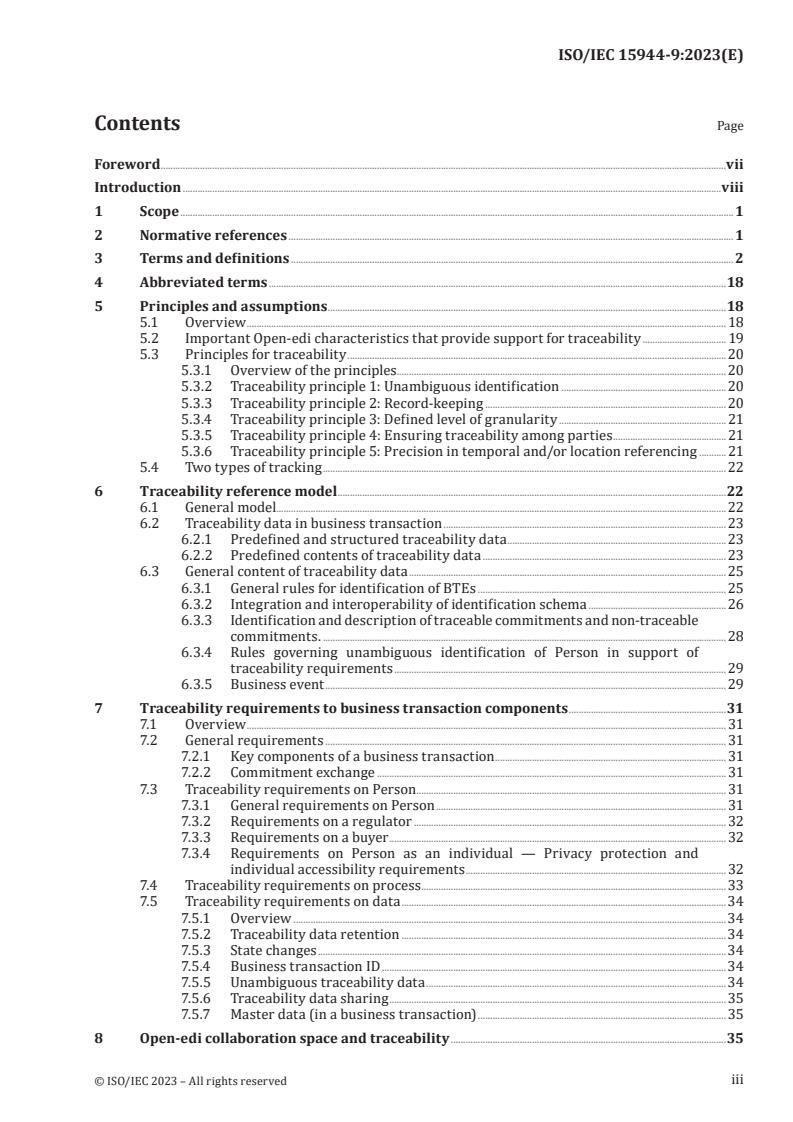
Contents Page
Foreword .vii
Introduction .viii
1 Scope . 1
2 Normative references . 1
3 Terms and definitions . 2
4 Abbreviated terms .18
5 Principles and assumptions .18
5.1 Overview . 18
5.2 Important Open-edi characteristics that provide support for traceability . 19
5.3 Principles for traceability .20
5.3.1 Overview of the principles. 20
5.3.2 Traceability principle 1: Unambiguous identification .20
5.3.3 Traceability principle 2: Record-keeping . 20
5.3.4 Traceability principle 3: Defined level of granularity . 21
5.3.5 Traceability principle 4: Ensuring traceability among parties . 21
5.3.6 Traceability principle 5: Precision in temporal and/or location referencing . 21
5.4 Two types of tracking . 22
6 Traceability reference model .22
6.1 General model . . .22
6.2 Traceability data in business transaction . 23
6.2.1 Predefined and structured traceability data . 23
6.2.2 Predefined contents of traceability data . 23
6.3 General content of traceability data . 25
6.3.1 General rules for identification of BTEs . 25
6.3.2 Integration and interoperability of identification schema .26
6.3.3 Identification and description of traceable commitments and non-traceable
commitments. .28
6.3.4 Rules governing unambiguous identification of Person in support of
traceability requirements .29
6.3.5 Business event .29
7 Traceability requirements to business transaction components .31
7.1 Overview . 31
7.2 General requirements . 31
7.2.1 Key components of a business transaction . 31
7.2.2 Commitment exchange . 31
7.3 Traceability requirements on Person . 31
7.3.1 General requirements on Person . 31
7.3.2 Requirements on a regulator . 32
7.3.3 Requirements on a buyer . 32
7.3.4 Requirements on Person as an individual — Privacy protection and
individual accessibility requirements . 32
7.4 Traceability requirements on process . 33
7.5 Traceability requirements on data .34
7.5.1 Overview .34
7.5.2 Traceability data retention .34
7.5.3 State changes .34
7.5.4 Business transaction ID .34
7.5.5 Unambiguous traceability data .34
7.5.6 Traceability data sharing . 35
7.5.7 Master data (in a business transaction) . 35
8 Open-edi collaboration space and traceability .35
iii
© ISO/IEC 2023 – All rights reserved
8.1 Overview . 35
8.2 Basic Open-edi collaboration space: Independent view of traceability .36
8.3 Collaboration space: Roles of buyer, seller and regulator .36
9 Traceability attributes for Open-edi scenario .37
9.1 Overview . 37
9.2 Template structure and contents . 37
9.3 Template for specifying the scope of an Open-edi scenario — Traceability
requirements perspective . 37
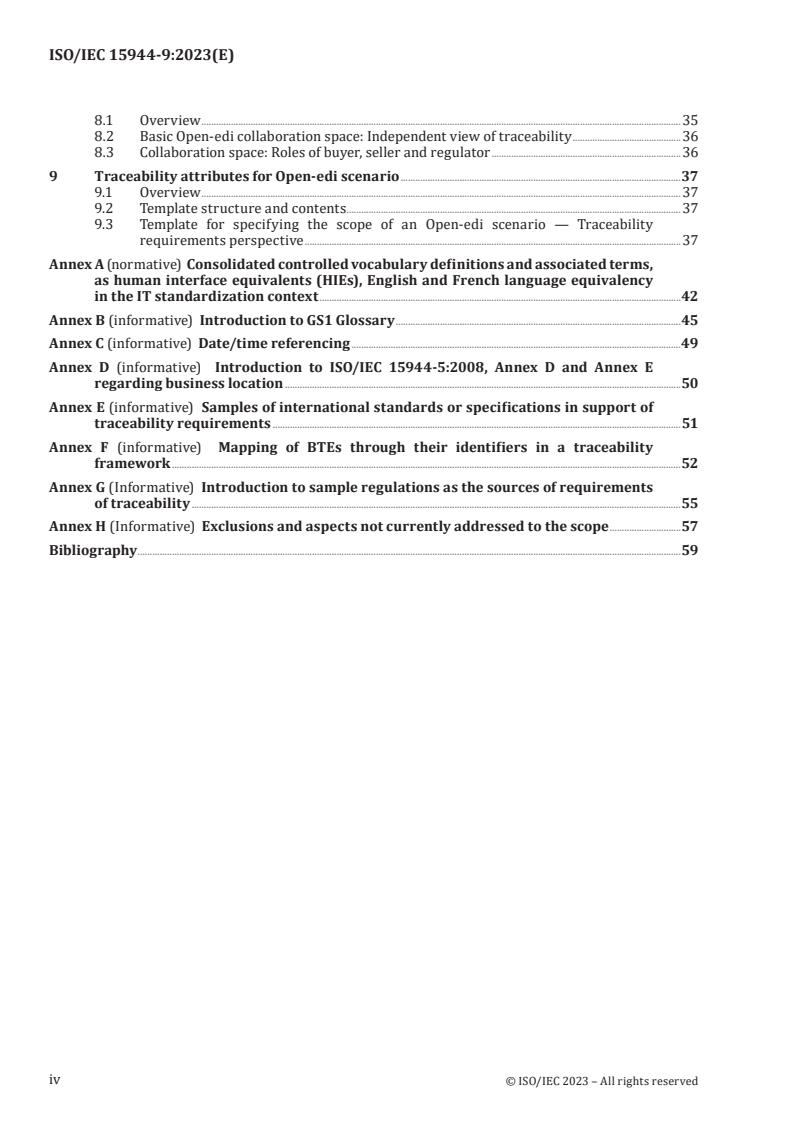
Annex A (normative) Consolidated controlled vocabulary definitions and associated terms,
as human interface equivalents (HIEs), English and French language equivalency
in the IT standardization context .42
Annex B (informative) Introduction to GS1 Glossary .45
Annex C (informative) Date/time referencing .49
Annex D (informative) Introduction to ISO/IEC 15944-5:2008, Annex D and Annex E
regarding business location .50
Annex E (informative) Samples of international standards or specifications in support of
traceability requirements .51
Annex F (informative) Mapping of BTEs through their identifiers in a traceability
framework .52
Annex G (Informative) Introduction to sample regulations as the sources of requirements
of traceability .55
Annex H (Informative) Exclusions and aspects not currently addressed to the scope .57
Bibliography .59
iv
© ISO/IEC 2023 – All rights reserved
List of Figures
Figure 1 — Open-edi environment .ix
Figure 2 — Integrated view — Business Operational Requirements .xi
Figure 3 — Model of traceability concepts .22
Figure 4 — Focus of BOV Open-edi standardization work required by traceability —
Predefined and structured traceability data .23
Figure 5 — Content model for traceability in a business transaction .24
Figure 6 — Identification radar: What it covers .26
Figure 7 — Commitments including traceable and non-traceable commitments .28
Figure 8 — Information model of business event .30
Figure 9 — Collaboration space with regulator as external constraints of traceability .36
Figure F.1 — Entity and entity Mapping .52
Figure F.2 — Chain of commitment exchange traceability mapping among entity identifiers .53
Figure F.3 — Traceability route in a food business transaction with multi-parties .54
v
© ISO/IEC 2023 – All rights reserved
List of Tables
Table 1 — Attributes for scenario scoping .37
vi
© ISO/IEC 2023 – All rights reserved
Foreword
ISO (the International Organization for Standardization) and IEC (the International Electrotechnical
Commission) form the specialized system for worldwide standardization. National bodies that are
members of ISO or IEC participate in the development of International Standards through technical
committees established by the respective organization to deal with particular fields of technical
activity. ISO and IEC technical committees collaborate in fields of mutual interest. Other international
organizations, governmental and non-governmental, in liaison with ISO and IEC, also take part in the
work.
The procedures used to develop this document and those intended for its further maintenance
are described in the ISO/IEC Directives, Part 1. In particular, the different approval criteria
needed for the different types of document should be noted. This document was drafted in
accordance with the editorial rules of the ISO/IEC Directives, Part 2 (see www.iso.org/directives or
www.iec.ch/members_experts/refdocs).
ISO and IEC draw attention to the possibility that the implementation of this document may involve the
use of (a) patent(s). ISO and IEC take no position concerning the evidence, validity or applicability of
any claimed patent rights in respect thereof. As of the date of publication of this document, ISO and IEC
had not received notice of (a) patent(s) which may be required to implement this document. However,
implementers are cautioned that this may not represent the latest information, which may be obtained
from the patent database available at www.iso.org/patents and https://patents.iec.ch. ISO and IEC shall
not be held responsible for identifying any or all such patent rights.
Any trade name used in this document is information given for the convenience of users and does not
constitute an endorsement.
For an explanation of the voluntary nature of standards, the meaning of ISO specific terms and
expressions related to conformity assessment, as well as information about ISO's adherence to
the World Trade Organization (WTO) principles in the Technical Barriers to Trade (TBT) see
www.iso.org/iso/foreword.html. In the IEC, see www.iec.ch/understanding-standards.
This document was prepared by Joint Technical Committee ISO/IEC JTC 1, Information technology,
Subcommittee SC 32, Data management and interchange.
This second edition cancels and replaced the first edition (ISO/IEC 15944-9:2015), which has been
technically revised.
The main changes are as follows:
— Clause 1 (Scope) has been amended to move the detailed description of "Exclusions" and "Aspects
not currently addressed" to a separate informative annex;
— entries in Clause 2 and Clause 3 have been removed to be more conformant to ISO Directives;
— definitions in Clause 3 have been updated to be aligned with other referenced source definitions;
— clauses and annexes have been aligned to changes in ISO/IEC JTC1 Directives, Part 2;
— there are minor edits of a temporal nature with respect to dated references, changes in URLs
referenced, minor edits, change of font to Cambria, as well as application of the new “ISO House
Style”, etc.
A list of all parts in the ISO/IEC 15944 series can be found on the ISO and IEC websites.
Any feedback or questions on this document should be directed to the user’s national standards
body. A complete listing of these bodies can be found at www.iso.org/members.html and
www.iec.ch/national-committees.
vii
© ISO/IEC 2023 – All rights reserved
Introduction
0.1 Purpose and overview
Modelling of a business transaction through scenarios and scenario components is done through
specifying the applicable constraints using explicitly stated rules. The Open-edi Reference Model
identified two basic classes of constraints, namely, “internal constraints” and “external constraints”.
External constraints apply to most business transactions.
Jurisdictional domains are the primary source of external constraints on a business transaction.
Traceability requirements in turn are a common requirement of most jurisdictional domains, although
they may result from explicit scenario demands from or on the parties to a business transaction, as
well as the goal, i.e., nature of the business transaction. The internal constraints are imposed in Open-
edi due to mutual agreements among parties to a business transaction and the external constraints
are invoked by the nature of a business transaction due to applicable laws, regulations, policies, etc. of
jurisdictional domains which need to be considered in Open-edi business transactions. All requirements
in this document originate from external constraints. However, parties to a business transaction may
well by mutual agreement apply external constraints of this nature as internal constraints.
In the actualization and post-actualization phases of a business transaction, traceability is needed for
the movement of goods, services and/or rights from seller to buyer, and for the associated payment
from buyer to seller. The focus therefore of this traceability framework standard is on commitment
exchange among autonomous parties to a business transaction.
This document presents a framework consisting of several models, including a reference model, a model
of concepts, a content model, an information model, as well as rules, templates and other technical
specifications for traceability requirements based on internal or external constraints as applicable to a
business transaction.
0.2 ISO/IEC 14662 “Open-edi Reference Model”
1)
ISO/IEC 14662 provides the conceptual architecture necessary for carrying out electronic business
transactions among autonomous parties. That architecture identifies and describes the need to have
two separate and related views of the business transaction. The first is the Business Operational View
(BOV), the second is the Functional Service View (FSV). ISO/IEC 14662:2010, Figure 1 illustrates the
Open-edi environment.
rd
1) ISO/IEC 14662(E/F) is an English/French, side-by-side, International Standard. Its 2010 3 edition has become
a stabilized standard and is now also an ISO/IEC declared “horizontal” standard, i.e., one serving as a base standard for
those developing standards in the various fields of EDI, including eBusiness. The stabilized status of ISO/IEC 14662
st
was re-affirmed for another 10 years by ISO/IEC JTC1 in 2021. ISO/IEC 14662 has since its 1997 1 edition been an
ISO/SO freely available standard. [See further https://standards.iso.org/ittf/PubliclyAvailableStandards/index.html
]
viii
© ISO/IEC 2023 – All rights reserved
Figure 1 — Open-edi environment
According to ISO/IEC 14662:2010, Clause 5:
“The intention is that the sending, by an Open-edi Party, of information from a scenario, conforming to
Open-edi standards, shall allow the acceptance and processing of that information in the context of that
scenario by one or more Open-edi Parties by reference to the scenario and without the need for agreement.
However, the legal requirements and/or liabilities resulting from the engagement of an organization in
any Open-edi transaction may be conditioned by the competent legal environment(s) of the formation of
a legal interchange agreement among the participating organizations. Open-edi Parties need to observe
rule-based behaviour and possess the ability to make commitments in Open-edi, (e.g., business, operational,
technical, legal, and/or audit perspectives)”.
See also ISO/IEC 14662:2010, Figure A.1.
This document is a BOV standard which focuses on the business operational view (including internal
constraints as well as external constraints) for the application of traceability from an Open-edi
perspective, and, as required, follow-up standards development in support of the “Open-edi Reference
Model”.
The purpose of this document includes identifying the means by which laws and regulations of a
jurisdictional domain impact scenarios and scenario components as external constraints and how they
are modelled and represented.
Finally, it is noted that the approach taken in ISO/IEC 15944-1:2023, Clause 7 is, as stated in
ISO/IEC 15944-1:2023, 7.1:
“. that of identifying the most primitive common components of a business transaction and then moving
from the general to the more detailed, the simplest aspects to the more complex, from no external constraints
on a business transaction to those which incorporate external constraints, from no special requirements on
functional services to specific requirements, and so on”.
This document focuses on addressing generally definable aspects of both internal constraints relating
to traceability which is mutually agreed to by parties to a business transaction, and external constraints
for which the source is a jurisdictional domain. A useful characteristic of external constraints is that at
the sector level, national and international levels, etc., focal points and recognized authorities often
already exist. The rules and common business practices in many sectorial areas are already known.
Use of ISO/IEC 15944 series (and related standards) will facilitate the transformation of these external
constraints as business rules (see 0.5) into specified, registered, and re-useable scenarios and scenario
components.
ix
© ISO/IEC 2023 – All rights reserved
0.3 ISO/IEC 15944-1: Business Operational View (BOV) — Operational aspects of Open-edi for
implementation
ISO/IEC 15944-1 identifies and enumerates the many requirements of the BOV aspects of Open-edi in
support of electronic business transactions. These requirements need to be taken into account in the
development of business semantic descriptive techniques for modelling e-business transactions and
components thereof as re-useable business objects. They include:
a) commercial frameworks and associated requirements;
b) legal frameworks and associated requirements;
c) public policy requirements, particularly those of a generic nature such as consumer protection,
privacy, and accommodation of handicapped/disabled;
d) requirements arising from the need to support cultural adaptability. This includes meeting
localization and multilingual requirements (e.g., as may be required by a particular jurisdictional
domain or desired to provide a good, service and/or right in a particular market).
e) in specifying scenarios, scenario components, and their semantics in the context of making
commitments, one needs to distinguish between:
1) the use of unique, unambiguous and linguistically neutral identifiers (often as composite
identifiers) at the information technology (IT) interface level among the IT systems of
participating parties on the one hand; and, on the other,
2) their multiple human interface equivalent (HIE) expressions in a presentation form
appropriate to the Persons involved in the making of the resulting commitments. (See
ISO/IEC 15944-10:2023, 5.4). It is the intention of this document that the modelling of scenario
and its components about traceability takes this approach.
Figure 2 provides an integrated view of these business operational requirements. Figure 2 is based on
ISO/IEC 15944-1:2023, Figure 3. The focus of this document is that of internal and external constraints,
2)
and those constraints about traceability may be either from legal requirements , commercial
3) 4)
requirements , or public policy requirements , which are the shaded “clouds” in Figure 2, while other
sources for external constraints than traceability is represented in Figure 2 as “clouds” not shaded.
2) One example of the legal traceability requirement can be the EU EC N78/2002, which is obligatory and contains
traceability requirement for the purpose of food safety.
3) The commercial framework is mostly “for profit” activities among private companies and individuals, where
features of traceability in a product may be required by or provide added benefit to the customer.
4) One example of the traceability public policy requirement can be “The 12th Five Year Plan on National Food
Safety Supervision System” issued by state council of China.
x
© ISO/IEC 2023 – All rights reserved
Figure 2 — Integrated view — Business Operational Requirements
0.4 “Traceability” in the context of business transaction and commitment exchange
Traceability in a business transaction originates from the (common) legal practices in jurisdictional
domains that require the identification and verification of any non-conformance with applicable legal/
regulatory requirements pertaining to the goal of the business transaction including the ability to
withdraw and/or recall products, services and/or rights. The requirements for traceability in a business
transaction to support constraints (internal and external) include the need:
a) to fulfil any local, regional national or international regulations or policies, as applicable;
b) to meet the requirement of reporting by the seller to the regulator;
xi
© ISO/IEC 2023 – All rights reserved
c) to meet the labelling requirements of applicable regulators;
d) to support safety and/or quality objectives;
e) to determine the history or origin of the products;
f) to facilitate the withdrawal and/or recall of products;
g) to identify the responsible organizations in case of emergency;
h) to facilitate the verification of specific information about the product;
i) to meet consumer specification(s);
j) to meeting post-actualization requirements such as refund policy, product recall, warranty issue,
etc.
k) to meet the requirements of mutual agreement among parties to a business transaction;
l) to communicate information to relevant stakeholders and consumers.
In the Open-edi context, commitment exchange is added to information exchange, and entities are
unambiguously identified. With the requirements imposed internally or externally, the business
transactions are automated based on Open-edi system. In order to model the business transactions that
meet the requirements of traceability, there needs to be considerations on those specific requirements
on traceability to a business transaction, including the principles, methodologies for information
modelling, and requirements to components of a business transaction, etc.
This document adopts a top-down approach for an Open-edi based traceability framework for
commitment exchange, and associated accountabilities, among parties to a business transaction. As
such, it will assist implementers and standards developers from a business operational perspective in
considering or developing the framework, and/or strategies to support traceability requirements in
e-commerce, e-logistics, e-learning, e-medicine, e-government, etc.
For example, business analyser(s) and/or system designer(s) can consider and/or incorporate the rules
stated in this document in developing the architecture of business transaction. The incorporation of
these rules can be done either by understanding and adopting the requirements reflected in these rules,
or by transforming these rules in IT-enabled format and integrating them in the system configuration.
0.5 Representation of rules and guidelines
As defined in 5.1 and ISO/IEC 15944-1:2023, 6.1.2, this document uses the “rule-based” approach, and
the common rules are sequentially enumerated and presented in bold font, while guidelines which are
provided for a rule are numbered sequentially after that rule and are shown in bold and italic font.
For example, in ISO/IEC 15944-1:2023 “Guideline 5G2” equals the second Guidelines under Rule 5. The
same approach is taken in this document.
Conformance to this document is based on the conformance to the rules stated in this document.
0.6 Organization and description of document
This document consists of nine clauses, one normative annex and five informative annexes. The first
four clauses are normative to all standards, i.e., scope, normative references, terms and definitions, and
symbols and abbreviations. The remaining five clauses of this document are normative and as follows.
— Clause 5 presents the principles and assumptions about traceability put in an Open-edi context.
These principles are fundamental to the understanding of other clauses, and thus contain no rules
or Guidelines. Also, a categorization of two types of practices of traceability is described in this
clause as an assumption.
— Clause 6 provides the traceability framework as a reference model.
— Clause 7 states the requirements of traceability that affect different aspects of a business transaction.
xii
© ISO/IEC 2023 – All rights reserved
— Clause 8 introduces aspects of Open-edi collaboration space that are affected by traceability
requirements.
— Clause 9, as with other parts of ISO/IEC 15944, provides a template of attributes for scenario and
scenario components.
— Annex A (normative) provides the English and French language equivalents for terms and definitions
found in Clause 3 which are introduced for the first time, i.e., are not found in the existing parts of
ISO/IEC 15944 series as well as ISO/IEC 14662.
— Annex B (informative) introduces the GS1 glossary so that readers are able to understand the
concept of interoperability of this document and the GS1 traceability specifications.
— Annex C (informative) introduces date/time-based referencing on ISO/IEC 15944-5:2008, 6.6.4.5
that are used by Open-edi implementations in order to ensure that these traceability attributes are
identified correctly.
— Annex D (informative) introduces codes for the identification of business locations by jurisdictional
domains including their official (or de facto) languages. Annex D is based on and summarizes
normative text found in ISO/IEC 15944-5:2008 which includes country codes representing UN
member states so that Open-edi implementations adhere to the traceability requirements of
jurisdictional domain(s) for stating business locations.
— Annex E (informative) provides samples of other international standards or specifications that
support traceability; namely: ISO 26324; ISO/IEC 15459, ITU-T X.660, UN/CPC, UN/SPSC and WCO/
HS.
— Annex F (informative) provides a mapping of BTEs using identifiers in a traceability framework
for the purposes of supporting the design of information systems and other necessary instrument
enabling traceability.
— Annex G (informative) introduces samples of regulations as sources of traceability requirements.
— Annex H (informative) describes the exclusions to the scope of the document and aspects of
traceability requirements that are currently not addressed in the current edition of this document.
The document concludes with a bibliography citing references to both ISO and ISO/IEC international
standards (which are not used as Normative References in Clause 2), and other relevant documents.
xiii
© ISO/IEC 2023 – All rights reserved
INTERNATIONAL STANDARD ISO/IEC 15944-9:2023(E)
Information technology — Business operational view —
Part 9:
Business transaction traceability framework for
commitment exchange
1 Scope
This document:
— specifies a group of structured and inter-related concepts pertaining to traceability as a legal or
regulatory requirement in the Open-edi context, in addition to concepts that appear in other parts
of ISO/IEC 15944 series these concepts having the characteristics of cultural adaptability through
the use of multilingual terms and definitions;
— provides additional specifications for Open-edi scenarios and scenario components from the
perspective of traceability as required by internal or external constraints in business transactions;
— provides a more detailed specification for business transactions regarding aspects of traceability,
including refined models of Person, Data and Process in support of the ability for Open-edi to
incorporate elements or characteristics of traceability in its information bundles (including their
semantic components) and business processes;
— realizes specifications and descriptions from the traceability requirements as rules and guidelines,
to provide recommendations or guidance on Open-edi practices; and,
— provides revised primitive Open-edi scenario templates for traceability, integrating the modifications
to the template from other existing parts of ISO/IEC 15944 series.
This document can be used by Open-edi implementers (including business modellers and system
designers) and Open-edi standard developers in specifying Open-edi scenarios, developing Open-edi
related standards, and implementing Open-edi rules and guidelines for Open-edi activities.
This document does not specify the FSV aspects of traceability, internal behaviour requirements
of an organization, or traceability as a metrological concept. Detailed exclusions to the scope of this
document are provided in Annex H.
2 Normative references
The following documents are referred to in the text in such a way that some or all of their content
constitutes requirements of this document. For dated references, only the edition cited applies. For
undated references, the latest edition of the referenced document (including any amendments) applies.
ISO/IEC 15944-1:2023, Information technology — Business operational view — Part 1: Operational
aspects of Open-edi for implementation
ISO/IEC 15944-5:2008, Information technology — Business operational view — Part 5: Identification and
referencing of requirements of jurisdictional domains as sources of external constraints
ISO/IEC 15944-8:2012, Information technology — Business operational view — Part 8: Identification of
privacy protection requirements as external constraints on business transactions
ISO/IEC 15944-10:2023, Information technology — Business operational view — Part 10: IT-enabled coded
domains as semantic components in business transactions
© ISO/IEC 2023 – All rights reserved
3 Terms and definitions
For the purposes of this document, the following terms and definitions apply.
ISO and IEC maintain terminological databases for use in standardization at the following addresses:
— ISO Online browsing platform: available at https:// www .iso .org/ obp
— IEC Electropedia: available at https:// www .electropedia .org/
3.1
address
set of data elements (3.26) that specifies a location (3.44) to which a recorded information (3.67) item(s),
a business object(s) (3.7), a material object(s) (3.48) and/or a person(s) can be sent or from which it can
be received
Note 1 to entry: An address can be specified as either a physical address and/or electronic address.
Note 2 to entry: In the identification, referencing and retrieving of registered business objects, it is necessary to
state whether the pertinent recorded information is available in both physical and virtual forms.
Note 3 to entry: In the context of Open-edi, a “recorded information item” is modelled and registered as an Open-
edi scenario (OeS), Information Bundle (IB) or Semantic Component (SC).
[SOURCE: ISO/IEC 15944-2:2015, 3.1]
3.2
agent
Person (3.57) acting for another Person in a clearly specified capacity in the context of a business
transaction (3.9)
Note 1 to entry: Excluded are agents as “automatons” (or robots, bobots, etc.). In ISO/IEC 14662, “automatons”
are recognized and provided for but as part of the Functional Service View (FSV), where they are defined as
“Information Processing Domain (IPD)”.
[SOURCE: ISO/IEC 15944-1:2023, 3.1]
3.3
attribute
characteristic of an object (3.48) or entity (3.31)
[SOURCE: ISO/IEC 11179-3:2023, 3.1.11, modified — "set of objects" has been replaced by "entity"]
3.4
business
series of processes (3.63), each having a clearly understood purpose, involving more than one Person
(3.57), realized through the exchange of recorded information (3.67) and directed towards some
mutually agreed upon goal, extending over a period of time
[SOURCE: ISO/IEC 14662:2010, 3.2]
3.5
business event
occurrence in time that partners (3.56) to a business transaction (3.9) wish to monitor or control
Note 1 to entry: Business events are the workflow tasks that business partners need to accomplish to complete
a business transaction among themselves. As business events occur, they cause a business transaction to move
through its various phases of planning, identification, negotiation, actualization, and post-actualization.
Note 2 to entry: Occurrences in time can either be (1) internal as mutually agreed to among the parties to a
business transaction; and/or, (2) reference some common publicly available and recognized date/time
referencing schema, (e.g., one based on using ISO 8601 and/or ISO 19135 standard).
© ISO/IEC 2023 – All rights reserved
[SOURCE: ISO/IEC 15944-4:2015, 3.5]
3.6
business location
geographic site where an economic event is deemed to occur with its attendant transfer of an economic
resource from one Person (3.57) to another
[SOURCE: ISO/IEC 15944-4:2015, 3.6]
3.7
business object
unambiguously (3.84) identified, specified, referenceable, registered and re-useable Open-edi scenario
(3.52) or scenario component (3.76) of a business transaction (3.9)
Note 1 to entry: As an “object”, a “business object” exists only in the context of a business transaction.
[SOURCE: ISO/IEC 15944-2:2015, 3.6]
3.8
Business Operational View
BOV
perspective of business transactions (3.9) limited to those aspects regarding the making of business
(3.4) decisions and commitments (3.17) among Persons (3.57), which are needed for the description of a
business transaction
[SOURCE: ISO/IEC 14662:2010, 3.3]
3.9
business transaction
predefined set of activities and/or processes (3.63) of Persons (3.57) that is initiated by a Person to
accomplish an explicitly shared business (3.4) goal and terminated upon recognition of one of the agreed
conclusions by all the involved Person, although some of the recognition may be implicit
[SOURCE: ISO/IEC 14662:2010, 3.4]
3.10
business transaction entity
BTE
computable representation of any real-world entity (3.31) that participates, occurs or is materialized
during a business transaction (3.9)
[SOURCE: ISO/IEC 15944-4:2015, 3.9]
3.11
business transaction identifier
BTI
identifier (3.37) assigned by a seller (3.77) or a regulator (3.68) to an instantiated business transaction
(3.9) among the Persons (3.57) involved
Note 1 to entry: The identifier assigned by the seller or regulator shall have the properties and behaviours of an
“identifier (in a business transaction)”.
Note 2 to entry: As an identifier (in a business transaction), a BTI serves as the unique common identifier for
all Persons involved for the identification, referencing, retrieval of recorded information, etc., pertaining to the
commitments made and the resulting actualization (and post-actualization) of the business transaction agreed
to.
Note 3 to entry: A business transaction identifier can be assigned at any time during the planning, identification
or negotiation phases but shall be assigned prior to the start or during the actualization phase.
Note 4 to entry: As and where required by the applicable jurisdictional domain(s), the recorded information
associated with the business transaction identifier (BTI) may well require the seller to include other identifiers,
(e.g., for a value-added good or service tax, etc.) as assigned by the applicable jurisdictional domain(s).
© ISO/IEC 2023 – All rights reserved
[SOURCE: ISO/IEC 15944-5:2008, 3.12]
3.12
business transaction traceability
BTT
requirement to provide set(s) of recorded information (SRIs) (3.80) on the status and/or nature of a good,
service and/or right, which is the goal of the business transaction (3.9), in its transfer, transport, and/
or location(s) (3.44), from a seller (3.77) to a buyer (3.13), as either: (1) agreed to by the parties to a
business transaction as part of internal constraints (3.42); and/or, (2) imposed by a regulator(s) (3.68)
as applicable external constraints (3.32), based on the nature of the good, service, and/or right, which is
the goal of the business transaction.
Note 1 to entry: Traceability requirements which are of an internal constraint nature need to be specified and
agreed to by the parties to a business transaction as pa
...