

ISO/IEC 15944-20:2015
(Main)Information technology — Business operational view — Part 20: Linking business operational view to functional service view
General Information
- Abstract
ISO/IEC 15944-20:2015 specifies the properties of Base Functional Specification View (FSV) Standards in order to best meet the requirements of the Business Operational View (BOV) with interoperable implementations. Base FSV standards exhibiting these properties support business transactions beyond those that are in compliance with Open-edi scenarios (OeS). Additional beneficial business transactions may also be supported between a given IT system and IT system(s) outside of the Open-edi scenarios for which they were designed. These base FSV standards address those aspects of interoperability between IT systems used among Parties of the Open-edi Community participating in the scenario. Examples of such standards include the choreography of interchanges among systems, and the foundational structure and syntax used to express Information Bundles (IB) in the interchanges.
- Status
- Published
- Publication Date
- 23-Nov-2015
- Technical Committee
- ISO/IEC JTC 1/SC 32 - Data management and interchange
- Drafting Committee
- ISO/IEC JTC 1/SC 32/WG 1 - eBusiness
- Current Stage
- 9093 - International Standard confirmed
- Start Date
- 03-Sep-2026
- Completion Date
- 12-Sep-2026


Overview
ISO/IEC 15944-20:2015 - "Information technology - Business Operational View - Part 20: Linking business operational view to functional service view" defines the principles and properties that Base Functional Service View (FSV) Standards should exhibit to satisfy the requirements of the Business Operational View (BOV) with interoperable implementations. The standard clarifies how FSV specifications (e.g., syntax, choreography, information bundle structure) are linked to business-level requirements in Open-edi (open electronic data interchange) environments and promotes interoperable eBusiness solutions across different IT systems.
Key Topics
- Purpose of Base FSV Standards
- Properties that make FSV standards suitable as foundational specifications for interoperable implementations.
- Support for transactions within and beyond Open-edi scenarios.
- FSV vs BOV linkage
- How functional service representations and technologies map to business operational requirements.
- Guidance for deriving implementable subsets/extensions from base FSV standards.
- Interoperability areas
- User data interoperability: syntax and value constraints for Information Bundles (IBs).
- Choreography interoperability: patterns and exchange sequencing that enable multiple systems to interact predictably.
- Transfer interoperability: party identification, integrity assurance of IBs, and exchange reliability.
- FSV implementation and versioning
- Operational requirements for implementations.
- Version interoperability considerations: backward-compatible and forward-compatible strategies.
- Conformance
- Elements of a conformance statement for implementations aligned with base FSV standards.
- Scope exclusions
- Does not define properties of FSV implementations related to Open-edi support infrastructure (OeSI) interfaces inside an individual system’s information processing domain.
Applications
Who uses ISO/IEC 15944-20:2015 and why:
- Standards developers - to design base FSV standards (syntax, choreography, IB structure) that map to business needs.
- Enterprise architects and solution integrators - to ensure IT systems meet BOV requirements and interoperate across Open-edi communities.
- eBusiness platform vendors - for building interoperable message exchange, choreography, and data integrity mechanisms.
- Regulators and domain authorities - to assess conformance of eBusiness interoperability specifications.
Practical use cases include defining interoperable Information Bundles for cross-organization transactions, designing choreography for multi-party eBusiness workflows, and planning versioning strategies to preserve interoperability.
Related Standards (if applicable)
- ISO/IEC 14662 - Open-edi Reference Model (context for BOV/FSV separation)
- Other parts of ISO/IEC 15944 series (e.g., Parts 1, 2, 4, 5, 6, 7, 8, 9, 10) that address Open-edi operational aspects, vocabularies, privacy, and transaction semantics.
Keywords: ISO/IEC 15944-20:2015, Business Operational View, Functional Service View, FSV, BOV, Open-edi, interoperability, Information Bundles, choreography, eBusiness interoperability.
Get Certified
Connect with accredited certification bodies for this standard

BSI Group
BSI (British Standards Institution) is the business standards company that helps organizations make excellence a habit.

NYCE
Mexican standards and certification body.
Sponsored listings
Frequently Asked Questions
ISO/IEC 15944-20:2015 is a standard published by the International Organization for Standardization (ISO). Its full title is "Information technology — Business operational view — Part 20: Linking business operational view to functional service view". This standard covers: ISO/IEC 15944-20:2015 specifies the properties of Base Functional Specification View (FSV) Standards in order to best meet the requirements of the Business Operational View (BOV) with interoperable implementations. Base FSV standards exhibiting these properties support business transactions beyond those that are in compliance with Open-edi scenarios (OeS). Additional beneficial business transactions may also be supported between a given IT system and IT system(s) outside of the Open-edi scenarios for which they were designed. These base FSV standards address those aspects of interoperability between IT systems used among Parties of the Open-edi Community participating in the scenario. Examples of such standards include the choreography of interchanges among systems, and the foundational structure and syntax used to express Information Bundles (IB) in the interchanges.
ISO/IEC 15944-20:2015 specifies the properties of Base Functional Specification View (FSV) Standards in order to best meet the requirements of the Business Operational View (BOV) with interoperable implementations. Base FSV standards exhibiting these properties support business transactions beyond those that are in compliance with Open-edi scenarios (OeS). Additional beneficial business transactions may also be supported between a given IT system and IT system(s) outside of the Open-edi scenarios for which they were designed. These base FSV standards address those aspects of interoperability between IT systems used among Parties of the Open-edi Community participating in the scenario. Examples of such standards include the choreography of interchanges among systems, and the foundational structure and syntax used to express Information Bundles (IB) in the interchanges.
ISO/IEC 15944-20:2015 is classified under the following ICS (International Classification for Standards) categories: 35.240.60 - IT applications in transport; 35.240.63 - IT applications in trade. The ICS classification helps identify the subject area and facilitates finding related standards.
ISO/IEC 15944-20:2015 is available in PDF format for immediate download after purchase. The document can be added to your cart and obtained through the secure checkout process. Digital delivery ensures instant access to the complete standard document.
Standards Content (Sample)
INTERNATIONAL ISO/IEC
STANDARD 15944-20
First edition
2015-12-15
Information technology — Business
Operational View —
Part 20:
Linking business operational view
to functional Linking business
operational view to functional service
viewservice view
Technologies de l’information — Vue opérationnelle d’affaires —
Partie 20: Vue opérationnelle d’affaires reliée à la vue de service
fonctionnel
Reference number
©
ISO/IEC 2015
© ISO/IEC 2015, Published in Switzerland
All rights reserved. Unless otherwise specified, no part of this publication may be reproduced or utilized otherwise in any form
or by any means, electronic or mechanical, including photocopying, or posting on the internet or an intranet, without prior
written permission. Permission can be requested from either ISO at the address below or ISO’s member body in the country of
the requester.
ISO copyright office
Ch. de Blandonnet 8 • CP 401
CH-1214 Vernier, Geneva, Switzerland
Tel. +41 22 749 01 11
Fax +41 22 749 09 47
copyright@iso.org
www.iso.org
ii © ISO/IEC 2015 – All rights reserved
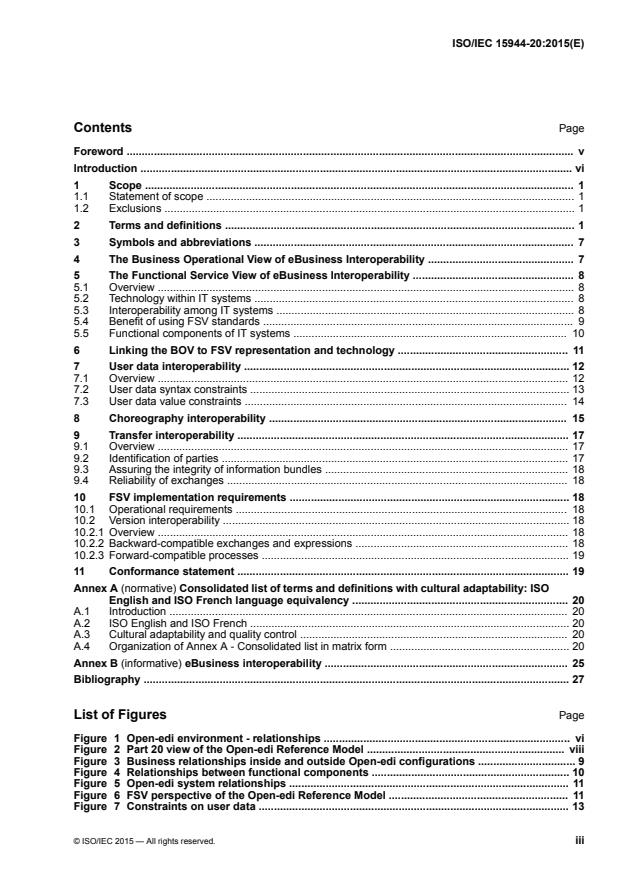
Contents Page
Foreword . v
Introduction . vi
1 Scope . 1
1.1 Statement of scope . 1
1.2 Exclusions . 1
2 Terms and definitions . 1
3 Symbols and abbreviations . 7
4 The Business Operational View of eBusiness Interoperability . 7
5 The Functional Service View of eBusiness Interoperability . 8
5.1 Overview . 8
5.2 Technology within IT systems . 8
5.3 Interoperability among IT systems . 8
5.4 Benefit of using FSV standards . 9
5.5 Functional components of IT systems . 10
6 Linking the BOV to FSV representation and technology . 11
7 User data interoperability . 12
7.1 Overview . 12
7.2 User data syntax constraints . 13
7.3 User data value constraints . 14
8 Choreography interoperability . 15
9 Transfer interoperability . 17
9.1 Overview . 17
9.2 Identification of parties . 17
9.3 Assuring the integrity of information bundles . 18
9.4 Reliability of exchanges . 18
10 FSV implementation requirements . 18
10.1 Operational requirements . 18
10.2 Version interoperability . 18
10.2.1 Overview . 18
10.2.2 Backward-compatible exchanges and expressions . 18
10.2.3 Forward-compatible processes . 19
11 Conformance statement . 19
Annex A (normative) Consolidated list of terms and definitions with cultural adaptability: ISO
English and ISO French language equivalency . 20
A.1 Introduction . 20
A.2 ISO English and ISO French . 20
A.3 Cultural adaptability and quality control . 20
A.4 Organization of Annex A - Consolidated list in matrix form . 20
Annex B (informative) eBusiness interoperability . 25
Bibliography . 27
List of Figures Page
Figure 1 Open-edi environment - relationships . vi
Figure 2 Part 20 view of the Open-edi Reference Model . viii
Figure 3 Business relationships inside and outside Open-edi configurations . 9
Figure 4 Relationships between functional components . 10
Figure 5 Open-edi system relationships . 11
Figure 6 FSV perspective of the Open-edi Reference Model . 11
Figure 7 Constraints on user data . 13
© ISO/IEC 2015 — All rights reserved. iii
Figure 8 Base FSV standard for syntax . 14
Figure 9 FSV Base Choreography Exchange Depiction . 16
Figure 10 FSV Base Choreography UML Depiction . 16
Figure B.1 eBusiness Interoperability . 26
iv © ISO/IEC 2015 — All rights reserved.
Foreword
ISO (the International Organization for Standardization) and IEC (the International Electrotechnical
Commission) form the specialized system for worldwide standardization. National bodies that are members
of ISO or IEC participate in the development of International Standards through technical committees
established by the respective organization to deal with particular fields of technical activity. ISO and IEC
technical committees collaborate in fields of mutual interest. Other international organizations, governmental
and non-governmental, in liaison with ISO and IEC, also take part in the work. In the field of information
technology, ISO and IEC have established a joint technical committee, ISO/IEC JTC 1.
The procedures used to develop this document and those intended for its further maintenance are described
in the ISO/IEC Directives, Part 1. In particular the different approval criteria needed for the different types
of document should be noted. This document was drafted in accordance with the editorial rules of the ISO/
IEC Directives, Part 2 (see www.iso.org/directives).
Attention is drawn to the possibility that some of the elements of this document may be the subject of patent
rights. ISO and IEC shall not be held responsible for identifying any or all such patent rights. Details of any
patent rights identified during the development of the document will be in the Introduction and/or on the ISO
list of patent declarations received (see www.iso.org/patents).
Any trade name used in this document is information given for the convenience of users and does not
constitute an endorsement.
For an explanation on the meaning of ISO specific terms and expressions related to conformity assessment,
as well as information about ISO's adherence to the WTO principles in the Technical Barriers to Trade (TBT)
see the following URL: Foreword - Supplementary information
The committee responsible for this document is ISO/IEC JTC 1, Information technology, Subcommittee
SC32, Data management and interchange.
ISO/IEC 15944-20 Linking business operational view (BOV) to functional service view (FSV) consists of the
following parts, under the general title Information technology— Business Operational View:
— Part 1: Operational aspects of Open-edi for implementation
— Part 2: Registration of scenarios and their components as business objects
— Part 4: Business transaction scenarios – Accounting and economic ontology
— Part 5: Identification and referencing of requirements of jurisdictional domains as sources of
external constraints
— Part 6: Technical introduction to e-Business modelling [Technical Report]
— Part 7: eBusiness vocabulary
— Part 8: Identification of privacy protection requirements as external constraints on business
transactions
— Part 9: Business transaction traceability framework for commitment exchange
— Part 10: IT-enabled coded domains as semantic components in business transactions
The following part is under preparation:
— Part 12: Privacy protection requirements on information life cycle management (ICLM) in EDI
© ISO/IEC 2015 — All rights reserved. v
Introduction
ISO/IEC 14662 Open-edi Reference Model describes the conceptual architecture necessary for carrying
out Open-edi. This architecture describes the need to have two separate and related views of the business
activities. The first is the Business Operational View (BOV). The second is the Functional Service View
(FSV). Figure 1 (Figure 1 from ISO/IEC 14662:2010) depicts the Open-edi environment (for definitions of
the terms in Figure 1 see clause 3).
Figure 1 — Open-edi environment - relationships
An Open-edi Party (OeP) is involved in one or more Open-edi configurations, with each configuration
executing Open-edi transactions corresponding to a given Open-edi scenario (OeS). The focus of executing
these transactions is interoperability among Open-edi Support Entities (OeSEs) of OePs in an Open-edi
community.
BOV-related standards address the business aspects of the transactions among OePs in a single Open-edi
environment. Agreeing upon a given Open-edi scenario with one set of business partners does not
necessarily address a different Open-edi scenario with another set of business partners.
FSV-related standards address the information technology aspects of the interactions among OePs. To
accommodate a single OeP's participation in more than one community, grounding the information
technology aspects on a suite of base FSV standards promotes interoperability. Doing so also promotes
ease of adaptation among communities to specific needs mandated in a given community.
The Open-edi Reference Model (ISO/IEC 14662:2010, Clause 5.2) states the following regarding the
Functional Service View (FSV):
Within the FSV, the interoperability addresses the interactions between the IT Systems supporting
the Open-edi Parties. Interoperability implies that two or more IT systems, conforming to the standards
1) ISO/IEC 14662 Information technology - Open-edi Reference Model/Technologies de l'information - Modèle de référence
EDI-ouvert. The English and French versions of this ISO/IEC standard are publicly available. {See }
vi © ISO/IEC 2015 — All rights reserved.
related to the FSV, are able to co-operate and support the execution of business transactions that are
in compliance with Open-edi scenarios. FSV-related standards address information technology
interoperability aspects which are generic to business transactions.
The FSV identifies and models the generic functional capabilities of IT Systems which are needed to
support the execution of Open-edi transactions. In addition, it provides the basic concepts which will
allow the FSV-related standards to accommodate different configurations of organizations and IT
systems to provide these functional capabilities.
A base FSV standard is a complete specification from which typically a subset of the specification, possibly
also including an extension, is used in an Information Technology System (IT system). A base FSV standard
is considered as the whole cloth from which the material for a given garment is cut.
The actual implemented subsets and extensions of base FSV standards for the Open-edi systems in an
Open-edi community may not, themselves, be standardized. However, the base FSV standards on which
they are derived are developed to promote ease-of-adaptation by implementers.
ISO/IEC 15944 Part 20 Linking business operational view (BOV) to functional service view (FSV) is a
standard establishing the principles and qualities of these specifications to be standardized as base FSV
standards. Also included is a formulation of the processes by which users implement the FSV standards in
an Open-edi system for interoperability. These relationships are depicted in Figure 2.
© ISO/IEC 2015 — All rights reserved. vii
Figure 2 — Part 20 view of the Open-edi Reference Model
Thus, implementations of the FSV standards from base FSV standards promote interoperability among
OePs within an Open-edi community, enhancing the adaptability needed for multiple configurations in which
any given OeP participates. Moreover, some possible level of additional beneficial interoperability may end
up existing between differing configurations, further enhancing the interoperability of an OeP within the larger
business world.
NOTE Because this part deals with the bridging of BOV standards to FSV standards it contains no "rules" as found in other
parts of ISO/IEC 15944.
viii © ISO/IEC 2015 — All rights reserved.
INTERNATIONAL STANDARD ISO/IEC 15944-20:2015(E)
Information Technology — Business Operational View —
Part 20:
Linking business operational view to functional service view
1 Scope
1.1 Statement of scope
ISO/IEC 15944-20 specifies the properties of Base Functional Specification View (FSV) Standards in order
to best meet the requirements of the Business Operational View (BOV) with interoperable implementations.
Base FSV standards exhibiting these properties support business transactions beyond those that are in
compliance with Open-edi scenarios (OeS). Additional beneficial business transactions may also be
supported between a given IT system and IT system(s) outside of the Open-edi scenarios for which they
were designed.
These base FSV standards address those aspects of interoperability between IT systems used among
Parties of the Open-edi Community participating in the scenario. Examples of such standards include the
choreography of interchanges among systems, and the foundational structure and syntax used to express
Information Bundles (IB) in the interchanges.
1.2 Exclusions
ISO/IEC 15944-20 does not specify the properties of FSV implementations related to the interfaces of the
Open-edi support infrastructure (OeSI) to the technology of the Information Processing Domain (IPD) in
which they are being used. Those are the interfaces of the services offered to Decision Making Applications
(DMA), and to the inter-working of the Open-edi support entities (OeSE) of the OeSI. How these OeSEs
interact are self-contained within a Party's IPD and have no interworking relationship with those OeSEs of
other IT system(s) in the scenario.
The Open-edi Reference Model (ISO/IEC 14662:2010, Clause 0.3) observes the following regarding
interoperability:
Only the external behaviour of Open-edi Parties affects the interoperability of Open-edi Systems.
2 Terms and definitions
For the purposes of this document, the following terms and definitions apply.
2.1
base FSV standard
Functional Service View standard from which a systematic derivation of some kind is implemented in an
Open-edi scenario
2.2
business
series of processes, each having a clearly understood purpose, involving more than one Person, realised
through the exchange of information and directed towards some mutually agreed upon goal, extending over
a period of time
[ISO/IEC 14662:2010, 3.2]
© ISO/IEC 2015 — All rights reserved. 1
2.3
Business Operational View
BOV
perspective of business transactions limited to those aspects regarding the making of business decisions
and commitments among Persons, which are needed for the description of a business transaction
[ISO/IEC 14662:2010, 3.3]
2.4
business transaction
predefined set of activities and/or processes of Persons which is initiated by a Person to accomplish an
explicitly shared business goal and terminated upon recognition of one of the agreed conclusions by all the
involved Persons although some of the recognition might be implicit
[ISO/IEC 14662:2010, 3.4]
2.5
choreography
instantiation of an Open-edi scenario in accordance with the rules governing the roles and Information
Bundles of that scenario, whose elements interact in a non-directed fashion with each autonomous member
knowing and following an observable predefined pattern of behavior for the entire (global) instantiation
NOTE There can be more than one choreography serving as an instantiation of an Open-edi scenario.
[adapted from ISO/IEC TR 30102:2012, 2.1.3]
2.6
constraint
rule, explicitly stated, that prescribes, limits, governs or specifies any aspect of a business transaction
NOTE 1 Constraints are specified as rules forming part of components of Open-edi scenarios, i.e., as scenario attributes,
roles, and/or information bundles.
NOTE 2 For constraints to be registered for implementation in Open-edi, they must have unique and unambiguous identifiers.
NOTE 3 A constraint may be agreed to among parties (condition of contract) and is therefore considered an "internal
constraint". Or a constraint may be imposed on parties (e.g., laws, regulations, etc.), and is therefore considered an "external
constraint".
[ISO/IEC 15944-1:2011, 3.24]
2.7
Decision Making Application
DMA
model of that part of an Open-edi system that makes decisions corresponding to the role(s) that the Open-
edi Party plays, as well as originating, receiving and managing data values contained in instantiated
Information Bundles, which is not required to be visible to the other Open-edi Party(ies)
[ISO/IEC 14662:2010, 3.7]
2.8
eBusiness
business transaction, involving the making of commitments, in a defined collaboration space, among
Persons using their Information Technology System, according to Open-edi Standards
NOTE 1 eBusiness can be conducted on both a for-profit and not-for-profit basis.
NOTE 2 A key distinguishing aspect of eBusiness is that it involves the making of commitment(s) of any kind among the
Persons in support of a mutually agreed upon goal, involving their IT systems, and doing so through the use of EDI (using a
variety of communication networks including the Internet).
NOTE 3 eBusiness includes various application areas such as e-commerce, e-administration, e-logistics, e-government, e-
medicine, e-learning, etc.
2 © ISO/IEC 2015 — All rights reserved.
NOTE 4 The equivalent French language term for “eBusiness” is always presented in its plural form.
[ISO/IEC 15944-7:2009, 3.6]
2.9
Electronic Data Interchange
EDI
automated exchange of any predefined and structured data for business purposes among information
systems of two or more Persons
NOTE This definition includes all categories of electronic business transactions.
[ISO/IEC 14662:2010, 3.8]
2.10
Functional Service View
FSV
perspective of business transactions limited to those information technology interoperability aspects of
Information Technology Systems needed to support the execution of Open-edi transactions
[ISO/IEC 14662:2010, 3.10]
2.11
Information Bundle
IB
formal description of the semantics of the recorded information to be exchanged by Open-edi Parties playing
roles in an Open-edi scenario
[ISO/IEC 14662:2010, 3.11]
2.12
Information Processing Domain
IPD
Information Technology System which includes at least either a Decision Making Application and/or one of
the components of an Open-edi Support Infrastructure (or both), and acts/executes on behalf of an Open-
edi Party (either directly or under a delegated authority)
[ISO/IEC 14662:2010, 3.12]
2.13
Information Technology System
IT System
set of one or more computers, associated software, peripherals, terminals, human operations, physical
processes, information transfer means, that form an autonomous whole, capable of performing information
processing and/or information transfer
[ISO/IEC 14662:2010, 3.13]
2.14
Open-edi
Electronic Data Interchange among multiple autonomous Persons to accomplish an explicit shared business
goal according to Open-edi Standards
[ISO/IEC 14662:2010, 3.14]
2.15
Open-edi community
defined group of Open-edi Parties engaged in business transactions which shares one or more Open-edi
scenarios
© ISO/IEC 2015 — All rights reserved. 3
2.16
Open-edi community configuration
specified Open-edi configuration used within an Open-edi community by its Open-edi Parties in their
associated Information Processing Domains, which can execute Open-edi transactions corresponding to
shared Open-edi scenario
2.17
Open-edi configuration
formal specification of an operational configuration of Open-edi Parties and their associated Information
Processing Domains, which can execute Open-edi transactions corresponding to a given Open-edi scenario
[ISO/IEC 14662:2010, 3.15]
2.18
Open-edi Control Information
OeCI
information exchanged among Open-edi Support Entities to co-ordinate their operation
NOTE Based on ISO/IEC 14662:2010 (D.1)
2.19
Open-edi Description Technique
OeDT
specification method such as a Formal Description Technique, another methodology having the
characteristics of a Formal Description Technique, or a combination of such techniques as needed to
formally specify Business Operational View concepts, in a computer processable form
[ISO/IEC 14662:2010, 3.16]
2.20
Open-edi Party
OeP
Person that participates in Open-edi
NOTE Often referred to generically in this and other eBusiness standards (e.g. other parts of this ISO/IEC 15944 multipart
"eBusiness" standard) as "party" or "parties" for any entity modelled as a Person as playing a role in Open-edi scenarios.
[ISO/IEC 14662:2010, 3.17]
2.21
Open-edi Profile
technical specification of properties of a business transaction forming part of commitment among Open-edi
Parties in an Open-edi community
2.22
Open-edi scenario
OeS
formal specification of a class of business transactions having the same business goal
[ISO/IEC 14662:2010, 3.18]
2.23
Open-edi Standard
standard that complies with the Open-edi Reference Model
[ISO/IEC 14662:2010, 3.19]
2.24
Open-edi Support Entity
OeSE
functional component of the Open-edi Support Infrastructure used to model a subset of generic functional
capabilities
4 © ISO/IEC 2015 — All rights reserved.
NOTE 1 The identification of such a subset of functional capabilities should take into account the possibility that the
corresponding Open-edi Support Entity may be implemented in a different Open-edi system
NOTE 2 Based on ISO/IEC 14662:2010 (D.1)
2.25
Open-edi Support Entity Interface
OeSEI
set of specifications that allows access to the services the Open-edi Support Entity provides
NOTE Based on ISO/IEC 14662:2010 (D.1)
2.26
Open-edi Support Entity Protocol
OeSEP
set of rules and data formats (semantic and syntactic) which models the interaction among peer Open-edi
Support Entities
NOTE 1 The purpose of the Open-edi Support Entity Protocol is to ensure the interoperability of implementations of Open-
edi Support Entities which are operated by different organizations.
NOTE 2 Open-edi Support Entity Protocol includes specification of Open-edi Control Information and possibly Open-edi
User Data.
NOTE 3 Based on ISO/IEC 14662:2010 (D.1)
2.27
Open-edi Support Infrastructure
OeSI
model of the set of functional capabilities for Open-edi systems which, when taken together with the Decision
Making Applications, allows Open-edi Parties to participate in Open-edi transactions
[ISO/IEC 14662:2010, 3.20]
2.28
Open-edi Support Organization
OeSO
organization, acting on behalf of an Open-edi Party(ies) to provide necessary support enabling execution
of Decision Making Applications, allows Open-edi Parties to participate in Open-edi transactions
[ISO/IEC 14662:2010, 3.21]
2.29
Open-edi system
Information Technology System which enables an Open-edi Party to participate in Open-edi transaction
[ISO/IEC 14662:2010, 3.22]
2.30
Open-edi transaction
business transaction that is in compliance with an Open-edi scenario
[ISO/IEC 14662:2010, 3.23]
2.31
Open-edi User Data
OeUD
instance of Information Bundles or components of Information Bundles (as Semantic Components)
NOTE Based on ISO/IEC 14662:2010 (D.1)
© ISO/IEC 2015 — All rights reserved. 5
2.32
Person
entity, i.e. a natural or legal person, recognized by law as having legal rights and duties, able to make
commitment(s), assume and fulfil resulting obligation(s), and able to be held accountable for its action(s)
NOTE 1 Synonyms for "legal person" include "artificial person", "body corporate", etc., depending on the terminology used
in competent jurisdictions.
NOTE 2 Person is capitalized to indicate that it is being utilized as formally defined in the standards and to differentiate it
from its day-to-day use.
NOTE 3 Minimum and common external constraints applicable to a business transaction often require one to differentiate
among three common sub-types of Person, namely "individual", "organization", and "public administration".
[ISO/IEC 14662:2010, 3.24]
2.33
role
specification which models an external intended behaviour (as allowed within a scenario) of an Open-edi
Party.
[ISO/IEC 14662:2010, 3.25]
2.34
rule
statement governing conduct, procedure, conditions and relations
NOTE 1 Rules specify conditions that must be complied with. These may include relations among objects and their attributes.
NOTE 2 Rules are of a mandatory or conditional nature.
NOTE 3 In Open-edi, rules formally specify the commitment(s) and role(s) of the parties involved, and the expected
behaviour(s) of the parties involved as seen by other parties involved in (electronic) business transactions. Such rules are
applied to:
— content of the information flows in the form of precise and computer-processable meaning, i.e. the semantics of data;
— the order and behaviour of the information flows themselves.
NOTE 4 Rules must be clear and explicit enough to be understood by all parties to a business transaction. Rules also must
be capable of being able to be specified using a Formal Description Technique(s) (FDTs).
EXAMPLE A current and widely used FDT is "Unified Modelling Language (UML)".
[ISO/IEC 15944-2:2006, 3.101]
2.35
Semantic Component
SC
unit of recorded information unambiguously defined in the context of the business goal of the business
transaction
NOTE A SC may be atomic or composed of other SCs.
[ISO/IEC 14662:2010, 3.27]
2.36
transfer
act of using the Transfer Infrastructure to effect the interchange of Information Bundles in a business
transaction
6 © ISO/IEC 2015 — All rights reserved.
2.37
Transfer Infrastructure
TI
complete set of functional capabilities offering interconnection services
NOTE 1 The TI allows Open-edi Support Entities and Decision Making Applications to inter-work without concern to their
location (location transparency).
NOTE 2 Based on ISO/IEC 14662:2010 (D.1)
2.38
Transfer Infrastructure Interface
set of specifications that allows Open-edi Support Entities to access the interconnection services the
Transfer Infrastructure provides
NOTE 1 The TI Interface promotes the independence of OeSEs from the structure of underlying interconnection services
and their functionality and protocols.
NOTE 2 The use of current available standards for interconnection services will be maximized. The TI allows OeSEs and
DMAs to inter-work without concern to their location (location transparency).
NOTE 3 Based on ISO/IEC 14662:2010 (D.1)
3 Symbols and abbreviations
BOV Business Operational View
DMA Decision Making Application
EDI Electronic Data Interchange
FSV Functional Service View
IB Information Bundle
ICT Information and Communications Technology
IT System Information Technology System
IPD Information Processing Domain
IT Information Technology
OeCI Open-edi Control Information
OeDT Open-edi Description Technique
OeP Open-edi Party
OeS Open-edi Scenario
OeSE Open-edi Support Entity
OeSEP Open-edi Support Entity Protocol
OeSI Open-edi Support Infrastructure
OeSO Open-edi Support Organization
OeUD Open-edi User Data
SC Semantic Component
TI Transfer Infrastructure
4 The Business Operational View of eBusiness Interoperability
Each Open-edi Party (OeP) engaged in business transactions has its own Open-edi IT system(s) satisfying
their respective business requirements for a common Business Operational View (BOV). In each such
2) ISO/IEC 15944-1:2011 Information technology - Business Operational View - Part 1: Operational aspects of Open-edi for
implementation/Technologies de l'information - Vue opérationnelle d'affaires - Parti 1: Aspects opérationnels de l'Edi ouvert
© ISO/IEC 2015 — All rights reserved. 7
system the Information Processing Domain (IPD) executes Open-edi transactions corresponding to all
Open-edi scenarios adopted by the Open-edi Community of Open-edi Parties. Each IPD employs a Decision
Making Application (DMA) that implements the BOV. Thus, the BOV of two OePs interoperate at an
organizational level to satisfy the configuration.
This Open-edi Standard perspective of business transactions is limited to those aspects regarding the
making or accepting of commitments among Persons, needed for the description of a business transaction.
The description of a business transaction is realized using an Open-edi Description Technique (OeDT).
5 The Functional Service View of eBusiness Interoperability
5.1 Overview
The Functional Service View (FSV) of Open-edi IT systems governs the information and communication
technologies (ICT) employed to enable technical interoperability among OePs of an Open-edi Community
engaged in business transactions. Practices undertaken in the Business Operational View provide for
flexibility in implementation at this interoperable level.
This Open-edi Standard perspective of business transactions is limited to those information technology
aspects of IT systems needed to support the execution of a business transaction with the use of interactions.
Note that both external constraints imposed on IT systems and internal constraints demanded within IT
systems impact on the application of FSV-related standards. An example of an external constraint is the
transfer syntax used to express the set of recorded information reflecting an information bundle. An example
of an internal constraint is the need to perform a number of interactions grouped as a batch process, rather
than performing individual interactions in real time.
5.2 Technology within IT systems
Within a given IT system, the technology implementing the Decision Making Application (DMA) interface of
the BOV to the FSV is isolated from that of other IT system(s) in the Open-edi Community. A primary reason
is that the DMA activities and processing focusses on decision-taking and commitment-making on behalf
of an Open-edi party (with associated fiduciary, legal, accountability, etc. requirements). Similarly, the Open-
edi Support Entity Protocol (OeSEP) methods implementing the Open-edi Support Entity Interfaces (OeSEI)
by which the Open-edi Support Entities (OeSE) of a given support infrastructure interact among themselves
and the DMA also are disconnected from those methods implemented by other IT system(s). The
implementations of these internal interactions do not impact on the technical interoperability among IT
systems.
5.3 Interoperability among IT systems
The interactions among the DMAs of two or more IT systems must interoperate at a concrete level of 1)
syntax, 2) interaction and 3) transfer to effect electronic data interchange (EDI). Otherwise, the IPDs will not
fulfill the requirements of the configuration. The independent DMAs of the interoperating IT systems achieve
this by interfacing with their respective independent Open-edi Support Entity (OeSE). As such, two or more
OeSEs interoperate in fulfilling the business transactions of the scenario by exchanging user data in
interactions.
Base FSV standards implemented by each OeSE independently for their respective DMA form the basis of
interoperability among OePs. The properties of the FSV-related standards chosen for the OeSEs reflect
how interoperable IPDs can be. Clause 6 Linking the BOV to FSV representation and technology introduces
pour application. Clause 5.3. The English and French versions of this ISO/IEC standard are publicly available. {See
www.jtc1.org>}
3) Ref. ISO/IEC 15944-8 Information technology — Business Operational View — Part 8: Identification of privacy protection
requirements as external constraints on business transactions/Technologies de l'information — Vue opérationnelle d'affaires
— Partie 8: Identification des exigences de protection de la vie privée en tant que contraintes externes sur les transactions
d'affaires Annex C (normative) Business Transaction Model (BTM): Classes of constraints Annex C. The English version of
this ISO/IEC standard is publicly available. {See }
8 © ISO/IEC 2015 — All rights reserved.
the principles of interoperable properties needed of FSV-related standards. The more that FSV-related
standards are implemented in an OeSE, the more interoperable that OeSE is with other OeSEs.
5.4 Benefit of using FSV standards
OePs do not necessarily function in an isolated world of the single Open-edi Community of users adopting
a given Open-edi configuration. Being a part of two or more Open-edi Communities may require an OeP to
act among two or more different Open-edi configurations. The effort to implement the IT standards
supporting an additional configuration is reduced when all configurations are grounded on the same suite
of Base FSV Standards. Additionally, when common base FSV standards are used for specific
implementations across configurations, an OeP may find itself in a situation of successfully engaging in
business transactions with another OeP outside of any given shared Open-edi configuration. This is
depicted in Figure 3.
Figure 3 — Business relationships inside and outside Open-edi configurations
The following text explains Figure 3.
Three Open-edi Communities of users are shown labeled (A), (B) and (C), each with different Open-edi
configurations. Community (A) uses a particular deployment of FSV standards, labeled (M), while
community (B) uses the deployment labeled (N) and community (C) uses the deployment labeled (P).
The OeP labeled (W) is a member of the community labeled (A) and the community labeled (C). The OeP
labeled (X) is a member of the community labeled (A) and the community labeled (B). The OeP labeled (Y)
is only a member of the community labeled (C). The OeP labeled (Z) is only a member of the community
labeled (B).
The additional beneficial use of FSV-standards, labeled (Q), may be realized between the OeP labeled (W)
and the OeP labeled (Z). The likelihood of being so enabled is enhanced when the Base FSV Standards
are the same across configurations.
The facilities of FSV-related specifications are chosen to support the deployment of business transactions
for a particular configuration. Differing configurations may utilize different facilities of the Base FSV
Standards available. Nevertheless, all configurations following the interoperability principles of linking the
© ISO/IEC 2015 — All rights reserved. 9
BOV to the FSV that are built on base FSV standards share common mandated components and may share
some optional components. These shared components may be able to be exploited in an additional
beneficial transaction among parties who do not share any particular configuration.
NOTE Business rules and other properties of the BOV may, of course, preclude using FSV-standards in such an ad-hoc
fashion as a additional beneficial transaction.
An example of such an additional beneficial transaction could materialize in the transportation domain. The
Open-edi Communities of air transport, road transport and marine transport would each have their own
Open-edi Configuration with their own implementation of Base FSV Standards. Nevertheless,
interoperability among members of two different Open-edi Communities is promoted by the commonality
mandated in the base FSV standards. This may realize benefits in addition to the ones expected from within
each individual Open-edi Configuration.
5.5 Functional components of IT systems
Figure 4 (Figure D-1 from ISO/IEC 14662:2010) depicts the relationship between the DMA and the OeSE,
and between the OeSE and the Transfer Infrastructure (TI). Each column represents an Open-edi System
and its inter-working relationships at each layer. The objective of DMAs (top layer) is to make business
decisions. In order to conduct business transactions, DMAs will exchange information (logical exchanges).
These interactions are accomplished when DMAs request services from the OeSEs through the OeSE
Interface using the OeSE Protocol. The OeSE Protocol includes the Open-edi Control Information (OeCI)
and Open-edi User Data (OeUD).
Figure 4 — Relationships between functional components
Figure 5 (Figure D.3 from ISO/IEC 14662:2010) shows possible relationships among the functional
components of two representative Open-edi Systems. The goal of these relationships is to support the
interaction among DMAs of the Open-edi Parties. For this interaction, DMAs use, through their DMA
Interface, the services of OeSEs and the TI. The OeSEs provide value added services to DMAs via
consistent OeSE interfaces. Each OeSE may inter-work with DMAs, other OeSEs and the TI. The
interconnection service is provided by the TI. OeSEs interact with each other via the OeSE Protocol over
the TI. The primary responsibility of the TI is to provide reliable interconnection services.
10 © ISO/IEC 2015 — All rights reserved.
Figure 5 — Open-edi system relationships
As described in clause 5.2 Technology within IT systems, the interfaces between the DMA and the OeSE
and its components of transfer (the transfer infrastructure), interaction (protocols) and syntax (structure and
representation) are orthogonal to the interoperability among IT systems. The transfer infrastructure interface
satisfies the requests of the OeSE. The OeSE interface satisfies the requests of each other OeSE. The
DMA interface satisfies the requests of the DMA made on the OeSE.
The concrete implementations of the transfer infrastructure for transfer, the protocol (including Open-edi
Control Information (OeCI)) for interaction, and the representation (the Open-edi User Data (OeUD) are the
commonly-defined and commonly-accepted aspects of interoperability among IT systems.
6 Linking the BOV to FSV representation and technology
Figure 6, excerpted from Figure 2, depicts three main components of the Open-edi Support Infrastructure:
the user data, the choreographies and the transfer.
Figure 6 — FSV perspective of the Open-edi Reference Model
The user data expressed in the transfer syntax of the information bundles used in a given set of recorded
information should accommodate the BOV information model requirements. The principles governing
© ISO/IEC 2015 — All rights reserved. 11
interoperable specifications in this area should accommodate omitting optional constructs of a standard
base definition of a generic transfer syntax that are not required. They should also accommodate
supplementing additional non-standard constructs on top of a standard base definition that are needed to
satisfy the information required by the community that is not realized in the adopted standard. Without such
flexibility, the integrity of the sets of recorded information among systems may have limited reliability.
The choreography of the protocol is the ordered exchange of sets of recorded information accommodating
the BOV process model requirements and activity model requirements. The principles governing
interoperable specifications in this area must accommodate the omission of irrelevant components of the
sets of recorded information and the addition of customized components to the sets of recorded information
needed to satisfy finer-grained requirements of the Open-edi Community that are not in the base definitions.
Further elaboration of choreography is depicted in Figure 25 of ISO/IEC 15944-1:2011.
The transfer is performed on the transfer infrastructure connecting two parties in which their transactions
are interchanged. The principles governing interoperable specifications in this area must accommodate the
impacts of interruptions or outside influences causing possible loss or duplication of sets of recorded
information. These principles implement the environment component of the BOV.
Not shown in the diagram are the implementation requirements respecting that there are operational details
among community members. Such business requirements evolve over time with more explicit descriptions
or new requirements. Existing Open-edi scenarios need to accommodate additional features and
functionality declared by t
...