

ISO/IEC 15944-17:2024
(Main)Information technology — Business operational view — Part 17: Fundamental principles and rules governing Privacy-by-Design (PbD) requirements in an EDI and collaboration space context
General Information
- Abstract
This document: a) focuses on PbD aspects of privacy protection requirements as external constraints on any type of Person, (e.g. organization or public administration) involved in any kind of business transaction among such Persons which involves the electronic data interchange (EDI) of any personal information; b) establishes a fundamental set of privacy principles known as Privacy by Design and assumptions based on primary sources; c) integrates existing normative elements in support of PbD as are already identified in ISO/IEC 14662 and ISO/IEC 15944-1, ISO/IEC 15944-5, ISO/IEC 15944-8, ISO 15944-12; d) provides overarching operational ‘best practice’ statements for associated (and not necessarily automated) processes, procedures, practices and governance requirements that need to act in support of implementing and enforcing technical mechanisms that support PbD in Open-edi transaction and collaboration space environments; e) focuses on PbD related aspects of the life cycle management of and accountability for the personal information, i.e. the contents of SPIs (and their SRIs) related to the business transaction interchanged via EDI as information bundles and their associated semantic components among the parties to a business transaction. This document focuses on the BOV aspects of a business transaction and does not concern itself with the technical mechanisms needed to implement the FSV aspects of the business requirements of the FSV including the specification of requirements of an FSV nature which include security techniques and services, communication protocols, etc.). The FSV includes any existing standard (or standards development of an FSV nature), which has been ratified by existing ISO, IEC, UN/ECE and/or ITU standards. This document does not specify the technical mechanisms, i.e. FSV which are required to support BOV-identified requirements. Detailed exclusions to the scope of this document are provided in Annex D.
- Status
- Published
- Publication Date
- 08-Apr-2024
- Technical Committee
- ISO/IEC JTC 1/SC 32 - Data management and interchange
- Drafting Committee
- ISO/IEC JTC 1/SC 32 - Data management and interchange
- Current Stage
- 6060 - International Standard published
- Start Date
- 09-Apr-2024
- Due Date
- 22-Dec-2024
- Completion Date
- 09-Apr-2024
Buy Documents


ISO/IEC 15944-17:2024 - Information technology — Business operational view — Part 17: Fundamental principles and rules governing Privacy-by-Design (PbD) requirements in an EDI and collaboration space context Released:9. 04. 2024
Overview
ISO/IEC 15944-17:2024 - Information technology - Business operational view - Part 17 - sets out fundamental principles and rules governing Privacy-by-Design (PbD) in the context of electronic data interchange (EDI) and collaboration space environments. This first-edition standard focuses on PbD as an external constraint on any Person (organization or public administration) engaged in EDI transactions that include personal information. It defines privacy principles, life‑cycle management expectations, tagging/labelling of personal information bundles (SPIs/SRIs), and operational best practices at the Business Operational View (BOV) level. Importantly, ISO/IEC 15944-17:2024 addresses business and governance requirements and explicitly does not specify the technical mechanisms (Functional Service View, FSV) needed to implement those requirements.
Key topics and requirements
- Privacy-by-Design principles: formalizes PbD concepts (proactive, default privacy, embedded privacy, full functionality, end-to-end safeguards, transparency, user‑centricity) and maps them to privacy protection principles.
- Privacy protection principles (PPP): consolidates primary legal/regulatory sources into an eleven‑point PPP framework applicable to EDI exchanges.
- Tagging and labelling: requirements for identifying and tagging sets of personal information (SPIs) and their semantic components (SRIs) to support policy enforcement and interoperability.
- Information Life Cycle Management (ILCM): rules to ensure personal information remains “under the control of” the organization across the full life cycle (cradle-to-grave) with clear accountability obligations.
- Collaboration space governance: operational best practices for processes, procedures and governance needed to support PbD in multi‑party EDI and collaboration environments.
- Conformance and scope: guidance on conformance statements and mapping to Open‑edi reference model constraints; Annex D lists detailed exclusions to scope.
Applications and who should use it
Practical uses include embedding privacy requirements early in business modelling, defining operational policies for cross‑organizational EDI, and creating interoperable metadata and tagging schemes for personal data. Typical users:
- Privacy engineers and Data Protection Officers (DPOs)
- Enterprise architects and EDI solution designers
- Compliance, legal and governance teams
- Standards developers and implementers integrating BOV requirements with technical FSV standards
- Public administrations and vendors operating collaboration spaces
Related standards
ISO/IEC 15944-17:2024 is intended for use with:
- ISO/IEC 14662 (Open‑edi Reference Model)
- Other parts of the ISO/IEC 15944 series (e.g., -1, -4, -5, -8, -12) The document maps PbD/BOV requirements to existing normative elements without prescribing technical protocols or security mechanisms (FSV), allowing organizations to apply jurisdictional privacy obligations within EDI and collaboration spaces.
Buy Documents
ISO/IEC 15944-17:2024 - Information technology — Business operational view — Part 17: Fundamental principles and rules governing Privacy-by-Design (PbD) requirements in an EDI and collaboration space context Released:9. 04. 2024
Get Certified
Connect with accredited certification bodies for this standard

BSI Group
BSI (British Standards Institution) is the business standards company that helps organizations make excellence a habit.

NYCE
Mexican standards and certification body.
Sponsored listings
Frequently Asked Questions
ISO/IEC 15944-17:2024 is a standard published by the International Organization for Standardization (ISO). Its full title is "Information technology — Business operational view — Part 17: Fundamental principles and rules governing Privacy-by-Design (PbD) requirements in an EDI and collaboration space context". This standard covers: This document: a) focuses on PbD aspects of privacy protection requirements as external constraints on any type of Person, (e.g. organization or public administration) involved in any kind of business transaction among such Persons which involves the electronic data interchange (EDI) of any personal information; b) establishes a fundamental set of privacy principles known as Privacy by Design and assumptions based on primary sources; c) integrates existing normative elements in support of PbD as are already identified in ISO/IEC 14662 and ISO/IEC 15944-1, ISO/IEC 15944-5, ISO/IEC 15944-8, ISO 15944-12; d) provides overarching operational ‘best practice’ statements for associated (and not necessarily automated) processes, procedures, practices and governance requirements that need to act in support of implementing and enforcing technical mechanisms that support PbD in Open-edi transaction and collaboration space environments; e) focuses on PbD related aspects of the life cycle management of and accountability for the personal information, i.e. the contents of SPIs (and their SRIs) related to the business transaction interchanged via EDI as information bundles and their associated semantic components among the parties to a business transaction. This document focuses on the BOV aspects of a business transaction and does not concern itself with the technical mechanisms needed to implement the FSV aspects of the business requirements of the FSV including the specification of requirements of an FSV nature which include security techniques and services, communication protocols, etc.). The FSV includes any existing standard (or standards development of an FSV nature), which has been ratified by existing ISO, IEC, UN/ECE and/or ITU standards. This document does not specify the technical mechanisms, i.e. FSV which are required to support BOV-identified requirements. Detailed exclusions to the scope of this document are provided in Annex D.
This document: a) focuses on PbD aspects of privacy protection requirements as external constraints on any type of Person, (e.g. organization or public administration) involved in any kind of business transaction among such Persons which involves the electronic data interchange (EDI) of any personal information; b) establishes a fundamental set of privacy principles known as Privacy by Design and assumptions based on primary sources; c) integrates existing normative elements in support of PbD as are already identified in ISO/IEC 14662 and ISO/IEC 15944-1, ISO/IEC 15944-5, ISO/IEC 15944-8, ISO 15944-12; d) provides overarching operational ‘best practice’ statements for associated (and not necessarily automated) processes, procedures, practices and governance requirements that need to act in support of implementing and enforcing technical mechanisms that support PbD in Open-edi transaction and collaboration space environments; e) focuses on PbD related aspects of the life cycle management of and accountability for the personal information, i.e. the contents of SPIs (and their SRIs) related to the business transaction interchanged via EDI as information bundles and their associated semantic components among the parties to a business transaction. This document focuses on the BOV aspects of a business transaction and does not concern itself with the technical mechanisms needed to implement the FSV aspects of the business requirements of the FSV including the specification of requirements of an FSV nature which include security techniques and services, communication protocols, etc.). The FSV includes any existing standard (or standards development of an FSV nature), which has been ratified by existing ISO, IEC, UN/ECE and/or ITU standards. This document does not specify the technical mechanisms, i.e. FSV which are required to support BOV-identified requirements. Detailed exclusions to the scope of this document are provided in Annex D.
ISO/IEC 15944-17:2024 is classified under the following ICS (International Classification for Standards) categories: 35.240.63 - IT applications in trade. The ICS classification helps identify the subject area and facilitates finding related standards.
ISO/IEC 15944-17:2024 is available in PDF format for immediate download after purchase. The document can be added to your cart and obtained through the secure checkout process. Digital delivery ensures instant access to the complete standard document.
Standards Content (Sample)
International
Standard
ISO/IEC 15944-17
First edition
Information technology — Business
2024-04
operational view —
Part 17:
Fundamental principles and rules
governing Privacy-by-Design
(PbD) requirements in an EDI and
collaboration space context
Technologies de l'information — Vue opérationnelle d'affaires —
Partie 17: Règles et principes fondamentaux régissant les
exigences de protection de la vie privée par conception (PbD)
dans un contexte d'EDI et d'espace de collaboration
Reference number
© ISO/IEC 2024
All rights reserved. Unless otherwise specified, or required in the context of its implementation, no part of this publication may
be reproduced or utilized otherwise in any form or by any means, electronic or mechanical, including photocopying, or posting on
the internet or an intranet, without prior written permission. Permission can be requested from either ISO at the address below
or ISO’s member body in the country of the requester.
ISO copyright office
CP 401 • Ch. de Blandonnet 8
CH-1214 Vernier, Geneva
Phone: +41 22 749 01 11
Email: copyright@iso.org
Website: www.iso.org
Published in Switzerland
© ISO/IEC 2024 – All rights reserved
ii
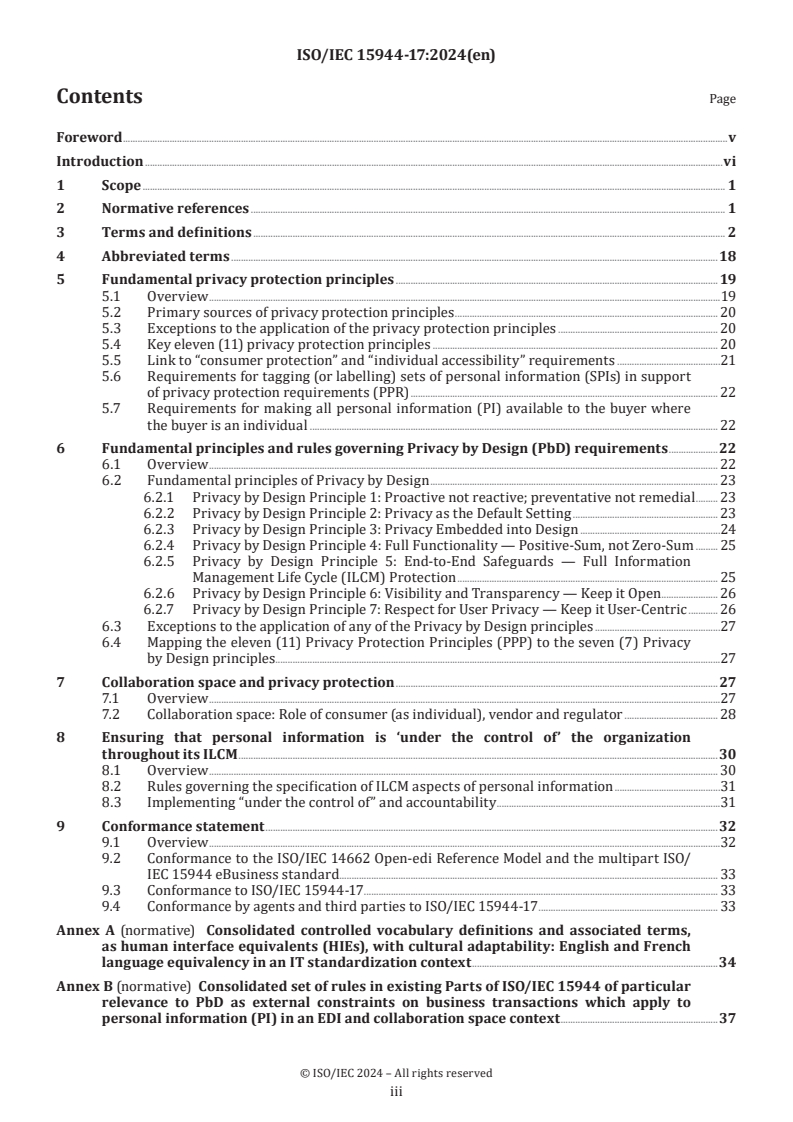
Contents Page
Foreword .v
Introduction .vi
1 Scope . 1
2 Normative references . 1
3 Terms and definitions . 2
4 Abbreviated terms .18
5 Fundamental privacy protection principles . 19
5.1 Overview .19
5.2 Primary sources of privacy protection principles . 20
5.3 Exceptions to the application of the privacy protection principles . 20
5.4 Key eleven (11) privacy protection principles . 20
5.5 Link to “consumer protection” and “individual accessibility” requirements .21
5.6 Requirements for tagging (or labelling) sets of personal information (SPIs) in support
of privacy protection requirements (PPR) . 22
5.7 Requirements for making all personal information (PI) available to the buyer where
the buyer is an individual . 22
6 Fundamental principles and rules governing Privacy by Design (PbD) requirements .22
6.1 Overview . 22
6.2 Fundamental principles of Privacy by Design . 23
6.2.1 Privacy by Design Principle 1: Proactive not reactive; preventative not remedial . 23
6.2.2 Privacy by Design Principle 2: Privacy as the Default Setting . 23
6.2.3 Privacy by Design Principle 3: Privacy Embedded into Design .24
6.2.4 Privacy by Design Principle 4: Full Functionality — Positive-Sum, not Zero-Sum . 25
6.2.5 Privacy by Design Principle 5: End-to-End Safeguards — Full Information
Management Life Cycle (ILCM) Protection . 25
6.2.6 Privacy by Design Principle 6: Visibility and Transparency — Keep it Open . 26
6.2.7 Privacy by Design Principle 7: Respect for User Privacy — Keep it User-Centric . 26
6.3 Exceptions to the application of any of the Privacy by Design principles .27
6.4 Mapping the eleven (11) Privacy Protection Principles (PPP) to the seven (7) Privacy
by Design principles . . .27
7 Collaboration space and privacy protection .27
7.1 Overview .27
7.2 Collaboration space: Role of consumer (as individual), vendor and regulator . 28
8 Ensuring that personal information is ‘under the control of’ the organization
throughout its ILCM .30
8.1 Overview . 30
8.2 Rules governing the specification of ILCM aspects of personal information .31
8.3 Implementing “under the control of” and accountability .31
9 Conformance statement .32
9.1 Overview .32
9.2 Conformance to the ISO/IEC 14662 Open-edi Reference Model and the multipart ISO/
IEC 15944 eBusiness standard. 33
9.3 Conformance to ISO/IEC 15944-17. 33
9.4 Conformance by agents and third parties to ISO/IEC 15944-17 . 33
Annex A (normative) Consolidated controlled vocabulary definitions and associated terms,
as human interface equivalents (HIEs), with cultural adaptability: English and French
language equivalency in an IT standardization context .34
Annex B (normative) Consolidated set of rules in existing Parts of ISO/IEC 15944 of particular
relevance to PbD as external constraints on business transactions which apply to
personal information (PI) in an EDI and collaboration space context .37
© ISO/IEC 2024 – All rights reserved
iii
Annex C (informative) Mapping ISO/IEC 15944-8 Privacy Protection Principles (PPP) to the
Privacy by Design principles.54
Annex D (informative) Exclusions to the scope of ISO/IEC 15944-17 .58
Annex E (informative) Fair Information Principles / Fair Information Practices .60
Annex F (informative) Aspects currently not addressed . 61
Bibliography .62
© ISO/IEC 2024 – All rights reserved
iv
Foreword
ISO (the International Organization for Standardization) and IEC (the International Electrotechnical
Commission) form the specialized system for worldwide standardization. National bodies that are
members of ISO or IEC participate in the development of International Standards through technical
committees established by the respective organization to deal with particular fields of technical activity.
ISO and IEC technical committees collaborate in fields of mutual interest. Other international organizations,
governmental and non-governmental, in liaison with ISO and IEC, also take part in the work.
The procedures used to develop this document and those intended for its further maintenance are described
in the ISO/IEC Directives, Part 1. In particular, the different approval criteria needed for the different types
of document should be noted. This document was drafted in accordance with the editorial rules of the ISO/
IEC Directives, Part 2 (see www.iso.org/directives or www.iec.ch/members_experts/refdocs).
ISO and IEC draw attention to the possibility that the implementation of this document may involve the
use of (a) patent(s). ISO and IEC take no position concerning the evidence, validity or applicability of any
claimed patent rights in respect thereof. As of the date of publication of this document, ISO and IEC have not
received notice of (a) patent(s) which may be required to implement this document. However, implementers
are cautioned that this may not represent the latest information, which may be obtained from the patent
database available at www.iso.org/patents and https://patents.iec.ch. ISO and IEC shall not be held
responsible for identifying any or all such patent rights.
Any trade name used in this document is information given for the convenience of users and does not
constitute an endorsement.
For an explanation of the voluntary nature of standards, the meaning of ISO specific terms and expressions
related to conformity assessment, as well as information about ISO's adherence to the World Trade
Organization (WTO) principles in the Technical Barriers to Trade (TBT) see www.iso.org/iso/foreword.html.
In the IEC, see www.iec.ch/understanding-standards.
This document was prepared by Joint Technical Committee ISO/IEC JTC 1, Information technology,
Subcommittee SC 32, Data management and interchange.
This document is intended to be used in conjunction with ISO/IEC 14662, ISO/IEC 15944-1, ISO/IEC 15944-4,
ISO/IEC 15944-5, ISO/IEC 15944-8 and ISO/IEC 15944-12.
A list of all parts in the ISO/IEC 15944 series can be found on the ISO and IEC websites.
Any feedback or questions on this document should be directed to the user’s national standards
body. A complete listing of these bodies can be found at www.iso.org/members.html and
www.iec.ch/national-committees.
© ISO/IEC 2024 – All rights reserved
v
Introduction
0.1 Purpose and overview
The ISO/IEC 14662 and the ISO/IEC 15944 Business Operational View (BOV) series of standards focus on
electronic data interchange (EDI) and “collaboration space” among Persons. Modelling business transactions
using scenarios and scenario components includes specifying the applicable constraints on the data
using explicitly stated rules. The ISO/IEC 14662 Open-edi Reference Model identifies two basic classes of
constraints, "internal constraints" and "external constraints".
Jurisdictional domains are the primary source of external constraints on business transactions. Privacy
protection is addressed as a common set of external constraint requirements coming from jurisdictional
domains. Jurisdictional domains, such as UN member states and/or their administrative sub-divisions
(see further 5.2 on sources of requirements), have enacted various “privacy” laws, “data protection” laws,
“protection of personal information” laws, etc., (as well as pursuant regulations). Some of these sources
of legal requirements focus on the protection of personal information in IT systems only, (e.g. “data
protection”), while others focus on the protection of personal information irrespective of the medium used
for the recording of personal information and/or its communication to other Persons.
[2]
The overall purpose of the PbD approach is two folds: (1) to ensure that privacy protection requirements
(as stated in applicable legal and/or regulatory requirements) are identified as early as possible in the
business operational process; (2) are specified in a systematic and rule-based manner for those developing
any IT systems within their organization.
The PbD approach has always been supported and embedded in ISO/IEC 15944 development work. The need
for the multipart ISO/IEC series of standards to comply with and support privacy protection requirements
was already incorporated in the1st edition of ISO/IEC 15944-1. The development of the multipart series
of ISO/IEC 15944 eBusiness standards and relevant parts of the multipart ISO/IEC standard that focus on
privacy protection requirements fully supports the seven (7) foundational principles of the PbD approach.
[2]
In particular, it provides the detailed rules, definitions and related guidelines necessary to ensure that
privacy protection requirements are identified and implemented not only throughout the entire life cycle
of the recorded information involved, i.e. “cradle-to-grave” information life cycle management (ILCM)
but especially for any personal information interchanged via EDI among parities to a particular business
transaction.
This document highlights the requirements of ISO/IEC 14662 and ISO/IEC 15944 that focus on addressing
commonly definable aspects of external constraints that relate to Privacy by Design in a privacy protection
1)
requirements (PPR) context when the source is a jurisdictional domain. Use of this document (and related
standards) addresses the transformation of these external constraints (business rules) into specified,
registered, and re-useable scenarios and scenario components.
This document also extends the requirements of ISO/IEC 14662 and ISO/IEC 15944 where relevant and
describes the added business semantic descriptive techniques needed to support PbD aspects beyond
privacy protection requirements (PPR) when modelling business transactions. PbD aspects are central to
ensuring that PPR are embedded early on in the design, passed on and supported throughout the lifecycle of
the personal information, among all the parties to a business transaction using EDI.
0.2 Use of ISO/IEC 14662 and ISO/IEC 15944
2)
0.2.1 ISO/IEC 14662 "Open-edi Reference Model"
ISO/IEC 14662 states the conceptual architecture necessary for carrying out electronic business transactions
among autonomous parties. That architecture identifies and describes the need to have two separate and
1) See further sublause 0.2 below which identifies and summarizes the relevance of ISO/IEC 14662 and specific parts
of the multipart ISO/IEC 15944 standard to this document.
2) The ISO/IEC 14462 Open-edi Reference Model serves as the basis of the 2000 Memorandum of Understanding (MOU)
among ISO, IEC, ITU and the UN/ECE concerning [harmonization of standardization in the field of electronic business. See
https://www.itu.int//ITU-T/e-business/files/mou.pdf
© ISO/IEC 2024 – All rights reserved
vi
related views of the business transaction. ISO/IEC 15944 is a multipart eBusiness standard which is based
on and focuses on the BOV perspective of the ISO/IEC 14662 Open-edi reference model.
The delivery of Privacy by Design and privacy protection requires action both at the business operational
level (BOV) and functional services view (FSV) (or technology levels). Where human beings interact with
recorded information once it has passed through an Open-edi transaction, they have the potential to
compromise technical controls (FSV) that have been applied. It is essential that business models take into
account the need to establish overarching business processes that address issues that have not been, and/or
cannot be resolved by the technical FSV controls. This is to provide the overall privacy protection demands
of regulation that are required to be applied to personal data, their use, prescribed dissemination and so on.
In this regard, the interplay of the BOV and FSV views of all organizations is important.
The first is the Business Operational View (BOV). The second is the Functional Service View (FSV).
ISO/IEC 14662:2010, Figure 1 illustrates the realm to which PbD aligns with the Open-edi environment.
Figure 1 — Privacy by Design and Open-edi reference model environment
0.2.2 ISO/IEC 15944-1 Business operational view (BOV) — Operational aspects of Open-edi for
implementation
ISO/IEC 15944-1 states the requirements of the BOV aspects of Open-edi in support of electronic business
transactions. They include:
— commercial frameworks and associated requirements;
— legal frameworks and associated requirements;
— public policy requirements particularly which apply to individuals, i.e. are rights of individuals, which
are of a generic nature such as consumer protection, privacy protection, accessibility and human rights
(see ISO/IEC 15944-5:2008, 6.3);
— requirements arising from the need to support cultural adaptability. This includes meeting localization
and multilingual requirements, (e.g. as can be required by a particular jurisdictional domain or desired
to provide a good, service and/or right in a particular market). One needs the ability to distinguish,
© ISO/IEC 2024 – All rights reserved
vii
the specification of scenarios, scenario components, and their semantics, in the context of making
commitments, between:
a) the use of unique, unambiguous and linguistically neutral identifiers (often as composite identifiers)
at the information technology interface level among the IT systems of participation parties on the
one hand; and, on the other,
b) their multiple human interface equivalent (HIE) expressions in a presentation form appropriate to
the Persons involved in the making of the resulting commitments.
Figure 2 shows an integrated view of these business operational requirements. Since the focus of this
document on Open-edi and Privacy by Design is that of external constraints for which jurisdictional domains
are the primary source, these primary sources have been shaded (see 5.2 for sources of requirements).
© ISO/IEC 2024 – All rights reserved
viii
Figure 2 — Integrated view of business operational requirements with a focus on external
constraints relevant to Privacy by Design
In electronic business transactions, whether undertaken on a for profit or not-for-profit basis, the key
element is commitment exchange among Persons made through their Decision Making Applications (DMAs)
of their Information Technology Systems (IT Systems) (see ISO/IEC 14662:2010, 5.2) acting on behalf of
3)
"Persons". "Persons" are the only entities able to make commitments .
0.2.3 Links to ISO/IEC 15944-5, ISO/IEC 15944-8, ISO/IEC 15944-4 and ISO/IEC 15944-12
rd
3) The text in this section is based on existing text in Section "0.3" in ISO/IEC 15944-1 and ISO/IEC 14662 (3
edition). ISO/IEC 15944-7 “… eBusiness vocabulary” standard
© ISO/IEC 2024 – All rights reserved
ix
ISO/IEC 15944-5 focuses on external constraints, the primary source of which is jurisdictional domains, at
various levels. It also identified a common class of external constraints known as “public policy”, which apply
where and when the “buyer” in a business transaction is an “individual”. It identifies three key sub-types,
along with applicable rules; of public policy constraints, namely: “consumer protection”, “privacy protection”
and “individual accessibility” (see ISO/IEC 15944-5:2008, 6.3). In addition, ISO/IEC 15944-5 specifies how
and where (common) external constraints of jurisdictional domains impact the “Person”, “process”, and
“data” components of the business transaction model (BTM), as introduced in ISO/IEC 15944-1.
ISO/IEC 15944-8, which is based on ISO/IEC 15944-5, focuses on providing a more detailed identification
and specification of the common privacy protection requirements as they apply to any business transaction
where the buyer is an individual. This document uses ISO/IEC 15944-8 as the basis for establishing the
fundamental privacy protection principles and rules that carry over to Privacy by Design. (Refer to Annex C.)
ISO/IEC 15944-4 helps to define the context in which PPP and PbD rules apply which is to the collaboration
space. ISO/IEC 15944-4 provides the independent and the trading partner perspectives in the Open EDI
ontology. In ISO/IEC 15944-1:2011, 6.1.3, Rule 1 states: “Business transactions require both information
exchange and commitment exchange.” REA firmly agrees with and helps give definition to this assertion.
Reciprocal commitments are exchanged in REA via economic contracts that govern exchanges, while
information exchange is tracked via business events that govern the state transitions of business transaction
entities that represent various economic phenomena. (See further 7.2 for REA and collaboration space). It is
the requirement for information exchange and more specifically, information exchange with an individual
within a business transaction that will trigger privacy protection rules in an Open EDI environment.
ISO/IEC 15944-12 is based on both ISO/IEC 15944-5 and ISO/IEC 15944-8 and integrates applicable concepts
and definitions, principles, rules, etc., found in both (as well as applicable elements of the Open-edi reference
model and other parts of the ISO/IEC 15944 series). The focus is on information life cycle management
(ILCM) aspects at a more granular level, i.e. that are required to be able to support implementation of the
same. The focus is on any kind of recorded information concerning identifiable living individuals as buyers
in a business transaction or whose personal information is used in a business transaction or any type of
commitment exchange. It describes the added business semantic descriptive techniques needed to support
information life cycle management aspects as part of privacy protection requirements when modelling
business transactions using the external constraints of jurisdictional domains. ILCM aspects are central to
the ability to ensure that privacy protection requirements (PPR) are passed on and supported among all the
parties to a business transaction using EDI. ILCM is an important aspect of privacy protection and PbD.
4)
0.3 Importance and role of terms and definitions
The ISO/IEC 15944 series sets out the processes for achieving a common understanding of the BOV from
commercial, legal, ICT, public policy and cross-sectoral perspectives. It is important to check and confirm
that a “common understanding” in any one of these domains is also unambiguously understood as identical
in the others.
This subclause is included in each part of the ISO/IEC 15944 series to emphasize that harmonized concepts
and definitions (and assigned terms) are essential to the continuity of the overall series.
In order to minimize ambiguity in the definitions and associated terms, each definition and its associated
term has been made available in at least one language other than English in the document in which it is
introduced. In this context, it is noted that ISO/IEC 15944-7 already also contains human interface
equivalents (HIEs) in Chinese, French, and Russian.
0.4 Basic rules and guidelines
This document is intended to be used by diverse sets of users having different perspectives and needs (see
Figure 2).
4) All the terms and definitions of the current editions of the ISO/IEC 14662 Open-edi Reference Model and the
multipart ISO/IEC 15944 eBusiness standard have been consolidated in ISO/IEC 15944-7. A primary reason for having
“Terms and definitions” in a standard is because one cannot assume that a common understanding exists, worldwide,
for a specific concept. And even if one assumes that such an understanding exists, then having such a common definition
in Clause 3 serves to formally and explicitly affirm (re-affirm) such a common understanding, i.e. ensure that all parties
concerned share this common understanding as stated through the text of the definitions in Clause 3.
© ISO/IEC 2024 – All rights reserved
x
The ISO/IEC 15944 series focuses on "other precise criteria to be used consistently as rules, guidelines, or
definitions of characteristics, to ensure that materials, products, processes and services are fit for their
purpose".
Open-edi is based on rules which are predefined and for which there is mutual agreement. They are precise
criteria and agreed-upon requirements of business transactions representing common business operational
practices and functional requirements.
These rules also serve as a common understanding bridging the varied perspectives of the commercial
framework, the legal framework, the information technology framework, standardisers, consumers, etc.
0.5 Use of “Person”, “organization”, “individual” and “party” in the context of business transaction
and commitment exchange
Throughout this document:
— the use of Person with a capital "P" represents Person as a defined term, i.e., as the entity within an Open-
edi Party that carries the legal responsibility for making commitment(s);
— "individual", "organization", and "public administration" are defined terms representing the three
common sub-types of "Person";
— the use of the words “person(s)” and “party (ies)” without a capital “P” indicates their use in a generic
context independent of “Person”, as a defined concept in ISO/IEC 14662 and the ISO/IEC 15944 series.
0.6 Use of “identifier” (in a business transaction) and roles of an individual
ISO/IEC 15944-1:2011, 6.1.4 focuses on the requirement for the unambiguous identification of entities in
business transactions (see also ISO/IEC 15944-1:2011, Annex C). "Unambiguous" is a key issue in business
transactions because states of ambiguity and uncertainty are an anathema from commercial, legal,
consumer and information technology perspectives. Issues of unambiguousness apply to all aspects of a
business transaction and even more so to those which are EDI-based. Open-edi transactions anticipate that
all entities are fully and clearly identified prior to the instantiation of a business transaction.
0.7 Use of "jurisdictional domain" in the context of privacy protection requirements and Privacy
by Design
The term "jurisdiction" has many possible definitions. Some definitions of “jurisdiction” have accepted
international legal status while others do not. It is also common practice to equate "jurisdiction" with
"country", although the two are by no means synonymous. It is also common practice to refer to states,
provinces, länder, cantons, territories, municipalities, etc., as "jurisdictions", and in contract law it is
customary to specify a particular court of law as having jurisdiction or a defined national body, or an
international body as having jurisdiction (even if that is not legally enforceable), and so on. Finally, there are
differing "legal" definitions of "jurisdiction". Readers should understand that in this document:
— the use of the term "jurisdictional domain" represents its use as a defined term; and,
— the use of the terms “jurisdiction(s)” and/or “country (ies)” represents their use in their generic contexts
and do not imply any legal effect per se.
0.8 Use of “privacy protection” in the context of business transaction, EDI and any type of
commitment exchange
Jurisdictional domains, such as UN member states (and/or their administrative sub-divisions), have enacted
various “privacy” laws, “data protection” laws, “protection of personal information” laws, etc. (as well as
pursuant regulations). Some of these sources of legal requirements focus on the protection of personal
information in IT systems only (e.g. “data protection”), while others focus on the protection of personal
information irrespective of the medium (see ISO/IEC 15944-1:2011, 6.4.1) used for the recording of personal
information and/or its communication to other Persons.
In the case of personal information, this is currently defined by most jurisdictional domains to be a specific
sub-set of recorded information relating to the Person as an “individual” — where the qualities of such type
© ISO/IEC 2024 – All rights reserved
xi
of Person are that they are required to be an identifiable, living individual. As a consequence, this can only
apply to some proportion of the specific role players in a business transaction (including their personae) and
not others.
0.9 Use of “set of recorded information” (SRI) and “set of personal information” (SPI) versus record,
document, message, data, etc.
The concepts of “record”, “document”, “data”, “message”, etc., are defined and used in ISO standards and
in different levels of jurisdictional domains. However, multiple differing definitions exist for each of these
terms. To address this polysemy issue, the unifying concept and definition of “set of recorded information”
was introduced and defined in ISO/IEC 15944-5.
In Open-edi, SRIs are modelled as information bundles (IBs) and semantic components (SCs) when they
are interchanged among participating parties in a business transaction. Within the IT systems of an
organization, and especially within its decision-making applications (DMAs), the recorded information
pertaining to a business transaction is usually maintained as one or more (linked) SRIs.
In order to maximize linkages between Open-edi (external behaviour) aspects and data management
(internal behaviour) aspects of an organization (as well as associated record management and EDIFACT
standards), SRI is used as a common higher-level concept, which incorporates essential attributes of the
concepts of “record”, “document”, “message”, etc. as defined in various ways in existing ISO standards.
Where and when an SRI is of the nature of personal information or contains personal information, privacy
protection requirements (PPR) apply. Within the context of PPR and with the focus of PbD the concept and
definition of SPI applies:
set of personal information (SPI)
set of recorded information (SRI) which is of the nature of or contains personal information.
This document focuses on PbD in support of PPR and as such “set of personal information (SPI)” is used
throughout this document.
0.10 Aspects currently not addressed
The first edition of this document focuses on the essential and basic PbD aspects in an EDI and collaboration
space context. Other aspects identified in the development of this document remain to be addressed. For
detailed information, see Annex F.
0.11 IT-systems environment neutrality
This document, like all the other parts of ISO/IEC 15944, does not assume or endorse any specific system
environment, database management system, database design paradigm, system development methodology,
data definition language, command language, system interface, user interface, syntax, computing platform,
or any technology required for implementation, i.e. it is information technology neutral. At the same
time, this document maximizes an IT-enabled approach to its implementation and maximizes semantic
interoperability.
0.12 Organization and description of this document
The focus of this document is on any kind of recorded personal information concerning individuals as buyers
in a business transaction or whose personal information is used in a business transaction or any type of
commitment exchange. (Refer to the exclusion of Publicly Available Personal Information (PAPI) in Annex D).
This document applies to any organization which receives, creates, process, maintains, communicates, etc.
personal information (PI) of a consumer and, in particular, to those who receive, create, capture, maintain,
use, store or dispose of sets of recorded information (SRIs) electronically. This document applies to private
and public sector activities of Persons irrespective of whether such activities are undertaken on a for-profit
or not-for-profit basis.
© ISO/IEC 2024 – All rights reserved
xii
This document is intended for use by organizations to ensure that the recorded information (electronic
records and transactions) in their IT systems is trustworthy, reliable and recognized as authentic. Typical
users of this document include:
a) managers of private and public sector organizations;
b) IT systems and design management professionals;
c) Privacy protection officers (PPOs) and other personnel in organizations, including those responsible for
risk management; and,
d) legal professionals and others within an organization responsible for information law compliance by
the organization.
Clause 5 summarizes the 11 “Fundamental privacy protection principles” introduced and defined in detail
in ISO/IEC 15944-8:2012, Clause 5 along with its associated rules and guidelines. Clause 5 also provides a
link to related “consumer protection” and “individual accessibility” requirements. A key purpose of Clause 5
is to place privacy protection principles in the context of PbD requirements.
The purpose and focus of Clause 6 is to apply the seven PbD requirements in Open-edi business transaction
context using the ISO/IEC 15944 rule-based approach as they apply to any organization (or public
administration) in their interaction with any individual (outside of their organization) in the role of that
individual as a buyer, i.e. consumer, in its interaction with the organization.
The importance of the concept of “collaboration space” introduced in ISO/IEC 15944-4 is carried forward
and adapted in the privacy protection context in Clause 7, as the “privacy collaboration space (PCS)”.
Clause 8 summarizes the Information Lifecycle Management (ILCM) aspects of PbD as part of privacy
protection requirements when modelling business transactions using the external constraints of
jurisdictional domains defined in detail in ISO/IEC 15944-12:2020.
Clause 9 provided the conformance requirements for this document.
Annex A provides the HIEs for all the terms and definitions newly defined in this document in addition to
other parts of ISO/IEC 15944.
Annex B provides a consolidated set of rules defined in ISO/IEC 15944 relevant to this document.
Annex C provides the mapping of Privacy Protection Principles (PPP) to the Privacy by Design principles.
Annex D is a further description to the scope to clarify the exclusions that this document is not specifying.
Annex E introduces the concept of Fair Information Principles/Fair Information Practices in more detail.
Annex F provides additional information to the scope, stating those aspects that are yet addressed by the
content of this document.
© ISO/IEC 2024 – All rights reserved
xiii
International Standard ISO/IEC 15944-17:2024(en)
Information technology — Business operational view —
Part 17:
Fundamental principles and rules governing Privacy-by-Design
(PbD) requirements in an EDI and collaboration space context
1 Scope
This document:
a) focuses on PbD aspects of privacy protection requirements as external constraints on any type of
Person, (e.g. organization or public administration) involved in any kind of business transaction among
such Persons which involves the electronic data interchange (EDI) of any personal information;
b) establishes a fundamental set of privacy principles known as Privacy by Design and assumptions based
on primary sources;
c) integrates existing normative elements in support of PbD as are already identified in ISO/IEC 14662 and
ISO/IEC 15944-1, ISO/IEC 15944-5, ISO/IEC 15944-8, ISO 15944-12;
d) provides overarching operational ‘best practice’ statements for associated (and not necessarily
automated) processes, procedures, practices and governance requirements that need to act in support
of implementing and enforcing technical mechanisms that support PbD in Open-edi transaction and
collaboration space environments;
e) focuses on PbD related aspects of the life cycle management of and accountability for the personal
information, i.e. the contents of SPIs (and their SRIs) related to the business transaction interchanged via
EDI as information bundles and their associated semantic components among the parties to a business
transaction.
This document focuses on the BOV aspects of a business transaction and does not concern itself with
the technical mechanisms needed to implement the FSV aspects of the business requirements of the FSV
including the specification of requirements of an FSV nature which include security techniques and services,
communication protocols, etc.). The FSV includes any existing standard (or standards development of an
FSV nature), which has been ratified by existing ISO, IEC, UN/ECE and/or ITU standards.
This document does not specify the technical mechanisms, i.e. FSV which are required to support BOV-
identified requirements. Detailed exclusions to the scope of this document are provided in Annex D.
2 Normative references
The following documents are referred to in the text in such a way that some or all of their content constitute
requirements of this document. For dated references, only the edition cited applies. For undated references,
the latest edition of the referenced document (including any amendments) applies.
ISO/IEC 14662:2010, Information technology — Open-edi reference model
ISO/IEC 15944-1:2011, Information technology — Business operational view — Part 1: Operational aspects of
open-edi for implementation
ISO/IEC 15944-4:2015, Information technology — Business operational view — Part 4: Business transaction
scenarios — Accounting and economic ontology
© ISO/IEC 2024 – All rights reserved
ISO/IEC 15944-5:2008, Information technology — Business Operational View — Part 5: Identification and
referencing of requirements of jurisdictional domains as sources external constraints
ISO/IEC 15944-7:2009, Information technology — Business Operational View — Part 7: eBusiness vocabulary
ISO/IEC 15944-8:2012, Information technology — Business operational view — Part 8: Identification of privacy
protection requirements as external constraints on business transactions
ISO/IEC 15944-12:2020, Information technology — Business operational view — Part 12: Privacy protection
requirements (PPR) on information life cycle management (ILCM) and EDI of personal information (PI)
3 Terms and definitions
For the purposes of this document, the following terms and definitions apply.
ISO and IEC maintain terminology databases for use in standardization at the following addresses:
— ISO Online browsing platform: available at https:// www .iso .org/ obp
— IEC Electropedia: available at https:// www .electropedia .org/
3.1
agent
Person (3.41) acting for another Person in a clearly specified capacity in the context of a business transaction (3.4)
Note 1 to entry: Excluded are agents as "automatons" (or robots, bobots, etc.). In ISO/IEC 14662, "automatons" are
recognized and provided for but as part of the Functional Service View (FSV) where they are defined as an "Information
Processing Domain (IPD)".
[SOURCE: ISO/IEC 15944-1:2011, 3.1]
3.2
business
series of processes (3.51), each having a clearly understood purpose, involving more than one Person (3.41),
realized through the exchange of recorded information (3.57) and directed towards some mutually agreed
upon goal, extending over a period of time
[SOURCE: ISO/IEC 14662:2010, 3.2]
3.3
Business Operational View
BOV
perspective of business transactions (3.4) limited to those aspects regarding the making of business (3.2)
decisions and commitments (3.9) among Persons (3.41), which are needed for the description of a business
transaction
[SOURCE: ISO/IEC 14662:2010, 3.3]
3.4
business transaction
predefined set of activities and/or processes of Persons (3.41) which is initiated by a Person to accomplish an
explicitly shared business (3.2) goal and terminated upon recognition of one of the agreed conclusions by all
the involved Persons although some of the recognition may be implicit
[SOURCE: ISO/IEC 14662:2010, 3.4]
© ISO/IEC 2024 – All rights reserved
3.5
business transaction identifier
BTI
identifier assigned by a seller (3.63) or a regulator (3.58) to an instantiated business transaction (3.4) among
the Persons (3.41) involved
Note 1 to entry: The identifier assigned by the seller or regulator shall have the properties and behaviours of an
identifier (in a business transaction).
Note 2 to entry: As an identifier (in a business transaction), a BTI serves as the unique common identifier for all Persons
involved for the identification, referencing, retrieval of recorded information, etc., pertaining to the commitments
made and the resulting actualization (and post-actualization) of the business transaction agreed to.
Note 3 to entry: A business transaction identifier can be assigned at any time during the planning, identification or
negotiation phases but shall be assigned at least prior to the start or during the actualization phase.
Note 4 to entry: As and where required by the applicable jurisdictional domain(s), the recorded information associated
with the business transaction identifier (BTI) can require the seller to include other identifiers, (e.g., from a value-
added good or service tax, etc., pers
...