


ISO/IEC FDIS 17020
(Main)Conformity assessment - Requirements for bodies performing inspection
Conformity assessment - Requirements for bodies performing inspection
ISO/IEC 17020:2012 specifies requirements for the competence of bodies performing inspection and for the impartiality and consistency of their inspection activities. It applies to inspection bodies of type A, B or C, as defined in ISO/IEC 17020:2012, and it applies to any stage of inspection.
Évaluation de la conformité — Exigences pour les organismes effectuant des inspections
L'ISO/CEI 17020:2012 contient les exigences en matière de compétences des organismes procédant à des inspections, ainsi qu'en matière d'impartialité et de cohérence de leurs activités d'inspection. Elle s'applique aux organismes d'inspection des types A, B ou C, comme définis dans l'ISO/CEI 17020:2012 et à toute étape de l'inspection.
General Information
- Status
- Not Published
- Technical Committee
- ISO/CASCO - Committee on conformity assessment
- Drafting Committee
- ISO/CASCO - Committee on conformity assessment
- Current Stage
- 5020 - FDIS ballot initiated: 2 months. Proof sent to secretariat
- Start Date
- 21-Nov-2025
- Completion Date
- 21-Nov-2025
Relations
- Effective Date
- 28-Jan-2023
- Effective Date
- 24-Dec-2022
Overview
ISO/IEC FDIS 17020 (ISO/IEC 17020:2025 draft) - Conformity assessment - Requirements for bodies performing inspection - defines requirements for the competence, impartiality and consistent operation of inspection bodies. Prepared by ISO/CASCO, this third-edition draft updates ISO/IEC 17020:2012 and is intended as a requirements document for accreditation, peer assessment or internal implementation. It applies across all stages of inspection and to inspection bodies classified by independence (historically Type A, B and C; the new edition moves toward Type A and Type non‑A).
Key topics and technical requirements
The standard is organized into concise, actionable clauses. Major topics include:
- General requirements: impartiality, confidentiality and management of conflicts of interest.
- Structural requirements: independence, legal entity and organizational responsibilities.
- Resource requirements: personnel competence, facilities, equipment and control of externally provided products/services.
- Process requirements: review of requests and contracts; inspection methods and procedures; handling of items; records; inspection reports and certificates; appeals and complaints.
- Management system: documented information, policies, risk-based thinking, corrective actions, internal audits and management review.
- Annexes: independence requirements, optional report/certificate elements, and an EU relationship clause (Regulation (EC) No 765/2008).
- Normative references: ISO/IEC 17000:2020 and incorporation of PROC 33 common CASCO elements.
Notable editorial/technical changes in this edition: emphasis on risk-based thinking, a shift toward performance‑based requirements with greater flexibility, updated categorization of independence (Type A vs Type non‑A), and added requirements for control of data and information.
Applications and who uses it
ISO/IEC 17020 is used by:
- Inspection bodies seeking accreditation or to demonstrate consistent, impartial inspection practice.
- Accreditation and peer-assessment bodies that assess competence and impartiality.
- Regulatory authorities specifying inspection requirements or accepting inspection results.
- Organizations procuring inspection services (clients, manufacturers, operators) to specify expectations for reports and certificates.
- Quality and compliance managers integrating inspection into broader conformity assessment or certification schemes.
Practical benefits include improved trust in inspection results, clearer contractual terms, stronger evidence for regulatory acceptance, and a risk‑based framework that supports operational efficiency.
Related standards
- ISO/IEC 17000:2020 - Conformity assessment - Vocabulary and general principles (normative).
- PROC 33 - Common elements in CASCO standards (incorporated text).
- Annex ZA references Regulation (EC) No 765/2008 for EU market surveillance and accreditation alignment.
Keywords: ISO/IEC FDIS 17020, ISO/IEC 17020:2025, inspection bodies, conformity assessment, impartiality, competence, accreditation, inspection report, risk-based thinking.


ISO/IEC FDIS 17020 - Conformity assessment — Requirements for bodies performing inspection Released:7. 11. 2025


REDLINE ISO/IEC FDIS 17020 - Conformity assessment — Requirements for bodies performing inspection Released:7. 11. 2025


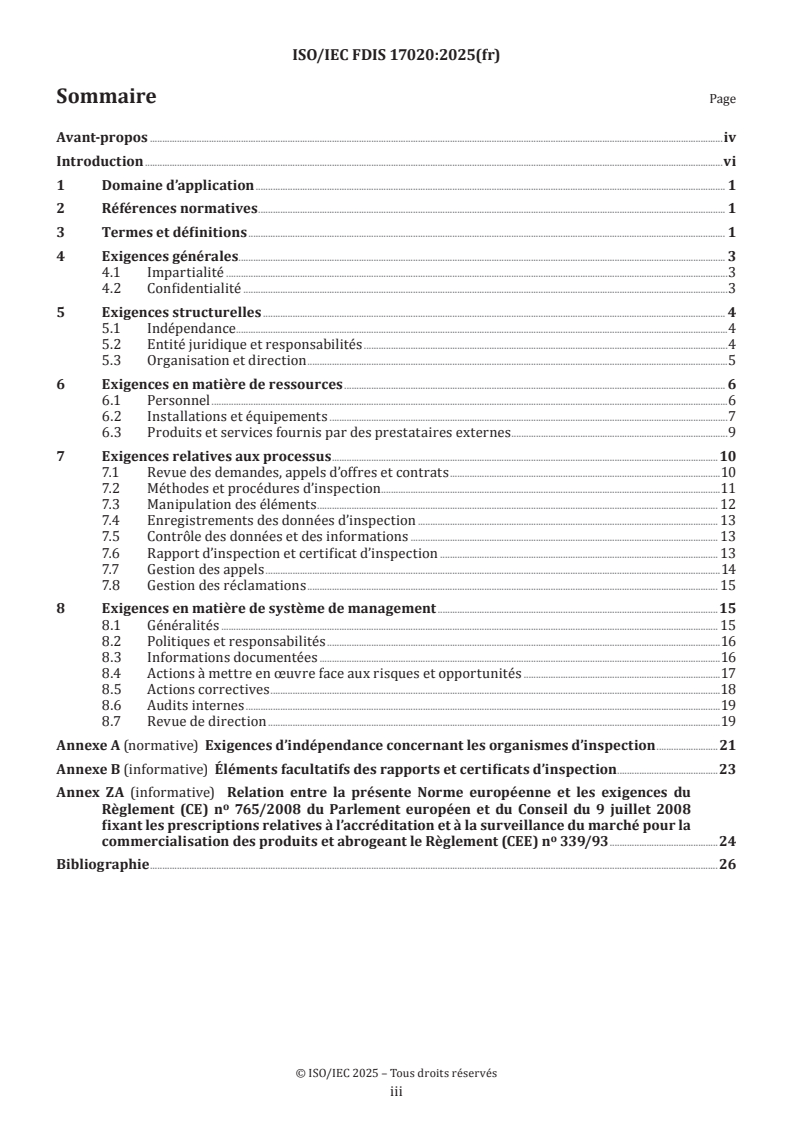
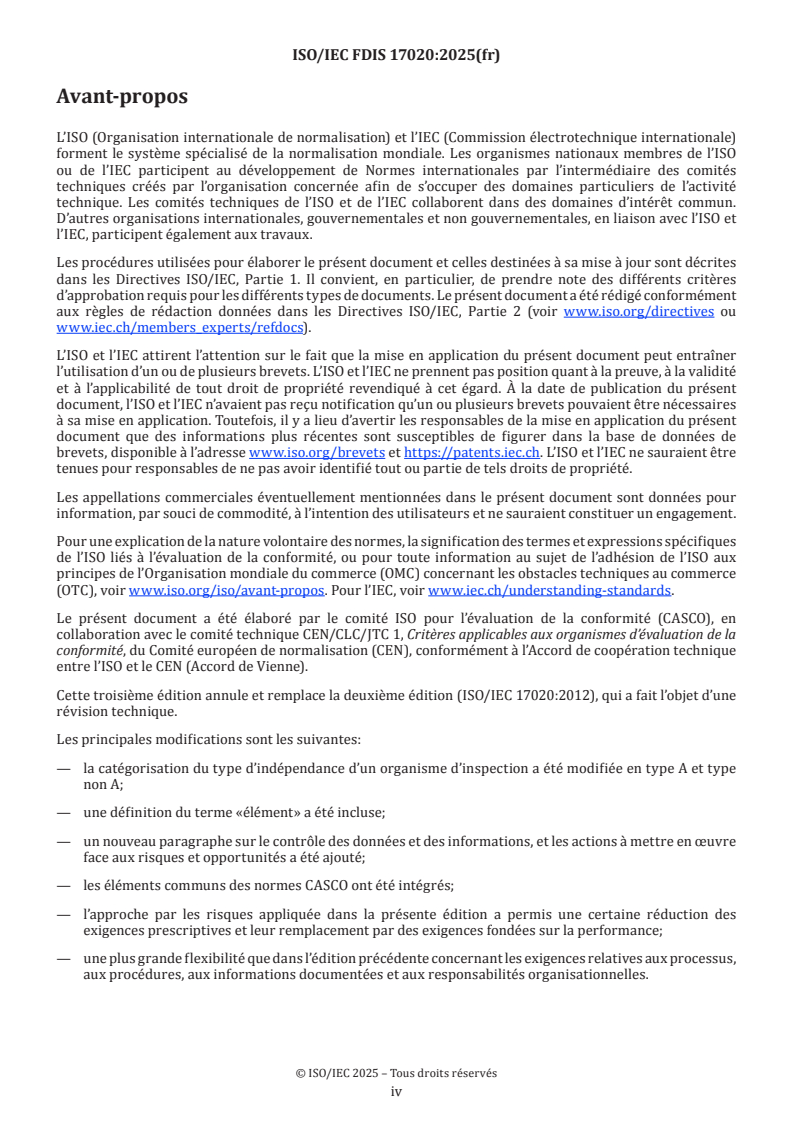
ISO/IEC FDIS 17020 - Évaluation de la conformité — Exigences pour les organismes effectuant des inspections Released:9. 12. 2025
Frequently Asked Questions
ISO/IEC FDIS 17020 is a draft published by the International Organization for Standardization (ISO). Its full title is "Conformity assessment - Requirements for bodies performing inspection". This standard covers: ISO/IEC 17020:2012 specifies requirements for the competence of bodies performing inspection and for the impartiality and consistency of their inspection activities. It applies to inspection bodies of type A, B or C, as defined in ISO/IEC 17020:2012, and it applies to any stage of inspection.
ISO/IEC 17020:2012 specifies requirements for the competence of bodies performing inspection and for the impartiality and consistency of their inspection activities. It applies to inspection bodies of type A, B or C, as defined in ISO/IEC 17020:2012, and it applies to any stage of inspection.
ISO/IEC FDIS 17020 is classified under the following ICS (International Classification for Standards) categories: 03.120.20 - Product and company certification. Conformity assessment. The ICS classification helps identify the subject area and facilitates finding related standards.
ISO/IEC FDIS 17020 has the following relationships with other standards: It is inter standard links to ISO 23904:2020, ISO/IEC 17020:2012. Understanding these relationships helps ensure you are using the most current and applicable version of the standard.
ISO/IEC FDIS 17020 is available in PDF format for immediate download after purchase. The document can be added to your cart and obtained through the secure checkout process. Digital delivery ensures instant access to the complete standard document.
Standards Content (Sample)
FINAL DRAFT
International
Standard
ISO/CASCO
Conformity assessment —
Secretariat: ISO
Requirements for bodies
Voting begins on:
performing inspection
2025-11-21
Évaluation de la conformité — Exigences pour les organismes
Voting terminates on:
effectuant des inspections
2026-01-16
RECIPIENTS OF THIS DRAFT ARE INVITED TO SUBMIT,
This draft is submitted to a parallel vote in ISO and in IEC.
WITH THEIR COMMENTS, NOTIFICATION OF ANY
RELEVANT PATENT RIGHTS OF WHICH THEY ARE AWARE
AND TO PROVIDE SUPPOR TING DOCUMENTATION.
IN ADDITION TO THEIR EVALUATION AS
BEING ACCEPTABLE FOR INDUSTRIAL, TECHNO
ISO/CEN PARALLEL PROCESSING LOGICAL, COMMERCIAL AND USER PURPOSES, DRAFT
INTERNATIONAL STANDARDS MAY ON OCCASION HAVE
TO BE CONSIDERED IN THE LIGHT OF THEIR POTENTIAL
TO BECOME STAN DARDS TO WHICH REFERENCE MAY BE
MADE IN NATIONAL REGULATIONS.
Reference number
FINAL DRAFT
International
Standard
ISO/CASCO
Conformity assessment —
Secretariat: ISO
Requirements for bodies
Voting begins on:
performing inspection
Évaluation de la conformité — Exigences pour les organismes
Voting terminates on:
effectuant des inspections
RECIPIENTS OF THIS DRAFT ARE INVITED TO SUBMIT,
This draft is submitted to a parallel vote in ISO and in IEC.
WITH THEIR COMMENTS, NOTIFICATION OF ANY
RELEVANT PATENT RIGHTS OF WHICH THEY ARE AWARE
AND TO PROVIDE SUPPOR TING DOCUMENTATION.
© ISO/IEC 2025
IN ADDITION TO THEIR EVALUATION AS
All rights reserved. Unless otherwise specified, or required in the context of its implementation, no part of this publication may
BEING ACCEPTABLE FOR INDUSTRIAL, TECHNO
ISO/CEN PARALLEL PROCESSING
LOGICAL, COMMERCIAL AND USER PURPOSES, DRAFT
be reproduced or utilized otherwise in any form or by any means, electronic or mechanical, including photocopying, or posting on
INTERNATIONAL STANDARDS MAY ON OCCASION HAVE
the internet or an intranet, without prior written permission. Permission can be requested from either ISO at the address below
TO BE CONSIDERED IN THE LIGHT OF THEIR POTENTIAL
or ISO’s member body in the country of the requester.
TO BECOME STAN DARDS TO WHICH REFERENCE MAY BE
MADE IN NATIONAL REGULATIONS.
ISO copyright office
CP 401 • Ch. de Blandonnet 8
CH-1214 Vernier, Geneva
Phone: +41 22 749 01 11
Email: copyright@iso.org
Website: www.iso.org
Published in Switzerland Reference number
© ISO/IEC 2025 – All rights reserved
ii
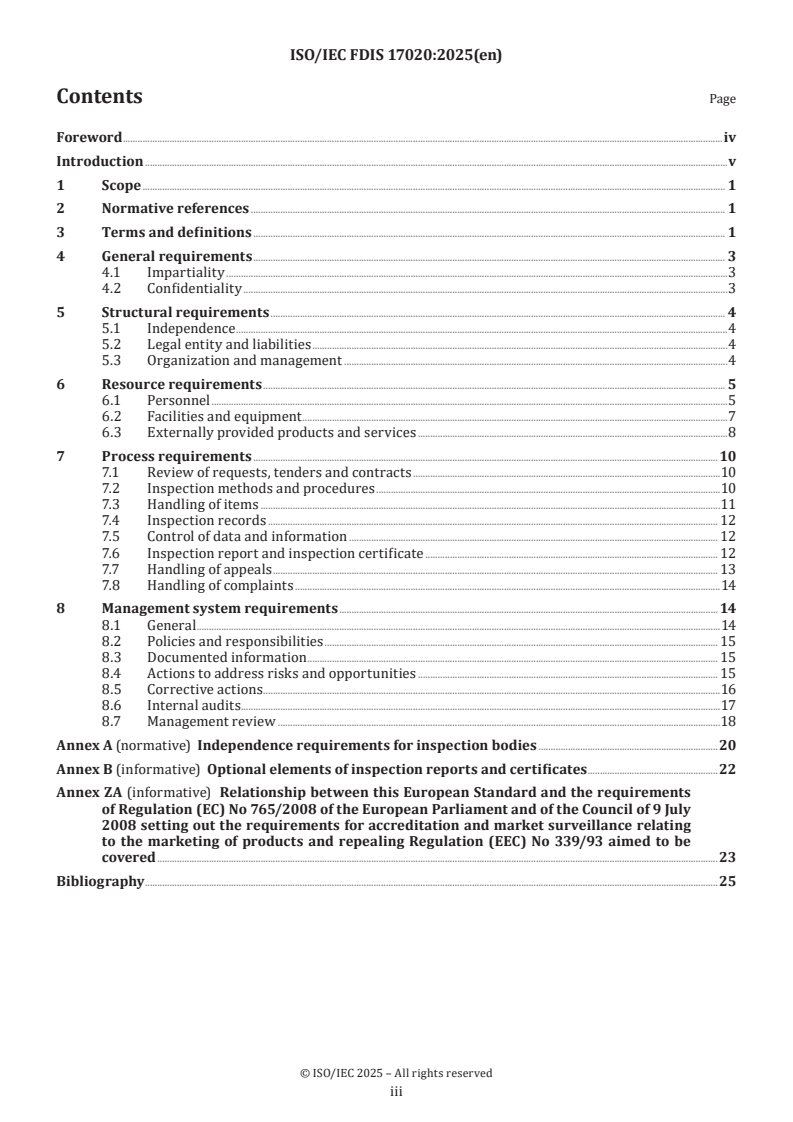
Contents Page
Foreword .iv
Introduction .v
1 Scope . 1
2 Normative references . 1
3 Terms and definitions . 1
4 General requirements . 3
4.1 Impartiality .3
4.2 Confidentiality .3
5 Structural requirements . 4
5.1 Independence .4
5.2 Legal entity and liabilities .4
5.3 Organization and management .4
6 Resource requirements . 5
6.1 Personnel .5
6.2 Facilities and equipment .7
6.3 Externally provided products and services .8
7 Process requirements . 10
7.1 Review of requests, tenders and contracts .10
7.2 Inspection methods and procedures .10
7.3 Handling of items .11
7.4 Inspection records . 12
7.5 Control of data and information . 12
7.6 Inspection report and inspection certificate . 12
7.7 Handling of appeals . 13
7.8 Handling of complaints .14
8 Management system requirements . 14
8.1 General .14
8.2 Policies and responsibilities . 15
8.3 Documented information . 15
8.4 Actions to address risks and opportunities . 15
8.5 Corrective actions .16
8.6 Internal audits.17
8.7 Management review .18
Annex A (normative) Independence requirements for inspection bodies .20
Annex B (informative) Optional elements of inspection reports and certificates .22
Annex ZA (informative) Relationship between this European Standard and the requirements
of Regulation (EC) No 765/2008 of the European Parliament and of the Council of 9 July
2008 setting out the requirements for accreditation and market surveillance relating
to the marketing of products and repealing Regulation (EEC) No 339/93 aimed to be
covered .23
Bibliography .25
© ISO/IEC 2025 – All rights reserved
iii
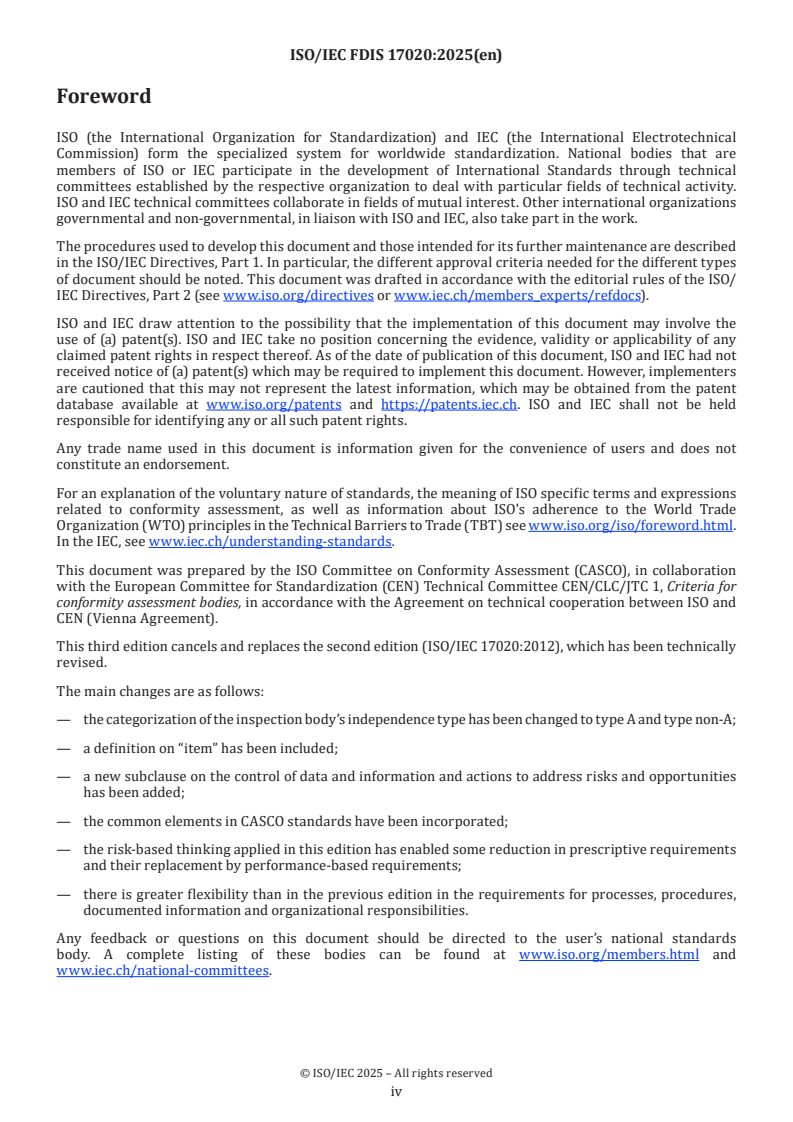
Foreword
ISO (the International Organization for Standardization) and IEC (the International Electrotechnical
Commission) form the specialized system for worldwide standardization. National bodies that are
members of ISO or IEC participate in the development of International Standards through technical
committees established by the respective organization to deal with particular fields of technical activity.
ISO and IEC technical committees collaborate in fields of mutual interest. Other international organizations
governmental and non-governmental, in liaison with ISO and IEC, also take part in the work.
The procedures used to develop this document and those intended for its further maintenance are described
in the ISO/IEC Directives, Part 1. In particular, the different approval criteria needed for the different types
of document should be noted. This document was drafted in accordance with the editorial rules of the ISO/
IEC Directives, Part 2 (see www.iso.org/directives or www.iec.ch/members_experts/refdocs).
ISO and IEC draw attention to the possibility that the implementation of this document may involve the
use of (a) patent(s). ISO and IEC take no position concerning the evidence, validity or applicability of any
claimed patent rights in respect thereof. As of the date of publication of this document, ISO and IEC had not
received notice of (a) patent(s) which may be required to implement this document. However, implementers
are cautioned that this may not represent the latest information, which may be obtained from the patent
database available at www.iso.org/patents and https://patents.iec.ch. ISO and IEC shall not be held
responsible for identifying any or all such patent rights.
Any trade name used in this document is information given for the convenience of users and does not
constitute an endorsement.
For an explanation of the voluntary nature of standards, the meaning of ISO specific terms and expressions
related to conformity assessment, as well as information about ISO's adherence to the World Trade
Organization (WTO) principles in the Technical Barriers to Trade (TBT) see www.iso.org/iso/foreword.html.
In the IEC, see www.iec.ch/understanding-standards.
This document was prepared by the ISO Committee on Conformity Assessment (CASCO), in collaboration
with the European Committee for Standardization (CEN) Technical Committee CEN/CLC/JTC 1, Criteria for
conformity assessment bodies, in accordance with the Agreement on technical cooperation between ISO and
CEN (Vienna Agreement).
This third edition cancels and replaces the second edition (ISO/IEC 17020:2012), which has been technically
revised.
The main changes are as follows:
— the categorization of the inspection body’s independence type has been changed to type A and type non-A;
— a definition on “item” has been included;
— a new subclause on the control of data and information and actions to address risks and opportunities
has been added;
— the common elements in CASCO standards have been incorporated;
— the risk-based thinking applied in this edition has enabled some reduction in prescriptive requirements
and their replacement by performance-based requirements;
— there is greater flexibility than in the previous edition in the requirements for processes, procedures,
documented information and organizational responsibilities.
Any feedback or questions on this document should be directed to the user’s national standards
body. A complete listing of these bodies can be found at www.iso.org/members.html and
www.iec.ch/national-committees.
© ISO/IEC 2025 – All rights reserved
iv
Introduction
This document was developed to promote confidence in bodies performing inspection.
Inspection bodies carry out inspection activities on behalf of private clients, their parent organizations,
regulatory authorities, or others, with the objective of providing information about the conformity of
inspected items with regulations, standards, specifications, inspection schemes or contracts. Inspection
parameters include matters of quantity, quality, safety, fitness for purpose, and conformity of inspected
item(s) with specified requirements (e.g. safety compliance of installations or systems in operation). This
document provides requirements for the competence, impartiality and consistent operation of inspection
bodies as a basis to promote confidence about and acceptance of inspection results by clients, regulatory
authorities and others.
This document covers the activities of inspection bodies whose work can include the examination of
materials, products, installations, plants, processes, work procedures or services, and the determination
of their conformity with requirements and the subsequent reporting of results of these activities to clients
and, when required, to regulatory authorities. Inspection can concern all stages during the lifetime of these
items, including the design stage. Such work normally requires the exercise of professional judgement in
performing inspection, in particular when assessing conformity with general requirements.
This document can be used as a requirements document for accreditation or peer-assessment or other
assessments.
The requirements of this document can be interpreted when applied to particular sectors.
Inspection can be an activity embedded in a larger process. For example, inspection can be specified as
a surveillance activity in a product certification scheme. Likewise, results of other conformity assessment
activities can be used as an input when performing inspection activities. Inspection can be an activity that
precedes maintenance or simply provides information about the inspected item with no determination of
conformity with requirements.
The categorization of inspection bodies as type A and type non-A reflects the level of their independence.
The impartiality requirements are equally applicable to both type A and type non-A inspection bodies.
© ISO/IEC 2025 – All rights reserved
v
FINAL DRAFT International Standard ISO/IEC FDIS 17020:2025(en)
Conformity assessment — Requirements for bodies
performing inspection
1 Scope
This document contains requirements for the competence and impartiality of bodies performing inspection,
and for the consistent operation of their inspection activities.
2 Normative references
The following documents are referred to in the text in such a way that some or all of their content constitutes
requirements of this document. For dated references, only the edition cited applies. For undated references,
the latest edition of the referenced document (including any amendments) applies.
ISO/IEC 17000:2020, Conformity assessment — Vocabulary and general principles
3 Terms and definitions
For the purposes of this document, the terms and definitions given in ISO/IEC 17000 and the following apply.
ISO and IEC maintain terminology databases for use in standardization at the following addresses:
— ISO Online browsing platform: available at https:// www .iso .org/ obp
— IEC Electropedia: available at https:// www .electropedia .org/
3.1
inspection
examination of an item (3.8) and determination of its conformity with detailed requirements or, on the basis
of professional judgement, with general requirements
Note 1 to entry: Examination can include direct or indirect observations, which can include measurements or the
output of instruments.
Note 2 to entry: Inspection results normally include a statement of conformity of the item. However, schemes or
contracts can specify inspection as examination only.
Note 3 to entry: Inspection of processes can include personnel, facilities, technology or methodology.
[SOURCE: ISO/IEC 17000:2020, 6.3, modified — "object of conformity assessment" has been replaced by
"item"; the original notes 2 and 3 to entry have been replaced by 2 new ones.]
3.2
inspection body
body that performs inspection (3.1)
3.3
inspection scheme
inspection programme
set of rules and procedures that describes the item (3.8), identifies the specified requirements and provides
the methodology for performing inspection (3.1) activities
Note 1 to entry: Inspection schemes can be operated at the international, regional, national, sub-national or industry
sector level.
© ISO/IEC 2025 – All rights reserved
Note 2 to entry: A scheme which includes inspection can provide methodology for activities in either all or only in
some of the conformity assessment functions. It can include methodology for inspection only (a determination
function activity) or for other determination function activities. The scheme can include methodology for selection
function activities and, in addition, it can include methodology for review, decision, attestation function activities (see
ISO/IEC 17000:2020, Annex A) .
Note 3 to entry: The inspection scheme can specify independence requirements.
[SOURCE: ISO/IEC 17000:2020, 4.9, modified — In the terms, "conformity assessment" has been replaced by
"inspection"; in the definition, "objects of conformity assessment" has been replaced by "items"; "conformity
assessment" has been replaced by "inspection activities"; the original notes to entry have been replaced.]
3.4
impartiality
objectivity with regard to the outcome of an inspection (3.1)
Note 1 to entry: Objectivity means that conflicts of interest do not exist or are resolved so as not to adversely influence
activities of the inspection body (3.2).
Note 2 to entry: Other terms that are useful in conveying the element of impartiality are: freedom from conflict of
interests, freedom from bias, lack of prejudice, neutrality, fairness, open-mindedness, even-handedness, detachment,
balance.
[SOURCE: ISO/IEC 17000:2020, 5.3, modified — "conformity assessment activity" has been replaced by
"inspection"; note 1 to entry has been changed and note 2 to entry added.]
3.5
appeal
request by the client (3.7) to an inspection body (3.2) for reconsideration by that body of a decision it has
made relating to the conformity of the item (3.8) inspected
Note 1 to entry: An appeal is only possible if a statement of conformity has been issued
[SOURCE: ISO/IEC 17000:2020, 8.6, modified — In the definition, "person or organization that provides, or
that is, the object of conformity assessment to a conformity assessment body or an accreditation body" has
been replaced by "client to an inspection body"; "that object" has been replaced by "the conformity of the
item inspected"; note 1 to entry has been added.]
3.6
complaint
expression of dissatisfaction, other than appeal (3.5), by any person or organization to an inspection body
(3.2), relating to the activities of that body, where a response is expected
[SOURCE: ISO/IEC 17000:2020, 8.7, modified — "a conformity assessment body or an accreditation body"
has been replaced by "an inspection body".]
3.7
client
person or organization requesting inspection (3.1) of an item (3.8)
Note 1 to entry: The client can be different from the provider of the item.
3.8
item
object of inspection (3.1) to which the specified requirements for the inspection apply
Note 1 to entry: The term “item” is used in this document to encompass product, process, service, material, location,
facility, premises, installation, or parts of thereof, or their design, as appropriate.
Note 2 to entry: The object of inspection can be a group of objects or a single object.
Note 3 to entry: An item can be inspected at any stages, e.g. design stage, type examination, initial inspection, in-
service inspection or under surveillance.
© ISO/IEC 2025 – All rights reserved
4 General requirements
4.1 Impartiality
4.1.1 Inspection activities shall be undertaken impartially.
4.1.2 The inspection body shall be responsible for the impartiality of its inspection activities and shall not
allow commercial, financial or other pressures to compromise its impartiality.
4.1.3 The inspection body shall monitor its activities and its relationships to identify on an ongoing basis
threats to its impartiality. This monitoring shall include the relationships of its personnel.
NOTE A relationship can be based on ownership, governance, management, personnel, shared resources,
finances, contracts or marketing (including branding and sponsoring) and the payment of sales commissions or
other inducement for the referral of new client. Such relationships do not necessarily present a body with a threat to
impartiality.
4.1.4 If a threat to impartiality is identified, its effect shall be eliminated or minimized so that the
impartiality is not compromised. The inspection body shall demonstrate how it eliminates or minimizes
such threats.
4.1.5 The inspection body shall have top management commitment to impartiality.
4.1.6 The inspection body shall be structured and managed so as to safeguard impartiality.
4.1.7 All personnel of the inspection body, either internal or external, that could influence the inspection
activities shall act impartially. In particular, personnel involved in inspection activities shall not be
remunerated in a way that influences the results of inspections.
4.2 Confidentiality
4.2.1 The inspection body shall be responsible, through legally enforceable commitments, for the
management of all information obtained or created during the performance of inspection activities. The
inspection body shall inform the client, in advance, of the information it intends to place in the public domain.
Except for information that the client makes publicly available, or when agreed between the inspection
body and the client, all other information is considered proprietary information and shall be regarded as
confidential.
NOTE Legally enforceable commitments can be, for example, contractual agreements or commitments related to
confidentiality policy published on the inspection body’s website or in the inspection body’s documentation.
4.2.2 When the inspection body is required by law or authorized by contractual arrangements to
release confidential information, the client concerned shall be notified of the information provided, unless
prohibited by law.
4.2.3 Information about the client obtained from sources other than the client (e.g. complainant, regulatory
authorities) shall be treated as confidential unless agreed by the source.
4.2.4 Personnel, including any committee members, contractors, personnel of external bodies, or persons
acting on the inspection body's behalf, shall keep confidential all information obtained or created during the
performance of the inspection activities.
© ISO/IEC 2025 – All rights reserved
5 Structural requirements
5.1 Independence
The inspection body shall meet independence requirements specified in Annex A based on the conditions
under which it performs its inspection activities and if applicable as required by the inspection scheme.
NOTE An inspection body can meet different independence requirements (i.e. type A, type non-A) for different
inspection activities.
5.2 Legal entity and liabilities
5.2.1 The inspection body shall be a legal entity, or a defined part of a legal entity. The legal entity is
legally responsible for the inspection body and all its inspection activities.
NOTE A governmental inspection body is a legal entity on the basis of its governmental status.
5.2.2 An inspection body that is part of a legal entity shall be identifiable within that entity.
NOTE Identifiable means visible in the general organization and structure of the legal entity.
5.2.3 The inspection body shall define and document the inspection activities for which it conforms to the
requirements of this document.
NOTE The description of the activities includes defining the general field and range of inspection (e.g. categories
or sub-categories of products, processes, services, or installations) and the stage of inspection, and, where applicable,
the regulations, inspection scheme, standards or specifications containing the requirements against which the
inspection will be performed.
5.2.4 The inspection body shall have adequate provision (e.g. insurance or reserves) to cover liabilities
arising from its activities. The inspection body shall:
a) analyse the risks arising from the inspection activities;
b) assess the potential liabilities associated with identified risks;
c) assure that the level of provisions established is consistent with those liabilities.
NOTE The liability can be assumed by the State in accordance with national laws, or by the organization of which
the inspection body forms a part.
5.2.5 The inspection body shall have documentation describing the contractual conditions under which it
provides the inspection, except when it provides inspection services to the legal entity of which it is a part.
In this case, internal agreements shall be established.
NOTE The contractual conditions cover the general and specific conditions for the performance of the inspections.
5.3 Organization and management
5.3.1 The inspection body shall:
a) define its organization and management structure, its place within any parent organization and the
relationship between management, technical activities and support services;
b) specify the responsibility, authority and interrelationships of all personnel who manage or perform
work affecting the results of its inspection activities;
c) maintain its capability to carry out inspection activities as described in 5.2.3;
© ISO/IEC 2025 – All rights reserved
d) document its procedures to the extent necessary to ensure the consistent application of its inspection
body activities and the validity of the results.
NOTE An inspection body can carry out simulated inspections to maintain the capability for inspection activities
carried out infrequently.
5.3.2 The inspection body shall have technical management who have overall authority and responsibility
for the:
a) development of inspection activities including inspection methods and associated processes;
b) performance of monitoring (see 6.1.5);
c) access to the necessary resources;
d) requirements for competence of personnel;
e) provision of technical aspects of contractual arrangements;
f) performance of inspection activities.
5.3.3 The inspection body technical management shall be technically competent for the operation of an
inspection body.
5.3.4 The inspection body shall have personnel who, irrespective of other responsibilities, have the
authority and resources needed to carry out their duties, including:
a) implementation, maintenance and improvement of the management system;
b) identification of deviations from the management system;
c) initiation of actions to prevent or minimize such deviations;
d) reporting to inspection body management on the performance of the management system and any need
for improvement;
e) ensuring the effectiveness of the inspection body’s activities.
5.3.5 The inspection body shall document the duties, responsibilities and authorities for each function
involved in its inspection activities in a job description or other documentation.
NOTE The functions involved in inspection activities are inspectors and other positions which can have an effect
on the management, performance, recording or reporting of inspections.
6 Resource requirements
6.1 Personnel
6.1.1 The inspection body shall have access to a sufficient number of competent persons to perform the
type, range and volume of its inspection activities. The inspection body shall ensure that each person clearly
understands their duties, responsibilities, and authorities within the scope of the functions they perform.
6.1.2 The inspection body shall have a documented process for managing competence of its personnel
involved in inspection activities. The process shall address the following:
a) determination of the competence requirements including where needed for making professional
judgement (e.g. education, training, technical knowledge, skills or experience);
b) selection of personnel;
© ISO/IEC 2025 – All rights reserved
c) initial training of personnel;
d) authorization of personnel;
e) monitoring of competence of personnel;
f) continual training.
6.1.3 The personnel performing the inspection shall have knowledge, to the extent required, for the type
of inspection undertaken, of the following:
a) the technology used for the manufacture of the products inspected, the operation of processes and the
delivery of services;
b) the way in which products are used, processes are operated and services are delivered;
c) any defects which can occur during the use of the product, any failures in the operation of the process
and any deficiencies in the delivery of services;
d) the significance of deviations in the normal use of products, the operation of processes and the provision
of services.
6.1.4 The initial training shall include an induction period and a mentored working period with authorized
and competent personnel for the relevant inspection activity.
6.1.5 Personnel involved in inspection activities shall be monitored at a defined frequency by authorized
and competent personnel in accordance with a monitoring programme.
NOTE The following can be considered in the design of the programme:
— the risks and complexities of the inspections;
— results of previous monitoring activities;
— technical, procedural or legislative developments relevant to the inspections;
— inspection activities which use new technology.
6.1.6 Results of monitoring shall be used as a means of identifying training needs (see 6.1.8) and shall be
considered for maintenance of authorisation.
NOTE Monitoring can include a combination of techniques, such as on-site observations, report reviews,
interviews, simulated inspections and other techniques to assess performance, and depends on the nature of the
inspection activities.
6.1.7 Each inspector shall be observed performing inspection, unless there is sufficient supporting
evidence that the inspector is continuing to perform competently.
NOTE 1 Depending on the fields, types and ranges of inspection covered by the inspector’s authorisations, there can
be more than one observation per inspector necessary to adequately cover the whole range of required competencies.
Also, more frequent observations can be necessary if there is a lack of evidence of continuing satisfactory performance.
NOTE 2 Sufficient evidence of an inspector’s continuous competent performance can be substantiated by a
combination of information such as satisfactory:
— performance of examinations and determinations;
— outcome of monitoring;
— outcome of separate evaluations to confirm the outcome of the inspections;
— outcome of mentoring and training;
© ISO/IEC 2025 – All rights reserved
— results of examination by a competent body, e.g. a body operating certification of persons.
6.1.8 The inspection body shall identify training needs and provide relevant training to personnel involved
in the inspection activities to keep pace with technology developments, inspection methods and other
relevant changes depending on their competence, experience and upon the results of monitoring (see 6.1.7).
6.1.9 The inspection body shall have documented information demonstrating competence of its personnel
(see 6.1.2).
6.2 Facilities and equipment
6.2.1 The inspection body shall have available, suitable and adequate facilities and equipment to ensure
that inspection activities and all associated activities are performed in a competent and safe manner.
NOTE The inspection body is not necessarily the owner of the facilities or equipment that it uses. Facilities and
equipment can be borrowed, rented, hired, leased or provided by another party (e.g. the manufacturer or installer of
the equipment). However, the responsibility for the suitability and the calibration status of the equipment used in the
inspection activities, whether owned by the inspection body or not, lies solely with the inspection body.
6.2.2 The inspection body shall have rules for the access to, and the use of, specified facilities and
equipment used to perform inspections.
6.2.3 The inspection body shall ensure the continued suitability of the facilities and of the equipment
mentioned in 6.2.1 for their intended use.
NOTE Continued suitability can be established by visual inspection, functional checks, periodic maintenance or
re-calibration.
6.2.4 All equipment having a significant influence on the results of the inspection shall be determined and
where appropriate:
a) be uniquely identified;
b) be subjected to in-service checks according to a procedure when necessary to maintain confidence in
the performance of the equipment;
c) for measuring equipment, be calibrated before being put into service, and thereafter calibrated
according to an established programme.
NOTE 1 Inspection bodies can document and retain the rationale for decisions on the significance of influence of
equipment on the inspection, including environmental conditions, when relevant.
NOTE 2 The procedure in b) can specify the nature of such checks, the frequency and acceptance criteria.
6.2.5 The inspection body shall have a procedure for handling, transport, storage, use and planned
maintenance of equipment in 6.2.4 to ensure proper functioning and to prevent contamination or
deterioration.
6.2.6 The inspection body shall verify that equipment conforms to specified requirements before being
placed into service or returned to service.
6.2.7 The inspection body shall ensure that measurement results which have a significant influence on
the result of the inspection or when required by the inspection scheme are metrologically traceable to the
International System of Units (SI) through at least one of the following:
a) calibration provided by a competent laboratory;
NOTE 1 Laboratories fulfilling the requirements of ISO/IEC 17025 are considered to be competent.
© ISO/IEC 2025 – All rights reserved
b) certified values of certified reference materials provided by a competent producer with stated
metrological traceability to the SI;
NOTE 2 Reference material producers fulfilling the requirements of ISO 17034 are considered to be competent.
c) direct realization of the SI units ensured by comparison, directly or indirectly, with national standards
or international standards.
NOTE 3 Details of practical realization of the definitions of some important units are given in the SI brochure.
NOTE 4 ISO/IEC 17025:2017, Annex A provides additional information on metrological traceability.
6.2.8 When metrological traceability to the SI units is not technically possible, the metrological traceability
to an appropriate reference shall be ensured by, for example:
a) certified values of certified reference materials provided by a competent producer;
NOTE Reference material producers fulfilling the requirements of ISO 17034 are considered to be competent.
b) results of reference measurement procedures, specified methods or consensus standards that are
clearly described and accepted as providing measurement results fit for their intended use and ensured
by suitable comparison.
6.2.9 If the inspection body uses technology, in connection with inspections (e.g. computers or automated
equipment, data processing, artificial intelligence, augmented reality or remote inspection techniques), it
shall ensure that:
a) the technology is suitable and adequate for use;
NOTE This can be done by the following:
— validation of calculations before use;
— periodic revalidation of related hardware and software;
— revalidation whenever changes are made to related hardware or software;
— software updates implemented as required.
b) procedures are established and implemented for protecting the integrity and security of data;
c) equipment, including hardware and software, is maintained to ensure proper functioning.
6.2.10 The inspection body shall have documented procedures for dealing with defective equipment.
Defective equipment shall be removed from service by segregation and clearly identified as defective by
prominent labelling or marking. The inspection body shall examine the effect of defects on previous
inspections and follow the procedure in 8.5.
6.2.11 Relevant information on the equipment, including software, shall be recorded. This shall include
identification and, where appropriate, information on calibration and maintenance.
6.3 Externally provided products and services
6.3.1 The inspection body shall ensure only suitable externally provided products and services that affect
inspection activities are used, when such products and services:
a) are intended for incorporation into its own inspection activities;
b) are provided, in part or in full, directly to the client by the inspection body, as received from the external
provider;
© ISO/IEC 2025 – All rights reserved
c) are used to support the operation of the inspection body.
NOTE Products can include, for example, equipment, installations, consumable materials and reference materials.
Services can include, for example, calibration services, testing services in the framework of inspection process,
inspection services, facility and equipment maintenance services, IT services, expertise services and auditing services.
6.3.2 The inspection body shall have a procedure and retain records for:
a) defining, reviewing and approving the inspection body’s requirements for externally provided products
and services;
b) defining the criteria for evaluation, selection, monitoring of performance and re-evaluation of the
external providers;
c) ensuring that externally provided products and services conform to the inspection body’s established
requirements, or when applicable, to the relevant requirements of this document or in other relevant
standards for conformity assessment bodies, before they are used;
d) taking any actions arising from evaluations, monitoring of performance and re-evaluations of the
external providers.
6.3.3 The inspection body shall itself normally perform the inspections that it contracts to undertake. The
use of externally provided inspection activities for part of the inspection or the entire inspection shall be
used in exceptional circumstances.
NOTE 1 Examples of exceptional circumstances can be:
a) an unforeseen or abnormal overload;
b) key inspection personnel being temporarily unavailable;
c) key facilities or equipment being temporarily unfit for use.
NOTE 2 The terms “subcontracting”, “outsourcing” and “externally provided inspection activities” are considered
to be synonyms.
NOTE 3 Where the inspection body engages individuals to provide additional resources or competence, these
individuals are not considered to be external service providers provided they operate under the inspection body's
management system (see 6.1).
NOTE 4 The use of external service providers for activities referred to in 6.3.1, such as testing, calibration, or IT
services, is not restricted to exceptional circumstances, provided that the requirements of 6.3.1 and 6.3.2 are fulfilled.
6.3.4 The inspection body shall inform the client of its intention to use externally provided inspection
activities for part of the inspection, or the entire inspection, to provide the client with an opportunity to
object in advance.
6.3.5 Whenever externally provided inspection activities form part of an inspection or the entire
inspection, the responsibility for the inspection results and any determination of conformity of the item
inspected with the requirements shall remain with the inspection body.
6.3.6 The inspection body shall retain documented information for approved external service providers
and for which services the approval applies.
© ISO/IEC 2025 – All rights reserved
7 Process requirements
7.1 Review of requests, tenders and contracts
7.1.1 The inspection body shall have a procedure for the review of inspection requests, tenders, and
contracts. The procedure shall ensure that:
a) the inspection to be carried out is defined, the item to be inspected is clearly identified and the
requirements to be satisfied are adequately defined, documented, and understood;
NOTE 1 The requirements can be part of the inspection scheme.
b) the inspection body has the capability, including adequate resources, to meet the client requirements;
c) the appropriate inspection methods are available or are to be developed to meet the client requirements;
d) the requirements, including any special conditions of the client, are adequately defined and understood,
so that clear instructions can be issued to personnel performing the required services;
e) the requirements of the request, tender, contract or work order have been met.
NOTE 2 For routine or repeated work requests, reviews of requests, tenders and contracts can be performed in a
simplified way.
7.1.2 The inspection body shall inform the client if a requested inspection is considered to be inappropriate.
7.1.3 Any differences between the request or tender and the contract shall be resolved before inspection
activities start.
7.1.4 Each contract shall be acceptable both to the insp
...
WG31/N74
ISO/CASCO
Secretariat: ISO
Date: 2025-09-0811-07
Conformity assessment — Requirements for bodies performing
inspection
Évaluation de la conformité — Exigences pour les organismes effectuant des inspections
FDIS stage
Warning for WDs and CDs
This document is not an ISO Document. It is distributed for review and comment. It is subject to change without
notice and may not be referred to as an Document.
Recipients of this draft are invited to submit, with their comments, notification of any relevant patent rights of
which they are aware and to provide supporting documentation.
© ISO/IEC 2025 – All rights reserved
ISO #####-#:####(X)
2 © ISO #### – All rights reserved
ISO/IEC DISFDIS 17020:2025(en)
© ISO/IEC 2025
All rights reserved. Unless otherwise specified, or required in the context of its implementation, no part of this publication
may be reproduced or utilized otherwise in any form or by any means, electronic or mechanical, including photocopying,
or posting on the internet or an intranet, without prior written permission. Permission can be requested from either ISO
at the address below or ISO’s member body in the country of the requester.
ISO copyright office
CP 401 • Ch. de Blandonnet 8
CH-1214 Vernier, Geneva
Phone: + 41 22 749 01 11
EmailE-mail: copyright@iso.org
Website: www.iso.orgwww.iso.org
Published in Switzerland
© ISO/IEC 2025 – All rights reserved
iii
ISO/IEC DISFDIS 17020:2025(en)
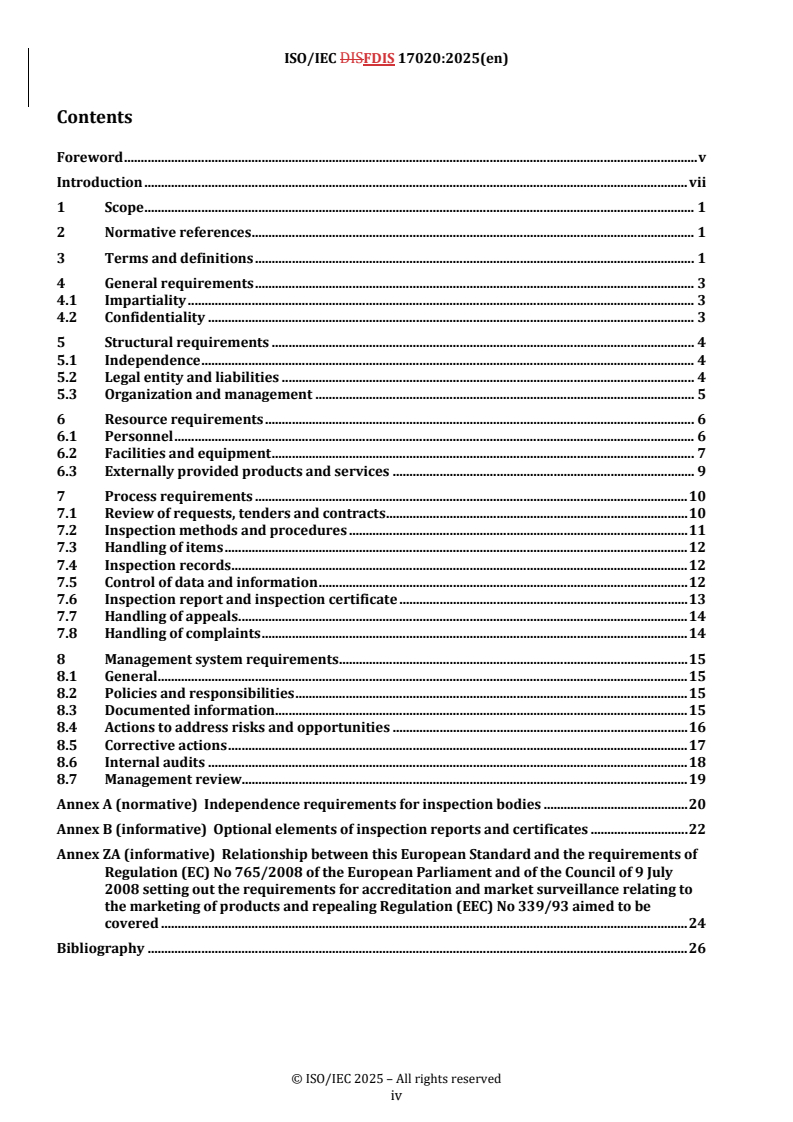
Contents
Foreword . v
Introduction . vii
1 Scope . 1
2 Normative references . 1
3 Terms and definitions . 1
4 General requirements . 3
4.1 Impartiality . 3
4.2 Confidentiality . 3
5 Structural requirements . 4
5.1 Independence . 4
5.2 Legal entity and liabilities . 4
5.3 Organization and management . 5
6 Resource requirements . 6
6.1 Personnel . 6
6.2 Facilities and equipment . 7
6.3 Externally provided products and services . 9
7 Process requirements . 10
7.1 Review of requests, tenders and contracts . 10
7.2 Inspection methods and procedures . 11
7.3 Handling of items . 12
7.4 Inspection records . 12
7.5 Control of data and information . 12
7.6 Inspection report and inspection certificate . 13
7.7 Handling of appeals . 14
7.8 Handling of complaints . 14
8 Management system requirements . 15
8.1 General. 15
8.2 Policies and responsibilities . 15
8.3 Documented information . 15
8.4 Actions to address risks and opportunities . 16
8.5 Corrective actions . 17
8.6 Internal audits . 18
8.7 Management review. 19
Annex A (normative) Independence requirements for inspection bodies . 20
Annex B (informative) Optional elements of inspection reports and certificates . 22
Annex ZA (informative) Relationship between this European Standard and the requirements of
Regulation (EC) No 765/2008 of the European Parliament and of the Council of 9 July
2008 setting out the requirements for accreditation and market surveillance relating to
the marketing of products and repealing Regulation (EEC) No 339/93 aimed to be
covered . 24
Bibliography . 26
© ISO/IEC 2025 – All rights reserved
iv
ISO/IEC DISFDIS 17020:2025(en)
Foreword
ISO (the International Organization for Standardization) and IEC (the International Electrotechnical
Commission) form the specialized system for worldwide standardization. National bodies that are members
of ISO or IEC participate in the development of International Standards through technical committees
established by the respective organization to deal with particular fields of technical activity. ISO and IEC
technical committees collaborate in fields of mutual interest. Other international organizations governmental
and non-governmental, in liaison with ISO and IEC, also take part in the work.
The procedures used to develop this document and those intended for its further maintenance are described
in the ISO/IEC Directives, Part 1. In particular, the different approval criteria needed for the different types of
document should be noted. This document was drafted in accordance with the editorial rules of the ISO/IEC
Directives, Part 2 (see www.iso.org/directives or www.iec.ch/members_experts/refdocs).
ISO and IEC draw attention to the possibility that the implementation of this document may involve the use of
(a) patent(s). ISO and IEC take no position concerning the evidence, validity or applicability of any claimed
patent rights in respect thereof. As of the date of publication of this document, ISO and IEC had not received
notice of (a) patent(s) which may be required to implement this document. However, implementers are
cautioned that this may not represent the latest information, which may be obtained from the patent database
available at www.iso.org/patents and https://patents.iec.ch. ISO and IEC shall not be held responsible for
identifying any or all such patent rights.
Any trade name used in this document is information given for the convenience of users and does not
constitute an endorsement.
For an explanation of the voluntary nature of standards, the meaning of ISO specific terms and expressions
related to conformity assessment, as well as information about ISO's adherence to the World Trade
Organization (WTO) principles in the Technical Barriers to Trade (TBT) see www.iso.org/iso/foreword.html.
In the IEC, see www.iec.ch/understanding-standards.
This document was prepared by the ISO Committee on Conformity Assessment (CASCO), in collaboration with
the European Committee for Standardization (CEN) Technical Committee CEN/CLC/JTC 1, Criteria for
conformity assessment bodies, in accordance with the Agreement on technical cooperation between ISO and
CEN (Vienna Agreement).
This third edition cancels and replaces the second edition (ISO/IEC 17020:2012), which has been technically
revised.
The main changes are as follows:
— — Categorizationthe categorization of the inspection body’s independence type has been changed to
Typetype A and Type Non type non-A;
— Inclusion of a definition on “item” has been included;
— Aa new sub clausesubclause on the control of data and information and actions to address risks and
opportunities has been added;
— Inclusion of the obligatory text from the PROC 33 Commoncommon elements in CASCO standards have
been incorporated;
— the risk-based thinking applied in this edition has enabled some reduction in prescriptive requirements
and their replacement by performance-based requirements;
© ISO/IEC 2025 – All rights reserved
v
ISO/IEC DISFDIS 17020:2025(en)
— there is greater flexibility than in the previous edition in the requirements for processes, procedures,
documented information and organizational responsibilities;.
Any feedback or questions on this document should be directed to the user’s national standards body. A
complete listing of these bodies can be found at www.iso.org/members.html and www.iec.ch/national-
committees.
© ISO/IEC 2025 – All rights reserved
vi
ISO/IEC DISFDIS 17020:2025(en)
Introduction
This document was developed to promote confidence in bodies performing inspection.
Inspection bodies carry out inspection activities on behalf of private clients, their parent organizations,
regulatory authorities, or others, with the objective of providing information about the conformity of
inspected items with regulations, standards, specifications, inspection schemes or contracts. Inspection
parameters include matters of quantity, quality, safety, fitness for purpose, and conformity of inspected
item(s) with specified requirements (e.g. safety compliance of installations or systems in operation). This
document provides requirements for the competence, impartiality and consistent operation of inspection
bodies as a basis to promote confidence about and acceptance of inspection results by clients, regulatory
authorities and others.
This document covers the activities of inspection bodies whose work can include the examination of materials,
products, installations, plants, processes, work procedures or services, and the determination of their
conformity with requirements and the subsequent reporting of results of these activities to clients and, when
required, to regulatory authorities. Inspection can concern all stages during the lifetime of these items,
including the design stage. Such work normally requires the exercise of professional judgement in performing
inspection, in particular when assessing conformity with general requirements.
This document can be used as a requirements document for accreditation or peer-assessment or other
assessments.
The requirements of this document can be interpreted when applied to particular sectors.
Inspection can be an activity embedded in a larger process. For example, inspection can be specified as a
surveillance activity in a product certification scheme. Likewise, results of other conformity assessment
activities can be used as an input when performing inspection activities. Inspection can be an activity that
precedes maintenance or simply provides information about the inspected item with no determination of
conformity with requirements.
The categorization of inspection bodies as type A and type non-A reflects the level of their independence. The
impartiality requirements are equally applicable to both type A and type non-A inspection bodies.
© ISO/IEC 2025 – All rights reserved
vii
ISO/IEC DISFDIS 17020:2025(en)
Conformity assessment — Requirements for bodies performing
inspection
1 Scope
This document contains requirements for the competence and impartiality of bodies performing inspection,
and for the consistent operation of their inspection activities.
2 Normative references
The following documents are referred to in the text in such a way that some or all of their content constitutes
requirements of this document. For dated references, only the edition cited applies. For undated references,
the latest edition of the referenced document (including any amendments) applies.
ISO/IEC 17000:2020, Conformity assessment — Vocabulary and general principles
3 Terms and definitions
For the purposes of this document, the terms and definitions given in ISO/IEC 17000 and the following apply.
ISO and IEC maintain terminology databases for use in standardization at the following addresses:
— ISO Online browsing platform: available at https://www.iso.org/obp
— IEC Electropedia: available at https://www.electropedia.org/
3.1 3.1
inspection
examination of an item (3.8(3.8)) and determination of its conformity with detailed requirements or, on the
basis of professional judgement, with general requirements
Note 1 to entry: Examination can include direct or indirect observations, which can include measurements or the output
of instruments.
Note 2 to entry: Inspection results normally include a statement of conformity of the item. However, schemes or contracts
can specify inspection as examination only).
Note 3 to entry: Inspection of processes can include personnel, facilities, technology or methodology.
[SOURCE: ISO/IEC 17000:2020, 6.3, modified — "object of conformity assessment" has been replaced by
"item"; "or regulations" has been added; the original notes 2 and 3 to entry have been replaced by 2 new ones.]
3.2 3.2
inspection body
body that performs inspection (3.1(3.1))
3.3 3.3
inspection scheme
inspection programme
set of rules and procedures that describes the item (3.8(3.8),), identifies the specified requirements and
provides the methodology for performing inspection (3.1) activities
© ISO/IEC 2025 – All rights reserved
ISO/IEC DISFDIS 17020:2025(en)
Note 1 to entry: Inspection schemes can be operated at the international, regional, national, sub-national or industry
sector level.
Note 2 to entry: ).
A scheme which includes inspection can provide methodology for activities in either all or only in some of the conformity
assessment functions. It can include methodology for inspection only (a determination function activity) or for other
determination function activities. The scheme can include methodology for selection function activities and, in addition,
it can include methodology for review, decision, attestation function activities (see ISO/IEC 17000:2020, Annex A).) .
Note 3 to entry: The inspection scheme can specify independence requirements.
[SOURCE: ISO/IEC 17000:2020, 4.9, modified — In the terms and the definition, "conformity assessment" has
been replaced by "inspection"; in the definition, "objects of conformity assessment" has been replaced by
"items"; "conformity assessment" has been replaced by "inspection activities"; the original notes to entry have
been reordered and updatedreplaced.]
3.4 3.4
impartiality
objectivity with regard to the outcome of an inspection (3.1(3.1))
Note 1 to entry: Objectivity means that conflicts of interest do not exist or are resolved so as not to adversely influence
activities of the inspection body (3.2(3.2).).
Note 2 to entry: Other terms that are useful in conveying the element of impartiality are: freedom from conflict of
interests, freedom from bias, lack of prejudice, neutrality, fairness, open-mindedness, even-handedness, detachment,
balance.
[SOURCE: ISO/IEC 17000:2020, 5.3, modified — "conformity assessment activity" has been replaced by
"inspection"; note 1 to entry has been changed and note 2 to entry added.]
3.5 3.5
appeal
request by the client (3.7(3.7)) to an inspection body (3.2(3.2)) for reconsideration by that body of a decision
it has made relating to the conformity of the item (3.8(3.8)) inspected
Note 1 to entry: An appeal is only possible if a statement of conformity has been issued
[SOURCE: ISO/IEC 17000:2020, 8.6, modified — In the definition, "person or organization that provides, or
that is, the object of conformity assessment to a conformity assessment body or an accreditation body" has
been replaced by "client to thean inspection body"; "that object" has been replaced by "the conformity of the
item inspected".]"; note 1 to entry has been added.]
3.6 3.6
complaint
expression of dissatisfaction, other than appeal (3.5(3.5),), by any person or organization to an inspection body
(3.2(3.2),), relating to the activities of that body, where a response is expected
[SOURCE: ISO/IEC 17000:2020, 8.7, modified — "a conformity assessment body or an accreditation body" has
been replaced by "an inspection body".]
3.7 3.7
client
person or organization requesting inspection (3.1(3.1)) of an item (3.8(3.8))
Note 1 to entry: The client can be different from the provider of the item.
© ISO/IEC 2025 – All rights reserved
ISO/IEC DISFDIS 17020:2025(en)
3.8 3.8
item
object of inspection (3.1(3.1)) to which the specified requirements for the inspection apply
Note 1 to entry: The term “item” is used in this document to encompass product, process, service, material, location,
facility, premises, installation, or parts of thereof, or their design, as appropriate.
Note 2 to entry: The object of inspection can be a group of objects or a single object.
Note 3 to entry an: An item can be inspected at any stages, e.g. design stage, type examination, initial inspection, in-
service inspection or under surveillance.
NOTE FROM SECRETARIAT to ballotters: the text shaded in grey in the document correspond to the obligatory requirements
from the CASCO Common Elements and as such are not open for comments
4 General requirements
4.1 Impartiality
4.1.1 4.1.1 Inspection activities shall be undertaken impartially.
4.1.2 4.1.2 The inspection body shall be responsible for the impartiality of its inspection activities and
shall not allow commercial, financial or other pressures to compromise its impartiality.
4.1.3 4.1.3 The inspection body shall monitor its activities and its relationships to identify on an ongoing
basis threats to its impartiality. This monitoring shall include the relationships of its personnel.
NOTE A relationship can be based on ownership, governance, management, personnel, shared resources, finances,
contracts or marketing (including branding and sponsoring) and the payment of sales commissions or other inducement
for the referral of new client. Such relationships do not necessarily present a body with a threat to impartiality.
4.1.4 4.1.4 If a threat to impartiality is identified, its effect shall be eliminated or minimized so that the
impartiality is not compromised. The inspection body shall demonstrate how it eliminates or minimizes such
threats.
4.1.5 4.1.5 The inspection body shall have top management commitment to impartiality.
4.1.6 4.1.6 The inspection body shall be structured and managed so as to safeguard impartiality.
4.1.7 4.1.7 All personnel of the inspection body, either internal or external, that could influence the
inspection activities shall act impartially. In particular, personnel involved in inspection activities shall not be
remunerated in a way that influences the results of inspections.
4.2 Confidentiality
4.2.1 4.2.1 The inspection body shall be responsible, through legally enforceable commitments, for the
management of all information obtained or created during the performance of inspection activities. The
inspection body shall inform the client, in advance, of the information it intends to place in the public domain.
Except for information that the client makes publicly available, or when agreed between the inspection body
and the client, all other information is considered proprietary information and shall be regarded as
confidential.
© ISO/IEC 2025 – All rights reserved
ISO/IEC DISFDIS 17020:2025(en)
NOTE Legally enforceable commitments can be, for example, contractual agreements or commitments related to
confidentiality policy published on the inspection body’s website or in the inspection body’s documentation.
4.2.2 4.2.2 When the inspection body is required by law or authorized by contractual arrangements to
release confidential information, the client concerned shall be notified of the information provided, unless
prohibited by law.
4.2.3 4.2.3 Information about the client obtained from sources other than the client (e.g.,. complainant,
regulatory authorities) shall be treated as confidential unless agreed by the source.
4.2.4 4.2.4 Personnel, including any committee members, contractors, personnel of external bodies, or
persons acting on the inspection body's behalf, shall keep confidential all information obtained or created
during the performance of the inspection activities.
5 Structural requirements
5.1 Independence
The inspection body shall meet independence requirements specified in Annex AAnnex A based on the
conditions under which it performs its inspection activities and if applicable as required by the inspection
scheme.
NOTE An inspection body can meet different independence requirements (i.e. type A, type non-A) for different
inspection activities.
5.2 Legal entity and liabilities
5.2.1 5.2.1 The inspection body shall be a legal entity, or a defined part of a legal entity. The legal entity is
legally responsible for the inspection body and all its inspection activities.
NOTE A governmental inspection body is a legal entity on the basis of its governmental status.
5.2.2 5.2.2 An inspection body that is part of a legal entity shall be identifiable within that entity.
NOTE Identifiable means visible in the general organization and structure of the legal entity.
5.2.3 5.2.3 The inspection body shall define and document the inspection activities for which it conforms
to the requirements of this document.
NOTE The description of the activities includes defining the general field and range of inspection (e.g. categories or
sub-categories of products, processes, services, or installations) and the stage of inspection, and, where applicable, the
regulations, inspection scheme, standards or specifications containing the requirements against which the inspection
will be performed.
5.2.4 5.2.4 The inspection body shall have adequate provision (e.g. insurance or reserves) to cover
liabilities arising from its activities. The inspection body shall:
a) analyse the risks arising from the inspection activities;
b) assess the potential liabilities associated with identified risks; and
c) assure that the level of provisions established is consistent with those liabilities.
NOTE The liability can be assumed by the State in accordance with national laws, or by the organization of which
the inspection body forms a part.
5.2.5 5.2.5 The inspection body shall have documentation describing the contractual conditions under
which it provides the inspection, except when it provides inspection services to the legal entity of which it is
a part. In this case, internal agreements shall be established.
© ISO/IEC 2025 – All rights reserved
ISO/IEC DISFDIS 17020:2025(en)
NOTE The contractual conditions cover the general and specific conditions for the performance of the inspections.
5.3 Organization and management
5.3.1 5.3.1 The inspection body shall:
a) define its organization and management structure, its place within any parent organisationorganization
and the relationship between management, technical activities and support services;
b) specify the responsibility, authority and interrelationships of all personnel who manage or perform work
affecting the results of its inspection activities;
c) maintain its capability to carry out inspection activities as described in 5.2.35.2.3 , and ;
d) document its procedures to the extent necessary to ensure the consistent application of its inspection
body activities and the validity of the results.
NOTE An inspection body can carry out simulated inspections to maintain the capability for inspection activities
carried out infrequently.
5.3.2 5.3.2 The inspection body shall have technical management who have overall authority and
responsibility for the:
a) development of inspection activities including inspection methods and associated processes;
b) performance of monitoring (see 6.1.56.1.5););
c) access to the necessary resources, ;
d) requirements for competence of personnel;
e) provision of technical aspects of contractual arrangements; and
f) performance of inspection activities.
5.3.3 5.3.3 The inspection body technical management shall be technically competent for the operation of
an inspection body.
5.3.4 5.3.4 The inspection body shall have personnel who, irrespective of other responsibilities, have the
authority and resources needed to carry out their duties, including:
a) implementation, maintenance and improvement of the management system;
b) identification of deviations from the management system;
c) initiation of actions to prevent or minimize such deviations;
d) reporting to inspection body management on the performance of the management system and any need
for improvement;
e) ensuring the effectiveness of the inspection body’s activities.
5.3.5 5.3.5 The inspection body shall document the duties, responsibilities and authorities for each
function involved in its inspection activities in a job description or other documentation.
© ISO/IEC 2025 – All rights reserved
ISO/IEC DISFDIS 17020:2025(en)
NOTE The functions involved in inspection activities are inspectors and other positions which can have an effect on
the management, performance, recording or reporting of inspections.
6 Resource requirements
6.1 Personnel
6.1.1
6.1.1 The inspection body shall have access to a sufficient number of competent persons to perform the type,
range and volume of its inspection activities. The inspection body shall ensure that each person clearly
understands their duties, responsibilities, and authorities within the scope of the functions they perform.
6.1.2
6.1.2 The inspection body shall have a documented process for managing competence of its personnel
involved in inspection activities. The process shall address the following:
a) determination of the competence requirements including where needed for making professional
judgement (e.g. education, training, technical knowledge, skills or experience);
b) selection of personnel;
c) initial training of personnel;
d) authorization of personnel;
e) monitoring of competence of personnel; and
f) continual training.
6.1.3 6.1.3 The personnel performing the inspection shall have knowledge, to the extent required, for the
type of inspection undertaken, of the following:
a) the technology used for the manufacture of the products inspected, the operation of processes and the
delivery of services;
b) the way in which products are used, processes are operated and services are delivered;
c) any defects which can occur during the use of the product, any failures in the operation of the process and
any deficiencies in the delivery of services; and
d) the significance of deviations in the normal use of products, the operation of processes and the provision
of services.
6.1.4
6.1.4 The initial training shall include an induction period and a mentored working period with authorized
and competent personnel for the relevant inspection activity.
6.1.5
6.1.5 Personnel involved in inspection activities shall be monitored at a defined frequency by authorized
and competent personnel in accordance with a monitoring programme.
NOTE The following can be considered in the design of the programme:
— - the risks and complexities of the inspections, ;
© ISO/IEC 2025 – All rights reserved
ISO/IEC DISFDIS 17020:2025(en)
— - results of previous monitoring activities, ;
— - technical, procedural or legislative developments relevant to the inspections, and;
— - Inspectioninspection activities which use new technology.
6.1.6 6.1.6 Results of monitoring shall be used as a means of identifying training needs (see 6.1.86.1.8)) and
shall be considered for maintenance of authorisation.
NOTE Monitoring can include a combination of techniques, such as on-site observations, report reviews, interviews,
simulated inspections and other techniques to assess performance, and will dependdepends on the nature of the
inspection activities.
6.1.7 6.1.7. Each inspector shall be observed performing inspection, unless there is sufficient supporting
evidence that the inspector is continuing to perform competently.
NOTE 1 Depending on the fields, types and ranges of inspection covered by the inspector’s authorisations, there can
be more than one observation per inspector necessary to adequately cover the whole range of required competencies.
Also, more frequent observations can be necessary if there is a lack of evidence of continuing satisfactory performance.
NOTE 2 Sufficient evidence of an inspector’s continuous competent performance can be substantiated by a
combination of information such as satisfactory:
— —performance of examinations and determinations;
— —outcome of monitoring;
— —outcome of separate evaluations to confirm the outcome of the inspections;
— —outcome of mentoring and training; and
— —results of examination by a competent body, e.g. a body operating certification of persons.
6.1.8
6.1.8 The inspection body shall identify training needs and provide relevant training to personnel involved
in the inspection activities to keep pace with technology developments, inspection methods and other relevant
changes depending on their competence, experience and upon the results of monitoring (see 6.1.76.1.7).).
6.1.9 6.1.9 The inspection body shall have documented information demonstrating competence of its
personnel (see 6.1.26.1.2). ).
6.2 Facilities and equipment
6.2.1 6.2.1 The inspection body shall have available, suitable and adequate facilities and equipment to
ensure that inspection activities and all associated activities are performed in a competent and safe manner.
NOTE The inspection body is not necessarily the owner of the facilities or equipment that it uses. Facilities and
equipment can be borrowed, rented, hired, leased or provided by another party (e.g. the manufacturer or installer of the
equipment). However, the responsibility for the suitability and the calibration status of the equipment used in the
inspection activities, whether owned by the inspection body or not, lies solely with the inspection body.
6.2.2 6.2.2 The inspection body shall have rules for the access to, and the use of, specified facilities and
equipment used to perform inspections.
6.2.3 6.2.3 The inspection body shall ensure the continued suitability of the facilities and of the equipment
mentioned in 6.2.16.2.1 for their intended use.
© ISO/IEC 2025 – All rights reserved
ISO/IEC DISFDIS 17020:2025(en)
NOTE Continued suitability can be established by visual inspection, functional checks, periodic maintenance or re-
calibration.
6.2.4 6.2.4 All equipment having a significant influence on the results of the inspection shall be
determined and where appropriate:
a) be uniquely identified;
b) be subjected to in-service checks according to a procedure when necessary to maintain confidence in the
performance of the equipment;
c) for measuring equipment, be calibrated before being put into service, and thereafter calibrated according
to an established programme.
NOTE 1 Inspection bodies can document and retain the rationale for decisions on the significance of influence of
equipment on the inspection, including environmental conditions, when relevant.
NOTE 2 The procedure in b) can specify the nature of such checks, the frequency and acceptance criteria.
6.2.5 6.2.5 The inspection body shall have a procedure for handling, transport, storage, use and planned
maintenance of equipment in 6.2.46.2.4 to ensure proper functioning and to prevent contamination or
deterioration.
6.2.6 6.2.6 The inspection body shall verify that equipment conforms to specified requirements before
being placed into service or returned to service.
6.2.7 6.2.7 The inspection body shall ensure that measurement results which have a significant influence
on the result of the inspection or when required by the inspection scheme are metrologically traceable to the
International System of Units (SI) through at least one of the following:
a) calibration provided by a competent laboratory;
NOTE 1 Laboratories fulfilling the requirements of ISO/IEC 17025 are considered to be competent.
b) certified values of certified reference materials provided by a competent producer with stated
metrological traceability to the SI;
NOTE 2 Reference material producers fulfilling the requirements of ISO 17034 are considered to be competent.
c) direct realization of the SI units ensured by comparison, directly or indirectly, with national standards or
international standards. .
NOTE 3 Details of practical realization of the definitions of some important units are given in the SI brochure.
NOTE 4 ISO/IEC 17025:2017, Annex A provides additional information on metrological traceability.
6.2.8 6.2.8 When metrological traceability to the SI units is not technically possible, the metrological
traceability to an appropriate reference shall be ensured by, e.g.: for example:
a) certified values of certified reference materials provided by a competent producer;
NOTE Reference material producers fulfilling the requirements of ISO 17034 are considered to be competent.
b) results of reference measurement procedures, specified methods or consensus standards that are clearly
described and accepted as providing measurement results fit for their intended use and ensured by
suitable comparison.
© ISO/IEC 2025 – All rights reserved
ISO/IEC DISFDIS 17020:2025(en)
6.2.9 6.2.9 If the inspection body uses technology, in connection with inspections (e.g. computers or
automated equipment, data processing, artificial intelligence, augmented reality or remote inspection
techniques), , it shall ensure that:
a) the technology is suitable and adequate for use;
NOTE This can be done by the following:
— validation of calculations before use;
— periodic revalidation of related hardware and software;
— revalidation whenever changes are made to related hardware or software;
— software updates implemented as required.
b) procedures are established and implemented for protecting the integrity and security of data; and
c) equipment, including hardware and software, is maintained to ensure proper functioning.
6.2.10 6.2.10 The inspection body shall have documented procedures for dealing with defective equipment.
Defective equipment shall be removed from service by segregation and clearly identified as defective by
prominent labelinglabelling or marking. The inspection body shall examine the effect of defects on previous
inspections and follow the procedure in 8.58.5.
6.2.11 6.2.11 Relevant information on the equipment, including software, shall be recorded. This shall
include identification and, where appropriate, information on calibration and maintenance.
6.3 Externally provided products and services
6.3.1 6.3.1 The inspection body shall ensure only suitable externally provided products and services that
affect inspection activities are used, when such products and services:
a) are intended for incorporation into its own inspection activities;
b) are provided, in part or in full, directly to the client by the inspection body, as received from the external
provider;
c) are used to support the operation of the inspection body.
NOTE Products can include, for example, equipment, installations, consumable materials and reference materials.
Services can include, for example, calibration services, testing services in the framework of inspection process, inspection
services, facility and equipment maintenance services, IT services, expertise services and auditing services.
6.3.2 6.3.2 The inspection body shall have a procedure and retain records for:
a) defining, reviewing and approving the inspection body’s requirements for externally provided products
and services;
b) defining the criteria for evaluation, selection, monitoring of performance and re-evaluation of the external
providers;
c) ensuring that externally provided products and services conform to the inspection body’s established
requirements, or when applicable, to the relevant requirements of this document or in other relevant
standards for conformity assessment bodies, before they are used; and
d) taking any actions arising from evaluations, monitoring of performance and re-evaluations of the external
providers.
© ISO/IEC 2025 – All rights reserved
ISO/IEC DISFDIS 17020:2025(en)
6.3.3 6.3.3 The inspection body shall itself normally perform the inspections that it contracts to
undertake. The use of externally provided inspection activities for part of the inspection or the entire
inspection shall be used in exceptional circumstances.
NOTE 1 Examples of exceptional circumstances can be:
a) an unforeseen or abnormal overload;
b) key inspection personnel being temporarily unavailable;
c) key facilities or equipment being temporarily unfit for use.
NOTE 2 The terms “subcontracting”, “outsourcing” and “externally provided inspection activities” are considered to
be synonyms.
NOTE 3 Where the inspection body engages individuals to provide additional resources or competence, these
individuals are not considered to be external service providers provided they operate under the inspection body's
management system (see 6.16.1).).
NOTE 4 The use of external service providers for activities referred to in 6.3.16.3.1,, such as testing, calibration, or IT
services, is not restricted to exceptional circumstances, provided that the requirements of 6.3.16.3.1 and 6.3.26.3.2 are
fulfilled.
6.3.4 6.3.4 The inspection body shall inform the client of its intention to use externally provided inspection
activities for part of the inspection, or the entire inspection, to provide the client with an opportunity to object
in advance.
6.3.5 6.3.5 Whenever externally provided inspection activities form part of an inspection or the entire
inspection, the responsibility for the inspection results and any determination of conformity of the item
inspected with the requirements shall remain with the inspection body.
6.3.6 6.3.6 The inspection body shall retain documented information for approved external service
providers and for which services the approval applies.
7 Process requirements
7.1 Review of requests, tenders and contracts
7.1.1 7.1.1 The inspection body shall have a procedure for the review of inspection requests, tenders, and
contracts. The procedure shall ensure that:
a) the inspection to be carried out is defined, the item to be inspected is clearly identified and the
requirements to be satisfied are adequately defined, documented, and understood;
NOTE 1 The requirements can be part of the inspection scheme.
b) the inspection body has the capability, including adequate resources, to meet the client requirements;
c) the appropriate inspection methods are available or are to be developed to meet the client requirements;
d) the requirements, including any special conditions of the client, are adequately defined and understood,
so that clear instructions can be issued to personnel performing the required services; and
e) the requirements of the request, tender, contract or work order have been met.
NOTE 2 For routine or repeated work requests, reviews of requests, tenders and contracts can be performed in a
simplified way.
© ISO/IEC 2025 – All rights reserved
ISO/IEC DISFDIS 17020:2025(en)
7.1.2 7.1.2 The inspection body shall inform the client if a requested inspection is considered to be
inappropriate.
7.1.3 7.1.3 Any differences between the request or tender and the contract shall be resolved before
inspection activities start.
7.1.4 7.1.4 Each contract shall be acceptable both to the inspection body and the client. Deviations
requested by the client shall not impact the validity of the results.
7.1.5 7.1.5 Records of review of requests, tenders and contracts, including any significant changes, shall
be retained.
7.2 Inspection methods and procedures
7.2.1 7.2.1 The inspection body shall perform inspections using appropriate methods and procedures.
NOTE The requirements against which the inspection is performed are normally specified in regulations, standards,
specifications, inspection schemes or contracts. Specifications can include client or in-house requirements.
7.2.2 7.2.2 Where inspection methods and procedures are not defined, the inspection body shall develop
specific methods and procedures to be used (see 7.2.37.2.3).).
7.2.3 7.2.3 The inspection body shall use standard inspection methods or procedures. In cases where non-
standard inspection methods or procedures are used, they shall be appropriate and documented.
NOTE A standard inspection method or procedure is one that has been published, for example, in international,
regional or national standards, or by reputable technical organizations or associations or by co-operation of several
inspection bodies or in relevant scientific literature or journals. This means that methods or procedures developed by
any other means,
...
PROJET FINAL
Norme
internationale
ISO/CASCO
Évaluation de la conformité —
Secrétariat: ISO
Exigences pour les organismes
Début de vote:
effectuant des inspections
2025-11-21
Conformity assessment — Requirements for bodies performing
Vote clos le:
inspection
2026-01-16
LES DESTINATAIRES DU PRÉSENT PROJET SONT
INVITÉS À PRÉSENTER, AVEC LEURS OBSERVATIONS,
NOTIFICATION DES DROITS DE PROPRIÉTÉ DONT ILS
AURAIENT ÉVENTUELLEMENT CONNAISSANCE ET À
FOURNIR UNE DOCUMENTATION EXPLICATIVE.
Ce projet est soumis à un vote parallèle à ISO et à IEC.
OUTRE LE FAIT D’ÊTRE EXAMINÉS POUR
ÉTABLIR S’ILS SONT ACCEPTABLES À DES FINS
INDUSTRIELLES, TECHNOLOGIQUES ET COM-MERCIALES,
AINSI QUE DU POINT DE VUE DES UTILISATEURS, LES
PROJETS DE NORMES
TRAITEMENT PARALLÈLE ISO/CEN
INTERNATIONALES DOIVENT PARFOIS ÊTRE CONSIDÉRÉS
DU POINT DE VUE DE LEUR POSSI BILITÉ DE DEVENIR DES
NORMES POUVANT
SERVIR DE RÉFÉRENCE DANS LA RÉGLEMENTATION
NATIONALE.
Numéro de référence
PROJET FINAL
Norme
internationale
ISO/CASCO
Évaluation de la conformité —
Secrétariat: ISO
Exigences pour les organismes
Début de vote:
effectuant des inspections
2025-11-21
Conformity assessment — Requirements for bodies performing
Vote clos le:
inspection
2026-01-16
LES DESTINATAIRES DU PRÉSENT PROJET SONT
INVITÉS À PRÉSENTER, AVEC LEURS OBSERVATIONS,
NOTIFICATION DES DROITS DE PROPRIÉTÉ DONT ILS
AURAIENT ÉVENTUELLEMENT CONNAISSANCE ET À
FOURNIR UNE DOCUMENTATION EXPLICATIVE.
Ce projet est soumis à un vote parallèle à ISO et à IEC.
DOCUMENT PROTÉGÉ PAR COPYRIGHT
OUTRE LE FAIT D’ÊTRE EXAMINÉS POUR
ÉTABLIR S’ILS SONT ACCEPTABLES À DES FINS
© ISO/IEC 2025
INDUSTRIELLES, TECHNOLOGIQUES ET COM-MERCIALES,
AINSI QUE DU POINT DE VUE DES UTILISATEURS, LES
Tous droits réservés. Sauf prescription différente ou nécessité dans le contexte de sa mise en œuvre, aucune partie de cette
PROJETS DE NORMES
publication ne peut être reproduite ni utilisée sous quelque forme que ce soit et par aucun procédé, électronique ou mécanique, TRAITEMENT PARALLÈLE ISO/CEN
INTERNATIONALES DOIVENT PARFOIS ÊTRE CONSIDÉRÉS
y compris la photocopie, ou la diffusion sur l’internet ou sur un intranet, sans autorisation écrite préalable. Une autorisation peut DU POINT DE VUE DE LEUR POSSI BILITÉ DE DEVENIR DES
NORMES POUVANT
être demandée à l’ISO à l’adresse ci-après ou au comité membre de l’ISO dans le pays du demandeur.
SERVIR DE RÉFÉRENCE DANS LA RÉGLEMENTATION
NATIONALE.
ISO copyright office
Case postale 401 • Ch. de Blandonnet 8
CH-1214 Vernier, Genève
Tél.: +41 22 749 01 11
E-mail: copyright@iso.org
Web: www.iso.org
Publié en Suisse
Numéro de référence
© ISO/IEC 2025 – Tous droits réservés
ii
Sommaire Page
Avant-propos .iv
Introduction .vi
1 Domaine d’application . 1
2 Références normatives . 1
3 Termes et définitions . 1
4 Exigences générales . . 3
4.1 Impartialité .3
4.2 Confidentialité .3
5 Exigences structurelles . 4
5.1 Indépendance . .4
5.2 Entité juridique et responsabilités .4
5.3 Organisation et direction .5
6 Exigences en matière de ressources . 6
6.1 Personnel .6
6.2 Installations et équipements .7
6.3 Produits et services fournis par des prestataires externes .9
7 Exigences relatives aux processus .10
7.1 Revue des demandes, appels d’offres et contrats .10
7.2 Méthodes et procédures d’inspection .11
7.3 Manipulation des éléments . 12
7.4 Enregistrements des données d’inspection . 13
7.5 Contrôle des données et des informations . 13
7.6 Rapport d’inspection et certificat d’inspection . 13
7.7 Gestion des appels .14
7.8 Gestion des réclamations . 15
8 Exigences en matière de système de management .15
8.1 Généralités . 15
8.2 Politiques et responsabilités .16
8.3 Informations documentées .16
8.4 Actions à mettre en œuvre face aux risques et opportunités .17
8.5 Actions correctives .18
8.6 Audits internes .19
8.7 Revue de direction .19
Annexe A (normative) Exigences d’indépendance concernant les organismes d’inspection .21
Annexe B (informative) Éléments facultatifs des rapports et certificats d’inspection .23
Annex ZA (informative) Relation entre la présente Norme européenne et les exigences du
o
Règlement (CE) n 765/2008 du Parlement européen et du Conseil du 9 juillet 2008
fixant les prescriptions relatives à l’accréditation et à la surveillance du marché pour la
o
commercialisation des produits et abrogeant le Règlement (CEE) n 339/93 .24
Bibliographie .26
© ISO/IEC 2025 – Tous droits réservés
iii
Avant-propos
L’ISO (Organisation internationale de normalisation) et l’IEC (Commission électrotechnique internationale)
forment le système spécialisé de la normalisation mondiale. Les organismes nationaux membres de l’ISO
ou de l’IEC participent au développement de Normes internationales par l’intermédiaire des comités
techniques créés par l’organisation concernée afin de s’occuper des domaines particuliers de l’activité
technique. Les comités techniques de l’ISO et de l’IEC collaborent dans des domaines d’intérêt commun.
D’autres organisations internationales, gouvernementales et non gouvernementales, en liaison avec l’ISO et
l’IEC, participent également aux travaux.
Les procédures utilisées pour élaborer le présent document et celles destinées à sa mise à jour sont décrites
dans les Directives ISO/IEC, Partie 1. Il convient, en particulier, de prendre note des différents critères
d’approbation requis pour les différents types de documents. Le présent document a été rédigé conformément
aux règles de rédaction données dans les Directives ISO/IEC, Partie 2 (voir www.iso.org/directives ou
www.iec.ch/members_experts/refdocs).
L’ISO et l’IEC attirent l’attention sur le fait que la mise en application du présent document peut entraîner
l’utilisation d’un ou de plusieurs brevets. L’ISO et l’IEC ne prennent pas position quant à la preuve, à la validité
et à l’applicabilité de tout droit de propriété revendiqué à cet égard. À la date de publication du présent
document, l’ISO et l’IEC n’avaient pas reçu notification qu’un ou plusieurs brevets pouvaient être nécessaires
à sa mise en application. Toutefois, il y a lieu d’avertir les responsables de la mise en application du présent
document que des informations plus récentes sont susceptibles de figurer dans la base de données de
brevets, disponible à l’adresse www.iso.org/brevets et https://patents.iec.ch. L’ISO et l’IEC ne sauraient être
tenues pour responsables de ne pas avoir identifié tout ou partie de tels droits de propriété.
Les appellations commerciales éventuellement mentionnées dans le présent document sont données pour
information, par souci de commodité, à l’intention des utilisateurs et ne sauraient constituer un engagement.
Pour une explication de la nature volontaire des normes, la signification des termes et expressions spécifiques
de l’ISO liés à l’évaluation de la conformité, ou pour toute information au sujet de l’adhésion de l’ISO aux
principes de l’Organisation mondiale du commerce (OMC) concernant les obstacles techniques au commerce
(OTC), voir www.iso.org/iso/avant-propos. Pour l’IEC, voir www.iec.ch/understanding-standards.
Le présent document a été élaboré par le comité ISO pour l’évaluation de la conformité (CASCO), en
collaboration avec le comité technique CEN/CLC/JTC 1, Critères applicables aux organismes d’évaluation de la
conformité, du Comité européen de normalisation (CEN), conformément à l’Accord de coopération technique
entre l’ISO et le CEN (Accord de Vienne).
Cette troisième édition annule et remplace la deuxième édition (ISO/IEC 17020:2012), qui a fait l’objet d’une
révision technique.
Les principales modifications sont les suivantes:
— la catégorisation du type d’indépendance d’un organisme d’inspection a été modifiée en type A et type
non A;
— une définition du terme «élément» a été incluse;
— un nouveau paragraphe sur le contrôle des données et des informations, et les actions à mettre en œuvre
face aux risques et opportunités a été ajouté;
— les éléments communs des normes CASCO ont été intégrés;
— l’approche par les risques appliquée dans la présente édition a permis une certaine réduction des
exigences prescriptives et leur remplacement par des exigences fondées sur la performance;
— une plus grande flexibilité que dans l’édition précédente concernant les exigences relatives aux processus,
aux procédures, aux informations documentées et aux responsabilités organisationnelles.
© ISO/IEC 2025 – Tous droits réservés
iv
Il convient que l’utilisateur adresse tout retour d’information ou toute question concernant le présent
document à l’organisme national de normalisation de son pays. Une liste exhaustive desdits organismes se
trouve à l’adresse www.iso.org/members.html et www.iec.ch/national-committees.
© ISO/IEC 2025 – Tous droits réservés
v
Introduction
Le présent document a été élaboré dans le but de promouvoir la confiance dans les organismes effectuant
des inspections.
Les organismes d’inspection réalisent des activités d’inspection pour le compte de clients privés, de
leurs organisations mères, d’autorités publiques ou d’autres entités, avec pour objectif de fournir des
informations relatives à la conformité des éléments inspectés à des règlements, normes, spécifications,
systèmes particuliers d’inspection ou contrats. Les paramètres d’inspection incluent des données portant
sur la quantité, la qualité, la sécurité, l’aptitude à l’emploi et la conformité du ou des éléments inspectés
par rapport à des exigences spécifiées (par exemple, le maintien de la conformité aux exigences de sécurité
des installations ou des systèmes en service). Le présent document fournit des exigences relatives à la
compétence, à l’impartialité et à la cohérence des activités des organismes d’inspection, autant de conditions
essentielles pour promouvoir la confiance dans les résultats d’inspection et leur acceptation chez les clients,
les autorités publiques et d’autres entités.
Le présent document couvre les activités des organismes d’inspection dont les prestations peuvent inclure
l’examen des matériels, des produits, des installations, des usines, des processus, des procédures de travail ou
des services, la détermination de leur conformité aux exigences ainsi que, par la suite, l’émission d’un rapport
sur les résultats de ces activités et sa communication aux clients et, lorsque cela est exigé, aux autorités
publiques. L’inspection peut porter sur toutes les phases du cycle de vie de ces éléments, y compris celle de
la conception. La réalisation de la prestation d’inspection nécessite normalement l’exercice d’un jugement
professionnel, en particulier lors de l’évaluation de la conformité aux exigences générales.
Le présent document peut être utilisé comme document d’exigences pour l’accréditation, pour l’évaluation
par des pairs ou pour d’autres évaluations.
Les exigences du présent document peuvent être interprétées lorsqu’elles sont appliquées à des secteurs
particuliers.
L’inspection peut être une activité intégrée à un processus plus large. Par exemple, l’inspection peut servir
d’activité de surveillance dans un système particulier de certification de produits. De la même façon, les
résultats obtenus dans le cadre d’autres activités d’évaluation de la conformité peuvent être utilisés lors de
la réalisation d’activités d’inspection. L’activité d’inspection peut précéder la maintenance ou simplement
fournir des informations sur l’élément inspecté sans que la conformité aux exigences ne soit déterminée.
La catégorisation des organismes d’inspection en type A et en type non A reflète le niveau de leur
indépendance. Les exigences relatives à l’impartialité s’appliquent autant aux organismes d’inspection de
type A qu’à ceux de type non A.
© ISO/IEC 2025 – Tous droits réservés
vi
PROJET FINAL Norme internationale ISO/IEC FDIS 17020:2025(fr)
Évaluation de la conformité — Exigences pour les organismes
effectuant des inspections
1 Domaine d’application
Le présent document contient des exigences relatives aux compétences et à l’impartialité des organismes
effectuant des inspections, ainsi qu’à la cohérence de leurs activités d’inspection.
2 Références normatives
Les documents suivants sont cités dans le texte de sorte qu’ils constituent, pour tout ou partie de leur
contenu, des exigences du présent document. Pour les références datées, seule l’édition citée s’applique. Pour
les références non datées, la dernière édition du document de référence s’applique (y compris les éventuels
amendements).
ISO/IEC 17000:2020, Évaluation de la conformité — Vocabulaire et principes généraux
3 Termes et définitions
Pour les besoins du présent document, les termes et définitions donnés dans l’ISO/IEC 17000 ainsi que les
suivants s’appliquent.
L’ISO et l’IEC tiennent à jour des bases de données terminologiques destinées à être utilisées en normalisation,
consultables aux adresses suivantes:
— ISO Online browsing platform: disponible à l’adresse https:// www .iso .org/ obp
— IEC Electropedia: disponible à l’adresse https:// www .electropedia .org/
3.1
inspection
examen d’un élément (3.8) et détermination de sa conformité à des exigences spécifiées ou, sur la base d’un
jugement professionnel, à des exigences générales
Note 1 à l'article: L’examen peut inclure des observations directes ou indirectes, qui peuvent comprendre des
mesurages ou des données de sortie d’instruments.
Note 2 à l'article: Les résultats de l’inspection incluent normalement une déclaration de conformité de l’élément.
Les systèmes particuliers ou contrats peuvent toutefois définir l’inspection comme étant un simple examen.
Note 3 à l'article: L’inspection des processus peut comprendre le personnel, les installations, la technologie ou la
méthodologie.
[SOURCE: ISO/IEC 17000:2020, 6.3, modifié — «objet de l’évaluation de la conformité» a été remplacé par
«élément»; «détaillées» a été remplacé par «spécifiées»; les Notes 2 et 3 à l’article initiales ont été remplacées
par deux nouvelles.]
3.2
organisme d’inspection
organisme qui effectue des inspections (3.1)
© ISO/IEC 2025 – Tous droits réservés
3.3
système particulier d’inspection
programme d’inspection
ensemble de règles et procédures qui décrit l’élément (3.8), identifie les exigences spécifiées et fournit la
méthodologie pour la réalisation des activités d’inspection (3.1)
Note 1 à l'article: Les systèmes particuliers d’inspection peuvent être mis en œuvre à un niveau international, régional,
national, infranational ou sectoriel.
Note 2 à l'article: Un système particulier qui inclut l’inspection peut fournir une méthodologie pour tout ou partie des
activités des fonctions d’évaluation de la conformité. Il peut inclure la méthodologie pour l’inspection uniquement
(une activité de détermination) ou pour d’autres activités de détermination. Le système particulier peut inclure la
méthodologie pour des activités de sélection. En outre, il peut inclure la méthodologie pour des activités de revue, de
décision et d’attestation (voir ISO/IEC 17000:2020, Annexe A).
Note 3 à l'article: Le système particulier d’inspection peut spécifier les exigences relatives à l’indépendance.
[SOURCE: ISO/IEC 17000:2020, 4.9, modifié — Dans les termes, «évaluation de la conformité» a été remplacé
par «inspection»; dans la définition, «objets de l’évaluation de la conformité» a été remplacé par «éléments»,
«évaluation de la conformité» a été remplacé par «activités d’inspection»; les notes à l’article initiales ont été
remplacées.]
3.4
impartialité
objectivité vis-à-vis du résultat d’une inspection (3.1)
Note 1 à l'article: L’objectivité implique qu’il n’existe aucun conflit d’intérêts ou qu’ils sont résolus de façon à ne pas
influencer, de façon préjudiciable, les activités de l’organisme d’inspection (3.2).
Note 2 à l'article: Voici d’autres termes utiles pour véhiculer la notion d’impartialité: absence de tout conflit d’intérêts,
absence de parti pris, absence de préjugé, neutralité, équité, ouverture d’esprit, égalité de traitement, détachement,
équilibre.
[SOURCE: ISO/IEC 17000:2020, 5.3, modifié — «activité d’évaluation de la conformité» a été remplacé par
«inspection»; la Note 1 à l’article a été modifiée et la Note 2 à l’article a été ajoutée.]
3.5
appel
demande adressée par le client (3.7) de l’organisme d’inspection (3.2) pour que cet organisme reconsidère
une décision déjà prise relative à la conformité de l’élément (3.8) inspecté
Note 1 à l'article: Un appel est uniquement possible si une déclaration de conformité a été émise.
[SOURCE: ISO/IEC 17000:2020, 8.6, modifié — Dans la définition, «la personne ou l’organisation qui fournit
ou qui est l’objet de l’évaluation de la conformité à un organisme de l’évaluation de la conformité ou à un
organisme d’accréditation» a été remplacé par «le client de l’organisme d’inspection», «cet objet» a été
remplacé par «la conformité de l’élément inspecté»; la Note 1 à l’article a été ajoutée.]
3.6
réclamation
expression d’une insatisfaction, autre qu’un appel (3.5), émise par toute personne ou organisation auprès
d’un organisme d’inspection (3.2), relative aux activités de cet organisme, à laquelle une réponse est attendue
[SOURCE: ISO/IEC 17000:2020, 8.7, modifié — «d’un organisme d’évaluation de la conformité ou d’un
organisme d’accréditation» a été remplacé par «d’un organisme d’inspection».]
3.7
client
personne ou organisation demandant l’inspection (3.1) d’un élément (3.8)
Note 1 à l'article: Le client peut être différent de la personne ou de l’organisation qui met à disposition l’élément.
© ISO/IEC 2025 – Tous droits réservés
3.8
élément
objet d’une inspection (3.1) auquel s’appliquent les exigences spécifiées concernant ladite inspection
Note 1 à l'article: Le terme «élément» utilisé dans le présent document désigne un produit, un processus, un service,
un matériau, une structure, un emplacement, des locaux, une installation, ou leur conception, selon le cas.
Note 2 à l'article: L’objet de l’inspection peut être un groupe d’objets ou un objet unique.
Note 3 à l'article: Un élément peut être inspecté à n’importe quelle phase, par exemple la phase de conception,
un examen de type, une inspection initiale, une inspection en service ou la surveillance.
4 Exigences générales
4.1 Impartialité
4.1.1 Les activités d’inspection doivent être réalisées avec impartialité.
4.1.2 L’organisme d’inspection doit être responsable de l’impartialité de ses activités d’inspection et ne doit
pas permettre que des pressions commerciales, financières ou d’autres types de pressions compromettent
l’impartialité.
4.1.3 L’organisme d’inspection doit surveiller ses activités et suivre l’évolution de ses relations afin
d’identifier de manière continue les menaces pesant sur son impartialité. Cette surveillance doit inclure les
relations de son personnel.
NOTE Une relation peut reposer sur la propriété, la gouvernance, la direction, le personnel, les ressources
partagées, les finances, les contrats ou la commercialisation (y compris la création et la promotion d’une marque) et
le paiement de commissions sur les ventes ou autres incitations à apporter de nouveaux clients. De telles relations ne
représentent pas nécessairement une menace pour l’impartialité de l’organisme.
4.1.4 Si une menace sur l’impartialité est identifiée, ses effets doivent être éliminés ou minimisés afin que
l’impartialité ne soit pas compromise. L’organisme d’inspection doit démontrer de quelle manière il élimine
ou réduit au minimum de telles menaces.
4.1.5 La direction de l’organisme d’inspection doit s’engager à exercer ses activités en toute impartialité.
4.1.6 L’organisme d’inspection doit être structuré et géré de façon à préserver son impartialité.
4.1.7 L’ensemble du personnel de l’organisme d’inspection (qu’il soit interne ou externe) susceptible
d’influer sur les activités d’inspection doit agir avec impartialité. En particulier, les membres du personnel
impliqués dans les activités d’inspection ne doivent pas être rémunérés de sorte que cela puisse influer sur
les résultats des inspections.
4.2 Confidentialité
4.2.1 L’organisme d’inspection doit être responsable de la gestion de toutes les informations obtenues
ou générées au cours de la réalisation des activités d’inspection, par le biais d’accords juridiquement
exécutoires. L’organisme d’inspection doit indiquer au client, à l’avance, les informations qu’il a l’intention de
rendre publiques. À l’exception des informations rendues publiques par le client, ou lorsqu’il en a été convenu
entre l’organisme d’inspection et le client, toutes les autres informations sont considérées comme exclusives
et doivent être traitées comme des informations confidentielles.
NOTE Les accords juridiquement exécutoires peuvent être, par exemple, des accords ou des engagements
contractuels liés à la politique de confidentialité publiée sur le site de l’organisme d’inspection ou dans la
documentation de l’organisme d’inspection.
© ISO/IEC 2025 – Tous droits réservés
4.2.2 Quand l’organisme d’inspection est tenu par la loi de diffuser des informations confidentielles ou
lorsqu’il y est autorisé par des dispositions contractuelles, le client concerné doit être avisé des informations
divulguées, sauf si la loi l’interdit.
4.2.3 Les informations sur le client obtenues auprès de sources autres que le client (par exemple, plaignant
à l’origine de l’appel ou de la réclamation, autorités publiques) doivent être traitées comme des informations
confidentielles, sauf si la source a donné son accord.
4.2.4 Le personnel, mais aussi tous les membres des comités, les fournisseurs, le personnel des organismes
externes ou le personnel agissant au nom de l’organisme d’inspection, doit préserver la confidentialité de
toutes les informations obtenues ou générées au cours des activités d’inspection.
5 Exigences structurelles
5.1 Indépendance
L’organisme d’inspection doit satisfaire aux exigences d’indépendance spécifiées à l’Annexe A en fonction
des conditions dans lesquelles il réalise ses activités d’inspection et, le cas échéant, selon les dispositions
prévues par le système particulier d’inspection.
NOTE Un organisme d’inspection peut satisfaire à différentes exigences d’indépendance (c’est-à-dire, de type A et
de type non A) pour différentes activités d’inspection.
5.2 Entité juridique et responsabilités
5.2.1 L’organisme d’inspection doit être une entité juridique ou une partie définie d’une entité juridique.
L’entité juridique est juridiquement responsable de l’organisme d’inspection et de toutes ses activités
d’inspection.
NOTE Un organisme d’inspection gouvernemental est une entité juridique en vertu de son statut gouvernemental.
5.2.2 Un organisme d’inspection qui constitue une partie d’une entité juridique doit être identifiable à
l’intérieur de cette entité.
NOTE Le terme «identifiable» signifie «apparaissant de manière visible dans l’organisation générale et dans la
structure de l’entité juridique».
5.2.3 L’organisme d’inspection doit définir et documenter les activités d’inspection pour lesquelles il
satisfait aux exigences énoncées dans le présent document.
NOTE La description des activités d’inspection comprend la définition du domaine général de l’inspection, de
sa portée (par exemple, des catégories ou sous-catégories de produits, de processus, de services ou d’installations)
et de la phase concernée ainsi que, le cas échéant, la désignation des réglementations, des systèmes particuliers
d’inspection, des normes ou des spécifications dans lesquels figurent les exigences sur la base desquelles l’inspection
est effectuée.
5.2.4 L’organisme d’inspection doit disposer de provisions suffisantes (par exemple, assurances ou
réserves financières) pour couvrir les responsabilités découlant de ses activités. L’organisme d’inspection
doit:
a) analyser les risques découlant de ses activités d’inspection;
b) évaluer les responsabilités éventuelles liées aux risques identifiés;
c) s’assurer que le montant des provisions établi est cohérent avec ces responsabilités.
NOTE La responsabilité peut être assumée par l’État conformément à la législation nationale ou par l’organisation
dont l’organisme d’inspection fait partie.
© ISO/IEC 2025 – Tous droits réservés
5.2.5 L’organisme d’inspection doit avoir des documents qui définissent les conditions contractuelles dans
le cadre desquelles il fournit ses prestations d’inspection, sauf lorsqu’il fournit ses services d’inspection à
l’entité juridique dont il fait partie. Dans ce cas, des accords internes doivent être établis.
NOTE Les conditions contractuelles couvrent les conditions générales et spécifiques de réalisation des
inspections.
5.3 Organisation et direction
5.3.1 L’organisme d’inspection doit:
a) définir son organisation et la structure de sa direction, sa place dans l’organisation mère et les relations
entre la direction, les activités techniques et les services support;
b) spécifier les responsabilités, l’autorité et les relations entre tous les membres du personnel, qui gèrent
ou effectuent les tâches ayant une incidence sur les résultats de ses activités d’inspection;
c) maintenir sa capacité à réaliser des activités d’inspection telles que décrites en 5.2.3;
d) documenter ses procédures de manière suffisamment détaillée pour assurer une réalisation cohérente
de ses activités d’inspection et la validité des résultats.
NOTE Dans le but de maintenir les capacités nécessaires à la réalisation d’activités d’inspection rarement
effectuées, il peut être nécessaire d’effectuer des simulations d’inspection.
5.3.2 L’organisme d’inspection doit disposer d’une direction technique détenant l’autorité et la
responsabilité globales:
a) de l’élaboration des activités d’inspection, y compris des méthodes d’inspection et des processus
associés;
b) de la réalisation de la surveillance (voir 6.1.5);
c) de l’accès aux ressources nécessaires;
d) des exigences relatives à la compétence du personnel;
e) de la fourniture des dispositions techniques des conditions contractuelles;
f) de la réalisation des activités d’inspection.
5.3.3 La direction technique de l’organisme d’inspection doit disposer des compétences techniques
nécessaires au fonctionnement d’un organisme d’inspection.
5.3.4 L’organisme d’inspection doit avoir du personnel qui, indépendamment de toutes autres
responsabilités, dispose de l’autorité et des ressources nécessaires pour accomplir ses fonctions, y compris:
a) la mise en œuvre, le maintien et l’amélioration du système de management;
b) l’identification des écarts par rapport au système de management;
c) la mise en place d’actions visant à prévenir ou à réduire au minimum ces écarts;
d) les retours à la direction de l’organisme d’inspection sur les performances du système de management
et de tous besoins d’amélioration;
e) l’assurance de l’efficacité des activités de l’organisme d’inspection.
5.3.5 L’organisme d’inspection doit documenter les obligations, les responsabilités et les autorités de
chaque fonction impliquée dans les activités d’inspection au moyen d’une description de fonction ou d’autres
documents.
© ISO/IEC 2025 – Tous droits réservés
NOTE Les fonctions impliquées dans les activités d’inspections sont les inspecteurs et les autres fonctions
qui peuvent avoir une incidence sur la gestion, l’exécution, l’enregistrement ou l’élaboration de comptes rendus
d’inspection.
6 Exigences en matière de ressources
6.1 Personnel
6.1.1 L’organisme d’inspection doit avoir accès à un nombre suffisant de personnes compétentes
pour réaliser ses activités d’inspection en tenant compte du type, de l’étendue et du volume de celles-ci.
L’organisme d’inspection doit s’assurer que chaque personne comprend clairement ses obligations, ses
responsabilités et son autorité dans le cadre des fonctions qu’elle exerce.
6.1.2 L’organisme d’inspection doit mettre en place un processus documenté de gestion des compétences
de son personnel impliqué dans les activités d’inspection. Ce processus doit porter sur les aspects suivants:
a) la détermination des exigences de compétences, y compris, si nécessaire, pour émettre un jugement
professionnel (par exemple, formation initiale ou professionnelle, connaissances techniques,
compétences ou expérience);
b) la sélection du personnel;
c) la formation initiale du personnel;
d) les habilitations accordées au personnel;
e) la surveillance des compétences du personnel;
f) la formation continue.
6.1.3 Le personnel effectuant l’inspection doit posséder les connaissances appropriées, pour le type
d’inspection effectuée, des éléments suivants:
a) la technologie utilisée pour la fabrication des produits inspectés, la mise en œuvre des processus et la
prestation des services;
b) la manière dont les produits sont utilisés, les processus mis en œuvre et les services fournis;
c) tous les défauts pouvant survenir lors de l’utilisation du produit, toute défaillance lors de la mise en
œuvre des processus et toute déficience dans la prestation des services;
d) l’incidence des écarts détectés par rapport à l’utilisation normale des produits, à la mise en œuvre des
processus et à la prestation des services.
6.1.4 La formation initiale doit comprendre une période d’initiation ainsi qu’une période de travail
encadrée par du personnel autorisé et compétent pour l’activité d’inspection concernée.
6.1.5 Le personnel impliqué dans les activités d’inspection doit faire l’objet d’une surveillance par du
personnel autorisé et compétent, à des intervalles définis conformément à un programme de surveillance.
NOTE Lors de la conception du programme, les éléments suivants peuvent être pris en considération:
— les risques liés aux inspections et la complexité de ces dernières;
— les résultats des précédentes activités de surveillance;
— les évolutions techniques, juridiques et procédurales en rapport avec les inspections;
— les activités d’inspection qui utilisent de nouvelles technologies.
© ISO/IEC 2025 – Tous droits réservés
6.1.6 Les résultats de la surveillance doivent être utilisés pour identifier des besoins en formation
(voir 6.1.8) et doivent être pris en compte lors de l’évaluation du maintien des habilitations.
NOTE La surveillance peut inclure une combinaison de techniques telles que des observations sur site,
des examens de rapports, des interviews, des inspections simulées et d’autres techniques permettant d’évaluer les
performances; elle dépend de la nature des activités d’inspection.
6.1.7 Chaque inspecteur doit faire l’objet d’observations pendant la réalisation d’inspections, à moins
de disposer de suffisamment de preuves justifiant que l’inspecteur continue d’effectuer son travail avec
compétence.
NOTE 1 Selon les domaines, les types et l’étendue des inspections entrant dans le cadre des habilitations de
l’inspecteur, il peut s’avérer nécessaire qu’une même personne fasse l’objet de plusieurs observations afin que soit
couverte de façon adéquate l’étendue des compétences requises. En outre, il peut être nécessaire de procéder plus
fréquemment à des observations en l’absence de preuves suffisantes démontrant que les performances de l’inspecteur
restent satisfaisantes.
NOTE 2 Pour être considérées comme suffisantes, les preuves démontrant que l’inspecteur continue à effectuer
son travail avec compétence et performance peuvent être étayées par une combinaison d’informations telles que des
résultats satisfaisants obtenus dans le cadre:
— des examens et déterminations de conformité;
— de la surveillance;
— d’évaluations indépendantes réalisées pour confirmer les résultats des inspections;
— de l’encadrement de l’inspecteur et de sa formation;
— des résultats d’examen effectué par un organisme compétent (par exemple, un organisme effectuant la certification
de personnes).
6.1.8 L’organisme d’inspection doit identifier les besoins en formation et délivrer les formations
pertinentes au personnel impliqué dans les activités d’inspection en fonction de ses compétences, de son
expérience et des résultats de la surveillance de sorte que le personnel suive l’évolution de la technologie,
des méthodes d’inspection et d’autres changements pertinents (voir 6.1.7).
6.1.9 L’organisme d’inspection doit disposer d’informations documentées démontrant les compétences de
son personnel (voir 6.1.2).
6.2 Installations et équipements
6.2.1 L’organisme d’inspection doit disposer d’installations et d’équipements appropriés et adaptés pour
garantir que les activités d’inspection ainsi que toutes les activités qui y sont liées soient effectuées avec
compétence et en toute sécurité.
NOTE Il n’est pas nécessaire que l’organisme d’inspection soit propriétaire des installations et des équipements
qu’il utilise. Les installations et les équipements peuvent être empruntés, loués ou fournis par une autre partie
(par exemple, le fabricant ou l’installateur des équipements). Cependant, la responsabilité de l’aptitude à l’emploi et de
la traçabilité métrologique des équipements utilisés au cours des activités d’inspection, qu’ils appartiennent ou non à
l’organisme d’inspection, incombe entièrement à l’organisme d’inspection.
6.2.2 L’organisme d’inspection doit disposer de règles régissant l’accès et l’utilisation des installations et
équipements servant à la réalisation des inspections.
6.2.3 L’organisme d’inspection doit s’assurer que les installations et équipements mentionnés en 6.2.1
sont, en permanence, adaptés à l’utilisation prévue.
NOTE Le maintien de l’aptitude à l’emploi peut être établi au moyen d’une inspection visuelle, de contrôles
fonctionnels, d’une maintenance périodique ou d’un réétalonnage.
© ISO/IEC 2025 – Tous droits réservés
6.2.4 Tous les équipements ayant une influence significative sur les résultats de l’inspection doivent être
définis et, le cas échéant:
a) faire l’objet d’une identification unique;
b) être soumis à des contrôles en service conformément à une procédure définie lorsque cela est nécessaire
pour maintenir la confiance dans les performances des équipements;
c) pour ce qui est des équipements de mesure, être étalonnés avant d’être mis en service et être étalonnés
par la suite selon un programme établi.
NOTE 1 Les organismes d’inspection peuvent documenter et conserver les justifications des décisions prises en
ce qui concerne l’importance de l’influence des équipements sur l’inspection, y compris par rapport aux conditions
environnementales, le cas échéant.
NOTE 2 Dans le cadre de la procédure visée au point b), il est possible de spécifier la nature de ces contrôles,
leur fréquence et les critères d’acceptation.
6.2.5 L’organisme d’inspection doit disposer d’une procédure pour la manutention, le transport,
le stockage, l’utilisation et la maintenance planifiée des équipements mentionnés en 6.2.4 afin d’en assurer
le fonctionnement correct et d’éviter toute contamination ou détérioration.
6.2.6 L’organisme d’inspection doit vérifier que les équipements sont conformes aux exigences spécifiées
avant d’être mis en service ou remis en service.
6.2.7 L’organisme d’inspection doit s’assurer de la traçabilité métrologique des résultats de mesure par
rapport au Système international d’unités (SI) lorsqu’ils ont une influence significative sur les résultats de
l’inspection ou lorsque cela est exigé par le système particulier d’inspection par au moins l’un des moyens
suivants:
a) un étalonnage réalisé par un laboratoire compétent;
NOTE 1 Les laboratoires qui satisfont aux exigences de l’ISO/IEC 17025 sont considérés comme compétents.
b) des valeurs certifiées de matériaux de référence certifiés fournis par un producteur compétent avec une
traçabilité métrologique au SI déclarée;
NOTE 2 Les producteurs de matériaux de référence qui satisfont aux exigences de l’ISO 17034 sont considérés
compétents.
c) de réalisations directes des unités SI garanties au moyen d’une comparaison, effectuée directement ou
indirectement, avec des étalons nationaux ou internationaux.
NOTE 3 Des précisions sur la mise en pratique des définitions de quelques unités importantes sont données
dans la brochure concernant le SI.
NOTE 4 L’ISO/IEC 17025:2017, Annexe A fournit des informations supplémentaires sur la traçabilité
métrologique.
6.2.8 Lorsqu’il est techniquement impossible d’établir la traçabilité métrologique par rapport aux unités SI,
la traçabilité métrologique par rapport à une référence appropriée doit être garantie, par exemple, par:
a) les valeurs certifiées des matériaux de référence certifiés fournies par un producteur compétent;
NOTE Les producteurs de matériaux de référence qui satisfont aux exigences de l’ISO 17034 sont considérés
compétents.
b) les résultats de la mise en œuvre de procédures de mesure de référence, de méthodes spécifiées ou
d’étalons consensuels, qui sont clairement décrits et reconnus comme fournissant des résultats de
mesure adaptés à leur usage prévu et garantis par une comparaison appropriée.
© ISO/IEC 2025 – Tous droits réservés
6.2.9 Si l’organisme d’inspection utilise dans le cadre des inspections des technologies (par exemple,
ordinateurs ou équipements automatisés, traitement des données, intelligence artificielle, réalité augmentée
ou techniques d’inspection à distance), il doit s’assurer que:
a) la technologie est adaptée et répond à l’usage prévu;
NOTE Cela peut se faire en:
— validant les calculs avant utilisation;
— effectuant périodiquement de nouvelles validations des matériels et des logiciels concernés;
— effectuant de nouvelles validations à chaque fois que des changements sont apportés aux matériels ou aux
logiciels concernés;
— en mettant à jour, si nécessaire, les logiciels.
b) des procédures visant à protéger l’intégrité et la sécurité des données sont mises en place et appliquées;
c) les équipement
...
Questions, Comments and Discussion
Ask us and Technical Secretary will try to provide an answer. You can facilitate discussion about the standard in here.
Loading comments...