

ISO/UNDP FDIS 53002
(Main)Management systems for the United Nations Sustainable Development Goals (SDGs) — Implementation guidance
- Status
- Not Published
- Technical Committee
- ISO/PC 343 - Sustainable development goals management
- Drafting Committee
- ISO/PC 343/WG 1 - Development of ISO 53001
- Current Stage
- 5020 - Proof sent to secretariat or FDIS ballot initiated: 8 weeks - 50 Approval
- Start Date
- 22-Oct-2026
- Due Date
- 22-Oct-2026
- Completion Date
- 22-Oct-2026
Buy Documents
ISO/UNDP FDIS 53002 - Management systems for the United Nations Sustainable Development Goals (SDGs) — Implementation guidance
REDLINE ISO/UNDP FDIS 53002 - Management systems for the United Nations Sustainable Development Goals (SDGs) — Implementation guidance
ISO/UNDP FDIS 53002 is an ISO and UNDP standard that gives implementation guidance for management systems for the United Nations Sustainable Development Goals (SDGs). It explains how an organization can use an SDG management system based on ISO/UNDP 53001 to identify impacts, set priorities, integrate SDG action into governance and operations, and improve performance over time. It is written for any organization, regardless of type, size, product, service, or sector.
What does ISO/UNDP FDIS 53002 specify?
ISO/UNDP FDIS 53002 specifies guidance for organizations implementing a management system based on ISO/UNDP 53001 to optimize their contributions to the SDGs. The document is generic and applies to all organizations, and it explicitly says it does not add requirements to ISO/UNDP 53001 or define the only way to meet them.
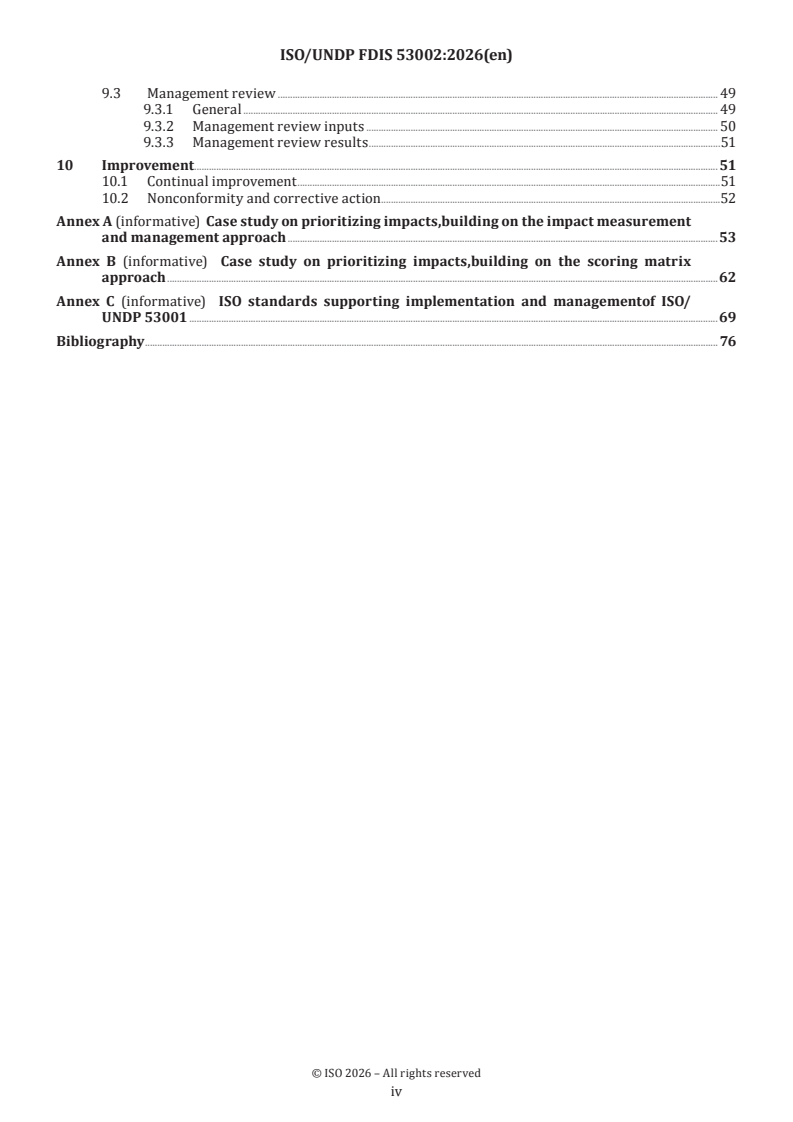
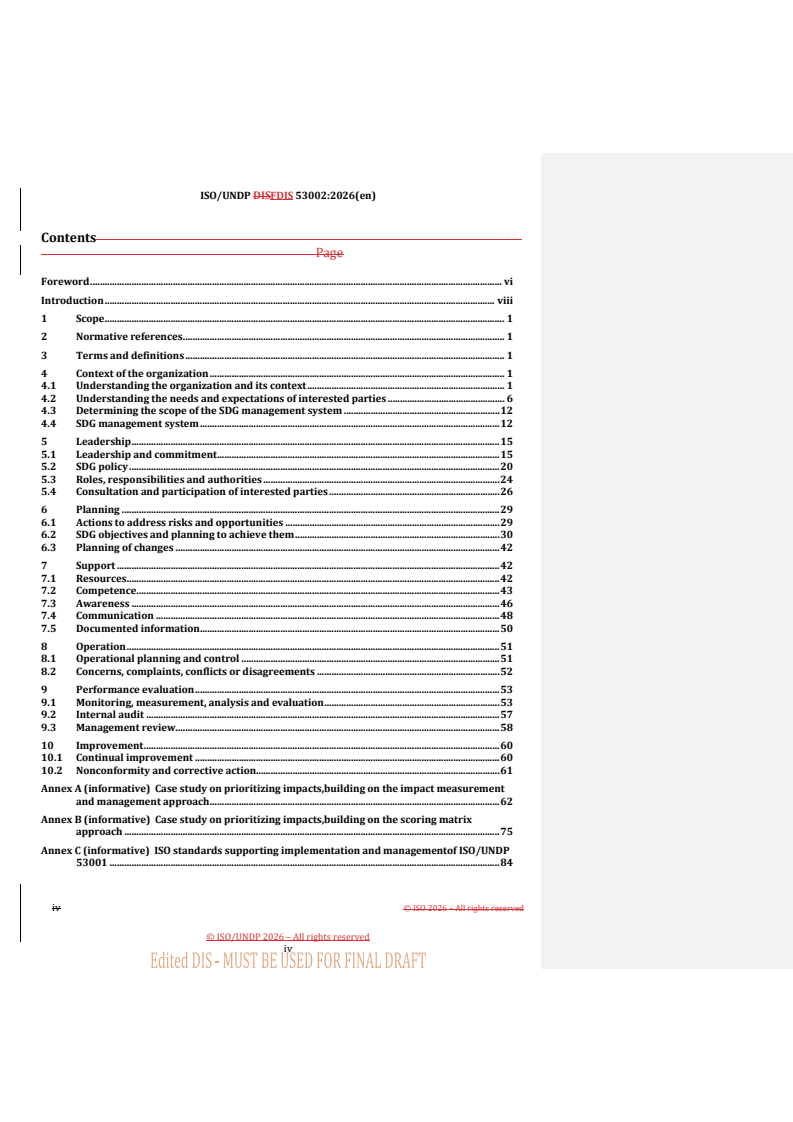
The document is organized into Clauses 1 to 10, followed by three informative annexes.
| Annex | What it covers |
|---|---|
| Annex A | Case study on prioritizing impacts using an impact measurement and management approach |
| Annex B | Case study on prioritizing impacts using a scoring matrix approach |
| Annex C | ISO standards that support implementation and management of ISO/UNDP 53001 |
Clause 1 sets the scope, Clause 2 names the normative reference, Clause 3 points to the terms and definitions in ISO/UNDP 53001, and Clauses 4 to 10 follow the familiar management-system structure from context through improvement.
What are the key requirements of ISO/UNDP FDIS 53002?
ISO/UNDP FDIS 53002 is a guidance document, so its substance is expressed as recommended actions for implementing and running an SDG management system. In practice, the document asks an organization to understand its context, engage interested parties, set priorities based on impacts, and build the SDGs into day-to-day management.
1. Build the system from the organization’s context
Clause 4 says the organization should understand its context, including sustainability issues, internal and external factors, and the effects of its activities on interested parties. It should map issues across the value chain and consider all SDGs, with particular attention to climate change, gender equality and decent work, as relevant.
This matters because the standard is trying to prevent a narrow or assumption-based view. The organization needs enough context to see where its actions create beneficial or adverse impacts and where its SDG effort will matter most.
2. Identify and engage interested parties carefully
Clause 4.2 says the organization should identify interested parties, understand their needs and expectations, and distinguish between parties that experience impacts and parties that contribute to those impacts. It should use direct engagement, review evidence from reliable sources, and pay attention to subgroups, systemically excluded groups, and, where relevant, project, programme and portfolio stakeholders.
This matters because the SDG approach in this document is impact-based, not just communication-based. The organization needs real input from affected people and groups so that priorities reflect actual conditions, risks, and opportunities.
3. Define the scope and integrate the SDG management system
Clause 4.3 says the scope should include all activities, products, services, value-chain relationships, and business relationships within the organization’s control or influence that can affect interested parties. Clause 4.4 says the SDG management system should be embedded in purpose, culture, strategy, business model, and other management systems.
In practice, this means the SDG system should not sit beside the business as a separate initiative. It should shape decision-making, and the organization should justify any requirement from ISO/UNDP 53001 that it considers not applicable.
4. Set policy, roles, and governance with accountability
Clause 5.2 says top management should establish an SDG policy that frames objectives, commits the organization to optimizing contributions to the SDGs, and reflects responsible business principles. Clause 5.3 says roles, responsibilities and authorities must be clear, understood, and supported by competence, resources, and governance.
This matters because the standard places responsibility at the top. The policy, governance, and accountability arrangements are what make the SDG commitment visible in decision-making, leadership behaviour, and project oversight.
5. Plan with risk, opportunity, and objective setting in mind
Clause 6 asks the organization to address risks and opportunities, set SDG objectives, plan how to achieve them, and manage change. Clause 6.2.2 on prioritization of impacts is central: the organization should focus first on the most significant impacts, then set ambitious targets and plan the data needed to track them.
This matters because organizations have limited resources. The document is telling them to prioritize where the impacts are most significant, not where action is easiest.
6. Support the system with resources, competence, awareness, communication, and documented information
Clause 7 covers resources, competence, awareness, communication, and documented information. The organization should provide the financial, human, technological, infrastructure, information-system, and externally provided resources it needs, and it should build competence in areas such as impact measurement, interested-party engagement, systems thinking, change management, and project governance.
This matters because SDG management is data- and people-intensive. The organization needs people who can measure impacts, explain them, act on them, and keep the system credible.
7. Control operations and handle concerns and grievances
Clause 8 says the organization should align operations with the SDG policy and objectives, set operating criteria, control relevant processes, and manage changes so they do not create unintended consequences. Clause 8.2 asks for processes to resolve concerns, complaints, conflicts, disagreements, and whistleblowing matters in an equitable and transparent way.
This matters because SDG commitments only count if they change operational behaviour. Good grievance handling also helps the organization learn early about adverse impacts and fix problems sooner.
8. Measure performance, audit, review, and improve
Clause 9 requires monitoring, measurement, analysis, evaluation, internal audit, and management review. Clause 10 calls for continual improvement and corrective action when requirements are not met or impacts are lower than expected.
This matters because the organization must show progress, not just intent. The SDG system should evolve as the context changes, the data improves, and the organization becomes more ambitious.
What terms does ISO/UNDP FDIS 53002 define?
ISO/UNDP FDIS 53002 uses the terms and definitions from ISO/UNDP 53001, and several terms are central to understanding how the guidance works.
- SDG management system - the management system based on ISO/UNDP 53001 that the document helps an organization implement.
- Interested parties - the people and groups that can affect, be affected by, or contribute to the organization’s impacts.
- Impacts - the beneficial or adverse consequences experienced by interested parties within the SDG context.
- Value chain - the chain of activities managed by the organization to deliver value, including multiple processes and business relationships.
- PDCA (Plan-Do-Check-Act) - the improvement cycle used as the organizing logic for planning, operating, evaluating, and improving the system.
- PMO (project management office) - a coordination function that can help integrate SDG management into portfolios, programmes, and projects.
- Nonconformity - a situation where a requirement is not met, including management-system, voluntary, legal, regulatory, or interested-party requirements.
Who uses ISO/UNDP FDIS 53002?
ISO/UNDP FDIS 53002 is for organizations that want guidance on implementing an SDG management system based on ISO/UNDP 53001. It is relevant across sectors, because the document applies to all organizations regardless of size or type.
Typical users include:
- top management and governing bodies, to set policy and direction
- sustainability, ESG, and strategy teams, to map impacts and set priorities
- quality, environmental, risk, innovation, and HR managers, to integrate SDG thinking into existing systems
- project, programme, portfolio, and PMO teams, to embed SDG criteria into change initiatives
- procurement, supply chain, and business relationship teams, to influence value-chain controls
- communication and learning teams, to build awareness and competence
- internal auditors and reviewers, to evaluate performance and improvement
- workers and operational managers, to apply controls and report concerns
What changed in ISO/UNDP FDIS 53002 from the previous edition?
ISO/UNDP FDIS 53002 is the first edition and replaces ISO/UNDP PAS 53002:2024. The revision converted the document from a PAS to an International Standard, aligned the text with ISO/UNDP 53001 and the harmonized structure, focused it on guidance for conforming to ISO/UNDP 53001, added several case examples, added a section on responsible business principles in Clause 4.4, and added Annex C on ISO standards supporting implementation of ISO/UNDP 53001.
Which standards are used with ISO/UNDP FDIS 53002?
ISO/UNDP FDIS 53002 has one normative reference: ISO/UNDP 53001, which provides the requirements that this document helps organizations implement.
Annex C and the bibliography identify several companion standards and supporting references, including:
- ISO 21502 and ISO 21504 - guidance on project, programme, and portfolio management
- ISO 21505 - governance for projects, programmes, and portfolios
- ISO 20400 - sustainable procurement
- ISO 37000 - governance of organizations
- ISO 9001 and the ISO 9000 series - quality management
- ISO 14001, the ISO 14000 series, ISO 14046, and ISO 14064-1 - environmental management, water footprint, and greenhouse gas quantification/reporting
- ISO 45001 and the ISO 45000 series - occupational health and safety
- ISO 31000 - risk management
- ISO 30400 series, ISO 30414, and ISO 30415 - human resource management, human capital reporting, and diversity and inclusion
- ISO 44001 and the ISO 44000 series - collaborative business relationships
- ISO 56001 and the ISO 56000 series - innovation management
- ISO 59001 and the ISO 59000 series - circular economy
- ISO 37101, ISO 37104, and ISO 37121 - sustainable development in communities and cities
- ISO 21401, ISO 18060, and ISO 20611 - tourism-related sustainability
- ISO 20121 - event sustainability management
- ISO 32210 - sustainable finance
- ISO/TS 26030, ISO 22000, ISO 21001, ISO/IEC 40180, and ISO 13485 - food chain, education, learning, and medical device-related support
What does the ISO/UNDP FDIS 53002 document contain?
ISO/UNDP FDIS 53002 contains a full management-system structure from scope and references through improvement, plus informative annexes with practical examples. Clauses 4 to 10 cover context, leadership, planning, support, operation, performance evaluation, and continual improvement.
The document also contains worked examples and decision-support material. Annex A and Annex B are case studies on prioritizing impacts, and Annex B includes impact-severity and likelihood tables, a prioritization matrix, and formulas used to score significance.
Annex C presents supporting ISO standards by function and by SDG-related topic. That section helps readers see how existing management-system standards, topic standards, and sector-specific standards can support an SDG management system without treating the standards as mutually exclusive.
Relations
- Effective Date
- 16-Aug-2025
Buy Documents
ISO/UNDP FDIS 53002 - Management systems for the United Nations Sustainable Development Goals (SDGs) — Implementation guidance
REDLINE ISO/UNDP FDIS 53002 - Management systems for the United Nations Sustainable Development Goals (SDGs) — Implementation guidance
Get Certified
Connect with accredited certification bodies for this standard

BSI Group
BSI (British Standards Institution) is the business standards company that helps organizations make excellence a habit.

Bureau Veritas
Bureau Veritas is a world leader in laboratory testing, inspection and certification services.

DNV
DNV is an independent assurance and risk management provider.
Sponsored listings
Frequently Asked Questions
ISO/UNDP FDIS 53002 is a draft published by the International Organization for Standardization (ISO). Its full title is "Management systems for the United Nations Sustainable Development Goals (SDGs) — Implementation guidance". This standard covers: Management systems for the United Nations Sustainable Development Goals (SDGs) — Implementation guidance
Management systems for the United Nations Sustainable Development Goals (SDGs) — Implementation guidance
ISO/UNDP FDIS 53002 is classified under the following ICS (International Classification for Standards) categories: 03.100.70 - Management systems; 13.020.20 - Environmental economics. Sustainability. The ICS classification helps identify the subject area and facilitates finding related standards.
ISO/UNDP FDIS 53002 has the following relationships with other standards: It is inter standard links to ISO/UNDP PAS 53002:2024. Understanding these relationships helps ensure you are using the most current and applicable version of the standard.
ISO/UNDP FDIS 53002 is available in PDF format for immediate download after purchase. The document can be added to your cart and obtained through the secure checkout process. Digital delivery ensures instant access to the complete standard document.
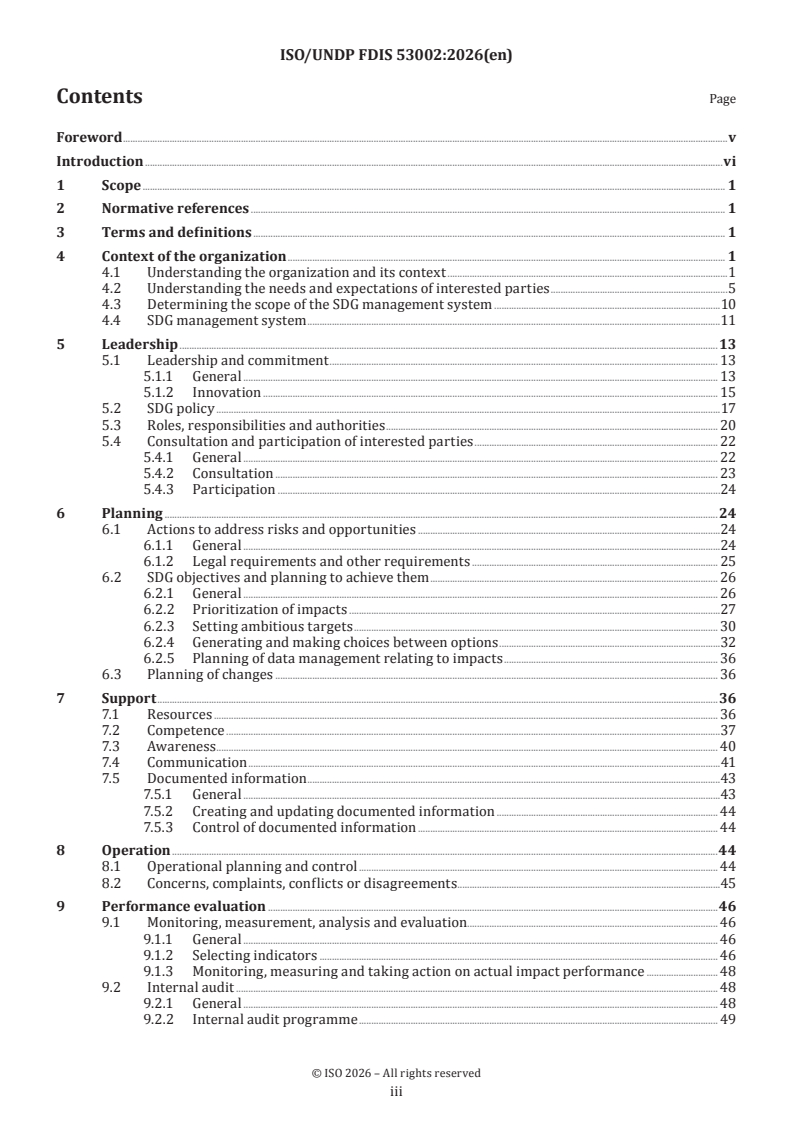
Standards Content (Sample)
Contents
- Introduction
- 1 Scope
- 2 Normative references
- 3 Terms and definitions
- 4 Context of the organization
- 4.1 Understanding the organization and its context
- 4.2 Understanding the needs and expectations of interested parties
- 4.3 Determining the scope of the SDG management system
- 4.4 SDG management system
- 5 Leadership
- 5.1 Leadership and commitment
- 5.2 SDG policy
- 5.3 Roles, responsibilities and authorities
- 5.4 Consultation and participation of interested parties
- 6 Planning
- 6.1 Actions to address risks and opportunities
- 6.2 SDG objectives and planning to achieve them
- 5. Ensuring
- 3. Ensuring 4. Ensuring
- 2. Ensuring paid equally paid equally
- 1. Increased workers are for same roles for the same
- 3 How many interested parties
- 4 What is the relative impor-
- 5 What is our contribution to
- 6 How significant is the im-
- 7 Risk that the impacts do not
- 8 Interested party risk toler-
- 6.3 Planning of changes
- 7 Support
- 7.1 Resources
- 7.2 Competence
- 7.3 Awareness
- 7.4 Communication
- 7.5 Documented information
- 8 Operation
- 8.1 Operational planning and control
- 8.2 Concerns, complaints, conflicts or disagreements
- 9 Performance evaluation
- 9.1 Monitoring, measurement, analysis and evaluation
- 9.2 Internal audit
- 9.3 Management review
- 10 Improvement
- 10.1 Continual improvement
- 10.2 Nonconformity and corrective action
- Annex A
- 1 What impact has been experienced
- 3 How is the impact measured? sessment (descrip-
- 9 How long does the impact last? 1 year 1 year 1 year 1 year 10 years 2 years 10 years
- Annex B
- 0 None The benefit has no effect on people or the The adverse impact has no effect on people
- 2 Low The benefit has a minor effect on people or The adverse impact has a minor effect on
- 5 Absolute The benefit has a transformative effect The adverse impact has a catastrophic
- 0 None The benefit has no effect on people or the The adverse impact has no effect on people
- 3 Moderate The benefit affects a moderate number of The adverse impact affects a moderate
- 0 Very easy to remedy The adverse impact is very easy to remedy and can be dealt with im-
- 0 Never No impact on people or the environment
- Annex C
- Bibliography
Introduction
This document provides guidance on how an organization can implement a management system to optimize its contributions to achieving the United Nations Sustainable Development Goals (SDGs) based on the requirements provided in ISO/UNDP 53001. By actively managing how it contributes to the SDGs, an organization can optimize its impacts on interested parties and related SDG targets. The organization can thus strengthen its resilience and future performance by maximizing beneficial impacts and minimizing adverse ones.
This document includes guidance on:
- leading transformational change of the organization’s strategy;
- embedding SDG impact management into the organization’s purpose, structure and strategy;
- embedding SDG impact management into organizational culture;
- engaging decision makers (the governing body and all levels of management) and all workers in SDG management;
- setting ambitious organizational SDG objectives and targets, aligned with the relevant SDG targets and indicators where practicable, to minimize adverse and maximize beneficial impacts on interested parties and optimize contribution to the achievement of the SDGs;
- engaging with relevant interested parties to identify and prioritize actual and expected impacts, whether beneficial or adverse;
- collecting data on actual and expected impacts;
- generating options that support innovation, and making informed choices between those options;
- making decisions that take into account the amount and type of risk that those experiencing the impacts of the organization’s decisions and activities can accept;
- understanding and managing interdependencies, synergies, and trade-offs to achieve positive results and avoid unintended adverse impacts at a rate commensurate with planetary needs, and to achieve the SDGs and meet the needs and relevant expectations of those experiencing impacts. The shared intention of this document and ISO/UNDP 53001 is to help shift an organization from SDG alignment to SDG action: from thinking about the SDGs as a mere “add-on”, to placing SDGs at the core of business operations.
This document and ISO/UNDP 53001 can assist organizations to better align business purpose, strategy and results with societal and planetary needs. They can help organizations to be more accountable for impacts on people and the planet, while also strengthening business performance. They encourage organizations to explore different business models and new ways of working and being that accelerate innovation (e.g. by driving the development of new products, services and solutions that can lead to new customers and market opportunities) and allocate resources more effectively and efficiently. Implementing the recommendations in these documents can enable organizations to anticipate risks and opportunities related to sustainable development earlier and manage them better.
The purpose of ISO/UNDP 53001 is to optimize an organization’s contribution to the achievement of the SDGs by optimizing the impacts on interested parties. Since the SDGs focus on sustainable development, the purpose of ISO/UNDP 53001 represents a new scope/purpose for many organizations whose purposes are usually driven by financial or ideological objectives.
Within this context, contributions can generally be divided into two categories:
- Category A: those that support both the SDGs and the organization’s financial performance, and
- Category B: those that primarily benefit people and the planet, with limited direct financial return.
ISO/UNDP FDIS 53002:2026(en) Category A actions are often easy to prioritize, as they align with traditional financial investment logic. Category B actions, however, require stronger commitment, since they demand resources with lower financial return on investment (ROI). ISO/UNDP 53001 defines the organization as one of many interested parties, emphasizing the need to prioritize the most significant impacts – regardless of their financial category.
This can create a dilemma between “doing good for the world” and “doing good for the interested parties with a strong financial interest in the organization in the short term.” In an ideal scenario, both actions would be aligned, recognizing that in the long term, organizations are dependent upon social and environmental systems being sustainable. The primary aim of ISO/UNDP 53001 is that an organization will embed SDG contributions into its strategy and culture so that it can contribute effectively to the achievement of the SDGs and sustainable development.
In the implementation of a management system based on ISO/UNDP 53001, it is recommended to start from the current level of maturity, learning through practice, and to apply the PDCA (Plan-Do-Check-Act) approach to impact management. Formal certification, through an independent third-party conformity assessment, is not the immediate goal – the focus is to get started on contributing to the achievement of the SDGs as ambitiously as possible.
This document and ISO/UNDP 53001 can also help organizations to communicate more effectively with governments, regulators, non-governmental organizations, partners, investors, financial institutions and other interested parties, including those impacted most by the organization’s decisions and activities. These documents can also help organizations to meet the requirements and expectations of relevant interested parties, in terms of disclosure, reporting and auditing.
Together with ISO/UNDP 53001, this document provides organizations with a common approach to fully integrate sustainable development and the SDGs into all business and investment decision-making processes and serves a basis for providing assurance to interested parties. This document applies the harmonized approach as published in the ISO/IEC Directives related to the development of management system standards (MSS). The intention is to support alignment and facilitate the integration of the requirements and recommendations of one or more MSS into an organization’s management system.
For more information, please see https://www.iso.org/management-system-standards.html. NOTE 1 To transform describes a change of higher complexity than to transition. By definition, the scope of a transformational change is both broader and wider than a transitional change. Many organizations seeking to conform to ISO/UNDP 53001 experience a transformational challenge due to the scope of aligning the business model - purpose, culture, and strategy and operations – with the SDGs. Changes requiring elements of new visions, new values, new mindsets and cultural development are typically considered transformational. NOTE 2 Additional information on sustainable transformation can be found in Transforming our world: the 2030 [4] Agenda for Sustainable Development.
FINAL DRAFT International Standard ISO/UNDP FDIS 53002:2026(en) Management systems for the United Nations Sustainable Development Goals (SDGs) — Implementation guidance
1 Scope
This document provides guidance for an organization implementing a management system based on ISO/UNDP 53001 (SDG management system), to optimize the organization's contributions to achieving the United Nations Sustainable Development Goals (SDGs).
This document is generic and applicable to all organizations, regardless of the organization’s type or size, or the nature of the products or services delivered.
NOTE 1 This document supports the current SDGs and any subsequent global goals that supersede the 2030 [4] Agenda.
NOTE 2 This document does not add to the requirements in ISO/UNDP 53001 or describe the only way to meet those requirements. The use of the term “should” does not weaken any of the requirements in ISO/UNDP 53001 or add new requirements.
2 Normative references
The following documents are referred to in the text in such a way that some or all of their content constitutes requirements of this document. For dated references, only the edition cited applies. For undated references, the latest edition of the referenced document (including any amendments) applies. ISO/UNDP 53001, Management systems for the United Nations Sustainable Development Goals (SDGs) — Requirements
3 Terms and definitions
For the purposes of this document, the terms and definitions given in ISO/UNDP 53001 apply. ISO and IEC maintain terminology databases for use in standardization at the following addresses:
- ISO Online browsing platform: available at https:// www .iso .org/ obp
- IEC Electropedia: available at https:// www .electropedia .org/
4 Context of the organization
4.1 Understanding the organization and its context
This clause provides guidance for organizations to understand exactly what affects its operations and what is affected by its operations. The organization should consider both its general context and issues specifically related to the SDGs when mapping its context.
To implement an effective SDG management system, the organization should understand the context within which it operates and what can affect its ability to achieve its intended results. As described in ISO/UNDP 53001:2026, 4.1, Note 2, issues are important topics or problems for debate or discussion, which can have a beneficial or adverse impact on interested parties and on the overall [4] achievement of the 2030 Agenda. In an SDG management system, impacts refer to the consequences experienced by the interested parties within the scope of the SDGs. Therefore, while analysing the context,
ISO/UNDP FDIS 53002:2026(en) the organization should identify sustainability issues that are problems or topics, which are expected to have an impact on interested parties.
The organization should consider all the SDGs and have a process to determine where relevant impacts relate to each of them. The organization should always consider at least those impacts relating to the crosscutting themes of climate change, gender equality and decent work, as relevant. The intention of analysing the context is to determine any issues that can affect the SDG management system and the organization’s ability to optimize the impacts experienced by interested parties and hereby the organizations contribution to the achievement of the SDGs. Some issues have a greater effect on impacts. However, the organization should ensure a full mapping of its context before determining relevance and significance of different impacts. Issues can be sustainability issues, management system issues as well as other strategic issues. The issues concerning the efficiency of the SDG management system and issues specifically concerning beneficial or adverse impact on interested parties should both be addressed when planning for addressing risks and opportunities as outlined in 6.1. 6.2.2 focuses specifically on sustainability issues, i.e. issues that concern actual or potential impacts on interested parties. Many organizations have already implemented processes focusing on impact management. Where this is the case, these processes should be leveraged where possible rather than duplicated. he organization should ensure engagement with interested parties to identify potentially relevant and significant impacts. Existing resources should also be considered. During the initial context analysis and identification of a complete list of issues, the organization should refer to credible sustainability resources that outline and map how sustainability issues relate to different sectors and industries. This can also include other resources, which track the current status of different SDG topics in different locations, so as to ensure common terminology and methodology as well as transparency and comparability of results. The organization should determine both external and internal factors, including the sustainability context in which it operates. The organization should ensure that determination of SDG relevant issues takes into account the needs and expectations of interested parties that can affect or be affected by the organization’s activities. The intention of mapping both issues and interested parties is to ensure the organization reduces the risk of taking too narrow an approach or acting on assumptions or biases. To avoid an approach which is too narrow, the organization should map the SDGs against the organization’s value chain. An initial high-level mapping can lead to a more detailed analysis of issues in relation to impacts arising from different activities. The value chain is the chain of activities managed by an organization to deliver value, consisting of multiple processes. This process-based approach gives a comprehensive picture of the organization’s activities and offers a structure to begin understanding the context of the organization. The process approach should be supplemented by mapping products, services and organizational units. Where relevant, the organization should also consider projects, programmes, portfolios and related organizational project management arrangements as part of its context. This includes, as applicable, project governance structures, project management offices (PMOs), portfolio decision-making mechanisms, and project-based change initiatives through which sustainability-related objectives, improvements and transformations are planned and implemented.
Issues at all levels, from local to global, should be taken into account. The organization should explore external factors such as political, economic, social, technological, environmental and legal elements (PESTEL), which can be relevant for the SDG management system. The organization should ensure that its PESTEL analysis goes beyond mere identification of issues to map the causal pathways and dependencies between external issues (e.g. regulatory changes, climate events) and the direct drivers of beneficial and adverse impacts experienced by interested parties. The context analysis should be iterative and develop in terms of depth and quality over time.
External issues include:
a) global, national, regional and local sustainable development performance, trends, priorities and strategies; b) political and economic factors, including trends and potential changes;
ISO/UNDP FDIS 53002:2026(en) c) environmental factors, including climate events, environmental conditions and natural resources; d) social factors, including human rights e.g. gender equality and decent work; e) supply chains; f) existing and future laws and regulations; g) local culture, ethics and demographics; h) indigenous and local knowledge; i) scientific and technological developments; j) sustainable development performance, trends, priorities and strategies within the sectors in which the organization operates; k) natural and competitive factors; l) best practice frameworks.
Internal issues include:
- organizational identity (including purpose, vision, values, culture and adaptability);
- governance and structure;
- organizational policies;
- organizational activities;
- resources, including availability of people, level of competence, finance;
- the size and maturity of the organization;
- the sectors and locations in which the organization operates;
- value chains and business relationships;
- products and services provided;
- facilities and equipment;
- past and current sustainability performance;
- business models;
- other management systems implemented by the organization (e.g. quality, environmental, compliance, risk, innovation);
- organizational processes;
- projects, programmes and portfolios;
- organizational project management structures and governance arrangements (e.g. PMOs, steering structures, portfolio coordination mechanisms);
- project-based change initiatives that influence sustainability performance and contribution to the achievement of the SDGs.
The organization should consider a life cycle perspective when mapping its context to ensure it considers all aspects of the services or products it provides, from the acquisition of raw materials to final disposal. Assessing how current business models align with the six principles of circular economy can help prevent unintentional oversights and shift adverse impacts to elsewhere in the life cycle. The six principles are:
systems thinking, innovation, stewardship, collaboration, value creation and transparency.
ISO/UNDP FDIS 53002:2026(en) The organization should be aware that external and internal issues can change and should be reviewed regularly. At least, an annual review of the context should be carried out. The organization should retain and maintain documented information of its external and internal issues, and its assessment of how these issues affect the organization and interested parties. Documented information can be of any type, according to the needs of the organization. For example, the following are considered documented information: photographs, spreadsheets, minutes of meetings and video or audio recordings of discussions.
Accounting for the SDGs can be seen as having a dual nature. While the SDGs express ambitions for the common good of the global society, organizations should strive to optimize their contributions to achieving the SDGs. This is also known as the “inside-out” perspective. This is aligned with ISO/UNDP 53001 where focus is placed solely on managing the impacts of interested parties and contributing to the achievement of the SDGs. Since sustainability issues affect the strategies of an organization, the organization takes into account sustainability issues when developing strategies. This perspective, focusing on how external issues can affect the strategy of the organization, is also known as “the outside-in” perspective. EXAMPLE A frozen food manufacturer with 500 workers operates in three different countries. To lead the mapping of issues that can affect the SDG management system, top management assigns responsibility to someone who is used to doing analysis, in this case, the head of production.
The head of production begins by collecting the knowledge the organization already has, including:
- the organizational chart showing the site and departmental structures;
- details of the three production sites (locations, workers, suppliers, distributors);
- a complete list of products;
- recent financial reports;
- process descriptions, including business critical processes;
- critical suppliers;
- main customers (wholesalers and dealers);
- market analysis, including known sustainability issues.
A task group is established with representatives from all departments and a workshop arranged to identify relevant [4] issues. As preparation for the meeting, the known information is shared, along with the 2030 Agenda. At the workshop, the head of production presents the information. Based on this information, the participants start identifying sustainability issues, including:
- some suppliers have unfair labour practices and poor preservation of ecosystems;
- the organization is sourcing many ingredients from large scale suppliers rather than supporting small scale and local farmers;
- the environment is being adversely impacted by production of some ingredients, including significant carbon footprint;
- some ingredients (especially meat) have high water usage, significant carbon footprint and poor land use;
- nutritional value of products;
- high water consumption in production processes;
- risk of organic waste in local ecosystems from wastewater;
- substantial energy consumption in production processes;
- priority of local sourcing;
ISO/UNDP FDIS 53002:2026(en) - packing drives waste of metal from metal cans; - distribution: energy consumption and emissions for exports by road; - laws relating food to security and food waste are changing.
...
Contents
- Introduction
- 1 Scope
- 2 Normative references
- 3 Terms and definitions
- 4 Context of the organization
- 4.1 Understanding the organization and its context
- 4.2 Understanding the needs and expectations of interested parties
- 4.3 Determining the scope of the SDG management system
- 4.4 SDG management system
- 5 Leadership
- 5.1 Leadership and commitment
- 5.2 SDG policy
- 5.3 Roles, responsibilities and authorities
- 5.4 Consultation and participation of interested parties
- 6 Planning
- 6.1 Actions to address risks and opportunities
- 6.2 SDG objectives and planning to achieve them
- 3. Ensuring 5. Ensuring
- 4. Ensuring
- 2. Ensuring paid equally
- 1. Increased roles and roles and
- 3 How many interested
- 4 What is the relative
- 5 What is our contribution to
- 6 How significant is the
- 7 Risk that the impacts do not
- 8 Interested party risk
- 6.3 Planning of changes
- 7 Support
- 7.1 Resources
- 7.2 Competence
- 7.3 Awareness
- 7.4 Communication
- 7.5 Documented information
- 8 Operation
- 8.1 Operational planning and control
- 8.2 Concerns, complaints, conflicts or disagreements
- 9 Performance evaluation
- 9.1 Monitoring, measurement, analysis and evaluation
- 9.2 Internal audit
- 9.3 Management review
- 10 Improvement
- 10.1 Continual improvement
- 10.2 Nonconformity and corrective action
- Annex A
- 9 How long does the impact last? 1 year 1 year 1 year 1 year 10 years 2 years 10 years
- 11 What is our contribution to the impact? 75 % 50 % 25 % 75 % 10 % 90 % 70 %
- Annex B
- 0 None The benefit has no effect on people or the The adverse impact has no effect on
- 2 Low The benefit has a minor effect on people or The adverse impact has a minor effect on
- 4 Substantial The benefit has a substantial effect on The adverse impact has a substantial
- 5 Absolute The benefit has a transformative effect on The adverse impact has a catastrophic
- 0 None The benefit has no effect on people or the The adverse impact has no effect on people
- 3 Moderate The benefit affects a moderate number of The adverse impact affects a moderate
- 4 Widespread The benefit affects a large number of The adverse impact affects a large number
- 5 Global The benefit affects people and the The adverse impact affects people and the
- 0 Very easy to remedy The adverse impact is very easy to remedy and can be dealt with
- 0 Never No impact on people or the environment
- Annex C
- Bibliography
Introduction
This document provides guidance on how an organization can implement a management system to optimize its contributioncontributions to achieving the United Nations Sustainable Development Goals (SDGs) based on the requirements provided in ISO/UNDP 53001. By actively managing how it contributes to the UN SDGs, an organization can optimize its impacts on interested parties and related SDG targets. The organization can thus strengthen its resilience and future performance by maximizing beneficial impacts and minimizing adverse ones. By actively managing how it contributes to the achievement of the SDGs, an organization can optimize its impacts on interested parties and related SDG targets by maximizing beneficial impacts and minimizing adverse ones, thereby strengthening organizational resilience and future performance. This document includes guidance on:
- leading transformational change of the organization’s strategy;
- embedding SDG impact management into the organization’s purpose, structure and strategy;
- embedding SDG impact management into organizational culture;
- engaging decision makers (the governing body and all levels of management) and all workers in SDG management;
- setting ambitious organizational SDG objectives and targets, aligned with the relevant SDG targets and indicators where practicable, to optimize minimize adverse and maximize beneficial impacts on interested parties and contributionsoptimize contribution to the achievement of the SDGs;
- engaging with relevant interested parties to identify and prioritize actual and expected impacts, whether beneficial or adverse;
- collecting data on actual and expected impacts;
- generating options that support innovation, and making informed choices between those options;
- making decisions that take into account the acceptable levelamount and type of risk ofthat those experiencing the impacts of the organization’s decisions and activities can accept;
- understanding and managing interdependencies, synergies, and trade-offs to achieve positive results and avoid unintended adverse impacts at a rate commensurate with planetary needs, and to achieve the SDGs and meet the needs and relevant expectations of those experiencing impacts. The shared intention of this document and ISO/UNDP 53001 is to help shift an organization from SDG alignment to SDG action: from thinking about the SDGs as a mere “add-on”, to placing SDGs at the core of business operations.
This document and ISO/UNDP 53001 can assist organizations to better align business purpose, strategy and results with societal and planetary needs. They can help organizations to be more accountable for impacts on people and the planet, while also strengthening business performance. They encourage organizations to explore different business models and new ways of working and being that accelerate innovation (e.g. by driving the development of new products, services and solutions that can lead to new customers and market opportunities) and allocate resources more effectively and efficiently. Implementing the recommendations in these documents can enable organizations to anticipate risks and opportunities related to sustainable development earlier and manage them better.
ISO/UNDP DISFDIS 53002:2026(en) The purpose of ISO/UNDP 53001 is to optimize an organization’s contribution to the achievement of the SDGs by optimizing the impacts on interested parties. Since the SDGs focus on sustainable development, the purpose of ISO/UNDP 53001 represents a new scope/purpose for many organizations whose purposes are usually driven by financial or ideological objectives.
Within this context, contributions can generally be divided into two categories:
Category A: Those that support both the SDGs and the organization’s financial performance, and Category B: Those that primarily benefit people and the planet, with limited direct financial return.
- Category A: those that support both the SDGs and the organization’s financial performance, and
- Category B: those that primarily benefit people and the planet, with limited direct financial return. Category A actions are often easy to prioritize, as they align with traditional financial investment logic. Category B actions, however, require stronger commitment, since they demand resources with lower financial ROI (Returnreturn on Investmentinvestment (ROI). ISO/UNDP 53001 defines the organization as one of many interested parties, emphasizing the need to prioritize the most significant impacts -– regardless of their financial category.
This can create a dilemma between “doing good for the world” and “doing good for the interested parties with a strong financial interest in the organization in the short term.” In an ideal scenario, both actions would be aligned, recognizing that in the long -term, organizations are dependent upon social and environmental systems being sustainable. The primary aim of ISO/UNDP 53001 is that an organization will embed SDG contributions into its strategy and culture so Itthat it can contribute effectively to the achievement of the SDGs and sustainable development.
In the implementation of a management system based on ISO/UNDP 53001, it is recommended to start from the current level of maturity, learning through practice, and applyingto apply the PDCA (Plan-Do-Check-Act) approach to impact management. Formal certification, through an independent third-party conformity assessment, is not the immediate goal -– the focus is to get started on contributing to the achievement of the SDGs as ambitiously as possible.
This document and ISO/UNDP 53001 can also help organizations to communicate more effectively with governments, regulators, non-governmental organizations, partners, investors, financial institutions and other interested parties, including those impacted most by the organization’s decisions and activities. These documents can also help organizations to meet the requirements and expectations of relevant interested parties, in terms of disclosure, reporting and auditing.
Together with ISO/UNDP 53001, this document provides organizations with a common approach to fully integrate sustainable development and the SDGs into all business and investment decision-making processes and serves a basis for providing assurance to interested parties. This document applies the harmonized approach as published in the ISO/IEC Directives related to the development of management system standards (MSS). The intention is to support alignment and facilitate the integration of the requirements and recommendations of one or more MSS into an organization’s management system.
ISO/UNDP DISFDIS 53002:2026(en) For more information, please see https://www.iso.org/management-system-standards.html. NOTE 1 To transform describes a change of higher complexity than to transition. By definition, the scope of a transformational change is both broader and wider than a transitional change. Many organizations seeking to conform to ISO/UNDP 53001 experience a transformational challenge due to the scope of aligning the business model -– purpose, culture, and strategy and operations -– with the SDGs. Changes requiring elements of new visions, new values, new mindsets and cultural development are typically considered transformational. NOTE 2 Additional information on sustainable transformation can be found in United Nations, A/RES/70/1, [4] [4] Transforming our world: the 2030 Agenda for Sustainable Development. .
ISO/UNDP DIS 53002:2026(en)
Management systems for the United Nations Sustainable Development Goals (SDGs) - — Implementation guidance
1 Scope
This document provides guidance for an organization implementing a management system based on ISO/UNDP 53001, (SDG management system), to optimize the organization's contributions to achieving the United Nations Sustainable Development Goals (SDGs) hereafter referred to as an SDG management system.). This document is generic and applicable to all organizations, regardless of the organization’s type or size, or the nature of the products or services delivered.
NOTE 1 This document supports the current SDGs and any subsequent global goals that supersede the 2030 UN [5] [4] Agenda ..
NOTE 2 This document does not add to the requirements in ISO/UNDP 53001 or describe the only way to meet those requirements. The use of the term “should” does not weaken any of the requirements in ISO/UNDP 53001 or add new requirements.
2 Normative references
The following documents are referred to in the text in such a way that some or all of their content constitutes requirements of this document. For dated references, only the edition cited applies. For undated references, the latest edition of the referenced document (including any amendments) applies. ISO/UNDP 53001, Management systems for the United Nations Sustainable Development Goals (SDGs) — Requirements
3 Terms and definitions
For the purposes of this document, the terms and definitions given in ISO/UNDP 53001 apply. ISO and IEC maintain terminology databases for use in standardization at the following addresses:
- — ISO Online browsing platform: available at https://www.iso.org/obp
- — IEC Electropedia: available at https://www.electropedia.org/
4 Context of the organization
4.1 Understanding the organization and its context
This clause provides guidance for organizations to understand exactly what affects its operations and what is affected by its operations. The organization should consider both its general context and issues specifically related to the SDGs when mapping its context.
To implement an effective SDG management system, the organization should understand the context within which it operates and what can affect its ability to achieve its intended results.
ISO/UNDP DISFDIS 53002:2026(en) As described in ISO/UNDP 53001:2026, 4.1, Note 2, Issuesissues are important topics or problems for debate or discussion, which can have a beneficial or adverse impact on interested parties and on the overall [5] [4] achievement of the 2030 agenda .Agenda. In an SDG Managementmanagement system, impacts refer to the consequences experienced by the interested parties within the scope of the SDGs. Therefore, while analyzinganalysing the context, the organization should identify sustainability issues that are problems or topics, which are expected to have an impact on interested parties. The organization should consider all the SDGs and have a process to determine where relevant impacts relate to each of them. The organization should always consider at least those impacts relating to the cross-cutting themes of climate change, gender equality and decent work, as relevant. The intention of analysing the context is to determine any issues that can affect the SDG management system and the organization’s ability to optimize the impacts experienced by interested parties and hereby the organizations contribution to the achievement of the SDGs. Some issues have a greater effect on impacts. However, the organization should ensure a full mapping of its context before determining relevance and significance of different impacts. Issues can be sustainability issues, management system issues as well as other strategic issues. The issues concerning the efficiency of the SDG management system and issues specifically concerning beneficial or adverse impact on interested parties should both be addressed when planning for addressing risks and opportunities as outlined in 6.16.1. Clause 6.2.2. 6.2.2 focuses specifically on sustainability issues, i.e. issues that concern actual or potential impacts on interested parties. Many organizations have already implemented processes focussingfocusing on impact management. Where this is the case, these processes should be leveraged where possible rather than duplicated. Thehe organization should ensure engagement with interested parties thatto identify potentially relevant and significant impacts are considered. Additionally existing. Existing resources areshould also a considerationbe considered. During the initial context analysis and identification of a complete list of issues, anthe organization should refer to credible sustainability resources that outline and map how sustainability issues relate to different sectors and industries. This can also include other resources, which track the current status of different SDG topics in different locations, so as to ensure common terminology and methodology as well as transparency and comparability of results.
The organization should determine both external and internal factors, including the sustainability context in which it operates. The organization should ensure that determination of SDG relevant issues takes into account the needs and expectations of interested parties that can affect or be affected by the organization’s activities. The intention of mapping both issues and interested parties is to ensure the organization reduces the risk of taking too narrow an approach or acting on assumptions or biases. To avoid an approach which is too narrow, the organization should map the SDGs against the organization’s value chain. An initial high-level mapping can lead to a more detailed analysis of issues in relation to impacts arising from different activities. The value chain is the chain of activities managed by an organization to deliver value, consisting of multiple processes. This process-based approach gives a comprehensive picture of the organization’s activities and offers a structure to begin understanding the context of the organization. The process approach should be supplemented by mapping products, services and organizational units. Where relevant, the organization should also consider projects, programmes, portfolios and related organizational project management arrangements as part of its context. This includes, as applicable, project governance structures, project management offices (PMOs), portfolio decision-making mechanisms, and project-based change initiatives through which sustainability-related objectives, improvements, and transformations are planned and implemented.
ISO/UNDP DISFDIS 53002:2026(en) Issues at all levels, from local to global, should be taken into account. The organization should explore external factors such as political, economic, social, technological, environmental and legal elements (PESTEL), which can be relevant for the SDG management system. The organization should ensure that its PESTEL analysis goes beyond mere identification of issues to map the causal pathways and dependencies between external issues (e.g. regulatory changes, climate events) and the direct drivers of beneficial and adverse impacts experienced by interested parties. The context analysis should be iterative and develop in terms of depth and quality over time.
External issues include:
a) global, national, regional and local sustainable development performance, trends, priorities and strategies; b) political and economic factors, including trends and potential changes; c) environmental factors, including climate events, environmental conditions and natural resources; d) social factors, including human rights e.g. gender equality and decent work; e) supply chains; f) existing and future laws and regulations; g) local culture, ethics and demographics; h) indigenous and local knowledge; i) scientific and technological developments; j) sustainable development performance, trends, priorities and strategies within the sectors in which the organization operates; k) natural and competitive factors; l) best practice frameworks.
Internal issues include:
- organizational identity (including purpose, vision, values, culture and adaptability);
- governance and structure;
- organizational policies;
- organizational activities;
- resources, including availability of people, level of competence, finance;
- the size and maturity of the organization;
- the sectors and locations in which the organization operates;
ISO/UNDP DISFDIS 53002:2026(en) - value chains and business relationships; - products and services provided; - facilities and equipment; - past and current sustainability performance; - business models; - other management systems implemented by the organization (e.g. quality, environmental, compliance, risk, innovation); - organizational processes.; - projects, programmes and portfolios; - Organizationalorganizational project management structures and governance arrangements (e.g. PMOs, steering structures, portfolio coordination mechanisms)); - project-based change initiatives that influence sustainability performance and contribution to the achievement of the SDGs.
The organization should consider a life cycle perspective when mapping its context to ensure it considers all aspects of the services or products it provides, from the acquisition of raw materials to final disposal. Assessing how current business models align with the six principles of circular economy can help prevent unintentional oversights and shiftingshift adverse impacts to elsewhere in the life cycle. The six principles are: systems thinking, innovation, stewardship, collaboration, value creation and transparency. The organization should be aware that external and internal issues can change and should be reviewed regularly. At least, an annual review of the context should be carried out. The organization should retain and maintain documented information of its external and internal issues, and its assessment of how these issues affect the organization and interested parties. Documented information can be of any type, according to the needs of the organization. For example, the following are considered documented information: photographs, spreadsheets, minutes of meetings and video or audio recordings of discussions.
Accounting for the SDGs can be seen as having a dual nature. While the SDGs express ambitions for the common good of the global society, organizations should strive to optimize their contributions to achieving the SDGs. This perspective is also known as the "“inside-out"” perspective. This is aligned with ISO/UNDP 53001 where focus is placed solely on managing the impacts of interested parties and contributing to the achievement of the SDGs. Since sustainability issues affect the strategies of an organization, the organization takes into account sustainability issues when developing strategies. This perspective, focusing on how external issues can affect the strategy of the organization, is also known as “the outside-in” perspective. EXAMPLE A frozen food manufacturer with 500 workers operates in three different countries. To lead the mapping of issues that can affect the SDG management system, top management assigns responsibility to someone who is used to doing analysis, in this case, the head of production.
The head of production begins by collecting the knowledge the organization already has, including:
ISO/UNDP DISFDIS 53002:2026(en) - the organizational chart showing the site and departmental structures; - details of the three production sites (locations, workers, suppliers, distributors); - a complete list of products; - recent financial reports; - process descriptions, including business critical processes; - critical suppliers; - main customers (wholesalers and dealers); - market analysis, including known sustainability issues.
A task group is established with representatives from all departments and a workshop arranged to identify relevant [5] [4] issues. As preparation for the meeting, the known information is shared, along with the 2030 Agenda. . At the workshop, the head of production presents the information. Based on this information, the participants start identifying sustainability issues, including:
...