

ISO 23032:2022
(Main)Meteorology — Ground-based remote sensing of wind — Radar wind profiler
General Information
- Abstract
This document provides guidelines for the design, manufacture, installation, and maintenance of a WPR. It describes the following: — Measurement principle (Clause 5). Scatterers that produce echoes and methods of wind velocity measurement are described. The description of the measurement principle mainly aims at providing the information necessary for describing the guidelines in Clauses 6 to 11. — Guidelines for WPR system (Clause 6). Frequency, hardware, software, and signal processing are described. They are mainly applied in designing and manufacturing the hardware and software of WPR. — Guidelines for system performance (Clause 7). Measurement resolution, range sampling, radar sensitivity evaluation, and measurement accuracy are described. They can be used for estimating the measurement performance of a WPR’s system design and operation. — Guidelines for quality control (QC) in digital signal processing (Clause 8). — Guidelines for measurement products and data format (Clause 9). Measurement products obtained by a WPR and their data levels are defined. Guidelines for data file formats are also described. — Guidelines for installation (Clause 10) and maintenance (Clause 11). This document does not aim at providing a thorough description of the measurement principle, WPR systems, and WPR applications. For further details of these items, users are referred to technical books (e.g. References [1],[2],[3]). WPRs are referred to by various names (e.g. radar wind profiler, wind profiler radar, wind profiling radar, atmospheric radar, or clear-air Doppler radar). Conventional naming for WPRs should be allowed.
- Status
- Published
- Publication Date
- 15-Dec-2022
- Technical Committee
- ISO/TC 146/SC 5 - Meteorology
- Drafting Committee
- ISO/TC 146/SC 5/WG 8 - Radar wind profiler
- Current Stage
- 6060 - International Standard published
- Start Date
- 16-Dec-2022
- Due Date
- 06-Nov-2021
- Completion Date
- 16-Dec-2022
Buy Documents






ISO 23032:2022 - Meteorology — Ground-based remote sensing of wind — Radar wind profiler Released:16. 12. 2022



ISO 23032:2022 - Meteorology — Ground-based remote sensing of wind — Radar wind profiler Released:16. 12. 2022
Overview
ISO 23032:2022 - "Meteorology - Ground-based remote sensing of wind - Radar wind profiler" provides international guidelines for the design, manufacture, installation, operation and maintenance of radar wind profilers (WPRs). The standard explains the measurement principle for ground‑based Doppler radars that profile wind in the troposphere and boundary layer, and sets out best practices for system hardware, software, performance assessment, quality control, data products and formats, installation and upkeep.
Keywords: ISO 23032:2022, radar wind profiler, WPR, wind profiling radar, ground-based remote sensing, Doppler, meteorology
Key topics and technical requirements
- Measurement principle (Clause 5): Describes spectral echo parameters, scatterer sources (turbulent scattering, partial reflection, precipitation echoes), clutter and radio‑frequency interference; covers methods for wind velocity retrieval (e.g., Doppler beam swinging and spaced‑antenna techniques).
- System guidance (Clause 6): Frequency selection, principal hardware components (antenna, transmitter, receiver), signal processing and observation control units; environmental considerations for deployment.
- System performance (Clause 7): Definitions and guidance on range, volume and time resolution, Nyquist limits, radar sensitivity, measurement range and accuracy for assessing WPR performance.
- Quality control (Clause 8): Recommended QC procedures in digital signal processing to ensure reliable velocity and spectrum products.
- Products and data formats (Clause 9): Definitions of measurement products, processing levels and recommended operational/scientific file formats (WMO BUFR and NetCDF examples are referenced).
- Installation and maintenance (Clauses 10–11): Site selection, licensing, infrastructure, clutter/interference mitigation, operational monitoring, preventive and corrective maintenance, spare‑parts and software management.
- Informative annexes: Practical material including radar equation representation, precipitation reflectivity, data assimilation impacts and real‑world data format examples.
Practical applications
ISO 23032:2022 supports reliable deployment and use of WPRs for:
- Atmospheric monitoring and operational weather forecasting
- High‑resolution boundary‑layer and turbulence profiling for research
- Providing wind observations for numerical weather prediction (NWP) assimilation
- Supporting national meteorological networks and routine operational services
Who should use this standard
- National and regional meteorological agencies and network operators
- WPR system designers, manufacturers and integrators
- Data centers and observation managers responsible for quality control and distribution
- Atmospheric researchers and modelers incorporating profiler data into analyses
Related standards and interoperability
ISO 23032:2022 aligns with meteorological data exchange practices by referencing operational formats (WMO BUFR) and scientific formats (NetCDF). Users should coordinate with radio licensing and electromagnetic spectrum regulations and with WMO guidance when integrating WPRs into operational observing systems.
For procurement, system specification and operational deployment, ISO 23032:2022 is a practical reference to ensure consistent, interoperable and quality‑assured radar wind profiler installations.
Buy Documents
ISO 23032:2022 - Meteorology — Ground-based remote sensing of wind — Radar wind profiler Released:16. 12. 2022
ISO 23032:2022 - Meteorology — Ground-based remote sensing of wind — Radar wind profiler Released:16. 12. 2022
Frequently Asked Questions
ISO 23032:2022 is a standard published by the International Organization for Standardization (ISO). Its full title is "Meteorology — Ground-based remote sensing of wind — Radar wind profiler". This standard covers: This document provides guidelines for the design, manufacture, installation, and maintenance of a WPR. It describes the following: — Measurement principle (Clause 5). Scatterers that produce echoes and methods of wind velocity measurement are described. The description of the measurement principle mainly aims at providing the information necessary for describing the guidelines in Clauses 6 to 11. — Guidelines for WPR system (Clause 6). Frequency, hardware, software, and signal processing are described. They are mainly applied in designing and manufacturing the hardware and software of WPR. — Guidelines for system performance (Clause 7). Measurement resolution, range sampling, radar sensitivity evaluation, and measurement accuracy are described. They can be used for estimating the measurement performance of a WPR’s system design and operation. — Guidelines for quality control (QC) in digital signal processing (Clause 8). — Guidelines for measurement products and data format (Clause 9). Measurement products obtained by a WPR and their data levels are defined. Guidelines for data file formats are also described. — Guidelines for installation (Clause 10) and maintenance (Clause 11). This document does not aim at providing a thorough description of the measurement principle, WPR systems, and WPR applications. For further details of these items, users are referred to technical books (e.g. References [1],[2],[3]). WPRs are referred to by various names (e.g. radar wind profiler, wind profiler radar, wind profiling radar, atmospheric radar, or clear-air Doppler radar). Conventional naming for WPRs should be allowed.
This document provides guidelines for the design, manufacture, installation, and maintenance of a WPR. It describes the following: — Measurement principle (Clause 5). Scatterers that produce echoes and methods of wind velocity measurement are described. The description of the measurement principle mainly aims at providing the information necessary for describing the guidelines in Clauses 6 to 11. — Guidelines for WPR system (Clause 6). Frequency, hardware, software, and signal processing are described. They are mainly applied in designing and manufacturing the hardware and software of WPR. — Guidelines for system performance (Clause 7). Measurement resolution, range sampling, radar sensitivity evaluation, and measurement accuracy are described. They can be used for estimating the measurement performance of a WPR’s system design and operation. — Guidelines for quality control (QC) in digital signal processing (Clause 8). — Guidelines for measurement products and data format (Clause 9). Measurement products obtained by a WPR and their data levels are defined. Guidelines for data file formats are also described. — Guidelines for installation (Clause 10) and maintenance (Clause 11). This document does not aim at providing a thorough description of the measurement principle, WPR systems, and WPR applications. For further details of these items, users are referred to technical books (e.g. References [1],[2],[3]). WPRs are referred to by various names (e.g. radar wind profiler, wind profiler radar, wind profiling radar, atmospheric radar, or clear-air Doppler radar). Conventional naming for WPRs should be allowed.
ISO 23032:2022 is classified under the following ICS (International Classification for Standards) categories: 07.060 - Geology. Meteorology. Hydrology. The ICS classification helps identify the subject area and facilitates finding related standards.
ISO 23032:2022 is available in PDF format for immediate download after purchase. The document can be added to your cart and obtained through the secure checkout process. Digital delivery ensures instant access to the complete standard document.
Standards Content (Sample)
SLOVENSKI STANDARD
01-julij-2023
Meteorologija - Daljinsko zaznavanje vetra na tleh - Radar za profiliranje vetra
Meteorology - Ground-based remote sensing of wind - Radar wind profiler
Météorologie - Télédétection du vent basée au sol - Profileur de vent
Ta slovenski standard je istoveten z: ISO 23032:2022
ICS:
07.060 Geologija. Meteorologija. Geology. Meteorology.
Hidrologija Hydrology
2003-01.Slovenski inštitut za standardizacijo. Razmnoževanje celote ali delov tega standarda ni dovoljeno.
INTERNATIONAL ISO
STANDARD 23032
First edition
2022-12
Meteorology — Ground-based remote
sensing of wind — Radar wind profiler
Météorologie — Télédétection du vent basée au sol — Profileur de
vent radar
Reference number
© ISO 2022
All rights reserved. Unless otherwise specified, or required in the context of its implementation, no part of this publication may
be reproduced or utilized otherwise in any form or by any means, electronic or mechanical, including photocopying, or posting on
the internet or an intranet, without prior written permission. Permission can be requested from either ISO at the address below
or ISO’s member body in the country of the requester.
ISO copyright office
CP 401 • Ch. de Blandonnet 8
CH-1214 Vernier, Geneva
Phone: +41 22 749 01 11
Email: copyright@iso.org
Website: www.iso.org
Published in Switzerland
ii
Contents Page
Foreword .v
Introduction . vi
1 Scope . 1
2 Normative references . 1
3 Terms and definitions . 1
4 Symbols and abbreviated terms.2
4.1 Symbols . 2
4.2 Abbreviated terms . 3
5 Measurement principle . 4
5.1 Spectral parameters of the echo . 4
5.2 Sources of received signals . 7
5.2.1 Turbulent scattering and partial reflection . 7
5.2.2 Echo in precipitation . . 9
5.2.3 Clutter . 9
5.2.4 Interference from radio sources . 10
5.3 Methods of wind velocity measurement . 10
5.3.1 General aspects . 10
5.3.2 Doppler beam swinging (DBS). 10
5.3.3 Spaced antenna (SA) . . 17
6 WPR system .20
6.1 Frequency . 20
6.2 Hardware and software . 21
6.2.1 Principal components . 21
6.2.2 Signal processing . 22
6.2.3 Antenna . 24
6.2.4 Transmitter .29
6.2.5 Receiver .34
6.2.6 Signal processing unit . . 42
6.2.7 Observation control unit . 45
6.2.8 Consideration on environmental conditions . 45
6.3 Resolution enhancement and clutter mitigation using adaptive signal processing .46
6.3.1 Range imaging (frequency domain interferometry) .46
6.3.2 Coherent radar imaging (spatial domain interferometry) . . 51
6.3.3 Adaptive clutter suppression (ACS) .54
7 System performance .57
7.1 Resolution . 57
7.1.1 Range resolution . . 57
7.1.2 Volume resolution .58
7.1.3 Time resolution.58
7.1.4 Nyquist frequency and frequency resolution of Doppler spectrum . 59
7.2 Range sampling . 59
7.3 Radar sensitivity and measurement range .60
7.4 Measurement accuracy .64
7.4.1 Requirements .64
7.4.2 Validation using other means .64
8 Quality control (QC) in digital signal processing .65
9 Products and data format .66
9.1 Products and data processing levels .66
9.2 Data format . 67
9.2.1 General . 67
9.2.2 Operational data format (WMO BUFR) . 67
iii
9.2.3 Scientific data format (NetCDF) . 67
9.2.4 Data format defined by user and/or supplier .68
9.2.5 Other recommendations .68
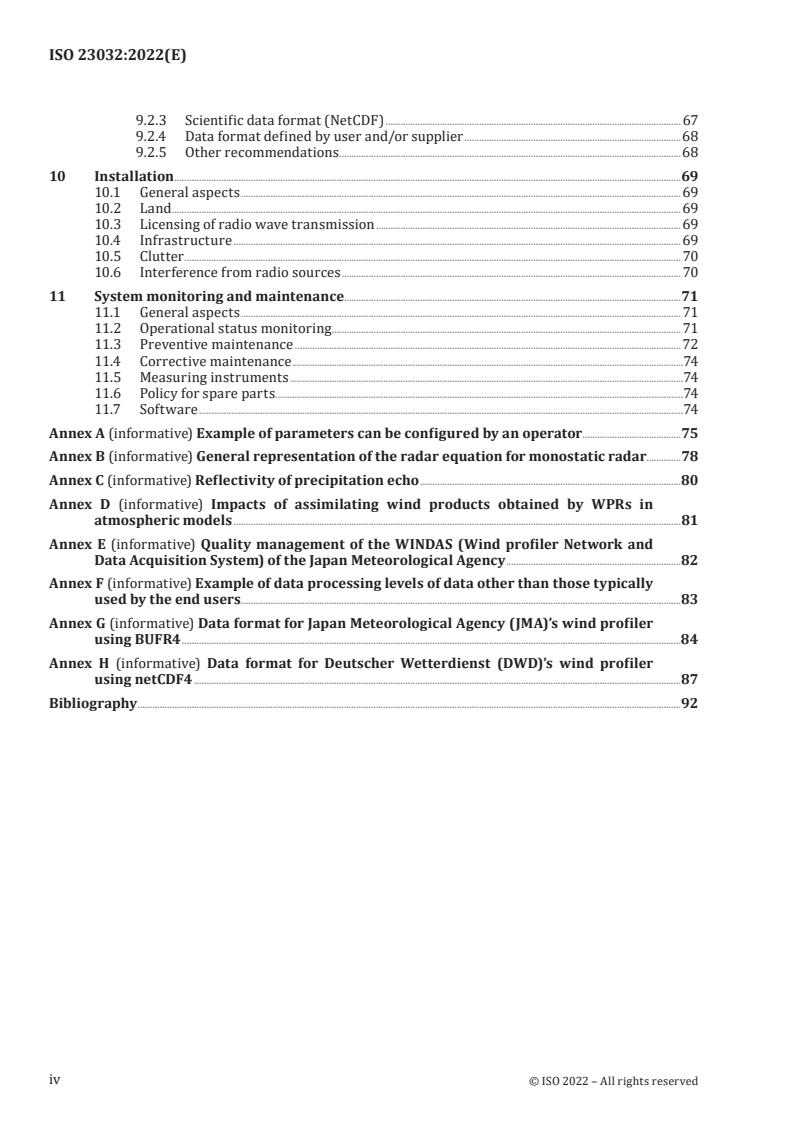
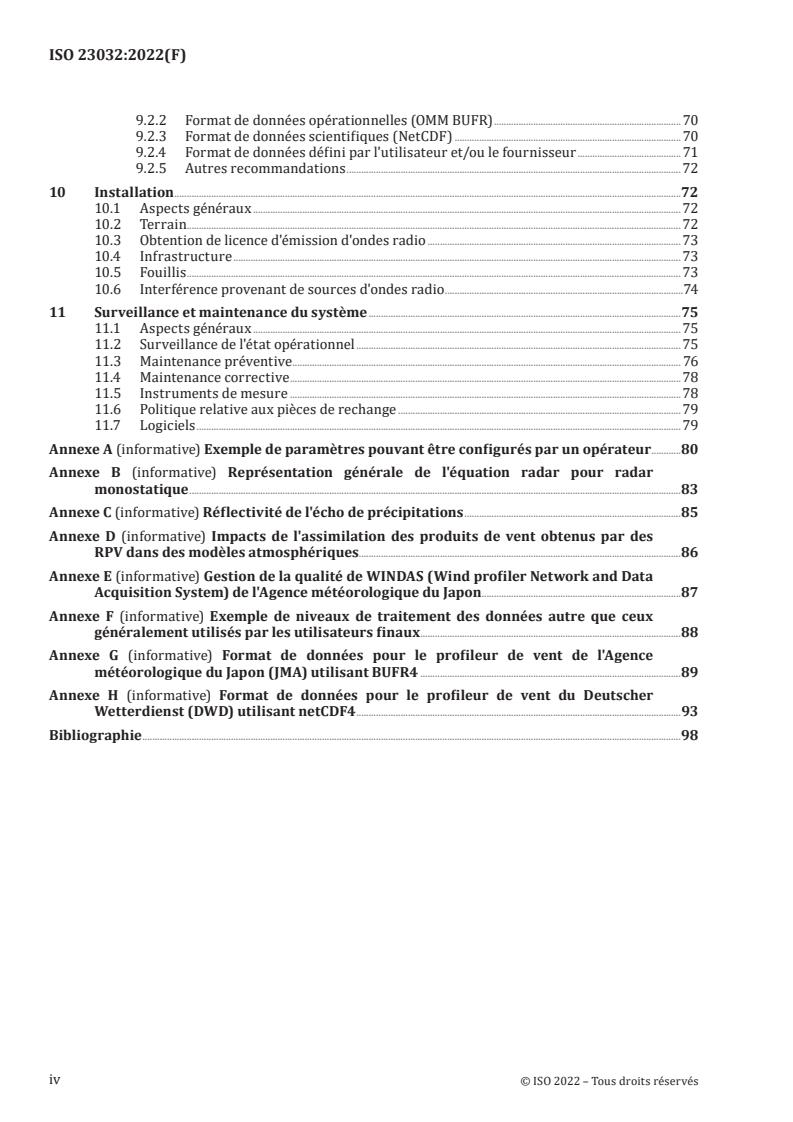
10 Installation .69
10.1 General aspects . 69
10.2 Land . 69
10.3 Licensing of radio wave transmission . 69
10.4 Infrastructure . 69
10.5 Clutter . 70
10.6 Interference from radio sources . 70
11 System monitoring and maintenance.71
11.1 General aspects . 71
11.2 Operational status monitoring. 71
11.3 Preventive maintenance .72
11.4 Corrective maintenance .74
11.5 Measuring instruments .74
11.6 Policy for spare parts.74
11.7 Software .74
Annex A (informative) Example of parameters can be configured by an operator .75
Annex B (informative) General representation of the radar equation for monostatic radar.78
Annex C (informative) Reflectivity of precipitation echo .80
Annex D (informative) Impacts of assimilating wind products obtained by WPRs in
atmospheric models .81
Annex E (informative) Quality management of the WINDAS (Wind profiler Network and
Data Acquisition System) of the Japan Meteorological Agency .82
Annex F (informative) Example of data processing levels of data other than those typically
used by the end users . .83
Annex G (informative) Data format for Japan Meteorological Agency (JMA)’s wind profiler
using BUFR4 .84
Annex H (informative) Data format for Deutscher Wetterdienst (DWD)’s wind profiler
using netCDF4 .87
Bibliography .92
iv
Foreword
ISO (the International Organization for Standardization) is a worldwide federation of national standards
bodies (ISO member bodies). The work of preparing International Standards is normally carried out
through ISO technical committees. Each member body interested in a subject for which a technical
committee has been established has the right to be represented on that committee. International
organizations, governmental and non-governmental, in liaison with ISO, also take part in the work.
ISO collaborates closely with the International Electrotechnical Commission (IEC) on all matters of
electrotechnical standardization.
The procedures used to develop this document and those intended for its further maintenance are
described in the ISO/IEC Directives, Part 1. In particular, the different approval criteria needed for the
different types of ISO documents should be noted. This document was drafted in accordance with the
editorial rules of the ISO/IEC Directives, Part 2 (see www.iso.org/directives).
Attention is drawn to the possibility that some of the elements of this document may be the subject of
patent rights. ISO shall not be held responsible for identifying any or all such patent rights. Details of
any patent rights identified during the development of the document will be in the Introduction and/or
on the ISO list of patent declarations received (see www.iso.org/patents).
Any trade name used in this document is information given for the convenience of users and does not
constitute an endorsement.
For an explanation of the voluntary nature of standards, the meaning of ISO specific terms and
expressions related to conformity assessment, as well as information about ISO's adherence to
the World Trade Organization (WTO) principles in the Technical Barriers to Trade (TBT), see
www.iso.org/iso/foreword.html.
This document was prepared by Technical Committee ISO/TC 146, Air quality, Subcommittee SC 5,
Meteorology, and by the World Meteorological Organization (WMO) as a common ISO/WMO Standard
under the Agreement on Working Arrangements signed between the WMO and ISO in 2008.
Any feedback or questions on this document should be directed to the user’s national standards body. A
complete listing of these bodies can be found at www.iso.org/members.html.
v
Introduction
Radar wind profiler, also referred to as wind profiler radar, wind profiling radar, atmospheric radar, or
clear-air Doppler radar (hereafter abbreviated to WPR) is an instrument that measures height profiles
of wind velocity in clear air. WPR detects echoes produced by perturbations of the radio refractive
index with a scale half of the radar wavelength (i.e. Bragg scale). The mechanism of radio wave
scattering in clear air was theoretically and experimentally understood in the 1960s. Since the 1970s,
large-sized Doppler radars for observing wind and turbulence in the mesosphere, stratosphere, and
the troposphere (MST radars) have been developed. Owing to their capability of measuring wind and
turbulence with excellent time and height resolution, they have made great contributions to describing
and clarifying the dynamical processes in the atmosphere.
Based on the MST radars, WPRs have been developed mainly since the 1980s. WPRs are designed for
measuring wind velocity predominantly in the troposphere, including the atmospheric boundary layer.
The measurement principle of WPRs are the same used in MST radars but a WPR is frequently smaller
in size than a typical MST radar. WPR can measure wind profiles in both a clear and cloudy atmosphere.
In order to monitor and forecast meteorological phenomena, nationwide operational WPR networks
have been constructed by meteorological agencies. Operational WPRs contribute to improving weather
forecast accuracy through assimilation of their wind products into numerical weather prediction
models used by meteorological agencies. Wind products obtained by operational WPRs are distributed
globally. Further applications of WPRs include the measurement of wind profiles in the vicinity of
airports to enable or improve wind shear warnings. The use of WPRs can improve an airport’s ability
to safely depart and land aircraft. WPRs are also used to analyse or predict the diffusion of pollutants.
In addition, WPRs are widely used by government agencies and various industries, including chemical
plants, mines, and power plants, to control emission levels or for computation of nowcast trajectories
during emergency situations. The high-quality wind products of WPRs are also widely used in
atmospheric research. Therefore, WPRs are an indispensable means for observing wind profiles
continuously in time and height. By additionally using radio acoustic sounding system, WPRs can
measure height profiles of virtual temperature.
In order to attain and retain high quality wind products, WPRs need to be designed, manufactured,
and maintained with state-of-the-art knowledge and ensured measurement capability. Aiming at
ensuring measurement capability of WPRs, this document provides guidelines in design, manufacture,
installation, and maintenance of WPRs.
vi
INTERNATIONAL STANDARD ISO 23032:2022(E)
Meteorology — Ground-based remote sensing of wind —
Radar wind profiler
1 Scope
This document provides guidelines for the design, manufacture, installation, and maintenance of a
WPR. It describes the following:
— Measurement principle (Clause 5). Scatterers that produce echoes and methods of wind velocity
measurement are described. The description of the measurement principle mainly aims at providing
the information necessary for describing the guidelines in Clauses 6 to 11.
— Guidelines for WPR system (Clause 6). Frequency, hardware, software, and signal processing are
described. They are mainly applied in designing and manufacturing the hardware and software of
WPR.
— Guidelines for system performance (Clause 7). Measurement resolution, range sampling, radar
sensitivity evaluation, and measurement accuracy are described. They can be used for estimating
the measurement performance of a WPR’s system design and operation.
— Guidelines for quality control (QC) in digital signal processing (Clause 8).
— Guidelines for measurement products and data format (Clause 9). Measurement products obtained
by a WPR and their data levels are defined. Guidelines for data file formats are also described.
— Guidelines for installation (Clause 10) and maintenance (Clause 11).
This document does not aim at providing a thorough description of the measurement principle, WPR
systems, and WPR applications. For further details of these items, users are referred to technical books
(e.g. References [1],[2],[3]).
WPRs are referred to by various names (e.g. radar wind profiler, wind profiler radar, wind profiling
radar, atmospheric radar, or clear-air Doppler radar). Conventional naming for WPRs should be allowed.
2 Normative references
There are no normative references in this document.
3 Terms and definitions
No terms and definitions are listed in this document.
ISO and IEC maintain terminology databases for use in standardization at the following addresses:
— ISO Online browsing platform: available at https:// www .iso .org/ obp
— IEC Electropedia: available at https:// www .electropedia .org/
4 Symbols and abbreviated terms
4.1 Symbols
8 −1
c speed of light (≈ 3,0 × 10 m s )
refractive index structure constant
C
n
Nyquist frequency
f
Nyq
mean Doppler frequency shift of the echo
f
r
antenna gain in decibels
G
ant
loss factor caused by the pulse shaping
L
p
n
radio refractive index
number of antenna beam directions
N
beam
N number of coherent integrations. In this document, N is defined as the
coh coh
number excluding N
pseq
N number of elements in I and Q (I/Q) time series after coherent integrations.
data
N is also the number of elements in the Doppler spectrum
data
number of transmitted frequencies
N
freq
number of incoherent integrations
N
incoh
number of pulse sequences
N
pseq
number of sub-pulses used in phase-modulated pulse compression
N
subp
inter pulse period
T
IPP
echo power
P
echo
noise power of the receiver
P
N
noise power of the Doppler spectrum
P
n
noise power of the Doppler spectrum per Doppler velocity bin
p
n
peak output power of the transmitter
P
p
peak output power at the antenna
P
t
u
zonal wind velocity
v
meridional wind velocity
peak-to-peak voltage
V
pp
radial Doppler velocity
V
r
sample volume
V
s
V wind vector
wind
w
vertical wind velocity
Δr range resolution
η
volume reflectivity
λ radar wavelength
spectral width defined as the half-power full width
σ
3dB
spectral width defined as the standard deviation
σ
std
time width between the two 3-dB drop-off points from the peak point
τ
3dB
duration during which the transmission signal is generated
τ
d
transmitted pulse width
τ
p
H Hermitian operator (complex transposition)
T
superscript which indicates matrix transposition
*
complex conjugation
4.2 Abbreviated terms
ACS adaptive clutter suppression
A/D analog-to-digital
ADC A/D converter
BUFR binary universal form for the representation of meteorological data
COHO coherent oscillator
CRI coherent radar imaging
D/A digital-to-analog
DBS Doppler beam swinging
DCMP directionally constrained minimization of power
DSP digital signal processor
FCA full correlation analysis
FDI frequency domain interferometry
FMCW frequency modulated continuous wave
I/O input/output
I/Q in-phase (I)/quadrature-phase (Q)
IF intermediate frequency
FPGA field programmable gate array
IPP inter pulse period
ITU International Telecommunication Union
JMA Japan Meteorological Agency
LNA low noise amplifier
MTBF mean time between failures
MTTF mean time to failure
NC-DCMP norm-constrained DCMP
NF noise figure
QC quality control
RF radio frequency
RIM range imaging
RL antenna return loss
SA spaced antenna
SNR signal to noise ratio
STALO stable (stabilized) local oscillator
UHF ultra high frequency
UPS uninterruptible power supply
VHF very high frequency
VAD velocity azimuth display
VSWR voltage standing wave ratio
WMO World Meteorological Organization
WPR radar wind profiler, wind profiler radar, wind profiling radar, atmospheric radar,
or clear-air Doppler radar
5 Measurement principle
5.1 Spectral parameters of the echo
The properties of all WPR echoes are generally estimated from the properties of the Doppler spectrum.
Spectral analysis is typically applied to estimate a finite set of parameters such as signal to noise ratio
(SNR), Doppler shift and spectral (spectrum) width. Of particular importance for a WPR is the echo
generated by clear air scattering (clear-air echo). For details of the clear-air echo, see 5.2.1.
NOTE 1 For real-time signal processing to obtain the Doppler spectrum, see 6.2.2 and 6.2.6.
NOTE 2 Interchangeable with spectral width, spectrum width, is also frequently used. The two terms have
the same meaning.
The frequency distribution of the echo contains information on the radial Doppler velocity (V ) and on
r
the wind variance caused by turbulence. Figure 1 shows an example of the Doppler spectrum. The
Doppler spectrum of the echo ( S ) and the noise shown in Figure 1 were produced by a numerical
echo
simulation. In the numerical simulation, Doppler spectra composed of S and white noise were
echo
produced. The noise power of the Doppler spectrum is expressed by P . It is assumed that S follows
n echo
.
a Gaussian distribution and that each spectrum point of S follows the χ distribution with 2
echo
degrees of freedom. The frequency bandwidth of the Doppler spectrum is expressed by B . Produced
s
Doppler spectra were integrated, and the Doppler spectrum after the integration (i.e. incoherent
integration) is plotted. Therefore, the noise variance over B is smaller than the square of the noise
s
power per Doppler velocity bin (p ). The noise variance is one of the principal factors that determine
n
the sensitivity of a WPR receiver. See 6.2.2 and 7.3 for details of incoherent integration and radar
sensitivity, respectively.
In general, it is assumed that S follows a Gaussian distribution. This assumption is generally applied
echo
for the clear-air echo. In this assumption, only the zeroth, first, and second order moments of the echo
are taken into account when determining the spectral parameters. This assumption shall be carefully
discriminated from the assumption that the received signal is the realization of one or more Gaussian
stochastic processes, which include those in both radio wave scattering and of course, uncorrelated
(white) noise. In the event of deviations from this assumption, higher order moments may be considered.
The noise produced in the receiver (receiver noise) can generally be regarded as white noise. For details
of the receiver noise, see 6.2.5.4.
Key
X Doppler velocity
Y intensity
NOTE
— For the definition of the symbols which are not listed in the keys, see text.
— The thin solid curve is an example of a Doppler spectrum which contains the Doppler spectrum of S and
echo
the white noise. The thick solid curve is the sum of P and the idealized S which follows a Gaussian
n echo
distribution and does not have perturbation. The idealized S and P are darkly and lightly shaded,
echo n
respectively. The power of the idealized S is denoted by P . f , σ , σ , and the peak intensity of
echo echo r std 3dB
the idealized S ( p ) is indicated by arrows.
echo k
Figure 1 — Example of Doppler spectrum and spectral parameters
Echo power ( P ), V , and the spectral width are the principal parameters that characterizes the
echo r
echo. They are referred to as the spectral parameters. V is computed from the mean Doppler frequency
r
shift of the echo ( f ). P and f are also the zeroth and first order moment of S , respectively.
r echo r echo
The spectral width defined as the standard deviation (σ ) is the square root of the second order
std
moment of S (see Figure 1). P , f , and σ are expressed by Formula (1), (2) and (3):
echo echo r std
PS= ()fdf (1)
echo echo
∫
fS ()fdf
echo
∫
f = (2)
r
Sf df
()
echo
∫
ff− Sf df
() ()
recho
∫
σ = (3)
std
Sf()df
echo
∫
where f is the Doppler frequency.
The relation between f and V is expressed by Formula (4):
r r
λ
Vf≈− (4)
rr
In Formula (4), V is defined to be positive when its direction is away from the antenna. However, when
r
one prefers to use the sign definition of V as that of f , V can be defined to be positive when its
r r r
direction is toward the antenna. In any case, the direction of V shall be defined clearly in the design
r
and manufacture of the WPR in order to prevent possible mistakes in the design, manufacture,
operation, and maintenance of the WPR. In this document, V is defined to be positive when its direction
r
is away from the antenna.
The spectral width can be also defined as the half-power full width (σ ) or half-power half width of
3dB
σ
3dB
the echo (i.e. ). When S is assumed to follow a Gaussian distribution, σ can be calculated
echo 3dB
by the relation of Formula (5):
σσ= 22ln2 (5)
3dB std
Because the spectral width can be expressed under the above-mentioned definitions, the definition
of the spectral width shall be given explicitly. It shall be noted that the spectral width is not only
determined by wind perturbation caused by turbulence, but also contains broadening effects due to the
[4]
angular and vertical extension of the sample volume . Details of the sample volume are described in
7.1.2.
In the estimation of the spectral parameters, P is also estimated. SNR is expressed by Formula (6):
n
P
echo
SNR= (6)
P
n
In the digital signal processing for estimating the spectral parameters and P , the noise power per
n
Doppler velocity bin ( p ) is generally used. p is expressed by Formula (7):
n n
Δf
pP= (7)
nn
B
s
where Δf is the frequency resolution of the Doppler spectrum (i.e. interval of the Doppler frequency
bins). It is noted that interference from other radio sources that contaminates the received signal has
frequency dependency in general. Therefore, contamination due to the radio interference can produce a
frequency dependency of the noise. Details of the interference from radio sources are described in 5.2.4
and 10.6.
When it is assumed that S follows a Gaussian distribution and SNR is infinite, the estimation error
echo
of Doppler velocity or the spectral width, ε , can be estimated by Formula (8):
v
σ
2
v
ε =K (8)
vv
T
c
where
K is the coefficient;
v
-1
σ is the spectral width defined as the standard deviation in m s ;
v
T is the measurement period in s.
c
When the antenna beam direction is changed after collecting a Doppler spectrum (i.e. after
NN N times transmissions and receptions) or after collecting all of the Doppler spectra used
pseq cohdata
in incoherent integration (i.e. after NN NN times transmissions and receptions),
pseq cohdataincoh
TT= NN NN . When the antenna beam direction is changed on a pulse-to-pulse basis,
cIPP pseq cohdataincoh
TT= NN NN N . See 6.2.3.2.5 for details about the timing change of the antenna
cIPP beam pseq cohdataincoh
beam direction.
K is defined by Formula (9):
v
λ
2
Kk= (9)
verr
2
where
k is the coefficient;
err
λ
is the radar wavelength;
Formulae (8) and (9) are derived from Formulae (13) and (14) in Reference [5], respectively. The value
of k (see Reference [5]) is listed in Table 1.
err
Table 1 — Value of k
err
Parameter Least square method Moment method
Doppler velocity 0,63 0,38
Spectral width 0,60 0,24
Error estimations of the spectral parameters when considering SNR is described in 6.3, 6.4, and 6.5 of
Reference [2].
5.2 Sources of received signals
5.2.1 Turbulent scattering and partial reflection
The ability to detect the clear-air echo is the most important characteristic of a WPR. It makes a WPR
capable of determining vertically resolved profiles of the wind vector from the measured Doppler shift
of the clear-air echo. There are two major mechanisms that produce echoes in clear air: turbulent
scattering from atmospheric turbulence and partial reflection from the horizontally stratified
atmosphere. Partial reflection is also referred to as Fresnel scattering. Atmospheric turbulence
produces perturbation of n , and perturbations of n with the scale of half of λ (i.e. Bragg scale) is a
source of radio wave scattering in clear air.
NOTE The clear-air echo is a return from a radio wave scattering caused by variations of the radio refractive
index n , and does not include scatterings from hard targets in the air (e.g. hydrometeors, insects, birds, and
aircrafts).
n in the neutral (i.e. unionized) atmosphere is given by Formula (10):
p e
−−51
n=+17,,76×+10 3731× 0 (10)
T
T
where
p
is the atmosphere pressure in hPa;
T
is the atmospheric temperature in K;
e
is the partial pressure of water vapour in hPa.
When perturbations of n is isotropic, turbulent scattering is also isotropic.
The refractive index structure constant C is defined as in Formula (11):
n
2 23/
nr+δδrn− rC= r (11)
[]() ()
n
where r is an arbitrary position and δr is a small distance between two spaced locations, respectively.
Because T and e are perturbed by turbulence and n depends on them, C significantly varies due to
n
the atmospheric conditions that determine T and e [see Formula (10)].
The frequency of a WPR is generally selected so that turbulent scattering occurs in the inertial sub-
range of turbulence. Frequencies between 50 MHz and 3 GHz have generally been used for WPRs.
In the inertial sub-range, the energy cascades from the largest eddies to the smallest ones through an
inertial (and inviscid) mechanism. The inertial sub-range exists between the inner scale of turbulence
( l ) and the buoyancy length scale (L ). l is the scale for determining the transition region between
0 B 0
the viscous and inertial sub-ranges, and L is the scale for determining the transition region between
B
the inertial and buoyancy sub-ranges. In the buoyancy sub-range, the turbulent eddies become
flattened and anisotropic. In the viscous sub-range, the smallest eddy is strongly affected by viscosity,
and kinetic energy is converted into heat. The transition from the inertial range to the viscous range
explains the reason why the maximum attainable height coverage for WPRs decreases towards smaller
wavelengths. Viscous subrange is also referred to as dissipative subrange. Long wavelengths (i.e. low
frequencies) whose Bragg scale lie in buoyance sub-range and short wavelengths (i.e. high frequencies)
whose Braggscale lie in the viscous sub-range are not preferable from the viewpoint of radar
sensitivity. See 3.4.2 and 7.3.3 of Reference [1] for more details of the inertial sub-range.
Horizontally stratified layers having sharp vertical gradients of n are known to produce partial
reflection. The echo intensity from partial reflection shows a strong dependency on the zenith angle.
Near zenith it reaches a maximum and decreases rapidly as the zenith angle increases.
The partial reflection coefficient ρ is given by Formula (12):
+l/2
1 1dn
2 − jzκ
ρ = edz (12)
∫
−l/2
4 ndz
where
l
is the thickness of the stratified layer;
z
is the altitude;
κ
is the wave number given as κ =4πλ/ .
See 3.4.3 of Reference [1] for more details of partial reflection. Partial reflection is not observed at the
[1]
UHF and microwave bands .
The intensity of the clear-air echo is determined by the strength of n perturbation caused by turbulence
or by the strength of vertical gradient of n caused by horizontally stratified layers.
5.2.2 Echo in precipitation
Raindrops, hail, snow crystals, ice crystals, and mixed-phase particles in precipitation (precipitation
echo) are also sources of echoes. The intensity of the precipitation echo is frequently comparable to
that of the clear-air echo for the VHF band and is generally greater than that of the clear-air echo for the
UHF band.
If both the precipitation echo and the clear-air echo exist in the Doppler spectrum, the measured
Doppler velocity can be a combination of wind (velocity of clear air) and terminal velocity of
hydrometeors relative to the ground. In this case, the vertical wind cannot be estimated correctly when
both scattering contributions cannot be separated. Nevertheless, the horizontal wind can usually be
derived accurately since the horizontal displacement velocity of the rather small hydrometeors is a
good proxy for the horizontal wind. WPRs using the UHF band generally measure the horizontal wind
velocity at a greater height in precipitation than in clear air.
5.2.3 Clutter
Undesired echoes are referred to as clutter. Because clutter contaminates the Doppler spectrum, it can
significantly decrease the quality of measurement products obtained by the WPR.
The sources of clutter are as follows:
— Clutter from sources fixed on the ground, referred to as ground clutter: Land, grass, trees on hills
and mountains, and high metallic structures (e.g. towers, buildings, and power lines) are the major
sources of ground clutter. Ground clutter can be distributed over a wide area. Though the mean
Doppler frequency of ground clutter is zero, the oscillation of clutter source can broaden the Doppler
spectrum of the ground clutter. Especially when the source of ground clutter is oscillatory (e.g.
grass, trees or power lines), the ground clutter peak in the Doppler spectrum can be significantly
broadened by a strong surface wind.
— Clutter from rotating objects: Wind turbines and rotating antennas are the major sources. Clutter
from them significantly spreads over a wide frequency range of the received Doppler spectrum.
— Clutter from the sea surface, referred to as sea clutter: Because sea clutter is distributed over a wide
area, it generally spreads over the received Doppler spectrum both in range and in frequency. The
intensity and Doppler spreading of sea clutter is a function of the surface wind.
— Clutter from moving sources on the ground or sea: Vehicles, trains, and ships are the major sources.
Clutter from vehicles frequently spreads over a wide frequency range of the Doppler spectrum
because road traffic flows in two opposite directions. The location and Doppler velocity of clutter
from trains can rapidly vary with time. Clutter from ships overlaps with sea clutter.
— Clutter from flying objects: Aircraft (e.g. airplanes and helicopters), birds, bats, and insects are the
major sources, and their flying velocity varies with time. Clutter from an aircraft can significantly
spread over the received Doppler spectrum due to its large Doppler velocity and intensity. Clutter
from helicopters can also spread over a wide frequency of the received Doppler spectrum because
of the high speed of their rotating blades. Birds are also a significant clutter source. Migratory
birds can fly at altitudes up to several thousand meters, and they typically fly at night. Intense bird
migration episodes can be a significant problem for WPR measurements if this type of clutter is not
properly addressed in signal processing. Even then, it can lead to gaps in the wind data. Insects in
the air can also be a source of clutter.
Clutter should be carefully taken into account in the design, installation, and digital signal processing.
The clutter environment should be examined in the survey of the installation site (see 10.5). A fence
designed to attenuate radio waves within the frequency band of the WPR (hereafter referred to as
the clutter fence) is a means for mitigating clutter and interference. For details of the clutter fence,
see 6.2.3.4 and 10.5.
QC in digital signal processing is also a means for mitigating clutter (see Clause 8). Adaptive clutter
suppression (ACS), which uses subarray antennas, is a technique that adaptively mitigates clutter by
controlling the side lobe of the receiver antenna. ACS is described in 6.3.3.
In the VHF band, meteors in the upper mesosphere and electromagnetic irregularities in the sporadic
E layer can also be a source of clutter when range aliasing occurs. Range aliasing can be prevented by
selecting the inter pulse period (IPP) sufficiently large to assure that the maximum measurable range
is greater than the heights where the meteors and electromagnetic irregularities can exist. However,
it is noted that preventing range aliasing can cause the loss of radar sensitivity by decreasing the duty
ratio of the transmission. Lightning can also be a source of clutter.
5.2.4 Interference from radio sources
When a radio wave from a man-ma
...
INTERNATIONAL ISO
STANDARD 23032
First edition
2022-12
Meteorology — Ground-based remote
sensing of wind — Radar wind profiler
Météorologie — Télédétection du vent basée au sol — Profileur de
vent radar
Reference number
© ISO 2022
All rights reserved. Unless otherwise specified, or required in the context of its implementation, no part of this publication may
be reproduced or utilized otherwise in any form or by any means, electronic or mechanical, including photocopying, or posting on
the internet or an intranet, without prior written permission. Permission can be requested from either ISO at the address below
or ISO’s member body in the country of the requester.
ISO copyright office
CP 401 • Ch. de Blandonnet 8
CH-1214 Vernier, Geneva
Phone: +41 22 749 01 11
Email: copyright@iso.org
Website: www.iso.org
Published in Switzerland
ii
Contents Page
Foreword .v
Introduction . vi
1 Scope . 1
2 Normative references . 1
3 Terms and definitions . 1
4 Symbols and abbreviated terms.2
4.1 Symbols . 2
4.2 Abbreviated terms . 3
5 Measurement principle . 4
5.1 Spectral parameters of the echo . 4
5.2 Sources of received signals . 7
5.2.1 Turbulent scattering and partial reflection . 7
5.2.2 Echo in precipitation . . 9
5.2.3 Clutter . 9
5.2.4 Interference from radio sources . 10
5.3 Methods of wind velocity measurement . 10
5.3.1 General aspects . 10
5.3.2 Doppler beam swinging (DBS). 10
5.3.3 Spaced antenna (SA) . . 17
6 WPR system .20
6.1 Frequency . 20
6.2 Hardware and software . 21
6.2.1 Principal components . 21
6.2.2 Signal processing . 22
6.2.3 Antenna . 24
6.2.4 Transmitter .29
6.2.5 Receiver .34
6.2.6 Signal processing unit . . 42
6.2.7 Observation control unit . 45
6.2.8 Consideration on environmental conditions . 45
6.3 Resolution enhancement and clutter mitigation using adaptive signal processing .46
6.3.1 Range imaging (frequency domain interferometry) .46
6.3.2 Coherent radar imaging (spatial domain interferometry) . . 51
6.3.3 Adaptive clutter suppression (ACS) .54
7 System performance .57
7.1 Resolution . 57
7.1.1 Range resolution . . 57
7.1.2 Volume resolution .58
7.1.3 Time resolution.58
7.1.4 Nyquist frequency and frequency resolution of Doppler spectrum . 59
7.2 Range sampling . 59
7.3 Radar sensitivity and measurement range .60
7.4 Measurement accuracy .64
7.4.1 Requirements .64
7.4.2 Validation using other means .64
8 Quality control (QC) in digital signal processing .65
9 Products and data format .66
9.1 Products and data processing levels .66
9.2 Data format . 67
9.2.1 General . 67
9.2.2 Operational data format (WMO BUFR) . 67
iii
9.2.3 Scientific data format (NetCDF) . 67
9.2.4 Data format defined by user and/or supplier .68
9.2.5 Other recommendations .68
10 Installation .69
10.1 General aspects . 69
10.2 Land . 69
10.3 Licensing of radio wave transmission . 69
10.4 Infrastructure . 69
10.5 Clutter . 70
10.6 Interference from radio sources . 70
11 System monitoring and maintenance.71
11.1 General aspects . 71
11.2 Operational status monitoring. 71
11.3 Preventive maintenance .72
11.4 Corrective maintenance .74
11.5 Measuring instruments .74
11.6 Policy for spare parts.74
11.7 Software .74
Annex A (informative) Example of parameters can be configured by an operator .75
Annex B (informative) General representation of the radar equation for monostatic radar.78
Annex C (informative) Reflectivity of precipitation echo .80
Annex D (informative) Impacts of assimilating wind products obtained by WPRs in
atmospheric models .81
Annex E (informative) Quality management of the WINDAS (Wind profiler Network and
Data Acquisition System) of the Japan Meteorological Agency .82
Annex F (informative) Example of data processing levels of data other than those typically
used by the end users . .83
Annex G (informative) Data format for Japan Meteorological Agency (JMA)’s wind profiler
using BUFR4 .84
Annex H (informative) Data format for Deutscher Wetterdienst (DWD)’s wind profiler
using netCDF4 .87
Bibliography .92
iv
Foreword
ISO (the International Organization for Standardization) is a worldwide federation of national standards
bodies (ISO member bodies). The work of preparing International Standards is normally carried out
through ISO technical committees. Each member body interested in a subject for which a technical
committee has been established has the right to be represented on that committee. International
organizations, governmental and non-governmental, in liaison with ISO, also take part in the work.
ISO collaborates closely with the International Electrotechnical Commission (IEC) on all matters of
electrotechnical standardization.
The procedures used to develop this document and those intended for its further maintenance are
described in the ISO/IEC Directives, Part 1. In particular, the different approval criteria needed for the
different types of ISO documents should be noted. This document was drafted in accordance with the
editorial rules of the ISO/IEC Directives, Part 2 (see www.iso.org/directives).
Attention is drawn to the possibility that some of the elements of this document may be the subject of
patent rights. ISO shall not be held responsible for identifying any or all such patent rights. Details of
any patent rights identified during the development of the document will be in the Introduction and/or
on the ISO list of patent declarations received (see www.iso.org/patents).
Any trade name used in this document is information given for the convenience of users and does not
constitute an endorsement.
For an explanation of the voluntary nature of standards, the meaning of ISO specific terms and
expressions related to conformity assessment, as well as information about ISO's adherence to
the World Trade Organization (WTO) principles in the Technical Barriers to Trade (TBT), see
www.iso.org/iso/foreword.html.
This document was prepared by Technical Committee ISO/TC 146, Air quality, Subcommittee SC 5,
Meteorology, and by the World Meteorological Organization (WMO) as a common ISO/WMO Standard
under the Agreement on Working Arrangements signed between the WMO and ISO in 2008.
Any feedback or questions on this document should be directed to the user’s national standards body. A
complete listing of these bodies can be found at www.iso.org/members.html.
v
Introduction
Radar wind profiler, also referred to as wind profiler radar, wind profiling radar, atmospheric radar, or
clear-air Doppler radar (hereafter abbreviated to WPR) is an instrument that measures height profiles
of wind velocity in clear air. WPR detects echoes produced by perturbations of the radio refractive
index with a scale half of the radar wavelength (i.e. Bragg scale). The mechanism of radio wave
scattering in clear air was theoretically and experimentally understood in the 1960s. Since the 1970s,
large-sized Doppler radars for observing wind and turbulence in the mesosphere, stratosphere, and
the troposphere (MST radars) have been developed. Owing to their capability of measuring wind and
turbulence with excellent time and height resolution, they have made great contributions to describing
and clarifying the dynamical processes in the atmosphere.
Based on the MST radars, WPRs have been developed mainly since the 1980s. WPRs are designed for
measuring wind velocity predominantly in the troposphere, including the atmospheric boundary layer.
The measurement principle of WPRs are the same used in MST radars but a WPR is frequently smaller
in size than a typical MST radar. WPR can measure wind profiles in both a clear and cloudy atmosphere.
In order to monitor and forecast meteorological phenomena, nationwide operational WPR networks
have been constructed by meteorological agencies. Operational WPRs contribute to improving weather
forecast accuracy through assimilation of their wind products into numerical weather prediction
models used by meteorological agencies. Wind products obtained by operational WPRs are distributed
globally. Further applications of WPRs include the measurement of wind profiles in the vicinity of
airports to enable or improve wind shear warnings. The use of WPRs can improve an airport’s ability
to safely depart and land aircraft. WPRs are also used to analyse or predict the diffusion of pollutants.
In addition, WPRs are widely used by government agencies and various industries, including chemical
plants, mines, and power plants, to control emission levels or for computation of nowcast trajectories
during emergency situations. The high-quality wind products of WPRs are also widely used in
atmospheric research. Therefore, WPRs are an indispensable means for observing wind profiles
continuously in time and height. By additionally using radio acoustic sounding system, WPRs can
measure height profiles of virtual temperature.
In order to attain and retain high quality wind products, WPRs need to be designed, manufactured,
and maintained with state-of-the-art knowledge and ensured measurement capability. Aiming at
ensuring measurement capability of WPRs, this document provides guidelines in design, manufacture,
installation, and maintenance of WPRs.
vi
INTERNATIONAL STANDARD ISO 23032:2022(E)
Meteorology — Ground-based remote sensing of wind —
Radar wind profiler
1 Scope
This document provides guidelines for the design, manufacture, installation, and maintenance of a
WPR. It describes the following:
— Measurement principle (Clause 5). Scatterers that produce echoes and methods of wind velocity
measurement are described. The description of the measurement principle mainly aims at providing
the information necessary for describing the guidelines in Clauses 6 to 11.
— Guidelines for WPR system (Clause 6). Frequency, hardware, software, and signal processing are
described. They are mainly applied in designing and manufacturing the hardware and software of
WPR.
— Guidelines for system performance (Clause 7). Measurement resolution, range sampling, radar
sensitivity evaluation, and measurement accuracy are described. They can be used for estimating
the measurement performance of a WPR’s system design and operation.
— Guidelines for quality control (QC) in digital signal processing (Clause 8).
— Guidelines for measurement products and data format (Clause 9). Measurement products obtained
by a WPR and their data levels are defined. Guidelines for data file formats are also described.
— Guidelines for installation (Clause 10) and maintenance (Clause 11).
This document does not aim at providing a thorough description of the measurement principle, WPR
systems, and WPR applications. For further details of these items, users are referred to technical books
(e.g. References [1],[2],[3]).
WPRs are referred to by various names (e.g. radar wind profiler, wind profiler radar, wind profiling
radar, atmospheric radar, or clear-air Doppler radar). Conventional naming for WPRs should be allowed.
2 Normative references
There are no normative references in this document.
3 Terms and definitions
No terms and definitions are listed in this document.
ISO and IEC maintain terminology databases for use in standardization at the following addresses:
— ISO Online browsing platform: available at https:// www .iso .org/ obp
— IEC Electropedia: available at https:// www .electropedia .org/
4 Symbols and abbreviated terms
4.1 Symbols
8 −1
c speed of light (≈ 3,0 × 10 m s )
refractive index structure constant
C
n
Nyquist frequency
f
Nyq
mean Doppler frequency shift of the echo
f
r
antenna gain in decibels
G
ant
loss factor caused by the pulse shaping
L
p
n
radio refractive index
number of antenna beam directions
N
beam
N number of coherent integrations. In this document, N is defined as the
coh coh
number excluding N
pseq
N number of elements in I and Q (I/Q) time series after coherent integrations.
data
N is also the number of elements in the Doppler spectrum
data
number of transmitted frequencies
N
freq
number of incoherent integrations
N
incoh
number of pulse sequences
N
pseq
number of sub-pulses used in phase-modulated pulse compression
N
subp
inter pulse period
T
IPP
echo power
P
echo
noise power of the receiver
P
N
noise power of the Doppler spectrum
P
n
noise power of the Doppler spectrum per Doppler velocity bin
p
n
peak output power of the transmitter
P
p
peak output power at the antenna
P
t
u
zonal wind velocity
v
meridional wind velocity
peak-to-peak voltage
V
pp
radial Doppler velocity
V
r
sample volume
V
s
V wind vector
wind
w
vertical wind velocity
Δr range resolution
η
volume reflectivity
λ radar wavelength
spectral width defined as the half-power full width
σ
3dB
spectral width defined as the standard deviation
σ
std
time width between the two 3-dB drop-off points from the peak point
τ
3dB
duration during which the transmission signal is generated
τ
d
transmitted pulse width
τ
p
H Hermitian operator (complex transposition)
T
superscript which indicates matrix transposition
*
complex conjugation
4.2 Abbreviated terms
ACS adaptive clutter suppression
A/D analog-to-digital
ADC A/D converter
BUFR binary universal form for the representation of meteorological data
COHO coherent oscillator
CRI coherent radar imaging
D/A digital-to-analog
DBS Doppler beam swinging
DCMP directionally constrained minimization of power
DSP digital signal processor
FCA full correlation analysis
FDI frequency domain interferometry
FMCW frequency modulated continuous wave
I/O input/output
I/Q in-phase (I)/quadrature-phase (Q)
IF intermediate frequency
FPGA field programmable gate array
IPP inter pulse period
ITU International Telecommunication Union
JMA Japan Meteorological Agency
LNA low noise amplifier
MTBF mean time between failures
MTTF mean time to failure
NC-DCMP norm-constrained DCMP
NF noise figure
QC quality control
RF radio frequency
RIM range imaging
RL antenna return loss
SA spaced antenna
SNR signal to noise ratio
STALO stable (stabilized) local oscillator
UHF ultra high frequency
UPS uninterruptible power supply
VHF very high frequency
VAD velocity azimuth display
VSWR voltage standing wave ratio
WMO World Meteorological Organization
WPR radar wind profiler, wind profiler radar, wind profiling radar, atmospheric radar,
or clear-air Doppler radar
5 Measurement principle
5.1 Spectral parameters of the echo
The properties of all WPR echoes are generally estimated from the properties of the Doppler spectrum.
Spectral analysis is typically applied to estimate a finite set of parameters such as signal to noise ratio
(SNR), Doppler shift and spectral (spectrum) width. Of particular importance for a WPR is the echo
generated by clear air scattering (clear-air echo). For details of the clear-air echo, see 5.2.1.
NOTE 1 For real-time signal processing to obtain the Doppler spectrum, see 6.2.2 and 6.2.6.
NOTE 2 Interchangeable with spectral width, spectrum width, is also frequently used. The two terms have
the same meaning.
The frequency distribution of the echo contains information on the radial Doppler velocity (V ) and on
r
the wind variance caused by turbulence. Figure 1 shows an example of the Doppler spectrum. The
Doppler spectrum of the echo ( S ) and the noise shown in Figure 1 were produced by a numerical
echo
simulation. In the numerical simulation, Doppler spectra composed of S and white noise were
echo
produced. The noise power of the Doppler spectrum is expressed by P . It is assumed that S follows
n echo
.
a Gaussian distribution and that each spectrum point of S follows the χ distribution with 2
echo
degrees of freedom. The frequency bandwidth of the Doppler spectrum is expressed by B . Produced
s
Doppler spectra were integrated, and the Doppler spectrum after the integration (i.e. incoherent
integration) is plotted. Therefore, the noise variance over B is smaller than the square of the noise
s
power per Doppler velocity bin (p ). The noise variance is one of the principal factors that determine
n
the sensitivity of a WPR receiver. See 6.2.2 and 7.3 for details of incoherent integration and radar
sensitivity, respectively.
In general, it is assumed that S follows a Gaussian distribution. This assumption is generally applied
echo
for the clear-air echo. In this assumption, only the zeroth, first, and second order moments of the echo
are taken into account when determining the spectral parameters. This assumption shall be carefully
discriminated from the assumption that the received signal is the realization of one or more Gaussian
stochastic processes, which include those in both radio wave scattering and of course, uncorrelated
(white) noise. In the event of deviations from this assumption, higher order moments may be considered.
The noise produced in the receiver (receiver noise) can generally be regarded as white noise. For details
of the receiver noise, see 6.2.5.4.
Key
X Doppler velocity
Y intensity
NOTE
— For the definition of the symbols which are not listed in the keys, see text.
— The thin solid curve is an example of a Doppler spectrum which contains the Doppler spectrum of S and
echo
the white noise. The thick solid curve is the sum of P and the idealized S which follows a Gaussian
n echo
distribution and does not have perturbation. The idealized S and P are darkly and lightly shaded,
echo n
respectively. The power of the idealized S is denoted by P . f , σ , σ , and the peak intensity of
echo echo r std 3dB
the idealized S ( p ) is indicated by arrows.
echo k
Figure 1 — Example of Doppler spectrum and spectral parameters
Echo power ( P ), V , and the spectral width are the principal parameters that characterizes the
echo r
echo. They are referred to as the spectral parameters. V is computed from the mean Doppler frequency
r
shift of the echo ( f ). P and f are also the zeroth and first order moment of S , respectively.
r echo r echo
The spectral width defined as the standard deviation (σ ) is the square root of the second order
std
moment of S (see Figure 1). P , f , and σ are expressed by Formula (1), (2) and (3):
echo echo r std
PS= ()fdf (1)
echo echo
∫
fS ()fdf
echo
∫
f = (2)
r
Sf df
()
echo
∫
ff− Sf df
() ()
recho
∫
σ = (3)
std
Sf()df
echo
∫
where f is the Doppler frequency.
The relation between f and V is expressed by Formula (4):
r r
λ
Vf≈− (4)
rr
In Formula (4), V is defined to be positive when its direction is away from the antenna. However, when
r
one prefers to use the sign definition of V as that of f , V can be defined to be positive when its
r r r
direction is toward the antenna. In any case, the direction of V shall be defined clearly in the design
r
and manufacture of the WPR in order to prevent possible mistakes in the design, manufacture,
operation, and maintenance of the WPR. In this document, V is defined to be positive when its direction
r
is away from the antenna.
The spectral width can be also defined as the half-power full width (σ ) or half-power half width of
3dB
σ
3dB
the echo (i.e. ). When S is assumed to follow a Gaussian distribution, σ can be calculated
echo 3dB
by the relation of Formula (5):
σσ= 22ln2 (5)
3dB std
Because the spectral width can be expressed under the above-mentioned definitions, the definition
of the spectral width shall be given explicitly. It shall be noted that the spectral width is not only
determined by wind perturbation caused by turbulence, but also contains broadening effects due to the
[4]
angular and vertical extension of the sample volume . Details of the sample volume are described in
7.1.2.
In the estimation of the spectral parameters, P is also estimated. SNR is expressed by Formula (6):
n
P
echo
SNR= (6)
P
n
In the digital signal processing for estimating the spectral parameters and P , the noise power per
n
Doppler velocity bin ( p ) is generally used. p is expressed by Formula (7):
n n
Δf
pP= (7)
nn
B
s
where Δf is the frequency resolution of the Doppler spectrum (i.e. interval of the Doppler frequency
bins). It is noted that interference from other radio sources that contaminates the received signal has
frequency dependency in general. Therefore, contamination due to the radio interference can produce a
frequency dependency of the noise. Details of the interference from radio sources are described in 5.2.4
and 10.6.
When it is assumed that S follows a Gaussian distribution and SNR is infinite, the estimation error
echo
of Doppler velocity or the spectral width, ε , can be estimated by Formula (8):
v
σ
2
v
ε =K (8)
vv
T
c
where
K is the coefficient;
v
-1
σ is the spectral width defined as the standard deviation in m s ;
v
T is the measurement period in s.
c
When the antenna beam direction is changed after collecting a Doppler spectrum (i.e. after
NN N times transmissions and receptions) or after collecting all of the Doppler spectra used
pseq cohdata
in incoherent integration (i.e. after NN NN times transmissions and receptions),
pseq cohdataincoh
TT= NN NN . When the antenna beam direction is changed on a pulse-to-pulse basis,
cIPP pseq cohdataincoh
TT= NN NN N . See 6.2.3.2.5 for details about the timing change of the antenna
cIPP beam pseq cohdataincoh
beam direction.
K is defined by Formula (9):
v
λ
2
Kk= (9)
verr
2
where
k is the coefficient;
err
λ
is the radar wavelength;
Formulae (8) and (9) are derived from Formulae (13) and (14) in Reference [5], respectively. The value
of k (see Reference [5]) is listed in Table 1.
err
Table 1 — Value of k
err
Parameter Least square method Moment method
Doppler velocity 0,63 0,38
Spectral width 0,60 0,24
Error estimations of the spectral parameters when considering SNR is described in 6.3, 6.4, and 6.5 of
Reference [2].
5.2 Sources of received signals
5.2.1 Turbulent scattering and partial reflection
The ability to detect the clear-air echo is the most important characteristic of a WPR. It makes a WPR
capable of determining vertically resolved profiles of the wind vector from the measured Doppler shift
of the clear-air echo. There are two major mechanisms that produce echoes in clear air: turbulent
scattering from atmospheric turbulence and partial reflection from the horizontally stratified
atmosphere. Partial reflection is also referred to as Fresnel scattering. Atmospheric turbulence
produces perturbation of n , and perturbations of n with the scale of half of λ (i.e. Bragg scale) is a
source of radio wave scattering in clear air.
NOTE The clear-air echo is a return from a radio wave scattering caused by variations of the radio refractive
index n , and does not include scatterings from hard targets in the air (e.g. hydrometeors, insects, birds, and
aircrafts).
n in the neutral (i.e. unionized) atmosphere is given by Formula (10):
p e
−−51
n=+17,,76×+10 3731× 0 (10)
T
T
where
p
is the atmosphere pressure in hPa;
T
is the atmospheric temperature in K;
e
is the partial pressure of water vapour in hPa.
When perturbations of n is isotropic, turbulent scattering is also isotropic.
The refractive index structure constant C is defined as in Formula (11):
n
2 23/
nr+δδrn− rC= r (11)
[]() ()
n
where r is an arbitrary position and δr is a small distance between two spaced locations, respectively.
Because T and e are perturbed by turbulence and n depends on them, C significantly varies due to
n
the atmospheric conditions that determine T and e [see Formula (10)].
The frequency of a WPR is generally selected so that turbulent scattering occurs in the inertial sub-
range of turbulence. Frequencies between 50 MHz and 3 GHz have generally been used for WPRs.
In the inertial sub-range, the energy cascades from the largest eddies to the smallest ones through an
inertial (and inviscid) mechanism. The inertial sub-range exists between the inner scale of turbulence
( l ) and the buoyancy length scale (L ). l is the scale for determining the transition region between
0 B 0
the viscous and inertial sub-ranges, and L is the scale for determining the transition region between
B
the inertial and buoyancy sub-ranges. In the buoyancy sub-range, the turbulent eddies become
flattened and anisotropic. In the viscous sub-range, the smallest eddy is strongly affected by viscosity,
and kinetic energy is converted into heat. The transition from the inertial range to the viscous range
explains the reason why the maximum attainable height coverage for WPRs decreases towards smaller
wavelengths. Viscous subrange is also referred to as dissipative subrange. Long wavelengths (i.e. low
frequencies) whose Bragg scale lie in buoyance sub-range and short wavelengths (i.e. high frequencies)
whose Braggscale lie in the viscous sub-range are not preferable from the viewpoint of radar
sensitivity. See 3.4.2 and 7.3.3 of Reference [1] for more details of the inertial sub-range.
Horizontally stratified layers having sharp vertical gradients of n are known to produce partial
reflection. The echo intensity from partial reflection shows a strong dependency on the zenith angle.
Near zenith it reaches a maximum and decreases rapidly as the zenith angle increases.
The partial reflection coefficient ρ is given by Formula (12):
+l/2
1 1dn
2 − jzκ
ρ = edz (12)
∫
−l/2
4 ndz
where
l
is the thickness of the stratified layer;
z
is the altitude;
κ
is the wave number given as κ =4πλ/ .
See 3.4.3 of Reference [1] for more details of partial reflection. Partial reflection is not observed at the
[1]
UHF and microwave bands .
The intensity of the clear-air echo is determined by the strength of n perturbation caused by turbulence
or by the strength of vertical gradient of n caused by horizontally stratified layers.
5.2.2 Echo in precipitation
Raindrops, hail, snow crystals, ice crystals, and mixed-phase particles in precipitation (precipitation
echo) are also sources of echoes. The intensity of the precipitation echo is frequently comparable to
that of the clear-air echo for the VHF band and is generally greater than that of the clear-air echo for the
UHF band.
If both the precipitation echo and the clear-air echo exist in the Doppler spectrum, the measured
Doppler velocity can be a combination of wind (velocity of clear air) and terminal velocity of
hydrometeors relative to the ground. In this case, the vertical wind cannot be estimated correctly when
both scattering contributions cannot be separated. Nevertheless, the horizontal wind can usually be
derived accurately since the horizontal displacement velocity of the rather small hydrometeors is a
good proxy for the horizontal wind. WPRs using the UHF band generally measure the horizontal wind
velocity at a greater height in precipitation than in clear air.
5.2.3 Clutter
Undesired echoes are referred to as clutter. Because clutter contaminates the Doppler spectrum, it can
significantly decrease the quality of measurement products obtained by the WPR.
The sources of clutter are as follows:
— Clutter from sources fixed on the ground, referred to as ground clutter: Land, grass, trees on hills
and mountains, and high metallic structures (e.g. towers, buildings, and power lines) are the major
sources of ground clutter. Ground clutter can be distributed over a wide area. Though the mean
Doppler frequency of ground clutter is zero, the oscillation of clutter source can broaden the Doppler
spectrum of the ground clutter. Especially when the source of ground clutter is oscillatory (e.g.
grass, trees or power lines), the ground clutter peak in the Doppler spectrum can be significantly
broadened by a strong surface wind.
— Clutter from rotating objects: Wind turbines and rotating antennas are the major sources. Clutter
from them significantly spreads over a wide frequency range of the received Doppler spectrum.
— Clutter from the sea surface, referred to as sea clutter: Because sea clutter is distributed over a wide
area, it generally spreads over the received Doppler spectrum both in range and in frequency. The
intensity and Doppler spreading of sea clutter is a function of the surface wind.
— Clutter from moving sources on the ground or sea: Vehicles, trains, and ships are the major sources.
Clutter from vehicles frequently spreads over a wide frequency range of the Doppler spectrum
because road traffic flows in two opposite directions. The location and Doppler velocity of clutter
from trains can rapidly vary with time. Clutter from ships overlaps with sea clutter.
— Clutter from flying objects: Aircraft (e.g. airplanes and helicopters), birds, bats, and insects are the
major sources, and their flying velocity varies with time. Clutter from an aircraft can significantly
spread over the received Doppler spectrum due to its large Doppler velocity and intensity. Clutter
from helicopters can also spread over a wide frequency of the received Doppler spectrum because
of the high speed of their rotating blades. Birds are also a significant clutter source. Migratory
birds can fly at altitudes up to several thousand meters, and they typically fly at night. Intense bird
migration episodes can be a significant problem for WPR measurements if this type of clutter is not
properly addressed in signal processing. Even then, it can lead to gaps in the wind data. Insects in
the air can also be a source of clutter.
Clutter should be carefully taken into account in the design, installation, and digital signal processing.
The clutter environment should be examined in the survey of the installation site (see 10.5). A fence
designed to attenuate radio waves within the frequency band of the WPR (hereafter referred to as
the clutter fence) is a means for mitigating clutter and interference. For details of the clutter fence,
see 6.2.3.4 and 10.5.
QC in digital signal processing is also a means for mitigating clutter (see Clause 8). Adaptive clutter
suppression (ACS), which uses subarray antennas, is a technique that adaptively mitigates clutter by
controlling the side lobe of the receiver antenna. ACS is described in 6.3.3.
In the VHF band, meteors in the upper mesosphere and electromagnetic irregularities in the sporadic
E layer can also be a source of clutter when range aliasing occurs. Range aliasing can be prevented by
selecting the inter pulse period (IPP) sufficiently large to assure that the maximum measurable range
is greater than the heights where the meteors and electromagnetic irregularities can exist. However,
it is noted that preventing range aliasing can cause the loss of radar sensitivity by decreasing the duty
ratio of the transmission. Lightning can also be a source of clutter.
5.2.4 Interference from radio sources
When a radio wave from a man-made radio source contaminates the received signals of the WPR, it
often decreases the quality of measurement products obtained by the WPR. Both radio stations
and machines that emit electromagnetic waves can be a radio source that causes interference.
Interference, which comes from other radio sources and contaminates the received signal, generally
has a frequency dependency. Even when the frequency of the interference is different from that of the
WPR, cross modulation in the receiver and frequency aliasing in data sampling can cause interference
contamination at the baseband. Interference mitigation should be taken into account in the design and
installation. The radio wave environment should be examined in the initial survey of the installation
site (see 10.6). Countermeasures for mitigating interference are also described in 10.6.
[6]
Emission of radio waves from lightning also can be a source of interference .
5.3 Methods of wind velocity measurement
5.3.1 General aspects
The wi
...
NORME ISO
INTERNATIONALE 23032
Première édition
2022-12
Météorologie — Télédétection du vent
basée au sol — Profileur de vent radar
Meteorology — Ground-based remote sensing of wind — Radar wind
profiler
Numéro de référence
DOCUMENT PROTÉGÉ PAR COPYRIGHT
© ISO 2022
Tous droits réservés. Sauf prescription différente ou nécessité dans le contexte de sa mise en œuvre, aucune partie de cette
publication ne peut être reproduite ni utilisée sous quelque forme que ce soit et par aucun procédé, électronique ou mécanique,
y compris la photocopie, ou la diffusion sur l’internet ou sur un intranet, sans autorisation écrite préalable. Une autorisation peut
être demandée à l’ISO à l’adresse ci-après ou au comité membre de l’ISO dans le pays du demandeur.
ISO copyright office
Case postale 401 • Ch. de Blandonnet 8
CH-1214 Vernier, Genève
Tél.: +41 22 749 01 11
E-mail: copyright@iso.org
Web: www.iso.org
Publié en Suisse
ii
Sommaire Page
Avant-propos .v
Introduction . vi
1 Domaine d'application .1
2 Références normatives .1
3 Termes et définitions . 1
4 Symboles et termes abrégés .2
4.1 Symboles . 2
4.2 Termes abrégés . 3
5 Principe de mesurage . 4
5.1 Paramètres spectraux de l'écho . 4
5.2 Sources des signaux reçus . . . 7
5.2.1 Dispersion turbulente et réflexion partielle . 7
5.2.2 Écho en précipitations . 9
5.2.3 Fouillis . 9
5.2.4 Interférence provenant de sources d'ondes radio . 10
5.3 Méthodes de mesurage de la vitesse du vent. 11
5.3.1 Aspects généraux . 11
5.3.2 Cadencement de faisceau Doppler (DBS) . 11
5.3.3 Antennes espacées (SA) . 17
6 Système RPV .20
6.1 Fréquence . 20
6.2 Matériel et logiciels . 21
6.2.1 Principaux composants . 21
6.2.2 Traitement du signal . 22
6.2.3 Antenne . 24
6.2.4 Émetteur . 30
6.2.5 Récepteur . 35
6.2.6 Unité de traitement du signal . 43
6.2.7 Unité de commande d'observation . 47
6.2.8 Considérations relatives aux conditions environnementales . 47
6.3 Amélioration de la résolution et réduction des fouillis grâce au traitement
adaptatif du signal .48
6.3.1 Imagerie par télémétrie (interférométrie dans le domaine fréquentiel) .48
6.3.2 Radarphotographie cohérente (interférométrie dans le domaine spatial) .53
6.3.3 Système adaptatif d'élimination du fouillis (ACS) .56
7 Performance du système .60
7.1 Résolution .60
7.1.1 Résolution en portée .60
7.1.2 Résolution de volume .60
7.1.3 Résolution temporelle. 61
7.1.4 Fréquence de Nyquist et résolution en fréquence du spectre Doppler . 61
7.2 Échantillonnage en distance . 62
7.3 Sensibilité du radar et plage de mesure .63
7.4 Précision des mesures .66
7.4.1 Exigences .66
7.4.2 Validation par d'autres moyens . 67
8 Contrôle de la qualité (CQ) dans le traitement numérique du signal .68
9 Produits et format des données .69
9.1 Produits et niveaux de traitement des données . 69
9.2 Format de données . . 70
9.2.1 Généralités . 70
iii
9.2.2 Format de données opérationnelles (OMM BUFR) . 70
9.2.3 Format de données scientifiques (NetCDF) . 70
9.2.4 Format de données défini par l'utilisateur et/ou le fournisseur . 71
9.2.5 Autres recommandations .72
10 Installation .72
10.1 Aspects généraux .72
10.2 Terrain.72
10.3 Obtention de licence d'émission d'ondes radio .73
10.4 Infrastructure .73
10.5 Fouillis .73
10.6 Interférence provenant de sources d'ondes radio .74
11 Surveillance et maintenance du système .75
11.1 Aspects généraux . 75
11.2 Surveillance de l'état opérationnel . 75
11.3 Maintenance préventive . 76
11.4 Maintenance corrective .78
11.5 Instruments de mesure .78
11.6 Politique relative aux pièces de rechange . 79
11.7 Logiciels . 79
Annexe A (informative) Exemple de paramètres pouvant être configurés par un opérateur .80
Annexe B (informative) Représentation générale de l'équation radar pour radar
monostatique .83
Annexe C (informative) Réflectivité de l'écho de précipitations .85
Annexe D (informative) Impacts de l'assimilation des produits de vent obtenus par des
RPV dans des modèles atmosphériques.86
Annexe E (informative) Gestion de la qualité de WINDAS (Wind profiler Network and Data
Acquisition System) de l'Agence météorologique du Japon .87
Annexe F (informative) Exemple de niveaux de traitement des données autre que ceux
généralement utilisés par les utilisateurs finaux .88
Annexe G (informative) Format de données pour le profileur de vent de l'Agence
météorologique du Japon (JMA) utilisant BUFR4 .89
Annexe H (informative) Format de données pour le profileur de vent du Deutscher
Wetterdienst (DWD) utilisant netCDF4 .93
Bibliographie .98
iv
Avant-propos
L'ISO (Organisation internationale de normalisation) est une fédération mondiale d'organismes
nationaux de normalisation (comités membres de l'ISO). L'élaboration des Normes internationales est
en général confiée aux comités techniques de l'ISO. Chaque comité membre intéressé par une étude
a le droit de faire partie du comité technique créé à cet effet. Les organisations internationales,
gouvernementales et non gouvernementales, en liaison avec l'ISO participent également aux travaux.
L'ISO collabore étroitement avec la Commission électrotechnique internationale (IEC) en ce qui
concerne la normalisation électrotechnique.
Les procédures utilisées pour élaborer le présent document et celles destinées à sa mise à jour sont
décrites dans les Directives ISO/IEC, Partie 1. Il convient, en particulier, de prendre note des différents
critères d'approbation requis pour les différents types de documents ISO. Le présent document a
été rédigé conformément aux règles de rédaction données dans les Directives ISO/IEC, Partie 2 (voir
www.iso.org/directives).
L'attention est attirée sur le fait que certains des éléments du présent document peuvent faire l'objet de
droits de propriété intellectuelle ou de droits analogues. L'ISO ne saurait être tenue pour responsable
de ne pas avoir identifié de tels droits de propriété et averti de leur existence. Les détails concernant
les références aux droits de propriété intellectuelle ou autres droits analogues identifiés lors de
l'élaboration du document sont indiqués dans l'Introduction et/ou dans la liste des déclarations de
brevets reçues par l'ISO (voir www.iso.org/brevets).
Les appellations commerciales éventuellement mentionnées dans le présent document sont données
pour information, par souci de commodité, à l’intention des utilisateurs et ne sauraient constituer un
engagement.
Pour une explication de la nature volontaire des normes, la signification des termes et expressions
spécifiques de l'ISO liés à l'évaluation de la conformité, ou pour toute information au sujet de l'adhésion
de l'ISO aux principes de l’Organisation mondiale du commerce (OMC) concernant les obstacles
techniques au commerce (OTC), voir www.iso.org/avant-propos.
Le présent document a été élaboré par le comité technique ISO/TC 146, Qualité de l'air, sous-comité SC 5,
Météorologie, en collaboration avec l’Organisation météorologique mondiale (OMM), en tant que norme
commune ISO/OMM dans le cadre de l’Accord sur les arrangements de travail signé par l’OMM et l’ISO
en 2008.
Il convient que l’utilisateur adresse tout retour d’information ou toute question concernant le présent
document à l’organisme national de normalisation de son pays. Une liste exhaustive desdits organismes
se trouve à l’adresse www.iso.org/fr/members.html.
v
Introduction
Un profileur de vent radar, également appelé radar atmosphérique, ou radar Doppler en air clair (ci-
après abrégé en RPV) est un instrument qui mesure les profils en altitude de la vitesse du vent en air
clair. Le RPV détecte les échos générés par les variations d'indice de réfraction radioélectrique sur une
échelle égale à la moitié de la longueur d'onde du radar (c'est-à-dire l'échelle de Bragg). Le mécanisme
de diffusion d'ondes radio en air clair a été élucidé sur les plans théorique et pratique dans les années
1960. Des radars Doppler de grande taille conçus pour l'observation des vents et des turbulences dans la
mésosphère, la stratosphère et la troposphère (radars MST) ont été développés depuis les années 1970.
En raison de leur capacité à mesurer les vents et turbulences avec une excellente résolution temporelle
et en altitude, ils ont été d'une grande utilité pour décrire et clarifier les processus dynamiques de
l'atmosphère.
Les RPV ont été développés principalement depuis les années 1980 sur la base des radars MST. Les
RPV sont conçus pour mesurer la vitesse des vents, particulièrement dans la troposphère, y compris la
couche limite atmosphérique. Le principe de mesure des RPV est le même que celui qui est utilisé dans
les radars MST, à ceci près qu'un RPV est souvent plus petit qu'un radar MST type. Un RPV peut mesurer
les profils de vent à la fois en atmosphère claire ou nuageuse.
Des réseaux RPV opérationnels à l'échelon national ont été construits par des agences météorologiques
dans le but de surveiller et de prévoir les phénomènes météorologiques. Les RPV opérationnels
contribuent à améliorer la précision des prévisions météorologiques par l'intégration de leurs produits
relatifs aux vents dans des modèles numériques de prévision météorologique utilisés par les agences
météorologiques. Les produits relatifs aux vents obtenus par des RPV opérationnels sont distribués
dans le monde entier. Les applications complémentaires des RPV comprennent le mesurage des
profils du vent au voisinage des aéroports, permettant d'activer ou d'améliorer les systèmes d'alerte
de cisaillement de vent. L'utilisation des RPV permet d'améliorer la sécurité d'un aéroport pendant
les phases de décollage et d'atterrissage des avions. Les RPV permettent également d'analyser ou
de prédire la diffusion des polluants. Les RPV sont en outre communément utilisés par des agences
gouvernementales et différents secteurs industriels, y compris les usines de produits chimiques, les
mines et les centrales électriques, pour gérer les niveaux d'émission ou pour calculer les prévisions
immédiates des trajectoires en situations d'urgence. Les RPV fournissent des produits de vent haute
qualité qui sont également utilisés dans le domaine de la recherche atmosphérique. Par conséquent, les
RPV sont des moyens indispensables pour observer les profils de vent de façon continue dans le temps
et en altitude. Si l'on utilise en plus un système de sondage radio-acoustique, les RPV peuvent mesurer
les profils de température virtuelle en altitude.
Afin d'obtenir et de maintenir la qualité élevée des produits relatifs aux vents, les RPV nécessitent d'être
conçus, fabriqués et entretenus avec une connaissance reflétant l'état de la technique et des capacités
de mesurage éprouvées. Dans le but d'assurer la capacité de mesurage des RPV, le présent document
fournit des lignes directrices pour la conception, la fabrication, l'installation et la maintenance des RPV.
vi
NORME INTERNATIONALE ISO 23032:2022(F)
Météorologie — Télédétection du vent basée au sol —
Profileur de vent radar
1 Domaine d'application
Le présent document fournit des lignes directrices pour la conception, la fabrication, l'installation et la
maintenance des RPV. Il décrit les points suivants:
— principe de mesurage (Article 5). Les diffuseurs produisant les échos et les méthodes de mesure
de la vitesse du vent sont décrits. La description du principe de mesurage a pour objet principal de
fournir les informations nécessaires à la description des lignes directrices des Articles 6 à 11;
— lignes directrices pour le système RPV (Article 6). La fréquence, le matériel, les logiciels et le
traitement du signal sont décrits. Ceux-ci sont principalement appliqués dans le cadre de la
conception et de la fabrication du matériel et des logiciels du RPV;
— lignes directrices pour les performances du système (Article 7). La résolution des mesures,
l'échantillonnage en distance, l'évaluation de la sensibilité du radar et la précision des mesures sont
décrits. Ceux-ci peuvent être utilisés pour estimer la performance de mesurage de la conception et
du fonctionnement d'un système RPV;
— lignes directrices de contrôle de la qualité (CQ) dans le traitement numérique du signal (Article 8);
— lignes directrices de produits de mesurage et de format de données (Article 9). Les produits de
mesurage obtenus par un RPV et leurs niveaux de données sont définis. Les lignes directrices de
formats de fichiers de données sont également décrites;
— lignes directrices d'installation (Article 10) et de maintenance (Article 11).
Le présent document n'a pas pour vocation de donner une description détaillée du principe de mesurage,
des systèmes RPV et des applications RPV. Pour de plus amples informations sur ces points, il convient
[1] [2] [3]
que les utilisateurs consultent les livrets techniques (par exemple, , , ).
Les RPV sont appelés par différents noms (par exemple, profileur de vent radar, radar atmosphérique,
ou radar Doppler en air clair). Il convient que les noms conventionnels des RPV soient autorisés.
2 Références normatives
Le présent document ne contient aucune référence normative.
3 Termes et définitions
Aucun terme n'est défini dans le présent document.
L'ISO et l'IEC tiennent à jour des bases de données terminologiques destinées à être utilisées en
normalisation, consultables aux adresses suivantes:
— ISO Online browsing platform: disponible à l'adresse https:// www .iso .org/ obp
— IEC Electropedia: disponible à l'adresse https:// www .electropedia .org/
4 Symboles et termes abrégés
4.1 Symboles
8 −1
c vitesse de la lumière (≈ 3,0 × 10 m s )
constante de structure d'indice de réfraction
C
n
fréquence de Nyquist
f
Nyq
décalage Doppler moyen de l'écho
f
r
gain d'antenne en décibels
G
ant
facteur de perte causé par la forme d'impulsion
L
p
n
indice de réfraction radioélectrique
nombre de directions de faisceau d'antenne
N
beam
N nombre d'intégrations cohérentes. Dans le présent document, N est défini
coh coh
comme étant le nombre qui exclut N
pseq
N nombre d'éléments dans les séries temporelles I et Q (I/Q) après des intégrations
data
cohérentes. N est également le nombre d'éléments dans le spectre Doppler
data
nombre de fréquences émises
N
freq
nombre d'intégrations incohérentes
N
incoh
nombre de séquences d'impulsions
N
pseq
nombre de sous-impulsions utilisées en compression d'impulsion modulée en phase
N
subp
période interimpulsion
T
IPP
puissance d'écho
P
echo
puissance de bruit du récepteur
P
N
puissance de bruit du spectre Doppler
P
n
puissance de bruit du spectre Doppler par cellule de vitesse Doppler
p
n
puissance crête en sortie au niveau de l'émetteur
P
p
puissance crête en sortie au niveau de l'antenne
P
t
u
vitesse du vent zonal
v
vitesse du vent méridien
tension crête à crête
V
pp
vitesse Doppler radiale
V
r
volume échantillon
V
s
V vecteur vent
wind
w
vitesse du vent vertical
Δr résolution en portée
η
réflectivité du volume
λ longueur d'onde du radar
largeur spectrale définie comme la pleine largeur à mi-puissance
σ
3dB
largeur spectrale définie comme l’écart-type
σ
std
largeur temporelle entre les deux points de chute à 3-dB à partir du point de crête
τ
3dB
durée pendant laquelle le signal d'émission est généré
τ
d
largeur d'impulsion émise
τ
p
H
opérateur hermitien (transposition complexe)
T
exposant qui indique la transposition de matrice
* conjugaison complexe
4.2 Termes abrégés
A/N analogique/numérique
ACS système adaptatif d'élimination du fouillis [adaptive clutter suppression]
AFB amplificateur à faible bruit
BUFR forme universelle de représentation binaire des données météorologiques [binary
universal form for the representation of meteorological data]
CAN convertisseur A/N
COHO oscillateur cohérent [coherent oscillator]
CQ contrôle de la qualité
CRI radarphotographie cohérente [coherent radar imaging]
DAV représentation de la vitesse en fonction de l'azimut
DBS cadencement de faisceau Doppler [Doppler beam swinging]
DCMP minimisation de puissance sous contrainte linéaire [directionally constrained
minimization of power]
DSP processeur de signal numérique [digital signal processor]
E/S entrée/sortie
FCA analyse de corrélation complète [full correlation analysis]
FDI interférométrie dans le domaine fréquentiel [frequency domain interferometry]
FI fréquence intermédiaire
FMCW onde continue à fréquence modulée [frequency modulated continuous wave]
FPGA contrôleur programmable de type «field programmable gate array»
I/Q en phase (I)/en quadrature de phase (Q)
IPP période interimpulsion [inter pulse period]
JMA Agence météorologique du Japon [Japan Meteorological Agency]
MTBF temps moyen entre défaillances
MTTF temps moyen de fonctionnement avant défaillance
N/A numérique/analogique
NC-DCMP DCMP sujette aux normes [norm-constrained DCMP]
NF facteur de bruit [noise figure]
OMM Organisation météorologique mondiale
RF radio fréquence
RIM imagerie par télémétrie [range imaging]
RL perte de retour d'antenne [antenna return loss]
RPV profileur de vent radar, radar atmosphérique, ou radar Doppler en air clair
SA antennes espacées [spaced antenna]
SNR rapport signal/bruit [signal to noise ratio]
STALO oscillateur local stabilisé [stable (stabilized) local oscillator]
TOS taux d'ondes stationnaires
UHF ultra haute fréquence
UIT Union Internationale des Télécommunications
UPS alimentation sans interruption [uninterruptible power supply]
VHF très haute fréquence [very high frequency]
5 Principe de mesurage
5.1 Paramètres spectraux de l'écho
Les propriétés de tous les échos du RPV sont généralement estimées à partir des propriétés du spectre
Doppler. L'analyse spectrale est ordinairement appliquée pour estimer un ensemble fini de paramètres
tels que le rapport signal/bruit (SNR), le décalage Doppler et la largeur spectrale. L'écho généré par la
dispersion en air clair (écho en air clair) revêt une importance particulière pour un RPV. Pour plus de
détails sur l'écho en air clair, voir 5.2.1.
NOTE 1 Pour le traitement du signal en temps réel en vue d'obtenir le spectre Doppler, voir 6.2.2 et 6.2.6.
NOTE 2 La largeur de spectre, qui est interchangeable avec la largeur spectrale, est aussi fréquemment
utilisée. Ces deux termes revêtent la même signification.
La distribution de fréquence de l'écho comporte des informations sur la vitesse Doppler radiale (V ) et
r
sur la variance du vent causée par des turbulences. La Figure 1 propose un exemple du spectre Doppler.
Le spectre Doppler de l'écho ( S ) et le bruit représenté à la Figure 1 ont été produits par une
echo
simulation numérique. C'est dans la simulation numérique que les spectres Doppler composés de S
echo
et du bruit blanc ont été produits. La puissance de bruit du spectre Doppler est exprimée par P . On
n
suppose que S suit une répartition gaussienne et que chaque point du spectre de S suit la
echo echo
répartition de χ avec 2 degrés de liberté. La largeur de bande de fréquence du spectre Doppler est
exprimée par B . Les spectres Doppler produits sont intégrés, et le spectre Doppler après intégration
s
(c'est-à-dire intégration incohérente) est tracé. Ainsi, la variance de bruit sur B est plus faible que le
s
carré de la puissance de bruit par cellule de vitesse Doppler (p ). La variance de bruit est l'un des
n
principaux facteurs qui déterminent la sensibilité d'un récepteur RPV. Voir 6.2.2 et 7.3 pour plus de
détails sur, respectivement, l'intégration incohérente et la sensibilité du radar.
On suppose d'une manière générale que S suit une répartition gaussienne. Cette hypothèse est
echo
normalement appliquée à l'écho en air clair. Dans cette hypothèse, seuls les moments d'ordre zéro, un et
deux de l'écho sont pris en compte pour la détermination des paramètres spectraux. Cette hypothèse
doit être soigneusement différenciée de celle selon laquelle le signal reçu est la réalisation d'un ou de
plusieurs processus stochastiques gaussiens, qui incluent ceux de la dispersion d'ondes radio et,
naturellement, le bruit (blanc) non corrélé. En cas d'écarts par rapport à cette hypothèse, des moments
d'ordre plus élevé peuvent être envisagés. Le bruit produit dans le récepteur (bruit de récepteur) peut
généralement être considéré comme du bruit blanc. Pour plus de détails sur le bruit de récepteur, voir
6.2.5.4.
Légende
X vitesse Doppler
Y intensité
NOTE
— Pour la définition des symboles non répertoriés dans les légendes se reporter au texte.
— La courbe en trait plein fin est un exemple de spectre Doppler qui contient le spectre Doppler de S et le
echo
bruit blanc. La courbe en trait plein épais correspond à la somme de P et du S idéal qui suit une
n echo
répartition gaussienne et est exempt de perturbations. Les S et P idéaux sont représentés en gris
echo n
sombre et gris clair, respectivement. La puissance du S idéal est exprimée par P . f , σ , σ et
echo echo r std 3dB
l'intensité du pic du S ( p ) idéal sont indiqués par des flèches.
echo k
Figure 1 — Exemple de spectre Doppler et de paramètres spectraux
La puissance d'écho ( P ), V et la largeur spectrale sont les principaux paramètres qui caractérisent
echo r
l'écho. Ils sont appelés paramètres spectraux. V est calculé à partir du décalage Doppler moyen de
r
l'écho ( f ). P et f sont également les moments d'ordre zéro et un de S , respectivement. La
r echo r echo
largeur spectrale définie comme l'écart-type (σ ) est la racine carrée du moment de second ordre de
std
S (voir Figure 1). P , f et σ sont exprimés par les Formules (1), (2) et (3):
echo echo r std
PS= ()fdf (1)
echo echo
∫
fS ()fdf
echo
∫
f = (2)
r
Sf df
()
echo
∫
ff− Sf df
() ()
recho
∫
σ = (3)
std
Sf()df
echo
∫
où f est la fréquence Doppler.
La relation entre f et V est exprimée par la Formule (4):
r r
λ
Vf≈− (4)
rr
Dans la Formule (4), V est définie comme positive lorsqu'elle s'éloigne de l'antenne. Toutefois, si l'on
r
préfère utiliser la définition de signe de V comme celle de f , V peut être définie comme positive
r r r
lorsqu'elle s'approche de l'antenne. Dans tous les cas, la direction de V doit être clairement définie
r
dans la conception et la fabrication du RPV afin d'éviter des erreurs possibles dans la conception, la
fabrication, l'exploitation et la maintenance du RPV. Dans le présent document, V est définie comme
r
positive lorsqu'elle s'éloigne de l'antenne.
La largeur spectrale peut également être définie comme étant la pleine largeur à mi-puissance (σ )
3dB
σ
3dB
ou la demi-largeur à mi-puissance de l'écho (c'est-à-dire, ). Quand S est supposé suivre une
echo
répartition gaussienne, σ peut être calculé par la relation de la Formule (5):
3dB
σσ= 22ln2 (5)
3dB std
Étant donné que la largeur spectrale peut être exprimée d'après les définitions ci-dessus, la définition
de cette largeur spectrale doit être donnée explicitement. Il doit être noté que la largeur spectrale n'est
pas uniquement déterminée par les perturbations du vent causées par des turbulences, mais englobe
[4]
également les effets d'élargissement dus à l'extension angulaire et verticale du volume échantillon. Le
volume échantillon est décrit en détail en 7.1.2.
L'estimation des paramètres spectraux comprend également l'estimation de la P . Le SNR est exprimé
n
par la Formule (6):
P
echo
SNR= (6)
P
n
Dans le traitement numérique du signal pour estimation des paramètres spectraux et de P , la
n
puissance de bruit par cellule de vitesse Doppler ( p ) est généralement utilisée. p est exprimé par la
n n
Formule (7):
Δf
pP= (7)
nn
B
s
où Δf est la résolution en fréquence du spectre Doppler (c'est-à-dire l'intervalle des cellules de
fréquence Doppler). Il est à noter que l'interférence d'autres sources d'ondes radio qui contaminent le
signal reçu a généralement une dépendance en fréquence. La contamination due aux interférences radio
peut donc produire une dépendance en fréquence du bruit. Une description détaillée des interférences
provenant de sources d'ondes radio est donnée en 5.2.4 et 10.6.
Lorsqu'il est supposé que S suit une répartition gaussienne et que le SNR est infini, l'erreur
echo
d'estimation de la vitesse Doppler ou de la largeur spectrale, ε , peut être donnée par la Formule (8):
v
σ
2
v
ε =K (8)
vv
T
c
où
K est le coefficient;
v
-1
σ est la largeur spectrale définie comme l'écart-type en m s ;
v
T est la période de mesurage en s.
c
Lorsque la direction du faisceau d'antenne change après l'acquisition d'un spectre Doppler (c'est-à-dire
après NN N émissions et réceptions) ou après le recueil de tous les spectres Doppler utilisés
pseq cohdata
en intégration incohérente (c'est-à-dire après NN NN émissions et réceptions),
pseq cohdataincoh
TT= NN NN . Lorsque la direction de faisceau d'antenne change sur une base
cIPP pseq cohdataincoh
d'impulsion à impulsion, TT= NN NN N . Voir 6.2.3.2.5 pour plus de détails sur le
cIPP beam pseq cohdataincoh
changement de temporisation de la direction de faisceau d'antenne.
K est défini par la Formule (9):
v
λ
2
Kk= (9)
verr
où
k est le coefficient;
err
λ
est la longueur d'onde du radar.
Les Formules (8) et (9) dérivent, respectivement, des Formules (13) et (14) de la Référence [5]. La valeur
de k (voir Référence [5]) est donnée dans le Tableau 1.
err
Tableau 1 — Valeur de k
err
Méthode des moindres
Paramètre Méthode des moments
carrés
Vitesse Doppler 0,63 0,38
Largeur spectrale 0,60 0,24
Les estimations d'erreur des paramètres spectraux lorsque l'on considère le SNR sont décrites en 6.3,
6.4 et 6.5 de la Référence [2].
5.2 Sources des signaux reçus
5.2.1 Dispersion turbulente et réflexion partielle
La capacité à détecter l'écho en air clair est la caractéristique la plus importante d'un RPV. Elle permet à
un RPV de déterminer les profils résolus verticalement du vecteur vent à partir du décalage Doppler
mesuré de l'écho en air clair. Il existe deux mécanismes essentiels qui produisent des échos en air clair:
la dispersion turbulente provenant de turbulences atmosphériques et la réflexion partielle provenant
d'une atmosphère stratifiée horizontalement. La réflexion partielle est également appelée dispersion
de Fresnel. Les turbulences atmosphériques produisent des perturbations de n , et les perturbations de
n sur une échelle égale à la moitié de λ (c'est-à-dire l'échelle de Bragg) sont une source de dispersion
d'ondes radio en air clair.
NOTE L'écho en air clair est un retour de la dispersion d'ondes radio causé par des variations de l'indice de
réfraction radioélectrique n , et ne comprend pas la dispersion provenant de cibles dures dans l'air (par exemple,
hydrométéores, insectes, oiseaux et avions).
n en atmosphère neutre (c'est-à-dire non ionisée) est donné par la Formule (10):
p e
−−51
n=+17,,76×+10 3731× 0 (10)
T
T
où
p
est la pression atmosphérique en hPa;
T
est la température atmosphérique, en K;
e
est la pression partielle de la vapeur d'eau en hPa.
Lorsque les perturbations de n sont isotropes, la dispersion turbulente est également isotrope.
La constante de structure d'indice de réfraction C est définie selon la Formule (11):
n
2 23/
nr+δδrn− rC= r (11)
[]() ()
n
où r est une position arbitraire et δr est une courte distance entre deux emplacements espacés
respectivement. Étant donné que T et e sont perturbés par des turbulences et que n dépend d'eux, C
n
varie de manière importante en raison des conditions atmosphériques qui déterminent T et e (voir
Formule (10)).
La fréquence d'un RPV est généralement choisie de manière à ce que la dispersion turbulente se produise
dans le sous-domaine inertiel des turbulences. Les fréquences de 50 MHz à 3 GHz sont généralement
utilisées pour les RPV.
Dans le sous-domaine inertiel, l'énergie se transmet des tourbillons les plus grands aux plus petits à
travers un mécanisme inertiel (et non visqueux). Le sous-domaine inertiel existe entre l'échelle de
structure des turbulences ( l ) et l'échelle de longueur de flottabilité (L ). l est l'échelle servant à
0 B 0
déterminer la région de transition entre les sous-domaines visqueux et inertiel, et L est l'échelle
B
servant à déterminer la région de transition entre les sous-domaines inertiel et de flottabilité. Dans le
sous-domaine de flottabilité, les tourbillons turbulents s'aplatissent et deviennent anisotropes. Dans le
sous-domaine visqueux, le plus petit tourbillon est fortement influencé par la viscosité, et l'énergie
cinétique est convertie en chaleur. La transition du domaine inertiel au domaine visqueux explique
pourquoi la couverture en altitude maximale réalisable pour les RPV diminue à mesure que l'on
s'approche des longueurs d'onde courtes. Le sous-domaine visqueux est également appelé sous-domaine
dissipatif. Les grandes longueurs d'onde (c'est-à-dire les basses fréquences) dont l'échelle de Bragg est
située dans le sous-domaine de flottabilité, et les longueurs d'onde courtes (c'est-à-dire les hautes
fréquences) dont l'échelle de Bragg est située dans le sous-domaine visqueux, ne sont pas préférables du
point de vue de la sensibilité du radar. Voir 3.4.2 et 7.3.3 de la Référence [1] pour plus de détails sur le
sous-domaine inertiel.
Les couches stratifiées horizontalement ayant des gradients verticaux importants de n sont réputées
produire des réflexions partielles. L'intensité de l'écho provenant de la réflexion partielle présente une
dépendance élevée à l'angle zénithal. Elle atteint son maximum près du zénith, puis diminue rapidement
à mesure que l'angle zénithal augmente.
Le coefficient de réflexion partielle ρ est donné par la Formule (12):
+l/2
1 1dn
− jzκ
ρ = edz (12)
∫
−l/2
4 ndz
où
l
est l'épaisseur de la couche stratifiée;
z
est l'altitude;
κ
est le nombre d'onde donné par κ =4πλ/ .
Voir le paragraphe 3.4.3 de la Référence [1] pour plus de détails sur la réflexion partielle. Aucune
[1]
réflexion partielle n'est observée aux bandes UHF et micro-ondes .
L'intensité de l'écho en air clair est déterminée par la force de n perturbations causées par les
turbulences ou par la force du gradient vertical de n causé par les couches stratifiées horizontales.
5.2.2 Écho en précipitations
Les gouttes de pluie, les grêlons, les cristaux de neige et de glace, et les particules de phase-mixte
en précipitations (écho de précipitations) sont aussi des sources d'échos. L'intensité de l'écho de
précipitations est souvent comparable à celle de l'écho d'air clair pour la bande VHF, et est généralement
supérieure à celle de l'écho en air clair pour la bande UHF.
Si l'écho de précipitations et l'écho en air clair sont tous deux présents dans le spectre Doppler, la vitesse
Doppler mesurée peut être une combinaison de la vitesse du vent (vitesse d'air clair) et de la vitesse
limite de chute des hydrométéores par rapport au sol. Dans ce cas, le vent vertical ne peut pas être
estimé correctement quand les deux apports de dispersion ne peuvent pas être séparés. Néanmoins,
le vent horizontal peut généralement être dérivé avec précision, puisque la vitesse de déplacement
horizontal d'hydrométéores relativement petits est une bonne approximation pour le vent horizontal.
Les RPV qui utilisent la bande UHF mesurent généralement la vitesse du vent horizontal à une altitude
plus élevée dans les précipitations que dans l'air clair.
5.2.3 Fouillis
Les échos indésirables sont appelés fouillis. Les fouillis contaminent le spectre Doppler, et peuvent donc
réduire de manière importante la qualité des produits de mesurage obtenus par le RPV.
Les sources de fouillis sont les suivantes:
— les fouillis provenant de sources fixes au sol, appelés fouillis de sol: les terrains, l'herbe, les arbres
sur les collines et les montagnes, et les structures métalliques élevées (par exemple pylônes,
bâtiments et lignes électriques) sont les principales sources de fouillis de sol. Un fouillis de sol peut
être réparti sur une zone étendue. Même si la fréquence Doppler moyenne de fouillis de sol est égale
à zéro, l'oscillation de la source de fouillis peut élargir le spectre Doppler du fouillis de sol. Le pic
de fouillis de sol dans le spectre Doppler peut être nettement élargi par un fort vent de surface,
particulièrement quand la source du fouillis de sol est sujette aux oscillations (par exemple, herbe,
arbres ou lignes électriques);
— les fouillis causés par des objets en rotation: les éoliennes et les antennes rotatives en sont les
sources principales. Les fouillis qui en proviennent s'étendent considérablement sur une large plage
de fréquences du spectre Doppler reçu;
— les fouillis provenant de la surface de la mer, appelés fouillis
...