

ISO 7366:1987
(Main)Animal and vegetable fats and oils — Determination of 1-monoglycerides and free glycerol contents
General Information
- Abstract
The method consists in dissolving of a test portion in chloroform, extracting of free glycerol from this sulution with acetic acid solution, oxidizing of 1-monoglycerides in the chloroform solution by an excess of periodic acid solution, adding of potassium iodide and titration of the liberated iodine with a sodium thiosulfate standard volumetric solution. Oxidation of free glycerol in the aqueous solution by an excess of periodic acid solution, adding of potassium iodide titration of the liberated iodine with a sodium thiosulfate standard volumetric solution.
- Status
- Published
- Publication Date
- 20-May-1987
- Technical Committee
- ISO/TC 34/SC 11 - Animal and vegetable fats and oils
- Drafting Committee
- ISO/TC 34/SC 11 - Animal and vegetable fats and oils
- Current Stage
- 9093 - International Standard confirmed
- Start Date
- 21-Jun-2022
- Completion Date
- 29-Aug-2026
Buy Documents
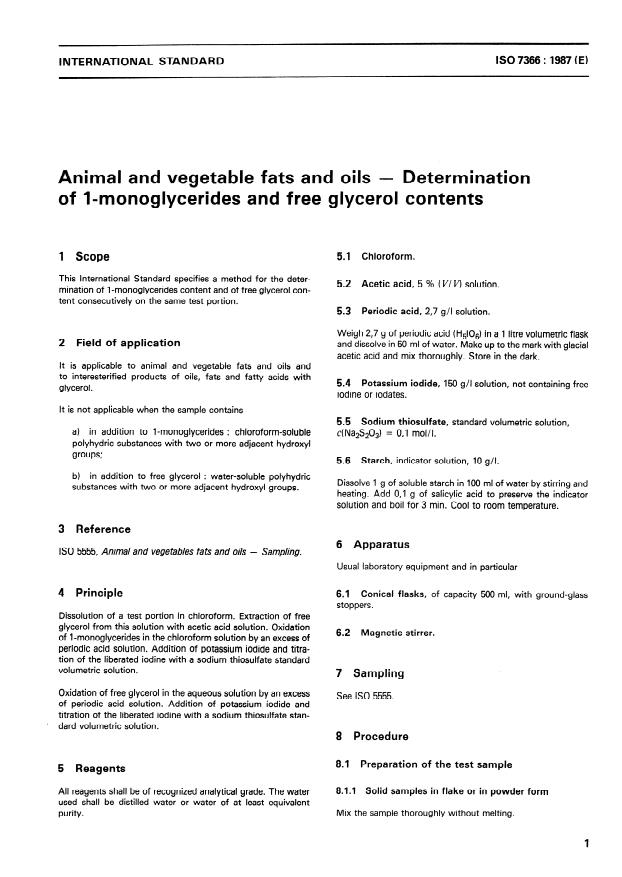
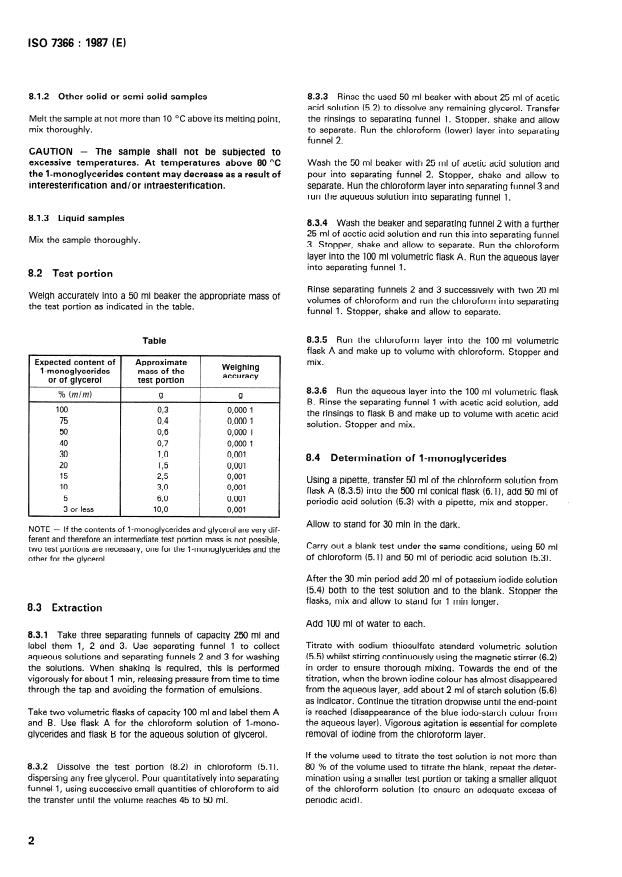
ISO 7366:1987 - Animal and vegetable fats and oils — Determination of 1-monoglycerides and free glycerol contents Released:5/21/1987
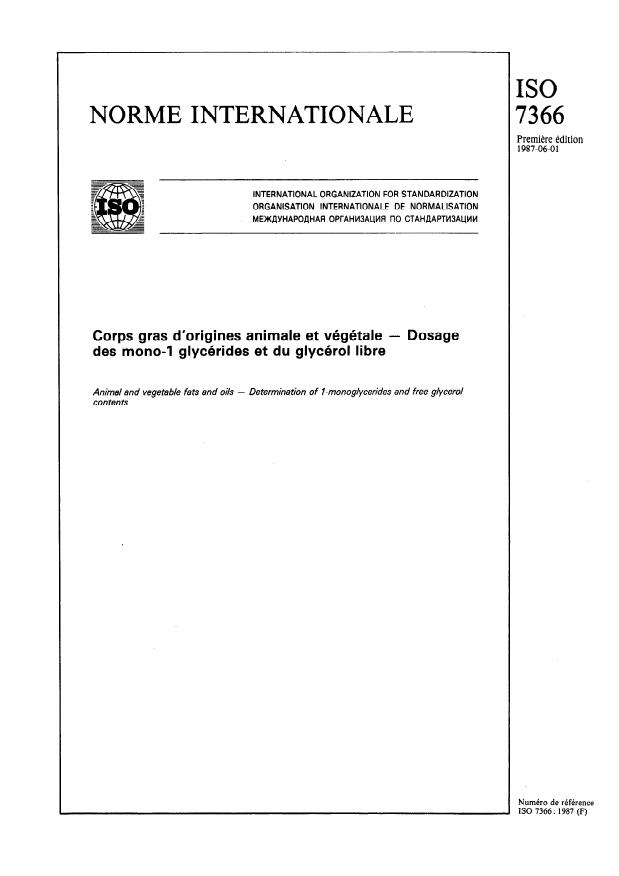
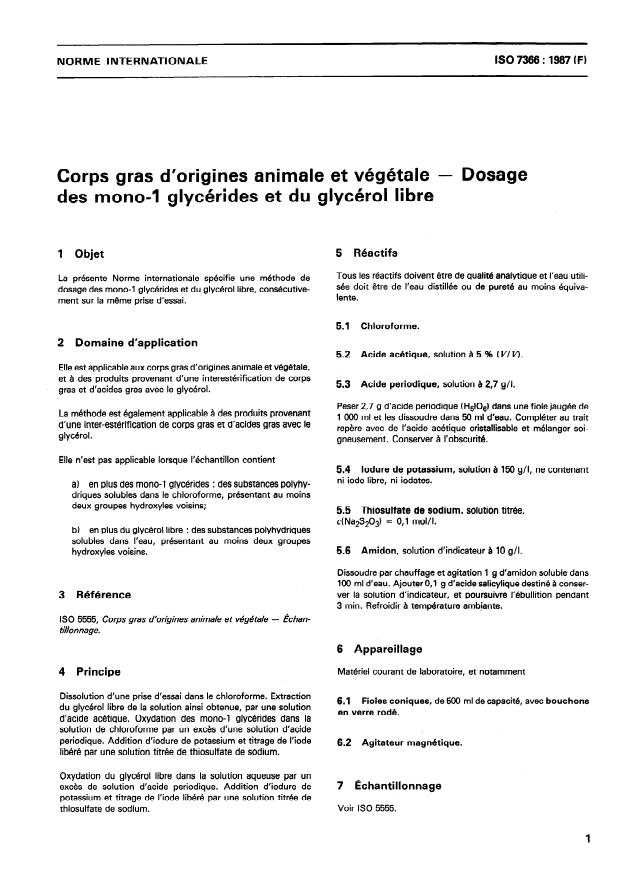
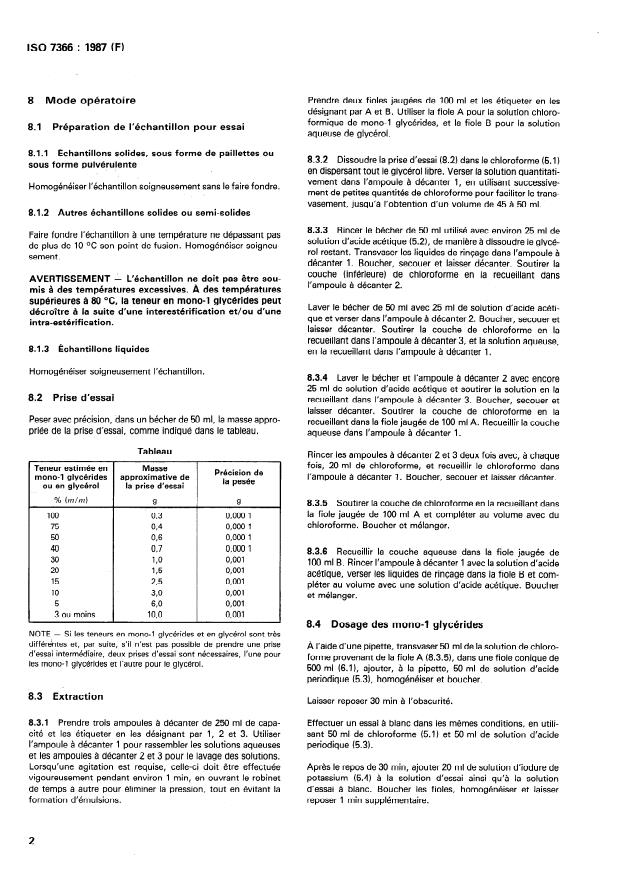
ISO 7366:1987 - Corps gras d'origines animale et végétale — Dosage des mono-1 glycérides et du glycérol libre Released:5/21/1987
ISO 7366:1987 - Corps gras d'origines animale et végétale — Dosage des mono-1 glycérides et du glycérol libre Released:5/21/1987
Overview - ISO 7366:1987 in brief
ISO 7366:1987 specifies a chemical titrimetric method for the determination of 1‑monoglycerides and free glycerol in animal and vegetable fats and oils. The standard covers samples including products from interesterification of fats and fatty acids with glycerol. The procedure separates the chloroform-soluble mono‑1‑glycerides from the aqueous phase containing free glycerol, oxidizes each fraction with periodic acid, and quantifies the liberated iodine by titration with sodium thiosulfate.
Key topics and technical requirements
- Scope: Applicable to animal and vegetable fats and oils and products from interesterification; not suitable if other polyhydric substances with adjacent hydroxyls are present in the same solvent phase.
- Analytical principle:
- Dissolve test portion in chloroform; extract free glycerol into aqueous acetic acid.
- Oxidize mono‑1‑glycerides in the chloroform phase with excess periodic acid; add potassium iodide (KI) and titrate liberated iodine with standard sodium thiosulfate.
- Oxidize glycerol in the aqueous phase similarly and titrate.
- Reagents (examples given in the standard):
- Chloroform; acetic acid 5% (w/v); periodic acid solution (2.7 g/L preparation described); KI solution (150 g/L, iodine/iodate‑free); sodium thiosulfate standard (c = 0.1 mol/L); starch indicator (10 g/L).
- Apparatus: Common laboratory glassware, separatory (decanter) funnels, 500 ml conical flasks, magnetic stirrer.
- Performance and reporting:
- Results expressed as mass percent with one decimal place.
- Repeatability limits indicated (e.g., mono‑1‑glycerides: difference between duplicate determinations not to exceed 0.5% (m/m) at 15–25% range; free glycerol: 0.1% (m/m)).
- Sampling: Reference to ISO 5555 for sample preparation and handling.
Practical applications and users
- Quality control laboratories in the edible fats and oils industry assessing mono‑glyceride and glycerol content.
- Food and agricultural product testing labs verifying compositional changes after processing or interesterification.
- Analytical chemists validating production batches where mono‑glyceride or glycerol levels affect product specifications.
- Regulatory and conformity testing where standardized, reproducible titrimetric methods are required.
Related standards
- ISO 5555 - Sampling of animal and vegetable fats and oils (referenced for sampling procedures).
- Other ISO methods for fat and oil analyses may be used in conjunction for broader compositional profiles.
Keywords: ISO 7366:1987, animal and vegetable fats and oils, determination of 1‑monoglycerides, free glycerol, periodic acid oxidation, titration, potassium iodide, sodium thiosulfate, chloroform extraction, food lab analysis.
Relations
- Effective Date
- 06-Jun-2022
Buy Documents
ISO 7366:1987 - Animal and vegetable fats and oils — Determination of 1-monoglycerides and free glycerol contents Released:5/21/1987
ISO 7366:1987 - Corps gras d'origines animale et végétale — Dosage des mono-1 glycérides et du glycérol libre Released:5/21/1987
ISO 7366:1987 - Corps gras d'origines animale et végétale — Dosage des mono-1 glycérides et du glycérol libre Released:5/21/1987
Get Certified
Connect with accredited certification bodies for this standard

BSI Group
BSI (British Standards Institution) is the business standards company that helps organizations make excellence a habit.

Bureau Veritas
Bureau Veritas is a world leader in laboratory testing, inspection and certification services.

DNV
DNV is an independent assurance and risk management provider.
Sponsored listings
Frequently Asked Questions
ISO 7366:1987 is a standard published by the International Organization for Standardization (ISO). Its full title is "Animal and vegetable fats and oils — Determination of 1-monoglycerides and free glycerol contents". This standard covers: The method consists in dissolving of a test portion in chloroform, extracting of free glycerol from this sulution with acetic acid solution, oxidizing of 1-monoglycerides in the chloroform solution by an excess of periodic acid solution, adding of potassium iodide and titration of the liberated iodine with a sodium thiosulfate standard volumetric solution. Oxidation of free glycerol in the aqueous solution by an excess of periodic acid solution, adding of potassium iodide titration of the liberated iodine with a sodium thiosulfate standard volumetric solution.
The method consists in dissolving of a test portion in chloroform, extracting of free glycerol from this sulution with acetic acid solution, oxidizing of 1-monoglycerides in the chloroform solution by an excess of periodic acid solution, adding of potassium iodide and titration of the liberated iodine with a sodium thiosulfate standard volumetric solution. Oxidation of free glycerol in the aqueous solution by an excess of periodic acid solution, adding of potassium iodide titration of the liberated iodine with a sodium thiosulfate standard volumetric solution.
ISO 7366:1987 is classified under the following ICS (International Classification for Standards) categories: 67.200.10 - Animal and vegetable fats and oils. The ICS classification helps identify the subject area and facilitates finding related standards.
ISO 7366:1987 has the following relationships with other standards: It is inter standard links to ISO 15005:2002. Understanding these relationships helps ensure you are using the most current and applicable version of the standard.
ISO 7366:1987 is available in PDF format for immediate download after purchase. The document can be added to your cart and obtained through the secure checkout process. Digital delivery ensures instant access to the complete standard document.
Standards Content (Sample)
ISO
INTERNATIONAL STANDARD
First- edition
1987-06-0 1
INTERNATIONAL ORGANIZATION FOR STANDARDIZATION
ORGANISATION INTERNATIONALE DE NORMALISATION
MEXflYHAPOflHAR OPI-AHVl3A~VlR fl0 CTAH~APTM3A~MM
Animal and vegetable fats and oils - Determination
of 1-monoglycerides and free glycerol contents
Corps gras d’origines animale et v&g&ale - Dosage des mono-1 glyckides et du g/yc&ol
libre
Reference number
ISO 7366 : 1987 (E)
Foreword
ISO (the International Organization for Standardization) is a worldwide federation of
national Standards bodies (ISO member bedies). The work of preparing International
Standards is normally carried out through ISO technical committees. Esch member
body interested in a subject for which a technical committee has been established has
the right to be represented on that committee. international organizations, govern-
mental and non-governmental, in liaison with ISO, also take part in the work.
Draft International Standards adopted by the technical committees are circulated to
the member bodies for approval before their acceptance as International Standards by
the ISO Council. They are approved in accordance with ISO procedures requiring at
least 75 % approval by the member bodies voting.
International Standard ISO 7366 was prepared by Technical Committee ISO/TC 34,
Agricultural food produc ts.
Users should note that all International Standards undergo revision from time to time
and that any reference made herein to any other International Standard implies its
latest edition, unless otherwise stated.
International Organkation for Standardkation, 1987
Printed in Switzerland
ISO 7366 : 1987 (EI
INTERNATIONAL STANDARD
Animal and vegetable fats and oils - Determination
of 1-monoglycerides and free glycerol contents
5.1 Chloroform.
1 Scope
This International Standard specifies a method for the deter-
5.2 Acetic acid, 5 % (Vl v) solution.
mination of l-monoglycerides content and of free glycerol con-
tent consecutively on the same test Portion.
5.3 Periodic acid, 2,7 g/l Solution.
Weigh 2,7 g of periodic acid (H,106) in a 1 litre volumetric flask
2 Field of application and dissolve in 50 ml of water. Make up to the mark with glacial
acetic acid and mix thoroughly. Store in the dark.
It is applicable to animal and vegetable fats and oils and
to interesterified products of oils, fats and fatty acids with
5.4 Potassium iodide, 150 g/l Solution, not containing free
glycerol.
iodine or iodates.
lt is not applicable when the Sample contains
5.5 Sodium thiosulfate, Standard volumetric Solution,
a) in addition to 1 -monoglycerides : chloroform-soluble
c( Na&031 = 0,l mol/l.
polyhydric substances with two or more adjacent hydroxyl
groups;
5.6 Starch, indicator solution, 10 g/l.
b) in addition to free glycerol : water-soluble polyhydric
Dissolve 1 g of soluble starch in 100 ml of water by stirring and
substances with two or more adjacent hydroxyl groups.
heating. Add 0,l g of salicylic acid to preserve the indicator
Solution and boil for 3 min. Cool to room temperature.
3 Reference
6 Apparatus
ISO 5555, Animal and vegetables fats and oifs - Sampling.
Usual laboratory equipment and in particular
6.1 Conical flasks, of capacity 500 ml, with ground-glass
4 Principle
Stoppers.
Dissolution of a test Portion in chloroform. Extraction of free
glycerol from this Solution with acetic acid Solution. Oxidation
6.2 Magnetit stirrer.
of 1-monoglycerides in the chloroform Solution by an excess of
periodic acid solution. Addition of potassium iodide and titra-
tion of the liberated iodine with a sodium thiosulfate Standard
volumetric solution.
7 Sampling
Oxidation of free glycerol in the aqueous Solution by an excess
See ISO 5555.
of periodic acid Solution. Addition of potassium iodide and
titration of the liberated iodine with a sodium thiosulfate stan-
’ dard volumetric Solution.
8 Procedure
8.1 Reparation of the test Sample
5 Reagents
8.1.1 Solid samples in flake or in powder form
All reagents shall be of recognized analytical grade. The water
used shall be distilled water or water of at least equivalent
Mix the Sample thoroughly without melting.
purity.
8.3.3 Rinse the used 50 ml beaker with about 25 ml of acetic
8.1.2 Other solid or semi-solid samples
acid Solution (5.2) to dissolve any remaining glycerol. Transfer
the rinsings to separating funnel 1. Stopper, Shake and allow
Melt the Sample at not more than IO OCa bove its melting Point,
to separate. Run the chloroform (lower) layer into separating
mix thoroughly.
funnel 2.
CAUTION - The Sample shall not be subjected to
excessive temperatures. At temperatures above 80 OC Wash the 50 ml beaker with 25 ml of acetic acid solution and
pour into separating funnel 2. Stopper, Shake and allow to
the 1-monoglycerides content may decrease as a result of
separate. Run the chloroform layer into separating funne13 and
interesterification and/or intraesterification.
run the aqueous Solution into separating funnel 1.
8.1.3 Liquid samples
8.3.4 Wash the beaker and separating funnel 2 with a further
25 ml of acetic acid Solution and run this into separating funnel
Mix the Sample thoroughly.
3. Stopper, Shake and allow to separate. Run the chloroform
layer into the 100 ml volumetric flask A. Run the aqueous layer
into separating funnel 1.
8.2 Test Portion
Rinse separating funnels 2 and 3 successively with two 20 ml
Weigh accurately into a 50 ml beaker the appropriate mass of
volumes of ch!oroform and run the chloroform into separating
the test Portion as indicated in the table.
funnel 1. Stopper, Shake and allow to separate.
8.3.5 Run the chloroform layer into the 100 ml volumetric
Table
flask A and make up to volume with chloroform. Stopper and
Expected content of Approximate mix.
Weighing
1-monoglycerides mass of the
accuracy
or of glycerol test Portion
8.3.6 Run the aqueous layer into the 100 ml volumetric flask
% (mlm)
g
B. Rinse the separating funnel 1 with acetic acid Solution, add
100 63 0,000 1
the rinsings to flask B and make up to volume with acetic acid
0,000 1
75 0,4
solution. Stopper and mix.
50 Ob3 0,000 1
40 0,7 0,000 1
0,001
30 14
8.4 Determination of l-monoglycerides
20 1,5 0,001
z5 0,001
Using a pipette, transfer 50 ml of the chloroform Solution from
IO 3,o 0,001
flask A (8.3.5) into the 500 ml conical flask (6.11, add 50 ml of
0,001
5 60
periodic acid Solution (5.3) with a pipette, mix and stopper. I
3 or less IO,0 0,001
Allow to stand
...
ISO
NORME INTERNATIONALE
Première édition
1987-06-O 1
INTERNATIONAL ORGANIZATION FOR STANDARDIZATION
ORGANISATION INTERNATIONALE DE NORMALISATION
MEXfiYHAPO~HAR OPrAHM3A~Mfl Il0 CTAH~APTM3A~Wl
Corps gras d’origines animale et végétale - Dosage
des mono-l glycérides et du glycérol libre
Animal and vegetable fats and oils - Determination of I-monoglycerides and free glycerol
contents
Numéro de référence
Avant-propos
L’ISO (Organisation internationale de normalisation) est une fédération mondiale
d’organismes nationaux de normalisation (comités membres de I’ISO). L’élaboration
des Normes internationales est normalement confiée aux comités techniques de I’ISO.
Chaque comité membre intéressé par une étude a le droit de faire partie du comité
technique créé à cet effet. Les organisations internationales, gouvernementales et non
gouvernementales, en liaison avec I’ISO participent également aux travaux.
Les projets de Normes internationales adoptés par les comités techniques sont soumis
aux comités membres pour approbation, avant leur acceptation comme Normes inter-
nationales par le Conseil de I’ISO. Les Normes internationales sont approuvées confor-
mément aux procédures de I’ISO qui requièrent l’approbation de 75 % au moins des
comités membres votants.
La Norme internationale ISO 7366 a été élaborée par le comité technique ISO/TC 34,
Produits agricoles alimentaires.
L’attention des utilisateurs est attirée sur le fait que toutes les Normes internationales
sont de temps en temps soumises à révision et que toute référence faite à une autre
Norme internationale dans le présent document implique qu’il s’agit, sauf indication
contraire, de la dernière édition.
0 Organisation internationale de normalisation, 1987
Imprimé en Suisse
ISO 7366 : 1987 (F)
NORME INTERNATIONALE
Corps gras d’origines animale et végétale - Dosage
des mono-l glycérides et du glycérol libre
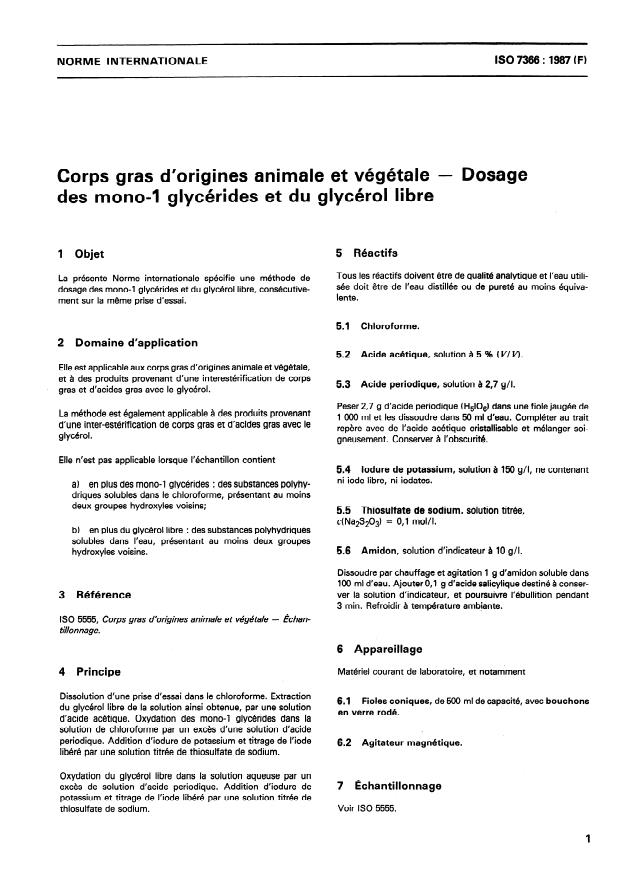
5 Réactifs
1 Objet
Tous les réactifs doivent être de qualité analytique et l’eau utili-
La présente Norme internationale spécifie une méthode de
sec doit être de l’eau distillée ou de pureté au moins équiva-
dosage des mono-l glycérides et du glycérol libre, consécutive-
lente.
ment sur la même prise d’essai.
5.1 Chloroforme.
2 Domaine d’application
5.2 Acide acdtique, solution à 5 % ( W y).
Elle est applicable aux corps gras d’origines animale et végétale,
et a des produits provenant d’une interestérification de corps
5.3 Acide periodique, solution à 2,7 g/l.
gras et d’acides gras avec le glycérol.
Peser 2,7 g d’acide periodique (H5)Oe) dans une fiole jaugee de
La méthode est également applicable à des produits provenant
1 000 ml et les dissoudre dans 50 ml d’eau. Compléter au trait
d’une inter-estérification de corps gras et d’acides gras avec le
repère avec de l’acide acétique cristallisable et mélanger soi-
glycérol.
gneusement. Conserver à I’obscuritk
Elle n’est pas applicable lorsque l’échantillon contient
5.4 Iodure de potassium, solution à 150 g/l, ne contenant
ni iode libre, ni iodates.
a) en plus des mono-l glycérides : des substances polyhy-
driques solubles dans le chloroforme, présentant au moins
deux groupes hydroxyles voisins;
5.5 Thiosulfate de sodium, solution titrde,
c( Na&031 = 0,l mol/l.
b) en plus du glycérol libre : des substances polyhydriques
solubles dans l’eau, présentant au moins deux groupes
5.6 Amidon, solution d’indicateur à 10 g/l.
hydroxyles voisins.
Dissoudre par chauffage et agitation 1 g d’amidon soluble dans
100 ml d’eau. Ajouter 0,l g d’acide salicylique destiné à conser-
ver la solution d’indicateur, et poursuivre l’ébullition pendant
Référence
3 min. Refroidir a température ambiante.
1.
ISO 5555, Corps gras d’origines animale et vt!g&ale - Échan-
tillonnage.
6 Appareillage
Matériel courant de laboratoire, et notamment
4 Principe
Dissolution d’une prise d’essai dans le chloroforme. Extraction
6.1 Fioles coniques, de 500 ml de capacité, avec bouchons
du glycérol libre de la solution ainsi obtenue, par une solution
en verre rodé.
d’acide acétique. Oxydation des mono-l glycérides dans la
solution de chloroforme par un excés d’une solution d’acide
periodique. Addition d’iodure de potassium et titrage de l’iode
6.2 Agitateur magnétique.
libéré par une solution titrée de thiosulfate de sodium.
Oxydation du glycérol libre dans la solution aqueuse par un
7 Échantillonnage
excès de solution d’acide periodique. Addition d’iodure de
potassium et titrage de l’iode libéré par une solution titrée de
Voir ISO 5555.
thiosulfate de sodium.
ISO 7366 : 1987 (FI
Prendre deux fioles jaugées de 100 ml et les étiqueter en les
8 Mode opératoire
désignant par A et B. Utiliser la fiole A pour la solution chloro-
formique de mono-l glycérides, et la fiole B pour la solution
8.1 Préparation de l’échantillon pour essai
aqueuse de glycérol.
8.1.1 Échantillons solides, sous forme de paillettes ou
8.3.2 Dissoudre la prise d’essai (8.2) dans le chloroforme (5.1)
sous forme pulvérulente
en dispersant tout le glycérol libre. Verser la solution quantitati-
vement dans l’ampoule à décanter 1, en utilisant successive-
Homogénéiser l’échantillon soigneusement sans le faire fondre.
ment de petites quantités de chloroforme pour faciliter le trans-
vasement, jusqu’à l’obtention d’un volume de 45 à 50 ml.
8.1.2 Autres échantillons solides ou semi-solides
8.3.3 Rincer le bécher de 50 ml utilisé avec environ 25 ml de
Faire fondre l’échantillon à une température ne dépassant pas
solution d’acide acétique (5.21, de manière à dissoudre le glycé-
de plus de 10 OC son point de fusion. Homogénéiser soigneu-
rol restant. Transvaser les liquides de rincage dans l’ampoule à
sement.
décanter 1. Boucher, secouer et laisser décanter. Soutirer la
couche (inférieure) de chloroforme en la recueillant dans
AVERTISSEMENT 1 L’échantillon ne doit pas être sou-
l’ampoule à décanter 2.
mis à des températures excessives. À des températures
supérieures à 80 OC, la teneur en mono-l glycérides peut
Laver le bécher de 50 ml avec 25 ml de solution d’acide acéti-
décroître à la suite d’une interestérification et/ou d’une
que et verser dans l’ampoule à décanter 2. Boucher, secouer et
intra-estérification.
laisser décanter. Soutirer la couche de chloroforme en la
recueillant dans l’ampoule à décanter 3, et la solution aqueuse,
8.1.3 Échantillons liquides
en la recueillant dans l’ampoule à décanter 1.
Homogénéiser soigneusement l’échantillon.
8.3.4 Laver le bécher et l’ampoule à décanter 2 avec encore
25 ml de solution d’acide acétique et soutirer la solution en la
8.2 Prise d’essai recueillant dans l’ampoule à décanter 3. Boucher, secouer et
laisser décanter. Soutirer la couche de chloroforme en la
Peser avec précision, dans un bécher de 50 ml, la masse appro-
recueillant dans la fiole jaugée de 100 ml A. Recueillir la couche
priée de la prise d’essai, comme indiqué dans le tableau.
aqueuse dans l’ampoule à décanter 1.
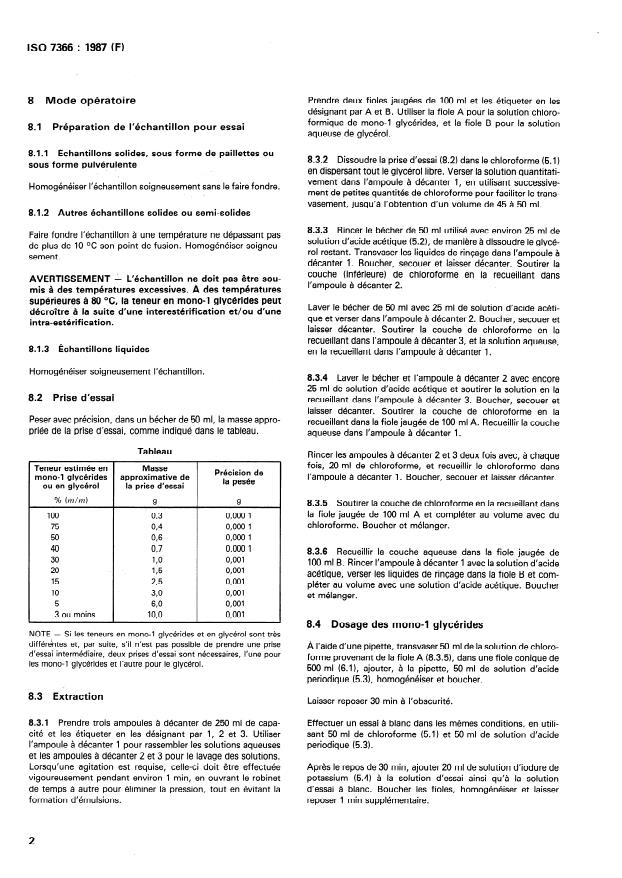
Tableau
Rincer les ampoules à décanter 2 et 3 deux fois avec, à chaque
fois, 20 ml de chloroforme, et recueillir le chloroforme dans
Teneur estimée en Masse
Précision de
l’ampoule à décanter 1. Boucher, secouer et laisser décanter.
mono-l giycérides approximative de
la pesée
ou en glycérol la prise d’essai
% bnlm) cl
g
8.3.5 Soutirer la couche de chloroforme en la recueillant dans
la fiole ja
...
ISO
NORME INTERNATIONALE
Première édition
1987-06-O 1
INTERNATIONAL ORGANIZATION FOR STANDARDIZATION
ORGANISATION INTERNATIONALE DE NORMALISATION
MEXfiYHAPO~HAR OPrAHM3A~Mfl Il0 CTAH~APTM3A~Wl
Corps gras d’origines animale et végétale - Dosage
des mono-l glycérides et du glycérol libre
Animal and vegetable fats and oils - Determination of I-monoglycerides and free glycerol
contents
Numéro de référence
Avant-propos
L’ISO (Organisation internationale de normalisation) est une fédération mondiale
d’organismes nationaux de normalisation (comités membres de I’ISO). L’élaboration
des Normes internationales est normalement confiée aux comités techniques de I’ISO.
Chaque comité membre intéressé par une étude a le droit de faire partie du comité
technique créé à cet effet. Les organisations internationales, gouvernementales et non
gouvernementales, en liaison avec I’ISO participent également aux travaux.
Les projets de Normes internationales adoptés par les comités techniques sont soumis
aux comités membres pour approbation, avant leur acceptation comme Normes inter-
nationales par le Conseil de I’ISO. Les Normes internationales sont approuvées confor-
mément aux procédures de I’ISO qui requièrent l’approbation de 75 % au moins des
comités membres votants.
La Norme internationale ISO 7366 a été élaborée par le comité technique ISO/TC 34,
Produits agricoles alimentaires.
L’attention des utilisateurs est attirée sur le fait que toutes les Normes internationales
sont de temps en temps soumises à révision et que toute référence faite à une autre
Norme internationale dans le présent document implique qu’il s’agit, sauf indication
contraire, de la dernière édition.
0 Organisation internationale de normalisation, 1987
Imprimé en Suisse
ISO 7366 : 1987 (F)
NORME INTERNATIONALE
Corps gras d’origines animale et végétale - Dosage
des mono-l glycérides et du glycérol libre
5 Réactifs
1 Objet
Tous les réactifs doivent être de qualité analytique et l’eau utili-
La présente Norme internationale spécifie une méthode de
sec doit être de l’eau distillée ou de pureté au moins équiva-
dosage des mono-l glycérides et du glycérol libre, consécutive-
lente.
ment sur la même prise d’essai.
5.1 Chloroforme.
2 Domaine d’application
5.2 Acide acdtique, solution à 5 % ( W y).
Elle est applicable aux corps gras d’origines animale et végétale,
et a des produits provenant d’une interestérification de corps
5.3 Acide periodique, solution à 2,7 g/l.
gras et d’acides gras avec le glycérol.
Peser 2,7 g d’acide periodique (H5)Oe) dans une fiole jaugee de
La méthode est également applicable à des produits provenant
1 000 ml et les dissoudre dans 50 ml d’eau. Compléter au trait
d’une inter-estérification de corps gras et d’acides gras avec le
repère avec de l’acide acétique cristallisable et mélanger soi-
glycérol.
gneusement. Conserver à I’obscuritk
Elle n’est pas applicable lorsque l’échantillon contient
5.4 Iodure de potassium, solution à 150 g/l, ne contenant
ni iode libre, ni iodates.
a) en plus des mono-l glycérides : des substances polyhy-
driques solubles dans le chloroforme, présentant au moins
deux groupes hydroxyles voisins;
5.5 Thiosulfate de sodium, solution titrde,
c( Na&031 = 0,l mol/l.
b) en plus du glycérol libre : des substances polyhydriques
solubles dans l’eau, présentant au moins deux groupes
5.6 Amidon, solution d’indicateur à 10 g/l.
hydroxyles voisins.
Dissoudre par chauffage et agitation 1 g d’amidon soluble dans
100 ml d’eau. Ajouter 0,l g d’acide salicylique destiné à conser-
ver la solution d’indicateur, et poursuivre l’ébullition pendant
Référence
3 min. Refroidir a température ambiante.
1.
ISO 5555, Corps gras d’origines animale et vt!g&ale - Échan-
tillonnage.
6 Appareillage
Matériel courant de laboratoire, et notamment
4 Principe
Dissolution d’une prise d’essai dans le chloroforme. Extraction
6.1 Fioles coniques, de 500 ml de capacité, avec bouchons
du glycérol libre de la solution ainsi obtenue, par une solution
en verre rodé.
d’acide acétique. Oxydation des mono-l glycérides dans la
solution de chloroforme par un excés d’une solution d’acide
periodique. Addition d’iodure de potassium et titrage de l’iode
6.2 Agitateur magnétique.
libéré par une solution titrée de thiosulfate de sodium.
Oxydation du glycérol libre dans la solution aqueuse par un
7 Échantillonnage
excès de solution d’acide periodique. Addition d’iodure de
potassium et titrage de l’iode libéré par une solution titrée de
Voir ISO 5555.
thiosulfate de sodium.
ISO 7366 : 1987 (FI
Prendre deux fioles jaugées de 100 ml et les étiqueter en les
8 Mode opératoire
désignant par A et B. Utiliser la fiole A pour la solution chloro-
formique de mono-l glycérides, et la fiole B pour la solution
8.1 Préparation de l’échantillon pour essai
aqueuse de glycérol.
8.1.1 Échantillons solides, sous forme de paillettes ou
8.3.2 Dissoudre la prise d’essai (8.2) dans le chloroforme (5.1)
sous forme pulvérulente
en dispersant tout le glycérol libre. Verser la solution quantitati-
vement dans l’ampoule à décanter 1, en utilisant successive-
Homogénéiser l’échantillon soigneusement sans le faire fondre.
ment de petites quantités de chloroforme pour faciliter le trans-
vasement, jusqu’à l’obtention d’un volume de 45 à 50 ml.
8.1.2 Autres échantillons solides ou semi-solides
8.3.3 Rincer le bécher de 50 ml utilisé avec environ 25 ml de
Faire fondre l’échantillon à une température ne dépassant pas
solution d’acide acétique (5.21, de manière à dissoudre le glycé-
de plus de 10 OC son point de fusion. Homogénéiser soigneu-
rol restant. Transvaser les liquides de rincage dans l’ampoule à
sement.
décanter 1. Boucher, secouer et laisser décanter. Soutirer la
couche (inférieure) de chloroforme en la recueillant dans
AVERTISSEMENT 1 L’échantillon ne doit pas être sou-
l’ampoule à décanter 2.
mis à des températures excessives. À des températures
supérieures à 80 OC, la teneur en mono-l glycérides peut
Laver le bécher de 50 ml avec 25 ml de solution d’acide acéti-
décroître à la suite d’une interestérification et/ou d’une
que et verser dans l’ampoule à décanter 2. Boucher, secouer et
intra-estérification.
laisser décanter. Soutirer la couche de chloroforme en la
recueillant dans l’ampoule à décanter 3, et la solution aqueuse,
8.1.3 Échantillons liquides
en la recueillant dans l’ampoule à décanter 1.
Homogénéiser soigneusement l’échantillon.
8.3.4 Laver le bécher et l’ampoule à décanter 2 avec encore
25 ml de solution d’acide acétique et soutirer la solution en la
8.2 Prise d’essai recueillant dans l’ampoule à décanter 3. Boucher, secouer et
laisser décanter. Soutirer la couche de chloroforme en la
Peser avec précision, dans un bécher de 50 ml, la masse appro-
recueillant dans la fiole jaugée de 100 ml A. Recueillir la couche
priée de la prise d’essai, comme indiqué dans le tableau.
aqueuse dans l’ampoule à décanter 1.
Tableau
Rincer les ampoules à décanter 2 et 3 deux fois avec, à chaque
fois, 20 ml de chloroforme, et recueillir le chloroforme dans
Teneur estimée en Masse
Précision de
l’ampoule à décanter 1. Boucher, secouer et laisser décanter.
mono-l giycérides approximative de
la pesée
ou en glycérol la prise d’essai
% bnlm) cl
g
8.3.5 Soutirer la couche de chloroforme en la recueillant dans
la fiole ja
...