

ISO 15774:2017
(Main)Animal and vegetable fats and oils — Determination of cadmium content by direct graphite furnace atomic absorption spectrometry
General Information
- Abstract
ISO 15774:2017 describes a method for the determination of trace amounts (micrograms per kilogram) of cadmium in all types of crude or refined edible oils and fats. Milk and milk products (or fat coming from milk and milk products) are excluded from the scope of this document.
- Status
- Published
- Publication Date
- 13-Feb-2017
- Technical Committee
- ISO/TC 34/SC 11 - Animal and vegetable fats and oils
- Drafting Committee
- ISO/TC 34/SC 11 - Animal and vegetable fats and oils
- Current Stage
- 9093 - International Standard confirmed
- Start Date
- 08-Nov-2022
- Completion Date
- 29-Aug-2026
Buy Documents

ISO 15774:2017 - Animal and vegetable fats and oils -- Determination of cadmium content by direct graphite furnace atomic absorption spectrometry
ISO 15774:2017 - Animal and vegetable fats and oils — Determination of cadmium content by direct graphite furnace atomic absorption spectrometry/14/2017

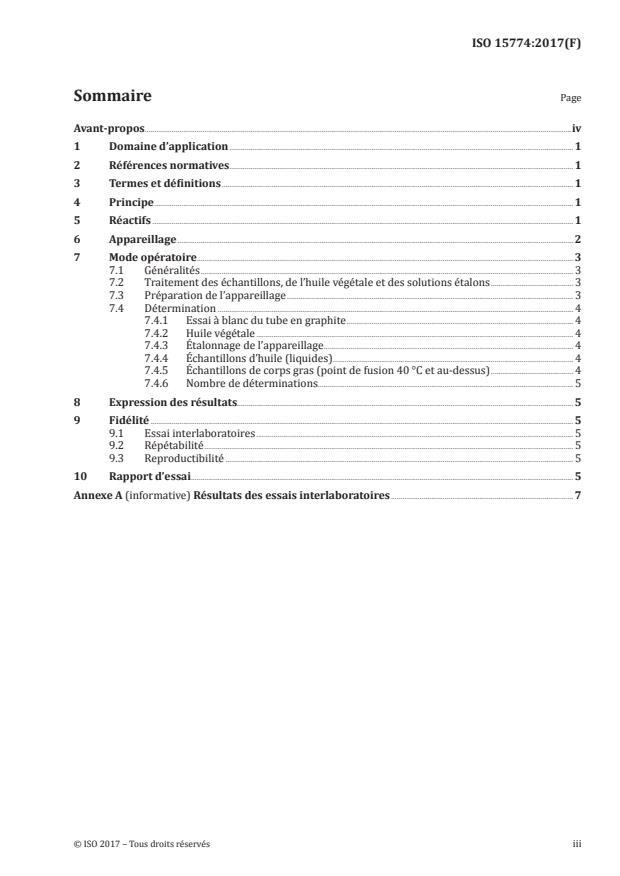
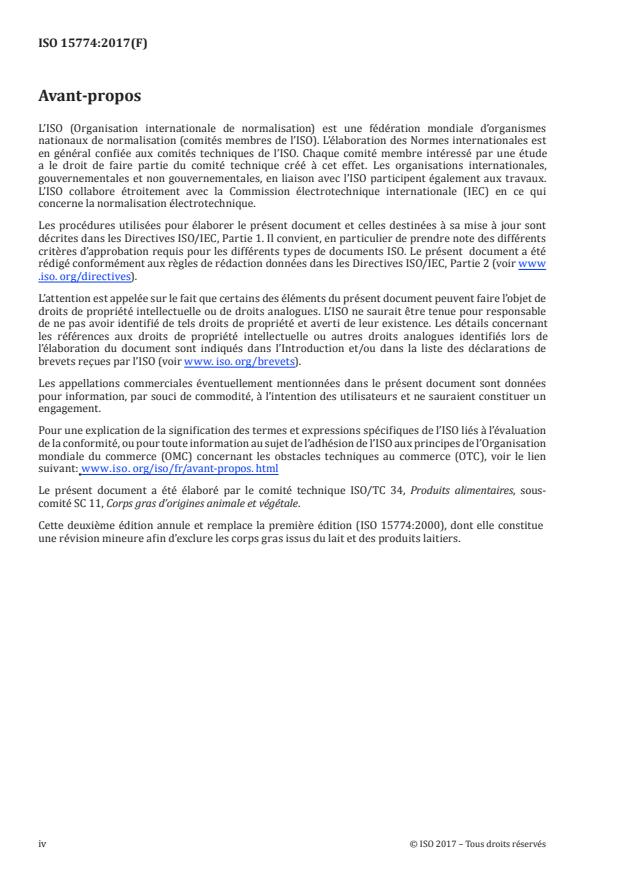
ISO 15774:2017 - Corps gras d'origines animale et végétale -- Détermination de la teneur en cadmium par spectrométrie d'absorption atomique a four graphite
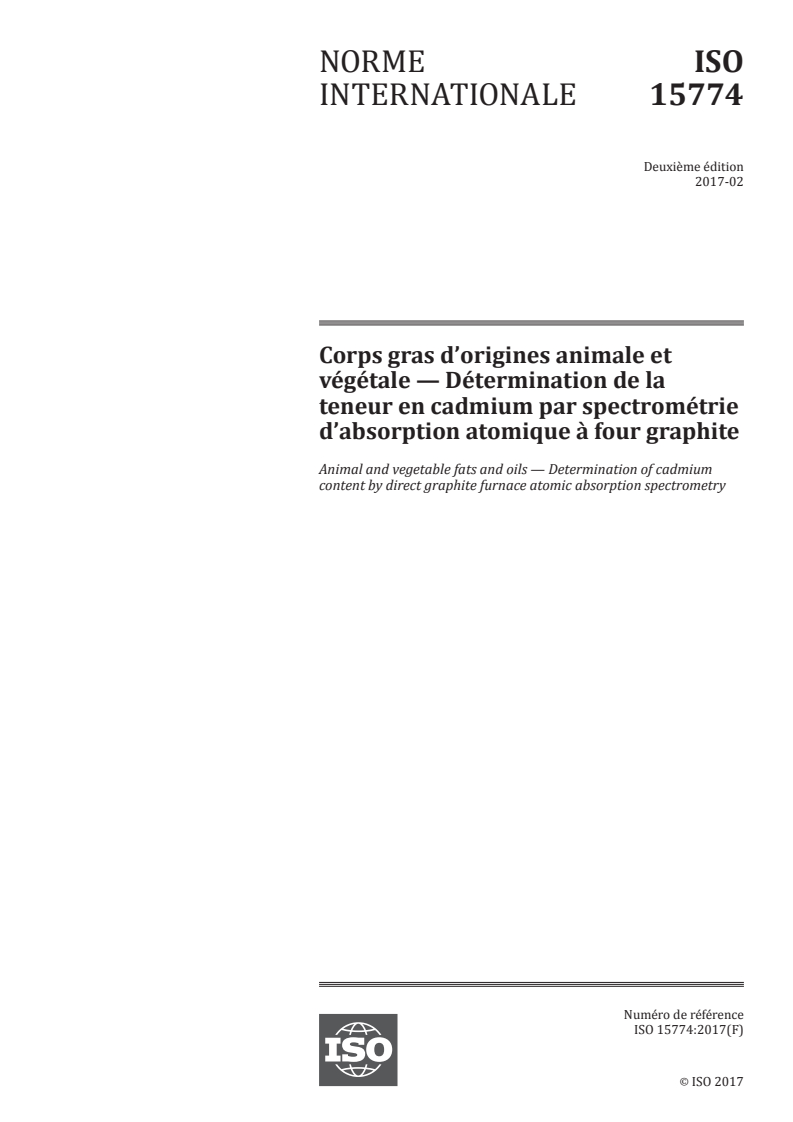
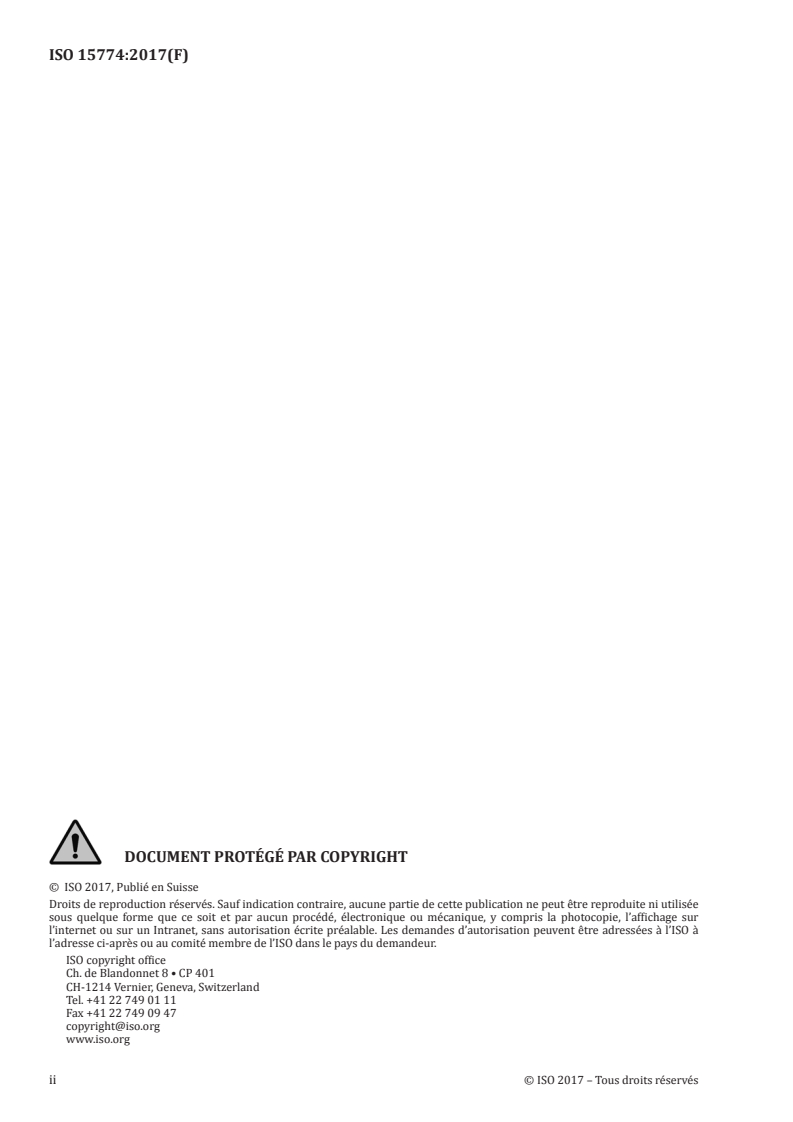
ISO 15774:2017 - Corps gras d'origines animale et végétale — Détermination de la teneur en cadmium par spectrométrie d'absorption atomique à four graphite/14/2017
Overview
ISO 15774:2017 specifies a laboratory method for the determination of trace amounts of cadmium (µg/kg level) in all types of crude or refined edible oils and fats using direct graphite furnace atomic absorption spectrometry (GFAAS). The standard covers sample treatment, apparatus, reagents, calibration and quality criteria for reporting results. Note: fat from milk and milk products is explicitly excluded from the scope.
Key Topics
- Scope and purpose: Quantitative determination of cadmium in edible oils/fats at microgram-per-kilogram concentrations.
- Analytical principle: Samples are incinerated and atomized in a graphite tube furnace; absorption is measured at 228.8 nm. Palladium is used as a matrix modifier to prevent Cd loss during thermal pretreatment.
- Reagents and standards:
- Type 1 laboratory water (ISO 3696)
- Cyclohexane and hydrochloric acid
- Palladium chloride; matrix modifier prepared as 0.1% (m/v) Pd solution
- Organometallic cadmium standard (example: Conostan) and prepared stock/working solutions (working levels 2.5, 5.0 and 10.0 µg/kg)
- Apparatus:
- Atomic absorption spectrometer with graphite furnace, platform (pyrolytic), uncoated graphite tubes, deuterium or Zeeman background correction, and optional autosampler with heated sample cups.
- Sample preparation & injection:
- Keep samples/standards at 60 °C prior to analysis.
- Autosampler with heating: inject 15 µl; without heating dilute 1:1 (mass/volume) with cyclohexane and inject 20 µl.
- Fat samples with melting point ≥40 °C: dilute 1:1 (mass) with blank oil and use an extra temperature program step.
- Typical injection volumes: 20 µl matrix modifier then 10 µl sample for manual pipetting.
- Calibration & quality: Calibrate using the three working standards; perform two determinations and report the mean. Precision data (repeatability and reproducibility limits) are given for specified concentration ranges.
Applications and Users
- Who uses it:
- Food and feed testing laboratories
- Regulatory and public health agencies monitoring heavy metals
- Quality control teams in edible oil and fat production and refining
- Contract analytical laboratories and accreditation bodies
- Practical uses:
- Routine monitoring for cadmium contamination in edible oils (raw and refined)
- Compliance testing against national/regional Cd limits
- Method transfer, validation and interlaboratory comparisons for oil matrices
Related Standards
- ISO 3696 - Water for analytical laboratory use (referenced for reagent water quality).
- Users should follow laboratory quality/validation practices and cite ISO 15774:2017 in test reports as required by the standard.
Keywords: ISO 15774:2017, cadmium determination, graphite furnace atomic absorption spectrometry, GFAAS, edible oils and fats, trace cadmium, food safety testing.
Relations
- Effective Date
- 12-Feb-2026
- Effective Date
- 06-Jun-2022
- Effective Date
- 07-May-2016
Buy Documents
ISO 15774:2017 - Animal and vegetable fats and oils -- Determination of cadmium content by direct graphite furnace atomic absorption spectrometry
ISO 15774:2017 - Animal and vegetable fats and oils — Determination of cadmium content by direct graphite furnace atomic absorption spectrometry/14/2017
ISO 15774:2017 - Corps gras d'origines animale et végétale -- Détermination de la teneur en cadmium par spectrométrie d'absorption atomique a four graphite
ISO 15774:2017 - Corps gras d'origines animale et végétale — Détermination de la teneur en cadmium par spectrométrie d'absorption atomique à four graphite/14/2017
Get Certified
Connect with accredited certification bodies for this standard

BSI Group
BSI (British Standards Institution) is the business standards company that helps organizations make excellence a habit.

Bureau Veritas
Bureau Veritas is a world leader in laboratory testing, inspection and certification services.

DNV
DNV is an independent assurance and risk management provider.
Sponsored listings
Frequently Asked Questions
ISO 15774:2017 is a standard published by the International Organization for Standardization (ISO). Its full title is "Animal and vegetable fats and oils — Determination of cadmium content by direct graphite furnace atomic absorption spectrometry". This standard covers: ISO 15774:2017 describes a method for the determination of trace amounts (micrograms per kilogram) of cadmium in all types of crude or refined edible oils and fats. Milk and milk products (or fat coming from milk and milk products) are excluded from the scope of this document.
ISO 15774:2017 describes a method for the determination of trace amounts (micrograms per kilogram) of cadmium in all types of crude or refined edible oils and fats. Milk and milk products (or fat coming from milk and milk products) are excluded from the scope of this document.
ISO 15774:2017 is classified under the following ICS (International Classification for Standards) categories: 67.200.10 - Animal and vegetable fats and oils. The ICS classification helps identify the subject area and facilitates finding related standards.
ISO 15774:2017 has the following relationships with other standards: It is inter standard links to EN ISO 15774:2017, ISO/TS 15638-9:2013, ISO 15774:2000. Understanding these relationships helps ensure you are using the most current and applicable version of the standard.
ISO 15774:2017 is available in PDF format for immediate download after purchase. The document can be added to your cart and obtained through the secure checkout process. Digital delivery ensures instant access to the complete standard document.
Standards Content (Sample)
INTERNATIONAL ISO
STANDARD 15774
Second edition
2017-02
Animal and vegetable fats and oils —
Determination of cadmium content
by direct graphite furnace atomic
absorption spectrometry
Corps gras d’origines animale et végétale — Détermination de la
teneur en cadmium par spectrométrie d’absorption atomique à four
graphite
Reference number
©
ISO 2017
© ISO 2017, Published in Switzerland
All rights reserved. Unless otherwise specified, no part of this publication may be reproduced or utilized otherwise in any form
or by any means, electronic or mechanical, including photocopying, or posting on the internet or an intranet, without prior
written permission. Permission can be requested from either ISO at the address below or ISO’s member body in the country of
the requester.
ISO copyright office
Ch. de Blandonnet 8 • CP 401
CH-1214 Vernier, Geneva, Switzerland
Tel. +41 22 749 01 11
Fax +41 22 749 09 47
copyright@iso.org
www.iso.org
ii © ISO 2017 – All rights reserved
Contents Page
Foreword .iv
1 Scope . 1
2 Normative references . 1
3 Terms and definitions . 1
4 Principle . 1
5 Reagents . 1
6 Apparatus . 2
7 Procedure. 3
7.1 General . 3
7.2 Treatment of samples, vegetable oil and standards . 3
7.3 Preparation of apparatus . 3
7.4 Determination . 4
7.4.1 Graphite tube blank . 4
7.4.2 Vegetable oil . 4
7.4.3 Calibration of apparatus . 4
7.4.4 Oil (liquid) samples . 4
7.4.5 Fat samples with melting point 40 °C and higher . 4
7.4.6 Number of determinations. 5
8 Expression of results . 5
9 Precision . 5
9.1 Interlaboratory test. 5
9.2 Repeatability . 5
9.3 Reproducibility . 5
10 Test report . 5
Annex A (informative) Results of interlaboratory test . 6
Foreword
ISO (the International Organization for Standardization) is a worldwide federation of national standards
bodies (ISO member bodies). The work of preparing International Standards is normally carried out
through ISO technical committees. Each member body interested in a subject for which a technical
committee has been established has the right to be represented on that committee. International
organizations, governmental and non-governmental, in liaison with ISO, also take part in the work.
ISO collaborates closely with the International Electrotechnical Commission (IEC) on all matters of
electrotechnical standardization.
The procedures used to develop this document and those intended for its further maintenance are
described in the ISO/IEC Directives, Part 1. In particular the different approval criteria needed for the
different types of ISO documents should be noted. This document was drafted in accordance with the
editorial rules of the ISO/IEC Directives, Part 2 (see www .iso .org/ directives).
Attention is drawn to the possibility that some of the elements of this document may be the subject of
patent rights. ISO shall not be held responsible for identifying any or all such patent rights. Details of
any patent rights identified during the development of the document will be in the Introduction and/or
on the ISO list of patent declarations received (see www .iso .org/ patents).
Any trade name used in this document is information given for the convenience of users and does not
constitute an endorsement.
For an explanation on the meaning of ISO specific terms and expressions related to conformity assessment,
as well as information about ISO’s adherence to the World Trade Organization (WTO) principles in the
Technical Barriers to Trade (TBT) see the following URL: www . i so .org/ iso/ foreword .html.
This document was prepared by Technical Committee ISO/TC 34, Food products, Subcommittee SC 11,
Animal and vegetable fats and oils.
This second edition cancels and replaces the first edition (ISO 15774:2000), which has been technically
revised to exclude its applicability for fat coming from milk and milk products.
iv © ISO 2017 – All rights reserved
INTERNATIONAL STANDARD ISO 15774:2017(E)
Animal and vegetable fats and oils — Determination
of cadmium content by direct graphite furnace atomic
absorption spectrometry
1 Scope
This document describes a method for the determination of trace amounts (micrograms per kilogram)
of cadmium in all types of crude or refined edible oils and fats.
Milk and milk products (or fat coming from milk and milk products) are excluded from the scope of this
document.
2 Normative references
The following documents are referred to in the text in such a way that some or all of their content
constitutes requirements of this document. For dated references, only the edition cited applies. For
undated references, the latest edition of the referenced document (including any amendments) applies.
ISO 3696, Water for analytical laboratory use — Specification and test methods
3 Terms and definitions
No terms and definitions are listed in this document.
ISO and IEC maintain terminological databases for use in standardization at the following addresses:
— IEC Electropedia: available at http:// www .electropedia .org/
— ISO Online browsing platform: available at http:// www .iso .org/ obp
4 Principle
The oil or fat is incinerated and atomized in a suitable graphite tube furnace with a platform connected
to an atomic absorption spectrometer, previously calibrated using standard solutions of an organo-
compound of cadmium. The metal content is determined from the observed absorption at a wavelength
of 228,8 nm. Palladium is added as a matrix modifier in order to prevent loss of cadmium during the
thermal pretreatment.
5 Reagents
Use only reagents of recognized analytical grade, unless otherwise specified.
5.1 Water, of grade 1 according to ISO 3696.
5.2 Cyclohexane.
5.3 Hydrochloric acid.
5.4 Palladium chloride.
5.
...
INTERNATIONAL ISO
STANDARD 15774
Second edition
2017-02
Animal and vegetable fats and oils —
Determination of cadmium content
by direct graphite furnace atomic
absorption spectrometry
Corps gras d’origines animale et végétale — Détermination de la
teneur en cadmium par spectrométrie d’absorption atomique à four
graphite
Reference number
©
ISO 2017
© ISO 2017, Published in Switzerland
All rights reserved. Unless otherwise specified, no part of this publication may be reproduced or utilized otherwise in any form
or by any means, electronic or mechanical, including photocopying, or posting on the internet or an intranet, without prior
written permission. Permission can be requested from either ISO at the address below or ISO’s member body in the country of
the requester.
ISO copyright office
Ch. de Blandonnet 8 • CP 401
CH-1214 Vernier, Geneva, Switzerland
Tel. +41 22 749 01 11
Fax +41 22 749 09 47
copyright@iso.org
www.iso.org
ii © ISO 2017 – All rights reserved
Contents Page
Foreword .iv
1 Scope . 1
2 Normative references . 1
3 Terms and definitions . 1
4 Principle . 1
5 Reagents . 1
6 Apparatus . 2
7 Procedure. 3
7.1 General . 3
7.2 Treatment of samples, vegetable oil and standards . 3
7.3 Preparation of apparatus . 3
7.4 Determination . 4
7.4.1 Graphite tube blank . 4
7.4.2 Vegetable oil . 4
7.4.3 Calibration of apparatus . 4
7.4.4 Oil (liquid) samples . 4
7.4.5 Fat samples with melting point 40 °C and higher . 4
7.4.6 Number of determinations. 5
8 Expression of results . 5
9 Precision . 5
9.1 Interlaboratory test. 5
9.2 Repeatability . 5
9.3 Reproducibility . 5
10 Test report . 5
Annex A (informative) Results of interlaboratory test . 6
Foreword
ISO (the International Organization for Standardization) is a worldwide federation of national standards
bodies (ISO member bodies). The work of preparing International Standards is normally carried out
through ISO technical committees. Each member body interested in a subject for which a technical
committee has been established has the right to be represented on that committee. International
organizations, governmental and non-governmental, in liaison with ISO, also take part in the work.
ISO collaborates closely with the International Electrotechnical Commission (IEC) on all matters of
electrotechnical standardization.
The procedures used to develop this document and those intended for its further maintenance are
described in the ISO/IEC Directives, Part 1. In particular the different approval criteria needed for the
different types of ISO documents should be noted. This document was drafted in accordance with the
editorial rules of the ISO/IEC Directives, Part 2 (see www .iso .org/ directives).
Attention is drawn to the possibility that some of the elements of this document may be the subject of
patent rights. ISO shall not be held responsible for identifying any or all such patent rights. Details of
any patent rights identified during the development of the document will be in the Introduction and/or
on the ISO list of patent declarations received (see www .iso .org/ patents).
Any trade name used in this document is information given for the convenience of users and does not
constitute an endorsement.
For an explanation on the meaning of ISO specific terms and expressions related to conformity assessment,
as well as information about ISO’s adherence to the World Trade Organization (WTO) principles in the
Technical Barriers to Trade (TBT) see the following URL: www . i so .org/ iso/ foreword .html.
This document was prepared by Technical Committee ISO/TC 34, Food products, Subcommittee SC 11,
Animal and vegetable fats and oils.
This second edition cancels and replaces the first edition (ISO 15774:2000), which has been technically
revised to exclude its applicability for fat coming from milk and milk products.
iv © ISO 2017 – All rights reserved
INTERNATIONAL STANDARD ISO 15774:2017(E)
Animal and vegetable fats and oils — Determination
of cadmium content by direct graphite furnace atomic
absorption spectrometry
1 Scope
This document describes a method for the determination of trace amounts (micrograms per kilogram)
of cadmium in all types of crude or refined edible oils and fats.
Milk and milk products (or fat coming from milk and milk products) are excluded from the scope of this
document.
2 Normative references
The following documents are referred to in the text in such a way that some or all of their content
constitutes requirements of this document. For dated references, only the edition cited applies. For
undated references, the latest edition of the referenced document (including any amendments) applies.
ISO 3696, Water for analytical laboratory use — Specification and test methods
3 Terms and definitions
No terms and definitions are listed in this document.
ISO and IEC maintain terminological databases for use in standardization at the following addresses:
— IEC Electropedia: available at http:// www .electropedia .org/
— ISO Online browsing platform: available at http:// www .iso .org/ obp
4 Principle
The oil or fat is incinerated and atomized in a suitable graphite tube furnace with a platform connected
to an atomic absorption spectrometer, previously calibrated using standard solutions of an organo-
compound of cadmium. The metal content is determined from the observed absorption at a wavelength
of 228,8 nm. Palladium is added as a matrix modifier in order to prevent loss of cadmium during the
thermal pretreatment.
5 Reagents
Use only reagents of recognized analytical grade, unless otherwise specified.
5.1 Water, of grade 1 according to ISO 3696.
5.2 Cyclohexane.
5.3 Hydrochloric acid.
5.4 Palladium chloride.
5.
...
NORME ISO
INTERNATIONALE 15774
Deuxième édition
2017-02
Corps gras d’origines animale et
végétale — Détermination de la
teneur en cadmium par spectrométrie
d’absorption atomique à four graphite
Animal and vegetable fats and oils — Determination of cadmium
content by direct graphite furnace atomic absorption spectrometry
Numéro de référence
©
ISO 2017
DOCUMENT PROTÉGÉ PAR COPYRIGHT
© ISO 2017, Publié en Suisse
Droits de reproduction réservés. Sauf indication contraire, aucune partie de cette publication ne peut être reproduite ni utilisée
sous quelque forme que ce soit et par aucun procédé, électronique ou mécanique, y compris la photocopie, l’affichage sur
l’internet ou sur un Intranet, sans autorisation écrite préalable. Les demandes d’autorisation peuvent être adressées à l’ISO à
l’adresse ci-après ou au comité membre de l’ISO dans le pays du demandeur.
ISO copyright office
Ch. de Blandonnet 8 • CP 401
CH-1214 Vernier, Geneva, Switzerland
Tel. +41 22 749 01 11
Fax +41 22 749 09 47
copyright@iso.org
www.iso.org
ii © ISO 2017 – Tous droits réservés
Sommaire Page
Avant-propos .iv
1 Domaine d’application . 1
2 Références normatives . 1
3 Termes et définitions . 1
4 Principe . 1
5 Réactifs . 1
6 Appareillage . 2
7 Mode opératoire. 3
7.1 Généralités . 3
7.2 Traitement des échantillons, de l’huile végétale et des solutions étalons . 3
7.3 Préparation de l’appareillage . 3
7.4 Détermination . 4
7.4.1 Essai à blanc du tube en graphite . 4
7.4.2 Huile végétale . 4
7.4.3 Étalonnage de l’appareillage. 4
7.4.4 Échantillons d’huile (liquides) . 4
7.4.5 Échantillons de corps gras (point de fusion 40 °C et au-dessus) . 4
7.4.6 Nombre de déterminations. 5
8 Expression des résultats. 5
9 Fidélité . 5
9.1 Essai interlaboratoires . 5
9.2 Répétabilité . 5
9.3 Reproductibilité . 5
10 Rapport d’essai . 5
Annexe A (informative) Résultats des essais interlaboratoires . 7
Avant-propos
L’ISO (Organisation internationale de normalisation) est une fédération mondiale d’organismes
nationaux de normalisation (comités membres de l’ISO). L’élaboration des Normes internationales est
en général confiée aux comités techniques de l’ISO. Chaque comité membre intéressé par une étude
a le droit de faire partie du comité technique créé à cet effet. Les organisations internationales,
gouvernementales et non gouvernementales, en liaison avec l’ISO participent également aux travaux.
L’ISO collabore étroitement avec la Commission électrotechnique internationale (IEC) en ce qui
concerne la normalisation électrotechnique.
Les procédures utilisées pour élaborer le présent document et celles destinées à sa mise à jour sont
décrites dans les Directives ISO/IEC, Partie 1. Il convient, en particulier de prendre note des différents
critères d’approbation requis pour les différents types de documents ISO. Le présent document a été
rédigé conformément aux règles de rédaction données dans les Directives ISO/IEC, Partie 2 (voir www
.iso. org/d irectives).
L’attention est appelée sur le fait que certains des éléments du présent document peuvent faire l’objet de
droits de propriété intellectuelle ou de droits analogues. L’ISO ne saurait être tenue pour responsable
de ne pas avoir identifié de tels droits de propriété et averti de leur existence. Les détails concernant
les références aux droits de propriété intellectuelle ou autres droits analogues identifiés lors de
l’élaboration du document sont indiqués dans l’Introduction et/ou dans la liste des déclarations de
brevets reçues par l’ISO (voir www. iso. org/br evets).
Les appellations commerciales éventuellement mentionnées dans le présent document sont données
pour information, par souci de commodité, à l’intention des utilisateurs et ne sauraient constituer un
engagement.
Pour une explication de la signification des termes et expressions spécifiques de l’ISO liés à l’évaluation
de la conformité, ou pour toute information au sujet de l’adhésion de l’ISO aux principes de l’Organisation
mondiale du commerce (OMC) concernant les obstacles techniques au commerce (OTC), voir le lien
suivant: ww w .iso. org/iso / fr/avant -propos . html
Le présent document a été élaboré par le comité technique ISO/TC 34, Produits alimentaires, sous-
comité SC 11, Corps gras d’origines animale et végétale.
Cette deuxième édition annule et remplace la première édition (ISO 15774:2000), dont elle constitue
une révision mineure afin d’exclure les corps gras issus du lait et des produits laitiers.
iv © ISO 2017 – Tous droits réservés
NORME INTERNATIONALE ISO 15774:2017(F)
Corps gras d’origines animale et végétale — Détermination
de la teneur en cadmium par spectrométrie d’absorption
atomique à four graphite
1 Domaine d’application
Le présent document décrit une méthode de détermination des traces de cadmium (microgrammes par
kilogramme) dans tous les types de corps gras alimentaires, qu’ils soient raffinés ou bruts.
Le lait et les produits laitiers (ou les corps gras issus du lait et des produits laitiers) sont exclus du
domaine d’application du présent document.
2 Références normatives
Les documents suivants cités dans le texte constituent, pour tout ou partie de leur contenu, des
exigences du présent document. Pour les références datées, seule l’édition citée s’applique. Pour les
références non datées, la dernière édition du document de référence s’applique (y compris les éventuels
amendements).
ISO 3696, Eau pour laboratoire à usage analytique — Spécification et méthodes d’essai
3 Termes et définitions
Aucun terme n’est défini dans le présent document.
L’ISO et l’IEC tiennent à jour des bases de données terminologiques destinées à être utilisées en
normalisation, consultables aux adresses suivantes:
— IEC Electropedia: disponible à l’adresse http:// www .electropedia .org/
— ISO Online browsing platform: disponible à l’adresse http:// www .iso .org/ obp
4 Principe
Pyrolyse puis atomisation d’un corps gras dans un four graphite muni d’une plate-forme et associé à
un spectrophotomètre d’absorption atomique préalablement étalonné à l’aide de solutions étalons d’un
composé organique de cadmium. Dosage du métal à partir de l’absorption observée à une longueur
d’onde de 228,8 nm. Utilisation de palladium comme modificateur de matrice pour éviter les pertes de
cadmium lors du traitement thermique préalable.
5 Réactifs
Sauf indication contraire, utiliser uniquement des réactifs de qualité analytique reconnue.
5.1 Eau, de qualité 1, conforme aux spécifications de l’ISO 3696.
5.2 Cyclohexane.
5.3 Acide chlorhydrique.
5.4 Chlorure de palladium.
5.5 Modificateur de matrice, solution de palladium à 0,1 % (masse par volume).
Dissoudre 0,167 g de chlorure de palladium (5.4) dans 50 ml d’eau (5.1) dans une fiole jaugée de 100 ml
(6.4) puis ajouter 1 ml d’acide chlorhydrique (5.3) et compléter au trait-repère avec de l’eau.
5.6 Huile végétale, raffinée.
N’importe quelle huile alimentaire liquide convient. La conserver dans un flacon en polyéthylène
exempt de métaux. La teneur en cadmium de l’huile ne doit pas être supérieure à 0,2 μg/kg.
1)
5.7 Étalon organométallique de cadmium (par exemple, Conostan, 5 000 mg/kg) .
5.8 Solution étalon mère, ayant une concentrat
...
NORME ISO
INTERNATIONALE 15774
Deuxième édition
2017-02
Corps gras d’origines animale et
végétale — Détermination de la
teneur en cadmium par spectrométrie
d’absorption atomique à four graphite
Animal and vegetable fats and oils — Determination of cadmium
content by direct graphite furnace atomic absorption spectrometry
Numéro de référence
©
ISO 2017
DOCUMENT PROTÉGÉ PAR COPYRIGHT
© ISO 2017, Publié en Suisse
Droits de reproduction réservés. Sauf indication contraire, aucune partie de cette publication ne peut être reproduite ni utilisée
sous quelque forme que ce soit et par aucun procédé, électronique ou mécanique, y compris la photocopie, l’affichage sur
l’internet ou sur un Intranet, sans autorisation écrite préalable. Les demandes d’autorisation peuvent être adressées à l’ISO à
l’adresse ci-après ou au comité membre de l’ISO dans le pays du demandeur.
ISO copyright office
Ch. de Blandonnet 8 • CP 401
CH-1214 Vernier, Geneva, Switzerland
Tel. +41 22 749 01 11
Fax +41 22 749 09 47
copyright@iso.org
www.iso.org
ii © ISO 2017 – Tous droits réservés
Sommaire Page
Avant-propos .iv
1 Domaine d’application . 1
2 Références normatives . 1
3 Termes et définitions . 1
4 Principe . 1
5 Réactifs . 1
6 Appareillage . 2
7 Mode opératoire. 3
7.1 Généralités . 3
7.2 Traitement des échantillons, de l’huile végétale et des solutions étalons . 3
7.3 Préparation de l’appareillage . 3
7.4 Détermination . 4
7.4.1 Essai à blanc du tube en graphite . 4
7.4.2 Huile végétale . 4
7.4.3 Étalonnage de l’appareillage. 4
7.4.4 Échantillons d’huile (liquides) . 4
7.4.5 Échantillons de corps gras (point de fusion 40 °C et au-dessus) . 4
7.4.6 Nombre de déterminations. 5
8 Expression des résultats. 5
9 Fidélité . 5
9.1 Essai interlaboratoires . 5
9.2 Répétabilité . 5
9.3 Reproductibilité . 5
10 Rapport d’essai . 5
Annexe A (informative) Résultats des essais interlaboratoires . 7
Avant-propos
L’ISO (Organisation internationale de normalisation) est une fédération mondiale d’organismes
nationaux de normalisation (comités membres de l’ISO). L’élaboration des Normes internationales est
en général confiée aux comités techniques de l’ISO. Chaque comité membre intéressé par une étude
a le droit de faire partie du comité technique créé à cet effet. Les organisations internationales,
gouvernementales et non gouvernementales, en liaison avec l’ISO participent également aux travaux.
L’ISO collabore étroitement avec la Commission électrotechnique internationale (IEC) en ce qui
concerne la normalisation électrotechnique.
Les procédures utilisées pour élaborer le présent document et celles destinées à sa mise à jour sont
décrites dans les Directives ISO/IEC, Partie 1. Il convient, en particulier de prendre note des différents
critères d’approbation requis pour les différents types de documents ISO. Le présent document a été
rédigé conformément aux règles de rédaction données dans les Directives ISO/IEC, Partie 2 (voir www
.iso. org/d irectives).
L’attention est appelée sur le fait que certains des éléments du présent document peuvent faire l’objet de
droits de propriété intellectuelle ou de droits analogues. L’ISO ne saurait être tenue pour responsable
de ne pas avoir identifié de tels droits de propriété et averti de leur existence. Les détails concernant
les références aux droits de propriété intellectuelle ou autres droits analogues identifiés lors de
l’élaboration du document sont indiqués dans l’Introduction et/ou dans la liste des déclarations de
brevets reçues par l’ISO (voir www. iso. org/br evets).
Les appellations commerciales éventuellement mentionnées dans le présent document sont données
pour information, par souci de commodité, à l’intention des utilisateurs et ne sauraient constituer un
engagement.
Pour une explication de la signification des termes et expressions spécifiques de l’ISO liés à l’évaluation
de la conformité, ou pour toute information au sujet de l’adhésion de l’ISO aux principes de l’Organisation
mondiale du commerce (OMC) concernant les obstacles techniques au commerce (OTC), voir le lien
suivant: ww w .iso. org/iso / fr/avant -propos . html
Le présent document a été élaboré par le comité technique ISO/TC 34, Produits alimentaires, sous-
comité SC 11, Corps gras d’origines animale et végétale.
Cette deuxième édition annule et remplace la première édition (ISO 15774:2000), dont elle constitue
une révision mineure afin d’exclure les corps gras issus du lait et des produits laitiers.
iv © ISO 2017 – Tous droits réservés
NORME INTERNATIONALE ISO 15774:2017(F)
Corps gras d’origines animale et végétale — Détermination
de la teneur en cadmium par spectrométrie d’absorption
atomique à four graphite
1 Domaine d’application
Le présent document décrit une méthode de détermination des traces de cadmium (microgrammes par
kilogramme) dans tous les types de corps gras alimentaires, qu’ils soient raffinés ou bruts.
Le lait et les produits laitiers (ou les corps gras issus du lait et des produits laitiers) sont exclus du
domaine d’application du présent document.
2 Références normatives
Les documents suivants cités dans le texte constituent, pour tout ou partie de leur contenu, des
exigences du présent document. Pour les références datées, seule l’édition citée s’applique. Pour les
références non datées, la dernière édition du document de référence s’applique (y compris les éventuels
amendements).
ISO 3696, Eau pour laboratoire à usage analytique — Spécification et méthodes d’essai
3 Termes et définitions
Aucun terme n’est défini dans le présent document.
L’ISO et l’IEC tiennent à jour des bases de données terminologiques destinées à être utilisées en
normalisation, consultables aux adresses suivantes:
— IEC Electropedia: disponible à l’adresse http:// www .electropedia .org/
— ISO Online browsing platform: disponible à l’adresse http:// www .iso .org/ obp
4 Principe
Pyrolyse puis atomisation d’un corps gras dans un four graphite muni d’une plate-forme et associé à
un spectrophotomètre d’absorption atomique préalablement étalonné à l’aide de solutions étalons d’un
composé organique de cadmium. Dosage du métal à partir de l’absorption observée à une longueur
d’onde de 228,8 nm. Utilisation de palladium comme modificateur de matrice pour éviter les pertes de
cadmium lors du traitement thermique préalable.
5 Réactifs
Sauf indication contraire, utiliser uniquement des réactifs de qualité analytique reconnue.
5.1 Eau, de qualité 1, conforme aux spécifications de l’ISO 3696.
5.2 Cyclohexane.
5.3 Acide chlorhydrique.
5.4 Chlorure de palladium.
5.5 Modificateur de matrice, solution de palladium à 0,1 % (masse par volume).
Dissoudre 0,167 g de chlorure de palladium (5.4) dans 50 ml d’eau (5.1) dans une fiole jaugée de 100 ml
(6.4) puis ajouter 1 ml d’acide chlorhydrique (5.3) et compléter au trait-repère avec de l’eau.
5.6 Huile végétale, raffinée.
N’importe quelle huile alimentaire liquide convient. La conserver dans un flacon en polyéthylène
exempt de métaux. La teneur en cadmium de l’huile ne doit pas être supérieure à 0,2 μg/kg.
1)
5.7 Étalon organométallique de cadmium (par exemple, Conostan, 5 000 mg/kg) .
5.8 Solution étalon mère, ayant une concentrat
...