

ISO 17978-3:2026
(Main)Road vehicles — Service-oriented vehicle diagnostics (SOVD) — Part 3: Application programming interface (API)
General Information
- Abstract
This document defines an application programming interface (API) which standardizes the methods for diagnosing HPCs and legacy ECUs, the retrieval of the diagnostic capabilities, and the discovery of the service-oriented vehicle diagnostics (SOVD) methods in an extended vehicle. The SOVD API provides a unified access to classic ECUs and HPCs. The SOVD API provides functions such as: access to the faults, including reading the fault entries, reading environment data, and deleting fault entries; measurements and identifications of all entities; execution of routines, input/output (I/O) controls and software functions in certain modes or states; configuration of a vehicle (e.g. equipment, country, customer demand, variant coding); encapsulation of the ExVe manufacturer specific software update strategy (including firmware over the air (FOTA) if available); access to logging information of an HPC. With these features, SOVD can cover all areas of the vehicle life cycle, including engineering (development), manufacturing (production), after sales (maintenance and repair), legal and technical inspections and vehicle operation (use). There are several aspects which are not covered by this document, as they are specific to the implementation of an SOVD server, for example: prevention and quick reaction to attack vectors like denial of service, zero-day exploits of vulnerabilities; recognition of security incidents; maintaining the operational safety based on data monitoring; management of security incidents; data privacy issues; load balancing of concurrent requests.
- Status
- Published
- Publication Date
- 16-Mar-2026
- Technical Committee
- ISO/TC 22 - Road vehicles
- Drafting Committee
- ISO/TC 22 - Road vehicles
- Current Stage
- 6060 - International Standard published
- Start Date
- 17-Mar-2026
- Due Date
- 17-Apr-2026
- Completion Date
- 17-Mar-2026
Overview
ISO 17978-3:2026 – Road vehicles – Service-oriented vehicle diagnostics (SOVD) – Part 3: Application programming interface (API) – establishes a standardized application programming interface (API) for vehicle diagnostics. Developed by ISO, this document provides a unified approach for accessing diagnostics, measurement, identification, configuration, routine executions, I/O controls, and software updates for both traditional ECUs and modern high-performance computers (HPCs) in extended vehicles.
By standardizing the SOVD API, the communication and diagnostic processes across the vehicle lifecycle are streamlined, enabling consistent and scalable integration for engineering, production, maintenance, legal and technical inspections, and vehicle operation.
Key Topics
- Unified API for Diagnostics: The SOVD API provides common methods to diagnose both legacy ECUs and advanced HPCs, minimizing integration effort across diverse vehicle architectures.
- Access to Faults and Data: Key features include reading and deleting fault entries, retrieving environmental data, and accessing measurements and identifications of vehicle entities.
- Routine Execution and I/O Control: Supports running diagnostic routines, controlling I/O, and software functions based on vehicle state or diagnostic modes.
- Vehicle Configuration Management: Enables configuration changes related to equipment, regional requirements, customer demands, and variant coding.
- Software Updates: Facilitates encapsulation of manufacturer-specific update strategies, including Firmware Over-the-Air (FOTA) updates if available.
- Logging and Monitoring: Provides standardized access to diagnostic logs and operational information from HPCs.
- Comprehensive Lifecycle Support: The SOVD API is applicable to all stages of the vehicle lifecycle, from development to aftersales support and legal inspections.
Applications
The ISO 17978-3 API is relevant for a range of stakeholders in the automotive sector, including:
- Vehicle OEMs and Suppliers: Enables seamless integration and interoperability between components from various suppliers, fostering a service-oriented vehicle architecture.
- Tool and Diagnostic System Vendors: Simplifies tool development for diagnostics, measurement, routine control, and software updates by using standardized APIs.
- Maintenance and Aftersales Providers: Facilitates advanced diagnostics and remote maintenance activities, supporting efficient repair workflows and minimizing vehicle downtime.
- Fleet Operators and Inspection Agencies: Standardized access to diagnostic information improves the efficiency of regulatory and technical inspections.
- Software Developers: Supports both cloud-based and on-premise applications for vehicle data analysis and remote diagnostics.
Related Standards
- ISO 17978-1: Road vehicles – Service-oriented vehicle diagnostics (SOVD) – Part 1: General information: Outlines the fundamental principles and framework of service-oriented diagnostics.
- ISO 17978-2: Road vehicles – Service-oriented vehicle diagnostics (SOVD) – Part 2: Communication protocols: Defines communication requirements supporting the SOVD API.
- ISO 22900 (MVCI): Modular vehicle communication interface standard: Details protocols and interface models for diagnostic communications.
- ISO 15765-4: Road vehicles – Diagnostics on CAN: Covers diagnostic communication over Controller Area Network, relevant to legacy E/E architectures.
Practical Value
Adopting ISO 17978-3:2026 brings several advantages:
- Interoperability: A unified API framework ensures compatibility across suppliers and future-proofs investments.
- Efficiency: Reduces development and integration time for new diagnostic tools and services.
- Scalability: Supports mixed architectures with both legacy ECUs and next-generation HPCs, facilitating a gradual transition to service-oriented vehicle diagnostics.
- Lifecycle Coverage: Streamlines processes from vehicle development to end-of-life management.
Organizations seeking to modernize and streamline their vehicle diagnostics infrastructure will find ISO 17978-3:2026 essential for leveraging the benefits of standardized APIs in a service-oriented, connected vehicle environment.
Get Certified
Connect with accredited certification bodies for this standard

TÜV Rheinland
TÜV Rheinland is a leading international provider of technical services.

TÜV SÜD
TÜV SÜD is a trusted partner of choice for safety, security and sustainability solutions.

DEKRA Certification Inc.
DEKRA US certification services.
Sponsored listings
Frequently Asked Questions
ISO 17978-3:2026 is a standard published by the International Organization for Standardization (ISO). Its full title is "Road vehicles — Service-oriented vehicle diagnostics (SOVD) — Part 3: Application programming interface (API)". This standard covers: This document defines an application programming interface (API) which standardizes the methods for diagnosing HPCs and legacy ECUs, the retrieval of the diagnostic capabilities, and the discovery of the service-oriented vehicle diagnostics (SOVD) methods in an extended vehicle. The SOVD API provides a unified access to classic ECUs and HPCs. The SOVD API provides functions such as: access to the faults, including reading the fault entries, reading environment data, and deleting fault entries; measurements and identifications of all entities; execution of routines, input/output (I/O) controls and software functions in certain modes or states; configuration of a vehicle (e.g. equipment, country, customer demand, variant coding); encapsulation of the ExVe manufacturer specific software update strategy (including firmware over the air (FOTA) if available); access to logging information of an HPC. With these features, SOVD can cover all areas of the vehicle life cycle, including engineering (development), manufacturing (production), after sales (maintenance and repair), legal and technical inspections and vehicle operation (use). There are several aspects which are not covered by this document, as they are specific to the implementation of an SOVD server, for example: prevention and quick reaction to attack vectors like denial of service, zero-day exploits of vulnerabilities; recognition of security incidents; maintaining the operational safety based on data monitoring; management of security incidents; data privacy issues; load balancing of concurrent requests.
This document defines an application programming interface (API) which standardizes the methods for diagnosing HPCs and legacy ECUs, the retrieval of the diagnostic capabilities, and the discovery of the service-oriented vehicle diagnostics (SOVD) methods in an extended vehicle. The SOVD API provides a unified access to classic ECUs and HPCs. The SOVD API provides functions such as: access to the faults, including reading the fault entries, reading environment data, and deleting fault entries; measurements and identifications of all entities; execution of routines, input/output (I/O) controls and software functions in certain modes or states; configuration of a vehicle (e.g. equipment, country, customer demand, variant coding); encapsulation of the ExVe manufacturer specific software update strategy (including firmware over the air (FOTA) if available); access to logging information of an HPC. With these features, SOVD can cover all areas of the vehicle life cycle, including engineering (development), manufacturing (production), after sales (maintenance and repair), legal and technical inspections and vehicle operation (use). There are several aspects which are not covered by this document, as they are specific to the implementation of an SOVD server, for example: prevention and quick reaction to attack vectors like denial of service, zero-day exploits of vulnerabilities; recognition of security incidents; maintaining the operational safety based on data monitoring; management of security incidents; data privacy issues; load balancing of concurrent requests.
ISO 17978-3:2026 is classified under the following ICS (International Classification for Standards) categories: 43.040.15 - Car informatics. On board computer systems. The ICS classification helps identify the subject area and facilitates finding related standards.
ISO 17978-3:2026 is available in PDF format for immediate download after purchase. The document can be added to your cart and obtained through the secure checkout process. Digital delivery ensures instant access to the complete standard document.
Standards Content (Sample)
International
Standard
ISO 17978-3
First edition
Road vehicles — Service-oriented
2026-03
vehicle diagnostics (SOVD) —
Part 3:
Application programming interface
(API)
Véhicules routiers — Diagnostic Véhicule Orienté Services
(SOVD) —
Partie 3: Interface de Programmation D’applications (API)
Reference number
© ISO 2026
All rights reserved. Unless otherwise specified, or required in the context of its implementation, no part of this publication may
be reproduced or utilized otherwise in any form or by any means, electronic or mechanical, including photocopying, or posting on
the internet or an intranet, without prior written permission. Permission can be requested from either ISO at the address below
or ISO’s member body in the country of the requester.
ISO copyright office
CP 401 • Ch. de Blandonnet 8
CH-1214 Vernier, Geneva
Phone: +41 22 749 01 11
Email: copyright@iso.org
Website: www.iso.org
Published in Switzerland
ii
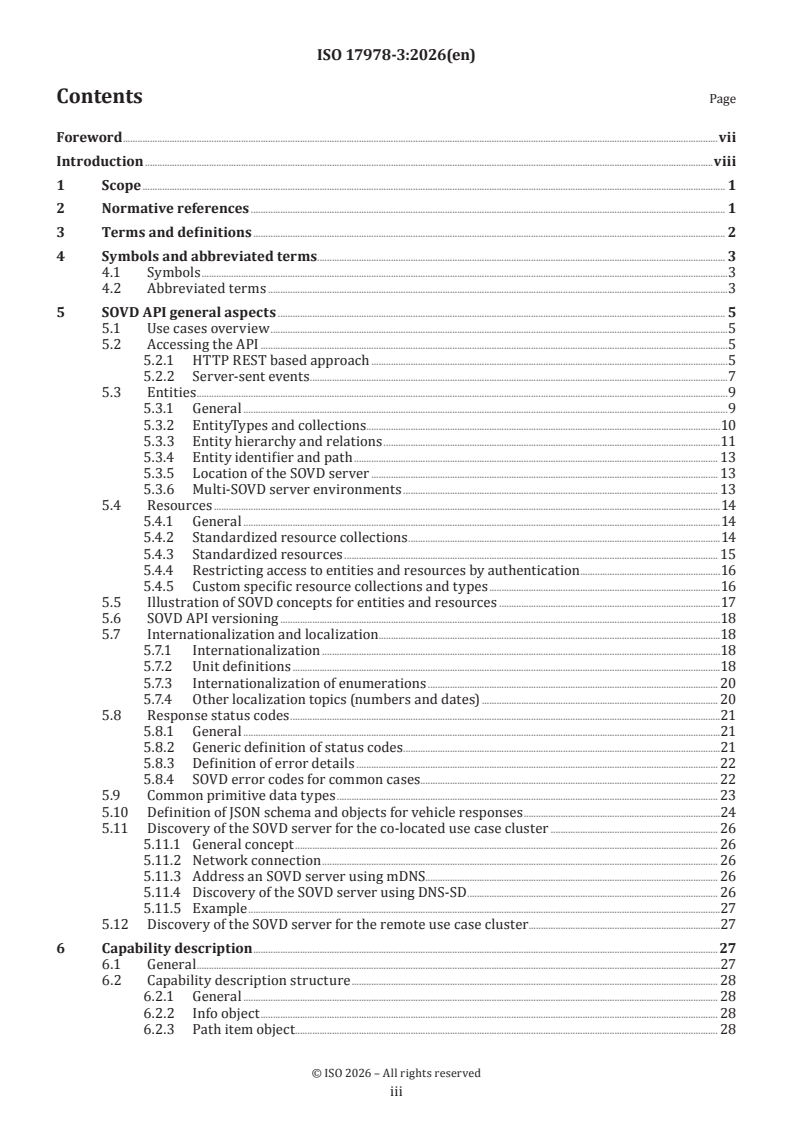
Contents Page
Foreword .vii
Introduction .viii
1 Scope . 1
2 Normative references . 1
3 Terms and definitions . 2
4 Symbols and abbreviated terms. 3
4.1 Symbols .3
4.2 Abbreviated terms .3
5 SOVD API general aspects . 5
5.1 Use cases overview .5
5.2 Accessing the API .5
5.2.1 HTTP REST based approach .5
5.2.2 Server-sent events .7
5.3 Entities .9
5.3.1 General .9
5.3.2 EntityTypes and collections.10
5.3.3 Entity hierarchy and relations .11
5.3.4 Entity identifier and path . 13
5.3.5 Location of the SOVD server . 13
5.3.6 Multi-SOVD server environments . 13
5.4 Resources .14
5.4.1 General .14
5.4.2 Standardized resource collections .14
5.4.3 Standardized resources . 15
5.4.4 Restricting access to entities and resources by authentication .16
5.4.5 Custom specific resource collections and types .16
5.5 Illustration of SOVD concepts for entities and resources .17
5.6 SOVD API versioning .18
5.7 Internationalization and localization .18
5.7.1 Internationalization .18
5.7.2 Unit definitions .18
5.7.3 Internationalization of enumerations . 20
5.7.4 Other localization topics (numbers and dates) . 20
5.8 Response status codes .21
5.8.1 General .21
5.8.2 Generic definition of status codes .21
5.8.3 Definition of error details . 22
5.8.4 SOVD error codes for common cases. 22
5.9 Common primitive data types . 23
5.10 Definition of JSON schema and objects for vehicle responses .24
5.11 Discovery of the SOVD server for the co-located use case cluster . 26
5.11.1 General concept . 26
5.11.2 Network connection . 26
5.11.3 Address an SOVD server using mDNS. 26
5.11.4 Discovery of the SOVD server using DNS-SD . 26
5.11.5 Example .27
5.12 Discovery of the SOVD server for the remote use case cluster .27
6 Capability description .27
6.1 General .27
6.2 Capability description structure . 28
6.2.1 General . 28
6.2.2 Info object . 28
6.2.3 Path item object . . 28
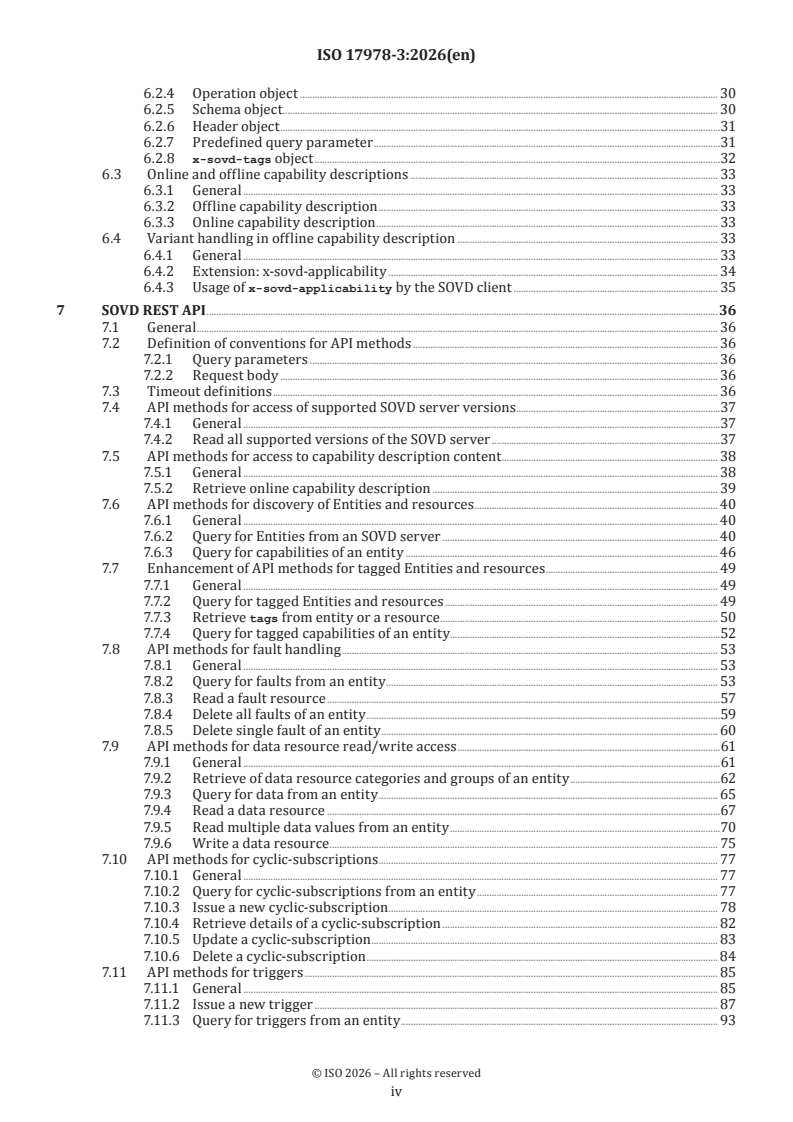
iii
6.2.4 Operation object . 30
6.2.5 Schema object . . . 30
6.2.6 Header object .31
6.2.7 Predefined query parameter .31
6.2.8 x-sovd-tags object .32
6.3 Online and offline capability descriptions . 33
6.3.1 General . 33
6.3.2 Offline capability description . 33
6.3.3 Online capability description . 33
6.4 Variant handling in offline capability description . 33
6.4.1 General . 33
6.4.2 Extension: x-sovd-applicability . 34
6.4.3 Usage of x-sovd-applicability by the SOVD client . 35
7 SOVD REST API .36
7.1 General . 36
7.2 Definition of conventions for API methods . 36
7.2.1 Query parameters . 36
7.2.2 Request body . 36
7.3 Timeout definitions . 36
7.4 API methods for access of supported SOVD server versions .37
7.4.1 General .37
7.4.2 Read all supported versions of the SOVD server .37
7.5 API methods for access to capability description content . 38
7.5.1 General . 38
7.5.2 Retrieve online capability description . 39
7.6 API methods for discovery of Entities and resources . 40
7.6.1 General . 40
7.6.2 Query for Entities from an SOVD server . 40
7.6.3 Query for capabilities of an entity . 46
7.7 Enhancement of API methods for tagged Entities and resources . 49
7.7.1 General . 49
7.7.2 Query for tagged Entities and resources . 49
7.7.3 Retrieve tags from entity or a resource . 50
7.7.4 Query for tagged capabilities of an entity.52
7.8 API methods for fault handling . 53
7.8.1 General . 53
7.8.2 Query for faults from an entity . 53
7.8.3 Read a fault resource .57
7.8.4 Delete all faults of an entity .59
7.8.5 Delete single fault of an entity . 60
7.9 API methods for data resource read/write access .61
7.9.1 General .61
7.9.2 Retrieve of data resource categories and groups of an entity .62
7.9.3 Query for data from an entity . 65
7.9.4 Read a data resource .67
7.9.5 Read multiple data values from an entity .70
7.9.6 Write a data resource . 75
7.10 API methods for cyclic-subscriptions . 77
7.10.1 General . 77
7.10.2 Query for cyclic-subscriptions from an entity . 77
7.10.3 Issue a new cyclic-subscription . 78
7.10.4 Retrieve details of a cyclic-subscription . 82
7.10.5 Update a cyclic-subscription . 83
7.10.6 Delete a cyclic-subscription . 84
7.11 API methods for triggers . 85
7.11.1 General . 85
7.11.2 Issue a new trigger . 87
7.11.3 Query for triggers from an entity . 93
iv
7.11.4 Retrieve details of a trigger . 95
7.11.5 Update a trigger . 96
7.11.6 Delete a trigger . 98
7.11.7 Trigger value reception . 99
7.12 API methods for configuration . . 100
7.12.1 General . 100
7.12.2 Query for configurations from an entity . 100
7.12.3 Read a configuration resource . 102
7.12.4 Write a configuration resource . 105
7.12.5 Reset configuration . . . 108
7.13 API methods for clearing data .110
7.13.1 General .110
7.13.2 Retrieve list of supported clear-data types . 111
7.13.3 Start clearing of data . 112
7.13.4 Retrieve status of clearing data .114
7.14 API methods for control of operations .116
7.14.1 General .116
7.14.2 Ensuring co-located diagnostics .116
7.14.3 Query for operations from an entity.116
7.14.4 Query for executions of an operation . 118
7.14.5 Retrieve details of an operation .119
7.14.6 Start execution of an operation . 122
7.14.7 Read the status of an operation execution . 125
7.14.8 Terminate the execution of an operation . 126
7.14.9 Support for execute / freeze / reset and custom capabilities . 127
7.15 API methods for script execution.129
7.15.1 General .129
7.15.2 Upload a script . 130
7.15.3 Query for scripts from an entity. 132
7.15.4 Retrieve details of a script . 133
7.15.5 Remove a script . 135
7.15.6 Start execution of a script . 136
7.15.7 Query for executions of a Script . 139
7.15.8 Read the status of a script execution . 140
7.15.9 Terminate the script execution .141
7.15.10 Remove the execution of a script .143
7.16 API methods for support of target modes . 144
7.16.1 General . 144
7.16.2 Query for modes of an entity . 144
7.16.3 Retrieve details of a mode. 146
7.16.4 Explicit control of entity states via their defined modes .147
7.16.5 Hint-based control of entity states via their defined modes . 149
7.17 API methods for locking . 149
7.17.1 General . 149
7.17.2 Acquire a lock on an entity . 152
7.17.3 Query for locks of an entity . .154
7.17.4 Retrieve details of a lock . 155
7.17.5 Modify the expiration time of a lock on an entity . 156
7.17.6 Release an acquired lock on an entity . 158
7.18 API methods for software update . 159
7.18.1 General . 159
7.18.2 Query for updates from an entity .161
7.18.3 Retrieve details of an update . 163
7.18.4 Automated installation of an update . 165
7.18.5 Prepare installation of an update. 166
7.18.6 Execute installation of an update . 168
7.18.7 Read the status of an update .170
7.18.8 Delete update package from an SOVD server . 172
7.18.9 Register an update at the SOVD server . 173
v
7.19 API methods for restarting an entity .174
7.19.1 General .174
7.19.2 Read the status of an entity . 175
7.19.3 Start an entity .176
7.19.4 Restart an entity . 178
7.19.5 Forced Restart an entity . 179
7.19.6 Shutdown an entity . 180
7.19.7 Forced Shutdown an entity . 181
7.20 API methods for handling of bulk-data . 183
7.20.1 General . 183
7.20.2 Retrieve bulk-data categories of an entity .184
7.20.3 Retrieve details of bulk-data resource . 186
7.20.4 Download and upload bulk-data . 188
7.20.5 Delete bulk-data . 192
7.21 API methods for logging . 194
7.21.1 General . 194
7.21.2 Retrieve resources of an SOVD log . 195
7.21.3 Read log entries from an SOVD log . 196
7.21.4 Configure SOVD log . 199
7.21.5 Retrieve the current SOVD log configuration from an entity .200
7.21.6 Reset SOVD logging configuration to default . 202
7.22 API methods for communication-logs . 203
7.22.1 General . 203
7.22.2 Query for communication-logs from an entity . 203
7.22.3 Configure communication-logs for an entity .204
7.22.4 Read the status of a communication-log . 206
7.22.5 Control a communication-log . 207
7.22.6 Delete communication-log .208
7.23 Authentication of SOVD clients (informative) .210
7.23.1 Online and offline authentication and authorization .210
7.23.2 Securing connectionc . 215
7.23.3 Verifying SOVD client credentials and requesting a token at the backend . 215
7.23.4 Verifying SOVD client credentials . 215
7.23.5 Requesting a token . 216
7.23.6 Request header for access-restricted resources .217
7.23.7 Validating a token . 218
8 Classic diagnostic adapter .218
8.1 General . 218
8.2 Access to UDS based entities . 218
8.3 Specific mapping of UDS services to SOVD modes.219
8.3.1 Mapping of DiagnosticSessionControl (10 ) subfunctions to SOVD modes .219
8.3.2 Mapping of SecurityAccess (27 ) subfunctions to SOVD modes . 220
8.3.3 Mapping of Authentication (29 ) to SOVD modes . 220
8.3.4 Mapping of CommunicationControl (28 ) subfunctions to SOVD modes . 220
8.3.5 Mapping of ControlDTC Setting (85 ) subfunctions to SOVD modes . 220
8.4 Mapping of UDS services to data resources . 220
8.5 Mapping of UDS services to fault resources . 221
8.6 Mapping of UDS services to operation resources . 221
8.6.1 Mapping of Routine (31 ) and InputOutputControlByIdentifier (2F ) services
16 16
to operation resources . 221
8.6.2 DEPRECATED — Mapping of EcuReset service (11 ) to operation resources . 221
8.7 Mapping of EcuReset service (11 ) to restart an entity resource . 221
Annex A (normative) Access to legally required diagnostics .222
Annex B (informative) SOVD API common example .225
Bibliography .235
vi
Foreword
ISO (the International Organization for Standardization) is a worldwide federation of national standards
bodies (ISO member bodies). The work of preparing International Standards is normally carried out through
ISO technical committees. Each member body interested in a subject for which a technical committee
has been established has the right to be represented on that committee. International organizations,
governmental and non-governmental, in liaison with ISO, also take part in the work. ISO collaborates closely
with the International Electrotechnical Commission (IEC) on all matters of electrotechnical standardization.
The procedures used to develop this document and those intended for its further maintenance are described
in the ISO/IEC Directives, Part 1. In particular, the different approval criteria needed for the different types
of ISO document should be noted. This document was drafted in accordance with the editorial rules of the
ISO/IEC Directives, Part 2 (see www.iso.org/directives).
ISO draws attention to the possibility that the implementation of this document may involve the use of (a)
patent(s). ISO takes no position concerning the evidence, validity or applicability of any claimed patent
rights in respect thereof. As of the date of publication of this document, ISO had not received notice of (a)
patent(s) which may be required to implement this document. However, implementers are cautioned that
this may not represent the latest information, which may be obtained from the patent database available at
www.iso.org/patents. ISO shall not be held responsible for identifying any or all such patent rights.
Any trade name used in this document is information given for the convenience of users and does not
constitute an endorsement.
For an explanation of the voluntary nature of standards, the meaning of ISO specific terms and expressions
related to conformity assessment, as well as information about ISO's adherence to the World Trade
Organization (WTO) principles in the Technical Barriers to Trade (TBT), see www.iso.org/iso/foreword.html.
This document was prepared by Technical Committee ISO/TC 22, Road vehicles, Subcommittee SC 31, Data
communication.
A list of all parts in the ISO 17978 series can be found on the ISO website.
Any feedback or questions on this document should be directed to the user’s national standards body. A
complete listing of these bodies can be found at www.iso.org/members.html.
vii
ISO 179
...