

ISO/TS 17919:2013
(Main)Microbiology of the food chain — Polymerase chain reaction (PCR) for the detection of food-borne pathogens — Detection of botulinum type A, B, E and F neurotoxin-producing clostridia
General Information
- Abstract
ISO/TS 17919:2013 specifies a horizontal method for the molecular detection of clostridia carrying botulinum neurotoxin A, B, E, and F genes by a PCR method. This method detects the genes and not the toxins, therefore a positive result does not necessarily mean the presence of these toxins in the sample investigated. ISO/TS 17919:2013 is applicable to products for human consumption, animal feed, and environmental samples. The PCR assays for detection of genetic sequences encoding specific toxin types are described in annexes.
- Status
- Published
- Publication Date
- 16-Oct-2013
- Technical Committee
- ISO/TC 34/SC 9 - Microbiology
- Drafting Committee
- ISO/TC 34/SC 9 - Microbiology
- Current Stage
- 9093 - International Standard confirmed
- Start Date
- 03-Sep-2024
- Completion Date
- 29-Aug-2026
Buy Documents

ISO/TS 17919:2013 - Microbiology of the food chain — Polymerase chain reaction (PCR) for the detection of food-borne pathogens — Detection of botulinum type A, B, E and F neurotoxin-producing clostridia Released:10/17/2013

ISO/TS 17919:2013 - Microbiology of the food chain — Polymerase chain reaction (PCR) for the detection of food-borne pathogens — Detection of botulinum type A, B, E and F neurotoxin-producing clostridia/17/2013
ISO/TS 17919:2013 - Microbiologie de la chaîne alimentaire — Réaction de polymérisation en chaîne (PCR) pour la détection de micro-organismes pathogènes dans les aliments — Détection des clostridies productrices de neurotoxine botulique de type A, B, E et F Released:10/17/2013
ISO/TS 17919:2013 - Microbiologie de la chaîne alimentaire — Réaction de polymérisation en chaîne (PCR) pour la détection de micro-organismes pathogènes dans les aliments — Détection des clostridies productrices de neurotoxine botulique de type A, B, E et F/17/2013
Overview
ISO/TS 17919:2013 - "Microbiology of the food chain - PCR for the detection of food‑borne pathogens - Detection of botulinum type A, B, E and F neurotoxin‑producing clostridia" - specifies a horizontal molecular method for detecting genes encoding botulinum neurotoxins (BoNT A, B, E, F) in food, feed and environmental samples. The method targets the causative organisms (clostridia carrying BoNT genes) via polymerase chain reaction (PCR). Importantly, the standard detects the presence of toxin genes and not the toxins themselves; a positive PCR result does not necessarily indicate active toxin in the sample.
Key topics and technical requirements
- Principle and workflow: consecutive steps of microbial enrichment, nucleic‑acid extraction, PCR amplification, detection of PCR products and confirmation. Real‑time PCR integrates amplification and detection.
- Microbial enrichment: non‑selective enrichment in tryptone–peptone–glucose–yeast extract (TPGY) broth under anaerobic conditions, with buffered variants for acidic foods. Composition and preparation of media are specified.
- Nucleic acid extraction: procedures to separate cells, lyse and purify DNA suitable for PCR.
- Amplification and detection: protocols for conventional PCR with gel electrophoresis and for real‑time PCR assays; annexes describe multiplex agarose‑gel assays (Annex B) and real‑time PCR assays (Annex C).
- Confirmation: identity of PCR amplicons must be confirmed by sequencing, hybridization, restriction analysis or equivalent.
- Reagents, equipment and sampling: guidance on analytical grade reagents, culture media (ISO 11133), dedicated molecular‑biology consumables and laboratory equipment.
- Quality and compliance: normative references include ISO 20837, ISO 20838, ISO 22174 and ISO 6887; these define sample preparation, amplification/detection requirements and general PCR method definitions.
- Intellectual property: the document notes possible patent claims (e.g., Applied Biosystems) relevant to assay elements.
Applications
- Screening of food products (finished goods and ingredients) for BoNT‑gene carrying clostridia.
- Testing of animal feed and environmental samples (processing environments, raw materials).
- Outbreak investigation, surveillance and risk assessment for botulism hazards in the food chain.
- Method development and validation in diagnostic and regulatory laboratories.
Who should use this standard
- Food microbiology laboratories and public‑health diagnostic labs.
- Regulatory agencies and food safety authorities.
- Food and feed manufacturers with in‑house testing or quality control units.
- Researchers developing PCR assays for Clostridium botulinum and related organisms.
Related standards (select)
- ISO 20837 - sample preparation for qualitative PCR detection.
- ISO 20838 - amplification and detection requirements for qualitative PCR.
- ISO 22174 - general PCR requirements and definitions.
- ISO 6887‑1, ISO 11133 - sample preparation and culture media production.
Keywords: ISO/TS 17919:2013, PCR, botulinum, Clostridia, botulinum neurotoxin, food safety, microbiology of the food chain, real‑time PCR, enrichment, nucleic acid extraction.
Relations
- Effective Date
- 12-Feb-2026
- Effective Date
- 06-Jun-2022
Buy Documents
ISO/TS 17919:2013 - Microbiology of the food chain — Polymerase chain reaction (PCR) for the detection of food-borne pathogens — Detection of botulinum type A, B, E and F neurotoxin-producing clostridia Released:10/17/2013
ISO/TS 17919:2013 - Microbiology of the food chain — Polymerase chain reaction (PCR) for the detection of food-borne pathogens — Detection of botulinum type A, B, E and F neurotoxin-producing clostridia/17/2013
ISO/TS 17919:2013 - Microbiologie de la chaîne alimentaire — Réaction de polymérisation en chaîne (PCR) pour la détection de micro-organismes pathogènes dans les aliments — Détection des clostridies productrices de neurotoxine botulique de type A, B, E et F Released:10/17/2013
ISO/TS 17919:2013 - Microbiologie de la chaîne alimentaire — Réaction de polymérisation en chaîne (PCR) pour la détection de micro-organismes pathogènes dans les aliments — Détection des clostridies productrices de neurotoxine botulique de type A, B, E et F/17/2013
Frequently Asked Questions
ISO/TS 17919:2013 is a technical specification published by the International Organization for Standardization (ISO). Its full title is "Microbiology of the food chain — Polymerase chain reaction (PCR) for the detection of food-borne pathogens — Detection of botulinum type A, B, E and F neurotoxin-producing clostridia". This standard covers: ISO/TS 17919:2013 specifies a horizontal method for the molecular detection of clostridia carrying botulinum neurotoxin A, B, E, and F genes by a PCR method. This method detects the genes and not the toxins, therefore a positive result does not necessarily mean the presence of these toxins in the sample investigated. ISO/TS 17919:2013 is applicable to products for human consumption, animal feed, and environmental samples. The PCR assays for detection of genetic sequences encoding specific toxin types are described in annexes.
ISO/TS 17919:2013 specifies a horizontal method for the molecular detection of clostridia carrying botulinum neurotoxin A, B, E, and F genes by a PCR method. This method detects the genes and not the toxins, therefore a positive result does not necessarily mean the presence of these toxins in the sample investigated. ISO/TS 17919:2013 is applicable to products for human consumption, animal feed, and environmental samples. The PCR assays for detection of genetic sequences encoding specific toxin types are described in annexes.
ISO/TS 17919:2013 is classified under the following ICS (International Classification for Standards) categories: 07.100.30 - Food microbiology. The ICS classification helps identify the subject area and facilitates finding related standards.
ISO/TS 17919:2013 has the following relationships with other standards: It is inter standard links to CEN ISO/TS 17919:2013, ISO 105-B06:1998/Amd 1:2002. Understanding these relationships helps ensure you are using the most current and applicable version of the standard.
ISO/TS 17919:2013 is available in PDF format for immediate download after purchase. The document can be added to your cart and obtained through the secure checkout process. Digital delivery ensures instant access to the complete standard document.
Standards Content (Sample)
TECHNICAL ISO/TS
SPECIFICATION 17919
First edition
2013-11-01
Microbiology of the food chain —
Polymerase chain reaction (PCR) for
the detection of food-borne pathogens
— Detection of botulinum type A, B, E
and F neurotoxin-producing clostridia
Microbiologie de la chaîne alimentaire — Réaction de polymérisation
en chaîne (PCR) pour la détection de micro-organismes pathogènes
dans les aliments — Détection des clostridies productrices de
neurotoxine botulique de type A, B, E et F
Reference number
©
ISO 2013
© ISO 2013
All rights reserved. Unless otherwise specified, no part of this publication may be reproduced or utilized otherwise in any form
or by any means, electronic or mechanical, including photocopying, or posting on the internet or an intranet, without prior
written permission. Permission can be requested from either ISO at the address below or ISO’s member body in the country of
the requester.
ISO copyright office
Case postale 56 • CH-1211 Geneva 20
Tel. + 41 22 749 01 11
Fax + 41 22 749 09 47
E-mail copyright@iso.org
Web www.iso.org
Published in Switzerland
ii © ISO 2013 – All rights reserved
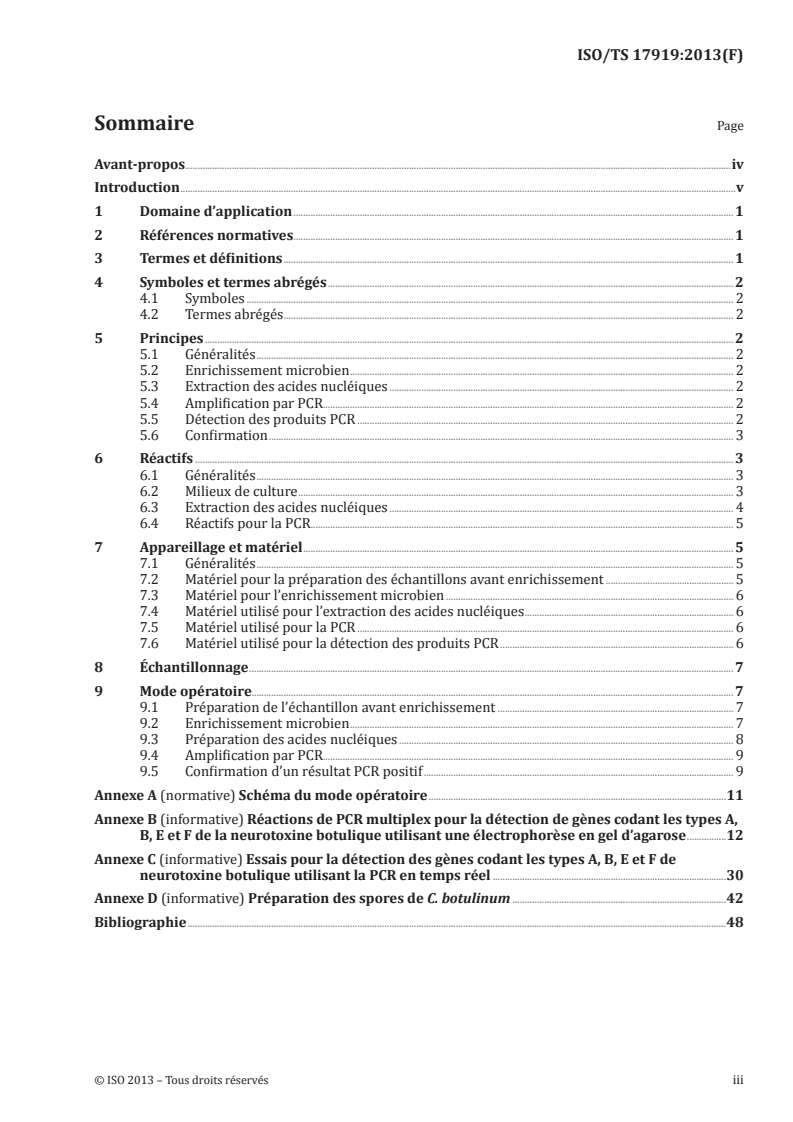
Contents Page
Foreword .iv
Introduction .v
1 Scope . 1
2 Normative references . 1
3 Terms and definitions . 1
4 Symbols and abbreviated terms . 1
4.1 Symbols . 1
4.2 Abbreviated terms . 2
5 Principle . 2
5.1 General . 2
5.2 Microbial enrichment . 2
5.3 Nucleic acid extraction . 2
5.4 Amplification by PCR . 2
5.5 Detection of PCR products . 2
5.6 Confirmation . 2
6 Reagents . 3
6.1 General . 3
6.2 Culture media . 3
6.3 Nucleic acid extraction . 4
6.4 Reagents for PCR . 5
7 Apparatus and equipment . 5
7.1 General . 5
7.2 Equipment for sample preparation prior to enrichment . 5
7.3 Equipment for microbial enrichment . . 5
7.4 Equipment used for nucleic acid extraction . 6
7.5 Equipment used for PCR . 6
7.6 Equipment used for the detection of the PCR product . 6
8 Sampling . 7
9 Procedure. 7
9.1 Sample preparation prior to enrichment . 7
9.2 Microbial enrichment . 7
9.3 Nucleic acid preparation. 8
9.4 PCR amplification . 9
9.5 Confirmation of a positive PCR result . 9
Annex A (normative) Flow-diagram of the procedure .10
Annex B (informative) Multiplex PCR assays for detection of genes encoding botulinum
neurotoxin types A, B, E, and F using agarose gel electrophoresis .11
Annex C (informative) Assays for detection of genes encoding botulinum neurotoxin types A, B, E,
and F using real-time PCR .29
Annex D (informative) Preparation of C. botulinum spores.40
Bibliography .46
Foreword
ISO (the International Organization for Standardization) is a worldwide federation of national standards
bodies (ISO member bodies). The work of preparing International Standards is normally carried out
through ISO technical committees. Each member body interested in a subject for which a technical
committee has been established has the right to be represented on that committee. International
organizations, governmental and non-governmental, in liaison with ISO, also take part in the work.
ISO collaborates closely with the International Electrotechnical Commission (IEC) on all matters of
electrotechnical standardization.
International Standards are drafted in accordance with the rules given in the ISO/IEC Directives, Part 2.
The main task of technical committees is to prepare International Standards. Draft International
Standards adopted by the technical committees are circulated to the member bodies for voting.
Publication as an International Standard requires approval by at least 75 % of the member bodies
casting a vote.
In other circumstances, particularly when there is an urgent market requirement for such documents, a
technical committee may decide to publish other types of document:
— an ISO Publicly Available Specification (ISO/PAS) represents an agreement between technical
experts in an ISO working group and is accepted for publication if it is approved by more than 50 %
of the members of the parent committee casting a vote;
— an ISO Technical Specification (ISO/TS) represents an agreement between the members of a
technical committee and is accepted for publication if it is approved by 2/3 of the members of the
committee casting a vote.
An ISO/PAS or ISO/TS is reviewed after three years in order to decide whether it will be confirmed for
a further three years, revised to become an International Standard, or withdrawn. If the ISO/PAS or
ISO/TS is confirmed, it is reviewed again after a further three years, at which time it must either be
transformed into an International Standard or be withdrawn.
ISO/TS 17919 was prepared by the European Committee for Standardization (CEN) Technical Committee
CEN/TC 275 Food analysis — Horizontal methods, in collaboration with Technical Committee ISO/TC 34,
Food products, Subcommittee SC 9, Microbiology, in accordance with the Agreement on technical
cooperation between ISO and CEN (Vienna Agreement).
iv © ISO 2013 – All rights reserved
Introduction
Botulinum neurotoxin-producing clostridia are ubiquitous in the environment. Botulism is a severe
neuroparalytic disease resulting from the action of botulinum neurotoxins (BoNTs). Seven different
serotypes of BoNTs (type A to G) and a number of subtypes have been identified to date.
BoNT type A (BoNT/A), type B (BoNT/B), type E (BoNT/E) and type F (BoNT/F) are mainly responsible
for botulism in humans and the genes encoding these toxins are the targets of this Technical Specification.
BoNT type A, B, E, and F-producing clostridia exist in four physiologically distinct groups (Group I
Clostridium botulinum, Group II C. botulinum, C. baratii, C. butyricum).
The International Organization for Standardization (ISO) draws attention to the fact that it is claimed
that compliance with this document may involve the use of patents.
ISO take no position concerning the evidence, validity and scope of this patent right.
The holder of this patent right has assured ISO that they are willing to negotiate licences under reasonable
and non-discriminatory terms and conditions with applicants throughout the world. In this respect, the
statement of the holder of this patent right is registered with ISO. Information may be obtained from:
Applied Biosystems, LLC
Scott Miller, Legal Department
5781 Van Allen Way
CARLSBAD
CA 92008
USA
Tel: +1 760 476 4387
Fax: +1 760 476 6048
e-mail: Scott.miller@lifetechnologies.com
Attention is drawn to the possibility that some of the elements of this document may be the subject of
patent rights other than those identified above. ISO shall not be held responsible for identifying any or
all such patent rights.
ISO (www.iso.org/patents) maintains an on-line database of patents relevant to its documents. Users
are encouraged to consult the databases for the most up-to-date information concerning patents.
TECHNICAL SPECIFICATION ISO/TS 17919:2013(E)
Microbiology of the food chain — Polymerase chain
reaction (PCR) for the detection of food-borne pathogens
— Detection of botulinum type A, B, E and F neurotoxin-
producing clostridia
1 Scope
This Technical Specification specifies a horizontal method for the molecular detection of clostridia
carrying botulinum neurotoxin A, B, E, and F genes by a PCR method. This method detects the genes
and not the toxins, therefore a positive result does not necessarily mean the presence of these toxins in
the sample investigated. This Technical Specification is applicable to products for human consumption,
animal feed, and environmental samples.
The PCR assays for detection of genetic sequences encoding specific toxin types are described
in Annexes B and C.
2 Normative references
The following referenced documents are indispensable for the application of this document. For dated
references, only the edition cited applies. For undated references, the latest edition of the referenced
document (including any amendments) applies.
ISO 6887-1, Microbiology of food and animal feeding stuffs — Preparation of test samples, initial suspension
and decimal dilutions for microbiological examination — Part 1: General rules for the preparation of the
initial suspension and decimal dilutions
ISO 7218, Microbiology of food and animal feeding stuffs — General requirements and guidance for
microbiological examinations
ISO 11133, Microbiology of food, animal feed and water — Preparation, production, storage and performance
testing of culture media
ISO 20837, Microbiology of food and animal feeding stuffs — Polymerase chain reaction (PCR) for the
detection of food-borne pathogens — Requirements for sample preparation for qualitative detection
ISO 20838:2006, Microbiology of food and animal feeding stuffs — Polymerase chain reaction (PCR) for the
detection of food-borne pathogens — Requirements for amplification and detection for qualitative methods
ISO 22174, Microbiology of food and animal feeding stuffs — Polymerase chain reaction (PCR) for the
detection of food-borne pathogens — General requirements and definitions
3 Terms and definitions
For the purpose of this document, the terms and definitions given in ISO 22174 apply.
4 Symbols and abbreviated terms
4.1 Symbols
c substance concentration
ρ mass concentration
φ volume fraction
w mass fraction
4.2 Abbreviated terms
BoNT botulinum neurotoxin
5 Principle
5.1 General
The method comprises the following consecutive steps:
a) microbial enrichment (see 5.2);
b) nucleic acid extraction (see 5.3);
c) amplification (see 5.4);
d) detection of PCR products (see 5.5);
e) confirmation (see 5.6).
NOTE Real-time-PCR combines steps c) to e).
5.2 Microbial enrichment
The number of BoNT-producing clostridia (spores or vegetative cells) to be detected is increased by
encouraging their germination and growth in non-selective liquid nutrient medium tryptone–peptose–
glucose–yeast extract broth under anaerobic conditions.
5.3 Nucleic acid extraction
Bacterial cells are separated from the nutrient medium, lysed and the nucleic acids are extracted for use
in the PCR reaction.
5.4 Amplification by PCR
The extracted nucleic acid is transferred to the PCR mix and the amplification is carried out in a
thermal cycler.
5.5 Detection of PCR products
PCR products are detected by gel electrophoresis or an appropriate alternative.
5.6 Confirmation
The identity of the PCR products shall be confirmed by any appropriate method, e.g. sequencing,
hybridization or restriction analysis.
2 © ISO 2013 – All rights reserved
6 Reagents
6.1 General
For all stages 5.1 b) to e), use only reagents of recognized analytical grade and consumables suitable for
molecular biology applications as specified in ISO 20837 and ISO 20838.
Reagent requirements specified in ISO 20838:2006, Clause 5, apply.
6.2 Culture media
6.2.1 General
Follow ISO 11133 for the preparation, production and performance testing of culture media.
6.2.2 Diluent
[9]–[13]
Follow ISO 6887-1 and the relevant part of ISO 6887 dealing with the product to be examined.
6.2.3 Non–selective enrichment culture medium, tryptone–peptone–glucose–yeast extract
broth (TPGY broth) (Reference [7])
6.2.3.1 General
Other approved non-selective enrichment culture media can be used provided equivalent
performance is shown.
6.2.3.2 Composition and pH
Tryptone 50 g
Peptone 5 g
Yeast extract 20 g
d-Glucose 4 g
Sodium thioglycolate, HSCH COONa 1 g
Water to 1 000 ml
pH 7,0 ± 0,2
6.2.3.3 Preparation
Dissolve the components in the water by boiling. After sterilization, adjust to pH 7,0 ± 0,2 at 25 °C.
Dispense the base into flasks or bottles of appropriate capacity. Sterilize for 15 min at 121 °C. Store in a
refrigerator at 5 °C ± 3 °C. Discard unused medium 4 weeks after preparation.
6.2.4 TPGY broth buffered — for acidic and acidifying foodstuffs only
6.2.4.1 Stock solution (phosphate buffer)
6.2.4.1.1 Solution 1
Sodium dihydrogenphosphate monohydrate [NaH PO ·H O] 138 g
2 4 2
Water to 1 000 ml
6.2.4.1.2 Solution 2
Disodium hydrogenphosphate [Na HPO ] 142 g
2 4
Water to 1 000 ml
6.2.4.1.3 Preparation
Dissolve the components in the water by boiling. To 250 ml solution 1, add solution 2 until the pH reaches
7,2. Store in a refrigerator at 5 °C ± 3 °C.
6.2.4.2 Preparation of the complete medium
Dissolve the components given for the base (6.2.3.2) in 500 ml water by boiling. Add 100 ml phosphate
buffer (6.2.4.1) The final phosphate concentration of the complete medium is 0,1 mol/l. Add water up
to 1 000 ml. Dispense the complete medium into flasks or bottles of appropriate capacity. Sterilize for
15 min at 121 °C. Store in a refrigerator at 5 °C ± 3 °C. Discard unused medium 4 weeks after preparation.
6.3 Nucleic acid extraction
6.3.1 Chloroform, CHCl .
6.3.2 Ethanol, φ(C H OH) = 96 %.
2 5
6.3.3 Ethylenediaminetetraacetic acid disodium salt (Na EDTA), C H N O Na .
2 10 14 2 8 2
6.3.4 Hexadecyl(trimethyl)ammonium bromide [(cetyl(trimethyl)ammonium bromide, CTAB],
C H BrN.
19 42
6.3.5 Hydrochloric acid, φ(HCl) = 37 %.
6.3.6 Isopropanol, CH CH(OH)CH .
3 3
6.3.7 Proteinase-K, approximately 20 units/mg of lyophilizate.
6.3.8 Sodium chloride, NaCl.
6.3.9 Sodium hydroxide, NaOH.
6.3.10 Tris(hydroxymethyl)aminomethane (tris), C H NO .
4 11 3
6.3.11 CTAB extraction buffer, ρ(CTAB) = 20 g/l, c(NaCl) = 1,4 mol/l, c(tris) = 0,1 mol/l, c(Na EDTA) =
0,02 mol/l.
Adjust to pH 8,0 with HCl or NaOH.
6.3.12 CTAB-precipitation buffer, ρ(CTAB) = 5 g/l, c(NaCl) = 0,04 mol/l.
6.3.13 Sodium chloride solution, c(NaCl) = 1,2 mol/l.
4 © ISO 2013 – All rights reserved
6.3.14 Ethanol solution, φ(C H OH) = 70 %.
2 5
6.3.15 Proteinase-K solution, ρ = 20 mg/ml, dissolved in sterile water.
Do not autoclave. Store at −20 °C, but avoid repeated freezing and thawing.
6.3.16 Tris–EDTA (TE) buffer, c(tris) = 0,01 mol/l, c(Na EDTA) = 0,001 mol/l.
Adjust to pH 8,0 with HCl or NaOH.
6.4 Reagents for PCR
6.4.1 Thermostable DNA polymerase, as specified in ISO 20838 and ISO 22174.
6.4.2 Deoxyribonucleoside triphosphates (dNTPs) containing dATP, dCTP, dGTP and dTTP or dUTP,
as specified in ISO 20838 and ISO 22174.
6.4.3 PCR buffer solution, as specified in ISO 20838 and ISO 22174.
The PCR buffer solution is usually delivered with the DNA polymerase, which may or may not include
MgCl in a concentration specified by the manufacturer. The final MgCl concentrations are method
2 2
specific and are therefore listed in the annexes. It is possible that ready-to-use reagents are commercially
available. If so, follow the manufacturer’s instructions for use.
6.4.4 Primers and probes
Primers and probes for specific detection of the neurotoxin gene sequences are listed in Annexes B and C.
7 Apparatus and equipment
7.1 General
Usual microbiological laboratory equipment (see ISO 7218) and, in particular, the following.
7.2 Equipment for sample preparation prior to enrichment
7.2.1 Water bath, capable of being maintained at 50 °C ± 1 °C.
7.2.2 Centrifuge, for 50 ml and 100 ml tubes and with an adjustable acceleration of up to 12 000 × g.
7.2.3 Membrane filter, nitrocellulose-filter, pore size 0,45 µm.
7.2.4 Centrifuge tubes, of capacities of 50 ml and 100 ml.
7.3 Equipment for microbial enrichment
7.3.1 Water baths, capable of being maintained at 30 °C ± 1 °C, 65 °C ± 1 °C and 100 °C ± 1 °C.
7.3.2 Anaerobic jar or anaerobic cabinet, capable of being maintained at 30 °C ± 1 °C, according to
ISO 7218.
7.3.3 Incubator, capable of operating at 30 °C ± 1 °C.
7.3.4 Flasks or bottles, of appropriate capacity.
7.4 Equipment used for nucleic acid extraction
Appropriate equipment according to ISO 20837 and, in particular, the following.
7.4.1 Microcentrifuge tubes, of capacities of 1,5 ml and 2,0 ml.
7.4.2 Thermo block, with a mixing frequency between 300 r/min and 1 400 r/min.
7.4.3 Graduated pipettes and pipette filter tips, for volumes between 1 µl and 1 000 µl.
7.4.4 Centrifuge, for reaction tubes having a capacity of 1,5 ml and 2,0 ml, e.g. microcentrifuge, capable
of achieving an acceleration of up to 12 000 × g.
7.4.5 Mixer, e.g. vortex type.
7.5 Equipment used for PCR
Appropriate equipment according to the method and, in particular, the following.
7.5.1 Pipettes and pipette filter tips, having a capacity between 1 µl and 1 000 µl.
7.5.2 Microcentrifuge tubes, having a capacity of 1,5 ml and 2,0 ml.
7.5.3 Thin-walled PCR microtubes, 0,2 ml or 0,5 ml reaction tubes, multi-well PCR microplates or
other suitable equipment.
7.5.4 Thermal cycler.
7.6 Equipment used for the detection of the PCR product
Appropriate equipment according to the method and, in particular, the following.
7.6.1 Gel-based PCR
7.6.1.1 Horizontal gel system.
7.6.1.2 Power supply.
7.6.1.3 Ultraviolet (UV) transilluminator or UV light box.
7.6.1.4 Gel documentation system.
7.6.2 Real-time PCR
7.6.2.1 Real-time PCR thermal cycler.
7.6.2.2 Appropriate detection and analysis software.
6 © ISO 2013 – All rights reserved
8 Sampling
Sampling is not part of the method specified in this Technical Specification. If there is no specific
International Standard dealing with the sampling of the product concerned, it is recommended that the
parties concerned come to an agreement on the subject.
It is important the laboratory receive a truly representative sample which has not been damaged or
changed during transport or storage.
9 Procedure
9.1 Sample preparation prior to enrichment
9.1.1 General
See Figure A.1.
It is recommended that at least 25 g be analysed, particularly for honey samples; however, if supply is
limited, smaller sample sizes may be used.
9.1.2 Preparation of the sample
[9]–[13]
Prepare and homogenize the sample according to ISO 6887-1 and the relevant parts of ISO 6887
concerning the relevant matrix.
9.1.3 Preparation of honey samples
Place the vessel of honey in a water bath (7.2.1) at 50 °C ± 1 °C for 30 min to melt the honey. Invert the
vessel several times to mix the sample.
Weigh 25 g ± 2 g of honey into a sterile centrifuge tube with a capacity of 100 ml (7.2.4) and add at least
50 ml of sterile distilled or deionized water containing 1 % volume fraction polysorbate 80, preheated
to 50 °C ± 1 °C. Mix until the solution is homogeneous. Centrifuge the mixture at 12 000 × g (7.2.2) for
30 min. Remove the supernatant carefully and pass it through a 0,45 µm membrane filter (7.2.3). In
case of blockage, pass any remaining supernatant through a fresh filter. Use all filters in the subsequent
steps. Store the sediment temporarily at 5 ± 3 °C.
9.2 Microbial enrichment
9.2.1 Inoculation
9.2.1.1 General
Remove dissolved oxygen from the enrichment medium (6.2) by boiling for 10 min to 15 min in a water
bath (7.3.1).
If the sample is acidic or acidifying, the enrichment broth shall be prepared according to 6.2.4.
9.2.1.2 Inoculation of test portion
9.2.1.2.1 Recovery of vegetative cells and spores
Adjust the temperature of the enrichment medium to 30 °C ± 1 °C in a water bath (7.3.1). Transfer the
−1
test portion into the degassed enrichment medium to give a final dilution of 10 .
9.2.1.2.2 Recovery of spores
Adjust the temperature of the enrichment medium to 65 °C ± 1 °C in a water bath (7.3.1). Transfer the
−1
test portion into the preheated enrichment medium to give a final dilution of 10 at 65 °C ± 1 °C. After
inoculation, maintain the flask or bottle at 65 °C ± 1 °C for further 10 min, and then quickly cool to
30 °C ± 1 °C in a water bath (7.3.1).
9.2.1.3 Inoculation of honey test portions
Adjust the temperature of the enrichment broth to 65 °C ± 1 °C (7.3.1). Transfer the sediment (9.1.3)
to one flask or bottle (7.3.4) and the filter or filters (9.1.3) into a second flask or bottle (7.3.4) each
containing at least 10 ml of the heated enrichment broth, but in all cases ensure sufficient liquid covers
the filters. Incubate both flasks or bottles at 65 °C ± 1 °C for 10 min in a water bath (7.3.1).
NOTE Honey samples are only analysed for spores.
9.2.2 Incubation
Incubate under anaerobic conditions (7.3.2) at 30 °C ± 1 °C. After 24 h ± 2 h of incubation, remove 1 ml of
the enrichment for the PCR analysis and return immediately to anaerobic conditions.
If the result of the first PCR is negative, continue incubation under the same conditions for a further
48 h ± 2 h, then transfer 1 ml of the enrichment into a flask or bottle (7.3.4) containing 9 ml of fresh
enrichment broth (6.2.3). Incubate anaerobically (7.3.2) at 30 °C ± 1 °C for 18 h ± 2 h and perform a
second PCR run.
9.2.3 Process controls
Positive and negative process controls shall be included according to ISO 22174.
An example of a method for the preparation of spores is given in Annex D.
9.3 Nucleic acid preparation
9.3.1 General
An appropriate nucleic acid extraction procedure for Gram-positive bacteria shall be used.
An example of a procedure is given in 9.3.2 to 9.3.4. This procedure consists of a lysis step — thermal
lysis in the presence of CTAB — followed by several extraction steps in order to remove inhibitors, such
as polysaccharides and proteins.
Once the matrix test portion has been prepared, apply the DNA extraction and purification protocol
given in 9.3.2 to 9.3.4.
Scale adaptation of masses and buffer volumes is required as a function of the selected size of the test portion.
9.3.2 Sample extraction
Transfer 1 000 µl of the enrichment culture (9.2.2) into a microcentrifuge tube (7.4.1). Centrifuge (7.4.4)
for 5 min at approximately 12 000 × g. Discard the supernatant (aqueous).
Add 500 µl prewarmed (65 °C) CTAB extraction-buffer (6.3.11) to the pellet and mix gently until the
pellet is lysed. Incubate for 30 min at 65 °C, under agitation (7.4.2). Add 20 µl of proteinase-K solution
(6.3.7), gently mix the tube and incubate for 30 min at 65 °C, under agitation (7.4.2). Centrifuge for
10 min at approximately 12 000 × g. Transfer the supernatant to a new tube, add 0,7 to 1 volume of
chloroform (6.3.1) and mix thoroughly.
Centrifuge for 15 min at approximately 12 000 × g. Transfer the supernatant (aqueous) to a new tube.
8 © ISO 2013 – All rights reserved
9.3.3 CTAB precipitation
Add 2 volumes of the CTAB precipitation buffer (6.3.12). Incubate for 60 min at room temperature without
agitation. Centrifuge for 15 min at 12 000 × g. Discard the supernatant. Dissolve the precipitated DNA by
adding 350 µl of NaCl solution (6.3.13). Add 350 µl of chloroform (6.3.1) and mix thoroughly. Centrifuge
for 10 min at 12 000 × g. Transfer the aqueous phase into a new tube.
NOTE CTAB-precipitation is not necessary for all matrices, only for protein- and polysaccharide-rich
matrices. Alternatively, a solid-phase purification of the DNA (e.g. by the use of spin columns) is possible assuming
the results are equivalent.
9.3.4 DNA precipitation
Add 0,6 volume of isopropanol (6.3.6), mix smoothly by inverting the tube and keep the tube at room
temperature for 20 min. Centrifuge for 15 min at 12 000 × g. Discard the supernatant. Add 500 µl of
ethanol solution (6.3.14) to the tube and invert several times. This is the critical step ensuring the
complete removal of CTAB. Centrifuge for 10 min at 12 000 × g. Discard the supernatant. Dry the DNA
pellet and redissolve it into 100 µl of an appropriate buffer, e.g. TE buffer (6.3.16). This is the DNA master
stock. The DNA can be stored at −20 °C until use.
9.4 PCR amplification
Different procedures for PCR amplification can be used. The detection of the PCR product can be either
gel based or by detection of the fluorescence signal.
All requirements for the PCR amplification are specified in ISO 20838.
Examples of gel-based PCR methods are described in Annex B and of real-time PCR methods in Annex C.
9.4.1 PCR controls
PCR controls shall be in accordance with ISO 22174.
9.4.2 Detection of PCR products
Different procedures for detection of PCR products can be used. Examples of gel-based PCR methods are
described in Annex B and of real-time PCR methods in Annex C.
9.5 Confirmation of a positive PCR result
Follow the procedure specified in ISO 20838.
9.5.1 Interpretation of the results
The results obtained, including the controls specified in ISO 22174, should be unambiguous and the
controls should yield expected results, otherwise the procedure shall be repeated.
The PCR result is:
a) positive, if a specific PCR product has been detected and confirmed and all the controls give
expected results;
b) negative within the limits of detection, if a specific PCR product has not been detected, and all
controls give expected results.
A positive PCR result does not automatically indicate the presence of botulinum neurotoxins. To confirm
the presence of the neurotoxins suitable methods targeting the toxins directly shall be applied.
Annex A
(normative)
Flow-diagram of the procedure
Prepare sample (9.1.1)
Test portion
x g or x ml
9x ml enrichment-broth (6.2.3)
Incubate under anaerobic conditions at 30 °C ± 1 °C for 24 h ± 2 h (7.3.2)
Remove 1 ml of the enrichment for PCR analysis and return to anaerobic conditions
Positive PCR result Negative PCR result:
Incubate for a further 48 h ± 2 h
under anaerobic conditions (7.3.2)
Transfer 1 ml of enrichment broth into
9 ml of fresh enrichment broth (6.2.3)
Incubate under anaerobic conditions
at 30 °C ± 1 °C for 18 h ± 2 h (7.3.2)
Second PCR run
Figure A.1
10 © ISO 2013 – All rights reserved
Annex B
(informative)
Multiplex PCR assays for detection of genes encoding botulinum
neurotoxin types A, B, E, and F using agarose gel electrophoresis
B.1 Method 1
B.1.1 Introduction
This clause describes a method for the specific amplification and detection of the genes encoding
botulinum neurotoxin types A, B, E, and F using agarose gel electrophoresis.
For limitations see B.1.7.6.
B.1.2 Performance characteristics
B.1.2.1 General
The method has been validated for DNA extracted from various C. botulinum type A, B, E, and F reference
strains and from naturally contaminated samples.
The method appears in References [1][2][5].
B.1.2.2 Theoretical evaluation of the method
Theoretical evaluation was done by performing a sequence similarity search against the GenBank/EMBL/
DDBJ database, where EMBL is the European Molecular Biology Laboratory and DDBJ is the DNA Database
of Japan (Reference [16], 2009-09-20). The result of the search confirmed a complete identity only with
the expected target sequences.
B.1.2.3 Selectivity
B.1.2.3.1 Inclusivity test
The inclusivity of the method was tested with 86 C. botulinum type A strains, 70 C. botulinum type B,
15 C. botulinum/butyricum type E and six C. botulinum type F strains, see Table B.1.
Table B.1 — Inclusivity of the multiplex PCR using target strains
Type of botulinum neurotoxin gene detected
Number
Strain, type and subtype
of strains
Type A Type B Type E Type F
a
C. botulinum type A subtype A1 3 3 0 0 0
b
C. botulinum type A subtype A2 9 9 0 0 0
c
C. botulinum type A subtype A3 1 1 0 0 0
d
C. botulinum type A subtype A5 4 4 0 0 0
e
C. botulinum type A undetermined subtype 69 69 0 0 0
f
C. botulinum type Ba subtype A4 1 1 1 0 0
g
C. botulinum type Ab subtype A2 4 4 4 0 0
h
C. botulinum type B 70 0 70 0 0
i
C. botulinum type E 4 0 0 4 0
j
C. butyricum type E 11 0 0 11 0
k
C. botulinum type F 6 0 0 0 6
a
C. botulinum National Collection of Type Cultures (NCTC 4587), C. botulinum strain 62A, C. botulinum NCTC 7272.
b
Strains isolated from Italian National Reference Centre for Botulism (NRCB).
c
C. botulinum NCTC 2012 Loch Maree.
d
C. botulinum strains from Institute of Food Research (IFR), UK.
e
A total of 64 strains from NRCB collection and five strains from the Consultant Laboratory for Anaerobic Bacteria
(CLAB) of the University of Leipzig, Germany.
f
C. botulinum strain 657Ba from IFR, UK.
g
Strains isolated by NRCB, Italy.
h
C. botulinum NCTC 7273 and 69 strains from NRCB collection.
i
Three strains from the CLAB and one strain from NRCB.
j
Seven strains isolated in Italy by NRCB, four strains provided by Reference [17].
k
C. botulinum NCTC 10281: three strains isolated in Italy by NRCB; two strains isolated in Germany by CLAB.
B.1.2.3.2 Exclusivity test
The exclusivity of the method was tested with 34 non-target organisms, see Table B.2. No cross-reactivity
was observed with the non-target bacteria.
12 © ISO 2013 – All rights reserved
Table B.2 — Exclusivity of the multiplex PCR using non-target strains
Type of botulinum neurotoxin gene detected
Number
a
Strains
of strains
Type A Type B Type E Type F
C. sporogenes WDCM 00008 1 0 0 0 0
C. perfringens (WDCM 00007 and field strains) 3 0 0 0 0
C. carnis NCTC 13036 1 0 0 0 0
C. histolyticum NCTC 503 1 0 0 0 0
C. butyricum NCTC 7423 1 0 0 0 0
C. barati NCTC 10986 1 0 0 0 0
Bacillus subtilis WDCM 00003 1 0 0 0 0
B. cereus (NCTC 11143 and field strains) 3 0 0 0 0
Thermophilic Campylobacter spp. (field strains) 2 0 0 0 0
Escherichia coli (WDCM 00013 and field strains) 3 0 0 0 0
Salmonella spp. (WDCM 00030 and field strain) 2 0 0 0 0
Listeria spp. (WDCM 00017 and WDCM 00109) 2 0 0 0 0
Brochotrix thermospacta WDCM 00071 1 0 0 0 0
Enterococcus faecalis WDCM 00087 1 0 0 0 0
Citrobacter freundii WDCM 00078 1 0 0 0 0
Pseudomonas spp. (field strains) 3 0 0 0 0
Yersinia enterocolitica (field strains) 3 0 0 0 0
Lactobacillus fermentum (field strain) 1 0 0 0 0
Aspergillus spp. (field strains) 2 0 0 0 0
Saccharomyces cervisiae (field strain) 1 0 0 0 0
a WDCM ≡ World Data Centre for Microorganisms.
B.1.2.4 Sensitivity
B.1.2.4.1 Sensitivity tests using artificially contaminated samples (Reference [2])
The limit of detection was assessed by measuring artificially contaminated samples with different
inoculation levels (0,1 cfu to 10 cfu and 10 cfu to 100 cfu before enrichment) in 10 g of various food matrices
(canned fish, canned sausages, and honey) under investigation using the culture method (Reference [1]).
According to the results, the false-positive rate for the method using artificially contaminated samples
is 0 % and the false-negative rate is 0 %. The limit of detection for the method described is 1 cfu to 10 cfu
or spores per 10 g before enrichment.
B.1.2.4.2 Sensitivity tests using naturally contaminated samples (Reference [2])
The limit of detection was assessed by measuring 382 naturally contaminated samples (e.g. honey,
vegetable matter, and canned meats) using the mouse bioassay as reference method. According to the
results the false-positive rate for the method using naturally contaminated samples is 0 % and the false-
negative rate is 0 %.
NOTE The experiments were performed with test portions of 10 g.
B.1.2.5 Analytical controls
All tests were performed using positive and negative process controls and additionally for PCR an
internal amplification control (IAC) described in B.1.6.
B.1.2.6 Instruments and reagents
1) 2)
® ®
Validation was carried out with the MyCycler and with the Mastercycler Gradient using the 2×
3) ®
Multiplex qPCR MasterMix (Reference [1]) and the MasterMix according to Table B.7 (References [2][5]).
B.1.3 Principle
Specific DNA fragments of the BoNT/A, B, E, and F genes are amplified by multiplex PCR in combination
with a homologous IAC using eight primers. The detection of the PCR products is done using agarose gel
electrophoresis.
B.1.4 Reagents
B.1.4.1 General
For the quality of reagents to be used, see ISO 22174.
B.1.4.2 Reagents for PCR
B.1.4.2.1 Nuclease-free water.
4)
B.1.4.2.2 PCR buffer solution, 10×.
The PCR buffer solution is usually delivered with the DNA polymerase, which may or may not include
MgCl in a concentration specified by the manufacturer. The final MgCl concentrations are method
2 2
specific and are therefore listed in Table B.7. It is possible that ready-to-use reagents are commercially
available. If so, follow the manufacturer’s instructions for use.
B.1.4.2.3 MgCl solution, c(MgCl ) = 25 mmol/l.
2 2
B.1.4.2.4 Thermostable DNA polymerase (for hot-start PCR), 5 IU/µl.
B.1.4.2.5 dNTP solution, c(dNTP) = 10 mmol/l.
B.1.4.2.6 Oligonucleotides.
Sequences of the oligonucleotides are listed in Table B.3. ®
1) MyCycler is the trade name of a product supplied by BioRad. This information is given for the convenience of
users of this document and does not constitute an endorsement by ISO of the product named. Equivalent products
may be used if they can be shown to lead to the same results. ®
2) Mastercycler Gradient is the trade name of a product supplied by Eppendorf. This information is given for
the convenience of users of this document and does not constitute an endorsement by ISO of the product named.
Equivalent products may be used if they can be shown to lead to the same results. ®
3) 2× Multiplex qPCR MasterMix is the trade name of a product supplied by Qiagen. This information is given for
the convenience of users of this document and does not constitute an endorsement by ISO of the product named.
Equivalent products may be used if they can be shown to lead to the same results.
4) 10× means 10-fold; i.e. the concentration of the PCR buffer.
14 © ISO 2013 – All rights reserved
Table B.3 — Sequences of oligonucleotides
Amplicon size
Type Primer Sequence (5´ — 3´)
bp
a
IA_O3_fw ggg CCT AgA ggT AgC gTA R Tg
A 101
a
IA_O4_rev TCT TY A TTT CCA gAA gCA TAT TTT
CBMLB1 CAg gAg AAg Tgg AgC gAA AA
B 205
CBMLB2 CTT gCg CCT TTg TTT TCT Tg
CBMLE1 CCA AgA TTT TCA TCC gCC TA
E 389
CBMLE2 gCT ATT gAT CCA AAA Cgg TgA
CBMLF1 Cgg CTT CAT TAg AgA ACg gA
F 543
CBMLF2 TAA CTC CCC TAg CCC CgT AT
a
In the sequence of oligonucleotides R = A,G and Y = C,T.
B.1.4.3 Reagents for gel electrophoresis
B.1.4.3.1 General. The agarose gel electrophoresis may be carried out with TAE buffer or TBE buffer.
Solutions as described in this method do not usually need to be autoclaved.
B.1.4.3.2 Agarose, suitable for DNA electrophoresis and for the intended size separation of the DNA
molecules.
B.1.4.3.3 Boric acid , H BO , for the TBE buffer system only.
3 3
B.1.4.3.4 Bromophenol blue, C H Br O SNa and/or xylene cyanol FF, C H N O S Na.
19 9 4 5 25 27 2 6 2
B.1.4.3.5 DNA molecular mass standard, e.g. a commercial preparation containing DNA fragments
from very high to very low molecular mass.
B.1.4.3.6 Glacial acetic acid, CH COOH, for the TAE buffer system only.
B.1.4.3.7 Ethylenediaminetetraacetic acid disodium salt (Na EDTA), C H N O Na .
2 10 14 2 8 2
B.1.4.3.8 Ethidium bromide (EthBr), C H N Br.
21 20 3
B.1.4.3.9 Glycerol, C H O .
3 8 3
B.1.4.3.10 Sodium acetate, C H O Na, for the TAE buffer system only.
2 3 2
B.1.4.3.11 Hydrochloric acid, φ(HCl) = 37 %.
B.1.4.3.12 Sodium hydroxide, NaOH.
B.1.4.3.13 Tris(hydroxymethyl)aminomethane (tris), C H NO .
4 11 3
B.1.4.3.14 Tris–acetate–EDTA (TAE) buffer solution (1×), c(tris) = 0,050 mol/l, c(C H O Na) =
2 3 2
20 mmol/l, c(Na EDTA) = 0,001 mol/l.
Adjust to pH 8,0 with glacial acetic acid or NaOH. It is advisable to prepare the TAE buffer solution
as a concentrated stock solution (maximum 50-fold concentrated). Discard it if a precipitate is visible.
Dilution of the concentrated electrophoresis buffers can be carried out, immediately before its use, with
non-sterile, (mono)-distilled or deionized water.
B.1.4.3.15 Tris–borate–EDTA (TBE) buffer solution (0,5×), c(tris) = 0,055 mol/l, c(boric acid) =
0,055 mol/l, c(Na EDTA) = 0,001 mol/l.
Adjust to pH 8,0 with HCl or NaOH. It is advisable to prepare the TBE buffer solution as a concentrated
stock solution (maximum 10-fold concentrated). Discard it if precipitation is visible. Dilution of the
concentrated electrophoresis buffers can be carried out, immediately before its use, with non-sterile,
(mono)-distilled or deionized water.
B.1.4.3.16 Sample loading buffer solution (5×), φ(glycerol) = 50 %, ρ(bromophenol blue) = 2,5 g/l
and/or ρ(xylene cyanol) = 2,5 g/l, dissolved in electrophoresis buffer solution (B.1.4.3.14 or B.1.4.3.15).
B.1.4.3.17 Ethidium bromide solution, c(EthBr) = 0,5 mg/l.
It is advisable to store the ethidium bromide solution as a concentrate (e.g. 10 mg/ml) at 5 °C in the
dark (EthBr is light-sensitive). It is also advisable to avoid weighing EthBr. The stock solution should be
prepared by dissolving an appropriate amount of water in the vessel already containing the EthBr powder,
or alternatively, by employing preweighed EthBr tablets. Solubilization of EthBr should be carried out
protected from light, under agitation at room temperature. This usually takes approximately 1 h.
WARNING — Ethidium bromide is a known mutagen. Follow safe h
...
TECHNICAL ISO/TS
SPECIFICATION 17919
First edition
2013-11-01
Microbiology of the food chain —
Polymerase chain reaction (PCR) for
the detection of food-borne pathogens
— Detection of botulinum type A, B, E
and F neurotoxin-producing clostridia
Microbiologie de la chaîne alimentaire — Réaction de polymérisation
en chaîne (PCR) pour la détection de micro-organismes pathogènes
dans les aliments — Détection des clostridies productrices de
neurotoxine botulique de type A, B, E et F
Reference number
©
ISO 2013
© ISO 2013
All rights reserved. Unless otherwise specified, no part of this publication may be reproduced or utilized otherwise in any form
or by any means, electronic or mechanical, including photocopying, or posting on the internet or an intranet, without prior
written permission. Permission can be requested from either ISO at the address below or ISO’s member body in the country of
the requester.
ISO copyright office
Case postale 56 • CH-1211 Geneva 20
Tel. + 41 22 749 01 11
Fax + 41 22 749 09 47
E-mail copyright@iso.org
Web www.iso.org
Published in Switzerland
ii © ISO 2013 – All rights reserved
Contents Page
Foreword .iv
Introduction .v
1 Scope . 1
2 Normative references . 1
3 Terms and definitions . 1
4 Symbols and abbreviated terms . 1
4.1 Symbols . 1
4.2 Abbreviated terms . 2
5 Principle . 2
5.1 General . 2
5.2 Microbial enrichment . 2
5.3 Nucleic acid extraction . 2
5.4 Amplification by PCR . 2
5.5 Detection of PCR products . 2
5.6 Confirmation . 2
6 Reagents . 3
6.1 General . 3
6.2 Culture media . 3
6.3 Nucleic acid extraction . 4
6.4 Reagents for PCR . 5
7 Apparatus and equipment . 5
7.1 General . 5
7.2 Equipment for sample preparation prior to enrichment . 5
7.3 Equipment for microbial enrichment . . 5
7.4 Equipment used for nucleic acid extraction . 6
7.5 Equipment used for PCR . 6
7.6 Equipment used for the detection of the PCR product . 6
8 Sampling . 7
9 Procedure. 7
9.1 Sample preparation prior to enrichment . 7
9.2 Microbial enrichment . 7
9.3 Nucleic acid preparation. 8
9.4 PCR amplification . 9
9.5 Confirmation of a positive PCR result . 9
Annex A (normative) Flow-diagram of the procedure .10
Annex B (informative) Multiplex PCR assays for detection of genes encoding botulinum
neurotoxin types A, B, E, and F using agarose gel electrophoresis .11
Annex C (informative) Assays for detection of genes encoding botulinum neurotoxin types A, B, E,
and F using real-time PCR .29
Annex D (informative) Preparation of C. botulinum spores.40
Bibliography .46
Foreword
ISO (the International Organization for Standardization) is a worldwide federation of national standards
bodies (ISO member bodies). The work of preparing International Standards is normally carried out
through ISO technical committees. Each member body interested in a subject for which a technical
committee has been established has the right to be represented on that committee. International
organizations, governmental and non-governmental, in liaison with ISO, also take part in the work.
ISO collaborates closely with the International Electrotechnical Commission (IEC) on all matters of
electrotechnical standardization.
International Standards are drafted in accordance with the rules given in the ISO/IEC Directives, Part 2.
The main task of technical committees is to prepare International Standards. Draft International
Standards adopted by the technical committees are circulated to the member bodies for voting.
Publication as an International Standard requires approval by at least 75 % of the member bodies
casting a vote.
In other circumstances, particularly when there is an urgent market requirement for such documents, a
technical committee may decide to publish other types of document:
— an ISO Publicly Available Specification (ISO/PAS) represents an agreement between technical
experts in an ISO working group and is accepted for publication if it is approved by more than 50 %
of the members of the parent committee casting a vote;
— an ISO Technical Specification (ISO/TS) represents an agreement between the members of a
technical committee and is accepted for publication if it is approved by 2/3 of the members of the
committee casting a vote.
An ISO/PAS or ISO/TS is reviewed after three years in order to decide whether it will be confirmed for
a further three years, revised to become an International Standard, or withdrawn. If the ISO/PAS or
ISO/TS is confirmed, it is reviewed again after a further three years, at which time it must either be
transformed into an International Standard or be withdrawn.
ISO/TS 17919 was prepared by the European Committee for Standardization (CEN) Technical Committee
CEN/TC 275 Food analysis — Horizontal methods, in collaboration with Technical Committee ISO/TC 34,
Food products, Subcommittee SC 9, Microbiology, in accordance with the Agreement on technical
cooperation between ISO and CEN (Vienna Agreement).
iv © ISO 2013 – All rights reserved
Introduction
Botulinum neurotoxin-producing clostridia are ubiquitous in the environment. Botulism is a severe
neuroparalytic disease resulting from the action of botulinum neurotoxins (BoNTs). Seven different
serotypes of BoNTs (type A to G) and a number of subtypes have been identified to date.
BoNT type A (BoNT/A), type B (BoNT/B), type E (BoNT/E) and type F (BoNT/F) are mainly responsible
for botulism in humans and the genes encoding these toxins are the targets of this Technical Specification.
BoNT type A, B, E, and F-producing clostridia exist in four physiologically distinct groups (Group I
Clostridium botulinum, Group II C. botulinum, C. baratii, C. butyricum).
The International Organization for Standardization (ISO) draws attention to the fact that it is claimed
that compliance with this document may involve the use of patents.
ISO take no position concerning the evidence, validity and scope of this patent right.
The holder of this patent right has assured ISO that they are willing to negotiate licences under reasonable
and non-discriminatory terms and conditions with applicants throughout the world. In this respect, the
statement of the holder of this patent right is registered with ISO. Information may be obtained from:
Applied Biosystems, LLC
Scott Miller, Legal Department
5781 Van Allen Way
CARLSBAD
CA 92008
USA
Tel: +1 760 476 4387
Fax: +1 760 476 6048
e-mail: Scott.miller@lifetechnologies.com
Attention is drawn to the possibility that some of the elements of this document may be the subject of
patent rights other than those identified above. ISO shall not be held responsible for identifying any or
all such patent rights.
ISO (www.iso.org/patents) maintains an on-line database of patents relevant to its documents. Users
are encouraged to consult the databases for the most up-to-date information concerning patents.
TECHNICAL SPECIFICATION ISO/TS 17919:2013(E)
Microbiology of the food chain — Polymerase chain
reaction (PCR) for the detection of food-borne pathogens
— Detection of botulinum type A, B, E and F neurotoxin-
producing clostridia
1 Scope
This Technical Specification specifies a horizontal method for the molecular detection of clostridia
carrying botulinum neurotoxin A, B, E, and F genes by a PCR method. This method detects the genes
and not the toxins, therefore a positive result does not necessarily mean the presence of these toxins in
the sample investigated. This Technical Specification is applicable to products for human consumption,
animal feed, and environmental samples.
The PCR assays for detection of genetic sequences encoding specific toxin types are described
in Annexes B and C.
2 Normative references
The following referenced documents are indispensable for the application of this document. For dated
references, only the edition cited applies. For undated references, the latest edition of the referenced
document (including any amendments) applies.
ISO 6887-1, Microbiology of food and animal feeding stuffs — Preparation of test samples, initial suspension
and decimal dilutions for microbiological examination — Part 1: General rules for the preparation of the
initial suspension and decimal dilutions
ISO 7218, Microbiology of food and animal feeding stuffs — General requirements and guidance for
microbiological examinations
ISO 11133, Microbiology of food, animal feed and water — Preparation, production, storage and performance
testing of culture media
ISO 20837, Microbiology of food and animal feeding stuffs — Polymerase chain reaction (PCR) for the
detection of food-borne pathogens — Requirements for sample preparation for qualitative detection
ISO 20838:2006, Microbiology of food and animal feeding stuffs — Polymerase chain reaction (PCR) for the
detection of food-borne pathogens — Requirements for amplification and detection for qualitative methods
ISO 22174, Microbiology of food and animal feeding stuffs — Polymerase chain reaction (PCR) for the
detection of food-borne pathogens — General requirements and definitions
3 Terms and definitions
For the purpose of this document, the terms and definitions given in ISO 22174 apply.
4 Symbols and abbreviated terms
4.1 Symbols
c substance concentration
ρ mass concentration
φ volume fraction
w mass fraction
4.2 Abbreviated terms
BoNT botulinum neurotoxin
5 Principle
5.1 General
The method comprises the following consecutive steps:
a) microbial enrichment (see 5.2);
b) nucleic acid extraction (see 5.3);
c) amplification (see 5.4);
d) detection of PCR products (see 5.5);
e) confirmation (see 5.6).
NOTE Real-time-PCR combines steps c) to e).
5.2 Microbial enrichment
The number of BoNT-producing clostridia (spores or vegetative cells) to be detected is increased by
encouraging their germination and growth in non-selective liquid nutrient medium tryptone–peptose–
glucose–yeast extract broth under anaerobic conditions.
5.3 Nucleic acid extraction
Bacterial cells are separated from the nutrient medium, lysed and the nucleic acids are extracted for use
in the PCR reaction.
5.4 Amplification by PCR
The extracted nucleic acid is transferred to the PCR mix and the amplification is carried out in a
thermal cycler.
5.5 Detection of PCR products
PCR products are detected by gel electrophoresis or an appropriate alternative.
5.6 Confirmation
The identity of the PCR products shall be confirmed by any appropriate method, e.g. sequencing,
hybridization or restriction analysis.
2 © ISO 2013 – All rights reserved
6 Reagents
6.1 General
For all stages 5.1 b) to e), use only reagents of recognized analytical grade and consumables suitable for
molecular biology applications as specified in ISO 20837 and ISO 20838.
Reagent requirements specified in ISO 20838:2006, Clause 5, apply.
6.2 Culture media
6.2.1 General
Follow ISO 11133 for the preparation, production and performance testing of culture media.
6.2.2 Diluent
[9]–[13]
Follow ISO 6887-1 and the relevant part of ISO 6887 dealing with the product to be examined.
6.2.3 Non–selective enrichment culture medium, tryptone–peptone–glucose–yeast extract
broth (TPGY broth) (Reference [7])
6.2.3.1 General
Other approved non-selective enrichment culture media can be used provided equivalent
performance is shown.
6.2.3.2 Composition and pH
Tryptone 50 g
Peptone 5 g
Yeast extract 20 g
d-Glucose 4 g
Sodium thioglycolate, HSCH COONa 1 g
Water to 1 000 ml
pH 7,0 ± 0,2
6.2.3.3 Preparation
Dissolve the components in the water by boiling. After sterilization, adjust to pH 7,0 ± 0,2 at 25 °C.
Dispense the base into flasks or bottles of appropriate capacity. Sterilize for 15 min at 121 °C. Store in a
refrigerator at 5 °C ± 3 °C. Discard unused medium 4 weeks after preparation.
6.2.4 TPGY broth buffered — for acidic and acidifying foodstuffs only
6.2.4.1 Stock solution (phosphate buffer)
6.2.4.1.1 Solution 1
Sodium dihydrogenphosphate monohydrate [NaH PO ·H O] 138 g
2 4 2
Water to 1 000 ml
6.2.4.1.2 Solution 2
Disodium hydrogenphosphate [Na HPO ] 142 g
2 4
Water to 1 000 ml
6.2.4.1.3 Preparation
Dissolve the components in the water by boiling. To 250 ml solution 1, add solution 2 until the pH reaches
7,2. Store in a refrigerator at 5 °C ± 3 °C.
6.2.4.2 Preparation of the complete medium
Dissolve the components given for the base (6.2.3.2) in 500 ml water by boiling. Add 100 ml phosphate
buffer (6.2.4.1) The final phosphate concentration of the complete medium is 0,1 mol/l. Add water up
to 1 000 ml. Dispense the complete medium into flasks or bottles of appropriate capacity. Sterilize for
15 min at 121 °C. Store in a refrigerator at 5 °C ± 3 °C. Discard unused medium 4 weeks after preparation.
6.3 Nucleic acid extraction
6.3.1 Chloroform, CHCl .
6.3.2 Ethanol, φ(C H OH) = 96 %.
2 5
6.3.3 Ethylenediaminetetraacetic acid disodium salt (Na EDTA), C H N O Na .
2 10 14 2 8 2
6.3.4 Hexadecyl(trimethyl)ammonium bromide [(cetyl(trimethyl)ammonium bromide, CTAB],
C H BrN.
19 42
6.3.5 Hydrochloric acid, φ(HCl) = 37 %.
6.3.6 Isopropanol, CH CH(OH)CH .
3 3
6.3.7 Proteinase-K, approximately 20 units/mg of lyophilizate.
6.3.8 Sodium chloride, NaCl.
6.3.9 Sodium hydroxide, NaOH.
6.3.10 Tris(hydroxymethyl)aminomethane (tris), C H NO .
4 11 3
6.3.11 CTAB extraction buffer, ρ(CTAB) = 20 g/l, c(NaCl) = 1,4 mol/l, c(tris) = 0,1 mol/l, c(Na EDTA) =
0,02 mol/l.
Adjust to pH 8,0 with HCl or NaOH.
6.3.12 CTAB-precipitation buffer, ρ(CTAB) = 5 g/l, c(NaCl) = 0,04 mol/l.
6.3.13 Sodium chloride solution, c(NaCl) = 1,2 mol/l.
4 © ISO 2013 – All rights reserved
6.3.14 Ethanol solution, φ(C H OH) = 70 %.
2 5
6.3.15 Proteinase-K solution, ρ = 20 mg/ml, dissolved in sterile water.
Do not autoclave. Store at −20 °C, but avoid repeated freezing and thawing.
6.3.16 Tris–EDTA (TE) buffer, c(tris) = 0,01 mol/l, c(Na EDTA) = 0,001 mol/l.
Adjust to pH 8,0 with HCl or NaOH.
6.4 Reagents for PCR
6.4.1 Thermostable DNA polymerase, as specified in ISO 20838 and ISO 22174.
6.4.2 Deoxyribonucleoside triphosphates (dNTPs) containing dATP, dCTP, dGTP and dTTP or dUTP,
as specified in ISO 20838 and ISO 22174.
6.4.3 PCR buffer solution, as specified in ISO 20838 and ISO 22174.
The PCR buffer solution is usually delivered with the DNA polymerase, which may or may not include
MgCl in a concentration specified by the manufacturer. The final MgCl concentrations are method
2 2
specific and are therefore listed in the annexes. It is possible that ready-to-use reagents are commercially
available. If so, follow the manufacturer’s instructions for use.
6.4.4 Primers and probes
Primers and probes for specific detection of the neurotoxin gene sequences are listed in Annexes B and C.
7 Apparatus and equipment
7.1 General
Usual microbiological laboratory equipment (see ISO 7218) and, in particular, the following.
7.2 Equipment for sample preparation prior to enrichment
7.2.1 Water bath, capable of being maintained at 50 °C ± 1 °C.
7.2.2 Centrifuge, for 50 ml and 100 ml tubes and with an adjustable acceleration of up to 12 000 × g.
7.2.3 Membrane filter, nitrocellulose-filter, pore size 0,45 µm.
7.2.4 Centrifuge tubes, of capacities of 50 ml and 100 ml.
7.3 Equipment for microbial enrichment
7.3.1 Water baths, capable of being maintained at 30 °C ± 1 °C, 65 °C ± 1 °C and 100 °C ± 1 °C.
7.3.2 Anaerobic jar or anaerobic cabinet, capable of being maintained at 30 °C ± 1 °C, according to
ISO 7218.
7.3.3 Incubator, capable of operating at 30 °C ± 1 °C.
7.3.4 Flasks or bottles, of appropriate capacity.
7.4 Equipment used for nucleic acid extraction
Appropriate equipment according to ISO 20837 and, in particular, the following.
7.4.1 Microcentrifuge tubes, of capacities of 1,5 ml and 2,0 ml.
7.4.2 Thermo block, with a mixing frequency between 300 r/min and 1 400 r/min.
7.4.3 Graduated pipettes and pipette filter tips, for volumes between 1 µl and 1 000 µl.
7.4.4 Centrifuge, for reaction tubes having a capacity of 1,5 ml and 2,0 ml, e.g. microcentrifuge, capable
of achieving an acceleration of up to 12 000 × g.
7.4.5 Mixer, e.g. vortex type.
7.5 Equipment used for PCR
Appropriate equipment according to the method and, in particular, the following.
7.5.1 Pipettes and pipette filter tips, having a capacity between 1 µl and 1 000 µl.
7.5.2 Microcentrifuge tubes, having a capacity of 1,5 ml and 2,0 ml.
7.5.3 Thin-walled PCR microtubes, 0,2 ml or 0,5 ml reaction tubes, multi-well PCR microplates or
other suitable equipment.
7.5.4 Thermal cycler.
7.6 Equipment used for the detection of the PCR product
Appropriate equipment according to the method and, in particular, the following.
7.6.1 Gel-based PCR
7.6.1.1 Horizontal gel system.
7.6.1.2 Power supply.
7.6.1.3 Ultraviolet (UV) transilluminator or UV light box.
7.6.1.4 Gel documentation system.
7.6.2 Real-time PCR
7.6.2.1 Real-time PCR thermal cycler.
7.6.2.2 Appropriate detection and analysis software.
6 © ISO 2013 – All rights reserved
8 Sampling
Sampling is not part of the method specified in this Technical Specification. If there is no specific
International Standard dealing with the sampling of the product concerned, it is recommended that the
parties concerned come to an agreement on the subject.
It is important the laboratory receive a truly representative sample which has not been damaged or
changed during transport or storage.
9 Procedure
9.1 Sample preparation prior to enrichment
9.1.1 General
See Figure A.1.
It is recommended that at least 25 g be analysed, particularly for honey samples; however, if supply is
limited, smaller sample sizes may be used.
9.1.2 Preparation of the sample
[9]–[13]
Prepare and homogenize the sample according to ISO 6887-1 and the relevant parts of ISO 6887
concerning the relevant matrix.
9.1.3 Preparation of honey samples
Place the vessel of honey in a water bath (7.2.1) at 50 °C ± 1 °C for 30 min to melt the honey. Invert the
vessel several times to mix the sample.
Weigh 25 g ± 2 g of honey into a sterile centrifuge tube with a capacity of 100 ml (7.2.4) and add at least
50 ml of sterile distilled or deionized water containing 1 % volume fraction polysorbate 80, preheated
to 50 °C ± 1 °C. Mix until the solution is homogeneous. Centrifuge the mixture at 12 000 × g (7.2.2) for
30 min. Remove the supernatant carefully and pass it through a 0,45 µm membrane filter (7.2.3). In
case of blockage, pass any remaining supernatant through a fresh filter. Use all filters in the subsequent
steps. Store the sediment temporarily at 5 ± 3 °C.
9.2 Microbial enrichment
9.2.1 Inoculation
9.2.1.1 General
Remove dissolved oxygen from the enrichment medium (6.2) by boiling for 10 min to 15 min in a water
bath (7.3.1).
If the sample is acidic or acidifying, the enrichment broth shall be prepared according to 6.2.4.
9.2.1.2 Inoculation of test portion
9.2.1.2.1 Recovery of vegetative cells and spores
Adjust the temperature of the enrichment medium to 30 °C ± 1 °C in a water bath (7.3.1). Transfer the
−1
test portion into the degassed enrichment medium to give a final dilution of 10 .
9.2.1.2.2 Recovery of spores
Adjust the temperature of the enrichment medium to 65 °C ± 1 °C in a water bath (7.3.1). Transfer the
−1
test portion into the preheated enrichment medium to give a final dilution of 10 at 65 °C ± 1 °C. After
inoculation, maintain the flask or bottle at 65 °C ± 1 °C for further 10 min, and then quickly cool to
30 °C ± 1 °C in a water bath (7.3.1).
9.2.1.3 Inoculation of honey test portions
Adjust the temperature of the enrichment broth to 65 °C ± 1 °C (7.3.1). Transfer the sediment (9.1.3)
to one flask or bottle (7.3.4) and the filter or filters (9.1.3) into a second flask or bottle (7.3.4) each
containing at least 10 ml of the heated enrichment broth, but in all cases ensure sufficient liquid covers
the filters. Incubate both flasks or bottles at 65 °C ± 1 °C for 10 min in a water bath (7.3.1).
NOTE Honey samples are only analysed for spores.
9.2.2 Incubation
Incubate under anaerobic conditions (7.3.2) at 30 °C ± 1 °C. After 24 h ± 2 h of incubation, remove 1 ml of
the enrichment for the PCR analysis and return immediately to anaerobic conditions.
If the result of the first PCR is negative, continue incubation under the same conditions for a further
48 h ± 2 h, then transfer 1 ml of the enrichment into a flask or bottle (7.3.4) containing 9 ml of fresh
enrichment broth (6.2.3). Incubate anaerobically (7.3.2) at 30 °C ± 1 °C for 18 h ± 2 h and perform a
second PCR run.
9.2.3 Process controls
Positive and negative process controls shall be included according to ISO 22174.
An example of a method for the preparation of spores is given in Annex D.
9.3 Nucleic acid preparation
9.3.1 General
An appropriate nucleic acid extraction procedure for Gram-positive bacteria shall be used.
An example of a procedure is given in 9.3.2 to 9.3.4. This procedure consists of a lysis step — thermal
lysis in the presence of CTAB — followed by several extraction steps in order to remove inhibitors, such
as polysaccharides and proteins.
Once the matrix test portion has been prepared, apply the DNA extraction and purification protocol
given in 9.3.2 to 9.3.4.
Scale adaptation of masses and buffer volumes is required as a function of the selected size of the test portion.
9.3.2 Sample extraction
Transfer 1 000 µl of the enrichment culture (9.2.2) into a microcentrifuge tube (7.4.1). Centrifuge (7.4.4)
for 5 min at approximately 12 000 × g. Discard the supernatant (aqueous).
Add 500 µl prewarmed (65 °C) CTAB extraction-buffer (6.3.11) to the pellet and mix gently until the
pellet is lysed. Incubate for 30 min at 65 °C, under agitation (7.4.2). Add 20 µl of proteinase-K solution
(6.3.7), gently mix the tube and incubate for 30 min at 65 °C, under agitation (7.4.2). Centrifuge for
10 min at approximately 12 000 × g. Transfer the supernatant to a new tube, add 0,7 to 1 volume of
chloroform (6.3.1) and mix thoroughly.
Centrifuge for 15 min at approximately 12 000 × g. Transfer the supernatant (aqueous) to a new tube.
8 © ISO 2013 – All rights reserved
9.3.3 CTAB precipitation
Add 2 volumes of the CTAB precipitation buffer (6.3.12). Incubate for 60 min at room temperature without
agitation. Centrifuge for 15 min at 12 000 × g. Discard the supernatant. Dissolve the precipitated DNA by
adding 350 µl of NaCl solution (6.3.13). Add 350 µl of chloroform (6.3.1) and mix thoroughly. Centrifuge
for 10 min at 12 000 × g. Transfer the aqueous phase into a new tube.
NOTE CTAB-precipitation is not necessary for all matrices, only for protein- and polysaccharide-rich
matrices. Alternatively, a solid-phase purification of the DNA (e.g. by the use of spin columns) is possible assuming
the results are equivalent.
9.3.4 DNA precipitation
Add 0,6 volume of isopropanol (6.3.6), mix smoothly by inverting the tube and keep the tube at room
temperature for 20 min. Centrifuge for 15 min at 12 000 × g. Discard the supernatant. Add 500 µl of
ethanol solution (6.3.14) to the tube and invert several times. This is the critical step ensuring the
complete removal of CTAB. Centrifuge for 10 min at 12 000 × g. Discard the supernatant. Dry the DNA
pellet and redissolve it into 100 µl of an appropriate buffer, e.g. TE buffer (6.3.16). This is the DNA master
stock. The DNA can be stored at −20 °C until use.
9.4 PCR amplification
Different procedures for PCR amplification can be used. The detection of the PCR product can be either
gel based or by detection of the fluorescence signal.
All requirements for the PCR amplification are specified in ISO 20838.
Examples of gel-based PCR methods are described in Annex B and of real-time PCR methods in Annex C.
9.4.1 PCR controls
PCR controls shall be in accordance with ISO 22174.
9.4.2 Detection of PCR products
Different procedures for detection of PCR products can be used. Examples of gel-based PCR methods are
described in Annex B and of real-time PCR methods in Annex C.
9.5 Confirmation of a positive PCR result
Follow the procedure specified in ISO 20838.
9.5.1 Interpretation of the results
The results obtained, including the controls specified in ISO 22174, should be unambiguous and the
controls should yield expected results, otherwise the procedure shall be repeated.
The PCR result is:
a) positive, if a specific PCR product has been detected and confirmed and all the controls give
expected results;
b) negative within the limits of detection, if a specific PCR product has not been detected, and all
controls give expected results.
A positive PCR result does not automatically indicate the presence of botulinum neurotoxins. To confirm
the presence of the neurotoxins suitable methods targeting the toxins directly shall be applied.
Annex A
(normative)
Flow-diagram of the procedure
Prepare sample (9.1.1)
Test portion
x g or x ml
9x ml enrichment-broth (6.2.3)
Incubate under anaerobic conditions at 30 °C ± 1 °C for 24 h ± 2 h (7.3.2)
Remove 1 ml of the enrichment for PCR analysis and return to anaerobic conditions
Positive PCR result Negative PCR result:
Incubate for a further 48 h ± 2 h
under anaerobic conditions (7.3.2)
Transfer 1 ml of enrichment broth into
9 ml of fresh enrichment broth (6.2.3)
Incubate under anaerobic conditions
at 30 °C ± 1 °C for 18 h ± 2 h (7.3.2)
Second PCR run
Figure A.1
10 © ISO 2013 – All rights reserved
Annex B
(informative)
Multiplex PCR assays for detection of genes encoding botulinum
neurotoxin types A, B, E, and F using agarose gel electrophoresis
B.1 Method 1
B.1.1 Introduction
This clause describes a method for the specific amplification and detection of the genes encoding
botulinum neurotoxin types A, B, E, and F using agarose gel electrophoresis.
For limitations see B.1.7.6.
B.1.2 Performance characteristics
B.1.2.1 General
The method has been validated for DNA extracted from various C. botulinum type A, B, E, and F reference
strains and from naturally contaminated samples.
The method appears in References [1][2][5].
B.1.2.2 Theoretical evaluation of the method
Theoretical evaluation was done by performing a sequence similarity search against the GenBank/EMBL/
DDBJ database, where EMBL is the European Molecular Biology Laboratory and DDBJ is the DNA Database
of Japan (Reference [16], 2009-09-20). The result of the search confirmed a complete identity only with
the expected target sequences.
B.1.2.3 Selectivity
B.1.2.3.1 Inclusivity test
The inclusivity of the method was tested with 86 C. botulinum type A strains, 70 C. botulinum type B,
15 C. botulinum/butyricum type E and six C. botulinum type F strains, see Table B.1.
Table B.1 — Inclusivity of the multiplex PCR using target strains
Type of botulinum neurotoxin gene detected
Number
Strain, type and subtype
of strains
Type A Type B Type E Type F
a
C. botulinum type A subtype A1 3 3 0 0 0
b
C. botulinum type A subtype A2 9 9 0 0 0
c
C. botulinum type A subtype A3 1 1 0 0 0
d
C. botulinum type A subtype A5 4 4 0 0 0
e
C. botulinum type A undetermined subtype 69 69 0 0 0
f
C. botulinum type Ba subtype A4 1 1 1 0 0
g
C. botulinum type Ab subtype A2 4 4 4 0 0
h
C. botulinum type B 70 0 70 0 0
i
C. botulinum type E 4 0 0 4 0
j
C. butyricum type E 11 0 0 11 0
k
C. botulinum type F 6 0 0 0 6
a
C. botulinum National Collection of Type Cultures (NCTC 4587), C. botulinum strain 62A, C. botulinum NCTC 7272.
b
Strains isolated from Italian National Reference Centre for Botulism (NRCB).
c
C. botulinum NCTC 2012 Loch Maree.
d
C. botulinum strains from Institute of Food Research (IFR), UK.
e
A total of 64 strains from NRCB collection and five strains from the Consultant Laboratory for Anaerobic Bacteria
(CLAB) of the University of Leipzig, Germany.
f
C. botulinum strain 657Ba from IFR, UK.
g
Strains isolated by NRCB, Italy.
h
C. botulinum NCTC 7273 and 69 strains from NRCB collection.
i
Three strains from the CLAB and one strain from NRCB.
j
Seven strains isolated in Italy by NRCB, four strains provided by Reference [17].
k
C. botulinum NCTC 10281: three strains isolated in Italy by NRCB; two strains isolated in Germany by CLAB.
B.1.2.3.2 Exclusivity test
The exclusivity of the method was tested with 34 non-target organisms, see Table B.2. No cross-reactivity
was observed with the non-target bacteria.
12 © ISO 2013 – All rights reserved
Table B.2 — Exclusivity of the multiplex PCR using non-target strains
Type of botulinum neurotoxin gene detected
Number
a
Strains
of strains
Type A Type B Type E Type F
C. sporogenes WDCM 00008 1 0 0 0 0
C. perfringens (WDCM 00007 and field strains) 3 0 0 0 0
C. carnis NCTC 13036 1 0 0 0 0
C. histolyticum NCTC 503 1 0 0 0 0
C. butyricum NCTC 7423 1 0 0 0 0
C. barati NCTC 10986 1 0 0 0 0
Bacillus subtilis WDCM 00003 1 0 0 0 0
B. cereus (NCTC 11143 and field strains) 3 0 0 0 0
Thermophilic Campylobacter spp. (field strains) 2 0 0 0 0
Escherichia coli (WDCM 00013 and field strains) 3 0 0 0 0
Salmonella spp. (WDCM 00030 and field strain) 2 0 0 0 0
Listeria spp. (WDCM 00017 and WDCM 00109) 2 0 0 0 0
Brochotrix thermospacta WDCM 00071 1 0 0 0 0
Enterococcus faecalis WDCM 00087 1 0 0 0 0
Citrobacter freundii WDCM 00078 1 0 0 0 0
Pseudomonas spp. (field strains) 3 0 0 0 0
Yersinia enterocolitica (field strains) 3 0 0 0 0
Lactobacillus fermentum (field strain) 1 0 0 0 0
Aspergillus spp. (field strains) 2 0 0 0 0
Saccharomyces cervisiae (field strain) 1 0 0 0 0
a WDCM ≡ World Data Centre for Microorganisms.
B.1.2.4 Sensitivity
B.1.2.4.1 Sensitivity tests using artificially contaminated samples (Reference [2])
The limit of detection was assessed by measuring artificially contaminated samples with different
inoculation levels (0,1 cfu to 10 cfu and 10 cfu to 100 cfu before enrichment) in 10 g of various food matrices
(canned fish, canned sausages, and honey) under investigation using the culture method (Reference [1]).
According to the results, the false-positive rate for the method using artificially contaminated samples
is 0 % and the false-negative rate is 0 %. The limit of detection for the method described is 1 cfu to 10 cfu
or spores per 10 g before enrichment.
B.1.2.4.2 Sensitivity tests using naturally contaminated samples (Reference [2])
The limit of detection was assessed by measuring 382 naturally contaminated samples (e.g. honey,
vegetable matter, and canned meats) using the mouse bioassay as reference method. According to the
results the false-positive rate for the method using naturally contaminated samples is 0 % and the false-
negative rate is 0 %.
NOTE The experiments were performed with test portions of 10 g.
B.1.2.5 Analytical controls
All tests were performed using positive and negative process controls and additionally for PCR an
internal amplification control (IAC) described in B.1.6.
B.1.2.6 Instruments and reagents
1) 2)
® ®
Validation was carried out with the MyCycler and with the Mastercycler Gradient using the 2×
3) ®
Multiplex qPCR MasterMix (Reference [1]) and the MasterMix according to Table B.7 (References [2][5]).
B.1.3 Principle
Specific DNA fragments of the BoNT/A, B, E, and F genes are amplified by multiplex PCR in combination
with a homologous IAC using eight primers. The detection of the PCR products is done using agarose gel
electrophoresis.
B.1.4 Reagents
B.1.4.1 General
For the quality of reagents to be used, see ISO 22174.
B.1.4.2 Reagents for PCR
B.1.4.2.1 Nuclease-free water.
4)
B.1.4.2.2 PCR buffer solution, 10×.
The PCR buffer solution is usually delivered with the DNA polymerase, which may or may not include
MgCl in a concentration specified by the manufacturer. The final MgCl concentrations are method
2 2
specific and are therefore listed in Table B.7. It is possible that ready-to-use reagents are commercially
available. If so, follow the manufacturer’s instructions for use.
B.1.4.2.3 MgCl solution, c(MgCl ) = 25 mmol/l.
2 2
B.1.4.2.4 Thermostable DNA polymerase (for hot-start PCR), 5 IU/µl.
B.1.4.2.5 dNTP solution, c(dNTP) = 10 mmol/l.
B.1.4.2.6 Oligonucleotides.
Sequences of the oligonucleotides are listed in Table B.3. ®
1) MyCycler is the trade name of a product supplied by BioRad. This information is given for the convenience of
users of this document and does not constitute an endorsement by ISO of the product named. Equivalent products
may be used if they can be shown to lead to the same results. ®
2) Mastercycler Gradient is the trade name of a product supplied by Eppendorf. This information is given for
the convenience of users of this document and does not constitute an endorsement by ISO of the product named.
Equivalent products may be used if they can be shown to lead to the same results. ®
3) 2× Multiplex qPCR MasterMix is the trade name of a product supplied by Qiagen. This information is given for
the convenience of users of this document and does not constitute an endorsement by ISO of the product named.
Equivalent products may be used if they can be shown to lead to the same results.
4) 10× means 10-fold; i.e. the concentration of the PCR buffer.
14 © ISO 2013 – All rights reserved
Table B.3 — Sequences of oligonucleotides
Amplicon size
Type Primer Sequence (5´ — 3´)
bp
a
IA_O3_fw ggg CCT AgA ggT AgC gTA R Tg
A 101
a
IA_O4_rev TCT TY A TTT CCA gAA gCA TAT TTT
CBMLB1 CAg gAg AAg Tgg AgC gAA AA
B 205
CBMLB2 CTT gCg CCT TTg TTT TCT Tg
CBMLE1 CCA AgA TTT TCA TCC gCC TA
E 389
CBMLE2 gCT ATT gAT CCA AAA Cgg TgA
CBMLF1 Cgg CTT CAT TAg AgA ACg gA
F 543
CBMLF2 TAA CTC CCC TAg CCC CgT AT
a
In the sequence of oligonucleotides R = A,G and Y = C,T.
B.1.4.3 Reagents for gel electrophoresis
B.1.4.3.1 General. The agarose gel electrophoresis may be carried out with TAE buffer or TBE buffer.
Solutions as described in this method do not usually need to be autoclaved.
B.1.4.3.2 Agarose, suitable for DNA electrophoresis and for the intended size separation of the DNA
molecules.
B.1.4.3.3 Boric acid , H BO , for the TBE buffer system only.
3 3
B.1.4.3.4 Bromophenol blue, C H Br O SNa and/or xylene cyanol FF, C H N O S Na.
19 9 4 5 25 27 2 6 2
B.1.4.3.5 DNA molecular mass standard, e.g. a commercial preparation containing DNA fragments
from very high to very low molecular mass.
B.1.4.3.6 Glacial acetic acid, CH COOH, for the TAE buffer system only.
B.1.4.3.7 Ethylenediaminetetraacetic acid disodium salt (Na EDTA), C H N O Na .
2 10 14 2 8 2
B.1.4.3.8 Ethidium bromide (EthBr), C H N Br.
21 20 3
B.1.4.3.9 Glycerol, C H O .
3 8 3
B.1.4.3.10 Sodium acetate, C H O Na, for the TAE buffer system only.
2 3 2
B.1.4.3.11 Hydrochloric acid, φ(HCl) = 37 %.
B.1.4.3.12 Sodium hydroxide, NaOH.
B.1.4.3.13 Tris(hydroxymethyl)aminomethane (tris), C H NO .
4 11 3
B.1.4.3.14 Tris–acetate–EDTA (TAE) buffer solution (1×), c(tris) = 0,050 mol/l, c(C H O Na) =
2 3 2
20 mmol/l, c(Na EDTA) = 0,001 mol/l.
Adjust to pH 8,0 with glacial acetic acid or NaOH. It is advisable to prepare the TAE buffer solution
as a concentrated stock solution (maximum 50-fold concentrated). Discard it if a precipitate is visible.
Dilution of the concentrated electrophoresis buffers can be carried out, immediately before its use, with
non-sterile, (mono)-distilled or deionized water.
B.1.4.3.15 Tris–borate–EDTA (TBE) buffer solution (0,5×), c(tris) = 0,055 mol/l, c(boric acid) =
0,055 mol/l, c(Na EDTA) = 0,001 mol/l.
Adjust to pH 8,0 with HCl or NaOH. It is advisable to prepare the TBE buffer solution as a concentrated
stock solution (maximum 10-fold concentrated). Discard it if precipitation is visible. Dilution of the
concentrated electrophoresis buffers can be carried out, immediately before its use, with non-sterile,
(mono)-distilled or deionized water.
B.1.4.3.16 Sample loading buffer solution (5×), φ(glycerol) = 50 %, ρ(bromophenol blue) = 2,5 g/l
and/or ρ(xylene cyanol) = 2,5 g/l, dissolved in electrophoresis buffer solution (B.1.4.3.14 or B.1.4.3.15).
B.1.4.3.17 Ethidium bromide solution, c(EthBr) = 0,5 mg/l.
It is advisable to store the ethidium bromide solution as a concentrate (e.g. 10 mg/ml) at 5 °C in the
dark (EthBr is light-sensitive). It is also advisable to avoid weighing EthBr. The stock solution should be
prepared by dissolving an appropriate amount of water in the vessel already containing the EthBr powder,
or alternatively, by employing preweighed EthBr tablets. Solubilization of EthBr should be carried out
protected from light, under agitation at room temperature. This usually takes approximately 1 h.
WARNING — Ethidium bromide is a known mutagen. Follow safe h
...
SPÉCIFICATION ISO/TS
TECHNIQUE 17919
Première édition
2013-11-01
Microbiologie de la chaîne
alimentaire — Réaction de
polymérisation en chaîne (PCR)
pour la détection de micro-
organismes pathogènes dans les
aliments — Détection des clostridies
productrices de neurotoxine
botulique de type A, B, E et F
Microbiology of the food chain — Polymerase chain reaction (PCR)
for the detection of food-borne pathogens — Detection of botulinum
type A, B, E and F neurotoxin-producing clostridia
Numéro de référence
©
ISO 2013
DOCUMENT PROTÉGÉ PAR COPYRIGHT
© ISO 2013
Droits de reproduction réservés. Sauf indication contraire, aucune partie de cette publication ne peut être reproduite ni utilisée
sous quelque forme que ce soit et par aucun procédé, électronique ou mécanique, y compris la photocopie, l’affichage sur
l’internet ou sur un Intranet, sans autorisation écrite préalable. Les demandes d’autorisation peuvent être adressées à l’ISO à
l’adresse ci-après ou au comité membre de l’ISO dans le pays du demandeur.
ISO copyright office
Case postale 56 • CH-1211 Geneva 20
Tel. + 41 22 749 01 11
Fax + 41 22 749 09 47
E-mail copyright@iso.org
Web www.iso.org
Publié en Suisse
ii © ISO 2013 – Tous droits réservés
Sommaire Page
Avant-propos .iv
Introduction .v
1 Domaine d’application . 1
2 Références normatives . 1
3 Termes et définitions . 1
4 Symboles et termes abrégés . 2
4.1 Symboles . 2
4.2 Termes abrégés . 2
5 Principes . 2
5.1 Généralités . 2
5.2 Enrichissement microbien . 2
5.3 Extraction des acides nucléiques . 2
5.4 Amplification par PCR. 2
5.5 Détection des produits PCR . 2
5.6 Confirmation . 3
6 Réactifs . 3
6.1 Généralités . 3
6.2 Milieux de culture . 3
6.3 Extraction des acides nucléiques . 4
6.4 Réactifs pour la PCR. 5
7 Appareillage et matériel . 5
7.1 Généralités . 5
7.2 Matériel pour la préparation des échantillons avant enrichissement . 5
7.3 Matériel pour l’enrichissement microbien . 6
7.4 Matériel utilisé pour l’extraction des acides nucléiques . 6
7.5 Matériel utilisé pour la PCR . 6
7.6 Matériel utilisé pour la détection des produits PCR . 6
8 Échantillonnage . 7
9 Mode opératoire. 7
9.1 Préparation de l’échantillon avant enrichissement . 7
9.2 Enrichissement microbien . 7
9.3 Préparation des acides nucléiques . 8
9.4 Amplification par PCR. 9
9.5 Confirmation d’un résultat PCR positif . 9
Annexe A (normative) Schéma du mode opératoire .11
Annexe B (informative) Réactions de PCR multiplex pour la détection de gènes codant les types A,
B, E et F de la neurotoxine botulique utilisant une électrophorèse en gel d’agarose .12
Annexe C (informative) Essais pour la détection des gènes codant les types A, B, E et F de
neurotoxine botulique utilisant la PCR en temps réel .30
Annexe D (informative) Préparation des spores de C. botulinum .42
Bibliographie .48
Avant-propos
L’ISO (Organisation internationale de normalisation) est une fédération mondiale d’organismes
nationaux de normalisation (comités membres de l’ISO). L’élaboration des Normes internationales est
en général confiée aux comités techniques de l’ISO. Chaque comité membre intéressé par une étude
a le droit de faire partie du comité technique créé à cet effet. Les organisations internationales,
gouvernementales et non gouvernementales, en liaison avec l’ISO participent également aux travaux.
L’ISO collabore étroitement avec la Commission électrotechnique internationale (CEI) en ce qui concerne
la normalisation électrotechnique.
Les Normes internationales sont rédigées conformément aux règles données dans les Directives
ISO/CEI, Partie 2.
La tâche principale des comités techniques est d’élaborer les Normes internationales. Les projets de
Normes internationales adoptés par les comités techniques sont soumis aux comités membres pour vote.
Leur publication comme Normes internationales requiert l’approbation de 75 % au moins des comités
membres votants.
Dans d’autres circonstances, en particulier lorsqu’il existe une demande urgente du marché, un comité
technique peut décider de publier d’autres types de documents:
— une Spécification publiquement disponible ISO (ISO/PAS) représente un accord entre les experts
dans un groupe de travail ISO et est acceptée pour publication si elle est approuvée par plus de 50 %
des membres votants du comité dont relève le groupe de travail;
— une Spécification technique ISO (ISO/TS) représente un accord entre les membres d’un comité technique
et est acceptée pour publication si elle est approuvée par 2/3 des membres votants du comité.
Une ISO/PAS ou ISO/TS fait l’objet d’un examen après trois ans afin de décider si elle est confirmée pour
trois nouvelles années, révisée pour devenir une Norme internationale, ou annulée. Lorsqu’une ISO/PAS
ou ISO/TS a été confirmée, elle fait l’objet d’un nouvel examen après trois ans qui décidera soit de sa
transformation en Norme internationale soit de son annulation.
L’ISO/TS 17919 a été élaborée par le Comité européen de normalisation (CEN) comité technique
CEN/TC 275 Analyse des produits alimentaires — Méthodes horizontales, en collaboration avec le comité
technique ISO/TC 34, Produits alimentaires, sous-comité SC 9, Microbiologie, conformément à l’Accord de
coopération technique entre l’ISO et le CEN (Accord de Vienne).
iv © ISO 2013 – Tous droits réservés
Introduction
Les clostridies productrices de neurotoxine botulique sont ubiquitaires dans l’environnement. Elles sont
à l’origine du botulisme, une affection neuroparalytique sévère due à l’action de neurotoxines botuliques
(BoNT). À ce jour, sept sérotypes différents de BoNT (types A à G) ainsi qu’un certain nombre de leurs
sous-types ont été identifiés.
Les principales BoNT responsables du botulisme chez l’Homme sont celles du type A (BoNT/A), du
type B (BoNT/B), du type E (BoNT/E) et du type F (BoNT/F) et la présente Spécification technique
traite des gènes codant ces toxines. Les clostridies productrices de BoNT des types A, B, E et F sont
classées en quatre groupes distincts sur le plan physiologique (Groupe I Clostridium botulinum, Groupe II
C. botulinum, C. baratii, C. butyricum).
L’Organisation internationale de normalisation (ISO) attire l’attention sur le fait qu’il est déclaré que la
conformité avec les dispositions du présent document peut impliquer l’utilisation de brevets.
L’ISO ne prend pas position quant à la preuve, à la validité et à la portée de ces droits de propriété.
Le détenteur de ces droits de propriété a donné l’assurance à l’ISO qu’il consent à négocier des licences
avec des demandeurs du monde entier, soit gratuites, soit à des termes et conditions raisonnables et non
discriminatoires. À ce propos, la déclaration du détenteur des droits de propriété est enregistrée à l’ISO.
Des informations peuvent être demandées à:
Applied Biosystems, LLC
Scott Miller, Legal Department
5781 Van Allen Way
CARLSBAD
CA 92008
États-Unis
Tel: +1 760 476 4387
Fax: +1 760 476 6048
email: Scott.miller@lifetechnologies.com
L’attention est d’autre part attirée sur le fait que certains des éléments du présent document peuvent
faire l’objet de droits de propriété autres que ceux qui ont été mentionnés ci-dessus. L’ISO ne saurait être
tenue pour responsable de l’identification de ces droits de propriété en tout ou partie.
L’ISO (www.iso.org/brevets) tient à jour des bases de données en ligne des droits de propriété relatifs à
ses documents. Les utilisateurs sont invités à consulter les bases de données pour avoir l’information la
plus à jour sur les droits de propriété.
SPÉCIFICATION TECHNIQUE ISO/TS 17919:2013(F)
Microbiologie de la chaîne alimentaire — Réaction de
polymérisation en chaîne (PCR) pour la détection de
micro-organismes pathogènes dans les aliments —
Détection des clostridies productrices de neurotoxine
botulique de type A, B, E et F
1 Domaine d’application
La présente Spécification technique spécifie une méthode horizontale de détection moléculaire des
clostridies portant les gènes A, B, E et F de neurotoxine botulique par réaction de polymérisation en
chaîne (PCR). Cette méthode détecte les gènes, et non les toxines. Par conséquent, un résultat positif
n’est pas nécessairement synonyme de présence de ces toxines dans l’échantillon examiné. La présente
Spécification technique s’applique aux produits destinés à être consommés par l’Homme, aux aliments
pour animaux et aux échantillons environnementaux.
La réaction de PCR de détection des séquences génétiques codant ces types particuliers de toxine est
décrite dans les Annexes B et C.
2 Références normatives
Les documents ci-après, dans leur intégralité ou non, sont des références normatives indispensables à
l’application du présent document. Pour les références datées, seule l’édition citée s’applique. Pour les
références non datées, la dernière édition du document de référence s’applique (y compris les éventuels
amendements).
ISO 6887-1, Microbiologie des aliments — Préparation des échantillons, de la suspension mère et des
dilutions décimales en vue de l’examen microbiologique — Partie 1: Règles générales pour la préparation de
la suspension mère et des dilutions décimales
ISO 7218, Microbiologie des aliments — Exigences générales et recommandations
ISO 11133, Microbiologie des aliments et de l’eau — Préparation, production, stockage et essais de
performance des milieux de culture
ISO 20837, Microbiologie des aliments — Réaction de polymérisation en chaîne (PCR) pour la détection des
micro-organismes pathogènes dans les aliments — Exigences relatives à la préparation des échantillons
pour la détection qualitative
ISO 20838:2006, Microbiologie des aliments — Réaction de polymérisation en chaîne (PCR) pour la détection
des micro-organismes pathogènes dans les aliments — Exigences relatives à l’amplification et à la détection
pour les méthodes qualitatives
ISO 22174, Microbiologie des aliments — Réaction de polymérisation en chaîne (PCR) pour la recherche de
micro-organismes pathogènes dans les aliments — Exigences générales et définitions
3 Termes et définitions
Pour les besoins du présent document, les termes et définitions donnés dans l’ISO 22174 s’appliquent.
4 Symboles et termes abrégés
4.1 Symboles
c concentration de la substance
ρ concentration massique
φ fraction volumique
w fraction massique
4.2 Termes abrégés
BoNT botulinum neurotoxin (neurotoxine botulique)
5 Principes
5.1 Généralités
La méthode comprend les étapes consécutives suivantes:
a) enrichissement microbien (voir 5.2);
b) extraction des acides nucléiques (voir 5.3);
c) amplification (voir 5.4);
d) détection des produits PCR (voir 5.5);
e) confirmation (voir 5.6).
NOTE Une PCR en temps réel combine les étapes c) à e).
5.2 Enrichissement microbien
Le nombre de clostridies productrices de BoNT (spores ou cellules végétatives) à détecter est augmenté
par incubation favorisant leur germination et leur développement dans un milieu nutritif liquide non
sélectif, à savoir le bouillon tryptone-peptose-glucose à l’extrait de levure dans des conditions anaérobies.
5.3 Extraction des acides nucléiques
Les cellules bactériennes sont séparées du milieu nutritif et sont lysées, puis les acides nucléiques sont
extraits afin d’être analysés par PCR.
5.4 Amplification par PCR
L’acide nucléique extrait est transféré au mélange PCR et l’amplification est effectuée dans un
thermocycleur.
5.5 Détection des produits PCR
Les produits PCR sont détectés par électrophorèse en gel ou une autre méthode appropriée.
2 © ISO 2013 – Tous droits réservés
5.6 Confirmation
L’identité des produits PCR doit être confirmée par une méthode appropriée (par exemple séquençage,
hybridation ou analyse de restriction).
6 Réactifs
6.1 Généralités
Pour toutes les étapes 5.1 b) à e), utiliser uniquement des réactifs de qualité analytique reconnue et
des consommables adaptés aux applications de biologie moléculaire, tel que spécifié dans l’ISO 20837
et l’ISO 20838.
Les exigences relatives aux réactifs spécifiées dans l’ISO 20838:2006, Article 5, s’appliquent.
6.2 Milieux de culture
6.2.1 Généralités
Suivre l’ISO 11133 pour la préparation, la production et les essais de performance des milieux de culture.
6.2.2 Diluant
[9]-[13]
Suivre l’ISO 6887-1 et la partie pertinente de l’ISO 6887 traitant du produit à examiner.
6.2.3 Milieu d’enrichissement non sélectif, bouillon tryptone-peptone-glucose-extrait de levure
(bouillon TPGY) (Référence [7])
6.2.3.1 Généralités
Un autre milieu d’enrichissement non sélectif validé peut être utilisé à condition que l’équivalence de ses
performances soit démontrée.
6.2.3.2 Composition et pH
Tryptone 50 g
Peptone 5 g
Extrait de levure 20 g
d-Glucose 4 g
Thioglycolate de sodium, HSCH COONa 1 g
Eau qsp 1 000 ml
pH 7,0 ± 0,2
6.2.3.3 Préparation
Dissoudre les composants dans l’eau par ébullition. Après stérilisation, ajuster le pH à 7,0 ± 0,2 à 25 °C.
Verser la base dans des fioles ou flacons de capacité appropriée. Stériliser pendant 15 min à 121 °C.
Conserver au réfrigérateur à 5 °C ± 3 °C. Jeter tout le milieu qui n’a pas été utilisé dans les 4 semaines
suivant la préparation.
6.2.4 Bouillon TPGY tamponné — uniquement pour les aliments acides et acidifiants
6.2.4.1 Solution mère (tampon phosphate)
6.2.4.1.1 Solution 1
Dihydrogénophosphate de sodium monohydraté [NaH PO , H O] 138 g
2 4 2
Eau qsp 1 000 ml
6.2.4.1.2 Solution 2
Hydrogénophosphate de disodium [Na HPO ] 142 g
2 4
Eau qsp 1 000 ml
6.2.4.1.3 Préparation
Dissoudre les composants dans l’eau par ébullition. À 250 ml de la solution 1, ajouter la solution 2 jusqu’à
ce que le pH atteigne 7,2. Conserver au réfrigérateur à 5 °C ± 3 °C.
6.2.4.2 Préparation du milieu complet
Dissoudre les composants spécifiés pour la base (6.2.3.2) dans 500 ml d’eau par ébullition. Ajouter 100 ml
de tampon phosphate (6.2.4.1). La concentration finale en phosphate du milieu complet est de 0,1 mol/l.
Ajouter de l’eau pour un volume final de 1 000 ml. Verser le milieu complet dans des fioles ou flacons de
capacité appropriée. Stériliser pendant 15 min à 121 °C. Conserver au réfrigérateur à 5 °C ± 3 °C. Jeter
tout le milieu qui n’a pas été utilisé dans les 4 semaines suivant la préparation.
6.3 Extraction des acides nucléiques
6.3.1 Chloroforme, CHCl .
6.3.2 Éthanol, φ(C H OH) = 96 %.
2 5
6.3.3 Acide éthylènediaminetétraacétique, sel disodique (Na EDTA), C H N O Na .
2 10 14 2 8 2
6.3.4 Bromure d’hexadécyltriméthylammonium (CTAB), C H BrN.
19 42
6.3.5 Acide chlorhydrique, φ(HCl) = 37 %.
6.3.6 Isopropanol, CH CH(OH)CH .
3 3
6.3.7 Protéinase-K, approximativement 20 unités/mg de lyophilisat.
6.3.8 Chlorure de sodium, NaCl.
6.3.9 Hydroxyde de sodium, NaOH.
6.3.10 Tris(hydroxyméthyle) aminométhane (tris), C H NO .
4 11 3
4 © ISO 2013 – Tous droits réservés
6.3.11 Tampon d’extraction au CTAB, ρ(CTAB) = 20 g/l, c(NaCl) = 1,4 mol/l, c(tris) = 0,1 mol/l,
c(Na EDTA) = 0,02 mol/l.
Ajuster à pH 8,0 avec HCl ou NaOH.
6.3.12 Tampon de précipitation au CTAB, ρ(CTAB) = 5 g/l, c(NaCl) = 0,04 mol/l.
6.3.13 Solution de chlorure de sodium, c(NaCl) = 1,2 mol/l.
6.3.14 Solution d’éthanol, φ(C H OH) = 70 %.
2 5
6.3.15 Solution de protéinase-K, ρ = 20 mg/ml, dissous dans de l’eau stérile.
Ne pas stériliser à l’autoclave. Conserver à −20 °C, mais éviter les décongélations/congélations répétées.
6.3.16 Tampon tris-EDTA(TE), c(tris) = 0,01 mol/l, c(Na EDTA) = 0,001 mol/l.
Ajuster à pH 8,0 avec HCl ou NaOH.
6.4 Réactifs pour la PCR
6.4.1 ADN polymérase thermostable, comme spécifié dans l’ISO 20838 et l’ISO 22174.
6.4.2 Désoxynucléotidetriphosphates (dNTP), contenant dATP, dCTP, dGTP et dTTP ou dUTP, comme
spécifié dans l’ISO 20838 et l’ISO 22174.
6.4.3 Solution tampon pour la PCR, comme spécifié dans l’ISO 20838 et l’ISO 22174.
La solution tampon pour la PCR contient habituellement l’ADN polymérase. Elle est susceptible de
contenir ou pas du MgCl dont la concentration est spécifiée par le fabricant. Les teneurs finales en
MgCl dépendent de la méthode et sont, par conséquent, mentionnées dans les annexes. Des réactifs
prêts à l’emploi peuvent être disponibles dans le commerce. Si cela est le cas. suivre les instructions
d’utilisation du fabricant.
6.4.4 Amorces et sondes
Les amorces et les sondes utilisées pour la détection particulière des séquences de gènes de neurotoxines
sont répertoriées dans les Annexes B et C.
7 Appareillage et matériel
7.1 Généralités
Matériel courant de microbiologie (voir l’ISO 7218) et, en particulier, ce qui suit.
7.2 Matériel pour la préparation des échantillons avant enrichissement
7.2.1 Bain-marie, pouvant être maintenu à 50 °C ± 1 °C.
7.2.2 Centrifugeuse, pour tubes à centrifuger de 50 ml et de 100 ml et avec accélération réglable
jusqu’à 12 000g.
7.2.3 Filtre à membrane, filtre de nitrocellulose, taille des pores 0,45 µm.
7.2.4 Tubes à centrifuger, d’une capacité de 50 ml et de 100 ml.
7.3 Matériel pour l’enrichissement microbien
7.3.1 Bains-marie, pouvant être maintenus à 30 °C ± 1 °C, 65 °C ± 1 °C et 100 °C ± 1 °C.
7.3.2 Jarre ou enceinte anaérobie, pouvant être maintenue à 30 °C ± 1 °C, conformément à l’ISO 7218.
7.3.3 Incubateur, pouvant fonctionner à 30 °C ± 1 °C.
7.3.4 Fioles ou flacons, de capacité appropriée.
7.4 Matériel utilisé pour l’extraction des acides nucléiques
Matériel approprié conformément à l’ISO 20837 et, en particulier, ce qui suit.
7.4.1 Tubes pour centrifugeuse, d’une capacité de 1,5 ml et de 2,0 ml.
7.4.2 Bloc chauffant, avec une vitesse d’agitation comprise entre 300 r/min et 1 400 r/min.
7.4.3 Pipettes graduées et pointes à filtres, pour des volumes compris entre 1 µl et 1 000 µl.
7.4.4 Centrifugeuse, pour des tubes à essai d’une capacité de 1,5 ml et 2,0 ml, par exemple
microcentrifugeuse, pouvant atteindre une accélération de 12 000g.
7.4.5 Mélangeur, par exemple de type vortex.
7.5 Matériel utilisé pour la PCR
Matériel approprié selon la méthode et, en particulier, ce qui suit.
7.5.1 Pipettes et pointes à filtres, d’une capacité comprise entre 1 µl et 1 000 µl.
7.5.2 Tubes pour centrifugeuse, d’une capacité de 1,5 ml et 2,0 ml.
7.5.3 Microtubes de PCR à parois fines (tubes à essai de 0,2 ml ou de 0,5 ml), microplaques PCR
multipuits ou autre matériel adapté.
7.5.4 Thermocycleur.
7.6 Matériel utilisé pour la détection des produits PCR
Matériel approprié selon la méthode et, en particulier, ce qui suit.
7.6.1 PCR par analyse en point final
7.6.1.1 Système pour électrophorèse en gel horizontal.
7.6.1.2 Alimentation électrique.
7.6.1.3 Révélateur à ultraviolets (UV) ou caisson à UV.
6 © ISO 2013 – Tous droits réservés
7.6.1.4 Système de documentation de gel.
7.6.2 PCR en temps réel
7.6.2.1 Thermocycleur de PCR en temps réel.
7.6.2.2 Logiciel de détection et d’analyse approprié.
8 Échantillonnage
L’échantillonnage ne fait pas partie de la méthode spécifiée dans la présente Spécification technique.
S’il n’existe aucune Norme internationale traitant de l’échantillonnage du produit concerné, il est
recommandé que les parties concernées concluent un accord à ce sujet.
Il est important que le laboratoire reçoive un échantillon réellement représentatif, non endommagé ou
modifié lors du transport ou du stockage.
9 Mode opératoire
9.1 Préparation de l’échantillon avant enrichissement
9.1.1 Généralités
Voir Figure A.1.
Il est recommandé d’analyser au moins 25 g, notamment pour les échantillons de miel. Cependant, si
l’approvisionnement est limité, des tailles d’échantillon plus petites peuvent être utilisées.
9.1.2 Préparation de l’échantillon
[9]-[13]
Préparer et homogénéiser l’échantillon conformément à l’ISO 6887-1 et aux parties de l’ISO 6887
correspondant à la matrice concernée.
9.1.3 Préparation des échantillons de miel
Placer le récipient contenant le miel au bain-marie (7.2.1) à 50 °C ± 1 °C pendant 30 min pour ramollir le
miel. Retourner le récipient plusieurs fois pour mélanger l’échantillon.
Peser 25 g ± 2 g de miel dans un tube de centrifugeuse stérile d’une capacité de 100 ml (7.2.4) et ajouter au
minimum 50 ml d’eau distillée ou déionisée stérile contenant 1 % (fraction volumique) de polysorbate 80,
préchauffée à 50 °C ± 1 °C. Mélanger jusqu’à obtenir une solution homogène. Centrifuger le mélange
à 12 000g (7.2.2) pendant 30 min. Retirer avec précaution le surnageant et le passer dans un filtre à
membrane de 0,45 µm (7.2.3). Si le filtre se bouche, filtrer tout surnageant restant à l’aide d’un filtre neuf.
Conserver tous les filtres pour les prochaines étapes. Conserver temporairement le sédiment à 5 ± 3 °C.
9.2 Enrichissement microbien
9.2.1 Inoculation
9.2.1.1 Généralités
Retirer l’oxygène dissous du milieu d’enrichissement (6.2) par ébullition pendant 10 min à 15 min au
bain-marie (7.3.1).
Si l’échantillon est acide ou acidifiant, le bouillon d’enrichissement doit être préparé conformément à 6.2.4.
9.2.1.2 Inoculation de la prise d’essai
9.2.1.2.1 Cas de l’analyse des cellules végétatives et des spores
Ajuster la température du milieu d’enrichissement à 30 °C ± 1 °C au bain-marie (7.3.1). Transférer la
−1
prise d’essai dans le milieu d’enrichissement dégazé de manière à obtenir une dilution finale de 10 .
9.2.1.2.2 Cas de l’analyse des spores uniquement
Ajuster la température du milieu d’enrichissement à 65 °C ± 1 °C au bain-marie (7.3.1). Transférer la
prise d’essai dans le milieu d’enrichissement préchauffé de manière à obtenir une dilution finale de
−1
10 à 65 °C ± 1 °C. Après inoculation, maintenir la fiole ou le flacon à 65 °C ± 1 °C pendant 10 min
supplémentaires, puis refroidir rapidement à 30 °C ± 1 °C au bain-marie (7.3.1).
9.2.1.3 Inoculation des prises d’essai de miel
Ajuster la température du bouillon d’enrichissement à 65 °C ± 1 °C (7.3.1). Transférer le sédiment (9.1.3)
dans une fiole ou un flacon (7.3.4) et le ou les filtres (9.1.3) dans une seconde fiole ou un second flacon
(7.3.4), chacun(e) contenant au moins 10 ml du bouillon d’enrichissement chauffé, et dans tous les cas,
s’assurer que la quantité de liquide est suffisante pour recouvrir les filtres. Incuber les deux fioles ou
flacons à 65 °C ± 1 °C pendant 10 min au bain-marie (7.3.1).
NOTE Les échantillons de miel ne sont analysés que pour les spores.
9.2.2 Incubation
Incuber en conditions anaérobies (7.3.2) à 30 °C ± 1 °C. Après 24 h ± 2 h d’incubation, retirer 1 ml de la
culture pour l’analyse PCR et revenir immédiatement en conditions anaérobies.
Si le résultat de la première PCR est négatif, continuer l’incubation dans les mêmes conditions pendant
48 h ± 2 h supplémentaires, puis transférer 1 ml de la culture dans une fiole ou un flacon (7.3.4) contenant
9 ml de bouillon d’enrichissement (6.2.3). Incuber en conditions anaérobies (7.3.2) à 30 °C ± 1 °C pendant
18 h ± 2 h et procéder à une deuxième analyse PCR.
9.2.3 Témoins de processus
Les témoins de processus positifs et négatifs doivent être inclus conformément à l’ISO 22174.
Un exemple de méthode de préparation des spores est donné dans l’Annexe D.
9.3 Préparation des acides nucléiques
9.3.1 Généralités
Un mode opératoire d’extraction des acides nucléiques approprié pour les bactéries à Gram positif doit
être utilisé.
Un exemple de mode opératoire est donné en 9.3.2 à 9.3.4. Ce mode opératoire comprend une étape de
lyse — lyse thermique en présence de CTAB — suivie de plusieurs étapes d’extraction visant à éliminer
les inhibiteurs, tels que les polysaccharides et les protéines.
Une fois la prise d’essai de la matrice préparée, appliquer le protocole d’extraction et de purification de
l’ADN spécifié en 9.3.2 à 9.3.4.
Il est nécessaire d’adapter les masses et les volumes de tampon proportionnellement à la taille
sélectionnée de la prise d’essai.
8 © ISO 2013 – Tous droits réservés
9.3.2 Extraction de l’échantillon
Transférer 1 000 µl de la culture (9.2.2) dans un tube de microcentrifigeuse (7.4.1). Centrifuger (7.4.4)
pendant 5 min à environ 12 000g. Jeter la phase supérieure (aqueuse).
Ajouter au culot 500 µl de tampon d’extraction au CTAB (6.3.11) préchauffé (65 °C) et mélanger
doucement jusqu’à ce que le culot soit lysé. Incuber pendant 30 min à 65 °C, sous agitation (7.4.2). Ajouter
20 µl de solution de protéinase-K (6.3.7), agiter doucement le tube et incuber pendant 30 min à 65 °C,
sous agitation (7.4.2). Centrifuger pendant 10 min à environ 12 000g. Transvaser le surnageant dans un
nouveau tube, ajouter 0,7 à 1 volume de chloroforme (6.3.1) et mélanger vigoureusement.
Centrifuger pendant 15 min à environ 12 000g. Transvaser la phase supérieure (aqueuse) dans un
nouveau tube.
9.3.3 Précipitation au CTAB
Ajouter 2 volumes du tampon de précipitation au CTAB (6.3.12). Incuber pendant 60 min à température
ambiante sans agitation. Centrifuger pendant 15 min à 12 000 g. Jeter le surnageant. Dissoudre l’ADN
précipité en ajoutant 350 µl de solution de NaCl (6.3.13). Ajouter 350 µl de chloroforme (6.3.1) et mélanger
vigoureusement. Centrifuger pendant 10 min à 12 000 g. Transvaser la phase aqueuse dans un nouveau tube.
NOTE La précipitation au CTAB n’est pas nécessaire pour toutes les matrices, seulement pour les matrices
riches en protéines et en polysaccharides. Une purification sur phase solide de l’ADN (par exemple en utilisant des
colonnes de séparation) est également possible à la condition que les résultats soient équivalents.
9.3.4 Précipitation de l’ADN
Ajouter 0,6 volume d’isopropanol (6.3.6), mélanger doucement en retournant le tube et laisser le tube à
température ambiante pendant 20 min. Centrifuger pendant 15 min à 12 000g. Éliminer le surnageant.
Ajouter 500 µl de solution d’éthanol (6.3.14) dans le tube et le retourner plusieurs fois. Cette étape
est essentielle car elle permet de garantir le retrait total du CTAB. Centrifuger pendant 10 min à 12
000g. Éliminer le surnageant. Sécher le culot d’ADN et le dissoudre à nouveau dans 100 µl d’un tampon
approprié, par exemple, tampon TE (6.3.16). Il s’agit de la solution mère maître d’ADN. L’ADN peut être
conservé à −20 °C jusqu’à utilisation.
9.4 Amplification par PCR
Différents modes opératoires d’amplification par PCR peuvent être utilisés. La détection du produit de
PCR peut être effectuée soit sur gel, soit par détection du signal de fluorescence.
Toutes les exigences concernant l’amplification par PCR sont spécifiées dans l’ISO 20838.
Des exemples de méthodes de PCR par analyse en point final sont décrits dans l’Annexe B et des exemples
de méthodes de PCR par analyse en temps réel dans l’Annexe C.
9.4.1 Témoins PCR
Les témoins de PCR doivent être conformes à l’ISO 22174.
9.4.2 Détection des produits PCR
Différents modes opératoires de détection des produits PCR peuvent être utilisés. Des exemples pour
les méthodes de PCR par analyse en point final sont décrits dans l’Annexe B et des exemples pour les
méthodes de PCR en temps réel dans l’Annexe C.
9.5 Confirmation d’un résultat PCR positif
Suivre le mode opératoire spécifié dans l’ISO 20838.
9.5.1 Interprétation des résultats
Il convient que les résultats obtenus, incluant les témoins spécifiés dans l’ISO 22174, ne soient pas
ambigus et que les témoins génèrent les résultats attendus. Dans le cas contraire, le mode opératoire
doit être repris du début.
Le résultat PCR est:
a) positif, si un produit PCR particulier a été détecté et confirmé et que tous les témoins donnent les
résultats attendus;
b) négatif dans les limites de détection, si aucun produit PCR particulier n’a été détecté et que tous les
témoins donnent les résultats attendus.
Un résultat PCR positif n’est pas nécessairement synonyme de présence de neurotoxines botuliques.
Pour confirmer la présence de neurotoxines, des méthodes adaptées visant directement les toxines
doivent être appliquées.
10 © ISO 2013 – Tous droits réservés
Annexe A
(normative)
Schéma du mode opératoire
Préparer un échantillon (9.1.1)
Prise d’essai
x g ou x ml
Bouillon d’enrichissement 9 x ml (6.2.3)
Incuber dans des conditions anaérobies à 30 °C ± 1 °C pendant 24 h ± 2 h (7.3.2)
Prélever 1 ml de la culture en vue d’une analyse PCR puis remettre en conditions anaérobies
Résultat négatif en PCR
Résultat positif en PCR
Incuber pendant 48 h ± 2 h supplémentaires
dans des conditions anaérobies (7.3.2)
Transférer 1 ml de la culture dans 9 ml
de bouillon d’enrichissement (6.2.3)
Incuber dans des conditions anaérobies à
30 °C ± 1 °C pendant 18 h ± 2 h (7.3.2)
Seconde analyse PCR
Figure A.1
Annexe B
(informative)
Réactions de PCR multiplex pour la détection de gènes codant
les types A, B, E et F de la neurotoxine botulique utilisant une
électrophorèse en gel d’agarose
B.1 Méthode 1
B.1.1 Introduction
Le présent article décrit une méthode d’amplification et de détection propre aux gènes codant les types A,
B, E et F de neurotoxine botulique avec détection des produits PCR par électrophorèse en gel d’agarose.
En ce qui concerne les restrictions, voir B.1.7.6.
B.1.2 Caractéristiques de performance
B.1.2.1 Généralités
La méthode a été validée pour de l’ADN extrait de différentes souches de référence des types A, B, E et F
de C. botulinum et d’échantillons naturellement contaminés.
La méthode apparaît dans les Références[1][2] et [5].
B.1.2.2 Évaluation théorique de la méthode
Une évaluation théorique a été menée en effectuant une recherche de similitudes de séquences dans la
base de données GenBank/EMBL/DDBJ, l’EMBL étant le Laboratoire européen de biologie moléculaire
et DDBJ, la base de données ADN du Japon, (Référence [16], 2009-09-20). Le résultat de la recherche n’a
confirmé une identité complète que pour les séquences cibles attendues.
B.1.2.3 Sélectivité
B.1.2.3.1 Essai d’inclusivité
L’inclusivité de la méthode a été soumise à essai sur 86 souches de type A de C. botulinum, 70 souches
de type B de C. botulinum, 15 souches de type E de C. botulinum/butyricum et 6 souches de type F de
C. botulinum, voir Tableau B.1.
12 © ISO 2013 – Tous droits réservés
Tableau B.1 — Inclusivité de la réaction de PCR multiplex utilisant les souches cibles
Type de gène de neurotoxine botulique
Nombre de
détecté
Souche, type et sous-type
souches
Type A Type B Type E Type F
a
C. botulinum type A sous-type A1 3 3 0 0 0
b
C. botulinum type A sous-type A2 9 9 0 0 0
c
C. botulinum type A sous-type A3 1 1 0 0 0
d
C. botulinum type A sous-type A5 4 4 0 0 0
e
C. botulinum type A sous-type indéterminé 69 69 0 0 0
f
C. botulinum type Ba sous-type A4 1 1 1 0 0
g
C. botulinum type Ab sous-type A2 4 4 4 0 0
h
C. botulinum type B 70 0 70 0 0
i
C. botulinum type E 4 0 0 4 0
j
C. butyricum type E 11 0 0 11 0
k
C. botulinum type F 6 0 0 0 6
a
Souches issues de la collection nationale de cultures types C. botulinum (NCTC 4587), C. botulinum souche 62A, C.
botulinum NCTC 7272.
b
Souches isolées par le Centre national de référence pour le botulisme (ou collection NRCB pour National Reference
Centre for Botulism), situé en Italie.
c
C. botulinum NCTC 2012 Loch Maree.
d
Souches C. botulinum de l’Institut de recherche sur l’alimentation (ou IFR pour Institute of Food Research), Royaume-
Uni.
e
64 souches de la collection NRCB et 5 souches issues du Laboratoire de conseil sur les bactéries anaérobies (ou CLAB
pour Consultant Laboratory for Anaerobic Bacteria) de l’Université de Leipzig, Allemagne.
f
Souche 657Ba de C. botulinum issue de l’IFR, Royaume-Uni.
g
Souches isolées par le NRCB, Italie.
h
C. botulinum NCTC 7273 et 69 souches issues de la collection NRCB.
i
3 souches issues du CLAB et 1 souche issue du NRCB.
j
7 souches isolées en Italie par le NRCB, 4 souches mises à disposition par la Référence [17].
k
C. botulinum NCTC 10281, 3 souches isolées en Italie par le NRCB, 2 souches isolées en Allemagne par le CLAB.
B.1.2.3.2 Essai d’exclusivité
L’exclusivité de la méthode a été soumise à essai sur 34 organismes non cibles, voir Tableau B.2. Aucune
réaction croisée n’a été observée avec ces bactéries non cibles.
Tableau B.2 — Exclusivité de la PCR multiplex utilisant des bactéries non cibles
Type de gène de neurotoxine botulique détecté
Nombre de
a
Souches
souches
Type A Type B Type E Type F
C. sporogenes WDCM 00008 1 0 0 0 0
C. perfringens (WDCM 00007 et souches
3 0 0 0 0
sauvages)
C. carnis NCTC 13036 1 0 0 0 0
C. histolyticum NCTC 503 1 0 0 0 0
C. butyricum NCTC 7423 1 0 0 0 0
C. barati NCTC 10986 1 0 0 0 0
Bacillus subtilis WDCM 00003 1 0 0 0 0
B. cereus (NCTC 11143 et souches sauvages) 3 0 0 0 0
Campylobacter spp. thermophiles (souches
2 0 0 0 0
sauvages)
Escherichia coli (WDCM 00013 et souches
3 0 0 0 0
sauvages)
Salmonella spp. (WDCM 00030 et souche
2 0 0 0 0
sauvage)
Listeria spp. (WDCM 00017 et WDCM 00109) 2 0 0 0 0
Brochotrix thermospacta WDCM 00071 1 0 0 0 0
Enterococcus faecalis WDCM 00087 1 0 0 0 0
Citrobacter freundii WDCM 00078 1 0 0 0 0
Pseudomonas spp. (souches sauvages) 3 0 0 0 0
Yersinia enterocolitica (souches sauvages) 3 0 0 0 0
Lactobacillus fermentum (souches sauvages) 1 0 0 0 0
Aspergillus spp. (souches sauvages) 2 0 0 0 0
Saccharomyces cervisiae (souche sauvage) 1 0 0 0 0
a
WDCM = World Data Centre for Microorganisms (Centre mondial de données pour les micro-organismes).
B.1.2.4 Sensibilité
B.1.2.4.1 Essais de sensibilité utilisant des échantillons artificiellement contaminés (Réfé-
rence [2])
La limite de détection a été évaluée en mesurant les différents niveaux d’inoculum d’échantillons
artificiellement contaminés (0,1 ufc à 10 ufc et 10 ufc à 100 ufc avant enrichissement) dans 10 g de
matrices alimentaires différentes (poisson en conserve, saucisses en conserve et miel) étudiées
en utilisant la méthode par culture (Référence [1]). D’après les résultats, le taux de faux positif de la
méthode utilisant des échantillons artificiellement contaminés est de 0 % et le taux de faux négatifs est
de 0 %. La limite de détection de la méthode décrite est comprise entre 1 ufc et 10 ufc ou spores dans
10 g avant enrichissement.
B.1.2.4.2 Essais de sensibilité en utilisant des échantillons naturellement contaminés (Réfé-
rence [2])
La limite de détection a été évaluée sur 382 échantillons naturellement contaminés (par exemple miel,
légumes et viandes en conserve) en utilisant un essai biologique sur souris comme méthode de référence.
14 © ISO 2013 – Tous droits réservés
D’après les résultats, le taux de faux positifs de la méthode utilisant des échantillons naturellement
contaminés est de 0 % et le taux de faux négatifs est de 0 %.
NOTE Les expériences ont été effectuées sur des prises d’essai de 10 g.
B.1.2.5 Témoins analytiques
Tous les essais ont également été effectués sur des témoins de processus positifs et négatifs et, pour la
réaction de PCR, sur des témoins internes d’amplification (TIA) décrits en B.1.6.
B.1.2.6 Instruments et réactifs
1) 2)
® ®
La validation a été effectuée avec les thermocycleurs MyCycler et Mastercycler Gradient en
®3)
utilisant le mélange maître 2× Multiplex qPCR MasterMix (Référence [1]) et le MasterMix donné dans
le Tableau B.7 (Références [2] et [5]).
B.1.3 Principe
Les fragments d’ADN propres aux gènes codant les types A, B, E et F de BoNT ainsi qu’un témoin interne
d’amplification homologue sont amplifiés par PCR multiplex en utilisant huit amorces. La détection des
produits PCR est effectuée par électrophorèse en gel d’agarose.
B.1.4 Réactifs
B.1.4.1 Généralités
En ce qui concerne la qualité des réactifs à utiliser, voir l’ISO 22174.
B.1.4.2 Réactifs pour la PCR
B.1.4.2.1 Eau exempte de nucléase.
4)
B.1.4.2.2 Solution tampon pour la PCR, 10× .
La solution tampon pour la PCR est habituellement fournie avec l’ADN polymérase, qui est susceptible
de contenir ou pas du MgCl dont la concentration est spécifiée par le fabricant. Les teneurs finales en
MgCl dépendent de la méthode et sont, par conséquent, répertoriées dans le Tableau B.7. Des réactifs
prêts à l’emploi peuvent être disponibles dans le commerce. Si cela est le cas, suivre les instructions
d’utilisation du fabricant.
B.1.4.2.3 Solution de MgCl , c(MgCl ) = 25 mmol/l.
2 2
B.1.4.2.4 ADN polymérase thermostable (pour les PCR activées par chauffage ou PCR «hot start»), 5 UI/µl. ®
1) MyCycler est l’appellation commerciale d’un produit fourni par BioRad. Cette information est donnée
à l’intention des utilisateurs du présent document et ne signifie nullement que l’ISO approuve ou recommande
l’emploi exclusif du produit ainsi désigné. Des produits équivalents peuvent être utilisés s’il est démontré qu’ils
conduisent aux mêmes résultats. ®
2) Mastercycler Gradient est l’appellation commerciale d’un produit fourni par Eppendorf. Cette information est
donnée à l’intention des utilisateurs du présent document et ne signifie nullement que l’ISO approuve ou recommande
l’emploi exclusif du produit ainsi désigné. Des produits équivalents peuvent être utilisés s’il est démontré qu’ils
conduisent aux mêmes résultats. ®
3) 2× Multiplex qPCR MasterMix est l’appellation commerciale d’un produit fourni par Qiagen. Cette information
est donnée à l’intention des utilisateurs du présent document et ne signifie nullement que l’ISO approuve ou
recommande l’emploi exclusif du produit ainsi désig
...
SPÉCIFICATION ISO/TS
TECHNIQUE 17919
Première édition
2013-11-01
Microbiologie de la chaîne
alimentaire — Réaction de
polymérisation en chaîne (PCR)
pour la détection de micro-
organismes pathogènes dans les
aliments — Détection des clostridies
productrices de neurotoxine
botulique de type A, B, E et F
Microbiology of the food chain — Polymerase chain reaction (PCR)
for the detection of food-borne pathogens — Detection of botulinum
type A, B, E and F neurotoxin-producing clostridia
Numéro de référence
©
ISO 2013
DOCUMENT PROTÉGÉ PAR COPYRIGHT
© ISO 2013
Droits de reproduction réservés. Sauf indication contraire, aucune partie de cette publication ne peut être reproduite ni utilisée
sous quelque forme que ce soit et par aucun procédé, électronique ou mécanique, y compris la photocopie, l’affichage sur
l’internet ou sur un Intranet, sans autorisation écrite préalable. Les demandes d’autorisation peuvent être adressées à l’ISO à
l’adresse ci-après ou au comité membre de l’ISO dans le pays du demandeur.
ISO copyright office
Case postale 56 • CH-1211 Geneva 20
Tel. + 41 22 749 01 11
Fax + 41 22 749 09 47
E-mail copyright@iso.org
Web www.iso.org
Publié en Suisse
ii © ISO 2013 – Tous droits réservés
Sommaire Page
Avant-propos .iv
Introduction .v
1 Domaine d’application . 1
2 Références normatives . 1
3 Termes et définitions . 1
4 Symboles et termes abrégés . 2
4.1 Symboles . 2
4.2 Termes abrégés . 2
5 Principes . 2
5.1 Généralités . 2
5.2 Enrichissement microbien . 2
5.3 Extraction des acides nucléiques . 2
5.4 Amplification par PCR. 2
5.5 Détection des produits PCR . 2
5.6 Confirmation . 3
6 Réactifs . 3
6.1 Généralités . 3
6.2 Milieux de culture . 3
6.3 Extraction des acides nucléiques . 4
6.4 Réactifs pour la PCR. 5
7 Appareillage et matériel . 5
7.1 Généralités . 5
7.2 Matériel pour la préparation des échantillons avant enrichissement . 5
7.3 Matériel pour l’enrichissement microbien . 6
7.4 Matériel utilisé pour l’extraction des acides nucléiques . 6
7.5 Matériel utilisé pour la PCR . 6
7.6 Matériel utilisé pour la détection des produits PCR . 6
8 Échantillonnage . 7
9 Mode opératoire. 7
9.1 Préparation de l’échantillon avant enrichissement . 7
9.2 Enrichissement microbien . 7
9.3 Préparation des acides nucléiques . 8
9.4 Amplification par PCR. 9
9.5 Confirmation d’un résultat PCR positif . 9
Annexe A (normative) Schéma du mode opératoire .11
Annexe B (informative) Réactions de PCR multiplex pour la détection de gènes codant les types A,
B, E et F de la neurotoxine botulique utilisant une électrophorèse en gel d’agarose .12
Annexe C (informative) Essais pour la détection des gènes codant les types A, B, E et F de
neurotoxine botulique utilisant la PCR en temps réel .30
Annexe D (informative) Préparation des spores de C. botulinum .42
Bibliographie .48
Avant-propos
L’ISO (Organisation internationale de normalisation) est une fédération mondiale d’organismes
nationaux de normalisation (comités membres de l’ISO). L’élaboration des Normes internationales est
en général confiée aux comités techniques de l’ISO. Chaque comité membre intéressé par une étude
a le droit de faire partie du comité technique créé à cet effet. Les organisations internationales,
gouvernementales et non gouvernementales, en liaison avec l’ISO participent également aux travaux.
L’ISO collabore étroitement avec la Commission électrotechnique internationale (CEI) en ce qui concerne
la normalisation électrotechnique.
Les Normes internationales sont rédigées conformément aux règles données dans les Directives
ISO/CEI, Partie 2.
La tâche principale des comités techniques est d’élaborer les Normes internationales. Les projets de
Normes internationales adoptés par les comités techniques sont soumis aux comités membres pour vote.
Leur publication comme Normes internationales requiert l’approbation de 75 % au moins des comités
membres votants.
Dans d’autres circonstances, en particulier lorsqu’il existe une demande urgente du marché, un comité
technique peut décider de publier d’autres types de documents:
— une Spécification publiquement disponible ISO (ISO/PAS) représente un accord entre les experts
dans un groupe de travail ISO et est acceptée pour publication si elle est approuvée par plus de 50 %
des membres votants du comité dont relève le groupe de travail;
— une Spécification technique ISO (ISO/TS) représente un accord entre les membres d’un comité technique
et est acceptée pour publication si elle est approuvée par 2/3 des membres votants du comité.
Une ISO/PAS ou ISO/TS fait l’objet d’un examen après trois ans afin de décider si elle est confirmée pour
trois nouvelles années, révisée pour devenir une Norme internationale, ou annulée. Lorsqu’une ISO/PAS
ou ISO/TS a été confirmée, elle fait l’objet d’un nouvel examen après trois ans qui décidera soit de sa
transformation en Norme internationale soit de son annulation.
L’ISO/TS 17919 a été élaborée par le Comité européen de normalisation (CEN) comité technique
CEN/TC 275 Analyse des produits alimentaires — Méthodes horizontales, en collaboration avec le comité
technique ISO/TC 34, Produits alimentaires, sous-comité SC 9, Microbiologie, conformément à l’Accord de
coopération technique entre l’ISO et le CEN (Accord de Vienne).
iv © ISO 2013 – Tous droits réservés
Introduction
Les clostridies productrices de neurotoxine botulique sont ubiquitaires dans l’environnement. Elles sont
à l’origine du botulisme, une affection neuroparalytique sévère due à l’action de neurotoxines botuliques
(BoNT). À ce jour, sept sérotypes différents de BoNT (types A à G) ainsi qu’un certain nombre de leurs
sous-types ont été identifiés.
Les principales BoNT responsables du botulisme chez l’Homme sont celles du type A (BoNT/A), du
type B (BoNT/B), du type E (BoNT/E) et du type F (BoNT/F) et la présente Spécification technique
traite des gènes codant ces toxines. Les clostridies productrices de BoNT des types A, B, E et F sont
classées en quatre groupes distincts sur le plan physiologique (Groupe I Clostridium botulinum, Groupe II
C. botulinum, C. baratii, C. butyricum).
L’Organisation internationale de normalisation (ISO) attire l’attention sur le fait qu’il est déclaré que la
conformité avec les dispositions du présent document peut impliquer l’utilisation de brevets.
L’ISO ne prend pas position quant à la preuve, à la validité et à la portée de ces droits de propriété.
Le détenteur de ces droits de propriété a donné l’assurance à l’ISO qu’il consent à négocier des licences
avec des demandeurs du monde entier, soit gratuites, soit à des termes et conditions raisonnables et non
discriminatoires. À ce propos, la déclaration du détenteur des droits de propriété est enregistrée à l’ISO.
Des informations peuvent être demandées à:
Applied Biosystems, LLC
Scott Miller, Legal Department
5781 Van Allen Way
CARLSBAD
CA 92008
États-Unis
Tel: +1 760 476 4387
Fax: +1 760 476 6048
email: Scott.miller@lifetechnologies.com
L’attention est d’autre part attirée sur le fait que certains des éléments du présent document peuvent
faire l’objet de droits de propriété autres que ceux qui ont été mentionnés ci-dessus. L’ISO ne saurait être
tenue pour responsable de l’identification de ces droits de propriété en tout ou partie.
L’ISO (www.iso.org/brevets) tient à jour des bases de données en ligne des droits de propriété relatifs à
ses documents. Les utilisateurs sont invités à consulter les bases de données pour avoir l’information la
plus à jour sur les droits de propriété.
SPÉCIFICATION TECHNIQUE ISO/TS 17919:2013(F)
Microbiologie de la chaîne alimentaire — Réaction de
polymérisation en chaîne (PCR) pour la détection de
micro-organismes pathogènes dans les aliments —
Détection des clostridies productrices de neurotoxine
botulique de type A, B, E et F
1 Domaine d’application
La présente Spécification technique spécifie une méthode horizontale de détection moléculaire des
clostridies portant les gènes A, B, E et F de neurotoxine botulique par réaction de polymérisation en
chaîne (PCR). Cette méthode détecte les gènes, et non les toxines. Par conséquent, un résultat positif
n’est pas nécessairement synonyme de présence de ces toxines dans l’échantillon examiné. La présente
Spécification technique s’applique aux produits destinés à être consommés par l’Homme, aux aliments
pour animaux et aux échantillons environnementaux.
La réaction de PCR de détection des séquences génétiques codant ces types particuliers de toxine est
décrite dans les Annexes B et C.
2 Références normatives
Les documents ci-après, dans leur intégralité ou non, sont des références normatives indispensables à
l’application du présent document. Pour les références datées, seule l’édition citée s’applique. Pour les
références non datées, la dernière édition du document de référence s’applique (y compris les éventuels
amendements).
ISO 6887-1, Microbiologie des aliments — Préparation des échantillons, de la suspension mère et des
dilutions décimales en vue de l’examen microbiologique — Partie 1: Règles générales pour la préparation de
la suspension mère et des dilutions décimales
ISO 7218, Microbiologie des aliments — Exigences générales et recommandations
ISO 11133, Microbiologie des aliments et de l’eau — Préparation, production, stockage et essais de
performance des milieux de culture
ISO 20837, Microbiologie des aliments — Réaction de polymérisation en chaîne (PCR) pour la détection des
micro-organismes pathogènes dans les aliments — Exigences relatives à la préparation des échantillons
pour la détection qualitative
ISO 20838:2006, Microbiologie des aliments — Réaction de polymérisation en chaîne (PCR) pour la détection
des micro-organismes pathogènes dans les aliments — Exigences relatives à l’amplification et à la détection
pour les méthodes qualitatives
ISO 22174, Microbiologie des aliments — Réaction de polymérisation en chaîne (PCR) pour la recherche de
micro-organismes pathogènes dans les aliments — Exigences générales et définitions
3 Termes et définitions
Pour les besoins du présent document, les termes et définitions donnés dans l’ISO 22174 s’appliquent.
4 Symboles et termes abrégés
4.1 Symboles
c concentration de la substance
ρ concentration massique
φ fraction volumique
w fraction massique
4.2 Termes abrégés
BoNT botulinum neurotoxin (neurotoxine botulique)
5 Principes
5.1 Généralités
La méthode comprend les étapes consécutives suivantes:
a) enrichissement microbien (voir 5.2);
b) extraction des acides nucléiques (voir 5.3);
c) amplification (voir 5.4);
d) détection des produits PCR (voir 5.5);
e) confirmation (voir 5.6).
NOTE Une PCR en temps réel combine les étapes c) à e).
5.2 Enrichissement microbien
Le nombre de clostridies productrices de BoNT (spores ou cellules végétatives) à détecter est augmenté
par incubation favorisant leur germination et leur développement dans un milieu nutritif liquide non
sélectif, à savoir le bouillon tryptone-peptose-glucose à l’extrait de levure dans des conditions anaérobies.
5.3 Extraction des acides nucléiques
Les cellules bactériennes sont séparées du milieu nutritif et sont lysées, puis les acides nucléiques sont
extraits afin d’être analysés par PCR.
5.4 Amplification par PCR
L’acide nucléique extrait est transféré au mélange PCR et l’amplification est effectuée dans un
thermocycleur.
5.5 Détection des produits PCR
Les produits PCR sont détectés par électrophorèse en gel ou une autre méthode appropriée.
2 © ISO 2013 – Tous droits réservés
5.6 Confirmation
L’identité des produits PCR doit être confirmée par une méthode appropriée (par exemple séquençage,
hybridation ou analyse de restriction).
6 Réactifs
6.1 Généralités
Pour toutes les étapes 5.1 b) à e), utiliser uniquement des réactifs de qualité analytique reconnue et
des consommables adaptés aux applications de biologie moléculaire, tel que spécifié dans l’ISO 20837
et l’ISO 20838.
Les exigences relatives aux réactifs spécifiées dans l’ISO 20838:2006, Article 5, s’appliquent.
6.2 Milieux de culture
6.2.1 Généralités
Suivre l’ISO 11133 pour la préparation, la production et les essais de performance des milieux de culture.
6.2.2 Diluant
[9]-[13]
Suivre l’ISO 6887-1 et la partie pertinente de l’ISO 6887 traitant du produit à examiner.
6.2.3 Milieu d’enrichissement non sélectif, bouillon tryptone-peptone-glucose-extrait de levure
(bouillon TPGY) (Référence [7])
6.2.3.1 Généralités
Un autre milieu d’enrichissement non sélectif validé peut être utilisé à condition que l’équivalence de ses
performances soit démontrée.
6.2.3.2 Composition et pH
Tryptone 50 g
Peptone 5 g
Extrait de levure 20 g
d-Glucose 4 g
Thioglycolate de sodium, HSCH COONa 1 g
Eau qsp 1 000 ml
pH 7,0 ± 0,2
6.2.3.3 Préparation
Dissoudre les composants dans l’eau par ébullition. Après stérilisation, ajuster le pH à 7,0 ± 0,2 à 25 °C.
Verser la base dans des fioles ou flacons de capacité appropriée. Stériliser pendant 15 min à 121 °C.
Conserver au réfrigérateur à 5 °C ± 3 °C. Jeter tout le milieu qui n’a pas été utilisé dans les 4 semaines
suivant la préparation.
6.2.4 Bouillon TPGY tamponné — uniquement pour les aliments acides et acidifiants
6.2.4.1 Solution mère (tampon phosphate)
6.2.4.1.1 Solution 1
Dihydrogénophosphate de sodium monohydraté [NaH PO , H O] 138 g
2 4 2
Eau qsp 1 000 ml
6.2.4.1.2 Solution 2
Hydrogénophosphate de disodium [Na HPO ] 142 g
2 4
Eau qsp 1 000 ml
6.2.4.1.3 Préparation
Dissoudre les composants dans l’eau par ébullition. À 250 ml de la solution 1, ajouter la solution 2 jusqu’à
ce que le pH atteigne 7,2. Conserver au réfrigérateur à 5 °C ± 3 °C.
6.2.4.2 Préparation du milieu complet
Dissoudre les composants spécifiés pour la base (6.2.3.2) dans 500 ml d’eau par ébullition. Ajouter 100 ml
de tampon phosphate (6.2.4.1). La concentration finale en phosphate du milieu complet est de 0,1 mol/l.
Ajouter de l’eau pour un volume final de 1 000 ml. Verser le milieu complet dans des fioles ou flacons de
capacité appropriée. Stériliser pendant 15 min à 121 °C. Conserver au réfrigérateur à 5 °C ± 3 °C. Jeter
tout le milieu qui n’a pas été utilisé dans les 4 semaines suivant la préparation.
6.3 Extraction des acides nucléiques
6.3.1 Chloroforme, CHCl .
6.3.2 Éthanol, φ(C H OH) = 96 %.
2 5
6.3.3 Acide éthylènediaminetétraacétique, sel disodique (Na EDTA), C H N O Na .
2 10 14 2 8 2
6.3.4 Bromure d’hexadécyltriméthylammonium (CTAB), C H BrN.
19 42
6.3.5 Acide chlorhydrique, φ(HCl) = 37 %.
6.3.6 Isopropanol, CH CH(OH)CH .
3 3
6.3.7 Protéinase-K, approximativement 20 unités/mg de lyophilisat.
6.3.8 Chlorure de sodium, NaCl.
6.3.9 Hydroxyde de sodium, NaOH.
6.3.10 Tris(hydroxyméthyle) aminométhane (tris), C H NO .
4 11 3
4 © ISO 2013 – Tous droits réservés
6.3.11 Tampon d’extraction au CTAB, ρ(CTAB) = 20 g/l, c(NaCl) = 1,4 mol/l, c(tris) = 0,1 mol/l,
c(Na EDTA) = 0,02 mol/l.
Ajuster à pH 8,0 avec HCl ou NaOH.
6.3.12 Tampon de précipitation au CTAB, ρ(CTAB) = 5 g/l, c(NaCl) = 0,04 mol/l.
6.3.13 Solution de chlorure de sodium, c(NaCl) = 1,2 mol/l.
6.3.14 Solution d’éthanol, φ(C H OH) = 70 %.
2 5
6.3.15 Solution de protéinase-K, ρ = 20 mg/ml, dissous dans de l’eau stérile.
Ne pas stériliser à l’autoclave. Conserver à −20 °C, mais éviter les décongélations/congélations répétées.
6.3.16 Tampon tris-EDTA(TE), c(tris) = 0,01 mol/l, c(Na EDTA) = 0,001 mol/l.
Ajuster à pH 8,0 avec HCl ou NaOH.
6.4 Réactifs pour la PCR
6.4.1 ADN polymérase thermostable, comme spécifié dans l’ISO 20838 et l’ISO 22174.
6.4.2 Désoxynucléotidetriphosphates (dNTP), contenant dATP, dCTP, dGTP et dTTP ou dUTP, comme
spécifié dans l’ISO 20838 et l’ISO 22174.
6.4.3 Solution tampon pour la PCR, comme spécifié dans l’ISO 20838 et l’ISO 22174.
La solution tampon pour la PCR contient habituellement l’ADN polymérase. Elle est susceptible de
contenir ou pas du MgCl dont la concentration est spécifiée par le fabricant. Les teneurs finales en
MgCl dépendent de la méthode et sont, par conséquent, mentionnées dans les annexes. Des réactifs
prêts à l’emploi peuvent être disponibles dans le commerce. Si cela est le cas. suivre les instructions
d’utilisation du fabricant.
6.4.4 Amorces et sondes
Les amorces et les sondes utilisées pour la détection particulière des séquences de gènes de neurotoxines
sont répertoriées dans les Annexes B et C.
7 Appareillage et matériel
7.1 Généralités
Matériel courant de microbiologie (voir l’ISO 7218) et, en particulier, ce qui suit.
7.2 Matériel pour la préparation des échantillons avant enrichissement
7.2.1 Bain-marie, pouvant être maintenu à 50 °C ± 1 °C.
7.2.2 Centrifugeuse, pour tubes à centrifuger de 50 ml et de 100 ml et avec accélération réglable
jusqu’à 12 000g.
7.2.3 Filtre à membrane, filtre de nitrocellulose, taille des pores 0,45 µm.
7.2.4 Tubes à centrifuger, d’une capacité de 50 ml et de 100 ml.
7.3 Matériel pour l’enrichissement microbien
7.3.1 Bains-marie, pouvant être maintenus à 30 °C ± 1 °C, 65 °C ± 1 °C et 100 °C ± 1 °C.
7.3.2 Jarre ou enceinte anaérobie, pouvant être maintenue à 30 °C ± 1 °C, conformément à l’ISO 7218.
7.3.3 Incubateur, pouvant fonctionner à 30 °C ± 1 °C.
7.3.4 Fioles ou flacons, de capacité appropriée.
7.4 Matériel utilisé pour l’extraction des acides nucléiques
Matériel approprié conformément à l’ISO 20837 et, en particulier, ce qui suit.
7.4.1 Tubes pour centrifugeuse, d’une capacité de 1,5 ml et de 2,0 ml.
7.4.2 Bloc chauffant, avec une vitesse d’agitation comprise entre 300 r/min et 1 400 r/min.
7.4.3 Pipettes graduées et pointes à filtres, pour des volumes compris entre 1 µl et 1 000 µl.
7.4.4 Centrifugeuse, pour des tubes à essai d’une capacité de 1,5 ml et 2,0 ml, par exemple
microcentrifugeuse, pouvant atteindre une accélération de 12 000g.
7.4.5 Mélangeur, par exemple de type vortex.
7.5 Matériel utilisé pour la PCR
Matériel approprié selon la méthode et, en particulier, ce qui suit.
7.5.1 Pipettes et pointes à filtres, d’une capacité comprise entre 1 µl et 1 000 µl.
7.5.2 Tubes pour centrifugeuse, d’une capacité de 1,5 ml et 2,0 ml.
7.5.3 Microtubes de PCR à parois fines (tubes à essai de 0,2 ml ou de 0,5 ml), microplaques PCR
multipuits ou autre matériel adapté.
7.5.4 Thermocycleur.
7.6 Matériel utilisé pour la détection des produits PCR
Matériel approprié selon la méthode et, en particulier, ce qui suit.
7.6.1 PCR par analyse en point final
7.6.1.1 Système pour électrophorèse en gel horizontal.
7.6.1.2 Alimentation électrique.
7.6.1.3 Révélateur à ultraviolets (UV) ou caisson à UV.
6 © ISO 2013 – Tous droits réservés
7.6.1.4 Système de documentation de gel.
7.6.2 PCR en temps réel
7.6.2.1 Thermocycleur de PCR en temps réel.
7.6.2.2 Logiciel de détection et d’analyse approprié.
8 Échantillonnage
L’échantillonnage ne fait pas partie de la méthode spécifiée dans la présente Spécification technique.
S’il n’existe aucune Norme internationale traitant de l’échantillonnage du produit concerné, il est
recommandé que les parties concernées concluent un accord à ce sujet.
Il est important que le laboratoire reçoive un échantillon réellement représentatif, non endommagé ou
modifié lors du transport ou du stockage.
9 Mode opératoire
9.1 Préparation de l’échantillon avant enrichissement
9.1.1 Généralités
Voir Figure A.1.
Il est recommandé d’analyser au moins 25 g, notamment pour les échantillons de miel. Cependant, si
l’approvisionnement est limité, des tailles d’échantillon plus petites peuvent être utilisées.
9.1.2 Préparation de l’échantillon
[9]-[13]
Préparer et homogénéiser l’échantillon conformément à l’ISO 6887-1 et aux parties de l’ISO 6887
correspondant à la matrice concernée.
9.1.3 Préparation des échantillons de miel
Placer le récipient contenant le miel au bain-marie (7.2.1) à 50 °C ± 1 °C pendant 30 min pour ramollir le
miel. Retourner le récipient plusieurs fois pour mélanger l’échantillon.
Peser 25 g ± 2 g de miel dans un tube de centrifugeuse stérile d’une capacité de 100 ml (7.2.4) et ajouter au
minimum 50 ml d’eau distillée ou déionisée stérile contenant 1 % (fraction volumique) de polysorbate 80,
préchauffée à 50 °C ± 1 °C. Mélanger jusqu’à obtenir une solution homogène. Centrifuger le mélange
à 12 000g (7.2.2) pendant 30 min. Retirer avec précaution le surnageant et le passer dans un filtre à
membrane de 0,45 µm (7.2.3). Si le filtre se bouche, filtrer tout surnageant restant à l’aide d’un filtre neuf.
Conserver tous les filtres pour les prochaines étapes. Conserver temporairement le sédiment à 5 ± 3 °C.
9.2 Enrichissement microbien
9.2.1 Inoculation
9.2.1.1 Généralités
Retirer l’oxygène dissous du milieu d’enrichissement (6.2) par ébullition pendant 10 min à 15 min au
bain-marie (7.3.1).
Si l’échantillon est acide ou acidifiant, le bouillon d’enrichissement doit être préparé conformément à 6.2.4.
9.2.1.2 Inoculation de la prise d’essai
9.2.1.2.1 Cas de l’analyse des cellules végétatives et des spores
Ajuster la température du milieu d’enrichissement à 30 °C ± 1 °C au bain-marie (7.3.1). Transférer la
−1
prise d’essai dans le milieu d’enrichissement dégazé de manière à obtenir une dilution finale de 10 .
9.2.1.2.2 Cas de l’analyse des spores uniquement
Ajuster la température du milieu d’enrichissement à 65 °C ± 1 °C au bain-marie (7.3.1). Transférer la
prise d’essai dans le milieu d’enrichissement préchauffé de manière à obtenir une dilution finale de
−1
10 à 65 °C ± 1 °C. Après inoculation, maintenir la fiole ou le flacon à 65 °C ± 1 °C pendant 10 min
supplémentaires, puis refroidir rapidement à 30 °C ± 1 °C au bain-marie (7.3.1).
9.2.1.3 Inoculation des prises d’essai de miel
Ajuster la température du bouillon d’enrichissement à 65 °C ± 1 °C (7.3.1). Transférer le sédiment (9.1.3)
dans une fiole ou un flacon (7.3.4) et le ou les filtres (9.1.3) dans une seconde fiole ou un second flacon
(7.3.4), chacun(e) contenant au moins 10 ml du bouillon d’enrichissement chauffé, et dans tous les cas,
s’assurer que la quantité de liquide est suffisante pour recouvrir les filtres. Incuber les deux fioles ou
flacons à 65 °C ± 1 °C pendant 10 min au bain-marie (7.3.1).
NOTE Les échantillons de miel ne sont analysés que pour les spores.
9.2.2 Incubation
Incuber en conditions anaérobies (7.3.2) à 30 °C ± 1 °C. Après 24 h ± 2 h d’incubation, retirer 1 ml de la
culture pour l’analyse PCR et revenir immédiatement en conditions anaérobies.
Si le résultat de la première PCR est négatif, continuer l’incubation dans les mêmes conditions pendant
48 h ± 2 h supplémentaires, puis transférer 1 ml de la culture dans une fiole ou un flacon (7.3.4) contenant
9 ml de bouillon d’enrichissement (6.2.3). Incuber en conditions anaérobies (7.3.2) à 30 °C ± 1 °C pendant
18 h ± 2 h et procéder à une deuxième analyse PCR.
9.2.3 Témoins de processus
Les témoins de processus positifs et négatifs doivent être inclus conformément à l’ISO 22174.
Un exemple de méthode de préparation des spores est donné dans l’Annexe D.
9.3 Préparation des acides nucléiques
9.3.1 Généralités
Un mode opératoire d’extraction des acides nucléiques approprié pour les bactéries à Gram positif doit
être utilisé.
Un exemple de mode opératoire est donné en 9.3.2 à 9.3.4. Ce mode opératoire comprend une étape de
lyse — lyse thermique en présence de CTAB — suivie de plusieurs étapes d’extraction visant à éliminer
les inhibiteurs, tels que les polysaccharides et les protéines.
Une fois la prise d’essai de la matrice préparée, appliquer le protocole d’extraction et de purification de
l’ADN spécifié en 9.3.2 à 9.3.4.
Il est nécessaire d’adapter les masses et les volumes de tampon proportionnellement à la taille
sélectionnée de la prise d’essai.
8 © ISO 2013 – Tous droits réservés
9.3.2 Extraction de l’échantillon
Transférer 1 000 µl de la culture (9.2.2) dans un tube de microcentrifigeuse (7.4.1). Centrifuger (7.4.4)
pendant 5 min à environ 12 000g. Jeter la phase supérieure (aqueuse).
Ajouter au culot 500 µl de tampon d’extraction au CTAB (6.3.11) préchauffé (65 °C) et mélanger
doucement jusqu’à ce que le culot soit lysé. Incuber pendant 30 min à 65 °C, sous agitation (7.4.2). Ajouter
20 µl de solution de protéinase-K (6.3.7), agiter doucement le tube et incuber pendant 30 min à 65 °C,
sous agitation (7.4.2). Centrifuger pendant 10 min à environ 12 000g. Transvaser le surnageant dans un
nouveau tube, ajouter 0,7 à 1 volume de chloroforme (6.3.1) et mélanger vigoureusement.
Centrifuger pendant 15 min à environ 12 000g. Transvaser la phase supérieure (aqueuse) dans un
nouveau tube.
9.3.3 Précipitation au CTAB
Ajouter 2 volumes du tampon de précipitation au CTAB (6.3.12). Incuber pendant 60 min à température
ambiante sans agitation. Centrifuger pendant 15 min à 12 000 g. Jeter le surnageant. Dissoudre l’ADN
précipité en ajoutant 350 µl de solution de NaCl (6.3.13). Ajouter 350 µl de chloroforme (6.3.1) et mélanger
vigoureusement. Centrifuger pendant 10 min à 12 000 g. Transvaser la phase aqueuse dans un nouveau tube.
NOTE La précipitation au CTAB n’est pas nécessaire pour toutes les matrices, seulement pour les matrices
riches en protéines et en polysaccharides. Une purification sur phase solide de l’ADN (par exemple en utilisant des
colonnes de séparation) est également possible à la condition que les résultats soient équivalents.
9.3.4 Précipitation de l’ADN
Ajouter 0,6 volume d’isopropanol (6.3.6), mélanger doucement en retournant le tube et laisser le tube à
température ambiante pendant 20 min. Centrifuger pendant 15 min à 12 000g. Éliminer le surnageant.
Ajouter 500 µl de solution d’éthanol (6.3.14) dans le tube et le retourner plusieurs fois. Cette étape
est essentielle car elle permet de garantir le retrait total du CTAB. Centrifuger pendant 10 min à 12
000g. Éliminer le surnageant. Sécher le culot d’ADN et le dissoudre à nouveau dans 100 µl d’un tampon
approprié, par exemple, tampon TE (6.3.16). Il s’agit de la solution mère maître d’ADN. L’ADN peut être
conservé à −20 °C jusqu’à utilisation.
9.4 Amplification par PCR
Différents modes opératoires d’amplification par PCR peuvent être utilisés. La détection du produit de
PCR peut être effectuée soit sur gel, soit par détection du signal de fluorescence.
Toutes les exigences concernant l’amplification par PCR sont spécifiées dans l’ISO 20838.
Des exemples de méthodes de PCR par analyse en point final sont décrits dans l’Annexe B et des exemples
de méthodes de PCR par analyse en temps réel dans l’Annexe C.
9.4.1 Témoins PCR
Les témoins de PCR doivent être conformes à l’ISO 22174.
9.4.2 Détection des produits PCR
Différents modes opératoires de détection des produits PCR peuvent être utilisés. Des exemples pour
les méthodes de PCR par analyse en point final sont décrits dans l’Annexe B et des exemples pour les
méthodes de PCR en temps réel dans l’Annexe C.
9.5 Confirmation d’un résultat PCR positif
Suivre le mode opératoire spécifié dans l’ISO 20838.
9.5.1 Interprétation des résultats
Il convient que les résultats obtenus, incluant les témoins spécifiés dans l’ISO 22174, ne soient pas
ambigus et que les témoins génèrent les résultats attendus. Dans le cas contraire, le mode opératoire
doit être repris du début.
Le résultat PCR est:
a) positif, si un produit PCR particulier a été détecté et confirmé et que tous les témoins donnent les
résultats attendus;
b) négatif dans les limites de détection, si aucun produit PCR particulier n’a été détecté et que tous les
témoins donnent les résultats attendus.
Un résultat PCR positif n’est pas nécessairement synonyme de présence de neurotoxines botuliques.
Pour confirmer la présence de neurotoxines, des méthodes adaptées visant directement les toxines
doivent être appliquées.
10 © ISO 2013 – Tous droits réservés
Annexe A
(normative)
Schéma du mode opératoire
Préparer un échantillon (9.1.1)
Prise d’essai
x g ou x ml
Bouillon d’enrichissement 9 x ml (6.2.3)
Incuber dans des conditions anaérobies à 30 °C ± 1 °C pendant 24 h ± 2 h (7.3.2)
Prélever 1 ml de la culture en vue d’une analyse PCR puis remettre en conditions anaérobies
Résultat négatif en PCR
Résultat positif en PCR
Incuber pendant 48 h ± 2 h supplémentaires
dans des conditions anaérobies (7.3.2)
Transférer 1 ml de la culture dans 9 ml
de bouillon d’enrichissement (6.2.3)
Incuber dans des conditions anaérobies à
30 °C ± 1 °C pendant 18 h ± 2 h (7.3.2)
Seconde analyse PCR
Figure A.1
Annexe B
(informative)
Réactions de PCR multiplex pour la détection de gènes codant
les types A, B, E et F de la neurotoxine botulique utilisant une
électrophorèse en gel d’agarose
B.1 Méthode 1
B.1.1 Introduction
Le présent article décrit une méthode d’amplification et de détection propre aux gènes codant les types A,
B, E et F de neurotoxine botulique avec détection des produits PCR par électrophorèse en gel d’agarose.
En ce qui concerne les restrictions, voir B.1.7.6.
B.1.2 Caractéristiques de performance
B.1.2.1 Généralités
La méthode a été validée pour de l’ADN extrait de différentes souches de référence des types A, B, E et F
de C. botulinum et d’échantillons naturellement contaminés.
La méthode apparaît dans les Références[1][2] et [5].
B.1.2.2 Évaluation théorique de la méthode
Une évaluation théorique a été menée en effectuant une recherche de similitudes de séquences dans la
base de données GenBank/EMBL/DDBJ, l’EMBL étant le Laboratoire européen de biologie moléculaire
et DDBJ, la base de données ADN du Japon, (Référence [16], 2009-09-20). Le résultat de la recherche n’a
confirmé une identité complète que pour les séquences cibles attendues.
B.1.2.3 Sélectivité
B.1.2.3.1 Essai d’inclusivité
L’inclusivité de la méthode a été soumise à essai sur 86 souches de type A de C. botulinum, 70 souches
de type B de C. botulinum, 15 souches de type E de C. botulinum/butyricum et 6 souches de type F de
C. botulinum, voir Tableau B.1.
12 © ISO 2013 – Tous droits réservés
Tableau B.1 — Inclusivité de la réaction de PCR multiplex utilisant les souches cibles
Type de gène de neurotoxine botulique
Nombre de
détecté
Souche, type et sous-type
souches
Type A Type B Type E Type F
a
C. botulinum type A sous-type A1 3 3 0 0 0
b
C. botulinum type A sous-type A2 9 9 0 0 0
c
C. botulinum type A sous-type A3 1 1 0 0 0
d
C. botulinum type A sous-type A5 4 4 0 0 0
e
C. botulinum type A sous-type indéterminé 69 69 0 0 0
f
C. botulinum type Ba sous-type A4 1 1 1 0 0
g
C. botulinum type Ab sous-type A2 4 4 4 0 0
h
C. botulinum type B 70 0 70 0 0
i
C. botulinum type E 4 0 0 4 0
j
C. butyricum type E 11 0 0 11 0
k
C. botulinum type F 6 0 0 0 6
a
Souches issues de la collection nationale de cultures types C. botulinum (NCTC 4587), C. botulinum souche 62A, C.
botulinum NCTC 7272.
b
Souches isolées par le Centre national de référence pour le botulisme (ou collection NRCB pour National Reference
Centre for Botulism), situé en Italie.
c
C. botulinum NCTC 2012 Loch Maree.
d
Souches C. botulinum de l’Institut de recherche sur l’alimentation (ou IFR pour Institute of Food Research), Royaume-
Uni.
e
64 souches de la collection NRCB et 5 souches issues du Laboratoire de conseil sur les bactéries anaérobies (ou CLAB
pour Consultant Laboratory for Anaerobic Bacteria) de l’Université de Leipzig, Allemagne.
f
Souche 657Ba de C. botulinum issue de l’IFR, Royaume-Uni.
g
Souches isolées par le NRCB, Italie.
h
C. botulinum NCTC 7273 et 69 souches issues de la collection NRCB.
i
3 souches issues du CLAB et 1 souche issue du NRCB.
j
7 souches isolées en Italie par le NRCB, 4 souches mises à disposition par la Référence [17].
k
C. botulinum NCTC 10281, 3 souches isolées en Italie par le NRCB, 2 souches isolées en Allemagne par le CLAB.
B.1.2.3.2 Essai d’exclusivité
L’exclusivité de la méthode a été soumise à essai sur 34 organismes non cibles, voir Tableau B.2. Aucune
réaction croisée n’a été observée avec ces bactéries non cibles.
Tableau B.2 — Exclusivité de la PCR multiplex utilisant des bactéries non cibles
Type de gène de neurotoxine botulique détecté
Nombre de
a
Souches
souches
Type A Type B Type E Type F
C. sporogenes WDCM 00008 1 0 0 0 0
C. perfringens (WDCM 00007 et souches
3 0 0 0 0
sauvages)
C. carnis NCTC 13036 1 0 0 0 0
C. histolyticum NCTC 503 1 0 0 0 0
C. butyricum NCTC 7423 1 0 0 0 0
C. barati NCTC 10986 1 0 0 0 0
Bacillus subtilis WDCM 00003 1 0 0 0 0
B. cereus (NCTC 11143 et souches sauvages) 3 0 0 0 0
Campylobacter spp. thermophiles (souches
2 0 0 0 0
sauvages)
Escherichia coli (WDCM 00013 et souches
3 0 0 0 0
sauvages)
Salmonella spp. (WDCM 00030 et souche
2 0 0 0 0
sauvage)
Listeria spp. (WDCM 00017 et WDCM 00109) 2 0 0 0 0
Brochotrix thermospacta WDCM 00071 1 0 0 0 0
Enterococcus faecalis WDCM 00087 1 0 0 0 0
Citrobacter freundii WDCM 00078 1 0 0 0 0
Pseudomonas spp. (souches sauvages) 3 0 0 0 0
Yersinia enterocolitica (souches sauvages) 3 0 0 0 0
Lactobacillus fermentum (souches sauvages) 1 0 0 0 0
Aspergillus spp. (souches sauvages) 2 0 0 0 0
Saccharomyces cervisiae (souche sauvage) 1 0 0 0 0
a
WDCM = World Data Centre for Microorganisms (Centre mondial de données pour les micro-organismes).
B.1.2.4 Sensibilité
B.1.2.4.1 Essais de sensibilité utilisant des échantillons artificiellement contaminés (Réfé-
rence [2])
La limite de détection a été évaluée en mesurant les différents niveaux d’inoculum d’échantillons
artificiellement contaminés (0,1 ufc à 10 ufc et 10 ufc à 100 ufc avant enrichissement) dans 10 g de
matrices alimentaires différentes (poisson en conserve, saucisses en conserve et miel) étudiées
en utilisant la méthode par culture (Référence [1]). D’après les résultats, le taux de faux positif de la
méthode utilisant des échantillons artificiellement contaminés est de 0 % et le taux de faux négatifs est
de 0 %. La limite de détection de la méthode décrite est comprise entre 1 ufc et 10 ufc ou spores dans
10 g avant enrichissement.
B.1.2.4.2 Essais de sensibilité en utilisant des échantillons naturellement contaminés (Réfé-
rence [2])
La limite de détection a été évaluée sur 382 échantillons naturellement contaminés (par exemple miel,
légumes et viandes en conserve) en utilisant un essai biologique sur souris comme méthode de référence.
14 © ISO 2013 – Tous droits réservés
D’après les résultats, le taux de faux positifs de la méthode utilisant des échantillons naturellement
contaminés est de 0 % et le taux de faux négatifs est de 0 %.
NOTE Les expériences ont été effectuées sur des prises d’essai de 10 g.
B.1.2.5 Témoins analytiques
Tous les essais ont également été effectués sur des témoins de processus positifs et négatifs et, pour la
réaction de PCR, sur des témoins internes d’amplification (TIA) décrits en B.1.6.
B.1.2.6 Instruments et réactifs
1) 2)
® ®
La validation a été effectuée avec les thermocycleurs MyCycler et Mastercycler Gradient en
®3)
utilisant le mélange maître 2× Multiplex qPCR MasterMix (Référence [1]) et le MasterMix donné dans
le Tableau B.7 (Références [2] et [5]).
B.1.3 Principe
Les fragments d’ADN propres aux gènes codant les types A, B, E et F de BoNT ainsi qu’un témoin interne
d’amplification homologue sont amplifiés par PCR multiplex en utilisant huit amorces. La détection des
produits PCR est effectuée par électrophorèse en gel d’agarose.
B.1.4 Réactifs
B.1.4.1 Généralités
En ce qui concerne la qualité des réactifs à utiliser, voir l’ISO 22174.
B.1.4.2 Réactifs pour la PCR
B.1.4.2.1 Eau exempte de nucléase.
4)
B.1.4.2.2 Solution tampon pour la PCR, 10× .
La solution tampon pour la PCR est habituellement fournie avec l’ADN polymérase, qui est susceptible
de contenir ou pas du MgCl dont la concentration est spécifiée par le fabricant. Les teneurs finales en
MgCl dépendent de la méthode et sont, par conséquent, répertoriées dans le Tableau B.7. Des réactifs
prêts à l’emploi peuvent être disponibles dans le commerce. Si cela est le cas, suivre les instructions
d’utilisation du fabricant.
B.1.4.2.3 Solution de MgCl , c(MgCl ) = 25 mmol/l.
2 2
B.1.4.2.4 ADN polymérase thermostable (pour les PCR activées par chauffage ou PCR «hot start»), 5 UI/µl. ®
1) MyCycler est l’appellation commerciale d’un produit fourni par BioRad. Cette information est donnée
à l’intention des utilisateurs du présent document et ne signifie nullement que l’ISO approuve ou recommande
l’emploi exclusif du produit ainsi désigné. Des produits équivalents peuvent être utilisés s’il est démontré qu’ils
conduisent aux mêmes résultats. ®
2) Mastercycler Gradient est l’appellation commerciale d’un produit fourni par Eppendorf. Cette information est
donnée à l’intention des utilisateurs du présent document et ne signifie nullement que l’ISO approuve ou recommande
l’emploi exclusif du produit ainsi désigné. Des produits équivalents peuvent être utilisés s’il est démontré qu’ils
conduisent aux mêmes résultats. ®
3) 2× Multiplex qPCR MasterMix est l’appellation commerciale d’un produit fourni par Qiagen. Cette information
est donnée à l’intention des utilisateurs du présent document et ne signifie nullement que l’ISO approuve ou
recommande l’emploi exclusif du produit ainsi désig
...