

ISO/FDIS 18363-1
(Main)Animal and vegetable fats and oils — Determination of fatty-acid-bound chloropropanediols (MCPDs) and glycidol by GC/MS — Part 1: Method using fast alkaline transesterification and measurement for 3-MCPD and differential measurement for glycidol
- Abstract
ISO 18363-1:2015 describes a procedure for the indirect determination of 3-MCPD esters (bound 3-MCPD) and possible free 3-MCPD after alkaline catalysed ester cleavage and derivatization with phenylboronic acid (PBA). Furthermore, this part of ISO 18363 enables the indirect determination of glycidyl esters (bound glycidol) under the assumption that no other substances are present that react at room temperature with inorganic chloride to generate 3-MCPD. ISO 18363-1:2015 is applicable to solid and liquid fats and oils. Milk and milk products (or fat coming from milk and milk products) are excluded from the scope of this part of ISO 18363.
- Status
- Not Published
- Technical Committee
- ISO/TC 34/SC 11 - Animal and vegetable fats and oils
- Drafting Committee
- ISO/TC 34/SC 11 - Animal and vegetable fats and oils
- Current Stage
- 5020 - Proof sent to secretariat or FDIS ballot initiated: 8 weeks - 50 Approval
- Start Date
- 02-Nov-2026
- Due Date
- 02-Nov-2026
- Completion Date
- 02-Nov-2026
Buy Documents
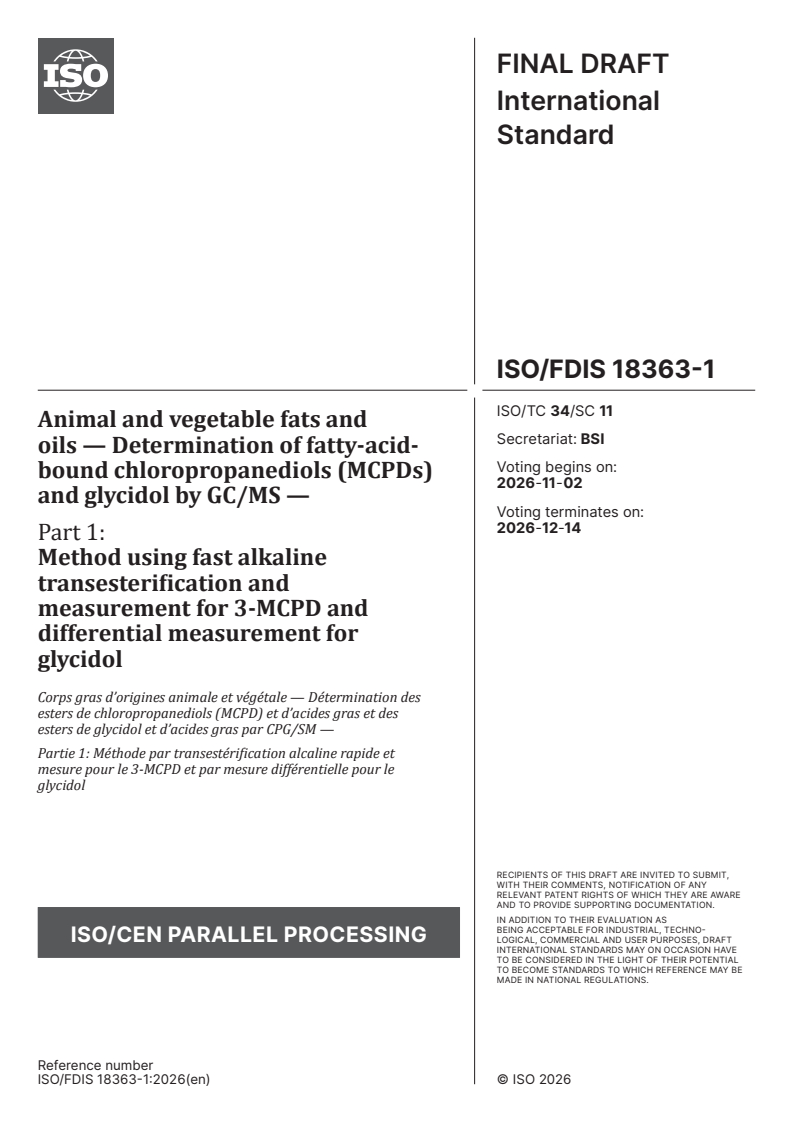
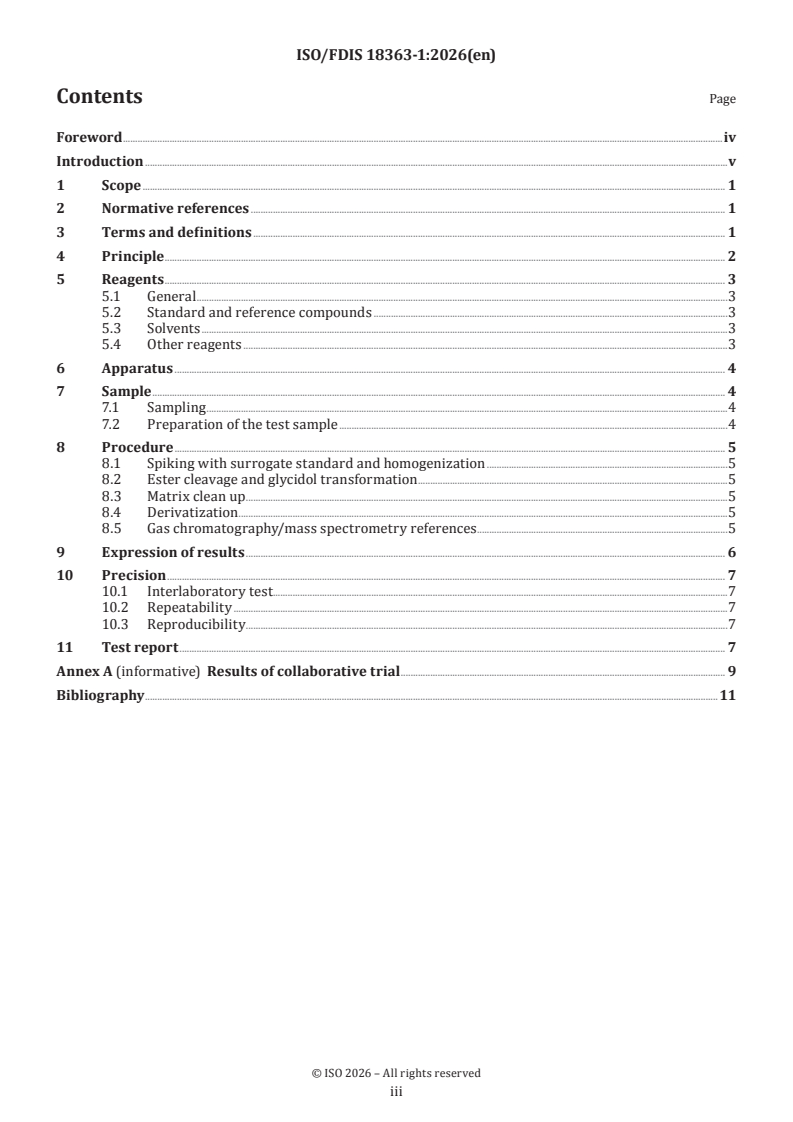
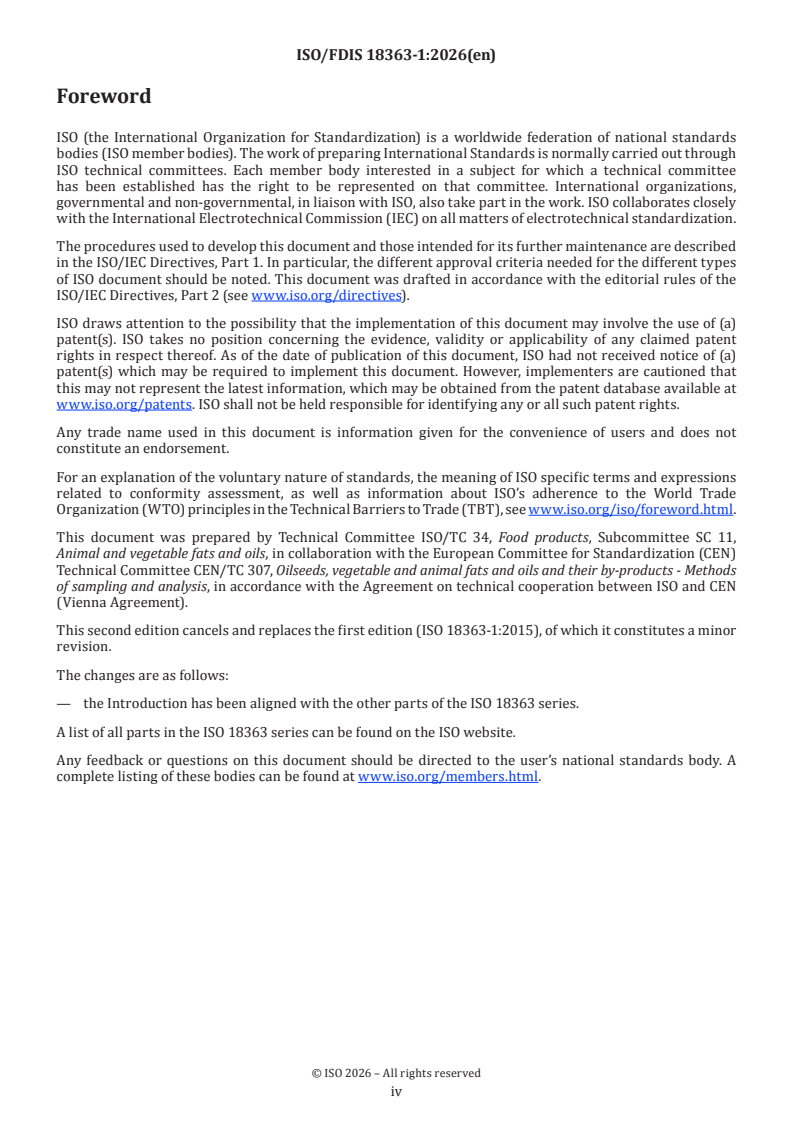
ISO/FDIS 18363-1 - Animal and vegetable fats and oils — Determination of fatty-acid-bound chloropropanediols (MCPDs) and glycidol by GC/MS — Part 1: Method using fast alkaline transesterification and measurement for 3-MCPD and differential measurement for glycidol
REDLINE ISO/FDIS 18363-1 - Animal and vegetable fats and oils — Determination of fatty-acid-bound chloropropanediols (MCPDs) and glycidol by GC/MS — Part 1: Method using fast alkaline transesterification and measurement for 3-MCPD and differential measurement for glycidol
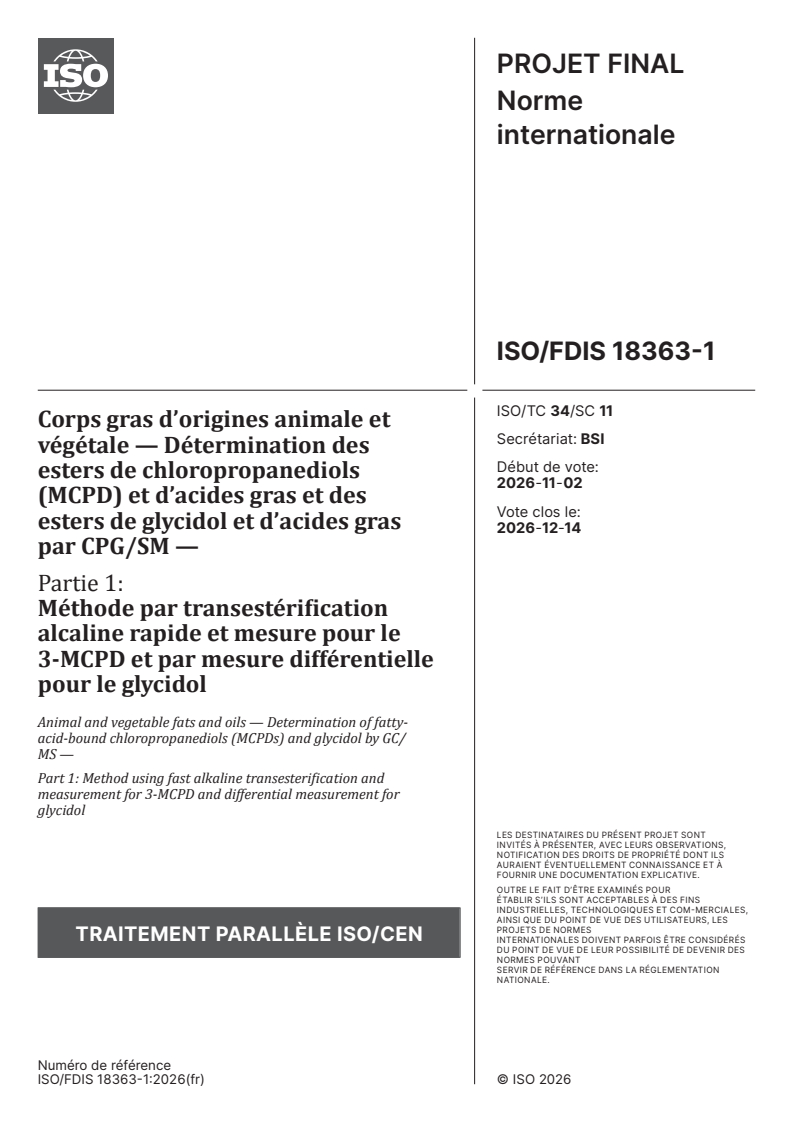
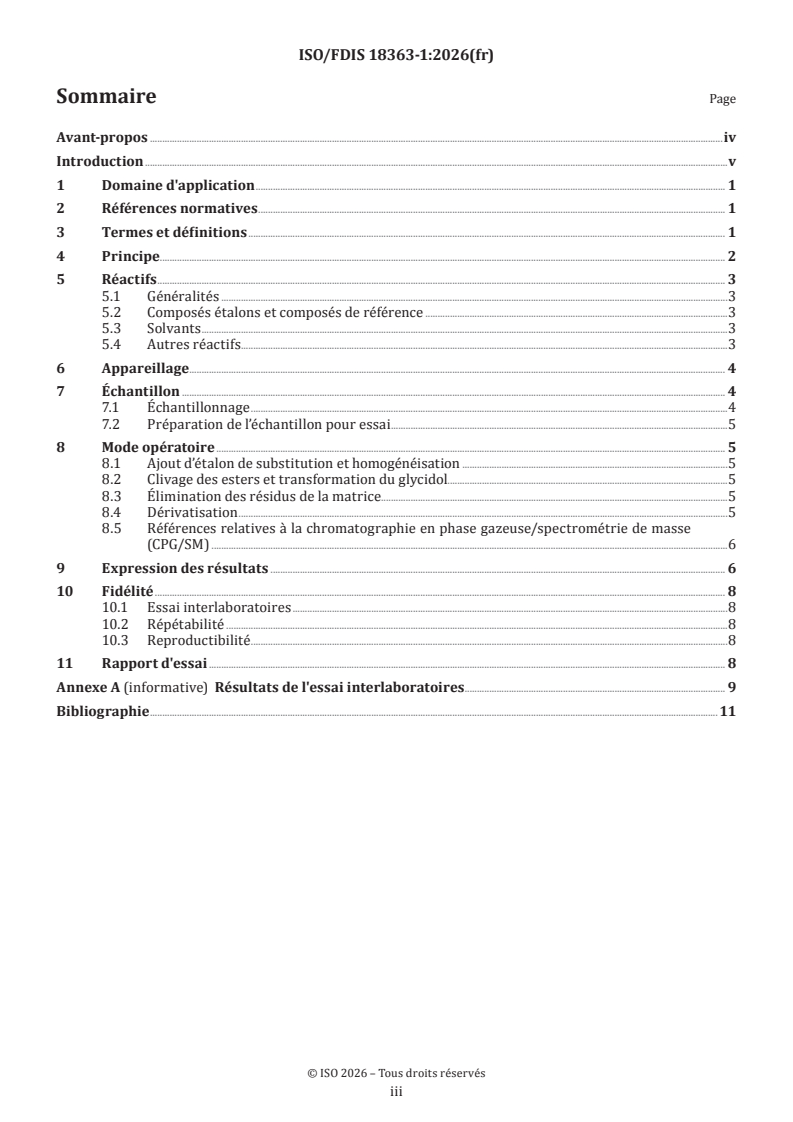
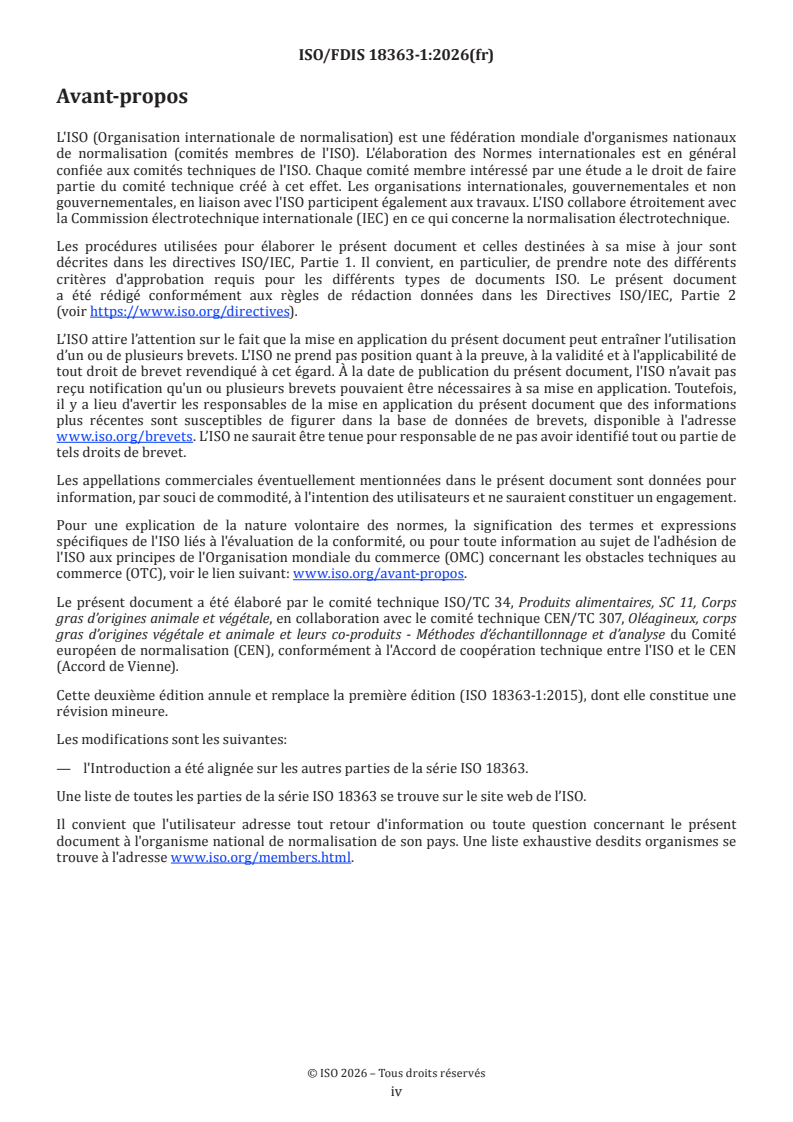
ISO/FDIS 18363-1 - Corps gras d’origines animale et végétale — Détermination des esters de chloropropanediols (MCPD) et d’acides gras et des esters de glycidol et d’acides gras par CPG/SM — Partie 1: Méthode par transestérification alcaline rapide et mesure pour le 3-MCPD et par mesure différentielle pour le glycidol
ISO/FDIS 18363-1 is an International Organization for Standardization (ISO) method for measuring fatty-acid-bound chloropropanediols and glycidol in animal and vegetable fats and oils by gas chromatography/mass spectrometry (GC/MS). It specifies a fast alkaline transesterification procedure for the indirect determination of bound 3-MCPD and glycidol, with results reported through separate assay A and assay B measurements. The document is written for laboratories that analyze fats and oils and need a defined GC/MS procedure, calculation approach, and reporting format.
What does ISO/FDIS 18363-1 specify?
ISO/FDIS 18363-1 specifies a laboratory method for solid and liquid fats and oils. It covers indirect determination of bound 3-MCPD after alkaline-catalysed ester cleavage and derivatization with phenylboronic acid (PBA), and indirect determination of bound glycidol by differential measurement.
The scope excludes milk and milk products, including fat from milk and milk products. The document is organized into clauses on scope, normative references, terms and definitions, principle, reagents, apparatus, sampling and sample preparation, procedure, result expression, precision, and test report, plus an informative annex with collaborative-trial data.
What are the key requirements of ISO/FDIS 18363-1?
ISO/FDIS 18363-1 is built around two parallel determinations, assay A and assay B. Assay A measures the combined response from bound 3-MCPD and bound glycidol after glycidol is converted to 3-MCPD under acidic chloride conditions; assay B measures bound 3-MCPD only under chloride-free acidic conditions. In practice, the glycidol content is obtained from the difference between the two assays, so the analyst must run both preparations and keep them strictly comparable.
Sample handling and preparation
Clause 7 says liquid samples are used as received, while solid or turbid fats are melted carefully. Samples with significant water phase separation are not simply melted; they are used as such or the fat fraction is isolated by liquid/liquid extraction. This matters because water, chloride, and phase behavior can affect the reaction and the result.
Reaction control and cleanup
Clause 8 requires a short alkaline cleavage time, followed by immediate stopping of the reaction with either acidified sodium chloride solution for assay A or acidified chloride-free salt solution for assay B. The document warns that the reaction time is critical, because 3-MCPD and the isotopically labelled internal standard can convert to glycidol if the alkaline step is too long. The method then uses solvent extraction, matrix cleanup, derivatization with PBA, drying over anhydrous sodium sulfate, and final dissolution in isooctane before GC/MS analysis.
Instrumental measurement
Clause 8.5 specifies GC/MS conditions, including temperature-programmed injection, helium carrier gas, electron-impact ionization, selected ion monitoring (SIM), and a fused-silica GC column with a 50 % diphenyl - 50 % dimethylpolysiloxane stationary phase. In practice, this tells the laboratory what type of GC/MS setup is suitable and which ion traces are used for quantification and confirmation.
Quantification and calibration
Clause 9 states that quantification uses the isotopically labelled surrogate standard d-3-MCPD-1,2-bis-palmitoyl ester. The document also requires a matrix calibration to establish method linearity, relative recovery, and the transformation factor used for glycidol. This matters because the glycidol result is not measured directly as glycidol, but calculated from the difference between the two assays.
Reporting and quality control
Clause 9 requires reporting results to one decimal place. Clause 11 requires the report to identify the sample, the sampling method if known, the test method, and whether assay A or assay B was used. The document also notes that assay B is used for the true 3-MCPD result, while assay A gives the combined amount of 3-MCPD and glycidol. A blank sample is recommended daily to monitor contamination.
What terms does ISO/FDIS 18363-1 define?
- Bound 3-MCPD - the sum of 3-MCPD derivatives cleaved by alkaline-catalysed alcoholysis, reported as mg/kg.
- Bound glycidol - the sum of glycidyl derivatives cleaved by alkaline-catalysed alcoholysis, reported as mg/kg.
- Assay A - the determination that gives the combined amount of bound 3-MCPD and bound glycidol, expressed as 3-MCPD.
- Assay B - the determination that gives bound 3-MCPD only.
- PBA - phenylboronic acid, the derivatization reagent used before GC/MS measurement.
- tBME - tertiary-butyl methyl ether, the solvent used to dissolve the sample at the start of the procedure.
- GC-MS - gas chromatography/mass spectrometry, the measurement technique used to detect and quantify the derivatized analytes.
Who uses ISO/FDIS 18363-1?
ISO/FDIS 18363-1 is used by analytical laboratories that test edible fats and oils, including quality-control, routine testing, and method-validation labs. It is relevant to food manufacturers, ingredient suppliers, and buyers who need results for 3-MCPD and glycidol monitoring in fat-based raw materials or finished products. It is also useful for laboratories that need a documented GC/MS procedure with defined calculation and reporting rules.
What changed in ISO/FDIS 18363-1 from the previous edition?
ISO/FDIS 18363-1 replaces ISO 18363-1:2015. This second edition is a minor revision, and the change stated in the document is that the Introduction has been aligned with the other parts of the ISO 18363 series.
Which standards are used with ISO/FDIS 18363-1?
- ISO 3696 - provides the water quality required for analytical laboratory use.
- ISO 5555 - gives a recommended sampling method for fats and oils.
- ISO 5725-2 - provides the basic method used for the precision evaluation reported in Annex A.
- ISO 18363 (all parts) - the series for determining fatty-acid-bound MCPDs and glycidol by GC/MS, with this part positioned as the fast alkaline transesterification method.
- ISO 18363-2, ISO 18363-3, ISO 18363-4 - related methods in the same series, cited in the introduction for comparison of method principles and analyte coverage.
What does the ISO/FDIS 18363-1 document contain?
ISO/FDIS 18363-1 contains a stepwise analytical method rather than a product specification. Clauses 4 to 11 cover the principle, reagents, apparatus, sample preparation, reaction steps, cleanup, derivatization, GC/MS conditions, result calculations, precision, and the test report. Annex A gives collaborative-trial results, including statistical summaries for assay A and assay B. The document also includes formulas for calculating 3-MCPD, the transformation factor, and glycidol from the measured signal-area ratios.
Relations
- Effective Date
- 15-Aug-2026
- Effective Date
- 08-Aug-2026
Buy Documents
ISO/FDIS 18363-1 - Animal and vegetable fats and oils — Determination of fatty-acid-bound chloropropanediols (MCPDs) and glycidol by GC/MS — Part 1: Method using fast alkaline transesterification and measurement for 3-MCPD and differential measurement for glycidol
REDLINE ISO/FDIS 18363-1 - Animal and vegetable fats and oils — Determination of fatty-acid-bound chloropropanediols (MCPDs) and glycidol by GC/MS — Part 1: Method using fast alkaline transesterification and measurement for 3-MCPD and differential measurement for glycidol
ISO/FDIS 18363-1 - Corps gras d’origines animale et végétale — Détermination des esters de chloropropanediols (MCPD) et d’acides gras et des esters de glycidol et d’acides gras par CPG/SM — Partie 1: Méthode par transestérification alcaline rapide et mesure pour le 3-MCPD et par mesure différentielle pour le glycidol
Get Certified
Connect with accredited certification bodies for this standard

BSI Group
BSI (British Standards Institution) is the business standards company that helps organizations make excellence a habit.

Bureau Veritas
Bureau Veritas is a world leader in laboratory testing, inspection and certification services.

DNV
DNV is an independent assurance and risk management provider.
Sponsored listings
Frequently Asked Questions
ISO/FDIS 18363-1 is a draft published by the International Organization for Standardization (ISO). Its full title is "Animal and vegetable fats and oils — Determination of fatty-acid-bound chloropropanediols (MCPDs) and glycidol by GC/MS — Part 1: Method using fast alkaline transesterification and measurement for 3-MCPD and differential measurement for glycidol". This standard covers: ISO 18363-1:2015 describes a procedure for the indirect determination of 3-MCPD esters (bound 3-MCPD) and possible free 3-MCPD after alkaline catalysed ester cleavage and derivatization with phenylboronic acid (PBA). Furthermore, this part of ISO 18363 enables the indirect determination of glycidyl esters (bound glycidol) under the assumption that no other substances are present that react at room temperature with inorganic chloride to generate 3-MCPD. ISO 18363-1:2015 is applicable to solid and liquid fats and oils. Milk and milk products (or fat coming from milk and milk products) are excluded from the scope of this part of ISO 18363.
ISO 18363-1:2015 describes a procedure for the indirect determination of 3-MCPD esters (bound 3-MCPD) and possible free 3-MCPD after alkaline catalysed ester cleavage and derivatization with phenylboronic acid (PBA). Furthermore, this part of ISO 18363 enables the indirect determination of glycidyl esters (bound glycidol) under the assumption that no other substances are present that react at room temperature with inorganic chloride to generate 3-MCPD. ISO 18363-1:2015 is applicable to solid and liquid fats and oils. Milk and milk products (or fat coming from milk and milk products) are excluded from the scope of this part of ISO 18363.
ISO/FDIS 18363-1 is classified under the following ICS (International Classification for Standards) categories: 67.200.10 - Animal and vegetable fats and oils. The ICS classification helps identify the subject area and facilitates finding related standards.
ISO/FDIS 18363-1 has the following relationships with other standards: It is inter standard links to prEN ISO 18363-1, ISO 18363-1:2015. Understanding these relationships helps ensure you are using the most current and applicable version of the standard.
ISO/FDIS 18363-1 is available in PDF format for immediate download after purchase. The document can be added to your cart and obtained through the secure checkout process. Digital delivery ensures instant access to the complete standard document.
Standards Content (Sample)
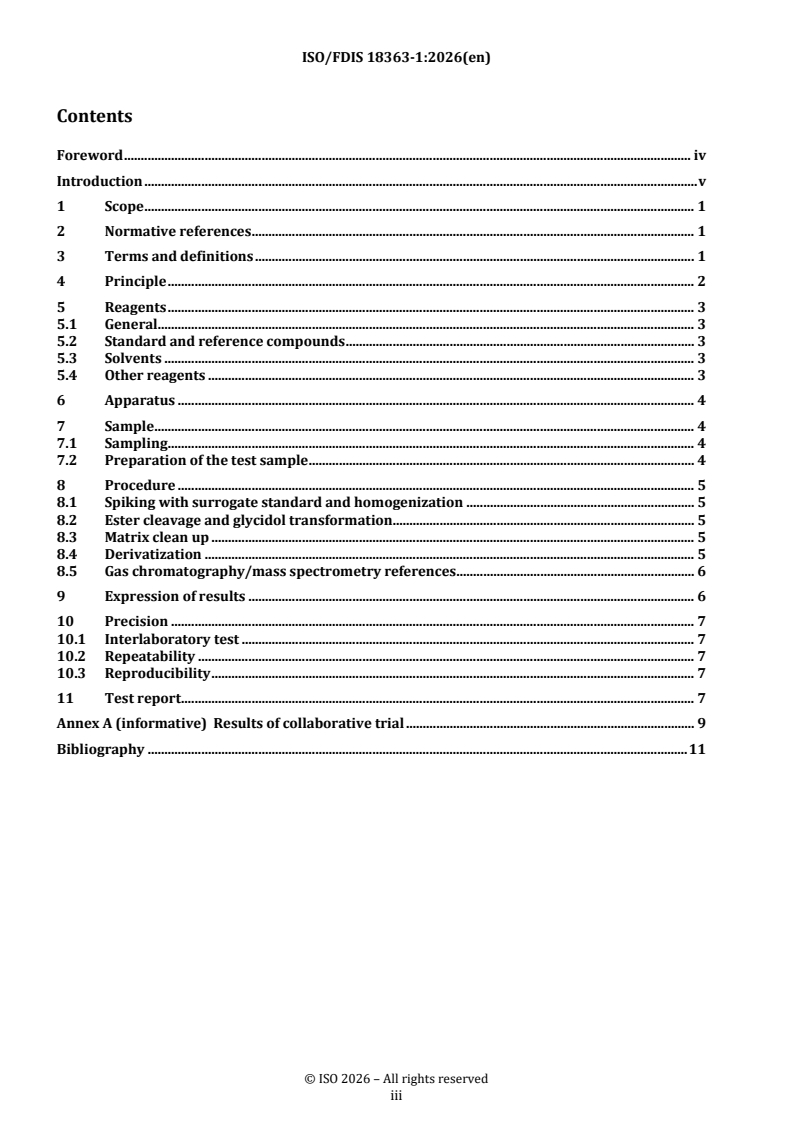
Contents
- Introduction
- 1 Scope
- 2 Normative references
- 3 Terms and definitions
- 3.1 bound 3-MCPD
- 3.2 bound glycidol
- 4 Principle
- 5 Reagents
- 5.1 General
- 5.2 Standard and reference compounds
- 5.3 Solvents
- 5.4 Other reagents
- 6 Apparatus
- 7 Sample
- 7.1 Sampling
- 7.2 Preparation of the test sample
- 8 Procedure
- 8.1 Spiking with surrogate standard and homogenization
- 8.2 Ester cleavage and glycidol transformation
- 8.3 Matrix clean up
- 8.4 Derivatization
- 8.5 Gas chromatography/mass spectrometry references
- 9 Expression of results
- 10 Precision
- 10.1 Interlaboratory test
- 10.2 Repeatability
- 10.3 Reproducibility
- 11 Test report
- Annex A
- Bibliography
Introduction
[1] The ISO 18363 series can be used for the determination of ester-bound MCPD and glycidol. This introduction describes the methods specified in the different parts so that the analyst can decide which methods are suitable for application. The detailed application of each method is contained within the scope of each individual method.
[2] This document (i.e. 18363-1) is a differential method equivalent to the DGF standard C-VI 18 (10) and [3] identical to AOCS Official Method Cd 29c-13 . In brief, it is based on a fast alkaline catalysed release of 3-MCPD and glycidol from the ester derivatives. Glycidol is subsequently converted into induced 3-MCPD. It consists of two parts. The first part (A) allows the determination of the sum of ester-bound 3-MCPD and ester-bound glycidol, whereas the second part (B) determines ester-bound 3-MCPD only. Both assays are based on the release of the target analytes 3-MCPD and glycidol from the ester-bound form by an alkaline catalysed alcoholysis carried out at room temperature. In part A, an acidified sodium chloride solution is used to stop the reaction and subsequently convert the glycidol into induced 3-MCPD. Thus, 3-MCPD and glycidol become indistinguishable in part A. In part B, the reaction stop is achieved by the addition of an acidified chloride-free salt solution which also prevents the conversion of glycidol into induced MCPD. Consequently, part B allows the determination of the genuine 3-MCPD content. Finally, the glycidol content of the sample is proportional to the difference of both assays (A – B) and can be calculated when the transformation ratio from glycidol to 3-MCPD has been determined. This document is applicable to the fast determination of ester-bound 3-MCPD and glycidol in refined and non-refined vegetable oils and fats. This document can also apply to animal fats and used frying oils and fats, but a validation study must be undertaken before the analysis of these matrices. Any free analytes within the sample would be included in the results, but the document does not allow the distinction between free and bound analytes. However, as of publication of this document, research has not shown any evidence of a free analyte content as high as the esterified analyte content in refined vegetable oils and fats. In principle, this document can also be modified in such a way [4] that the determination of 2-MCPD is feasible , but again, a validation study must be undertaken before the analysis of this analyte.
[5] [6] ISO 18363-2 represents AOCS Official Method Cd 29b-13 . In brief, it is based on a slow alkaline release of MCPD and glycidol from the ester derivatives. Glycidol is subsequently converted into 3-MBPD. [7] [5] ISO 18363-2 consists of two sample preparations that differ in the use of internal standards. Both preparations are used for the determination of ester-bound 2-MCPD and 3-MCPD. In part A, a preliminary result for ester-bound glycidol is determined. Because the 3-MCPD present in the sample is converted to some minor extent into induced glycidol by the sample preparation, part B serves to quantify this amount of induced glycidol that is subsequently subtracted from the preliminary glycidol result of part A. By the use of isotopically labelled free MCPD isomers in assay A and isotopically labelled ester-bound 2-MCPD and 3-MCPD in part B, the efficiency of ester cleavage can be monitored. Both assays A and B are based on the release of the target analytes 2-MCPD, 3-MCPD and glycidol from the ester-bound form by a slow alkaline catalysed alcoholysis in the cold. In both sample preparations, the reaction is stopped by the addition of an acidified concentrated sodium bromide solution so as to convert the unstable and volatile glycidol into 3-MBPD which shows comparable properties to 3-MCPD with regard to its stability and chromatographic performance. Moreover, the major excess of bromide ions prevents the undesired formation of 3-MCPD from glycidol in [5] the case of samples which contain naturally occurring amounts of chloride. ISO 18363-2 is applicable to the determination of ester-bound 3-MCPD, 2-MCPD and glycidol in refined and unrefined vegetable oils and fats. It also applies to animal fats and used frying oils and fats, but a validation study must be undertaken before the analysis of these matrices. Any free analytes within the sample are included in the results, but the document does not allow the distinction between free and bound analytes. However, as of publication of this document, research has not shown any evidence of a free analyte content as high as the esterified analyte content in refined vegetable oils and fats.
[8] [9][10] ISO 18363-3 represents AOCS Official Method Cd 29a-13 . In brief, it is based on the conversion of glycidyl esters into 3-MBPD esters and a slow acidic catalysed release of MCPD and MBPD from the ester [8] derivatives. ISO 18363-3 is based on a single sample preparation in which glycidyl esters are converted into MBPD monoesters, and subsequently the free analytes 2-MCPD, 3-MCPD and 3-MBPD are released by a slow acid-catalysed alcoholysis. The 3-MBPD represents the genuine content of bound glycidol. ISO 18363-3 [8] is applicable to the determination of ester-bound 2-MCPD, 3-MCPD and glycidol in refined and non-refined vegetable oils and fats. It also applies to animal fats and used frying oils and fats, but a validation study must be undertaken before the analysis of these matrices. The method is suited for the analysis of bound
ISO/FDIS 18363-1:2026(en) [8] (esterified) analytes, but if required, ISO 18363-3 can also be performed without the initial conversion of glycidyl esters. In such a setup, both free and bound 2-MCPD and 3-MCPD forms are included in the results and the amount of free analytes can be calculated as the difference between two determinations performed in both setups. However, as of publication of this document, research has not shown any evidence of a free analyte content as high as the esterified analyte content in refined vegetable oils and fats. [11] ISO 18363-4 specifies a rapid procedure based on fast alkaline cleavage of the MCPD and glycidyl esters. The released glycidol is subsequently converted into 3-MBPD. The pH of the fast alkaline cleavage generally causes the released MCPD to partially convert to glycidol during the cleavage of the esters, leading to overestimation of the glycidyl ester content of the sample. By adding two distinct isotopically labelled esterbound 3-MCPD and glycidol internal standards, it is possible to quantify the amount of labelled glycidol resulting from the degradation of the released internal standard. This information can be used to correct for overestimation of the glycidyl ester induced glycidol by 3-MCPD induced glycidol. The same two internal standards are used for quantification of the bound MCPD and glycidol, requiring a single sample preparation [12] to quantify bound 2-MCPD-, 3-MCPD- and glycidol esters. In analogue with ISO 18363-1 , this document [8] and ISO 18363-3 , the released MCPDs and 3-MBPD are derivatized with phenylboronic acid before GC- [1] [11] MS/MS analysis. In contrast to the other parts of the ISO 18363 series , ISO 18363-4 requires GC-MS/ MS instrumentation to unambiguously detect each of the (isotopically labelled) MBPDs required for correct [11] quantification of the glycidyl ester induced glycidol. ISO 18363-4 is applicable to the determination of ester-bound 3-MCPD, 2-MCPD and glycidol in refined and unrefined vegetable oils and fats. It also applies to animal fats and used frying oils and fats, but a validation study must be undertaken before analysis of [11] these matrices. Any free analytes within the sample are included in the results, but ISO 18363-4 will not allow the distinction between free and bound analytes. However, as of publication of this document, research has not shown any evidence of a free analyte content as high as the esterified analyte content in refined vegetable oils and fats.
FINAL DRAFT International Standard ISO/FDIS 18363-1:2026(en) Animal and vegetable fats and oils — Determination of fattyacid-bound chloropropanediols (MCPDs) and glycidol by GC/ MS — Part 1:
Method using fast alkaline transesterification and measurement for 3-MCPD and differential measurement for glycidol
1 Scope
This document specifies a procedure for the indirect determination of 3-MCPD esters (bound 3-MCPD) and possible free 3-MCPD after alkaline catalysed ester cleavage and derivatization with phenylboronic acid (PBA). Furthermore, this document enables the indirect determination of glycidyl esters (bound glycidol) under the assumption that no other substances are present that react at room temperature with inorganic chloride to generate 3-MCPD.
This document is applicable to solid and liquid fats and oils. It does not apply to milk and milk products (or fat coming from milk and milk products).
2 Normative references
The following documents are referred to in the text in such a way that some or all of their content constitutes requirements of this document. For dated references, only the edition cited applies. For undated references, the latest edition of the referenced document (including any amendments) applies. ISO 3696, Water for analytical laboratory use — Specification and test methods
3 Terms and definitions
For the purposes of this document, the following terms and definitions apply. ISO and IEC maintain terminology databases for use in standardization at the following addresses:
- ISO Online browsing platform: available at https:// www .iso .org/ obp
- IEC Electropedia: available at https:// www .electropedia .org/
3.1 bound 3-MCPD
sum of all 3-MCPD derivatives being cleaved by alkaline catalysed alcoholysis (especially fatty acid esters) according to the reference method Note 1 to entry: The content of 3-MCPD is calculated and reported as a mass fraction, in milligrams per kilogram (mg/ kg).
Note 2 to entry: In fats and oils, the amount of free 3-MCPD which can possibly occur is generally negligibly low but has a bearing on the result.
ISO/FDIS 18363-1:2026(en)
3.2 bound glycidol
sum of all glycidyl derivatives being cleaved by alkaline catalysed alcoholysis (especially fatty acid esters) according to the specified standard Note 1 to entry: The content of glycidol is calculated and reported as a mass fraction, in milligrams per kilogram (mg/ kg).
Note 2 to entry: The presence of free glycidol in fats and oils is unlikely because of the instability of this compound.
4 Principle
For the determination of the sum of bound 3-MCPD and bound glycidol as free 3-MCPD (assay A), an aliquot of the sample is spiked with surrogate standard d -3-MCPD-1,2-bis-palmitoyl ester and dissolved in tertiary-
...
Contents
- Introduction
- 1 Scope
- 2 Normative references
- 3 Terms and definitions
- 3.1 bound 3-MCPD
- 3.2 bound glycidol
- 4 Principle
- 5 Reagents
- 5.1 General
- 5.2 Standard and reference compounds
- 5.3 Solvents
- 5.4 Other reagents
- 6 Apparatus
- 7 Sample
- 7.1 Sampling
- 7.2 Preparation of the test sample
- 8 Procedure
- 8.1 Spiking with surrogate standard and homogenization
- 8.2 Ester cleavage and glycidol transformation
- 8.3 Matrix clean up
- 8.4 Derivatization
- 8.5 Gas chromatography/mass spectrometry references
- 9 Expression of results
- 10 Precision
- 10.1 Interlaboratory test
- 10.2 Repeatability
- 10.3 Reproducibility
- 11 Test report
- Annex A
- Bibliography
Introduction
[1] The ISO 18363 series can be used for the determination of ester-bound MCPD and glycidol. This introduction describes the methods specified in the different parts so that the analyst can decide which methods are suitable for application. The detailed application of each method is contained within the scope of each individual method.
[2] This document (i.e. 18363-1) is a differential method equivalent to the DGF standard C-VI 18 (10) and [3] identical to AOCS Official Method Cd 29c-13 .. In brief, it is based on a fast alkaline catalysed release of 3- MCPD and glycidol from the ester derivatives. Glycidol is subsequently converted into induced 3-MCPD. It consists of two parts. The first part (A) allows the determination of the sum of ester-bound 3-MCPD and esterbound glycidol, whereas the second part (B) determines ester-bound 3-MCPD only. Both assays are based on the release of the target analytes 3-MCPD and glycidol from the ester-bound form by an alkaline catalysed alcoholysis carried out at room temperature. In part A, an acidified sodium chloride solution is used to stop the reaction and subsequently convert the glycidol into induced 3-MCPD. Thus, 3-MCPD and glycidol become indistinguishable in part A. In part B, the reaction stop is achieved by the addition of an acidified chloride-free salt solution which also prevents the conversion of glycidol into induced MCPD. ConsequantlyConsequently, part B allows the determination of the genuine 3-MCPD content. Finally, the glycidol content of the sample is proportional to the difference of both assays (A – B) and can be calculated when the transformation ratio from glycidol to 3-MCPD has been determined. This document is applicable forto the fast determination of esterbound 3-MCPD and glycidol in refined and non-refined vegetable oils and fats. This document can also apply to animal fats and used frying oils and fats, but a validation study has tomust be undertaken before the analysis of these matrices. Any free analytes within the sample would be included in the results, but the document does not allow the distinction between free and bound analytes. However, as of publication of this document, research has not shown any evidence of a free analyte content as high as the esterified analyte content in refined vegetable oils and fats. In principle, this document can also be modified in such a way that the [4] determination of 2-MCPD is feasible ,, but again, a validation study has tomust be undertaken before the analysis of this analyte.
[5] [6] ISO 18363-2 ISO 18363-2 represents AOCS Official Method Cd 29b-13 . In brief, it is based on a slow alkaline release of MCPD and glycidol from the ester derivatives. Glycidol is subsequently converted into 3- [7] [5] MBPD . ISO 18363-2. ISO 18363-2 consists of two sample preparations that differ in the use of internal standards. Both preparations are used for the determination of ester-bound 2-MCPD and 3-MCPD. In part A, a preliminary result for ester-bound glycidol is determined. Because the 3-MCPD present in the sample is converted to some minor extent into induced glycidol by the sample preparation, part B serves to quantify this amount of induced glycidol that is subsequently subtracted from the preliminary glycidol result of part A. By the use of isotopically labelled free MCPD isomers in assay A and isotopically labelled ester-bound 2-MCPD and 3-MCPD in part B, the efficiency of ester cleavage can be monitored. Both assays A and B are based on the release of the target analytes 2-MCPD, 3-MCPD and glycidol from the ester-bound form by a slow alkaline catalysed alcoholysis in the cold. In both sample preparations, the reaction is stopped by the addition of an acidified concentrated sodium bromide solution so as to convert the unstable and volatile glycidol into 3- MBPD which shows comparable properties to 3-MCPD with regard to its stability and chromatographic performance. Moreover, the major excess of bromide ions prevents the undesired formation of 3-MCPD from [5] glycidol in the case of samples which contain naturally occurring amounts of chloride. ISO 18363-2 ISO 18363-2 is applicable to the determination of ester-bound 3-MCPD, 2-MCPD and glycidol in refined and unrefined vegetable oils and fats. It also applies to animal fats and used frying oils and fats, but a validation study must be undertaken before the analysis of these matrices. Any free analytes within the sample are included in the results, but the document does not allow the distinction between free and bound analytes. However, as of publication of this document, research has not shown any evidence of a free analyte content as high as the esterified analyte content in refined vegetable oils and fats. [8] [9] [10] ISO 18363-3 represents AOCS Official Method Cd 29a-13 .. In brief, it is based on the conversion of glycidyl esters into 3-MBPD esters and a slow acidic catalysed release of MCPD and MBPD from the ester [8] derivatives. ISO 18363-3 ISO 18363-3 is based on a single sample preparation in which glycidyl esters are
ISO/FDIS 18363-1:2026(en) converted into MBPD monoesters, and subsequently the free analytes 2-MCPD, 3-MCPD and 3-MBPD are released by a slow acid-catalysed alcoholysis. The 3-MBPD represents the genuine content of bound glycidol. [8] ISO 18363-3 ISO 18363-3 is applicable to the determination of ester-bound 2-MCPD, 3-MCPD and glycidol in refined and non-refined vegetable oils and fats. It also applies to animal fats and used frying oils and fats, but a validation study must be undertaken before the analysis of these matrices. The method is suited for the [8] analysis of bound (esterified) analytes, but if required, ISO 18363-3 ISO 18363-3 can also be performed without the initial conversion of glycidyl esters. In such a setup, both free and bound 2-MCPD and 3-MCPD forms are included in the results and the amount of free analytes can be calculated as the difference between two determinations performed in both setups. However, as of publication of this document, research has not shown any evidence of a free analyte content as high as the esterified analyte content in refined vegetable oils and fats.
[11] ISO 18363-4 ISO 18363-4 specifies a rapid procedure based on fast alkaline cleavage of the MCPD and glycidyl esters. The released glycidol is subsequently converted into 3-MBPD. The pH of the fast alkaline cleavage generally causes the released MCPD to partially convert to glycidol during the cleavage of the esters, leading to overestimation of the glycidyl ester content of the sample. By adding two distinct isotopically labelled ester-bound 3-MCPD and glycidol internal standards, it is possible to quantify the amount of labelled glycidol resulting from the degradation of the released internal standard. This information can be used to correct for overestimation of the glycidyl ester induced glycidol by 3-MCPD induced glycidol. The same two internal standards are used for quantification of the bound MCPD and glycidol, requiring a single sample [12] preparation to quantify bound 2-MCPD-, 3-MCPD- and glycidol esters. In analogue with ISO 18363-1 ISO [8] 18363-1,, this document and ISO 18363-3 ISO 18363-3,, the released MCPDs and 3-MBPD are derivatized [1] with phenylboronic acid before GC-MS/MS analysis. In contrast to the other parts of the ISO 18363 series , [11] ISO 18363-4, ISO 18363-4 requires GC-MS/MS instrumentation to unambiguously detect each of the (isotopically labelled) MBPDs required for correct quantification of the glycidyl ester induced glycidol. ISO [11] 18363-4 ISO 18363-4 is applicable to the determination of ester-bound 3-MCPD, 2-MCPD and glycidol in refined and unrefined vegetable oils and fats. It also applies to animal fats and used frying oils and fats, but a validation study must be undertaken before analysis of these matrices. Any free analytes within the sample [11] are included in the results, but ISO 18363-4 ISO 18363-4 will not allow the distinction between free and bound analytes. However, as of publication of this document, research has not shown any evidence of a free analyte content as high as the esterified analyte content in refined vegetable oils and fats.
ISO/FDIS 18363-1:2026(en) Animal and vegetable fats and oils — Determination of fatty-acidbound chloropropanediols (MCPDs) and glycidol by GC/MS — Part 1:
Method using fast alkaline transesterification and measurement for 3- MCPD and differential measurement for glycidol
1 Scope
This part of ISO 18363 describesdocument specifies a procedure for the indirect determination of 3-MCPD esters (bound 3-MCPD) and possible free 3-MCPD after alkaline catalysed ester cleavage and derivatization with phenylboronic acid (PBA). Furthermore, this part of ISO 18363document enables the indirect determination of glycidyl esters (bound glycidol) under the assumption that no other substances are present that react at room temperature with inorganic chloride to generate 3-MCPD. This part of ISO 18363document is applicable to solid and liquid fats and oils. MilkIt does not apply to milk and milk products (or fat coming from milk and milk products) are excluded from the scope of this part of ISO 18363.).
2 Normative references
The following documents are referred to in the text in such a way that some or all of their content constitutes requirements of this document. For dated references, only the edition cited applies. For undated references, the latest edition of the referenced document (including any amendments) applies. ISO 3696, Water for analytical laboratory use — Specification and test methods
3 Terms and definitions
For the purposes of this document, the following terms and definitions apply. ISO and IEC maintain terminology databases for use in standardization at the following addresses:
- ISO Online browsing platform: available at https://www.iso.org/obp
- IEC Electropedia: available at https://www.electropedia.org/
3.1 bound 3-MCPD
sum of all 3-MCPD derivatives being cleaved by alkaline catalysed alcoholysis (especially fatty acid esters) according to the reference method Note 1 to entry: The content of 3-MCPD is calculated and reported as a mass fraction, in milligrams per kilogram (mg/kg). Note 2 to entry: In fats and oils, the amount of free 3-MCPD which can possibly occur is generally negligibly low but has a bearing on the result.
3.2 bound glycidol
sum of all glycidyl derivatives being cleaved by alkaline catalysed alcoholysis (especially fatty acid esters) according to the specified standard
ISO/FDIS 18363-1:2026(en) Note 1 to entry: The content of glycidol is calculated and reported as a mass fraction, in milligrams per kilogram (mg/kg). Note 2 to entry: The presence of free glycidol in fats and oils is unlikely because of the instability of this compound.
4 Principle
For the determination of the sum of bound 3-MCPD and bound glycidol as free 3-MCPD (assay A), an aliquot of the sample is spiked with surrogate standard d -3-MCPD-1,2-bis-palmitoyl ester and dissolved in tertiary-
...
Contents
- Introduction
- 1 Domaine d'application
- 2 Références normatives
- 3 Termes et définitions
- 3.1 3-MCPD lié
- 3.2 glycidol lié
- 4 Principe
- 5 Réactifs
- 5.1 Généralités
- 5.2 Composés étalons et composés de référence
- 5.3 Solvants
- 5.4 Autres réactifs
- 6 Appareillage
- 6.5 Flacons à bouchon vissé (d'une capacité de 2 ml environ) et bouchons à vis avec septum en
- 6.10 Colonne chromatographique en silice fondue, phase stationnaire 50 % diphényl - 50 %
- 7 Échantillon
- 7.1 Échantillonnage
- 7.2 Préparation de l’échantillon pour essai
- 8 Mode opératoire
- 8.1 Ajout d’étalon de substitution et homogénéisation
- 8.2 Clivage des esters et transformation du glycidol
- 8.3 Élimination des résidus de la matrice
- 8.4 Dérivatisation
- 8.5 Références relatives à la chromatographie en phase gazeuse/spectrométrie de masse
- 9 Expression des résultats
- 10 Fidélité
- 10.1 Essai interlaboratoires
- 10.2 Répétabilité
- 10.3 Reproductibilité
- 11 Rapport d'essai
- Annexe A
- Bibliographie
Introduction
[1] La série ISO 18363 peut être utilisée pour la détermination des esters de MCPD et de glycidol. Cette introduction décrit les méthodes spécifiées dans les différentes parties pour que les analystes puissent décider des méthodes qui conviennent à leurs applications. L’application détaillée de chaque méthode figure dans le domaine d’application de chaque méthode concernée.
Le présent document (c'est-à-dire l'ISO 18363-1) est une méthode différentielle équivalente à la norme C VI 18 [2] [3] (10) de la DGF et identique à la méthode officielle Cd 29c-13 de l’AOCS. En résumé, elle repose sur la libération rapide par catalyse alcaline de 3-MCPD et de glycidol à partir de leurs dérivés esters. Le glycidol est par la suite converti en 3-MCPD. Elle comprend deux parties. La première partie (A) permet de déterminer la somme des esters de 3-MCPD et des esters de glycidol, tandis que la seconde partie (B) ne détermine que les esters de 3-MCPD. Les deux analyses reposent sur la libération des analytes cibles, le 3-MCPD et le glycidol, à partir des esters par alcoolyse en présence d’un catalyseur alcalin à température ambiante. Dans la partie A, une solution acidifiée de chlorure de sodium est utilisée pour interrompre la réaction et induire par la suite la conversion du glycidol en 3-MCPD. Il n’est par conséquent plus possible de faire la distinction entre le 3-MCPD et le glycidol dans la partie A. Dans la partie B, la réaction est interrompue par ajout d’une solution saline acidifiée exempte de chlorure qui évite aussi la conversion du glycidol en MCPD. Par conséquent, la partie B permet de déterminer la véritable teneur en 3-MCPD. Enfin, la teneur en glycidol de l’échantillon est proportionnelle à la différence entre les deux analyses (A – B) et peut être calculée lorsque le coefficient de transformation du glycidol en 3-MCPD a été déterminé. Le présent document s’applique à la détermination rapide des esters de 3-MCPD et de glycidol dans les corps gras d’origine végétale raffinés et non raffinés. Le présent document peut également s’appliquer aux graisses animales et aux corps gras de friture usagés, mais une étude de validation doit être menée avant de procéder à l’analyse de ces matrices. Les analytes libres éventuellement contenus dans l’échantillon sont habituellement inclus dans les résultats, mais le document ne permet pas de faire la distinction entre les analytes libres et les analytes liés. Néanmoins, les études disponibles au moment de la publication du présent document ne révèlent aucune teneur en analytes libres aussi élevée que la teneur en analytes estérifiés dans les corps gras d’origine végétale raffinés. En principe, [4] le présent document peut également être modifié de façon à permettre la détermination du 2-MCPD, mais une fois encore, une étude de validation doit être menée avant d’analyser cet analyte. [5] [6] L'ISO 18363-2 correspond à la méthode officielle Cd 29b-13 de l'AOCS. En résumé, elle repose sur une libération alcaline lente de MCPD et de glycidol à partir des formes esters. Le glycidol est par la suite converti [7] [5] en 3-MBPD. L'ISO 18363-2 comprend deux préparations d’échantillons qui se distinguent par l’utilisation d’étalons internes. Les deux préparations sont utilisées pour la détermination des esters de 2-MCPD et de 3-MCPD. Un résultat préliminaire pour les esters de glycidol est déterminé dans la partie A. Comme le 3-MCPD présent dans l’échantillon est partiellement converti en glycidol lors de la préparation de l’échantillon, la partie B sert à quantifier la teneur en glycidol issue de cette transformation qui est ensuite soustraite du résultat préliminaire obtenu pour le glycidol dans la partie A. L’utilisation d’isomères isotopiques de MCPD libres dans l’analyse A et de formes isotopiques d’esters de 2-MCPD et de 3-MCPD dans la partie B permet de surveiller le rendement du clivage des esters. Les analyses A et B reposent toutes les deux sur la libération des analytes cibles, 2-MCPD, 3-MCPD et glycidol à partir des esters dans le cadre d’une alcoolyse lente en présence d’un catalyseur alcalin dans le froid. Dans les deux préparations d’échantillons, la réaction est interrompue par l’ajout d’une solution acidifiée et concentrée de bromure de sodium de façon à transformer le glycidol instable et volatil en 3-MBPD qui présente des propriétés comparables au 3-MCPD en matière de stabilité et de performances chromatographiques. De plus, l’excès important d’ions bromure empêche la formation non souhaitée de 3-MCPD à partir du glycidol dans les échantillons contenant naturellement [5] des quantités de chlorure. L'ISO 18363-2 s’applique à la détermination des esters de 3-MCPD, de 2-MCPD et de glycidol dans les corps gras d’origine végétale raffinés et non raffinés. Elle s’applique également aux graisses animales et aux corps gras de friture usagés, mais une étude de validation doit être menée avant de procéder à l’analyse de ces matrices. Les analytes libres éventuellement contenus dans l’échantillon sont inclus dans les résultats, mais le document ne permet pas de faire la distinction entre les analytes libres et les analytes liés. Néanmoins, les études disponibles au moment de la publication du présent document ne révèlent aucune teneur en analytes libres aussi élevée que la teneur en analytes estérifiés dans les corps gras d’origine végétale raffinés.
[8] [9][10] L’ISO 18363-3 correspond à la méthode officielle Cd 29a-13 de l'AOCS. En résumé, elle repose sur la transformation des esters de glycidol en esters de 3-MBPD et une libération lente par catalyse acide du MCPD [8] et du MBPD à partir des formes esters. L’ISO 18363-3 repose sur la préparation d’un échantillon unique
ISO/FDIS 18363-1:2026(fr) dans lequel les esters de glycidol sont transformés en monoesters de MBPD puis les analytes libres 2-MCPD, 3-MCPD et 3-MBPD sont libérés par alcoolyse lente en présence d’un catalyseur acide. Le 3-MBPD représente [8] la véritable teneur en glycidol lié. L’ISO 18363-3 s’applique à la détermination des esters de 2-MCPD, de 3-MCPD et de glycidol dans les corps gras d’origine végétale raffinés et non raffinés. Elle s’applique également aux graisses animales et aux corps gras de friture usagés, mais une étude de validation doit être menée avant de procéder à l’analyse de ces matrices. La méthode est adaptée à l’analyse d’analytes liés (estérifiés), mais si [8] cela est exigé, L’ISO 18363-3 peut également être mise en œuvre sans la transformation initiale des esters de glycidol. Dans cette configuration, les formes libres et liées du 2-MCPD et du 3-MCPD sont toutes deux incluses dans les résultats et la teneur en analytes libres peut être calculée comme la différence entre deux déterminations réalisées dans les deux configurations. Néanmoins, les études disponibles au moment de la publication du présent document ne révèlent aucune teneur en analytes libres aussi élevée que la teneur en analytes estérifiés dans les corps gras d’origine végétale raffinés. [11] L’ISO 18363-4 spécifie un mode opératoire rapide reposant sur un clivage alcalin rapide des esters de MCPD et de glycidol. Le glycidol libéré est par la suite converti en 3-MBPD. Le pH du clivage alcalin rapide entraîne généralement la transformation partielle des MCPD libérés en glycidol au cours du clivage des esters, conduisant à une surestimation de la teneur en esters de glycidol de l’échantillon. En ajoutant deux étalons internes distincts d’ester de 3-MCPD et d’ester de glycidol marqués aux isotopes, il est possible de quantifier la quantité de glycidol marqué résultant de la dégradation de l’étalon interne libéré. Cette information peut être utilisée pour corriger la surestimation du glycidol issu des esters de glycidol par le glycidol issu du 3-MCPD. Les deux mêmes étalons internes sont utilisés pour la quantification des esters de MCPD et des esters de glycidol, nécessitant la préparation d’un seul échantillon pour quantifier les esters de [12] [8] 2-MCPD, 3-MCPD et de glycidol. De même que dans l’ISO 18363-1 e présent document et L’ISO 18363-3 les MCPD et 3-MBPD libérés sont dérivés avec de l’acide phénylboronique avant l’analyse par CPG-SM/SM. Au [1] [11] contraire des autres parties de la série ISO 18363, l’ISO 18363-4 exige un appareil de type CPG-SM/SM pour détecter sans ambiguïté chaque MBPD (marqué aux isotopes) requis pour une quantification exacte du [11] glycidol issu des esters de glycidol. L’ISO 18363-4 est applicable à la détermination des esters de 3-MCPD, de 2-MCPD et de glycidol dans les corps gras d’origine végétale raffinés et non raffinés. Elle s’applique également aux graisses animales et aux corps gras de friture usagés, mais une étude de validation doit être menée avant de procéder à l’analyse de ces matrices. Les analytes libres éventuellement contenus dans [11] l’échantillon sont inclus dans les résultats, mais l’ISO 18363-4 ne permettra pas de faire la distinction entre les analytes libres et les analytes liés. Néanmoins, les études disponibles au moment de la publication du présent document ne révèlent aucune teneur en analytes libres aussi élevée que la teneur en analytes estérifiés dans les corps gras d’origine végétale raffinés.
PROJET FINAL Norme internationale ISO/FDIS 18363-1:2026(fr) Corps gras d’origines animale et végétale — Détermination des esters de chloropropanediols (MCPD) et d’acides gras et des esters de glycidol et d’acides gras par CPG/SM — Partie 1:
Méthode par transestérification alcaline rapide et mesure pour le 3-MCPD et par mesure différentielle pour le glycidol
1 Domaine d'application
Le présent document spécifie un mode opératoire permettant la détermination indirecte des esters de 3-MCPD (ou 3-MCPD lié) et des éventuels 3-MCPD libres après clivage des esters par catalyse alcaline et dérivatisation à l'acide phénylboronique (PBA). Il définit également la détermination indirecte des esters de glycidol (ou glycidol lié) en partant de l'hypothèse qu'aucune autre substance présente ne réagit, à température ambiante, avec le chlorure inorganique pour générer du 3-MCPD. Le présent document est applicable aux corps gras solides et liquides. Il ne s'applique pas au lait et aux produits laitiers (ou aux corps gras issus du lait et des produits laitiers).
2 Références normatives
Les documents suivants sont cités dans le texte de sorte qu'ils constituent, pour tout ou partie de leur contenu, des exigences du présent document. Pour les références datées, seule l'édition citée s'applique. Pour les références non datées, la dernière édition du document de référence s'applique (y compris les éventuels amendements).
ISO 3696, Eau pour laboratoire à usage analytique — Spécification et méthodes d'essai
3 Termes et définitions
Pour les besoins du présent document, les termes et définitions suivants s'appliquent. L'ISO et l'IEC tiennent à jour des bases de données terminologiques destinées à être utilisées en normalisation, consultables aux adresses suivantes:
- ISO Online browsing platform: disponible à l'adresse https:// www .iso .org/ obp
- IEC Electropedia: disponible à l'adresse https:// www .electropedia .org/
3.1 3-MCPD lié
somme de tous les dérivés de 3-MCPD soumis à un clivage par alcoolyse en présence d'un catalyseur alcalin (notamment les esters d'acides gras) conformément à la méthode de référence Note 1 à l'article: La teneur en 3-MCPD est calculée et consignée sous forme de fraction massique, exprimée en milligrammes par kilogramme (mg/kg).
Note 2 à l'article: Dans les corps gras, la teneur en 3-MCPD libre susceptible d'être trouvée est généralement très basse mais a une influence sur le résultat.
ISO/FDIS 18363-1:2026(fr)
3.2 glycidol lié
somme de tous les dérivés de glycidol soumis à un clivage par alcoolyse en présence d'un catalyseur alcalin (notamment les esters d'acides gras) conformément à la norme spécifiée Note 1 à l'article: La teneur en glycidol est calculée et consignée sous forme de fraction massique, exprimée en milligrammes par kilogramme (mg/kg).
Note 2 à l'article: La présence de glycidol libre dans les corps gras est peu probable en raison de l'instabilité de ce composé.
4 Principe
Pour la détermination de la somme du 3-MCPD lié et du glycidol lié sous forme de 3-MCPD libre (analyse A), une fraction aliquote de l'échantillon est mise en solution avec l'étalon de substitution, ester de d -3-MCPD-
...