


ISO 5840-3:2013
(Main)Cardiovascular implants — Cardiac valve prostheses — Part 3: Heart valve substitutes implanted by transcatheter techniques
Cardiovascular implants — Cardiac valve prostheses — Part 3: Heart valve substitutes implanted by transcatheter techniques
ISO 5840-3:2013 outlines an approach for verifying/validating the design and manufacture of a transcatheter heart valve substitute through risk management. The selection of appropriate verification/validation tests and methods are to be derived from the risk assessment. The tests may include those to assess the physical, chemical, biological and mechanical properties of heart valve substitutes and of their materials and components. The tests can also include those for preclinical in vivo evaluation and clinical evaluation of the finished heart valve substitute. ISO 5840-3:2013 defines operational conditions and performance requirements for transcatheter heart valve substitutes where adequate scientific and/or clinical evidence exists for their justification. ISO 5840-3:2013 is applicable to all devices intended for implantation in human hearts as a transcatheter heart valve substitute. ISO 5840-3:2013 is applicable to both newly developed and modified transcatheter heart valve substitutes and to the accessory devices, packaging and labelling required for their implantation and for determining the appropriate size of heart valve substitute to be implanted.
Implants cardiovasculaires — Prothèses valvulaires — Partie 3: Valves cardiaques de substitution implantées par des techniques transcathéter
L'ISO 5840-3:2013 présente une approche pour la vérification/validation de la conception et la fabrication d'une prothèse valvulaire implantée par transcathéter à travers la gestion des risques. La sélection des méthodes et des essais de vérification/validation appropriés se fait à partir de l'appréciation du risque. Les essais peuvent inclure les essais destinés à évaluer les propriétés physiques, chimiques, biologiques et mécaniques des prothèses valvulaires ainsi que de leurs matériaux et composants. Les essais peuvent également englober les essais destinés à l'évaluation préclinique in vivo et à l'évaluation clinique des prothèses valvulaires à l'état fini. L'ISO 5840-3:2013 définit les conditions de fonctionnement et les exigences de performances relatives aux prothèses valvulaires implantées par transcathéter lorsqu'une preuve scientifique et/ou clinique adéquate existe pour les justifier. L'ISO 5840-3:2013 s'applique à tous les dispositifs destinés à être implantés dans le c?ur humain, comme les prothèses valvulaires implantées par transcathéter. L'ISO 5840-3:2013 s'applique à la fois aux prothèses valvulaires implantées par transcathéter récemment mises au point qu'à celles modifiées ainsi qu'aux dispositifs accessoires, à l'emballage et à l'étiquetage exigés pour leur implantation et pour la détermination de la taille appropriée de la prothèse valvulaire à implanter.
General Information
- Status
- Withdrawn
- Publication Date
- 03-Mar-2013
- Withdrawal Date
- 03-Mar-2013
- Technical Committee
- ISO/TC 150/SC 2 - Cardiovascular implants and extracorporeal systems
- Drafting Committee
- ISO/TC 150/SC 2/WG 1 - Cardiac valves
- Current Stage
- 9599 - Withdrawal of International Standard
- Start Date
- 21-Jan-2021
- Completion Date
- 12-Feb-2026
Relations
- Effective Date
- 09-Feb-2026
- Effective Date
- 12-Feb-2026
- Consolidates
ISO 6971:2002 - Cranked-link drag chains of welded construction, attachments and sprockets - Effective Date
- 06-Jun-2022
- Effective Date
- 11-Oct-2014






Get Certified
Connect with accredited certification bodies for this standard

BSI Group
BSI (British Standards Institution) is the business standards company that helps organizations make excellence a habit.

TÜV Rheinland
TÜV Rheinland is a leading international provider of technical services.

TÜV SÜD
TÜV SÜD is a trusted partner of choice for safety, security and sustainability solutions.
Sponsored listings
Frequently Asked Questions
ISO 5840-3:2013 is a standard published by the International Organization for Standardization (ISO). Its full title is "Cardiovascular implants — Cardiac valve prostheses — Part 3: Heart valve substitutes implanted by transcatheter techniques". This standard covers: ISO 5840-3:2013 outlines an approach for verifying/validating the design and manufacture of a transcatheter heart valve substitute through risk management. The selection of appropriate verification/validation tests and methods are to be derived from the risk assessment. The tests may include those to assess the physical, chemical, biological and mechanical properties of heart valve substitutes and of their materials and components. The tests can also include those for preclinical in vivo evaluation and clinical evaluation of the finished heart valve substitute. ISO 5840-3:2013 defines operational conditions and performance requirements for transcatheter heart valve substitutes where adequate scientific and/or clinical evidence exists for their justification. ISO 5840-3:2013 is applicable to all devices intended for implantation in human hearts as a transcatheter heart valve substitute. ISO 5840-3:2013 is applicable to both newly developed and modified transcatheter heart valve substitutes and to the accessory devices, packaging and labelling required for their implantation and for determining the appropriate size of heart valve substitute to be implanted.
ISO 5840-3:2013 outlines an approach for verifying/validating the design and manufacture of a transcatheter heart valve substitute through risk management. The selection of appropriate verification/validation tests and methods are to be derived from the risk assessment. The tests may include those to assess the physical, chemical, biological and mechanical properties of heart valve substitutes and of their materials and components. The tests can also include those for preclinical in vivo evaluation and clinical evaluation of the finished heart valve substitute. ISO 5840-3:2013 defines operational conditions and performance requirements for transcatheter heart valve substitutes where adequate scientific and/or clinical evidence exists for their justification. ISO 5840-3:2013 is applicable to all devices intended for implantation in human hearts as a transcatheter heart valve substitute. ISO 5840-3:2013 is applicable to both newly developed and modified transcatheter heart valve substitutes and to the accessory devices, packaging and labelling required for their implantation and for determining the appropriate size of heart valve substitute to be implanted.
ISO 5840-3:2013 is classified under the following ICS (International Classification for Standards) categories: 11.040.40 - Implants for surgery, prosthetics and orthotics. The ICS classification helps identify the subject area and facilitates finding related standards.
ISO 5840-3:2013 has the following relationships with other standards: It is inter standard links to EN ISO 5840-1:2015, EN ISO 5840-3:2013, ISO 6971:2002, ISO 5840-3:2021. Understanding these relationships helps ensure you are using the most current and applicable version of the standard.
ISO 5840-3:2013 is available in PDF format for immediate download after purchase. The document can be added to your cart and obtained through the secure checkout process. Digital delivery ensures instant access to the complete standard document.
Standards Content (Sample)
INTERNATIONAL ISO
STANDARD 5840-3
First edition
2013-03-01
Cardiovascular implants — Cardiac
valve prostheses —
Part 3:
Heart valve substitutes implanted by
transcatheter techniques
Implants cardiovasculaires — Prothèses valvulaires —
Partie 3: Valves cardiaques de substitution implantées par des
techniques transcathéter
Reference number
©
ISO 2013
© ISO 2013
All rights reserved. Unless otherwise specified, no part of this publication may be reproduced or utilized otherwise in any form
or by any means, electronic or mechanical, including photocopying, or posting on the internet or an intranet, without prior
written permission. Permission can be requested from either ISO at the address below or ISO’s member body in the country of
the requester.
ISO copyright office
Case postale 56 • CH-1211 Geneva 20
Tel. + 41 22 749 01 11
Fax + 41 22 749 09 47
E-mail copyright@iso.org
Web www.iso.org
Published in Switzerland
ii © ISO 2013 – All rights reserved
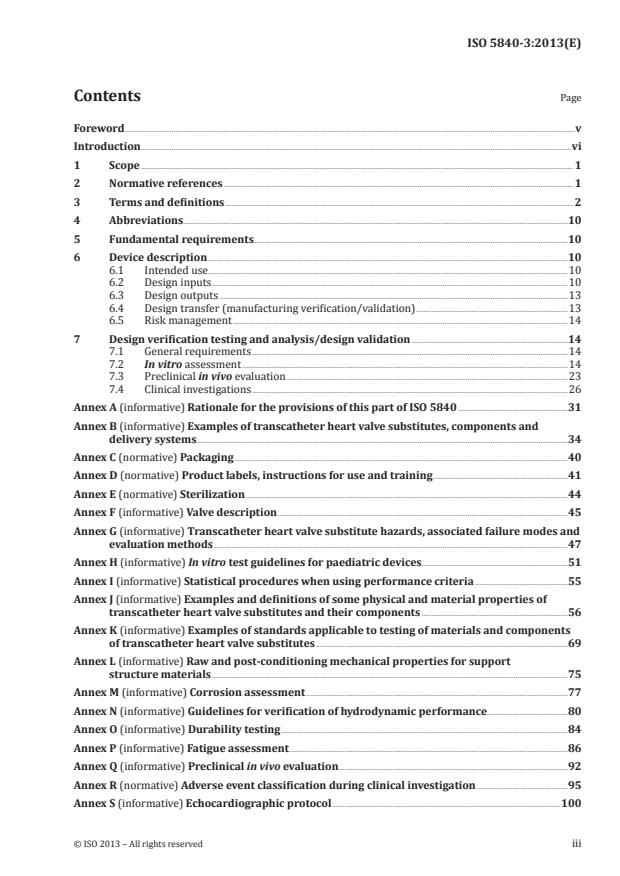
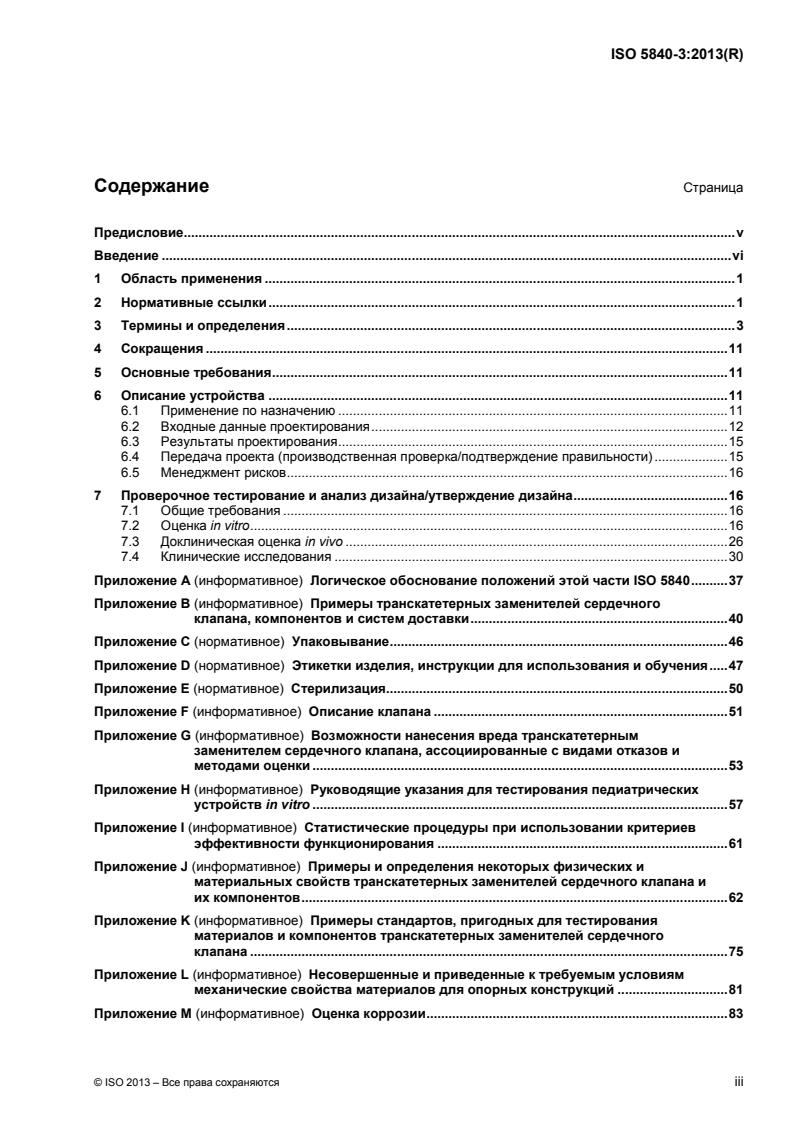
Contents Page
Foreword .v
Introduction .vi
1 Scope . 1
2 Normative references . 1
3 Terms and definitions . 2
4 Abbreviations.10
5 Fundamental requirements .10
6 Device description .10
6.1 Intended use .10
6.2 Design inputs .10
6.3 Design outputs .13
6.4 Design transfer (manufacturing verification/validation) .13
6.5 Risk management .14
7 Design verification testing and analysis/design validation .14
7.1 General requirements .14
7.2 In vitro assessment .14
7.3 Preclinical in vivo evaluation .23
7.4 Clinical investigations .26
Annex A (informative) Rationale for the provisions of this part of ISO 5840 .31
Annex B (informative) Examples of transcatheter heart valve substitutes, components and
delivery systems .34
Annex C (normative) Packaging .40
Annex D (normative) Product labels, instructions for use and training .41
Annex E (normative) Sterilization .44
Annex F (informative) Valve description .45
Annex G (informative) Transcatheter heart valve substitute hazards, associated failure modes and
evaluation methods .47
Annex H (informative) In vitro test guidelines for paediatric devices .51
Annex I (informative) Statistical procedures when using performance criteria .55
Annex J (informative) Examples and definitions of some physical and material properties of
transcatheter heart valve substitutes and their components .56
Annex K (informative) Examples of standards applicable to testing of materials and components
of transcatheter heart valve substitutes .69
Annex L (informative) Raw and post-conditioning mechanical properties for support
structure materials .75
Annex M (informative) Corrosion assessment .77
Annex N (informative) Guidelines for verification of hydrodynamic performance.80
Annex O (informative) Durability testing .84
Annex P (informative) Fatigue assessment .86
Annex Q (informative) Preclinical in vivo evaluation .92
Annex R (normative) Adverse event classification during clinical investigation .95
Annex S (informative) Echocardiographic protocol .100
Bibliography .103
iv © ISO 2013 – All rights reserved
Foreword
ISO (the International Organization for Standardization) is a worldwide federation of national standards
bodies (ISO member bodies). The work of preparing International Standards is normally carried out
through ISO technical committees. Each member body interested in a subject for which a technical
committee has been established has the right to be represented on that committee. International
organizations, governmental and non-governmental, in liaison with ISO, also take part in the work.
ISO collaborates closely with the International Electrotechnical Commission (IEC) on all matters of
electrotechnical standardization.
International Standards are drafted in accordance with the rules given in the ISO/IEC Directives, Part 2.
The main task of technical committees is to prepare International Standards. Draft International
Standards adopted by the technical committees are circulated to the member bodies for voting.
Publication as an International Standard requires approval by at least 75 % of the member bodies
casting a vote.
Attention is drawn to the possibility that some of the elements of this document may be the subject of
patent rights. ISO shall not be held responsible for identifying any or all such patent rights.
ISO 5840-3 was prepared by Technical Committee ISO/TC 150, Implants for surgery, Subcommittee SC 2,
Cardiovascular implants and extracorporeal systems.
ISO 5840 consists of the following parts, under the general title Cardiovascular implants — Cardiac
valve prostheses:
— Part 3: Heart valve substitutes implanted by minimally invasive techniques
Introduction
No heart valve substitute is ideal. Therefore, a group of engineers, scientists and clinicians well aware
of the problems associated with heart valve substitutes and their development has prepared this part
of ISO 5840. In several areas, the provisions of this part of ISO 5840 have been deliberately left partially
defined so as not to inhibit development and innovation. This part of ISO 5840 specifies types of tests,
test methods and requirements for test apparatus. It requires documentation of test methods and
results. This part of ISO 5840 deals with those areas that will ensure adequate mitigation of device-
associated risks for patients and other users of the device, facilitate quality assurance, aid the cardiac
surgeon and cardiologist in choosing a heart valve substitute, and ensure that the device will be
presented in a convenient form. This part of ISO 5840 emphasizes the need to specify types of in vitro
testing, preclinical in vivo and clinical evaluations as well as to report all in vitro, preclinical in vivo and
clinical evaluations. It describes the labels and packaging of the device. Such a process involving in vitro,
preclinical in vivo and clinical evaluations is intended to clarify the required procedures prior to market
release and to enable prompt identification and management of any subsequent problems.
With regard to in vitro testing and reporting, apart from basic material testing for mechanical, physical,
chemical and biocompatibility characteristics, this part of ISO 5840 also covers important hydrodynamic
and durability characteristics of transcatheter heart valve substitutes and their delivery systems. This
part of ISO 5840 does not specify exact test methods for hydrodynamic and durability testing but it
offers guidelines for the test apparatus.
This part of ISO 5840 should be revised, updated and amended as knowledge and techniques in heart
valve substitute technology improve.
This part of ISO 5840 is to be used in conjunction with ISO 5840:2005, which will be replaced by
ISO 5840-1 in future.
vi © ISO 2013 – All rights reserved
INTERNATIONAL STANDARD ISO 5840-3:2013(E)
Cardiovascular implants — Cardiac valve prostheses —
Part 3:
Heart valve substitutes implanted by transcatheter
techniques
1 Scope
This part of ISO 5840 outlines an approach for verifying/validating the design and manufacture
of a transcatheter heart valve substitute through risk management. The selection of appropriate
verification/validation tests and methods are to be derived from the risk assessment. The tests may
include those to assess the physical, chemical, biological and mechanical properties of heart valve
substitutes and of their materials and components. The tests can also include those for preclinical in
vivo evaluation and clinical evaluation of the finished heart valve substitute.
This part of ISO 5840 defines operational conditions and performance requirements for transcatheter
heart valve substitutes where adequate scientific and/or clinical evidence exists for their justification.
This part of ISO 5840 is applicable to all devices intended for implantation in human hearts as a
transcatheter heart valve substitute.
This part of ISO 5840 is applicable to both newly developed and modified transcatheter heart valve
substitutes and to the accessory devices, packaging and labelling required for their implantation and for
determining the appropriate size of heart valve substitute to be implanted.
This part of ISO 5840 excludes heart valve substitutes designed for implantation in artificial hearts or
heart assist devices.
This part of ISO 5840 excludes valve-in-valve configurations and homografts.
This part of ISO 5840 does not specifically address non-traditional surgically implanted heart valve
substitutes (e.g. sutureless). For these devices, the requirements of both this part of ISO 5840 and
ISO 5840:2005 might be relevant and can be considered.
NOTE A rationale for the provisions of this part of ISO 5840 is given in Annex A.
2 Normative references
The following referenced documents are indispensable for the application of this document. For dated
references, only the edition cited applies. For undated references, the latest edition of the referenced
document (including any amendments) applies.
ISO 10993-1, Biological evaluation of medical devices — Part 1: Evaluation and testing within a risk
management process
ISO 10993-2, Biological evaluation of medical devices — Part 2: Animal welfare requirements
ISO 11135-1, Sterilization of health care products — Ethylene oxide — Part 1: Requirements for development,
validation and routine control of a sterilization process for medical devices
ISO/TS 11135-2, Sterilization of health care products — Ethylene oxide — Part 2: Guidance on the application
of ISO 11135-1
ISO 11137-1, Sterilization of health care products — Radiation — Part 1: Requirements for development,
validation and routine control of a sterilization process for medical devices
ISO 11137-2, Sterilization of health care products — Radiation — Part 2: Establishing the sterilization dose
ISO 11137-3, Sterilization of health care products — Radiation — Part 3: Guidance on dosimetric aspects
ISO 11607-1, Packaging for terminally sterilized medical devices — Part 1: Requirements for materials,
sterile barrier systems and packaging systems
ISO 11607-2, Packaging for terminally sterilized medical devices — Part 2: Validation requirements for
forming, sealing and assembly processes
ISO 14155, Clinical investigation of medical devices for human subjects — Good clinical practice
ISO 14160, Sterilization of health care products — Liquid chemical sterilizing agents for single-use medical
devices utilizing animal tissues and their derivatives — Requirements for characterization, development,
validation and routine control of a sterilization process for medical devices
ISO 14630:2012, Non-active surgical implants — General requirements
ISO 14937, Sterilization of health care products — General requirements for characterization of a sterilizing
agent and the development, validation and routine control of a sterilization process for medical devices
ISO 14971, Medical devices — Application of risk management to medical devices
ISO 17665-1, Sterilization of health care products — Moist heat — Part 1: Requirements for the development,
validation and routine control of a sterilization process for medical devices
ISO 22442-1, Medical devices utilizing animal tissues and their derivatives — Part 1: Application of risk
management
ISO 22442-2, Medical devices utilizing animal tissues and their derivatives — Part 2: Controls on sourcing,
collection and handling
ISO 22442-3, Medical devices utilizing animal tissues and their derivatives — Part 3: Validation of the
elimination and/or inactivation of viruses and transmissible spongiform encephalopathy (TSE) agents
ISO/IEC 17025, General requirements for the competence of testing and calibration laboratories
IEC 62366, Medical devices — Application of usability engineering to medical devices
ASTM F2052, Standard test method for measurement of magnetically induced displacement force on medical
devices in the magnetic resonance environment
ASTM F2503, Standard practice for marking medical devices and other items for safety in the magnetic
resonance environment
ASTM F2213, Standard test method for measurement of magnetically induced torque on medical devices in
the magnetic resonance environment
ASTM F2182, Standard test method for measurement of radio frequency induced heating near passive
implants during magnetic resonance imaging
ASTM F2119, Standard test method for evaluation of MR image artifacts from passive implants
3 Terms and definitions
For the purposes of this document, the following terms and definitions apply.
NOTE Additional definitions can be found in the informative annexes.
2 © ISO 2013 – All rights reserved
3.1
accessories
device-specific tools that are required to assist in the implantation of the transcatheter heart valve substitute
3.2
adverse event
AE
untoward medical occurrence in a study subject which does not necessarily have to have a causal
relationship with study treatment
Note 1 to entry: An AE can be an unfavourable and unintended sign (including an abnormal laboratory finding), symptom
or disease, temporary or permanent, whether or not related to the prosthetic valve implantation or procedure.
3.3
arterial end diastolic pressure
minimum value of the arterial pressure during diastole
3.4
arterial peak systolic pressure
maximum value of the arterial pressure during systole
3.5
back pressure
differential pressure applied across the valve during the closed phase
3.6
body surface area
A
bs
total surface area (m ) of the human body
Note 1 to entry: This can be calculated (Mosteller’s formula) as the square root of product of the weight in kg
[12]
times the height in cm divided by 3 600 (see Reference ).
3.7
cardiac index
2 2
cardiac output (CO, l/min) divided by the body surface area (A , m ), in units l/min/m
bs
3.8
closing volume
portion of the regurgitant volume that is associated with the dynamics of the valve closure during
a single cycle
Note 1 to entry: See Figure 1.
Key
X time
Y flowrate
1 closing volume
2 leakage volume
Figure 1 — Schematic representation of flow waveform and regurgitant volumes for one cycle
3.9
coating
thin-film material that is applied to an element of a heart valve substitute to modify its physical or
chemical properties
3.10
compliance
relationship between change in diameter and change in pressure of a deformable tubular structure (e.g.
valve annulus, aorta, conduit), defined in this part of ISO 5840 as
()rr−×100
C =×100%
rp×−()p
12 1
where
C is the compliance in units of % radial change/100 mmHg;
p is the diastolic pressure, in mmHg;
p is the systolic pressure, in mmHg;
r is the inner radius at p , in millimetres;
1 1
r is the inner radius at p , in millimetres.
2 2
Note 1 to entry: See ISO 25539-1.
4 © ISO 2013 – All rights reserved
3.11
component-joining material
material, such as a suture, adhesive or welding compound, used to assemble the components of a heart
valve substitute, thereby becoming part of the implant device
Note 1 to entry: See examples in Annex B.
3.12
cycle
one complete sequence in the action of a heart valve substitute under pulsatile flow conditions
3.13
cycle rate
number of complete cycles per unit of time, usually expressed as cycles per minute (cycles/min)
3.14
delivery approach
anatomical access used to deliver the implant to the implant site (e.g. transfemoral, transapical, transeptal)
3.15
delivery system
catheter or other device-based system used to deliver the implant to the implant site
3.16
deployed valve diameter
outer diameter (mm) of the implantable device when deployed within the target implant site in an
idealized circular configuration
3.17
device embolization
dislodgement from the intended and documented original position to an unintended and non-
therapeutic location
3.18
device failure
inability of a device to perform its intended function sufficient to cause a hazard
3.19
device migration
detectable movement or displacement of the device from its original position within the implant site,
without embolization
3.20
effective orifice area
EOA
orifice area that has been derived from flow and pressure or velocity data
3.21
failure mode
mechanism of device failure
Note 1 to entry: Catastrophic support structure fracture, calcification and prolapse are examples of failure modes.
3.22
follow-up
continued assessment of patients who have received the heart valve substitute
3.23
forward flow volume
volume of flow ejected through the test heart valve substitute in the forward direction during one cycle
3.24
fracture
disruption, under the action of applied stress or strain, of any part of the transcatheter heart valve
substitute that was previously intact
3.25
heart valve substitute
device used to replace the function of a natural valve of the heart
Note 1 to entry: See examples in Annex B.
3.26
imaging modality
imaging method used to facilitate delivery and/or retrieval of the implant within the target implant site,
as well as to assess valve performance after implantation
3.27
implant site
intended site of transcatheter heart valve substitute deployment
3.28
intended use
use of a product, process or service in accordance with the specifications, instructions and information
provided by the manufacturer
3.29
leakage volume
component of the regurgitant volume that is associated with leakage during closed phase of a valve in a
single cycle and is the sum of the transvalvular leakage volume and paravalvular leakage volume
Note 1 to entry: The point of separation between the closing and leakage volumes is obtained according to a
defined and stated criterion (the linear extrapolation shown in Figure 1 is just an example).
Note 2 to entry: See Figure 1.
3.30
mean arterial pressure
time-averaged arithmetic mean value of the arterial pressure during one cycle
3.31
mean pressure difference
time-averaged arithmetic mean value of the pressure difference across a heart valve substitute during
the forward flow phase of the cycle
3.32
non-structural valve dysfunction
abnormality extrinsic to the transcatheter heart valve substitute that results in valve dysfunction
(stenosis, regurgitation or both)
3.33
occluder/leaflet
component that inhibits back flow
Note 1 to entry: See examples in Annex B.
3.34
paravalvular leakage volume
component of the leakage volume that is associated with leakage around the closed heart valve substitute
during a single cycle
6 © ISO 2013 – All rights reserved
3.35
reference valve
heart valve substitute with a known clinical experience used for comparative preclinical and clinical
evaluations
3.36
regurgitant fraction
regurgitant volume expressed as a percentage of the forward flow volume
3.37
regurgitant volume
volume of fluid that flows through a heart valve substitute in the reverse direction during one cycle and
is the sum of the closing volume and the leakage volume
Note 1 to entry: See Figure 1.
3.38
repositioning
change in implant position of a partially or fully deployed transcatheter heart valve substitute via a
transcatheter technique, possibly requiring full or partial recapturing of the device
3.39
retrieval
removal of a partially or fully deployed transcatheter heart valve substitute via a transcatheter technique
3.40
risk
combination of the probability of occurrence of harm and the severity of that harm
Note 1 to entry: Adapted from ISO 14971.
3.41
risk analysis
systematic use of available information to identify hazards and to estimate the associated risks
Note 1 to entry: Adapted from ISO 14971.
3.42
risk assessment
overall process comprising a risk analysis and a risk evaluation
Note 1 to entry: Adapted from ISO 14971.
3.43
root mean square forward flow
RMS forward flow
square root of the integral of the volume flow rate waveform squared during the positive differential
pressure interval of the forward flow phase used to calculate EOA
Note 1 to entry: See Figure 2.
Key title
1 aortic pressure
2 left ventricular pressure
3 aortic flow rate
a
Positive pressure range.
b
Q range.
rms
Figure 2 — Schematic representation of the positive pressure period of an aortic forward
flow interval
3.44
safety
freedom from unacceptable risk
Note 1 to entry: Adapted from ISO 14971.
3.45
severity
measure of the possible consequences of a hazard
Note 1 to entry: Adapted from ISO 14971.
3.46
special processes
processes for which the product cannot be fully verified by inspection or test
8 © ISO 2013 – All rights reserved
3.47
sterility assurance level
SAL
probability of a single viable microorganism occurring on an item after sterilization
-6 -3
Note 1 to entry: The term SAL takes a quantitative value, generally 10 or 10 . When applying this quantitative
-6
value to assurance of sterility, an SAL of 10 has a lower value but provides a greater assurance of sterility than
-3
an SAL of 10 .
[ISO/TS 11139, definition 2.46]
3.48
sterilization
validated process used to render product free from viable microorganisms
Note 1 to entry: In a sterilization process, the nature of microbial inactivation is exponential and thus the survival
of a microorganism on an individual item can be expressed in terms of probability. While this probability can be
reduced to a very low number, it can never be reduced to zero.
Note 2 to entry: See sterility assurance level (3. 47).
Note 3 to entry: Adapted from ISO/TS 11139.
3.49
structural component failure
degradation of structural integrity of the support structure (e.g. strut fractures) that results in the
functional performance of the implant no longer being acceptable and/or that results in adverse events
3.50
structural valve dysfunction
structural abnormality intrinsic to the transcatheter heart valve substitute that results in valve
dysfunction (stenosis and/or transvalvular and/or paravalvular regurgitation)
3.51
support structure
portion of the transcatheter heart valve substitute that transfers loads between occluder and implant
site and anchors the device within the implant site
3.52
surgically implanted heart valve substitute
heart valve substitute generally requiring direct visualization and cardiopulmonary bypass for implantation
3.53
transcatheter heart valve substitute
heart valve substitute implanted in a manner generally not involving direct visualization, and generally
involving a beating heart
3.54
transcatheter heart valve system
implantable device, delivery system, accessories, packaging, labelling and instructions
3.55
transvalvular leakage volume
component of the leakage volume that is associated with leakage through the closed valve during a
single cycle
3.56
usability
characteristic of the user interface that establishes effectiveness, efficiency, ease of user learning and
user satisfaction
3.57
valve loading
process to affix or attach a transcatheter heart valve substitute onto a delivery device and collapse the
valve (e.g. reduce its diameter) for insertion via the delivery system (e.g. catheter), performed either
during manufacture or in the clinic
4 Abbreviations
For the purposes of this part of ISO 5840, the following abbreviations apply.
AE Adverse event
EOA Effective orifice area
AWT Accelerated wear testing
CFD Computational fluid dynamics
ECG Electrocardiogram
FEA Finite element analysis
IFU Instructions for use
LV Left ventricle, left ventricular
MAP Mean arterial pressure
MRI Magnetic resonance imaging
5 Fundamental requirements
The manufacturer shall determine, at all stages of the product life cycle, the acceptability of the product
for clinical use.
6 Device description
6.1 Intended use
The manufacturer shall identify the physiological condition(s) to be treated, the intended patient
population, potential adverse events and intended claims.
6.2 Design inputs
6.2.1 Operational specifications
The manufacturer shall define the operational specifications for the device, including the principles
of operation, intended device delivery approach/process, expected device lifetime, shelf life,
shipping/storage limits, and the physiological environment in which it is intended to function. The
manufacturer shall carefully define all relevant dimensional parameters that will be required to
accurately select the size of device to be implanted. Table 1 and Table 2 define the expected physiological
parameters of the intended adult patient population for transcatheter heart valve substitutes for both
normal and pathological patient conditions.
10 © ISO 2013 – All rights reserved
Table 1 — Heart valve substitute operational environment for left side of heart — Adult population
Parameter General condition
Surrounding medium Human heart/human blood
Temperature 34 °C to 42 °C
Heart rate 30 bpm to 200 bpm
Cardiac output 3 l/min to 15 l/min
Peak differential pressure
Arterial peak Arterial end
a
across closed valve
Blood pressures and resultant pressure loads systolic diastolic
by patient condition pressure pressure
Aortic Δp Mitral Δp
A M
mmHg mmHg
mmHg mmHg
Normotensive 120 80 100 120
Hypotensive 60 40 50 60
Hypertensive
Mild 140 to 159 90 to 99 115 to 129 140 to 159
Moderate 160 to 179 100 to 109 130 to 144 160 to 179
Severe 180 to 209 110 to 119 145 to 164 180 to 209
Very severe ≥ 210 ≥ 120 ≥ 165 ≥ 210
a
Peak differential pressure across closed aortic valve is estimated using the following relationship:
— ΔP approximately pressure associated with dicrotic notch assuming LV pressure is zero approximately arterial end
Aortic
diastolic pressure + 1/2(arterial peak systolic pressure – arterial end diastolic pressure).
— Peak differential pressure across closed mitral valve estimated to be equivalent to arterial peak systolic pressure.
Table 2 — Heart valve substitute operational environment for right side of heart — Adult
population
Parameter General condition
Surrounding medium Human heart/human blood
Temperature 34 °C to 42 °C
Heart rate 30 bpm to 200 bpm
Cardiac output 3 l/min to 15 l/min
Forward flow volume 25 ml to 100 ml
Peak differential pressure
Pulmonary
Right ventricle
a
across closed valve
artery end
Blood pressures and resultant pressure loads peak systolic
diastolic
Pulmonary Tricuspid
by patient condition pressure
pressure
Δp Δp
P T
mmHg
mmHg
mmHg mmHg
Normotensive 18 to 35 8 to 15 13 to 25 18 to 35
Hypotensive 15 5 10 15
Hypertensive
Mild 40 to 49 15 to 19 28 to 34 40 to 49
Moderate 50 to 59 20 to 24 35 to 42 50 to 59
a
Peak differential pressure across closed pulmonary valve is estimated using the following relationship:
— ΔP approximate pressure associated with dicrotic notch assuming RV pressure is zero approximately pulmonary
pulmonic
artery end diastolic pressure + 1/2(right ventricle peak systolic pressure – pulmonary artery end diastolic pressure).
— Peak differential pressure across closed tricuspid valve estimated to be equivalent to right ventricle peak systolic
pressure.
Table 2 (continued)
Parameter General condition
Severe 60 to 84 25 to 34 43 to 59 60 to 84
Very severe 85 to 120 ≥ 35 60 to 78 85 to 120
a
Peak differential pressure across closed pulmonary valve is estimated using the following relationship:
— ΔP approximate pressure associated with dicrotic notch assuming RV pressure is zero approximately pulmonary
pulmonic
artery end diastolic pressure + 1/2(right ventricle peak systolic pressure – pulmonary artery end diastolic pressure).
— Peak differential pressure across closed tricuspid valve estimated to be equivalent to right ventricle peak systolic
pressure.
6.2.2 Performance specifications
The manufacturer shall establish (i.e. define, document and implement) the clinical performance
requirements of the device and the corresponding device performance specifications for the intended
use and device claims. The following list of desired clinical and device-based performance characteristics
describe a safe and effective transcatheter heart valve substitute system.
6.2.2.1 Implantable device
The design attribute requirements of ISO 14630:2012, Clause 5, shall apply. The intended performance
of the transcatheter heart valve substitute shall take into account at least the following:
a) the ability to be consistently, accurately and safely loaded onto the delivery system;
b) the ability to be consistently, accurately and safely deployed;
c) the ability to be safely retrieved and/or repositioned (if applicable);
d) the ability to ensure effective fixation within the target implant site;
e) the ability to maintain structural and functional integrity during the expected lifetime of the device;
f) the ability to conform with anatomical structures within the implant site (e.g. in the aortic position,
there is potential for interaction with coronary ostia, anterior mitral leaflet, AV bundle branch);
g) the ability to allow forward flow with acceptably small mean pressure difference;
h) the ability to prevent retrograde flow with acceptably small regurgitation, including paravalvular
leakage;
i) the ability to resist migration and embolization during the expected lifetime of the device;
j) the ability to minimize haemolysis;
k) the ability to minimize thrombus formation;
l) the ability to maintain its functionality for the intended application consistent with the target
patient population.
6.2.2.2 Delivery system
The design attributes to meet the intended performance of the delivery system shall take into account
at least the following:
a) the ability to permit consistent, accurate and safe access, delivery, placement and deployment of the
transcatheter heart valve substitute to the intended implant site;
b) the ability to permit consistent and safe withdrawal of the delivery system prior to and after
deployment of transcatheter heart valve substitute;
12 © ISO 2013 – All rights reserved
c) the ability to minimize haemolysis;
d) the ability to minimize thrombus formation;
e) the ability to minimize blood loss (haemostasis);
f) the ability to retrieve, reposition and/or remove the transcatheter heart valve substitute (if applicable).
6.2.2.3 Transcatheter heart valve system
The design attributes to meet the intended performance of the transcatheter heart valve system shall
take into account at least the following:
a) the compliance of the transcatheter heart valve system with the requirements of ISO 10993-1 and
appropriate other parts of ISO 10993;
b) the visibility of the transcatheter heart valve system under fluoroscopy or other imaging modalities;
c) compatibility with magnetic resonance imaging (MRI);
d) the ability of the transcatheter heart valve system to maintain its functionality and sterility for its
specified shelf life prior to implantation.
6.2.3 Implant procedure
The entire system shall provide intended users with the ability to safely and effectively perform all required
pre-operative, intra-operative and post-operative procedural tasks and achieve all desired objectives.
This shall include all other tools and accessories that intended users will use to complete the procedure.
NOTE For guidance on how to determine and establish design attributes pertaining to the use of the system
to conduct the implant procedure, see IEC 62366.
6.2.4 Packaging, labelling and sterilization
The transcatheter heart valve substitute system shall meet the requirements for packaging, labelling
and sterilization contained within Annex C, Annex D and Annex E, respectively.
The manufacturer shall provide sufficient information and guidance in the labelling to allow for
appropriate preparation of the implant site (e.g. balloon valvuloplasty), accurate selection of appropriate
implant size and reliable implantation of the transcatheter heart valve substitute.
6.3 Design outputs
The manufacturer shall establish (i.e. define, document and implement) a complete specification of the
transcatheter heart valve substitute system, including component and assembly-level specifications,
delivery system, accessories, packaging and labelling. Annex F contains a listing of terms that may
be used in describing various valve models. In addition to the physical components of the heart valve
substitute system, the implant procedure itself should be considered an important element of safe and
effective heart valve therapy.
6.4 Design transfer (manufacturing verification/validation)
The manufacturer shall generate a flowchart identifying the manufacturing process operations
and inspection steps. The flowchart shall indicate the input of all components and important
manufacturing materials.
As part of the risk management process, the manufacturer shall establish the control measures and
process conditions necessary to ensure that the device is safe and suitable for its intended use. The
risk management file shall identify and justify the verification activities necessary to demonstrate the
acceptability of the process ranges chosen.
The manufacturer shall establish the adequacy of full scale manufacturing by validation of the
manufacturing process. The manufacturer shall validate all special processes and process software,
and document the results of the validation.
NOTE See ISO 13485.
6.5 Risk management
The manufacturer shall define and implement a risk management program in accordance with ISO 14971.
Annex G contains a list of potential hazards specific to heart valve substitutes that can serve as the basis
for a risk analysis.
7 Design verification testing and analysis/design validation
7.1 General requirements
The manufacturer shall perform verification testing to demonstrate that the device specifications result
in a transcatheter heart valve substitute system that meets the design specifications (design output
meets design input). The manufacturer shall establish tests relating to hazards identified from the risk
analysis. The protocols shall identify the test purpose, set-up, equipment (specifications, calibration,
etc.), test conditions (with a justification of appropriateness to anticipated in vivo operating conditions
for the device), acceptance criteria and sample quantities tested.
The manufacturer shall validate the design of the transcatheter heart valve substitute system.
7.2 In vitro assessment
7.2.1 Test conditions, sample selection and reporting requirements
7.2.1.1 Test specimens shall represent, as closely as possible, the finished product to be supplied for
clinical use, including exposure to the maximum number of recommended sterilization cycles, process
chemicals, aging effects, and any catheter loading and deployment steps (including repositioning and
recapturing, if applicable) in accordance with all manufacturing procedures and IFU, where appropriate.
Any deviations of the test specimens from the finished product shall be justified.
7.2.1.2 The specimens selected for testing shall fully represent the total implant size range. Depending
on the particular test, testing might not necessarily have to be completed for each discrete valve size, but
shall at least be completed for the largest and smallest sizes, each deployed to the largest and smallest
deployed diameters as per the IFU. Sampling shall ensure adequate representation of the expected
variability in the manufacture of devices. A rationale for device size selection shall be provided.
7.2.1.3 For all tests, the number of samples shall be justified based on the specific intent of the test.
Additional recommendations regarding sampling and sample conditioning are included within each test
method defined herein, as appropriate.
7.2.1.4 Where simulation of in vivo conditions is applicable to the test method, consideration shall be
given to those operational environments given in Table 1 and Table 2 for the adult population. See Annex
H for guidelines regarding suggested test conditions for the paediatric population. Where applicable,
testing shall be performed using a test fluid of isotonic saline, blood, or a blood-equivalent fluid whose
physical properties (e.g. specific gravity, viscosity at working temperatures) are appropriate to the test
being performed. The test fluid used shall be justified. The testing shall be performed at the intended
operating temperature as appropriate.
7.2.1.5 Test methods for verification testing shall be appropriately validated. Refer to applicable
sections of ISO/IEC 17025.
14 © ISO 2013 – All rights reserved
7.2.1.6 Each test report shall include:
a) rationale for the test;
b) identification and description of the transcatheter heart valve substitute system elements tested
(e.g. batch number);
c) identification and description of the reference valve(s) where appropriate;
d) number of specimens tested, and rationale for sample size;
e) detailed description of the test method including preconditioning to simulate intended use;
f) verification that appropriate quality assurance standards have been met (e.g. Good Laboratory Practice);
g) test results and conclusions.
Statistical procedures, such as the ones described in Annex I, may be used to assist data analysis.
7.2.2 Material property assessment
7.2.2.1 General
Properties of the transcatheter heart valve substitute system components (e.g. support structure, valve
leaflets) shall be evaluated as applicable to the specific design of the system as determined by the risk
assessment. The materials requirements of ISO 14630:2012, Clause 6, shall apply. Additional testing
specific to certain materials shall be performed to determine the appropriateness of the material for
use in the design. For example, materials dependent on shape memory properties shall be subjected to
test
...
NORME ISO
INTERNATIONALE 5840-3
Première édition
2013-03-01
Implants cardiovasculaires —
Prothèses valvulaires —
Partie 3:
Valves cardiaques de substitution
implantées par des techniques
transcathéter
Cardiovascular implants — Cardiac valve prostheses —
Part 3: Heart valve substitutes implanted by transcatheter techniques
Numéro de référence
©
ISO 2013
DOCUMENT PROTÉGÉ PAR COPYRIGHT
© ISO 2013
Droits de reproduction réservés. Sauf indication contraire, aucune partie de cette publication ne peut être reproduite ni utilisée
sous quelque forme que ce soit et par aucun procédé, électronique ou mécanique, y compris la photocopie, l’affichage sur
l’internet ou sur un Intranet, sans autorisation écrite préalable. Les demandes d’autorisation peuvent être adressées à l’ISO à
l’adresse ci-après ou au comité membre de l’ISO dans le pays du demandeur.
ISO copyright office
Case postale 56 • CH-1211 Geneva 20
Tel. + 41 22 749 01 11
Fax + 41 22 749 09 47
E-mail copyright@iso.org
Web www.iso.org
Publié en Suisse
ii © ISO 2013 – Tous droits réservés
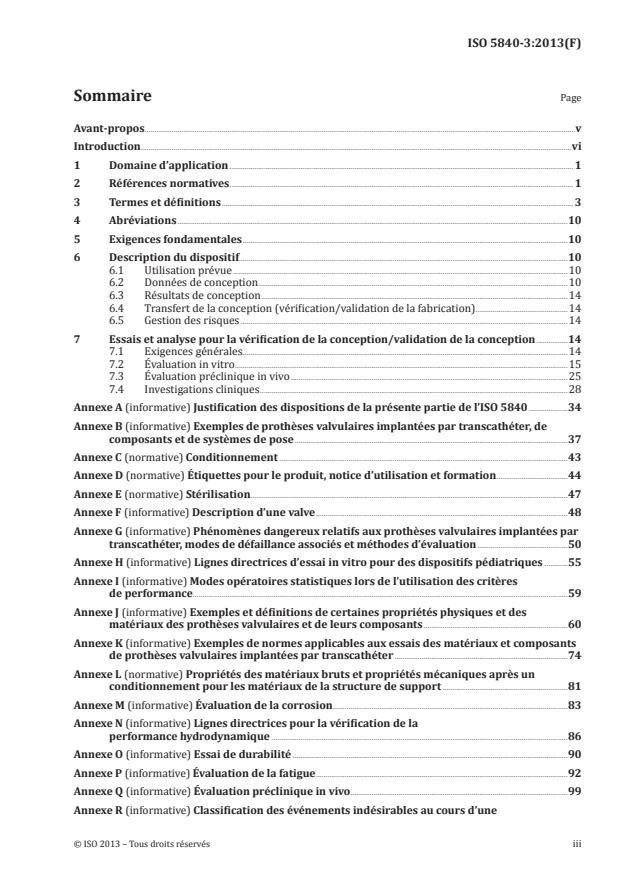
Sommaire Page
Avant-propos .v
Introduction .vi
1 Domaine d’application . 1
2 Références normatives . 1
3 Termes et définitions . 3
4 Abréviations .10
5 Exigences fondamentales .10
6 Description du dispositif.10
6.1 Utilisation prévue .10
6.2 Données de conception .10
6.3 Résultats de conception .14
6.4 Transfert de la conception (vérification/validation de la fabrication) .14
6.5 Gestion des risques .14
7 Essais et analyse pour la vérification de la conception/validation de la conception .14
7.1 Exigences générales .14
7.2 Évaluation in vitro .15
7.3 Évaluation préclinique in vivo .25
7.4 Investigations cliniques .28
Annexe A (informative) Justification des dispositions de la présente partie de l’ISO 5840 .34
Annexe B (informative) Exemples de prothèses valvulaires implantées par transcathéter, de
composants et de systèmes de pose .37
Annexe C (normative) Conditionnement .43
Annexe D (normative) Étiquettes pour le produit, notice d’utilisation et formation .44
Annexe E (normative) Stérilisation .47
Annexe F (informative) Description d’une valve .48
Annexe G (informative) Phénomènes dangereux relatifs aux prothèses valvulaires implantées par
transcathéter, modes de défaillance associés et méthodes d’évaluation .50
Annexe H (informative) Lignes directrices d’essai in vitro pour des dispositifs pédiatriques .55
Annexe I (informative) Modes opératoires statistiques lors de l’utilisation des critères
de performance.59
Annexe J (informative) Exemples et définitions de certaines propriétés physiques et des
matériaux des prothèses valvulaires et de leurs composants .60
Annexe K (informative) Exemples de normes applicables aux essais des matériaux et composants
de prothèses valvulaires implantées par transcathéter .74
Annexe L (normative) Propriétés des matériaux bruts et propriétés mécaniques après un
conditionnement pour les matériaux de la structure de support .81
Annexe M (informative) Évaluation de la corrosion .83
Annexe N (informative) Lignes directrices pour la vérification de la
performance hydrodynamique .86
Annexe O (informative) Essai de durabilité .90
Annexe P (informative) Évaluation de la fatigue .92
Annexe Q (informative) Évaluation préclinique in vivo .99
Annexe R (informative) Classification des événements indésirables au cours d’une
investigation clinique .102
Annexe S (informative) Protocole échocardiographique .107
Bibliographie .110
iv © ISO 2013 – Tous droits réservés
Avant-propos
L’ISO (Organisation internationale de normalisation) est une fédération mondiale d’organismes
nationaux de normalisation (comités membres de l’ISO). L’élaboration des Normes internationales est
en général confiée aux comités techniques de l’ISO. Chaque comité membre intéressé par une étude
a le droit de faire partie du comité technique créé à cet effet. Les organisations internationales,
gouvernementales et non gouvernementales, en liaison avec l’ISO participent également aux travaux.
L’ISO collabore étroitement avec la Commission électrotechnique internationale (CEI) en ce qui concerne
la normalisation électrotechnique.
Les Normes internationales sont rédigées conformément aux règles données dans les Directives
ISO/CEI, Partie 2.
La tâche principale des comités techniques est d’élaborer les Normes internationales. Les projets de
Normes internationales adoptés par les comités techniques sont soumis aux comités membres pour vote.
Leur publication comme Normes internationales requiert l’approbation de 75 % au moins des comités
membres votants.
L’attention est appelée sur le fait que certains des éléments du présent document peuvent faire l’objet de
droits de propriété intellectuelle ou de droits analogues. L’ISO ne saurait être tenue pour responsable de
ne pas avoir identifié de tels droits de propriété et averti de leur existence.
L’ISO 5840-3 a été élaborée par le comité technique ISO/TC 150, Implants chirurgicaux, sous-comité SC 2,
Implants cardiovasculaires et circuits extra-corporels.
L’ISO 5840 comprend les parties suivantes, présentées sous le titre général Implants cardiovasculaires —
Prothèses valvulaires:
— Partie 3: Valves cardiaques de substitution implantées par des techniques transcathéter
Introduction
Aucune prothèse valvulaire n’est idéale. Par conséquent, un groupe d’ingénieurs, de scientifiques et
de médecins bien conscients des problèmes associés aux prothèses valvulaires et à leur mise au point
a élaboré la présente partie de l’ISO 5840. Dans plusieurs domaines, les dispositions de la présente
partie de l’ISO 5840 ont été délibérément laissées partiellement définies de façon à ne pas entraver
les démarches de développement et d’innovation. La présente partie de l’ISO 5840 spécifie les types
d’essais, les méthodes d’essais et les exigences applicables à l’appareillage d’essai. Elle exige que les
méthodes et les résultats d’essais fassent l’objet d’une documentation. La présente Norme traite des
domaines qui garantiront que les risques associés au dispositif pour les patients et les autres utilisateurs
du dispositif ont été limités de façon adéquate et promouvront l’assurance de la qualité, aideront le
chirurgien cardiaque et le cardiologue dans le choix d’une prothèse valvulaire et assureront que le
dispositif sera présenté sous une forme pratique. La présente partie de l’ISO 5840 souligne la nécessité
de spécifier des types d’essais in vitro, des évaluations précliniques in vivo et cliniques ainsi que de
consigner dans un rapport toutes les évaluations in vitro, précliniques in vivo et cliniques. Elle décrit
également les étiquettes et l’emballage du dispositif. Un tel processus impliquant des évaluations in
vitro, précliniques in vivo et cliniques est destiné à clarifier les procédures requises avant la mise sur le
marché et à permettre l’identification et la gestion rapides des problèmes susceptibles d’être rencontrés
ultérieurement.
En ce qui concerne les essais in vitro et leurs rapports, à l’exception des essais des matériaux de base
relatifs aux propriétés mécaniques, physiques, chimiques et aux caractéristiques de biocompatibilité, la
présente Norme internationale traite également des principales caractéristiques hydrodynamiques et
de durabilité des prothèses valvulaires implantées par transcathéter et de leurs systèmes de pose. La
présente Norme ne spécifie pas de méthodes d’essais exactes pour les essais hydrodynamiques et de
durabilité mais elle propose des lignes directrices pour l’appareillage d’essai.
Il convient de réviser, de mettre à jour et d’amender la présente partie de l’ISO 5840 en fonction de
l’amélioration des connaissances et des techniques liées à la technologie des prothèses valvulaires.
La présente partie de l’ISO 5840 est à utiliser conjointement avec l’ISO 5840:2005qui sera remplacée par
l’ISO 5840-1 à l’avenir.
vi © ISO 2013 – Tous droits réservés
NORME INTERNATIONALE ISO 5840-3:2013(F)
Implants cardiovasculaires — Prothèses valvulaires —
Partie 3:
Valves cardiaques de substitution implantées par des
techniques transcathéter
1 Domaine d’application
La présente partie de l’ISO 5840 présente une approche pour la vérification/validation de la conception
et la fabrication d’une prothèse valvulaire implantée par transcathéter à travers la gestion des risques. La
sélection des méthodes et des essais de vérification/validation appropriés se fait à partir de l’appréciation
du risque. Les essais peuvent inclure les essais destinés à évaluer les propriétés physiques, chimiques,
biologiques et mécaniques des prothèses valvulaires ainsi que de leurs matériaux et composants. Les
essais peuvent également englober les essais destinés à l’évaluation préclinique in vivo et à l’évaluation
clinique des prothèses valvulaires à l’état fini.
La présente partie de l’ISO 5840 définit les conditions de fonctionnement et les exigences de performances
relatives aux prothèses valvulaires implantées par transcathéter lorsqu’une preuve scientifique et/ou
clinique adéquate existe pour les justifier.
La présente partie de l’ISO 5840 s’applique à tous les dispositifs destinés à être implantés dans le cœur
humain, comme les prothèses valvulaires implantées par transcathéter.
La présente partie de l’ISO 5840 s’applique à la fois aux prothèses valvulaires implantées par transcathéter
récemment mises au point qu’à celles modifiées ainsi qu’aux dispositifs accessoires, à l’emballage et à
l’étiquetage exigés pour leur implantation et pour la détermination de la taille appropriée de la prothèse
valvulaire à implanter.
La présente partie de l’ISO 5840 exclut les prothèses valvulaires destinées à être implantées dans les
cœurs artificiels ou dans des dispositifs d’assistance cardiaque.
La présente partie de l’ISO 5840 exclut les configurations de valves intégrée à une autre valve (valve-in-
valve) et d’allogreffes.
La présente partie de l’ISO 5840 ne traite pas en particulier des prothèses valvulaires implantées par
des techniques chirurgicales non traditionnelles (par exemple sans suture). Pour ces dispositifs, les
exigences spécifiées à la fois dans la présente partie de l’ISO 5840 et dans l’ISO 5840:2005 peuvent être
pertinentes et doivent être prises en compte.
NOTE Une justification des dispositions de la présente partie de l’ISO 5840 est donnée dans l’Annexe A.
2 Références normatives
Les documents de référence suivants sont indispensables à l’application du présent document. Pour les
références datées, seule l’édition citée s’applique. Pour les références non datées, la dernière édition du
document de référence s’applique (y compris les éventuels amendements).
ISO 10993-1, Évaluation biologique des dispositifs médicaux — Partie 1: Évaluation et essais au sein d’un
processus de gestion du risque
ISO 10993-2, Évaluation biologique des dispositifs médicaux — Partie 2: Exigences relatives à la
protection des animaux
ISO 11135-1, Stérilisation des produits de santé — Oxyde d’éthylène — Partie 1: Exigences de développement,
de validation et de contrôle de routine d’un processus de stérilisation pour des dispositifs médicaux
ISO/TS 11135-2, Stérilisation des produits de santé — Oxyde d’éthylène — Partie 2: Directives relatives à
l’application de l’ISO 11135-1
ISO 11137-1, Stérilisation des produits de santé — Irradiation — Partie 1: Exigences relatives à la mise au
point, à la validation et au contrôle de routine d’un procédé de stérilisation pour les dispositifs médicaux
ISO 11137-2, Stérilisation des produits de santé — Irradiation — Partie 2: Établissement de la dose stérilisante
ISO 11137-3, Stérilisation des produits de santé — Irradiation — Partie 3: Directives relatives aux aspects
dosimétriques
ISO 11607-1, Emballages des dispositifs médicaux stérilisés au stade terminal — Partie 1: Exigences relatives
aux matériaux, aux systèmes de barrière stérile et aux systèmes d’emballage
ISO 11607-2, Emballages des dispositifs médicaux stérilisés au stade terminal — Partie 2: Exigences de
validation pour les procédés de formage, scellage et assemblage
ISO 14155, Investigation clinique des dispositifs médicaux pour sujets humains — Bonnes pratiques cliniques
ISO 14160, Stérilisation des produits de santé — Agents stérilisants chimiques liquides pour dispositifs
médicaux non réutilisables utilisant des tissus animaux et leurs dérivés — Exigences pour la caractérisation,
le développement, la validation et le contrôle de routine d’un procédé de stérilisation de dispositifs médicaux
ISO 14630:2012, Implants chirurgicaux non actifs — Exigences générales
ISO 14937, Stérilisation des produits de santé — Exigences générales pour la caractérisation d’un agent
stérilisant et pour la mise au point, la validation et la vérification de routine d’un processus de stérilisation
pour dispositifs médicaux
ISO 14971, Dispositifs médicaux — Application de la gestion des risques aux dispositifs médicaux
ISO 17665-1, Stérilisation des produits de santé — Chaleur humide — Partie 1: Exigences pour le
développement, la validation et le contrôle de routine d’un procédé de stérilisation des dispositifs médicaux
ISO 22442-1, Dispositifs médicaux utilisant des tissus animaux et leurs dérivés — Partie 1: Application de la
gestion des risques
ISO 22442-2, Dispositifs médicaux utilisant des tissus animaux et leurs dérivés — Partie 2: Contrôles de
l’origine, de la collecte et du traitement
ISO 22442-3, Dispositifs médicaux utilisant des tissus animaux et leurs dérivés — Partie 3: Validation de
l’élimination et/ou de l’inactivation des virus et autres agents responsables d’encéphalopathie spongiforme
transmissible (EST)
ISO/CEI 17025, Exigences générales concernant la compétence des laboratoires d’étalonnages et d’essais
CEI 62366, Application de l’ingénierie de l’aptitude à l’utilisation aux dispositifs médicaux
ASTM F2052, Standard test method for measurement of magnetically induced displacement force on medical
devices in the magnetic resonance environment
ASTM F2503, Standard practice for marking medical devices and other items for safety in the magnetic
resonance environment
ASTM F2213, Standard test method for measurement of magnetically induced torque on medical devices in
the magnetic resonance environment
ASTM F2182, Standard test method for measurement of radio frequency induced heating near passive
implants during magnetic resonance imaging
2 © ISO 2013 – Tous droits réservés
ASTM F2119, Standard test method for Evaluation of MR image artifacts from passive implants
3 Termes et définitions
Pour les besoins du présent document, les termes et définitions suivants s’appliquent.
NOTE Des définitions supplémentaires figurent dans les annexes informatives.
3.1
accessoires
outils spécifiques exigés permettant d’implanter la prothèse valvulaire par transcathéter
3.2
événement indésirable
AE
occurrence médicale indésirable chez un sujet d’étude qui ne doit pas nécessairement avoir une relation
de cause à effet avec le traitement étudié
Note 1 à l’article: Un événement indésirable peut être un signe défavorable et non voulu (comprenant une
découverte de laboratoire anormale), un symptôme ou une maladie, temporaire ou permanent, associé ou non à
l’implantation d’une prothèse valvulaire ou à une procédure.
3.3
pression artérielle diastolique
valeur minimale de la pression artérielle pendant la diastole
3.4
pression artérielle systolique de crête
valeur maximale de la pression artérielle pendant la systole
3.5
contre-pression
pression différentielle appliquée de part et d’autre de la valve au cours de la phase fermée
3.6
surface corporelle
A
bs
surface totale (m ) du corps humain
Note 1 à l’article: Elle peut être calculée (formule de Mosteller) par la racine carrée du produit de la masse en
kilogrammes par la hauteur en centimètres divisée par 3 600 (voir Référence [12]).
3.7
index cardiaque
2 2
débit cardiaque (CO, l/min) divisé par la surface corporelle (A , m ), avec des unités l/min/m
bs
3.8
volume de fermeture
partie du volume de régurgitation liée à la dynamique de la fermeture de la prothèse valvulaire sur un seul cycle
Voir Figure 1.
Légende
X temps
Y débit
1 volume de fermeture
2 volume de fuite
Figure 1 — Représentation schématique de la forme d’onde du débit et des volumes de
régurgitation pour un cycle
3.9
revêtement
couche mince de matériau appliqué à un composant d’une prothèse valvulaire pour en modifier les
propriétés physiques ou chimiques
3.10
compliance
relation entre la variation de diamètre et la variation de pression d’une structure tubulaire déformable
(par exemple un anneau valvulaire, une aorte, un conduit), définie dans la présente partie de l’ISO 5840 par
rr− ×100
()
C =×100%
rp×−p
()
12 1
où
4 © ISO 2013 – Tous droits réservés
C est la compliance en unités de variation radiale en % /100 mmHg
p est la pression diastolique, en mmHg,
p est la pression systolique, en mmHg,
r est le rayon intérieur à la pression p , en millimètres,
1 1
r est le rayon intérieur à la pression p , en millimètres.
2 2
Note 1 à l’article: Voir l’ISO 25539-1.
3.11
matériau d’assemblage
matériau du type suture, adhésif ou soudure, utilisé pour assembler les composants d’une prothèse
valvulaire et devenant ainsi partie intégrante de l’implant
Note 1 à l’article: Voir les exemples dans l’Annexe B.
3.12
cycle
séquence complète de fonctionnement d’une prothèse valvulaire dans des conditions de flux pulsatile
3.13
fréquence du cycle
nombre de cycles complets par unité de temps, en général exprimé en cycles par minute (cycles/min)
3.14
voie d’abord
accès anatomique utilisé pour installer l’implant sur le site d’implantation (par exemple transfémorale,
transapicale, transeptale)
3.15
système de pose
cathéter ou autre système fondé sur un dispositif utilisé pour installer l’implant sur le site d’implantation
3.16
diamètre de valve déployée
diamètre extérieur (mm) du dispositif implantable lorsqu’il est déployé dans le site d’implantation cible
dans une configuration circulaire idéale
3.17
embolisation du dispositif
délogement de la position d’origine prévue et documentée vers une position non désirée et non
thérapeutique
3.18
défaillance du dispositif
inaptitude d’un dispositif à remplir sa fonction prévue, au point de provoquer un phénomène dangereux
3.19
migration du dispositif
mouvement ou déplacement détectable du dispositif par rapport à sa position d’origine dans le site
d’implantation, sans embolisation
3.20
aire efficace de l’orifice
AEO
aire de l’orifice, obtenue à partir de données de débit, de pression ou de vitesse
3.21
mode de défaillance
mécanisme de défaillance du dispositif
Note 1 à l’article: Une fracture catastrophique de la structure de support, une calcification et un prolapsus sont
des exemples de modes de défaillance.
3.22
suivi
évaluation continue de patients porteurs d’une prothèse valvulaire
3.23
volume d’écoulement vers l’aval
volume d’écoulement éjecté à travers la prothèse valvulaire d’essai dans la direction aval au cours d’un cycle
3.24
fracture
rupture, sous l’application d’une contrainte ou d’une déformation, d’une partie quelconque de la prothèse
valvulaire implantée par transcathéter qui était au préalable intacte
3.25
prothèse valvulaire
dispositif destiné à remplacer la fonction d’une valve naturelle du cœur
Note 1 à l’article: Voir les exemples dans l’Annexe B.
3.26
modalité d’imagerie
méthode d’imagerie utilisée pour faciliter la pose et/ou la récupération de l’implant dans le site
d’implantation cible, de même que pour évaluer les performances d’une valve après implantation
3.27
site d’implantation
site de déploiement prévu d’une prothèse valvulaire implantée par transcathéter
3.28
utilisation prévue
utilisation d’un produit, procédé ou service conformément aux spécifications, instructions et
informations fournies par le fabricant
3.29
volume de fuite
partie du volume de régurgitation associée à une fuite au cours de la phase fermée de la prothèse
valvulaire sur un seul cycle, égale à la somme du volume de fuite transvalvulaire et du volume de fuite
paravalvulaire
Note 1 à l’article: Le point de séparation entre les volumes de fermeture et de fuite est obtenu conformément à un
critère défini et énoncé (l’extrapolation linéaire indiquée à la Figure 1 n’est qu’un exemple).
Voir Figure 1.
3.30
pression artérielle moyenne
moyenne arithmétique temporelle de la pression artérielle au cours d’un cycle
3.31
différence moyenne de pression
moyenne arithmétique temporelle de la différence de pression de part et d’autre d’une prothèse
valvulaire au cours de la phase du cycle d’écoulement vers l’aval
6 © ISO 2013 – Tous droits réservés
3.32
dysfonctionnement de valve non structurel
anomalie extrinsèque à la prothèse valvulaire implantée par transcathéter engendrant un
dysfonctionnement de la prothèse valvulaire (sténose, régurgitation ou bien les deux)
3.33
obturateur/feuillet
composant qui empêche le reflux
Note 1 à l’article: Voir les exemples dans l’Annexe B.
3.34
volume de fuite paravalvulaire
partie du volume de fuite qui est associée à la fuite autour de la prothèse valvulaire fermée au cours
d’un seul cycle
3.35
valve de référence
prothèse valvulaire bénéficiant d’une expérience clinique connue qui est utilisée pour des évaluations
précliniques et cliniques comparatives
3.36
fraction de régurgitation
volume de régurgitation exprimé en pourcentage du volume d’écoulement vers l’aval
3.37
volume de régurgitation
volume de fluide qui reflue au travers d’une prothèse valvulaire, dans le sens inverse,
au cours d’un cycle et qui est la somme du volume de fermeture et du volume de fuite
Voir Figure 1.
3.38
repositionnement
modification de la position d’implantation d’une prothèse valvulaire implantée par transcathéter
déployée partiellement ou totalement par l’intermédiaire d’une technique d’implantation par
transcathéter, exigeant éventuellement une récupération totale ou partielle du dispositif
3.39
récupération
retrait d’une prothèse valvulaire implantée par transcathéter déployée partiellement ou totalement par
l’intermédiaire d’une technique d’implantation par transcathéter
3.40
risque
combinaison de la probabilité d’occurrence d’un dommage et de sa gravité
Note 1 à l’article: Adapté de l’ISO 14971:2007.
3.41
analyse du risque
utilisation systématique des informations disponibles pour identifier les phénomènes dangereux et
estimer les risques associés
Note 1 à l’article: Adapté de l’ISO 14971:2007.
3.42
appréciation du risque
processus englobant une analyse du risque et une évaluation du risque
Note 1 à l’article: Adapté de l’ISO 14971:2007.
3.43
débit quadratique moyen vers l’aval
racine carrée de l’intégrale du volume du flux sinusoïdal au carré pendant l’intervalle de pression
différentielle positive de la phase d’écoulement vers l’aval utilisée pour calculée la valeur AEO
Voir Figure 2.
Intervalle de pression positive
Pression aortique
Pression ventriculaire gauche
Débit aortique
Intervalle Q
rms
Figure 2 — Représentation schématique de la période de pression positive d’un intervalle
d’écoulement aortique vers l’aval
3.44
sécurité
absence de risque inacceptable
Note 1 à l’article: Adapté de l’ISO 14971:2007.
3.45
gravité
mesure des conséquences possibles d’un phénomène dangereux
Note 1 à l’article: Adapté de l’ISO 14971:2007.
3.46
procédés spéciaux
procédés pour lesquels le produit ne peut pas être complètement vérifié par inspection ou par un essai
3.47
niveau d’assurance de la stérilité
NAS
probabilité de présence d’un seul micro-organisme viable sur un produit après la stérilisation
–6 –3
Note 1 à l’article: Le terme NAS prend une valeur quantitative, généralement 10 ou 10 . Si l’on applique cette
–6
valeur quantitative à l’assurance de la stérilité, un NAS de 10 a une valeur inférieure mais offre une meilleure
–3
assurance de stérilité qu’un NAS de 10 .
8 © ISO 2013 – Tous droits réservés
[ISO/TS 11139:2006, définition 2.46]
3.48
stérilisation
procédé validé utilisé pour obtenir un produit exempt de micro-organismes viables
Note 1 à l’article: Dans un procédé de stérilisation, la nature de l’inactivation microbienne est exponentielle, par
conséquent la survie d’un micro-organisme sur une unité individuelle peut être exprimée en termes de probabilité.
Cette probabilité peut être réduite à un nombre très faible, mais elle ne peut jamais être nulle.
Note 2 à l’article: Voir niveau d’assurance de la stérilité (3.49).
Note 3 à l’article: Adapté de l’ISO/TS 11139:2006.
3.49
défaillance de composant structurel
dégradation de l’intégrité structurelle de la structure de support (par exemple des fractures d’entretoises)
engendrant une diminution inadmissible des performances fonctionnelles de l’implant au fil du temps
et/ou engendrant des événements indésirables
3.50
dysfonctionnement structurel de valve
anomalie structurelle intrinsèque à la prothèse valvulaire implantée par transcathéter engendrant un
dysfonctionnement de valve (sténose, et/ou régurgitation transvalvulaire et/ou paravalvulaire)
3.51
structure de support
partie de la prothèse valvulaire implantée par transcathéter permettant de transférer les charges entre
l’obturateur et le site d’implantation et d’ancrer le dispositif dans le site d’implantation
3.52
prothèse valvulaire implantée par une technique chirurgicale
prothèse valvulaire nécessitant en général une visualisation directe et une circulation extra-corporelle
pour être implantée
3.53
prothèse valvulaire implantée par transcathéter
prothèse valvulaire implantée qui ne comporte pas, de manière générale, une visualisation directe et
impliquant en général un cœur qui bat
3.54
système de prothèse valvulaire implanté par transcathéter
dispositif implantable, système de pose, accessoires, emballage, étiquetage et instructions
3.55
volume de fuite transvalvulaire
partie du volume de fuite associée à une fuite au travers de la prothèse valvulaire fermée au cours
d’un seul cycle
3.56
aptitude à l’utilisation
caractéristique de l’interface utilisateur permettant d’obtenir efficacité, rendement, facilité
d’apprentissage par l’utilisateur et satisfaction de l’utilisateur
3.57
chargement de la valve
processus consistant à fixer ou attacher une prothèse valvulaire implantée par transcathéter sur un dispositif
de pose et à réduire la valve (par exemple diminuer son diamètre) pour une insertion via le système de pose
(par exemple un cathéter), et qui peut être mis en œuvre soit chez le fabricant, soit en clinique
4 Abréviations
Pour les besoins du présent document, les abréviations suivantes s’appliquent.
AE Événement indésirable
AEO Aire efficace de l’orifice
AWT Essai d’usure accéléré
CFD Dynamique des fluides computationnelle
ECG Électrocardiogramme
FEA Analyse par éléments finis
IFU Notice d’utilisation
VG Ventricule gauche, ventriculaire gauche
MAP Pression artérielle moyenne
IRM Imagerie par résonance magnétique
5 Exigences fondamentales
Le fabricant doit déterminer, à chaque étape du cycle de vie du produit, l’acceptabilité du produit pour
une utilisation clinique.
6 Description du dispositif
6.1 Utilisation prévue
Le fabricant doit identifier la ou les conditions physiologiques à traiter, la population de patients prévue,
les événements indésirables possibles et les revendications prévues.
6.2 Données de conception
6.2.1 Spécifications opérationnelles
Le fabricant doit définir les spécifications opérationnelles du dispositif, notamment les principes de
fonctionnement, la voie d’abord/le procédé de pose du dispositif prévu, la durée de vie attendue, la durée
de stockage, les spécifications pour le transport/stockage et l’environnement physiologique pour le
fonctionnement prévu. Le fabricant doit définir avec soin tous les paramètres dimensionnels pertinents
qui seront nécessaires pour correctement sélectionner la taille du dispositif devant être implanté. Les
Tableaux 1 et 2 définissent les paramètres physiologiques attendus de la population de patients adultes
prévue pour les prothèses valvulaires implantées par transcathéter dans des conditions normales et
pathologiques.
10 © ISO 2013 – Tous droits réservés
Tableau 1 — Environnement de fonctionnement des prothèses valvulaires pour le côté gauche
du cœur — Population adulte
Paramètre Condition générale
Milieu environnant Cœur humain/sang humain
Température 34 °C à 42 °C
Fréquence cardiaque 30 bpm à 20°bpm
Débit cardiaque 3 l/min à 15 l/min
Volume d’écoulement vers
25 ml à 100 ml
l’aval
Pression différentielle de crête
Pression artérielle
de part et d’autre de la valve
Pression arté-
Pressions sanguines et charges
systolique de
a
fermée
rielle diastolique
de pression résultantes selon
crête
l’état du patient Δp aortique Δp mitrale
A M
mmHg mmHg mmHg mmHg
Normotension 120 80 100 120
Hypotension 60 40 50 60
Hypertension
Léger 140 à 159 90 à 99 115 à 129 140 à 159
Modéré 160 à 179 100 à 109 130 à 144 160 à 179
a
Sévère 180 à 209 110 à 119 145 à 164 180 à 209
Très sévère ≥ 210 ≥ 120 ≥ 165 ≥ 210
a
La pression différentielle de crête de part et d’autre de la valve aortique fermée a été estimée en utilisant la relation
suivante:
— Δp ≈ pression associée à une incisure dicrote, en prenant pour hypothèse que la pression du ventricule gauche est nulle
A
≈ pression diastolique finale + ½ (pression artérielle systolique de crête – pression artérielle diastolique finale).
— La pression différentielle de crête de part et d’autre de la valve mitrale fermée a été estimée comme étant équivalente à
la pression artérielle systolique de crête.
Tableau 2 — Environnement de fonctionnement des prothèses valvulaires pour le côté droit du
cœur — Population adulte
Paramètre Condition générale
Milieu environnant Cœur humain/sang humain
Température 34 °C à 42 °C
Fréquence cardiaque 30 bmp à 20° bpm
Débit cardiaque 3 l/min à 15 l/min
Volume d’écoulement vers
25 ml à 100 ml
l’aval
Pression différentielle de crête
Pression diasto-
de part et d’autre de la valve
Pression systo-
lique artérielle
a
Pressions sanguines et charges
fermée
lique de crête du
pulmonaire
de pression résultantes selon
ventricule droit
Δp pulmo-
P
finale
l’état du patient Δp tricuspide
T
naire
mmHg mmHg mmHg mmHg
Normotension 18 à 35 8 à 15 13 à 25 18 à 35
Hypotension 15 5 10 15
Hypertension
Léger 40 à 49 15 à 19 28 à 34 40 à 49
Modéré 50 à 59 20 à 24 35 à 42 50 à 59
a
Sévère 60 à 84 25 à 34 43 à 59 60 à 84
Très sévère 85 à 120 ≥ 35 60 à 78 85 à 120
a La pression différentielle de crête de part et d’autre de la valve pulmonaire fermée a été estimée en utilisant la relation
suivante:
— Δp ≈ pression associée à une incisure dicrote, en prenant pour hypothèse que la pression VD est nulle ≈ pression
T
artérielle diastolique pulmonaire finale + ½(pression systolique de crête du ventricule droit – pression artérielle diastolique
pulmonaire finale).
— La pression différentielle de crête de part et d’autre de la valve tricuspide fermée a été estimée comme étant équivalente
à la pression systolique de crête du ventricule droit.
6.2.2 Spécifications de performances
Le fabricant doit établir (c’est-à-dire définir, documenter et mettre en œuvre) les exigences de
performances cliniques du dispositif et les spécifications de performances correspondantes du dispositif
pour l’utilisation prévue et les revendications du dispositif. La liste suivante des caractéristiques de
performances cliniques souhaitées et des caractéristiques de performances du dispositif correspond à
un système de prothèse valvulaire implantée par transcathéter, sûr et efficace.
6.2.2.1 Dispositif implantable
Les exigences d’attribut de conception de l’ISO 14630:2012, Article 5, doivent s’appliquer. Les
performances prévues de la prothèse valvulaire implantée par transcathéter doivent prendre en compte
au moins les éléments suivants:
a) son aptitude à être chargée de façon cohérente, avec exactitude et en toute sécurité sur le
système de pose;
b) son aptitude à être déployée de façon cohérente, avec exactitude et en toute sécurité;
c) son aptitude à être récupérée et/ou repositionnée en toute sécurité (le cas échéant);
d) son aptitude à assurer une fixation efficace dans le site d’implantation cible;
12 © ISO 2013 – Tous droits réservés
e) son aptitude à conserver son intégrité structurelle et fonctionnelle au cours de sa durée de vie attendue;
f) son aptitude à se conformer aux structures anatomiques dans le site d’implantation (par exemple
dans la position aortique, il existe une éventualité d’interaction avec les ostia coronaires, un feuillet
mitral antérieur, une ramification du faisceau atrio-ventriculaire);
g) son aptitude à permettre un écoulement vers l’aval présentant une faible et admissible différence de
pression moyenne;
h) son aptitude à empêcher un flux rétrograde avec une faible régurgitation admissible, y compris une
fuite paravalvulaire;
i) son aptitude à résister à une migration et à une embolisation au cours de sa durée de vie attendue;
j) son aptitude à réduire le plus possible l’hémolyse;
k) son aptitude à réduire le plus possible la formation de thrombus;
l) son aptitude à conserver sa fonctionnalité pour une application prévue compatible avec la population
de patients cible.
6.2.2.2 Système de pose
Les attributs de conception pour satisfaire aux performances prévues du système de pose doivent
prendre en compte au moins les éléments suivants:
a) son aptitude à permettre un accès, une pose, un positionnement et un déploiement cohérents, exacts
et sûrs de la prothèse valvulaire implantée par transcathéter dans le site d’implantation prévu;
b) son aptitude à permettre un retrait cohérent et sûr du système de pose avant et après le déploiement
de la prothèse valvulaire implantée par transcathéter;
c) son aptitude à réduire le plus possible l’hémolyse;
d) son aptitude à réduire le plus possible la formation de thrombus;
e) son aptitude à réduire le plus possible la perte de sang (une hémostase);
f) son aptitude à récupérer, repositionner et/ou retirer la prothèse valvulaire implantée par
transcathéter (le cas échéant).
6.2.2.3 Système de prothèse valvulaire implantée par transcathéter
Les attributs de conception pour satisfaire aux performances prévues du système valvulaire implanté
par transcathéter doivent prendre en compte au moins les éléments suivants:
a) la conformité du système de prothèse valvulaire implantée par transcathéter avec les exigences de
l’ISO 10993-1 et à d’autres parties appropriées de l’ISO 10993;
b) la possibilité de visualiser le système de prothèse valvulaire implantée par transcathéter sous
fluoroscopie ou d’autres modalités d’imagerie;
c) la compatibilité avec l’imagerie par résonance magnétique (IRM);
d) l’aptitude du système de prothèse valvulaire implantée par transcathéter à conserver sa
fonctionnalité et sa stérilité pendant sa durée de stockage spécifiée avant implantation.
6.2.3 Mode opératoire d’implantation
Le système entier doit offrir aux utilisateurs visés la possibilité d’effectuer de façon sûre et efficace toutes
les tâches préopératoires, peropératoires et postopératoires requises et d’atteindre tous les objectifs
souhaités. Ceci doit comprendre tous les outils et accessoires supplémentaires que les utilisateurs
concernés utiliseront pour effectuer le mode opératoire.
NOTE Pour obtenir des lignes directrices sur la façon de déterminer et d’établir les attributs de conception se
rapportant à l’utilisation du système afin de mener le mode opératoire d’implantation, voir la CEI 62366.
6.2.4 Emballage, étiquetage et stérilisation
Le système de prothèse valvulaire implantée par transcathéter doit satisfaire aux exigences d’emballage,
d’étiquetage et de stérilisation présentées respectivement dans les Annexes C, D et E.
Le fabricant doit fournir suffisamment d’informations et de lignes directrices dans l’étiquetage pour
permettre une préparation appropriée du site d’implantation (par exemple valvuloplastie par ballonnet),
une sélection exacte de la taille d’implant appropriée et une implantation fiable de la prothèse valvulaire
par transcathéter.
6.3 Résultats de conception
Le fabricant doit établir (c’est-à-dire définir, documenter et mettre en œuvre) une spécification
complète du système de prothèse valvulaire implantée par transcathéter, incluant les spécifications des
composants et de l’assemblage, le système de pose, les accessoires, l’emballage et l’étiquetage. L’Annexe F
contient une liste de termes qui peuvent être utilisés lors de la description des différents modèles de
prothèses valvulaires. En plus des composants physiques du système de prothèse valvulaire, il convient
de considérer le mode opératoire d’implantation lui-même comme un élément important d’une thérapie
sûre et efficace par prothèse valvulaire.
6.4 Transfert de la conception (vérification/validation de la fabrication)
Le fabricant doit générer un logigramme identifiant les opérations du procédé de fabrication et les étapes
d’inspection. Le logigramme doit intégrer tous les composants et matériaux de fabrication importants.
En tant que partie du processus de gestion des risques, le fabricant doit établir les mesures de contrôle
et les conditions de procédé nécessaires pour garantir que le dispositif est sûr et adapté à l’utilisation
prévue. Le dossier de gestion des risques doit identifier et justifier les activités de vérification nécessaires
pour démontrer l’acceptabilité des gammes de procédé choisies.
Le fabricant doit établir la pertinence de la fabrication à grande échelle en validant le procédé de
fabrication. Le fabricant doit valider tous les procédés spéciaux et tous les logiciels de procédé et
documenter les résultats de la validation.
NOTE Voir l’ISO 13485.
6.5 Gestion des risques
Le fabricant doit définir et mettre en œuvre un programme de gestion des risques conformément à l’ISO 14971.
L’Annexe G comporte une liste des phénomènes dangereux potentiels spécifiques des prothèses
valvulaires qui peut servir de b
...
МЕЖДУНАРОДНЫЙ ISO
СТАНДАРТ 5840-3
Первое издание
2013-03-01
Сердечнососудистые имплантаты.
Протезы сердечного клапана
Часть 3.
Заменители сердечного клапана, вводимые
в организм транскатетерными методами
терапии
Cardiovascular implants — Cardiac valve prostheses —
Part 3. Heart valve substitutes implanted by transcatheter techniques
Ответственность за подготовку русской версии несёт GOST R
(Российская Федерация) в соответствии со статьёй 18.1 Устава ISO
Ссылочный номер
©
ISO 2013
ДОКУМЕНТ ЗАЩИЩЕН АВТОРСКИМ ПРАВОМ
Все права сохраняются. Если не указано иное, никакую часть настоящей публикации нельзя копировать или использовать в
какой-либо форме или каким-либо электронным или механическим способом, включая фотокопии и микрофильмы, без
предварительного письменного согласия ISO, которое должно быть получено после запроса о разрешении, направленного по
адресу, приведенному ниже, или в комитет-член ISO в стране запрашивающей стороны.
ISO copyright office
Case postale 56 • CH-1211 Geneva 20
Tel. + 41 22 749 01 11
Fax + 41 22 749 09 47
E-mail copyright@iso.org
Web www.iso.org
Опубликовано в Швейцарии
ii © ISO 2013 – Все права сохраняются
Содержание Страница
Предисловие. v
Введение . vi
1 Область применения . 1
2 Нормативные ссылки . 1
3 Термины и определения . 3
4 Сокращения . 11
5 Основные требования . 11
6 Описание устройства . 11
6.1 Применение по назначению . 11
6.2 Входные данные проектирования . 12
6.3 Результаты проектирования . 15
6.4 Передача проекта (производственная проверка/подтверждение правильности) . 15
6.5 Менеджмент рисков . 16
7 Проверочное тестирование и анализ дизайна/утверждение дизайна . 16
7.1 Общие требования . 16
7.2 Оценка in vitro . 16
7.3 Доклиническая оценка in vivo . 26
7.4 Клинические исследования . 30
Приложение А (информативное) Логическое обоснование положений этой части ISO 5840 . 37
Приложение В (информативное) Примеры транскатетерных заменителей сердечного
клапана, компонентов и систем доставки . 40
Приложение C (нормативное) Упаковывание . 46
Приложение D (нормативное) Этикетки изделия, инструкции для использования и обучения . 47
Приложение E (нормативное) Стерилизация. 50
Приложение F (информативное) Описание клапана . 51
Приложение G (информативное) Возможности нанесения вреда транскатетерным
заменителем сердечного клапана, ассоциированные с видами отказов и
методами оценки . 53
Приложение H (информативное) Руководящие указания для тестирования педиатрических
устройств in vitro . 57
Приложение I (информативное) Статистические процедуры при использовании критериев
эффективности функционирования . 61
Приложение J (информативное) Примеры и определения некоторых физических и
материальных свойств транскатетерных заменителей сердечного клапана и
их компонентов . 62
Приложение K (информативное) Примеры стандартов, пригодных для тестирования
материалов и компонентов транскатетерных заменителей сердечного
клапана . 75
Приложение L (информативное) Несовершенные и приведенные к требуемым условиям
механические свойства материалов для опорных конструкций . 81
Приложение M (информативное) Оценка коррозии . 83
Приложение N (информативное) Руководящие указания для проверки гидродинамической
характеристики . 86
Приложение O (информативное) Испытание на долговечность . 90
Приложение P (информативное) Оценка усталости . 92
Приложение Q (информативное) Доклиническая оценка in vivo . 98
Приложение R (нормативное) Классификация неблагоприятных событий во время
клинического исследования . 101
Приложение S (информативное) Эхокардиографический протокол. 106
Библиография . 109
iv © ISO 2013 – Все права сохраняются
Предисловие
Международная организация по стандартизации (ISO) является всемирной федерацией национальных
организаций по стандартизации (комитетов-членов ISO). Разработка международных стандартов
обычно осуществляется техническими комитетами ISO. Каждый комитет-член, заинтересованный в
деятельности, для которой был создан технический комитет, имеет право быть представленным в этом
комитете. Международные правительственные и неправительственные организации, имеющие связи с
ISO, также принимают участие в работах. Что касается стандартизации в области электротехники, то
ISO работает в тесном сотрудничестве с Международной электротехнической комиссией (IEC).
Проекты международных стандартов разрабатываются в соответствии с правилами Директив ISO/IEC,
Часть 2.
Основная задача технических комитетов заключается в подготовке международных стандартов.
Проекты международных стандартов, принятые техническими комитетами, рассылаются комитетам-
членам на голосование. Их опубликование в качестве международных стандартов требует одобрения
не менее 75 % комитетов-членов, принимающих участие в голосовании.
Следует иметь в виду, что некоторые элементы настоящего международного стандарта могут быть
объектом патентных прав. Международная организация по стандартизации не может нести
ответственность за идентификацию какого-либо одного или всех патентных прав.
Международный стандарт ISO 5840-3 был подготовлен Техническим комитетом ISO/TC 150,
Имплантаты для хирургии, Подкомитетом SC 2, Сердечнососудистые имплантаты и
экстракорпоральные системы
Международный стандарт ISO 5840 состоит из следующих частей под общим заголовком
Сердечнососудистые имплантаты Протезы сердечных клапанов:
― Часть 3. Заменители сердечного клапана, вводимые минимально инвазивными методами
терапии
Введение
Никакой заменитель сердечного клапана не является идеальным. Поэтому группа инженеров, ученых и
клинических врачей, хорошо знающих проблемы, связанные с заменителями сердечного клапана,
разработали настоящую часть ISO 5840. Некоторые положения настоящей части ISO 5840 были
умышленно оставлены частично определенными, чтобы не сдерживать разработку и нововведение.
Настоящая часть ISO 5840 задает типы испытаний, методы их проведения и требования к
испытательной аппаратуре. В этой части требуется подтверждать документами методы и результаты
испытаний. Настоящая часть ISO 5840 имеет дело с теми областями упомянутой проблемы, которые
будут обеспечивать адекватное смягчение рисков, связанных с определенными устройствами для
пациентов и других пользователей этих устройств. Она также должна способствовать обеспечению
качества и помогать кардиохирургами и кардиологам в отборе устройств замены сердечного клапана с
гарантией, что это устройство будет представлено в удобной для ввода в организм форме. В
настоящей части ISO 5840 придается особое значение необходимости точно определить типы
проведения испытаний in vitro, (в контролируемом окружении вне живого организма), предварительную
клиническую оценку in vivo (на живом организме) и клиническую оценку, а также представить отчет по
всем in vitro, доклиническим in vivo и клиническим оценкам. В ней дается описание этикеток и упаковок
для определенных устройств. Такой процесс с вовлечением оценок (in vitro, доклинической in vivo и
клинической) имеет своим намерением прояснить необходимые процедуры до выпуска устройств на
рынок и сделать возможным идентификацию и менеджмент любых последующих проблем.
Что касается проведения испытания in vitro и составления отчета, то кроме испытаний основных
материалов для определения механических, физических, химических характеристик и характеристик
биологической совместимости, настоящая часть ISO 5840 также охватывает важные
гидродинамические и износоустойчивые характеристики транскатетерных заменителей сердечного
клапана и системы ввода этих заменителей в организм. Настоящая часть ISO 5840 не специфицирует
точные испытательные методы для тестирования гидродинамики и износостойкости, то в ней
предлагаются руководящие указания для соответствующей испытательной аппаратуры.
Настоящую часть ISO 5840 следует пересматривать, видоизменять и исправлять по мере улучшения
знаний и методов в области технологии замены сердечного клапана.
Настоящую часть ISO 5840 надо использовать вместе с международным стандартом ISO 5840:2005,
который будет заменен в перспективе первой частью (ISO 5840-1).
vi © ISO 2013 – Все права сохраняются
МЕЖДУНАРОДНЫЙ СТАНДАРТ ISO 5840-3:2013(R)
Сердечнососудистые имплантаты. Протезы сердечного
клапана
Часть 3.
Заменители сердечного клапана, вводимые в организм
транскатетерными методами терапии
1 Область применения
Настоящая часть ISO 5840 намечает в общих чертах подход к проверке/утверждению дизайна и изготовления
транскатетерного заменителя (биопротеза) сердечного клапана через менеджмент рисков. Выбор
подходящих испытаний и методов проверки/утверждения должен быть сделан на основе результатов оценки
рисков. Испытания могут включать тесты для оценки физических, химических, биологических и механических
свойств заменителей сердечного клапана, их материалов и компонентов. Испытания могут также включать
тесты доклинической in vivo (на живом организме) и клинической оценки готового заменителя сердечного
клапана.
Настоящая часть ISO 5840 определяет операционные условия и требования к рабочим
характеристикам для транскатетерных заменителей сердечного клапана в случае, когда существует
научное и/или клиническое свидетельство для их обоснования.
Настоящая часть ISO 5840 применяется ко всем устройствами, предназначенным для имплантации в
человеческие сердца в качестве транскатетерного заменителя сердечного клапана.
Настоящая часть ISO 5840 применяется для вновь разработанных и видоизмененных транскатетерных
заменителей сердечного клапана, а также вспомогательных устройств, упаковывания и нанесения
этикеток, которые необходимы для имплантации заменителей, и для определения подходящего
размера заменителя сердечного клапана, подлежащего введению в живой организм.
Настоящая часть ISO 5840 исключает заменители сердечного клапана, сконструированные для
имплантации в искусственные сердца и устройства, помогающие работе сердца.
Настоящая часть ISO 5840 не обращается специально к нетрадиционным хирургически имплантированным
заменителям сердечного клапана (например, бесшовным). Для этих устройств требования настоящей
части ISO 5840 и стандарт ISO 5840:2005 могут быть уместными и могут быть приняты во внимание.
ПРИМЕЧАНИЕ Обоснование для положений настоящей части ISO 5840 дано в Приложении A.
2 Нормативные ссылки
Следующие документы, на которые даны ссылки, являются обязательными для применения настоящего
документа. Для датированных документов применяется только указанное издание. Для недатированных
документов применяется самое последнее издание такого документа (включая любые поправки).
ISO 10993-1:1997, Оценка биологическая медицинских изделий. Часть 1. Оценка и испытания
ISO 10993-2:1992, Оценка биологическая медицинских изделий. Часть 2. Требования к охране
здоровья животных
ISO 11135-1, Стерилизация изделий по уходу за здоровьем. Оксид этилена. Часть 1. Требования к
разработке, обоснованию и повседневному контролю процесса стерилизации медицинских устройств.
ISO/TS 11135-2, Стерилизация изделий по уходу за здоровьем. Оксид этилена. Часть 2.
Руководство по применению ISO 11135-1
ISO 11137-1, Стерилизация изделий по уходу за здоровьем. Облучение. Часть 1. Требования к
разработке, обоснованию и повседневному контролю процесса стерилизации медицинских устройств
ISO 11137-2, Стерилизация изделий по уходу за здоровьем. Облучение. Часть 2. Установление доз
стерилизации
ISO 11137-3, Стерилизация изделий по уходу за здоровьем. Облучение. Часть 3. Руководство по
дозиметрическим аспектам
ISO 11607-1, Упаковывание для периодически стерилизованных медицинских устройств. Часть 1.
Требования к материалам, стерильным барьерным и упаковывающим системам
ISO 11607-2, Упаковывание для периодически стерилизованных медицинских устройств. Часть 2.
Требования к подтверждению правильности процессов формования, герметизации и сборки
ISO 14155-1:2003, Испытания клинические медицинских изделий для людей. Хорошая клиническая практика
ISO 14160, Стерилизация изделий по уходу за здоровьем. Жидкие химические стерилизующие
агенты для одноразовых медицинских изделий, использующих живые ткани животного
происхождения и их производные. Требования для характеристики, разработки, проверки
достоверности и повседневного контроля процессов стерилизации медицинских устройств
ISO 14630:2012, Имплантаты хирургические неактивные. Общие требования
ISO 14937:2000, Стерилизация изделий по уходу за здоровьем. Общие требования для определения
характеристик стерилизующего вещества и для разработки, проверки достоверности и текущего
контроля процессов стерилизации медицинских изделий
ISO 14971, Устройства медицинские. Применение управления рисками к медицинским устройствам
ISO 17665-1, Стерилизация изделий по уходу за здоровьем. Влажный нагрев. Часть 1. Требования
для характеристики, разработки, проверки достоверности и повседневного контроля процессов
стерилизации медицинских устройств
ISO 22442-1, Ткани животных и их производные, применяемые для изготовления медицинских
изделий. Часть 1. Применение менеджмента рисков
ISO 22442-2, Ткани животных и их производные, применяемые для изготовления медицинских
изделий. Часть 2. Контроль источников снабжения, сбора и обращения
ISO 22442-3, Ткани животных и их производные, применяемые для изготовления медицинских
изделий. Часть 3. Проверка правильности исключения и/или инактивации вирусов и переносимых
возбудителей губчатой энцелопатии (TSE)
ISO/IEC 17025, Общие требования для компетенции испытательных и поверочных лабораторий
IEC 62366, Устройства медицинские. Применение инженерного искусства для простоты и
удобства использования медицинских устройств
ASTM F2503, Стандартный испытательный метод изготовления медицинских устройств и других
изделий для обеспечения безопасности в магниторезонансной окружающей среде
ASTM F2213, Стандартный испытательный метод для измерения магнитно индуцированного
вращающего момента на медицинских устройствах в магниторезонансной окружающей среде
ASTM F2182, Стандартный испытательный метод для измерения радиочастотного индуцированного
нагревания вблизи пассивных имплантатов во время магниторезонансного получения изображения
2 © ISO 2013 – Все права сохраняются
ASTM F2119, Стандартный испытательный метод для оценки артефактов магниторезонансного
изображения от пассивных имплантатов
3 Термины и определения
В настоящем документе применяются следующие термины и определения.
ПРИМЕЧАНИЕ Дополнительные определения можно найти в информационных приложениях.
3.1
принадлежности
accessories
зависящие от конкретного устройства инструменты, которые требуются для ассистирования в
имплантации транскатетерного заменителя сердечного клапана
3.2
неблагоприятное событие
adverse event
AE
неблагоприятное медицинское явление в субъекте изучения, которое не обязательно должно иметь
причинно-следственную связь с научной терапией
ПРИМЕЧАНИЕ Вредное событие может быть неблагоприятным или непреднамеренным признаком (включая
ненормальный лабораторный результат), симптомом болезни, временным или постоянным, имеющим или не
имеющим отношение к имплантации или процедуре протезирования клапана.
3.3
артериальное крайнее диастолическое давление
arterial end diastolic pressure
минимальное значение артериального давления во время диастолы (расслабления сердца)
3.4
артериальное пиковое систолическое давление
arterial peak systolic pressure
максимальное значение артериальное давление во время систолы (сокращения сердца)
3.5
обратное давление
back pressure
дифференциальное давление на клапан в течение фазы закрытия
3.6
площадь поверхности тела
body surface area
A
bs
общая площадь поверхности (м ) тела человека
ПРИМЕЧАНИЕ Общая площадь поверхности человеческого тела может быть вычислена (по формуле
[12]
Мостеллера) как квадратный корень произведения веса в кг на высоту в см, деленного на 3600 (см. ссылку ).
3.7
сердечный индекс
cardiac index
минутный сердечный выброс сердца ( CO,л/мин), деленный на площадь поверхности тела (A , м ), в
bs
единицах размерности – л/мин/м
3.8
объем закрытия
closing volume
доля объема регургитации (обратного выброса), которая ассоциируется с динамикой закрытия клапана
на протяжении одного цикла
ПРИМЕЧАНИЕ Смотрите Рисунок 1.
Обозначение
X время
Y скорость потока
1 объем при закрытии
2 объем утечки
Рисунок 1 — Схематичное представление формы волны потока и объемов регургитации для
одного цикла
3.9
покрытие
coating
тонкопленочный материал, который наносится на элемент заменителя сердечного клапана, чтобы
видоизменить его физические или химические свойства
3.10
соответствие
compliance
взаимоотношение между изменением в диаметре и изменением в давлении деформируемой
трубчатой структуры (например, кольцевого отверстия клапана, аорты, канала), определенное в
настоящей части ISO 5840 как
где
C соответствие в единицах измерения радиального изменения в % /100 мм ртутного столба
4 © ISO 2013 – Все права сохраняются
p диастолическое давление в мм ртутного столба (mmHg);
p систолическое давление в мм ртутного столба (mmHg);
r внутренний радиус на p в миллиметрах;
1 1
r внутренний радиус на p в миллиметрах;
2 2
ПРИМЕЧАНИЕ Смотрите ISO 25539-1.
3.11
материал, соединяющий компоненты
component-joining material
материал, например, для наложения швов, липкий или сварочный компаунд, используемый для сборки
компонентов заменителя сердечного клапана, становясь тем самым частью вживляемого устройства
ПРИМЕЧАНИЕ Смотрите примеры в Приложении B
3.12
цикл
cycle
одна полная последовательность в действии заменителя сердечного клапана в режиме
пульсирующего потока
3.13
частота циклов
cycle rate
количество полных циклов за единицу времени, обычно выражаемое в циклах в минуту (циклов/мин)
3.14
технология доставки
delivery approach
анатомический доступ, используемый для доставки имплантата на свое место, например,
трансфеморальный (через бедренную артерию), трансапикальный (через верхушку сердца),
транссептальный (через бедренную или плечевую вену)
3.15
система доставки
delivery system
система на основе катетера или другого устройства, которая используется для доставки имплантата на
предназначенное место
3.16
диаметр введенного клапана
deployed valve diameter
наружный диаметр имплантируемого устройства, когда он введен в пределах намеченного места
имплантации в идеализированной круглой конфигурации
3.17
эмболизация устройства
device embolization
смещение от планируемой и подтвержденной документами исходной позиции в непреднамеренное и
не терапевтическое местоположение
3.18
отказ устройства
device failure
неспособность устройства выполнять свою функцию по назначению, достаточная для того, чтобы
стать причиной возможного нанесения вреда
3.19
миграция устройства
device migration
обнаруживаемое перемещение или смещение устройства от своего исходного положения в пределах
места имплантации без эмболизации (уменьшения просвета или закупорки кровеносных сосудов
3.20
эффективная площадь отверстия
effective orifice area
EOA
площадь отверстия внутреннего органа, которая была выведена из потока и давления или данных скорости
3.21
состояние отказа
failure mode
механизм отказа устройства
ПРИМЕЧАНИЕ Катастрофическая трещина в опорной конструкции, отвердение за счет известковых солей и
выпадение являются примерами состояний отказа
3.22
дальнейшее лечение
follow-up
продолжающаяся оценка состояния пациентов, которые получили заменитель сердечного клапана
3.23
объем прямотока
forward flow volume
объем потока, пропускаемого через тестируемый заменитель сердечного клапана в прямом
направлении на протяжении одного цикла
3.24
разлом
fracture
разрушение под действием приложенного механического напряжения или деформации любой части
транскатетерного заменителя сердечного клапана, которая ранее была неповрежденной
3.25
заменитель сердечного клапана
heart valve substitute
устройство, используемое для замены функции естественного сердечного клапана
ПРИМЕЧАНИЕ Смотрите примеры в Приложении B.
3.26
медицинская визуализация
imaging modality
метод получения изображений, используемый для облегчения доставки и/или извлечения имплантата
в пределах целевого места его расположения, а также для оценки функционирования клапана после
имплантации
3.27
местонахождение имплантата
implant site
запланированное место расположения транскатетерного заменителя сердечного клапана
6 © ISO 2013 – Все права сохраняются
3.28
использование по назначению
intended use
использование изделия, процесса или услуги в соответствии с техническими условиями, инструкциями
и информацией от производителя
3.29
объем утечки
leakage volume
компонент объема регургитации (текущего в обратном направлении), который ассоциируется с утечкой
в течение закрытой фазы клапана за один цикл и является суммой объема трансвальвулярной утечки
и объема перивальвулярной утечки
ПРИМЕЧАНИЕ 1 Точка разделения между объемами закрытием и утечки получается согласно определенному и
заявленному критерию (линейная экстраполяция, показанная на Рисунке 1, только для примера)
ПРИМЕЧАНИЕ 2 Смотрите Рисунок 1.
3.30
среднее артериальное давление
mean arterial pressure
усредненное по времени арифметическое среднее значение артериального давления за один цикл
3.31
средняя разность давлений
mean pressure difference
усредненное по времени арифметическое среднее значение разности давлений через заменитель
сердечного клапана в течение прямоточной фазы цикла
3.32
неструктурная дисфункция клапана
non-structural valve dysfunction
ненормальность, посторонняя к транскатетерному заменителю сердечного клапана, что имеет результатом
дисфункцию клапана (стеноз, регургитацию или то и другое)
3.33
обтуратор/створка сердечного клапана
occluder/leaflet
компонент, который сдерживает поток в обратную сторону
ПРИМЕЧАНИЕ Смотрите примеры в Приложении B.
3.34
объем перивальвулярной утечки
paravalvular leakage volume
компонент объема утечки, который ассоциируется с утечкой вокруг заменителя сердечного клапана в
течение одного цикла
3.35
эталонный (контрольный) клапан
reference valve
заменитель сердечного клапана с известным клиническим опытом, который используется для
сравнительных доклинических и клинических оценок
3.36
регургитирующая фракция
regurgitant fraction
текущий в обратном направлении объем, выраженный как процент объема прямотока
3.37
регургитирующий объем
regurgitant fraction
объем жидкости, который протекает через заменитель сердечного клапана в обратном направлении в
течение одного цикла и являющийся суммой объема закрытия и объема утечки
ПРИМЕЧАНИЕ Смотрите Рисунок 1.
3.38
изменение положения
repositioning
изменение в позиции имплантации частично или полностью введенного транскатетерного заменителя
сердечного клапана по транскатетерной технологии, которая возможно предусматривает полный или
частичный возврат устройства
3.39
извлечение
retrieval
удаление частично или полностью введенного транскатетерного заменителя сердечного клапана по
технологии с использование катетера
3.40
риск
risk
комбинация вероятности события с нанесением вреда и серьезности этого вреда
ПРИМЕЧАНИЕ Адаптировано из ISO 14971.
3.41
анализ рисков
risk analyses
систематическое использование доступной информации, чтобы идентифицировать возможное
нанесение вреда и приблизительно подсчитывать ассоциированные риски
ПРИМЕЧАНИЕ Адаптировано из ISO 14971.
3.42
оценка рисков
risk assessment
всесторонний процесс обобщения анализа и статистической оценки рисков
ПРИМЕЧАНИЕ Адаптировано из ISO 14971.
3.43
среднеквадратический прямоток
root mean square forward flow
RMS forward flow
квадратный корень интеграла формы волны объемного расхода в квадрате на протяжении интервала
позитивного дифференциального давления прямоточной фазы, используемый для вычисления
эффективной площади отверстия (EOA)
ПРИМЕЧАНИЕ Смотрите Рисунок 2
8 © ISO 2013 – Все права сохраняются
Обозначение
1 аортное давление
2 давление в полости левого желудочка
3 аортный расход
a диапазон позитивного давления
b диапазон Q
RMS
Рисунок 2 – Схематическое представление периода позитивного давления в интервале
аортного прямотока
3.44
безопасность
safety
свобода от неприемлемого риска
ПРИМЕЧАНИЕ Адаптировано из ISO 14971.
3.45
серьезность (суровость)
severity
мера возможных последствий нанесения вреда
ПРИМЕЧАНИЕ Адаптировано из ISO 14971
3.46
специальные процессы
special processes
процессы, для которых изделие не может быть полностью проверено путем инспекции или испытания
3.47
уровень гарантии стерильности
sterility assurance level
SAL
вероятность одиночного жизнеспособного микроорганизма, встречающегося на изделии после
стерилизации
-6 -3
ПРИМЕЧАНИЕ Термин SAL принимает количественное значение, как правило, 10 или 10 . В случае
-6
применения этого количественного значения, чтобы гарантировать стерильность, SAL величиной 10 имеет
-3
нижнее значение, но дает большую гарантию стерильности, чем SAL величиной 10 .
[ISO/TS 11139, определение 2.46]
3.48
стерилизация
sterilization
обоснованный процесс, используемый для приведение изделия в состояние, свободное от
жизнеспособных микроорганизмов
ПРИМЕЧАНИЕ 1 В процессе стерилизации характер микробной инактивации является экспоненциальным и,
следовательно, выживание микроорганизма на отдельном изделии может быть выражено на основе вероятности.
В то время как вероятность может снижаться к очень малому числу, она никогда не снизится до нуля.
ПРИМЕЧАНИЕ 2 Смотрите уровень гарантии стерильности (3.47)
ПРИМЕЧАНИЕ 3 Адаптировано из ISO/TS 11139
3.49
отказ структурного компонента
structural component failure
деградация конструкционной целостности опорной конструкции (например, трещины стойки), в
результате которой функциональная характеристика имплантата не является больше приемлемой
и/или имеет результатом неблагоприятные события
3.50
конструкционная дисфункция клапана
structural valve dysfunction
отклонение от нормы конструкции, присущее транскатетерному заменителю сердечного клапана, что
имеет результатом дисфункцию клапана (стеноз и/или трансвальвулярную и/или перивальвулярную
регургитацию)
3.51
опорная конструкция
support structure
часть транскатетерного заменителя сердечного клапана, которая передает нагрузки между
запирающим элементом и местом имплантации и закрепляет устройство в пределам места
расположения имплантата
3.52
хирургически имплантированный заменитель сердечного клапана
surgically implanted heart valve substitute
заменитель сердечного клапана, требующий, как правило, непосредственную визуализацию и
сердечно-легочный байпас для имплантации
3.53
транскатетерный заменитель сердечного клапана
transcatheter heart valve substitute
заменитель сердечного клапана, имплантированный, как правило, без вовлечения непосредственной
визуализации, но обычно вовлекая бьющееся сердце
10 © ISO 2013 – Все права сохраняются
3.54
система транскатетерного сердечного клапана
transcatheter heart valve system
имплантируемое устройство, система доставки, принадлежности, упаковывание, нанесение этикеток и
инструкции
3.55
объем трансвальвулярной утечки
transvalvular leakage volume
компонент объема утечки, который ассоциируется с утечкой через закрытый клапан в течение одного цикла
3.56
удобство и простота использования
usability
характеристика пользовательского интерфейса, которая определяет эффективность, действенность,
легкость изучения пользователем и удовлетворение потребностей пользователя
3.57
приложение нагрузки на клапан
valve loading
процесс, чтобы присоединить или прикрепить транскатетерный заменитель сердечного клапана для
ввода в организм и обжать клапан (например, уменьшить его диаметр) для ввода через систему
доставки (например, катетер), который выполняется либо во время изготовления или в клинике
4 Сокращения
В настоящей части ISO 5840 применяются следующие сокращения.
AE неблагоприятное событие (adverse event)
EOA эффективная площадь отверстия (effective orifice area)
AWT ускоренное испытание на износ (accelerated wear testing)
BSE губчатая энцефалопатия, коровье бешенство
CFD вычисляемая жидкостная динамика (computational fluid dynamics)
ECG электрокардиограмма (electrocardiogram)
FEA анализ методом конечных элементов (finite element analysis)
IFU инструкция по применению (instruction for use)
LV левый желудочек, левый желудочковый (left ventricle, left ventricular)
MAP среднее артериальное давление (mean arterial pressure)
MRI магниторезонансная визуализация (magnetic resonance imaging)
5 Основные требования
Производитель должен установить на всех стадиях жизненного цикла продукции пригодность
определенного изделия для клинического использования.
6 Описание устройства
6.1 Применение по назначению
Производитель должен идентифицировать физиологическое(ие) состояние(я), которое надо лечить,
предполагаемую группу пациентов среди населения, потенциальные неблагоприятные события и
предполагаемые претензии и жалобы.
6.2 Входные данные проектирования
6.2.1 Эксплуатационные технические условия
Производитель должен определить эксплуатационные технические условия для конкретного
устройства, включая принципы его работы, планируемый подход/процесс доставки (ввода в организм)
устройства, ожидаемый срок службы и хранения, предельные условия транспортировки/хранения на
складе и физиологическую окружающую среду, в которой изделие будет работать. Производитель
должен внимательно определить все уместные размерные параметры, которые потребуются, чтобы
точно выбирать размер устройства, предназначенного для имплантации. Таблицы 1 и Таблицы 2
определяют ожидаемые физиологические параметры предполагаемой группы взрослых пациентов,
которым можно вводить транскатетерные заменители сердечного клапана и которые находятся как в
нормальном, так и патологическом состоянии.
Таблица 1 — Окружающая операционная среда заменителя сердечного клапана для левой
стороны сердца
Параметр Общее состояние
Окружающая среда: Сердце человека/Кровь человека
Температура: От 34 °C до 42 °C
Сердцебиение: от 30 биений/мин до 200 биений/мин
Минутный сердечный выброс: от 3 л/мин до 15 л/мин
Пиковое дифференциальное
Артериальное Артериальное
a
давление на закрытом клапане
пиковое конечно-
Давления крови и результирующие
систолическое диастолическое
нагрузки давления по состоянию Аортальное Митральное
давление давление
пациента:
∆p ∆p
A M
мм рт. ст. мм рт. ст.
мм рт. ст. мм рт. ст.
С нормальным давлением крови от 120 80 100 120
Гипотоник 60 40 50 60
Гипертоник (артериальная гипертензия
по степеням тяжести)
1-ая степень тяжести (мягкая) от 140 до 159 от 90 до 99 от 115 до 129 от 140 до 159
2-ая степень тяжести (умеренная) от 160 до 179 от 100 до 109 от 130 до 144 от 160 до 179
3-я степень тяжести (тяжелая) от 180 до 209 от 110 до 119 от 145 до 164 от 180 до 209
4-ая степень тяжести (очень тяжелая) ≥ 210 ≥ 120 ≥165 ≥210
a Пиковое дифференциальное давление на закрытом аортном клапане оценивается с использованием
следующего взаимоотношения:
− ∆P приблизительное давление, ассоциированное с дикротической вырезкой, принимая LV давление = 0,
Aortic
приблизительное артериальное и диастолическое давление +1/2 (артериальное пиковое систолическое
давление – артериальное конечное диастолическое давление).
− Пиковое дифференциальное давление на закрытом митральном клапане оценивается как эквивалентное
артериальному пиковому систолическому давлению.
12 © ISO 2013 – Все права сохраняются
Таблица 2 — Окружающая операционная среда заменителя сердечного клапана для правой
стороны сердца – Взрослое население
Параметр Общее состояние
Окружающая среда: Сердце человека/Кровь человека
Температура: От 34 °C до 42 °C
Сердцебиение: от 30 биений./мин до 200 биений./мин
Минутный сердечный выброс: от 3 л/мин до 15 л/мин
Объем прямотока От 25 мл до 100 мл
Пиковое дифференциальное
Пиковое Легочное
a
давление на закрытом клапане
систолическое артериальное
Давления крови и результирующие
давление конечно-
Легочное
Трехстворчатый
нагрузки давления по состоянию
правого диастолическое
клапан
пациента:
желудочка давление
∆p
P
∆p
MT
мм рт. ст. мм рт. ст. мм рт. ст.
мм рт. ст.
С нормальным давлением крови от 18 до 35 от 8 до 15 от 13 до 25 от 18 до 35
Гипотоник 15 5 10 15
Гипертоник (гипертензия по степеням
тяжести)
1-ая степень тяжести (мягкая) от 40 до 49 от 15 до 19 от 28 до 34 от 40 до 49
2-ая степень тяжести (умеренная) от 50 до 59 от 20 до 24 от 35 до 42 от 50 до 59
3-я степень тяжести (тяжелая) от 60 до 84 от 25 до 34 от 43 до 59 от 60 до 84
4-ая степень тяжести (очень тяжелая) от 85 до 120 ≥ 35 от 60 до 78 от 85 до 120
a Пиковое дифференциальное давление на закрытом легочном клапане оценивается с использованием
следующего взаимоотношения:
− ∆P приблизительное давление, ассоциированное с дикротической вырезкой, принимая RV давление = 0,
Pulmonic
приблизительное легочное артериальное конечно - диастолическое давление +1/2 (пиковое систолическое
давление правого желудочка – легочное артериальное конечное диастолическое давление).
− Пиковое дифференциальное давление на закрытом трехстворчатом клапане оценивается эквивалентным
пиковому систолическому давлению правого желудочка.
6.2.2 Техническое задание
Изготовитель должен установить (то есть определить, подтвердить документами и выполнить)
требования клинического функционирования устройства и его соответствующие рабочие технические
условия для использования по назначению и рекламаций на устройство. Следующий перечень дает
описание желательных клинических и функциональных рабочих характеристик безопасного и
эффективного транскатетерного заменителя сердечного клапана.
6.2.2.1 Имплантируемое устройство
Должны применяться требования ISO 14630:2012, раздел 5, к проектным свойствам. Планируемое
функционирование транскатетерного заменителя сердечного клапана должно учитывать, по меньшей
мере, следующее:
a) способность быть загруженным последовательно, правильно и безопасно в систему доставки
(для ввода в живой организм);
b) способность быть установленным в заданном месте последовательно, правильно и безопасно;
c) способность быть безопасно извлеченным и/или перемещенным в другое место (в приемлемом
случае);
d) способность обеспечивать эффективную фиксацию в пределах целевого места имплантации;
e) способность сохранять конструкционную и функциональную целостность на протяжении
ожидаемого срока службы устройства;
f) способность соответствия с анатомическими структурами в пределах места имплантации
(например, в аортной позиции имеется потенциал для взаимодействия с коронарными устьями,
передней митральной створкой, ответвлением узла AV (аортного клапана));
g) способность пропускать прямоток с приемлемой небольшой разностью среднего давления;
h) способность предотвращать обратный ток крови с приемлемой небольшой регургитацией,
включая перивальвулярную утечку;
i) способность сопротивляться миграции и эмболизации на протяжении ожидаемого срока службы
устройства;
j) способность сводить к минимуму гемолиз
k) способность минимизировать образование тромбов;
l) способность поддерживать свою функциональность для применения по назначению,
непротиворечивую с целевыми пациентами населения
6.2.2.2 Система доставки (ввода в организм)
Чтобы обеспечить планируемое функционирование системы доставки, проектные свойства должны
учитывать, по меньшей мере, следующее:
a) способность разрешать последовательный, правильный и безопасный доступ, доставку и
развертывание транскатетерного заменителя сердечного клапана в намеченное место
имплантации;
b) способность разрешать последовательный, правильный и безопасный отвод системы доставки
до и после развертывания транскатетерного заменителя сердечного клапана;
c) способность минимизировать гемолиз;
d) способность минимизировать образование тромбов;
e) способность минимизировать потерю крови (застой крови);
f) способность восстанавливать, перемещать в другое место и/или удалять транскатетерный
заменитель сердечного клапана (в приемлемом случае)
6.2.2.3 Система транскатетерного сердечного клапана
Чтобы обеспечить планируемое функционирование системы транскатетерного сердечного клапана,
атрибуты дизайна должны учитывать, по меньшей мере, следующее:
a) соответствие системы транскатетерного сердечного клапана требованиям ISO 10993-1 и
подходящих других частей ISO 10993;
b) видимость системы транскатетерного сердечного клапана в модальностях рентгеновской и
другой визуализации;
14 © ISO 2013 – Все права сохраняются
c) совместимость с магниторезонансной визуализацией (MRI);
d) способность системы транскатетерного сердечного клапана сохранять свою функциональность и
стерильность в течение заданного срока хранения до имплантации.
6.2.3 Процедура имплантации
Вся система должна обеспечивать предполагаемым пользователям способность безопасно и
эффективно выполнять все дооперационные, внутри операционные и после операционные
процедурные задачи и достигать всех желаемых целей. Сюда необходимо включить все другие
инструменты и принадлежности, которые предполагаемые пользователи будут применять для
завершения упомянутой процедуры.
ПРИМЕЧАНИЕ Руководство по вопросам, как определять и устанавливать атрибуты дизайна в отношении
использования системы, чтобы осуществлять процедуру имплантации, смотрите в IEC 62366.
6.2.4 Упаковывание, нанесение этикеток и стерилизация
Система транскатетерного заменителя сердечного клапана должна отвечать требованиям для
упаковывания, нанесения этикеток и стерилизации, которые содержатся в Приложении C,
Приложении D и Приложении E соответственно.
Производитель должен предоставить достаточную информацию и руководство в этикетках, чтобы
обеспечить подходящее приготовление места имплантации (например, баллонную вальвулопластику),
правильный выбор подходящего размера имплантата и надежную имплантацию транскатетерного
заменителя сердечного клапана.
6.3 Результаты проектирования
Производитель должен учредить (т.е. определить, подтвердить документами и реализовать) полную
спецификацию системы транскатетерного заменителя сердечного клапана, включая технические
условия на компоненты и уровни сборки, систему доставки, принадлежности, упаковывание и
нанесение этикеток. Приложение F содержит перечень терминов, которые могут быть использованы
при описании различных моделей клапанов. Дополнительно к физическим компонентам системы
заменителя сердечного клапана, саму процедуру имплантации следует считать важным элементом
безопасной и эффективной терапии сердечного клапана.
6.4 Передача проекта (производственная проверка/подтверждение правильности)
Производитель должен создать блок-схему, показывающую операции производственного процесса и
шаги инспекции. Эта блок-схема должна указывать ввод всех компонентов и важных
производственных материалов.
Как часть процесса менеджмента рисков, производитель должен учредить меры контроля и режим
процесса, которые необходимы для гарантии, что устройство является безопасным и подходящим для
использования по назначению. Файл менеджмента рисков должен идентифицировать и находить
оправдание проверочной деятельности, необходимой для демонстрации приемлемости выбранных
диапазонов процесса.
Производитель должен установить адекватность полномасштабного изготовления путем проверки
достоверности производственного про
...
Questions, Comments and Discussion
Ask us and Technical Secretary will try to provide an answer. You can facilitate discussion about the standard in here.
Loading comments...