

ISO 16649-3:2015
(Main)Microbiology of the food chain — Horizontal method for the enumeration of beta-glucuronidase-positive Escherichia coli — Part 3: Detection and most probable number technique using 5-bromo-4-chloro-3-indolyl-ß-D-glucuronide
General Information
- Abstract
ISO 16649-3:2015 specifies a horizontal method for the detection and enumeration of β-glucuronidase positive Escherichia coli, by means of the liquid-medium culture technique and calculation of the most probable number (MPN) after incubation at (37 ± 1) °C, then at (44 ± 1) °C. This part of ISO 16649 is applicable to the following: - products intended for human consumption and the feeding of animals; - environmental samples in the area of food production and food handling. The method is suitable for the enumeration of cells of E. coli that might have been subjected to stress arising from dehydration, freezing, and exposure to a saline (such as marine) environment or damage by disinfectants such as chlorine-containing products. A limitation of the applicability of this part of ISO 16649 is imposed by the susceptibility of the method to a large degree of variability. The method is intended to be applied and the results interpreted in the light of the information given in Clause 11. This method has not been fully evaluated for all matrices (e.g. for milk and milk products). ISO 7251 is intended to be used for milk and milk products.
- Status
- Published
- Publication Date
- 17-May-2015
- Technical Committee
- ISO/TC 34/SC 9 - Microbiology
- Drafting Committee
- ISO/TC 34/SC 9 - Microbiology
- Current Stage
- 9093 - International Standard confirmed
- Start Date
- 29-Jan-2026
- Completion Date
- 29-Aug-2026
Buy Documents
ISO 16649-3:2015 - Microbiology of the food chain -- Horizontal method for the enumeration of beta-glucuronidase-positive Escherichia coli
ISO 16649-3:2015 - Microbiology of the food chain — Horizontal method for the enumeration of beta-glucuronidase-positive Escherichia coli — Part 3: Detection and most probable number technique using 5-bromo-4-chloro-3-indolyl-ß-D-glucuronide/12/2016
ISO 16649-3:2015 - Microbiologie de la chaîne alimentaire -- Méthode horizontale pour le dénombrement des Escherichia coli bêta-glucuronidase positive
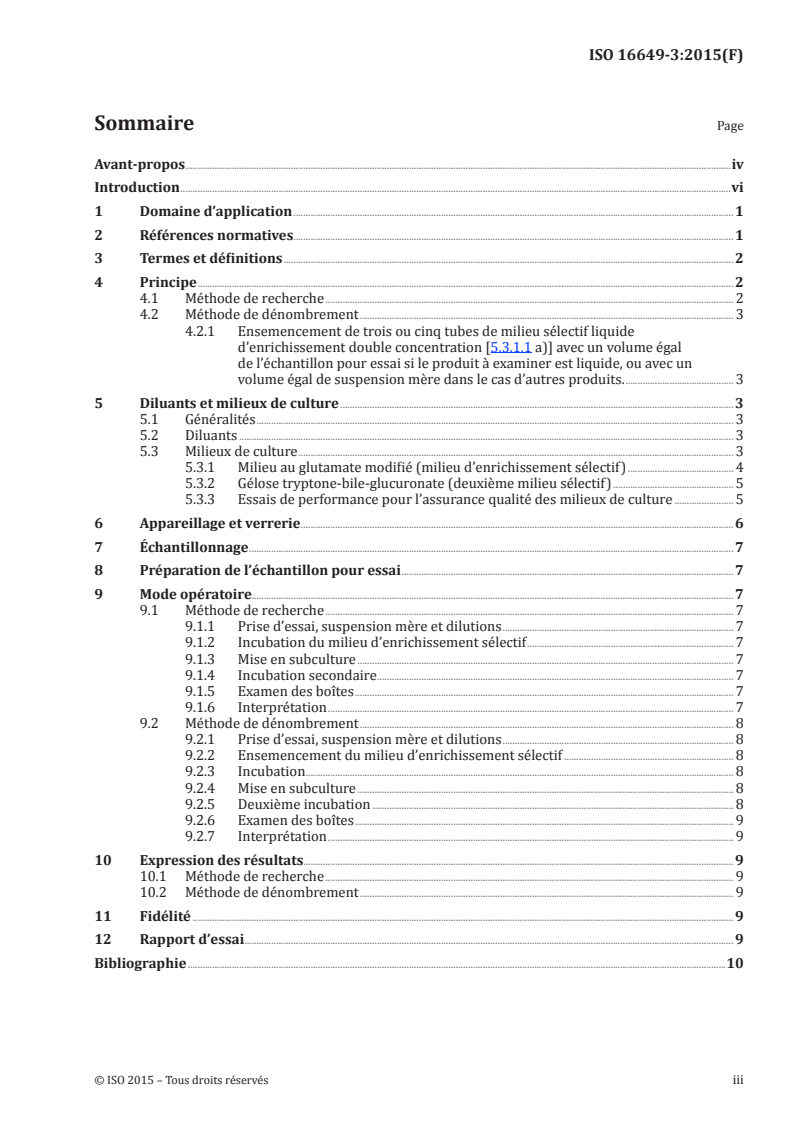
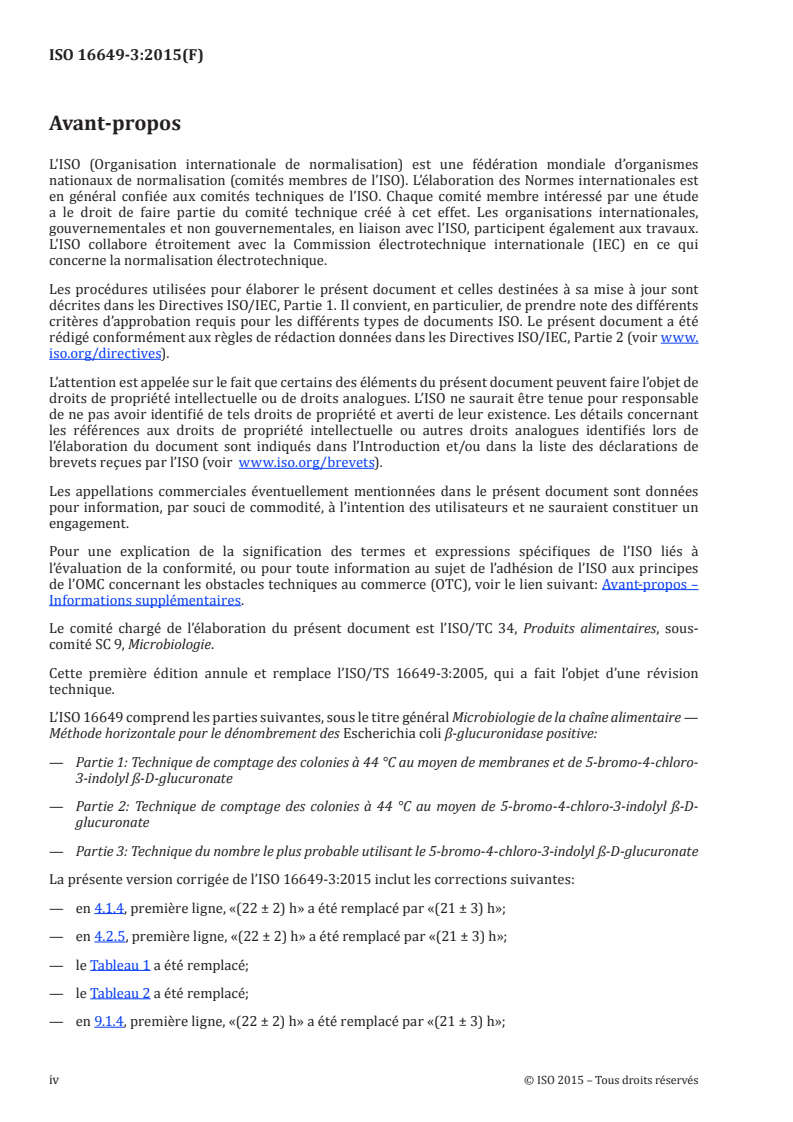
ISO 16649-3:2015 - Microbiologie de la chaîne alimentaire — Méthode horizontale pour le dénombrement des Escherichia coli bêta-glucuronidase positive — Partie 3: Recherche et technique du nombre le plus probable utilisant le bromo-5-chloro-4-indolyl-3 ß-D-glucuronate/12/2016
ISO 16649-3:2015 - Overview
ISO 16649-3:2015 defines a horizontal microbiological method for the detection and enumeration of β‑glucuronidase‑positive Escherichia coli (E. coli) using a liquid‑medium culture technique and the Most Probable Number (MPN) calculation. The method uses the chromogenic substrate 5‑bromo‑4‑chloro‑3‑indolyl‑β‑D‑glucuronide (BCIG) and a two‑stage incubation (first at 37 ± 1 °C, then at 44 ± 1 °C) to identify typical blue/blue‑green colonies on tryptone bile glucuronide agar. ISO 16649‑3 applies to food, animal feed and environmental samples in food production and handling areas.
Key technical topics and requirements
- Scope and suitability
- Applicable to products for human consumption and animal feed, plus environmental sampling in food production zones.
- Suitable for enumeration of E. coli cells stressed by dehydration, freezing, saline (marine) exposure or chlorine disinfection.
- Detection and enumeration principle
- Liquid selective enrichment (e.g., minerals modified glutamate medium) inoculated with test portion → incubate 37 °C → screen for lactose fermentation → subculture to tryptone bile glucuronide agar and incubate 44 °C → examine for β‑glucuronidase‑positive colonies and calculate MPN.
- Media and quality assurance
- Defines dilution fluids, selective enrichment medium and tryptone bile glucuronide agar.
- Calls for performance testing and QA of culture media per ISO TS 11133.
- Limitations and precision
- Method subject to relatively high variability; results must be interpreted in light of Clause 11 (precision and variability).
- Not fully evaluated for all matrices (e.g., milk and milk products); ISO 7251 is recommended for milk.
- Warning: β‑glucuronidase‑negative strains (including some pathogenic strains such as E. coli O157) and strains that do not grow at 44 °C may not be detected.
Practical applications and users
- Food microbiology and quality control: routine testing of processed foods, raw materials and environmental swabs in production facilities.
- Regulatory and inspection laboratories: compliance testing where enumeration of β‑glucuronidase‑positive E. coli is required.
- Seafood and marine products testing: suitable for organisms exposed to saline environments.
- Laboratories addressing stressed organisms (frozen, dried or chlorine‑exposed samples) where recovery sensitivity matters.
Related standards and references
- ISO 6887 series - sample preparation and dilutions
- ISO 7218 - general rules for microbiological examination
- ISO TS 11133‑1/2 - culture media preparation and performance testing
- ISO 7251 - MPN technique for presumptive E. coli (recommended for milk and milk products)
This summary highlights the practical value of ISO 16649‑3:2015 for E. coli detection and MPN enumeration in food and environmental testing while noting method limitations and complementary standards for specific matrices.
Relations
- Effective Date
- 12-Feb-2026
- Effective Date
- 06-Jun-2022
- Effective Date
- 26-Jun-2010
Buy Documents
ISO 16649-3:2015 - Microbiology of the food chain -- Horizontal method for the enumeration of beta-glucuronidase-positive Escherichia coli
ISO 16649-3:2015 - Microbiology of the food chain — Horizontal method for the enumeration of beta-glucuronidase-positive Escherichia coli — Part 3: Detection and most probable number technique using 5-bromo-4-chloro-3-indolyl-ß-D-glucuronide/12/2016
ISO 16649-3:2015 - Microbiologie de la chaîne alimentaire -- Méthode horizontale pour le dénombrement des Escherichia coli bêta-glucuronidase positive
ISO 16649-3:2015 - Microbiologie de la chaîne alimentaire — Méthode horizontale pour le dénombrement des Escherichia coli bêta-glucuronidase positive — Partie 3: Recherche et technique du nombre le plus probable utilisant le bromo-5-chloro-4-indolyl-3 ß-D-glucuronate/12/2016
Frequently Asked Questions
ISO 16649-3:2015 is a standard published by the International Organization for Standardization (ISO). Its full title is "Microbiology of the food chain — Horizontal method for the enumeration of beta-glucuronidase-positive Escherichia coli — Part 3: Detection and most probable number technique using 5-bromo-4-chloro-3-indolyl-ß-D-glucuronide". This standard covers: ISO 16649-3:2015 specifies a horizontal method for the detection and enumeration of β-glucuronidase positive Escherichia coli, by means of the liquid-medium culture technique and calculation of the most probable number (MPN) after incubation at (37 ± 1) °C, then at (44 ± 1) °C. This part of ISO 16649 is applicable to the following: - products intended for human consumption and the feeding of animals; - environmental samples in the area of food production and food handling. The method is suitable for the enumeration of cells of E. coli that might have been subjected to stress arising from dehydration, freezing, and exposure to a saline (such as marine) environment or damage by disinfectants such as chlorine-containing products. A limitation of the applicability of this part of ISO 16649 is imposed by the susceptibility of the method to a large degree of variability. The method is intended to be applied and the results interpreted in the light of the information given in Clause 11. This method has not been fully evaluated for all matrices (e.g. for milk and milk products). ISO 7251 is intended to be used for milk and milk products.
ISO 16649-3:2015 specifies a horizontal method for the detection and enumeration of β-glucuronidase positive Escherichia coli, by means of the liquid-medium culture technique and calculation of the most probable number (MPN) after incubation at (37 ± 1) °C, then at (44 ± 1) °C. This part of ISO 16649 is applicable to the following: - products intended for human consumption and the feeding of animals; - environmental samples in the area of food production and food handling. The method is suitable for the enumeration of cells of E. coli that might have been subjected to stress arising from dehydration, freezing, and exposure to a saline (such as marine) environment or damage by disinfectants such as chlorine-containing products. A limitation of the applicability of this part of ISO 16649 is imposed by the susceptibility of the method to a large degree of variability. The method is intended to be applied and the results interpreted in the light of the information given in Clause 11. This method has not been fully evaluated for all matrices (e.g. for milk and milk products). ISO 7251 is intended to be used for milk and milk products.
ISO 16649-3:2015 is classified under the following ICS (International Classification for Standards) categories: 07.100.30 - Food microbiology. The ICS classification helps identify the subject area and facilitates finding related standards.
ISO 16649-3:2015 has the following relationships with other standards: It is inter standard links to EN ISO 16649-3:2015, ISO 717-1:1996/Amd 1:2006, ISO/TS 16649-3:2005. Understanding these relationships helps ensure you are using the most current and applicable version of the standard.
ISO 16649-3:2015 is available in PDF format for immediate download after purchase. The document can be added to your cart and obtained through the secure checkout process. Digital delivery ensures instant access to the complete standard document.
Standards Content (Sample)
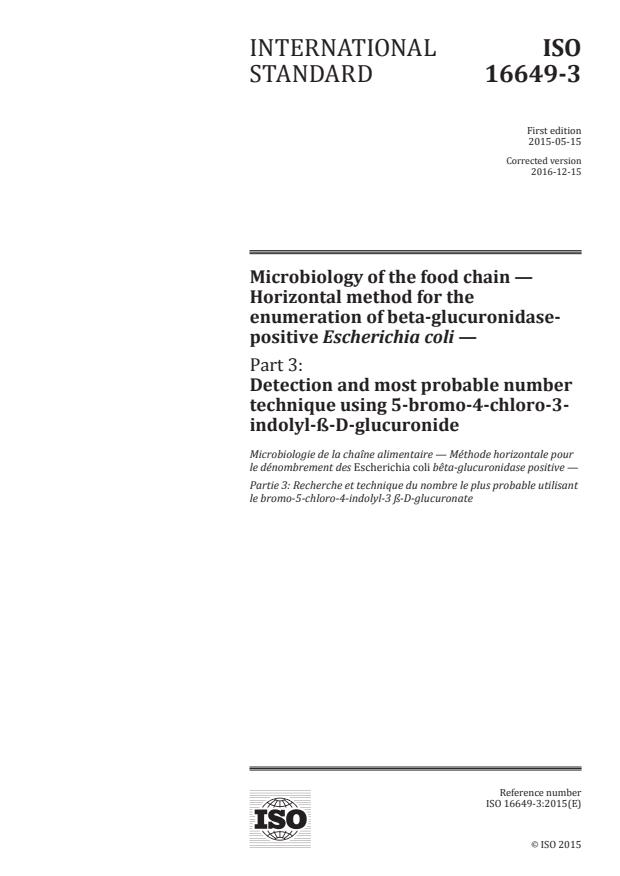
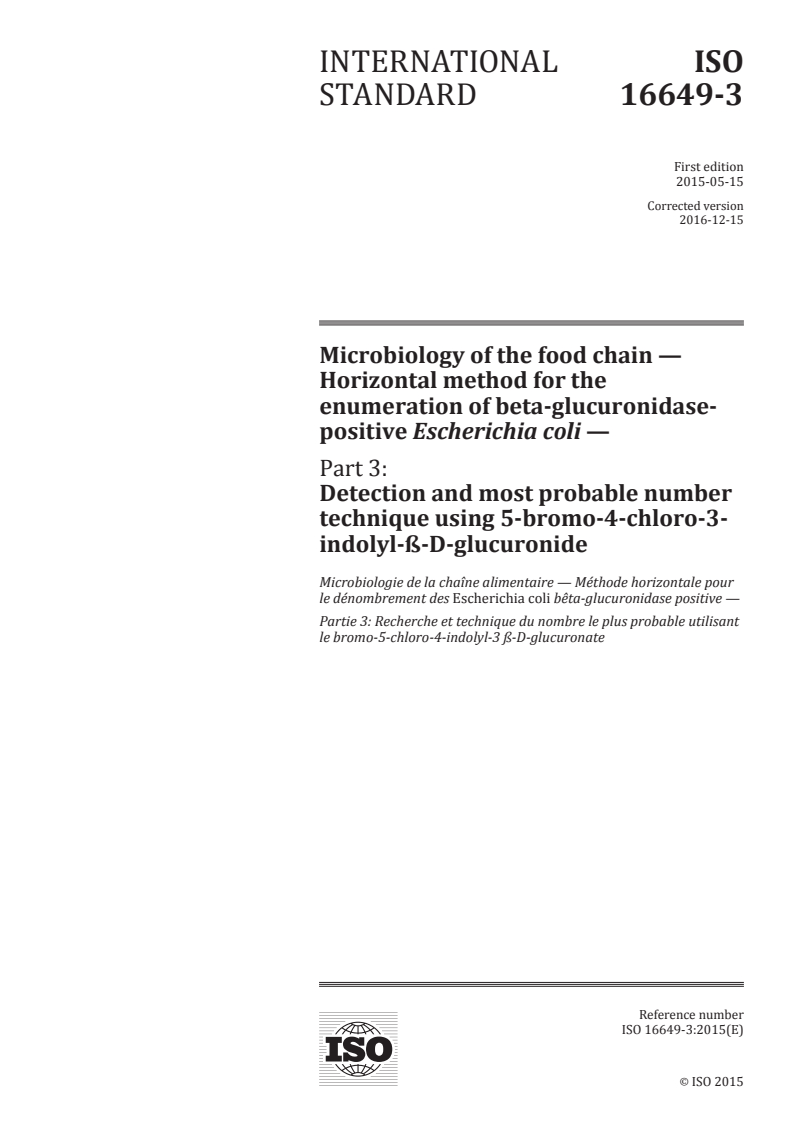
INTERNATIONAL ISO
STANDARD 16649-3
First edition
2015-05-15
Corrected version
2016-12-15
Microbiology of the food chain —
Horizontal method for the
enumeration of beta-glucuronidase-
positive Escherichia coli —
Part 3:
Detection and most probable number
technique using 5-bromo-4-chloro-3-
indolyl-ß-D-glucuronide
Microbiologie de la chaîne alimentaire — Méthode horizontale pour
le dénombrement des Escherichia coli bêta-glucuronidase positive —
Partie 3: Recherche et technique du nombre le plus probable utilisant
le bromo-5-chloro-4-indolyl-3 ß-D-glucuronate
Reference number
©
ISO 2015
© ISO 2015, Published in Switzerland
All rights reserved. Unless otherwise specified, no part of this publication may be reproduced or utilized otherwise in any form
or by any means, electronic or mechanical, including photocopying, or posting on the internet or an intranet, without prior
written permission. Permission can be requested from either ISO at the address below or ISO’s member body in the country of
the requester.
ISO copyright office
Ch. de Blandonnet 8 • CP 401
CH-1214 Vernier, Geneva, Switzerland
Tel. +41 22 749 01 11
Fax +41 22 749 09 47
copyright@iso.org
www.iso.org
ii © ISO 2015 – All rights reserved
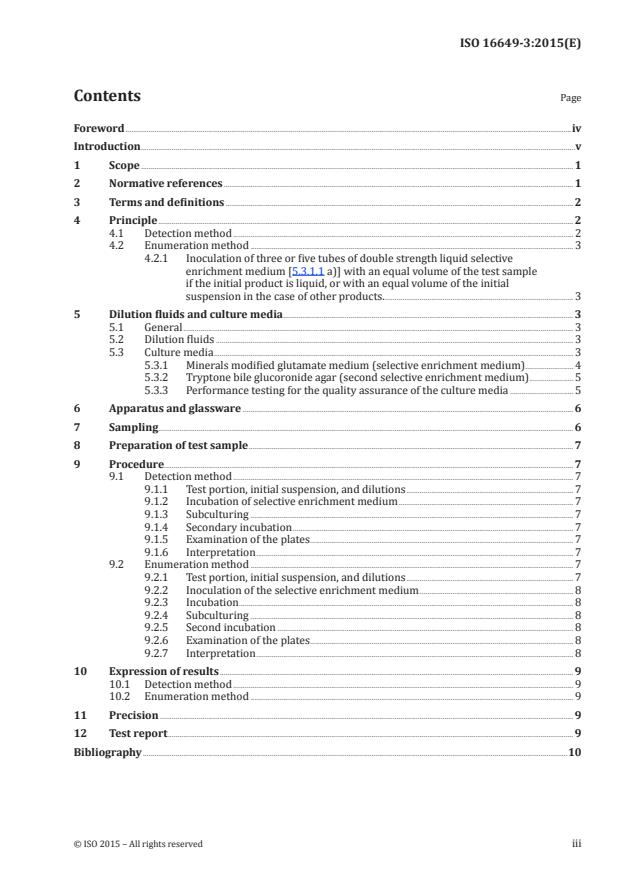
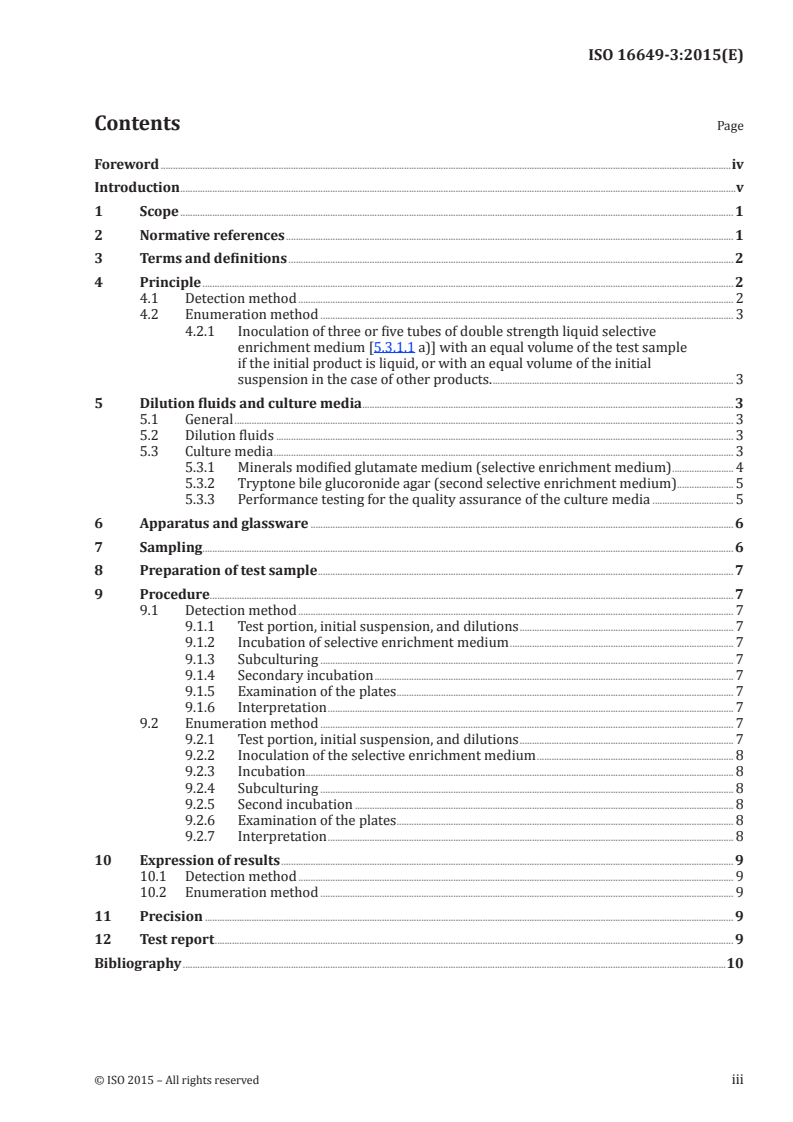
Contents Page
Foreword .iv
Introduction .v
1 Scope . 1
2 Normative references . 1
3 Terms and definitions . 2
4 Principle . 2
4.1 Detection method . 2
4.2 Enumeration method . 3
4.2.1 Inoculation of three or five tubes of double strength liquid selective
enrichment medium [5.3.1.1 a)] with an equal volume of the test sample
if the initial product is liquid, or with an equal volume of the initial
suspension in the case of other products. . 3
5 Dilution fluids and culture media . 3
5.1 General . 3
5.2 Dilution fluids . 3
5.3 Culture media . 3
5.3.1 Minerals modified glutamate medium (selective enrichment medium) . 4
5.3.2 Tryptone bile glucoronide agar (second selective enrichment medium) . 5
5.3.3 Performance testing for the quality assurance of the culture media . 5
6 Apparatus and glassware . 6
7 Sampling . 6
8 Preparation of test sample . 7
9 Procedure. 7
9.1 Detection method . 7
9.1.1 Test portion, initial suspension, and dilutions . 7
9.1.2 Incubation of selective enrichment medium . 7
9.1.3 Subculturing . 7
9.1.4 Secondary incubation . 7
9.1.5 Examination of the plates . 7
9.1.6 Interpretation . 7
9.2 Enumeration method . 7
9.2.1 Test portion, initial suspension, and dilutions . 7
9.2.2 Inoculation of the selective enrichment medium . 8
9.2.3 Incubation . 8
9.2.4 Subculturing . 8
9.2.5 Second incubation . 8
9.2.6 Examination of the plates . 8
9.2.7 Interpretation . 8
10 Expression of results . 9
10.1 Detection method . 9
10.2 Enumeration method . 9
11 Precision . 9
12 Test report . 9
Bibliography .10
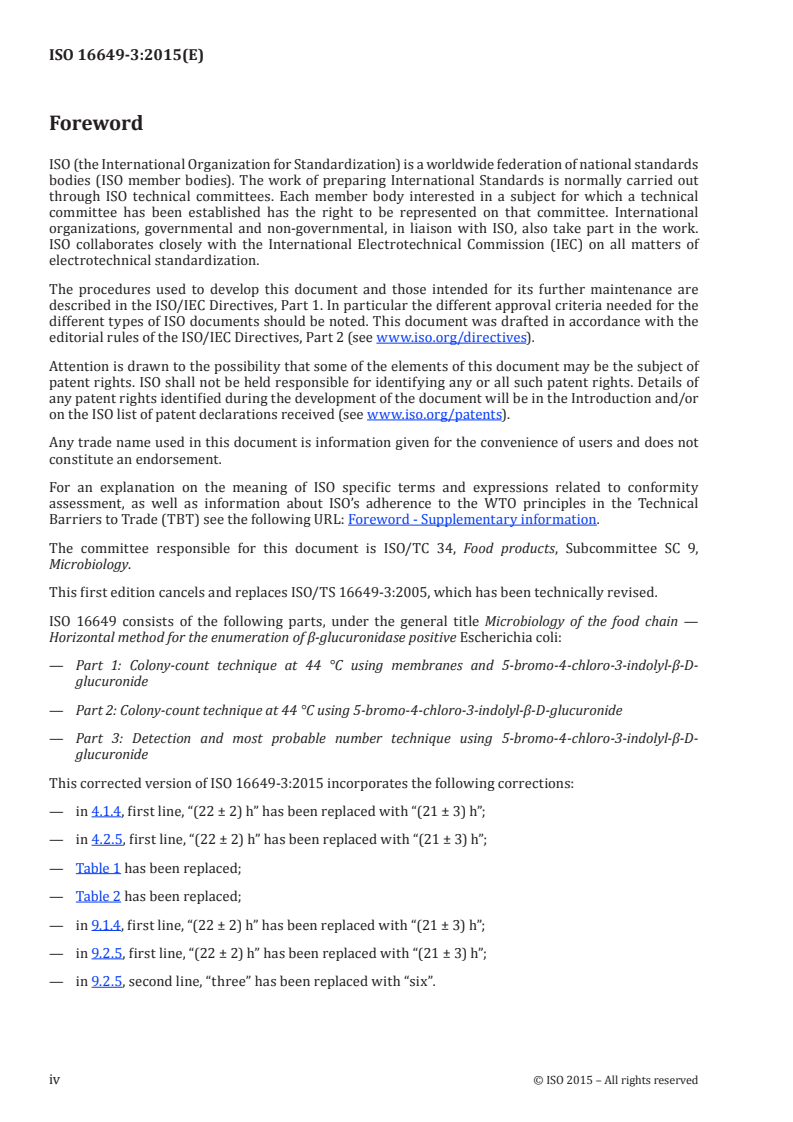
Foreword
ISO (the International Organization for Standardization) is a worldwide federation of national standards
bodies (ISO member bodies). The work of preparing International Standards is normally carried out
through ISO technical committees. Each member body interested in a subject for which a technical
committee has been established has the right to be represented on that committee. International
organizations, governmental and non-governmental, in liaison with ISO, also take part in the work.
ISO collaborates closely with the International Electrotechnical Commission (IEC) on all matters of
electrotechnical standardization.
The procedures used to develop this document and those intended for its further maintenance are
described in the ISO/IEC Directives, Part 1. In particular the different approval criteria needed for the
different types of ISO documents should be noted. This document was drafted in accordance with the
editorial rules of the ISO/IEC Directives, Part 2 (see www.iso.org/directives).
Attention is drawn to the possibility that some of the elements of this document may be the subject of
patent rights. ISO shall not be held responsible for identifying any or all such patent rights. Details of
any patent rights identified during the development of the document will be in the Introduction and/or
on the ISO list of patent declarations received (see www.iso.org/patents).
Any trade name used in this document is information given for the convenience of users and does not
constitute an endorsement.
For an explanation on the meaning of ISO specific terms and expressions related to conformity
assessment, as well as information about ISO’s adherence to the WTO principles in the Technical
Barriers to Trade (TBT) see the following URL: Foreword - Supplementary information.
The committee responsible for this document is ISO/TC 34, Food products, Subcommittee SC 9,
Microbiology.
This first edition cancels and replaces ISO/TS 16649-3:2005, which has been technically revised.
ISO 16649 consists of the following parts, under the general title Microbiology of the food chain —
Horizontal method for the enumeration of β-glucuronidase positive Escherichia coli:
— Part 1: Colony-count technique at 44 °C using membranes and 5-bromo-4-chloro-3-indolyl-β-D-
glucuronide
— Part 2: Colony-count technique at 44 °C using 5-bromo-4-chloro-3-indolyl-β-D-glucuronide
— Part 3: Detection and most probable number technique using 5-bromo-4-chloro-3-indolyl-β-D-
glucuronide
This corrected version of ISO 16649-3:2015 incorporates the following corrections:
— in 4.1.4, first line, “(22 ± 2) h” has been replaced with “(21 ± 3) h”;
— in 4.2.5, first line, “(22 ± 2) h” has been replaced with “(21 ± 3) h”;
— Table 1 has been replaced;
— Table 2 has been replaced;
— in 9.1.4, first line, “(22 ± 2) h” has been replaced with “(21 ± 3) h”;
— in 9.2.5, first line, “(22 ± 2) h” has been replaced with “(21 ± 3) h”;
— in 9.2.5, second line, “three” has been replaced with “six”.
iv © ISO 2015 – All rights reserved
Introduction
Because of the large variety of food and feed products, this horizontal method might not be appropriate
in every detail for certain products. In this case, different methods which are specific to these products
might be used if absolutely necessary, for justified technical reasons. Nevertheless, every attempt will
be made to apply this horizontal method as far as possible.
When this part of ISO 16649 is next reviewed, account will be taken of all information available
regarding the extent to which this horizontal method has been followed and the reasons for deviations
from this method in the case of particular products.
The harmonization of test methods cannot be immediate and for certain groups of products,
International Standards and/or national standards might already exist that do not comply with this
horizontal method. It is hoped that when such standards are reviewed, they will be changed to comply
with this part of ISO 16649 so that eventually, the only remaining departures will be those necessary
for well-established technical reasons.
INTERNATIONAL STANDARD ISO 16649-3:2015(E)
Microbiology of the food chain — Horizontal method
for the enumeration of beta-glucuronidase-positive
Escherichia coli —
Part 3:
Detection and most probable number technique using
5-bromo-4-chloro-3-indolyl-ß-D-glucuronide
WARNING — Strains of Escherichia coli that do not grow at 44 °C and, in particular, those that are
β-glucuronidase negative, such as Escherichia coli O157 and some other strains of pathogenic
E. coli, will not be detected by the method described in this part of ISO 16649.
1 Scope
This part of ISO 16649 specifies a horizontal method for the detection and enumeration of
β-glucuronidase positive Escherichia coli, by means of the liquid-medium culture technique and
calculation of the most probable number (MPN) after incubation at (37 ± 1) °C, then at (44 ± 1) °C. This
part of ISO 16649 is applicable to the following:
— products intended for human consumption and the feeding of animals;
— environmental samples in the area of food production and food handling.
The method is suitable for the enumeration of cells of E. coli that might have been subjected to stress
arising from dehydration, freezing, and exposure to a saline (such as marine) environment or damage
by disinfectants such as chlorine-containing products.
A limitation of the applicability of this part of ISO 16649 is imposed by the susceptibility of the method
to a large degree of variability. The method is intended to be applied and the results interpreted in the
light of the information given in Clause 11.
This method has not been fully evaluated for all matrices (e.g. for milk and milk products). ISO 7251 is
intended to be used for milk and milk products.
2 Normative references
The following documents, in whole or in part, are normatively referenced in this document and are
indispensable for its application. For dated references, only the edition cited applies. For undated
references, the latest edition of the referenced document (including any amendments) applies.
ISO 6887-1, Microbiology of food and animal feeding stuffs — Preparation of test samples, initial suspension
and decimal dilutions for microbiological examination — Part 1: General rules for the preparation of the
initial suspension and decimal dilutions
ISO 6887-2, Microbiology of food and animal feeding stuffs — Preparation of test samples, initial suspension
and decimal dilutions for microbiological examination — Part 2: Specific rules for the preparation of meat
and meat products
ISO 6887-3, Microbiology of food and animal feeding stuffs — Preparation of test samples, initial suspension
and decimal dilutions for microbiological examination — Part 3: Specific rules for the preparation of fish
and fishery products
ISO 6887-4, Microbiology of food and animal feeding stuffs — Preparation of test samples, initial suspension
and decimal dilutions for microbiological examination — Part 4: Specific rules for the preparation of
miscellaneous products
ISO 6887-5, Microbiology of food and animal feeding stuffs — Preparation of test samples, initial suspension
and decimal dilutions for microbiological examination — Part 5: Specific rules for the preparation of milk
and milk products
ISO 6887-6, Microbiology of food and animal feed — Preparation of test samples, initial suspension and
decimal dilutions for microbiological examination — Part 6: Specific rules for the preparation of samples
taken at the primary production stage
ISO 7218, Microbiology of food and animal feeding stuffs — General requirements and guidance for
microbiological examinations
ISO 11133, Microbiology of food, animal feed and water — Preparation, production, storage and
performance testing of culture media
3 Terms and definitions
For the purposes of this document, the following terms and definitions apply.
3.1
β-glucuronidase positive Escherichia coli
strains of E. coli which, at 44 °C, form typical blue or blue green colonies on tryptone bile glucuronide
medium (TBX) under the conditions specified in the procedure
3.2
enumeration of β-glucuronidase positive Escherichia coli
determination of the most probable number of β-glucuronidase positive E. coli per millilitre or gram of
sample when the test is carried out in accordance with the specified procedure
4 Principle
4.1 Detection method
4.1.1 A liquid selective enrichment medium is inoculated with a specified quantity of test sample if the
initial product is liquid or with a specified quantity of the initial suspension in the case of other products.
4.1.2 The tube is incubated at (37 ± 1) °C for (24 ± 2) h. The tube is examined for acid production,
indicating lactose fermentation.
4.1.3 If the tube has given rise to acid production, it is subcultured onto tryptone bile glucuronide agar
(5.3.2).
4.1.4 Incubat
...
INTERNATIONAL ISO
STANDARD 16649-3
First edition
2015-05-15
Corrected version
2016-12-15
Microbiology of the food chain —
Horizontal method for the
enumeration of beta-glucuronidase-
positive Escherichia coli —
Part 3:
Detection and most probable number
technique using 5-bromo-4-chloro-3-
indolyl-ß-D-glucuronide
Microbiologie de la chaîne alimentaire — Méthode horizontale pour
le dénombrement des Escherichia coli bêta-glucuronidase positive —
Partie 3: Recherche et technique du nombre le plus probable utilisant
le bromo-5-chloro-4-indolyl-3 ß-D-glucuronate
Reference number
©
ISO 2015
© ISO 2015, Published in Switzerland
All rights reserved. Unless otherwise specified, no part of this publication may be reproduced or utilized otherwise in any form
or by any means, electronic or mechanical, including photocopying, or posting on the internet or an intranet, without prior
written permission. Permission can be requested from either ISO at the address below or ISO’s member body in the country of
the requester.
ISO copyright office
Ch. de Blandonnet 8 • CP 401
CH-1214 Vernier, Geneva, Switzerland
Tel. +41 22 749 01 11
Fax +41 22 749 09 47
copyright@iso.org
www.iso.org
ii © ISO 2015 – All rights reserved
Contents Page
Foreword .iv
Introduction .v
1 Scope . 1
2 Normative references . 1
3 Terms and definitions . 2
4 Principle . 2
4.1 Detection method . 2
4.2 Enumeration method . 3
4.2.1 Inoculation of three or five tubes of double strength liquid selective
enrichment medium [5.3.1.1 a)] with an equal volume of the test sample
if the initial product is liquid, or with an equal volume of the initial
suspension in the case of other products. . 3
5 Dilution fluids and culture media . 3
5.1 General . 3
5.2 Dilution fluids . 3
5.3 Culture media . 3
5.3.1 Minerals modified glutamate medium (selective enrichment medium) . 4
5.3.2 Tryptone bile glucoronide agar (second selective enrichment medium) . 5
5.3.3 Performance testing for the quality assurance of the culture media . 5
6 Apparatus and glassware . 6
7 Sampling . 6
8 Preparation of test sample . 7
9 Procedure. 7
9.1 Detection method . 7
9.1.1 Test portion, initial suspension, and dilutions . 7
9.1.2 Incubation of selective enrichment medium . 7
9.1.3 Subculturing . 7
9.1.4 Secondary incubation . 7
9.1.5 Examination of the plates . 7
9.1.6 Interpretation . 7
9.2 Enumeration method . 7
9.2.1 Test portion, initial suspension, and dilutions . 7
9.2.2 Inoculation of the selective enrichment medium . 8
9.2.3 Incubation . 8
9.2.4 Subculturing . 8
9.2.5 Second incubation . 8
9.2.6 Examination of the plates . 8
9.2.7 Interpretation . 8
10 Expression of results . 9
10.1 Detection method . 9
10.2 Enumeration method . 9
11 Precision . 9
12 Test report . 9
Bibliography .10
Foreword
ISO (the International Organization for Standardization) is a worldwide federation of national standards
bodies (ISO member bodies). The work of preparing International Standards is normally carried out
through ISO technical committees. Each member body interested in a subject for which a technical
committee has been established has the right to be represented on that committee. International
organizations, governmental and non-governmental, in liaison with ISO, also take part in the work.
ISO collaborates closely with the International Electrotechnical Commission (IEC) on all matters of
electrotechnical standardization.
The procedures used to develop this document and those intended for its further maintenance are
described in the ISO/IEC Directives, Part 1. In particular the different approval criteria needed for the
different types of ISO documents should be noted. This document was drafted in accordance with the
editorial rules of the ISO/IEC Directives, Part 2 (see www.iso.org/directives).
Attention is drawn to the possibility that some of the elements of this document may be the subject of
patent rights. ISO shall not be held responsible for identifying any or all such patent rights. Details of
any patent rights identified during the development of the document will be in the Introduction and/or
on the ISO list of patent declarations received (see www.iso.org/patents).
Any trade name used in this document is information given for the convenience of users and does not
constitute an endorsement.
For an explanation on the meaning of ISO specific terms and expressions related to conformity
assessment, as well as information about ISO’s adherence to the WTO principles in the Technical
Barriers to Trade (TBT) see the following URL: Foreword - Supplementary information.
The committee responsible for this document is ISO/TC 34, Food products, Subcommittee SC 9,
Microbiology.
This first edition cancels and replaces ISO/TS 16649-3:2005, which has been technically revised.
ISO 16649 consists of the following parts, under the general title Microbiology of the food chain —
Horizontal method for the enumeration of β-glucuronidase positive Escherichia coli:
— Part 1: Colony-count technique at 44 °C using membranes and 5-bromo-4-chloro-3-indolyl-β-D-
glucuronide
— Part 2: Colony-count technique at 44 °C using 5-bromo-4-chloro-3-indolyl-β-D-glucuronide
— Part 3: Detection and most probable number technique using 5-bromo-4-chloro-3-indolyl-β-D-
glucuronide
This corrected version of ISO 16649-3:2015 incorporates the following corrections:
— in 4.1.4, first line, “(22 ± 2) h” has been replaced with “(21 ± 3) h”;
— in 4.2.5, first line, “(22 ± 2) h” has been replaced with “(21 ± 3) h”;
— Table 1 has been replaced;
— Table 2 has been replaced;
— in 9.1.4, first line, “(22 ± 2) h” has been replaced with “(21 ± 3) h”;
— in 9.2.5, first line, “(22 ± 2) h” has been replaced with “(21 ± 3) h”;
— in 9.2.5, second line, “three” has been replaced with “six”.
iv © ISO 2015 – All rights reserved
Introduction
Because of the large variety of food and feed products, this horizontal method might not be appropriate
in every detail for certain products. In this case, different methods which are specific to these products
might be used if absolutely necessary, for justified technical reasons. Nevertheless, every attempt will
be made to apply this horizontal method as far as possible.
When this part of ISO 16649 is next reviewed, account will be taken of all information available
regarding the extent to which this horizontal method has been followed and the reasons for deviations
from this method in the case of particular products.
The harmonization of test methods cannot be immediate and for certain groups of products,
International Standards and/or national standards might already exist that do not comply with this
horizontal method. It is hoped that when such standards are reviewed, they will be changed to comply
with this part of ISO 16649 so that eventually, the only remaining departures will be those necessary
for well-established technical reasons.
INTERNATIONAL STANDARD ISO 16649-3:2015(E)
Microbiology of the food chain — Horizontal method
for the enumeration of beta-glucuronidase-positive
Escherichia coli —
Part 3:
Detection and most probable number technique using
5-bromo-4-chloro-3-indolyl-ß-D-glucuronide
WARNING — Strains of Escherichia coli that do not grow at 44 °C and, in particular, those that are
β-glucuronidase negative, such as Escherichia coli O157 and some other strains of pathogenic
E. coli, will not be detected by the method described in this part of ISO 16649.
1 Scope
This part of ISO 16649 specifies a horizontal method for the detection and enumeration of
β-glucuronidase positive Escherichia coli, by means of the liquid-medium culture technique and
calculation of the most probable number (MPN) after incubation at (37 ± 1) °C, then at (44 ± 1) °C. This
part of ISO 16649 is applicable to the following:
— products intended for human consumption and the feeding of animals;
— environmental samples in the area of food production and food handling.
The method is suitable for the enumeration of cells of E. coli that might have been subjected to stress
arising from dehydration, freezing, and exposure to a saline (such as marine) environment or damage
by disinfectants such as chlorine-containing products.
A limitation of the applicability of this part of ISO 16649 is imposed by the susceptibility of the method
to a large degree of variability. The method is intended to be applied and the results interpreted in the
light of the information given in Clause 11.
This method has not been fully evaluated for all matrices (e.g. for milk and milk products). ISO 7251 is
intended to be used for milk and milk products.
2 Normative references
The following documents, in whole or in part, are normatively referenced in this document and are
indispensable for its application. For dated references, only the edition cited applies. For undated
references, the latest edition of the referenced document (including any amendments) applies.
ISO 6887-1, Microbiology of food and animal feeding stuffs — Preparation of test samples, initial suspension
and decimal dilutions for microbiological examination — Part 1: General rules for the preparation of the
initial suspension and decimal dilutions
ISO 6887-2, Microbiology of food and animal feeding stuffs — Preparation of test samples, initial suspension
and decimal dilutions for microbiological examination — Part 2: Specific rules for the preparation of meat
and meat products
ISO 6887-3, Microbiology of food and animal feeding stuffs — Preparation of test samples, initial suspension
and decimal dilutions for microbiological examination — Part 3: Specific rules for the preparation of fish
and fishery products
ISO 6887-4, Microbiology of food and animal feeding stuffs — Preparation of test samples, initial suspension
and decimal dilutions for microbiological examination — Part 4: Specific rules for the preparation of
miscellaneous products
ISO 6887-5, Microbiology of food and animal feeding stuffs — Preparation of test samples, initial suspension
and decimal dilutions for microbiological examination — Part 5: Specific rules for the preparation of milk
and milk products
ISO 6887-6, Microbiology of food and animal feed — Preparation of test samples, initial suspension and
decimal dilutions for microbiological examination — Part 6: Specific rules for the preparation of samples
taken at the primary production stage
ISO 7218, Microbiology of food and animal feeding stuffs — General requirements and guidance for
microbiological examinations
ISO 11133, Microbiology of food, animal feed and water — Preparation, production, storage and
performance testing of culture media
3 Terms and definitions
For the purposes of this document, the following terms and definitions apply.
3.1
β-glucuronidase positive Escherichia coli
strains of E. coli which, at 44 °C, form typical blue or blue green colonies on tryptone bile glucuronide
medium (TBX) under the conditions specified in the procedure
3.2
enumeration of β-glucuronidase positive Escherichia coli
determination of the most probable number of β-glucuronidase positive E. coli per millilitre or gram of
sample when the test is carried out in accordance with the specified procedure
4 Principle
4.1 Detection method
4.1.1 A liquid selective enrichment medium is inoculated with a specified quantity of test sample if the
initial product is liquid or with a specified quantity of the initial suspension in the case of other products.
4.1.2 The tube is incubated at (37 ± 1) °C for (24 ± 2) h. The tube is examined for acid production,
indicating lactose fermentation.
4.1.3 If the tube has given rise to acid production, it is subcultured onto tryptone bile glucuronide agar
(5.3.2).
4.1.4 Incubat
...
NORME ISO
INTERNATIONALE 16649-3
Première édition
2015-05-15
Version corrigée
2016-12-15
Microbiologie de la chaîne
alimentaire — Méthode horizontale
pour le dénombrement des
Escherichia coli bêta-glucuronidase
positive —
Partie 3:
Recherche et technique du nombre le
plus probable utilisant le bromo-5-
chloro-4-indolyl-3 ß-D-glucuronate
Microbiology of the food chain — Horizontal method for the
enumeration of beta-glucuronidase-positive Escherichia coli —
Part 3: Detection and most probable number technique using
5-bromo-4-chloro-3-indolyl-ß-D-glucuronide
Numéro de référence
©
ISO 2015
DOCUMENT PROTÉGÉ PAR COPYRIGHT
© ISO 2015, Publié en Suisse
Droits de reproduction réservés. Sauf indication contraire, aucune partie de cette publication ne peut être reproduite ni utilisée
sous quelque forme que ce soit et par aucun procédé, électronique ou mécanique, y compris la photocopie, l’affichage sur
l’internet ou sur un Intranet, sans autorisation écrite préalable. Les demandes d’autorisation peuvent être adressées à l’ISO à
l’adresse ci-après ou au comité membre de l’ISO dans le pays du demandeur.
ISO copyright office
Ch. de Blandonnet 8 • CP 401
CH-1214 Vernier, Geneva, Switzerland
Tel. +41 22 749 01 11
Fax +41 22 749 09 47
copyright@iso.org
www.iso.org
ii © ISO 2015 – Tous droits réservés
Sommaire Page
Avant-propos .iv
Introduction .vi
1 Domaine d’application . 1
2 Références normatives . 1
3 Termes et définitions . 2
4 Principe . 2
4.1 Méthode de recherche . 2
4.2 Méthode de dénombrement . 3
4.2.1 Ensemencement de trois ou cinq tubes de milieu sélectif liquide
d’enrichissement double concentration [5.3.1.1 a)] avec un volume égal
de l’échantillon pour essai si le produit à examiner est liquide, ou avec un
volume égal de suspension mère dans le cas d’autres produits. . 3
5 Diluants et milieux de culture . 3
5.1 Généralités . 3
5.2 Diluants . 3
5.3 Milieux de culture . 3
5.3.1 Milieu au glutamate modifié (milieu d’enrichissement sélectif) . 4
5.3.2 Gélose tryptone-bile-glucuronate (deuxième milieu sélectif) . 5
5.3.3 Essais de performance pour l’assurance qualité des milieux de culture . 5
6 Appareillage et verrerie . 6
7 Échantillonnage . 7
8 Préparation de l’échantillon pour essai . 7
9 Mode opératoire. 7
9.1 Méthode de recherche . 7
9.1.1 Prise d’essai, suspension mère et dilutions . 7
9.1.2 Incubation du milieu d’enrichissement sélectif . 7
9.1.3 Mise en subculture . 7
9.1.4 Incubation secondaire . . 7
9.1.5 Examen des boîtes . 7
9.1.6 Interprétation . 7
9.2 Méthode de dénombrement . 8
9.2.1 Prise d’essai, suspension mère et dilutions . 8
9.2.2 Ensemencement du milieu d’enrichissement sélectif . 8
9.2.3 Incubation . 8
9.2.4 Mise en subculture . 8
9.2.5 Deuxième incubation . 8
9.2.6 Examen des boîtes . 9
9.2.7 Interprétation . 9
10 Expression des résultats. 9
10.1 Méthode de recherche . 9
10.2 Méthode de dénombrement . 9
11 Fidélité . 9
12 Rapport d’essai . 9
Bibliographie .10
Avant-propos
L’ISO (Organisation internationale de normalisation) est une fédération mondiale d’organismes
nationaux de normalisation (comités membres de l’ISO). L’élaboration des Normes internationales est
en général confiée aux comités techniques de l’ISO. Chaque comité membre intéressé par une étude
a le droit de faire partie du comité technique créé à cet effet. Les organisations internationales,
gouvernementales et non gouvernementales, en liaison avec l’ISO, participent également aux travaux.
L’ISO collabore étroitement avec la Commission électrotechnique internationale (IEC) en ce qui
concerne la normalisation électrotechnique.
Les procédures utilisées pour élaborer le présent document et celles destinées à sa mise à jour sont
décrites dans les Directives ISO/IEC, Partie 1. Il convient, en particulier, de prendre note des différents
critères d’approbation requis pour les différents types de documents ISO. Le présent document a été
rédigé conformément aux règles de rédaction données dans les Directives ISO/IEC, Partie 2 (voir www.
iso.org/directives).
L’attention est appelée sur le fait que certains des éléments du présent document peuvent faire l’objet de
droits de propriété intellectuelle ou de droits analogues. L’ISO ne saurait être tenue pour responsable
de ne pas avoir identifié de tels droits de propriété et averti de leur existence. Les détails concernant
les références aux droits de propriété intellectuelle ou autres droits analogues identifiés lors de
l’élaboration du document sont indiqués dans l’Introduction et/ou dans la liste des déclarations de
brevets reçues par l’ISO (voir www.iso.org/brevets).
Les appellations commerciales éventuellement mentionnées dans le présent document sont données
pour information, par souci de commodité, à l’intention des utilisateurs et ne sauraient constituer un
engagement.
Pour une explication de la signification des termes et expressions spécifiques de l’ISO liés à
l’évaluation de la conformité, ou pour toute information au sujet de l’adhésion de l’ISO aux principes
de l’OMC concernant les obstacles techniques au commerce (OTC), voir le lien suivant: Avant-propos –
Informations supplémentaires.
Le comité chargé de l’élaboration du présent document est l’ISO/TC 34, Produits alimentaires, sous-
comité SC 9, Microbiologie.
Cette première édition annule et remplace l’ISO/TS 16649-3:2005, qui a fait l’objet d’une révision
technique.
L’ISO 16649 comprend les parties suivantes, sous le titre général Microbiologie de la chaîne alimentaire —
Méthode horizontale pour le dénombrement des Escherichia coli β-glucuronidase positive:
— Partie 1: Technique de comptage des colonies à 44 °C au moyen de membranes et de 5-bromo-4-chloro-
3-indolyl ß-D-glucuronate
— Partie 2: Technique de comptage des colonies à 44 °C au moyen de 5-bromo-4-chloro-3-indolyl ß-D-
glucuronate
— Partie 3: Technique du nombre le plus probable utilisant le 5-bromo-4-chloro-3-indolyl ß-D-glucuronate
La présente version corrigée de l’ISO 16649-3:2015 inclut les corrections suivantes:
— en 4.1.4, première ligne, «(22 ± 2) h» a été remplacé par «(21 ± 3) h»;
— en 4.2.5, première ligne, «(22 ± 2) h» a été remplacé par «(21 ± 3) h»;
— le Tableau 1 a été remplacé;
— le Tableau 2 a été remplacé;
— en 9.1.4, première ligne, «(22 ± 2) h» a été remplacé par «(21 ± 3) h»;
iv © ISO 2015 – Tous droits réservés
— en 9.2.5, première ligne, «(22 ± 2) h» a été remplacé par «(21 ± 3) h»;
— en 9.2.5, deuxième ligne, «trois» a été remplacé «six».
Introduction
En raison de la grande diversité des aliments destinés à la consommation humaine ou animale, la
présente méthode horizontale pourrait ne pas convenir en tous points pour certains produits. Dans
ce cas, différentes méthodes spécifiques de ces produits pourraient être utilisées si cela s’avère
absolument nécessaire pour des raisons techniques justifiées. Néanmoins, la méthode horizontale
devra être appliquée aussi souvent que possible.
Lors de la prochaine révision de la présente partie de l’ISO 16649, il sera tenu compte de toutes les
informations indiquant dans quelle mesure cette méthode horizontale a été suivie, ainsi que des raisons
des dérogations dans le cas de produits particuliers.
L’harmonisation de toutes les méthodes d’essai ne peut être réalisée de façon immédiate; de ce fait,
il peut déjà exister des normes internationales et/ou nationales pour certains groupes de produits,
qui ne concordent pas avec cette méthode horizontale. Lors de la prochaine révision de ces normes, il
serait souhaitable de les aligner avec la présente partie de l’ISO 16649 et de ne conserver que les seules
divergences justifiées indispensables pour des raisons techniques.
vi © ISO 2015 – Tous droits réservés
NORME INTERNATIONALE ISO 16649-3:2015(F)
Microbiologie de la chaîne alimentaire — Méthode
horizontale pour le dénombrement des Escherichia coli
bêta-glucuronidase positive —
Partie 3:
Recherche et technique du nombre le plus probable
utilisant le bromo-5-chloro-4-indolyl-3 ß-D-glucuronate
AVERTISSEMENT — La méthode décrite dans la présente partie de l’ISO 16649 ne permet pas de
détecter les souches d’Escherichia coli qui ne se développent pas à 44 °C et, en particulier, celles
qui sont β-glucuronidase négative, comme Escherichia coli O157 et quelques autres souches d’E.
coli pathogènes.
1 Domaine d’application
La présente partie de l’ISO 16649 spécifie une méthode horizontale pour la recherche et le
dénombrement des Escherichia coli β-glucuronidase positives par la technique de mise en culture en
milieu liquide et par le calcul du nombre le plus probable (NPP) après incubation à (37 ± 1) °C, puis à
(44 ± 1) °C. La présente partie de l’ISO 16649 est applicable:
— aux produits alimentaires destinés à la consommation humaine ou à l’alimentation des animaux;
— aux échantillons environnementaux dans la zone de production et de manutention des produits
alimentaires.
Cette méthode convient pour le dénombrement des cellules d’Escherichia coli qui ont pu souffrir de
déshydratation, de congélation, d’exposition à un environnement salin (marin par exemple) ou avoir été
endommagées par des désinfectants, par exemple des produits contenant du chlore.
L’applicabilité de la présente partie de l’ISO 16649 est limitée par le fait que la méthode est sujette à
une importante variabilité. Il faut appliquer la méthode et interpréter les résultats à la lumière des
informations fournies à l’Article 11.
Cette méthode n’a pas fait l’objet d’une évaluation complète pour toutes les matrices, par exemple pour
le lait et les produits laitiers, pour lesquels il convient d’utiliser l’ISO 7251.
2 Références normatives
Les documents ci-après, dans leur intégralité ou non, sont des références normatives indispensables à
l’application du présent document. Pour les références datées, seule l’édition citée s’applique. Pour les
références non datées, la dernière édition du document de référence s’applique (y compris les éventuels
amendements).
ISO 6887-1, Microbiologie des aliments — Préparation des échantillons, de la suspension mère et des
dilutions décimales en vue de l’examen microbiologique — Partie 1: Règles générales pour la préparation de
la suspension mère et des dilutions décimales.
ISO 6887-2, Microbiologie des aliments — Préparation des échantillons, de la suspension mère et des
dilutions décimales en vue de l’examen microbiologique — Partie 2: Règles spécifiques pour la préparation
des viandes et produits à base de viande.
ISO 6887-3, Microbiologie des aliments — Préparation des échantillons, de la suspension mère et des
dilutions décimales en vue de l’examen microbiologique — Partie 3: Règles spécifiques pour la préparation
des produits de la pêche.
ISO 6887-4, Microbiologie des aliments — Préparation des échantillons, de la suspension mère et des
dilutions décimales en vue de l’examen microbiologique — Partie 4: Règles spécifiques pour la préparation
de produits autres que les produits laitiers, les produits carnés et les produits de la pêche.
ISO 6887-5, Microbiologie des aliments — Préparation des échantillons, de la suspension mère et des
dilutions décimales en vue de l’examen microbiologique — Partie 5: Règles spécifiques pour la préparation
du lait et des produits laitiers.
ISO 6887-6, Microbiologie des aliments — Préparation des échantillons, de la suspension mère et des
dilutions décimales en vue de l’examen microbiologique — Partie 6: Règles spécifiques pour la préparation
des échantillons prélevés au stade de production primaire
ISO 7218, Microbiologie des aliments — Exigences générales et recommandations.
ISO 11133, Microbiologie des aliments pour animaux et des eaux - Préparation, production, stockage et
essais de performance des milieux de culture
3 Termes et définitions
Pour les besoins du présent document, les termes et définitions suivants s’appliquent.
3.1
Escherichia coli β-glucuronidase positive
souches d’E. coli qui, à 44 °C, forment des colonies bleues ou bleu-vert caractéristiques sur le milieu
tryptone-bile-glucuronate (TBX) dans les conditions spécifiées dans le mode opératoire
3.2
dénombrement des Escherichia coli β-glucuronidase positive
détermination du nombre le plus probable d’E. coli β-glucuronidase positive, par millilitre ou par
gramme d’échantillon, lorsque l’essai est effectué selon le mode opératoire spécifié
4 Principe
4.1 Méthode de recherche
4.1.1 Ensemencement d’un milieu sélectif liquide d’enrichissement avec une quantité déterminée
de l’échantillon pour essai si le produit à examiner est liquide, ou avec une quantité déterminée de
suspension mère dans le cas d’autres produits.
4.1.2 Incubation du tube à (37 ± 1) °C pendant (24 ± 2) h. Examen du tube pour déceler une éventuelle
production d’acide, signifiant une fermentation du lactose.
4.1.3 Si le tube présente une production d’acide, mettre en subculture sur gélose tryptone-bile-
glucuronate (5.3.2).
4.1.4 Incubation de la gélose tryptone-bile-glucuronate (5.3.2) à (44 ± 1) °C pendant (21 ± 3) h.
Examen de la gélose tryptone-bile-glucuronate (5.3.2) pour déceler la présence éventu
...
NORME ISO
INTERNATIONALE 16649-3
Première édition
2015-05-15
Version corrigée
2016-12-15
Microbiologie de la chaîne
alimentaire — Méthode horizontale
pour le dénombrement des
Escherichia coli bêta-glucuronidase
positive —
Partie 3:
Recherche et technique du nombre le
plus probable utilisant le bromo-5-
chloro-4-indolyl-3 ß-D-glucuronate
Microbiology of the food chain — Horizontal method for the
enumeration of beta-glucuronidase-positive Escherichia coli —
Part 3: Detection and most probable number technique using
5-bromo-4-chloro-3-indolyl-ß-D-glucuronide
Numéro de référence
©
ISO 2015
DOCUMENT PROTÉGÉ PAR COPYRIGHT
© ISO 2015, Publié en Suisse
Droits de reproduction réservés. Sauf indication contraire, aucune partie de cette publication ne peut être reproduite ni utilisée
sous quelque forme que ce soit et par aucun procédé, électronique ou mécanique, y compris la photocopie, l’affichage sur
l’internet ou sur un Intranet, sans autorisation écrite préalable. Les demandes d’autorisation peuvent être adressées à l’ISO à
l’adresse ci-après ou au comité membre de l’ISO dans le pays du demandeur.
ISO copyright office
Ch. de Blandonnet 8 • CP 401
CH-1214 Vernier, Geneva, Switzerland
Tel. +41 22 749 01 11
Fax +41 22 749 09 47
copyright@iso.org
www.iso.org
ii © ISO 2015 – Tous droits réservés
Sommaire Page
Avant-propos .iv
Introduction .vi
1 Domaine d’application . 1
2 Références normatives . 1
3 Termes et définitions . 2
4 Principe . 2
4.1 Méthode de recherche . 2
4.2 Méthode de dénombrement . 3
4.2.1 Ensemencement de trois ou cinq tubes de milieu sélectif liquide
d’enrichissement double concentration [5.3.1.1 a)] avec un volume égal
de l’échantillon pour essai si le produit à examiner est liquide, ou avec un
volume égal de suspension mère dans le cas d’autres produits. . 3
5 Diluants et milieux de culture . 3
5.1 Généralités . 3
5.2 Diluants . 3
5.3 Milieux de culture . 3
5.3.1 Milieu au glutamate modifié (milieu d’enrichissement sélectif) . 4
5.3.2 Gélose tryptone-bile-glucuronate (deuxième milieu sélectif) . 5
5.3.3 Essais de performance pour l’assurance qualité des milieux de culture . 5
6 Appareillage et verrerie . 6
7 Échantillonnage . 7
8 Préparation de l’échantillon pour essai . 7
9 Mode opératoire. 7
9.1 Méthode de recherche . 7
9.1.1 Prise d’essai, suspension mère et dilutions . 7
9.1.2 Incubation du milieu d’enrichissement sélectif . 7
9.1.3 Mise en subculture . 7
9.1.4 Incubation secondaire . . 7
9.1.5 Examen des boîtes . 7
9.1.6 Interprétation . 7
9.2 Méthode de dénombrement . 8
9.2.1 Prise d’essai, suspension mère et dilutions . 8
9.2.2 Ensemencement du milieu d’enrichissement sélectif . 8
9.2.3 Incubation . 8
9.2.4 Mise en subculture . 8
9.2.5 Deuxième incubation . 8
9.2.6 Examen des boîtes . 9
9.2.7 Interprétation . 9
10 Expression des résultats. 9
10.1 Méthode de recherche . 9
10.2 Méthode de dénombrement . 9
11 Fidélité . 9
12 Rapport d’essai . 9
Bibliographie .10
Avant-propos
L’ISO (Organisation internationale de normalisation) est une fédération mondiale d’organismes
nationaux de normalisation (comités membres de l’ISO). L’élaboration des Normes internationales est
en général confiée aux comités techniques de l’ISO. Chaque comité membre intéressé par une étude
a le droit de faire partie du comité technique créé à cet effet. Les organisations internationales,
gouvernementales et non gouvernementales, en liaison avec l’ISO, participent également aux travaux.
L’ISO collabore étroitement avec la Commission électrotechnique internationale (IEC) en ce qui
concerne la normalisation électrotechnique.
Les procédures utilisées pour élaborer le présent document et celles destinées à sa mise à jour sont
décrites dans les Directives ISO/IEC, Partie 1. Il convient, en particulier, de prendre note des différents
critères d’approbation requis pour les différents types de documents ISO. Le présent document a été
rédigé conformément aux règles de rédaction données dans les Directives ISO/IEC, Partie 2 (voir www.
iso.org/directives).
L’attention est appelée sur le fait que certains des éléments du présent document peuvent faire l’objet de
droits de propriété intellectuelle ou de droits analogues. L’ISO ne saurait être tenue pour responsable
de ne pas avoir identifié de tels droits de propriété et averti de leur existence. Les détails concernant
les références aux droits de propriété intellectuelle ou autres droits analogues identifiés lors de
l’élaboration du document sont indiqués dans l’Introduction et/ou dans la liste des déclarations de
brevets reçues par l’ISO (voir www.iso.org/brevets).
Les appellations commerciales éventuellement mentionnées dans le présent document sont données
pour information, par souci de commodité, à l’intention des utilisateurs et ne sauraient constituer un
engagement.
Pour une explication de la signification des termes et expressions spécifiques de l’ISO liés à
l’évaluation de la conformité, ou pour toute information au sujet de l’adhésion de l’ISO aux principes
de l’OMC concernant les obstacles techniques au commerce (OTC), voir le lien suivant: Avant-propos –
Informations supplémentaires.
Le comité chargé de l’élaboration du présent document est l’ISO/TC 34, Produits alimentaires, sous-
comité SC 9, Microbiologie.
Cette première édition annule et remplace l’ISO/TS 16649-3:2005, qui a fait l’objet d’une révision
technique.
L’ISO 16649 comprend les parties suivantes, sous le titre général Microbiologie de la chaîne alimentaire —
Méthode horizontale pour le dénombrement des Escherichia coli β-glucuronidase positive:
— Partie 1: Technique de comptage des colonies à 44 °C au moyen de membranes et de 5-bromo-4-chloro-
3-indolyl ß-D-glucuronate
— Partie 2: Technique de comptage des colonies à 44 °C au moyen de 5-bromo-4-chloro-3-indolyl ß-D-
glucuronate
— Partie 3: Technique du nombre le plus probable utilisant le 5-bromo-4-chloro-3-indolyl ß-D-glucuronate
La présente version corrigée de l’ISO 16649-3:2015 inclut les corrections suivantes:
— en 4.1.4, première ligne, «(22 ± 2) h» a été remplacé par «(21 ± 3) h»;
— en 4.2.5, première ligne, «(22 ± 2) h» a été remplacé par «(21 ± 3) h»;
— le Tableau 1 a été remplacé;
— le Tableau 2 a été remplacé;
— en 9.1.4, première ligne, «(22 ± 2) h» a été remplacé par «(21 ± 3) h»;
iv © ISO 2015 – Tous droits réservés
— en 9.2.5, première ligne, «(22 ± 2) h» a été remplacé par «(21 ± 3) h»;
— en 9.2.5, deuxième ligne, «trois» a été remplacé «six».
Introduction
En raison de la grande diversité des aliments destinés à la consommation humaine ou animale, la
présente méthode horizontale pourrait ne pas convenir en tous points pour certains produits. Dans
ce cas, différentes méthodes spécifiques de ces produits pourraient être utilisées si cela s’avère
absolument nécessaire pour des raisons techniques justifiées. Néanmoins, la méthode horizontale
devra être appliquée aussi souvent que possible.
Lors de la prochaine révision de la présente partie de l’ISO 16649, il sera tenu compte de toutes les
informations indiquant dans quelle mesure cette méthode horizontale a été suivie, ainsi que des raisons
des dérogations dans le cas de produits particuliers.
L’harmonisation de toutes les méthodes d’essai ne peut être réalisée de façon immédiate; de ce fait,
il peut déjà exister des normes internationales et/ou nationales pour certains groupes de produits,
qui ne concordent pas avec cette méthode horizontale. Lors de la prochaine révision de ces normes, il
serait souhaitable de les aligner avec la présente partie de l’ISO 16649 et de ne conserver que les seules
divergences justifiées indispensables pour des raisons techniques.
vi © ISO 2015 – Tous droits réservés
NORME INTERNATIONALE ISO 16649-3:2015(F)
Microbiologie de la chaîne alimentaire — Méthode
horizontale pour le dénombrement des Escherichia coli
bêta-glucuronidase positive —
Partie 3:
Recherche et technique du nombre le plus probable
utilisant le bromo-5-chloro-4-indolyl-3 ß-D-glucuronate
AVERTISSEMENT — La méthode décrite dans la présente partie de l’ISO 16649 ne permet pas de
détecter les souches d’Escherichia coli qui ne se développent pas à 44 °C et, en particulier, celles
qui sont β-glucuronidase négative, comme Escherichia coli O157 et quelques autres souches d’E.
coli pathogènes.
1 Domaine d’application
La présente partie de l’ISO 16649 spécifie une méthode horizontale pour la recherche et le
dénombrement des Escherichia coli β-glucuronidase positives par la technique de mise en culture en
milieu liquide et par le calcul du nombre le plus probable (NPP) après incubation à (37 ± 1) °C, puis à
(44 ± 1) °C. La présente partie de l’ISO 16649 est applicable:
— aux produits alimentaires destinés à la consommation humaine ou à l’alimentation des animaux;
— aux échantillons environnementaux dans la zone de production et de manutention des produits
alimentaires.
Cette méthode convient pour le dénombrement des cellules d’Escherichia coli qui ont pu souffrir de
déshydratation, de congélation, d’exposition à un environnement salin (marin par exemple) ou avoir été
endommagées par des désinfectants, par exemple des produits contenant du chlore.
L’applicabilité de la présente partie de l’ISO 16649 est limitée par le fait que la méthode est sujette à
une importante variabilité. Il faut appliquer la méthode et interpréter les résultats à la lumière des
informations fournies à l’Article 11.
Cette méthode n’a pas fait l’objet d’une évaluation complète pour toutes les matrices, par exemple pour
le lait et les produits laitiers, pour lesquels il convient d’utiliser l’ISO 7251.
2 Références normatives
Les documents ci-après, dans leur intégralité ou non, sont des références normatives indispensables à
l’application du présent document. Pour les références datées, seule l’édition citée s’applique. Pour les
références non datées, la dernière édition du document de référence s’applique (y compris les éventuels
amendements).
ISO 6887-1, Microbiologie des aliments — Préparation des échantillons, de la suspension mère et des
dilutions décimales en vue de l’examen microbiologique — Partie 1: Règles générales pour la préparation de
la suspension mère et des dilutions décimales.
ISO 6887-2, Microbiologie des aliments — Préparation des échantillons, de la suspension mère et des
dilutions décimales en vue de l’examen microbiologique — Partie 2: Règles spécifiques pour la préparation
des viandes et produits à base de viande.
ISO 6887-3, Microbiologie des aliments — Préparation des échantillons, de la suspension mère et des
dilutions décimales en vue de l’examen microbiologique — Partie 3: Règles spécifiques pour la préparation
des produits de la pêche.
ISO 6887-4, Microbiologie des aliments — Préparation des échantillons, de la suspension mère et des
dilutions décimales en vue de l’examen microbiologique — Partie 4: Règles spécifiques pour la préparation
de produits autres que les produits laitiers, les produits carnés et les produits de la pêche.
ISO 6887-5, Microbiologie des aliments — Préparation des échantillons, de la suspension mère et des
dilutions décimales en vue de l’examen microbiologique — Partie 5: Règles spécifiques pour la préparation
du lait et des produits laitiers.
ISO 6887-6, Microbiologie des aliments — Préparation des échantillons, de la suspension mère et des
dilutions décimales en vue de l’examen microbiologique — Partie 6: Règles spécifiques pour la préparation
des échantillons prélevés au stade de production primaire
ISO 7218, Microbiologie des aliments — Exigences générales et recommandations.
ISO 11133, Microbiologie des aliments pour animaux et des eaux - Préparation, production, stockage et
essais de performance des milieux de culture
3 Termes et définitions
Pour les besoins du présent document, les termes et définitions suivants s’appliquent.
3.1
Escherichia coli β-glucuronidase positive
souches d’E. coli qui, à 44 °C, forment des colonies bleues ou bleu-vert caractéristiques sur le milieu
tryptone-bile-glucuronate (TBX) dans les conditions spécifiées dans le mode opératoire
3.2
dénombrement des Escherichia coli β-glucuronidase positive
détermination du nombre le plus probable d’E. coli β-glucuronidase positive, par millilitre ou par
gramme d’échantillon, lorsque l’essai est effectué selon le mode opératoire spécifié
4 Principe
4.1 Méthode de recherche
4.1.1 Ensemencement d’un milieu sélectif liquide d’enrichissement avec une quantité déterminée
de l’échantillon pour essai si le produit à examiner est liquide, ou avec une quantité déterminée de
suspension mère dans le cas d’autres produits.
4.1.2 Incubation du tube à (37 ± 1) °C pendant (24 ± 2) h. Examen du tube pour déceler une éventuelle
production d’acide, signifiant une fermentation du lactose.
4.1.3 Si le tube présente une production d’acide, mettre en subculture sur gélose tryptone-bile-
glucuronate (5.3.2).
4.1.4 Incubation de la gélose tryptone-bile-glucuronate (5.3.2) à (44 ± 1) °C pendant (21 ± 3) h.
Examen de la gélose tryptone-bile-glucuronate (5.3.2) pour déceler la présence éventu
...