

ISO 7173:2023
(Main)Furniture — Chairs and stools — Determination of strength and durability
General Information
- Abstract
This document specifies test methods for the determination of strength and durability of the structure of all types of seating without specific regard to end use, materials, design/construction or manufacturing process. This document does not apply to children’s highchairs, table mounted chairs and bath seats. Test methods for the assessment of ageing, degradation, ergonomics and electrical functions are not included. The test methods are not intended to assess the durability of upholstery materials.
- Status
- Published
- Publication Date
- 14-Aug-2023
- Technical Committee
- ISO/TC 136 - Furniture
- Drafting Committee
- ISO/TC 136/WG 1 - Chairs - Methods of test
- Current Stage
- 9092 - International Standard to be revised
- Start Date
- 03-Jun-2025
- Completion Date
- 29-Aug-2026
Overview
ISO 7173:2023 - Furniture - Chairs and stools - Determination of strength and durability defines standardized test methods to evaluate the structural strength and long‑term durability of all types of seating (chairs and stools) regardless of materials or design. The standard covers general test conditions, required test equipment and detailed test procedures for both non‑work seating and work chairs.
Exclusions: children's highchairs, table‑mounted chairs and bath seats. Tests for ageing, material degradation, ergonomics, electrical functions or upholstery durability are not included.
Key topics and technical requirements
- General test conditions and preparation: specimen conditioning, application of forces and acceptable tolerances.
- Test equipment and fixtures: seat loading point templates, loading pads (seat, back, local), impact hammers/impactors, stops, pads, and test surfaces.
- Determination of loading points: methods to define seat, back and accessory loading points for consistent, repeatable testing.
- Static load tests: seat and back static loads, front‑edge static loads, backrest vertical/horizontal loads, armrest and footrest static tests.
- Durability (cyclic) tests: combined seat/backrest durability, seat front edge durability, armrest and footrest durability, swivel and castor/chair‑base durability.
- Impact and drop tests: seat, backrest and armrest impact tests, drop tests for single and multiple‑seat units, backward fall tests.
- Special tests: stacking and multi‑position backrests, rolling resistance, side‑to‑side load for single‑column seating, tipping operation and castor test surfaces.
- Work chairs: dedicated procedures and specific loading points for office and task chairs, including castor and base endurance.
(These topics are described in ISO 7173:2023 with detailed apparatus specifications and procedural steps to ensure repeatability - consult the full standard for test setup dimensions and acceptance criteria.)
Practical applications and who uses this standard
ISO 7173 is used by:
- Manufacturers and product designers to validate seat structural integrity during R&D and prior to market release.
- Testing laboratories and certification bodies to perform accredited strength and durability testing.
- Quality assurance teams for production sampling and failure investigation.
- Purchasing, procurement and specification writers who need objective test criteria for tenders and supplier contracts.
- Retailers and product safety officers to assess product claims and reduce warranty risk.
Benefits include consistent, repeatable test methods, clearer compliance evidence for safety and durability claims, and reduced field failures through validated design.
Related standards
ISO 7173 complements other furniture standards addressing ergonomics, upholstery, children’s seating and performance requirements. For full compliance and product specification, consult ISO 7173 alongside relevant national and industry standards.
Relations
- Effective Date
- 03-Jun-2017
Frequently Asked Questions
ISO 7173:2023 is a standard published by the International Organization for Standardization (ISO). Its full title is "Furniture — Chairs and stools — Determination of strength and durability". This standard covers: This document specifies test methods for the determination of strength and durability of the structure of all types of seating without specific regard to end use, materials, design/construction or manufacturing process. This document does not apply to children’s highchairs, table mounted chairs and bath seats. Test methods for the assessment of ageing, degradation, ergonomics and electrical functions are not included. The test methods are not intended to assess the durability of upholstery materials.
This document specifies test methods for the determination of strength and durability of the structure of all types of seating without specific regard to end use, materials, design/construction or manufacturing process. This document does not apply to children’s highchairs, table mounted chairs and bath seats. Test methods for the assessment of ageing, degradation, ergonomics and electrical functions are not included. The test methods are not intended to assess the durability of upholstery materials.
ISO 7173:2023 is classified under the following ICS (International Classification for Standards) categories: 97.140 - Furniture. The ICS classification helps identify the subject area and facilitates finding related standards.
ISO 7173:2023 has the following relationships with other standards: It is inter standard links to ISO 7173:1989. Understanding these relationships helps ensure you are using the most current and applicable version of the standard.
ISO 7173:2023 is available in PDF format for immediate download after purchase. The document can be added to your cart and obtained through the secure checkout process. Digital delivery ensures instant access to the complete standard document.
Standards Content (Sample)
INTERNATIONAL ISO
STANDARD 7173
Second edition
2023-08
Furniture — Chairs and stools —
Determination of strength and
durability
Ameublement — Chaises et tabourets — Détermination de la
résistance et de la durabilité
Reference number
© ISO 2023
All rights reserved. Unless otherwise specified, or required in the context of its implementation, no part of this publication may
be reproduced or utilized otherwise in any form or by any means, electronic or mechanical, including photocopying, or posting on
the internet or an intranet, without prior written permission. Permission can be requested from either ISO at the address below
or ISO’s member body in the country of the requester.
ISO copyright office
CP 401 • Ch. de Blandonnet 8
CH-1214 Vernier, Geneva
Phone: +41 22 749 01 11
Email: copyright@iso.org
Website: www.iso.org
Published in Switzerland
ii
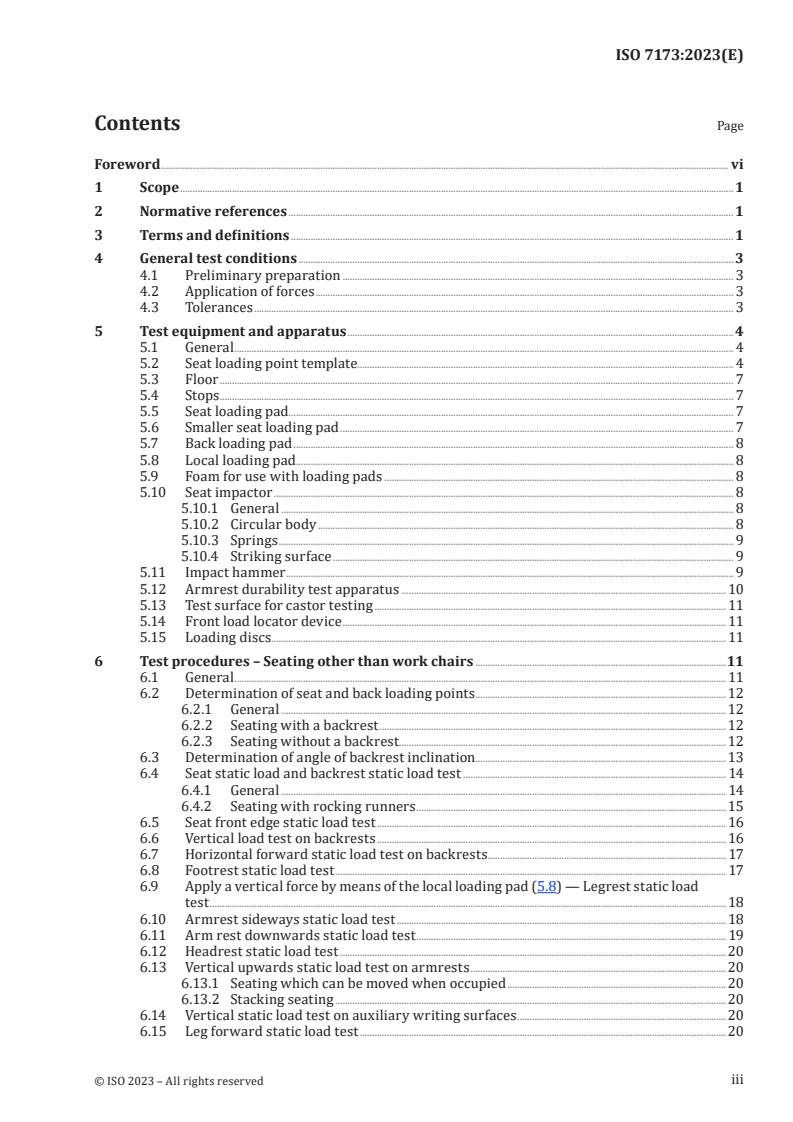
Contents Page
Foreword . vi
1 Scope . 1
2 Normative references . 1
3 Terms and definitions . 1
4 General test conditions .3
4.1 Preliminary preparation . 3
4.2 Application of forces . 3
4.3 Tolerances . 3
5 Test equipment and apparatus .4
5.1 General . 4
5.2 Seat loading point template. 4
5.3 Floor . 7
5.4 Stops . 7
5.5 Seat loading pad. 7
5.6 Smaller seat loading pad . 7
5.7 Back loading pad . 8
5.8 Local loading pad. 8
5.9 Foam for use with loading pads . 8
5.10 Seat impactor . 8
5.10.1 General . 8
5.10.2 Circular body . 8
5.10.3 Springs . 9
5.10.4 Striking surface . 9
5.11 Impact hammer . 9
5.12 Armrest durability test apparatus . 10
5.13 Test surface for castor testing . 11
5.14 Front load locator device . 11
5.15 Loading discs . . 11
6 Test procedures – Seating other than work chairs .11
6.1 General . 11
6.2 Determination of seat and back loading points .12
6.2.1 General .12
6.2.2 Seating with a backrest .12
6.2.3 Seating without a backrest .12
6.3 Determination of angle of backrest inclination . . 13
6.4 Seat static load and backrest static load test . 14
6.4.1 General . 14
6.4.2 Seating with rocking runners . 15
6.5 Seat front edge static load test . 16
6.6 Vertical load test on backrests . 16
6.7 Horizontal forward static load test on backrests. 17
6.8 Footrest static load test . 17
6.9 Apply a vertical force by means of the local loading pad (5.8) — Legrest static load
test . 18
6.10 Armrest sideways static load test . 18
6.11 Arm rest downwards static load test . 19
6.12 Headrest static load test . 20
6.13 Vertical upwards static load test on armrests . 20
6.13.1 Seating which can be moved when occupied . 20
6.13.2 Stacking seating . 20
6.14 Vertical static load test on auxiliary writing surfaces . 20
6.15 Leg forward static load test . 20
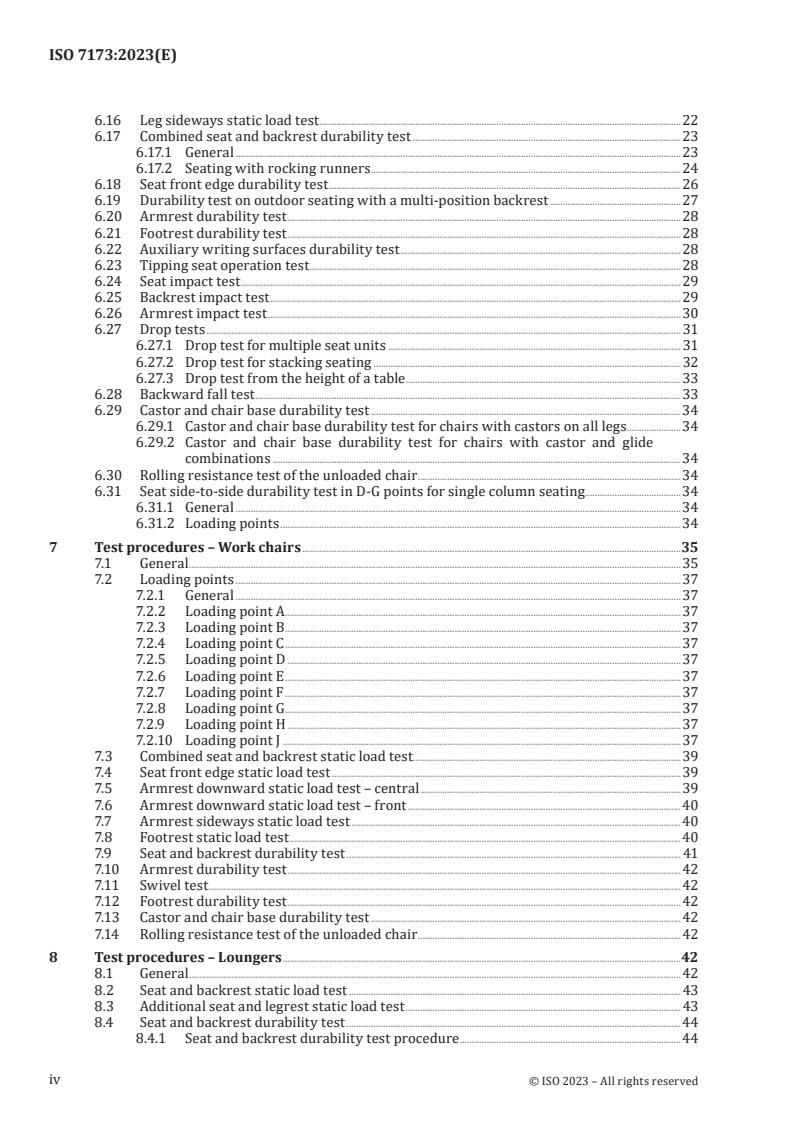
iii
6.16 Leg sideways static load test .22
6.17 Combined seat and backrest durability test . 23
6.17.1 General .23
6.17.2 Seating with rocking runners . 24
6.18 Seat front edge durability test . 26
6.19 Durability test on outdoor seating with a multi-position backrest . 27
6.20 Armrest durability test .28
6.21 Footrest durability test .28
6.22 Auxiliary writing surfaces durability test .28
6.23 Tipping seat operation test .28
6.24 Seat impact test .29
6.25 Backrest impact test . 29
6.26 Armrest impact test .30
6.27 Drop tests . 31
6.27.1 Drop test for multiple seat units . 31
6.27.2 Drop test for stacking seating . 32
6.27.3 Drop test from the height of a table . 33
6.28 Backward fall test . 33
6.29 Castor and chair base durability test .34
6.29.1 Castor and chair base durability test for chairs with castors on all legs .34
6.29.2 Castor and chair base durability test for chairs with castor and glide
combinations .34
6.30 Rolling resistance test of the unloaded chair .34
6.31 Seat side-to-side durability test in D-G points for single column seating .34
6.31.1 General .34
6.31.2 Loading points .34
7 Test procedures – Work chairs .35
7.1 General . 35
7.2 Loading points . 37
7.2.1 General . 37
7.2.2 Loading point A . 37
7.2.3 Loading point B . 37
7.2.4 Loading point C . 37
7.2.5 Loading point D . 37
7.2.6 Loading point E . 37
7.2.7 Loading point F . 37
7.2.8 Loading point G . 37
7.2.9 Loading point H . 37
7.2.10 Loading point J . 37
7.3 Combined seat and backrest static load test.39
7.4 Seat front edge static load test .39
7.5 Armrest downward static load test – central .39
7.6 Armrest downward static load test – front .40
7.7 Armrest sideways static load test .40
7.8 Footrest static load test .40
7.9 Seat and backrest durability test . 41
7.10 Armrest durability test . 42
7.11 Swivel test . 42
7.12 Footrest durability test . 42
7.13 Castor and chair base durability test . 42
7.14 Rolling resistance test of the unloaded chair . 42
8 Test procedures – Loungers .42
8.1 General . 42
8.2 Seat and backrest static load test . 43
8.3 Additional seat and legrest static load test . 43
8.4 Seat and backrest durability test .44
8.4.1 Seat and backrest durability test procedure .44
iv
8.4.2 Additional seat durability test procedure .44
8.5 Durability test on backrest mechanism . 45
8.6 Armrest downwards static load test . 45
8.7 Armrest durability test . 45
8.8 Impact test . 45
8.9 Lifting test for mobile loungers . 47
9 Test report .47
Annex A (normative) Seat loading pad data .48
Annex B (informative) Armrest loading pad details .51
Annex C (normative) Front load locator device (5.14) .52
Annex D (informative) Purpose and applicability of test methods .57
Annex E (informative) Suggested loads and cycles .62
Annex F (informative) Example construction of front load locator device .68
Bibliography .70
v
Foreword
ISO (the International Organization for Standardization) is a worldwide federation of national standards
bodies (ISO member bodies). The work of preparing International Standards is normally carried out
through ISO technical committees. Each member body interested in a subject for which a technical
committee has been established has the right to be represented on that committee. International
organizations, governmental and non-governmental, in liaison with ISO, also take part in the work.
ISO collaborates closely with the International Electrotechnical Commission (IEC) on all matters of
electrotechnical standardization.
The procedures used to develop this document and those intended for its further maintenance are
described in the ISO/IEC Directives, Part 1. In particular, the different approval criteria needed for the
different types of ISO documents should be noted. This document was drafted in accordance with the
editorial rules of the ISO/IEC Directives, Part 2 (see www.iso.org/directives).
Attention is drawn to the possibility that some of the elements of this document may be the subject of
patent rights. ISO shall not be held responsible for identifying any or all such patent rights. Details of
any patent rights identified during the development of the document will be in the Introduction and/or
on the ISO list of patent declarations received (see www.iso.org/patents).
Any trade name used in this document is information given for the convenience of users and does not
constitute an endorsement.
For an explanation of the voluntary nature of standards, the meaning of ISO specific terms and
expressions related to conformity assessment, as well as information about ISO's adherence to
the World Trade Organization (WTO) principles in the Technical Barriers to Trade (TBT), see
www.iso.org/iso/foreword.html.
This document was prepared by Technical Committee ISO/TC 136, Furniture.
This second edition cancels and replaces the first edition (ISO 7173:1989), which has been technically
revised.
The main changes are as follows:
— the scope has been revised;
— terms and definitions were added;
— test methods for work chairs and seating other than work chairs were added;
— new Annexes were added.
Any feedback or questions on this document should be directed to the user’s national standards body. A
complete listing of these bodies can be found at www.iso.org/members.html.
vi
INTERNATIONAL STANDARD ISO 7173:2023(E)
Furniture — Chairs and stools — Determination of
strength and durability
1 Scope
This document specifies test methods for the determination of strength and durability of the
structure of all types of seating without specific regard to end use, materials, design/construction or
manufacturing process.
This document does not apply to children’s highchairs, table mounted chairs and bath seats.
Test methods for the assessment of ageing, degradation, ergonomics and electrical functions are not
included.
The test methods are not intended to assess the durability of upholstery materials.
2 Normative references
The following documents are referred to in the text in such a way that some or all of their content
constitutes requirements of this document. For dated references, only the edition cited applies. For
undated references, the latest edition of the referenced document (including any amendments) applies.
ISO 48-4, Rubber, vulcanized or thermoplastic — Determination of hardness — Part 4: Indentation
hardness by durometer method (Shore hardness)
3 Terms and definitions
For the purposes of this document, the following terms and definitions apply.
ISO and IEC maintain terminology databases for use in standardization at the following addresses:
— ISO Online browsing platform: available at https:// www .iso .org/ obp
— IEC Electropedia: available at https:// www .electropedia .org/
3.1
structure
load bearing parts of furniture such as the frame, seat, backrest and arm supports and suspension
3.2
legrest
extension of the seat area intended to support the legs of the user
Note 1 to entry: A legrest can or cannot be permanently attached to the structure of the item of seating and may
not be suitable for use as an item of seating itself.
3.3
footrest
extension of the seat area, whether attached or not to the structure of the item of seating, intended to
support the feet of the user
3.4
work chair
swivelling chair, with or without arm rests, for use by one adult for office work (for example working
with a computer), whose upper part, which includes the seat and backrest, is supported on a single
column and can rotate in the horizontal plane and is at least adjustable in height
3.5
backrest
element that supports the back of the user higher than 200 mm above the seat loading point
3.6
armrest
part of the seating able to support the arms of the user when seated, 100 mm or higher above the height
of the seat loading point
3.7
armrest length
horizontal distance along the armrest within an envelope down from the top of the armrest that is
20 mm deep
Note 1 to entry: See Figure 1.
Dimensions in millimetres
Key
1 armrest
l armrest length
Figure 1 — Armrest length
[SOURCE: ISO 24496:2021, 3.3, modified – "horizontal" added and Note 1 to entry adapted to correct
Figure number.]
3.8
multiple seating unit
unit with a seating surface wider/longer than 1 100 mm
3.9
lounger
item of seating intended for reclined posture with at least one backrest position such that backrest
angle is 45° or less to the horizontal, and a leg rest which is an integral part of the product and intended
to support the full body mass of a user
Note 1 to entry: See example in Figure 37.
3.10
single column seating
item of seating, whose upper part, which includes the seat, is mounted on a single support with a
diameter of up to 120 mm at its narrowest point
4 General test conditions
4.1 Preliminary preparation
The furniture shall be tested as delivered. Knock-down furniture shall be assembled according to the
instructions supplied with it. If the instructions allow the furniture to be assembled or combined in
different ways, the most adverse combination shall be used for each test. Knock-down fittings shall be
tightened before testing. Further tightening shall not take place.
For seating that is designed to be fixed to the structure of a building, the unit shall be mounted
according to the manufacturer’s instructions to a structure representative of the service installation.
This structure shall be sufficiently strong and stiff to eliminate the possibility of it affecting the results
of the test.
Unless otherwise specified by the manufacturer, the sample for test shall be stored in indoor ambient
conditions for at least 24 h immediately prior to testing.
The tests shall be carried out at indoor ambient conditions. However, if during a test the temperature is
outside the range 15 °C to 27 °C, the maximum and/or minimum temperature shall be recorded in the
test report.
4.2 Application of forces
The forces in durability and static load tests shall be applied sufficiently slowly to ensure that negligible
dynamic load is applied. The forces in durability tests shall be applied sufficiently slowly to ensure that
kinetic heating does not occur.
Unless otherwise stated, static forces shall be maintained for (10 ± 2) s. Unless otherwise stated,
durability forces shall be maintained for (2 ± 1) s, not more than 20 times per min.
The forces may be replaced by masses. The relationship 10 N = 1 kg shall be used.
4.3 Tolerances
Unless otherwise stated, the following tolerances are applicable to the test equipment:
— Forces: ±5 % of the nominal force;
— Masses: ±1 % of the nominal mass;
— Dimensions: ±1 mm of the nominal dimension for dimensions 0 up to 200 mm;
±0,5 % of the nominal dimension for dimensions > 200 mm;
— Velocities: ±10 % of the nominal velocity;
— Angles: ±2° of the nominal angle.
Test forces, masses, dimensions, velocities and angle used to perform the test shall be targeted at the
nominal values specified and shall be subjected to the above tolerances.
The accuracy for the positioning of loading pads and impact plates shall be ±5 mm.
NOTE For the purposes of uncertainty measurement, test results are not considered to be adversely affected
when the above tolerances are met.
5 Test equipment and apparatus
5.1 General
The equipment shall not inhibit deformation nor cause unnatural deformation of the unit/component,
i.e. it shall be able to move so that it can follow the deformation of the unit/component during testing.
All loading pads shall be capable of pivoting in relation to the direction of the applied force. The pivot
point shall be as close as practically possible to the load surface. The point of application of force shall
be in the direction of the pivoting point of the loading pads.
If a loading pad tends to slide, use a slip resistant material between the loading pad and the foam for
loading pads (5.9).
The tests may be performed using any suitable device because results are dependent upon correctly
applied forces and not upon the apparatus. Exceptions include cases of impact tests where the apparatus
described in 5.10 and 5.11 shall be used and the armrest durability test where the apparatus described
in 5.12 shall be used.
5.2 Seat loading point template
The loading point template consists of two shaped members (see Figure 2) fastened together by a pivot
at one end.
The contours of the shaped surfaces are so devised as to sink into the upholstery. For this purpose, the
+1
loading point template, with an additional mass applied at the seat loading point, shall be ( 20 ) kg.
The mass distribution of different components of the template as shown in Table 1.
Table 1 — Mass distribution of template components
Mass of the seat Mass of the back Mass of the addi-
Total mass
portion portion tional mass
(kg) (kg) (kg) (kg)
+1
(2 ± 1) (1,7 ± 0,7) (16 ± 1,5)
( 20 )
The loading point template is marked as shown in Figure 3 a). An example of loading point template
assembly is shown in Figure 3 b).
Dimensions in millimetres
Key
1 top of back portion 6 seat portion
2 rear of seat portion 7 front of seat portion
3 back portion 8 bottom of back portion
4 seat loading point (A) 9 loading point for additional load (D)
5 back loading point (B) P pivot point
Figure 2 — Loading surface curves for seat and back loading point template
Dimensions in millimetres
a) Marking of the loading point template
b) Example of loading point template assembly
Key
1 typical section of back portion 7 mark to fix 90°
2 typical section of seat portion A seat loading point (chairs)
3 back portion B back loading point (chairs)
4 flange (rigid) C seat loading point (stools)
5 straight edge for the determination of seat or backrest inclination D loading point for additional load
6 seat portion P pivot point
Figure 3 — Loading point template
A line is drawn on the back portion, so that the template can be positioned easily with the two members
at 90° to each other.
5.3 Floor
The floor shall be horizontal, flat and rigid with a smooth surface. For the back and arm rest impact
tests (6.25 and 6.26), the drop test (6.27) and the backward fall test (6.28), the floor shall be faced with
a 2 mm thick layer of rubber with a tests hardness of Shore A according to ISO 48-4 or a steel plate with
a minimum thickness of 5 mm, placed directly on the floor.
5.4 Stops
Stops are used to prevent the item from sliding but not tilting, no higher than 12 mm, except in cases
where the design of the item necessitates the use of higher stops, in which case the lowest that will
prevent the item from moving shall be used.
5.5 Seat loading pad
The seat loading pad is a naturalistically shaped rigid indenter with a hard, smooth surface having
overall dimensions within the limits according to Figure A.1 and Figure A.2.
The design of the seat loading pad shall be in accordance with Annex A.
5.6 Smaller seat loading pad
The smaller seat loading pad is a rigid circular object 200 mm in diameter, the loading surface of
which has a convex spherical curvature of 300 mm ± 5 mm radius with a 12 mm front edge radius (see
Figure 4).
Dimensions in millimetres
Figure 4 — Smaller seat loading pad
5.7 Back loading pad
The back loading pad is a rigid rectangular object 200 mm high and 250 mm wide, the loading surface
of which is curved across the width of the pad with a convex cylindrical curvature of (450 ± 10) mm
radius and with a 12 mm radius on all front edges (see Figure 5).
Dimensions in millimetres
Figure 5 — Back loading pad
5.8 Local loading pad
The local loading pad is a rigid cylindrical object 100 mm in diameter, with a flat face and a 12 mm edge
radius.
5.9 Foam for use with loading pads
The foam for use with loading pads shall be a foam sheet with a thickness of 25 mm and a bulk density
of (120 ± 25) kg/m . The foam shall be attached to the loading pads or alternatively positioned between
the loading pad and the test structure.
NOTE When the foam is used with loading pads it is attached to the loading pads or alternatively positioned
between the loading pad and the test structure.
5.10 Seat impactor
5.10.1 General
The seat impactor is shown in Figure 6. The impactor is comprised of the following elements.
5.10.2 Circular body
The circular body is 200 mm in diameter, separated from the striking surface by helical compression
springs and free to move relative to it on a line perpendicular to the plane of the central area of the
striking surface. The body and associated parts minus the springs shall have a mass of (17 ± 0,1) kg and
the whole apparatus, including mass, springs and striking surface, shall have a mass of (25 ± 0,1) kg.
5.10.3 Springs
The springs shall be such that the nominal spring rate of the combined spring system is (7 ± 2) N/mm
and the total friction resistance of the moving parts is less than 1 N.
The spring system shall be compressed to an initial force of (1 040 ± 5) N (measured statically) and
the amount of spring compression movement available from the initial compression point to the point
where the springs become fully closed shall be not less than 60 mm.
5.10.4 Striking surface
The striking surface shall be a rigid circular object, 200 mm in diameter, the face of which has a convex
spherical curvature of 300 mm ± 5 mm radius with a 12 mm front edge radius.
Key
1 joint of lifting device not inhibiting free fall
Figure 6 — Seat impactor
5.11 Impact hammer
Hammer with a cylindrical pendulum head having a mass of (6,5 ± 0,07) kg, supported from a pivot by
a steel tube of 38 mm in diameter and with a wall thickness of 2 mm having a mass of (2 ± 0,2) kg. The
pendulum arm shall be pivoted by a low friction bearing (see Figure 7).
Dimensions in millimetres
Key
1 pendulum head, steel mass 6,4 kg
2 hard wood
3 rubber (50 ± 10) shore A according to ISO 48-4
4 pendulum arm, steel tube ∅ 38 x 2 mm; mass 2 kg ± 0,2 kg
5 pivot point
Mass of assembly 1 + 2 + 3 = (6,5 ± 0,07) kg
Figure 7 — Impact hammer
5.12 Armrest durability test apparatus
Test apparatus capable of applying a cyclic force simultaneously to both armrests of a seat (see Annex B).
The forces shall be applied through an armrest loading device in principle operating as shown in
Figure 8.
The apparatus shall be capable of applying forces at varying angles to the vertical. It shall be adjustable
both vertically and horizontally, and set as specified in 6.20. The apparatus shall be capable of freely
following the deformation of the armrests during testing. The length of the loading pad shall be 100 mm
with the force acting through the centre of its length.
Dimensions in millimetres
Key
F force
Figure 8 — Armrest durability test – Armrest loading device
5.13 Test surface for castor testing
Test surface, which is a horizontal, flat, smooth and rigid steel surface.
5.14 Front load locator device
Used for locating the loading points for front static load test and front durability test.
The device shall be as specified in Annex C.
5.15 Loading discs
Discs with a mass of 10 kg each, with a diameter of 350 mm and a thickness of 48 mm. The centre of
gravity shall be the centre of the disc. The surface friction of the disc (disc to disc) shall be such that the
force to initiate movement shall be 31 N ± 9 N.
6 Test procedures – Seating other than work chairs
6.1 General
Unless otherwise specified, the tests shall be carried out in the configuration most likely to cause
failure.
Except in the case of test 6.13, a layer of foam (5.9) shall be positioned between the loading pads and the
test structure.
If a test cannot be carried out as specified, the test shall be carried out as closely as possible to that
specified. Any modification to the test method shall be technically justified and shall be recorded in the
test report.
In Annex E loads, forces and cycles are suggested to ensure that the test methods are of use where no
requirements document is available, or to assist in the development of one. See also Annex D where
rationale for selected test is provided.
6.2 Determination of seat and back loading points
6.2.1 General
The seat and back loading points shall be determined using the template as specified in 5.2 in the
manner specified in 6.2.2 or 6.2.3.
In some cases, it may not be possible to determine the loading points by means of the template.
In such cases, the seat loading point shall be 175 mm forward of the seat/backrest junction or at the
point closest to this that allows the seat force to be applied.
Where the geometry of the seating unit does not allow the back force to be applied at the point defined
by the above method, the force shall be applied at the nearest applicable point (up or down the backrest).
The bending moment, as calculated in Formula (1), shall remain constant.
MF=⋅I (1)
where
M is the bending moment, in Nm;
F is the back force, in N;
I is the vertical distance between seat and back loading points, in m.
If the number of seats in the item is not obvious, divide the total seat length (in mm) by 600 mm and
round to the nearest whole number to determine the number of seats. Divide the total seat length into
seats of equal length.
6.2.2 Seating with a backrest
For seating with adjustable backrests, set the backrest to its most upright position.
Adjust the template such that the angle between the seat and back portions is 90°.
Position the loaded template (5.2) on the centreline of the seat as far towards the rear as possible
without applying force to the backrest. For upholstered and flexible seating, adjust the position of the
template by pushing the back loading portion into the back of the seating so that it is fully in contact
with the backrest, allowing the shape of the seat portion of the template to correlate with that of the
seat (see Figure 9 a)).
For rigid seating, adjust the position of the template by pushing the back loading portion into the back
so that it is in contact with the backrest whilst ensuring that point A on the template is in contact with
the seating surface (see Figure 9 b)).
In cases where the template can be settled in more than one position, the position having the smallest
angle between the seat and back portions of the template shall be used. The angle shall in no cases be
less than 90°. Mark the required loading positions from the template. If relevant, repeat the procedures
on the other seat(s).
6.2.3 Seating without a backrest
Set up the template (5.2) at 90° with the aid of the mark C as shown in Figure 3. Place it on each seating
position as shown in Figure 9 c). Mark the required loadi
...