

ISO 9221:2024
(Main)Furniture — Children’s high chairs — Safety requirements and test methods
General Information
- Abstract
This document specifies safety requirements for free-standing children’s high chairs that elevate children to dining table height, usually for the purposes of feeding or eating. Children’s high chairs are for children up to three years of age who are capable of sitting unaided. This document is applicable to children’s high chairs for domestic and non-domestic use. It does not apply to special high chairs for medical purposes. NOTE If a children’s high chair is or can be converted into other functions, additional standards can apply.
- Status
- Published
- Publication Date
- 25-Nov-2024
- Technical Committee
- ISO/TC 136 - Furniture
- Drafting Committee
- ISO/TC 136 - Furniture
- Current Stage
- 6060 - International Standard published
- Start Date
- 26-Nov-2024
- Due Date
- 10-Jan-2025
- Completion Date
- 26-Nov-2024
Overview
ISO 9221:2024 - Furniture - Children’s high chairs - Safety requirements and test methods is the first consolidated edition that specifies safety requirements and standardized test methods for free‑standing children’s high chairs. It applies to high chairs that elevate children (up to three years old, able to sit unaided) to dining table height for feeding or eating, for both domestic and non‑domestic use. It does not apply to medical high chairs. The 2024 edition merges and replaces ISO 9221‑1:2015 and ISO 9221‑2:2015 and is organized around hazard‑based requirements.
Key topics and technical requirements
The standard provides a comprehensive set of safety topics and test procedures, including:
- Scope and test conditions - definitions, test sequences and tolerances (Clauses 1–4).
- Test equipment - specification of apparatus needed to carry out reproducible tests (Clause 5).
- Chemical hazards - requirements and sampling for chemical risks such as migration of elements, phthalates, azo colorants and flame retardants (Clause 6).
- Thermal hazards - assessment of burn and heat risks (Clause 7).
- Mechanical hazards - extensive requirements and test methods for folding mechanisms, height adjustment, entrapment (fingers/head), moving parts (compression/shear), entanglement, choking/ingestion, edges/protrusions, strength, durability, dynamic strength tests, seat and footrest load tests, trays, and fall‑out prevention (Clause 8).
- Castors/wheels and stability - special tests and parking/locking requirements, including products with more than two castors (Clause 8.11–8.12).
- Restraint systems and lateral/back protection - requirements for passive crotch restraints and measures to reduce falls out of the high chair (Clause 8.9).
- Marking and product information - mandatory markings, packaging warnings, instructions for use, durability of marking and purchaser information (Clause 9).
- Rationale and informative guidance - Annex A explains hazard rationale and testing intent.
Notable updates include the hazard‑based format, added chemical and thermal hazard clauses, a new dynamic strength test, enhanced castor requirements, and improved restraint system requirements.
Applications and who uses it
ISO 9221:2024 is used by:
- Manufacturers and product designers to design safer children’s high chairs and to specify materials and mechanisms that meet safety tests.
- Test laboratories and conformity assessors to perform standardized tests and produce repeatable results.
- Retailers and procurement teams to evaluate product safety and supplier compliance.
- Regulators and standards bodies for policy, market surveillance and alignment with consumer safety requirements.
- Safety engineers and QA teams to integrate tests into production and quality control.
Related standards
This document was prepared by ISO/TC 136 (Furniture) and replaces ISO 9221‑1:2015 and ISO 9221‑2:2015. Other national and international child safety and furniture standards may also apply depending on product function and market.
Keywords: ISO 9221:2024, children’s high chairs, safety requirements, test methods, restraint system, mechanical hazards, chemical hazards, stability, marking and instructions.
Relations
- Effective Date
- 14-Jan-2023
- Effective Date
- 14-Jan-2023
Frequently Asked Questions
ISO 9221:2024 is a standard published by the International Organization for Standardization (ISO). Its full title is "Furniture — Children’s high chairs — Safety requirements and test methods". This standard covers: This document specifies safety requirements for free-standing children’s high chairs that elevate children to dining table height, usually for the purposes of feeding or eating. Children’s high chairs are for children up to three years of age who are capable of sitting unaided. This document is applicable to children’s high chairs for domestic and non-domestic use. It does not apply to special high chairs for medical purposes. NOTE If a children’s high chair is or can be converted into other functions, additional standards can apply.
This document specifies safety requirements for free-standing children’s high chairs that elevate children to dining table height, usually for the purposes of feeding or eating. Children’s high chairs are for children up to three years of age who are capable of sitting unaided. This document is applicable to children’s high chairs for domestic and non-domestic use. It does not apply to special high chairs for medical purposes. NOTE If a children’s high chair is or can be converted into other functions, additional standards can apply.
ISO 9221:2024 is classified under the following ICS (International Classification for Standards) categories: 97.140 - Furniture. The ICS classification helps identify the subject area and facilitates finding related standards.
ISO 9221:2024 has the following relationships with other standards: It is inter standard links to ISO 9221-1:2015, ISO 9221-2:2015. Understanding these relationships helps ensure you are using the most current and applicable version of the standard.
ISO 9221:2024 is available in PDF format for immediate download after purchase. The document can be added to your cart and obtained through the secure checkout process. Digital delivery ensures instant access to the complete standard document.
Standards Content (Sample)
International
Standard
ISO 9221
First edition
Furniture — Children’s high chairs —
2024-11
Safety requirements and test methods
Ameublement — Chaises hautes pour enfants — Exigences de
sécurité et méthodes d'essai
Reference number
© ISO 2024
All rights reserved. Unless otherwise specified, or required in the context of its implementation, no part of this publication may
be reproduced or utilized otherwise in any form or by any means, electronic or mechanical, including photocopying, or posting on
the internet or an intranet, without prior written permission. Permission can be requested from either ISO at the address below
or ISO’s member body in the country of the requester.
ISO copyright office
CP 401 • Ch. de Blandonnet 8
CH-1214 Vernier, Geneva
Phone: +41 22 749 01 11
Email: copyright@iso.org
Website: www.iso.org
Published in Switzerland
ii
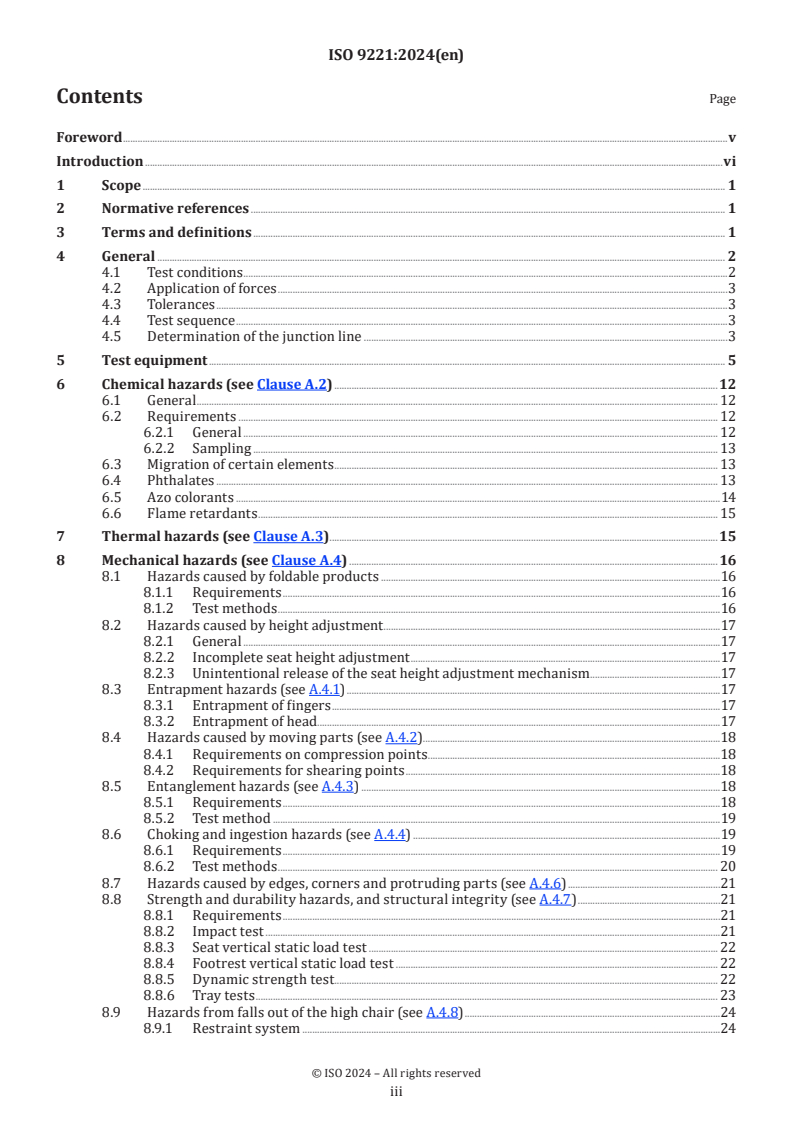
Contents Page
Foreword .v
Introduction .vi
1 Scope . 1
2 Normative references . 1
3 Terms and definitions . 1
4 General . 2
4.1 Test conditions .2
4.2 Application of forces .3
4.3 Tolerances .3
4.4 Test sequence .3
4.5 Determination of the junction line .3
5 Test equipment . 5
6 Chemical hazards (see Clause A.2) .12
6.1 General . 12
6.2 Requirements . 12
6.2.1 General . 12
6.2.2 Sampling . 13
6.3 Migration of certain elements . 13
6.4 Phthalates . 13
6.5 Azo colorants .14
6.6 Flame retardants . 15
7 Thermal hazards (see Clause A.3) .15
8 Mechanical hazards (see Clause A.4) .16
8.1 Hazards caused by foldable products .16
8.1.1 Requirements .16
8.1.2 Test methods .16
8.2 Hazards caused by height adjustment .17
8.2.1 General .17
8.2.2 Incomplete seat height adjustment .17
8.2.3 Unintentional release of the seat height adjustment mechanism .17
8.3 Entrapment hazards (see A.4.1) .17
8.3.1 Entrapment of fingers .17
8.3.2 Entrapment of head.17
8.4 Hazards caused by moving parts (see A.4.2) .18
8.4.1 Requirements on compression points .18
8.4.2 Requirements for shearing points .18
8.5 Entanglement hazards (see A.4.3) .18
8.5.1 Requirements .18
8.5.2 Test method .19
8.6 Choking and ingestion hazards (see A.4.4) .19
8.6.1 Requirements .19
8.6.2 Test methods . 20
8.7 Hazards caused by edges, corners and protruding parts (see A.4.6) .21
8.8 Strength and durability hazards, and structural integrity (see A.4.7) .21
8.8.1 Requirements .21
8.8.2 Impact test .21
8.8.3 Seat vertical static load test . 22
8.8.4 Footrest vertical static load test . 22
8.8.5 Dynamic strength test . . 22
8.8.6 Tray tests . 23
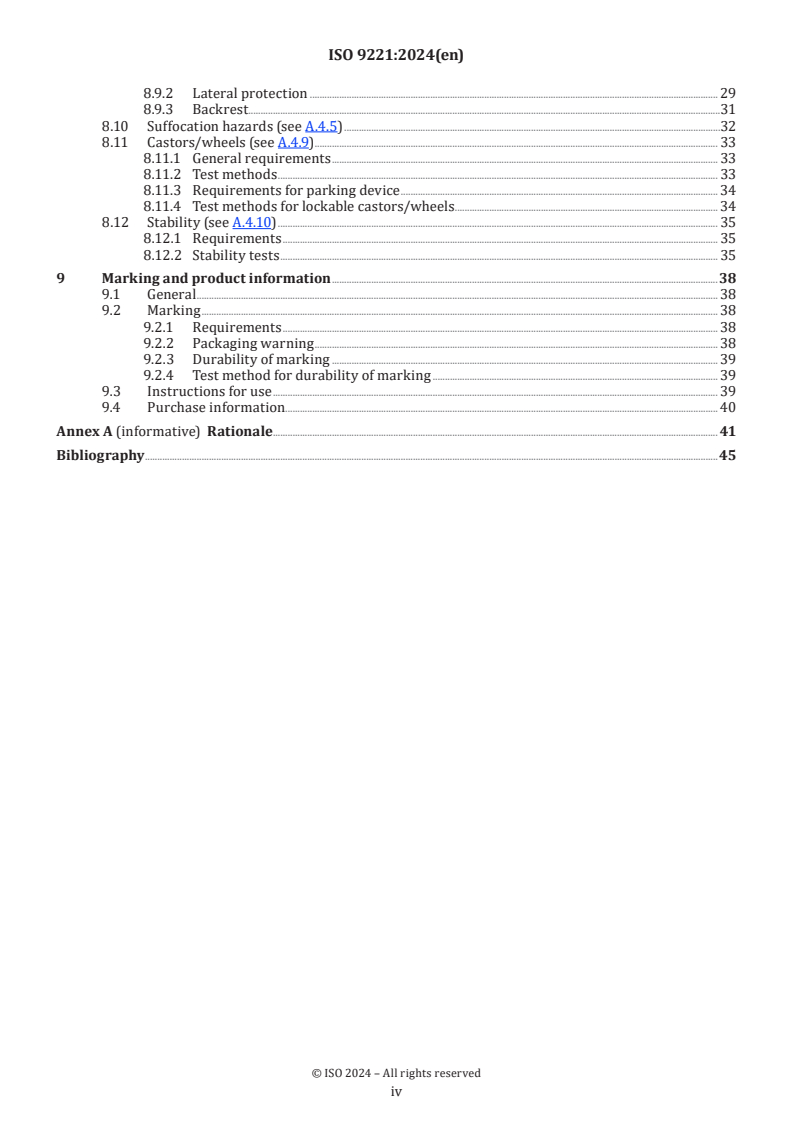
8.9 Hazards from falls out of the high chair (see A.4.8) .24
8.9.1 Restraint system .24
iii
8.9.2 Lateral protection . 29
8.9.3 Backrest.31
8.10 Suffocation hazards (see A.4.5) .32
8.11 Castors/wheels (see A.4.9) . 33
8.11.1 General requirements . 33
8.11.2 Test methods . 33
8.11.3 Requirements for parking device . 34
8.11.4 Test methods for lockable castors/wheels . 34
8.12 Stability (see A.4.10) . 35
8.12.1 Requirements . 35
8.12.2 Stability tests . 35
9 Marking and product information .38
9.1 General . 38
9.2 Marking . 38
9.2.1 Requirements . 38
9.2.2 Packaging warning . 38
9.2.3 Durability of marking . 39
9.2.4 Test method for durability of marking . 39
9.3 Instructions for use . 39
9.4 Purchase information . . 40
Annex A (informative) Rationale . 41
Bibliography .45
iv
Foreword
ISO (the International Organization for Standardization) is a worldwide federation of national standards
bodies (ISO member bodies). The work of preparing International Standards is normally carried out through
ISO technical committees. Each member body interested in a subject for which a technical committee
has been established has the right to be represented on that committee. International organizations,
governmental and non-governmental, in liaison with ISO, also take part in the work. ISO collaborates closely
with the International Electrotechnical Commission (IEC) on all matters of electrotechnical standardization.
The procedures used to develop this document and those intended for its further maintenance are described
in the ISO/IEC Directives, Part 1. In particular, the different approval criteria needed for the different types
of ISO document should be noted. This document was drafted in accordance with the editorial rules of the
ISO/IEC Directives, Part 2 (see www.iso.org/directives).
ISO draws attention to the possibility that the implementation of this document may involve the use of (a)
patent(s). ISO takes no position concerning the evidence, validity or applicability of any claimed patent
rights in respect thereof. As of the date of publication of this document, ISO had not received notice of (a)
patent(s) which may be required to implement this document. However, implementers are cautioned that
this may not represent the latest information, which may be obtained from the patent database available at
www.iso.org/patents. ISO shall not be held responsible for identifying any or all such patent rights.
Any trade name used in this document is information given for the convenience of users and does not
constitute an endorsement.
For an explanation of the voluntary nature of standards, the meaning of ISO specific terms and expressions
related to conformity assessment, as well as information about ISO’s adherence to the World Trade
Organization (WTO) principles in the Technical Barriers to Trade (TBT), see www.iso.org/iso/foreword.html.
This document was prepared by Technical Committee ISO/TC 136, Furniture.
This first edition cancels and replaces ISO 9221-1:2015 and ISO 9221-2:2015, which have been merged into
one single document and technically revised.
The main changes are as follows:
— complete review of the document in a hazard base format;
— addition of chemical and thermal hazards in Clauses 6 and 7, respectively;
— addition of a dynamic strength test in 8.8.5;
— inclusion of specific requirements for high chairs with more than two castors/wheels in 8.11.1;
— improvement of restraint system requirements to require a passive crotch restraint for products with a
horizontal component in front of the baby in 8.9.1.1.
Any feedback or questions on this document should be directed to the user’s national standards body. A
complete listing of these bodies can be found at www.iso.org/members.html.
v
Introduction
This document has been prepared in order to specify requirements and test methods intended to minimize
accidents to children resulting from normal use and reasonably foreseeable misuse of children’s high chairs.
The test methods are designed to evaluate properties without regard to materials, design/construction or
manufacturing processes.
vi
International Standard ISO 9221:2024(en)
Furniture — Children’s high chairs — Safety requirements
and test methods
1 Scope
This document specifies safety requirements for free-standing children’s high chairs that elevate children to
dining table height, usually for the purposes of feeding or eating. Children’s high chairs are for children up to
three years of age who are capable of sitting unaided.
This document is applicable to children’s high chairs for domestic and non-domestic use. It does not apply to
special high chairs for medical purposes.
NOTE If a children’s high chair is or can be converted into other functions, additional standards can apply.
2 Normative references
The following documents are referred to in the text in such a way that some or all of their content constitutes
requirements of this document. For dated references, only the edition cited applies. For undated references,
the latest edition of the referenced document (including any amendments) applies.
ISO 48-4, Rubber, vulcanized or thermoplastic — Determination of hardness — Part 4: Indentation hardness by
durometer method (Shore hardness)
ISO 8124-2:2023, Safety of toys — Part 2: Flammability
ISO 8124-3, Safety of toys — Part 3: Migration of certain elements
ISO 8124-6, Safety of toys — Part 6: Certain phthalate esters
ISO 14362-1, Textiles — Methods for determination of certain aromatic amines derived from azo colorants —
Part 1: Detection of the use of certain azo colorants accessible with and without extracting the fibres
ISO 14362-3, Textiles — Methods for determination of certain aromatic amines derived from azo colorants —
Part 3: Detection of the use of certain azo colorants, which may release 4-aminoazobenzene
ISO 17234-1, Leather — Chemical tests for the determination of certain azo colourants in dyed leathers — Part
1: Determination of certain aromatic amines derived from azo colourants
ISO 17234-2, Leather — Chemical tests for the determination of certain azo colorants in dyed leathers — Part 2:
Determination of 4-aminoazobenzene
3 Terms and definitions
For the purposes of this document, the following terms and definitions apply.
ISO and IEC maintain terminology databases for use in standardization at the following addresses:
— ISO Online browsing platform: available at https:// www .iso .org/ obp
— IEC Electropedia: available at https:// www .electropedia .org/
3.1
active restraint system
system where a carer performs an action to ensure that a child is secured in the restraint system
3.2
passive restraint system
system where a carer does not perform an action to ensure that a child is secured in the restraint system
3.3
crotch restraint
device passing between the legs of a child and preventing the child from slipping forwards out of the high chair
3.4
waist restraint
rigid or flexible device(s), which, when fastened, goes from one side of the high chair to the other, passing in
front of a child’s waist or surrounding a child’s waist
3.5
shoulder restraint
device passing over the shoulders and connecting either to a crotch restraint (3.3) or to a waist restraint (3.4)
3.6
locking device
component that maintains part(s) of a product in the position of use
EXAMPLE Latch, a hook, an over centre lock.
3.7
operating device
part of the locking mechanism(s) (3.9) or parking device(s) (3.8) designed to be activated by a carer by one or
several action(s)
3.8
parking device
device intended to prevent rolling of castors/wheels
3.9
locking mechanism
assembly consisting of one or more locking device(s) (3.6) and one or more operating device(s) (3.7)
3.10
junction line
intersection of a seat and a backrest
3.11
paint or similar surface-coating
fluid, semi-fluid or other material, with or without colouring matter, which changes to a solid film when a
thin layer is applied to a metal, wood, leather, cloth, plastic or another surface
4 General
4.1 Test conditions
The high chair shall be tested as delivered. If the high chair is a knock-down type, it shall be assembled
according to the instructions supplied with it. If the instructions allow for different adjustments or
configurations of components (e.g. inclination of the backrest, height of the seat, position of the tray, position
of castors/wheels), the most onerous combination shall be used for each test, unless otherwise specified in
the test method.
Knock-down fittings shall be tightened before testing. Further re-tightening shall not take place.
4.2 Application of forces
The forces in the static load tests shall be applied sufficiently slowly to ensure that negligible dynamic force
is applied.
The tests are described in terms of the application of forces; however, masses can be used. The relationship
10 N = 1 kg shall be used for this purpose.
4.3 Tolerances
Unless otherwise stated, the following tolerances apply:
— forces: ±5 % of the nominal force;
— masses: ±0,5 % of the nominal mass;
— dimensions: ±1,0 mm of the nominal dimension;
— angles: ±2° of the nominal angle;
— positioning of loading pads: ±5 mm.
NOTE For the purposes of uncertainty in measurements, test results are not considered to be adversely affected
when the above tolerances are met.
4.4 Test sequence
The tests in Clause 8 shall be carried out on the same high chair and in the order of the clauses of this
document.
4.5 Determination of the junction line
The junction line is shown in Figure 1.
Where the backrest and the seat do not meet, the junction line is the projection of the backrest onto the seat
(see Figure 1).
Key
1 backrest
2 seat
LL junction line
Figure 1 — Junction line
When the seat unit is in the form of a hammock, a theoretical junction line, “LL”, shall be determined as
shown in Figure 2. The junction line may vary when the backrest is adjusted in different positions.
Key
AA top edge of the backrest
BB front edge of the seat
LL junction line
CL vertical projection of C on the hammock
C mid-point between A and B
Figure 2 — Junction line for seat units in the form of a hammock
5 Test equipment
Unless otherwise specified, test forces may be applied by any suitable device as results are dependent only
upon correctly applied forces and not upon the apparatus.
5.1 Test mass A: A rigid cylinder 200 mm in diameter and 300 mm in height, having a mass of 15 kg with
its centre of gravity 150 mm above its base. The edges shall have a radius of 5 mm. Two anchorage points
shall be provided. These shall be positioned 150 mm from the base and at an angle of 180° to each other
around the circumference (see Figure 3).
Dimensions in millimetres
Key
1 edge radius: (5 ± 1) mm
2 anchorage points
Figure 3 — Test mass A
5.2 Impact hammer: A striker in the form of a cylindrical object having a total mass of 6,5 kg supported
from a pivot by a steel tube of 38 mm in diameter and with a wall thickness of 2 mm (see Figure 4). The
distance between the pivot and the centre of gravity of the striker shall be 1 000 mm. The pendulum arm
shall be pivoted by a low friction bearing.
Dimensions in millimetres
Key
1 pendulum head, steel mass 6,4 kg
2 hardwood
3 rubber (50 ± 10) Shore A (see ISO 48-4)
4 pendulum arm, length 950 mm; high tensile steel tube ∅ 38 mm × 2 mm; mass (2 ± 0,2) kg
5 pivot point
Mass of assembly (key numbers 1, 2 and 3): (6,5 ± 0,07) kg.
Figure 4 — Impact hammer
5.3 Large loading pad: A rigid cylindrical object 100 mm in diameter having a smooth hard surface and
edges rounded with radius of 12 mm.
5.4 Small loading pad: A rigid cylindrical object 30 mm in diameter having a smooth hard surface and
edges rounded with radius of (0,8 ± 0,3) mm.
5.5 Stops, which prevent the high chair from sliding but not tilting, no higher than 12 mm. Except in cases
where the design of the item necessitates the use of higher stops, in which case the lowest stops that will
prevent the item from sliding shall be used.
5.6 Floor surface: A horizontal, flat and rigid plane with a smooth surface.
For the tests according to 8.8.6.4, a 2 mm thick rubber mat, with hardness (75 ± 10) Shore A in accordance
with ISO 48-4, shall be used on a concrete floor.
5.7 Beams for stability testing and for measuring the length of the lateral protection.
5.7.1 Beam, not less than 900 mm long, with a square section of 25 mm × 25 mm and with a mass of
(0,5 ± 0,01) kg.
5.7.2 Beam for measuring the height for lateral protection test, 86 mm wide and with a mass of
(0,5 ± 0,01) kg.
5.8 Probes for finger entrapment.
5.8.1 Finger probe, made of plastic or another hard, smooth material, with diameters 7 mm and
−01,
+01,
12 mm, with a hemispherical end (see Figure 5) and which can be mounted on a force-measuring device.
Dimensions in millimetres
Key
1 line around the probe showing the depth of penetration
A diameter
Figure 5 — Test probes with hemispherical ends
5.8.2 Shape assessment probe, made of rigid and smooth material, with the dimensions shown in
Figure 6.
Key
A side view
B top view
C front view
Figure 6 — Shape assessment probe
5.9 Test mass B: A cylinder with a mass of 5 kg and a diameter of 100 mm.
5.10 Small parts cylinder for the assessment of small components, having dimensions in accordance with
Figure 7.
Dimension in millimetres
Figure 7 — Small parts cylinder
5.11 Small torso probe made from plastic or another hard, smooth material, with dimensions as shown in
Figure 8.
Dimensions in millimetres
Key
1 handle
Figure 8 — Small torso probe
5.12 Test mass C: An object made of steel with a total mass of (9 ± 0,1) kg and with dimensions as
specified in Figure 9.
All edges shall be rounded or chamfered.
Dimensions in millimetres
Key
1 seat part [mass: (4,495 ± 0,05) kg]
2 backrest part [mass: (4,501 ± 0,05) kg]
3 hinge pin made of steel [mass of hinge pin: (17 ± 0,5) g, length: 79,5 mm]
d diameter: 6 mm
Dimension tolerances: ±2 mm.
Figure 9 — Test mass C
5.13 Leg probe: A cylindrical probe with a diameter of 38 mm and a length of at least 76 mm.
5.14 Wedge block made of plastic or another hard, smooth material, with dimensions according to
Figure 10.
Dimensions in millimetres
a) Top view
b) Front view c) Side view
Figure 10 — Wedge block
5.15 Large head probe made of plastic or another hard, smooth material, with dimensions according to
Figure 11.
Dimensions in millimetres
Key
1 handle
Figure 11 — Large head probe
5.16 Impactor: A cylindrical bag with a diameter of 150 mm filled with steel shot with a diameter of
(4 ± 2) mm. The total mass shall be 23 kg.
5.17 Wood block, with dimensions of 150 mm by 150 mm with a thickness of 25 mm and with the edges
rounded with a radius of 8 mm.
5.18 Feeler gauge, with a thickness of (0,4 ± 0,02) mm and an insertion end radius of (3 ± 0,5) mm (see
Figure 12).
Dimensions in millimetres
Figure 12 — Feeler gauge
5.19 Test mass D: A mass of 9 kg on a base area of 200 mm × 100 mm.
6 Chemical hazards (see Clause A.2)
6.1 General
In general, the main materials used in children’s high chairs are plastics or polymers, coatings, rubber,
fabrics, leather, artificial leather, etc.
6.2 Requirements
6.2.1 General
The chemicals presented by material given in Table 1 shall conform to the requirements given in 6.3 to 6.6.
Table 1 — Chemicals by material
Migration of certain Phthalates Azo colorants Flame retardants
Materials
elements (see 6.4) (see 6.5) (see 6.6)
(see 6.3)
Plastics X X X
Coating X X
Rubber X X
Artificial
X X X X
leather
Fabric X X X
Leather X X
Other materials X
NOTE Other materials (e.g. paper and paperboard, wood, bamboo) are included, but metal, glass and ceramics are excluded.
6.2.2 Sampling
The sample for testing shall be representative of the material used in mass production. Identical materials
may be combined and treated as a single test portion. Test portions may be composed of more than one
material or colour only if physical separation, such as dot printing, patterned textiles or mass limitation
reasons, precludes the formation of discrete specimens.
NOTE 1 The manufacturing process ensures that it does not increase prohibited risk to the materials.
Where a surface is coated with a multi-layer of paint or similar surface-coating, the test sample shall not
include any of the base material.
NOTE 2 If the composite materials (e.g. coated fabric) can be mechanically separated, each homogenous material is
tested separately.
For migration of certain elements and phthalates tests, a test portion of less than 10 mg from a single
laboratory sample shall not be tested.
If the mass of the test portion from a single sample is greater than 10 mg but less than the normal mass for
testing, it is recommended to supplement the test materials with either:
a) identical materials from other locations of the same sample; or
b) sampling from raw materials.
If raw materials are used instead of finished product, this shall be noted in the test report.
6.3 Migration of certain elements
All accessible materials (see Table 1) shall not exceed the amounts of elements given in Table 2, considering
the correction factor when tested in accordance with ISO 8124-3.
Table 2 — Maximum acceptable element migration from children’s high chairs materials
Element Sb As Ba Cd Cr Pb Hg Se
Limit (mg/kg) 60 25 1 000 75 60 90 60 500
6.4 Phthalates
All accessible plasticized materials (see Table 1) shall not contain phthalates exceeding the limits given in
Table 3.
The test procedure given in ISO 8124-6 shall be used.
Table 3 — Maximum acceptable phthalates in children’s high chairs
Material Substance CAS Registry Limit
a
Number®
Bis (2-ethylhexyl) phthalate (DEHP) 117-81-7
Plastic or polymer, coating, Concentrations equal to or
Dibutyl phthalate (DBP) 84-74-2
artificial leather and rubber less than 0,1 % by mass
Benzyl butyl phthalate (BBP) 85-68-7
Di-n-octyl phthalate (DNOP) 117-84-0
Plastic or polymer, coating,
28553-12-0
Di-’isononyl’ phthalate (DINP)
artificial leather and rubber Concentrations equal to or
68515-48-0
that can be placed in the less than 0,1 % by mass
26761-40-0
mouth by children
Di-’isodecyl’ phthalate (DIDP)
68515-49-1
a
CAS Registry Number® is a trademark of the American Chemical Society (ACS). This information is given for
the convenience of users of this document and does not constitute an endorsement by ISO of the product named.
Equivalent products may be used if they can be shown to lead to the same results.
6.5 Azo colorants
All accessible coloured fabrics, leather and artificial leather shall not contain aromatic amines as given in
Table 4, which can be released by reductive cleavage of one or more azo groups.
Table 4 — Limits of aromatic amines in children’s high chairs
Limit ®
Material Substance CAS RN
mg/kg
4-aminobiphenyl 92-67-1 30
benzidine 92-87-5 30
4-chloro-o-toluidine 95-69-2 30
Fabrics, leather 2-naphthylamine 91-59-8 30
(including artificial)
o-aminoazotoluene 97-56-3 30
5-nitro-o-toluidine 99-55-8 30
4-chloroaniline 106-47-8 30
4-methoxy-m-phenylenediamine 615-05-4 30
4,4′-diaminodiphenylmethane 101-77-9 30
3,3′-dichlorobenzidine 91-94-1 30
3,3′-dimethoxybenzidine 119-90-4 30
3,3′-dimethylbenzidine 119-93-7 30
4,4′-methylenedi-o-toluidine 838-88-0 30
p-cresidine 120-71-8 30
4,4′-methylene-bis-(2-chloro-aniline) 101-14-4 30
4,4′-oxydianiline 101-80-4 30
4,4′-thiodianiline 139-65-1 30
o-toluidine 95-53-4 30
4-methyl-m-phenylenediamine 95-80-7 30
2,4,5-trimethylaniline 137-17-7 30
2-methoxyaniline 90-04-0 30
4-aminoazobenzene 60-09-3 30
2,4-xylidine 95-68-1 30
2,6-xylidine 87-62-7 30
The test procedure given in ISO 14362-1 and ISO 14362-3 for fabric, and ISO 17234-1 and ISO 17234-2 for
leather, shall be used.
A test portion below 0,2 g in a single laboratory sample shall be exempted from test. All colours shall be
tested. Up to three colours may be combined as one specimen.
Under the conditions of ISO 14362-1 and ISO 17234-1, those Azo colorants that are able to form ®
4-aminoazobenzene also generate two other amines, namely aniline (CAS RN 6253-3) and ®
1,4-phenylenediamine (CAS RN 106-50-3). Due to detection limits, it can be that only aniline is detected. If
aniline of above 5 mg/kg is detected, then the presence of these colorants shall be tested in accordance with
ISO 14362-3 for fabric or ISO 17234-2 for leather, which can release 4-aminoazobenzene.
NOTE “White” does not always mean uncoloured.
6.6 Flame retardants
Accessible plastics, artificial leather and fabrics in children’s high chairs that are not treated with flame
retardants shall be exempted from the flame-retardant requirement. Only a declaration of conformity
statement is required. The example template given in A.2.3 can be used.
Accessible plastics, artificial leather and fabrics in children’s high chairs that are treated with flame
retardants shall not contain the flame retardants listed in Table 5 according to the limits given in Table 5.
Table 5 — Flame retardants concerned in children’s high chairs ®
CAS RN Substance Limit
25637-99-4 Hexabromocyclododecane (HBCDD) < 100 mg/kg
5436-43-1 Tetrabromodiphenyl ether (tetra-BDE) < 10 mg/kg
32534-81-9 Pentabromodiphenyl ether (penta-BDE) < 10 mg/kg
36483-60-0 Hexabromodiphenyl ether (hexa-BDE) < 10 mg/kg
189084-68-2 Heptabromodiphenyl ether (hepta-BDE) < 10 mg/kg
32536-52-0 Octabromodiphenyl ether (octa-BDE) < 0,1 %
1163-19-5 Decabromodiphenyl ether (deca-BDE) < 0,1 %
a
59536-65-1 Polibrominated biphenyl (PBB) Not to be used
a
126-72-7 Tri-(2,3_dibromopropyl)-phosphate (TRIS) Not to be used
a
545-55-1 Tris-(aziridinyl)-phosphinoxide (TEPA) Not to be used
115-96-8 Tris(2-chloroethyl) phosphate (TCEP) < 5 mg/kg
13674-87-8 Tris-Diclorpropylphosphat (TDCPP) < 5 mg/kg
13674-84-5 Tris-Chlorpropylphosphat (TCPP) < 5 mg/kg
NOTE Relevant regulations include the European Union REACH (registration, evaluation, authorisation and restriction of
chemicals), RoHS (restriction of hazardous substances), POPs (persistent organic pollutants), TSD (Toy Safety Directive), etc.
a
“Not to be used” means undetectable when testing is performed.
7 Thermal hazards (see Clause A.3)
Separate samples may be used for these tests.
This requirement is only applicable to textiles, coated textiles and plastic coverings. It does not apply to
hook and loop fasteners, cords and alike.
Materials shall not produce a surface flash effect when applying a flame in accordance with ISO 8124-2:2023, 5.5.
8 Mechanical hazards (see Clause A.4)
8.1 Hazards caused by foldable products
8.1.1 Requirements
8.1.1.1 General
There shall be at least one locking mechanism which prevents a high chair from folding while in use and also
when a child is being placed into and removed from the high chair.
8.1.1.2 Incomplete deployment
In order to prevent hazards due to incomplete deployment, the high chair shall fulfil one of the following:
a) the mass of the child in the high chair shall act to prevent the folding; or
b) at least one locking device shall engage automatically, when the product is ready for use.
8.1.1.3 Unintentional folding of the high chair
Unintentional folding of the high chair shall be prevented. This requirement is fulfilled if one of the following
conditions is met before and after testing in accordance with 8.1.2.1:
a) at least one operating device requires a minimum force of 50 N to activate, with and without test mass A
(5.1) on the seat; or
b) folding is only possible if at least one locking mechanism requires the use of a tool; or
c) folding is only possible when two independent operating devices are operated simultaneously; or
d) there are two or more automatically engaging locking devices that both cannot be released by one single
action; or
e) folding of the high chair requires two consecutive actions, the first of which shall be maintained while
the second is carried out.
8.1.1.4 Locking mechanism strength
When tested in accordance with 8.1.2.2, the high chair shall not fold and the locking mechanism shall remain
engaged.
8.1.2 Test methods
8.1.2.1 Durability of the locking mechanism
Operate all locking mechanisms 300 times.
8.1.2.2 Strength of the locking mechanism
Place the high chair on the floor with the test mass A (5.1) at the centre of the seat.
Apply a force of 200 N at the point and in the direction considered most likely for the high chair to fold.
If the high chair tends to tilt, secure it in a manner which prevents tilting but not folding.
8.2 Hazards caused by height adjustment
8.2.1 General
This requirement does not apply to high chairs in which the seat height cannot be adjusted, either due to the
construction of the high chair or when a child is inside the high chair.
There shall be locking mechanism(s) to prevent the seat unit of a high chair from moving from a higher to a
lower position.
8.2.2 Incomplete seat height adjustment
In order to prevent hazards due to incomplete seat height adjustment, at least one locking device shall
engage automatically when the seat is adjusted in height.
8.2.3 Unintentional release of the seat height adjustment mechanism
In order to prevent unintentional release of the seat height adjustment mechanism, one of the following
requirements shall be fulfilled before and after testing in accordance with 8.1.2.1:
a) at least one operating device requires a minimum force of 50 N to activate, with and without test mass A
(5.1) on the seat; or
b) height adjustment requires the use of a tool; or
c) release is only possible when two independent operating devices are operated simultaneously; or
d) there are two or more automatically engaging locking devices that both cannot be released by one single
action; or
e) height adjustment requires two consecutive actions, the first of which shall be maintained while the
second is carried out.
8.3 Entrapment hazards (see A.4.1)
8.3.1 Entrapment of fingers
8.3.1.1 Requirement
With the exception of the back of the backrest, parts of the high chair from the floor up to and including the
under-surface of the seat and buckles and adjusters of the restraint system, there shall not be any completely
bounded openings in rigid materials that let the 7 mm probe go through unless the depth of penetration is
less than 10 mm or unless the shape assessment probe (5.8.2) enters when tested in accordance with 8.3.1.2.
8.3.1.2 Test method
Check whether the 7 mm probe (5.8.1) with an applied force of up to 30 N enters 10 mm or more into any
completely bounded opening in rigid materials in any possible direction. If the 7 mm probe enters 10 mm or
more, then the shape assessment probe (5.8.2) shall also enter 10 mm or more with an applied force of up to 5 N.
8.3.2 Entrapment of head
8.3.2.1 Requirements
With the exception of the entrance to the seat unit, the two openings for a child’s legs and openings in the
frame above the level of the top surface of the lateral protection, there shall not be any holes, gaps or openings
above the seat surface which allow the small torso probe (5.11) to pass through when tested according to
8.3.2.2.
8.3.2.2 Test method
Check whether the small torso probe (5.11) with an applied force of up to 30 N enters into any accessible
opening located above the seat.
The probe shall be inserted from inside the seat unit in a straight direction along the longitudinal axis of
the probe.
8.4 Hazards caused by moving parts (see A.4.2)
8.4.1 Requirements on compression points
This requirement does not apply to the back of the backrest, the parts from the floor up to and including the
...