

ISO 9221-1:2015
(Main)Furniture — Children's high chairs — Part 1: Safety requirements
General Information
- Abstract
ISO 9221-1:2015 specifies safety requirements for children's high chairs intended for children from 6 months to 36 months of age. If the product can be converted into a product for which an ISO safety standard exists, it is intended that the product also fulfil the requirements of that International Standard.
- Status
- Withdrawn
- Publication Date
- 02-Nov-2015
- Technical Committee
- ISO/TC 136 - Furniture
- Drafting Committee
- ISO/TC 136 - Furniture
- Current Stage
- 9599 - Withdrawal of International Standard
- Start Date
- 26-Nov-2024
- Completion Date
- 29-Aug-2026
Buy Documents
ISO 9221-1:2015 - Furniture -- Children's high chairs
ISO 9221-1:2015 - Furniture — Children's high chairs — Part 1: Safety requirements/3/2015
Overview
ISO 9221-1:2015 - Furniture - Children’s high chairs - Part 1: Safety requirements specifies safety requirements for free‑standing children’s high chairs intended for children aged 6 months to 36 months. The standard is intended to minimize accidents from normal use and reasonably foreseeable misuse. It covers construction, materials, restraint systems, locking mechanisms, stability, information and packaging. Products that can be converted into items covered by other ISO safety standards are expected to comply with those additional standards as well.
Key topics and technical requirements
- Scope and purpose: Safety requirements for high chairs that elevate a child to approximately dining table height and are used by children capable of sitting unaided.
- Materials and surfaces: Accessible materials must be clean, free from infestation and comply with relevant chemical migration limits (referenced: EN 71‑3).
- Construction and edges: Exposed edges and protrusions must be rounded/chamfered and free from burrs or sharp edges.
- Holes, gaps and openings: Limits on accessible openings (e.g., no holes/gaps 7–12 mm deeper than 10 mm; restrictions on openings above the seat that allow penetration by the small torso probe).
- Moving parts & squeeze/shear points: Requirements to avoid shear and squeeze hazards; specific clearance rules for parts under spring or powered forces (e.g., minimum distances or maximum safe closures such as 18 mm / 5 mm exceptions and 12 mm closure limits where applicable).
- Locking mechanisms: Mandatory locking devices to prevent folding during use, guard against incomplete deployment and unintentional folding; requirements for durability and strength.
- Restraint systems: Definitions and requirements for integral harness, crotch restraints, waist belts/straps; differentiation between active and passive restraint systems.
- Stability: Stability assessments for forwards, rearwards and sideways tipping; consideration of footrest and tray effects.
- Additional requirements: Castors/wheels, structural integrity, durability tests, packaging, marking and instructions for use including mandatory warnings.
Applications and users
- Manufacturers and product designers developing children’s high chairs to ensure compliance with international safety expectations.
- Test laboratories and conformity assessment bodies using ISO 9221‑2 (Test methods) alongside Part 1 requirements.
- Retailers and importers verifying product safety and labeling before market placement.
- Regulators and procurement professionals referencing recognized safety criteria for consumer protection.
- Product safety engineers and standards consultants advising on hazard mitigation and documentation.
Related standards
- ISO 9221-2 (Furniture - Children’s high chairs - Part 2: Test methods) - complementary test procedures.
- EN 71‑1 / EN 71‑3 referenced for mechanical/physical properties and migration of certain elements (toy safety analogues where applicable).
Keywords: ISO 9221-1:2015, children’s high chairs, high chair safety standard, restraint system, locking mechanisms, stability, materials, test methods.
Relations
- Effective Date
- 14-Jan-2023
- Effective Date
- 14-Jun-2014
Buy Documents
ISO 9221-1:2015 - Furniture -- Children's high chairs
ISO 9221-1:2015 - Furniture — Children's high chairs — Part 1: Safety requirements/3/2015
Frequently Asked Questions
ISO 9221-1:2015 is a standard published by the International Organization for Standardization (ISO). Its full title is "Furniture — Children's high chairs — Part 1: Safety requirements". This standard covers: ISO 9221-1:2015 specifies safety requirements for children's high chairs intended for children from 6 months to 36 months of age. If the product can be converted into a product for which an ISO safety standard exists, it is intended that the product also fulfil the requirements of that International Standard.
ISO 9221-1:2015 specifies safety requirements for children's high chairs intended for children from 6 months to 36 months of age. If the product can be converted into a product for which an ISO safety standard exists, it is intended that the product also fulfil the requirements of that International Standard.
ISO 9221-1:2015 is classified under the following ICS (International Classification for Standards) categories: 97.140 - Furniture. The ICS classification helps identify the subject area and facilitates finding related standards.
ISO 9221-1:2015 has the following relationships with other standards: It is inter standard links to ISO 9221:2024, ISO 9221-1:1992. Understanding these relationships helps ensure you are using the most current and applicable version of the standard.
ISO 9221-1:2015 is available in PDF format for immediate download after purchase. The document can be added to your cart and obtained through the secure checkout process. Digital delivery ensures instant access to the complete standard document.
Standards Content (Sample)
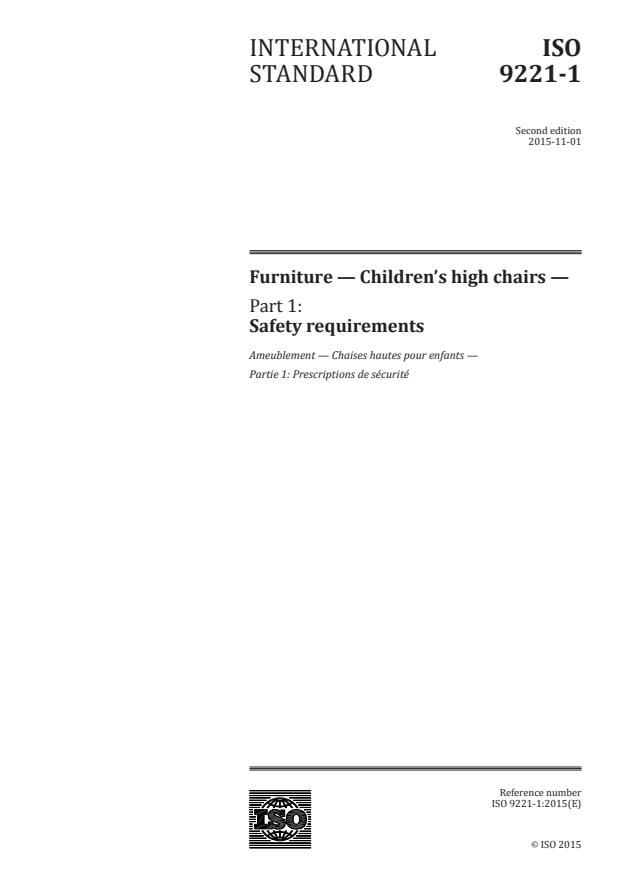
INTERNATIONAL ISO
STANDARD 9221-1
Second edition
2015-11-01
Furniture — Children’s high chairs —
Part 1:
Safety requirements
Ameublement — Chaises hautes pour enfants —
Partie 1: Prescriptions de sécurité
Reference number
©
ISO 2015
© ISO 2015, Published in Switzerland
All rights reserved. Unless otherwise specified, no part of this publication may be reproduced or utilized otherwise in any form
or by any means, electronic or mechanical, including photocopying, or posting on the internet or an intranet, without prior
written permission. Permission can be requested from either ISO at the address below or ISO’s member body in the country of
the requester.
ISO copyright office
Ch. de Blandonnet 8 • CP 401
CH-1214 Vernier, Geneva, Switzerland
Tel. +41 22 749 01 11
Fax +41 22 749 09 47
copyright@iso.org
www.iso.org
ii © ISO 2015 – All rights reserved
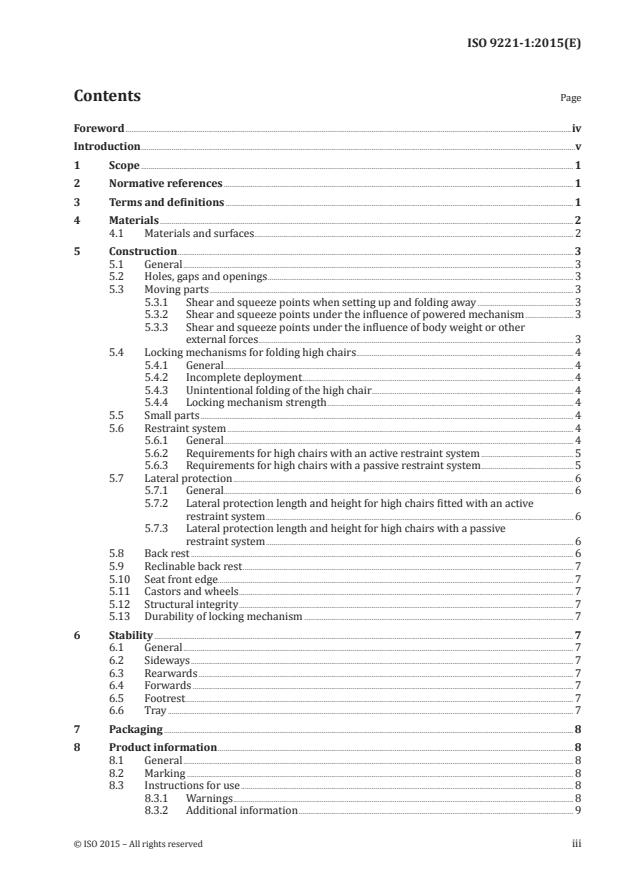
Contents Page
Foreword .iv
Introduction .v
1 Scope . 1
2 Normative references . 1
3 Terms and definitions . 1
4 Materials . 2
4.1 Materials and surfaces . 2
5 Construction . 3
5.1 General . 3
5.2 Holes, gaps and openings . 3
5.3 Moving parts . 3
5.3.1 Shear and squeeze points when setting up and folding away . 3
5.3.2 Shear and squeeze points under the influence of powered mechanism . 3
5.3.3 Shear and squeeze points under the influence of body weight or other
external forces . . 3
5.4 Locking mechanisms for folding high chairs . 4
5.4.1 General. 4
5.4.2 Incomplete deployment . 4
5.4.3 Unintentional folding of the high chair . . 4
5.4.4 Locking mechanism strength . 4
5.5 Small parts . 4
5.6 Restraint system . 4
5.6.1 General. 4
5.6.2 Requirements for high chairs with an active restraint system . 5
5.6.3 Requirements for high chairs with a passive restraint system . 5
5.7 Lateral protection . 6
5.7.1 General. 6
5.7.2 Lateral protection length and height for high chairs fitted with an active
restraint system . 6
5.7.3 Lateral protection length and height for high chairs with a passive
restraint system . 6
5.8 Back rest . 6
5.9 Reclinable back rest . 7
5.10 Seat front edge. 7
5.11 Castors and wheels . 7
5.12 Structural integrity . 7
5.13 Durability of locking mechanism . 7
6 Stability . 7
6.1 General . 7
6.2 Sideways . 7
6.3 Rearwards . 7
6.4 Forwards . 7
6.5 Footrest. 7
6.6 Tray . 7
7 Packaging . 8
8 Product information . 8
8.1 General . 8
8.2 Marking . 8
8.3 Instructions for use . 8
8.3.1 Warnings . 8
8.3.2 Additional information . 9
Foreword
ISO (the International Organization for Standardization) is a worldwide federation of national standards
bodies (ISO member bodies). The work of preparing International Standards is normally carried out
through ISO technical committees. Each member body interested in a subject for which a technical
committee has been established has the right to be represented on that committee. International
organizations, governmental and non-governmental, in liaison with ISO, also take part in the work.
ISO collaborates closely with the International Electrotechnical Commission (IEC) on all matters of
electrotechnical standardization.
The procedures used to develop this document and those intended for its further maintenance are
described in the ISO/IEC Directives, Part 1. In particular the different approval criteria needed for the
different types of ISO documents should be noted. This document was drafted in accordance with the
editorial rules of the ISO/IEC Directives, Part 2 (see www.iso.org/directives).
Attention is drawn to the possibility that some of the elements of this document may be the subject of
patent rights. ISO shall not be held responsible for identifying any or all such patent rights. Details of
any patent rights identified during the development of the document will be in the Introduction and/or
on the ISO list of patent declarations received (see www.iso.org/patents).
Any trade name used in this document is information given for the convenience of users and does not
constitute an endorsement.
For an explanation on the meaning of ISO specific terms and expressions related to conformity
assessment, as well as information about ISO’s adherence to the WTO principles in the Technical
Barriers to Trade (TBT) see the following URL: Foreword - Supplementary information
The committee responsible for this document is ISO/TC 136, Furniture.
This second edition cancels and replaces the first edition (ISO 9221-1:1992), which has been
technically revised.
ISO 9221 consists of the following parts, under the general title Furniture — Children’s high chairs:
— Part 1: Safety requirements
— Part 2: Test methods
iv © ISO 2015 – All rights reserved
Introduction
This part of ISO 9221 is intended to minimize accidents to children resulting from normal use and
reasonably foreseeable misuse of children’s high chairs.
INTERNATIONAL STANDARD ISO 9221-1:2015(E)
Furniture — Children’s high chairs —
Part 1:
Safety requirements
1 Scope
This part of ISO 9221 specifies safety requirements for children’s high chairs intended for children from
6 months to 36 months of age.
If the product can be converted into a product for which an ISO safety standard exists, it is intended
that the product also fulfil the requirements of that International Standard.
2 Normative references
The following documents, in whole or in part, are normatively referenced in this document and are
indispensable for its application. For dated references, only the edition cited applies. For undated
references, the latest edition of the referenced document (including any amendments) applies.
1)
ISO 9221-2:— , Furniture — Children’s high chairs — Part 2: Test methods
EN 71-1, Safety of toys — Part 1: Mechanical and physical properties
EN 71-3, Safety of toys — Part 3: Migration of certain elements
3 Terms and definitions
For the purposes of this document, the following terms and definitions apply.
3.1
children’s high chair
free standing chair that elevates the child to approximately dining table height, intended for holding the
child from 6 months to 36 months of age who is capable of remaining in a sitting position due to his or
her own coordination
3.2
crotch restraint
strap or bar passing between the legs of the child which prevents the child from slipping forward out of
the high chair
3.3
integral harness
assembly intended to retain the child in the high chair comprising either a crotch restraint, waist strap
and shoulder straps or comprising straps that pass over the child’s shoulders and between the child’s legs
3.4
waist belt
strap, which when fastened, “fully” surrounds the child’s waist
3.5
waist strap
strap, which when fastened, goes from one side of the child to the other passing in front of the child’s
...
INTERNATIONAL ISO
STANDARD 9221-1
Second edition
2015-11-01
Furniture — Children’s high chairs —
Part 1:
Safety requirements
Ameublement — Chaises hautes pour enfants —
Partie 1: Prescriptions de sécurité
Reference number
©
ISO 2015
© ISO 2015, Published in Switzerland
All rights reserved. Unless otherwise specified, no part of this publication may be reproduced or utilized otherwise in any form
or by any means, electronic or mechanical, including photocopying, or posting on the internet or an intranet, without prior
written permission. Permission can be requested from either ISO at the address below or ISO’s member body in the country of
the requester.
ISO copyright office
Ch. de Blandonnet 8 • CP 401
CH-1214 Vernier, Geneva, Switzerland
Tel. +41 22 749 01 11
Fax +41 22 749 09 47
copyright@iso.org
www.iso.org
ii © ISO 2015 – All rights reserved
Contents Page
Foreword .iv
Introduction .v
1 Scope . 1
2 Normative references . 1
3 Terms and definitions . 1
4 Materials . 2
4.1 Materials and surfaces . 2
5 Construction . 3
5.1 General . 3
5.2 Holes, gaps and openings . 3
5.3 Moving parts . 3
5.3.1 Shear and squeeze points when setting up and folding away . 3
5.3.2 Shear and squeeze points under the influence of powered mechanism . 3
5.3.3 Shear and squeeze points under the influence of body weight or other
external forces . . 3
5.4 Locking mechanisms for folding high chairs . 4
5.4.1 General. 4
5.4.2 Incomplete deployment . 4
5.4.3 Unintentional folding of the high chair . . 4
5.4.4 Locking mechanism strength . 4
5.5 Small parts . 4
5.6 Restraint system . 4
5.6.1 General. 4
5.6.2 Requirements for high chairs with an active restraint system . 5
5.6.3 Requirements for high chairs with a passive restraint system . 5
5.7 Lateral protection . 6
5.7.1 General. 6
5.7.2 Lateral protection length and height for high chairs fitted with an active
restraint system . 6
5.7.3 Lateral protection length and height for high chairs with a passive
restraint system . 6
5.8 Back rest . 6
5.9 Reclinable back rest . 7
5.10 Seat front edge. 7
5.11 Castors and wheels . 7
5.12 Structural integrity . 7
5.13 Durability of locking mechanism . 7
6 Stability . 7
6.1 General . 7
6.2 Sideways . 7
6.3 Rearwards . 7
6.4 Forwards . 7
6.5 Footrest. 7
6.6 Tray . 7
7 Packaging . 8
8 Product information . 8
8.1 General . 8
8.2 Marking . 8
8.3 Instructions for use . 8
8.3.1 Warnings . 8
8.3.2 Additional information . 9
Foreword
ISO (the International Organization for Standardization) is a worldwide federation of national standards
bodies (ISO member bodies). The work of preparing International Standards is normally carried out
through ISO technical committees. Each member body interested in a subject for which a technical
committee has been established has the right to be represented on that committee. International
organizations, governmental and non-governmental, in liaison with ISO, also take part in the work.
ISO collaborates closely with the International Electrotechnical Commission (IEC) on all matters of
electrotechnical standardization.
The procedures used to develop this document and those intended for its further maintenance are
described in the ISO/IEC Directives, Part 1. In particular the different approval criteria needed for the
different types of ISO documents should be noted. This document was drafted in accordance with the
editorial rules of the ISO/IEC Directives, Part 2 (see www.iso.org/directives).
Attention is drawn to the possibility that some of the elements of this document may be the subject of
patent rights. ISO shall not be held responsible for identifying any or all such patent rights. Details of
any patent rights identified during the development of the document will be in the Introduction and/or
on the ISO list of patent declarations received (see www.iso.org/patents).
Any trade name used in this document is information given for the convenience of users and does not
constitute an endorsement.
For an explanation on the meaning of ISO specific terms and expressions related to conformity
assessment, as well as information about ISO’s adherence to the WTO principles in the Technical
Barriers to Trade (TBT) see the following URL: Foreword - Supplementary information
The committee responsible for this document is ISO/TC 136, Furniture.
This second edition cancels and replaces the first edition (ISO 9221-1:1992), which has been
technically revised.
ISO 9221 consists of the following parts, under the general title Furniture — Children’s high chairs:
— Part 1: Safety requirements
— Part 2: Test methods
iv © ISO 2015 – All rights reserved
Introduction
This part of ISO 9221 is intended to minimize accidents to children resulting from normal use and
reasonably foreseeable misuse of children’s high chairs.
INTERNATIONAL STANDARD ISO 9221-1:2015(E)
Furniture — Children’s high chairs —
Part 1:
Safety requirements
1 Scope
This part of ISO 9221 specifies safety requirements for children’s high chairs intended for children from
6 months to 36 months of age.
If the product can be converted into a product for which an ISO safety standard exists, it is intended
that the product also fulfil the requirements of that International Standard.
2 Normative references
The following documents, in whole or in part, are normatively referenced in this document and are
indispensable for its application. For dated references, only the edition cited applies. For undated
references, the latest edition of the referenced document (including any amendments) applies.
1)
ISO 9221-2:— , Furniture — Children’s high chairs — Part 2: Test methods
EN 71-1, Safety of toys — Part 1: Mechanical and physical properties
EN 71-3, Safety of toys — Part 3: Migration of certain elements
3 Terms and definitions
For the purposes of this document, the following terms and definitions apply.
3.1
children’s high chair
free standing chair that elevates the child to approximately dining table height, intended for holding the
child from 6 months to 36 months of age who is capable of remaining in a sitting position due to his or
her own coordination
3.2
crotch restraint
strap or bar passing between the legs of the child which prevents the child from slipping forward out of
the high chair
3.3
integral harness
assembly intended to retain the child in the high chair comprising either a crotch restraint, waist strap
and shoulder straps or comprising straps that pass over the child’s shoulders and between the child’s legs
3.4
waist belt
strap, which when fastened, “fully” surrounds the child’s waist
3.5
waist strap
strap, which when fastened, goes from one side of the child to the other passing in front of the child’s
...