

ISO 12808:2024
(Main)Hardware for furniture — Strength and durability of extension elements and their components
General Information
- Abstract
This document specifies test methods and requirements for the strength and durability of all types of extension elements and their components for all fields of application, except table extensions. With the exception of corrosion, ageing and the influence of heat and humidity are not covered in this document.
- Status
- Published
- Publication Date
- 19-Mar-2024
- Technical Committee
- ISO/TC 136 - Furniture
- Drafting Committee
- ISO/TC 136 - Furniture
- Current Stage
- 6060 - International Standard published
- Start Date
- 20-Mar-2024
- Due Date
- 18-Feb-2025
- Completion Date
- 20-Mar-2024
Overview
ISO 12808:2024 - Hardware for furniture - Strength and durability of extension elements and their components - specifies standardized test methods and requirements to evaluate the mechanical performance of extension elements (e.g., drawers, suspended pocket files, keyboard trays) and their components. The scope covers all extension types for all fields of application except table extensions. Corrosion testing is included; ageing and the influence of heat and humidity (except corrosion) are not covered.
Key topics and technical requirements
- Test scope and limits
- Applies to extension elements and attachment parts (screws, catches); results are valid for the tested element and representative production models.
- Excludes table extensions and climatic ageing effects (other than corrosion).
- Test conditions
- Indoor ambient conditions: 15 °C to 27 °C; hygroscopic plastics conditioned at (23 ± 2) °C and (50 ± 5) % RH for ≥7 days.
- Forces may be applied as masses (relation: 10 N = 1 kg).
- Tolerances
- Forces ±5%, velocities ±5%, masses ±1%, dimensions ±1 mm, angles ±2°, loading pad positioning ±5 mm.
- Test equipment & setup
- Tests performed in a specified test frame and test drawer using defined masses, loading pads, marbles and particleboard properties.
- Test procedures
- Overload tests: vertical downwards static, horizontal sideways static, outwards static, and slam-shut/open impact.
- Functional tests: deflection of bottoms and fronts, deformation checks, operating forces, static load checks, durability cycling and re-assessment of deformation and forces.
- Corrosion resistance: standardized corrosion testing methods referenced.
- Inspection & reporting
- Pre/post-test inspections for fractures, loosening, deformation or wear; tests executed in sequence; deviations recorded in the test report.
Applications and users
- Furniture manufacturers and designers: verify load capacity, service life and functional safety of drawers and extension hardware during design and product development.
- Component and hardware suppliers: demonstrate compliance and performance of slides, dampers, catches and attachments.
- Test laboratories and certification bodies: perform repeatable, comparable strength and durability testing for compliance, product claims and quality control.
- Specifiers and procurement teams: use test results to select reliable extension hardware for residential, commercial and contract furniture.
Related standards
Normative references cited in ISO 12808:2024 include:
- ISO 6270-2 (humidity resistance)
- ISO 9427 (wood-based panel density)
- ISO 10289 (corrosion testing and rating)
- EN 320 (axial withdrawal resistance of screws)
Keywords: ISO 12808:2024, hardware for furniture, extension elements, strength and durability tests, drawer testing, load capacity, functional tests, corrosion resistance.
Frequently Asked Questions
ISO 12808:2024 is a standard published by the International Organization for Standardization (ISO). Its full title is "Hardware for furniture — Strength and durability of extension elements and their components". This standard covers: This document specifies test methods and requirements for the strength and durability of all types of extension elements and their components for all fields of application, except table extensions. With the exception of corrosion, ageing and the influence of heat and humidity are not covered in this document.
This document specifies test methods and requirements for the strength and durability of all types of extension elements and their components for all fields of application, except table extensions. With the exception of corrosion, ageing and the influence of heat and humidity are not covered in this document.
ISO 12808:2024 is classified under the following ICS (International Classification for Standards) categories: 97.140 - Furniture. The ICS classification helps identify the subject area and facilitates finding related standards.
ISO 12808:2024 is available in PDF format for immediate download after purchase. The document can be added to your cart and obtained through the secure checkout process. Digital delivery ensures instant access to the complete standard document.
Standards Content (Sample)
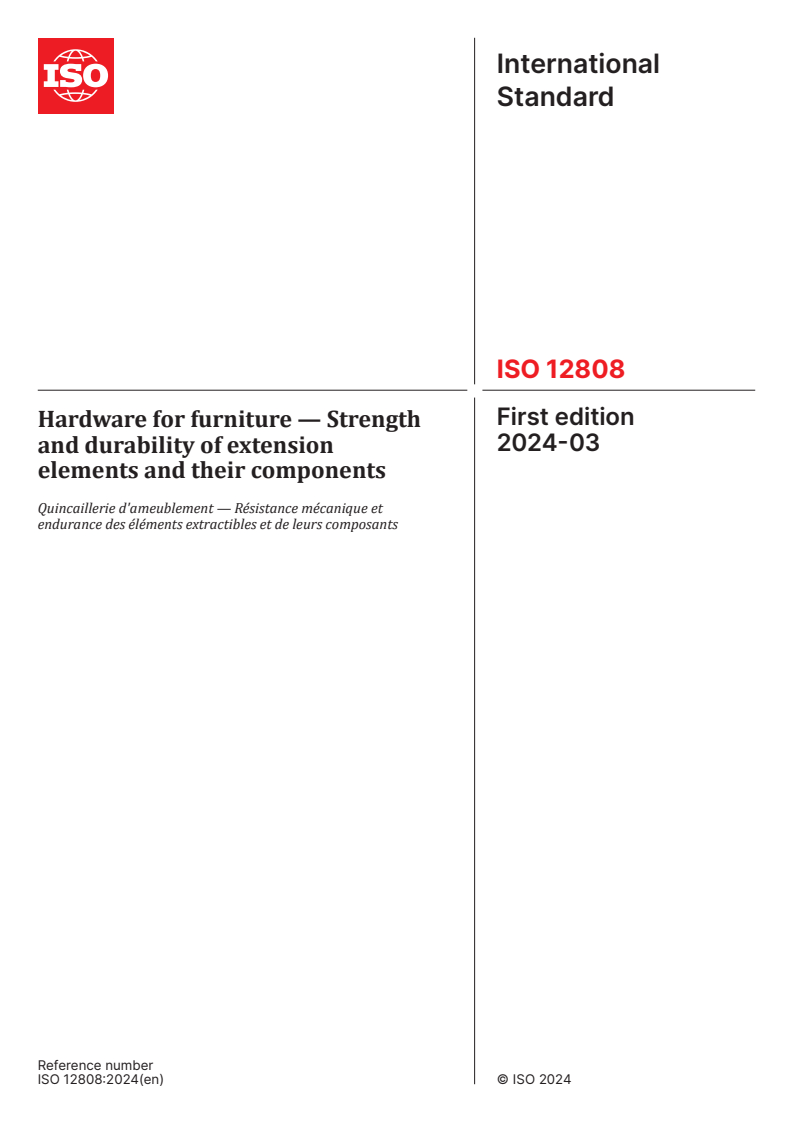
International
Standard
ISO 12808
First edition
Hardware for furniture — Strength
2024-03
and durability of extension
elements and their components
Quincaillerie d'ameublement — Résistance mécanique et
endurance des éléments extractibles et de leurs composants
Reference number
© ISO 2024
All rights reserved. Unless otherwise specified, or required in the context of its implementation, no part of this publication may
be reproduced or utilized otherwise in any form or by any means, electronic or mechanical, including photocopying, or posting on
the internet or an intranet, without prior written permission. Permission can be requested from either ISO at the address below
or ISO’s member body in the country of the requester.
ISO copyright office
CP 401 • Ch. de Blandonnet 8
CH-1214 Vernier, Geneva
Phone: +41 22 749 01 11
Email: copyright@iso.org
Website: www.iso.org
Published in Switzerland
ii
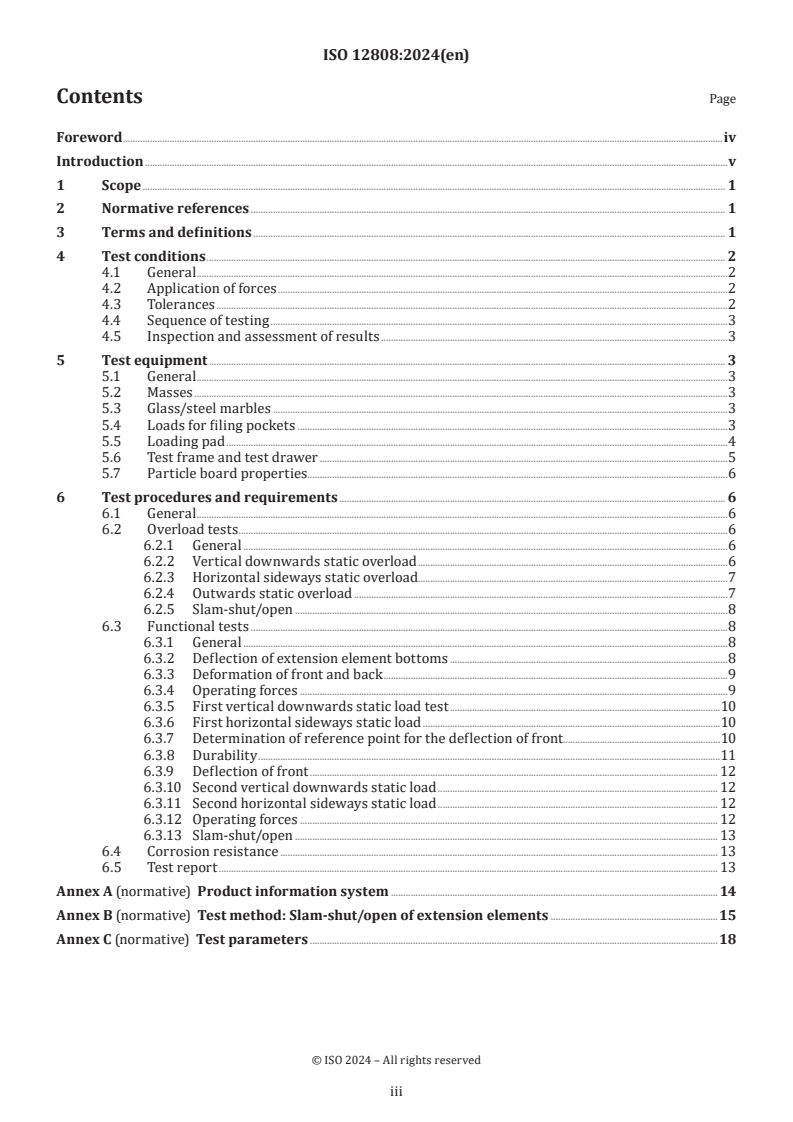
Contents Page
Foreword .iv
Introduction .v
1 Scope . 1
2 Normative references . 1
3 Terms and definitions . 1
4 Test conditions . 2
4.1 General .2
4.2 Application of forces .2
4.3 Tolerances .2
4.4 Sequence of testing .3
4.5 Inspection and assessment of results .3
5 Test equipment . 3
5.1 General .3
5.2 Masses .3
5.3 Glass/steel marbles .3
5.4 Loads for filing pockets .3
5.5 Loading pad .4
5.6 Test frame and test drawer .5
5.7 Particle board properties.6
6 Test procedures and requirements . 6
6.1 General .6
6.2 Overload tests . .6
6.2.1 General .6
6.2.2 Vertical downwards static overload .6
6.2.3 Horizontal sideways static overload.7
6.2.4 Outwards static overload .7
6.2.5 Slam-shut/open .8
6.3 Functional tests .8
6.3.1 General .8
6.3.2 Deflection of extension element bottoms .8
6.3.3 Deformation of front and back .9
6.3.4 Operating forces .9
6.3.5 First vertical downwards static load test .10
6.3.6 First horizontal sideways static load .10
6.3.7 Determination of reference point for the deflection of front.10
6.3.8 Durability .11
6.3.9 Deflection of front . 12
6.3.10 Second vertical downwards static load . 12
6.3.11 Second horizontal sideways static load . 12
6.3.12 Operating forces . 12
6.3.13 Slam-shut/open . 13
6.4 Corrosion resistance . 13
6.5 Test report . 13
Annex A (normative) Product information system . 14
Annex B (normative) Test method: Slam-shut/open of extension elements .15
Annex C (normative) Test parameters .18
iii
Foreword
ISO (the International Organization for Standardization) is a worldwide federation of national standards
bodies (ISO member bodies). The work of preparing International Standards is normally carried out through
ISO technical committees. Each member body interested in a subject for which a technical committee
has been established has the right to be represented on that committee. International organizations,
governmental and non-governmental, in liaison with ISO, also take part in the work. ISO collaborates closely
with the International Electrotechnical Commission (IEC) on all matters of electrotechnical standardization.
The procedures used to develop this document and those intended for its further maintenance are described
in the ISO/IEC Directives, Part 1. In particular, the different approval criteria needed for the different types
of ISO document should be noted. This document was drafted in accordance with the editorial rules of the
ISO/IEC Directives, Part 2 (see www.iso.org/directives).
ISO draws attention to the possibility that the implementation of this document may involve the use of (a)
patent(s). ISO takes no position concerning the evidence, validity or applicability of any claimed patent
rights in respect thereof. As of the date of publication of this document, ISO had not received notice of (a)
patent(s) which may be required to implement this document. However, implementers are cautioned that
this may not represent the latest information, which may be obtained from the patent database available at
www.iso.org/patents. ISO shall not be held responsible for identifying any or all such patent rights.
Any trade name used in this document is information given for the convenience of users and does not
constitute an endorsement.
For an explanation of the voluntary nature of standards, the meaning of ISO specific terms and expressions
related to conformity assessment, as well as information about ISO's adherence to the World Trade
Organization (WTO) principles in the Technical Barriers to Trade (TBT), see www.iso.org/iso/foreword.html.
This document was prepared by Technical Committee ISO/TC 136, Furniture.
Any feedback or questions on this document should be directed to the user’s national standards body. A
complete listing of these bodies can be found at www.iso.org/members.html.
iv
Introduction
The aim of this document is to provide furniture manufacturers, designers and developers with comparable
information regarding the performance of extension elements and drawers.
The tests consist of the application of loads, forces and velocities simulating normal functional use, as well
as misuse, that can reasonably be expected to occur.
With the exception of the corrosion test in 6.4, the tests are designed to evaluate properties without regard
to materials, design/construction or manufacturing processes.
The strength and durability tests only relate to the extension elements and the parts used for the attachment,
e.g. screws.
The strength and durability tests are carried out in a test frame with specified properties. The test results
can only be used as a guide to the performance of a piece of furniture.
The test results are only valid for the extension element tested. These results can be used to represent the
performance of production models provided that the tested model is representative of the production model.
v
International Standard ISO 12808:2024(en)
Hardware for furniture — Strength and durability of
extension elements and their components
1 Scope
This document specifies test methods and requirements for the strength and durability of all types of
extension elements and their components for all fields of application, except table extensions.
With the exception of corrosion, ageing and the influence of heat and humidity are not covered in this
document.
2 Normative references
The following documents are referred to in the text in such a way that some or all of their content constitutes
requirements of this document. For dated references, only the edition cited applies. For undated references,
the latest edition of the referenced document (including any amendments) applies.
ISO 6270-2, Paints and varnishes — Determination of resistance to humidity — Part 2: Condensation (in-cabinet
exposure with heated water reservoir)
ISO 9427, Wood-based panels — Determination of density
ISO 10289, Methods for corrosion testing of metallic and other inorganic coatings on metallic substrates —
Rating of test specimens and manufactured articles subjected to corrosion tests
EN 320, Particleboards and fibreboards — Determination of resistance to axial withdrawal of screws
3 Terms and definitions
For the purposes of this document, the following terms and definitions apply.
ISO and IEC maintain terminology databases for use in standardization at the following addresses:
— ISO Online browsing platform: available at https:// www .iso .org/ obp
— IEC Electropedia: available at https:// www .electropedia .org/
3.1
catch device
device which keeps or pulls an extension element (3.2) in place, but does not require a second action in order
to release it
EXAMPLE A magnetic catch or a self-closing or self-opening mechanism.
3.2
extension element
component that can be pulled out and pushed in
EXAMPLE Drawers, suspended pocket files, keyboard trays.
3.3
loading capacity
total mass
M
mass, as specified by the manufacturer, for which the extension element (3.2) fulfils the strength and
durability requirements
Note 1 to entry: The load capacity is expressed in kg.
Note 2 to entry: The loading capacity includes the extension element and the load in/on the extension element.
3.4
damper
mechanism which gently brings the extension element (3.2) to a stop
4 Test conditions
4.1 General
The extension element shall be assembled/mounted in accordance with the instructions supplied with it.
If mounting or assembly instructions are not supplied, the most adverse configuration shall be used and
the mounting or assembly method shall be recorded in the test report. Fittings shall be tightened before
testing and shall not be re-tightened unless specifically required in the manufacturer’s instructions. If the
configuration must be changed to produce the worst-case conditions, this shall be recorded in the test report.
For testing a range of related extension elements, only worst case(s) need to be tested.
The tests shall be carried out in indoor ambient conditions at a temperature between 15 °C and 27 °C. If
during a test the temperature is outside of the range of 15 °C to 27 °C, the maximum and/or minimum
temperature shall be recorded in the test report.
Extension elements which include structural hardware parts made of hygroscopic plastic materials, for
example, polyamide, shall be conditioned at (23 ± 2) °C and a relative humidity of (50 ± 5) % for at least 7 d
before testing.
In the case of designs not addressed in the test procedures, the test shall be carried out as far as possible as
described, and deviations from the test procedure recorded in the test report.
Before beginning the testing, visually inspect the extension element thoroughly. Record any defects so that
they are not assumed to have been caused by the tests. Carry out measurements when specified.
4.2 Application of forces
The forces in the static load tests shall be applied sufficiently slowly to ensure that negligible dynamic force
is applied. Unless otherwise specified, each force shall be maintained for not less than 10 s and not more
than 15 s.
The forces in durability tests shall be applied at a rate to ensure that excessive heating does not occur.
The forces may be replaced by masses. The relation 10 N = 1 kg may be used for this purpose.
4.3 Tolerances
Unless otherwise stated, the following tolerances are applicable:
— forces: ±5 % of the nominal force;
— velocities: ±5 % of the nominal velocity;
— masses: ±1 % of the nominal mass;
— dimensions: ±1 mm of the nominal dimension;
— angles: ±2° of the nominal angle.
The accuracy for the positioning of loading pads shall be ±5 mm.
4.4 Sequence of testing
The tests shall be carried out in the same sequence as the clauses are numbered in this document. If the
clause sequence is not followed, the sequence shall be recorded in the test report.
4.5 Inspection and assessment of results
Before and after completion of each test, carry out the inspection as specified, after using adjustment
devices, if available.
Before any measurements are taken, the loaded extension shall be moved 10 times over the total
extension length.
Record any changes that have taken place since the initial inspection. The inspection shall include at least
the following:
a) the fracture of any component or joint;
b) the loosening of any joint intended to be rigid, which can be demonstrated by hand pressure;
c) the deformation or wear of any part or component such that its functioning is impaired;
d) the loosening of any means of fixing components;
e) any impaired function of a component or part.
5 Test equipment
5.1 General
Unless otherwise specified, the tests may be applied by any suitable device because results are not dependent
upon the apparatus.
The equipment shall not inhibit deformation of the extension element, i.e. it shall be able to move so that it
can follow the deformation of the extension element during testing.
5.2 Masses
Masses shall be designed so that they do not reinforce the structure or re-distribute the stresses.
5.3 Glass/steel marbles
Marbles are made of solid glass with a 10 mm to 15 mm diameter. They shall be in a flexible bag large enough
to allow them to move in the bag during the test.
NOTE A bag that is approximately 50 % filled is considered loosel
...